




Abstract
Politicians whose political careers appear finished rarely make successful comebacks. Slovakia’s Robert Fico was propelled back to power when his party, Smer-SD, won the 2023 parliamentary elections and was able to form a coalition government. An election victory for Fico, however, seemed unthinkable in 2018 when he resigned as prime minister amid large-scale protests, and even more unlikely in 2020 when his party lost power, suffered a subsequent split, and slipped to single digits in the polls. Organizational and ideational resources provided a platform for recovery for Smer-SD and other parties to bounce back. Moreover, the chaotic nature of the government formed in 2020 and stark challenges posed by the pandemic and the war in Ukraine created conditions propitious for a comeback. Data from a specially commissioned survey conducted in the days after the election show campaign messaging around strong and effective leadership combined with policy pitches towards key demographic groups found a receptive audience. Although Smer-SD won a plurality of the vote, its ability to return to power was dependent on forging a coalition highlighting not just the pivotal nature of one of Smer-SD’s eventual partners in government, but also the mechanics of the electoral system that ensured Smer-SD’s other coalition partner crossed the electoral threshold. The 2023 elections demonstrate not just how divisive politicians like Fico can return to power, but also given the subsequent democratic erosion in Slovakia, they provide lessons for the study of democratic backsliding and resilience.
How do politicians whose political careers appear finished manage to stage a comeback? Robert Fico looked a broken man in the spring of 2020. He had resigned as Slovakia’s prime minister two years previously following large demonstrations and widespread revulsion to the murder of a journalist and his fiancée. Moreover, following the defeat of his party Direction-Social Democracy (Smer-Sociálna demokracia, Smer-SD) in the February 2020 parliamentary elections, several of his close political allies abandoned ship and joined a new breakaway Voice-Social Democracy (Hlas-sociálna demokracia, Hlas-SD) party, led by his former lieutenant Peter Pellegrini. For much of 2020 it seemed that the only direction for Fico and his party was down. After the departure of Pellegrini and others Fico labelled as “traitors,” 1 Smer-SD’s leader only made rare public appearances in the second half of 2020 and by November the party had slumped to single digits in the opinion polls. In contrast, soon after its creation Hlas-SD had become the most popular party in Slovakia. Indeed, for much of the 2020-3 term Hlas-SD looked likely to win a plurality. In September 2023, however, it was Smer-SD that won a plurality of the vote (22.9%) in the parliamentary elections and quickly forged a coalition propelling the three-time premier back to the post of prime minister.
The return to power of Fico and Smer-SD is striking for several reasons. First, very few prime ministers in Central and Eastern Europe (CEE) who have been forced to resign and whose party lost power at the ballot box have managed a subsequent return to power. Second, such political comebacks are particularly notable given the fluid party systems of CEE where there is often a predilection for the new. We might expect support from disgruntled voters would coalesce around a new party rather than a longstanding player on the scene. 2 Third, Fico had become a divisive figure. He was the love-me-or-hate me Marmite figure in Slovakia’s politics. Although he appealed strongly to a section of the electorate, more voters disliked and distrusted him. 3 His only chance of returning to power was as part of a coalition, and central to any coalition was striking a deal with former partisan colleagues who had defected just a few years earlier. Fourth, although Fico had returned to office before in 2012 following the collapse of the government led by Iveta Radičová, Fico’s return to power in 2023 was of a different magnitude as it followed his scandal-induced resignation as prime minister, a major party fission and the forging of a governing coalition with the splitters. Moreover, we might point to the increase in the share of the vote in 2023 compared with the election of 2020 and suggest a 4.7 percentage point increase is not a striking change, especially as oppositions might be expected to profit from governments’ unpopularity. But that glosses over Smer-SD’s recovery from just 8 percent in the polls at the end of 2020 to winning the largest share of the vote in the elections just over two years later (Figure 1).
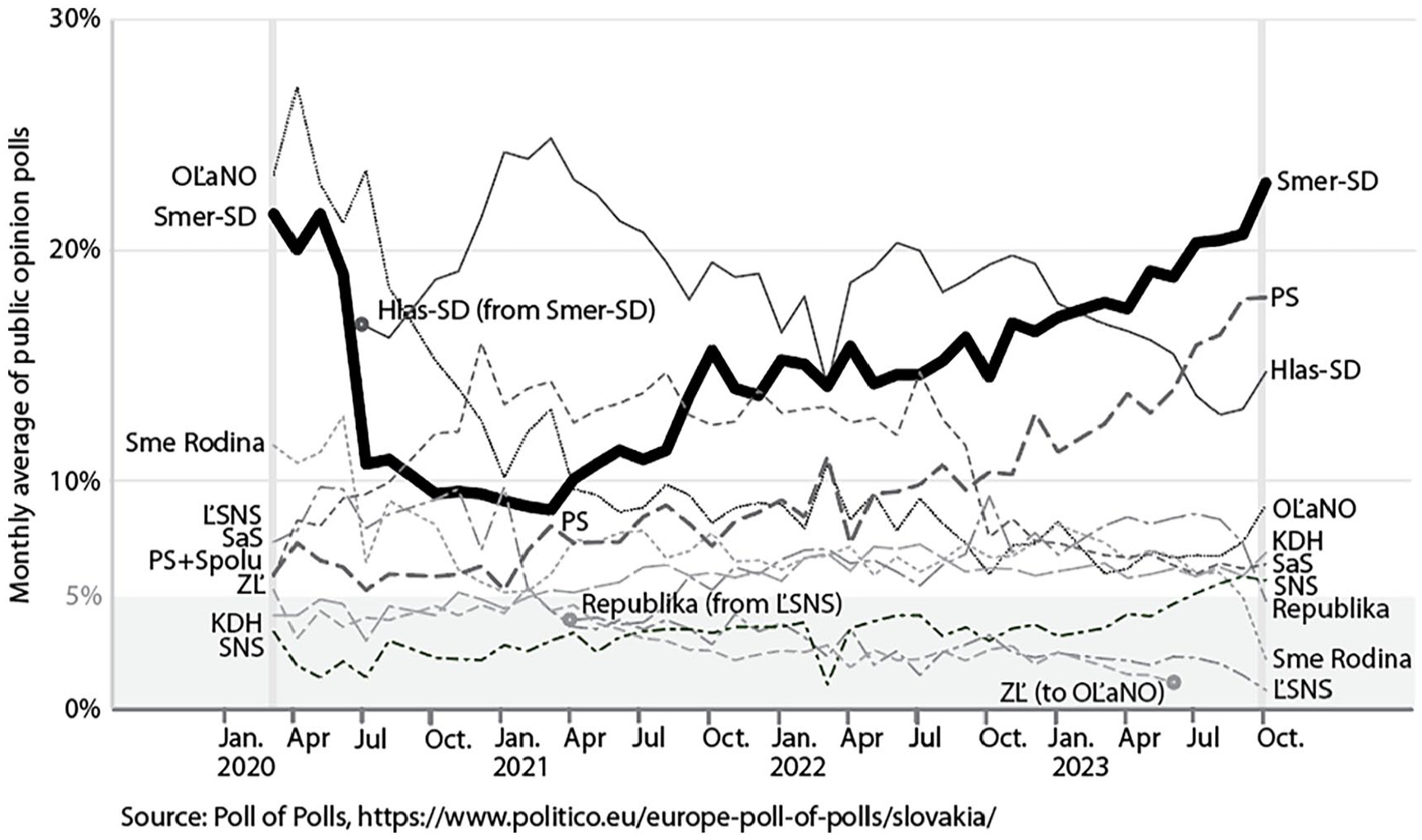
Public opinion polling for Smer-SD 2020–2023
The 2023 elections, however, were not just about the return to power of Robert Fico (Table 1). More broadly, it was a reactive election: Voters reacted against the parties that had formed the 2020 government. From winning over 45 percent of the vote in 2020, they mustered just 17 percent. Some of that vote went to Smer-SD, but that was only part of the story.
The 2023 Parliamentary Election Results in Slovakia
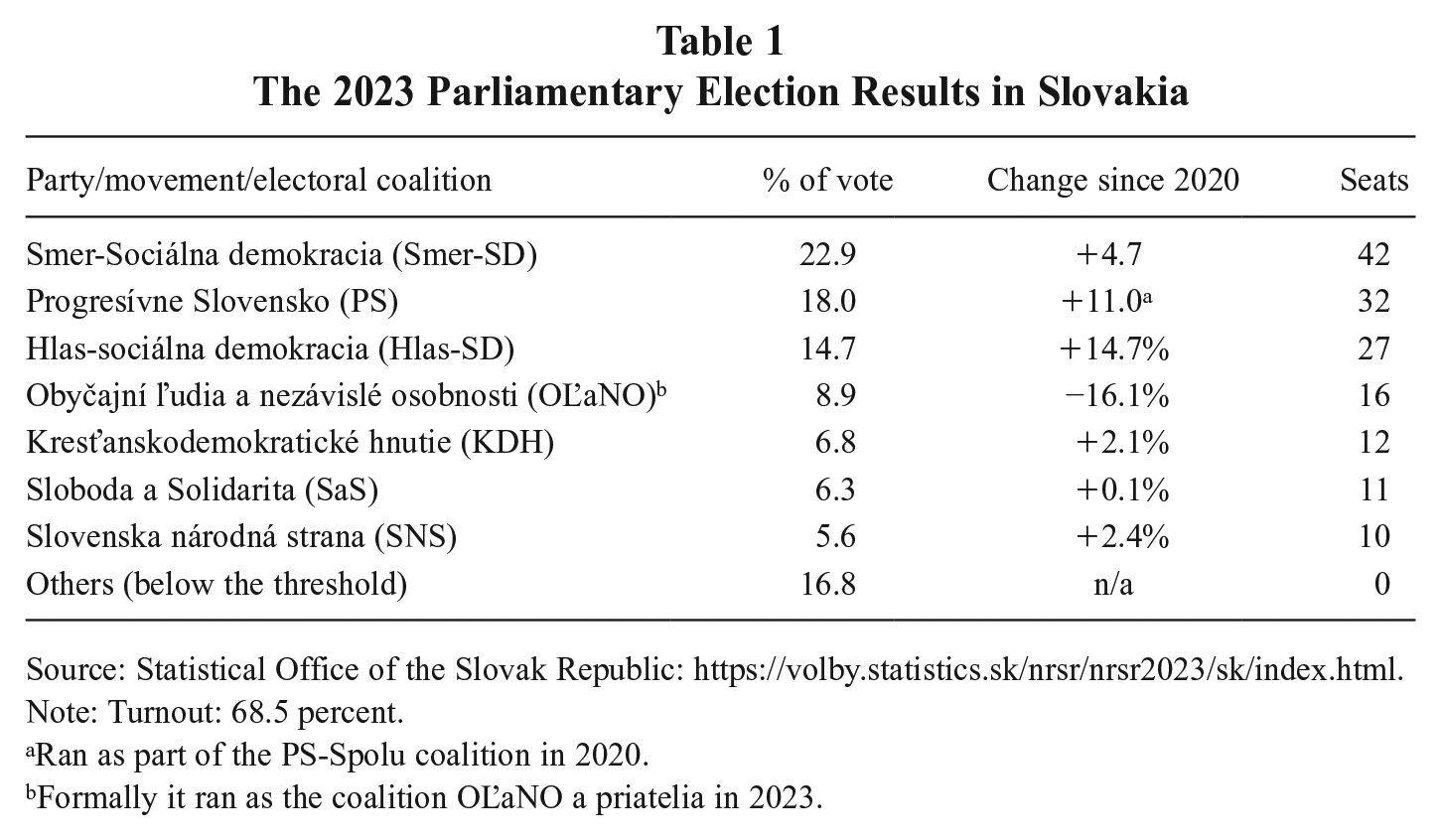
Source: Statistical Office of the Slovak Republic: https://volby.statistics.sk/nrsr/nrsr2023/sk/index.html.
Note: Turnout: 68.5 percent.
Ran as part of the PS-Spolu coalition in 2020.
Formally it ran as the coalition OĽaNO a priatelia in 2023.
Slovakia’s elections are conducted under a list-based proportional representation system with one nationwide electoral district, a 5 percent threshold for parties and a 7 percent threshold for electoral coalitions of two or three parties. No fewer than half of all votes cast in 2023 went to parties that had not crossed the threshold in the previous election. A large slice of that vote went to what became Smer-SD’s main challenger in the election, the socially liberal, economically centrist and pro-European Progressive Slovakia (Progresívne Slovensko, PS). But the 2023 election also marked the return to parliament of two of the perennial parties of Slovak politics that had played important roles from 1989 onwards: the Christian Democratic Movement (Kresťanskodemokratické hnutie, KDH) and the Slovak National Party (Slovenská národná strana, SNS). Although admittedly down on the strikingly high figure of 28.5 percent in 2020, 16.75 percent of voters cast their ballots for parties that fell below the threshold, including Aliancia (the party representing the ethnic Hungarian population), the neofascist Republika, and two parties founded and led by former prime ministers.
To explain Fico’s return, we draw on a specially commissioned cross-sectional post-election survey conducted by Slovakia’s leading polling agency FOCUS in the immediate aftermath of the elections. This nationally representative survey of 1,014 respondents only contains adults who were eligible to vote at the time of the election and is weighted using a core set of sociodemographic information to adjust for any disparities between the sample and population. Combining these findings with a close observation of the campaign across Slovakia, we provide an explanation for the election outcome, particularly Smer-SD’s success. We maintain there are four elements from both the party (supply) and voter (demand) sides of the equation that provided a path to victory for Fico. None are sufficient explanations by themselves, but all were necessary ingredients in the recipe for return.
First, building on the scholarship on party endurance, we suggest Smer-SD survived the electoral setback of 2020 thanks to a combination of its party structures and organization, and a set of core appeals linked to the party and its leader. Second, the opportunity structure of politics between 2020 and 2023 was a key element in the resuscitation of Fico’s support. Smer-SD was replaced in government in 2020 by a coalition led by Igor Matovič’s Ordinary People and Independent Personalities (Obyčajní ľudia a nezávislé osobnosti, OĽaNO). That government not only faced enormous and unprecedented challenges linked to the COVID-19 pandemic, the cost-of-living crisis, and the impact of the Ukraine war, but was also bedeviled by tensions and disagreements that led to the erosion of the coalition’s majority and its eventual collapse. Parties from outside that governing coalition, not just Smer-SD, but also others such as PS, were in a strong position to capitalize. Third, Fico used his political acumen to exploit the opportunities accorded him by developing a package of appeals combining leftist socioeconomic policies with a strong nationalist message. This combination not just solidified the support of those who had backed Smer-SD in 2020, but it also mobilized some who had stayed at home at that election and lured others to supporting Fico’s party. The framing of the election, especially around messages linked to experience, leadership, and policy priorities directed at key voters such as pensioners, helped convert Fico’s potential into actual votes at the ballot box. Fourth, to these three elements explaining the electoral outcome, we also need to add the process of coalition formation. Not only was it not inevitable that Hlas-SD would join Smer-SD in a coalition, but SNS was only in a position to be a coalition partner thanks largely to the electoral boost derived from its decision to offer places on its party list to non-party personalities.
Building on insights from the party, voting, and campaigning literature, we begin by examining the elements required for a return to power. We then highlight not just the narrow path to victory for Fico, but also the reasons why some other parties achieved modicums (or more) of success in the 2023 elections. The article concludes by examining the wider lessons from the election both for Slovakia and politics more broadly in contemporary Europe.
Endurance and Bouncing Back
CEE does provide examples of politicians returning to power after losing it at the ballot box. Unlike in Africa and the United States, for example, where incumbency is often seen to be an advantage, 4 it has frequently been a burden in CEE where the re-election of prime ministers is more an exception than a rule. Governing parties have often been punished at the ballot box, experiencing the loss of a lot of support. 5 Several parties, however, have managed to endure and bounce back at the next election. But the case of Fico and Smer-SD is of a different magnitude. Fico was forced to resign in 2018 as prime minister by one of his coalition partners, although he remained as party leader. He then suffered a defeat in the subsequent election and saw his party experience a major fission soon afterwards with the breakaway performing much better in the opinion polls.
Several studies of party endurance in CEE offer clues for how parties can survive electoral drubbings pointing towards the importance of organizational structures in cushioning the blow and providing the basis for building back towards electoral success. 6 But voters do not vote for a party because of its organizational structure, they vote because of the appeals the party makes to the electorate. Moreover, the recent history of Slovak politics shows that two parties with the most extensive party structures in the 1990s, Vladimír Mečiar’s Movement for a Democratic Slovakia and the communist-successor Party of the Democratic Left, were not able to halt the decline in their support after losing power. 7
In line with other scholars such as Binev, we find significant traction in the party scholarship focused on Latin America. 8 In particular, Jennifer Cyr offers a helpful framework to explain not just the survival and endurance of parties, but also their revivals. 9 Examining cases from Peru, Venezuela, and Bolivia, she sees that endurance owes much to the combination of organizational and ideational resources, the latter referring to a “core stock of principles or ideas for which the party is broadly known in society.” 10 The importance of this combination is perhaps unsurprising when we understand political parties as organizations with both internal structures that bind people together in a common enterprise and as electoral vehicles that have to project themselves externally to voters.
An exclusive focus on the supply side of elections, however, provides only a partial framework. Organizational and ideational resources place parties in a position to win back votes, but they require voters to make the switch. Two elements are likely to be integral to any explanation of that switch. First, rehabilitation is linked to crisis. To return to a political home they have abandoned, especially after scandals, voters are likely to need to be confronted with harsh political conditions that make them have not just some longing or nostalgia for their previous abode, but a willingness to contemplate returning. For such a return the crisis would need to highlight in the minds of voters some of the qualities and achievements that appear to be missing in the contemporary crisis.
Crises, in particular, tend to heighten the appeal of strong or what is perceived to be effective leadership, helping explain the return from the political wilderness of politicians as diverse as Alan García in Peru, Charles de Gaulle in France, Juan Perón in Argentina and Shinzo Abe in Japan. 11 The case of Abe, for instance, illustrates well the potency of the appeal of effective leadership especially when the contrast can be made with a fractious incumbent government that had to deal with major challenges such as the Fukushima nuclear accident. 12 Given the importance of leadership appeals in Slovak politics, 13 we would expect this to be a central element in the explanation for any return. Second, those voters need to be actively persuaded to return through an effective framing of the electoral contest during the campaign. As studies of campaigning have shown, this requires both the choice of a message that resonates and the use of modes of campaigning to communicate that message effectively. 14
The final piece of the jigsaw is coalition potential. In multi-party systems, such as Slovakia very occasionally, as Smer-SD managed to do in 2012, parties win enough votes to form single-party majority governments. But that is extremely unlikely, hence any political comeback will involve being able to forge a coalition. Such coalitions may be particularly difficult to form for politicians who have been dominant and divisive figures in their political systems. The cases of Janez Janša in Slovenia, and Mečiar and Fico on previous occasions in Slovakia point to the fact that the possibility of them continuing or returning to power has been a powerful glue in the assembling of disparate parties in a coalition to keep that divisive figure out of power. 15
In 2023, even though the party bounced back to win a plurality of the vote, Smer-SD only won less than a quarter of votes cast. The organizational structures of the party may have provided a cushion to break the fall and a platform for rebuilding and projecting Smer-SD’s campaign messages, and the crisis and chaos of politics in 2020–2023 might have fostered a receptive audience to the calls for stability and strong leadership, but Smer-SD did not return to the levels of support achieved over a decade earlier. Its ability to return to government owed much to the electoral support of its eventual coalition allies. In short, the path to victory for the return of a divisive figure is the combination of a party’s organizational and ideational resources plus crisis plus an effective campaign framing and ability to forge a coalition. It is a narrow path.
Organizational and Ideational Resources
Fico’s party has been on a long journey since it was founded in 1999. 16 Initially, it offered new faces and a new direction (hence the name) with a package of appeals linked to newness, anti-corruption and the leadership of Robert Fico. After disappointing election results in 2002, the party positioned itself as the main opponent of the neoliberal policies enacted by the government led by Mikuláš Dzurinda. From that time onwards Smer-SD has sought to project itself as the standard bearer of the left with left-leaning economic and social policies at the core of the party’s pitch to the electorate. While Smer-SD was embroiled in some corruption scandals, especially in later years, its stints in government witnessed periods of economic growth and it enacted policies that were seen to benefit the more disadvantaged in society such as free travel for pensioners. In short, Smer-SD could highlight delivery. These elements are key to explaining why the campaigning messages, such as increased pensions, had resonance with sections of the electorate. Indeed, our data showed, for instance, that Smer-SD enjoyed higher than average support from pensioners (39% of Smer-SD voters were older than the age of 65).
Although national themes had long been a part of Smer-SD’s appeal, thanks in no small part to Europe’s migration crisis and clear trends in public opinion, in its 2016 election campaign, Smer-SD made much more use of more national/nationalist themes, appeals which helped win over some voters from nationalist and neofascist parties. From that point onwards, these elements have been further strengthened by a more open embracing of the nationalist agenda, a development well illustrated by the party’s rebranding in the 2020–2023 parliamentary term. The party became Smer-slovenská sociálna demokracia, conveying both a nationalist message and the idea that there was a “Slovak” variant of social democracy. Fico contrasted his party’s variant to “Brussels social democracy” underscoring in particular opposition to the idea that there are more than two genders. 17 Our data highlighted large proportions of Smer-SD’s voters who said the party’s economic programme (81.4%), promises to protect the nation (83%), and its stance on traditional values (85.7%) affected their decision to vote for Fico’s party.
The aftermath of the disappointing election results in 2002 was also important for the development of the party’s organizational resources. Indeed, its organizational structures were transformed after that election from a lightweight model characteristic of many new parties into an extensive network of party branches and offices, a development only reinforced when Smer fused with a small social democratic party and remnants of the Party of the Democratic Left. 18 The latter brought to the marriage an extensive organizational dowry and helped ensure Smer-SD became the party with the most extensive organizational structures in the country. In addition to its networks of party branches, Smer-SD had, consistently and by some margin, the largest membership in the country (see Table 2). Although from 2016 to 2020 there was a drop of 14.8 percent in party membership, its membership levels were still comfortably more than double any other party in parliament and at 13,284 in 2022 it had as many members as all of the other parties elected to parliament in 2020 and/or 2023 combined, providing a strong network to help highlight and propagate the party’s message.
Membership Figures for Parties Elected to Parliament in 2020 and/or 2023
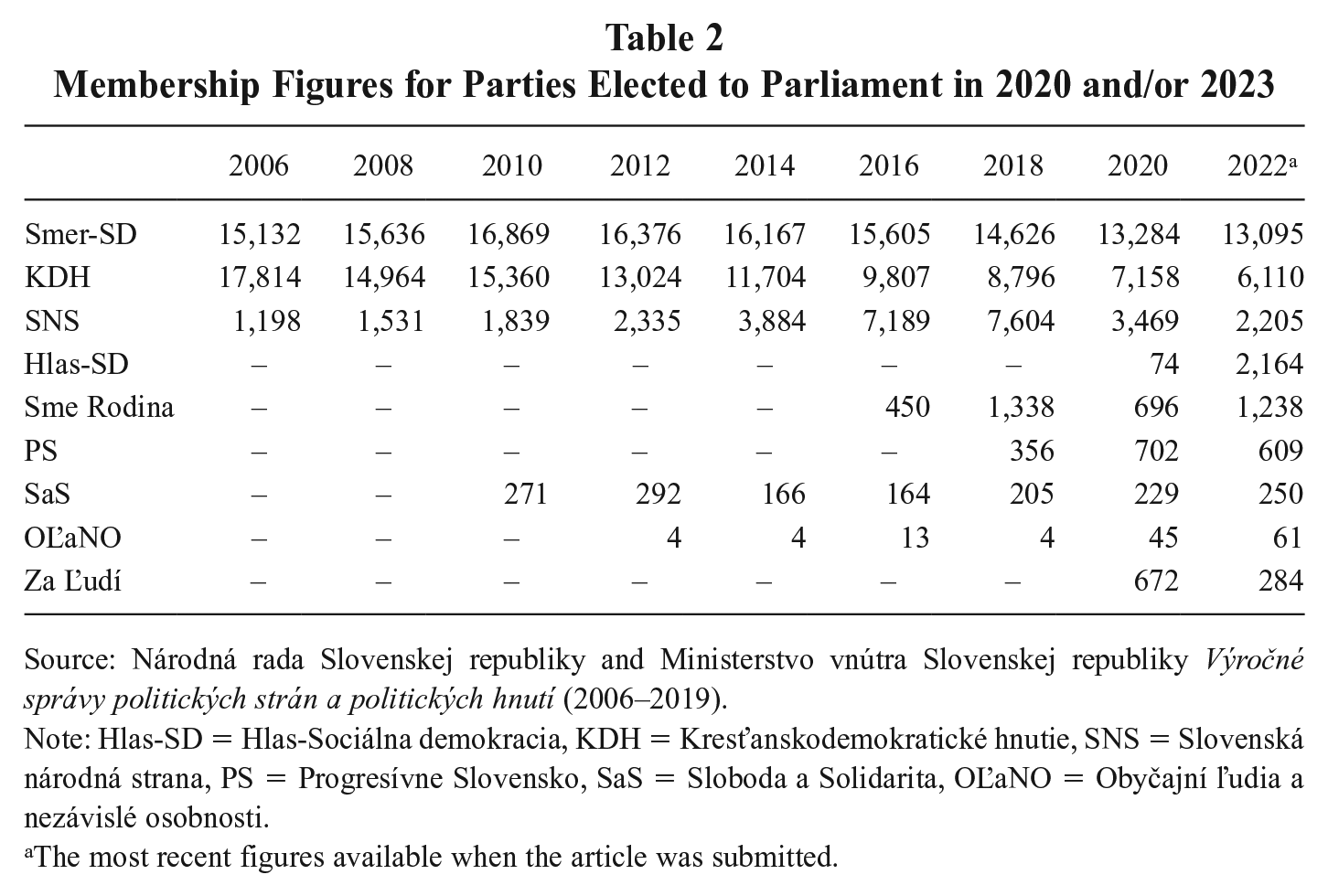
Source: Národná rada Slovenskej republiky and Ministerstvo vnútra Slovenskej republiky Výročné správy politických strán a politických hnutí (2006–2019).
Note: Hlas-SD = Hlas-Sociálna demokracia, KDH = Kresťanskodemokratické hnutie, SNS = Slovenská národná strana, PS = Progresívne Slovensko, SaS = Sloboda a Solidarita, OĽaNO = Obyčajní ľudia a nezávislé osobnosti.
The most recent figures available when the article was submitted.
The organizational basis was central not just to Smer-SD’s revival, but also important for the return to parliament of KDH. For the first two decades of Slovakia’s post-communist experience, the party had been a mainstay with a solid support base delivering a steady level of support: around 8 percent in four successive elections from 2002 onwards. KDH’s revival in 2023 owed something to the experience of the Matovič government (discussed below), but also to its deep roots in Slovak politics and society. 19 With its strong ties to the Catholic Church and civil society groupings associated with the Church, KDH was seen by some voters as the standard bearer of conservative catholic values in politics. Moreover, the revival of KDH had a distinctly regional and sub-national flavour. The leader of KDH in the 2023 election, Milan Majerský, was a prominent politician in Eastern Slovakia, having served as mayor of Levoča and as the governor of the Prešov region. It was no surprise to see KDH’s geographical spread of support included concentrations in the north and north-east of the country.
Organizational and ideational resources matter for parties because they help to forge partisan ties. Prior to the 2023 elections, Smer-SD had demonstrated an ability to hold onto their voters. In their study using FOCUS exit polls, Linek and Gyárfášová showed Smer-SD managed to retain more than 60 percent of its former voters in 2016 and 53 percent in 2020, figures that stands in “stark contrast to the other incumbent parties” in 2012 and 2020. 20 Moreover, if we remove from the equation the voters who shifted to Hlas-SD, our poll showed Smer-SD retained 93 percent of the rest of its voters from 2020. Furthermore, certain sections of the electorate, especially the over 60s, were particularly loyal to Fico’s party, even in the face of scandal. The main reason why some voters switched away from Smer-SD in 2020 was corruption. 21 For Smer-SD to win back votes would require a significant shift in attitudes or a transformation of the landscape of political debates. Events, and the response of politicians to those events, in the 2020–3 period duly provided such a transformed landscape.
Crisis and the Context of the 2023 Elections
In the aftermath of the 2020 elections, agreement was reached quickly on forming a new government. Despite their different stances on a range of economic and cultural issues, the new government was “united by a markedly negative attitude towards Smer-SD and the will to cleanse the government of systematic corruption and connection with the oligarchs.” 22 Although commanding a three-fifths constitutional majority in parliament, the portents for the four party coalition were not all that rosy. Not only had three of the four parties no experience of governing, but also the last iteration of an anti-Fico government had survived less than two years when SaS left over Slovakia’s contribution to the Greek eurozone bailout. Nonetheless, the new government put on a united front not least as the country—and the globe—was facing the uncertainties of the spread of COVID-19.
The pandemic dominated the news agenda for large chunks of the existence of the OĽaNO-led governments. Its importance for Slovak politics (and the outcome of the 2023 election) lay both in the way the government and opposition politicized the response, but also how Matovič’s style and rhetoric exacerbated tensions in the ruling coalition. Initially, the government performed well. 23 The decision to maintain the state of emergency until June 2020 and Matovič’s population-wide COVID testing in the autumn of 2020 may have helped slowed down the onset of the pandemic’s second wave. But the manner in which he announced and propagated the decision to hold nationwide testing only served to politicize the management of the pandemic. 24 By using the government’s pandemic response to burnish his credentials for decisive leadership, Matovič was tying his fortunes to the fate of the pandemic and his government’s ability to tackle it. Matovič’s governing style, however, was erratic, regularly generating untried and often controversial ideas that he presented as perfect solutions, only then to abandon them replacing them with newer and more bombastic initiatives, all the while disregarding the usual procedures for policymaking and dismissing his critics. 25
By late 2021, when mortality rates were higher than many other European cases, it became much easier for his opponents to criticize the government and Matovič’s governing style. As OLaNO’s support slipped, Smer-SD’s rose, reaching 14 percent by year’s end. Smer-SD’s criticism of pandemic management and the call for effective leadership resonated with voters and helped rehabilitate Fico’s image in the minds of some voters. But politicians in Smer-SD and Hlas-SD also questioned how well Matovič’s actions sat with democratic norms, criticizing the state of emergency for restricting people’s rights to assemble and protest, that is, to participate in the political process. One prominent Smer-SD politician even likened lockdown to a Nazi concentration camp. 26 Moreover, opposition leaders including Robert Fico led protests against wearing masks. The opposition chose 17 November (the date in 1989 when Czechoslovakia’s Velvet/Gentle Revolution began) for protests to lambast what they saw as the anti-democratic aspects of the government’s policies. 27 Furthermore, the pandemic was a period that generated a fertile ground for conspiracy theories, fueled by social and alternative media channels, many of which propagated and circulated disinformation related to powerful secret groups and international corporations including the pharmaceutical industry.
More broadly, as our FOCUS data show, the 26.3 percent of Smer-SD’s voters Hlas-SD took away in 2023 were the more moderate left-leaning ones. The split in Smer-SD, therefore, pushed Fico to seek out other potential supporters. The data suggest two sources of support. First, the period from 2021 onwards was important for Fico in building alliances with alternative media outlets, extra-parliamentary opposition and, in general, the far right. “Conspiracyland” 28 was a world where “Fico took root.” 29 COVID and the Ukraine crises generated not just a body of public opinion (anti-vaxers, pro-Russian authoritarians, etc.) opposed to the government that Fico could tap into, but by associating himself with far-right politicians through, for example, organizing joint anti-government rallies he reinforced the nationalist component of Smer-SD’s message, helping explaining why those who had voted for the nationalist right in 2020 constituted around half the switchers whom Smer-SD were able to entice in 2023. Second, our data indicate that a fifth of Smer-SD voters had switched from supporting the governing parties in 2020, especially OĽaNO (12.2%), no doubt in part a response to the handling of the pandemic.
Matovič’s response to COVID-19, however, also generated tensions within the coalition. Part of this was rooted in ideological differences that many governments faced during the pandemic with measures to restrict the spread of the virus being challenged by those opposed to restrictions on personal liberty and concerned over the potentially devastating impact on the economy of measures designed to stop the spread of the virus. This cautionary versus liberal ideological difference lay at the heart of differences between Matovič and SaS. But what poured fuel on the flames of ideological differences was the prime minister’s governing style. Matovič’s unilateral decision in March 2021 to buy Russian Sputnik V vaccines without the government approving it beforehand led to two coalition partners demanding his resignation as prime minister. But even after engineering the job swap with Eduard Heger and becoming finance minister Matovič’s stunts and the trading of barbs and bad language with SaS leader Richard Sulík continued. The coalition collapsed losing a vote of no confidence in December 2022 and was replaced by a caretaker government of experts appointed by the president in May 2023.
It was not just the pandemic that would have provided a challenge for a government of any political hue, Russia’s full-scale invasion of Ukraine in February 2022 posed significant questions and challenges for Slovakia. As a neighbour Slovakia quickly became a state on the front line of the flow of Ukrainians fleeing the fighting, but as the war continued, it raised questions about the type and extent of Slovakia’s involvement and the impact on Slovakia’s economy and society; themes Fico drew on in the campaign which we discuss below.
Both the pandemic and the war on Ukraine shaped the political context in the run-up to the 2023 elections, but these were not the only developments affecting Fico’s messages and motivations. Central to OĽaNO’s electoral performance in 2020 was its pitch around anti-corruption. 30 Under the Matovič-Heger governments there were some notable achievements, including investigations launched into corrupt activities associated with several prominent individuals leading to some successful convictions, including a chief special prosecutor sentenced for aiding organized crime. 31
Ironically, this one area of success provided motivational fuel for the former prime minister as the investigative net closed in not just on individuals close to Fico, but Fico himself. Knowing a return to power would offer the opportunity to hobble or stop many of these investigations, the corruption prosecutions provided strong incentives for Fico to cooperate with other parties critical of the government, especially on the far right, but also helped exacerbate the polarized nature of politics. 32 For instance, the initial steps of the Fico government formed after the election focused on removing prosecutors and changes to the criminal code only serve to underline this element in his motivation to return to power. Crucially, Fico succeeded in persuading a large slice of the voters that the criminal investigations pursued under the Matovič and Heger governments were politically biased, unjust, and even directly manipulated. 33 Although more respondents suggested its economic programme and promises to protect the nation and traditional values were stronger motivators affecting party choice, our data show 50.7 percent of Smer-SD voters suggested that corruption had impacted their vote choice.
Nonetheless, even though Smer-SD’s organizational and ideational resources provided a platform from which Smer-SD could bounce back, and crisis generated a context pregnant with possibility, for Smer-SD to achieve electoral success required an effective campaign to translate sentiment into votes.
Framing of the Election
Campaigns matter. They play a particularly important role in fluid party systems where strong partisan ties between voters and political parties overall tend to be weaker. In terms of when voters made their decisions, the 2023 elections were very much in line with the norm where usually between a fifth and a third of voters decide in the last week. 34 Analysis of the two main exit polls conducted by IPSOS and FOCUS indicates that although more that 40 percent of voters had decided how to vote more than two months before polling day, around 30 percent of voters made their decisions in the last week before polling. 35
The primary purpose of election campaigns is to increase and maximize the votes for one’s party. To achieve that goal requires both mobilization of voters who are already supporters or inclined to vote for your party and persuading other voters to switch to support yours. In 2020, former Smer-SD voters had been enticed away to support other parties, but many of Smer-SD’s 2016 voters stayed at home. 36 Analysis of the IPSOS exit poll suggests that, in 2023, Smer-SD won the support of 120,000 people who had not voted in 2020. 37 Although we cannot say for certain, it is a reasonable assumption to suggest many of those voters who had stayed at home in 2020 remained receptive to Smer-SD’s core appeal and hence could be enticed back. Indeed, the fact that our data showed that just less than two-thirds (62.2%) of Smer-SD voters indicated the campaign had persuaded them to take part in the election and that only 13.2 percent of Smer-SD’s voters were convinced to switch by the campaign indicates Smer-SD’s campaign was largely one of successful mobilization.
Effective campaigning requires both a message or set of messages to frame the debates and the choices, and the use of a package of modes to convey that message. The chaos of the OĽaNO-led government discussed in the previous section was central to the way several of the successful parties framed the election. Prominent among the Smer-SD messages were calls for stability, poriadok (order), and an end to chaos. Moreover, one of the most prominent of PS’s billboards proclaimed “Dosť bolo minulosti a chaosu. Zvoľme si budúcnosť” (“Enough of the past and chaos. Let’s vote for the future”), a dig at both the OĽaNO-led government and the past of Robert Fico.
Smer-SD’s prescription for the end of chaos was the leadership of Robert Fico, pointing to his previous stints as prime minister that had delivered economic growth and measures to support the poorer sections of Slovak society. 38 Moreover, using a line he had deployed to great effect in previous elections, he depicted the choice being between a government led by him or a chaotic zlepenec (glued together hack-job). These messages had resonance with voters. According to our data, only a fifth of Slovak voters gave “best leader” as the primary reason for voting for a party but this exceeded a third for those who voted for Smer-SD. Moreover, nearly 45 percent, considerably higher than the average, of those who voted for Smer-SD stated that the party offered the “best policy solutions.”
While the return to power of Fico was a strong card for Smer-SD to play, for very different reasons it was also one PS and OĽaNO played. Pointing to the scandals, investigations, and murky links between Smer-SD politicians, businessmen, and organs of the state, Šimečka talked about doing everything to ensure Fico did not return to power. 39 Šimečka often referred to Fico and the mafia state, language that was taken further by Igor Matovič. OĽaNO’s success in 2020 had owed much to its anti-corruption appeal. In his characteristically forthright style in the 2023 campaign, he projected himself as the main fighter against corruption, a stance well illustrated in the most widely covered event of the election campaign when he gatecrashed a Smer-SD press conference using a megaphone to label Fico and his allies as a bunch of mafioso. The altercation between Matovič and Smer-SD politicians descended into a physical altercation generating much publicity, but it helped underline a message to core OĽaNO voters that Matovič is the man to fight corruption.
In addition to an offer to provide stability and strong leadership, two other themes were central to Smer-SD’s pitch to the electorate. First, at the core of the party’s appeal for two decades had been a promise to help the poorer regions and sections of society. In 2023, the party emphasized the infrastructure projects and investment in regions, and stressed support for those facing challenging economic times, especially the retired who were promised higher pensions, helping to win a disproportional slice of the above 65 vote and those with a household monthly income below 1,200 euros. Second, Fico criticized the West’s involvement in the war on Ukraine. His criticism was carefully calibrated. On one hand, he lambasted the West’s military involvement, promising not to send another bullet to Ukraine, but he also stressed the need to offer humanitarian aid to Slovakia’s neighbours and help them rebuild their country. Crucially, he tied the war to the economic consequences for ordinary Slovaks who were facing a cost of living crisis.
The content of messages matter, but they also need to be conveyed to voters. TV debates are often seen to play a central role in Slovak campaigns 40 and our FOCUS data showed that 60 percent of respondents (and 61.3% of Smer-SD voters) indicated they had the biggest impact on vote choice in 2023, by far the most influential mode of campaigning. Not only do they offer parties a chance to mobilize their base to ensure they will turn out, but they also accord an opportunity to persuade some undecided voters to switch their votes. Moreover, they shine a spotlight on the leaders of the respective parties which is particularly important given the role of leader evaluations in vote choice in elections in Slovakia. 41 In the leader debates, particularly the ones in the final weeks of the campaign, the party leaders pushed their core messages. Fico stressed his leadership qualities and experience, contrasting them with Šimečka’s lack of executive office. 42 Moreover, he highlighted his policies to help poorer sections of society such as pensioners and underlined his opposition to Western military involvement in the war on Ukraine. In contrast, Šimečka not only pointed to corruption allegations around Fico, but also highlighted PS’s socially liberal values, strong pro-European Union (EU) line and its expertise to deal with the economic challenges facing the country. Pellegrini projected himself as a more moderate figure, but indicated he was more inclined to side with Fico than Šimečka. Nonetheless, he emphasized on Facebook that his red line for entry into a coalition with Smer-SD would be the participation of the neofascists Republika which was running above the electoral threshold in polls just a month before election day. 43
Other modes of campaigning were also influential, most notably campaign rallies and social media. In terms of the former, despite being seen by some as a mode of a different era, these in-person interactions were important in mobilizing and enthusing party members and activists. But their significance was enhanced by the way in which they combined with social media. Indeed, what was striking about a number of party meetings across the country was the way in which clips from those events and livestreaming were used by politicians to highlight not just their messages but also the fact they were getting around the country, underlining both the importance of message and place in campaigning. Analysis of Fico’s use of Facebook posts demonstrated the prominence of posts critical of the Western military involvement in Ukraine, but notably among the posts that generated the greatest number of interactions were ones highlighting the impact on the costs of living crisis facing ordinary Slovaks. 44 In addition to Facebook, Telegram and various alternative media sources became key sources of (dis)information for sections of the electorate, including Smer-SD voters, but especially SNS voters, nearly a quarter of whom (23.1%) listed that as one of their main sources of information in our poll. Linking back to the impact of the crisis, these alternative sources became more widely used and trusted during the pandemic by a section of the electorate. Although difficult to assess the impact, analysis suggests they had little impact in changing opinions, but rather helped reinforce illiberal and pro-Russian sentiments of those voters already inclined to such positions. 45
The Drivers of Smer-SD, PS, and Hlas-SD Support
The descriptive data from the FOCUS poll reveal a clear difference in the socioeconomic makeup of different parties, especially between Smer-SD and PS supporters (Table 3). While Smer-SD voters are more likely to be male, married, retired, rural dwellers who have lower levels of education and monthly income, PS voters are more likely to be female, unmarried, younger, university educated with a high monthly income and urban dwellers. The sociodemographic profile of Hlas-SD also differs from Smer-SD. Hlas-SD voters are more likely to be female, middle-aged, high school graduates, or university educated, and their support is relatively evenly distributed across Slovakia. Like PS, they tend to be professionals and earn high monthly incomes. However, they are more likely to be married (similar to Smer-SD) than single. In terms of attitudinal differences, Table 4 reveals stark contrasts. Smer-SD and Hlas-SD derived most of its support from electors who see themselves on the left of the political spectrum, although the former tended to share stronger conservative values than the latter. In contrast, PS voters are more liberal-minded and right-leaning.
Sociodemographic Profile of Party Support in the 2023 Slovak Elections a
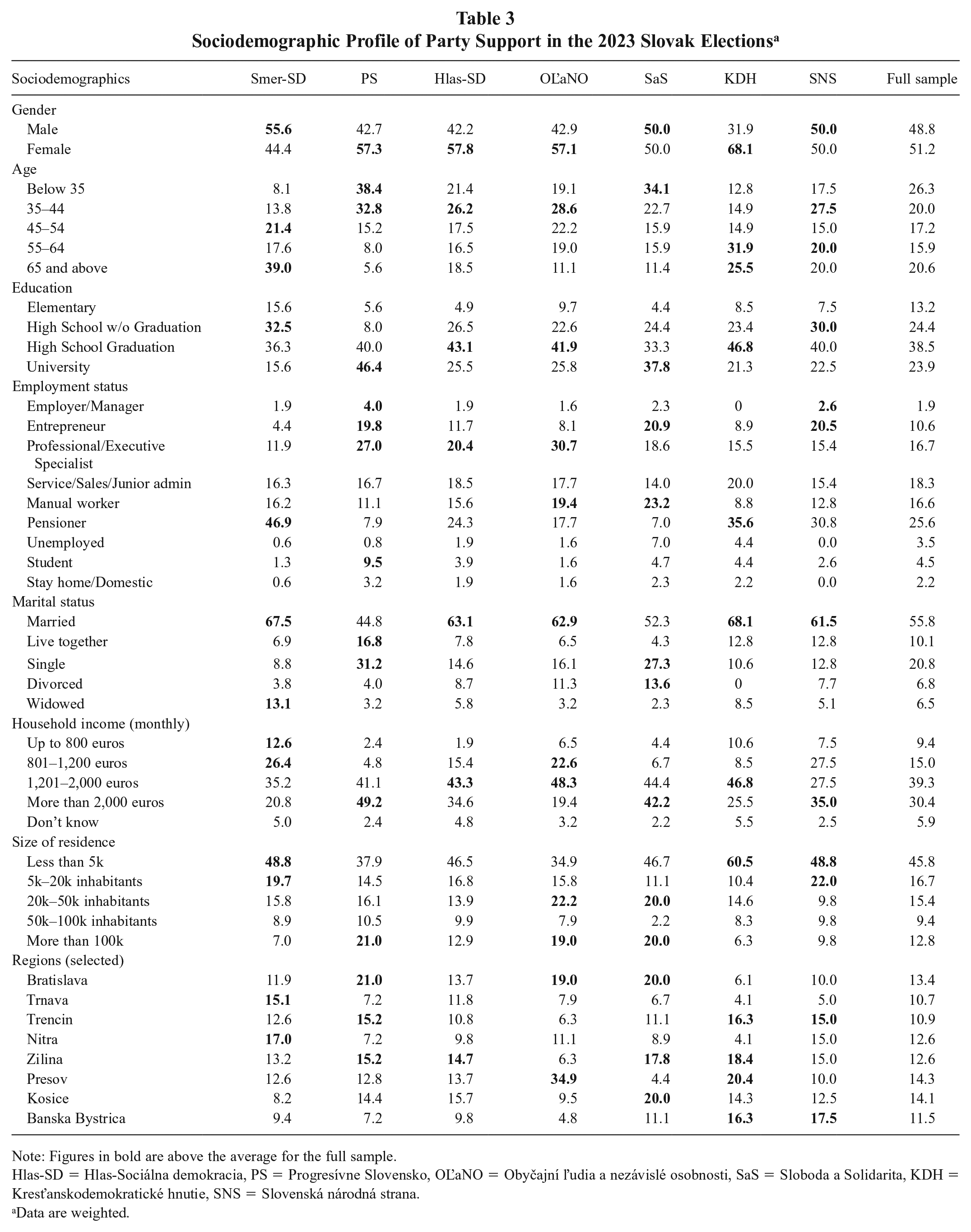
Note: Figures in bold are above the average for the full sample.
Hlas-SD = Hlas-Sociálna demokracia, PS = Progresívne Slovensko, OĽaNO = Obyčajní ľudia a nezávislé osobnosti, SaS = Sloboda a Solidarita, KDH = Kresťanskodemokratické hnutie, SNS = Slovenská národná strana.
Data are weighted.
Political Profile of Party Support in the 2023 Slovak Elections
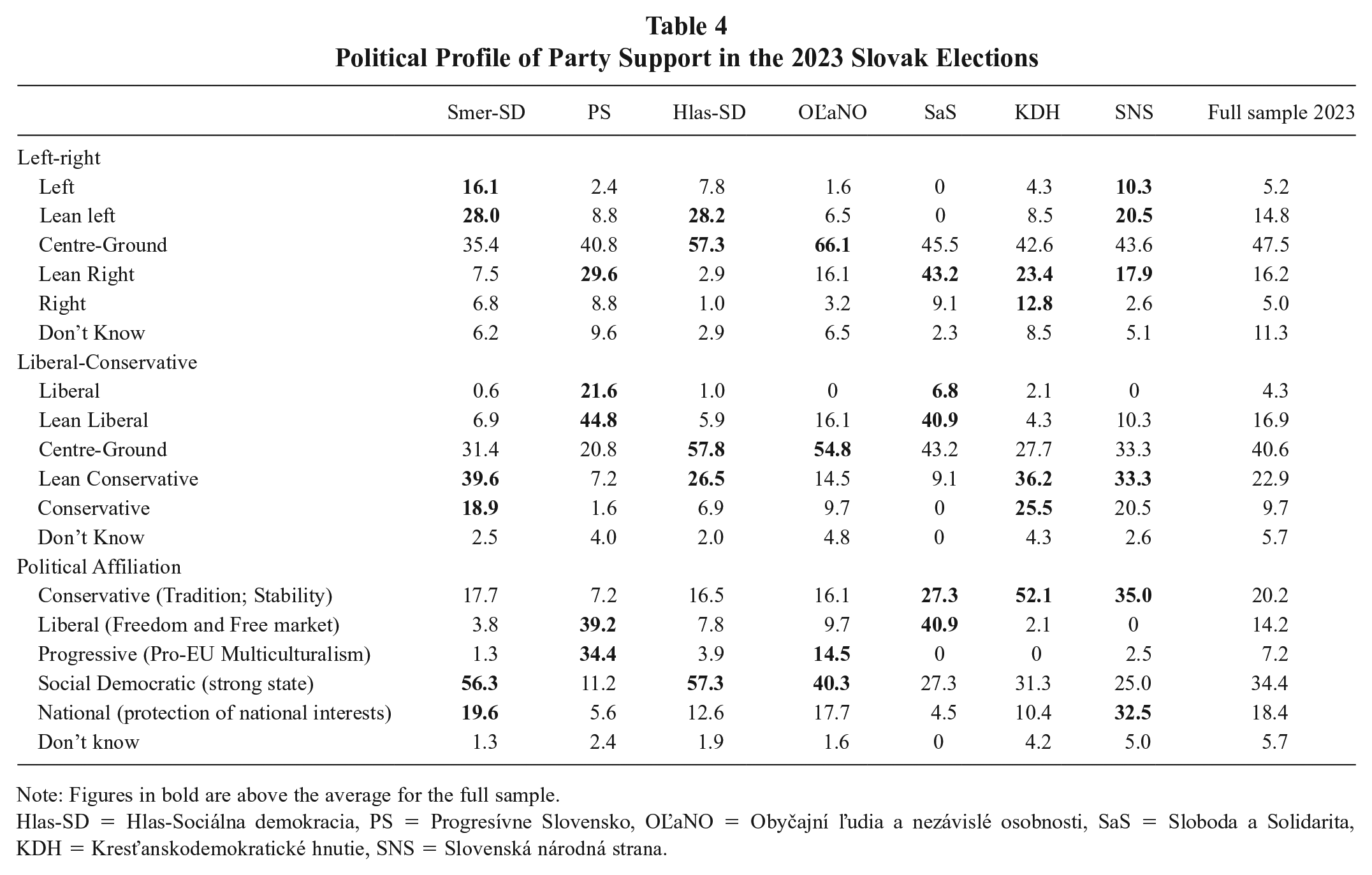
Note: Figures in bold are above the average for the full sample.
Hlas-SD = Hlas-Sociálna demokracia, PS = Progresívne Slovensko, OĽaNO = Obyčajní ľudia a nezávislé osobnosti, SaS = Sloboda a Solidarita, KDH = Kresťanskodemokratické hnutie, SNS = Slovenská národná strana.
To examine further the key drivers of Smer-SD, Hlas-SD, and PS support, we ran a multinomial logistic regression on the FOCUS data where support for these three frontrunners in the election is assessed against those who voted for other parties. The data examine voters only. The multinomial logistic regression model includes partisanship (identify with a party), social drivers (friends and family), and valence judgements (competent leader; party provided the best solutions to issues). Respondents were asked to select their response to each item. Political variables included a left-right measure (on a scale 0–10), a conservative-liberal minded scale (0–10), and a measure of the type of politics that the respondent likes. Here we include Social Democratic (which emphasizes the need for a strong state, social policy, and social justice) and Liberal Progressive (which emphasizes freedom and the free market; pro-Europeanism, gender and racial equality, and lesbian, gay, bisexual, transgender, and queer/questioning [LGBTQ] rights). Both are coded as dichotomous variables. Our model also contains variables that measure salient issues such as whether Slovakia’s membership of North Atlantic Treaty Organization (NATO) is a good thing and if Slovakia should support Ukraine in a war with Russia (coded on a Likert scale where 1 = totally agree and 5 = totally disagree). To assess attitudes towards the EU, we include a categorical response which compares those who believe the EU has no future, or that the role nation states should be strengthened within the EU against further and deeper EU integration. Reflecting the complexity of the party system and need for parties to win seats to achieve the electoral threshold, we take account of voting as a tactical measure (supporting a party to prevent another from winning). And given one of the stories of the 2023 election was the collapse in support for OĽaNO, we also include a variable which measures 2020 OĽaNO voters who switched in 2023.
The full model results are shown in the appendix (Supplemental Table A1). The regression coefficients provide the log risk ratios relative to the base outcome (all other parties’ support). For ease of interpretation, we compute the average marginal effects. These provide the difference in probability of each of the outcome level associated with a unit change in each predictor and is completely independent of our base outcome (all other parties’ support). So for each of the different outcome levels (voted for Smer-SD, voted for Hlas-SD, voted for PS), the marginal effect of x on that stated outcome level is that a unit change or difference in x is allied with a difference in the probability of this outcome. We show the significant predictors for each outcome and the plots are shown in Figure 2. Model fit statistics are provided for the regressions and indicate no underlying concerns.
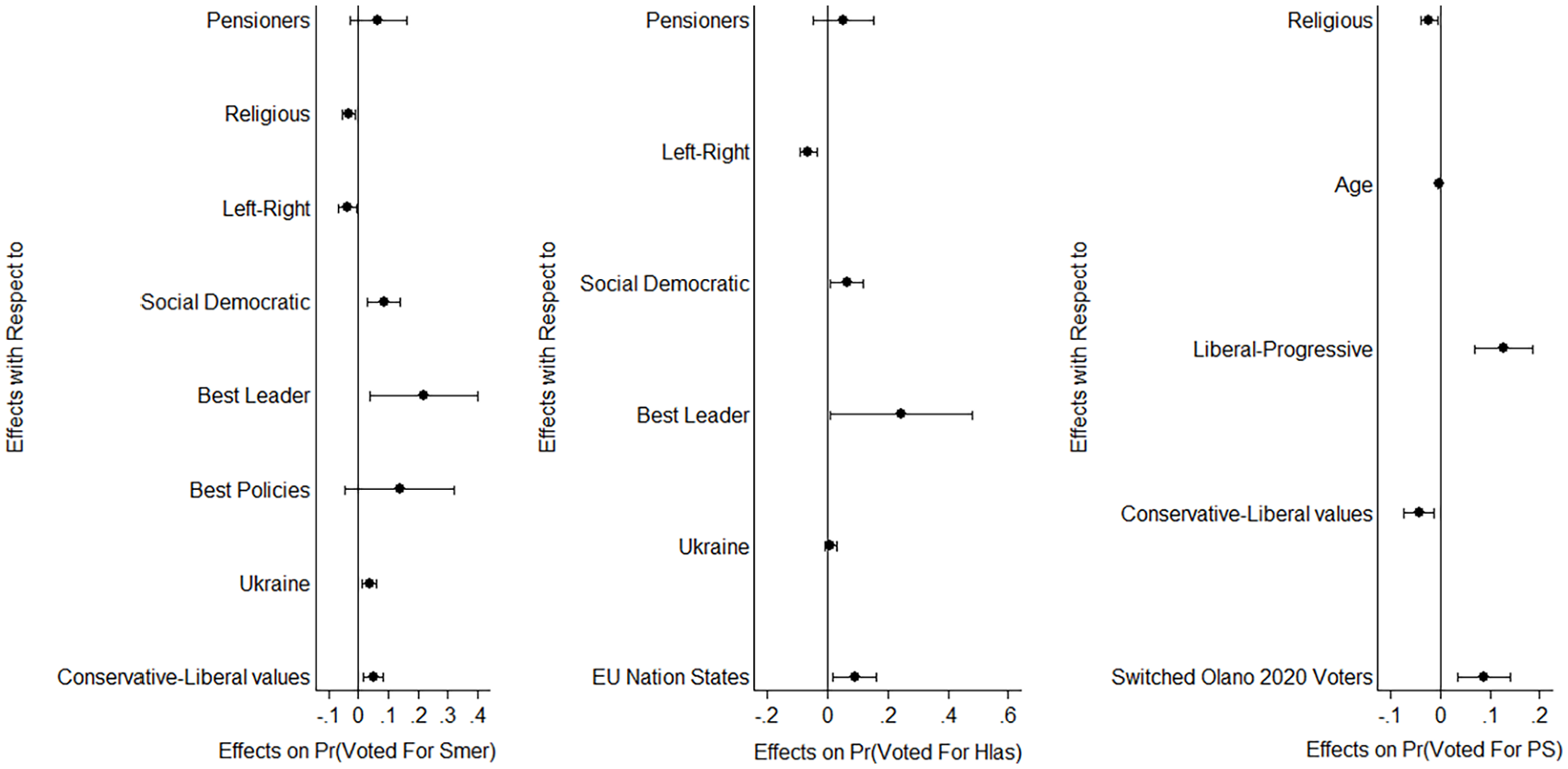
Average marginal effects of voting for Smer-SD, Hlas-SD, and Progressive Slovakia in the 2023 election (significant predictors only from Multinomial logit model—see Supplemental Appendix A1)
Our evidence suggests that Smer-SD voters have a distinctive political profile and motivations for casting their ballots for Fico’s party. In particular, linking to the pandemic and the cost of living crisis, valence-based judgements are the key drivers of Smer-SD support: Voters who believed that the party has the best policy solutions and the best leader are 14 and 22 percentage points more likely to vote for Smer-SD, respectively. Sociodemographics are less important, with only those who were of pensionable age or not religious more likely to support the party in the 2023 election. It is noteworthy that while Hlas-SD voters tended to have more moderate views than Smer-SD voters, leadership also matters for them. Those voters who believed Pellegrini was the best leader, on average, are 24 percentage points more likely to support Hlas-SD. In contrast, valence-based judgments did not influence voters who supported PS. While younger voters and those who were less religious are more likely to support PS, holding liberal values seem to matter most. Voters who consider themselves liberal progressives—supportive of the free market, multiculturalism, equality of different groups—are 13 percentage points more likely to vote for PS while those are liberally minded are 4 percentage points more likely to support PS than those who hold strong conservative values.
How and Where Did Smer-SD Win Support?
Evidence from the FOCUS data suggests that nearly 70 percent of 2020 Smer-SD voters voted for the party again 2023. To examine sustained loyalty and those voters who returned and those who left, we ran a multinomial logistic regression (Table 5). Simply put, we compare those who remained loyal to Smer-SD across the two elections, voters who were recruited to Smer-SD in 2023 and those who voted for the party in 2020 but switched from Smer-SD in the 2023 election against the base category, that is, did not vote for Smer-SD in either election. Those voters who remained loyal shared many sociodemographic characteristics—significantly more likely to be less educated, non-religious, and older—and placed themselves in similar places on the political spectrum. Loyal Smer-SD voters are 11 percentage points more likely to be social democratic than progressive liberals or conservatives, yet are significantly more likely to share conservative than liberal values. They are also significantly more likely not to support Ukraine in their war with Russia. However, it is Fico himself that drives loyal support—on average, loyal Smer-SD voters are 23 percentage points more likely to regard him as the best leader than not (Figure 3).
Multinomial Logit Model of Smer-SD Support: Retention, Recruitment, and Switching from Smer-SD in 2023 Slovak Election
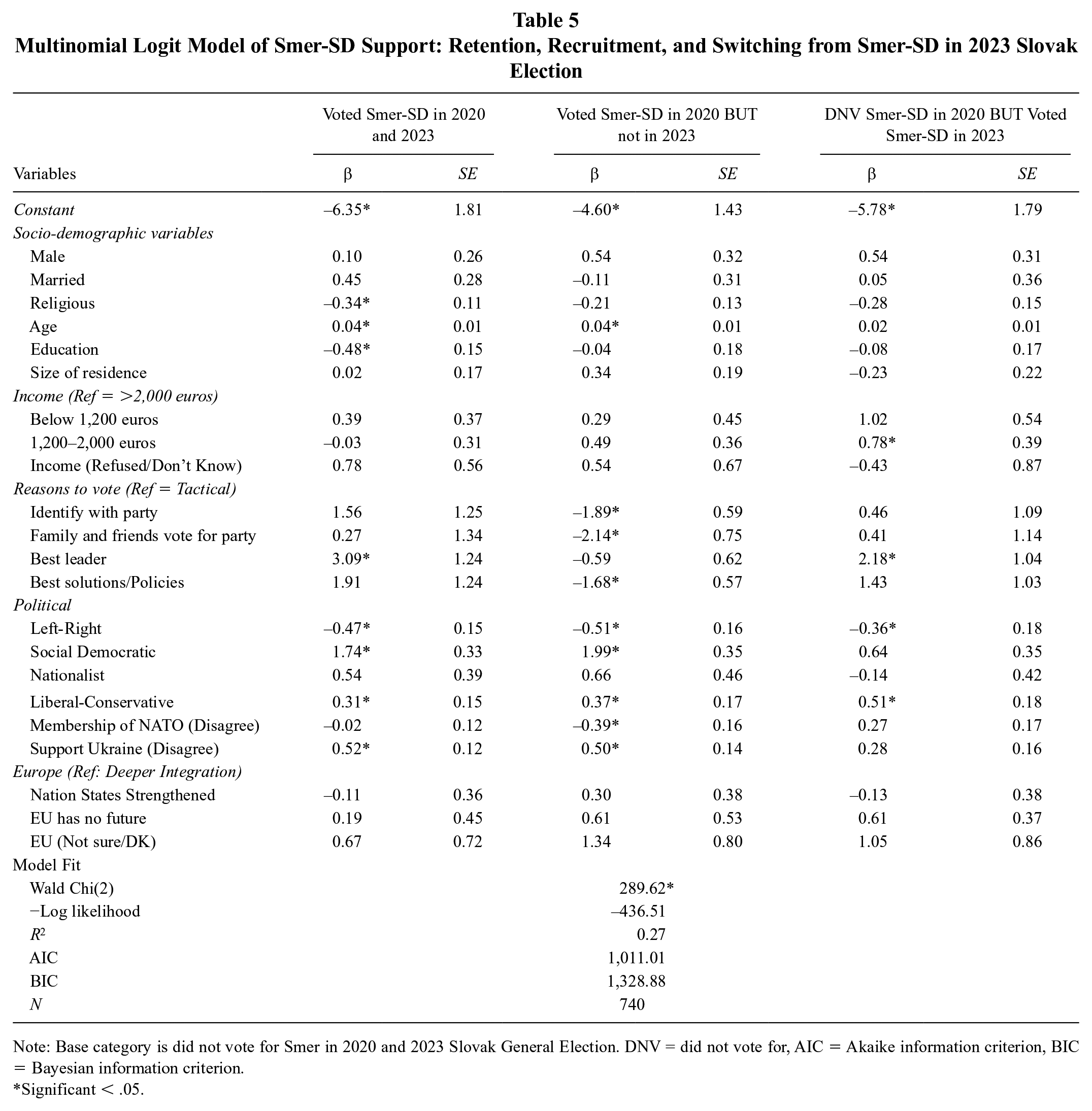
Note: Base category is did not vote for Smer in 2020 and 2023 Slovak General Election. DNV = did not vote for, AIC = Akaike information criterion, BIC = Bayesian information criterion.
Significant < .05.
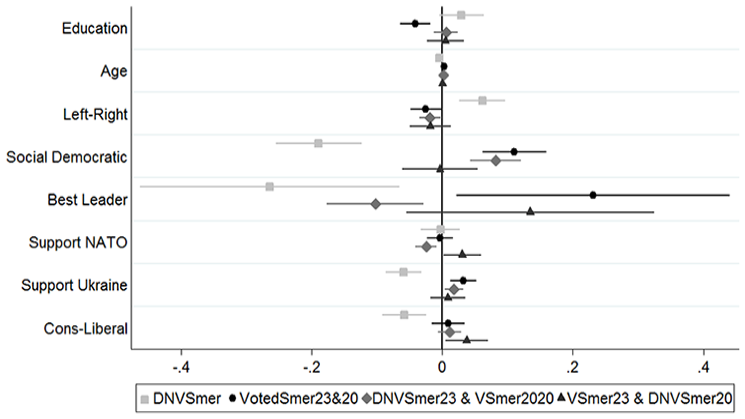
Average marginal effects of significant variables on loyalty to Smer-SD in 2023 and 2020, switching to and from Smer-SD in 2023 and not voting for Smer-SD in 2023 and 2023
To win the election, Smer-SD needed to recruit voters and our evidence suggests that aside from drawing support from those on lower to middle incomes, there were two major political drivers. First, while Smer-SD lost voters who were on the left of the political spectrum to Hlas-SD, it largely offset this through the recruitment of left-leaning voters who did not support the party in 2020 but chose instead to stay at home. Second, leadership. Smer-SD managed to persuade voters who previously supported the extreme right to vote for it (hence the failure of neofascist parties to reach the electoral threshold). A closer look at the data, however, suggests a more nuanced explanation. On one hand, it is clear that those who held Conservative values are 4 percentage points more likely to vote for Smer-SD in 2023 than those who did not. Yet, we find no evidence that voters who self-identified as Nationalist politically were significantly more likely to vote for Smer-SD in 2023 when holding other variables constant, perhaps unsurprising given that a sizeable slice of switchers to Smer-SD came from OĽaNO. Ultimately though, Fico proved to be the decisive factor. After adjusting for other explanatory variables, those who regarded Fico as the best leader compared with those who did not are 13 percentage points more likely to have been recruited by Smer-SD in the 2023 election (Figure 2). It suggests that Fico’s nationalist and traditional values rhetoric made him more palatable to voters who had cast their ballots for far-right parties in 2020, particularly for those who sought a strong and decisive leader.
Differentiating between Smer-SD and Hlas-SD Voters
The electoral growth of Hlas-SD is also a notable feature of the 2023 election. To assess how Hlas-SD voters differ from Smer-SD supporters, we ran an additional multinomial logistic regression model where those who voted for Hlas-SD are compared directly against those who voted for Smer-SD (the base category in the model). The results are shown in the appendix (Supplemental Table A2)—for brevity we include those who voted for other parties; however, this is not the focus of the analysis—but for ease of interpretation, we once again compute average marginal effects (Figure 4). The model only contains those who voted in the 2023 Slovak election.
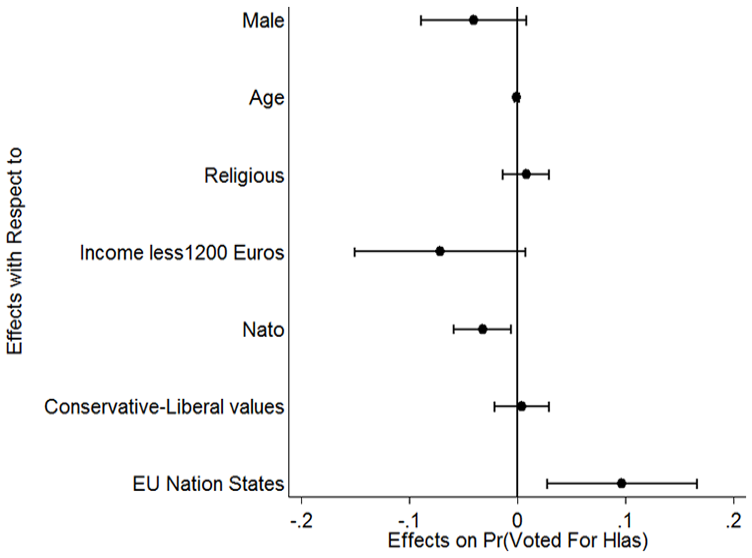
Average marginal effects of voting for Hlas-SD in the 2023 election (significant predictors only from multinomial logit model where Smer-SD is the base category—see Supplemental Appendix A2)
Our findings suggest that Hlas-SD voters have a distinctive sociodemographic profile: they are significantly more likely to be female, have higher income levels, less likely to be older, and more likely to be religious than Smer-SD voters. Moreover, Hlas-SD voters are significantly less likely to hold conservative values and oppose NATO membership but are significantly more likely than Smer-SD supporters to favour strengthening nation states within the EU. To put this into perspective, those who oppose NATO membership are, on average, 3 percentage points less likely to vote for Hlas-SD, whereas Hlas-SD voters are also 10 percentage points more likely to favour strengthening nation states than embarking on deeper EU integration. Given the role Hlas-SD played in coalition formation, its ability to attract more moderate and centrist voters was a key component in Fico’s return to executive office.
Coalition Formation
The final step along Fico’s narrow path to power was to forge a coalition. Once the election results were in, the most likely coalition appeared to be Smer-SD teaming up with Hlas-SD and SNS. Although other configurations were mathematically possible, the only other option for a viable coalition would be headed by PS. The fact SNS had won seats and was in a position to form a coalition with Fico was in no small part thanks to the functioning of the electoral system. 46
Slovakia’s lists are not closed, but rather “strongly flexible.” 47 Voters can express their preferences for up to four candidates. Any candidate who gets the preference of more than 3 percent of voters for that electoral list automatically gets pushed up the list. No fewer than 25 MPs elected in 2023 (one-sixth of the entire total) owed their election to preference votes. The open nature of the lists means that parties can offer places on the list to other politicians, personalities, and political groupings with the genuine possibility they might get elected even if not near the top of the list. Of the ten MPs elected on the SNS list, only one, the party leader Andrej Danko, was a member of the party. The others were prominent nationalist figures from alternative media channels and leading figures from an array of nationalist groupings some of whom had links to the neofascist party, Kotlebists People’s Party Our Slovakia (Kotlebovci—Ľudová strana naše Slovensko, ĽSNS). Our data indicate SNS won 16.7 percent of voters who had voted for ĽSNS in 2020. Although the makeup of the SNS parliamentary contingent provoked questions about its cohesion, they were united by conservative views and nationalist appeals making a coalition with PS a non-starter.
The participation of Hlas-SD appeared less certain. Cognizant of the need for coalition partners to return to power Fico had shifted his rhetoric over the course of the parliamentary term from labelling Pellegrini and other former members of Smer-SD as “traitors” to seeing Hlas-SD as a “sister party.” 48 But Hlas-SD’s participation in a Fico-led government was far from a foregone conclusion. The splitters had displayed a ruthless self-interested calculation in leaving their mother party in 2020 and would in all likelihood prioritize their career aspirations when weighing up coalition partners. For the few days after the election talks were held between PS and Hlas-SD, there was a flurry of speculation and rumours of offers made by both PS and Smer-SD. 49 The decision of Hlas-SD to join a coalition with Smer-SD was shaped by four factors. First, although Hlas-SD had sought to project itself as a moderate and European variant of social democracy, there was a greater degree of ideological proximity with Smer-SD than other potential coalition bedfellows. Second, the alternative to a Smer-SD government would likely be a more fractious and fissiparous coalition involving ideologically diverse parties such as PS, KDH, and SaS. Third, the cloud of suspicion that surrounded some figures in Smer-SD extended to their former colleagues now in Hlas-SD. If some of those suspicions had truth to them, it is likely Fico had kompromat on his recent underlings. Fourth, not only was Fico was willing to offer Pellegrini support in the forthcoming presidential elections (once the incumbent Zuzana Čaputová had announced she would not seek a second term all the polling pointed towards Pellegrini being the most likely winner), but Fico offered Hlas-SD the same number of ministerial positions even though Pellegrini’s party had won considerably fewer votes.
Conclusion
Robert Fico’s return to power generated significant international media coverage, particularly given the consequences for the Ukraine war. But despite the geopolitical implications of Smer-SD’s success, the outcome of the election was largely the product of domestic political factors. Fico’s return to power was built on the organizational and ideational resources Smer-SD had generated over two decades. These party factors were combined with a message of stability, leadership, and support for the poorer sections of Slovak society infused with a nationalist message conveyed through an effective campaign that went down well with voters who had experienced not just a chaotic period of politics, but also the socioeconomic consequences of the pandemic and the war in Ukraine. But the electoral success of Smer-SD was only converted into a return to executive office for Fico thanks to an ability to muster a coalition, itself a product of Hlas-SD pulling in more moderate voters and SNS’s support enhanced from the functioning of the electoral system.
The 2023 elections carry several lessons. First, it highlighted the polarization of Slovak politics. Fico’s politics contributed to, and benefitted from, the polarization of Slovak politics, something that helped Peter Pellegrini win the presidential elections a few months later. Indeed, in many respects, the two-round presidential election held in the spring of 2024 was a coda to the parliamentary elections, with the divisions of Slovak politics more starkly on display. 50 Moreover, the divisions of Slovak politics were further exposed in May 2024 when Fico was shot, with close allies of the premier minister quick to point fingers of blame in the direction of progressive and liberals in politics and the media. Second, the elections pointed to the continued fluidity of party politics with some prominent parties in the 2020–2003 period slipping into obscurity, other parties bouncing back into parliament, and half of all votes going to parties who had not crossed the threshold at the previous election. Not only were the attachments of voters to their chosen parties weak in the 2020–2003 period, but so too were those of MPs to their parties. At the time parliament was dissolved for the election, no fewer than a third of all MPs had changed their party affiliations since taking their seats three years earlier. Third, Fico’s return to power provoked questions about democratic backsliding, concerns only heightened by many of the new government’s measures such as changes to the judicial sphere, the stymieing of funds to non-governmental organizations (NGOs), and an overhaul of the state broadcaster. 51 Fico’s ability to reclaim the reins of power, however, had been the product of a combination of factors linked to his party’s organizational and ideational resources, effective campaign framing in a period of crisis, and the ability to forge a coalition. All of those ingredients were needed for the three-time prime minister to return to power, highlighting a particular recipe of which all those concerned with democratic erosion and resilience should be aware.
Supplemental Material
sj-docx-1-eep-10.1177_08883254251324191 – Supplemental material for A Narrow Path to Victory: Robert Fico, Smer-SD, and the 2023 Elections in Slovakia
Supplemental material, sj-docx-1-eep-10.1177_08883254251324191 for A Narrow Path to Victory: Robert Fico, Smer-SD, and the 2023 Elections in Slovakia by Tim Haughton, David Cutts and Marek Rybář in East European Politics and Societies
Footnotes
Acknowledgements
The authors express their thanks to Martin Slosiarik and his team at FOCUS for conducting the poll for us. Moreover, they are grateful to Nigel Baker, Charlotte Galpin, and Robert Ralston, audiences at the Foreign Commonwealth and Development Office, University College London, and the University of Birmingham for comments on drafts and presentations, and to Kevin Deegan-Krause, Erik Láštic, and Darina Malová for a series of helpful conversations. Furthermore, they thank the reviewers and editors of EEPS for their constructive criticisms of the initial submission.

Supplemental Material
Supplemental material for this article is available online.
Notes
Supplementary Material
Please find the following supplemental material available below.
For Open Access articles published under a Creative Commons License, all supplemental material carries the same license as the article it is associated with.
For non-Open Access articles published, all supplemental material carries a non-exclusive license, and permission requests for re-use of supplemental material or any part of supplemental material shall be sent directly to the copyright owner as specified in the copyright notice associated with the article.
