




Abstract
Party politics across Central and Eastern Europe has become less structured. Many of the divides that anchored political competition have waned in recent years, weakening the attachment of voters to the existing palette of parties and making them more likely to be attracted to new and non-traditional electoral vehicles. But for such parties to succeed at the ballot box, they need to be able to frame elections and campaign effectively. Drawing on data from a specially commissioned survey, we find that the success of Ordinary People and Independent Personalities (OĽaNO) led by Igor Matovič in the 2020 parliamentary elections in Slovakia owed much to the crafting of an anti-corruption appeal combined with an effective campaign. Both mobilization and conversion of voters, particularly through television and the leaders’ debates, in the months leading up to election day ensured OĽaNO won a quarter of the vote. OĽaNO stands in stark contrast to other parties whose leaders failed to craft as effective a message, miscalculated the impact of electoral rules and in some cases were unable to distance themselves enough from their past actions. The success of OĽaNO underlines that themes related to anti-corruption and good governance have become central to party politics and political contestation. More broadly, the election and its aftermath continued a general trend of forward movement of voters from old parties to new to newer still, indicating the churn of party politics in Slovakia is likely to continue.
Introduction
Party politics across Central and Eastern Europe is striking for both its continuities and change. On the one hand, elections frequently throw up new parties that are often able to ride an electoral vehicle fuelled by anti-corruption, celebrity, and their appeal of newness to achieve (some degree of) success at the ballot box. But politics is also characterized by perennial issues and deep divides linked to ethnicity and different visions of socio-economic organization and distribution. The former highlights institutional fluidity, whereas the latter underscores the deeper fault-lines that shape the geomorphology of politics. 1
The 2020 parliamentary elections in Slovakia illustrated both continuities and change. Ordinary People and Independent Personalities (Obyčajní ľudia a nezávislé osobnosti [OĽaNO]) led by Igor Matovič, which had been seemingly stuck in the doldrums in late 2019 and looked as if it might fail to cross the electoral threshold, stormed the boards a few months later in February’s election, winning a quarter of the vote. Whilst OĽaNO’s support rose, parties in the governing coalition could only muster a combined total of just 23.6 percent of the vote. Moreover, following the pattern of almost all parliamentary elections in Slovakia, 2020 saw not just some parliamentary parties fail to muster enough support to survive, but new entrants garner significant slices of the vote, one of which won enough votes to enter parliament and become part of the new government (see Table 1). Furthermore, with one notable exception, all the parties in the new parliament had contested their first general election within the previous decade. In addition, even the oldest party in the new parliament witnessed a significant fission soon after the election, with many of its prominent members creating a new party led by a former prime minister.
Results of the Parliamentary Elections in Slovakia 29 February 2020
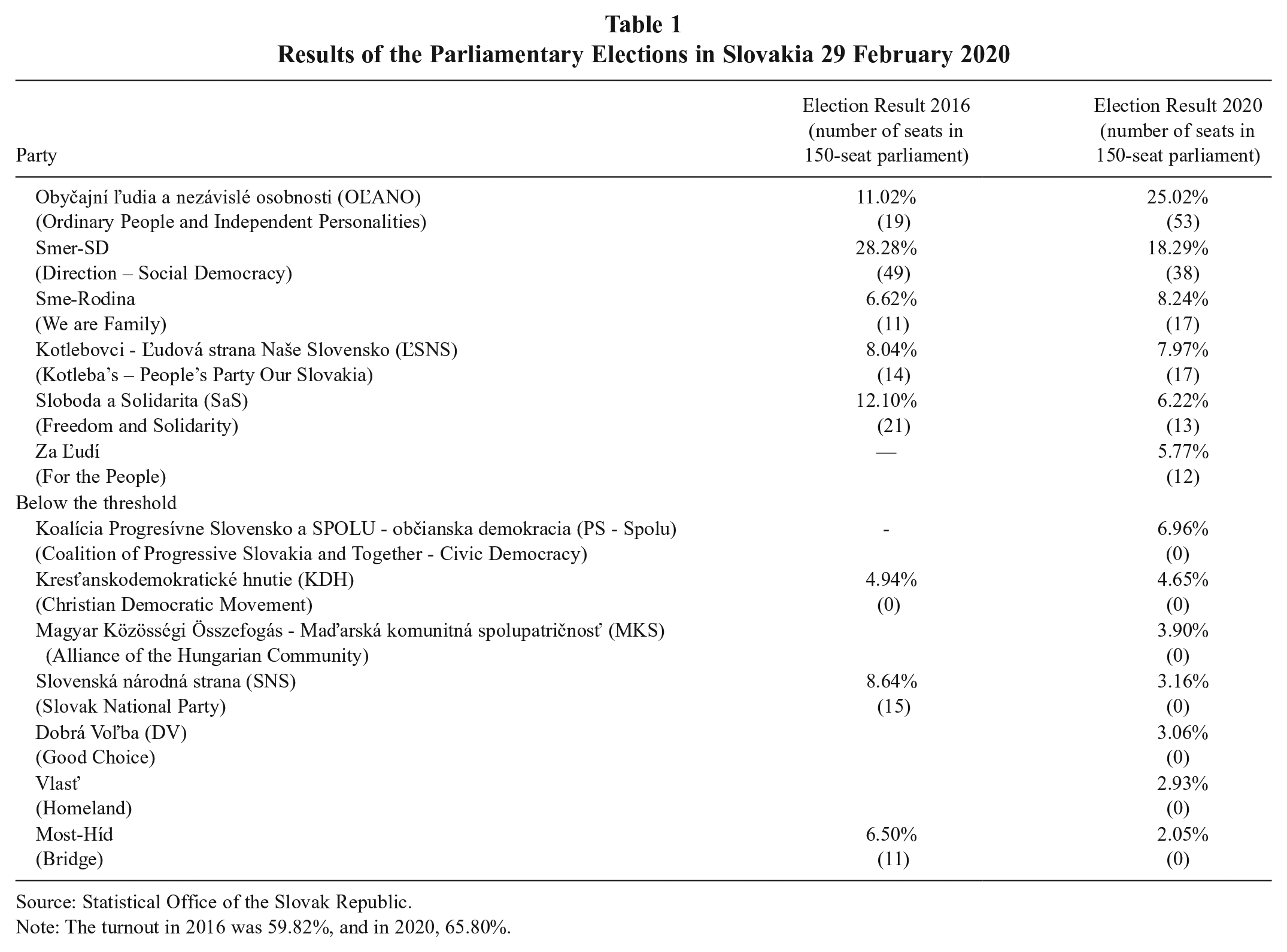
Source: Statistical Office of the Slovak Republic.
Note: The turnout in 2016 was 59.82%, and in 2020, 65.80%.
And yet, there were notable continuities. Socio-economic, geographical, cultural, and ethnic divisions still mattered for sizeable parts of the electorate. Even in the changes we see evidence of recurring patterns, the stable instability of party politics in Slovakia, 2 not just with another iteration of the steady entrance and exit of parties but also in the movement of voters from new to newer parties. Moreover, political contestation was striking for the sharp division between the parties in government and those in the opposition camps, the latest iteration of a perennial theme of party politics in Slovakia.
This article has three main goals. Firstly, it provides an account of the election, particularly the success of OĽaNO. We maintain that the results underline larger trends across not just Central and Eastern Europe (CEE) but democracies on a wider geographical canvas. Matovič’s achievement highlights that although success on the battlefield of politics may be impacted by the terrain (itself shaped by the underlying political geology) of overall patterns of divisions and contestation, victory or defeat is also shaped by the response and choices of parties and their leaders to the opportunities presented to them. Secondly, drawing in particular on data from a specially commissioned poll, we examine the impact of campaigning. Electoral results are driven by both the fundamentals and the fickle. Fundamental divisions linked to sociological characteristics, socio-economic appeals, and cultural values may form the bedrock of support for many parties, but voters are open to persuasion—meaning that campaigning has the possibility to play a significant role and making campaigning choices potentially decisive in determining electoral outcomes. The 2020 election indicates the importance of the campaign in shifting voters, but even in an era of digital technology it shows that television rather than social media remains the primary source of information for voters. Thirdly, given the salience of new party appeals, we examine not just the power of a newness appeal in contemporary politics, but also chart new voter movements. Our analysis indicates that in a similar vein to other countries in the region such as Slovenia and the Czech Republic, there is a general trend of forward movement of voters from old parties to new to newer still. In the Slovak case, however, there is some movement back to an older party but the “older” party, in question had participated in only two previous elections and, thanks to its marginalization during the previous parliaments, could still plausibly cast itself as not yet having had a chance to demonstrate its potential for change.
We begin by placing the election within the wider trends of party politics particularly the changing bases of party competition in CEE. We then analyse the election campaign highlighting the salience of particular issues like corruption, but also the consequences of certain choices. The final part of the article focuses not just on the role newness plays in voter perception and party appeals, but also the flow of voters from established to newer parties.
Changing Patterns of Party Politics
In the three decades since the 1989 revolutions, electoral politics across CEE has been marked by high levels of volatility, and party politics has been characterized by fluidity. Although some parties have managed to endure, many others have been ephemeral: living fast and dying young.
The academic literature explaining the (in)stability of party politics tends to fall into one of four categories: historical, sociological, institutional, and strategic. 3 By drawing on the power of communist legacies or the exit from communism, historical accounts offered valuable insights in the first post-communist decade in CEE, but their explanatory power has faded as the forty years of communist rule has moved further away from the present. In the case of Slovakia, it was arguably the exit from the Czechoslovak federation in the early 1990s that played a more significant role in shaping political contestation. Indeed, until the 2000s politics was dominated by themes related to the nation, illiberalism, and Slovakia’s place in the world. The central questions of politics in this period centred around what is the nation, who belongs, what kind of regime citizens wanted, and the country’s geopolitical orientation. 4 The nationalist, nationally inclined, and illiberal forces mostly concentrated in the Movement for a Democratic Slovakia (HZDS) led by Vladimír Mečiar and the Slovak National Party (SNS) faced off against a changing array of parties which eventually came together in the Slovak Democratic Coalition (SDK) and a wider governing coalition to remove HZDS and SNS from power in 1998 and confirm the country’s geopolitical orientation. 5 From the early 2000s, however, party competition revolved much more around socio-economic issues, particularly how to organize the economy to deliver prosperity and how the fruits of economic success should be distributed throughout society, 6 although national questions were far from absent.
Sociological accounts based on cleavages have long provided the frameworks to explain party politics in democracies, but even those who use such approaches for longer-established democracies in Western Europe have identified new cleavages and divides to explain the patterns of political contestation. 7 Deep sociological divisions clearly play a role in shaping party politics in CEE, especially ethnic politics. Slovakia’s ethnic Hungarian population amounting to close to a tenth of the population has tended to vote en masse for parties who make a clear pitch to defend the interests of that minority. Moreover, support for parties like HZDS and SNS, and in more recent times the far-right People’s Party Our Slovakia (ĽSNS) have been built—at least in part—on attitudes towards the ethnic Hungarian and Roma minorities. Furthermore, the divisions linked to contrasts between conservative and liberal views of culture, morality, and the nation which have been represented in party competition can be tied back to the church–state cleavage identified by Lipset and Rokkan in their landmark study. Nonetheless, as even advocates of cleavage-based approaches argue, in a true Rokkanian sense it is hard to identify such cleavages in CEE. Indeed, the most persuasive accounts in this tradition temper the structural determinism by acknowledging the role of agency. 8
Institutional frameworks, particularly the choice of electoral system, are also seen to shape party politics. While majoritarian and plurality systems in countries like the United States and the United Kingdom help entrench the two-party system and make it harder for other parties to break through, more proportional systems, such as Slovakia’s list-based PR system with a 5 percent threshold, are expected to be more likely to foster multi-party systems and more permissive to new party breakthrough. But the fact they can foster both long-standing and short-lived parties underlines that electoral systems provide incentives and disincentives that political actors can choose to follow or not.
Although explanations drawing on historical, sociological, and institutional factors offer some analytical leverage, the limitations of those accounts point to the importance of choices made by politicians and parties. In their compelling account of the rise of challenger parties in Western Europe, De Vries and Hobolt, for instance, argue that political change is best seen as a battle between the forces of dominance and innovation. Drawing on experiences in the business world, they show how the attempts by firms to maintain their dominant position are challenged by newcomers. Parties in the oligopoly do not all perish or prosper, but their fate is contingent on the choices made by political actors. De Vries and Hobolt’s account underline why challenger parties can be successful even in party systems with histories of stability and deep partisan attachments. Given the shorter history of democracies and weaker levels of partisanship in CEE, we would expect the odds of success for challenger parties to be higher.
Strategic models highlight the salience of strategies adopted by parties to ensure endurance and enhance or hamper new party emergence. Many of the most compelling accounts of the dynamics of party politics in Latin America, Western Europe, and CEE, for instance, have stressed how decisions to build and maintain organizational structures have aided endurance. 9 Moreover, scholarship has shown how the appeal at the heart of a party’s pitch to the electorate matters. Ethnic-based appeals or those based on the defence of socially conservative values can constitute a “party brand” that helps survival even when performance in office is poor, 10 whereas other appeals like anti-corruption may be easy to invoke, but harder to claim and develop long-term issue ownership.
The theme of corruption has become a significant driver of politics across CEE often tied to appeals linked to competence and novelty. 11 In Poland, for instance, the liberal–conservative rivalry between Civic Platform and Law and Justice that has shaped party competition in the past decade and a half owes much to the dramatic decline of the once popular Polish socialists whose support slumped thanks to a combination of questions of corruption and competence. 12 In Hungary, the electoral dominance of FIDESZ may be due in recent times to the playing of the national card and the curbing of liberal democratic norms and practices, but the initial change in Hungary’s stable two party competition owed much to the collapse in support for the Hungarian Socialists thanks to questions related to their integrity and competence. 13 In the Czech Republic, party politics was dominated by left–right competition, but both the Civic Democrats and Social Democrats paid a heavy price for their association with various corruption scandals, which fuelled the rise of parties proclaiming their cleanliness and competence, particularly ANO, founded and led by the businessman Andrej Babiš. 14
The empirical patterns in the other Visegrád 4 countries underline the changing spatial nature of party competition. The breakdown of once strong opponents not only forces the other side to identify other enemies or themes in order to mobilize their voters but the collapse helps create room for other parties to emphasize alternative issues and divisions. Cultural and national themes have been part of the successful recipes for well-established parties and some new entrants not just in CEE but on a wider geographical canvas. But drawing on the well of scandals, new parties and those without experience of government have placed competence and anti-corruption at the heart of their pitch to voters. Stressing these valence themes not only helps distinguish the new(er) entrants and challengers from governing parties in an era where spatial differences between parties on the socio-economic dimension may be far less pronounced, they provide an appealing pitch to disgruntled voters. 15
Since the early 1990s governments of all different hues in Slovakia have been implicated in corruption scandals, with friends and associates of the politicians in power profiting from their connections. 16 Corruption has been a perennial theme of party politics provoking politicians to paint their rivals as less than angelic white and galvanizing citizens to demonstrate such as after the revelations in the Gorilla file in the early 2010s. 17 Questions revolving around how to run the country better and how (or even whether) to break up networks of power and influence became even more prominent in the 2016–2020 parliamentary term. In particular, the murder of the journalist Ján Kuciak and his fiancée Martina Kušnírová in 2018 provoked a series of demonstrations across the country against the Direction–Social Democracy (Smer–sociálna demokracia [Smer-SD]) government led by Robert Fico. The investigations into the deaths exposed links between politicians, powerful business interests, and organs of the state, leading to the resignation of the interior and prime ministers, although Fico remained as party leader. The widespread disgust over the corrupt behaviour highlighted by the Kuciak and Kušnírová murders was a major factor in an outsider, Zuzana Čaputová, winning election to Slovakia’s largely ceremonial presidency in 2019. Čaputová’s recipe of novelty and cleanliness was a variation on the pitch Andrej Kiska had made five years previously to defeat Fico for the presidency. 18
As Slovakia geared up for the 2020 elections, therefore, the terrain of party competition appeared to be changing. In more volatile political environments, elections provide opportunities for new entrants or previously more minor parties on the political stage to mobilize voters through campaigning and hence can be both reflective of, and catalysts for, change.
Campaigning: Mobilization and Conversion
The academic literature on elections and campaigning is vast assessing both impact and types of campaigning. 19 It is, however, predominantly focused on the United States, and to a lesser extent the United Kingdom, with the countries of Central and Eastern Europe largely neglected. 20 In terms of impact, in well-established party systems with deep ties of group identity and partisanship, campaigning is often seen as having only a marginal impact, albeit that the successful shifting of those few marginal voters during a campaign can be decisive. Thanks to the shorter length of democratic experience (for both voters and parties) and/or the roller-coaster ride of politics in three decades since the establishment of democracy, voters in CEE are thought to have weaker ties to parties. Indeed, the main exit poll conducted for Markíza TV of the Slovak elections indicated the loyalty levels of voters (comparing whom they voted for in 2016 and 2020) does not exceed two-thirds for any party, 21 following trends in previous elections. 22 Even OĽaNO, whose support more than doubled in 2020 only managed to hold on to 65.2 percent of its voters from 2016. Given those weaker bonds, we would expect the campaign to have an impact on the election outcome.
Central to campaigning are the overlapping tasks of mobilization and conversion. In all elections voters need to be mobilized to turn out to cast their ballots for their preferred choice (or dissuaded from voting for opponents), but in more fluid party systems like Slovakia, where partisan ties are weaker, voter preferences are more labile and open to persuasion; hence, conversion of voters to support a particular party or candidate becomes a key task to be undertaken before, or in conjunction with, mobilization. The exact blend of mobilization and conversion varies not just across party systems, but also between different parties within those systems. Nevertheless, political operatives have long stressed the key to successful campaigns—in terms of both mobilization and conversion—can be boiled down to two components: framing the election around a key theme and projecting your party and candidate as the one to deliver on that theme. 23
In terms of the modes, one of the few studies that has sought to provide a comparative analysis of campaigning in CEE found, perhaps rather surprisingly, that there was not much of a difference between older and newer parties in terms of the types of communication tools used, especially in terms of new media use, and that the main forms of party contact were by leaflets, mail, or face-to-face contact with much lower scores for social media. Nonetheless, given that the study was based on data from 2011–2016, the authors concluded by expecting an increase in importance in social media in future elections. 24
This article draws on the findings of a post-election poll we commissioned from the leading Slovak polling agency, FOCUS. The survey data were collected between 11 and 17 March 2020 (in the immediate aftermath of the election) with a representative sample of 1,013 voters. We recognize the weaknesses of survey-based data and acknowledge it has become popular in campaigning studies, particularly in the United States, to conduct experiments. 25 Such tools can leverage significant insights, but even well-designed experiments tend to offer only glimpses of what may be happening on the wider national scale and outside a controlled environment. In contrast, nationwide surveys of a representative sample of voters provide a broader numerical and geographical basis for claims about national elections.
FOCUS used a stratified random sampling process. In the first stage, the agency divided the population into regions and then settlement size. 26 In the second stage, they then used stratified sampling by quotas (gender, age, education, and nationality). We recognize that panel data can provide useful insights in survey-based analyses, but given that the landscape of political parties in Slovakia has changed considerably over time, cross-sectional data should be the first choice. Moreover, it is appropriate to use this form of data given that our primary focus is to explain the outcome of a specific election. We acknowledge that future studies would benefit from a combination of cross-sectional and panel data blended with well-crafted experiments and encourage funding bodies to support such data collection exercises. In this study, we combined the findings of our survey with the findings of other surveys, analysis of manifestos, campaign materials, and first-hand observation of campaign activities across the length and breadth of the country.
Campaigning and Positioning: How Ordinary People Win
In the autumn of 2019, OĽaNO was languishing in the polls scarcely 1 percentage point above the 5 percent electoral threshold and on the decline (see Figure 1). How then to explain the party’s stunning success just a few months later when it mopped up a quarter of the vote? Part of the explanation lies with the choices made by other parties and part lies with the choices made by OĽaNO. We begin with the latter.
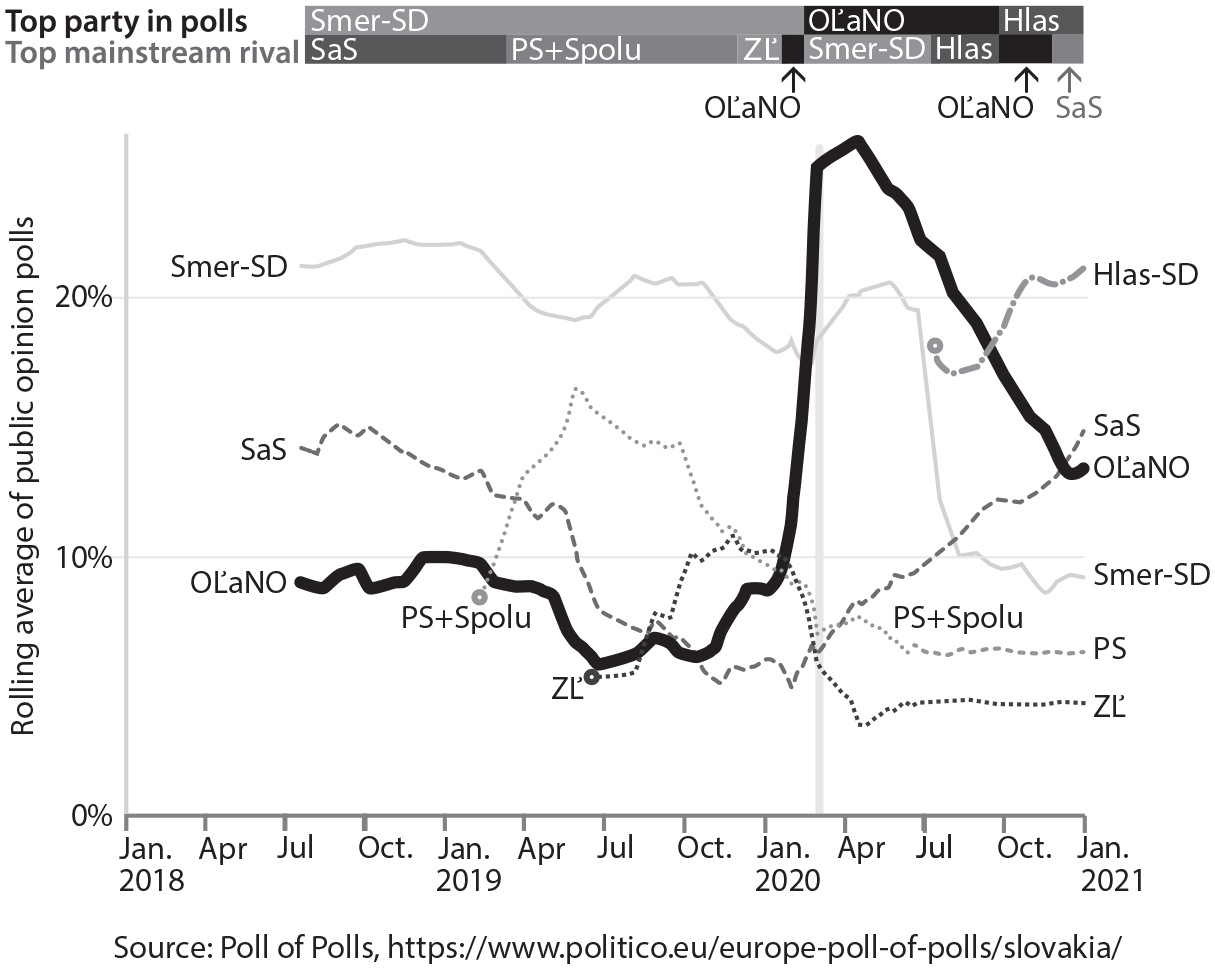
Opinion polling for selected parties and first and second place parties in polls, July 2018 to December 2020
OĽaNO began life in 2010. Igor Matovič had become wealthy through his company Regionpress, which published local free weeklies. Alongside advertisements paid for by local businesses, Matovič penned articles with corruption as a common theme. 27 With three others he formed a civic grouping, Ordinary People, which had political aspirations. In the run-up to the 2010 elections, Matovič struck a deal with Richard Sulík, the leader of a newly formed party Freedom and Solidarity (SaS). In return for SaS being given significant space in the Regionpress publications, Matovič and his allies were granted the last four places on the electoral list. Thanks to preference voting—actively advocated in Regionpress circulars—all four were elected over the heads of nearly 150 people on the party list. Nonetheless, because of Matovič’s unwillingness always to follow the SaS party line, relations between Matovič and SaS soon deteriorated, leading to him being thrown out of the parliamentary caucus and culminating in the decision to form a new party, OĽaNO, in 2011 as Slovakia geared up for early elections. In those elections (2012), OĽaNO won 8.6 percent of the vote and 16 seats. Throughout the remainder of the decade, the party experienced much churn with many politicians elected on its list leaving the parliamentary group, but it maintained its parliamentary presence.
Matovič became a prominent figure on the political stage, derided by opponents as a clown for his high-profile publicity-seeking stunts, but the crude language and raucous style in which he conducted his relentless attacks helped identify him as a fighter against corruption, double standards, and hypocrisy in politics. OĽaNO’s leader directed much of his fire at Robert Fico and Smer-SD. Matovič was frequently seen in parliament bedecked in a T-shirt emblazoned with the slogan “Fico protects thieves” and carried out some of his most high-profile stunts outside buildings associated with Smer-SD’s leader including the apartment complex where Fico rented a flat from a businessman accused of tax fraud. 28
As mentioned above, political operatives have longed stressed the key to successful campaigns can be boiled down to two components: framing the election around a key theme and projecting your party and candidate as the one to deliver on that theme. In 2020, Matovič managed to do both and was rewarded at the ballot box. Before turning to OĽaNO’s strategy we first examine the broader processes of mobilization and conversion.
Data from our specially commissioned poll indicates that the campaign mattered. Over half the respondents (55.2 percent) answered that the campaign convinced them to participate in the election with 27.8 percent completely agreeing the campaign had persuaded them and 27.4 percent somewhat agreeing. We then asked respondents who voted in the election where they got their information about political parties and what forms of party communication had the greatest impact on their decision to vote for a particular party. As Tables 2 and 3 show television was the main source of information with social media and party communications also important. Given those figures, it is perhaps not surprising that when asked what form of communication from parties had the greatest impact on voters’ decision, respondents mentioned the pre-election debates and debates in the media.
Where Voters Got Their Information About Political Parties (Respondents Could Choose up to Two)
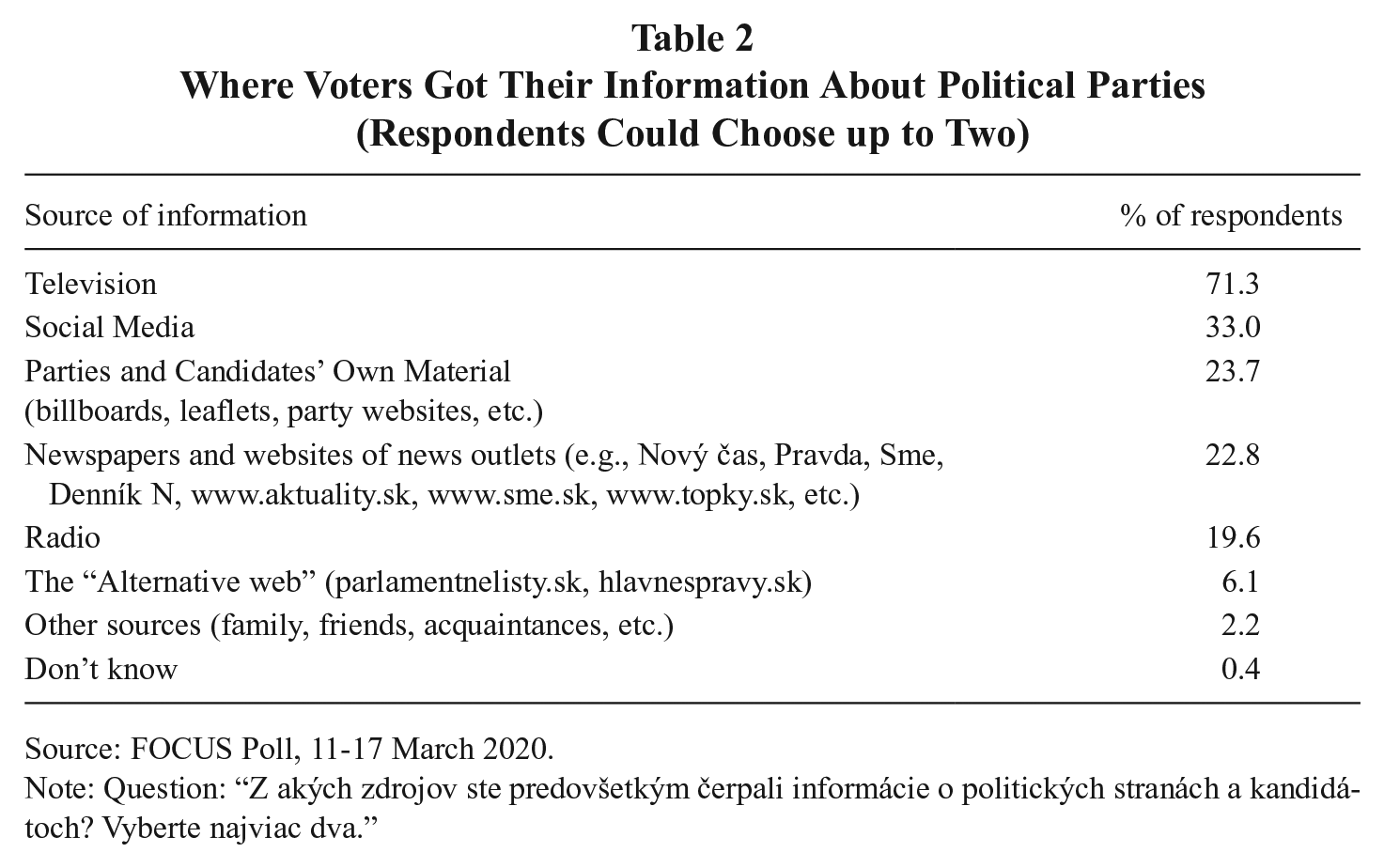
Source: FOCUS Poll, 11-17 March 2020.
Note: Question: “Z akých zdrojov ste predovšetkým čerpali informácie o politických stranách a kandidátoch? Vyberte najviac dva.”
Type of Party Communication Which Had the Greatest Impact When Voters Made Their Decision
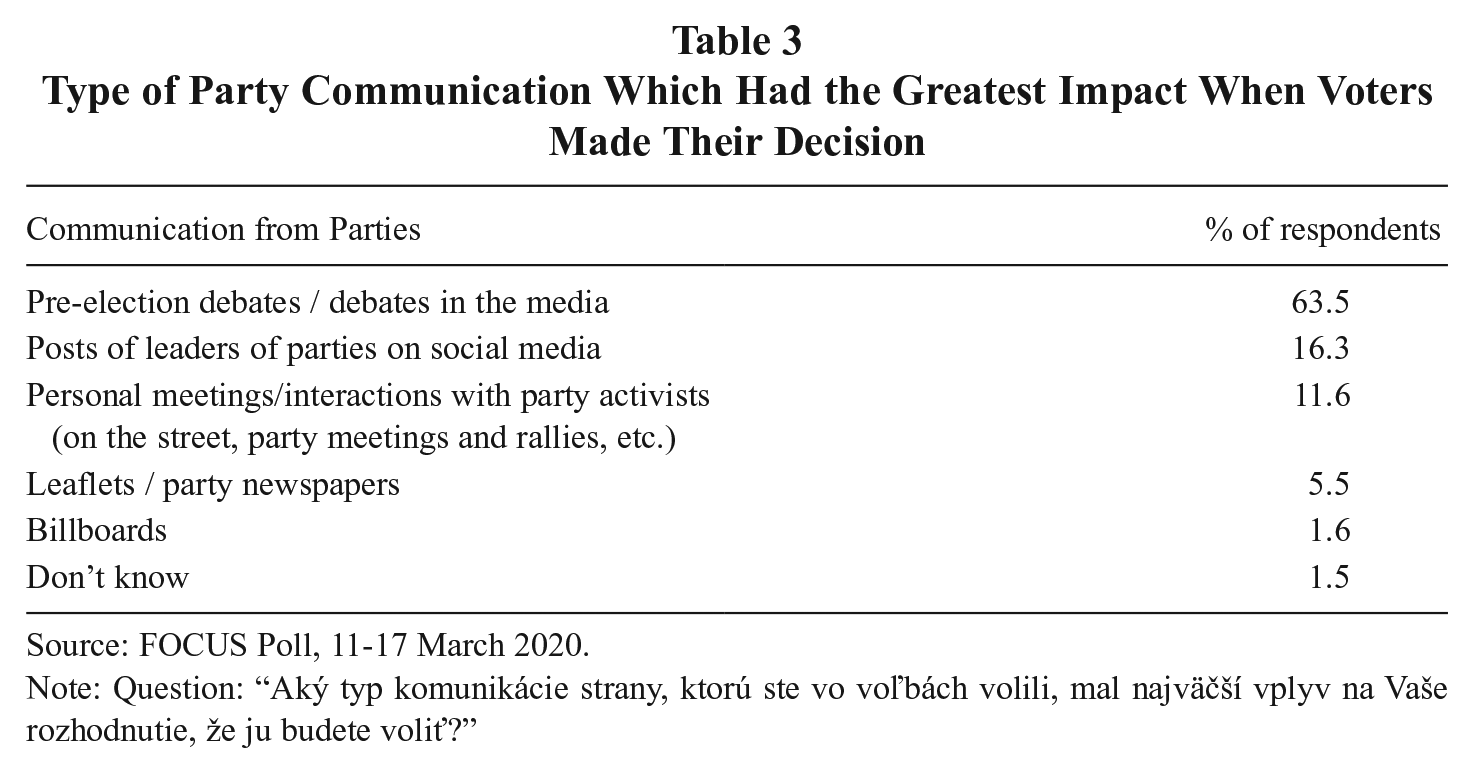
Source: FOCUS Poll, 11-17 March 2020.
Note: Question: “Aký typ komunikácie strany, ktorú ste vo voľbách volili, mal najväčší vplyv na Vaše rozhodnutie, že ju budete voliť?”
Matovič placed corruption and good governance at the heart of his campaign. Drawing on the pool of support that had long considered corruption a problem in Slovak society 29 —a pool that had been replenished by the scandals of the 2016–2020 Smer-SD government—OĽaNO’s anti-corruption appeal was key to its success. During the campaign Matovič continued his habit of high-profile stunts, including a trip to Cannes where he put signs on the fence surrounding the villa of Ján Počiatek stating, “Property of the Slovak Republic,” to publicize the dubious wealth of the former Smer-SD finance minister. These stunts helped reinforce in the minds of the public Matovič’s position as the chief critic of corruption committed not just during the 2016–2020 government’s watch, but over the past decade. The framing of the election around corruption and making OĽaNO the vehicle to root out corruption is also in evidence in the party’s manifesto. Indeed, the first theme the OĽaNO manifesto covers is the battle against corruption. Moreover, in the opening eleven sentences of the manifesto in the “Who We Are” section, the first statement declares that for “ten years we have fought courageously against corruption,” the seventh stresses that “no oligarchs stand behind us,” the ninth that they will “not allow anyone to steal” (directed not at petty criminals, but the plunderers of the state), and the tenth that “property stolen by politicians we will return to the people.” 30 The wider themes of good (and effective) governance are in evidence not just in the second main section of the manifesto under the label “A State That Serves,” amounting to 70 of the manifesto’s 210 pages, but also in the “Who Are We” section stressing the party’s veracity, activity, and “excellent programme full of excellent solutions which will help people.”
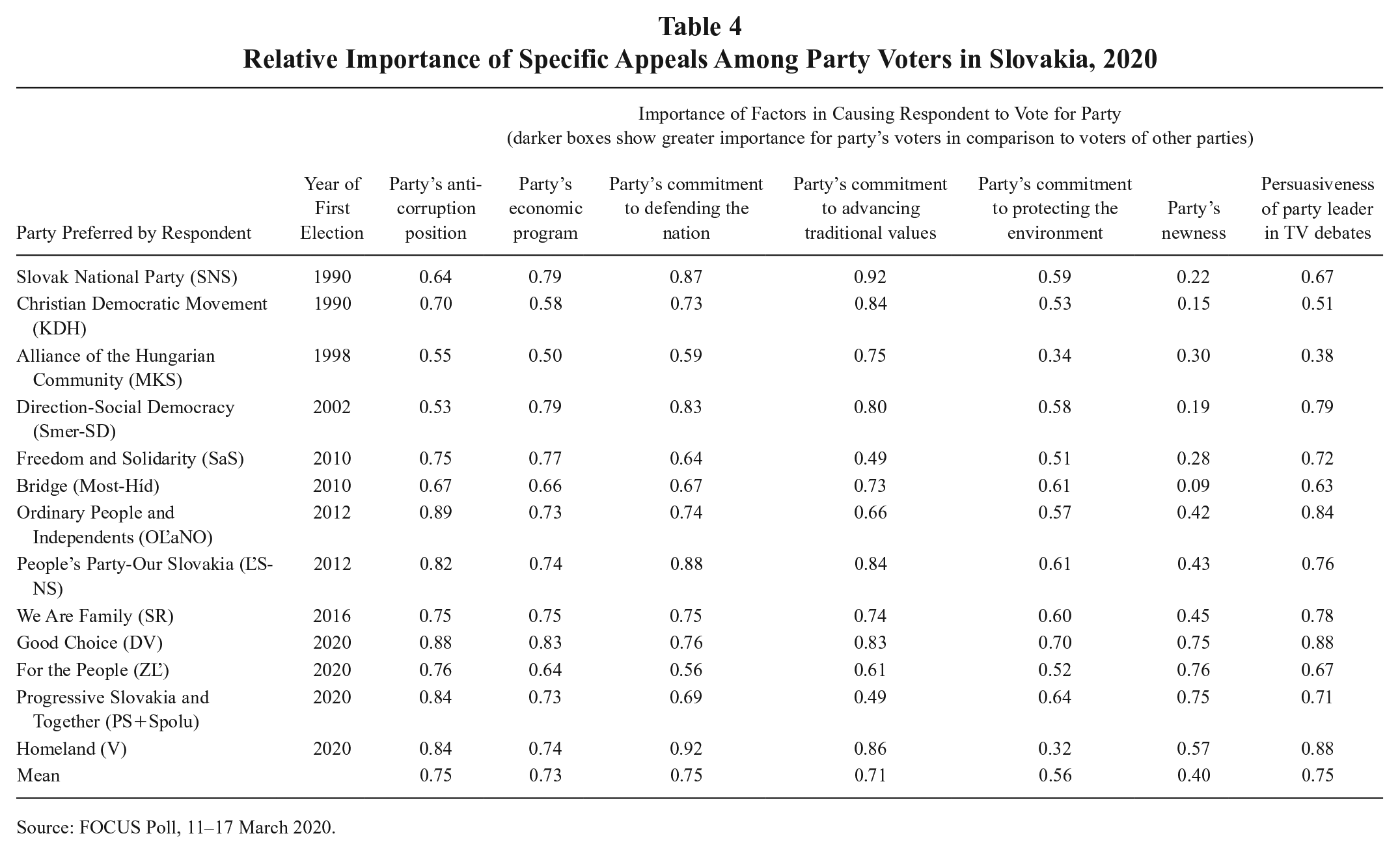
Given this pitch, it is no surprise that exit polls indicated that 69.4 percent of OĽaNO voters cast their ballots for Matovič’s party because of its stance on corruption 31 —a finding also confirmed in our poll. Voters were asked how much certain themes (anti-corruption stance of the party, the newness of the party, the economic programme of the party, the ability of the party to defend “our nation,” the party’s promotion of traditional values, the party’s defence of the environment, and the convincing performance of the leader in the pre-election TV debates) had impacted on their choice to vote for the party they eventually chose. We then aggregated the scores for each party and created an average of low-to-high impact standardized on a 0.0–1.0 scale. As Table 4 shows, OĽaNO’s score of 0.89 for its anti-corruption stance (both the highest anti-corruption score for any party and the highest score for any issue among OĽaNO voters) indicates anti-corruption was not just very important for its voters, but overall more important than other themes for its voters, and of greater importance to its voters than to other parties, albeit that anti-corruption was important for voters across the political spectrum.
Relative Importance of Specific Appeals Among Party Voters in Slovakia, 2020
Source: FOCUS Poll, 11–17 March 2020.
The battle against corruption was central to the election. Matovič’s framing of the election around combating corruption meant defeating Smer-SD, and he projected himself and his party as the best vehicle to remove Smer-SD from power. There was a clear momentum towards OĽaNO during the campaign indicating a successful process of conversion. In our specially commissioned poll, 15.8 percent of voters admitted to switching their votes in the month before the election and of those 41 percent shifted to supporting OĽaNO, a figure four times higher than for any other party. Of those voters who moved to Matovič’s party 22 percent came from Za Ľudí and 20 percent from PS-Spolu (two new electoral vehicles we discuss below). Unsurprisingly, only 4 percent came from those who were considering voting for Smer-SD a month before the election. Our analysis of the data indicates that the profile of those who switched to OĽaNO during the campaign was similar to those who had planned to vote for OĽaNO before the campaign began. It suggests that voters switched less because they cared more about corruption, but rather in a bandwagon effect saw OĽaNO as the best vehicle to remove corrupt politicians from power. The final stages of OĽaNO’s campaign with billboards imploring citizens to “decide” and adverts on radio and TV stressing the need to turn out pointed to a mobilization strategy akin to classic Get Out the Vote campaigns. 32 But the most striking event was a Facebook interview Matovič conducted with his daughter on 24 February just days before the end of the campaign. 33 After evading the question for months and hinting others would be better suited for the role even if OĽaNO won, he finally acknowledged he would be willing to be prime minister. Not only did this dominate the news cycle and helped cement Matovič’s position as Smer-SD’s main opponent, but it left little time for prime minister Peter Pellegrini and Fico to reorient their attacks towards the dangers of a Matovič-led government.
Matovič’s decision to frame the election about corruption and defeating Smer-SD was clearly a major factor in OĽaNO’s success, but other choices linked to the electoral system augmented the success. As mentioned above, OĽaNO has a history of using effectively the mechanics of the electoral system, particularly linked to the open list system. Preference voting allows citizens to express preferences for up to four candidates, and candidates who win over 3 percent of the party’s total vote get bumped to the top of the list. Matovič placed himself in last place (150) with other prominent OĽaNO parliamentarians at the bottom of the list, thereby freeing up places higher up the list (and hence more electable) for others. In the “who we are” section of the manifesto, the party proclaimed the “honourableness” of this decision. In the end, Matovič and six others from the last places on the list ended up getting elected, but the overwhelming majority of new MPs were elected from the first four dozen places on the electoral list. Indeed, Matovič was able to make a virtue out of a weakness. OĽaNO’s parliamentary groupings in both 2012–2016 and 2016–2020 had been notoriously fractious with many departures. By the time of the 2020 election, for instance, only nine MPs of the nineteen elected on the OĽaNO ticket four years previously remained in the party, freeing up space on the electoral list and allowing him to project the party as led by a “new team, with new hopes and new faces,” 34 and some of the party’s most prominent billboards proclaimed “the best candidate list is OĽaNO’s.”
Integral to OĽaNO’s success in 2020 was a decision to offer places on its list to groups and prominent individuals popular in their respective professional and local communities. Indeed, the formal full name of the list Obyčajní Ľudia a nezávislé osobnosti, NOVA, Kresťanská únia (KÚ), Zmena Zdola (Ordinary People and Independent Personalities, New, Christian Union, Change from Below) indicates the extent to which Matovič reached out to others to join him on the ticket. The list included a well-known comedian, an investigator into the Gorilla corruption scandal, a tennis player, and a hardline conservative former MEP. Tying the last of these to the data in Table 4, where OĽaNO has a score of 0.66 for defence of traditional values—which is striking for an anti-establishment party—points to the fact that Matovič’s party was able to draw in some support from some socially conservative voters that, along with Sme Rodina whose leader Boris Kollár frequently emphasized his attachment to conservative social values during the campaign, contributed to the Christian Democratic Movement’s (KDH’s) inability to cross the 5 percent threshold.
Change of Direction, but Continuation of a Trend
Whilst OĽaNO was able to frame the campaign and mobilize voters, other parties struggled. By 2020, Fico had ceased to be an asset and was more of a liability to his party. He ran unsuccessfully for the country’s presidency in 2014, when he was defeated by Andrej Kiska. Three years later, during the disputes over nominations to the Constitutional Court, he made clear his own interest in serving as president of that judicial body, but lack of support from President Kiska and MPs from other parties scuppered his chances. Both of these examples signalled a desire to move on to a new role, but both attempts were unsuccessful.
Implicated in many of the scandals of the past few years and tainted in particular by the Kuciak and Kušnírová murders, Smer-SD embarked on a threefold strategy to reverse its slide in the polls and to try to secure victory. Taking a leaf out of the marketing handbook, in an attempt to distance itself from its past the party went for a rebrand in autumn 2019, calling itself ‘Nový Smer’ (New Smer). Moreover, to help signal this change, the party decided to place Pellegrini at the top of its candidate list, with the once-dominant figure of Slovak politics (who remained as party leader), Robert Fico, playing more of a supporting role. During the campaign Pellegrini promised “responsible change,” a message repeated on billboards and in TV adverts. Other campaigning material contrasted the qualified pilot Pellegrini as the only one capable of guiding Slovakia, encapsulated in another prominent slogan: “many candidates [for the post of prime minister], but only one premier” accompanied on the billboard by a picture of a confident-looking Pellegrini.
In addition to this side of the campaign conducted in (relatively) more positive tones, the party also pumped out negative campaign messages, particularly using its social media platforms, especially Facebook. Research indicated that on social media Smer-SD ran by some margin the most negative campaign. 35 The party lambasted the opposition parties deploying its oft-used label “zlepenec” (a glued together hack job) indicating that any government put together by the opposition parties was likely to be messy and disputatious. But crucially the party chose to direct a lot of its fire in the campaign at the newly formed party Za Ľudí and its leader the former president Kiska. As Figure 1 shows, at the beginning of the campaign in early 2020, Za Ľudí was running second to Smer-SD at around 10 percent in the opinion polls, making Kiska the probable alternative prime minister to Pellegrini. Smer-SD seized on Kiska’s comments on immigration, which seemed to indicate a tolerant and welcoming stance. In response, Smer-SD used Facebook ads to suggest the choice before voters was ten thousand immigrants under Kiska or free school meals and more doctors under Smer-SD. Moreover, Smer-SD’s attacks on Kiska were aided by a prominent news story in the final weeks of the campaign centred around grainy video footage seemingly implicating the former president in a dodgy property deal, an accusation Kiska denied.
Smer-SD’s campaign, however, lacked the effort and energy of its past triumphs, eschewing the large-scale pre-planned rallies that had characterized their efforts in previous elections. 36
With Smer-SD’s support not bouncing back and the election rapidly approaching, the party was keen to broadcast its left-wing credentials. With the acquiescence of its coalition ally, the Slovak National Party (SNS) and the far-right ĽSNS led by Marian Kotleba, Smer-SD called an extraordinary session of parliament during the official election campaign and sought to push through increases to pensions and child benefit, combined with a cut in charges for motorists in an attempt to shore up support with its core voters.
Mobilization and Degrees of Cooperation
Being a junior partner in a coalition often damages the chances of that party at subsequent elections. 37 The 2016–2020 government in Slovakia was no exception to this general trend. Both the Slovak National Party (SNS) and Most-Híd were tainted by their participation in the Smer-SD led government, not just by the scandals surrounding the government, especially the Kuciak and Kušnírová murders, but also the decision to be in a coalition with each other. SNS struggled. Part of this stemmed from the party leader Andrej Danko who had become the butt of jokes and plagiarism accusations and who performed poorly during the TV debates. SNS’s billboards proclaiming “We don’t promise changes, we carry them out” and a manifesto stressing their defence of the Slovak nation 38 were not enough to halt the slide. But part of SNS’s woes was linked to the fundamentals of Slovak politics. SNS had long been able to project itself as the country’s nationalist party. By 2020, however, it faced opponents fighting for this ideological ground. Not only had ĽSNS led by Marian Kotleba burst through in 2016 with 8 percent of the vote (and looked set to win at least the same amount again in 2020), but a former justice minister and the man who came third in the 2019 presidential elections, Štefan Harabin, formed his own new party, Homeland (Vlasť), which received the endorsement of the long-time SNS leader, Ján Slota. Neither SNS nor Vlasť, however, made it over the 5 percent threshold themselves, but combined they mustered more than 6 percent of the vote.
The split of the Slovak national vote was also mirrored on the ethnic Hungarian side of politics. At least one ethnic Hungarian party (representing the tenth of the population of the country that was ethnically Hungarian) had been in the Slovak parliament since the establishment of democracy. But by the autumn of 2019, with elections rapidly approaching it was clear that there was a chance that no Hungarian party would make it. Negotiations began between representatives of Most-Híd, the Party of the Hungarian Community, and others. An agreement appeared to be reached but soon fell apart. In the election, two groupings ran, Most-Híd and the Alliance of the Hungarian Community. As with the ethnic Slovak nationalists of SNS and Vlasť, neither of these parties by themselves managed to cross the 5 percent threshold, but combined they won 6 percent of the vote. The aggregate total of votes cast for Slovak nationalists and ethnic Hungarians (12 percent) that fell below the threshold constitute a major part of the 28 percent of Slovak voters who cast their ballots for parties that were not represented in the new parliament: the largest share in Slovakia’s democratic history. Another major component of that 28 percent lies with the Progressive Slovakia–Together coalition.
Novelty and Cooperation
The coalition of two new parties, Progressive Slovakia (PS) and Together (Spolu), polled 6.96 percent of the vote, which was higher than SaS (6.22 percent) and Za Ľudí (5.77 percent), both of which entered parliament and the new government. Slovak electoral law, however, sets a 7 percent threshold for coalitions of two parties, meaning PS-Spolu fell just 926 votes short of achieving parliamentary representation. Its degree of success, but ultimate failure to secure seats in parliament by a slim margin, owed something to the fundamental factors shaping Slovak politics, but much to its campaign. Our poll indicated nearly a fifth (19.1 percent) of all voters who switched parties during the campaign were originally planning to cast their ballots for PS-Spolu, a much higher figure than for any other electoral subject.
PS and Spolu held their separate founding congresses in early 2018. Both parties’ platforms stressed liberal, centrist, pro-European and internationalist standpoints, although of the two, PS’s liberalism leant more to the left and was geared more towards liberalism on social questions. Although initially promoting different candidates in the 2019 presidential election, they united behind PS’s Deputy Chairwoman, Zuzana Čaputová, who went from being a largely unknown lawyer and environmental activist to becoming president, defeating Smer-SD’s candidate in the run-off. A formal PS-Spolu electoral coalition followed that up two months later by winning the most votes in the European Parliament elections. 39
The larger coalescence of non-Smer-SD forces that swung behind Čaputová in the run-off showed the merits of cooperation and had echoes of the coalition of forces that united to defeat Mečiar back in the 1990s. It was perhaps no surprise, therefore, that as Slovakia geared up for the 2020 elections there was much talk of cementing a bloc of parties in a formal coalition. Although eventually a non-aggression pact was signed, it fell well short of a formal coalition, merely indicating the likely parties who would be involved in a non–Smer-SD government. Arguably, the key decision for the ultimate fate of PS-Spolu, however, was the one made by Kiska.
Rumours had circulated for years that the former president would form a new party and in September 2019 Kiska’s Za Ľudí held its founding congress. In a similar vein to PS-Spolu and the pitch of other new parties across the region, Za Ľudí offered voters not just novelty and anti-corruption appeals 40 but also the celebrity and expertise of its leader. Like PS-Spolu, ideologically Kiska’s party projected itself as internationalist and pro-European, albeit with a more centre-right moderate Christian Democratic appeal. The similarity of the type of voters PS-Spolu and Za Ľudí was not lost on the leaders of the former. 41
PS-Spolu and Za Ľudí ran different types of campaigns. The former opted to go on the offence. Three decisions of PS-Spolu, however, did not have the desired effect. Firstly, the party chose to focus much of its fire on the threat from the far right. In early 2020, Kotleba’s party appeared to be on an upward trajectory. PS-Spolu organized demonstrations at ĽSNS rallies and in the leaders’ TV debates Spolu’s leader Miroslav Beblavý directed many of his attacks at Kotleba. Although appealing to the PS-Spolu’s socially liberal base, this strategy contrasted starkly with Matovič’s clearer focus on Fico and Smer-SD. Secondly, during the extraordinary session of parliament, a few of the PS-Spolu MPs (who had been elected on different party lists in 2016) took the lead in attacking the government’s proposals. The backing of Kotleba’s contingent for Smer-SD’s proposals was used by PS-Spolu as evidence of the nascent and potential post-election coalition. But it was the PS-Spolu members’ actions in parliament involving an all-night vigil blocking the podium and thereby stopping the debate in the chamber, which grabbed the headlines. This stunt seemed more out of the Matovič handbook, but whilst PS-Spolu camped in parliament in their pyjamas, OĽaNO’s leader appeared more prime ministerial by offering to broker a solution. Thirdly, drawing on their success in the presidential and EP elections, but also aware of the criticism often made of liberal parties that they are too focused on the café culture of the capital, 42 PS-Spolu engaged in an energetic campaign to visit every town, village, and hamlet in the country. Although that campaign made for a stream of good images on the party’s social media feeds, it meant less effort was placed in mobilizing its core vote amongst the young in the main urban centres. The evidence here is less clear-cut, but it is striking that OĽaNO’s mopped up 35.1 percent of the support of first-time voters compared to 15.4 percent for PS-Spolu. 43
In contrast, Za Ľudí ran a much more defensive campaign. The party did promote its slogan “heads high” on billboards across the country with the pictures of various prominent players in Za Ľudí accompanied by the name of the local town, but thanks to the attacks on Kiska by Smer-SD and the allegations of murky dealings mentioned above, the party had to spend a significant slice of its time simply defending its leader.
The campaign of both parties sent out signals that fed into a perennial subplot of every election in Slovakia’s democratic history: who will cross the threshold and how will this shape the options for a governing coalition? In recent elections, this debate has been spiced up by the fourteen-day moratorium on polling, making it harder to know the latest trends, although the results of private polls conducted by the main voting agencies were leaked during the fortnight before polling in 2020. SaS appeared vulnerable, but its market liberal base was mobilized and augmented by its pitch in the last few days of the campaign, that—as one of their prominent slogans went—without SaS “a government of the right cannot be created.” The exit poll indicated that Za Ľudí’s main pool of support came from its anti-corruption credentials (30.3 percent) combined with the appeal of its leader (25.8 percent), but it may have been pushed over (or at least towards) the 5 percent threshold thanks to a slice of the party’s voters (3.9 percent) casting their ballots for Za Ľudí in order that it did not fall below the threshold. 44
New Parties: Voter Loyalty and Novel Appeal
Discussion of Za Ľudí and PS-Spolu highlights the role new parties play in the evolution of party systems. The appeal of new parties 45 has been seen across Central and Eastern Europe as a powerful motor of politics luring voters from their existing party homes to newer alternatives. To what extent do the 2020 elections confirm the appeal of the new? First we need to know what voters consider to be new—a question that very few surveys have ever asked. Studies of new party emergence and success tend to engage in discussion about what constitutes newness, but they neglect to ask the voters whether they consider parties to be new. In our poll, we asked voters whether they considered parties were new or old on a five-point scale ranging from 1 (it is definitely a new party) to 5 (it is definitely not a new party). The results confirm that voters saw the parties founded in 2018 or 2019 (Za Ľudí, PS-Spolu, Dobrá Voľba, and Vlasť) as new. The results also showed that when it comes to parties, “new” has a relatively short life span. All parties formed before 2010, were no longer seen as new by voters. The results also showed a notable difference in the various party attempts at rebranding. An updated logo and informal appellation of “new” to the name of Smer-SD on billboards (but not on the ballot) did not have any apparent effect on convincing voters of the party’s newness. In contrast, a reconfiguration of the longstanding Party of the Hungarian Community into the Alliance of the Hungarian Community (MKS to MKÖ) persuaded some voters that they were voting for a new entity. For those MKÖ voters, however, newness was far less important in generating support for the party than was its long roots in the Hungarian community.
As Table 4 shows, the desire for something different that motivated support for many of Slovakia’s new parties and some of its slightly older ones (especially OĽaNO) reflects a long dynamic in Slovakia’s political party system. The 2020 elections gave Slovakia arguably the youngest political party system in Europe (when party longevity is weighted by party electoral performance) and one of the youngest in any of the world’s stable democracies. Nor has Slovakia’s fountain of youth run dry: the poor electoral performance of Smer-SD led to the creation of a new breakaway political party called Voice-Social Democracy (Hlas-SD) under former prime minister Pellegrini. As Figure 1 shows, Hlas-SD started its life near the top of the polls, largely (if not exclusively) at the expense of the older Smer-SD (which itself is not even two decades old), and by the year’s end was comfortably the most popular party in the country.
Slovakia’s constant churn of party institutions mirrors frequent shifts in voter preferences. Even extremely conservative estimates suggest that in every single election more than one-fifth of all voters have changed their political choice, a level of volatility that has risen in the most recent two elections to nearly one-third. While it is hard to know what is going on in the choices of individual voters, we can string together public opinion polls that ask voters whom they voted for in previous elections—a method that is surprisingly robust 46 —to produce the map of voter flows over the four parliamentary elections held in Slovakia in the last decade. Figure 2 shows those flows in schematic form, grouping parties into successive waves (and ignoring the significant differences among parties in those waves) and showing voter flows greater than 10 percent of a party’s total vote with lines that are approximately proportional to the size of the voter flow. The most obvious pattern is the sustained step-by-step shift away from parties established before 2010 toward new parties. Slightly more subtle, but equally important, is the shift in voters away from the new parties, most often toward still newer parties. These newer parties not only draw voters from the wells of nonvoters and those who had supported established parties, but also from previously new parties. In fact the changing preferences exhibited by Slovakia’s voters are notable not only for their magnitude but for their tendency almost always to favour newer parties over older ones. Figure 2 demonstrates the rarity of significant shifts from newer to older parties by marking these with dotted lines. These appear only four times and played relatively marginal roles in the country’s political dynamic. Even the sudden growth of Wave 2 parties (born in 2012 and by 2020 dominated by OĽaNO) partially at the expense of Wave 3 parties (born in 2016) does not shift the overall pattern. In 2020, most voters who changed their preference opted for newer parties than the one they had voted for previously.
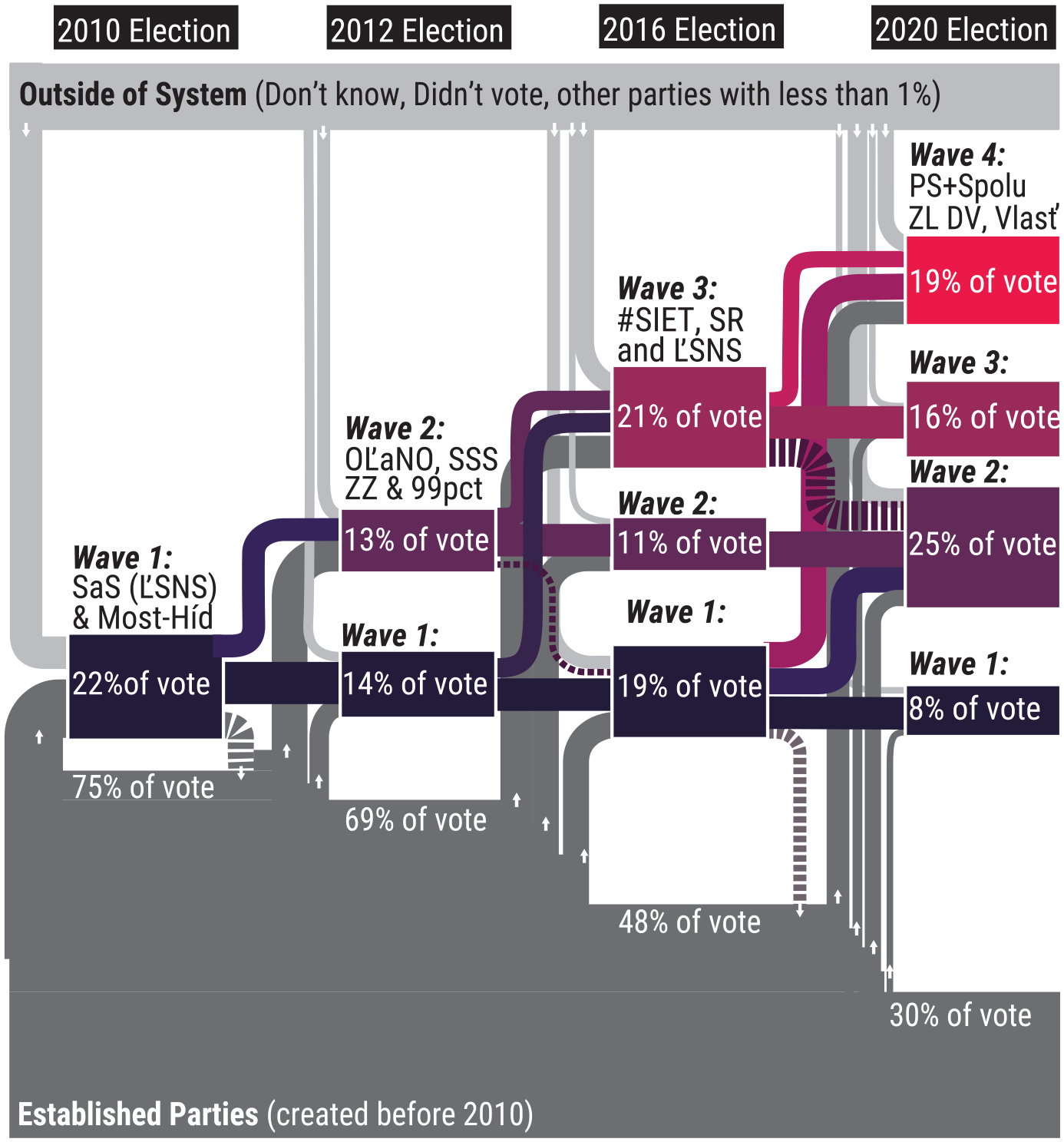
Voter flow between political parties in Slovakia by period of origin, 2010–2020
Conclusion
The 2020 elections demonstrated both continuities and change in party politics in Slovakia. While the results highlighted the enduring role of societal divisions (such as ethnicity) and institutional factors (such as the electoral system) in shaping the country’s politics, the results also underlined changes in the nature of party competition in Slovakia and across the region. Although left–right socio-economic differences and value divisions mattered (between conservative/national on the one hand and liberal/cosmopolitan on the other), themes related to governance were important in shaping voter choice. Indeed, it is helpful to conceive of a third “clean” versus “corrupt” dimension of politics to explain how parties, especially new parties, project themselves against those in power. In the battle between dominance and innovation, 47 the use of such themes strengthens the hands of the challengers and can have a significant effect in party systems like Slovakia with weak levels of partisanship. Moreover, the results underscored the importance of campaign strategies in mobilizing and converting voters in a fluid party landscape, showing in particular the power of framing an election around anti-corruption appeals. Above all, the results of the 2020 election in Slovakia underlined the ramifications of choices, not just the choices of individual voters on election day, but also the strategic and tactical decisions of politicians over their pitch to the electorate and whether to collaborate with like-minded parties or go it alone. A different decision by Kiska over whether to form a party, for instance, and the complexion of the post-election parliament and government would have been (markedly) different. In party systems like Slovakia with a large number of parties, low party identification and high electoral volatility, the impact of seemingly small contingent decisions can be significant.
The election led to Smer-SD’s removal from power and replacement by a new four-party coalition (OĽaNO, SaS, Sme Rodina, and Za Ľudí) with a command of 95 of the 150 seats in parliament. History offered pessimistic precedents for the new government. Another four-party coalition had removed Fico from power in 2010, but failed to last the course, brought down by disagreements over how to respond to the Eurozone crisis. Immediately on taking power, the new Matovič-led government faced the challenge of the coronavirus pandemic, a challenge that quickly exposed tensions within the coalition, and called into question its competence and ability to create coherent, stable governance.
In addition to putting a new government in place, the election reshaped the playing field for many of the main actors. It exposed the winners to new internal tensions and public scrutiny. The challenge for OĽaNO was one of cohesion given both the sizeable defections it experienced in its two previous parliamentary terms combined with the demands and compromises of governing and the difficulty of delivering an anti-corruption agenda in office.
Moreover, as coalition negotiations began, Kiska publicized his health problems and chose to step back from the running of his party, provoking a leadership election and posing questions about Za Ľudí’s future direction and survival. For others, especially Smer-SD, defeat opened up an internal fracture and produced an overt rupture. The new offspring, Hlas-SD was catapulted almost immediately to first place in the opinion polls. By 2021, the oldest party in Slovakia’s parliament, Smer-SD, was barely two decades old and four-fifths of the deputies in parliament represented parties that gained parliamentary representation in 2010 or later. It was a new parliament in more ways than one.
Where newness mattered was in voter movements. Showing similarities to other countries in the region voters tend to go from new to newer parties and are far less likely to return to the more established parties. Once released, the newness genie can be difficult to put back into the bottle. In one perspective, such surface-level change seems unimportant as long as the constantly changing suite of parties is representing the same underlying core interests and value. However, the changing of the guard still matters because every change in direction and every new party requires time to build the stable relationship and linkage with voters that make democratic contestation effective and tend to generate good quality public policy.
Footnotes
Acknowledgements
The authors express their thanks to Martin Slosiarik and his team at FOCUS for conducting the polls for us, the University of Birmingham’s School of Government and Department of Political Science and International Studies for according funds from their respective research funds for the lead author to travel around Slovakia during the campaign, and to this journal’s anonymous reviewers and editors for their constructive criticisms on the initial submission. The lead author also expresses his thanks to his colleagues Nicola Smith, Natascha Neudorfer and Charlotte Galpin for organizing a series of virtual writing retreats which helped us carve out time to write this article when confronted with other challenges associated with the coronavirus pandemic.
