




Abstract
Since 1979 figures have shown an irregular yet overall decline in turnout in the European elections. In her article, Sara Pini analyses this phenomenon from the perspective both of the European Union and the various Member States individually. The author examines different factors which are believed to play a role in influencing citizens to vote or abstain. The level of information provided through communication and publicity by the national media make up crucial elements when it comes to mobilising the population, especially when it comes to young Europeans.
The evolution of voter turnout in Member States
The well-publicised decline in turnout in European elections, a widespread theme both in the literature and in political discourse, is not as simple a phenomenon as it seems. An analysis of the turnout for European elections in the various Member States since 1979 shows an overall decline but also important differences between the Member States and over time. In 2004, for example, there was an important increase in participation in six Member States 1 that was obscured by the very low turnout in new Member States. The same also happened after previous enlargements: in 1999 the turnout in the EU-12 was 56.2% on average, 2% points lower than in 1994, but in the new members the average turnout was only 52.9%. Moreover, in each Member State the decline has not happened at a constant rate but has fluctuated, with periods of both waxing and waning (Fig. 1).
Previous ballots were also characterised by rising rates of participation in some Member States.
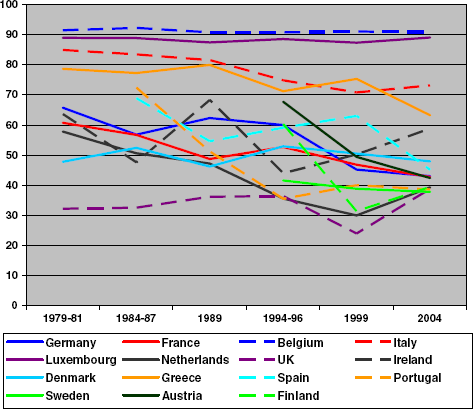
Participation rates for elections to the EU Parliament
We have thus to identify the concomitant variables that may have played a role in influencing the decision to vote or to abstain in each Member State, as well as the explanatory power of each.
The electoral timetable
When other elections take place concurrently with European elections, turnout for the latter increases. Thus in 2004 the abstention rate decreased almost 15% points in the United Kingdom and 8.3 points in Ireland, where local elections were held the same day. On the other hand, in Spain, where no other elections were taking place, the abstention rate increased by more than 19% compared to 1999, when European and regional elections were held at the same time. This also explains the relatively high turnout in Lithuania, compared to the other Central and East European countries (CEECs), as the first round of presidential elections was held the same day.
Conversely, where a national election takes place before the European one the abstention rate in the second ballot is higher. This is known as ‘electoral fatigue’ and is another possible factor explaining the important decline in turnout in 2004 in Spain, where legislative and regional elections had taken place in the two previous years. This probably accounts for the low level of participation in the CEECs, where voters had already pronounced their views on EU membership in 2003.
The correlation between the day of the week the ballot is held, on the other hand, is far from direct. Sunday is generally considered the most favourable day, and countries where the vote is held on Thursday or Friday do have low levels of turnout, but so do many countries where people vote on Sunday: in the seven Member States with the lowest turnout in 2004, all held the vote on Sunday except the Czech Republic.
The voting system
Even though all countries have to comply with some basic principles, such as proportional representation, the electoral system and practical details differ from state to state. We obviously have to take into account the fact of compulsory voting in some Member States, as well as its actual enforcement: voting is compulsory in Belgium, Greece, Cyprus and Luxembourg (in Italy it is no longer compulsory as of 1993), but the effect of this obligation differs, depending on the existence of financial sanctions (Luxembourg and Greece), administrative ones (Greece) or both (Belgium), and the strictness of their application.
In countries where voting is compulsory, the decline in turnout is less dramatic (in Italy the rate of decline has accelerated since 1993) but it is nevertheless real; moreover, these elections are usually characterised by a larger number of blank or invalid ballots.
Other features of the electoral system, often taken into account in the political debate, are less relevant. Thus, the number of constituencies compared to the size of the country or its population can be considered an indicator. In countries such as Spain, where there is just one single national constituency for the entire country, it could happen that most candidates come from the capital region and some regions are not represented at all in the lists. People from these regions could thus be less motivated to cast their ballot. Recent reforms in various European countries have taken this factor into account. In France, for instance, law no. 2003-327 of 11 April 2003 created eight constituencies, thus abandoning the principle of a single national district. However, its influence on electoral participation in France is not clear (in 2004 abstention was still rising, but the rate had slowed compared to the 1994-1999 period). The choice of the voting method, that is, closed list or preference vote, is also often mentioned in the political debate.
The choice of the voting method, that is, closed list or preference vote, is another important element. In the first instance voters are not able to indicate their preference for a specific candidate; they are asked only to approve of or disagree with the party's choice. In this case the chances of being elected depend largely on the candidate's position on the list. Electors will thus be less inclined to vote, as they will have a stronger sense that their vote doesn't really matter. Empirical data however don't provide solid evidence for this theory: preference vote exists in countries with high as well as with low levels of turnout and compulsory vote seems to be a stronger determinative for the formers.
Political factors
Another important variable to take into account is the current state of political affairs at the national level at the time of the ballot.
A political crisis affecting the national government or political representation more widely can lead to the disengagement of the electorate. This was the case in Poland and the Czech Republic in 2004, where elections were held at a time when public attention was focused on the serious difficulties experienced by governments at the national level. In the CEECs, people largely mistrust their political leaders and institutions, and disengagement from politics is strong. This may partly explain the electorate's disaffection with European elections and elections in general.
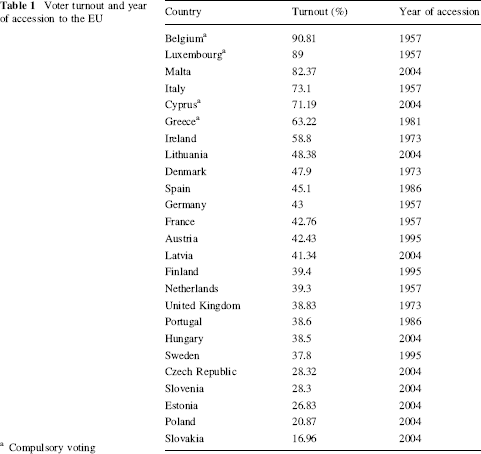
In countries where European elections are more deeply rooted in the national political scene, participation can be stimulated by a stronger European identity and the number of times such a vote has been held. This could account for the lower rates of turnout in the new Member States, whose voters are not used to this kind of ballot and may feel like second-class EU citizens because of the many restrictions and transition periods applied to them. However, the year of accession has not necessarily been a strong determinative: it is true for CEECs but not for Malta and Cyprus; it was not true for the Mediterranean countries of the second enlargement, which had high levels of turnout from the beginning. Turnout tends to decline over time, so a longer period of membership has more a negative impact than a positive one. Finally, an ordering of Member States based on the year of their accession does not match the ordering based on their turnout rate (Table 1).
Voter turnout and year of accession to the EU
Compulsory voting
Another element often underlined is the importance of ‘democratic experience’, but once again, what is true for CEECs is not true for other countries that have experienced a non-democratic phase in their recent history. In the CEECs, in fact, strong participation in the first democratic ballots was rapidly followed by a very significant fall in turnout. This was not the case during the democratic transition in Italy and Germany after the Second World War or in Spain and Greece during the 1980s. Only the case of Portugal supports the hypothesis of rapidly declining rates of electoral participation in countries returning to democracy.
Level of information and interest
Finally, the more an election campaign is publicised and the more its key issues are discussed, the more it will attract voters. It is thus important to focus on the treatment of European affairs in national media, during and before the election campaign, as well as on the informational tools provided by the national government, parties or associations.
The debate around the French referendum on the Constitutional Treaty was, for example, very intense: libraries were filled with books by political leaders from all sides arguing in favour or against the ratification; debates were held every day on television and were followed even by people who normally were not interested in political broadcasts. As a consequence, turnout increased to 69.3%, almost 9% points higher than the first European elections and even higher than all legislative elections held since 1986!
Ireland experienced the same situation in 2008, when, after a hard-fought campaign, 53% of Irish voters cast their ballot to express their opinion on the ratification of the Lisbon Treaty, a rate which was well above the 35% of the referendum on the Nice Treaty in 2001.
But the positive effects of an intense campaign are not confined to referendums. In the 2004 European elections, the United Kingdom experienced a record (for that country) participation rate of 38.83%, impressive progress compared to the 24% participation rate in 1999. In this election, the United Kingdom Independent Party, which had been quite marginal until then (7% support in the 1999 European elections), received 16% of the votes, thus becoming the third-biggest party in the country. Mobilisation of the eurosceptic coalition can thus lead to an increase in participation as well, as it will attract people wishing to express their discontent through a protest vote.
The specificity of European elections
The first chapter has provided some possible explanations for an increase or decrease in voter participation in each Member State, as well as for differences between countries. Our next step is to determine why factors negatively affecting participation seem to have a greater effect on European elections than on national ones, while at the same time the European Parliament enjoys a better reputation than national institutions in many Member States.
In fact, the spring 2008 Eurobarometer [3] provides evidence that Europeans have more trust in European than in national institutions. Only 32% of the respondents in the 27 Member States declared trust in their national government and 34% in their country's parliament, while 50% affirmed their confidence in the EU, 52% specifically in the European Parliament and 47% in the Commission.
Abstention at European elections is not irrational behaviour; on the contrary it is the logical consequence of the way the European political system works and is organised. Some of the factors include
poorly identifiable political issues, the absence of a real campaign and the lack of clear ideological stances;
a weak perception of what is at stake in these elections, why it is of interest to the voter, its concrete fallout and thus the importance of choosing someone close to one's interests and political preferences;
the complexity of the European political and institutional system and the difficulty of understanding it; and
the absence of a truly European public sphere and hence of truly European elections, which are more a collection of national elections.
We need to compare national and European spheres at different levels, first of all the Members of Parliaments themselves. A seat in the European Parliament should be a highly desirable target for each politician, as a substantial part of the legislation passed by national parliaments is for the purpose of incorporating EU law into national law. The prestige of a career in European politics should thus increase as the European Parliament acquires a more central role in EU policymaking. Despite these prospects, in many countries politicians seek a seat in the European Parliament only as a second choice. It is thus easy to understand that these politicians will hardly campaign with enthusiasm and that electors will not be eager to vote. The distance between the MEP and his or her constituency will grow over the term, as euro-parliamentarians rarely visit their electors to give them an account of their decisions and positions taken in the European policy arena.
A second element which contributes to an explanation for the lower level of participation in European elections is a lack of information: the visibility of electoral platforms and of candidates, the relevance of the issues at stake, information about the campaign and its presence in the media–-all are much reduced in a European campaign as compared to national and even local ones. Because the national level remains the main point of reference for candidates to the European Parliament, and because they depend on the national party in order to run for seats in the European assembly, candidates don't need to defend a solid and comprehensive programme in order to get elected. Added to this is the national bias of most media in the treatment of information, which helps to explain why campaigns for European elections rarely last more than 1 or 2 months, but also why they are often dominated by national issues, leading to what the literature defines as a ‘second-order election’.
Turnout in European elections will rise if voters feel that something important is at stake. They will in fact be more inclined to cast their ballot if they believe that their vote matters and that the issues at stake have an important impact on their lives. That is why it is important to focus on issues that are political rather than institutional. Issues such as the number of commissioners or the weighting of qualified-majority voting do not have the power to inflame the passions of the electorate. But this is not enough: the European Parliament's increased power, its growing centrality in the European decision-making process as well as in the national legislative arena, its impact on European citizens’ everyday life did not manage to raise electoral participation, nor did the fundamental questions at stake in 2004.
It is in fact necessary that voters be aware of what is at stake, that issues be publicised and, even more important, politicised. Differences must be visible and a real debate must take place, in which each political option is clearly identified with a party or a candidate. For this purpose, an in-depth campaign, starting soon and taking advantage of all possible means of communication, is needed to inform citizens first of all of the existence of European elections (in spring 2008, only 16% of European citizens knew that such a ballot would take place in 2009, and in November of the same year this percentage had grown only to 26%) and then of the issues, the political programmes and the candidates.
At the moment, these ‘evaded campaigns’ [4] remain too short, too national and without passion or strong interest. This leads to the disengagement of the electorate. Lack of awareness and the indifference which stems from it, both linked to a lack of information and education, constitute a valid explanation for abstention in European elections and notably of the difference in turnout between European and national elections.
We have to teach national media how to talk about Europe: there are no truly European media, and the European public space is still under construction. The few existing examples are too often confined to a small circle of the initiated. We also have to adapt to new forms of communication, in particular in order to address young people, who read fewer newspapers and are less engaged in political parties and trade unions but meet, exchange and form their political beliefs on the Internet, on blogs and on social networks. In that sense, the EU has a unique opportunity, as these new forms of interaction represent a public sphere with less rigid national boundaries, where international exchanges are more common and where it is easier to keep in touch with distant realities.
Finally, an understanding of the European governance system is also needed if people are to vote: we have to take into account the specific political culture of each country, which partially or largely shapes the vision and the understanding of the European system in general and of the European Parliament in particular. For example, the European search for consensus and the care taken to avoiding a vote which would put a party in a minority position is absolutely logical for a Belgian but an aberration for a Briton, because it is close to the former's political system and completely opposite to the latter's. Where a Belgian will find an honourable attempt to avoid a crisis, a Briton will see an intolerable outrage to democracy, which is mainly based on the majority/opposition principle.
Young people and the European Parliament: indifference or different engagement?
The previous section helped us to understand the differences between turnout in European and national elections, but there is still a paradox which needs further explanation: why does the disaffection with European politics mainly affect young people (only one-third of 18-24 year olds voted in 2004), who at the same time show more confidence in and affection for the European Union? Does this prove a level of indifference or hostility towards Europe and the EU, or does it simply reflect a desire for more direct forms of participation and engagement?
Two distinct but nevertheless similar phenomena characterise young people's electoral behaviour in Europe: disengagement, which turns into abstention, and protest mobilisation, which is expressed in European elections as a eurosceptic vote and in referenda on European matters as a ‘no’ vote, and is motivated by dissatisfaction with national governments or Europe. But even abstention, at least at the European level, comes closer to protest than indifference, according to Muxel [5], and reflects ‘a redefinition of the place of voting between all possible tools of political expression […] less a lack of democracy than a transition toward a more critical model of civic expression’. Abstention can thus represent a form of ‘electoral dissidence’ [7], of the weakening of representative democracy and the shift towards new forms of political participation.
The 2007 Gallup survey of young Europeans [1] indicates that despite the fact that a majority of young Europeans consider themselves interested in politics and current affairs in their own country and in the EU, only a minority is engaged in political parties or trade unions. They seem to favour other forms of political action to make their voice heard by policymakers, such as demonstrations, strikes, Internet forums and petitions.
The paradox of young people's low turnout, coupled with their stronger confidence in European institutions and attachment to the European project, can thus be explained by their use of new forms of political engagement. This could reflect a general criticism of politics as usual, as offered by traditional parties or candidates, but also of the idea of representative democracy itself, which is the foundation of modern politics.
In this context, it is useful to analyse the political debate that took place around the Constitutional Treaty and the Lisbon Treaty's ratification.
The French debate raised the issue of the more democratic nature of referenda compared to parliamentary ratification. While the entire political spectrum favoured the ratification of the Lisbon Treaty, the support for a new referendum was widespread, in public opinion as well as within both the left-wing and right-wing parties. Such arguments are not limited to the French political scene as they were used to justify, beyond the constitutional requirement, the choice of a referendum in Ireland.
These kinds of assertions could be a sign of the decreasing credibility of parliaments in general as symbols of representative democracy. Parliaments are no longer seen as the expressions of the people's will and thus of democracy, but more and more, especially in southern and eastern countries, as lethargic, inefficient institutions sheltering privileged and sometimes corrupt politicians who are no longer in touch with the real needs of the people they govern and represent.
Protest can also be addressed towards European politics. Eurobarometer data may well show strong confidence among young people in European institutions and support of European integration, but the way the questions were conceived, the evident will to avoid difficult issues and to use consensual formulations that call for positive answers make the Eurobarometer a poor instrument to measure the reasons for the dissatisfaction of younger voters and hence of their low turnout. General support for the EU does not exclude the desire for another Europe, as shown by the debate around the Constitutional Treaty and the Treaty of Lisbon.
Finally, protest can also be addressed directly at national politics: because issues are not clear or do not seem relevant in European elections, the political space is filled by national issues. The ballot turns thus into an occasion to sanction the national government without consequences, in what [6] called ‘second-order elections’. This explains why these elections are characterised by a diminished vote for the political parties that form national governments, especially if they have been in power for a long time, and by the rise of parties outside of the national system.
While ‘indifference abstention’ mainly concerns less politicised sociological categories and often corresponds to a more systematic abstention, ‘protest abstention’, which is becoming the main form of political behaviour among young people (notably in the CEECs, Italy and Germany) mainly concerns politicised groups and often corresponds to a more intermittent relation to voting. The first kind of abstention is linked to a lack of information and to a less-developed sense of belonging to the EU; the second has a more political meaning and reflects hostility not towards Europe as such, but towards the kind of Europe which is being built. This second kind of abstainer tends to decide whether to vote or not at the last minute. We should thus work to turn this volatility, which mainly affects young voters, 2 into the European Parliament's advantage.
Of those voters over 55 years, 60% are loyal to their previous vote, while only 35% of voters between 18 and 24 years and 48% of those between the ages of 25 to 34 are. 15% of voters over 55 decide whether to vote or not a few days before the election, while 31% of voters between 18 and 24 do so.
The fact that political Europe is being built at the intergovernmental level, between elites, amid the general lack of interest among European citizens is a problem for European democracy, for sovereignty and decision-making are moving away from the national level and towards a level which still lacks genuine electoral legitimacy. Universal suffrage does exist, but European citizens have not yet seized this opportunity to invest the institutions in charge with democratic legitimacy.
In this respect, the European Parliament and the groups and members sitting in it enjoy a significant advantage: a majority of Europeans, and an even more important majority of young Europeans, consider that the European Parliament ‘should have the greatest decision-making power within the European Union’ (47%), that it is ‘democratic’ (69%) and that it has a positive or a neutral image (80% and even 85% for 15-24 year olds) [2].
In the lead-up to the June 2009 European elections, MEPs and parliamentary groups should make no mistake about it: the road that will bring young Europeans closer to politics and restore representative democracy's reputation passes through Strasbourg.
Footnotes