




Abstract
Establishing representative bodies for the regions was an opportunity for politics to be decentralized. Using a three-dimensional index of congruence of the vote, this article explores the extent to which this opportunity has been taken up in Czech regional elections. Analyzing all such ballots since 2000, it compares electoral competition at the national and regional levels; the success of regional parties is also analyzed. The results show that Czech regional polls are strongly national in flavor, and their results are similar to those of national elections (only the second-order-election effect is visible); the success of regional parties is very limited, while national parties clearly dominate.
Keywords
Introduction
Traditionally, electoral research has paid most attention to national elections, even though “regional elections are clearly on the rise.” 1 This “methodological nationalism” in election research has been criticized more than once. 2 The main reason for the limited interest in regional polls is probably their nature as second-order elections. However, Schakel and Jeffery and Romanova 3 have criticized the tendency developed by Reif and Schmitt’s theory 4 automatically to assume that these are second-order elections, as a number of factors influence whether they can be considered second order or not. These include, in particular, the powers of the body that is elected, the involvement of a regional (rather than countrywide) party or parties, and the lack of a direct link with the formation of the national government, if regional elections are held concurrently with national elections. Thus, the specific aspects of any elections analyzed should always be examined in detail.
According to Schakel and Romanova, the scholarship on regional elections brings many benefits: “a refinement on the scope conditions of the second-order election model; the introduction of the concept of barometer elections; and the insight that each regional (and national) election is regionalized or nationalized to a certain extent.” 5
Examining regional elections is also important because of their relationship with the decentralization of power, which gives political parties and voters opportunities to mobilize and address issues of importance at the local level, possibly leading to a greater interest in democracy. 6 Schakel and Romanova assume that “voters differentiate between national and regional elections based on variations in regional policy autonomy.” 7 Political parties are then motivated to adapt their policies to the regional electoral arena if it is politically beneficial to diverge from the party’s nationwide policy. 8 According to Amat and Léon, decentralization affects parties themselves as it tends to promote greater independence from their centralist leaderships (e.g., by allowing more independent election strategies). 9 Furthermore, decentralization changes the environment to benefit regionalist parties, and thus electoral arenas diverge (with fewer spillovers), with, for instance, national parties gaining much less from their participation in regional coalitions or tending to establish more radical profiles alongside the center-periphery axis.
Voting in regional elections can take on a different form from national elections due to region-specific preferences. Schakel and Romanova argue that specific regional interests can be expected when there are territorial cleavages based on, e.g., history, language, or ethnicity. 10 Bochsler notes the effect of ethnic divisions, which decrease the measure of the nationalization of the party system. 11 Liñeira stresses the influence of the regional identities of voters on their perception of regional elections. 12
The degree of regionalization is reflected in the incongruence of party systems in national and regional elections. 13 Schakel and Dandoy argue that “regionalized regional elections are characterized by similar or higher levels of turnout compared to national elections, minimal second-order election effects, and electorally strong non-state-wide parties with vote shares close to or above 30 percent.” 14 Some studies point to a decrease in the nationalization of regional elections due to increasing regional authority and strong regional identities. 15 According to the same authors, “regional party systems become increasingly dissimilar from national party systems and the second-order nature of regional elections declines to the extent regional government becomes more powerful and/or regional cleavages are present and politically mobilized.” 16
In contrast, Caramani argues that, despite strong institutional decentralization, there is no evidence of the vote being regionalized. 17 This approach emphasizes the nationalization of politics and party systems, including regional elections. 18 According to Golosov, high degrees of political decentralization exert a strong negative effect on party system nationalization. Countries with large populations and societies divided along linguistic and/or religious lines also tend to have party systems that are less nationalized. However, different factors may strongly contribute to party system nationalization, even in federations. The most prominent among these is a high level or quality of democracy. 19
According to Schakel and Romanova, “nationalized regional elections can be recognized by highly similar regional and national party systems, second-order elections lead to dissimilar regional and national party systems according to the magnitude of second-order election effects.” 20 Also, in nationalized regional elections, regional parties cannot be expected to have much success. As recently shown by Tsirbas and Romanova, some regional elections may thus be simultaneously regionalized and nationalized. 21
Most studies to date have examined established Western democracies, yet longer experience with democratic institutions and a greater quality of democracy are important factors for regionalization.22,23 Our study therefore examines the regionalization/nationalization of regional elections using the case of the Czech Republic with the aim of answering the following questions: Is political competition at the regional level identical to national political competition? How successful are regional parties? And to what extent can regional elections be described as second-order elections?
The Czech case is worth examining for several reasons. Not only is it a case outside the Western democracies that have received most of the attention, but it is also a country with an interesting tradition of decentralization. While any decentralization efforts were severely weakened after the collapse of the multi-ethnic Czechoslovakia, the Czech Republic is made up of three historical macro-regions that used to have their own governance—Bohemia, Moravia, and part of Silesia. The Czech Republic thus offers an opportunity to study the impact of historical decentralization on contemporary regionalization. Moreover, the Czech national and regional elections use an almost identical (proportional) electoral system. This removes a significant methodological obstacle for comparing national and regional electoral arenas that has caused problems for research in many other countries.
Regional Elections in the Czech Republic
After the dissolution of the Czechoslovak Federation in late 1992, a new regional division of the country was sought. It was not until 2000 that the Czech Republic was newly divided into fourteen regions (technically “higher-level territorial self-government units”). Simultaneously, new, directly-elected regional governments were established, which have become an important part of the Czech constitutional order. The first elections were held in 2000 and have taken place regularly every four years since.
Note that the final form of the regions fails to respect a number of natural administrative and communication routes, and a number of old regions were treated insensitively. The present regions were thus created on an artificial, non-historical basis, failing to respect the old settlement and administrative catchment areas. Dissatisfaction with the regions was retrospectively expressed by a number of politicians across the political spectrum. 24
Our paper partly builds on the work of Pink 25 ; however, unlike him, we examine the regionalization of regional elections after a period of large recurrent electoral earthquakes. 26 The decline of the major parties that have dominated the political scene since the early 1990s and major changes in the party system could theoretically provide opportunities for regionalization. Similarly, the longer existence of regions gives more opportunities for regional identities to emerge, which may in turn be reflected in the regionalization of elections. Compared to the work of Pink, our article also analyzes the congruence of individual parties’ results and thus offers deeper understanding. Furthermore, our contribution is that, in contrast to many other recent studies that focus on a single election, 27 we examine the results of as many as six regional elections and compare them to a corresponding number of national elections.
Methods and Data
The regionalization of regional elections can be measured effectively by comparing political competition at the regional and national levels. 28 It is often the electoral outcomes and gains of political parties that reflect the political mindset of voters and their identities, including the extent of political regionalization. If regions have a strong identity and therefore regionalize politics, this should be reflected in regional electoral competition, where we would expect to see relatively weaker performance of national parties (compared to the national arena) and conversely success for regional parties. If politics is scarcely regionalized, we expect the regional electoral contest to match the national one, with national parties succeeding. Therefore, this study compares regional electoral competition to national electoral competition using the Index of Congruence of the Vote (IoCV). Given the nature of this instrument, the paper also secondarily describes the main trends in the success or failure of political parties in regional elections.
At the same time, we focus on whether regional elections have the nature of second-order elections. Specifically, we compare the electoral performance of the government parties and opposition parties in regional and national elections. 29 Finally, we analyze the performance of regional parties in regional elections. If regional elections are regionalized, significant regional parties are expected in the system. Those are parties that do not operate nationwide and are regularly able to win seats in regional elections, which are their primary arena.
With reference to the different historical experiences with self-governance of the two historical macro-regions of the Czech Republic—Bohemia and Moravia (the small part of Silesia that is part of the Czech Republic is associated with the Moravian region in this research)—we also investigate whether the existence of the historical macro-regions is reflected in contemporary regional politics, i.e., specifically whether the degree of nationalization of regional elections differs in these two historical macro-regions.
Hypotheses
Applying the theory to the Czech case, we propose the following four hypotheses:
Congruence of the Vote
As we already argued, a comparison between regional and national election vote shares is widely used to assess territorial heterogeneity in the vote. 30 Dissimilarity scores are calculated by taking the sum of absolute differences between regional and national vote shares for each party and subsequently dividing the result by two. In this article, we apply an adjusted dissimilarity index which allows us to vary vote shares according to the type of election as well as the level of aggregation (Schakel 2013), whereby Xi is the vote share won by party i in election j or l (dis)aggregated at the territorial level k or m. The type of election as well as the level of aggregation can vary between regional and national levels. The absolute values are summed and divided by two to avoid double counting (one party’s gain is another party’s loss). Scores may range from complete congruence/similarity (0 percentage points [pp]) to complete incongruence/dissimilarity (100 pp).

In most published papers, the index takes three forms:
Party system congruence: similarity between the national vote at the national level and the regional vote in the region (NN-RR)
Electorate congruence: similarity between the national vote at the national level and the national vote in the region (NN-NR)
Election congruence: similarity between the national vote at the regional level and the regional vote in the region (NR-RR)
Data
The main source of data is the archive of election results held by the Czech Statistical Office, available at www.volby.cz, and a number of publications on this topic as described earlier. We analyze data from six regional elections (2000, 2004, 2008, 2012, 2016, and 2020) and related national elections. The Czech Republic has de jure fourteen regions including the capital, Prague. However, the capital city has its own status outside regional government, and the elections in Prague have a number of unique regulations. Most importantly, elections in Prague are held at the time of local elections, which take place two years after regional elections in a completely different social atmosphere. Also, a completely different electoral system is used, allowing a panachage procedure. Compatibility with elections in other regions is thus de facto non-existent. For that reason, in what follows, Prague is disregarded entirely, and all the analyses and calculations are based on the results of the elections in the thirteen regions only.
Territorial Distribution of Electoral Support
The preceding sections described the context of Czech regional elections and what we know about them so far. Now we shall focus on the electoral support for parties and its analysis using the instruments as noted. If we view regional elections as a nationwide contest—but one that uses a different set of rules from that used to elect the Chamber of Deputies, the lower chamber of parliament—the triple IoCV as described can help us to understand them. Electorate congruence (NN-NR) is a measure of the similarity or dissimilarity between the results of the elections to the Chamber nationwide and at the level of regions. The indicator makes it quite clear that the results of the national elections have been very evenly distributed among the various regions, and according to Figure 1, there have been no substantial differences. The support for political parties is more uniformly spread in Bohemia, where the NN-NR index did not reach values above 1 pp. By contrast, in the eastern part of the country, in Moravia, it exceeded 1.5 in 2000, which is still a very low value. Moreover, the trend in the two macro-regions is the same—a decreasing index, and hence increasingly even distribution of support for parties over time. Despite the slight difference between Bohemia and Moravia, no significant regionalization was observed in the Czech party system.
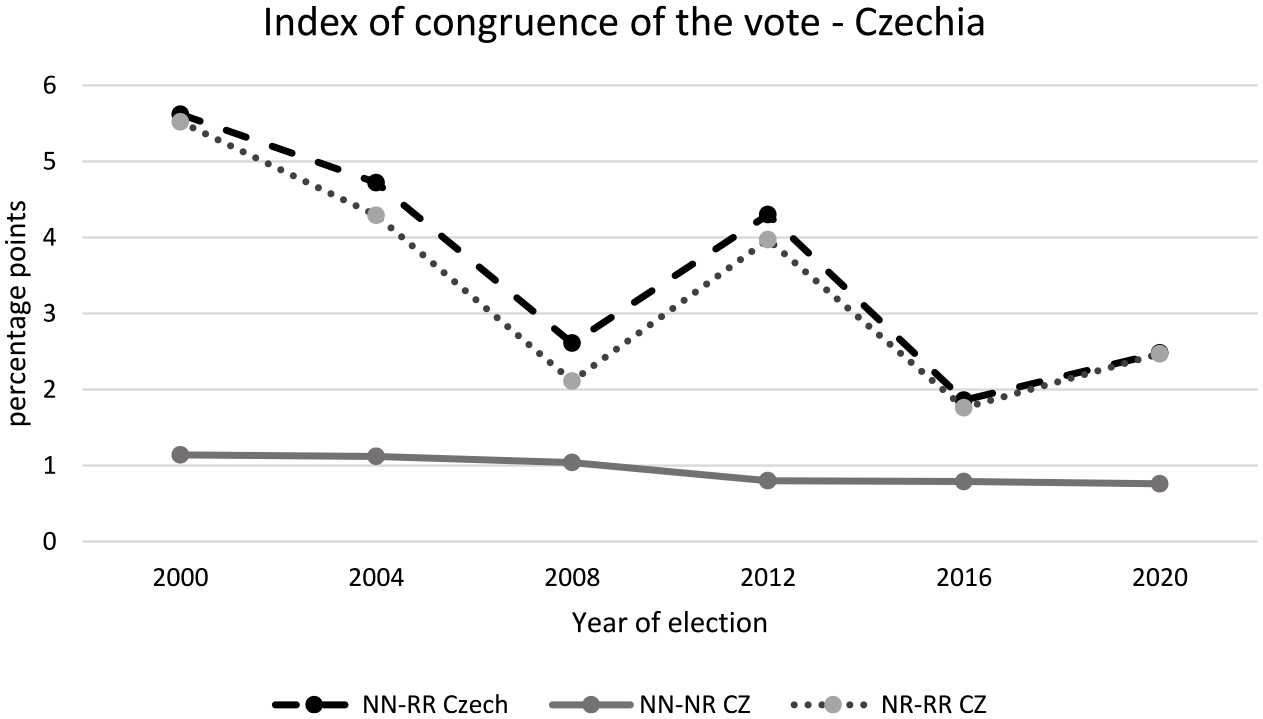
Decreasing values of IoCV during the time. Their indices show relatively stable support for the political parties across regions during the time
The second indicator of the congruence of the vote (NR-RR) shows how the results of elections to the Chamber and regional elections differ in the same territory, i.e., the thirteen regions, across time. With this indicator, greater differences are apparent, as suggested by the maximums in 2000, 2004, and 2012, in particular. In these elections, which were always held with some time lag after the elections to the Chamber—at about the mid-term of the government—the interregional differences were the greatest. This means that people in various regions voted relatively differently in elections to the Chamber and regional assemblies. The lowest values were recorded in 2016, followed by 2008 and 2020, when people voted similarly in both elections in regions. The NR-RR index was very similar in the two macro-regions observed.
The third and last indicator (NN-RR), which shows the party system congruence nationally and regionally, exhibits the greatest variance. It shows the difference between the percentages of the vote obtained by parties in national elections to the Chamber and regional elections. These are the averages of the results achieved by parties in those years. Since Czech political parties enjoy stable support across regions in elections to the Chamber, as shown by the NN-NR index, the NN-RR and NR-RR indices are very similar. We again observe that, in the elections in 2000, 2004, and 2012, the results of national and regional elections were different at the level of the individual regions. By contrast, in 2008, 2016, and 2020, the differences between the party systems nationally and regionally were relatively small, as the two most recent elections were not held during the government’s mid-term. With this index, we also observe the greatest differences when comparing election results in Bohemia and Moravia. In Bohemia, it reached the highest value—above 5 pp—in 2004. In that same year, the index in Moravia was less than four. By contrast, the maximum in Moravia was achieved in 2000, when the value of the index was above 6.5. Considerable growth appeared in both macro-regions in 2012 but was quite brief. In recent years, however, the values of the index have been very similar in the two macro-regions observed.
The overall values of the individual indices do not exceed 6 pp, and they reached this value rather exceptionally during the first regional elections. On the contrary, the index values confirm that, overall, there is a relatively high correlation between national and regional elections. Thus, it is hardly possible to detect any trend towards regionalization, especially in the last two elections, when the values of the index indicators did not exceed 3 pp. These patterns confirm the assumptions made in Hypothesis 1.
Main Political Actors
If we want to analyze regional elections in relation to the current Czech party system, it is best to distinguish two clusters of political parties for a full understanding of the restructuring of the party system in Czechia. This also enables a potential effect resulting from changes in the party system to be assessed.
Thus, we distinguish (1) traditional political parties established in the early 1990s that created the foundations of the party system; these were stable political actors until 2020, with variable electoral support. (2) Newly established political parties, the political actors of the last decade; they have been emerging since 2009 and have gained relevance during the reshuffling of the party system after the electoral earthquakes of the past decade, demonstrating a loss of domination by traditional parties.
Traditional parties
a. The Czech Social Democratic Party (ČSSD—Česká strana sociálně demokratická) is the main representative of left-wing values in the Czech party system. In the early 1990s, it defined itself in opposition to the liberal-conservative government coalition. It took on the government role in 1998, which it continued to perform after the next elections in 2002. In 2006, it joined the opposition and, although it gained the next elections to the Chamber, it did not form a government coalition. 31 It again became the main party of government in 2014; after the elections in 2017, in which it suffered a significant slump, it was the junior partner of the ruling ANO 2011 party.
In assessing the results, it is apparent that it reached its maximum value in 2008 when it exceeded 35 percent of the vote. In the same elections, an overall maximum was reached—over 42 percent—a result to which ČSSD was not even close in other ones. In 2012, they, again as an opposition party, also achieved a high average result, over 23 percent, and they won in all regions. ČSSD met with the minimum response on the part of the electorate in the most recent election and suffered substantial loses. Moreover, in 2020, it received less than 7 percent of the vote, and ČSSD failed to cross the 5 percent threshold in several regions. Their regional elites were weakened.
b. The Christian and Democratic Union–Czechoslovak People’s Party (KDU-ČSL–Křesťanská a demokratická unie–Československá strana lidová) is representative of the Christian-democratic political bloc, described sometimes as the center of the Czech party system. It faced a number of unfavorable circumstances, including a concentration of its electoral support in some regions, decreasing religiosity in Czech society, and a split in the party in 2009. Although the KDU-ČSL has been gradually marginalized within the party system, it has been a part of the government majorities most of the time, with a high coalition potential. 32 Three years after the historic failure in 2010, it managed to cross the 5 percent threshold and return to the Chamber of Deputies. Given the prevailing balance of power at the time and the party’s political temperament, it went straight into government, where together with ČSSD and ANO 2011, it created government policy after 2013.
Thanks to the regional nature of KDU-ČSL support, its regional election results have been unique. It has long been able to win strong support and representation in some regions (Zlín, South Moravia, Vysočina, and Pardubice). In the north of the country, by contrast, the party regularly fails and seeks to enter into various alliances and coalitions with local political entities. Due to this aspect of regionally concentrated support KDU-ČSL has been able to win representation in the leadership of some regions, including governor positions—once regions were established, the party obtained very strong positions there and, with five governors, influenced the foundation of many regions. The minimum and maximum values for this party range from the weakest performance equalling zero 33 to the strongest above 30 percent. It suggests the already-mentioned regional disproportionality in the party’s electoral support, which confirms a number of earlier findings about the party’s electoral base. 34
c. The Communist Party of Bohemia and Moravia (KSČM–Komunistická strana Čech a Moravy) continues to be the main heir to the non-democratic regime before 1989 and, at the lower levels of the system of government, has been moderately successful. The party’s messages and program (which have become more moderate over the past two decades) are focused on defending left-wing socio-economic values; but in matters of culture, the party mainly advances conservative values. The KSČM has long questioned the Czech Republic’s pro-Western orientation, including its membership in the European Union and especially NATO. Although represented in the Czech parliament, unlike local and regional politics, it has long been the subject of a convention to exclude it from national politics, and its coalition potential nationally was for long non-existent. This changed after the 2017 elections, when the party facilitated the formation of a minority ANO and ČSSD government, which relied on its support. KSČM is the most successful of those communist parties in Central Europe that stayed close to their pre-1989 traditions.
The party’s share of the vote reached a maximum above 28 percent in 2000 and somewhat lower figures in 2004 and 2012. It is probable that in the first two elections it attracted votes because it was the only left-wing party of the opposition (the social democrats were in government at the time). Recently, the results of KSČM in regional elections show a modest success rate. This decrease is a great loss for a party for which decent polling performance in regional elections had been a way out of isolation.
d. The liberal-conservative Civic Democratic Party (ODS—Občanská demokratická strana) was the main successor to the Civic Forum established in 1989 and promotor of the economic and social transformation process following the fall of communism. ODS long served as the main party of the right. It remained the main party of government until 1998 and led the gradual transformation and democratization of the country. 35
After the elections in 1998, it concluded a pact with its main rival, ČSSD, that continues to be seen as bizarre by many, as it bound ODS to tolerate a minority ČSSD government. By contrast, after 2002, as the social democrats continued to govern, ODS dominated regional elections, winning most of the governorships and, in Central Bohemia, polled 44.65 percent of the vote. Contrariwise, two regional elections, in 2008 and 2012, held at the mid-term of unpopular center-right governments, were fiascos for ODS. It was in particular the slump following the Nečas government in 2013 that questioned the position of ODS as the pole in the right-wing segment of the political spectrum. In 2020, the party obtained regional governorships for the first time since 2004. However, there has been a gradual transformation in the party overall; it shifted from social-liberal (during the government of Mirek Topolánek) to social-conservative positions (the government of Petr Nečas and the leadership of Petr Fiala) on issues such as the integration of minorities in society, the role of religious principles in politics and alternative life-styles. 36
Support for ODS is distributed relatively uniformly across the country. It tends to be stronger in Bohemia, especially in Central Bohemia and Plzeň. By contrast, its positions have been weaker in Moravia, especially in recent years. The party has long polled about 20 percent of the vote, but after 2012, this declined to about 10 percent. Despite this slump until 2020 it stood on its own in regional elections and has been able to win more than 5 percent of the vote in all regions.
New parties
a. Smaller liberal parties have won seats in the Chamber, albeit sometimes only for a single term. This is not a homogeneous group of parties, though they are mostly centrist, mostly liberal in orientation and appealing to similar electorates (urban voters, intellectuals and, usually, younger people). Over time this ‘quasi-movement’ has become a firm part of Czech party politics, although it has been subject to fluctuations and has not been particularly strong in winning vote shares or seats. Its importance is due to its centrist position that has allowed its representatives to serve as junior coalition partners (in the 1990s, with ODS; after 2002, with ČSSD; after 2006, again with ODS).
Historically these small parties included US-DEU (1998-2002, latently until 2006) and the Greens (Zelení) (2006-10). In 2010, the role was taken on by the newly-formed Tradition Responsibility Prosperity 09 (TOP 09), led by Miroslav Kalousek, and its important and close ally, the group of local politicians called Mayors and Independents (STAN—Starostové a nezávislí). Until 2016, TOP 09 and STAN constituted a single (electoral) party. 37 However, they contested the 2017 elections to the Chamber separately and both narrowly crossed the election threshold. In 2017 they were joined at the national level by the Czech Pirate Party (Česk. pir.tsk. strana), which gradually became stronger and hence became the third representative of this liberal-oriented movement around the political center. In the subsequent regional elections, the Pirates put members into all regional assemblies. 38 The Pirate Party had long been unable to break into parliament and their gradually improving results at the lower levels of politics facilitated its success. 39
The aggregated support for these liberal parties has been on the increase. However, it needs noting that the structure of these parties has changed over time and in 2025 there are three of them. Though their average aggregated result in 2017 was 9.57 percent and in 2020 16.14 percent, the vote shares won by the individual parties varied widely across the country. The support for these liberal parties is also regionally specific with huge differences. While in the Moravia-Silesia region it has long been very low, in Liberec their combined share of the vote exceeded 38 percent in 2020. In considering the level of support for these parties we also need to bear in mind that they were in opposition from 2013. 40
b. ANO (ANO 2011), led by businessman Andrej Babiš is a political movement founded in 2012. It took to the Czech political stage with a bang the next year, when following national elections it became the junior coalition partner of the Social Democrats. Following the next elections in 2017 the two parties switched their positions and ANO dominated the Czech political scene until 2021. The party, which describes itself emphatically as a “movement,” originally established its profile on the issue of fighting corruption and traditional political parties. It is a party with strong populist tendencies and orientation, vehemently critical of the political establishment. It has also been considered a business-firm party. 41
ANO, the party of government, achieved similar scores in both years, although it fared slightly better in the latter elections. The average vote share in 2016 was 20.81 percent, while in 2020, it was 1 pp higher. Similarly, the minimum share of the vote won by the party increased in the most recent regional elections, while the maximum increased by nearly 5 pp.
c. While ANO can be described as Andrej Babiš’s party, Dawn of Direct Democracy (ÚPD—Úsvit přímé demokracie) and its direct successor, Freedom and Direct Democracy (SPD—Svoboda a přímá demokracie), have both been projects led by Tomio Okamura. 42 In addition to promoting direct democracy and criticizing the elite, SPD’s program has a strong nativist bent. Since the outbreak of the migration crisis in 2015, it has been a vocal critic of migration and of Islam. In this respect, it can be described as a populist far-right party, although not an extremist one. SPD is also strongly critical of the European Union and pushes for the Czech Republic to leave it. It cooperates with foreign parties of a similar orientation, including Marine Le Pen’s National Rally.
Tomio Okamura’s parties fared similarly in the two regional elections observed, in 2016 achieving an average result of 5.82 percent of the vote, and in 2020, 6.20 percent. Minimum and maximum vote shares achieved by the party in regions are likewise similar; in 2020, the party did a bit better. 43
Analysis of IoCV of Individual Parties
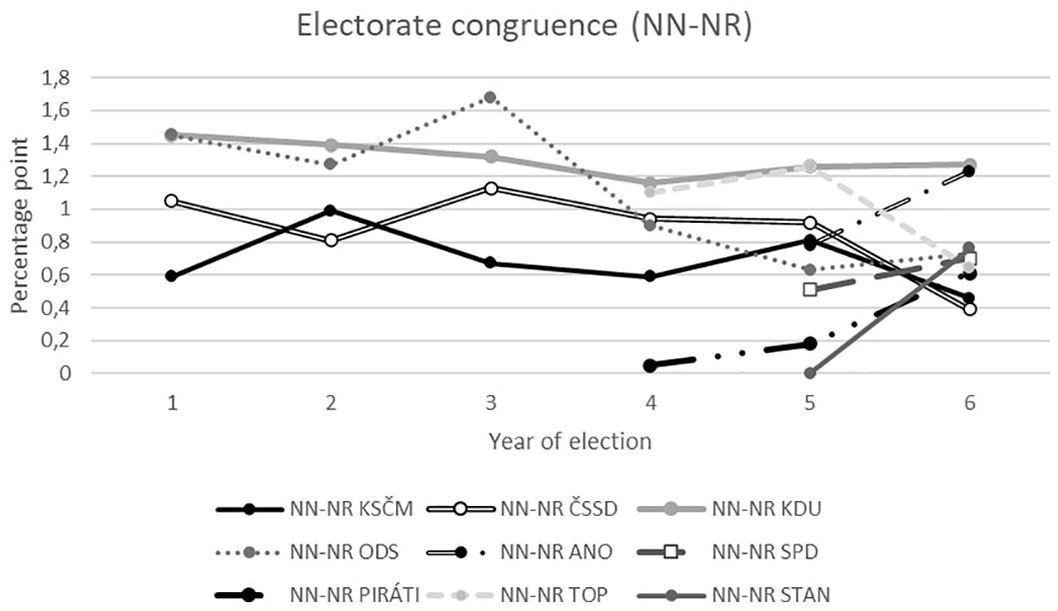
Similarity between the national vote at the national level and the national vote in the region was quite stable during two decades for the majority of parties, even the newcomers
The index of electorate congruence (NN-NR), which only uses the results of the elections to the lower chamber of parliament, has been relatively stable; throughout the two decades, the variance in ČSSD electoral performance has been very low. There is only slightly higher value in Moravia than in Bohemia. This shows that ČSSD has enjoyed stable support across all Czech regions, especially in Bohemia. The index reached its lowest value after 2017, when ČSSD polled its historically worst result in elections to the Chamber (7.27 percent).
Similarly, for KDU-ČSL the measure of NN-NR between the various elections is very similar here. Thus, the party’s performance across constituencies in the elections to the Chamber does not show substantial fluctuations. There are not even differences between Moravia and Bohemia.
Figure 2 suggests that, in elections to the Chamber, KSČM enjoys very stable support across all regions—this is true for both Bohemia and Moravia. The very slight fluctuations follow the same pattern in both macro-regions. As with ČSSD, the evenness of support increased after 2016 as the party’s electoral performance declined.
The support for ODS has lower electorate congruence in the individual constituencies (regions); in elections to the Chamber it is more varied (particularly in Moravian ones). This effect was the greatest in the 2008 elections (reflecting a huge slump compared to its previous parliamentary result), reaching 3 pp, but then decreased steadily, reaching a level similar to that in Bohemia.
Concerning new parties, for TOP 09, NN-NR indicates low values in both macro-regions. It reached under 1.0 pp recently, and there appears no difference from traditional parties’ trends. On the contrary, for both STAN and Pirates, NN-NR increased after 2016; for the latter party, as much as three times the previous value.
The index of NN-NR shows that support for ANO across the Bohemian and Moravian regions was relatively stable. Obviously, in 2020, the stability of support across regions decreased—in Moravia, the index reached twice the previous value. However, support for ANO across regions during elections to the Chamber did not vary significantly. In the two terms studied, ANO had support spread more evenly than parties already mentioned across regions despite the already noted increase in Moravia. Again, this is not a significant difference.
For SPD, the index of NN-NR achieved very low values in the two elections to the Chamber analyzed here. We only observe a slight increase in 2020, greater in Moravia, where the index is just above 1 pp. Evidently, both Dawn of Direct Democracy and Freedom and Direct Democracy had very uniform support across the regions of the Czech Republic during elections to the Chamber and, therefore, have not deviated from the overall trend of relatively balanced support for all parties.
The index of party system congruence (NN-RR) and the index of election congruence (congruence in constituencies; NR-RR) are largely the same across the two decades. The indices show that, comparing the elections to the regional assemblies and those to the Chamber of Deputies, ČSSD did not have stable support in the regions. Very high differences in support are observed in the first two regional elections held in 2000 and 2004 (in Moravia somewhat higher than in Bohemia) with values of 8.0–9.0 pp—the elections were held at the midpoint of the government’s term. Contrary to 2016, when the increase in the values of both indices was caused by ČSSD’s further slump in regional elections, this was not as pronounced as in the first two regional elections.
Party system congruence of KDU-ČSL was the highest at the beginning when it reached almost 7.0 pp and then decreased particularly between 2004 and 2008. Since then, the values are higher in Moravia—stabilized around 4.5 pp, compared to 2.0 pp in Bohemia. In terms of NR-RR, KDU-ČSL reached its peak during the first regional elections, when this indicator was between 6.0 and 7.0 pp (in both macro-regions). The subsequent trends varied: in Bohemia, this difference decreased to 1 pp in 2008 and later remained at this level and was substantially similar to that achieved in national elections. In Moravia, the indicator increased after 2008, thus the difference increased respective to the national party system and so did the measure of the difference in voters in the two types of election on the same territory, up to 3 pp. The 2020 elections confirmed these divergent developmental trends in the two territorially (and historically) defined parts of the Czech Republic.
Observing trends in the development of support for KSČM in national and regional elections, some fundamental traits become apparent. If we compare the support in regional and national elections using the indices of congruence in constituencies, in Figures 3 and 4, we observe greater fluctuations, which are very similar in both macro-regions. In 2000 and 2012, substantially different support in regions was observed during regional elections. This shows that, compared to the preceding elections to the Chamber, KSČM fared much better in the 2012 regional elections, by more than 5 pp on average. It is also evident that when such a phenomenon takes place, the support for KSČM increases more in Bohemia than in Moravia-Silesia.
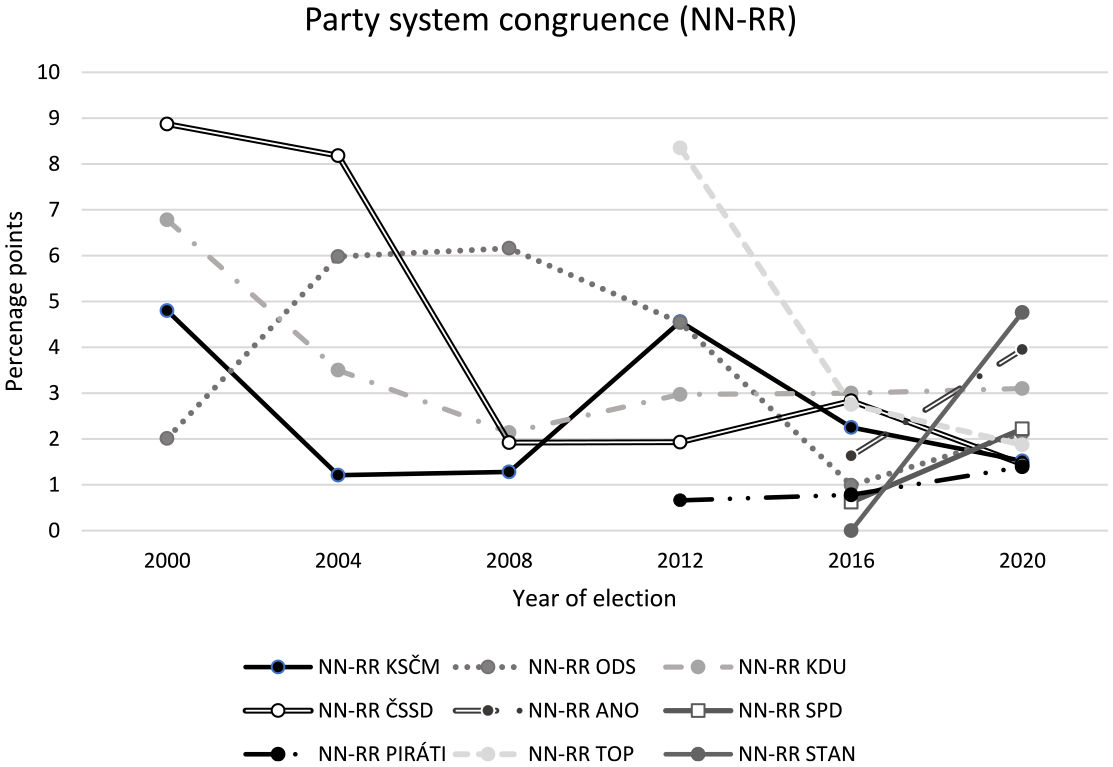
The national vote at the national level and the regional vote in the region has varied significantly for individual parties. Relative match between the similarity of the national party system and party system in the particular regions after 2008 was replaced by recent growth
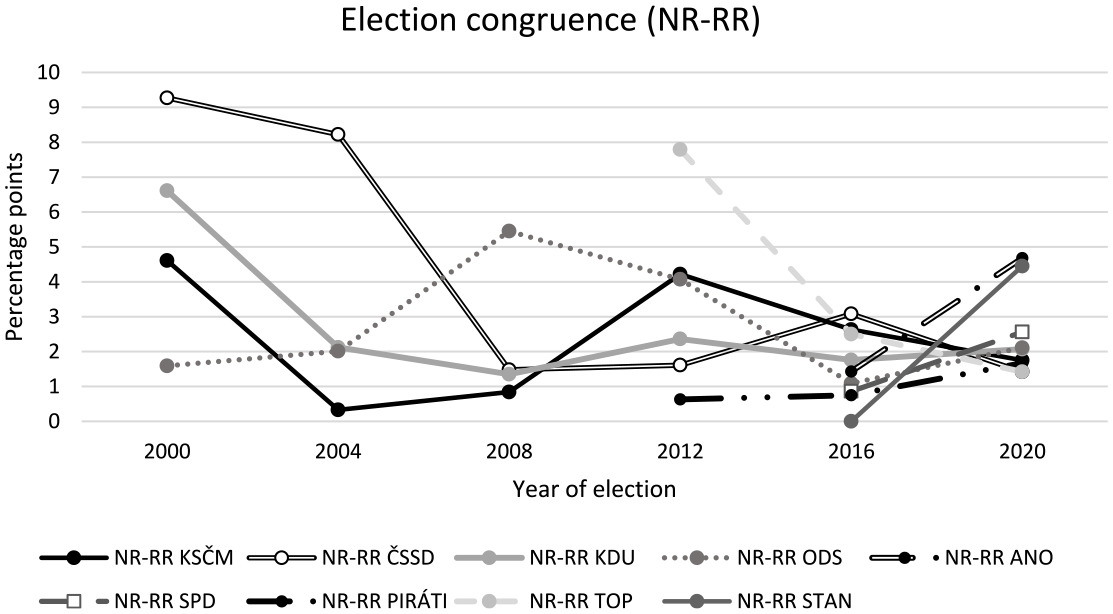
The similarity between the national vote at the regional level and the regional vote in the region that peaked in the first two regional elections. The values mainly decrease since - the electorate behaves more similarly on the same territory in different types of elections - the level of election congruence increased then
Moravia clearly has lower electorate congruence—the support for ODS in the individual constituencies (regions) there in elections to the Chamber is more varied. This effect was greatest in the 2008 elections, reaching 3 pp, but then decreased steadily, reaching a level similar to that in Bohemia. In Bohemia, in 2004, the values of election congruence and party system congruence (similar to overall congruence) reached their maximum, up to 8 pp. The trends of these indices have been very similar, and they gradually decreased until 2016, down to 1 pp. In Moravia, the growth trend of these indicators occurred to a greater extent between 2004 and 2008, when the party system (NN-RR) in Moravian regions differed the most from the national one; this was followed by a steep decline until 2016, when the two indices came closer again. In 2020, both indices increased slightly in Bohemia and Moravia, but this was not a major swing.
The indices for TOP 09 started off quite high as suggested by both Figures 3 and 4, around 8.0 pp, both for party system congruence (NN-RR) and election congruence (NR-RR). This followed from the significant difference between the share of the vote received by TOP 09 in elections to the national parliament and regional elections two years later, when the party suffered a significant slump. However, these values decreased over the following elections, reaching 2.0 pp, and the difference between the party’s performance in national and regional elections decreased and is comparable to average values, even considering the overall decrease in voter support.
The values of the NN-RR and NR-RR indices for STAN in 2020, when it stood independently for the first time, reached 4 pp. Thus, there was a substantial difference between national and regional elections at the level of the individual regions. Similarly, with the higher values of the indicator of NN-RR, the system at the level of the individual constituencies (regions) differed from the national system, as in some regions, STAN was able to win more than 30 percent of the vote, while in others, none. A more comprehensive evaluation will only be possible after the next elections.
For the Pirate Party, voters started to differ in national elections after 2016 from voters in earlier elections; this is linked with the party’s growing popularity and increase of support. The index of party system congruence doubled between 2016 and 2020 and so did the difference between the party’s results in the various constituencies. The growing values of NR-RR suggest that voters in national and regional elections in the same area gradually grew apart, but this is not a sudden hike, overall reaching a maximum of only 2.5 pp (in Moravia). Thus, some developmental trends are discernible regarding the Pirates, and they are linked to some extent with the substantial rise in the support for this party since 2016.
ANO’s indices of party system congruence and election congruence are largely the same in the two macro-regions (see Supplemental Appendix). The indices make it clear that in comparing elections to the regional assemblies and to the Chamber of Deputies, ANO enjoyed relatively stable support in 2016, particularly in Bohemia. In Moravia, the values of the two indices in that year were close to 2.0 pp, because ANO achieved better results in regional elections than national elections, on average by more than 3 pp. However, in the next regional elections, both indices increased markedly, especially in Bohemia (up to 5.0 pp). This is because ANO, as a party of government for several years, was significantly penalized.
Two indices for SPD showing NN-RR and NR-RR are again very similar to each other (particularly true in Bohemia). Their values differ over time, as shown in Figures 3 and 4. In 2016, Dawn of Direct Democracy in regions during regional elections had very similar support to that recorded during the preceding election to the Chamber of Deputies, especially in Moravia (around 0.5 pp). In 2020 the values of the indices of NN-RR and NR-RR increased markedly nationally (and in both macro-regions observed) up to 2.5 pp.
This growth in indices for new parties is not strong given the trends over the past 20 years; the 2024 regional elections may suggest a change in patterns. Overall the results of the last three regional elections (after changes in the party system) are not characterized by a greater degree of regionalization. On the regional level, the positions of traditional parties have been replaced by newly established national parties. The total number of successful regional actors (detailed in the following sections) did not mark a new “dawn” of regionalism, thus not confirming Hypothesis 2.
Penalization of Individual Parties
Observing both Figures 5 and 6, it is evident that parties suffered higher electoral loses particularly during the first two regional elections.
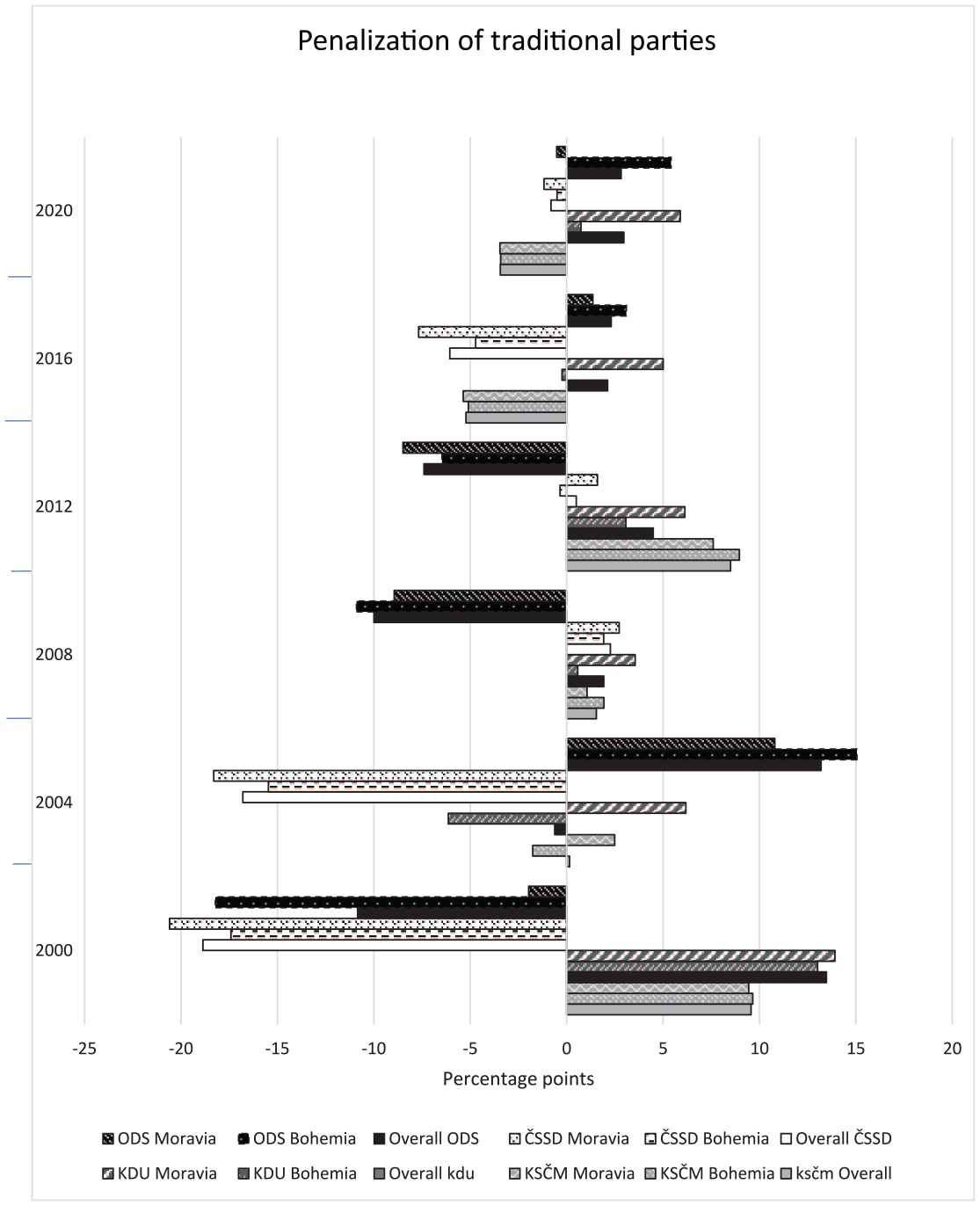
Indicates penalization of traditional parties, particularly in the first elections held in the middle of the government term. Penalization depended mostly on their role in government or opposition
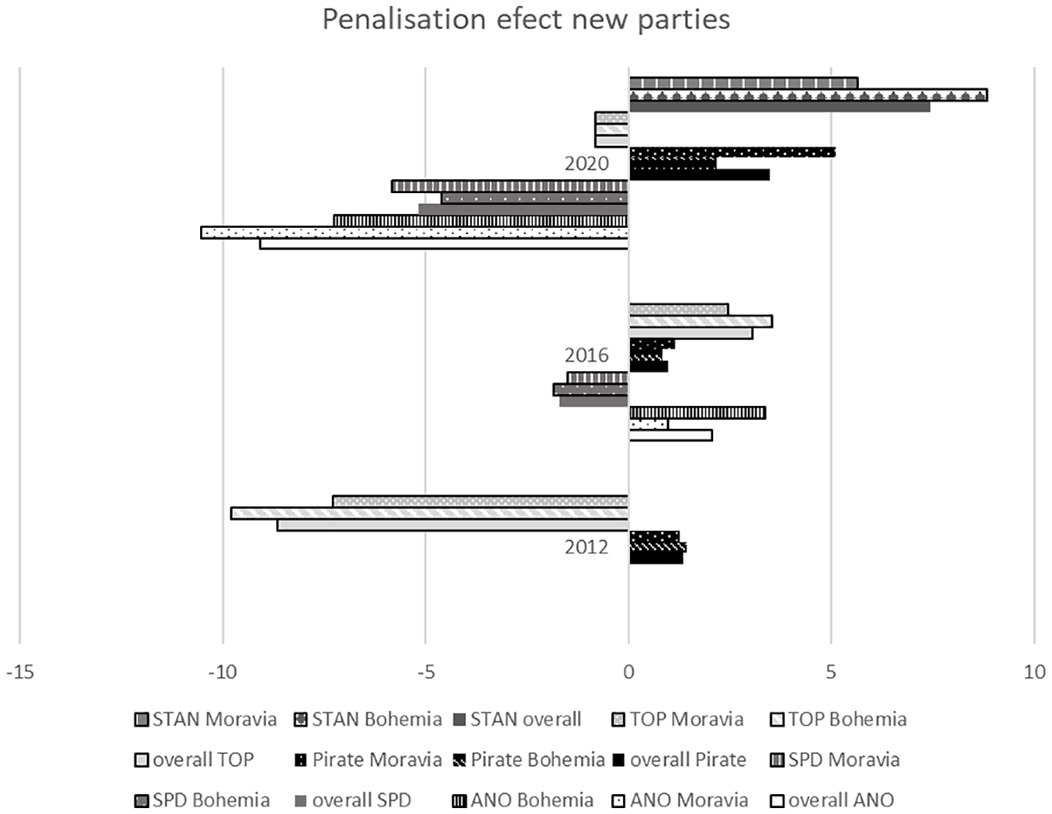
Penalization of new parties. The position of government-opposition is less evident here as the regional elections take place much closer to the national election term
For ČSSD, we observe a pronounced penalizing effect compared to the previous elections to the Chamber (especially in 2000 and 2004). ČSSD was always penalized more in Moravia than in Bohemia. During both these elections, ČSSD was the government party nationally. In 2008 and 2012, in opposition, the party did better in these elections than in the previous elections to the Chamber of Deputies (in Moravia in particular). From 2014, ČSSD was a party of government; it did not achieve success in regional elections and was penalized, both in Moravia and in Bohemia. In 2020, beyond the fact of being a governmental party for six years, ČSSD’s result shows a pronounced loss of support, observed in recent years across all electoral contests. It failed to win a seat in several assemblies.
KDU-ČSL’s long-term trend is that the party wins a greater share of the vote in the regional second-order elections than in the preceding elections to the Chamber, and the measure of this share varies substantially over time. The party obtained its biggest share during the time of the so-called Opposition Agreement in 2000, when KDU-ČSL was part of the Coalition of Four, with an ambition to serve as a third “quasi-pole” in the party system—although this ambition ultimately went unfulfilled. 44 By contrast, the smallest shares of the vote were recorded during periods when KDU-ČSL participated in government. The party was only weakly penalized overall in 2004 for its government with ČSSD and achieved a very small share of the vote in 2008 when it participated in the ODS-led government. In 2010, it failed to enter the Chamber of Deputies; but in 2012, it was able to exploit the substantial unpopularity of the government parties and to hold onto its previous positions in the regions. However, the discrepancy between the party’s support in Moravia and Bohemia cannot be ignored. In Moravian regions, the party has long been able to win a greater proportion of the vote (regardless of its national role), and the extra favor it received from voters there has not been less than 5 pp, while in Bohemia its support has been weaker overall, and the party lost important positions, e.g., in 2004 as already noted. KDU-ČSL’s greater success rate in Moravia can also be seen from its greater ability to win governorships there and to regularly sit in the regional councils. Thus, the regionalization of the party’s support is apparent here, and this has long been linked with the more religious regions located in Moravia.
Support for KSČM has been relatively stable, and the party was mostly able to obtain greater shares of the vote overall. The party achieved its greatest success in 2000, 2004, and 2012. Except for 2004, when KSČM won a greater share of the vote in Moravia but suffered losses in Bohemia, it has been the rule that the party was weakened more in the Moravian regions, although the differences have been very small. In 2016, KSČM suffered a downswing across the board by more than 5 pp on average, lacking regional personalities. In the most recent regional elections, the party suffered substantial losses, winning representation in only four regions. Its support for the minority government from 2018 needs to be noted here, as at that time support for the party could hardly be understood as a protest vote. The dropping of the vote share to under 5 percent reflects the party’s gradual decline.
The penalizing effect applying to ODS was long dependent on whether the party was in government or in opposition. In 2000, although in opposition, it allowed the emergence and fairly undisturbed functioning of a social-democratic government, and hence was not an unqualified success with the electorate. Although it won the regional elections, compared to the preceding parliamentary elections, it suffered substantial losses, particularly in Bohemia. Considering the positions of the Communists, ODS was still able to negotiate strong positions for itself in the regional leaderships with other parties, despite its mediocre electoral performance. In 2004, as an unambiguous party of the opposition, ODS successfully presented itself as an alternative to the center-left government majority and scored a landslide victory across the country. However, the number of ODS governors decreased, and for a long time, these were the party’s last. The party’s dominant position in the government coalitions led by Prime Ministers Topolánek and Nečas meant substantial losses in its regional positions, as also shown in the penalizing effect, which was about 10 pp compared to the preceding parliamentary elections in 2006 and 2010. ODS “sacrificed” the 2008 elections to allow a US missile defence radar system to be installed in Czechia, an issue which resonated particularly strongly at the time, and the regional elections were swept by an “orange wave,” symbolising the rise of the Social Democrats. Although ODS was in opposition after 2013, this had very little effect on the shares of the vote the party obtained in the 2016 and 2020 regional elections. The extra electorate favor for ODS did not reach even 5 pp, and the losses have never been fully recovered. One noticeable aspect is that ODS’s gains and losses tend to be very similar in Bohemia and Moravia. It seems that the two macro-regions follow the more general moods, and there is no apparent difference that would favor the party in one of the macro-regions, irrespective of circumstances.
The penalizing of TOP 09 in 2012 and 2016, obvious in Figure 6, depended on the position of the party in government or in opposition. During the first regional elections, the party was strongly penalized for participating in government alongside ODS, with penalizing effect in Bohemia, where the party has long been the stronger, reaching nearly 10 pp. In the following regional elections, when TOP 09 took a stance against the center-left government, the party earned slightly greater favor from the electorate. The share of the vote was not high overall and was much supported by the success of STAN in some regions such as Liberec. Opposition and vigorous criticism of the government led by ANO did not help TOP 09 to improve its position in the 2020 regional elections; rather, the party was weakened. It was not even able to put up its own candidate lists in all regions, and in some, it worked with other parties.
STAN by contrast capitalized on its positions and, after splitting from TOP 09 in 2020, became markedly the more popular choice, gaining more than 7 pp. In many regions, thanks to substantial favor from the electorate, it won very strong positions, and even several governorships, as well as respectable representation in the regional councils.
The Pirate Party has always been able to increase its share of the vote in regional elections compared to the previous national elections, even after winning seats in the Chamber in 2017, where the party remained in opposition. Figure 6 indicates that, until 2020, the measure of the party’s better result in regional elections was nearly identical in Moravia and Bohemia. In 2020, however, it received much more favor in Moravia, which until then had been considered by some as the Pirates’ weak spot. 45 Here, note that the results do not include Prague, which is notably liberal and favors the Pirates (a member of the party is now the mayor of the capital). Although the Pirates have no regional governors, they to negotiate more positions in the regional councils than some traditional parties (such as KDU-ČSL). Moreover, in the Olomouc region, they formed an electoral coalition with STAN, achieving 19.51 percent of the vote. The coalition was then applied nationally for parliamentary elections in 2021 (15.62 percent in total).
The newcomer, ANO, despite being a party of government for three years, was able to gain support in 2016. However, in 2020, it was significantly penalized by more than 9 pp on average. This occurred even though ANO in the 2020 regional elections fared slightly better than in 2016. However, in 2017, it scored a substantially better result in national elections than previously, and hence, in subsequent regional elections, it had to defend a much higher score. As Figure 6 indicates, ANO failed to do so. This may be because of its long government engagement and the gradually increasing number of scandals in which its politicians had become embroiled and because ANO is a party of a single strong leader and recently has been plagued by a lack of strong personalities in the regions. It was penalized in both macro-regions, more so in Bohemia, where the loss exceeded 10.5 pp. In Moravia, it lost 7 pp on average.
SPD suffered a substantial loss of support in the most recent regional elections. It suffered a greater loss on average in Moravia (5.8 pp) than in Bohemia (4.61 pp). The poorer performance of both Tomio Okamura’s parties in regional elections can be explained by the fact that these were one-man parties that lacked strong politicians (and structures) regionally. The greater penalization observed in the 2020 regional elections may also be due to the fact that SPD was a silent supporter of the government coalition.
The extent of penalization for parties, when they are in government, confirms the expectations of the third hypothesis. With the slight exception of ANO in 2016, although a ruling party, as a newcomer, it strengthened and gained its first seats at the regional level. The turnout regularly falls by 20 percent compared to levels in parliamentary elections.
Results of Regional Parties
To what extent Czech regional elections are nationalized can be inferred from the results of regional parties in these elections. In a limited number of regions and elections, regional parties have been able to gain limited representation (a few seats) in the regional council (see Supplemental Appendix).
In 2000, we witnessed the relative success of regional parties in the Moravian regions—an echo of Moravian regionalism, more prominent in the 1990s, when it had representatives in Parliament (terms 1990–96). At present, regional parties are rarely successful in regional elections.
Any occasional limited success of regional parties is more likely to occur in Bohemia, particularly in smaller regions (especially Karlovy Vary and Liberec), where there are significantly fewer voters, but the number of seats distributed is still high. A relatively small number of votes are thus needed to pass the electoral threshold and win at least one seat. Overall, the very small number of these successful regional actors, often on a one-off basis, is consistent with Hypothesis 4.
An exception to the overall trend are STAN’s results in the Liberec region in 2008–16 when regional elections (exceptionally) served as a vehicle for the party to establish itself at the national level of politics, by ensuring publicity and funding. Since 2017, STAN can no longer be described as a regional party. 46 It can even be argued that STAN has adapted to the logic of national competition, which has brought it greater success and relevance.
The meagre success of regional parties in regional elections can be explained in another way, which nevertheless confirms the low regionalization of Czech regional politics. Small regional parties that cannot be sure of crossing the 5 percent electoral threshold often prefer the tactic of running in coalition with a national party. As a smaller coalition partner, they nominate several of their own representatives on the coalition candidate list. In this way, they are usually able to win at least one or more seats thanks to preferential voting. 47
Discussion and Conclusion
This paper sought to assess the regionalization of Czech politics by comparing electoral competition in regional and national elections. Using an index of vote congruence, we argued that Czech regional elections are relatively strongly nationalized—the electoral contest in regional elections is fairly similar to the national scene. That confirms Hypothesis 1. It contrasts with the trend of regionalization observed in established Western democracies. 48
A possible explanation may be the shorter experience with democratic systems that generally give more room for democratic decentralization. This explanation, however, goes against the conclusions of Golosov, according to whom high-quality democracies tend to have more nationalized party systems. 49 At the same time, it is consistent with findings from some other Eastern European countries that note low levels of regionalization. 50 Understandably, we cannot describe Eastern European countries with their short democratic experience as having high-quality democracy (compared with Western democracies). However, it is more likely that this is just one of many factors affecting regionalization.
Czech regional elections are usually dominated by national parties. If a regional party gains a seat in a regional council, it is usually in Bohemia—particularly in smaller regions where few votes are needed to pass the threshold of 5 percent. Still, Hypothesis 4 is confirmed by this fact. The very limited success of regional parties is probably linked both with the late introduction of regions and the weakness of regional identities.
Although Schakel and Jeffery, and Romanova too, note that regional elections are not necessarily of a second-order character, Czech elections can clearly be described as such. 51 Beyond the recurring lower voter turnout, their lesser importance is demonstrated by the fact that regional topics are not important in elections something we would expect if they were “first order” 52 ; rather, national issues dominate. Voting in regional polls often follows national politics, and government parties are punished by voters, in line with the electoral-cycle theory, or they are “barometer elections.” 53
The results achieved by countrywide parties mostly depend on whether they are in government or opposition nationally, and they are accordingly penalized or favored in regional elections. In 2016, some deviations from this trend were observed, with the rise of populist movements ANO and SPD; but the 2020 elections confirmed the long-term trend. There is one major exception, KDU-ČSL, which has long enjoyed favor with voters in Moravia irrespective of its position in national politics. The Pirate Party has done better in the two most recent regional elections than in the preceding national elections. These exceptions aside, the manner in which voters penalize parties; the importance of the leader for the party’s overall result; the low voter turnout; the national topics that dominate the campaigns (as in 2008, when health care fees were discussed) 54 ; and also the timing of regional elections usually in the middle of the government term allow regional contests to be characterized as second-order elections, fully in concord with Hypothesis 3. 55
Support for the various parties as expressed by the IoCV is relatively uniform across regions for most parties. The only party to exhibit greater regionalization in the long term is KDU-ČSL, which has a stronger base in certain regions in Moravia than in Bohemia. STAN, which was originally founded by local politicians (mayors of municipalities), has exhibited a similar tendency, but this trend has only been apparent in the two most recent elections. Developmental trends observed in our two macro-regions, Bohemia and Moravia, are often very similar; sometimes one macro-region follows the other slightly later. There is a difference with KDU-ČSL, which is favored in Moravia; by contrast, ČSSD has long suffered from stronger penalization in the same region. ODS tends to be more successful in Bohemia than in Moravia. However, no pronounced effect of the historical division between Bohemia and Moravia is discernible in the election results. The historical expulsion of the populations of the Sudetenland after 1945, which resonates to this day, as these regions are structurally disadvantaged and less developed in the north of Bohemia and Moravia, has a much greater effect on electoral behavior and hence on parties’ electoral performance. 56
Given the structural changes to the political party system since 2010 (increasing clashes between traditional and marketing-oriented parties), with many parties emerging after running in only two or three elections, some of the trends are more tentative, such as the gradual strengthening of the positions of the Pirate Party in regional elections and the relatively weak position of the SPD, which is managed in a strongly centralized and lacks regional structures. These developmental trends (connected with a slight rise in the IoCV of these particular parties) may be confirmed or disproved in future elections, where their positions compared to the national elections may vary. It does not seem that large turbulences in the party system are associated with a greater regionalization of Czech regional elections. The decline of some traditional parties has not been exploited by regional parties to strengthen their positions in regional elections. Therefore, Hypothesis 2 is not supported by the results of this study.
The strong nationalization of Czech regional elections and the limited success of locally specific or regional parties are in total contrast to Czech local elections. This may confirm the actual position and character of the regions as administrative units providing a certain measure of decentralization and self-government, while remaining reliant on the center of political power, which substantially contributes to their legitimacy. 57 Thus Czech regions are not entities sui generis—considering also their major differences in area and population size and the fact that they do not overlap with the jurisdictions of the regional courts, for instance. Besides, the tendency to the above-average centralization has further implications for the functioning of the state, as it reinforces the role of the wealthy capital city while peripheral regions are depopulated and become unattractive—people are not bound by any regional identity and are more willing to leave, seeking work or a higher quality of life.
Also, there are no political groups with strong regional profiles (due to a lack of homogeneity and loyalty) that would oppose national politics or push their views through, including those on how the region ought to be managed. 58 If such groups run in election, they tend to garner only marginal support. This is reflected in the results of regional elections, which largely mirror political life and events at the national level. Despite significant nationalization, the results of regional elections have not caused many political shocks, although they may contribute to shake-ups within the parties, as some regional elites are recruited to the national party leadership. Although regions have not contributed to the regionalization of elections, they have had an impact on how parties are run, causing some decentralization of candidate selection and some regionalization of party elites. 59
All in all, contrary to Keating, the Czech regions do not represent a new wave of regionalism, well-illustrated also by the minimal use of the power to propose nationwide legislation, as only twelve tiny amendments sponsored by regions have been successful in more than twenty years. Prague on its own pushed through the same number in the same period. 60
Supplemental Material
sj-pdf-1-eep-10.1177_08883254231212487 – Supplemental material for Time for Regional Parties to Shine or for National Parties to Lock Horns Again? The True Nature of Czech Regional Elections
Supplemental material, sj-pdf-1-eep-10.1177_08883254231212487 for Time for Regional Parties to Shine or for National Parties to Lock Horns Again? The True Nature of Czech Regional Elections by Adam Folvarčný, Jan Hruška and Michal Pink in East European Politics and Societies
Footnotes
Acknowledgements
The authors would like to thank the reviewers for their feedback and comments during the revision of the manuscript.
Funding
The research for this paper was carried out at the Department of Political Science, Faculty of Social Studies, Masaryk University, Joštova 10, Brno, with the support of the Specific University Research Grant provided by the Ministry of Education of the Czech Republic.

Supplemental Material
Supplemental material for this article is available online.
Notes
Supplementary Material
Please find the following supplemental material available below.
For Open Access articles published under a Creative Commons License, all supplemental material carries the same license as the article it is associated with.
For non-Open Access articles published, all supplemental material carries a non-exclusive license, and permission requests for re-use of supplemental material or any part of supplemental material shall be sent directly to the copyright owner as specified in the copyright notice associated with the article.
