




Abstract
The power of the Serbian Progressive Party (SNS) has been steadily growing ever since 2012. The party has successfully taken control of all levels of government in Serbia, and the country has suffered from gradual democratic backsliding as a result. In this article, we focus on two protest waves in Serbia between 2017 and 2019. Crucially, a number of opposition parties involved in the more recent protest wave boycotted the 2020 parliamentary election. This article analyzes the characteristics of the citizen-led response in local communities across Serbia and estimates its electoral impact using a difference-in-differences approach. The case of Serbia not only elucidates modes of citizen response and their impact in post-Communist Europe but also provides comparative insights for the potential for citizen-led resistance to mobilize against backsliding in other countries. The objectives of the article are twofold. First, the article uses an original data set of Serbian protest events between 2017 and 2019 to ascertain how the two protest waves were conducted, and how citizens respond to democratic backsliding. Second, using data on municipal-level turnout and SNS vote share in the 2020 parliamentary election, we examine the average electoral impact of protest and, related to that, we evaluate the success of opposition parties in mobilizing voters for the electoral boycott. The article investigates whether SNS-led democratic backsliding is resilient to sustained citizen-led mobilization or whether this bottom-up resistance challenges the notion that “stabilitocracies” such as Serbia are immune to fundamental political change.
Introduction
Post-Communist Europe has witnessed substantial variation in the trajectory of democratic consolidation over the past few decades. In some places, the political opposition has been able to unseat incumbents who have undermined democracy, while in other places, the political opposition remains ineffective. However, democratic quality is slowly deteriorating in several countries across the region, which is also characterized by hitherto quiescent publics that have mobilized against backsliding in different ways in recent times.
We focus on Serbia, where the Serbian Progressive Party (Srpska napredna stranka, SNS) gradually accrued nearly unchecked power in the 2010s. After 2016, several waves of widespread anti-government protests took place across the country, culminating with an electoral boycott during the 2020 parliamentary election.
With the case of Serbia in mind, our main focus in this article is to investigate whether mobilizing against backsliding through protests allows for more effective political boycotts. Perhaps paradoxically, we are investigating whether there is a link between protest mobilization and coordinated non-participation, by estimating the impact of protest frequency on the change in turnout between successive parliamentary elections. Our research question is as follows:
Does the local intensity of mass demonstrations impact electoral outcomes related to electoral boycotts?
While analyzing the long-term impact of protest waves and related electoral boycotts on democracy in Serbia falls outside of the scope of this article, assessing the relationship between protest and electoral dynamics is crucial in understanding the prospects of democratic backsliding. On a broader level, our article seeks to bring the citizen back into analyses of democratic backsliding, which tend only to examine the role of incumbents, organized political opposition, and the international community while ignoring the potentially pivotal role of coordinated citizen-led resistance. We focus more on how citizens mobilize against democratic backsliding, rather than who mobilizes or why individuals mobilize in such contexts. 1
The article is divided into six sections. In the first section, we chart the rise and consolidation of SNS’s largely unconstrained political power between 2008 and 2020. In the second section, we summarize how some parts of the Serbian political opposition resorted to anti-government political mobilization, particularly the “Against Dictatorship” and “One of Five Million” protest waves, which diffused widely across the country. In the third section, we review and connect the literature on democratic backsliding and citizen-led mobilization in response (particularly the electoral boycott) in order to formulate our hypotheses about the relationship between the local intensity of protest and electoral outcomes. In the fourth section, we explain how we measure protest intensity using protest event data, and we outline the difference-in-differences (DD) approach applied to estimate the average effect of the protests on the 2020 parliamentary election. In the fifth section, we run the relevant regression models to test our hypotheses and show to what extent protest affected turnout and SNS vote share locally. In the concluding section, we posit that our results (of significantly greater decrease in turnout where protests were higher) suggest that the mobilization was successful insofar as focusing and coordinating citizen action. Although the results point to the impact of the boycott campaign, in the same section we also call for further discussion with respect to the overall efficacy of boycotts in appealing to external and domestic audiences.
Democracy in Serbia: From Weak Consolidation to Competitive Authoritarianism
Before analyzing recent protest dynamics in Serbia, in this section we describe the development of the current competitive authoritarian regime, which can be observed in relation to the development of SNS as its dominant political party. In 2008, in the aftermath of a split within the far-right Serbian Radical Party (Srpska radikalna stranka, SRS), a group of SRS members headed by Tomislav Nikolić and Aleksandar Vučić established SNS. Over the course of the next four years, SNS managed to establish itself as a new political force in the electoral arena of Serbia, skilfully combining nationalist ideology—including a hard-line position on the issue of Kosovo—and support for Serbia’s accession to the European Union. 2
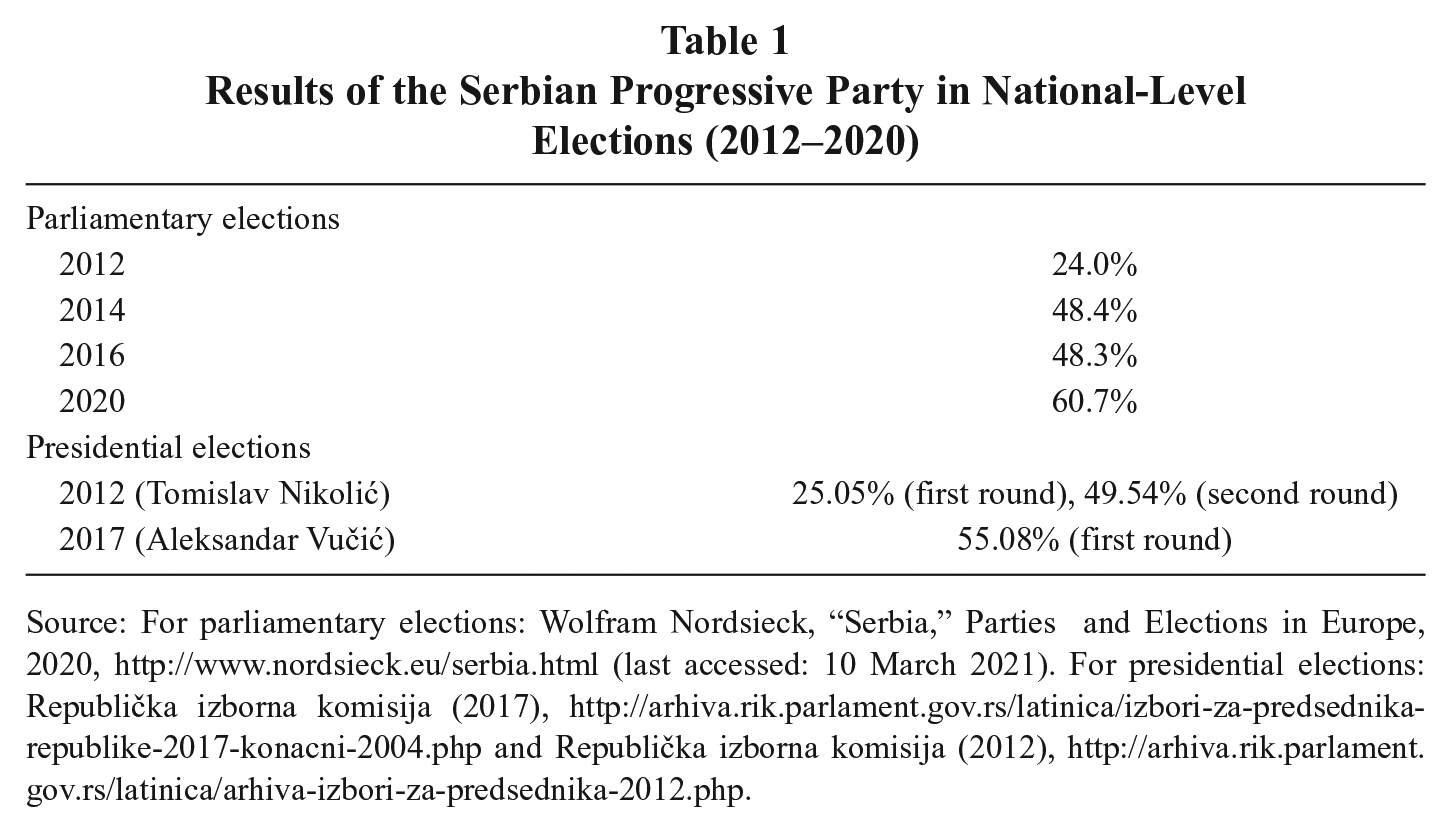
The first important electoral success of SNS occurred in 2012, when Serbia held national (both presidential and parliamentary), regional, and local elections within the same month. From being a relatively marginal parliamentary party with less than 10 per cent of parliamentary seats, SNS gained 24 per cent of the popular vote and suddenly became the leading parliamentary party. Success was also achieved in the presidential election, as SNS candidate Tomislav Nikolić managed to win over the incumbent Boris Tadić with 49.54 per cent of the vote (51.16% of valid votes) in the second round of elections. Since 2012, SNS has managed to consolidate its power further in every single election: in the 2014 parliamentary and local elections, the 2016 parliamentary and local elections, the 2017 presidential election, the 2018 local election, and the 2020 parliamentary election (see Table 1). All along these achievements have been followed by an unprecedented growth in SNS membership 3 as well as the party’s tightening grasp over the media, capturing of various institutions, and extending of patronage networks throughout the country. 4 The European Union’s (EU’s) prioritization of political stability over democratic standards in the region, so-called “stabilitocracy,” has further enabled the SNS regime to keep its pro-EU rhetoric while neglecting fundamental democratic standards. 5
Results of the Serbian Progressive Party in National-Level Elections (2012–2020)
Source: For parliamentary elections: Wolfram Nordsieck, “Serbia,” Parties and Elections in Europe, 2020, http://www.nordsieck.eu/serbia.html (last accessed: 10 March 2021). For presidential elections: Republička izborna komisija (2017), http://arhiva.rik.parlament.gov.rs/latinica/izbori-za-predsednika-republike-2017-konacni-2004.php and Republička izborna komisija (2012), http://arhiva.rik.parlament.gov.rs/latinica/arhiva-izbori-za-predsednika-2012.php.
Simultaneously with the unprecedented concentration of power in the hands of SNS, the electoral strength of the opposition parties, including the right-wing Socialist Party of Serbia (Socijalistička partija Srbije, SPS) as well as the centrist and liberal opposition parties, has been waning. 6 Although some new challengers, such as the extreme nationalist movement Dveri and the centre-right Enough Is Enough (Dosta je bilo, DJB), managed to gain parliamentary representation, the parliamentary domination of SNS was never disputed. 7 In both 2014 and 2016 elections, the second-strongest party, SPS, won 13.49 per cent and 10.95 per cent of the vote, respectively. All other contending parties won less than 10 per cent of the vote.
During the eleventh legislature of the National Assembly (2016–2020), the parliament became a space of constant tension between the opposition and the ruling majority, with the “deterioration of the parliament’s effectiveness, influence and accountability.” 8 As a tactic of contesting the regime, in September 2018 most of the opposition parties, including right-wing and centrist parties, organized into an ideologically heterogenous platform under the banner of “Alliance for Serbia” (Savez za Srbiju). The alliance announced the boycott of parliament in February 2019, two and a half months into the “One of Five Million” protest wave. The Alliance’s decision to extend the boycott into the 2020 parliamentary election can therefore be seen as a continuation of the strategy for which it opted in 2019. In spite of European Parliament representatives’ attempts to organize negotiations between SNS and the opposition throughout 2019, the only concession given by SNS was the lowering of the electoral threshold from 5 per cent to 3 per cent. This move can be seen as a tactical response, given that a lowered threshold helps more parties enter the parliament and makes the effect of the boycott less visible. 9 It is important to note that several parties opted not to join the election boycott, including ethnic minority parties and some oppositional parties, such as the liberal Movement of Free Citizens (Pokret slobodnih građana), the right-wing Democratic Party of Serbia (Demokratska stranka Srbije), the SRS, and the DJB. The Serbian Patriotic Alliance (Srpski patriotski savez) also participated in the election, declaring itself anti-regime, but immediately after the election it entered a coalition with SNS.
Notwithstanding the rise of SNS, to say that Serbian democracy has been backsliding is somewhat imprecise. After spending the 1990s under the authoritarian regime of Slobodan Milošević and SPS, the country experienced democratic consolidation after 2000. 10 Throughout this period, international actors, such as the European Union and the United States, were important supporters of the democratic opposition during its mobilization against Milošević, 11 and of the subsequent rise of the democratic opposition to power. 12 However, the period of democratic consolidation between 2001 and 2012 had limited effects. 13 Indeed, the political leaders of the period were described as “reluctant institution builders,” 14 ensuring their political parties kept a tight grasp over state institutions. 15 At the same time, the political conflict remained firmly structured around sociocultural cleavages and the issue of unfinished state-building. 16
A Contentious Response to Authoritarian Tendencies: Dynamics of Protests in Serbia between 2016 and 2020
In the period between the 2016 and 2020 parliamentary elections, Serbia saw an unprecedented level of anti-establishment protest activity in response to the consolidation of SNS in power. The protests unfolded in three distinct waves: the Do Not Let Belgrade D(r)own wave between May and July 2016, the Against Dictatorship wave in April 2017, and the One of Five Million wave, which started in November 2018 and substantially subsided in June 2019. While all three protest waves were focused on contesting the authoritarian rule of SNS, only the latter two achieved significant diffusion across Serbia. Due to our specific interest in protest diffusion and the investigation of the relationship between diffusion patterns and voting patterns, this article focuses only on the Against Dictatorship and One of Five Million protest waves. Let us take a brief look at the origins, diffusion dynamic, and organizational background of these two protest waves.
The Against Dictatorship protest wave came about as an immediate reaction to the results of the presidential election held on 2 April 2017. Aleksandar Vučić, the presidential candidate of the governing SNS, at the time serving as the country’s prime minister, managed to win the election by attracting an absolute majority of 55.08 per cent of the vote in the first round of the election. The electoral campaign was marked by reports of irregularities in the election administration, raising doubts about the fairness and legality of the process, 17 as well as the stark domination of Aleksandar Vučić in both publicly and privately owned media. 18
The first protest took place on 3 April 2017 in Belgrade, with parallel events in Niš and Novi Sad. Although the initial protest was announced only on election night through a Facebook event created by an outraged individual, 19 it managed to attract around 10,000 participants. 20 Over the following twenty-nine days, the wave diffused across twenty-six cities of Serbia. 21 Protests proceeded mostly in an uncoordinated manner, attracting diverse participants from across the ideological spectrum. 22 Given the absence of clear leaders, the protests attracted various activist groups attempting to claim and shape the protest framing. The protest wave started to subside soon after it began, with a drop of event frequency and participant count after the first ten days. With the exception of the protest organized by the initiative “Do Not Let Belgrade D(r)own” on 25 April 2017, which attracted more than 10,000 participants, and the traditional 1 May march hosted by trade unions, the participant count remained low relative to the beginning of the wave. 23
The other wave covered in this article—One of Five Million—was provoked by a physical assault on Borko Stefanović, a prominent opposition figure, that took place in Kruševac on 23 November 2018. One week later, on 30 November, some five hundred citizens, organized by several opposition parties, marched through the streets of Kruševac. 24 Another week later, on 8 December 2018, the first mass demonstrations took place in Belgrade under the banner “Stop the Bloody Shirts!” (Stop krvavim košuljama!), with organizers reporting the participation of up to 15,000 people. 25 Throughout December, protests continued in regular weekly intervals, with mass demonstrations taking place in Belgrade each Saturday. Although the opposition leaders did not play a central role in protests, the wave crucially relied on the infrastructure of opposition parties organized in the “Alliance for Serbia.” 26 The initial reaction of President Aleksandar Vučić and the media close to SNS aimed to discredit the protest events and demean their mobilization capacity. On 9 December Vučić remarked: “You can march as much as you want. I will never concede to any of your demands. Even if five million people gather.” In the protesters’ ironic reaction to Vučić’s statement, the protest wave soon came to be known as “One of Five Million.”
The initial diffusion of protest happened only on 5 January 2019, with the first protest events being organized in Novi Sad, Niš, and Kragujevac. From that point on, the protest wave gradually spread across the country, with at least one protest organized in 71 municipalities of Serbia. The mobilization was consistent throughout the following months, but the protests started to lose their mobilization capacity substantially in the second half of April 2019. By the beginning of June in the same year, the protest wave started to diminish, attracting only up to several hundred participants in a few major cities.
Throughout the observed period, the framing used by protesters focused heavily on criticizing the media and in particular the public broadcaster Radio Television of Serbia (RTS), which avoided reporting about the protests. One of the most notable protest events took place on 16 March 2019, when some of the protest participants forcefully entered the headquarters of RTS. The police arrested several protesters, provoking an additional protest on the following day, when several hundred protesters gathered in front of the official seat of the President of Serbia to demand the release of those arrested. As the “One of Five Million” protest wave developed, some of its organizers formed an association under the same name. It is relevant to note that, unlike the oppositional parties within “Alliance for Serbia,” which crucially helped the protest wave, the association “One of Five Million” later decided to run in 2020 parliamentary election but managed to achieve a mere 0.65 per cent of the vote.
Although the two waves relied on different organizational infrastructure, in both cases the protest framing remained heavily focused on criticizing the SNS regime and, in particular, President Aleksandar Vučić. Especially in the second wave, mass demonstrations mostly did not articulate any specific ideological principles, but instead they kept a general anti-authoritarian framing, attracting participants with diverse political identities. 27
Electoral Mobilization under Competitive Authoritarianism
Serbia is one of the cases in the growing universe of competitive authoritarian cases situated between consolidated democracies and autocracies. To this end, measuring regime change has moved from an institutional, dichotomous understanding with explicit thresholds to a conceptualization of an authoritarian-democratic continuum that relies on both qualitative and quantitative measures. 28 On this spectrum, competitive authoritarian regimes are at an intermediate point and are competitive, since the oppositions earnestly compete for power using democratic institutions, but they are also authoritarian since the “playing field” is heavily biased in favour of governments. 29
Understanding such political trajectories as lying along an authoritarian-democratic continuum, it is possible not only to reflect on where a country is situated on such a scale but also to observe political change. Political transition or democratic consolidation occurs as states shift from more authoritarian to democratic systems. However, there has been a counter-trend, and Nancy Bermeo, who characterizes different types of democratic backsliding, concludes that democratic backsliding “tends to be incremental rather than sudden.” 30
Vachudova shows that there are common strategies amongst right-oriented incumbents in post-Communist Europe, who frame their political objectives in terms of “ethnopopulism,” defending the majority “people” against external and internal enemies of the state. These incumbents do so by securing political power electorally, and then consolidating power by removing checks and balances on political institutions—leading to democratic backsliding. 31
This ethnopopulist “playbook” has been evident amongst ruling parties in the Visegrad countries—Fidesz in Hungary, Law and Justice in Poland, and Action of Dissatisfied Citizens in the Czech Republic. 32 In Serbia, since SNS was elected, there has been a deterioration in democratic quality through harassment directed at independent media and political opposition and through various measures to tilt the “playing field” in favour of the government by restricting access to resources and capturing public institutions. 33
The Serbian study draws on the notion of executive aggrandizement, whereby newly elected leaders with backsliding aspirations slowly undermine democratic institutions that may provide a counterweight to governmental power. 34 In addition to aggrandizement, an even more fundamental feature of backsliding in post-communist Europe is “vexing ambiguity.” That is, backsliding governments are legitimated in the eyes of international democracy promoters through democratic elections. 35 According to Bermeo, this ambiguity has a profound effect on the ability to construct substantial political alliances: media and jurists in opposition are portrayed as uncritically supporting the previous establishment, and non-governmental organizations, which rely on international funding, are seen as under foreign control. Similarly, the already fragmented opposition, in the face of executive aggrandizement and electoral manipulation, is too weak to counter the erosion of democracy without foreign assistance—thus playing into the hands of ethnopopulist framings. These “[p]iecemeal erosions of autonomy may thus provoke only fragmented resistance.” 36
Nonetheless, citizen-led movements have provided an important counterweight to political elites with authoritarian tendencies. Béla Greskovits examined the complex interplay between democratic backsliding and the “hollowing” of civil society and found that democratic performance varied even in cases of a vibrant citizenry (with a higher incidence of protest) in the post-2008 period. 37 Crucial, however, is not whether there is hollowing, but rather whether citizen mobilization is pursuing democratic or anti-democratic outcomes. Antoaneta Dimitrova similarly urges caution, since there has been a parallel rise of movements defending democratic practices and those advocating more religious conservatism. 38 On a positive note, Dimitrova argues that an increased incidence of protest indicates society’s attempts to keep political elites in check. 39 Susan Hyde finds that “democracy protests and citizen-led mass mobilization remain powerful forces” and that there are notable examples of democracy progressing due to mass protests despite backsliding pressures. 40
Having established the role of protests as a counterweight to elite efforts to undermine democratic processes, we now focus more closely on these movements and how they can impact electoral outcomes through boycotts.
Electoral boycott is a possible strategy open to a political opposition, but the extant literature is generally critical. Matthew Frankel explains “why election boycotts are a bad idea” and points out that the vast majority have resulted in negative political outcomes in the longer term, including “disastrous” subsequent electoral results for the boycotting parties, infrequent attention or leverage from desired international actors, and the further bolstering of the ruling elite. 41 The latter is corroborated by Erica Frantz, who surmises that abstaining voters tend to be supporters of the political opposition. Hence, lower turnout leads to higher support for ruling parties, and by extension, strengthens their grip on power. 42 Examining the relationship between international observers and electoral boycotts, Judith Kelley concludes “parties that boycott elections miss out on valuable political experience and forfeit potential legislative participation and a formal voice in domestic debate.” 43
Why, then, would the political opposition in authoritarian and semi-authoritarian countries pursue an electoral boycott? The compelling motivation is that organization of an electoral boycott is an alternative form of mobilization and not de-mobilization. There are three primary audiences to whom opposition leaders are signalling by calling a boycott: hybrid regime leaders, the international community, and opposition supporters. 44
Regarding government-opposition signalling, Gail Buttorff and Douglas Dion develop a formal model where the opposition decides how to act given incomplete information about the strength of the regime and the response from the government. 45 Depending on the costs to the government and opposition and its strength, the electoral boycott can cause governmental reform or political crisis, which may be complicated by bluffing by a weak regime. If the cost to the opposition of mobilizing is too high to threaten a crisis, it will quietly participate in the election. The possibility of government concessions and political change after boycotts is borne out empirically. For example, the threat of electoral boycott reaped concessions for the Inkatha Freedom Party in post-apartheid South Africa, for Bosniaks and Croats after the Dayton-Paris Agreement in Bosnia–Herzegovina, and for opposition parties prior to the post-coup Cambodian poll in 1998. 46
These concessions were secured through international pressure, and the involvement of external actors is pivotal to electoral boycotts. In the instruments available to international actors to promote democracy, conditionality is the most effective means of pushing targeted governments to reform. 47 The rewards for compliance range from securing international loans (as in the aforementioned Cambodian case) to membership in supra-national bodies. For example, the European Union employs external incentives to steer governments in enlargement countries to implement democratic reform. 48
It is beyond the empirical scope of this article to claim that the oppositional actors in Serbia in 2020 were motivated primarily by the need to draw the attention of international actors, but it is clear that highlighting regime illegitimacy is of particular importance with regard to the international community as one of the three boycott audiences mentioned above. Indeed, at least one part of the opposition had probably expected to draw more attention from external actors, as was the case during the late 1990s, but this turned out to be a miscalculation. 49
Boycotts are also used as an instrument aimed at supporters as a call for (in)action in upcoming elections from below. The success of the action boils down to an aggregate of individual decisions whether or not to vote. Individual motivations to boycott have been best examined in the consumer behaviour literature, which demonstrates that boycotting is linked to perceptions of efficacy, social pressure, and assessing costs. 50 This finding resonates with research on social movements examining the social psychology of protest, 51 particularly the role of efficacy and social embeddedness in individual decisions to protest, 52 as well as resource mobilization 53 and political opportunities 54 by opposition leaders. Moreover, there is a moral obligation not to “vote badly” if a sufficiently good choice is not available. 55 Hence, if “good” choices have removed themselves from contention, then the moral choice is not to vote at all.
Although there is substantial literature on the decision to protest and on the strategies and constraints faced by leaders, less attention has been paid to the links among the protest, the decision to call a boycott, and individual supporters’ decisions to follow the boycott. Recently, however, scholarly interest in collective action outcomes has revived. 56 Relevant to our current study, protest has various relational, affective, and cognitive impacts, 57 and protest participation triggers a number of subjective behavioral changes. 58 The most relevant subjective impacts of protest are feelings of empowerment and the constitution of new identities. Taking part in protest actions can give individuals a sense of purpose and feelings of empowerment to be able to affect social change. 59 In a related fashion, participating in protest leads to the constitution of new, politicized identities, so that new categories of citizenship come into being, such as the “One” in the “One of Five Million.” 60
Empowered by this new identity, these individual voters are faced with a choice once the preferred parties have boycotted: vote badly or not vote at all. Hence, for those who protested, there is no adequate supply of political options, 61 so individuals choose to abstain. This choice is not a sign of weakness, but rather an active decision to mobilize a “noisy” exit, 62 more in line with decisions intentionally to cast a spoiled, null, or blank ballot in protest. 63
To sum up, the more intense the protest is within a locale, the more likely the voters are empowered, and the higher the expected level of abstention.
However, as a consequence, voters supporting the regime view the opposition mobilization and boycott, and they anticipate that the ruling party will win more easily, which decreases their motivation to vote. 64 Hence, we would expect that where protest is more intense, ruling-party voters will tend to be more complacent.
With these hypotheses in mind, we summarize the data and methods used in our analysis.
Data and Methods
Parliamentary electoral data for 2016 65 were obtained from the Statistical Office of the Republic of Serbia. Data for the 2020 parliamentary election were downloaded from the Serbian Electoral Commission. 66 All the electoral data were disaggregated by city or municipality. The municipal turnout is calculated as the percentage of registered voters who voted. The SNS vote share is the percentage of votes the party list received of registered voters who voted. It is important to note that the 2020 parliamentary election was held in the middle of the COVID-19 pandemic, the fear of which may have contributed to lower turnout. Unfortunately, it was not possible empirically to address the potential pandemic effects, as the publicly accessible municipal-level data on new COVID-19 cases were not updated after 10 June 2020. 67
The Statistical Office of the Republic of Serbia also publishes annual information regarding municipalities and cities for the previous year. We include municipal unemployment in the analysis below, so we collected data from the end of 2015 68 and 2020. 69 We used the 2020 data instead of 2019 data, since the unemployment figures could have been affected by the coronavirus pandemic, and the 2019 data were collected beforehand.
To aid in standardization of spellings and to combine the protest data with maps, we used the freely available shapefiles from the Global Administrative Areas (GADM) web page. 70 The map data for Serbia include 161 municipalities. However, the urban municipalities in Belgrade are listed separately, so we combined them, resulting in 145 cities and municipalities.
The key primary data collection was identifying protest events during the two waves under study in Serbia. The main source for identifying protest events was the daily newspaper Danas, which is published every day except Sunday and public holidays. Due to the number of parallel events on a given day, the information in Danas may have been incomplete. To address this problem, complementary date-specific Google searches were conducted using the terms “protesti Srbija” to find additional events that were missed in the Danas coverage. Since the main objective of the data collection was to capture the main timeline of protest diffusion in different municipalities, data were collected only for the period in which protest events took place in a substantial number of locations outside Belgrade. For each protest event, an identification number was generated, and the following information collected when available and/or relevant: date of event, city or municipality, estimated number of participants, brief description of the action repertoire, date and page in Danas where reported, and the URL of the online source.
The resulting data set for “Against Dictatorship” covers the period from 3 April 2017 to 31 May 2017 and comprises 171 protest events. For the “One of Five Million” protest wave, 480 events were identified in the period between 30 November 2018 and 10 June 2019 (inclusive). When the number of estimated participants is explicitly given, this figure is used. However, in many cases, more approximate formulations are used in media reports, such as “several hundred” or “several thousand.” In such cases, we assign the lower bound of such an approximation, for example, two hundred for “several hundred.” 71 These approximations are retained in the data set. It is important to note that there are often no estimated numbers of participants for any of the events in a particular municipality.
The data set contains information about 171 events during the “Against Dictatorship” and 480 during the “One of Five Million” protest waves, for a total of 651 events across the two waves. Protest events were recorded in 26 municipalities or cities during “Against Dictatorship,” and 71 during “One of Five Million.” 72 However, in examining the data collected, a problem soon emerged. As mentioned above, many protests were reported without estimates of the number of participants. In the “Against Dictatorship” data, 26.9 per cent of the events had no information on participant numbers, while more than half (52.5%) of the “One of Five Million” events contained no information about the number of participants. Media sources tend to pick up larger events, and as Michael Biggs argues, larger events dominate the total number of participants in a location, so the protest events without participant numbers in our data set are most probably smaller events. 73
However, one of the municipalities in the “Against Dictatorship” protest wave, Prokuplje, had no data on the estimated number of participants, while nineteen municipalities had no estimated participant data for the “One of Five Million” protests. In other words, if we relied solely on the number of participants, we would lose one-fourth of the cases across the two waves. Crucially, of the locations for which there are no data on the number of participants for any of the recorded events, most had populations of 10,000 or less, none had more than 30,000 inhabitants, and only one (Loznica) had city status. If a key characteristic of the protests was how they diffused outside Belgrade to smaller municipalities, and our key objective is how this diffusion potentially affected electoral outcomes, then we cannot rely solely on the estimated total number of participants who participated in protest events by municipality.
The issue of quantifying protest has been a focus of such analyses for decades. Charles Tilly and James Rule examined strike events in the United States, and posited that there are three ways to quantify such occurrences: frequency of events, total number of participants, and participant-days (i.e., multiplying the duration by number of participants for each event). 74 The authors concluded that the best measure for protest events is participant-days. However, the product of the number of participants and duration would be relevant only for types of dissent that can stretch over multiple days, such as strikes, occupations, and hunger strikes. The typical repertoire in our data set on both protest waves usually consists of demonstrations and marches starting and finishing in the same day, such that the duration is “one,” and participant-days is equal to the number of participants.
Biggs makes an important conceptual clarification in quantifying protest. The number of participants counted is not equivalent to the unique number of individuals who have been involved in protest events. This is because the same individuals can take part in multiple demonstrations over the course of a protest wave. Rather, the total number of participants represents the number of distinct contentious actions during a protest wave. Furthermore, once this number is divided by the local population, the resulting figure is the propensity for an individual to take part in a protest event. 75 Hutter also concludes that taking the number of participants divided by inhabitants is the “best indicator” for measuring mobilization levels, especially in cross-country studies, but event frequency can also provide a good indication of mobilization within a country. 76 However, Biggs posits that event frequency is not measuring the same phenomenon as the aggregate number of participants and that the two indicators are uncorrelated. 77
Taking all this on board, we decided to use the correlation between the aggregate number of participants and the event frequency for “Against Dictatorship” events, since this way the problem with missing data was less acute, and only one municipality would be excluded. As outlined in the literature above, we scaled the number of total estimated participants per 100,000 inhabitants, that is, calculating the protest propensity. The distribution of values is positively skewed, with cities like Belgrade and Niš recording high values. We took the natural log of the propensity for two reasons. First, the distribution of the logged values is more symmetrical. Second, following Biggs, we note inherent unreliability with aggregate participant numbers in the underlying data, and by logging the values we compress these discrepancies. 78 The values for the frequency of events by location were also highly skewed, so we took the natural log, resulting in a more symmetric distribution. 79
We then examined the correlation between the logged propensity and logged event frequency, and found that it was quite high (True = 0.84) for “Against Dictatorship” events. Although this protest wave was more uncoordinated than “One of Five Million,” both waves relied on mass demonstrations as the primary action repertoire. Thus, we proceed with the analysis below assuming a strong correlation between the logged protest propensity and logged event frequency in both waves. We also treat “Against Dictatorship” and “One of Five Million” as a single period of anti-government mobilization between the 2016 and 2020 parliamentary elections. As such, our main explanatory variable in the analysis below is the natural log of the total number of protest events within a city or municipality in the period between 2017 and 2019.
The primary objective of this analysis is to estimate whether, or to what extent, the “Against Dictatorship” and “One of Five Million” protest waves affected parliamentary electoral results in 2020. The approach used in the analysis below is DD. This DD intuition can be expressed as a regression model for panel data as follows 80 :

where y is the outcome of interest for unit i at time t (either pre-treatment or post-treatment). The coefficient α captures the unit fixed effects and λ captures the time fixed effects. The former accounts for time-invariant unobserved factors within a unit that are related to the outcome. That is, there are particular counties where the average SNS support is higher or lower, that is, unit fixed effects. The time fixed effects account for constant factors across units. In other words, SNS could have performed better or worse on average across counties for a particular election.
The municipal fixed effects capture time-invariant factors, but there could also be time-varying confounders associated both with our key explanatory variable (protests) and our outcomes (SNS vote share or turnout), shown as
The term S i is our “treatment” (e.g., whether there was a protest), and d t is a dummy variable that is 1 in the post-treatment period and 0 otherwise. Thus, the interaction term is non-zero only in the post-treatment period for treated units, and hence δ is the DD estimate of interest. The error term is ε it . Instead of a dummy term, S i can also be continuous. 85 In this study, we consider a continuous “treatment” measured as the natural log of the total number of events identified.
The crucial assumption of the DD framework is that it can identify differences in the trends between treated and control groups. The form of Equation 1 can be extended thus:

where y is the outcome of interest (SNS vote share),
Results
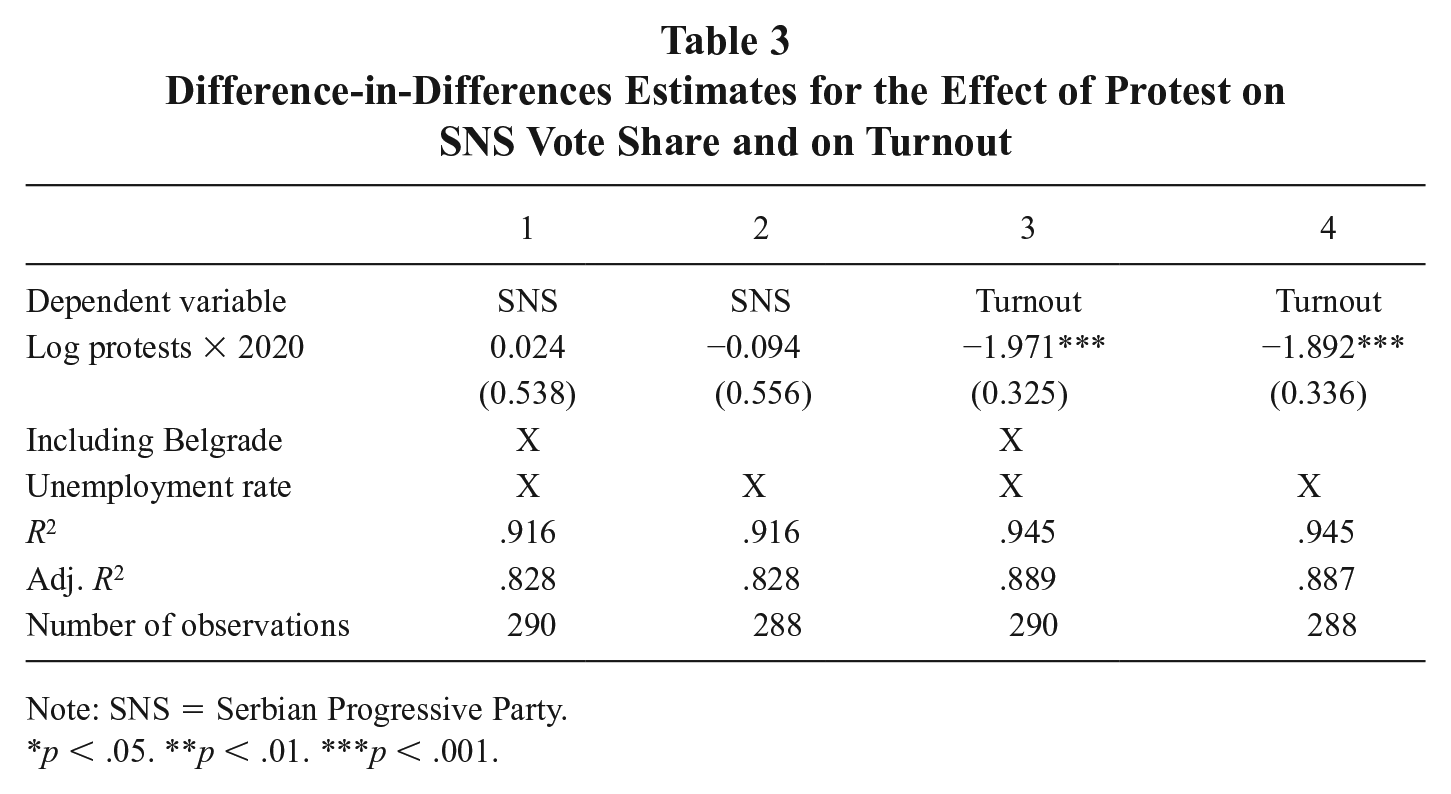
Using the DD approach outlined in the previous section, we find that there was a statistically significant negative impact on turnout in municipalities with more protests, supporting the Mobilization Hypothesis. On the other hand, protest was not statistically significantly associated with SNS vote share, thus providing insufficient evidence for the Complacency Hypothesis. We present the results in more detail below. Before doing so, we first look at the two protest waves descriptively.
As explained in the background section, the repertoires of “Against Dictatorship” and “One of Five Million” had many similarities, primarily in that they both relied on mass demonstrations that diffused (to a lesser or greater extent) across Serbia. On the other hand, the earlier wave spread quickly to different municipalities in the wake of the presidential election in 2017, then gradually subsided over a one-month period. By contrast, “One of Five Million” mainly started out in Belgrade, and only began spreading to a number of locations after the first month, and then there were more regular (weekly) demonstrations. The demonstrations largely subsided within six months. These differences are presented in Figure 1.
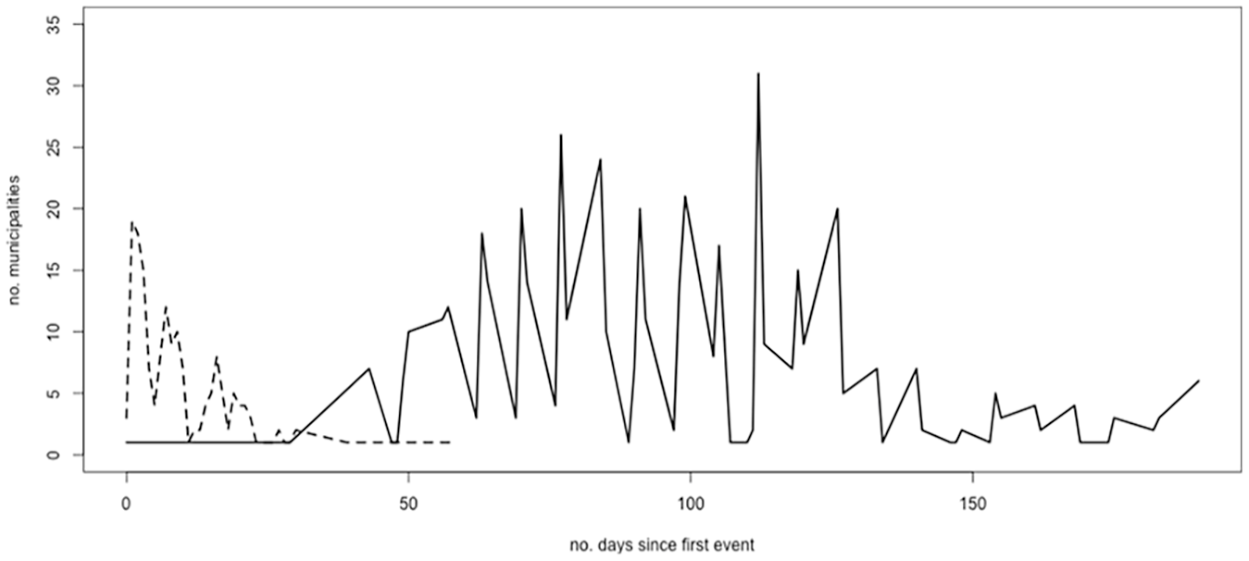
Protest wave diffusion and duration
The other main difference between the two waves is the number of municipalities to which the mass demonstrations spread. As our protest data show, there were twenty-six locations involved in the “Against Dictatorship” protest wave, and nearly three times the number of locations (71 cities and municipalities) for “One of Five Million.” The geographic distribution of the two protest waves is presented in Figure 2. The shading indicates the logged frequency of the protests, with darker shading indicating the highest values and lighter shading the lowest values, with white for locations in which no protests took place. The “Against Dictatorship” protests were more frequent in Belgrade, Niš, Novi Sad, and Subotica, with fewer protests elsewhere. For the “One of Five Million” protests, Belgrade, Niš, and Novi Sad were still active, with relatively fewer protest events in Subotica (in the north of the country on the Hungarian border). However, there was a marked increase in the number of places involved in the protests that cover most regions in Serbia, and the relatively darker colours in this plot indicate that the frequency was higher within a greater number of cities and municipalities.
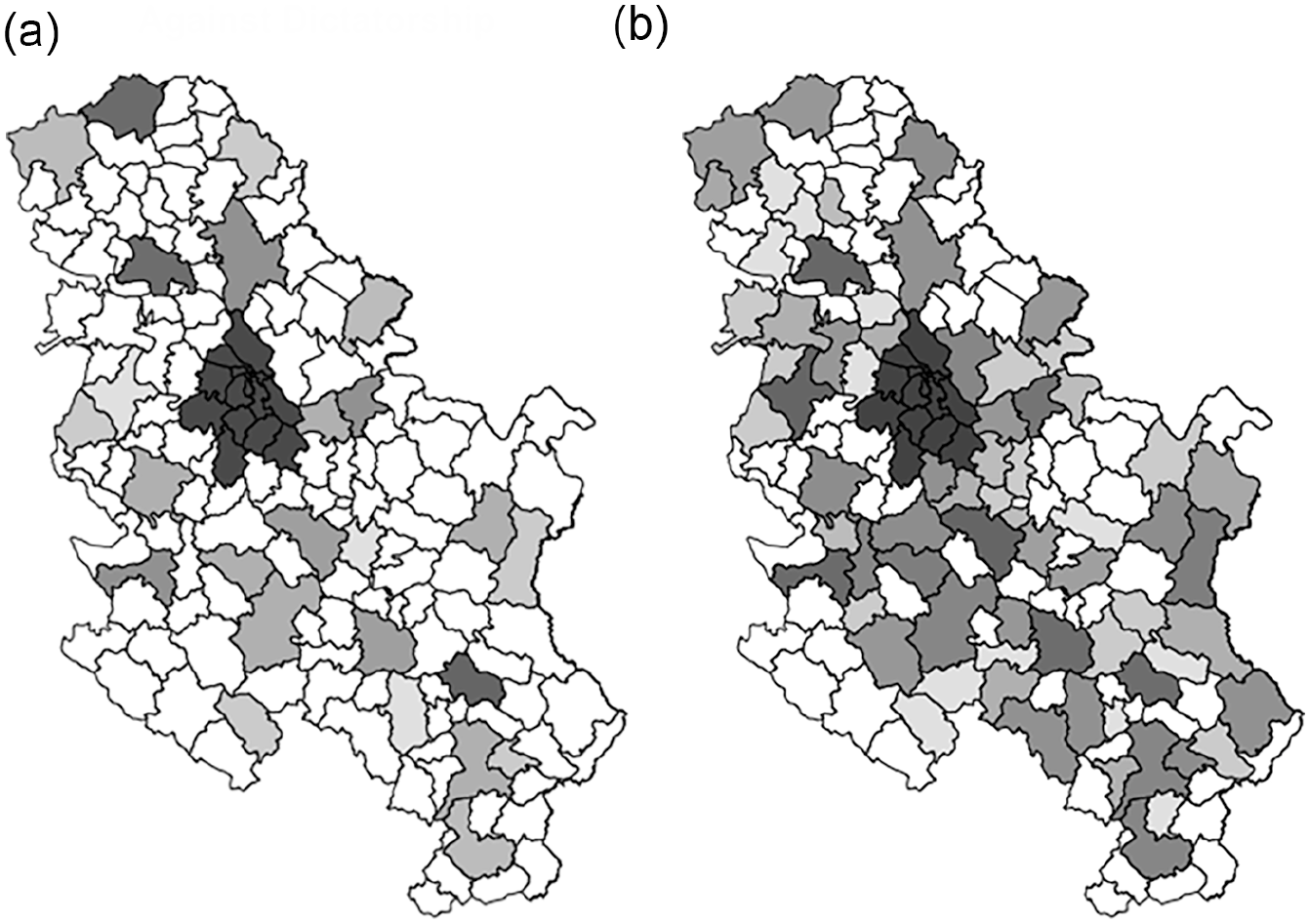
Geographic distribution and logged frequency of events, by protest wave. (a) “Against Dictatorship” and (b) “One of Five Million”
If we sum up the events from the two waves, the average number of protest-days in locations that had at least one event is 9.04 (SD 11.44). This number suggests that there is substantial variation, and furthermore, the marked difference between the mean and median (which is 5.00) suggests that the variable is positively skewed. The logged frequency of events has an average value of 1.89 (SD 0.89), and a median value (1.79) much closer to the mean, suggesting little skew.
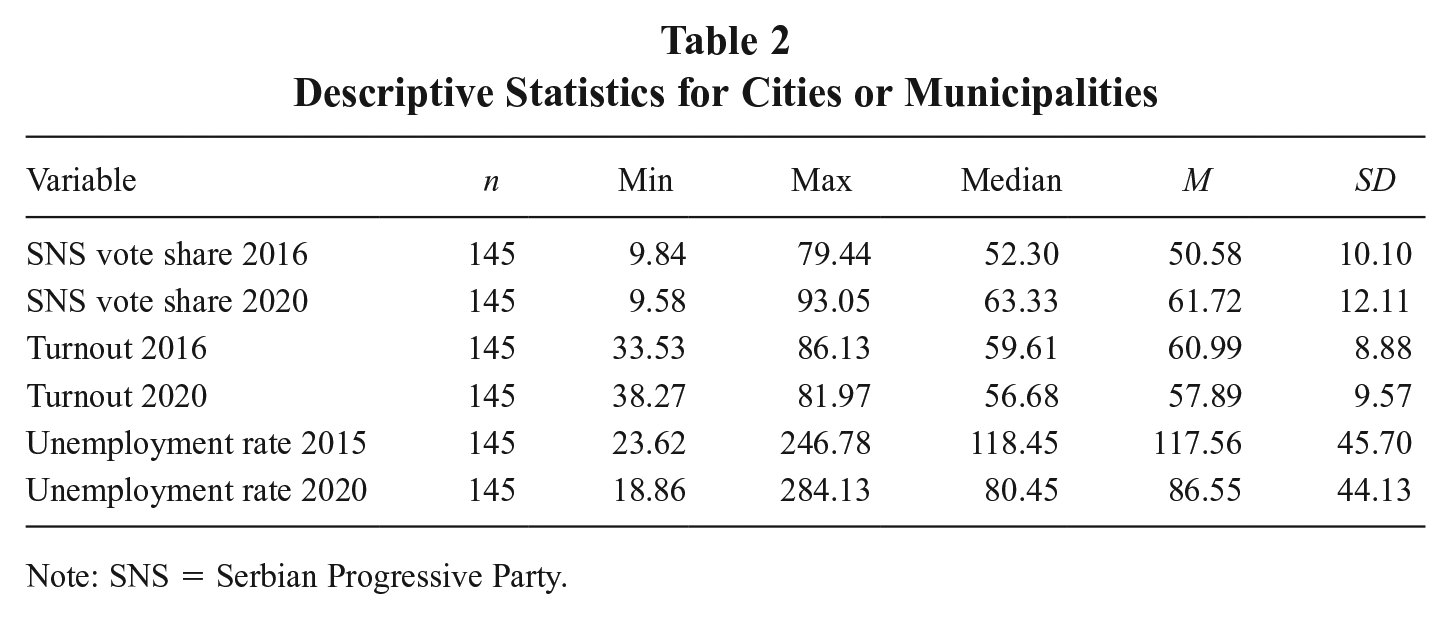
Turning to electoral data, our analysis examines the 2016 and 2020 Serbian parliamentary elections. The descriptive statistics for the turnout, SNS vote share, and unemployment rate (per 1,000) within cities and municipalities are presented in Table 2.
Descriptive Statistics for Cities or Municipalities
Note: SNS = Serbian Progressive Party.
The descriptive statistics show that within municipalities, the unemployment rate dropped on average between the end of 2015 and 2020. The turnout in the 2020 election was lower than in 2016, perhaps due to the coronavirus pandemic. On the other hand, there was a noticeable increase in SNS support within municipalities in the 2020 election compared with the earlier poll.
We first fitted ordinary least squares regression models in the form shown in Equation 2 with SNS vote share and turnout as the outcomes. We present four models in Table 3, all including the unemployment rate. Since the number of protests in each wave in Belgrade was around double that of any other city or municipality, we also fitted models that excluded Belgrade. The results are presented in Table 3 and used the R package texreg. 86
Difference-in-Differences Estimates for the Effect of Protest on SNS Vote Share and on Turnout
Note: SNS = Serbian Progressive Party.
p < .05. **p < .01. ***p < .001.
We examined the coefficient for “log protests × 2020,” which is
Discussion and Conclusions
Our findings suggest that the citizen-led waves of protest have provided some resistance to competitive authoritarianism. We found that the intensity of protest significantly and negatively impacted turnout within municipalities between the 2016 and 2020 elections, providing support for our Mobilization Hypothesis. However, change in SNS support within municipalities is not significantly associated with protest, contrary to our Complacency Hypothesis.
At the very least, our results suggest that the campaign to boycott the elections was successful insofar as places with protest had decreased turnout significantly more on average compared with 2016. This correlation would imply that participation in the protest campaign made it more likely for voters to mobilize along with the boycott, though the size of the effect was hardly substantial.
On the side of external actors, primarily the European Union, the boycotts do not seem to have been able to attract attention. As already mentioned, we can only speculate about the oppositional motivation for boycott, as it is beyond the scope of the article, but the literature emphasizes the pivotal role of external actors in facilitating political change following electoral boycotts in other places. A recent European Parliament resolution on the situation in Serbia remarked that there had “even been backsliding on issues that are fundamental for EU accession,” and that the European Union should consider suspending funding as a deterrent. 87 However, as previously established, the European Union as a whole has not condemned the authoritarian tendencies of SNS or acted in relation to them, 88 similar to other post-Communist contexts. 89 It is this EU reluctance that may impact the effectiveness of potential future boycott strategies of the Serbian opposition.
On the side of domestic audiences, including non-voters and voters sympathetic to the opposition, opposition parties have had only limited success in translating the potential discontent of protest waves into the boycott campaign. Part of the reason may be found in the ideological positioning of the oppositional parties. On one hand, the electoral strategy of SNS covers a relatively broad spectrum of voters, not leaving a lot of space for oppositional actors. 90 On the other hand, most opposition parties have failed to distinguish themselves clearly from the mainstream nationalist and neoliberal ideological framework. 91 It is important to note, however, that during the observed period (2016–2020), several new electoral actors emerged, introducing green and left-wing agendas into electoral conflict. It remains to be assessed whether they will be able to position themselves within electoral competition in future electoral cycles. In any case, in the aftermath of the 2020 election, the opposition did not continue the boycott and instead participated in 2022 general election. It seems that ultimately, in spite of the relationship between the protest wave and the boycott that we discussed in this article, the boycott strategy was evaluated as inefficient. It remains to be seen whether in the future the opposition’s strategic reasoning will shift yet again in favour of parliamentary or electoral boycott.
The avenue of future research where we see the most potential—and where our article makes an initial contribution—is to bring citizens back into the picture when examining democratic backsliding. 92 The extant literature largely views political change in countries with democratic backsliding as the interplay between backsliding governments, organized opposition, and international actors. However, even with serious political impediments and remote chances of success, Serbian citizens came out en masse to mobilize against the government and participate in the electoral boycott. The fact that they did bodes well for citizens acting as a counterweight to democratic backsliding, and it provides potential for positive political transformation.
Footnotes
Acknowledgements
Earlier drafts of this article were presented at the UNC-KCL Joint Symposium in March 2020, the 27 Conference of Europeanists in June 2021, and the Serbian Political Science Association conference in September 2021. The authors would like to thank the participants of these events for their feedback. They are especially grateful for the helpful comments by the thematic cluster editors and from Vujo Ilić. The usual disclaimer applies.
