




Abstract
When incumbent east central European ethnopopulist politicians attack liberal democratic institutions, how does the experience of living through Communism motivate people to protest in defense of liberal democracy? I argue that a critical subset of people in the generation who lived through Communism is extremely active in protests in defense of liberal democratic institutions. A memory of living with authoritarianism and struggling to establish democracy seems to motivate the older generation to actively safeguard these institutions by generating fear of a return to the past. I expect the older generation to be particularly active at protests in defense of democracy when incumbent ethnopopulists engage in democratic backsliding. I explicitly test these hypotheses by analyzing 82 interviews I conducted with people who protested in defense of liberal democratic institutions in nine different Polish towns and cities in 2019, 2021, and 2022. I couple these interviews with data from an original online protester survey and from the European Social Survey.
Introduction
In recent years, ethnopopulist parties have won elections in several east central European countries. Ethnopopulist politicians claim that nefarious domestic and transnational actors threaten “the people,” whom ethnopopulists define in ethnic, religious, or racial terms. 1 They leverage this language to justify attacks on liberal democratic institutions. 2 Many scholars explore how ethnopopulists win power and erode democracy. 3 However, we know less about how civic movements and citizens respond to ethnopopulists’ attacks on liberal democratic institutions. 4 Yet, in recent years, the largest protests since the fall of Communism have occurred in opposition to different kinds of democratic erosion in Bulgaria, the Czech Republic, Poland, Romania, Serbia, and Slovakia. 5 Who protests against democratic backsliding? Can the experience of living through Communism motivate some people to defend liberal democracy by protesting?
In this article, I analyze what motivates older pro-democracy protesters to protest in Poland. By combining qualitative data from 82 semi-structured interviews that I conducted with Polish protesters in 2019, 2021, and 2022 with quantitative data from an original protester survey and the European Social Survey (ESS), I find that generational memberships impact people’s willingness to defend liberal democratic institutions. 6 When ethnopopulists undermine liberal democratic institutions, individuals old enough to have lived through Communism and those who did not appear to perceive threats to democracy differently. Their threat perceptions shape which protests they attend. Memories of life under Communism and during the democratic transition appear strong and salient in motivating the older generation to protest. Some members of this older generation quickly recognize the fragility of democratic institutions and mobilize to protect them.
By analyzing the Polish case, I promote understandings of what motivates citizens to protest for liberal democratic institutions. These findings help us better understand citizens’ reactions to democratic backsliding. Robust protest movements help slow democratic backsliding and may even prevent it. 7 Thus, it is important to learn what motivates individuals to defend liberal democracy. Moreover, these findings are consequential to new democracies around the world. In other democracies where politicians rise to power and begin attacking liberal democratic institutions, if a critical portion of the population already fought to establish democracy, these individuals may mobilize to protect these hard-won institutions once again. Newer democracies thus may have a reserve of older citizens who are especially likely to quickly detect and respond to backsliding.
Protesting Democratic Backsliding in Poland
Support for ethnopopulist parties has risen across Europe. In Poland, the ethnopopulist Prawo i Sprawiedliwość (Law and Justice, PiS) party won successive elections and concentrated power by attacking liberal democratic institutions before losing its parliamentary majority in the 2023 elections. Though PiS also undermined individual rights, including lesbian, queer, bisexual, transgender, intersex, queer, asexual (LGBTQ+) and abortion rights, in this paper, I focus on responses to its attacks on liberal democratic institutions. 8 I define liberal democratic institutions as institutions preserving the rule of law and protecting minority rights from incursion by the majority.
After winning the 2015 elections, PiS changed electoral laws, packed the constitutional court, undermined the independence of local judges, attacked lawyers, turned public media platforms into propaganda machines, and reformed public school curricula in an illiberal fashion. 9 PiS pushed through controversial reforms, which would force judges to retire at a younger age with selective exceptions, allow Parliament to investigate and sanction judges for their court rulings, and give Parliament the right to appoint judges politically. 10 Beyond attacking judicial independence, PiS severely undermined media freedom by passing a new media law, which allowed it to hire and fire state broadcasters. 11 This reform silenced critics on state media and largely transformed Polish state media into a PiS propaganda outlet. 12
Reflecting these and other controversial changes to liberal democracy, democratic indicators, such as the Varieties of Democracy’s (V-Dem) Liberal Democracy Index shown in Figure 1, show a deterioration of democracy after PiS returned to power in 2015. Despite the extent of democratic backsliding, large protests defending liberal democracy challenged these measures in the streets. As Figure 2 shows, pro-democratic protests increased in size and frequency after 2015. 13 What motivates people to protest for liberal democratic institutions?
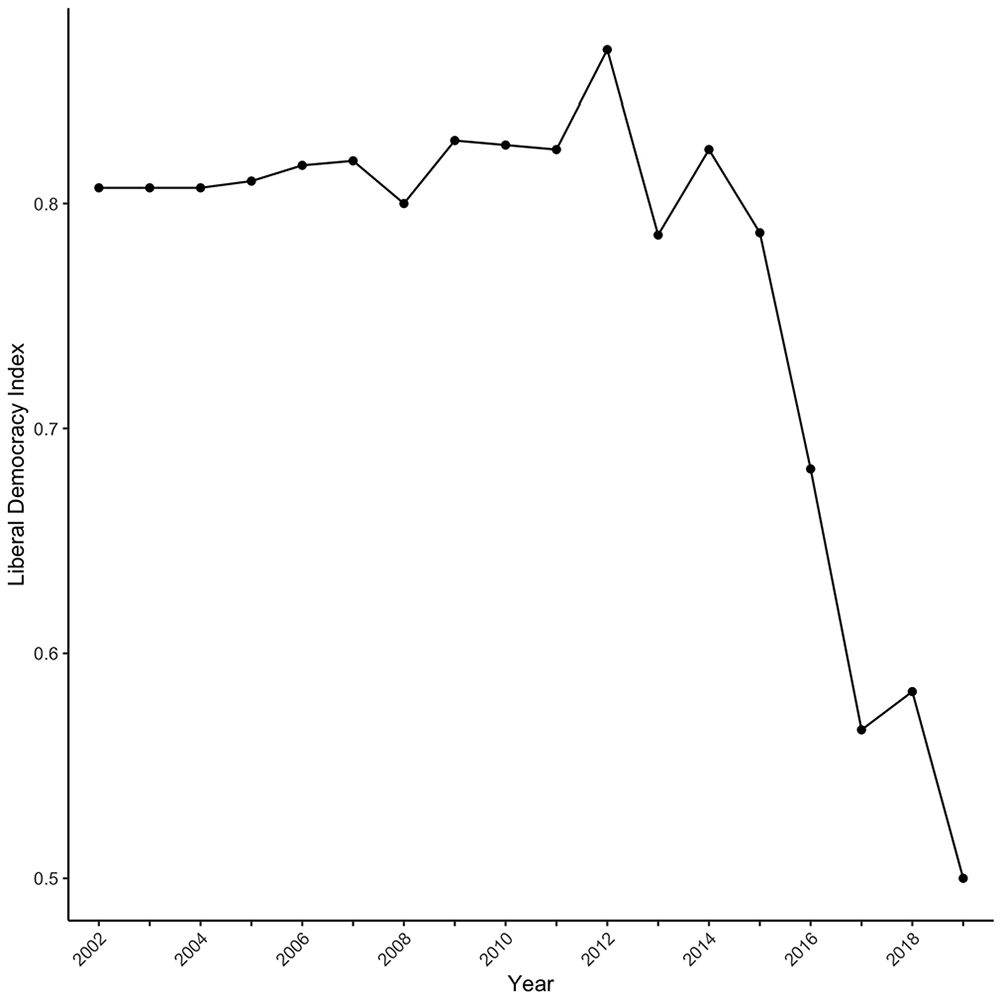
This figure plots V-Dem data, using the question, “To what extent is the ideal of liberal democracy achieved in Poland?” A score of 0 indicates that liberal democracy is not achieved and 1 indicates that liberal democracy is achieved
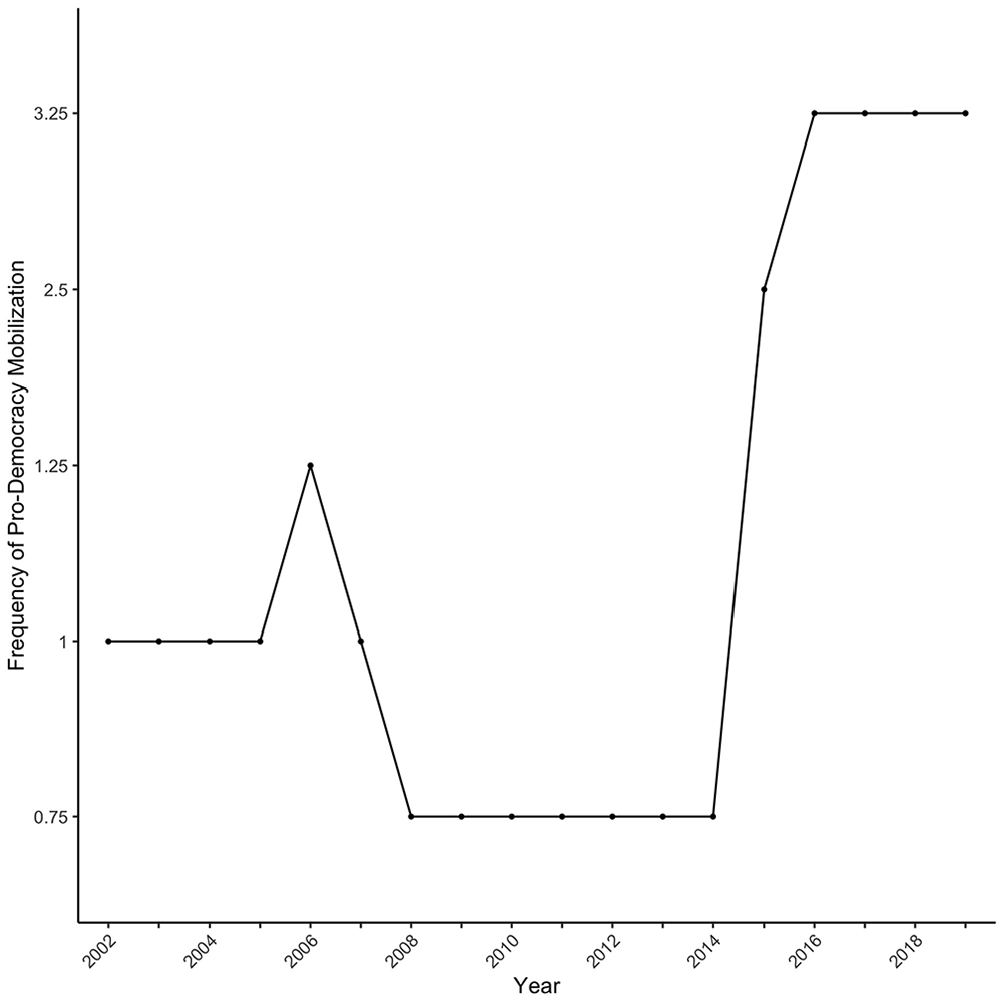
This figure plots the V-Dem data for the question, “In this year, how frequent and large have events of mass mobilization for pro-democratic aims been?” I use the mean score of all V-Dem coders. A score of 0 indicates that there have been virtually no events, 1 indicates that there have been several small-scale events, 2 indicates that there have been many small-scale events, 3 indicates that there have been several large-scale and small-scale events, and 4 indicates that there have been many large-scale and small-scale events
Why Protest in Defense of Liberal Democracy?
Protesters might protest based on both instrumental motivations—attempting to accomplish specific political goals—and expressive motivations—attempting to demonstrate one’s ideology, values, or emotions. 14 The generational experience of living through Communism may shape both types of motivations for older protesters.
Following Karl Mannheim, I define a generation as emerging when a group of people feels bonded with others of a similar age because they share common experiences that have imbued them with common cultural, social, and political values. 15 These shared experiences and values are both held and communicated. As Hanna Świda-Ziemba writes and as translated by Piotr Osęka, “a generation is distinguished by a system of meanings which makes up the language of discourse within the generation.” 16 Thus, a generation shares not only common experiences and values but also common discourse and meanings.
Why might some of the generation who lived through Communism and the democratic transition share common discourses, experiences, and values that could motivate them to protest for democratic institutions? To answer this question, I primarily draw from two theoretical lenses: political socialization and the role of social networks. Socialization theories applied to Poland indicate that older individuals who were socialized with Communist institutions and who fought to establish liberal democracy may be motivated to protect these hard-won liberal democratic institutions out of a fear of returning to the past. Additionally, social network theories suggest that older Polish citizens who were anti-Communist dissidents and protested to establish democratic institutions may maintain social networks from their dissident days. These pre-existing social networks may facilitate the organization of pro-democratic protests for some of this older generation and may motivate them to protest in a way rooted in both instrumental and expressive motivations.
These generational discourses and meanings may be particularly consequential for older protesters because anti-Communist discourse remains salient in Poland, though the shape of it varies. PiS leaders often suggest that Platforma Obywatelska (Civic Platform, PO) party officials represent a continuation of Communism and a failure to break from the People’s Republic of Poland. 17 However, parties like PO often claim that PiS behaves in a “Communist” way by undermining the achievements made since the fall of Communism and by returning to Communist-era practices. 18 The discourse on PiS actions that undermine democracy often ties back to this “trivial anti-Communism.” 19 This discourse may encourage protest participation for those who received political socialization during Communist times and who were anti-Communist dissidents. Some of the older generation may possess the motivations to mobilize based on trivial anti-Communism and the networks needed to organize large-scale protests for liberal democratic institutions. Thus, I expect that some of the older generation actively mobilize to protect liberal democratic institutions and have unique motivations encouraging them to protest.
Political Socialization
Political socialization suggests that an individuals “acquires attitudes, beliefs, and values relating to the political system of which he is a member and to his own role as a citizen within that political system.” 20 Though socialization has differential impacts on individuals 21 and can occur throughout one’s life, during childhood institutions impact individuals’ attitudes, beliefs, and values. 22 Undergoing political socialization in Communist times and during the democratic transition may impact some older individuals’ willingness to protest for democratic institutions.
While some scholars find that younger people are more likely to protest, others argue that older people are more likely to protest, especially when they perceive an extreme threat to their quality of life. 23 I claim that some members of the older generation perceive democratic backsliding as an extreme threat due to their political socialization in Communist times and during the transition to democracy. I expect political socialization to shape older individuals’ propensity to protest in two crucial ways.
First, whether an individual was socialized in an authoritarian or democratic regime can impact that individual’s political attitudes and propensity to protest. 24 Living through Communism affects political attitudes independently of pre-Communist and post-Communist legacies. 25 If living through Communism shapes political attitudes, it likely also affects political behaviors, including protest propensity. Living through Communism can create a subset of people willing to protest for liberal democratic institutions decades later, because the process of sharing traumatic memories from this period can generate an “anti-totalitarian” identity capable of mobilizing people for democracy. 26 Further, memories of past authoritarian regimes can be repurposed to motivate people to protest decades later. 27 Political socialization may impact memories of past authoritarian regimes by affecting individuals’ attitudes and beliefs toward their political systems. When the political socialization process during Communist times and the democratic transition generates views favorable to liberal democracy, memories of former regime institutions may be strongly negative. Steps to undercut liberal democratic institutions may evoke strong emotions like anger, and some older people may draw parallels between the illiberal past and present. 28 Those who maintain strong levels of support for liberal democracy may possess unique incentives to protest for democratic institutions when they are attacked by incumbent ethnopopulists. 29 Some of the older generation may accept “trivial anti-Communism” as an important rallying call. 30 Appeals claiming that PiS rejects and undermines the achievements made since the democratic transition in 1989 may be particularly powerful mobilizing frames for those older people who lived through the transition and believe it benefited them. They may be mobilized by a feeling that these institutional changes are unjust, due to how they acquired political attitudes, beliefs, and values. 31
Second, intensive and risky past protest participation can increase an individual’s likelihood of protesting later in time. 32 Protesting against the Communist regime was risky and this intensive mobilization may encourage future protest participation among the older generation. Living through and participating in the protests that contributed to the collapse of Communism may socialize some of the older generation to protest for liberal democratic institutions decades later. 33 Some people who lived through Communism developed liberal left preferences—combining neoliberal economic principles with strong commitments to democracy, inclusiveness, and the rule of law. 34 For them, anti-Communist discourses on democratic backsliding push them to defend democracy by protesting. Since “acting on behalf of important values brings . . . fulfilment and reward,” individuals who value liberal democracy may protest again. 35
I expect individuals who intensively participated in high-risk activism against the Communist regime to be more likely to protest decades later. Former protesters may remember that protest can actually change institutions and politicians’ behaviors. These feelings of efficacy, emerging from formative experiences with the former authoritarian regime, may mobilize older protesters to defend liberal democratic institutions. 36 People who protested to establish liberal democratic institutions may hold a politicized identity as a protester for liberal democracy. In turn, politicized identities correlate with feeling obliged to join related social movement activities, such as pro-democracy protests, decades later. 37 Furthermore, the older generation has strong memories of Communist times—even if members did not participate in its demise. Its members may draw parallels between the illiberal institutions with which they grew up and the concentration of power in the hands of PiS—particularly as many of the tactics used by PiS to control information and fuse the party with the state administration resemble those used by Poland’s Communist regime. 38 This older generation may draw parallels between the past and present on their own, or from the broader media and political environment, which describes the actions of PiS as undermining the democratic transition’s achivements. 39 They may feel a group-based sense of deprivation, perceiving these attacks as undercutting previously established rights and mobilizing in response. 40
This unique generational experience makes the older generation different from the younger generation. The younger generation is unlikely to have strong—or any—memories of the Communist time or democratic transition. These younger people were more likely to grow up expecting at least quasi-democratic institutions to continue. With no lived experience fighting for democracy and no experience living through Communism, this younger generation may not prioritize protecting specific democratic institutions. Therefore, I expect political socialization to impact each generation’s protest motivations. In turn, these motivations may help explain my hypothesized generational divide in protest behavior.
Networks
Membership in certain social networks facilitates protest participation. Since being asked to protest strongly predicts protesting, belonging to civic associations or to networks with more protesters increases an individual’s likelihood of protesting. 41 Even informal networks and peripheral members of a social network often join contentious politics when they know participants or believe in their capacity to affect an outcome. 42
Additionally, experience mobilizing against authoritarian regimes can create collective memory and organizational networks, which may encourage future mobilization. 43 Former dissidents may continue to feel affective ties with their group, maintaining a sense of psychological attachment and commitment to their group and the liberal democratic principles they feel it represented. 44 When dissidents share a generational identity, they can develop a common worldview, such as one supporting liberal democracy. 45 This politicized identity can generate a sense of obligation to join social movement activities. 46 When former dissidents see others already protesting for liberal democratic institutions, it can create normative pressures to join. 47 Though the anti-Communist social movements of the past are not the same as contemporary social movements, some contemporary protest organizers recycle frames and symbols used by anti-Communist dissidents. Past protest participation may create frames of reference understood by those former protesters. 48 In turn, references to frames used by anti-Communist dissidents may convince the older generation—but not the younger generation—to mobilize.
Moreover, these older individuals may remain networked with other former anti-Communist dissidents. Participating in high-risk activism, like anti-Communist protests, may radicalize participants and connect them to like-minded people, creating networks of activists who protest later in life. 49 For former activists, protest may appear as a way to improve their group’s status and return to the liberal democratic institutions of the recent past. 50 The effects of socialization and social networks are therefore intertwined.
I thus contend that individuals with experience protesting against the Communist regime may reactivate past protest networks and repurpose anti-Communist symbols to motivate individuals of their generation to defend democratic institutions decades later. Indeed, protesters who come from the culturally liberal camp that opposed the Communist regime have appeared particularly active at protests in recent years. 51
Data and Methods
To identify whether memories of Communism and experience protesting against the Communist regime encourage the older generation to protest for liberal democracy, I pull from semi-structured interviews, an original protester survey, and the ESS.
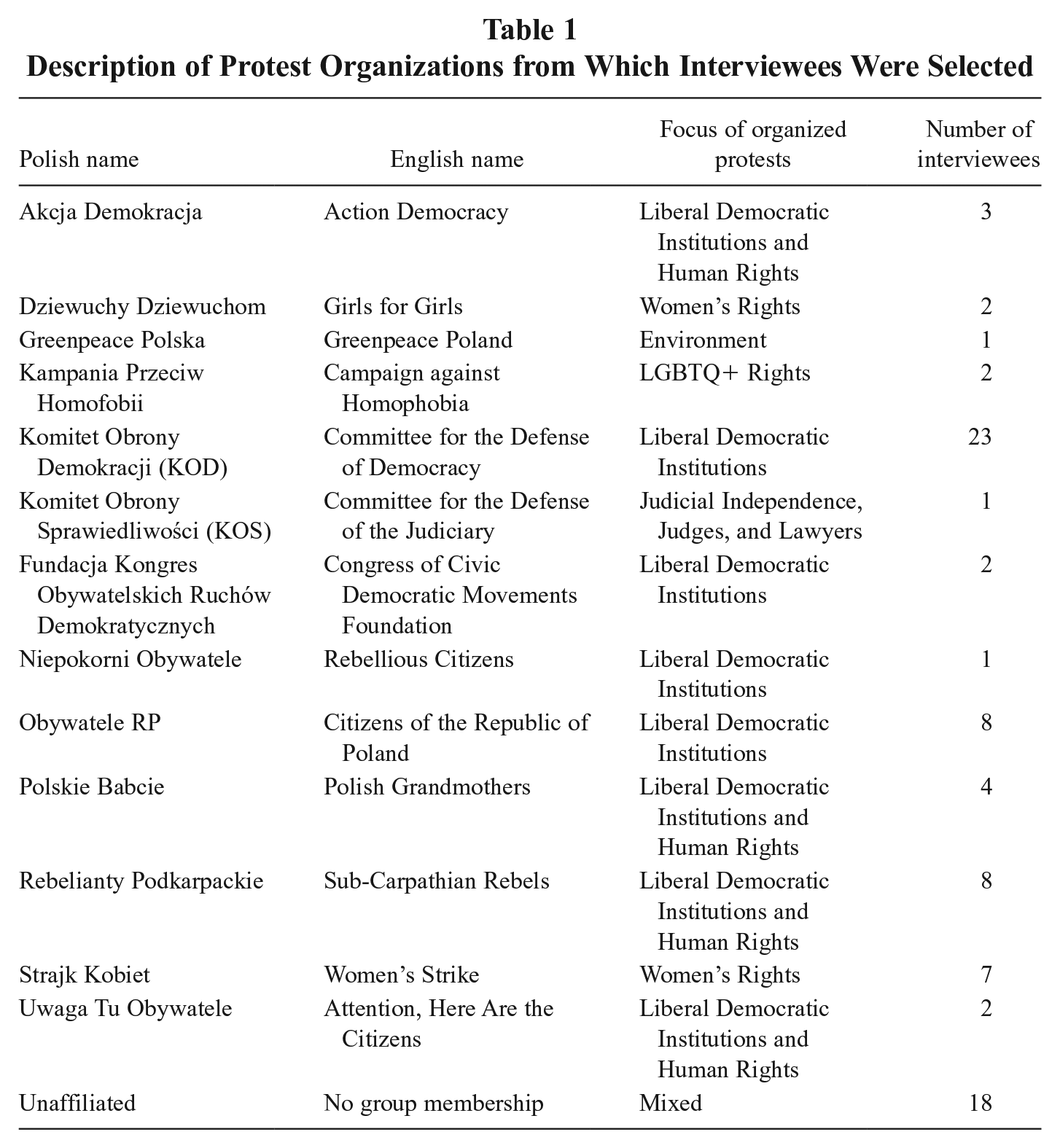
I conducted in-depth, semi-structured interviews with 82 Polish protesters in thirteen different Polish cities in 2019, 2021, and 2022: Białystok, Gdańsk, Gdynia, Gryfino, Kraków, Krosno, Lublin, Łódź, Przemyśl, Rzeszów, Szczecin, Warsaw, and Wrocław. Individuals from these localities have defended liberal democratic institutions by protesting against PiS’s actions in recent years. These localities vary in population size, strength of PiS support, and income levels. They also belonged to different historical partitions of Poland, which may affect contemporary political attitudes and behaviors. 52 After selecting these cities, I used local and national newspapers to identify protests defending liberal democratic institutions in these cities since 2015. I found these events on Facebook, where I was able to identify co-organizers of protests using the “Meet your hosts” feature. I reached out to these groups by sending Facebook messages, e-mail, or, texts, or by calling them. I also used snowball sampling to contact individuals who protested but did not organize. Table 1 shows the names of the organizations whose members I interviewed. Not all interviewed protesters formally belonged to one of the organizations listed in Table 1, but all participated in these protests. While 71 interviewed protesters were over 55 years, eleven were younger than 55 years.
Description of Protest Organizations from Which Interviewees Were Selected
In each interview, I first asked respondents when they began protesting and what motivated them to protest. I asked them to describe the types of people who took part in these protests. If respondents requested clarification on this question’s meaning, I asked them to describe the protest composition in demographic terms. However, I never mentioned specific demographic factors, to avoid biasing the responses. Next, I asked them to tell me about what they thought motivated others to protest and what others had told them about why these individuals began protesting. My interview length with each respondent ranged from one to four and a half hours, which provided me with extremely detailed information about protest histories, protest motivations, political ideologies, and political aims. I transcribed these interviews in full, translated them into English, and then coded them for types of protest motivations, including but not limited to mentioning living through Communism, drawing parallels between the illiberal past and present, belonging to specific social networks such as Solidarity or a group organized within a Catholic parish, expressing different emotional appeals, portraying themselves or their group as having or lacking efficacy, expressing perceptions of injustice, discussing a felt obligation to protest, and stating a feeling of deprivation. The quotes that I use below are in response to me asking either what motivated the individual to protest in support of liberal democratic institutions or what the individual thought motivated other people to participate in these protests. These quotes thus reflect protesters’ motivations and the motivations that protesters thought drove others to protest alongside them.
In addition to my rich qualitative data, I conducted an online survey of protesters belonging to one of two different Polish protest organizations. In March 2020, I distributed a survey via Facebook to Polish protesters belonging to Komitet Obrony Demokracji (Committee for the Defense of Democracy, KOD) and Obywatele RP (Citizens of the Republic of Poland). My contacts with KOD and Obywatele RP posted a link and the description of the survey to these groups’ national Facebook pages. Both KOD and Obywatele RP primarily organize protests in response to attacks on liberal democratic institutions. Their leaders and members have been and continue to be instrumental in organizing protests in defense of judicial independence, media freedom, and other key democratic institutions. They frequently cooperate with other protest organizations seeking explicitly to defend LGBTQ+ rights, women’s rights, and the environment. Only 149 protesters clicked through at least half of the survey, so I merely present these results in descriptive terms to complement the findings from the semi-structured interviews. 53 Since existing surveys almost never ask what issue(s) a respondent protests or why they protest, my survey offers the opportunity to learn more about who protests in defense of liberal democratic institutions.
Finally, I use data from the ESS on protest participation to gauge changes over time in the generations of protesters in Poland. Unfortunately, the ESS does not ask individuals for which issue areas they protest, but rather simply asks whether a respondent has taken part in a lawful demonstration in the last year. 54 I simply use these data to better triangulate my claims. Together, this mixed methods approach clarifies the motivations that trigger a specific type of protest.
Measuring Generation
To measure generations, I chose being born before 1982 as the critical cut-off year. Individuals born before 1982 belong to the older generation, whereas those born in or after 1982 belong to the younger generation. Poles who were younger than seven years old at the time of democratic transition in 1989 likely had neither a lived experience with Communism nor a clear memory of the Communist period, protests for democracy, or the democratic transition. Older individuals likely had stronger memories of this period. Furthermore, compulsory education in Communist Poland began at age seven. 55 Therefore, individuals born after 1982 did not turn seven years old until the democratic transition and might not have received as much political socialization under Communist institutions when compared to individuals over seven when the transition occurred. I conducted robustness checks on the generational measure. For all results presented below using ESS data, the same patterns exist when dividing the respondents based on their length of education during Communism (Appendix Figure A1) and on whether they were old enough to vote in a Communist election (Appendix Figure A2).
Do Older Poles Actively Protest in Defense of Liberal Democracy?
To explore whether the older generation protests for liberal democratic institutions, I first present quantitative data from ESS and my original survey of Polish protesters.
Figure 3 plots the mean level of participating in a demonstration in the last year for each generation with 95 percent confidence intervals using ESS data. Despite low protest participation, this figure illustrates a surprising temporal change in the prevalence of the older generation protesting. Before 2015, the older generation had extremely low levels of protest participation. After 2015, members of the older generation had much higher protest levels, though this change is not statistically significant. This increased activism corresponds to the time when attacks on liberal democratic institutions began, which suggests that some generational effects might exist.
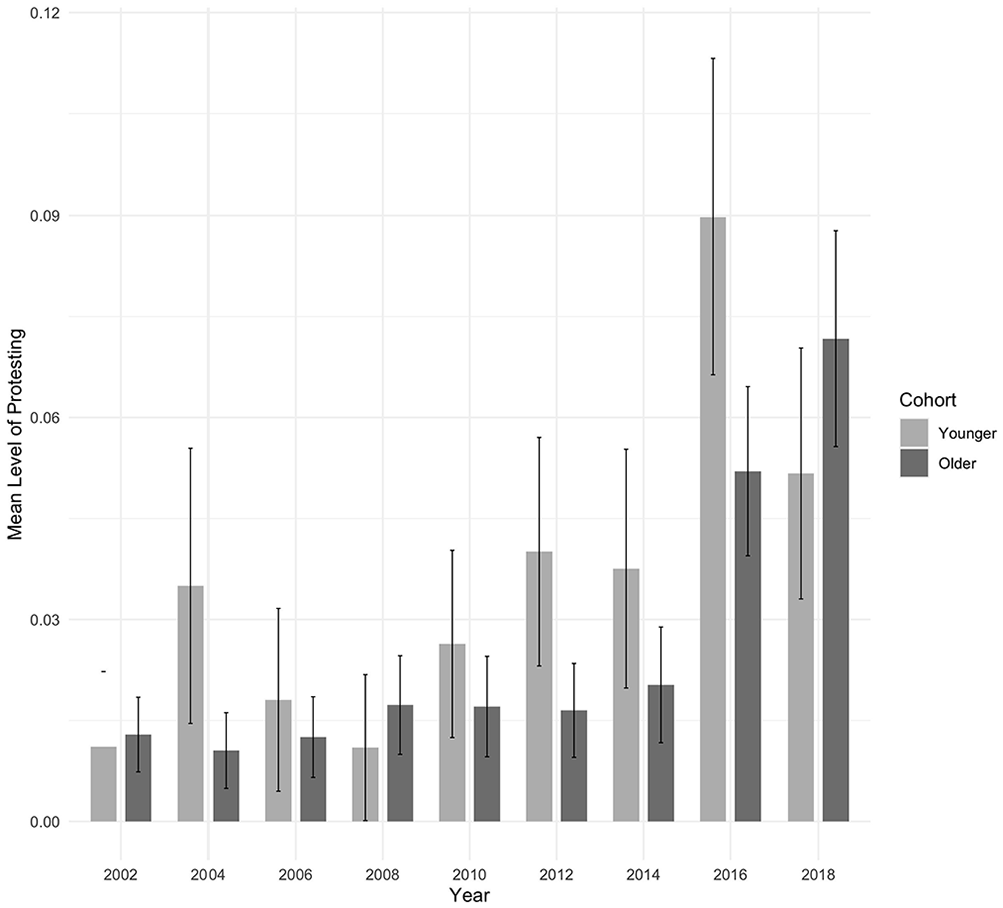
Have you participated in a demonstration in the last twelve months?
Unfortunately, ESS questions do not allow researchers to identify which types of demonstrations respondents attend. In east central Europe, right-wing and nationalist protests are common. 56 ESS data cannot tell us about only those protesters who mobilize in support of liberal democratic institutions. Therefore, I turn to analyzing data from my original protester survey.
Descriptive statistics from my protester survey reveal that 120 of 149 respondents protested for liberal democratic institutions. Of those 120 pro-democratic protesters, only nine belonged to the younger generation. Figures 4 and 5 show that survey participants who lived through Communism protested in higher numbers to defend liberal democratic institutions between 2015 and 2020. Figure 5 also illustrates that the older generation protested at high rates to support judicial independence. Based on interview evidence presented in the next section of this article, it seems that some of the older generation are systematically highly involved in protests defending liberal democratic institutions.
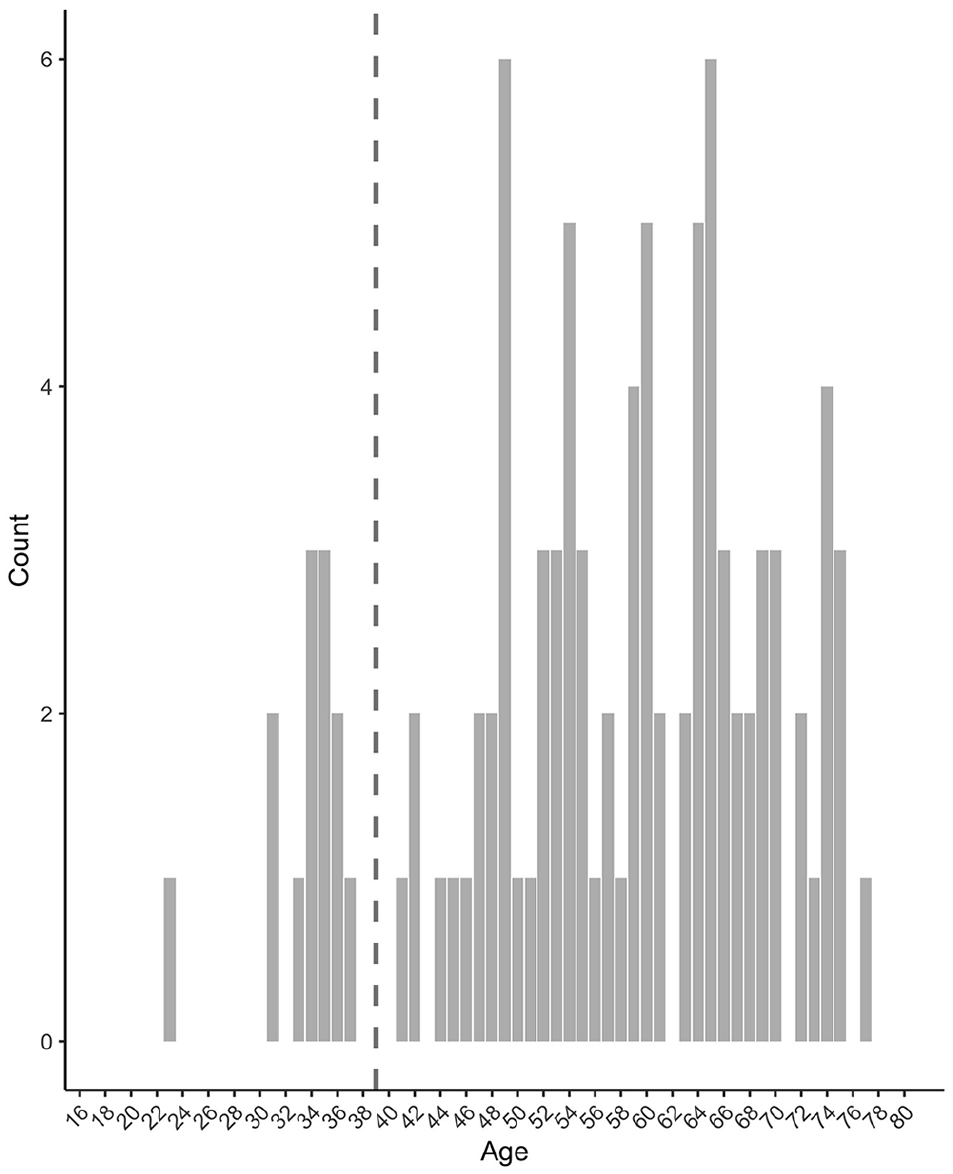
Age of protester. The dotted line divides those who lived through Communism from those who did not
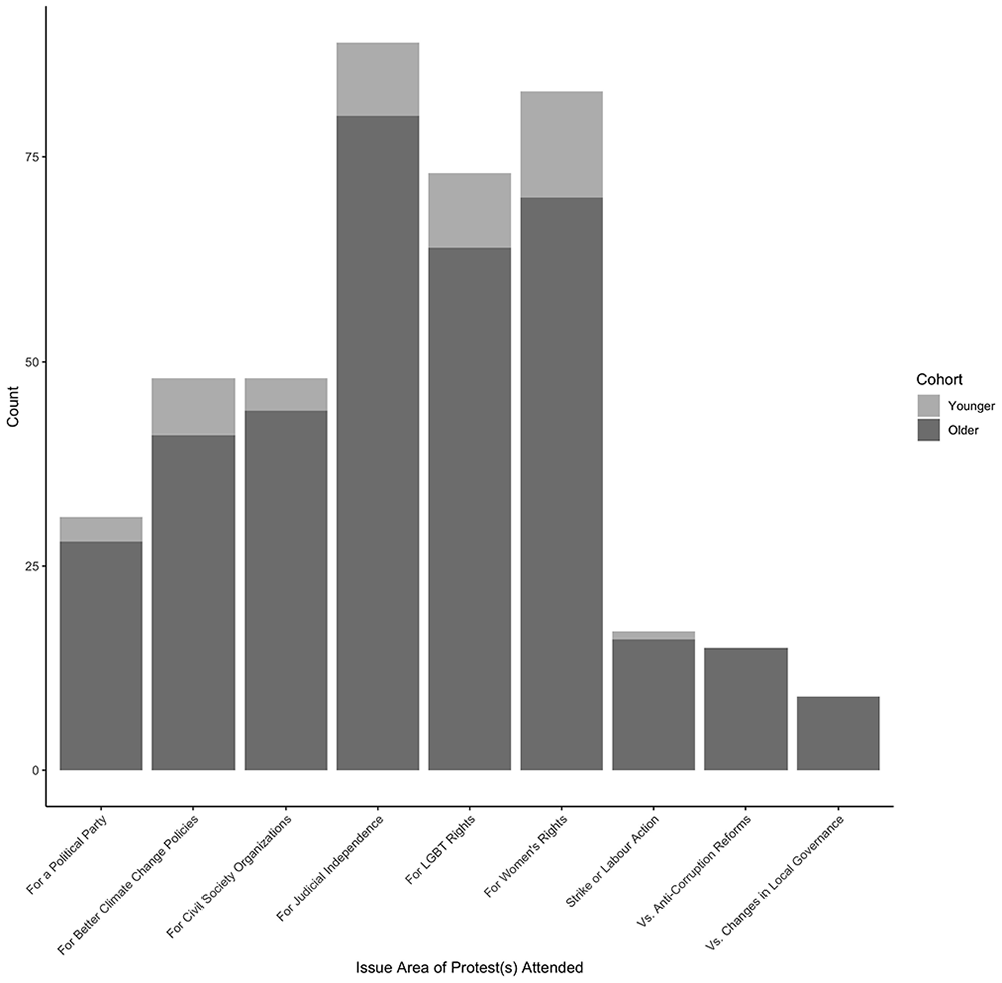
Please indicate the manifestations in which you have participated
Together, data from the ESS and my protester survey reveal that the older generation appears more active in protests immediately after PiS attacked liberal democracy. The overwhelming majority of respondents to the protester survey belong to the generation that lived through Communism and was socialized under Communist institutions. To what extent do generational experiences motivate these protesters?
Why Is the Older Generation a Protest Generation?
The older generation appears increasingly active in protests occurring to defend liberal democratic institutions in Poland. Why? My hypotheses expect that when members of the older generation are asked why they protest, they will explain that attacks on liberal democratic institutions remind them of Communist rule. They will express a fear of returning to authoritarianism, which will drive their protest participation. Furthermore, I expect many to reference personal experiences with anti-Communist mobilization to explain their contemporary protest participation.
Illiberalism as a Reminder of Communism
To identify protesters’ motivations, my survey asked respondents to select their top three protest motivations. Figure 6 suggests that living through Communism encourages people to protest. The most important motivation that surveyed protesters cited was a concern about the quality of democratic institutions—immediately followed by concerns about individual rights and civil liberties. Protesting because PiS reforms reminded individuals of Communist policies was the third most popular response.
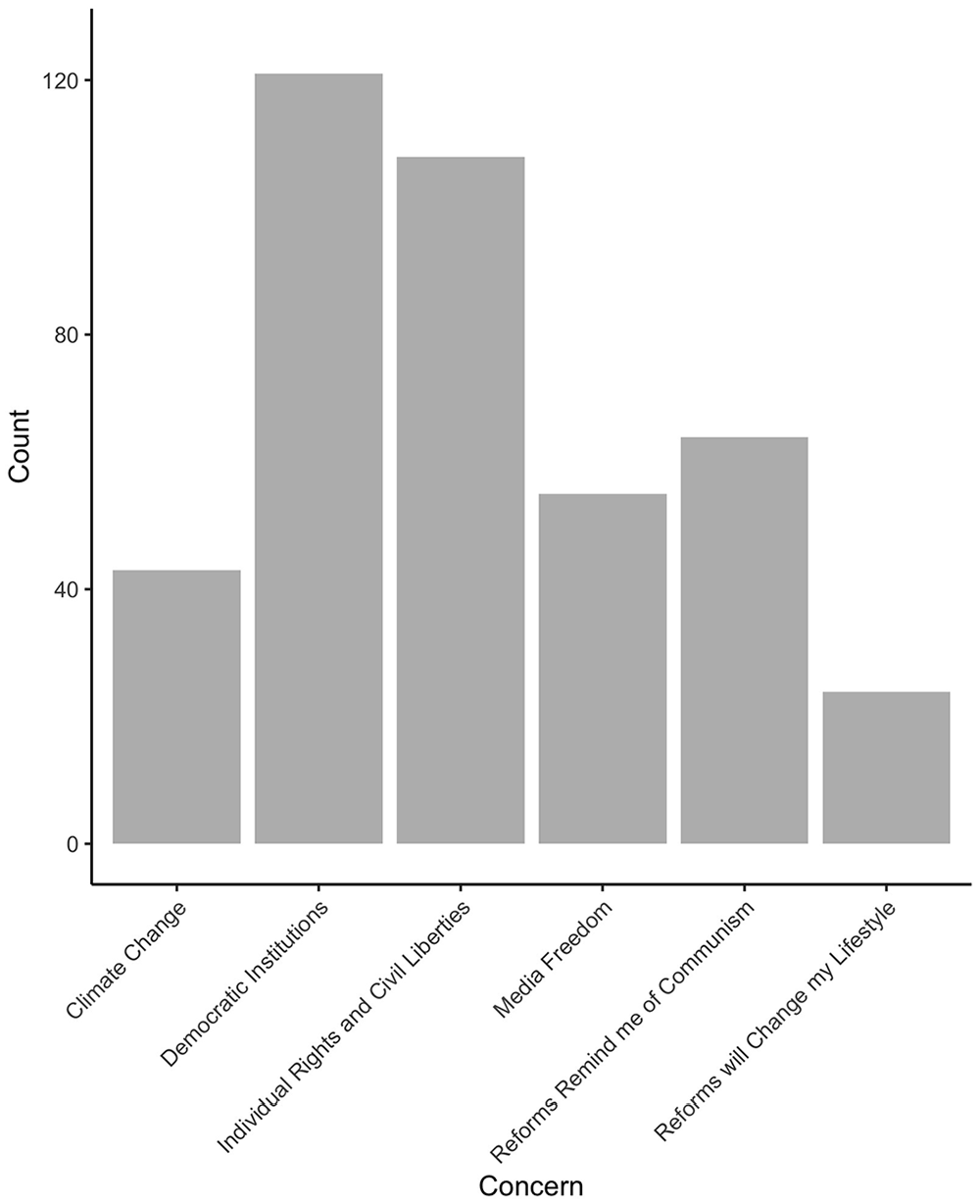
What were the top three reasons you decided to begin protesting against PiS reforms?
Since “these reforms remind me of Communism” was explicitly listed on my survey as a response option, one could argue that the question shapes the responses. However, in my interviews, I asked protesters why they began protesting. I also asked them to describe the types of people who attended protests in defense of liberal democratic institutions in demographic terms. I did not prompt individuals to reflect on generation. Without cueing, 71 out of the 71 protesters who were over 55 years old mentioned that living through Communism was critical to their personal decision to protest or to explaining why they think older people tend to protest more for liberal democratic institutions. Among the eleven people who protested for democratic institutions and were below 55, ten mentioned that older people protest in substantial numbers because they remembered what Communist times were like and feared a return to that type of governance. In these interviews, memories of Communism were the most frequently cited motivation for protesting for democratic institutions. The older generation often explained that they protest because illiberal policies remind them of policies that entrenched the Communists’ power.
One unaffiliated protester stated that the young were “not the keenest to protest, especially when related to the most important democratic values or democracy itself . . . [because] they always had a democratic state.” By contrast, he added, the older generation “had to fight for democracy in the past and they have the experience of living under a non-democratic state, so they protest for democratic institutions.” Protesters thus perceive living through Communism to impact the values underlying who mobilizes in support of liberal democratic institutions. 57
As one unaffiliated protester explained, living through Communism allows the older generation to “more readily identify when a systematic attack on judicial institutions occurs.” Reflecting this logic, when I asked a local leader of KOD in Warsaw why she began protesting for democratic institutions, she stated, I remember Communist times. I spent my youth under Communism. June 4, 1989 was the most important day and the happiest day of my life. I didn’t even dream that I could live in a free country. I know how it is when democracy is in danger. When PiS won, I was disappointed because I didn’t like their policies . . . but I thought okay we will survive. But suddenly, they destroyed democratic institutions, and we discovered their plan, which was to destroy democracy and keep power forever. It was natural for me to protest . . . . I think memory of Communism is why people protest for democracy. We know that a lack of freedom is realistic, and we remember how terrible it was.
Living through authoritarianism created memories for members of her generation of life without freedom. These memories—and a fear of returning to undemocratic governance—motivate some older Polish protesters. Political socialization can generate commitments to liberal democratic institutions, as Domonkos Sik finds in Hungary. 58
Moreover, when asked what types of people protest for liberal democratic institutions, 81 of 82 interviewees cited older people as the key demographic. One Warsaw-based KOD organizer highlighted the fact that at these protests, “There are a few young people, but we are mostly between fifty and seventy years old.” When asked why older people protest more for this issue, she responded, “people who remember Communist times saw a lot of big changes over the last thirty years and we appreciate it . . . . We know that this democracy is not constant and that it can change.” Some older people socialized under authoritarianism perceive democracy as fragile. In turn, these memories encourage some of the older generation to defend liberal democratic institutions when ethnopopulists attack them.
An older KOD protester in Kraków echoed this sentiment: “how a democratic government dies is not visible for most people, but maybe it is more visible for [our generation] because we lived without freedom.” Similarly, one older Niepokorni Obywatele (Rebellious Citizens) protester in Łódź said, “I remember Communist times. For us in the older generation . . . we remember when we could not travel and when there was not freedom . . . so we protest.” These quotes illustrate a trend in Polish public discourse, where competing narratives about Communism are used to erode support for political parties or policies. As Adam Ostolski explains, the mainstream opposition often portrays PiS as exhibiting “recidivism” by undermining the changes made since Communism fell and by returning to Communist-era practices. 59 Since protest organizations both create and respond to broader political discourse, these discourses may affect the way protesters express their motivations.
Protesters also mentioned specific life experiences under Communism as critical drivers of their protest participation. Of the 71 older protesters, 49 mentioned living without passports and without freedom of movement as key memories motivating them to protest for liberal democracy. One KOD leader in Wrocław explained that he protests because he remembers that “passports can be taken away [and] freedom of movement can be restricted.” Memories of life without freedom of movement emerge as one way in which living through Communism shapes the motivations of the older generation to protest for democracy.
Furthermore, specific losses of human rights drive some older people to protest. Out of the 71 older protesters, fifty mentioned that memories of life without respect for human rights motivated their contemporary protest participation. One Rebelianty Podkarpackie protester noted that his parents refused to join the Communist party and that he “was punished for it. It shocked me as a kid . . . . We fought for freedom then and I will protect these values now.” Experiencing unequal access to government services as a child, he noted, made him committed to liberal democratic values and encourages him to protect them by protesting today. Further, one protester from Fundacja Kongres Obywatelskich Ruchów Demokratycznych stated the following: I lived through Communism. I was 15 during martial law and broke curfew with my buddies. But also I know what it means to have empty shelves in stores . . . . I know the drab realities of Communism. Of course, I don’t believe that Communism will come back the way it was before, but for sure when it comes to the government’s actions, we should feel very seriously threatened. We are in danger of Poland closing and being less open. For sure, those people who are fifty and older remember this well. This is the driving force to be on the streets and to act, because we have a comparison of what things are like today and how disgusting they were in the past . . . . We so painfully experienced the violence from the authorities, the knowledge that we could be picked up from the street and it couldn’t be stopped, that we couldn’t have a passport or travel . . . we understand what could happen to us and how much it hurts.
For this protester, having experienced state-led repression and fearing a return to this lifestyle drives him to protest. Similarly, when describing why he thinks older people protest for liberal democratic institutions more than younger people, an Obywatele RP protester said that since “these young people were not deprived of their human rights in their ordinarily lives and were not humiliated so young by the Communist regime, democratic institutions are abstract to them.” For these fifty protesters, memories of life without human rights guarantees motivate them to protest for liberal democratic institutions. Lived experiences during Communism motivate some older people to protest for democracy. Memories of life without freedom of movement and individual rights socialize and motivate some of the older generation to protest for liberal democratic institutions.
Importantly, most protesters noted that the young do protest, but for other issues. One unaffiliated protester noted that older people “think about protest as a way to challenge the system rather than a way to promote a specific issue” because of their generation’s experience with the fall of Communism. By contrast, the younger generation tends to focus on changing specific aspects of how democratic institutions function. This experience with issue-specific protest appears to socialize liberal members of the younger generation to protest in support of specific issues, such as LGBTQ+ or women’s rights, but not necessarily in support of institutions. This does not appear as a story of the older generation bemoaning the young. The younger protesters interviewed concurred. One young KOD protester in Kraków noted that most members are forty to sixty, with several over seventy. He stated, “the older generation understands what achievements are at stake and protests with KOD more.” KOD primarily organizes protests defending liberal democratic institutions, so this statement implies that the older generation protests for these institutions more than the younger generation.
Other activists in the younger generation agreed that older people tend to be more involved in protests opposing attacks on institutions. One unaffiliated 23-year-old protester underscored the following: At protests for judicial institutions, mostly older people protest. These people remember the PRL-times and were the main group that decided to protest when PiS attacked the judiciary. They are afraid that this PRL-era will come back. I have seen people my age at judicial institutions protests, but not very many . . . . I think younger people do not protest as much for judicial institutions because they do not understand judicial institutions. If you are a teenager, you definitely understand LGBT issues and it often touches you personally. It is the same with women’s rights. The judicial system is more complicated. It is not taught at school . . . . If young people’s parents do not explain it to them, they are not likely to go to protests because they do not understand what they are protesting about. Young people do not remember the PRL-era. My parents and my aunt remember these years. They tell me about this time, and I know how it looked. The system and democratic institutions are more complicated for young people. Changes to the courts have less of an impact on young people because they are not fully aware of what it means for PiS to replace judges one by one.
Another young protester echoed her, noting that democratic institutions: are highly revered by older people who remember what life was like during the Communist regime, when there was no democracy. More importantly, they know what it is like when institutions are respected and when politicians behave democratically. Now the rules are being cut and changed.
Democratic backsliding and the deep understanding of what is at stake mobilize some of the older generation.
These findings align with Anna Radiukiewicz’s work, showing that KOD creates a legitimizing collective identity based on strengthening and maintaining the neoliberal status quo that existed prior to the 2015 election. 60 She finds that this group identity contrasts older KOD members with uninvolved young people who did not live through Communism. This discursive environment shapes how older protesters portray themselves vis-a-vis young people. My findings suggest that beyond KOD, generational gaps appear in protests defending liberal democratic institutions. Even if this generation gap is based on perceptions, it emerges as a central feature when protesters discuss who is more likely to protest for democratic institutions and what motivates them to protest.
Living through Communism helps explain why some of the older generation protest actively for liberal democratic institutions, perhaps even more so than members of the younger generation. A crucial subset of people who lived through Communism perceive this life experience as fundamental to their decision to protest for liberal democratic institutions decades later. Living through Communism sparked or reignited some of their protest participation.
Organizational Legacies of Past Protest Participation
Living through Communism might not only make the older generation more likely to protest by helping them draw parallels between the illiberal past and present, but it also may produce unique organizational legacies that promote protest participation. Participating in and witnessing anti-Communist protests may increase the older generation’s likelihood of protesting for liberal democratic institutions because past protest participation can create resources such as social networks and mobilizing symbols for subsequent protest movements. 61
Figure 7 reveals that—according to my protester survey data—people who protest for democratic institutions tend to have one of two protest histories. Forty percent of all surveyed protesters never protested before 2015. However, half protested either only during Communist times or during Communist times and at some later time. Protesting during Communism may influence one’s likelihood of protesting for democracy decades later.
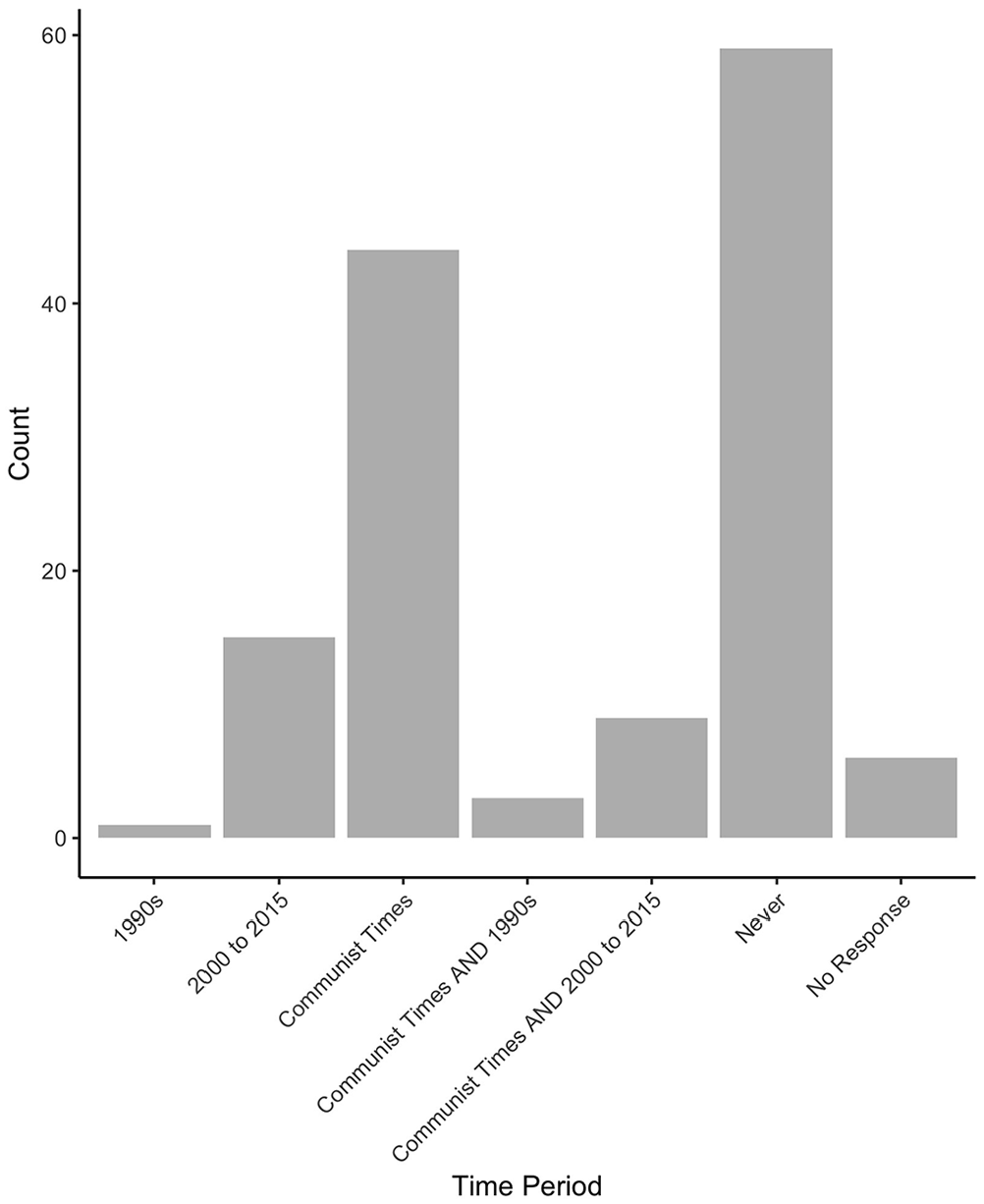
Did you protest in any of the following time periods? All respondents participated in protests against PiS attacks on democratic institutions since 2015
Furthermore, living through Communism and being exposed to Solidarity’s messages might help individuals generate narratives linking the illiberal past to the illiberal present. Past participation in anti-Communist protests—or even merely witnessing them—may create a shared set of slogans and symbols that can be recycled to a context where the preservation of hard-won liberal democratic institutions is at stake. Since generations are distinguished by sharing an understanding of common meanings, language, or discourse, these slogans and symbols may only mobilize the generation who remembers their origin. 62
In fact, KOD explicitly draws upon Solidarity legacies to encourage people to protest. KOD (Komitet Obrony Demokracji, Committee for the Defense of Democracy) is itself a wordplay on Komitet Obrony Robotników (Committee for the Defense of Workers, KOR), the anti-Communist group existing from the late 1970s to 1981 that subsequently merged with Solidarity. At KOD protests, participants sometimes sing Communist-era songs and take pictures holding up their fingers in the same iconic way Solidarity activists did during Communist times. Furthermore, KOD frequently invites former Solidarity activists to speak at its members’ meetings. 63
As a KOD protester from the Małopolska region noted, I’m 34 and there are only two other regional KOD members who are younger than me. KOD is an old people’s group, and many people are between seventy and eighty years old. Being in KOD is so uncool and young people—even my friends—make fun of us a lot.
Without narratives that resonate with the younger generation, protests defending liberal democratic institutions may remain siloed rather than unified. A generational disconnect exists between the types of protests these generations attend as well as the rhetoric and symbols that appeal to them. These explicit parallels among protest participants’ behaviors at protest events, their interpretation of their protest motivations, and Communist-era political behaviors suggest that living through Communism may help explain who protests for liberal democratic institutions.
Organizational legacies of anti-Communist protests also shape who protests for liberal democratic institutions. I asked those respondents who stated that the older generation participated more in these protests why they thought older people were more active. Though most pointed to an increased understanding of illiberalism and/or a fear of returning to a life without freedom, 29 respondents emphasized that either they themselves or people they knew were once anti-Communist dissidents. In explaining who protests for liberal democratic institutions, one respondent claimed, “the most important factor is belonging to Solidarity.” Another respondent noted, “many KOD members in our region were Solidarity members and many were jailed in Communist times.” Past anti-Communist activism can influence who protests for liberal democratic institutions. Echoing this line of commentary, one interviewee belonging to the older generation emphasized that “our generation experienced the fight against Communism, and [former] Solidarity members understand perfectly that what PiS does is a retreat to a Communist understanding of ruling.” A history of anti-Communist activism may generate protest participation by making salient discourses and frames that draw parallels between the Communist period and contemporary attacks on liberal democracy.
Anti-Communist protest thus seems to encourage some of the older generation to defend liberal democratic institutions later. As one older Obywatele RP organizer emphasized, “I grew up in the democratic opposition. When I saw the actions of the PiS government, I decided I couldn’t stay at home. I was motivated [to protest] because of my long-term background in the democratic opposition.” This history of pro-democratic activism generates a perceived obligation to protest for liberal democracy whenever it comes under attack. Another protester noted that her activism began with KOR in the 1970s. A few years later, she joined Solidarity, the Helsinki Committee, and other anti-Communist groups. Today, she belongs to Fundacja Kongres Obywatelskich Ruchów Demokratycznych, protesting because PiS has “attacked the Constitutional Tribunal, seized the civil service, and shows a completely parallel reality on public media,” which undermines democracy. She described this protest participation as a continuation of decades-long pro-democracy activism.
Similarly, a Polskie Babcie protester noted, My family history is important in why I started to protest . . . . My husband was important in the anti-Communist movement. In 1984, he signed onto the list of Solidarity demands. He was consulted on setting up the Polish constitution.
After being fired from a university position for political reasons, her husband worked as a cleaner at an opposition church. Her whole family began going to this church “because after work, they had anti-Communist lectures, plays, information about what was happening around the world, and more.” Eventually, her apartment became a salon and a place to print opposition pamphlets. When the transition to democracy occurred, for her, “it was like letting a breath of air out, but now everything is being broken and destroyed. It is such a shame and fills me with such sadness, so I started protesting.” The experience of fighting for liberal democratic institutions and subsequently watching their destruction also motivates other older protesters. For anti-Communist activists who fought for democracy and subsequently saw these institutions eroded, this process can generate strong emotions like shame and sadness, which drive their protest.
Even younger protesters perceive anti-Communist dissident movements to be important today. A young Akcja Demokracja organizer emphasized, “Most people who participate in the street opposition now are older than 55. They were more active in the beginning. Some of them were also with the Solidarity movement.” Protesting against the Communist regime helps explain why some of the older generation actively defends liberal democratic institutions. Belonging to Solidarity, participating in demonstrations, or even merely bearing witness to anti-Communist protests and the negotiated revolution of 1989 may endow the older generation with a greater propensity to defend liberal democratic institutions. Participating in and witnessing anti-Communist protests increases some older Polish citizens’ likelihood of protesting by giving them a common set of slogans and symbols that resonate strongly with generation members.
Other Motivations
As noted above, memories of Communism were the most frequently cited motivation for protesting in defense of liberal democratic institutions. All 71 interviewees over 55 mentioned that their experiences and memories of life during Communism motivated them to protest. Further, for those under 55, ten out of eleven interviewees indicated that they thought older people protested for liberal democratic institutions more and that this was due to memories of living during Communism. Beyond these memories, other protest motivations were also expressed.
For example, seventeen people mentioned a perceived obligation to join these protests. As a protester with Niepokorni Obywatele stated, “I saw that PiS was bringing the country into chaos and autocracy. For me, this was important . . . and I felt a duty to go to the first protest.” Many people who felt obliged to protest tied this duty to their past protest engagement. As a former Solidarity dissident currently in Obywatele RP noted, We took part in the changes in 1989 and could breathe in freedom. We joined Europe. All of this, we earned and drove it forward. I don’t want what I worked so hard for to be thrown away, so I must protest.
Some former dissidents continue to feel a psychological attachment to the liberal democratic principles that they believe underlie their group’s identity. 64
By contrast, for 26 people, familial concerns were important. One Obywatele RP protester noted that she protests because her “family is not 100 percent Polish and when nationalist or fascist labels make society more closed, it became harder for us.” Her family’s experiences with racism drove her protest engagement. Other protesters who invoked family concerns focused on concerns about public education or on concerns related to the curtailment of abortion or LGBTQ+ rights. One Polskie Babcie protester noted that she protests for democracy because she is concerned about young people’s education. She stated, “The village where my daughter lives is not far from Warsaw and the primary school is so bad . . . . Without education, we can’t have rule of law.” Concerns about the quality of education and how it shapes people’s views toward democracy appear salient for some protesters.
Though protesters expressed different motivations for protesting, living through Communism was referenced most frequently. Memories of this period and concerns about returning to a life without liberal democracy appear as critical drivers of protest participation.
Conclusion
In this article, I contribute to the literature exploring the individual-level motivations of people who participate in civic activism in east central Europe by focusing on those who mobilize against backsliding. 65 Generational experiences help explain what motivates individuals to protest for liberal democratic institutions. My evidence suggests that some members of the older generation protest more actively in support of liberal democratic institutions than the younger generation. Those who fought to establish liberal democratic institutions and benefited from them appear more likely to mobilize to defend them. By contrast, individuals who did not live through Communism seem less likely to participate in these protests, instead focusing on other issues, like abortion rights, LGBTQ+ rights, or the environment. Furthermore, having participated in and witnessed anti-Communist protests can provide organizational legacies in the form of well-known slogans, symbols, and networks capable of mobilizing some of the older generation.
Though living through Communism and participating in these anti-Communist protests has encouraged some older people to mobilize for liberal democratic institutions, not all older people defend these institutions. Older people comprise a nontrivial proportion of the PiS electorate. Exit polling from the 2019 parliamentary election showed that 51 percent of people from fifty to 59 and 56 percent of people over sixty voted for PiS—in comparison to about 35 percent of eighteen- to 49-year-olds. 66 Moreover, some former Solidarity dissidents—including PiS leader Jarosław Kaczyński himself—gravitate toward parties that undermine liberal democracy. Opposition to Communism does not necessarily translate into supporting liberal democracy. While some people who lived through Communism draw parallels between the actions of PiS and those of the old regime, a small majority support PiS, even as it undermines liberal democracy.
What drives this polarization amongst older Polish people? While the available data do not allow me to answer this question, future research should explore it. Perhaps divergent experiences during Communism and the democratic transition shape this polarization. Some PiS leaders have claimed that the democratic institutions established after Communism ended were corrupt, flawed, or enabled ex-Communists to maintain power. 67 PiS has used this rhetoric of an incomplete revolution and “a country in ruins” to criticize and justify fundamentally altering liberal democratic institutions. 68 Perhaps the degree to which older individuals’ expectations of the democratic transition meet their realities shapes their likelihood of believing in the need to alter these institutions fundamentally. Similarly, pocketbook voting may matter. When governing, PiS lowered the retirement age and provided higher pensions for the elderly that rolled out before the 2019 election. 69 For some, economic concerns may outweigh political concerns; however, I would note that the protesters interviewed belong to different socioeconomic classes. Further, Catholic Church attendance may help explain this polarization, as attending church positively correlates with voting for PiS, 70 and some religious leaders encourage parishioners to vote for PiS. 71 Differences in attending Mass or believing in the legitimacy of the Catholic Church exerting political influence may further impact older Poles’ political preferences.
Many values undergird the political preferences that people develop. My findings simply suggest that participating in the fight to establish liberal democracy generates a subset of individuals firmly committed to actively defending these institutions, even decades later. For these individuals, but surely not all former anti-Communist dissidents, a memory of living with authoritarian institutions powerfully mobilizes them to defend liberal democracy throughout their lives.
These findings shed light on the important impact key moments of political socialization have on future protest behavior. Large social movements created to topple an authoritarian regime not only matter in the moment of regime transition but could also serve as a reservoir of support for liberal democracy decades later. Memories of authoritarian rule and the knowledge of how to undermine authoritarianism in the streets facilitate subsequent mobilizations in defense of liberal democracy.
Across time, large social movements have overthrown authoritarian regimes around the world. In recent years, democratic backsliding has emerged in several countries that experienced moments of protester-led regime change. Though I explore these dynamics in Poland, I expect similar patterns to occur in other post-Communist countries where mass mobilization toppled Communist regimes and where democratic backsliding has emerged. Similar dynamics may also emerge in countries around the world with a recent history of authoritarianism, anti-authoritarian mass mobilization, and recent democratic backsliding. For instance, some Argentinians active in mobilizing for human rights during the previous authoritarian regime remobilized in 2016 when the government engaged in historically revisionist policies.
This hypothesis opens many fascinating avenues of research for scholars interested in protest. To what degree can periods of intense pro-democratic and anti-authoritarian mobilization produce a generation of individuals strongly committed to preserving liberal democratic institutions when they come under attack later in time? Under what conditions are middle-aged and older people more likely to protest than their younger counterparts? As democratic backsliding continues unabated in many democracies, questions of who mobilizes in defense of liberal democracy and why are critical to understanding the prospects for democracy’s preservation.
Footnotes
Appendix
Acknowledgements
I would like to thank Lenka Buštíková, Pamela Conover, Adam Fagan, Liesbet Hooghe, Conor O’Dwyer, Rahsaan Maxwell, Graeme Robertson, Jan Rovny, Milada Vachudova, participants of the March 2020 King’s College London Democratic Backsliding Workshop, and two anonymous reviewers for feedback on this article. I am also grateful for the guidance and comments of EEPS editors Krzysztof Jasiewicz and Wendy Bracewell. For help in recruiting protesters, I thank Joanna Fomina and Agnieszka Graff. I thank all the protesters who took the time to speak with me or to take my survey for making this project possible. This research was supported by grants from the American Councils and the Fulbright Commission. The Fulbright Commission, American Councils, and the U.S. Government are not responsible for the contents of this article.
