




Abstract
Employee job satisfaction is critical for organisational performance, yet the complex interplay between perceived organisational support (POS), pay equity, job equity, and job satisfaction remains underexplored. This study investigates the moderating role of POS on the relationships between equity perceptions (pay and job equity) and job satisfaction in the South African banking industry. Moderation analyses were conducted using a cross-sectional survey of 454 employees to examine these dynamics. Results indicate that both pay equity and job equity are positively associated with job satisfaction. POS significantly moderates the relationship between pay equity and job satisfaction but not between job equity and job satisfaction, suggesting domain-specific fairness dynamics. These findings extend Adam’s Equity Theory by demonstrating how organisational support can amplify or buffer the effects of equitable compensation on employee satisfaction, highlighting the differential mechanisms through which POS operates across equity dimensions. Practically, the study highlights the importance of implementing fair compensation and work allocation practices while fostering supportive organisational environments to enhance employee satisfaction and well-being.
Keywords
Introduction
Employee job satisfaction remains a critical determinant of organisational performance, with satisfied employees demonstrating higher productivity, lower turnover rates, and greater organisational commitment (Judge et al., 2020; Mishra et al., 2021). Consequently, understanding the antecedents of job satisfaction has become a strategic priority for organisations seeking sustainable competitive advantage (Ikon & Ogochukwu, 2019; Judge et al., 2020). Within this domain, organisational justice, particularly equity perceptions, has emerged as a fundamental driver of employee satisfaction and well-being (Loo et al., 2024; Pieters, 2018).
Extensive research has established that employees’ perceptions of equity, encompassing both job equity (fair distribution of work responsibilities and opportunities) and pay equity (fair compensation relative to contributions), significantly influence job satisfaction (Buttner & Lowe, 2017a; Inegbedion et al., 2020; Loo et al., 2024). Similarly, perceived organisational support (POS), employees’ beliefs about organisational care for their well-being and their contributions’ valuation have been consistently linked to positive employee outcomes, including enhanced job satisfaction (Maan et al., 2020; Rhoades & Eisenberger, 2002). However, a critical gap exists in understanding the complex interplay between these variables. Specifically, the literature lacks empirical evidence regarding whether and how POS moderates the relationship between equity perceptions and job satisfaction. This gap is particularly significant because it overlooks the potential for organisational support to serve as a contextual factor that amplifies or diminishes the impact of equity perceptions on employee satisfaction. The absence of research limits our theoretical understanding of organisational justice processes and constrains practical guidance for organisations seeking to optimise employee satisfaction through coordinated equity and support initiatives. This study addresses this gap by integrating Adams’ (1965) Equity Theory with Homans’(1958) Social Exchange Theory. Equity Theory suggests that employees evaluate fairness by comparing their input–outcome ratios with relevant others, with perceived inequity leading to dissatisfaction and corrective behaviours (Adams, 1965; Hasyim & Bakri, 2024). Social Exchange Theory proposes that positive organisational treatment creates reciprocal obligations, influencing how employees interpret and respond to organisational actions (Blau, 1964; Homans, 1958). The integration of these theories suggests that POS may function as a moderating variable by influencing how employees perceive and react to equity conditions. When organisational support is high, employees may interpret potential inequities more favourably due to positive exchange relationships. Conversely, low organisational support may amplify negative reactions to perceived inequity. This study investigates the moderating effect of perceived organisational support on the relationship between equity dimensions (job equity and pay equity) and job satisfaction among employees in the South African banking industry. This research extends organisational justice theory by examining conditional effects of equity perceptions and contributes to social exchange theory by identifying domain-specific moderating mechanisms. Practically, the study provides evidence-based guidance for banking institutions and other organisations seeking to optimise employee satisfaction through integrated approaches to equity management and organisational support.
Research Context
This study is conducted within the South African banking industry, the largest financial services sector and the most significant on the African continent contributing approximately 88% to the country’s GDP in 2020 (Cowling, 2024). This economic importance translates into a sophisticated organisational environment where equity perceptions and organisational support mechanisms are particularly salient.
First, the industry’s hierarchical structure creates distinct levels of organisational support experiences, from front-line employees to senior management (Ngobeni et al., 2022; Nwobodo-Anyadiegwu et al., 2018) enabling meaningful examination of how support perceptions vary and influence equity-satisfaction relationships across organisational levels. Second, banking roles involve clearly defined performance metrics and compensation structures (International Monetary Fund, 2022; Nkoana & Matjie, 2024), making employee pay equity assessments highly visible and consequential. Third, the demanding nature of banking work, emphasising targets, compliance, and customer service (Coetzee, 2014; Kengne et al., 2024; Sibindi & Platen, 2025), makes job equity (fair distribution of workloads, opportunities, and resources) particularly critical for employee well-being.
Competition has intensified dramatically in the industry, with traditional banks competing for skilled employees against fintech startups, digital payment companies, and financial service retailers (Nesindande et al., 2025; Ngobeni et al., 2022). This competitive pressure has created an employee market where perceptions of organisational support become crucial differentiators in retention decisions. Employees who perceive equitable treatment and strong organisational support may be more likely to remain with traditional banking institutions despite attractive external opportunities. Furthermore, the post-COVID-19 banking environment has highlighted the importance of organisational support in maintaining employee satisfaction during periods of change and uncertainty (Nyamunda et al., 2023). Banks that demonstrated genuine care for employee welfare during the pandemic may have strengthened their support relationships, potentially moderating how employees perceive and respond to equity issues (Ngobeni et al., 2022). This contemporary relevance makes the banking sector appropriate for investigating how organisational support influences equity-satisfaction dynamics.
Focussing on the South African context is theoretically significant. As an emerging market economy with distinct labour relations patterns and organisational cultures, South Africa provides an opportunity to test equity and social exchange theories beyond traditional Western contexts. The country’s diverse workforce and complex social dynamics create conditions where equity perceptions and organisational support may operate differently than in more homogeneous settings, potentially revealing culturally specific moderating mechanisms.
From a practical perspective, understanding these relationships in the South African banking context has immediate relevance for industry practitioners. With the sector employing over 200,000 people directly and facing ongoing skills shortages in critical areas such as risk management, digital banking, and customer analytics, insights into how organisational support can enhance the impact of equitable practices on job satisfaction have direct commercial value (Mamela et al., 2020; Manguzvane & Mwamba et al., 2022; Nesindande et al., 2025).
The study’s focus on this context acknowledges certain generalisability limitations while providing depth of understanding within a clearly defined setting. The findings may most directly apply to other hierarchical, performance-driven industries in emerging markets, though the theoretical insights regarding POS moderation may have broader relevance across organisational contexts.
Theoretical Framework
This study integrates Equity Theory (Adams, 1965) and Social Exchange Theory (Hormans, 1958) to explain how perceptions of job equity and pay equity influence job satisfaction and how these relationships are conditioned by perceived organisational support. Together, these perspectives provide a coherent framework for understanding how employees evaluate fairness in organisational settings and how the quality of employee–organisation relationships shapes the interpretation of these evaluations. Rather than treating fairness and support as independent predictors, perceived organisational support is positioned as a relational context that influences how equity perceptions are translated into job satisfaction.
Equity Theory: Job and Pay Equity
Equity Theory posits that employees evaluate fairness by comparing the ratio of their inputs (e.g. effort, skills, experience, and time) to outcomes (e.g. pay, recognition, and opportunities) relative to referent others (Adams, 1965). When employees perceive balance in these ratios, they experience equity, reinforcing satisfaction and stability in work attitudes (Omar & Kiley, 2022; To & Huang, 2022). Conversely, perceived inequity creates psychological tension that motivates corrective behaviours such as reduced effort, withdrawal, absenteeism, or turnover (Hasyim & Bakri, 2024; Pan et al., 2018).
In organisational contexts, equity evaluations commonly manifest in two interrelated domains, that is, job and pay equity. Job equity refers to perceptions of fairness in workload distribution, access to resources, and career development opportunities (Inuwa & Idris, 2017; Mrwebi et al., 2018). Pay equity concerns perceptions of fairness in compensation relative to one’s contributions and comparable employees (Buttner & Lowe, 2017a; To & Huang, 2022). Although both dimensions are grounded in Equity Theory, pay equity tends to be more salient due to its visibility and ease of comparison, whereas job equity involves broader evaluations of role design and opportunity structures.
Empirical research consistently demonstrates that both job equity and pay equity are positively associated with job satisfaction, while perceived inequities undermine motivation, fairness perceptions, and organisational attachment (Inegbedion et al., 2020; Mensah, 2020; Shkoler et al., 2021). From an Equity Theory perspective, fairness in both job and pay domains therefore constitutes a key antecedent of job satisfaction.
Social Exchange Theory and Perceived Organisational Support
Social Exchange Theory (SET) conceptualises employment relationships as ongoing exchanges of tangible and intangible resources governed by trust, reciprocity, and long-term obligation (Blau, 1964; Homans, 1961). The norm of reciprocity suggests that employees respond positively when they believe their organisation values their contributions and cares about their well-being (Gouldner, 1960).
Within this framework, perceived organisational support (POS) reflects employees’ global beliefs about the extent to which the organisation values their contributions and cares for their well-being (Eisenberger et al., 1986; Rhoades & Eisenberger, 2002). High POS signals a strong, trust-based exchange relationship, motivating employees to reciprocate with positive attitudes and behaviours such as job satisfaction, commitment, and engagement (Chillakuri & Vanka, 2022; Maan et al., 2020; Mabasa & Ngirande, 2015). Conversely, low POS weakens reciprocity and increases employees’ sensitivity to negative experiences and perceptions of unfairness (Oladimeji, 2024; Wattoo et al., 2018). SET further explains how organisational practices, including supportive management and high-performance work practices, foster positive exchange relationships by signalling organisational investment in employees’ professional and personal well-being (Ajmal et al., 2024; Klein et al., 2021; Kurtessis et al., 2017).
Integrating Equity Theory and Social Exchange Theory: POS as a Moderator
While Equity Theory explains what employees evaluate as fair or unfair, SET explains how these evaluations are interpreted within ongoing exchange relationships. Integrating Equity Theory and SET suggests that fairness perceptions are not evaluated in isolation but are embedded within the broader relational context defined by organisational support.
When POS is high, employees are more likely to interpret organisational actions benevolently, viewing potential inequities as temporary or justified (Thompson-Powell, 2024). High POS reduces equity sensitivity, enabling employees to tolerate minor imbalances because they trust that the organisation genuinely cares about them (Palmer, 2022). Employees may also demonstrate a temporal buffer effect, tolerating short-term inequities with the expectation that fairness will be restored over time (Rau, 2024). In addition, POS functions as a valued organisational resource that can partially offset perceived inequities, thereby reducing their negative impact on job satisfaction (Eviana, 2024).
In contrast, when POS is low, employees are more vigilant and likely to interpret inequities as deliberate or unjust, even when imbalances are relatively small (Küçükel, 2024; Scott, 2023). Under such conditions, equity perceptions carry greater emotional weight and exert a stronger influence on dissatisfaction. The moderating effect of POS is expected to be particularly salient for pay equity due to the visibility and comparability of pay outcomes (Liu et al., 2023), while remaining relevant for job equity, where organisational support may help employees frame workload and resource allocation challenges as reasonable or temporary (Cheng et al., 2022; Xu & Yang, 2021).
Contribution to Theory
This integrated framework advances both Equity Theory and SET by demonstrating that fairness perceptions are conditional rather than absolute. It extends Equity Theory by showing that equity evaluations are shaped by the broader relational context of organisational support (Unterhitzenberger & Lawrence, 2023). It also enriches SET by illustrating that exchange quality moderates, rather than merely predicts, the effects of organisational practices on employee outcomes (Ali et al., 2022). More broadly, the framework contributes to organisational justice scholarship by highlighting that the effects of fairness on employee attitudes depend on perceived organisational support, particularly in dynamic and high-stakes environments such as the South African banking sector.
Perceived Organisational Support (POS) and its Moderating Role
POS signals the provision of resources, recognition, and assistance in problem solving, fostering a sense of support and belonging within the employment relationship (Karim et al., 2014; Rhoades & Eisenberger, 2002). Grounded in Social Exchange Theory (Blau, 2017), POS captures the reciprocity inherent in the employee–organisation relationship: when employees perceive high organisational support, they are more likely to reciprocate through positive attitudes and behaviours such as loyalty, job satisfaction, commitment, and enhanced performance (Chillakuri & Vanka, 2022; Maan et al., 2020). Conversely, low POS weakens these outcomes, as employees may feel undervalued or neglected (Oladimeji, 2024).
Beyond its direct influence, POS functions as a contextual and relational moderator that shapes how fairness perceptions are translated into job satisfaction. According to Equity Theory (Adams, 1965), employees evaluate fairness by comparing their input–outcome ratios with those of relevant referent others. However, these evaluations are interpreted within the broader relational climate defined by organisational support. When POS is high, the positive effects of job equity and pay equity on job satisfaction are strengthened, as employees interpret fair treatment as evidence of organisational care and justice (Ajmal et al., 2024; Park et al., 2025). In contrast, when POS is low, even equitable treatment may fail to produce satisfaction because employees continue to perceive a lack of appreciation or empathy from the organisation (Liu et al., 2023).
Empirical evidence further indicates that supportive practices such as fair feedback, recognition, and access to resources reinforce employees’ trust and psychological safety, thereby enhancing the effectiveness of fairness perceptions (Chillakuri & Vanka, 2022; Karim et al., 2014). In this study, POS is therefore conceptualised in two interrelated ways: as a direct antecedent of job satisfaction and as a moderator that conditions the strength of the equity–satisfaction relationship (Chen et al., 2023; Rajâa & Mekkaoui, 2025). This dual role positions POS as a central construct in understanding how organisations can uphold fairness while fostering supportive climates that sustain employee satisfaction (Abdullahi et al., 2025; Flynn, 2025).
Job Satisfaction
Job satisfaction has been a central construct in organisational research since early work by Hoppock in 1935 and remains widely studied due to its strong associations with motivation, engagement, creativity, and organisational citizenship behaviours (Judge et al., 2020; Rafferty & Griffin, 2009; Saner & Eyupoglu, 2014; Tawana et al., 2019). Conversely, lower levels of job satisfaction are associated with absenteeism, presenteeism, and turnover intentions (Tinu & Adeniji, 2015).
Job satisfaction is commonly defined as a positive emotional state resulting from an individual’s evaluation of their job and work experiences (Locke, 1976). It reflects both affective and cognitive responses to work, capturing the extent to which employees’ needs, expectations, and values are met (Spector, 1997; Zhai et al., 2023). In line with Equity Theory, fairness in the allocation of rewards and responsibilities plays a central role in shaping job satisfaction (Shinde, 2025). Accordingly, job satisfaction serves as an appropriate outcome variable through which the effects of job equity, pay equity, and perceived organisational support can be examined (Abdullahi et al., 2025; Liu et al., 2023).
Hypothesis Development
Drawing on Equity Theory, perceptions of fairness in job design and compensation are expected to enhance job satisfaction:
Job equity and pay equity are positively related to job satisfaction.
Consistent with Social Exchange Theory, employees who perceive high organisational support are more likely to experience job satisfaction due to reciprocal socio-emotional exchanges:
Perceived organisational support is positively related to job satisfaction.
Integrating both theories, perceived organisational support is expected to condition the strength of the equity–satisfaction relationship:
Perceived organisational support moderates the relationship between job equity, pay equity, and job satisfaction, such that the positive effects of equity on satisfaction are stronger under high levels of POS.
Accordingly, this study investigates the relationship between job equity, pay equity, and job satisfaction and examines how this relationship is moderated by perceived organisational support within the South African banking sector.
Operationalisation and Analytical Approach
All constructs were measured using established multi-item scales rated on a 7-point Likert scale (1 = strongly disagree, 7 = strongly agree). Job satisfaction was assessed using Spector’s (1997) Job Satisfaction Survey (JSS); POS was measured using the shortened Survey of Perceived Organisational Support (SPOS) (Eisenberger et al., 1986). Pay equity and job equity were operationalised using adapted distributive justice items based on Colquitt’s (2001) organisational justice measure, with pay-focused and work-allocation-focused wording, respectively. Data were analysed using IBM SPSS Statistics (Version 28) and Hayes’ PROCESS macro (Version 4). Reliability (Cronbach’s alpha), descriptive statistics, and Pearson correlations were computed, followed by moderation testing using Hayes’ PROCESS macro (Model 1) with mean-centred predictors and the POS interaction term. Significant interactions were probed using simple slopes at −1 SD, the mean, and +1 SD of POS, and the results were illustrated graphically.
Methodology
Research Approach
This study employed a quantitative research approach grounded in a positivist epistemological framework, which emphasises objective measurement and statistical analysis of relationships among variables (Cohen et al., 2018). A cross-sectional survey design was utilised to examine the relationships between perceived organisational support (POS), pay equity, job equity, and job satisfaction in the South African banking sector at a single point in time. This design was appropriate for testing hypotheses derived from Equity Theory (Adams, 1965) and Social Exchange Theory (Blau, 1964), particularly where moderation effects are of interest.
Although longitudinal designs offer advantages for causal inference, the cross-sectional approach was suitable for the primary objective of examining conditional relationships among equity perceptions, organisational support, and job satisfaction. The design enabled the application of correlational analysis and hierarchical moderated regression techniques to evaluate the proposed theoretical model (Saunders et al., 2019). Causal inferences are therefore interpreted with caution.
Research Instruments
All constructs were measured using established, psychometrically validated instruments selected for their theoretical alignment with Equity Theory and Social Exchange Theory and their extensive use in organisational research. All items were rated on a 7-point Likert-type scale ranging from 1 (strongly disagree) to 7 (strongly agree), enhancing response sensitivity and variance (Finstad, 2010).
Job Satisfaction
Job satisfaction was measured using the Job Satisfaction Survey (JSS) developed by Spector (1997). The scale consists of 9 items that capture employees’ overall affective evaluation of their jobs. Sample items include ‘I feel satisfied with my job’ and ‘I enjoy my work’. Higher scores indicate higher levels of job satisfaction. In the present study, the scale demonstrated excellent internal consistency (α = .85). The JSS has been widely used across diverse organisational and cultural contexts, including financial services environments (Dhurup et al., 2016; Michael et al., 2005; Zeffane & Melhem, 2018) supporting its applicability in the South African banking sector.
Perceived Organisational Support (POS)
Perceived organisational support was measured using the eight-item shortened Survey of Perceived Organisational Support (SPOS) (Eisenberger et al., 1986). Sample items include ‘The organisation values my contribution to its well-being’ and ‘The organisation really cares about my well-being’. Responses were averaged to form a composite POS score, with higher values indicating stronger perceived support. The scale demonstrated excellent reliability in this study (α = .94).
Pay Equity
Pay equity was measured using items adapted from the distributive justice dimension of Colquitt’s (2001) organisational justice scale, focussing specifically on fairness of compensation relative to contributions and comparable others. This four-item measure assesses employees’ perceptions of pay fairness. Sample items include ‘My pay reflects the effort I put into my job’ and ‘My compensation is fair compared to others in similar roles’. Internal consistency was strong (α = .89).
Job Equity
Job equity was measured using four items adapted from Colquitt’s (2001) distributive justice scale, modified to assess fairness in workload distribution, responsibilities, and access to opportunities. Sample items include ‘Work responsibilities are distributed fairly in my unit’ and ‘Opportunities are allocated fairly across employees’. The scale demonstrated high internal consistency (α = .91).
All scales exceeded the recommended reliability threshold of α ≥ .70 (Hair et al., 2019) providing confidence in the measurement quality.
Sampling Method and Participants
A convenience sampling strategy was adopted due to restricted organisational access and confidentiality requirements typical of the South African banking sector. Participants were recruited from multiple commercial banking institutions, with organisational identities withheld to preserve confidentiality. Data collection took place via electronic survey distribution facilitated through internal communication channels over a period of approximately six weeks.
Eligible participants were permanent, full-time employees aged 18 years or older. No exclusions were applied based on occupational level or function. A total of 454 usable responses were obtained. While a precise response rate could not be calculated due to decentralised distribution, the final sample size exceeds conventional recommendations for moderated regression analysis (Aguinis et al., 2005; Green, 1991).
Sample Characteristics
The final sample comprised 55.1% female respondents (n = 250) and 44.9% male respondents (n = 204). Approximately 56% of participants were aged 18–29 years, with the remainder distributed across older age groups. Educational attainment included Degree/Diploma (57.5%), Matric (35.9%), and Postgraduate qualifications (6.4%). These characteristics reflect the demographic composition commonly observed in the South African banking workforce.
Data Collection Procedures
Data were collected using an online survey platform optimised for desktop and mobile access. The survey opened with an informed consent page, followed by demographic questions and the study measures. Completion time was approximately 12–15 minutes. Participation was voluntary, and no incentives were offered.
Ethical Considerations
Participation was voluntary, and participants could withdraw without penalty. Participants provided informed consent prior to accessing the questionnaire. Responses were anonymous, with no identifying information collected. Data were stored securely on password-protected systems accessible only to the research team and will be retained in accordance with institutional data-management policies.
Data Analysis
Data were analysed using SPSS (v28) and Hayes’ PROCESS macro (V4). Preliminary analyses included descriptive statistics, reliability analysis, and Pearson correlations.
Data Screening and Assumptions
Missing data were minimal and handled using listwise deletion. Normality was assessed using skewness and kurtosis statistics and visual inspection of histograms and Q–Q plots, indicating no severe deviations. Multicollinearity was evaluated using variance inflation factors (VIFs), with all values below 3.0, indicating no concern (Hair et al., 2019).
Common Method Bias
Common method variance was assessed using Harman’s single-factor test. The first factor accounted for 38% of the total variance, below the 50% threshold, suggesting that common method bias was not a significant concern.
Moderation Analysis
Moderation hypotheses were tested using PROCESS Model 1. Predictor variables (pay equity and job equity) and the moderator (POS) were mean-centred prior to creating interaction terms. Two separate models were estimated: (1) POS moderating the pay equity–job satisfaction relationship and (2) POS moderating the job equity–job satisfaction relationship.
Statistical significance was evaluated using 95% bootstrapped confidence intervals (5000 resamples). Significant interactions were probed using simple slope analysis at low (−1 SD), mean, and high (+1 SD) levels of POS and illustrated graphically.
Results
Descriptive Statistics, Reliability, and Correlations
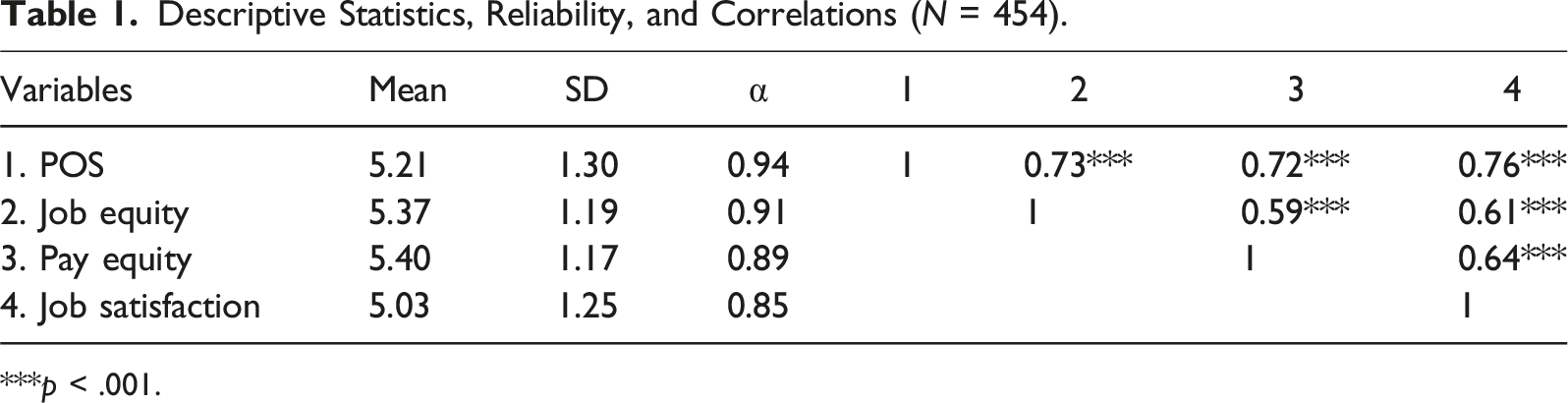
Descriptive Statistics, Reliability, and Correlations (N = 454).
***p < .001.
Correlation analysis shows strong positive associations among the variables. POS was positively related to job equity (r = 0.73, p < .001), pay equity (r = 0.72, p < .001), and job satisfaction (r = 0.76, p < .001). Similarly, job equity was positively related to pay equity (r = 0.59, p < .001) and job satisfaction (r = 0.61, p < .001). Pay equity also correlated positively with job satisfaction (r = 0.64, p < .001). These results provide preliminary support for the hypothesised positive relationships.
Hierarchical Moderated Regression
Hierarchical regression analyses were conducted using Hayes’ (2018) PROCESS macro to test the main and moderating effects of POS on the relationships between job equity, pay equity, and job satisfaction.
Main Effects
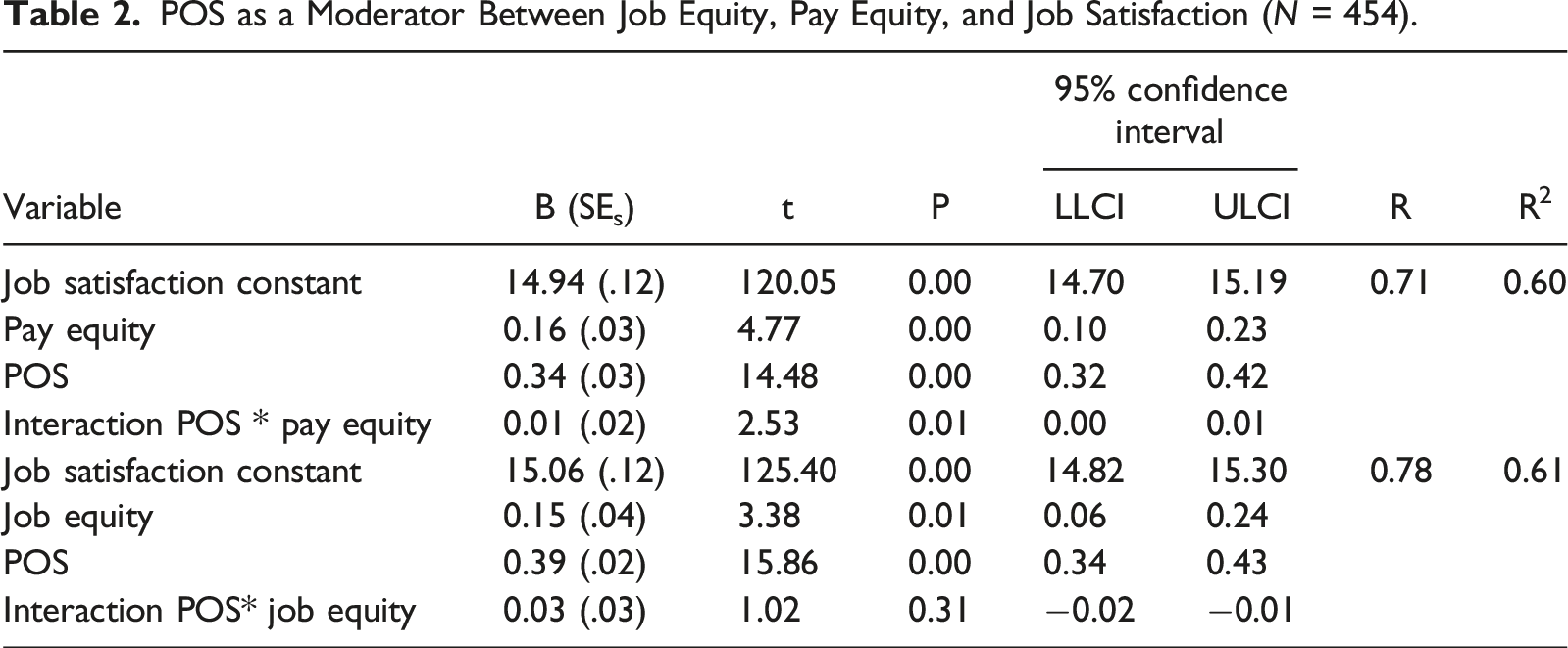
POS as a Moderator Between Job Equity, Pay Equity, and Job Satisfaction (N = 454).
Moderating Effects
The interaction between pay equity and POS was significant (β = 0.01, SE = 0.02, 95% CI [0.00, 0.01], p < .05), providing support for Hypothesis 3a. A simple slope analysis indicated that the relationship between pay equity and job satisfaction was stronger under high POS conditions than under low POS conditions. As illustrated in Figure 1, employees who perceived high pay equity and high organisational support reported the highest levels of job satisfaction. Interaction effects between organisational support, pay equity, and job satisfaction.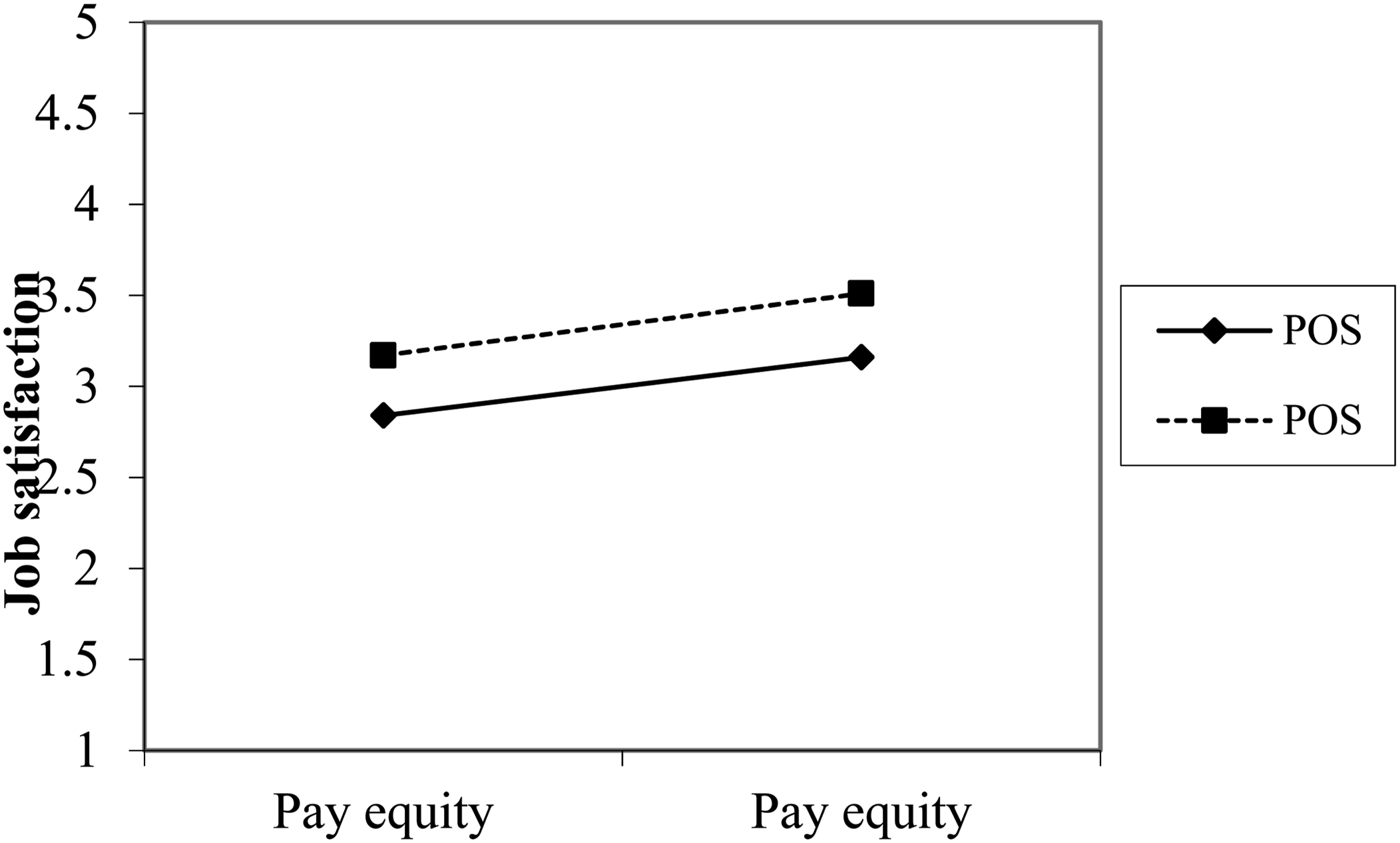
In contrast, the interaction between job equity and POS was not significant (β = 0.03, SE = 0.03, 95% CI [–0.02, 0.01], p > .05). Thus, Hypothesis 3b was not supported. This suggests that while POS strengthens the impact of pay equity on job satisfaction, it does not moderate the relationship between job equity and job satisfaction.
Discussion of Findings
This section integrates the findings with theoretical expectations, critically evaluating how results align with or diverge from prior studies. This study investigated how perceptions of pay and job equity relate to job satisfaction and whether perceived organisational support (POS) moderates these relationships. The discussion is structured around the direct relationships and the moderating effects, interpreted through the lenses of Equity Theory and Social Exchange Theory (SET).
Direct Relationships Among Pay Equity, Job Equity, POS, and Job Satisfaction
The findings confirmed that pa
Similarly, employees who perceived job equity fairness in workload distribution, responsibilities, and opportunities also reported higher satisfaction. This suggests that fairness extends beyond pay to encompass procedural aspects of work design, consistent with broader organisational justice literature (Cerci & Dumludag, 2019; Inegbedion et al., 2020). Fair distribution of tasks signals respect for employee contributions, fostering feelings of fulfilment.
In addition, POS was positively related to job satisfaction (supporting H2). This is consistent with SET, which posits that when employees perceive support and care from their employer, they feel obligated to reciprocate with positive attitudes (Abdullahi et al., 2025; Cropanzano et al., 2017; Eviana, 2024; Rhoades & Eisenberger, 2002). The South African banking sector’s high-pressure environment may make organisational support particularly valuable, as it addresses employees’ socio-emotional needs and strengthens their commitment.
POS as a Moderator of Equity–Satisfaction Relationships
The moderation results were mixed: POS strengthened the relationship between pay equity and job satisfaction (supporting H3a), but not between job equity and job satisfaction (rejecting H3b). The significant moderation for pay equity indicates that the effect of fair pay on satisfaction is amplified when employees feel supported. From an Equity Theory perspective, fair pay signals balance in the input outcome ratio (Chen et al., 2023; Mitalo & Wanyama, 2025). When combined with high POS representing trust, recognition, and resource provision, the fairness of pay is interpreted through a more positive evaluative lens (Rajâa & Mekkaoui, 2025). Employees see equitable pay not only as a transactional exchange but also as an expression of the organisation’s goodwill (Berber & Gašić, 2024; March, Aplin-Houtz, Lawrence, Lane, & Meriac, 2023). This aligns with SET, where POS fosters a high-quality exchange relationship that encourages employees to reciprocate with greater satisfaction and loyalty.
By contrast, POS did not moderate the relationship between job equity and satisfaction. A possible explanation is that fairness in workload allocation and job design is less visible and less directly tied to the organisation’s intentional support. Whereas pay equity is a highly salient and easily comparable outcome, job equity often involves complex, subjective judgments about task allocation and opportunity fairness (Gutierrez et al., 2025). Furthermore, job equity often involves diffuse and team-level dynamics. The absence of a moderating effect of POS on the job equity–satisfaction relationship also suggests that fairness in task and opportunity allocation may be perceived as a structural or managerial issue rather than a reflection of organisational care. Hence, employees may evaluate workload fairness independently of perceived support. Therefore, perceptions of job equity may independently influence satisfaction regardless of support levels. Future research could explore whether cultural or structural factors, such as hierarchical organisational design, mediate this non-significance. This highlights a potential boundary condition in the application of SET: POS strengthens the impact of tangible and salient fairness perceptions (such as pay equity) but not intangible and diffuse fairness perceptions (such as job equity) (Sharma et al., 2025; Shinde, 2025).
Theoretical and Practical Implications
This study contributes to theory in three keyways. First, it advances Equity Theory by showing that fairness in tangible (pay) and procedural (job design) domains predicts job satisfaction. However, the strength of these relationships varies depending on the organisational context. Second, it extends Social Exchange Theory (SET) by demonstrating that perceived organisational support (POS) amplifies fairness effects only in domains where outcomes are salient and directly linked to perceptions of organisational intent. This identifies a vital boundary condition: reciprocity dynamics are stronger when fairness is observable and attributable to deliberate organisational actions. Third, the findings integrate these frameworks, highlighting that justice effects are conditional, rather than universal, depending on the broader social exchange climate.
The results have practical implications for managers in the South African banking sector. Organisations should adopt a dual focus: (1) ensure transparent and equitable pay systems and (2) foster a supportive organisational climate that reinforces the fairness of these outcomes. This highlights the need to tailor HR interventions such as pay communication, recognition programs, and policy transparency toward domains where POS can exert the strongest reinforcing effect. While fairness in job allocation remains critical, its impact on satisfaction appears less dependent on POS. Organisations should consider POS as a lever to enhance pay fairness outcomes but recognise that structural fairness (job equity) may require procedural reforms rather than relational support.
By integrating Equity Theory and SET, this study shows that both pay equity (tangible) and job equity (procedural) independently predict job satisfaction, yet POS moderates only the pay equity–satisfaction relationship. Employees respond differently to fairness depending on whether it involves financial rewards or job-related factors like workload distribution and advancement opportunities. POS strengthens outcomes primarily when fairness is observable and attributable to intentional organisational action, emphasising that social exchange is domain-specific
Contextually, the South African banking sector’s regulatory environment and historical inequities provide unique insights into how socio-economic conditions shape fairness perceptions. The relatively modest explained variance in job satisfaction suggests additional contextual factors may influence these relationships, pointing to the need for theoretical adaptation in emerging market settings
Practically, the study sheds light on the importance of differentiated HR strategies. Transparent pay systems and visible support mechanisms reinforce fairness in compensation, while structural interventions, such as equitable workload distribution, resource allocation, and advancement opportunities, address job-related equity concerns. Leadership communication, policy transparency, and targeted manager training can enhance pay equity perceptions, whereas procedural fairness may require direct policy and structural adjustments. Such tailored approaches are likely to improve job satisfaction, reduce turnover intentions, and enhance performance outcomes.
Overall, this study offers theoretical and practical contributions by clarifying how organisational support interacts with different equity domains, providing guidance for HR strategy, sector-specific policy, and future research on contextual boundary conditions in emerging market organisations.
Limitations and Future Research Directions
While this study contributes to theoretical understanding of the interplay between organisational support, pay equity, job equity, and job satisfaction, several limitations must be acknowledged. First, the study relied on self-reported measures, which are susceptible to biases such as social desirability and common method bias. Incorporating objective measures or multi-source data in future research could mitigate these concerns and provide a more comprehensive view of the dynamics at play.
Second, the research employed a cross-sectional and correlational design, limiting the ability to draw causal inferences between organisational support, equity perceptions, and job satisfaction. Future studies should adopt longitudinal designs to better establish causal relationships.
Third, the study was conducted exclusively within the South African banking industry, which may constrain the generalisability of the findings to other sectors or cultural contexts. Replicating this study across diverse industries (e.g. insurance, fintech, or education) and geographical regions would enhance generalisability and validate whether the observed moderation patterns hold across contexts.
Fourth, the relatively low explained variance in job satisfaction suggests that additional variables may influence these relationships. Including different variables in future models could enhance predictive precision and theoretical scope. Future research should explore other contextual and psychological factors, particularly in emerging market contexts, that could affect employees’ perceptions of equity and organisational support.
Fifth, the study found that perceived organisational support moderated the relationship between pay equity and job satisfaction but did not significantly moderate the relationship between job equity and satisfaction. This differential moderation highlights the need for further investigation into the conditions under which organisational support influences equity outcomes. Exploring potential mediators, moderators, or contextual boundary conditions would provide deeper theoretical insights.
Finally, future research should explicitly link these investigations to Equity Theory and Social Exchange Theory. Future studies could extend the model by incorporating alternative or complementary mechanisms, such as organisational justice climate, psychological contract, or trust in management, to broaden the theoretical scope and assess competing explanations. Future studies could adopt qualitative or mixed-method designs to explore employees’ lived experiences of equity and organisational support in greater depth. For example, scholars could examine whether organisational support activates social exchange mechanisms differently across forms of equity, or whether perceptions of inequity are mitigated or amplified depending on the strength of exchange relationships. Such theoretical integration would enhance understanding of the mechanisms underlying the equity satisfaction relationship and strengthen the contribution to organisational justice and social exchange literature.
Footnotes
Declaration of Conflicting Interests
The authors declared no potential conflicts of interest with respect to the research, authorship, and/or publication of this article.
Funding
The authors received no financial support for the research, authorship, and/or publication of this article.
