



Abstract
Using data from research on the undervaluing of predominantly female occupations, we found that the usual procedures for setting wages, notably job evaluation methods, may undervalue care work, which is predominantly done by women. Such work is difficult to analyze and evaluate because the current labor market is described by a static language of specialization and skills, whereas care workers should be judged more by their experience, which varies with the context and the situation. It is also difficult to appreciate and evaluate the true value of their work, which is sometimes invisible and often unquantifiable. According to Dejours and Gernet, care work relies on less noticeable abilities. A care worker must be able to anticipate another person's needs—an ability too often noticed only when absent—and be able to foresee, interpret, and understand the person's circumstances. The usual job evaluation methods seem confined to more objective and rational criteria.
Keywords
Introduction
This article is based on a wide-ranging report on the undervaluing of predominantly female occupations in Quebec, Canada. In it, we found that the usual procedures for setting wages may undervalue care work, which is predominantly done by women. That finding seems to confirm the views of Molinier (2013), who says that such work is difficult to analyze and evaluate because the current labor market forces us to use a language of specialization and skill. Care-givers should be judged more by their experience in providing care and in focusing on the care-receiver. They should be evaluated in terms of the context, the situation, and the ability to relate to someone and bring value to that relationship. Evaluation should thus reflect their ability to advance another person's self-interest, in contrast to the logic of the market economy, which tends to prioritize acting in self-interest. It is also difficult to appreciate and evaluate the true value of such work, which is sometimes invisible (Dejours, 2003) and often unquantifiable (Ganem, 2011). According to Dejours and Gernet (2016), care work relies on less noticeable abilities. A care worker must be able to anticipate another person's needs—an ability too often noticed only when absent—and be able to foresee, interpret, and understand the person's circumstances (Molinier, 2013).
In this paper, we will challenge the customary ways of setting wages, in particular the usual methods of job evaluation and their compatibility with care work. We will discuss different skills that are difficult to put into words and, therefore, a priori difficult to evaluate. Our argument is explanatory and not prescriptive, even though some possible solutions are outlined in the conclusion. We wished to deconstruct the discourse that leads researchers and people to apply the usual methods to all jobs and base such methods sometimes too exclusively on the official job description alone and prescribed work. To that end, we will survey experts and practitioners on how they perceive pay and pay equity. Our survey will be rounded out with oral accounts from care workers, notably about their actual work and its essential but often underestimated skills.
We feel it is essential to understand how job evaluation methods first arose and later developed in order to understand the underlying logic of current methods. This historical background will be covered by the first section. We will then discuss and examine how these methods are applied to care work. Finally, we will present our methodology and our results, followed by a discussion.
History and origin of job evaluation methods
Job evaluation, as we know it today, goes back to the First World War. The first faltering steps were taken in 1917 by industrial psychologist Walter Dill Scott when he developed “job analysis” for the Classification of US Army Personnel (Arteaga and Hallée, 2021: 22). To that end, he compared the soldiers’ skills and qualifications with a list of abilities for each position (Kaufman, 2008: 174), thus enabling him to place the right person in the right position. In other words, the different jobs available were matched with the soldiers’ skills. The same idea of classifying personnel was also appearing in the American civil service. It can be traced to Frederick Winslow Taylor, who, to increase efficiency, sought to standardize jobs by analyzing job position requirements and then selecting those employees whose abilities best matched them (Kaufman, 2008: 74). This way of matching workers to their jobs flows from Taylor's second principle of scientific management (1916: 17): “And it becomes the duty of those engaged in scientific management to know something about the workmen under them.” Thus, a worker with measurably superior skills should be paid accordingly. Kaufman (2008: 74) adds that “Taylor's ideas gave rise to job evaluation and job analysis; in the public sector this same idea was called position classification.” But that is not all. His thinking would have other consequences.
To boost productivity, a business could also divide up the tasks and the labor—Taylor's fourth principle of scientific management (1916: 18). He wrote that “one of those sections [of the labour formerly done by the workers] is handed over to the management.” This vertical division of labor contributed to deskilling by dissociating the worker from the work (Figart, 2000: 5). A job position is divided into its main tasks (horizontal division of labor) with each task being appraised according to its value to the company, independently of the person in the position. This is likewise the rule in job evaluation methods (Arteaga and Hallée, 2021: 23). Taylor introduced the division of labor to find and introduce the most efficient ways of doing work. The same principle of subdivision applies when jobs are evaluated in terms of four major factors: skill; responsibility; effort; and working conditions. Those four factors are usually broken down into subfactors. 1
By 1921, Taylor was also influencing the private sector, which began to show interest in developing a “scientific” plan to determine wage rates for different types of employment. That interest was pursued in 1924 by the American Management Association, whose members discussed creating a method to evaluate office jobs (Arteaga and Hallée, 2021: 24). In 1925, a job evaluation method, based on 13 factors, was introduced for several metallurgical companies. It appeared in the book Wage Scales and Job Evaluation (Benge et al., 1941: 14; Figart, 2000: 4; ILO, 1984). The late 1930s saw development of a method using points and factors—the same four major factors described above (ILO, 1984: 4). It was developed initially to remove subjectivity from wage-setting in the metallurgical, rail transport, and electric power industries. It was thus based on male factory work, where physical strength and manual work were the norm. Keep in mind that wage-setting is not only an economic activity but also a social practice. As such, it reflects how society views what matters and what does not, and what men and women should be doing in their different stages of life (Figart, 2000). At that time, a woman's role was to perpetuate the human species by bearing and raising children. Her place was in the home, and work was “for her only a temporary circumstance or an extension of her household tasks” (Arteaga and Hallée, 2021: 26). People felt that a man, as the family breadwinner, should be paid more and that a woman's wage should be considered a second income. That view is still strong in representations of social roles (Fraser, 2012).
The postwar economic boom was especially conducive to developing and using analytical methods, in no small part due to the adjectives associated with them: technical, rational, scientific, solid, impartial, and so on (Arteaga and Hallée, 2021: 70). “Thus, the point method developed by Merrill Lott, in 1936 and the factor comparison method created by Eugene J. Benge were and still are the ones most used. It is worth noting that both methods have established almost the same evaluation criteria that have served as a basis for pay equity legislation, namely: skill, effort, responsibility, and working conditions” (Arteaga and Hallée, 2021: 70). Meanwhile, businesses were further segmenting their workforces, thus ensuring control over the tasks. Segmentation helped develop internal labor markets,
2
which had arisen before the war and were key to the growing use of job evaluation. In an organization with several hierarchical levels, the wage structure must better reflect the importance of the tasks in each job position. Job evaluation facilitated this trade-off. Three of the four compensable factors that form the core of job evaluation practice—skill, effort, and responsibility—are productivity-related variables. Workers were given a stake in increased productivity because the value of their jobs was linked to these factors. Through job evaluation, management had a new technique for worker control. (Figart, 2001: 417)
In summary, it was Taylorism “that favoured the emergence of job evaluation and job evaluation methods” (Arteaga and Hallée, 2021: 22). Such methods extended or continued the employer's use of Taylorism to divide up work, in ways strongly influenced at that time by gender, by ideas of natural skills, and by certain conceptions of work. Such methods led to a mechanical vision of work and employment. They also became ways to control the productivity of wage earners and the value of their jobs. This reality will provide the background of the next section, in which job evaluation is shown to be a potential limitation on the just recognition of predominantly female care work.
Job evaluation and care work
After covering the historical background, we will now ask whether these methods can properly measure and evaluate actual work activities and skills, i.e. a job in practice as opposed to one in theory. The latter is a description of all the tasks and how to do them to meet an organization's needs. It is a mechanical vision of work that imposes discipline and duties on the worker (Reynaud, 1988). For Reynaud (1988), these explicit or official rules determine how an organization's members should behave. They are properly called “control regulation.” They are imposed by management and aim to control and discipline behaviors within the organizational structure. However, to achieve the organization's aims, you cannot do a job exactly as foreseen, imagined, and planned (Caron et al., 2011). A job is much more than its rules. You have to adapt to the work environment and obtain or make the tools you need to become proficient in your work. To that end, you must think and act for yourself in ways that differ from what was foreseen at the planning stage (Gernet and Dejours, 2009). For care work, which encompasses here not only the care sector per se but also any work that requires a special ability to deal with emotions and human relationships, the evaluation of tasks, responsibilities, and skills should focus on the relationship with the client/beneficiary/patient, since the job is directly linked to the importance of the relationship, context, and situation that dictates and defines the work to do.
If, in this context, you subdivide the value of a job, as required by job evaluation methods, you may lessen the importance of relational, experiential, and nonprofessional skills—the core of care work—in the job's overall appraised value. Because existing evaluation methods have become so universally used, it is difficult to identify the specifics of care work, which is more concerned with human needs that are a priori difficult to define. It is easier to identify what is specific to other types of jobs, which are more formal, predictable, and technical. To give care is to meet another person's special needs, be they physical, spiritual, intellectual, psychological, or emotional (feeding, educating, reassuring, etc.) (Tronto, 1989). Furthermore, because job evaluation assigns a factor the same value for any job under evaluation, it will again not necessarily consider the specificity, variety, and extent of human needs. Molinier (2013) points to a problem with analysis and evaluation of care work: the current job market requires using a language of specialization and skills; however, care workers are defined by their care-giving experience in situ, their bonding with a person, and their development of that bond (Harvey et al., 2016). The care is for someone other than oneself. Such behavior does not follow the logic of the market economy, which often tends to prioritize acting in self-interest.
Such closeness to the client/beneficiary/patient increases the need for the relational, dialogical, emotional, and reflective skills of care work. Because those skills are associated with household work, they are viewed as being innate and natural, rather than learned. As a result, they are often underestimated and undervalued, notably in pay systems. The nonprofessional, experiential knowledge of care workers takes the rough edges off the job in practice, weakens the job control of Hyman (1989), and affects the value of work in the private sphere. The disciplines continue to police the boundaries between work and nonwork. The effects of the discourse of enclosure can be seen most dramatically in the separation between paid and unpaid labor, that is, the public and private divisions that feminist discourse is eager to counter. Work, for example, is conceived of as “employment in the production of goods and services for remuneration” (Rubin, cited in Pahl, 1988: 13). … The enclosure of work has had particular implications for definitions of skill and is reflected in gendered divisions of labor. Certain types of labor, particularly emotional labor, nurturing, supporting, and caring are omitted from job descriptions and job analyses, and they receive low levels of remuneration (Hochschild, 1983; Pringle, 1988). (Townley, 1993: 527)
Unsurprisingly, there is a “virtual identification of invisible work with women's work that is voluntary or done at home” (Deschaintre and Saulpic, 2022: 59). Invisible work is notably associated with predominantly female work and its corollary of household work. That association of ideas strengthens the belief in natural skills that are linked to the “natural role of women, not a real job,” and may thus lead to denial of professional status (Cléach, 2017: 15). Invisibilization may occur “when the ranking and description of tasks quite simply causes some activities to go unrecognized as work” (Dagiral and Peerbaye, 2012: 4).
Also, we need to ask about the actual value of care work, which the usual evaluation methods are supposed to measure. Is it the value that the employer assigns or the value generated by the care worker while doing the job, notably in line with the context and the situation? Do we consider the care worker in this appraisal? Should we? We have seen that care-giving is geared toward the care-receiver's needs. Traditionally, a job is valued for its perceived contribution to the organization's mission and goals. The employer's perspective therefore has priority. That perspective, however, may differ from the employee's. What matters to the care-giver or the care-receiver may differ from what matters to the employer or the administrator, who notably fails to see the often invisible ways of relating, dialoguing, and emoting. Such acts may also be differently valued and spoken about (Theule and Lambert, 2017).
In short, appraisal of a job's value may vary from one person to another and from one employer to another. It is relative, being neither absolute, nor independent, nor neutral. According to Theule and Lambert (2017: 183), it incorporates “in reality a certain idea of what ought to be evaluated and therefore valued.” A job may thus be differently appraised consciously or unconsciously. The appraisal may be systematic, but not completely objective. It is imbued with a certain form of subjectivity and may thus be biased in one way or another. Too often, managerial discourse dominates, thus excluding wage earners, including women, from analysis and study in human resource management (Adler et al., 2007; Ashcraft, 2011; Delbridge and Keenoy, 2010).
As for the value of care work, this is traditionally “a concept [that is] dealt with in the economics of health care, where the service has to be measurable to be evaluated. For, in economics, to evaluate means to quantify” (Vinot, 2018: 141). Measurement can mean using cost-utility or cost–benefit analysis to compare care work with its alternatives: therapies, medications, surgeries, and so on. (ibid). Does the comparison take into account the more subjective aspects of the work? Aspects based more on psychology and relationships? We should beware of “the tyranny of quantifying everything” (Le Coz, 2018: 157). Such quantification is often far removed from how the care-receiver perceives care-giving.
To the best of our knowledge, this issue has not been specifically addressed by any research in job compensation and job evaluation. At a time when people are seeking pay equity and smaller wage gaps between predominantly female and predominantly male jobs, it seems essential and appropriate to rethink and call into question the tools used to set wages and ensure pay equity. This is what we have done through the methodology described in the next section.
Methodology
Our qualitative research is based on content analysis and personal interviews with experts from unions, associations, and academia on pay and pay equity, as well as with care workers. We interviewed 38 people, including 27 care workers—not only those in hospital care but also those in job environments where administrative aspects and client relationships are especially important. The other interviewees were 11 experts with a good understanding of pay equity and pay issues. Some of them were union experts on job evaluation, particularly in the education and health care sectors—which provide most of the jobs in care work. Everyone was interviewed between November 2021 and May 2022. 4 These semi-open-ended interviews were then transcribed as verbatim texts and codified using NVivo. Next, the verbatim texts were all analyzed in-depth because qualitative samples tend to be oriented toward specific topics, rather than random ones (Huberman and Miles, 2003: 58). This purposive sampling provided us with a representative sample of all the identified occupation classes (Appendix A). It was thus a sample of certain occupations. We also resorted to snowball sampling, i.e. some of our interviewees referred us to other people in their field of work, whom we then interviewed. Our goal was to recruit a diverse sample, rather than simply a representative one.
We used Charles Pierce's method of abductive inference to generate the exploratory hypotheses we had in mind and wished to test (Hallée and Garneau, 2019; Peirce et al., 1965). In this method, the three types of inference provide a sequence of arguments: abduction, deduction, and induction. First, abduction begins the process of knowledge creation. Deduction then flows from the exploratory hypotheses to give direction to the line of inquiry. Finally, there is induction: empirical verification of the hypotheses or propositions (ibid). An iteration of deduction/induction continues until the questions are answered or, in other words, until the results are satisfactory. This is John Dewey's warranted assertability (Dewey, 1967). Inquiry has thus come to an end, in the sense of reaching its goal—in short, what has been agreed upon at that point in time, without being definitive knowledge.
We classified the conceptual categories using NVivo. The verbatim texts were then analyzed and discussed in detail, since it is through discussion that their meaning can be determined.
Our inquiry was guided by three hypotheses or propositions:
Results
These are the results obtained through our research hypotheses. Each verbatim text is identified by a number that refers to an expert or worker and an occupational classification (Appendix A).
Achieving pay equity through point-factor job evaluation
The existing literature confirms that the point-factor method of job evaluation, as we know it, is the one most recognized by national and international institutions that administer and/or promote pay equity, including Ontario's Pay Equity Office, 5 the Canadian Human Rights Commission, 6 the Australian Human Rights Commission, 7 the Equality and Human Rights Commission, 8 and Quebec's Commission des normes, de l’équité, de la santé et de la sécurité du travail (CNESST) (2011). The same is true in academia, which generally views the point-factor method as the one that best achieves the goal of pay equity, notably because it takes into account the four major factors of Quebec's Pay Equity Act (L.Q. 1996, c. 43) (Chicha, 2000). For Boivin, who defines herself as a practitioner-researcher, (2020: 195), “this management procedure is considered to be the preferred way to achieve pay equity to the extent that it enables one to identify unjustified pay gaps between predominantly female and predominantly male job categories of equal value within a company.”
France is not lagging behind other countries. “French labour law imposes pay equity for equal work and also for work of comparable value. This then raises the question of defining the value of work” (Lemière and Silvera, 2010: 66). The two researchers (2010: 65–66) point to the national interoccupational agreement on workplace diversity and gender equality, signed on March 1, 2004. It states the need to re-examine the “classifications, [and] the evaluation criteria used to define the different job positions in order to identify and correct those that may cause discrimination between men and women and to take into account all the skills put into practice” (article 13). The logic is indeed that of job equivalence and pay equity. “Comparable value approaches seek to determine an intrinsic value of work, which rests on skill requirements, efforts, and responsibilities” (Lemière, 2006: 85).
Thus, in pay equity, the intrinsic value of work is determined through the methodology of job evaluation. The ILO (1996) defines job evaluation as a systematic determination of a job's relative position with respect to others in the wage hierarchy, on the basis of the importance of the tasks assigned to that position. “An analytical method based on points and factors, usually referred to as the point method, is currently recognized as the most appropriate evaluation method for pay equity purposes” (ILO, 2009: 26). The ILO refers to the same four major factors described above (2009: 27).
The union experts we interviewed said the following on the usual evaluation methods. First, they preferred the point-factor method: to measure completely different jobs to make them equivalent, therefore to give them a value … It[the method] evolves and enables us to adapt to business realities, to job realities, care jobs among others, by adding sub-factors, abilities in interpersonal relationships, responsibilities for people. … You have to look at a totality of things, the weighting, how the jobs are measured. Are they measured on an ongoing basis? Or not measured? Do people work together or not work together? That is, jointly. Do they have shared mandates and decision-making powers that include union bargaining? It's all of that. That method, I like it because it's adaptable. (Expert #2) The systems we’ve built … compartmentalize, … if not, how [can we go about] recognizing those jobs if we don’t compartmentalize? … Your evaluation system, if [you] remove [for example] the sub-factor “responsibilities for people,” you measure the nurses, you don’t measure the teachers, you don’t measure a [multitude] of female jobs. … The arrival of the point-factor evaluation system [with regard to] the characteristics of female jobs [has made it possible] to identify them, name them, and measure them so that they’re at least paid! … But recognition of care work uses so many concepts that are hard to, I’ll say Cartesian… (Expert #2) Yes, point-factor is the best one, since because the jobs are broken down by criteria [well] clearly one can be less biased. It's less subjective. That's the principle. Except that in its application, often, it's very, very, very subjective (Expert #4). When we do the weighting … the first time we apply our pay equity method, we really have to think about justifying our weighting, but next, since it's a weighting that corresponds to our mission, to the context and to the company's values, it should not change over time (Expert #4). Yes, [that] can happen … to be an element of the solution, that weighting … the evolution of the evaluation system. But that's not enough. It's not just that. It's not the tool. It's a totality. (Expert #2)
Other possibilities should be explored. This respondent admitted that job evaluation has some limitations that hinder recognition of care work: I think job evaluation has its limitations. The pay equity law has its limitations too. It's set within a framework … We can’t fit everything into it (Expert #2).
An evaluation method is a tool created by and for management. As such, according to this respondent, it favors the employer's perspective. Yes, in fact… with the pay equity law, an amendment is needed, to the involvement of wage earners in decisions on what used to belong to the employer … creation of job titles, definition and recognition of tasks. That's really the employer's prerogative, and in most companies in which pay equity is being implemented, the employers are really holding on to it tight. When the time comes to evaluate the jobs, if you create evaluation systems that don’t recognize women's skills, [then] we have a problem … If we’re not able to recognize those characteristics. (Expert #2)
Actual work and considering the context and the situation
This is what a nursing assistant said about her actual job. According to her, the social relationships of care-giving are neglected because of work overload: The actual work really means being able to clean in a given time x toilets, feed x people, make x people walk twice a day, get the beds done or make sure that the person understands some rules or things like that. So we’re a lot more … in the action, the pressure is such that very often we have so many patients, the patient quota per employee which is so high that … actually, that part of human relationships is completely obscured. However, that's what will make a difference in patient recovery. (NOC3233) There are some things we really learn by ourselves … how to go to the tribunal, how to speak in front of the judge … The lawyer will prepare us. She’ll tell us a bit how things are done. But we learn as we go along, and if we keep going we learn how things work, what we should say, what we shouldn’t say. … We learn a lot on the job. (NOC4152) Because this is an area of work where we have to deal with many people, satisfy their whims [of some and then of others], … You have to be able to juggle with that … be able to calm things down … It's a position also where the pressure is constant, emergencies are continually arriving … You have to be able … to do four, five things at the same time … If I had to choose an animal to represent an administrative assistant [laughter], it would be an octopus. You need three heads and two dozen arms. (NOC1241) The reality of social work isn’t in line with what we learn in the courses. Through casual talk, you learn a lot … For mental health… a list of symptoms is all well and good, but it [the illness] isn’t expressed the same way in each person. … Those challenges are lived through experience, be it volunteer work or work experiences. … Also, I think people have no idea of the magnitude of the administrative tasks … the place taken by writing [reports]. Accountability … in the place where I work, we’re responsible for everything. You know, you have to leave a paper trail at almost every stage, each contact, each discussion, to protect yourself because otherwise you may be found at fault. (NOC4212) It isn’t written that you have to be empathetic … to be able to consider the other person, […] the “all other related tasks” [category] is vast in the milieu of life. (NOC4212) [There are some people] I think they don’t realize what it takes to listen, what it takes for empathy, that it isn’t just giving pills and then looking to see if the [patients] have swallowed [them]… [It's also what it takes] to bathe them… to have respect, as much with their baths as with their beds. I think, often, people don’t realize all the little details … you have to pay attention to. … When you bathe a client, … you don’t remove the covering and leave him or her completely naked … You uncover the part … with respect …. [You know] how to make them move forward, go at their pace. [You’re in a rush] but they can’t move forward faster even if [you’re] in a rush. You have to go at [their pace]. It's respect. (NOC3233)
One expert (4) referred to the importance of the context. She mentioned that the work is no longer evaluated in its context. Some dimensions of the context are concerned with job autonomy and service delivery: It's as [if there is] a context behind the doings of women … in care work, which take several variables into consideration, but it's as if those variables are negligible in a job evaluation system. (Expert #2) [It's] impossible to ask a teacher, even an education technician, a psychologist to not respond for pupils in the evening. [If there is] a request, it has to be done. So [there is] like that aspect of saying “It's your problem. It's your job autonomy.” [You know] job autonomy, I don’t know how we measure it but sometimes everything is piled into it … “Arrange yourself with that. It's up to you to settle your problem!” (Expert #2) We take the problem pupils home. We think about them. We come back. We’re constantly in touch with our clients, the pupils. So it's something that's fairly important. (Expert #2) … I would say … I have confidence in my abilities. … I can justify why I acted. Was it my best action? Maybe not, but at that time I thought it to be the most appropriate one. (NOC4152 (1))
Evaluating the skills of predominantly female care work and invisible work
We have come to our third hypothesis. For this, we need to discuss the skills of predominantly female care work and the concept of invisible work.
Such skills are often perceived as being natural to care workers and thus not recognized as skills, a perception pointed out by our respondents. Although skills are acquired through care work, they do not necessarily translate into professional qualifications, due to their perceived feminine nature and role. Wages are thus set accordingly (Albert et al., 2019). [I don’t have] the impression [that] the right places are being targeted … to deconstruct this occupational segregation in predominantly female jobs. [There is] a great deal of undervaluing that comes from viewing the skills as natural. It's so normal for a woman to do those things that you don’t even realize that a woman has these tasks to do in her job. So … people talk to me a lot about care work, about taking care [of patients], about accompanying [them]. (Expert #2) A study that was done to analyze applications for jobs … typically [those that were] more masculine versus [those that were] typically feminine [and] everything to do with human interactions: … listening ability, emotion management, whatever, and all of that [was feminine]. While [you] don’t have that … in executive positions, [in] construction jobs … [You know] even in positions that may ask for dealing with the public [it's] really less valued, less recognized … as it is in independent community organizations too, … anything to do with interactions, that's not quantified … that's not seen either, anything invisible [is less valued]. (NOC4212) No, they function as a blunt instrument and fail to capture the wide range of social and emotional dimensions of care work as well as the critical factor of language diversity particularly when it comes to aged care for migrants. A capacity to speak the language of people being cared for is crucial, but this is not simply about language and communication but also less tangible factors, such as understanding of diverse values and norms. These less tangible and often emotional skills are essential to successful care work in a variety of sectors but are not adequately recognized or valued. (Expert #5) The failure to address social, cultural, and emotional capacities is a huge flaw in the care sector. The workers are dealing with human beings in all their complexities and differences—they are not manufacturing standardized components. (Expert #5)
As for relational skills, this is what some union experts told us: There are many skills that aren’t recognized and notably the relational skills that are expressed in a variety of ways, not only with the pupils but also with the other co-workers, those ways being often considered to be chit-chat, something that isn’t necessarily important, and yet it's fundamental. (Expert #2) Yes, yes, yes, the people in care work, [they] are good. [They] have lots of qualities, but like objectively it's difficult to measure [well] in the work, in the interaction. That gets put aside. (Expert #2) Care isn’t just a technical act. Care is really everything that encompasses. … Let's imagine [you’re] in a CHSLD (a hospital centre for long-term care). Remove the relationships. What's left? … Everything to do with relationships is completely taken away. (Expert #4)
A wide range of relational abilities exists but is not considered, notably for one waitress. You still need good relational abilities. Because, for me, [there is] the customer who isn’t satisfied with his dish, which I have to return. I have to tell the cook that the customer isn’t satisfied. I’m like a messenger between the two … this position of messenger. [You have] the customer who is angry at you from the dining room, [and you have] the cook who is angry at you from the kitchen, [since there are] other dishes to do [and] you’re going back there [with] his dish and then bitching … I’m really in a, uh, nasty position! (NOC6513) I wanted a job that would be manual, artistic, linked with, in relation to other people … That's my job. As a hairdresser, that's what I do. [There is] a therapeutic aspect as well. …. The fact you share a nice moment… [You’re] alone with a person, in general. [You have] a real interaction. You learn to know the other person, you’re an attentive ear, you can give your opinion, you belong a little anyway to the daily lives of people, and I find that important in fact. For me, caring for another means… taking care of people and bringing them a little moment of happiness to their week or their day. It's something I really wanted to do. (NOC6341) You realize … that today perhaps this person has spent a shitty day and that thanks to my haircut or thanks to our discussion, [I’ve] given her smile back. And those emotions are very, very strong. [… Sometimes], I’ll let the person externalize what she feels, while not being judgemental. It's important in fact not to judge because I don’t necessarily want to get involved in a “conflict” [she makes the quotation marks with her hands], nor get attacked for that matter. So I tend not to get her going, just let it be. Yeah, if the person wants to talk, let her talk, but if, however, at a point I feel she's gone beyond my own limits, I’ll gently put her back in her place by saying I disagree with what she's saying, that we don’t have to agree but we can change the subject to make things more enjoyable. (NOC6341) No, the relational aspect isn’t taught. We’re going to have courses on legislation, courses on fine arts. I’ve had courses on sales … But … courses to learn … to be… … We’re clearly therapists, and we’re not taught to be that. (NOC6341) For me, what affects me especially in that work and in which I invest myself, is [the fact of] respecting people and actually going beyond the acts of daily life to be in touch with the elderly because this is a period that is very difficult. It's a period of transition for them. Illness often brings them losses, either cognitive or physical, a lot of insecurity, … and so the fact of being surrounded by people who are comfortable talking while bathing you or cleaning your butt because of incontinence, [well] I think that's very reassuring, and that's a role I have that's not necessarily written on my job description, but it's something I like… that I like to bring, if you wish, to that job. (NOC3233) What people in our job find important is being connected to people, being connected to pupils, people, patients, customers, whatever we want to call them, but this relationship is central to essentially feminine jobs. For many essentially feminine jobs it isn’t quantifiable, or very difficult to quantify … When I take care of someone, it's not quantifiable. (Expert #2) Flight attendants have an emotional load. They have to smile and all that, as obligations, that is, it's part of their job, it's intrinsic. Whether they’re in good humour or not, they’ve got to smile, always seeming to be in control, right. But for care workers, for care-giving, [there's] also an emotional load and a commitment to people [that] you drag around everywhere. You know, if you learn that a young person wants to commit suicide, you’re in big trouble! If a young person commits suicide in your class, you’re also in big trouble. Can that whole aspect be measured? (Expert #2) A big part of the job is teaching the children to manage their emotions and the situations they may encounter. … [You know], talking about the emotions and naming them, helping them go farther, progressing in the emotions and saying: “I understand, it's OK. You have the right to be angry.” But … that also requires emotions from me to do the job. (NOC4411) [You know] emotional investment and everything it involves. [You know], you’re really affected [by it] in every sphere. [You know] to what degree … you may be affected by what the children go through. … I think about one of my co-workers who has a class, a dreadful group. She really has plenty of problem pupils… with big problems. Next year [these pupils] may be in a special education class because they aren’t coping with the regular class … This year the principal told her: “I’m giving you the afternoon off as a gift.” … “OK, thanks, but that's not what I need.” … “Yes, I’ll take the time off, but that's not what will make me stay the whole year.” I don’t even know whether [my co-worker] will come back in January. [She] was exhausted in December… (NOC4032) Emotions [are] an integral part … of my work! As much with me, with my co-workers, with the clients, with the children… It's [an] integral part of social work, notably for youth protection, because these discussions are not obvious and we ought to have them. The decisions are extremely important in the lives of the children [and] the parents … It's clear that we’re stirring up … many, many emotions … Sometimes we’re seriously challenged by what we hear from the parents or even other professionals … be it sadness, disappointment. Sometimes … we just feel let down after investing a lot in some parents, [and] believing with them, [and] finally that doesn’t work … It's very difficult to experience those emotions. (NOC4152) Well, I think emotional intelligence in HR [is important]. I think the fact you are also able to detect … people, [you know], a facility to read people, to see [them]: “OK, that person is happy, that person is angry.” When she writes to me, it's [the ability] to discern signals that are not necessarily there [in words], [you know] social signals … The person needs a little bit more support than another. … [It's the ability] to be able to discern that easily without the person having to tell you that message in words. [Yes], emotional intelligence … enables you to know how to readjust yourself easily when there are situations that happen to people. (NOC1121)
We will now turn to invisible work. Though often commented upon by our experts, it is generally ignored by job evaluation systems: The tasks that are invisible [are] difficult to recognize. Unfortunately, the evaluation system measures responsibilities, tasks that are more visible than invisible, but those invisible ones remain complicated to put forward when the time comes to evaluate and discuss with the employer. (Expert #2) That invisible work … in care work … is difficult to quantify. When I take care of someone, it's not quantifiable. Recognition of everything that is invisible work, valuing of jobs that fulfil a “calling,” [you know] our passion, that should be our wage. [All the same] it's not our passion that will put bread on the table. (Expert #2) Clearly, it suits the government, and I will say the employer too, that the core of our job is invisible work. They know we’ll do it regardless … whether we’re nurses, educators, teachers, [we have] a professional conscience and we love our work. … Somewhere, they fully know we will do it. [It's] invisible, [and it] becomes volunteer work because we’ll do it regardless. (Expert #2).
One expert (#1) observed that invisible work, notably background work, is not sufficiently measured by job evaluation methods. In particular, administrative support is not given enough importance, though needed for the proper running of an industry or department. Also overlooked are relational skills, particularly emotional skills.
The same expert added: Some tasks are invisible, and hard to recognize. Unfortunately, the evaluation system measures responsibilities and tasks that are more visible than invisible. …When the time comes to evaluate and discuss our arguments with the employer, although we try to put those invisible tasks forward, [the discussion] remains complicated. (Expert #1).
Discussion
This section will cover our findings for each hypothesis.
First hypothesis: the point-factor method is commonly used for pay equity
Some respondents seemed comfortable with the point-factor method, if only for lack of a better one. We have already described how it gained support in 1981 with the appearance of the pay equity “bible”—an American study by Treiman and Hartman: Women, Work, and Wages: Equal Pay for Jobs of Equal Value. The book “promoted improvement of job evaluation (EVE) in order to establish the differences in value of equivalent jobs” (Arteaga and Hallée, 2021: 91). The authors considered the point-factor method to be sufficiently reliable and valid to detect and correct wage discrimination (England, 1992: 205). So, they did not call the method into question. They were more interested in identifying the characteristics of female work, by factor and by subfactor, and the sexist biases of job evaluation processes that may affect the concept of comparable value.
In the literature, job evaluation and pay equity have been criticized usually for sexist biases in the evaluation methods (Chicha, 2000; Steinberg, 1992; Weiner, 1991), in the choice of evaluation factors and sub-factors (Greig et al., 1989; Weiner, 1991), in the weighting (Treiman, 1984), and in the job evaluation procedure (Arvey, 1986; Grams and Schwab, 1985; Mount and Ellis, 1987, 1989; Steinberg, 1991). But, the evaluation method itself has not been challenged.
This was not so, however, for our respondents. Some of them doubted that the evaluation method can truly measure care-giving skills and assign them their just value. Their voices should certainly not be ignored, since the usual wage-setting procedures may undervalue predominantly female work, as indicated by our study of real-life experiences in the workplace. It also seems astonishing to us that these Taylorist methods have not been sufficiently called into question, knowing what we know about the original intentions behind them. The reason may be the concept of property rights: a business is based on the economic coercion that flows from its control of property rights, specifically its control of jobs, contracts, and employee earnings (Commons, 1959). By extension, there is also the right to manage—the employer's discretionary power not covered by the collective agreement. Townley (1993) views human resource management as a discourse and set of practices that tries to reduce the work contract's indeterminacy in defining the work to do and in imposing discipline and duties on individual workers (Reynaud, 1988). Given these aims, we should call into question those tools that aim to ensure control, to maintain various forms of domination, and to normalize domination by assigning a certain value to work and employment. Such tools support the social and economic systems that businesses serve and reproduce, notably with regard to gender, inequality, governance, power, and domination (Adler et al., 2007).
Second hypothesis: actual work, context, and situation
Our data suggest that the reality of work has largely been obscured. There seems to be less consideration of all the work that exists beyond the explicitly assigned tasks and which is nonetheless essential, even though not in the job description. Courses often fail to prepare care workers, and the respondents said they rely on the experiential learning that seems to characterize care work—Dewey's “learning by doing.” 9 Care work is about meeting diverse human needs and dealing with the unpredictability of human interactions and relationships. It is thus highly subjective in its ways and means, unlike predominantly male work—which tends to have more objectively defined tasks (Dussuet, 2017). The evaluation tools and methods reproduce, to some degree, how the work is conceived mechanically, objectively, and rationally. The same tools and methods seem poorly suited to grasping the subjectivity of actual work. They “reduce and orient human activities only toward indicators of economic performance and disregard all the complexity. … [They conceal] the world's fundamentally subjective nature” (Chiapello and Gilbert, 2013: 92, 66). Such methods neither evaluate nor consider a job in its context. Yet that context largely determines the work to do.
Third hypothesis: skills and invisible work
We also noticed that the “contents [of care work] seem to be hazier, and require unrecognized, invisible skills, even for skilled positions” (Lemière and Silvera, 2014: 134). Moreover, since care workers do a lot of relational and emotional work, as well as invisible work, they often tend to customize their ways of being and doing in order to adapt their job to each client (Lemière and Silvera, 2014: 134). This is what Molinier (2013) calls “circumstantial intelligence.” Such intelligence may lead, for example, to creation of tools for care work—customized techniques to establish trusting relationships, and so on—which a more quantitative approach cannot measure because each client is different and must be approached very subjectively through a customized human relationship. Nor can one easily and equitably measure the emotional effort that is invested in interpersonal relationships and which is very present in predominantly female jobs (Chadoin et al., 2016: 2). The work is unpredictable because the tasks are determined by “the needs felt and expressed by the people to be helped” (Dussuet, 2017: 111).
Molinier and Laugnier believe that outsourcing and professionalization of personal care “is giving emotion management an economic dimension” (Molinier and Laugier, 2013: 161). These authors are interested in Arlie Hochschild's pioneering work on emotional capitalism. Thus, the human behind the service is inseparable from the service itself; one cannot exist without the other in the relationship of co-production (Molinier and Laugnier, 2013: 161). In other words, by creating professions that require personal and emotional involvement, we are monetizing something invisible, i.e. their affects. Commercial profit is being made from emotions and personal practices, such as empathy, patience, smiling, emotional adjustment to the context and the situation, self-control, and so on. Are these relational skills being adequately considered and appraised by objectively and rationally designed evaluation methods? (Colombi, 2017, citing Hochschild, 2017).
Because some skills are going unrecognized and yet are evaluated, Junor et al. (2009) argue that pay equity should include skill re-evaluations. “The distance still to travel towards equality of skill recognition is reflected in academic debates over the nature of service skills. This debate is still often framed in terms of oppositions between ‘hard’ intellectual and technical skills and ‘soft’ interpersonal skills” (Junor et al., 2009: 201, quoting Thompson, 2007: 89). Thus, social and interpersonal skills may be ignored or under-described, like the ability to read fluid situations very fast, to gain cooperation, to make sense of the context to provide support, and so on—activities that, alas, may be thought of as chit-chat (Junor et al., 2009: 201–202). For these authors, one of the challenges of valuing predominantly female work and jobs is “full recognition of the intangible skills” (2009: 208), since the skills flow from a social construct. On this point, Hampson and Junor (2015: 451) distinguish two “stages of social construction”: first, the naming of the skill and, second, a policy of skills recognition in job/person descriptions and/or in qualifications. A third stage, which does not necessarily follow, is to recognize such skills in the wage being paid. Attempts have been made to improve job evaluation methods by introducing factors that specifically concern care work, but to no avail. Not enough has been done, and the approach is still a static one that ignores the impact of the contexts and situations of care work. Current methods notably disregard the economic value of the ability of care workers to deal with relationships and emotions.
In short, evaluation methods are being called into question because they cannot fully grasp the relational, emotional, and cognitive skills that matter so much to care work and which remain difficult to quantify and measure (Chadoin et al., 2016). Also, management indicators fail to capture the invisible work of women (Chadoin et al., 2016). Our findings are consistent with those of a study of homecare work. Although the relational aspect is one of the main motivations for doing this job (Illama et al., 2014), it is not considered to be work, with only the material tasks receiving recognition and pay. In actual fact, a large part of their work is devoted, among other things, to creation of a trusting relationship, as well as to listening to people and being attentive to their needs (Dussuet, 2011). Moreover, to perform the more material tasks properly, the women constantly have to be on the lookout for each person's unique needs and adapt their work accordingly. The tasks are hardly performed mechanically; task performance involves a “posture of attention to the other person” (Dussuet, 2011: 106). (Albert et al., 2019: 10).
Conclusion
Through our research on recognition of predominantly female work, we have come to distance ourselves from the usual methods of job evaluation. The pay may indeed not reflect the complexity, importance, and extent of the work (Chadoin et al., 2016). Our data indicate major obstacles to adequate measurement of “feminine” skills (relational, emotional, experiential, cognitive, etc.) and flaws in the concepts of actual work and invisible work. It seems difficult to assign a value in advance to a job defined and performed within a context and a situation. The actions of giving care and meeting human needs are not easy to predefine through a mechanical procedure.
As care work becomes professionalized, there will certainly be specific and diverse challenges in assigning value to its skills (Dussuet, 2017). In particular, the “downloading of emotional work on to the individual characterizes the process of work professionalization. The process mainly values those technical acts that are visible and, therefore, measurable and delegates the nonmeasurable ones without market value to the private sphere and subjective intimacy” (Benelli and Modak, 2010: 56).
If we are to build a society that values mutual assistance, with an identity shaped by awareness and concern for others, it must rise above the private level and publicly recognize the contribution of care work on an equitable and ongoing basis (Hallée and Delattre, 2021; Hallée, 2005). In other words, there must notably be social and societal recognition that upholds care for others and benevolence as a necessity and a virtue, while “striving to preserve and maintain human relationships … in order to strengthen the desire to live together” (Hallée and Delattre, 2021: 9). We must go beyond objective and mechanical visions of employment—whose measuring instruments reflect our conceptions—to appreciate the fact that a job's existence and very identity has value in the worker's relationship with the client/beneficiary/patient/co-worker and that the establishment of such a relationship is not an act isolated from other acts. Plainly put, a job is defined by its interaction—its relationship of receiver and provider. It seems imperative to redefine our conceptions of the value of work and better integrate its subjective aspects in order to strike a balance with its more objective and foreseeable aspects. We can no longer underestimate the socioeconomic value of care work (Hallée and Delattre, 2021). According to England, Budig and Folbre (2002: 469), care work creates more diffuse social benefits than those created by other kinds of work. “[It is thus] an investment in the capabilities of those who receive care; it enhances their cognitive, physical, or emotional skills, their health, and their development of functional habits. Much other work produces things that are consumed and their benefits largely end there. In contrast, investments in people's capabilities make them more able to do things that increase their own and others' well-being. When care-giving is effective, its recipients learn to make a living, to meet many of their physical and emotional needs in daily life, and to get along with others.”
Being responsible for others has thus become a core value. It surpasses the responsibility of neoliberal discourse, i.e. being responsible only for oneself (Tronto, 2013). We subscribe to a universalistic conception of care work as a “species activity that includes everything that we do to maintain, continue, and repair our ‘world’ so that we can live in it as well as possible” (Tronto, 1993: 103). As women or men, we are “responsible for all [humans, and as such] our responsibility is much greater than we may suppose, for it engages humanity as a whole” (Fleury, 2019: 2).
Thus, “economic policy should be constructed within a broader, feminist framework of human wellbeing and justice, rather than being solely concerned with the achievement of output-based metrics such as financial stability and economic growth” (Bahn, Cohen et al., 2020: 698). “[T]he shared response to the COVID-19 crisis demonstrates that the vast majority of society believes human wellbeing—not economic growth—should be at the centre of policy. COVID-19 [has exposed] the foundational role of care work, both paid and unpaid, to functioning societies and economies. Focusing on ‘production’ instead of the sustainable reproduction of human life devalues care work and those who perform it” (Bahn, Cohen et al., 2020: 695).
The concept of “substantive equality […] extends beyond a formal ‘like with like’ equality that valorises the male wage as norm and offers women wage equality to the extent they can be like men” (Whitehouse and Smith, 2020: 521). Keep in mind that male norms were used to construct the job evaluation methods that served to define wages. Can we use such methods to evaluate care work and hope to achieve real equality? Real equality would mean a higher status for care work. If the new norm is truly non-gendered, some female care workers would, in our opinion, earn more than some male care workers.
Finally, because “that remedy is as much a matter of political will as of technical solution” (Blackman et al., 2020: 585, quoting Rubery and Grimshaw, 2014), it will be important to bring the issues of care work into the public sphere and politicize them. Care work should thus be brought into the realm of politics and democracy. For Daly (2002: 263), “care is not just recognised as a good for society but policies [should be put] in place to achieve its valorisation (Fraser, 1997)”.
Footnotes
Acknowledgments
The authors wish to thank the reviewers of our paper for their highly appropriate comments and suggestions, which have enabled us to improve it substantially.
Declaration of conflicting interests
The authors declared no potential conflicts of interest with respect to the research, authorship, and/or publication of this article.
Funding
The author(s) received the following financial support for the research, authorship, and/or publication of this article: This paper was translated and revised through funding from the Program for the Dissemination and Promotion of Research Results of the Presses de l'Université Laval (PUL).

Notes
Appendix A – Interviewee Classification
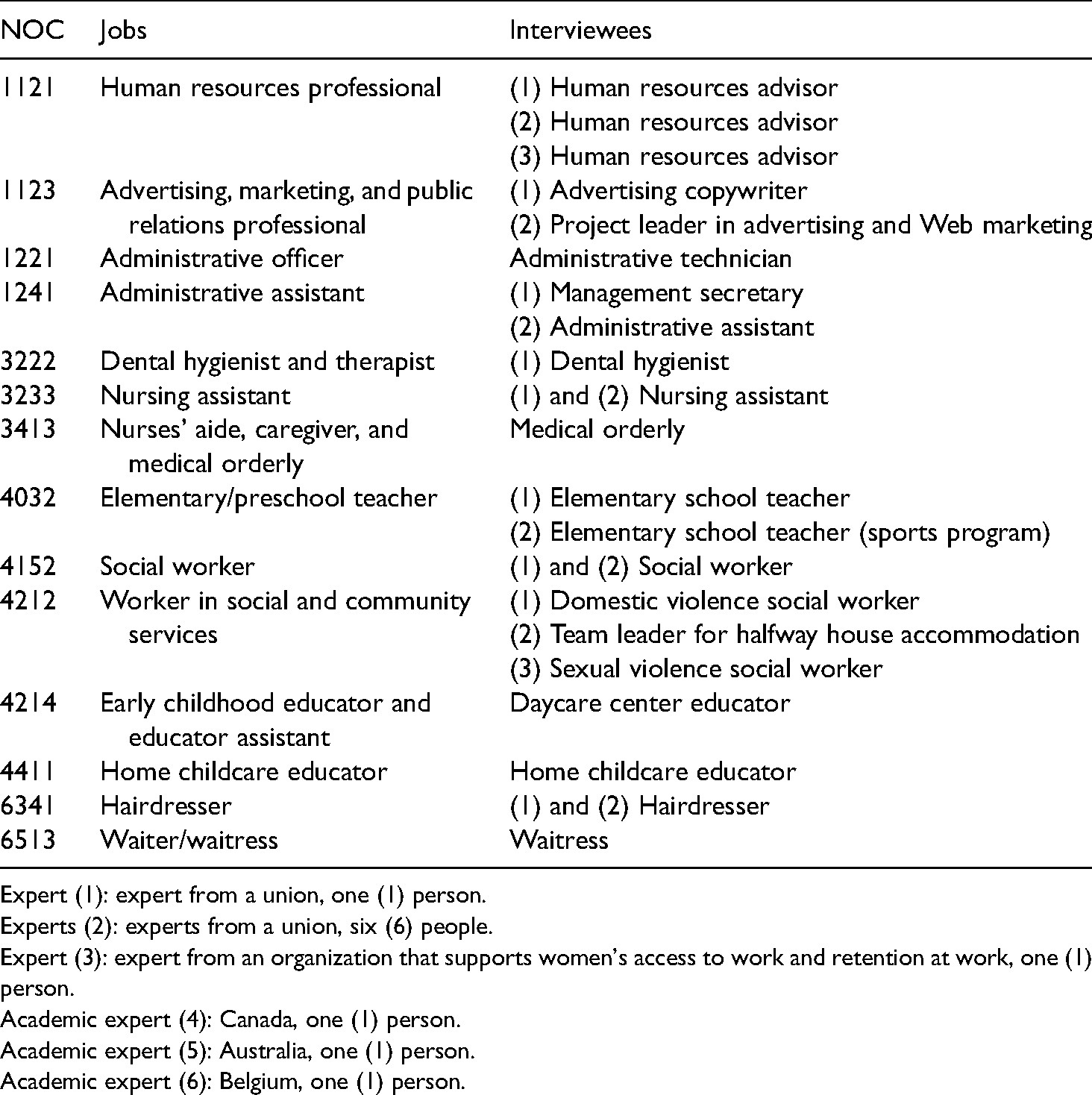
| NOC | Jobs | Interviewees |
|---|---|---|
| 1121 | Human resources professional | (1) Human resources advisor (2) Human resources advisor (3) Human resources advisor |
| 1123 | Advertising, marketing, and public relations professional | (1) Advertising copywriter (2) Project leader in advertising and Web marketing |
| 1221 | Administrative officer | Administrative technician |
| 1241 | Administrative assistant | (1) Management secretary (2) Administrative assistant |
| 3222 | Dental hygienist and therapist | (1) Dental hygienist |
| 3233 | Nursing assistant | (1) and (2) Nursing assistant |
| 3413 | Nurses’ aide, caregiver, and medical orderly | Medical orderly |
| 4032 | Elementary/preschool teacher | (1) Elementary school teacher (2) Elementary school teacher (sports program) |
| 4152 | Social worker | (1) and (2) Social worker |
| 4212 | Worker in social and community services | (1) Domestic violence social worker (2) Team leader for halfway house accommodation (3) Sexual violence social worker |
| 4214 | Early childhood educator and educator assistant | Daycare center educator |
| 4411 | Home childcare educator | Home childcare educator |
| 6341 | Hairdresser | (1) and (2) Hairdresser |
| 6513 | Waiter/waitress | Waitress |
Expert (1): expert from a union, one (1) person.
Experts (2): experts from a union, six (6) people.
Expert (3): expert from an organization that supports women's access to work and retention at work, one (1) person.
Academic expert (4): Canada, one (1) person.
Academic expert (5): Australia, one (1) person.
Academic expert (6): Belgium, one (1) person.