




Abstract
This paper investigates qualitatively the involvement of Human Resources (HR) professionals in executive remuneration governance within large UK public companies and similar organisations, considering the complex interplay of institutional, social and cognitive factors that influence executive pay decisions. Through interviews with senior HR professionals and focus groups involving mid-ranking HR professionals, the study identifies key themes, challenges and opportunities faced by HR in navigating the executive remuneration landscape. The study contributes to a more nuanced understanding of the sociological and psychological dimensions of executive pay governance. The findings highlight the practical implications for HR professionals, emphasising the need for active engagement with diverse stakeholder groups, fostering a culture of openness and transparency to ensure that executive pay practices and associated processes align with organisational values and societal expectations, while underscoring the value of learning from diverse perspectives and practices.
Keywords
Introduction
Corporate failures and scandals such as Enron, Tyco, Barings, WorldCom, Volkswagen, Parmalat and Lehman Brothers (Cole et al., 2021) have brought executive remuneration governance into the spotlight. These events have raised questions about the effectiveness of current processes for determining executive pay and the role of various stakeholders, including HR professionals, in ensuring fair and responsible remuneration practices.
The research question investigated in this paper is: How do HR professionals with reward management expertise perceive the effectiveness of current executive remuneration governance processes in large organisations, and what factors do they believe contribute to or hinder their efficacy? This question is crucial because HR professionals play a significant role in shaping and implementing executive remuneration policies, yet their perspectives on the challenges and opportunities in this domain remain underexplored.
Executive remuneration governance processes 1 in large organisations are a topic of concern for senior HR professionals with executive remuneration-related accountabilities. They perceive current processes for executive remuneration determination as lacking in effectiveness (Beer & Katz, 1998; Brown, 2008; Daniel, 2013; Ferrarini & Ungureanu, 2014; Kaplan, 2012; Manulang et al., 2023; Pepper et al., 2013; Thompson, 2005). A lack of understanding of business fundamentals, administrative orientation and constraints on HR professionals’ contribution are key issues that have been cited in explanation (Daniel, 2013).
This paper aims to provide a more nuanced and context-specific analysis to understand the processes and outcomes of executive remuneration governance. Its objective is to draw upon the in-depth insights of individuals nominally practising strategic human resource management (SHRM) within corporate – enterprises (Main et al., 2008), namely, HR reward professionals, who may inform systematic inferences leading to enhanced explanation.
Our original contribution is to analyse the perspectives of HR reward professionals on executive remuneration governance and to apply two theoretical frames of reference to explain decision-making in this regard: institutional isomorphism (DiMaggio & Powell, 1983) and upper echelons theory (Hambrick & Mason, 1984). Institutional isomorphism helps to explain how the involvement of internal HR advisers and external consultants in executive remuneration governance can lead to the adoption of similar practices and structures across organisations due to the influence of professional norms and standards (van Essen, Heugens, Otten, & van Oosterhout, 2012). Upper echelons theory, on the other hand, provides a framework to analyse how the backgrounds, values and cognitive perspectives of key decision-makers, such as remuneration committee (Remco) members, shape their interpretation of the operating context and, consequently, the outcomes of executive remuneration governance (Donaldson, 1997; Hambrick, 2007).
Literature Review: No Panaceas
Corporate governance codes of best practice provide sets of internationally recognised recommendations guiding the practice of shareholders, the board, firm internal organisation (audit, risk management, motivation and incentive schemes) and their relations with various stakeholders and institutions (Aluchna & Tomczyk, 2015), and are viewed as supporting self-regulation of listed companies in response to management and supervision inefficiencies. The company’s declaration of compliance with best practice serves as a mechanism enhancing image and reputation, assuring more efficient governance. Corporate governance reforms have had mixed success in aligning executive and shareholder interests (Thompson, 2005; Winter, 2011). Resulting from corporate failures and scandals, recommendations have called for stronger transparency standards, empowerment of shareholders, efficient board work, stronger board independence to discharge responsibility for executive remuneration, and involvement of more diverse actors in governance and management (Aluchna & Tomczyk, 2015). The focus for regulation of executive remuneration is on reducing agency costs and addressing social and political concerns (Ferrarini & Ungureanu, 2014). However, concerns remain about the impact of executive remuneration on corporate governance effectiveness (Manulang et al., 2023).
Strategic human resource management is a comprehensive approach that seeks to align HR strategies with an organisation’s strategic objectives, ensuring that human resources contribute effectively to the organisation’s success (Main et al., 2008; Matei, 2013). It requires careful planning, a deep understanding of the organisation’s strategic context, and a commitment to integrating HR practices with broader business strategies (Hu et al., 2023). SHRM prescriptions incorporate the resource-based perspective, which suggests that organisations can achieve sustainable competitive advantage through the effective and efficient management of their resources, including human resources (Colbert, 2004). The promise of SHRM is to achieve integration of people management with strategic planning to ensure that an organisation’s human capital contributes to the achievement of its business objectives. Strategic human resource management is characterised by its focus on aligning HR strategies with the overall direction of the organisation, considering both internal and external environmental factors (Paauwe & Boon, 2018). Conceptually, SHRM is built upon the idea that human resources are a key source of competitive advantage through practices that are not only distinctive and valuable but also difficult to imitate. It involves the development of approaches to managing people that are closely connected to the strategy and organisational goals of the enterprise. This includes planning for current and future management skills, identifying gaps, and areas for intervention, and understanding the implications of strategic HR investment decisions (Grundy, 1997). The practice of SHRM involves both an external fit, where HR strategies are aligned with the developmental stage of the organisation, and an internal fit, where the components of HR management complement and support each other. This dual fit is essential for the development and implementation of effective HR strategies (Baird & Meshoulam, 1988). In practice, SHRM requires a leadership that promotes its principles and strategies. It is not just about creating HR strategies but also about ensuring that these strategies are successfully implemented and that they have a positive effect on the organisation, contributing to increased productivity and efficiency (Tschirhart & Bielefeld, 2012).
Executive remuneration is a core aspect of SHRM but is a complex and controversial topic that has attracted significant attention from various stakeholders, including shareholders, regulators, academics and the public (Shortland & Perkins, 2023). The governance of executive remuneration involves the design, implementation, and disclosure of remuneration policies and practices that aim to align the interests of managers and shareholders, as well as to attract, retain and motivate top talent. However, there is no clear agreement on what constitutes effective governance of executive remuneration, and how it can be achieved in different organisational and institutional contexts. The literature on executive remuneration governance reveals a lack of consensus on the key issues, challenges and solutions in this domain. In summary, the main arguments and counterarguments from the academic literature include: • Performance-based pay systems are flawed and can lead to financial collapse (Manulang et al., 2023; Winter, 2011) versus performance-based pay systems are beneficial and can enhance firm performance (Conyon, 2014; Filatotchev & Allcock, 2010). • Executive remuneration contracts are prone to managerial self-dealing and require better design principles (Geiler & Renneboog, 2011; Shan & Walter, 2016) versus executive remuneration contracts are aligned with shareholder interests and reflect market forces (Bebchuk & Fried, 2004; Jensen & Murphy, 1990). • Remuneration governance and disclosure are essential for accountability and transparency (Aluchna & Tomczyk, 2015; Ferrarini et al., 2010) versus remuneration governance and disclosure are ineffective and can have unintended consequences (Edmans & Gabaix, 2016; Murphy, 2012).
In theoretical terms, under-contextualisation of the prevailing agency perspective (Jensen & Murphy, 1990) together with inconclusive empirical validation of the link between executive incentives and performance (Filatotchev & Allcock, 2010) reduce the confidence in extant frameworks to inform executive remuneration governance (Bruce et al., 2005). The problem is compounded by findings of unintended consequences of executive remuneration disclosure regulations, and the neglect of consideration of environmental interdependencies in corporate governance combined with evidence of managerial self-dealing and abuse of power, and the need for improved governance standards to address these issues (Filatotchev & Allcock, 2010; Geiler & Renneboog, 2011).
These diverse perspectives suggest that there is no one-size-fits-all approach to executive remuneration governance, and that the optimal design and implementation of policies and practices depend on various factors, such as firm strategy, industry, ownership, board composition, stakeholder preferences and institutional environment (Bruce et al., 2005; Carpenter et al., 2004). Against that backdrop, it is our contention that the institutional context in which agency around executive remuneration management is situated merits particular attention. Two theoretical perspectives provide valuable guidance for analysis in this regard: institutional isomorphism and upper echelons theory.
Institutional isomorphism (DiMaggio & Powell, 1983) offers a framework to understand the political and ceremonial processes that unfold through private interactions among those responsible for designing and approving executive remuneration. As these decision-makers navigate their environments and seek to establish influence and legitimacy for their actions, they adapt their behaviour accordingly. DiMaggio and Powell (1983) identify three mechanisms driving institutional change, each with distinct antecedents: coercive, mimetic and normative isomorphism.
Coercive isomorphism, stemming from political influence, inter-organisational pressures and socio-cultural expectations (Pfeffer & Salancik, 2003), is evident in the extensive corporate governance regulatory requirements. Mimetic isomorphism, a response to uncertainty, may manifest in the standardisation of executive remuneration practices as decision-makers seek to avoid reputational risks by imitating others rather than sanctioning unique remuneration arrangements. Normative isomorphism, closely tied to the social interactions involved in executive remuneration governance, is primarily driven by professionalisation. As Remcos respond to codified norms mandating specialist advice, they introduce market-based benchmarking practices mediated by pay consultants operating across industries (Ogden & Watson, 2012). This encourages isomorphic executive remuneration design as common models spread through professional networks spanning organisations (DiMaggio & Powell, 1983).
Upper echelons theory, which emphasises the ‘biases and dispositions of [organizations’] most powerful actors’ (Hambrick, 2007, p. 334), complements institutional isomorphism in explaining social agency. The theory posits that organisational outcomes, such as the appointment of a diverse Remco, reflect the orientation of dominant coalition members, shaped by their primary and secondary socialisation. Socialisation, the process of internalising social norms and ideals, occurs during childhood (primary) and adult interactions in various formal and informal settings, as well as through media, government and other social influences (Perkins & Shortland, 2024). Upper echelons theory (Hambrick, 2018; Hambrick & Mason, 1984) provides a lens to examine perceptions among social elites involved in the corporate governance of executive remuneration. The interplay of two complementary factors is central: the interpretation of operating contexts by powerful individuals acting in concert with similarly empowered individuals from the same social networks (McPherson et al., 2001), such as Remco members or institutional investors; and the influence of these actors’ experiences, personalities and values on their personalised constructs (Hambrick, 2018).
Method
This study employed a qualitative approach, situated within an interpretive paradigm, to investigate HR professionals’ perceptions of executive remuneration governance in large UK enterprises (Daniel, 2013; Main et al., 2008; Oliva & De Albuquerque, 2007). The qualitative approach allowed for an in-depth examination of the complex interplay of institutional, social and cognitive factors that shape executive remuneration decisions, while the interpretive paradigm emphasised the subjective nature of participants’ experiences and perspectives. As the research took place during COVID-19, a convenience sampling strategy was used to identify HR professionals experienced and knowledgeable about the determination of executive remuneration and its external scrutiny in accordance with the UK Corporate Governance Code of best practice (FRC, 2018).
The five individuals who agreed to be interviewed (four men and one woman) were part of a cadre in the UK corporate world where experience in dealing with this subject area is confined to a relatively small number of people and who, by virtue of their status, have significant influence on practice not only in their immediate setting but also through professional networks across sectors. These senior expert HR executive remuneration specialists may be described using the phrase ‘network stars’ (Pettigrew, 1992, p. 178), given their institutional connections and impact. The sample size was limited due to the fact that COVID-19 restrictions were in place at the time but the principle of data saturation was employed as far as was practicable in the difficult circumstances that surrounded conducting new research in a pandemic. As Guest et al. (2006) note around 80% of codes can be obtained from the first six transcripts. Our analysis of the five HR interviews provided consistency in terms of insight into the research issue (although with differing opinions on some aspects) and we could see clearly repetition of similar themes.
Separately, three focus groups were organised, drawing together 10 mid-ranking corporate HR professionals (three men and seven women) identified through their professional association, being reward expert members of the Chartered Institute of Personnel and Development (CIPD). Focus group participants were drawn from large organisations representative of a cross-section of UK sectors. Focus group 1 comprised five participants (two men and three women); focus group 2 had four participants (one man and three women); focus group 3 had four participants (all women). One woman attended all three focus groups; another attended two of the three groups. This was due to interest in the subject matter and wanting to learn from, and network with, a different range of HR professionals.
Purposive sampling led to interview and focus group participants’ corporate affiliations representing: Banking, Financial Services, Fast Moving Consumer Goods (FMCG), Hospitality, Information Technology, Professional Services, Manufacturing, Engineering, Healthcare, Housing, Further and Higher Education as well as Local and Central Government.
We chose to interview senior level participants individually while engaging in collective dialogue with the less senior personnel in focus group settings. The rationale for this was that, especially given the controversial nature of the subject matter, elite respondents were likely to resist accepting invitations to talk frankly about their views in the company of less senior peers, despite guarantees of anonymity. People are not anonymous when talking within a professional community and concerns may arise of information leakage that might compromise senior HR reward experts’ highly confidential roles as advisers and counsellors to executive remuneration decision-makers. At one level down, where networking may be perceived as advantageous as individuals progress their careers, such reservations were deemed less of a barrier to securing the cooperation of HR professionals to engage with academic researchers.
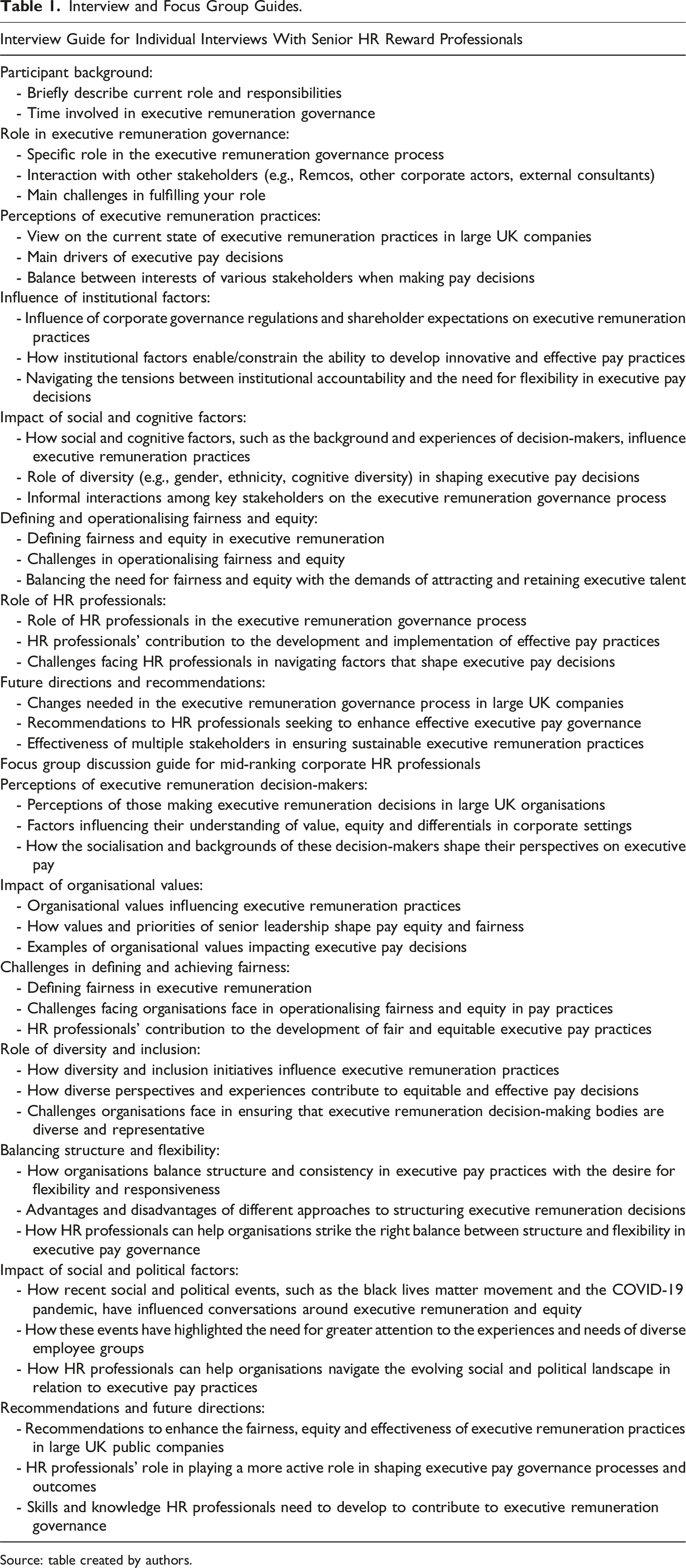
Interview and Focus Group Guides.
Source: table created by authors.
The focus groups were facilitated by one of the researchers, who set the scene for dialogue by explaining that the focus was on participants’ perceptions of the influence that executive remuneration decision-makers’ own socialisation might have on their views of value, equity and differentials in large corporate settings. Participants were encouraged to express their views to build up a picture of similarities and differences in their range of understanding of the topic. The focus groups were conducted using videoconferencing during lockdown under the auspices of the CIPD. Each lasted for an average of 45 minutes. All interviews and focus groups were audio-recorded. Ethical considerations were prioritised throughout the data collection process. Informed consent was obtained from all participants, and confidentiality and anonymity were assured. Data were securely stored and accessible only to the research team.
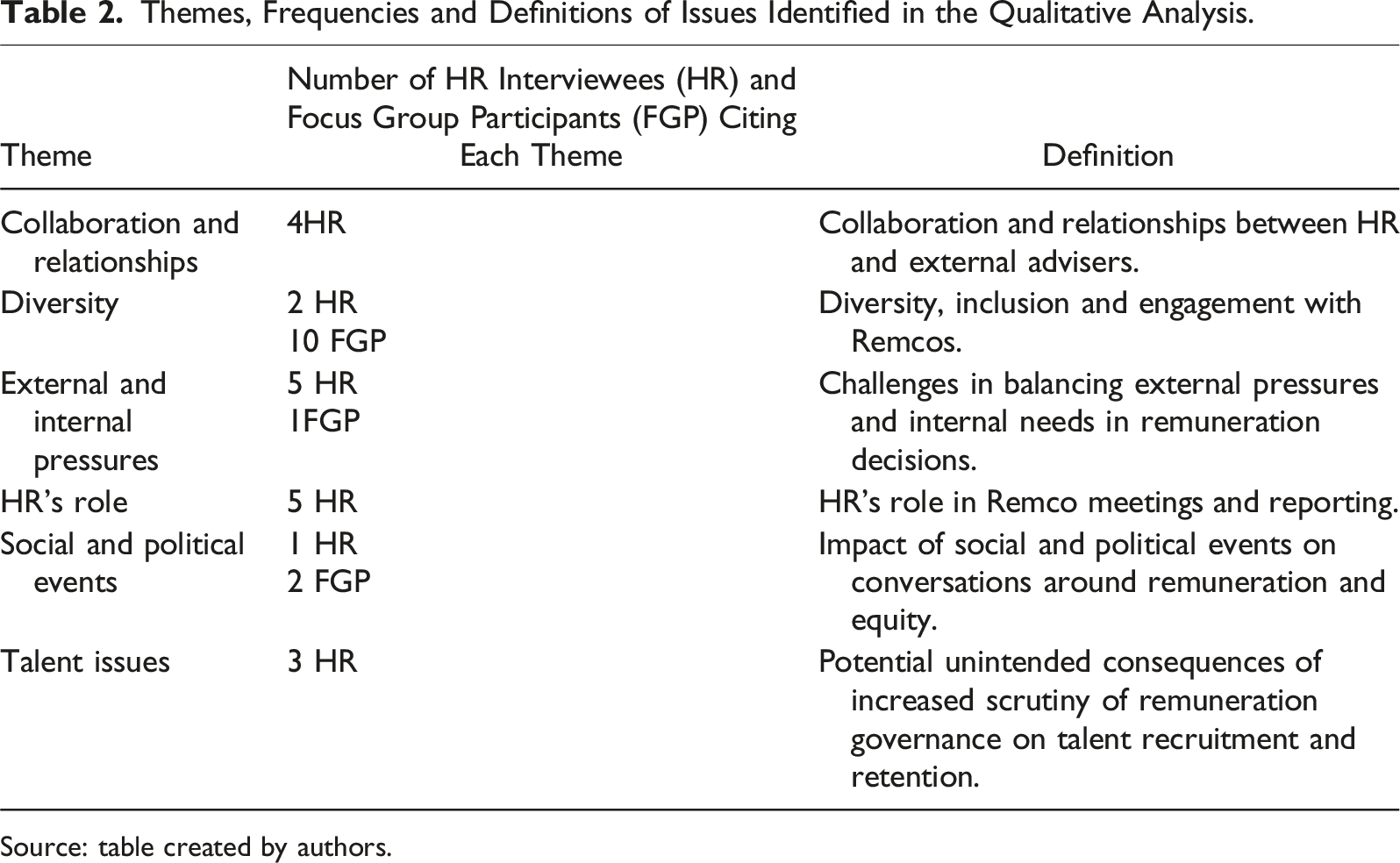
Themes, Frequencies and Definitions of Issues Identified in the Qualitative Analysis.
Source: table created by authors.
Findings
The role of HR professionals in executive remuneration in large UK public companies is a complex and multifaceted one, shaped by a range of institutional, social and cognitive factors. The analysis of the interviews and focus groups identified six key themes (listed alphabetically in Table 2). These themes are reported below and craft a narrative that characterise HR’s involvement in executive remuneration governance processes. Illustrative quotations and summarised comments from the interviewees are included and are tagged and numbered to preserve anonymity as follows: #HR1 (FMCG), #HR2 (Banking), #HR3 (Hospitality), #HR4 (Financial Services) and #HR5 (Financial Services).
HR’s Role
The HR interviewees confirmed that HR representatives do attend Remco meetings and play a significant role in preparing papers and crafting the narrative for remuneration reporting. However, the dialogue around the corporate Remco table on underlying business and performance issues was seen as somewhat limited in practice. For example, #HR5 observed that Remcos may not be fully engaged in understanding the broader context and drivers of executive performance.
External and Internal Pressures
All of the interviewees highlighted the challenges of navigating external pressures such as diverse shareholder opinions and regulatory requirements while trying to align remuneration practices with the company’s specific internal needs and operating context. #HR5 noted that little has altered in terms of Remco reporting over the past decade, except for the increased length of the reports themselves, suggesting that despite growing scrutiny and regulatory requirements, there has been limited substantive change in the way Remcos report on their decisions and processes. It was proposed that continental business practices should be recognised, even if they differ from UK practices: ‘Comparatively … they produce successful commercial outcomes … and that having a better thought out … philosophy … including what governs executive reward management is something for attention on this side of the English Channel’ (#HR5).
The problems of executive pay decision-making within the confines of external pressures led to one of the interviewees expressing concern about the limited scope for creativity and innovation in executive pay practices: ‘There just really isn’t scope for the degree of innovation that we really want to see’ (#HR1).
One of the focus group participants described different approaches to structuring remuneration decisions, contrasting executive remuneration and whole workforce pay, from more centralised models with defined budgets and decision-making bodies to more decentralised models that give local managers greater discretion. Emphasis was placed on providing structure at the lower end of pay scales, such as through living wage commitments, while allowing far greater flexibility and creativity at executive levels.
Talent Issues
Concerns were raised by three of the HR interviewees about the potential unintended consequences of increased scrutiny and limitations on executive pay (#HR1; #HR4; #HR5), with a suggestion that rewarding non-executive directors (NEDs) should be distinct from corporate reward arrangements. A ‘by the hour’ principle could apply, reflecting board committee and other attendance commitments (#HR5). This highlights the need to differentiate between the roles and responsibilities of executive directors and NEDs in the context of talent attraction and retention, as it allows for a more transparent and justifiable approach to remunerating NEDs for their specific contributions, while also mitigating the risk of perceived conflicts of interest or excessive influence of corporate reward practices on their decision-making processes. #HR5 also noted that factors around reputation were key drivers in motivating corporate executives, suggesting that non-financial factors might play a significant role in shaping executive behaviour and thus executive remuneration decision-making.
Collaboration and Relationships
While the importance of collaboration between HR and external advisers was emphasised by the HR interviewees, questions were raised about the true independence of external advisers. Views diverged on this issue: #HR1 described a strong partnership and trust between management, the Remco chair, and external advisers. However, #HR5 highlighted the potential for ‘collusion’ between corporate leaders and their chosen advisers, raising concerns about the independence and objectivity of the advice provided to Remcos. It was also recognised that, as Remcos may be influenced by the advice given on practices and levels of pay in other companies rather than solely focusing on the specific needs and circumstances of their own organisation, peer pressure needed to be recognised and taken into account in developing working relationships with external advisers.
While the significance of informal interactions and social dynamics in shaping remuneration decisions was emphasised, #HR4 raised questions about the true independence of external advisers, suggesting that a close working relationship between HR and these advisers may blur the lines of independence. Nonetheless, the value of building long-term relationships between HR reward specialists and their external advisers was stressed by #HR1 and #HR3.
Social and Political Events
Two focus group participants reflected on how recent social and political events, such as the Black Lives Matter movement and the COVID-19 pandemic, had influenced conversations around remuneration and equity. They described how these events brought greater attention to the distinct needs and vulnerabilities of different employee groups, particularly those from marginalised backgrounds. They emphasised the importance of proactively engaging with these issues and demonstrating a commitment to anti-racism in remuneration decisions.
The impact of the Black Lives Matter movement on conversations around remuneration and equity was also highlighted by one of the HR interviewees, with an emphasis on the need for organisations to understand and address these concerns: ‘In terms of Black Lives Matter … our group CEO, wanted to speak to groups in every country [within the group company] before he made any announcement … so he held a number of focus groups and then went out with what he thought the findings were at the time and what we needed to do about it’ (#HR2).
Diversity
The ongoing challenges in achieving diversity and representation in key governance roles were highlighted by two interviewees and all focus group participants. For example, #HR5 noted that the sheer numbers and logistics involved have meant that gender balance on Remcos remains elusive. Notwithstanding this, #HR2 reported that it was important to move beyond mere statements and focus on concrete actions to promote diversity and inclusion. This included initiatives aimed at increasing female representation and addressing other aspects of Remco diversity such as ethnicity. By adopting a comprehensive approach to diversity and inclusion, organisations could demonstrate a genuine commitment to creating a fair and equitable workplace for all employees from the boardroom downwards.
Focus group participants highlighted the importance of diversity and inclusion initiatives in informing remuneration decisions, describing efforts to engage diverse employee groups to better understand the experiences and needs of different segments of the workforce. One of them shared feedback from employees who perceived remuneration decision-makers as elitist or disconnected from the experiences of lower-level staff. This perception was linked to the social and economic backgrounds of senior leaders, with references to stereotypes such as them ‘shopping at John Lewis’. [This is a cultural allusion in UK parlance which characterises groups by reference to aspiring and having the means to shop at a high-end department store grouping – the John Lewis Partnership.] Focus group participants recognised the need to bridge this perceived gap and ensure that decision-makers are seen as understanding and responsive to the needs of all employees. It was suggested that senior leaders who had been promoted from front-line operations might be more attuned to the needs of lower-level employees while those decision-makers from more privileged backgrounds might struggle to understand the experiences of diverse employees.
Focus group participants also emphasised the importance of organisational values and priorities in guiding remuneration decisions within the context of diversity. They suggested that ‘looking after employees’ and doing ‘the right thing’ should inform the decisions made, even if individual decision-makers came from different backgrounds. Participants highlighted the role of senior leadership in setting the tone and communicating values that prioritise people over bottom-line results. Notwithstanding this, the complexity of defining fairness in remuneration decisions was highlighted by one focus group participant who noted that this might be better understood in terms of personalised outcomes rather than a one-size-fits-all approach. This perspective emphasises the importance of considering individual needs within the context of diversity and providing choice within a range of benefits, rather than assuming that fairness means everyone receives the same thing.
Two focus group participants discussed efforts to engage employees in remuneration decisions, such as through consultation groups or feedback mechanisms. However, they also noted challenges in ensuring that these engagement efforts were representative and meaningful, rather than being dominated by particular interest groups or trade union agendas. These participants emphasised the importance of creating a culture of openness and encouraging diverse voices to come forward with confidence, especially with developments such as executive pay ratios.
Discussion
The findings suggest that the role of HR professionals in executive remuneration in large UK organisations is characterised by a complex interplay of institutional, social and cognitive factors (Bruce et al., 2005; Carpenter et al., 2004; Daniel, 2013). While HR professionals play a significant role in the executive pay governance process, their ability and efficacy to drive creative and innovative pay practices is constrained by institutional accountability demands, the potential for collusion between corporate leaders and their chosen advisers, and the limited dialogue on underlying business and performance issues in Remcos (van Essen et al., 2012; Perkins & Shortland, 2023).
The questions raised regarding the true independence of external advisers highlight the potential tensions between institutional independence and the collaborative nature of the relationship between internal HR and external reward specialists. Limited scope for creativity and innovation in executive pay practices can be seen to flow from increased institutional accountability, with the pressure to conform to regulatory requirements, market norms and to gain shareholder approval constraining the ability and efficacy of Remcos and HR professionals to devise innovative pay practices (Bruce et al., 2005; Carpenter et al., 2004; Pepper et al., 2013; Winter, 2011). The observation that little has altered in terms of Remco reporting over the past decade further suggests that the institutional accountability demanded of listed companies may inadvertently stifle creativity and lead to a homogenisation of executive pay practices.
Concerns about the potential unintended consequences of increased scrutiny and limitations on executive pay and the need for distinct reward arrangements for NEDs highlight the tensions between institutional accountability and the need to attract and retain top talent. The findings also underscore the complex dynamics at play in executive remuneration decision-making, particularly in relation to questions of fairness and equity, with a focus on the importance of organisational values, personal experiences and backgrounds, and diversity and inclusion initiatives in shaping remuneration decisions (Shortland & Perkins, 2023).
Reflections on the impact of social and political events on conversations around remuneration and equity underscore the need for HR professionals to be proactive in engaging with these issues and demonstrating a commitment to inclusivity in remuneration decisions (Shortland & Perkins, 2024). This suggests that HR professionals have an important role to play in shaping the broader social and political context in which executive pay decisions are made, and in ensuring that these decisions are seen as legitimate and responsive to societal expectations.
A key point to note is that our findings indicated nuanced differences in the emphasis placed on specific issues related to executive remuneration governance by the HR professionals at higher and lower levels of seniority. Compared with their senior colleagues, mid-level HR respondents paid greater attention to questions about the efficacy of remuneration outcomes when considering diversity and socio-political influences. This may reflect the fact that mid-level HR professionals tended to occupy HR business partner roles, with closer proximity to front-line managers whom they supported as well as with the workforce more generally. In contrast, the senior HR professional specialists in executive remuneration management tended to have their sights more focused at the corporate level – interacting with board members and external consultants to support Remco work rather than liaising with organisational actors more generally.
Our findings also suggest that diversity and social and political phenomena should not be considered simply as part of an omnibus grouping, but as separate phenomena. Diversity is a major issue in its own right, featuring as part of equality, diversity and inclusion (EDI) considerations in executive pay governance, for example as discussed at length in Shortland and Perkins (2024). The attention drawn to Black Lives Matter as an example of a prominent social and political event (in the focus group sessions in particular) reflected less in the way of generic considerations around diversity but more of a reflection of the time-sensitive socio-political discourse that was an all-pervasive topic at the time across the media given that the focus groups were conducted in the wake of the George Floyd controversy.
Implications for Theory and Practice
From a theoretical perspective, the study highlights the need for a more nuanced understanding of the complex interplay between institutional, social and cognitive factors that shape executive pay decisions. The application of institutional isomorphism and upper echelons theories in combination to the analysis of HR professionals’ experiences and perspectives offers new insights into the ways in which individual backgrounds, values and cognitive frameworks influence remuneration practices and outcomes. This suggests that future research should continue to explore the sociological dimensions of executive pay governance, moving beyond purely economic or agency-based explanations to consider the broader social and psychological dynamics at play.
Observations about the influence of reputation as a key driver for executive motivation align with upper echelons theory (Hambrick, 2007), suggesting that the backgrounds and social networks of top executives can shape their cognitive perspectives on appropriate pay levels and the factors that influence their behaviour and decision-making. Findings on the limited scope for creativity and innovation in executive pay practices can be seen as a reflection of the homogenising effects of institutional pressures on top management teams (DiMaggio & Powell, 1983).
Building on this, in terms of theoretical contribution, inferences drawn from the interviews and focus groups may be applied to extend the explanatory power both of institutional isomorphism and upper echelons theories as lenses to assess HR professionals’ involvement in executive remuneration governance. Rather than see these two theoretical frames as distinct strands, our research helps to extend the explanatory power of these theories by considering their functioning as interdependent. Informed by the empirical research reported in this paper, the interplay between institutional isomorphism and upper echelons theories facilitates a more comprehensive understanding of the dynamics that shape executive remuneration governance.
The collaboration between internal HR reward specialists and external advisers, as highlighted by the interview participants can be seen as a manifestation of normative isomorphism, where the involvement of professionals helps ensure that executive pay practices conform to established norms and standards within the field. The focus group participants’ emphasis on the influence of personal experiences and backgrounds on decision-makers’ perspectives aligns with the upper echelons theory’s focus on the cognitive and social factors shaping executives’ interpretations and choices. The limited scope for creativity and innovation in executive pay practices can be understood as a result of the combined effects of institutional pressures (isomorphism) and the homogenising tendencies of top management teams (upper echelons).
Moreover, the challenges in achieving diversity in representation in key governance roles and the impact of social and political events on remuneration decisions highlight the need to consider both the institutional and societal contexts as well as individual characteristics of decision-makers. By integrating insights from institutional isomorphism and upper echelons theories, this study offers a more nuanced understanding of how the interplay between external pressures, professional norms, and the cognitive and social backgrounds of key actors shapes the dynamics of executive remuneration governance in large UK organisations.
From a practical standpoint, the study underscores the critical role that HR professionals can play in navigating the challenges of executive remuneration governance and promoting fair, equitable and sustainable pay practices. By actively engaging with diverse stakeholder groups, fostering a culture of openness and transparency, and proactively addressing issues of diversity and inclusion, HR professionals can help to ensure that executive pay decisions are aligned with organisational values and societal expectations. Moreover, the study highlights the value of learning from diverse perspectives and practices in order to develop more effective and responsive approaches to executive remuneration governance.
Limitations and Future Research
The study’s reliance on purposive sampling may have introduced some bias in the selection of participants, potentially limiting the diversity of perspectives represented. The study was also delimited to large UK organisations – mainly public companies – and so the findings may not be generalisable to other organisational contexts or national settings. Account must be taken of the COVID-19 era conditions in which the research data were assembled. During lockdowns data gathering had to be conducted remotely and this limited access to a wider range of sources, potentially affecting the opportunity to reach data saturation. In addition, the use of online communication tools (such as Zoom) meant that verbal discussions were hindered to some extent as side conversations were not possible and time delays had an effect on the flow and spontaneity of the conversation. Also non-verbal signals might have been less visible than traditional in-person qualitative interviewing, and so the responses need to be read in that light. Focus group discussions were also limited in length partly due to the set-up of scheduled periods of teleconferencing; additional discussions that might have taken place with meeting length extended as necessary were not possible.
Despite these limitations, the study’s in-depth qualitative approach and the inclusion of multiple stakeholder perspectives do provide valuable insights into the complex role of HR professionals and their perceptions in executive remuneration governance. Notwithstanding this, we suggest that this paper should be seen as a preliminary study with the identified themes examined more fully in the future. We also suggest including scope to extend this research beyond for-profit enterprises to the non-profit sector and to consider the impact of other external social and political events on executive remuneration decision-making, thereby going beyond internal EDI considerations.
Additionally, future research could explore the potential for cross-national comparisons, investigating how the interplay between institutional isomorphism and upper echelons theories may vary across different institutional contexts, such as those with different corporate governance regimes, cultural norms or stakeholder expectations. This could help identify the boundary conditions and contingencies that shape the explanatory power of these theoretical frameworks in different settings.
Furthermore, future studies could examine the implications of the interplay between institutional isomorphism and upper echelons theories for the effectiveness and legitimacy of executive remuneration governance. This could involve assessing the relationship between the identified dynamics and various outcomes, such as the alignment of executive pay with performance, the perceived fairness and appropriateness of remuneration practices, and the level of stakeholder support and trust as reflected by employee engagement in the governance process. By investigating these relationships, future research could provide valuable insights into the conditions under which the interplay between institutional and cognitive factors may lead to more or less desirable outcomes, and potential SHRM strategies for optimising executive remuneration governance in different contexts.
To further investigate the interplay between institutional isomorphism and upper echelons theories in shaping executive remuneration governance, future research could use grounded theory-building from empirical research and mixed-methods research approaches might also be employed. These could involve larger-scale surveys of HR professionals, Remco members and other key stakeholders across a broader range of organisations to assess the prevalence and impact of the identified themes, such as the collaboration between internal and external advisers and the challenges in achieving diversity and innovation. The survey data could be complemented by in-depth case studies of specific organisations, examining how the institutional context and the characteristics of top management teams interact to shape executive pay practices over time. Such case studies could involve longitudinal data collection, including interviews, observations of Remco meetings and document analysis, to provide a more granular understanding of the decision-making processes and the factors influencing them.
Concluding Remarks
The integration of focus group findings with the insights from interviewing senior HR reward specialists offers insights into the role of HR professionals in executive remuneration governance. The findings highlight the complex interplay of institutional, social and cognitive factors that shape executive pay decisions, and the challenges and opportunities that HR professionals face in navigating these factors to ensure that remuneration practices are seen as fair, equitable and responsive to the needs of all stakeholders. The theoretical and practical implications of this analysis suggest that HR professionals have a critical role to play in shaping the future of executive remuneration governance, but that this role is likely to be a complex and contested one that requires a deep understanding of the institutional, social and cognitive dynamics at play.
Footnotes
Declaration of Conflicting Interests
The author(s) declared no potential conflicts of interest with respect to the research, authorship, and/or publication of this article.
Funding
The author(s) received no financial support for the research, authorship, and/or publication of this article.
