




Abstract
Image-Based Sexual Abuse (IBSA), including deepfake sexual abuse – where fake yet lifelike sexual content is generated of non-consenting persons – constitutes a growing form of digitally mediated gender-based violence that remains largely under-researched within non-Anglophonic contexts. This study explores how IBSA is constructed and perceived by both laypeople and lawyers in Greece, a Southern European setting characterised by economic precarity, traditional gender norms, and evolving yet challenging legal frameworks. Drawing on semi-structured interviews with 21 participants either originating from or living in Greece (n = 16 lay persons, n = 5 legal professionals), we employed constructionist thematic analysis to examine how participants discursively frame IBSA, its motivations, barriers to reporting, legal challenges, and preventative measures. Five themes were identified: (1) constructions of IBSA as gendered violence motivated by control, humiliation, and financial exploitation; (2) barriers to reporting shaped by shame, stigma, and widespread mistrust in police institutions; (3) legal barriers related to financial inaccessibility and fragmented, outdated legal frameworks; (4) the central role of informal support networks alongside calls for education and public awareness; and (5) deepfake technologies as an emergent form of economic exploitation, particularly impacting sex workers within a legal vacuum. The findings highlight the need for structurally informed, context-sensitive responses to IBSA that address the intersections of gender, law, technology, and economic vulnerability.
Introduction
In today’s hyper-connected world, where digital infrastructures mediate even the most intimate aspects of life, boundaries between public and private spheres are increasingly blurred (Kaye et al., 2022). Within this context, image-based sexual abuse (IBSA) is a growing concern, entailing violations defined by their serious psychological, social, and reputational consequences (Fido et al., 2025; Fido & Harper, 2020). IBSA encompasses the non-consensual sending (i.e. cyber-flashing), capture (i.e. upskirting), creation (i.e. deepfake sexual abuse [DSA]), and sharing (i.e. so-called “revenge pornography”) of intimate media (DeKeseredy, 2021; Paradiso et al., 2024; Powell et al., 2020). DSA, specifically, represents a novel form of IBSA wherein AI is used to superimpose someone’s likeness onto sexually explicit material without consent; creating hyper-realistic content (Fido et al., 2022; Mania, 2024). DSA further complicates notions of consent, agency, and authenticity, and intensifies emotional harms that are exacerbated by public misconceptions that minimise victimisation and obscure digital agency (Hancock & Bailenson, 2021).
IBSA is shaped by power structures, including gender (Rousaki et al., 2025), with women disproportionately affected akin to other forms of gender-based violence such as sexual assault (Powell et al., 2024). Despite its prevalence, public awareness and legal protections remain limited, particularly in non-English-speaking contexts. Most research to date is rooted in Anglo-Western countries such as Australia, New Zealand, the United Kingdom, and the United States, whose frameworks may not be easily applicable elsewhere (Paradiso et al., 2024). In Southern Europe, significant legal and societal gaps persist, highlighting the urgent need for region-specific research and legislative reform (Revenge Porn Comparative Analysis in South East Europe, 2022).
The Case of Greece; Image-Based Sexual Abuse and the Legal Context
Greece is a particularly relevant context, with a recent Kaspersky global survey reporting that 49% of Greek respondents had either experienced or knew someone who had experienced online abuse (To Vima, 2024). Despite this, Greece’s legal framework on IBSA remains underdeveloped. Article 346 of the Greek Criminal Code was introduced to address gender-based digital violence, including IBSA, however, concerns remain over its clarity, implementation, and overall effectiveness. Lawyers also raised issues regarding its application, especially with emerging forms of abuse, such as DSA, exposing legislative gaps (DATAWO, 2022).
A major critique centres on the reductive term “revenge pornography,” which implies abuse is motivated solely by revenge from former partners; ignoring financial or opportunistic exploitation (DATAWO, 2022). Moreover, vague references to acts committed “without right” undermine the centrality of consent; an element that should be specific, informed, and revocable at all stages. High-profile Greek cases have nonetheless played a significant role in raising public awareness, serving as catalysts for justice and societal recognition of IBSA. However, despite enhanced awareness, penalties are deemed too lenient to serve as effective deterrents (Revenge Porn Comparative Analysis in South East Europe, 2022); reflecting ongoing challenges in aligning legislative measures with the lived realities of IBSA victims in Greece.
Socio-Political Context and Public Understanding
Greece presents a critical case given that the socio-political context in which IBSA unfolds is conjointly shaped by gendered issues and a welfare state significantly weakened by prolonged austerity. This economic crisis (circa 2008) led to widespread impoverishment (Kouki & Chatzidakis, 2021), with the imposition of austerity measures eroding the welfare state leaving it in perpetual crisis; deepening social and gendered inequalities. As Tzagkarakis and Kotroyannos (2022) highlight, “what raises lots of concerns about post-pandemic Greece is the formation of some negative dynamics and trends in society. To put it bluntly, some problems for the socially vulnerable groups seem to persist or even worsen, thus revealing a fear for the welfare system’s capacity and response to address social problems in the future” (p. 137).
The intersection of austerity, a weakened welfare state, and entrenched gender ideologies further intensifies structural inequalities in Greece. The economic crisis and austerity measures have exacerbated these inequalities, with necropolitical governance facilitating gendered violence. Women, LGB+ individuals, and other marginalised groups face increased precarity within what Carastathis (2015) describes as an “affective economy of hostility (p. 1)”. The disproportionate impact of austerity on women and migrants, manifested in higher unemployment and economic insecurity, is often ignored by financial institutions and political elites, reinforcing structural injustices under the pretence of economic necessity. These dynamics produce biopolitical regimes that devalue lives (Carastathis, 2015).
Despite the complex socio-economic Greek landscape, only one study has begun to address this knowledge gap. Brani (2024) found adolescent males engaging in IBSA downplayed their actions, failed to acknowledge abuse severity, and held sexist attitudes and stereotypes. However, Brani (2024) falls short of exploring how individuals living within these intricate socio-economic conditions perceive IBSA and the barriers to reporting it. Furthermore, it failed to examine how legal professionals interpret the social and legal frameworks surrounding IBSA, leaving critical perspectives unexplored.
While similar dynamics appear in other societies with low socio-economic security, they are particularly salient in Greece, where femicide is widely debated, gender inequality remains high, and institutional protection is limited (Kioupkiolis, 2025). Feminist analyses show that austerity has deepened precarity and reshaped gender relations. As Daskalaki et al. (2020) note, austerity policies have reduced women’s access to paid work, reinforcing dependence on family and informal networks. In turn, austerity and weak welfare provisions have intensified women’s economic dependency and restricted access to essential services (Christou, 2024; Kouki & Chatzidakis, 2021), creating conditions where digital coercion and exploitation can thrive. Collectively, these conditions position Greece as a particularly revealing context for examining the intersections of precarity, patriarchy, and neoliberal governance that shape digital victimisation and constrain justice. At the same time, insights drawn from the Greek context may be relevant to other post-crisis European settings, particularly in the Balkans and Mediterranean countries, where comparable struggles with austerity, gender inequality, institutional and legislative framework challenges persist (Anastasiou et al., 2015; Gálvez-Muñoz et al., 2013).
The Present Study
Despite growing international scholarship on IBSA, there remains a need to understand it within non-Anglophone settings. This gap is particularly significant for Greece given its socio-cultural, legal, and economic context, where conservative gender norms and patriarchal values persist (Tsiganou, 2021), and where recent legislative attempts face criticism (DATAWO, 2022). This study utilises interviews with Greek laypersons and legal professionals to explore how IBSA is constructed and perceived; through which we highlight how structural barriers, cultural norms, economic pressures, and technological developments intersect to produce complex socio-legal challenges in addressing technology-facilitated violence.
Methodology
Design and Procedure
Semi-structured interviews were conducted with Greek individuals, allowing for guided yet flexible discussions whilst providing in-depth insights into participants’ meaning-making processes (Alshenqeeti, 2014) and their perspectives and constructions (Adeoye-Olatunde & Olenik, 2021). To create a comfortable environment, we prioritised active listening, ensuring that participants felt at ease to express themselves. Aligning with Alshenqeeti (2014), interviewees were encouraged to share additional thoughts as sessions concluded. On average, interviews lasted 1 hr and were conducted via Microsoft Teams.
Participants
The study drew on two distinct samples. In the first, participants (n = 16, 4 males, 1 non-binary, 11 females, AgeRange = 21–55 years) were required to be over 18 years of age and either currently reside in, or have been born and raised in Greece. Three participants had emigrated, but only within the past 5 years, allowing us to be confident that their experiences were reflective of the Greek context. In the second, participants (n = 5, 3 males, 2 females, AgeRange = 28–32 years) consisted of qualified lawyers practising in Greece, working legal areas related to the topic (see Table 1 for further information).
Participant Demographics.
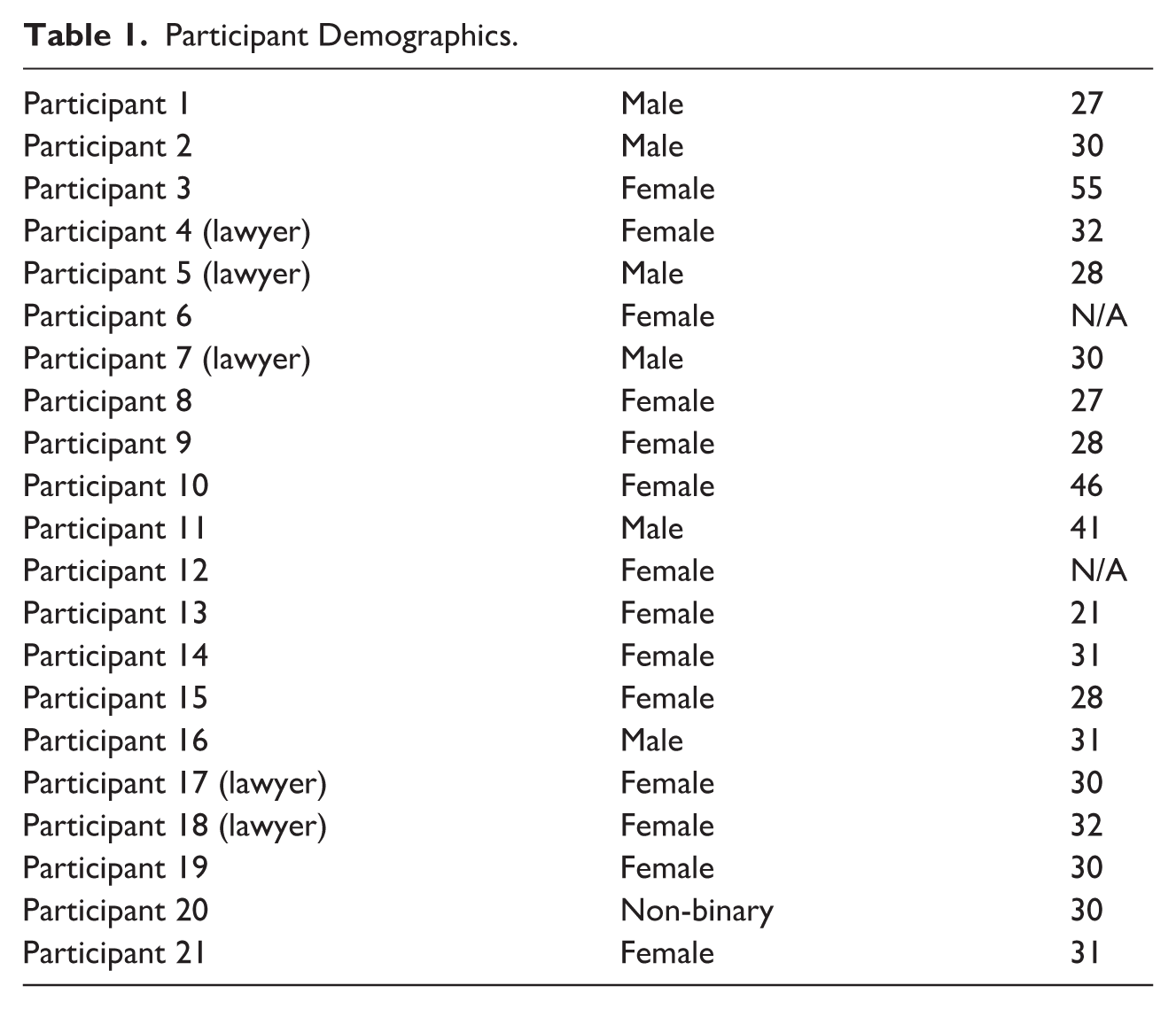
Recruitment was via snowball sampling and posts on platforms such as Facebook, Instagram and X, supplemented by professional networks. Sampling continued until thematic saturation was reached. Though thematic saturation can be reached by the 12th interview (Vasileiou et al., 2018), we concluded recruitment when substantial overlap and thematic repetition were observed in and across samples. Noteworthy, we did not directly recruit victim-survivors, nor did we explicitly exclude them, as IBSA can impact anyone. Our intention was to explore the socio-cultural and legal context in which IBSA unfolds, rather than individual experiences of victimisation. Moreover, we were ethically mindful that during data collection, there were no specialised services in Greece to which participants disclosing IBSA victimisation could be safely referred.
Analytical Procedure and Approach
Perceptions of IBSA are both gender- and context-sensitive, and subject to sociocultural frameworks, institutions, and systems that shape it (Rousaki et al., 2024). We used constructionist thematic analysis; focusing on societal norms depicting Greek society. From a constructionist perspective, meaning and experience are socially produced and reproduced rather than inherent to individuals; therefore, thematic analysis here neither examines individual psychology nor motivation, but instead theorises and explicates the socio-cultural contexts and structural conditions shaping individual accounts (Akhtar et al., 2024; Braun & Clarke, 2006).
Microsoft Teams’ automated transcription generated transcripts, which were analysed using NVivo 12. Our analytical process began with in-depth dataset engagement, where we familiarised ourselves with the transcripts to identify patterns and generate initial codes and themes. This involved independent data coding, documenting key observations, and structuring findings into a hierarchy of codes, subthemes, and overarching themes. We initiated this by conducting a line-by-line analysis to develop substantial data familiarity before reassessing the initial codes to highlight connections, overlaps, and distinctions. Here, we consolidated related codes and formed subthemes. Afterwards, themes were organised, discussed in relation to the full dataset, refined for clarity and consistency, and assigned appropriate labels (Braun & Clarke, 2006). Throughout, we paid attention to the critical questions regarding the broader implications of our findings and the ways in which participants’ perspectives might be interpreted within their sociopolitical contexts.
Interview Schedule
Interviews were conducted in Greek by AR, a native Greek speaker, before subsequently being translated into English. Following Turner III’s (2010) guidelines, we used open-ended and clear questions. The interview schedule used prompts to elicit responses and was designed around the topics: understanding non-consensual image sharing (e.g. “When you think of situations where someone’s private images are shared without their permission, what comes to mind?”), impact on victims (e.g. “How would you describe the potential impact on someone whose private images are shared without their permission?”), barriers to seeking help or reporting, (e.g. “What might prevent someone from reporting that their images have been shared without their permission?”), institutional and legal support (e.g. “What do you think about the role of institutions, like the police or online platforms, in dealing with cases of image sharing without consent?”), and deepfakes as an emerging form of IBSA (e.g. “How familiar are you with the concept of deepfakes, and where did you first learn about them?”) . Importantly, while the term “private images” is used throughout the manuscript, participants were introduced to the topic using the equivalent of the Greek term “personal,” which more accurately reflects how such content is described in Greek discourse. Moreover, further clarification was provided during the interview introduction to ensure participants understood that this referred specifically to intimate or sexual material shared without consent.
Reflexivity
The first author (AR) is a Marxist feminist originating from Greece. During the crisis, she witnessed the collapse of the welfare state and the subsequent years were her political awakening, and therefore, during the analysis, remained sensitive to how gender and socio-economic issues were intersecting to create structures of oppression. The second author (DF) has contributed knowledge to legislative developments underpinning both IBSA and domestic abuse within the United Kingdom, and who has consulted for technology firms looking to reduce technology-facilitated violence against women and girls, internationally.
Results
The thematic analysis resulted in five themes. The first, “Constructions of IBSA,” details participants’ perceptions on the gendered nature and the motivation regarding IBSA. The second, “Barriers to Reporting IBSA,” entails subthemes on shame and public reactions to IBSA, as well as distrust to the police. The third, “Barriers to Taking Legal Action,” entails discussions of the costs of legal processes, the challenges in the application of the law. The fourth, “Preventative Measures and IBSA” discusses family and friends as a form of societal support, as well as the need for education and awareness. Finally, theme five discusses “Sex Work and Deepfakes” and the needs to protect those vulnerable to victimisation. See Table 2 for a thematic.
Thematic Structure and Summary of Themes.
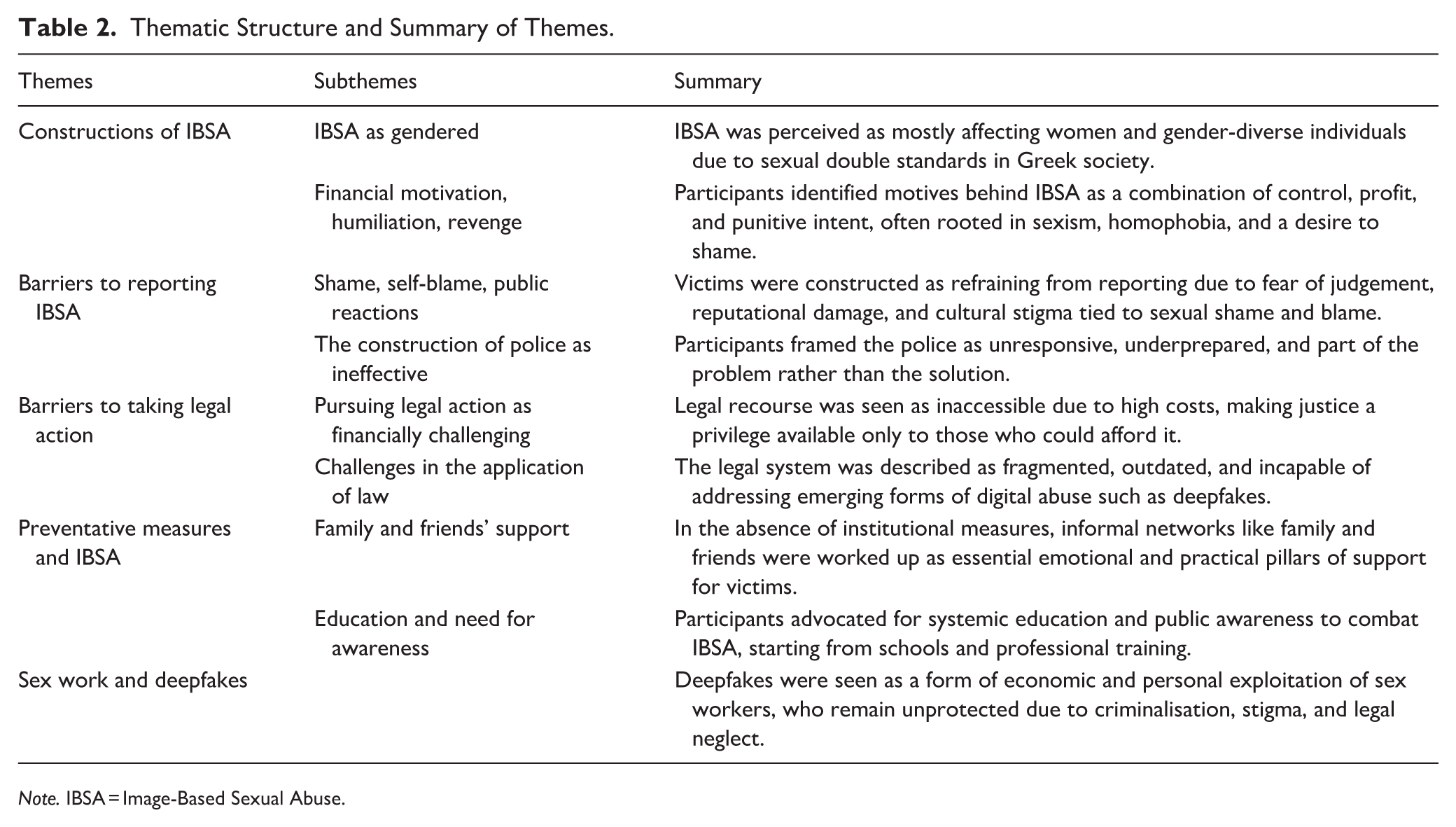
Note. IBSA = Image-Based Sexual Abuse.
Theme 1: Constructions of IBSA
Participants viewed IBSA as a social issue rooted in traditional cultural norms. They noted its gendered nature, with women and gender-diverse people facing harsher judgement, especially in Greece where female sexuality is more controlled. Participants constructed motivations for IBSA as including revenge, financial gain, and humiliation. Subthemes are explored below.
Subtheme 1.1. IBSA as a Gendered Behaviour
Though not directly asked, participants emphasised IBSA’s gendered nature; noting that while it can affect anyone, IBSA primarily impacts women in Greek society. Traditional gender roles and the shaming of female sexuality were considered key factors when it came to views of victims and perpetrators of IBSA, as well as the overall gendered context in which it unfolds:
In Greece, there is definitely the perception that something of a sexual nature is often seen as a mark of pride for men, and for the women it will be-and for someone who has a non-mainstream, not necessarily deviant, but simply different sexual identity, this often depends on what the majority perceives as a potential sexual partner. So, in general, if someone feels that this is “wrong,” it’s deeply linked to gender, sexual orientation, and people’s self-identification. From what I’ve seen, at least in Greek society, there’s a significant difference. That is slut shaming happens at about 50%. For women it’s more likely. It won’t happen to men. (Participant 11) It (IBSA) primarily affects women. They are the first group to be harmed, the first to be exploited, humiliated, and ridiculed at the expense of their dignity. (Participant 20)
Participant 11 highlights the gendered dynamics of IBSA, suggesting it disproportionately affects women and those with non-normative sexual identities. Excerpts reveal a cultural script in which male sexual expression is considered bold or admirable, while similar behaviour by others invites shame. This double standard reflects traditional gender norms, where public expressions of sexuality are only deemed acceptable when performed by men. Shaming someone for being involved in anything of sexual nature, which in turn might result in being non-consensually disseminated, becomes a mechanism for reinforcing these hierarchies. Often, in participants’ constructions, society appears to judge sexual behaviour not by the act itself, but by who performs it; suggesting that societal acceptance is framed more by the victim’s identity than actions. Similarly, when discussing those affected most by IBSA, Participant 20 employs a simple construction of gender as the organising principle of IBSA, positioning women as primary victims. Her account exposes how gendered abuse becomes a public spectacle; emphasising how IBSA is weaponised against women. Similar constructions were employed by Greek lawyers, who repeatedly highlighted how gender affects societal perceptions of IBSA victims:
Even today, a woman who has had multiple sexual partners is still considered promiscuous and morally questionable, while a man engaging in the same behaviour is seen as a “player” or a “lad” in quotation marks (. . .) and yes I believe that women consistently have worst consequences than anyone else. (Participant 17, Lawyer)
Participant 17 employs a strong binary construction to highlight how men and women are perceived in IBSA. They construct a societal cultural script in which women, when victimised, are viewed as morally questionable, while men may be socially elevated for engaging in sexual acts. The phrase “even today” suggests that although these gendered norms are outdated, they persist. Participant 17 highlights the disproportionate impact on women (“Women consistently have worse consequences than anyone else”); emphasising the social sanctions women face, where their reputations, safety, and social standing are more vulnerable. Their construction reflects cumulative harm: women are not just judged but they suffer enduring material and emotional consequences as a result.
Subtheme 1.2. Financial Motivation, Humiliation, and Revenge
Participants described IBSA as a series of actions driven by both personal and structural motives, with a focus on its emotional and economic consequences. They revealed it as a practice where financial exploitation, revenge, control, and humiliation intersect. In many ways, they perceived IBSA not just as an interpersonal violation, but as a broader exercise of societal power:
The motive, yes, I think the motive is often revenge. We’ve seen it. There have been entire forums dedicated to revenge porn. Revenge happens when the other person stands out, or let’s say, doesn’t fulfil your wishes. Then in other cases, the motive might be personal pleasure through the ridicule of the other person. Because they see it like that, exactly that. And then there’s profit. Profit is very important, because many of us know these photos and videos are sold. That’s what I think. (Participant 13) The motive. It may be the money, it may be the feeling that I will take revenge on you (Participant 21) The motive usually it could be financial, it could be the exploitation of these photos. But most of the time the people who share this kind of material have sexist, homophobic, racist motives. In some cases, I’d say, there were chats where men shared photos of women that were sent to them in private moments. I get the sense that the motive was clearly the humiliation of these individuals. (Participant 18, Lawyer)
Participants construct IBSA as being motivated by power, revenge, and exploitation; framing IBSA as not reducible to a single motive. Participant 13 introduces revenge as a primary motive, highlighting how IBSA is weaponised when one “stands out” or does not meet expectations; potentially hinting towards entitlement to control and submission, where the breach of desire or dominance results in retaliatory exposure. The phrase “personal pleasure through the ridicule of the other” suggests IBSA is conceptualised through enjoyable degradation. In this sense, IBSA is framed as a form of harm that asserts dominance and control. Participant 20 employs a straightforward scenario, aligning financial motives alongside revenge. They suggest IBSA can be both a means of material gain and a technique of emotional punishment; adopting the perpetrator’s voice to illustrate the culturally context surrounding IBSA.
Participant 18, a lawyer, discusses sexist, homophobic, and racist motives as underpinning this behaviour. The mention of men sharing women’s private images in group chats reinforces the idea that IBSA is a collective, culturally normalised practice within certain groups. The term “humiliation” is framed as the end goal, portraying IBSA as a form of societal degradation.
Theme 2: Barriers to Reporting IBSA
Shame and fear of exposure were perceived major barriers to reporting IBSA. Participants linked shame to victim-blaming and social stigma. Disclosure was framed as emotionally risky, socially isolating, and culturally unsupported; particularly when it came to police, which was constructed as an institution that was not trusted, and often was counter-productive.
Subtheme 2.1. Shame, Self-Blame, and Public Reactions
Participants discussed barriers to help-seeking and reporting; the strongest being shame and societal reactions. The construction of shame entailed two layers; shame resulting from being involved in the content, and shame stemming from the stigma and societal backlash once this gets public. It is noteworthy that participants often constructed reporting as something that would automatically result in IBSA material becoming publicly available and more widely known:
Shame. Uh . . . social environment, family, yes. Either there’s absence or there’s the reaction from society “you brought this on yourself,” right? So, shame, fear, fear of humiliation, of stigma. Yes. For those reasons, again, you know, admitting uh publicity. I don’t know, if it becomes public, if they say it, it’ll become more widely known, they might lose their job. Someone might uh, you know, their relationship. If the revenge porn is from a previous relationship, like . . . I don’t know in general, I think it can change someone’s life, shift the balance in their life. It takes a really strong stomach, I mean, to say: “Yes. I don’t care, I’m going to do it, I don’t care about the consequences”. (Participant 10)
Participant 10 frames shame, fear, and public exposure as key barriers to disclosing IBSA; a perception rooted in social narratives shaped by family, culture, and risks of visibility. Shame is tied to victim-blaming and stigma, with reporting seen as inevitably making the abuse public. This perception potentially implies a lack of institutional and social privacy, where disclosure is imagined as triggering a chain reaction with serious personal and professional consequences (e.g. relationship breakdowns, unemployment). The phrase “shifting the balance in someone’s life” showcases the extent of such harm, wherein reporting IBSA is not only reputationally damaging but life-altering. Reporting, then, is framed as an act requiring considerable emotional resilience.
It’s the fear of public condemnation. The reaction of those around them. The person whose photos have been shared illegally might be afraid of being seen as overreacting (Participant 6)
Participant 6 creates a list of reasons why one might not report victimisation, including public condemnation. However, they also list the societal de-validation of the victim’s feelings; implying that shame does not result only from public condemnation but also from the discourses implicitly dictating restraint and emotional control; positioning public opinion as dictating not only what is societally acceptable, but also policing which reactions are appropriate. Lawyers echoed this view, identifying shame as a central barrier to seeking both legal and institutional help. Participant 7 highlights how stigma can prevent victims from even confiding in supportive others, suggesting that societal narratives fail to normalise IBSA:
Then there’s the shame of admitting it to certain people, which could otherwise help them support the victim in taking the appropriate steps to move forward. And I think there’s also a fear that there’s no way back after that point. Because there’s no, no sense of safety, no reassurance that this is something that generally happens, that any one of us could overcome it. (Participant 7, Lawyer)
Participant 7 highlights the “shame of admitting it to certain people,” suggesting that while disclosure could lead to informal support, shame blocks access to it. The phrase “there’s no sense of safety that this is something which just happens, that anyone could overcome” implies a societal failure to normalise IBSA, framing it as a shameful and life-altering event. As a result of the “fatal” nature of IBSA, reporting is seen as risky, shaped by a lack of institutional support and broader social distrust. It is noteworthy that reporting is portrayed as an uncertain process, where the outcome is ambiguous and entangled with the social constructions of the phenomenon.
Subtheme 2.2. The Construction of Police as Ineffective
A central barrier to reporting was a deep mistrust of the police, which was often perceived as ineffective, indifferent, or even complicit. Several referenced well-known cases of femicide, particularly one that occurred outside a police station, as evidence institutional failure:
I don’t feel there’s proper staffing or an appropriate department. I mean, let’s not even bring up the tragic incidents. And I’m not bringing them up because I want to downplay them, but because I don’t want to take up discussion time going over things we all already know. It would become a bit rambling but we know what’s happened. (. . .) Victims are left unprotected outside the police department, so to speak. (Participant 12) (. . .) They don’t take her seriously and then she’s killed by the man, right outside the police station. How can someone go and report something that’s considered, in quotation marks, a “minor offence”? Something that didn’t cause immediate harm, like sharing your photo without consent. (Participant 20)
Participant 12 notes the lack of specialised staff and departments for online sexual abuse; referring to “tragic incidents” that signify police inaction. Phrases like “things we all already know” and “we know what’s happened” suggest these failures are considered normative. The statement “victims are left unprotected outside the police department” implies a recent femicide case, used to evidence public awareness of institutional failure. The decision not to name specific examples implies these events are so common they no longer require explanation. This narrative is complemented by Participant 20, who uses this case to highlight police inactivity in relation to IBSA. Participant 20 juxtaposes femicide with IBSA; highlighting that if such a serious incident is perceived as insignificant, what the police see as indirect harm for IBSA will be even less acted upon. The account employed here positions IBSA as belonging to a continuum of violence sustained by bureaucratic apathy, and the devaluation of victims experiences; reflecting perception that institutions responsible for protecting victims of such forms of violence are ineffective. Similar constructions were employed by the majority (4 out of 5) of lawyers:
The response is infantile, there’s absolutely no seriousness to it. It’s their logic: someone robs your house and they look at you condescendingly and say, “Yes, we’re doing what we can.” I’m not saying they have bad intentions or that they’re necessarily doing it on purpose, but. Whatever the reason might be, it shouldn’t be happening. There should be a stronger, more adequate response. (Participant 5, Lawyer)
Participant 5 intensifies critiques of the police, describing their response as “infantile” and lacking seriousness; implying a perception that contrasts with the urgency IBSA cases require. A vivid metaphor “someone robs your house and they look at you condescendingly and say ‘Yes, we’re doing what we can’” further highlights detachment, inefficiency, and what is perceived as a patronising attitude that downplays harm. While the participant avoids attributing malice, they stress that “whatever the reason might be, it shouldn’t be happening” shifting the focus to the need to protect victims, which is perceived as a process that is not currently happening.
Theme 3: Barriers to Taking Legal Action
Participants highlighted obstacles to attaining justice including refraining from reporting, financial inaccessibility of legal proceedings, and the absence of adequate legal frameworks or relevant legislation. The following sections explicate the subthemes this theme entailed.
Subtheme 3.1. Pursing Legal Action as Financially Challenging
Participants identified financial precarity as a barrier to reporting or pursuing legal action. Participants perceived such financial barriers as determining whether, and in what ways, victims can respond. In these constructions, the law is neither neutral nor universal. Instead, legal protection is effectively reserved for those who possess the financial means to seek it. Participant 8 discussed the financial aspect of hiring a lawyer:
You need a lawyer, and first of all, because everyone goes through this process, in any area this kind of thing happens, not just in this issue. Everyone starts thinking about how much this situation might cost them financially. And from the moment there is no real financial capacity in this country in general, that becomes a huge problem. The financial aspect is always involved, and turning to a lawyer, for example, is extremely expensive. (Participant 8) If you want to take it to court, you need a lot of money. It’s definitely a class issue too whether the person whose nude photos are exposed is a migrant woman working as a cleaner, or a wealthy woman who can afford the best lawyer. (Participant 15)
Participant 8 emphasises material dimensions related to legal proceedings regarding IBSA within Greece; highlighting the lack of financial resources required to pursue legal action. Legal representation is framed as a universally necessary, yet often inaccessible, element of justice-seeking. Financial barriers are perceived as common-sensical and universally understood, portraying the cost of initiating legal proceedings as an evident obstacle, particularly in Greece, where there is “no real financial capacity in this country.” The process of securing legal support is presented as a significant challenge, with hiring a lawyer commonly constructed as financially unattainable. Participant 15 constructs IBSA within broader socio-economic contexts, framing it as a class issue. The use of conditional phrasing (“if you want . . . you need . . . money”) conveys a societal understanding that legal recourse is contingent upon financial capacity; while categories such as “migrant” and “lawyer” exemplify the imbalance of power and capital embedded within institutional systems. Participant 7 acknowledged this relevance:
There are definitely financial consequences. Even just the basics, taking legal action to have the content taken down, there is the assumption you have the financial means to do so, which is not something everyone can count on. (Participant 7, Lawyer)
Here, IBSA is framed as having financial implications, not only for reporting but also for immediate actions such as content removal. These responses are presented as basic and necessary, yet they are juxtaposed with an implicit assumption that individuals can afford them. Contrary to Participant 8, who constructs the idea of the financial challenges as common-sensical, Participant 7 suggests that legal actions are far less accessible than what is implied to be commonly assumed.
Subtheme 3.2. Challenges in the Application of the Law
While discussing barriers in relation to legislative procedures, participants noted either the absence of a thorough legal framework in the case of IBSA or, where such a framework existed, its inadequacy. They emphasised that the complexity and novelty of emerging technologies, particularly deepfakes, posed significant challenges to the effective application of existing legislation. Such constructions are employed by Participant 16:
What also stops it [from being addressed] is the non-existent legal framework I mean, what has actually been developed is a legal framework supposedly for the protection of freedom of information on the internet. And there have been so many ways developed to preserve anonymity online especially in the EU. But unfortunately, the legal framework for lifting that anonymity hasn’t been developed. It might not even be technologically feasible in many cases. I mean, people now distribute this kind of material without even being on the visible or accessible internet. In that space, there’s not much you can do (. . .)And even though we’ve had this technology for decades, the legal framework simply doesn’t exist. They’ve just folded their arms because it suits them. (Participant 16)
Participant 16 criticises the legal and technological systems surrounding online anonymity in IBSA cases. They highlight a juxtaposition: while anonymity is protected under ideals of such as the freedom of information, there is a lack of legal mechanisms to pierce that anonymity when harm occurs. Participant 16 perceives this as emerging not due to technical limitations, but due to the emphasis on of liberty over accountability. Here, they note legal framework as lacking, conceptualising the issue as a deliberate absence, maintained for convenience. What is perhaps implied is that the state is depicted as wilfully inactive. The invisibility that the internet provides further reproduces the problem, allowing perpetrators to evade detection, despite having the time to address the issue (“even though we’ve had this technology for decades . . .”).
(,..) with this particular technology, I think it’s even more difficult, perhaps because it’s still new(..) they just don’t know how to deal with it. The legal framework itself. (Participant 19)
Participant 19 discusses IBSA, with an emphasis on deepfakes; highlighting difficulty in addressing it compared to what is implied to be traditional forms of violence. Through noting the legal framework itself, Participant 19 points to a perceived structural inadequacy and outdated legislation; potentially highlighting perceptions that legislative frameworks failing to keep pace with evolving forms of IBSA. Similar constructions were also employed by lawyers, albeit with more commentary on the legislative aspects of IBSA cases involving deepfake:
(. . .) There should be a watermark or some kind of visible mark on AI-generated products that clearly indicates what they are(. . .).There needs to be a legal framework to address these issues-whether it concerns intellectual property theft or labour rights violations.(. . .)In Greece, there is a law concerning the lifting of confidentiality (privacy breach) in the EU context, which was actually updated in 2022, and it allows for the lifting of confidentiality in specific offences, certain felonies, certain misdemeanours. And although it is allowed, for example, in cases of revenge porn, it’s not allowed for other types of privacy violations, which very often lead up to those cases. So, in that grey area, even the police are unsure about which article applies in each case, and whether the lifting of confidentiality can happen or not. At the same time, another practice is that the police or prosecutors, based on outdated opinions from the Prosecutor of the Supreme Court, sometimes request the lifting of confidentiality for everything. This puts platforms in a defensive position, because they respond, “No way we’re not doing that for everything. We’ll only act where it’s strictly and explicitly allowed.” And so somewhere in there, there’s a legal vacuum, cases and complaints that clearly relate to digital crimes committed in digital spaces, but the law doesn’t provide for lifting confidentiality. And they end up being thrown in the bin. (Participant 7, Lawyer)!
Participant 7 uses their expertise to criticise legal and procedural challenges surrounding AI-generated content. They call for clear labelling of AI-generated material, framing ambiguity as systemic and indicative of regulatory lag. Participant 7 roots this issue within the intersecting legal domains of intellectual property, labour, and privacy; situating IBSA within a wider pattern of digital exploitation under deregulated legislation. Focusing on Greece, Participant 7 highlights jurisdictional inconsistencies and construct a flawed legal sequence that overlooks the cumulative nature of digital abuse They argue that prosecutors’ data requests often conflict with platform resistance, suggesting a fragmented state-corporate dynamic and a legal system characterised by incoherence and uneven implementation.
Theme 4: Preventative Measures and IBSA
When discussing how to combat IBSA, participants mentioned that besides barriers, the topic needs to have preventative measures or measures that could support the victims. In these cases, both education and support from family and friends were perceived as useful.
Subtheme 4.1. Family and Friends’ Support
When asked about family and friends, participants overwhelmingly emphasised their importance; noting that in the absence of effective formal responses, family and friends provided both emotional backing and practical assistance. For instance, Participant 9 discussed their role in navigating the bureaucratic and material challenges of reporting IBSA.
I believe it’s crucial, it’s the alpha and the omega, because it’s the first point of contact. The first people someone will turn to, especially when it comes to younger individuals(,,)because even as adults, their life experiences are still relatively limited. Why? Because of life in general, but also due to limited experience navigating the bureaucratic system. So, family and close friends will play a very important role, because they’ll help the person orient themselves even within the bureaucratic side of things. Like, which official bodies and services to contact, whether they need to hire a lawyer, whether they should move forward with pressing charges all these practical matters that, especially when you’re young, you often don’t know about. And unfortunately, many times, you also don’t have the resources to act on them (Participant 9) Both are extremely important. (. . .) this combination makes everything much stronger, because it gives us the sense that there’s an entire network, almost an army, standing behind us, ready to defend us. (Participant 3)
Participant 9 presents family and friends as intermediaries in a young person’s experience of IBSA; perceiving them responsible for offering emotional support and practical guidance. Their reference to “life experience” and “bureaucratic mechanisms” challenges the opacity of these institutions, potentially highlighting assumptions of privilege or familiarity. Participant 9 also highlights financial constraints as a barrier to accessing justice, noting structural inequalities that shape outcomes. Participant 3 holds similar perceptions but focuses on emotional coping. They frame their collaboration as key to resilience, positioning collective solidarity as both an emotional and practical defence in instances of IBSA. This is further enhanced by the battle metaphors employed (“an entire network, almost an army, standing behind us, ready to defend us”); imagery that suggests IBSA requires collective mobilisation rather than individual coping. Reflecting on the collective nature of Mediterranean societies, these networks compensate for weak institutional support. What is not directly said, but implied, is how victims of IBSA rely on communities in the absence of systemic care; constructions echoed by lawyers:
As much as I’m in favour of broader socio-structural analyses (..)I think its super important. The family is the first space where you learn about your body and the kind of relationship you’ll have with it. And if that relationship is shaped by guilt, in one way or another, then it's much easier to be re-traumatised by these kinds of experiences again and again. Also, your family and friends if something like this happens should be able to carry it with you. We can’t carry these things as individuals alone, and we shouldn’t have to. (Participant 4, Lawyer)
Participant 4 seems to prefer looking at broader, system-level issues, possibly drawing a contrast between legal language and people’s real-life experiences. Within this framing, family is positioned as a key structure shaping responses to IBSA; serving both as a source of support and a formative influence on how one experiences stigma. Though not explicitly stated, sans institutional protections, the family becomes the primary site for processing and navigating harm. What is implied is that, when their understanding of these issues is problematic, the family may contribute to re-traumatisation. The participant’s claim that “the family is the first space where you learn about your body” casts the family as a disciplinary space that governs bodily self-perception. The participant also perceives IBSA as a collective, rather than individual, experience, suggesting a model of shared burden. The term “carry” is noteworthy, as it is perhaps indicative of IBSA as psychological and social weight best managed with the help communal networks. In many ways, the suggestion “we shouldn’t have” to carry things alone showcases a theorisation of combatting IBSA as a collective responsibility.
Subtheme 4.2. Education and Need for Awareness
When combatting IBSA, participants suggested that prevention through education is important, and that this education should start from school, whilst others highlighted that its absence was an issue that further perpetuates societal issues that eventually lead to IBSA:
And education, especially on issues related to sexuality and sexual abuse. From a young age, what can we learn in order to protect ourselves? That’s where the discussion begins. Now you might say “But what about the parents?” Yes, parents are important too, but they also need to learn this somewhere so the foundation has to be the school. And then, when it comes to professions, there should be a different kind of training what people learn and needs to be supported with education. Honestly there should be training every year. Things change; they don’t stay the same. Someone who learned something 20 years ago can’t operate the same way 20 years later. (Participant 14) If children were taught from a very young age that hitting, touching without consent, or sharing material that someone has entrusted to you are all forms of violation, things might be different. (Participant 1)
Participant 14 emphasises the importance of early education on sexuality and sexual abuse, framing it as self-preservation. They perceive education as something that should begin in childhood, primarily from families. However, they also highlight that parents need guidance, and therefore schools are depicted as foundational institutions that form societal understanding of sexuality and, by extension, IBSA. Participant 14 advocates for workplace training, emphasising the need for annual updates to reflect the rapid pace of technological change. Participant 1 also constructs education as a preventative mechanism; situating it within a socio-cultural framework. The conditional phrasing “If children were taught from a very young age. . .” conveys both a sense of lost opportunity and the potential for early moral development via education. Yet, they employ a list to put IBSA in a continuum of violence, perhaps to highlight the absence of education in all relevant domains. In contrast, lawyers framed prevention through public awareness. Their focus was on understanding the societal impact of IBSA and knowing how to respond when such issues arise, rather than on structured, long-term educational interventions.
First of all, prevention. Absolutely. Prevention in terms of information and awareness. I don’t mean prevention in a vague sense. Yes, “prevention” is an unfortunate word, but it has to be targeted awareness not just “call the police.” (Participant 5, Lawyer)
Participant 5 highlights the importance of prevention but quickly clarifies that they do not mean general uses of the term. Their comment “I don’t mean prevention in a vague sense” distances their view from generic rhetoric, instead rooting prevention in tangible strategies like education and awareness. The phrase “prevention is an unfortunate word” suggests discomfort with its usual connotations, such as implying victim responsibility or oversimplifying the issue. The remark “not just ‘call the police’” implies a dissatisfaction with default, punitive responses and calls for a more thoughtful, proactive approach centred on targeted awareness that moves beyond individual or punitive measures, and aims to stop IBSA before the incidents take place.
Theme 5: Sex Work and Deepfakes
Participants described DSA as a complex issue for sex workers, involving not just personal harm but also violations of labour and copyright, impacting their livelihood. They noted how sex work in Greece is stigmatised and excluded from public debate, leaving workers unprotected and subject to criminalisation. Many advocated for the participation of sex workers, but suggested this is virtually impossible with the current societal landscape:
(..) there’s also an element of economic exploitation tied to all this. For example, if I say that I make a living and I’m not only referring to sex work that involves physical acts. Let’s say I earn an income through platforms like (name of platform) or similar ones, from selling personal content online. And then someone else comes along and creates fake, deepfake content of me on their own, well, that’s a serious issue. That’s economic harm, primarily. Yes. That’s the first point. The second is that, unfortunately, in cases like this, I don’t think the Greek state is likely to engage seriously – at least not at this point in time (. . .). There’s a kind of puritanism too (. . .) I really don’t think there could ever be a productive conversation here in Greece about what this kind of work actually means. Because the profession, by its very nature, is seen as dirty by the Greek institutions. (Participant 2) There is a real threat to their work and replacement by deepfakes in general. And since the legal framework for their protection is practically non-existent, even regarding the most basic rights, such as bodily integrity, health, and sexual health. (Participant 15)
In the first extract, Participant 2 frames deepfakes involving sex workers as a form of financial exploitation. They distinguish online from physical sex work, highlighting its novelty and marginal status within the Greek context. The example of DSA is presented as a specific modality of harm, an unauthorised appropriation of one’s image and labour for another’s profit, thus situating deepfake pornography as economic harm that deprives individuals of income. Sex work is described as a means of “making a living,” reflecting a view of it as labour tied to material survival. The participant further critiques the state’s failure to recognise sex work as a legitimate issue, expressing resignation toward structural change within a conservative society. Similarly, Participant 15 constructs deepfakes as a work-related threat emerging from the absence of legal and social protections, portraying sex workers as technologically exploited and institutionally abandoned. A similar construction was often employed by lawyers:
I think the main issue here has to do with sex work itself. It remains in a somewhat illegal status, that is, we’re dealing with various forms of criminalisation, either direct or indirect (..). There needs to be a process of decriminalisation first, which would also apply to the kinds of people I mentioned earlier (,,)there’s currently no legal framework in place that addresses this. There’s no consistent treatment of online pornography in the same way as traditional forms of sex work, meaning sex in exchange for money. This is something that needs to be addressed. And it’s not necessary to place everything under a single, unified legal framework, but there needs to be a recognition that this kind of work, in the online sphere too, is still sex work. And beyond that, it can also be artistic labour, intellectual labour, and many other things. (Participant 4)
The phrase “sex work itself” highlights that any discussion must address its criminalised status. Participant 4 suggesting that sex work is “somewhat illegal” reflects the legal ambiguity of sex work (neither fully criminalised nor protected) marked by state regulation through indirect means. Participant 4 perceives sex workers as needing protection and suggests that such protection requires full decriminalisation. They contrast this with the lack of regulation around online pornography; noting that online sex work is not normatively recognised in Greek society. While not advocating for broad legislation, Participant 4 calls for recognition of online content creation as sex work and as legitimate labour involving artistic and intellectual property; potentially reflecting broader participant concerns that sex work is so highly stigmatised in Greek society that there is an absence of discourses that position it as work.
Discussion
IBSA literature predominantly centres on Anglophone contexts. However, in the context of Greece’s unique socio-economic challenges, traditional gender norms (Tsiganou, 2021), and inadequate legislative efforts (DATAWO, 2022), this examined constructions of IBSA among Greek laypersons and legal professionals . Findings revealed how structural inequalities, cultural context, economic instability, and vast technological change converge to create complex obstacles in effectively responding to technology-facilitated sexual violence. We highlight five themes: (1) Construction of IBSA, (2) Barriers to reporting IBSA, (3) Barriers to Taking Legal Action, (4) Preventative Measures, and IBSA (5) Sex Work and Deepfakes.
In theme one, Constructions of IBSA, participants highlighted gendered structures through which IBSA is enacted and rendered intelligible. Both groups framed women as the primary victims, reflecting enduring influences of patriarchal norms. While motivations for IBSA were linked to control and revenge, participants also identified financial gain as a driver; adding a crucial socio-economic dimension to extant discussions (Henry & Beard, 2024). Financial motives were seen as emerging from the socio-economic instability of post-crisis Greece (Melidis & Tzagkarakis, 2022), where austerity and neoliberal restructuring exacerbated gendered inequalities. In this context, IBSA was constructed as a form of gendered accumulation, where women’s sexualised images become a site of capitalist exploitation - reinforcing the exclusion of vulnerable groups (Carastathis, 2015).
In theme two, Barriers to Reporting IBSA, participants revealed two principal impediments. First, shame, stigma, and victim-blaming were seen as central mechanisms that deter victims from seeking help. Second, the police were widely perceived as ineffective, with participants expressing distrust and little faith in institutional protection. These findings align with global research showing that responses to IBSA often perpetuate harm and stigma (Aborisade, 2022), and in Greece, these issues appear exacerbated by specific legal and institutional shortcomings. Huber (2023) similarly found that inadequate police responses stem from limited legal knowledge, inconsistent law enforcement, and poor victim support.
In theme three, Barriers to Legal Action, participants discussed limited access to justice, and how such access is shaped by class, with both laypeople and lawyers identifying financial constraints as a major barrier to reporting. Legal redress was framed as commodified, where pursuing justice depends on one’s economic means, reflecting similar findings reported in the United States, where high legal costs hinder access to justice (Eaton et al., 2024). In this way, legal processes reflect neoliberal logics, marginalising those without financial resources (Mant, 2017; Mehrotra et al., 2016). Participants also criticised the inadequacy of current legislation, especially around deepfakes noting that legal frameworks have not kept pace with the evolving nature of tech-mediated abuse. These concerns echo global critiques of the law’s epistemic and institutional failures in addressing digital violence (Henry et al., 2017). In Greece, the recently introduced “revenge pornography” law was also seen as lacking, with DATAWO (2022) pointing to insufficient protections and vague terminology.
In theme four, Preventative Measures and Support, participants highlighted the reliance on informal support networks in the absence of institutional support. Participants emphasised the role of family and friends in providing emotional and practical support, alongside calls for greater public awareness and digital literacy. Such findings align with broader concerns about the erosion of public services in Greece following prolonged austerity measures (Melidis & Tzagkarakis, 2022). Indeed, state withdrawal from welfare measures and institutional care burdens individuals and forces communities to become the primary source of support (Rousaki et al., 2024). Moreover, the central role of family and friends are particularly prominent in Mediterranean society, playing a central role in the construction of Mediterranean identities (Petruzzellis & Craig, 2016).
The final theme, Protection for Sex Workers, brought to light the ways in which emerging technologies, particularly deepfakes, threaten already marginalised populations. Participants voiced concern about the lack of legal protections for sex workers and framed DSA as labour exploitation. While extant literature has theorised the implications of DSA on the privacy and consent of sex workers (Karagianni & Doh, 2024), such research highlights that the Greek context is entangled with negative attitudes towards prostitution (Digidiki, 2016; Digidiki & Baka, 2017). Our findings are novel in that participants expressed worry and concern and suggested higher need for protection of sex workers. Moreover, our study offers the first empirical insight into how these concerns are experienced and perceived by lawyers and the broader public in a Southern European context in relation to IBSA. Specifically, participants discussed the convergence of patriarchal, moralistic, and capitalist interests that render sex workers hyper-exploitable while simultaneously excluding them from the juridical protections afforded to other forms of labour.
Implications of Findings
Taken together, these findings showcase the necessity for a structurally informed, multi-layered response to IBSA that moves beyond individualistic framings and addresses its proliferation by broader configurations of gendered, economic, and technological domination. Clearly, there is a need for sex education curricula to include discussions of consent and digital safety, and also sustained engagement with the contexts that underpin digital sexual violence.
Moreover, to address the institutional distrust and underreporting raised, interactions with law enforcement, police, and legal professionals require mandatory, trauma-informed training that actively confronts gendered and moralising discourses. State-funded legal services must be expanded to guarantee access for those structurally excluded from costly legal processes.
Beyond these institutional reforms, both groups highlighted inadequacy of current legislation to contend with the evolving technological architectures of abuse. Legislative frameworks must incorporate digitally mediated forms of violence, including DSA, as specific offences, with recent legal developments elsewhere, with the U.K.’s Domestic Abuse Act 2021 and the Online Safety Act 2023, offering inspiration. However, the burden of informal support networks must be counterbalanced by comprehensive, state-funded victim support infrastructures.
Finally, participants discussed that the vulnerabilities that sex workers face within the new technological context demand the legal recognition of DSA as a form of digitally facilitated labour exploitation. Policy development must centre around the expertise of sex worker advocacy groups to ensure that protections are not only inclusive and rights-based, but that they resist the ongoing criminalisation and marginalisation of sex workers. However, any meaningful response to IBSA requires a re-evaluation of the socio-political structures that sustain digital violence.
This study contributes four key innovations. First, it provides the first in-depth qualitative analysis of IBSA in Greece, highlighting how socio-cultural and economic conditions shape the perceptions of legal professionals and laypeople. Second, it introduces socio-economic aspects as central perception to IBSA, both in terms of legislative responses, as well as a source of exploitation; an underexplored dimension in existing research. Third, it offers original empirical data on perceptions of DSA in relation to sex work, expanding current debates on digital sexual violence and labour to include perspectives from a neglected geographic and socio-legal context. Finally, it offers a comparative lens to the perceptions of both lawyers and laypeople. Most importantly, the findings are indicative of the importance of situating IBSA within contexts entailing gendered inequality and economic precarity.
Conclusion
Although this study focuses on Greece, its findings are relevant to other regions marked by socio-economic precarity, gender hierarchies, and limited institutional trust; common across Southern Europe and the Balkans (Anastasiou et al., 2015; Gálvez-Muñoz et al., 2013). These contexts differ in welfare capacity and social infrastructure from other parts of the world. For instance, Greece’s austerity decade (2010–2020) slashed public funding for gender-based violence, decentralising and underfunding local social care (Papadopoulos & Roumpakis, 2013). While some municipal shelters and Non-Governmental Organisations support victims of sexual or domestic violence, there is no coordinated digital abuse response. As participants discussed, care and justice-seeking are largely individualised, and borne by victims, families, or informal networks rather than state institutions. The study thus explicates how economic conditions, welfare structures, and gender norms shape experiences and perceptions of technology-facilitated abuse. Still, Greece’s distinct cultural and legal context limits broader generalisation. Future research should explore cross-national differences in low-income European regions to examine how gender, class, sexuality, and digital access intersect in shaping IBSA vulnerability and responses.
Study Limitations
This study is not without limitations. For example, we neither explicitly recruited nor excluded victims or survivors of IBSA, and participants were not directly asked to disclose such experiences. It is possible that some participants had personal experiences of IBSA that were not made explicit during interviews and which drove their accounts. Whilst it explicates the views of laypeople, many marginalised groups in Greek society such as non-binary individuals, remain under-represented despite recent research in the United Kingdom suggesting they are more vulnerable to being victims of digital abuse (Ringrose et al., 2024). Future research should strive for greater demographic and ideological diversity and consider longitudinal or cross-national comparative designs to further explicate how IBSA is constructed and contested across different contexts. Moreover, the explication of naturally occurring data such as media discourses or online narratives could provide a context-sensitive, in situ, exploration of the discursive terrain, as they provide insights into constructions that might be difficult or controversial to reproduce in the context of interviews.
Footnotes
Acknowledgements
The authors did not receive support from any organisation for the submitted work. The authors have no relevant financial or non-financial interests to disclose.

Author Contributions
Anastasia Rousaki: Conceptualisation (lead), Data Curation (lead), Formal Analysis (lead), Investigation (lead), Methodology (lead), Project Administration (lead), Resources, Writing – Original Draft Preparation.
Dean Fido: Supervision (lead), Conceptualisation (support), Methodology (support), Analysis (Support), Writing – Review & Editing (lead).
Funding
The authors received no financial support for the research and/or authorship of this article.
Declaration of Conflicting Interests
The authors declared no potential conflicts of interests with respect to the authorship and/or publication of this article.
Data Availability Statement
Due to the range of sensitive ethical issues covered in the interviews, participants did not provide consent for the full transcripts to be shared in a full open access manner.