




Abstract
There is a rich body of research addressing the issues of conflict-related sexual violence, and a similar wealth of scholarship focused on resilience. To date, however, these literatures have rarely engaged with each other. This article developed from an ongoing research project that seeks to address this gap, by exploring how victims-/survivors of conflict-related sexual violence in three highly diverse settings – Bosnia-Herzegovina, Colombia and Uganda – demonstrate resilience. This research is the first to apply the Adult Resilience Measure (ARM), a 28-item scale that seeks to measure protective resources across individual, relational, and contextual subscales, to the context of conflict-related sexual violence. A total of 449 female and male participants in the three aforementioned countries completed the ARM (in the framework of the study questionnaire) as part of this research. This article presents some of the results of the analyses. Specifically, we first sought to establish through Confirmatory Factor Analysis whether the ARM was actually measuring the same construct in all three countries, by confirming the invariance (or otherwise) of the factor structure. The second aim was to explore how different resources function and cluster in different cultural contexts, to arrive at a more nuanced understanding of the different protective factors in the lives of study participants. We generated different factor structures for BiH, Colombia, and Uganda respectively, suggesting that a single factor structure does not sufficiently capture the diverse groupings of protective factors linked to the particularities of each country, including the dynamics of the conflicts themselves. Ultimately, we use the findings to underscore the need for policy approaches that move away from a deficit model and give greater attention to strengthening and investing in the (often overlooked) protective resources that victims-/survivors may already have in their everyday lives.
Keywords
Introduction
Spanning multiple disciplines, there exists a wealth of literature addressing resilience (see, e.g., Folke, 2016; Ungar, 2019; Chandler, 2020; Quinn et al., 2020). Within scholarship on conflict-related sexual violence, however, resilience remains a significantly overlooked and underexplored concept. Part of the explanation arguably lies in the prevalence of what Tuck (2009, p. 413) has referred to as “damage-centered research.” Although she uses the term in relation to research with Indigenous communities, it also resonates in the context of work on conflict-related sexual violence. A strong emphasis on “damage” and harm done to those subjected to such violence (see, e.g., Durbach & Chappell, 2014; Ba & Bhopal, 2017) frequently detracts from other dimensions of their experiences. In this regard, the lack of attention to resilience is one example of the “incomplete story” that Tuck (2009, p. 416) associates with damage-centered research.
This article developed out of an ongoing five-year research project that seeks precisely to offer a more “complete story” about conflict-related sexual violence through its focus on resilience. Specifically, it is examining how victims-/survivors 1 of such violence (and other interrelated/co-occurring forms of violence) demonstrate resilience in their daily lives, how their particular environments shape and enable expressions of resilience, and how cross-contextual factors that support resilience operate in different settings. It is accordingly using three maximum diversity case studies—namely Bosnia-Herzegovina (BiH), Colombia, and Uganda—that reflect significant variation across key social–ecological variables, including family structure, institutional resources, and cultural systems. All three countries have experienced high levels of conflict-related sexual violence (including rape, forced nudity, sexual torture, and genital mutilation) in the context of different conflict dynamics over different time scales.
Consistent with a broad shift in resilience scholarship away from person-centric, psychological explanations toward a focus on inter-connected social–ecological systems (see, e.g., Berkes et al., 2003; Folke, 2006), this article and the underpinning research study locate resilience in the interactions between individuals and their wider social ecologies. Discussing resilience and children, for example, Ungar (2011, p. 6) argues that “the child’s own individual resources (e.g., a sense of humor, optimism, above average IQ, or musical talents) are only as good as the capacity of his or her social and physical ecologies that facilitate their expression and application to developmental tasks.” These ecologies—including family, community, and institutions—and the support and resources that they offer are similarly crucial when thinking about resilience in the context of conflict-related sexual violence (Clark, 2021a). This article thus understands resilience as “the qualities of both the individual and the individual’s environment that potentiate positive development” (Ungar & Leibenberg, 2011, p. 127).
This definition, in turn, makes it clear that resilience is a highly “dynamic, fluid process” (Henshall et al., 2020, p. 3598), which necessarily raises important measurement issues. Indeed, “there is no universally accepted methodology for operationalizing and measuring resilience empirically” (Alessi et al., 2020, p. 570). For this purpose, we ultimately chose to use the Adult Resilience Measure, or ARM (Resilience Research Centre, 2016), a 28-item scale divided into individual, relational, and contextual sub-scales. Our reasons for using the ARM over other resilience scales, including the Connor-Davidson Resilience Scale (Connor & Davidson, 2003) and the Brief Resilience Scale (Smith et al., 2008), were twofold. First, the ARM reflects a social–ecological approach to resilience, focusing not just on individual assets but also on the capacity of people’s environments to provide the resources that individuals require to cope when exposed to atypical amounts of stress or adversity. Each item in the scale is scored on a 5-point scale and overall ARM scores (ranging from 28 to 140) are an indicator of the protective resources that people have in their lives to support resilience.
Second, we wanted to use a measurement tool that we felt could be easily understood in BiH, Colombia, and Uganda, including by participants with little or no education. A notable strength of the ARM is that it is an adaptation of the Child and Youth Resilience Measure (CYRM), the development of which involved multiple cross-cultural research sites (Ungar & Liebenberg, 2011, p. 134). Also highly relevant is Liebenberg and Moore’s (2018, p. 13) finding, based on their own use of the ARM, that “in contrast to some longer and more complex measures of resilience, the RRC [Resilience Research Centre]-ARM may be a good fit for vulnerable adult populations.”
Liebenberg and Moore (2008) utilized the ARM in their research on Irish survivors of clerical institutional abuse. The measure has also been used, inter alia, in a study exploring resilience as a moderator of substance use outcomes in the context of young adults (Kurtz et al., 2019) and in a study about post-traumatic stress disorder (PTSD) in war veterans and civilians (Wall & Lowe, 2020). This research is the first to use the ARM in relation to victims-/survivors of conflict-related sexual violence—and the first to apply it to a comparative study of BiH, Colombia, and Uganda. Significant in this regard is Daigneault et al.’s (2013, p. 161) observation that “The search for a singular metric with an invariant factorial structure across the globe may be fruitless, as the meaning of resilience likely varies according to context… .” The first aim of this research, thus, was to establish through confirmatory factor analysis (CFA) whether the ARM was actually measuring the same construct in all three countries, by confirming the invariance (or otherwise) of the factor structure. The second aim was to explore how different resources function and cluster in different cultural environments, to arrive at a more nuanced understanding of the different protective factors in the lives of study participants.
Resilience in the Context of Conflict-related Sexual Violence
Gopal and Nunlall (2017, p. 63) note that “Although much research has been reported on the nature and trends of violence against women, few studies have focussed on what may be regarded as necessary for their ‘survival’ during and post-violence.” Particularly in the context of extant scholarship on conflict-related sexual violence, what also stands out is a lack of attention to the various ways that those who have experienced such violence “survive” in the sense of rebuilding and moving forward with their lives—in interaction with their social ecologies. When scholars writing about conflict-related sexual violence have referred to resilience (see, e.g., Zraly et al., 2013; Koos, 2018), they have tended to do so in a very abstract and peripheral way that does not substantively engage with the concept, its meaning or its complexity. 2 As one illustration, a Ugandan-based study by Edström et al. (2016, p. 5) finds that “despite pervasive discrimination, groups of male survivors have been able to develop resilience and mutual support through collective action.” At no point, however, do the authors actually define resilience.
Related concepts are also underexplored. Hope, for example, can contribute to resilience, in the sense of giving people a reason to get on with their lives and engage in processes that support a future orientation (Eggerman & Panter-Brick, 2010, p. 72). Yet hope has received little attention in discussions about conflict-related sexual violence, and so too have the goals and desires that help motivate individuals to go forward (Wallström, 2012, p. 5). Indeed, citing a victim-/survivor in the Democratic Republic of Congo, Dossa et al. (2014, p. 249) suggest that “a raped woman is no longer capable of pursuing her dreams because of how she is regarded in her community.”
It is impossible to write about resilience without acknowledging and discussing some of the trenchant criticisms that it has attracted. Indeed, the many arguments problematizing the concept may further help to explain why resilience has not received the attention that it arguably merits in research on conflict-related sexual violence. Critical voices have particularly focused on wider normative and ideological issues. Joseph (2013, p. 40), for example, maintains that resilience “has been plucked from the ecology literature and used in a fairly instrumental way to justify particular forms of governance which emphasize responsible conduct,” meaning that individuals are expected “to govern themselves in appropriate ways” (see also Chandler, 2014; Welsh, 2014). A related concern, illustrating Chandler’s (2020, p. 210) discussion of “artificial” or “coercive” forms of adaptation, is that some individuals and communities have no choice but to be resilient in the face of shocks and stressors that are both unequally distributed and reflective of deeper inequalities and power imbalances. For example, Smyth and Sweetman (2015, p. 410) point out that “Women living in poverty in contexts threatened by complex crises are required each day to be resilient and withstand stresses and shocks which threaten the wellbeing – and sometimes the very lives – of themselves and their dependents.” The issue of “differential access to resources” (Jordan, 2019, p. 168) also has important implications for resilience and further highlights underlying structural issues which, according to some critics, have not been sufficiently addressed or acknowledged within resilience scholarship (see, e.g., MacKinnon & Derickson, 2012, p. 254; Mayor, 2018, p. 209).
In view of such critiques, which must be taken seriously, it is imperative to stress from the outset that the underpinning research on which this article draws is not seeking to argue that victims-/survivors of conflict-related sexual violence should demonstrate resilience. Nor is its intention to deflect attention from, or to diminish, the responsibilities that governments have toward populations affected by conflict and violence. In addressing the neglect of resilience within extant scholarship on conflict-related sexual violence, what it is seeking to show is that the concept has an important and legitimate place within this corpus of literature. Framing resilience as a social–ecological concept and focusing on three very different societies that have experienced large-scale violence and instability, this research is essentially seeking to gain deeper insights into how and where environments are “succeeding” and “failing.” More specifically, it aims to show that because “resilience does not occur in isolation” and is “dependent upon context or environment, including our relationships” (Kent, 2012, p. 111), exploring the factors and resources that support and enable resilience potentially provides a basis for more contextually-sensitive interventions, including transitional justice interventions (Clark, 2021b).
Study Design and Methodology
The Participants
The study sample consisted of 449 participants (n = 126 in BiH, n = 171 in Colombia, and n = 152 in Uganda), all of them victims-/survivors of conflict-related sexual violence, who completed a questionnaire between May and December 2018. There were no exclusion criteria, but all participants had to be aged 18 years or over and able to give informed consent. 3 The challenging nature of the research and the fact that there are no publicly available lists of victims-/survivors of conflict-related sexual violence in any of the three countries, for obvious reasons, meant that it was largely necessary to rely on a convenience sampling strategy. This involved close collaboration with several in-country organizations 4 that are supporting the research and facilitated crucial access to research participants. Some of these organizations were working directly with victims-/survivors of conflict-related sexual violence. Others had links to them through their existing contacts. The organizations also played a role in verifying that the participants had suffered conflict-related sexual violence. Further evidence of this was the fact that some of the participants, particularly those in BiH, had testified in court against their accused. In addition, some of the Bosnians were in receipt of monthly payments from the state (as a form of compensation [see Clark, 2017, chapter 6]); and some of the participants in Colombia had received reparations from the country’s Victims’ Unit.
Individuals that have contact with local organizations might be assumed to have greater access to resilience-supporting resources than those who do not have such contact, thus potentially creating a bias within the sample. However, two important points should be underlined in this regard. First, some of the participants were merely known to the individual in-country organizations and were not necessarily in regular contact with them or in receipt of any direct support. Indeed, many of them had not received any help, particularly some of the participants living in remote areas of northern Uganda, and this was one of the reasons why a referral network was built into the study design (discussed below under “Ethics Issues”). Second, even when participants did have close contact with one of the organizations, it is important not to automatically assume that these relationships exerted more influence on participants’ resilience than their relationships with other parts of their social ecologies, including their families, children, friends, and faith.
Convenience sampling was combined with elements of purposive sampling, meaning that particular categories of victims-/survivors were specifically sought out to ensure that the samples, as much as possible, captured some of the demographic variation within each country. This was also a key part of the study’s commitment to diversity. One of its aims in this regard was to ensure that male victims-/survivors were represented. This was important because although a growing body of literature in recent years “has begun to recognize that sexual violence against men and boys is perpetrated more frequently than has been commonly assumed,” 5 the issue nevertheless “remains underexplored in scholarship and policymaking alike” (Schulz & Touquet, 2020, p. 1175). Finding such men, however, is often extremely difficult, not least because some of them may have never acknowledged what happened to them. According to Schulz (2018, p. 588), “male survivors themselves frequently choose to remain silent, due to shame and fear of stigmatization, as preserving the silence can be protective.” Reflecting these challenges, only 27 (6%) of the study participants were men (12 in BiH, five in Colombia, and 10 in Uganda).
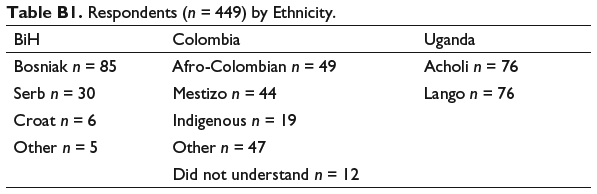
Another diversity-led priority was to address the fact that within each country, particular ethnic groups have received little attention, namely Serbs and Croats in BiH, Indigenous people in Colombia and Lango people in Uganda. The challenges of reaching some of these groups were substantial. In BiH, for example, nongovernmental organizations (NGOs) that work with victims-/survivors of conflict-related sexual violence committed during the Bosnian war overwhelmingly work with Bosniak women. This makes it extremely difficult to gain access to individuals from other ethnic groups, particularly given the general lack of cooperation between NGOs in the BiH Federation and Republika Srpska (the country’s two entities). Even though some ethnic groups are underrepresented in the sample, the overall result is a unique dataset that captures some of the complex ethnic dimensions of the conflicts in each country (see Table B.1).
Achieving diversity meant applying the study questionnaire in multiple locations in all three countries. In BiH, questionnaires were completed in seven of the ten cantons within the BiH Federation, in twelve different locations in Republika Srpska, and in two locations in Brčko District (a self-governing administrative unit). In Colombia, the application of the questionnaire covered 18 different departments, including Bolívar in the Caribbean region, Putumayo in the Amazon region, and Antioquia in the Andean region. In northern Uganda, research participants were located in 12 different districts in the Acholi and Lango sub-regions, including Gulu, Pader, and Oyam. Decisions about where to apply the study questionnaire were influenced by four key considerations: security issues (particularly in Colombia); achieving a balance between urban and rural locations; the clustering of conflict-related sexual violence cases in particular areas; and on-the-ground resources (in the sense of the logistical support that the in-country organizations could offer).
The age of participants ranged from 18 to 80 years. On average, the participants from BiH were older overall (M = 55), compared to those in Colombia (M = 42) and Uganda (M = 40). Part of the explanation for these age variations lies in the conflicts themselves. The majority of the Bosnian participants suffered sexual violence in 1992, the first year of the Bosnian war. In contrast, the very protracted nature of the armed conflict in Colombia, extending over more than 50 years, meant that Colombian participants’ experiences of sexual violence had a much greater temporal spread. In Uganda, some of the participants were very young when they suffered conflict-related sexual violence; they were abducted as children and forcibly recruited into Joseph Kony’s rebel Lord’s Resistance Army.
Ethics Issues
The study necessarily raises many complex ethics issues, and the process of securing ethics approval from the host institution, the research funder, and relevant authorities in BiH, Colombia, and Uganda took many months. Issues that needed to be comprehensively addressed included informed consent, confidentiality, incidental findings, potential re-traumatization of research participants, data storage, data transfer, and fair benefit sharing. It is beyond the scope of this article to cover all of these. However, it is important to stress that the guidelines of the World Health Organization (WHO) on researching violence against women—which underline the four key principles of respect for persons, maleficence (minimizing harm), beneficence (maximizing benefits), and justice (Ellsberg & Heise, 2005, p. 36)—were closely followed. The guidelines state, inter alia, that “In the case of adult women, there is consensus among most researchers that the principles of autonomy and confidentiality should prevail and that researchers should do everything within their power to avoid usurping a woman’s right to make autonomous decisions about her life” (Ellsberg & Heise, 2005, p. 37). Participants were made aware during the informed consent process that all of the data they provided would be treated as strictly confidential and that confidentiality would only be breached in exceptional circumstances, namely if the researchers felt that an individual was at risk of serious harm. Confidentiality was only breached on one occasion (and with the participant’s consent); this particular participant had talked about wanting to harm herself. No names were used in the research and the questionnaire did not contain any identifying information; only the participants’ unique ID numbers (consisting of the initials of the country, the initials of the person/organization that administered the questionnaire and the number of the questionnaire) were recorded. The researchers used laptops with full disk encryption and all of the research materials were uploaded as encrypted files (including by the in-country organizations) onto the University of Birmingham’s extremely secure BEAR DataShare system.
The aforementioned WHO guidelines also state that “At a minimum…researchers have an ethical obligation to provide a respondent with information or services that can help her situation. In areas where specific violence-related services are available, research teams have developed detailed directories that interviewers can use to make referrals” (Ellsberg & Heise, 2005, p. 40). All participants were provided with a participant information booklet with names and contact details of relevant local organizations and potential sources of support. All participants, after completing a questionnaire, received a follow-up telephone call a few days later, in many cases from a psychologist from the nearest in-country organization. Those who needed it were offered support by the organization or, in some cases, were referred to external sources of support.
Participants were not paid for their involvement in the study; this might have unduly influenced their decision to take part in it, thus compromising the informed consent process. However, travel expenses were reimbursed and those who had traveled longer distances (this was sometimes necessary in Colombia for security reasons) were given lunch/refreshments.
Measures
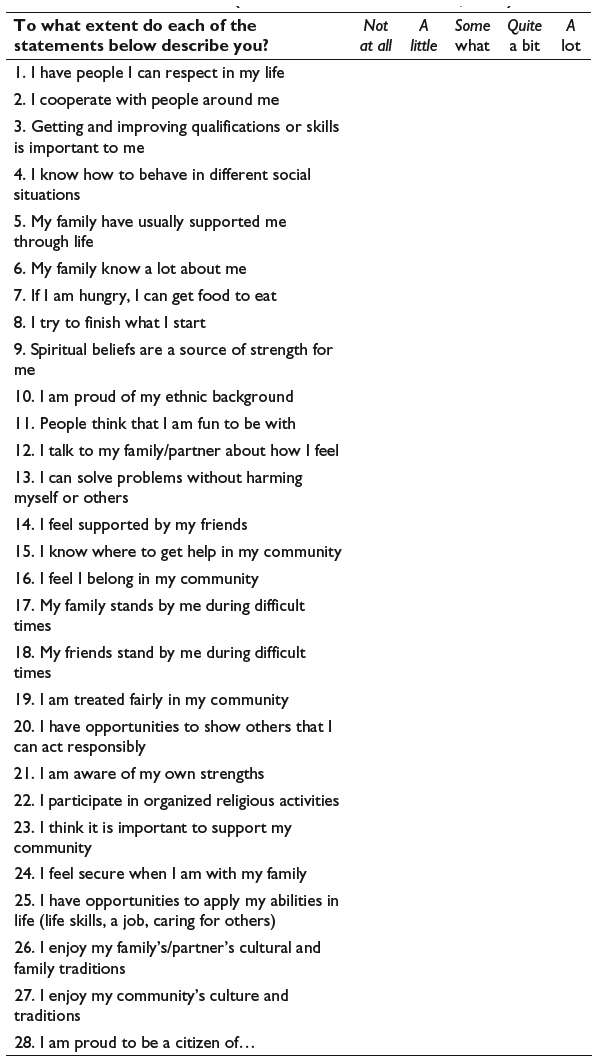
In addition to sociodemographic questions including age, ethnicity, marital status, number of children, education, place of residence (e.g., city, town, village), and employment status, the study questionnaire consisted of several measures broadly addressing risk variables and indicators of well-being, the piloting and validation of which are discussed below. Of particular significance was the aforementioned ARM (α = .77-.95, May-Chahal et al., 2012; Liebenberg & Moore, 2018), which asks respondents to rate the extent to which they agree with 28 items using a 5-point scale (1 = “Not at all,” 2 = “A little,” 3 = “Somewhat,” 4 = “Quite a bit,” 5 = “A lot”). These items include “My family have usually supported me through life” and “I know where to get help in my community” (for all of the scales used, see Appendix C).
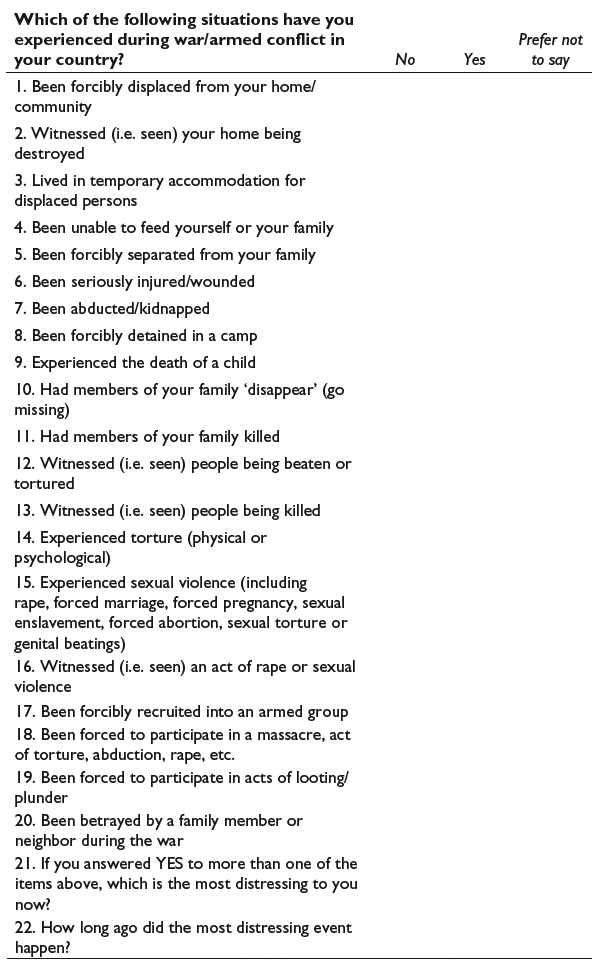
We also used a Traumatic Events Checklist (TEC). Different versions of such checklists exist, including the Traumatic Experiences Checklist (Nijenhuis et al., 2002), the War Experiences Checklist (Amone-P’Olak et al., 2007), and the Gaza Traumatic Events Checklist (Thabet et al., 2009). To gain an overview of participants’ distressing experiences (which extended beyond conflict-related sexual violence), the research team developed their own TEC based on knowledge of the three conflicts and the first author’s work in BiH spanning more than 10 years. Specifically, 20 potentially traumatic situations—relevant to all three countries—were read out to participants and they were asked to indicate “No,” “Yes” or “Prefer not to say” to each one. The situations included “Been forcibly displaced from your home/community,” “Been seriously injured/wounded” and “Had members of your family killed” (score range 0-20). The items in the TEC specifically related to war/armed conflict. However, they necessarily covered different temporal periods, reflecting the aforementioned fact that the duration of the conflicts in BiH, Colombia and Uganda varied significantly (three years in BiH [1992-1995); more than five decades in Colombia [starting in 1964]; and two decades in Uganda [1986-2006]).
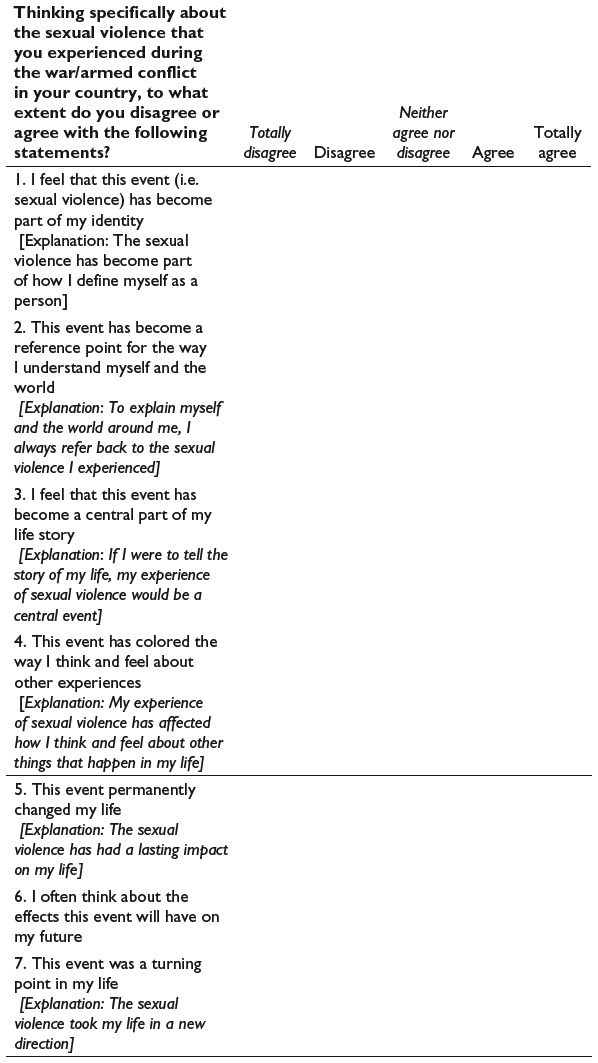
Participants also completed the seven-item short-form Centrality of Event Scale (CES; Berntsen & Rubin, 2006, p. 220), which measures “the extent to which a memory for a stressful event forms a reference point for personal identity and for the attribution of meaning to other experiences in a person’s life.” Substantial positive correlations between high centralizing and PTSD symptoms have been found (Berntsen & Rubin, 2006, p. 220). Although, to reiterate, participants had experienced multiple distressing events, we used the CES to capture the centrality of the experience/s of conflict-related sexual violence in participants’ lives (e.g., “I feel that this event has become part of my identity” and “I feel that this event has become a central part of my life story”). Scores ranged from 7 to 35.
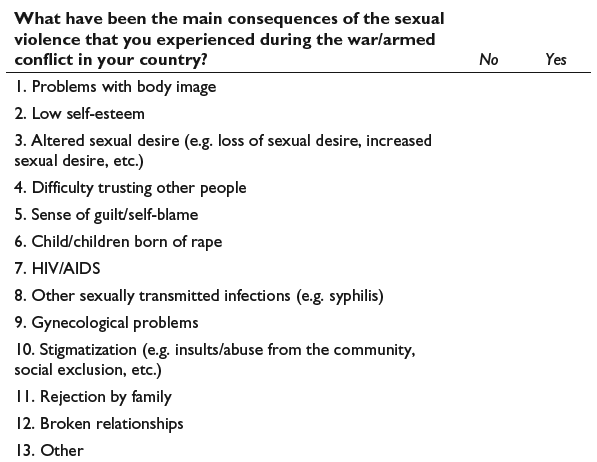
Participants also completed a 12-item Consequences of Sexual Violence scale, the development of which was informed by the first author’s previous research (2017) on the long-term consequences of conflict-related sexual violence. Using yes/no responses, participants were asked about the impact of the sexual violence that they had experienced, including difficulties trusting other people, broken relationships, and low self-esteem. Scores ranged from 0 to 12 and higher scores indicated a greater number of consequences.
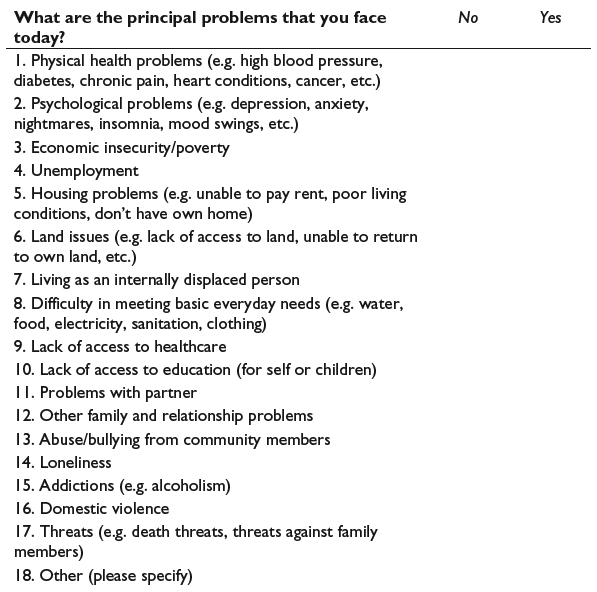
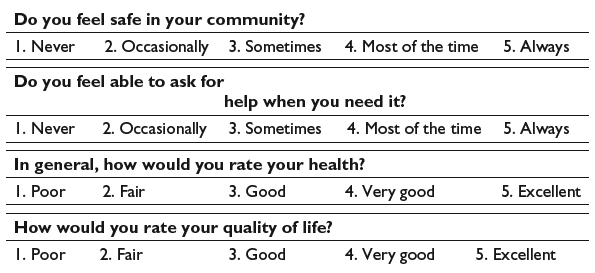
In addition, participants responded yes/no to 18 items reflecting current life problems, for example experiencing economic insecurity, loneliness, and domestic violence (drawn from researcher knowledge of the different country contexts). Four further questions, using a 5-point scale, enquired about an individual’s quality of life (QoL), their perceived health, how safe they felt in their community, and how able they felt to ask for help. Higher scores indicated more positive perceptions. Concepts such as QoL are necessarily complex, particularly in a cross-cultural context, and several validated scales exist, including the Quality of Life Scale (Flanagan, 1982) and the Quality of Life Inventory (Frisch et al., 1992). Indeed, Gill and Feinstein (1994, p. 624) maintain that “Since the 1970s, the measurement of quality of life has grown from a small cottage industry to a large academic enterprise.” One of the priorities, however, was to ensure that the questionnaire did not become overly lengthy and take participants away from their everyday activities for longer than necessary. We therefore used a single item for measuring QoL (as well as health), following the example of some other studies (see, e.g., Siebens et al., 2015; Wasson, 2019). Bowling (2005, p. 343) points out that “It has been proposed that concepts such as health status, QoL and HRQoL [health related QoL], when used as outcome variables, are more appropriately measured with a global single item. This is because multi-domain measures confound the dimensionality of these concepts with the multiplicity of their causal sources.” Using a single measure was additionally important for capturing the fact that “QOL can also be negative” (Kemp, 1999, p. 159); and thus for exploring how low and high QoL scores correlated with other variables.
Translating the study questionnaire into the relevant local languages (Bosnian/Croatian/Serbian, Spanish, and the Acholi and Lango dialects of the Luo language) was a crucial part of the research process. Van Ommeren et al. (1999) note that “One sequence, popular in the field, has been developed by Brislin (1976, p. 287). He suggested a five-step translation process: (a) translation; (b) blind back-translation; (c) examination of original, translation and blind back-translation; (d) pilot study; and (e) examination of pilot study data and subjects.” We similarly adopted this process. It is important to note that we were not simply aiming for what (Peña, 2007, p. 1256) has termed linguistic equivalence, meaning the very literal translation of English words into the local languages. This would have been too blunt, particularly in the case of Uganda. Discussing the challenges of research translation from English to Luo, and using the example of compound words such as firewood, sawdust, and household, Omona and Groce (2021) note that “Some of them had meanings that had nothing to do with the individual words involved.” The Luo language also uses many metaphors. During the piloting of the questionnaire in Uganda, for example, one of the participants—referring to his desire to have some psychological support—talked about “putting a warm cloth on the wounded place.” In the case of all three countries, thus, a key aim was to ensure that the translation made sense in the particular cultural context. In this regard, (Peña, 2007, p. 1258) talks about “cultural equivalence” that “focuses more centrally on the way members of different cultural and linguistic groups view or interpret the underlying meaning of an item.” It is for this reason that multiple people (including from some of the in-country organizations) were involved in the translation process, in addition to professional translators.
Validation of the questionnaire occurred in two ways. First, it was shared with the aforementioned in-country organizations involved in the study, and they were invited to comment, inter alia, on the wording and ordering of the questions, the scales used, and anything that they felt was problematic or needed to be changed, including irrelevant items. Second, the questionnaire was piloted during research team visits to each country between January and April 2018. A total of 32 female and male victims-/survivors (11 in BiH, 10 in Colombia and 11 in Uganda) took part in the pilots, which were extremely useful in highlighting issues that needed to be addressed.
For example, two particular problems with the TEC emerged during the piloting. First, the use of the word “witnessed” (e.g., “Witnessed the destruction of your home or other people’s home”) caused some confusion; some participants interpreted it as meaning that they had “witnessed” in the sense of giving testimony in court. Second, the question “Other than the situations described above, has anything else ever happened to you that was very frightening, dangerous, or violent?” frequently elicited a long narrative (which could have been anticipated). For this reason, the question was removed from the post-pilot version of the questionnaire. Including it in the pilot version, however, was an important opportunity to ascertain whether the TEC items covered the full range of experiences that participants found distressing.
During the piloting process, it also quickly became apparent that parts of the CES, and especially the statement “This event has become a reference point for the way I understand myself and the world,” were not easily understandable to some of the participants. To address this, additional explanations were prepared for six of the seven statements in the scale (one of the statements did not require any further clarification). This was a way of ensuring that all participants would receive the same explanation if they did not understand a particular statement. These additional explanations were very effective and participants did not have any difficulties understanding them. For the above-mentioned statement, for example, the additional explanation used was “To explain myself and the world around me, I always refer back to the sexual violence I experienced.” Those who participated in the piloting of the questionnaire were also asked for their views on it, whether they would add or change anything and whether they found any parts of it difficult.
The first author, two postdoctoral researchers and the aforementioned in-country organizations applied both the pilot questionnaire and the final questionnaire. Two independent psychologists with experience of working with victims-/survivors of conflict-related sexual violence, in BiH and Colombia respectively, also conducted a small number of administrations. The sensitivity of the subject matter, the fact that some of the participants were illiterate and the need to mitigate the risk of possible low response rates meant that the questionnaires were read aloud rather than self-administered.
Analyses
The first aim of the study was to use CFA to gauge the conceptual and measurement equivalence of the ARM across sites. However, the traditional factor structure of the model resulted in a poor fit across the sites and led to the need to conduct exploratory factor analyses (EFA) for each one, to determine new factor structures. For further detail regarding the CFA and the use of the EFAs, see Appendix A.
Following identification of appropriate models for each country, we used Mann-Whitney U-tests and one-way analysis of variance (ANOVA; Kruskal-Wallis) to examine how individuals within each country compared in terms of their ARM factor scores based on sociodemographic and diversity variables, including their age, ethnicity, and education level. Given that male participants reflected only a small proportion of the total sample (for reasons discussed in the previous section), we repeated analyses with just the female participants and the results did not significantly change. Male participants were accordingly left in, both for diversity reasons and to retain a suitable level of power for the analyses.
We also compared scores on the emergent ARM factors with the key psychosocial variables measured in the questionnaire. Effect sizes (epsilon squared and Cohen’s d) are reported for all significant results and interpreted using thresholds (Cohen, 1992, 2013). All analyses were undertaken using Jamovi v1.6.3.0 (The Jamovi Project, 2020).
Results
BiH
In the BiH sample, the scree plot generated as part of the EFA indicated that models consisting of three to five factors were potentially suitable. Of these options, a four-factor model emerged as the most well-fitting solution (RMSEA = .06, [90% CI = .05-.08]) and the latent factors correlated appropriately. The items in the four-factor model reflected individual differences in: factor 1: Social and community relations; factor 2: Family support and relationships; factor 3: Cultural participation and belonging, and factor 4: Abilities and opportunities (Table B.2). Each of the items appeared to load distinctly onto a factor, aside from items 16, 25, and 27, which cross-loaded onto multiple factors. Items 16 and 27 loaded more strongly onto a single factor and so were not permitted to cross-load. However, given that item 25 (“I have opportunities to apply abilities in life”) loaded similarly onto factors 3 and 4, which may reflect an important interaction of individual engagement and contexts that provide opportunities, it was permitted to remain cross-loading on both factors.
As the distribution of scores within the factors was slightly negatively skewed (which is common for the measure; e.g., Borualogo & Jefferies, 2019), nonparametric tests were used to investigate potential differences between sociodemographic groups in terms of their factor scores. However, no significant differences were determined (Table B.3).
Associations between the emergent ARM factors and the psychosocial variables were examined (Table B.4). Social and community relations (factor 1) positively correlated with feelings of safety in the community and feeling able to ask for help (marginally with perceived QoL, p = .048). Family support and relationships (factor 2) negatively correlated with consequences of sexual violence and number of current problems, and positively correlated with feelings of safety in the community, feeling able to ask for help, and QoL (marginally with perceived health, p = .040). Interestingly, cultural participation and belonging (factor 3) was positively associated with traumatic events, feeling safe in the community, and feeling able to ask for help, but negatively correlated with current problems. Finally, abilities and opportunities (factor 4) positively correlated with feeling safe in the community and feeling able to ask for help.
Colombia
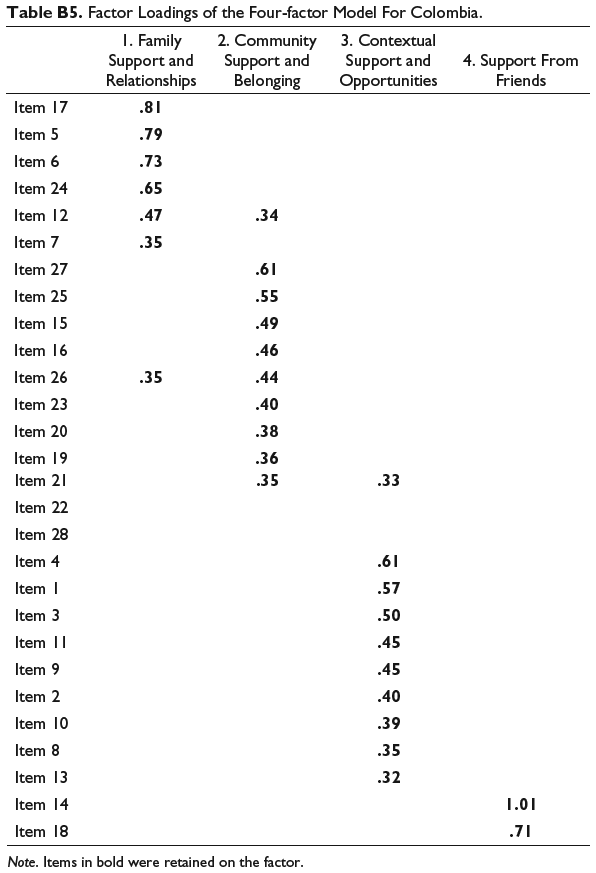
In the Colombian sample, the scree plot indicated that models consisting of three to six factors could be appropriate, but a four-factor model was the best-fitting model (RMSEA = .06, [90% C I= .05-.07]) and the factors also correlated appropriately. The items in this four-factor model appeared to cluster into the following: factor 1: Family support and relationships; factor 2: Community support and belonging; factor 3: Contextual support and opportunities; factor 4: Support from friends (Table B.5). Three items cross-loaded onto multiple factors (items 12, 21, and 26). Given the similarities in the magnitude of the loadings, as well as making contextual sense, the items were allowed to cross-load.
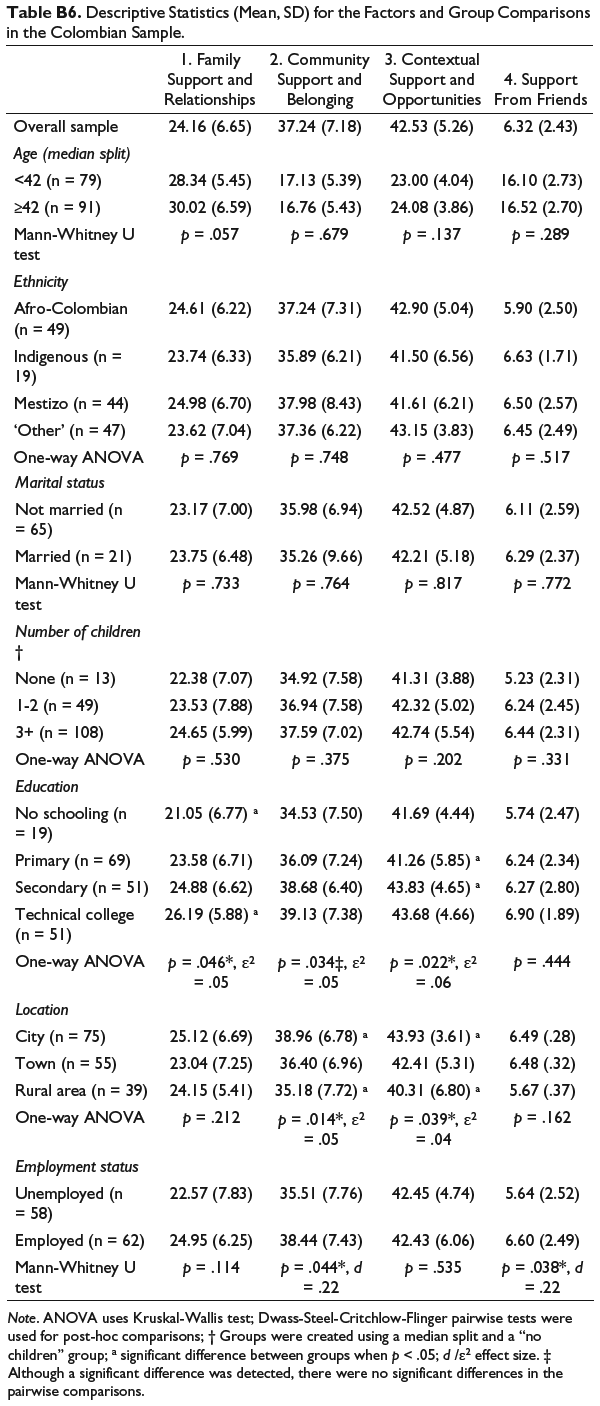
Scores on the emergent factors in the Colombian sample did not generally differ across the sociodemographic variables (Table B.6). That said, there was a modest but significant difference in family support and relationships according to level of education (p = .046, ε2 = .05). Specifically, pairwise comparisons indicated that those who had completed technical college (técnica professional) had significantly higher scores on the factor (M = 26.19, SD = 5.88) than those with no schooling (M = 21.05, SD = 6.77). There was a similarly modest difference in the contextual support and opportunities factor (p = .022, ε2 = .06) by education level, with higher scores for those with secondary school (M = 43.83, SD = 4.65) compared to those who had only completed primary school education (M = 41.26, SD = 5.85).
For both community support and belonging and contextual support and opportunities, participants who lived in cities reported significantly higher scores (M = 38.96, SD = 6.78; M = 43.93, SD = 3.61, respectively) compared to those in rural environments (M = 35.18, SD = 7.72; M = 40.31, SD = 6.80, respectively). Finally, employed participants reported significantly higher levels of community support and belonging (M = 35.51, SD = 7.76) and support from friends factors (M = 5.64, SD = 2.52, d =.22) than unemployed participants (M = 38.44, SD = 7.43, M = 6.60, SD = 2.49, respectively). Though modest (d = .22 and d = .22 respectively), these differences suggest that employment constitutes an important resource for managing economic stressors.
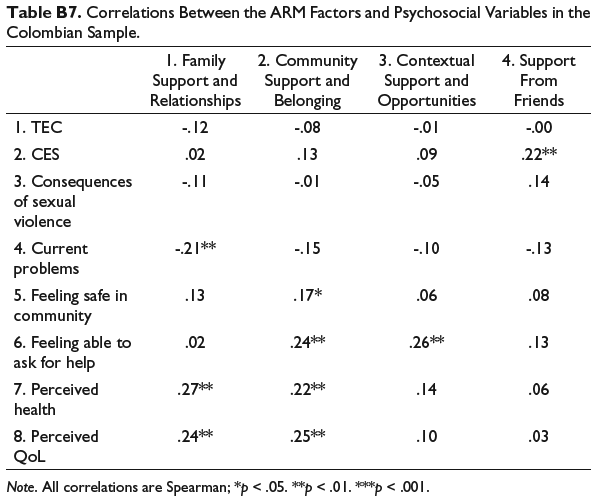
Individual differences in family support and relationships were negatively associated with current problems and positively associated with perceived health and QoL (Table B.7). Community support and belonging correlated positively not only with perceived health and QoL, but also with feeling safe in the community and feeling able to ask for help. Contextual support and opportunities was associated with feeling able to ask for help (p = .001), and, interestingly, support from friends was positively associated with CES scores.
Uganda
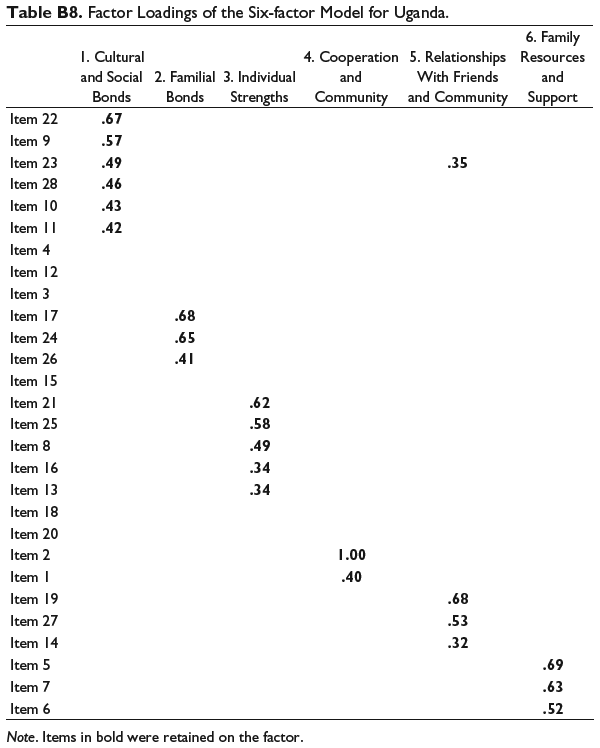
In the Uganda sample, the scree plot indicated that models consisting of three to six factors could be appropriate. Model fit estimates indicated that a six-factor model was the most appropriate solution (RMSEA = .05, [90% CI = .04-.07]) and the factors correlated appropriately. The items in this six-factor model reflected: factor 1: Cultural and social bonds; factor 2: Familial bonds; factor 3: Individual strengths; factor 4: Cooperation and community; factor 5: Relationships with friends and community; and factor 6: Family resources and support (Table B.8). Item 23 (“I think it is important to support my community”) cross-loaded onto factors 1 and 5, which is in line with their community nature.
There were modest but significant differences in individual strengths depending on the individual’s ethnicity (d = .28), with Acholi participants scoring higher (M = 20.07, SD = 3.81) than participants who identified as Lango (M = 18.47, SD = 2.94). However, the reverse was found for relationships with friends and community (d = .36); Lango participants scored significantly higher (M = 15.72, SD = 2.73) than those identifying as Acholi (M = 13.65, SD = 3.73; Table B.9).
Modest differences were found for familial bonds according to marital status (d = .28), with married participants having higher scores (M = 12.95, SD = 2.25) than unmarried participants (M = 11.44, SD = 3.14). There were also modest differences in cultural and social bonds (d = .25) and relationships with friends and community (d = .21) according to family size. Individuals with fewer than four children had higher scores (M = 27.08, SD = 2.79, M = 15.44, SD = 3.13 respectively) than those with four or more children (M = 25.55, SD = 3.86, M = 15.44, SD = 3.13, respectively).
Finally, modest but significant urban–rural contrasts were observed. For individual strengths, this difference (p = .034, ε2 = .05) indicated that individuals in cities had significantly higher scores (M = 20.61, SD = 3.62) than those in villages (M = 18.94, SD = 3.27). The reverse was true for relationships with friends and community (ε2 = .09) and family resources and support (ε2 = .11), with participants in cities having lower scores (M = 12.79, SD = 3.81; M = 7.88, SD = 2.86, respectively) than those in trading centers (M = 15.04, SD = 3.23; M = 10.26, SD = 2.98, respectively) and villages (M = 15.29, SD = 3.09; M = 10.19, SD = 2.65, respectively).
In terms of the psychosocial variables, both cultural and social bonds and relationships with friends and community positively correlated with CES scores. Relationships with friends and community, family resources and support, and familial bonds positively correlated with feeling able to ask for help. Familial bonds were also negatively associated with current problems, and positively associated with perceived QoL. Individual strengths were negatively correlated with consequences of sexual violence and current problems, but were positively associated with feeling safe in the community, perceived health and QoL. Cooperation and community scores positively correlated with feeling safe in the community (Table B.10).
Discussion
Our findings demonstrate that there can be significant differences—as well as some broad commonalities—on a measure of adult resilience between countries where populations share similar experiences of violence but come from very different cultures. In BiH, notwithstanding the legacy of the 1992-1995 war and the continuing constitutional division of the country along ethnic lines, the factor structure of the ARM reveals that social and community relations (factor 1) constitute a significant protective resource. It is interesting to note in this regard the positive correlation between social and community relations and feelings of safety, particularly as many of the participants were living in ethnically-mixed areas. That social and community relations also positively correlated with feeling able to ask for help and perceived QoL suggests that, at least in some areas, a multi-ethnic way of life persists (O’Loughlin, 2010). Cultural participation and belonging (factor 3), similarly, point to a deeper level of “resilience” within the sub-strata of Bosnian communities. In particular, factor 3’s positive correlations with TEC scores, feeling safe in the community, and feeling able to ask for help indicate the protective functioning of sociocultural dynamics.
Community was also very important in Colombia, but in a different way. Some of the participants were social leaders who, because of their activism, had faced death threats. That community support and belonging (factor 2) correlated with feeling safe in the community suggests that the work that these women did, notwithstanding the dangers (Reuters, 2020), was a protective factor in their lives in the sense of giving them a purpose. Further highlighting this, contextual support and opportunities (factor 3) enabled participants to ask for help, and in some cases they were asking not only for themselves but also for those who were part of their organizations. Higher scores with respect to both community support and belonging and contextual support and opportunities among participants in urban areas were unsurprising given that rural areas “have historically borne the brunt of the armed conflict in Colombia” (Rosas, 2018), in part due to weak state control.
In Uganda, the fact that three of the factors had a community dimension—cultural and social bonds (factor 1), cooperation and community (factor 4) and relationships with friends and community (factor 5)—attests to the fundamental significance of community in participants’ lives. Community was particularly important in providing a sense of safety, which is noteworthy given that some of the participants were living in border areas that continued to experience violent cattle raids from the Karamojong, a pastoralist group in northeast Uganda. The significantly higher scores among Lango participants compared to Acholi participants with respect to relationships with friends and community may be explained by the nature of the war in northern Uganda, which began in Acholiland and brutally tore apart families and communities, “[w]ith nearly the entire rural population of Acholiland displaced into internment camps” (Branch, 2007, p. 194).
The overall findings additionally point to the significance—and resilience—of families. Nelson (2003, p. 312) notes that “The role of the family in a traumatized society can be both a sanctuary of safety and protection for its members and an area of pain and destruction that parallels the horrors of the larger society that are projected onto the family system.” While the results from the TEC showed that participants’ distressing experiences frequently included their families (e.g., seeing a loved one being beaten), family support and relationships (factor 2) emerged as a key protective factor in BiH, further highlighted by its correlation with other items in the questionnaire, including QoL.
In Colombia, family support and relationships (factor 1) correlated negatively with current problems and positively with perceived health and QoL, suggesting that family was also an important protective resource within Colombian participants’ lives. The loading of item 12 (“I talk to my family/partner about how I feel”) onto factors 1 and 2, however, was consistent with the fact that during the application of the questionnaire, some of the participants raised questions about the meaning of “family,” which underscores the fluidity of the concept (Parry, 2005). Moreover, the long duration of the armed conflict in Colombia had taken a significant toll on families (although this was the case in all three countries). During the application of the aforementioned TEC, for example, 90 Colombian respondents said that they had experienced family members being “disappeared” (most commonly by paramilitary groups) and 113 said that members of their family had been killed. Potentially, therefore, the boundaries of “family” and “community” have somewhat blurred, with communities essentially stepping in and playing the role of a “family.” The cross-loading of item 26 (“I enjoy my family/partner’s cultural and family traditions”) onto factors 1 and 2 further supports this.
It is also noteworthy regarding Colombia that two of the items loaded to form a factor specifically about support from friends (factor 4). Because many of the Colombian participants were internally displaced, and were separated from or had lost their families, friends—including other victims-/survivors of conflict-related sexual violence—were an important protective resource for some of them. Support from friends positively correlated with CES scores, suggesting that the centrality of the sexual violence in participants’ lives created a need for them to turn to others (often in the context of women’s associations) who had gone through similar experiences.
That the Ugandan model has the largest number of factors partly reflects the complexity of social relationships, particularly evinced through notions of kinship—defined as “the social organization and cultural meanings of relatedness through descent and through marriage (affinity)” (Peters, 2019, p. 34). The fact that participants who were married scored slightly higher on familial bonds (factor 2) illustrates the importance of kinship. The existence of two family-related factors, familial bonds and family resources and support (factor 6), further points to the rich meanings and complex functioning of family in this context.
In BiH, the smallest number of items loaded onto abilities and opportunities (factor 4). This was unsurprising. More than 20 years after the war in BiH ended, a strong sense of apathy has set in, fueled by a perceived absence of significant change and progress, particularly vis-à-vis the political and economic situation (Bennoni & Ramović, 2020, p. 47). Alongside a macro level narrative of stagnation, however, positive correlations with feeling safe in the community and feeling able to ask for help point to important “movement” at the local level.
Indeed, this idea of movement emerges from all of the factor models in different ways, in the sense of drawing attention to the enabling dynamics of protective factors. This, in turn, illuminates a larger point. Policy discussions about conflict-related sexual violence often embrace a “deficit model” (Burstow, 2003, p. 1311), through a focus on victims-/survivors’ unmet needs, including for psychosocial support and healthcare. At the international level, the widespread emphasis on a “survivor-centered approach” to dealing with conflict-related sexual violence—a concept formally adopted by the United Nations Security Council (2019) as part of its Women, Peace and Security agenda—is fundamentally about putting the needs and priorities of victims-/survivors first (International Committee of the Red Cross, 2020).
Frequently overlooked within such discussions about conflict-related sexual violence, however, are the resources that victims-/survivors have in their daily lives. This research, because of its particular focus on resilience, offers something new in this regard. The different factor structures for each country bring to the fore diverse and varied clustering of protective resources. What they underscore, thus, is the need for policy interventions, including transitional justice interventions (Clark & Ungar, 2021), that not only address resource deficits but also, as a complementary approach, give attention to and invest in victims-/survivors’ resource structures, including family and community. The crucial point in this regard is that “centring” those who have suffered conflict-related sexual violence also means bringing to the forefront the social ecologies with which their lives are inextricably intertwined (Clark, 2021a).
Limitations
One of the main limitations of the study is sample size. While the total sample size was 449, we decided, based on the results of the CFA, that it made most sense to proceed on a country-by-country basis as opposed to combining the three datasets. There are divergent views of what constitutes an acceptable minimum sample size for EFA, but Worthington and Whittaker (2006, p. 817) point out that “In general, there is some agreement that larger sample sizes are likely to result in more stable correlations among variables and will result in greater replicability of EFA outcomes.” They also suggest that a minimum of 300 participants constitutes an adequate sample size (Worthington & Whittaker, 2006, p. 817). Nevertheless, some studies using EFA have had significantly fewer participants; Liebenberg and Moore’s (2006) study of survivors of Irish clerical institutional abuse, for example, included 105 participants. De Winter et al. (2009, p. 149), moreover, note that “it remains undefined how small a sample size can be and still yield acceptable solutions,” also underlining the important point that “EFA is indeterminate by nature, but so is the empirical world” (De Winter et al., 2009, p. 178). The larger point is that the relatively small size of each of the country samples means that the models are necessarily tentative. CFA would therefore be useful to validate each country model.
Particularly from a diversity perspective, a significant limitation is the small number of male participants. Certainly, the results cannot be automatically generalized to male participants at this time, but this would be an interesting avenue for further research.
A further limitation is that the scores for the TEC, CES, and current problems were based on summed totals. While this is not unusual (see, e.g., Heathcote & Simons, 2020), each item in these scales is a distinct issue that may affect people or relate to the factors in distinct ways. Hence, they are not necessarily equally interchangeable indicators of the variable in question, like trauma. This is one of the issues with such measures and future research could disaggregate them, for example by looking at the impact of specific types of potentially traumatic events or particular types of problems.
Finally, because the dataset was cross-sectional, it was not possible to ascertain the direction of effects. For example, does having stronger familial bonds lead to fewer current problems, or does having fewer current problems allow people to focus on nurturing familial bonds, or does it work both ways? The fact that the data form part of a broader mixed methods study means that the qualitative data can partly help to address such issues (see, e.g., Clark, 2021a). Additionally, longitudinal research could add further clarity (see, e.g., Weziak-Bialowolska et al., 2020).
Conclusion
Notwithstanding an expansive body of literature on resilience and a similarly large body of scholarship addressing the issue of conflict-related sexual violence, neither one to date has given much attention to the other. In seeking to address this gap, this research is the first to apply the ARM to victims-/survivors of conflict-related sexual violence. Based on both CFA and EFA, it has ultimately generated three different factor structures for BiH, Colombia, and Uganda, suggesting that a single factor structure does not sufficiently capture the diverse clustering of protective factors linked to the particularities of each country, including the dynamics of the conflicts themselves. While the sample size underscores the importance of further research, the results strongly support the need—particularly at the policy level—for greater attention to be given to victims-/survivors’ social ecologies and to the potential resources that they offer.
This, in turn, resonates with broader scholarship on resilience—and in particular social-ecological systems. This concept, referred to in the introduction, specifically recognizes and emphasizes interconnections between people and ecological systems (see, e.g., Folke et al., 2005, pp. 443-444; Cinner & Barnes, 2019, p. 51). In the context of conflict-related sexual violence, the relevance of the concept is that it provides a framework for thinking about the different ways that individuals’ ecologies can support and foster social processes that help victims-/survivors to rebuild and move on with their lives.
Appendix A: Confirmatory and Exploratory Factor Analyses
Confirmatory Factor Analysis (CFA)
Given that other studies employing the ARM have found varying factor structures (e.g., Arslan, 2015; Liebenberg & Moore, 2018), our first aim was to use CFA to assess the conceptual and measurement equivalence of the ARM factor structure across sites. To evaluate the CFA, we used a maximum likelihood estimator and evaluated model fit using the established criteria of a comparative fit index (CFI) and Tucker-Lewis Index (TLI) >.90 (Hu & Bentler, 1999) and a root mean square error of approximation (RMSEA) and standardized root mean square residual (SRMR) <.08 (Hu & Bentler, 1999).
An initial CFA applied to the entire dataset resulted in poor fit (CFI = .69, TLI = .66, RMSEA = .08 [90% = .07 -.08], SRMR = .08). When checking the fit per country, similar poor fit statistics were observed: BiH: CFI = .70, TLI = .67, RMSEA = .09, [90% CI = .08 -.10], SRMR = .10; Colombia: CFI = .69, TLI = .66, RMSEA = .09, [90% CI = .08 -.09], SRMR = .08; Uganda: CFI = .57, TLI = .53, RMSEA = .09, [90% CI = .08 -.10], SRMR = .09). Although reviewing the modification indices suggested some ways in which the model could be improved (by freeing parameters), these improvements still did not result in a model with adequate fit, suggesting the original three-factor structure of the ARM should be reconsidered.
Exploratory Factor Analysis (EFA)
We accordingly revisited the factor structure of the ARM through EFA to determine a better-fitting model. We chose to use EFA (rather than principal component analysis) to identify the underlying dimensions of the measure (for other examples of EFAs applied to the CYRM/ARM, see Robinson et al., 2016; Amini-Tehrani et al., 2020; Kaunda-Khangamwa et al., 2020). While similar to principal component analysis (PCA), EFA is widely considered as the appropriate approach when investigating the dimensionality of social and psychological constructs because, unlike PCA, it takes account of measurement error and shared variance (Brown, 2006).
Given the variation in the CFA fit statistics for each country sample, and the variation in factor structures when the ARM has been used in other countries (e.g., see Van Rensburg et al. 2017; Liebenberg & Moore, 2018), we determined that individual EFAs for each country would result in the most contextually appropriate solutions. For each country sample, Barlett’s Test of Sphericity produced a significant finding (p <.001), indicating interrelationships between the variables (Field, 2009), and a Kaiser-Meyer-Olkin test for sampling adequacy confirmed that values fell between .6 and 1.0 (Tabachnick & Fidell, 2006) (BiH = .77; Colombia = .77; Uganda = .73).
For the EFAs, we used a maximum likelihood extraction technique and an oblique rotation strategy (oblimin), given that others have found highly correlated factors in previous structural investigations of the CYRM and ARM (e.g., Liebenberg et al., 2012). To determine factor structure we used Comrey and Lee’s generally accepted thresholds for item loading values, where items loading ≥ .32 are considered the minimum values for loading. Items that cross-load (loadings ≥ .32 on two or more factors) can be managed in various ways (see Yong & Pearce, 2013). Some suggest that a minimum separation between factor loadings indicates how to manage an item (Matsunaga, 2010; Howard, 2016), while others retain cross-loading items regardless (e.g., Le & Cheong, 2010). We reviewed each cross-loading item to see if the loading separation suggested that an item could be dropped from a particular factor. However, we were also open to retaining cross-loading items, given that some of the items in the ARM were likely to relate to multiple dimensions of resilience.
We then used multiple criteria to assess and select an appropriate model; including examining scree plots and eigenvalues, RMSEA values <.08 (Hu & Bentler, 1999), ensuring factors correlated appropriately and also Henson and Roberts’ (2006, p. 399) “reasoned reflection” concerning sensible configurations of the items per factor in factor loading matrices. In sum, we sought a parsimonious model for each country that had good statistical properties and one that possessed relatively clear and distinct factors.
References
Appendix B: Tables
Respondents (n = 449) by Ethnicity.
Factor Loadings of the Four-factor Model for BiH.
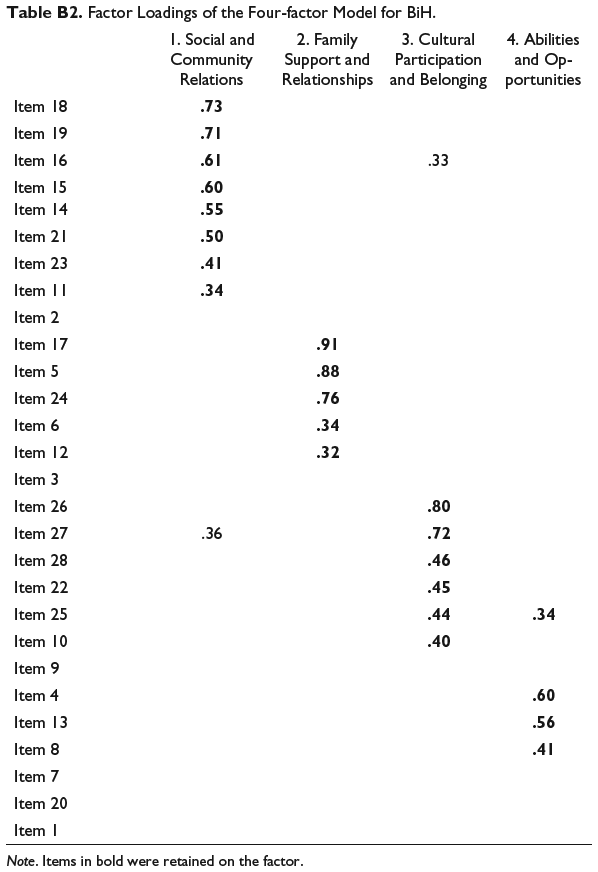
Note. Items in bold were retained on the factor.
Descriptive Statistics (Mean, SD) for the Factors and Group Comparisons in the BiH Sample.
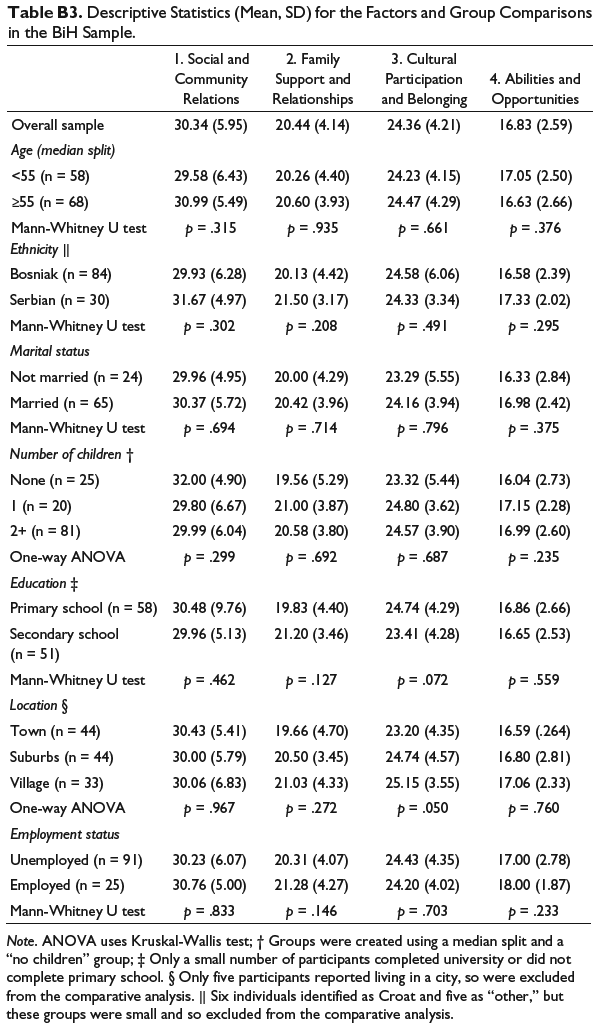
Note. ANOVA uses Kruskal-Wallis test; † Groups were created using a median split and a “no children” group; ‡ Only a small number of participants completed university or did not complete primary school. § Only five participants reported living in a city, so were excluded from the comparative analysis. ‖ Six individuals identified as Croat and five as “other,” but these groups were small and so excluded from the comparative analysis.
Correlations Between the ARM Factors and Psychosocial Variables in the BiH Sample.
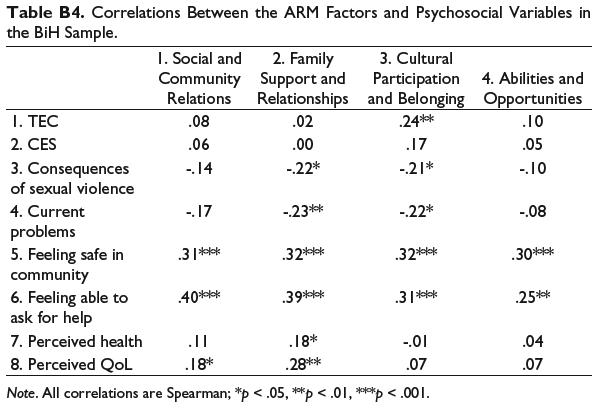
Note. All correlations are Spearman; *p < .05, **p < .01, ***p < .001.
Factor Loadings of the Four-factor Model For Colombia.
Note. Items in bold were retained on the factor.
Descriptive Statistics (Mean, SD) for the Factors and Group Comparisons in the Colombian Sample.
Note. ANOVA uses Kruskal-Wallis test; Dwass-Steel-Critchlow-Flinger pairwise tests were used for post-hoc comparisons; † Groups were created using a median split and a “no children” group; a significant difference between groups when p < .05; d /ε2 effect size. ‡ Although a significant difference was detected, there were no significant differences in the pairwise comparisons.
Correlations Between the ARM Factors and Psychosocial Variables in the Colombian Sample.
Note. All correlations are Spearman; *p < .05. **p < .01. ***p < .001.
Factor Loadings of the Six-factor Model for Uganda.
Note. Items in bold were retained on the factor.
Descriptive Statistics (Mean, SD) for the Factors and Group Comparisons in the Ugandan Sample.
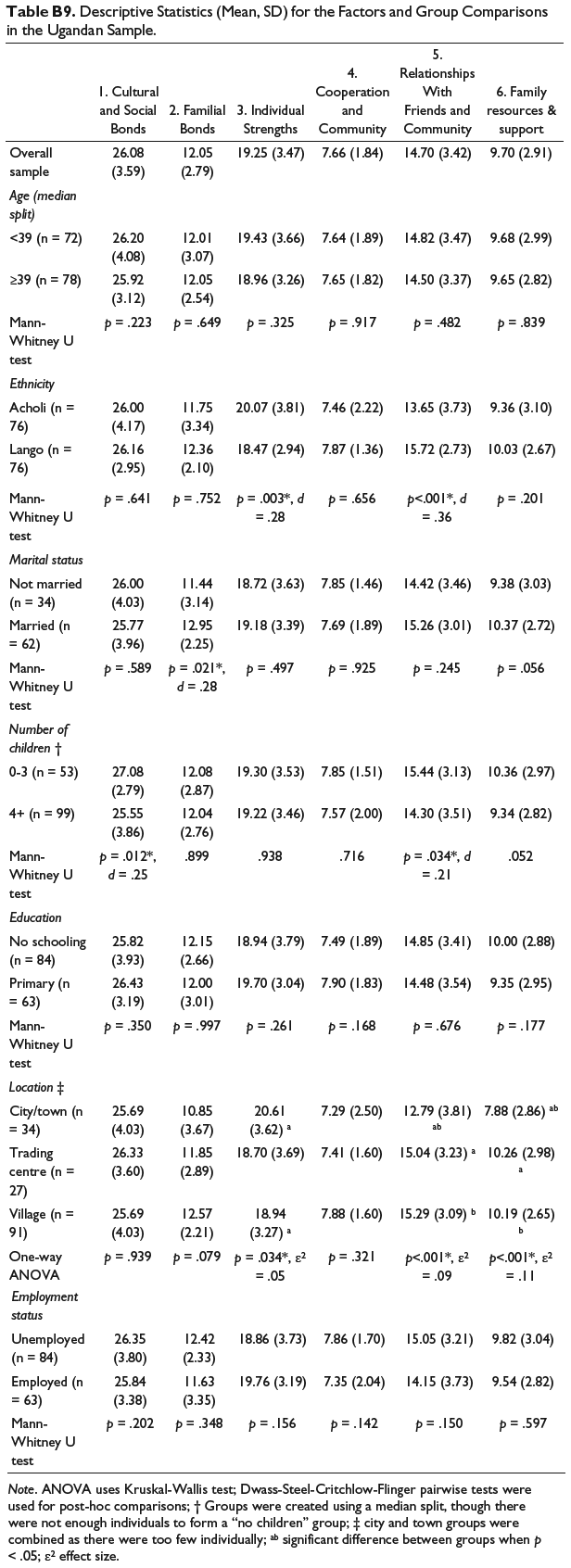
Note. ANOVA uses Kruskal-Wallis test; Dwass-Steel-Critchlow-Flinger pairwise tests were used for post-hoc comparisons; † Groups were created using a median split, though there were not enough individuals to form a “no children” group; ‡ city and town groups were combined as there were too few individually; ab significant difference between groups when p < .05; ε2 effect size.
Correlations Between the ARM Factors and Psychosocial Variables in the Ugandan Sample.
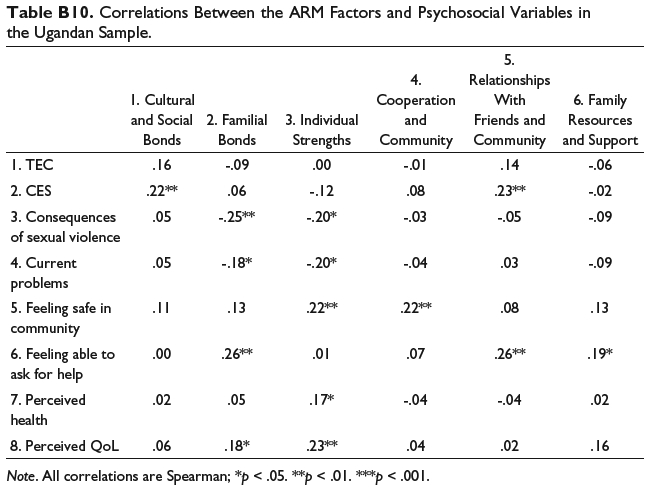
Note. All correlations are Spearman; *p < .05. **p < .01. ***p < .001.
Appendix C: Scales
References
Supplemental Material
Supplemental material for this article is available online.
Supplemental Material for Measuring Resilience in the Context of Conflict-Related Sexual Violence: A Novel Application of the Adult Resilience Measure (ARM) by Janine Natalya Clark, Philip Jefferies, Sarah Foley, and Michael Ungar, in Journal of Interpersonal Violence
Footnotes
Declaration of Conflicting Interests
Funding
The author(s) disclosed receipt of the following financial support for the research, authorship, and/or publication of this article: This research was supported by the European Research Council under grant number 724518.
Notes

Author Biographies
References
Supplementary Material
Please find the following supplemental material available below.
For Open Access articles published under a Creative Commons License, all supplemental material carries the same license as the article it is associated with.
For non-Open Access articles published, all supplemental material carries a non-exclusive license, and permission requests for re-use of supplemental material or any part of supplemental material shall be sent directly to the copyright owner as specified in the copyright notice associated with the article.
