



Abstract
Berntsen and Rubin’s Centrality of Event Scale (CES) has been used in many different studies. This interdisciplinary and exploratory article is the first to apply the scale and to analyse event centrality in the context of conflict-related sexual violence (CRSV). It draws on a research sample of 449 victims-/survivors of CRSV in Bosnia and Herzegovina (BiH), Colombia and Uganda. Existing research on event centrality has mainly focused on the concept’s relationship with post-traumatic stress disorder and/or post-traumatic growth. This article, in contrast, does something new, by examining associations between high event centrality, resilience, well-being and experienced consequences of CRSV, as well as ethnicity and leadership. Its analyses strongly accentuate crucial contextual dimensions of event centrality, in turn highlighting that the concept has wider implications for policy and interventions aimed at supporting those who have suffered CRSV. Ultimately, the article juxtaposes event centrality with a ‘survivor-centred approach’ to CRSV, using the former to argue for a reframing of the latter. This reframing means giving greater attention to the social ecologies (environments) that shape legacies of sexual violence in conflict.
Keywords
Introduction
Berntsen and Rubin’s (2006) Centrality of Event Scale (CES) measures the centrality of a stressful event in a person’s life. Greater centrality of traumatic memories has been found to positively correlate with symptoms of post-traumatic stress disorder (PTSD) (Berntsen and Rubin, 2006: 228; see also Boals and Ruggero, 2016; Gehrt et al., 2018). The concept of event centrality has been explored and discussed in a wide range of contexts (see, for example, Boelen, 2021; Cook et al., 2021; Glad et al., 2020; Mordeno et al., 2018). To our knowledge, this interdisciplinary and exploratory article is the first to apply the CES to victims-/survivors 1 of conflict-related sexual violence (CRSV). In this way, it makes an original contribution to extant literature on event centrality, as well as scholarship on CRSV.
Existing research on CRSV frequently uses single case studies (see, for example, Baaz and Stern, 2013; Mookherjee, 2015; Porter, 2017; Schulz, 2021; Skjelsbaek, 2012). This article adds an important comparative perspective. Drawing on a large quantitative sample (N = 449), it presents the results of applying the CES in three diverse countries – Bosnia and Herzegovina (BiH), Colombia and Uganda – that have all have faced high levels of CRSV, albeit different types, over different time scales. It uses the CES specifically to explore the centrality of research participants’ experiences of rape and/or other forms of CRSV, 2 and it thereby brings a new dimension to existing (and limited) scholarship on CRSV and meaning making (see, for example, Dolan et al., 2020; Gray et al., 2020).
More broadly, this research underlines that event centrality is more than just a psychological concept; it also has implications for policy and interventions aimed at supporting those who have suffered CRSV. To demonstrate this, the article juxtaposes event centrality with the idea of a ‘survivor-centred approach’ to dealing with and preventing CRSV – terminology that the United Nations (UN) Security Council (2019) officially adopted in the framework of its Women, Peace and Security agenda (Kirby and Shepherd, 2021; Thomson, 2019). To date, there has been little critical discussion of, or reflection on, the concept of a survivor-centred approach – and its limitations (Clark, 2021). What this research argues is that ‘centring’ victims-/survivors risks marginalising the social ecologies (Moletsane and Theron, 2017; Ungar, 2013a) that fundamentally shape their experiences, needs and priorities. Its analysis brings these social ecologies – meaning victims-/survivors’ environments and everything that they have around them (from family and community to non-governmental organisations (NGOs), institutions and the cultural and political landscape) – to the forefront. The article ultimately uses the concept of event centrality to propose a social-ecological reframing of survivor-centred discourse and approaches.
Researching event centrality
The wider context
There exists a rich corpus of literature addressing the issue of CRSV. Scholars have variously explored why such violence occurs (Baaz and Stern, 2009; Cohen and Nordås, 2014; Wood, 2016); the challenges of researching it (Boesten and Henry, 2018; Gordon, 2021; Schulz and Kreft, 2021); its potential effects on physical and mental health (Ba and Bhopal, 2017; Bouvier, 2014; Pruitt, 2012); the importance and complexities of prosecuting it (Brammertz and Jarvis, 2016; De Brouwer, 2015; Martin and SáCouto, 2020); and the frequent neglect of male victims-/survivors (Grey and Shepherd, 2013; Njoku and Dery, 2021; Schulz, 2018).
This article is primarily interested in the salience and meaning that victims-/survivors attach to their experiences of CRSV – and how their social ecologies shape this process. Dolan et al. (2020) maintain that due to the ‘deeply established’ framing of sexual violence in conflict as a weapon of war, such violence ‘appears as already somehow known and understood, thus foreclosing, or at least deflecting, critical enquiry into survivors’ lived experiences and the ways in which they attempt to make sense of them’ (p. 1,153). However, this states the case too strongly. First, while the ‘weapon of war’ framing remains highly influential at the international policy level, it has also been challenged. Scholars have argued, inter alia, that it presents CRSV as exceptional (Boesten, 2017: 507) and thereby detracts from important continuities of violence that extend across the boundaries of war and ‘peace’ (Baaz and Stern, 2013; Davies and True, 2015; Gray, 2019; Kirby, 2013; Motlafi, 2018; Stallone, 2021).
Second, some scholars have addressed, directly or indirectly, different ways that victims-/survivors seek to make sense of their experiences. In her research with displaced African female victims-/survivors of CRSV now living in New York City, for example, Akinsulure-Smith (2014) found that ‘Elements of religion and spirituality frequently offer a means of self-soothing, meditation, and meaning making’ (p. 686). Coulter’s (2009) work in Sierra Leone has examined how contextual factors shaped women’s stories and interpretations of CRSV, but also how ‘local moral imperatives’ (Coulter, 2009: 125) influenced the way that women dealt with their experiences in order to survive. In her research in Peru, similarly, Theidon has highlighted the wider social and narrative context in which women situated – and made sense of – their experiences of rape. The women, she explains,
detailed the preconditions that structured vulnerability and emphasized their efforts to minimize harm to themselves and to the people they cared for. With their insistence on context, women situated their experience of sexual violence – those episodes of brutal victimization – within womanly narratives of heroism (Theidon, 2013: 118).
Most recently, Kreft conducted interviews with representatives of civil society in Colombia, some of whom had themselves experienced sexual violence in conflict. As an important dimension of the women’s meaning making, they overwhelmingly viewed CRSV ‘as grounded in patriarchal structures that are deeply embedded in Colombian society’ (Kreft, 2020: 459).
While building on such research, this article approaches the issue of meaning making from a novel angle, through its focus on the concept of event centrality. Specifically, it uses Berntsen and Rubin’s CES to examine whether and to what extent the 449 research participants across BiH, Colombia and Uganda ‘centralised’ 3 their experiences of CRSV – and to analyse some of the wider social-ecological and contextual factors imbricated in event centrality.
The CES
Berntsen and Rubin (2006) developed:
a standardized scale measuring the extent to which a traumatic or stressful event forms a personal reference point for the attribution of meaning to other events, a salient turning point in the life story, and a central component of a person’s identity and self-understanding. (p. 223)
Sparking their curiosity in this regard was a conversation, years earlier, with a student who had been involved in a serious road traffic accident and who continued to struggle with the memory of what happened. For Berntsen and Rubin (2007: 417), this conversation raised important questions about the effects of making a negative event highly central to one’s identity and overall life story – and whether it was adaptive to do so. Their expectation was that high event centrality would positively correlate with PTSD and other related conditions, based on the logic that: ‘If memories of traumas and other highly negative life events form reference points for the organisation of less salient experiences in a person’s life, the outcome is likely to be harmful to that person’s mental health’ (Berntsen and Rubin, 2006: 220).
A total of 707 undergraduate students in four universities in North America completed the questionnaire that ultimately became the CES. The results revealed a positive correlation between a particular way of thinking and talking about stressful life events and symptoms of PTSD (Berntsen and Rubin, 2006: 228). Contrary to the view that traumatic memory reflects poor integration of the event (see, for example, Ehlers and Clark, 2000; Torsti, 1997), Berntsen and Rubin’s (2006: 228) research revealed the opposite; ‘The trauma has become too central to the cognitive organization of the life story and identity of the person’.
Just as much of the development of the CES occurred in the context of a privileged, high-income country population, many studies of event centrality using the CES have similarly focused on university (and particularly undergraduate) students (Bernard et al., 2015; Boals et al., 2010; Schuettler and Boals, 2011). Moreover, Gehrt et al.’s (2018: 18) review of the correlates of the CES, based on results from 92 publications, found that many of the studies relied on samples of university students in the United States or Europe. Roland et al. (2014) have argued that this reliance on undergraduate samples, and isolated stressors, underlines ‘a need for additional research on event centrality with samples of persons exposed to a greater severity of potentially traumatic events’ (p. 336). That others have similarly recognised this need is reflected in the fact that event centrality is increasingly being discussed in more diverse contexts involving different types and levels of trauma. Scholars have examined the concept, inter alia, in relation to victims of the 2011 Oslo bombing attack (Blix et al., 2014); children and grandchildren of Holocaust survivors (Greenblatt-Kimron et al., 2021); teachers facing everyday violence in El Salvador (Roland et al., 2014); internally displaced persons (Chukwuorji et al., 2017); and war veterans (Brown et al., 2010).
It is beyond the scope of this article to offer a comprehensive review of existing studies that use the CES. It is, however, important to mention some of the research that has been done on event centrality in the context of sexual and gender-based violence (SGBV). Robinaugh and McNally’s (2011) study, for example, focused on women (N = 102) who reported a history of childhood sexual abuse. The authors’ analyses revealed that high CES scores positively correlated with PTSD and severity of depression symptoms (and negatively correlated with self-esteem), leading them to conclude that high event centrality creates an increased risk for PTSD (Robinaugh and McNally, 2011: 486). Hamrick and Owens’ (2021: 166) research, based on a convenience sample of female sexual assault survivors (N = 253), also found positive correlations between event centrality and PTSD. Their study further established that even when the women showed higher levels of self-compassion, this did not alter the relationship between event centrality and distress. According to the authors, ‘It is possible that behaving in a compassionate manner towards the self is not strong enough to buffer against negative outcomes once a sexual assault experience has become highly centralized in one’s identity’ (Hamrick and Owens, 2021: 167).
In a longitudinal study over an 18 month period, Bakaitytė et al. (2022) explored the relationship between event centrality and post-traumatic growth (PTG)
4
in women (N = 217) who had experienced intimate partner violence (IPV) in Lithuania. At the start of the study, they found a positive relationship between higher levels of both event centrality and PTG (Bakaitytė et al., 2022: 1070). However, they also discovered that levels of event centrality did not affect PTG over the study period – potentially suggesting that ‘those women who recognize the IPV as core to their life story tend to develop PTG more immediately’ (Bakaitytė et al., 2022: 1070). Similarly focused on IPV, Webermann et al.’s (2020) study examined whether event centrality is a risk factor for the use of violence in intimate relationships, based on a sample of male perpetrators (N = 143). Of these, 89.0% reported at least one potentially traumatic event (PTE). The authors found that:
Participants who experience PTEs as a central turning point in their life narrative and a central feature in self-concept had higher levels of PTSS [post-traumatic stress syndrome], more relationship problems, and exhibited greater psychological aggression, emotional abuse, and physical assault. (Webermann et al., 2020: 205)
This article, to reiterate, is the first to utilise the CES in the context of CRSV. What also distinguishes it from existing research, including the above-mentioned studies on event centrality and SGBV, is that it is not specifically about the relationship between event centrality and PTSD and/or PTG (Boals et al., 2010; Boals and Ruggero, 2016; Fitzgerald et al., 2016; Groleau et al., 2013; Lancaster et al., 2013). The data on which this article draws were collected as part of a larger research study designed to explore some of the different ways that victims-/survivors of CRSV (and other frequently co-occurring forms of violence) demonstrate everyday resilience through their relationships and interactions with their social ecologies. To cite Ungar (2015), ‘resilience is predicted by both the capacity of individuals, and the capacity of their social and physical ecologies to facilitate their coping in culturally meaningful ways’ (p. 4).
There is little discussion of resilience within extant literature on CRSV (see, however, Koos, 2018; Mookherjee, 2021; Zraly et al., 2013). The concept also remains relatively under-explored within research on event centrality. 5 There are some exceptions, but these studies typically address resilience alongside PTSD and/or PTG and other psychological outcomes (e.g. Bakaitytė et al., 2021; Hamrick and Owens, 2021; Tranter et al., 2021; Wolfe and Ray, 2015).
In this research, we looked directly at the relationship between event centrality and resilience through analysis of the correlations between participants’ CES and resilience scores. The latter were based on the Adult Resilience Measure (ARM) (Resilience Research Centre, 2016), which is discussed in the next section. We also explored the relationship between resilience and event centrality more indirectly by analysing participants’ CES scores in relation to three other variables of interest – namely, number of PTEs experienced (as a way of assessing whether high levels of exposure to multiple and cumulative traumas affect CES scores); 6 well-being (as a dimension or outcome of resilience: Panter-Brick and Leckman, 2013; Ungar, 2008; Zautra et al., 2010); and consequences of sexual violence (as an example of potential and ongoing ‘risk exposures’: Liebenberg and Moore, 2018: 4). In addition, we used two variables – ethnicity and leadership – to look at some of the contextual and cultural dimensions of participants’ CES scores (see section ‘Measures’).
Event centrality, however, is not simply a quantitative issue to be measured through a research tool. It also raises important questions about context. Through its analyses of the country samples from BiH, Colombia and Uganda, this article reflects on some of the ways that participants’ social ecologies (environments) – including political, structural and cultural factors – were potentially implicated in event centrality. If this itself is an unexplored dimension of the phenomenon within extant scholarship, it also accentuates the larger point – which the final section develops – that application of the CES to the issue of CRSV has wider policy-related significance.
Methods
Participants
In total, 449 people (BiH N = 126, Colombia N =171, Uganda N = 152) participated in this research by completing a study questionnaire. All of them had suffered some form of CRSV, most commonly rape, but had also experienced many other PTEs, including forced displacement, detention in a camp and physical beatings (participants reported experiencing an average of 13.3 out of a list of 19 PTEs, not including directly experiencing CRSV). It is important to note that when answering the questions in the CES, respondents were asked specifically to focus on their experiences of CRSV. The rationale for this was twofold. First, as noted above, the research was undertaken in the framework of a study about CRSV. For the purposes of comparative analysis, moreover, it would not have been practical to apply the CES without asking participants to focus on one particular experience or set of experiences (some participants had suffered CRSV more than once). CRSV, however, was never assumed to be more traumatic than other types of violence. 7 This is important to underline in the context of Bourke’s (2012) comment that ‘from the 1970s sexual assault was widely agreed to be exceptionally traumatic’ (p. 31, emphasis in the original). It is an individual’s reaction to an event and the meaning, if any, that s/he attaches to it that are crucially determinative of its impact (Dawson, 2017: 84; Ganzevoort, 2008: 20). Such factors are shaped by the wider socio-political-cultural context, which is precisely what this article explores.
Second, the first author, based on previous fieldwork experience in BiH, anticipated that Bosnian participants – for reasons discussed in the final section – would have higher CES scores than participants in Colombia and Uganda. Hence, asking respondents to answer the questions in the CES with specific reference to their experiences of CRSV was important for analysing whether levels of event centrality did significantly vary between the three countries – and if so why.
Study participants ranged in age from 18 to 80 years old. In recognition of the fact that it is not only women who suffer CRSV (Edström and Dolan, 2019; Schulz, 2021; Sivakumaran, 2007), considerable efforts were made to include men. However, of the total 449 study participants, only 27 were male. This small number attests to the immense challenges of locating and gaining access to male victims-/survivors, which is linked to what Schulz (2020) has referred to as the ‘ubiquitous global inattentiveness of post-conflict processes to male sexual harms’ (p. 24).
Lists or databases of victims-/survivors of CRSV in BiH, Colombia and Uganda are not publicly available, for obvious reasons. It was necessary, therefore, to rely mainly on a convenience sampling strategy. This involved close collaboration with several in-country organisations 8 that played a vital role in the study by facilitating access to research participants. It is important to acknowledge that the involvement of these organisations potentially could have introduced a resilience bias into the overall sample. Individuals who were not in contact with any organisations and/or had never spoken about their experiences may have given very different answers. However, it is also necessary to emphasise that some of the participants were merely known to the organisations and were not in regular contact with them or in receipt of any direct support. Indeed, many of them had not received any help, particularly those living in remote areas of northern Uganda. In short, participants’ relationships with the in-country organisations were extremely varied.
We also used elements of purposive sampling to capture the diverse demographic profiles of victims-/survivors of CRSV in each country. One of the priorities was to establish contact with individuals who have been particularly affected by sexual and other forms of violence (e.g. Afro-Colombian and Indigenous women in Colombia: Sachseder, 2020; Santamaría et al., 2020), or whose experiences have been significantly overlooked within existing scholarship on CRSV (e.g. Serbs and Croats in BiH: Clark, 2017; Simić, 2018; Lango people in Uganda and male victims-/survivors in all three countries – see, however, Schulz, 2021). Although some of the numbers achieved were very small, the overall result was a highly original and unique data set that captured important ethnic dimensions of the conflicts in each country (see Table 1).
Sample characteristics.
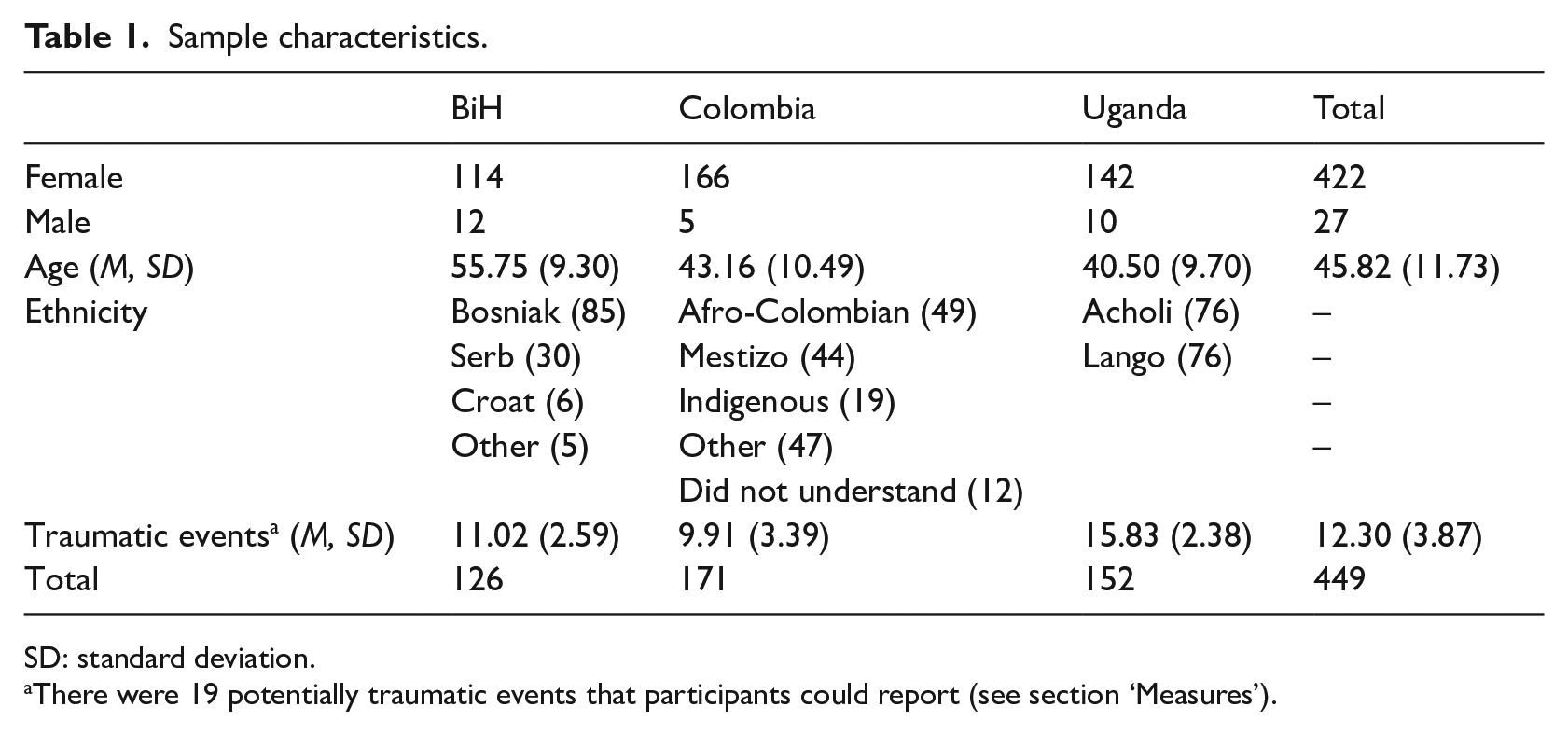
SD: standard deviation.
There were 19 potentially traumatic events that participants could report (see section ‘Measures’).
Measures
To avoid respondent fatigue, we used the shorter version of the CES (Berntsen and Rubin, 2006) and asked participants to answer the seven statements in the scale (1 = ‘Totally disagree’; 5 = ‘Totally agree’). These include ‘I feel that this event has become part of my identity’ and ‘This event was a turning point in my life’. In this study, the measure was found to have good internal reliability (α = 0.82, ω = 0.82). Although thresholds are not prescribed for the CES, the developers of the measure found that individuals meeting the criteria for PTSD on the Post-Traumatic Stress Disorder Checklist (Blanchard et al., 1996; Weathers et al., 1994) had an average CES score of 3.56 (SD = 0.80), while those below the threshold had an average score of 2.84 (SD = 0.89) (Berntsen and Rubin, 2006). These average scores give an indication of typical and problematic event centrality.
We used a demographic variable, ethnicity, to examine the potential role of socio-cultural factors in shaping event centrality. Participants were asked ‘What is your ethnic group’? 9 It is essential to point out in this regard that while there is some research on event centrality and culture in broad terms, in the sense of cross-country comparative studies (see, for example, Zaragoza Scherman et al., 2015, 2020), to our knowledge the relationship between event centrality and ethnicity has not been explored. We also included a leadership variable (we asked participants whether they held a leadership role in any organisations, including NGOs, political groups and trade unions), to examine different potential relationships with – and ‘uses’ of – event centrality.
To measure resilience, we used the aforementioned ARM (α = 0.77–0.95, Liebenberg and Moore, 2018; May-Chahal et al., 2012). As an extension of the earlier Child and Youth Resilience Measure (CYRM), which was developed through mixed methods research in 11 different countries (Ungar and Liebenberg, 2011: 128), the ARM was considered a suitable measure for this comparative study. The scale measures a person’s protective resources across three social-ecological levels – individual, relational and contextual – and consists of 28 statements (Resilience Research Centre, 2016). These statements include ‘Spiritual beliefs are a source of strength for me’ and ‘My family stands by me during difficult times’ (present study: α = 0.85, ω = 0.86). Answer options are based on a 5-point scale (1 = ‘Not at all’, 2 = ‘A little’, 3 = ‘Somewhat’, 4 = ‘Quite a bit’, 5 = ‘A lot’). In our previous work, we found that the existing factor structure of the ARM did not work equally well across BiH, Colombia and Uganda. We accordingly developed our own country-based factor structures – four for BiH, four for Colombia and six for Uganda (Clark et al., 2021) – and we analysed participants’ CES scores in relation to these different factors.
We used a Traumatic Events Checklist (TEC) to explore event centrality in the context of other PTEs that study participants might have experienced in the framework of war/armed conflict. Rather than using an existing checklist, the research team drew on knowledge of the three conflicts and the first author’s many years of work in BiH to develop a contextually tailored TEC. The scale consisted of 19 situations that were potentially applicable to participants in all three countries, including ‘Been forcibly separated from your family’, ‘Had members of your family killed’ and ‘Witnessed people being beaten or tortured’ (score range 0–19; α = 0.81, ω = 0.81). Participants could answer ‘No’, ‘Yes’ or ‘Prefer not to say’ to each statement.
To measure well-being, two items of the survey were combined. The first of these asked, ‘In general, how would you rate your health?’ The second item asked, ‘How would you rate your quality of life?’ Scores on both of these items were based on a 5-point Likert-type scale (from ‘Poor’ to ‘Excellent’) and were added together to provide a single score (2–10), with higher scores indicating better general well-being (α = 0.69, ω = 0.69).
Participants additionally completed a Consequences of Sexual Violence Scale, which consisted of 12 items informed by both existing scholarship and the first author’s previous work. In the form of ‘Yes’/‘No’ responses, participants were asked which of the consequences in the scale – including problems with body image, sense of guilt/self-blame and rejection by family – they had experienced. Higher scores (range 0–12) indicated a larger number of experienced consequences (α = 0.69, ω = 0.70). There are two main reasons why more positive items – such as increased sense of personal strength, new friendships and relationships, new life goals and community/social leadership work – were not included in the scale. First, the aim was to focus directly on consequences that are commonly associated with CRSV (see, for example, Kuwert et al., 2014; Østby et al., 2019; Woldetsadik et al., 2022), both in order to explore the prevalence of these consequences and to specifically analyse them in relation to resilience (a concept which, to reiterate, remains marginalised within scholarship on CRSV). Second, because the questionnaire was designed in the framework of a larger mixed methods study, it was considered more appropriate to allow some of the potential positive legacies of CRSV to organically emerge during the qualitative stage of the research (semi-structured interviews), rather than to specifically ask about these in a questionnaire. Although scholars have discussed some of the positive and transformative consequences that individuals may experience (and agentically help to create) following CRSV (see, for example, Clark, 2022a; Kreft, 2019; Mukamana and Brysiewicz, 2008), adding some of these consequences to the questionnaire would have felt somewhat contextually out of place. It might also have left some participants questioning themselves – and wondering whether they had done something wrong – if they had not experienced any of the listed positive consequences. 10
Process
The process of translating the study questionnaire into the local languages (Bosnian/Croatian/Serbian, Spanish and the Acholi and Lango dialects of the Luo language) was complex. As the translations needed to make cultural and contextual sense, the emphasis was placed on achieving ‘cultural equivalence’, which, according to Peña (2007), ‘focuses more centrally on the way members of different cultural and linguistic groups view or interpret the underlying meaning of an item’ (p. 1258). Hence, in addition to professional translators, several people (including from the in-country organisations) were involved in translating the study questionnaire, particularly in Uganda where some of the biggest translation issues arose.
A two-stage process was used to validate the questionnaire. First, the in-country organisations were asked to give feedback and to note any questions that they considered problematic or unclear, as well as any notable omissions. Second, the questionnaire was piloted in all three countries between January and April 2018. Thirty-two women and men (11 in both BiH and Uganda and 10 in Colombia) were involved in this process.
The 449 study participants completed the final (post-pilot) version of the questionnaire between May and December 2018. Due to the sensitivity of the subject matter and the concomitant high risk of low response rates, as well as literacy challenges among some participants, a self-administered questionnaire would not have been appropriate. Instead, a personal approach was adopted; questions were read out to each participant and his or her responses were noted. The first author, two researchers, staff (including psychologists and social workers) from the in-country organisations and three independent psychologists in BiH and Colombia were all involved in applying the study questionnaire. This was administered in multiple locations in each country.
The Humanities and Social Sciences Research Ethics Committee at the University of Birmingham, the research funder and relevant authorities in BiH, Colombia and Uganda all reviewed the study and granted ethics approval. Some of the many ethics issues that the study raised have been discussed in the first author’s previous work (see, for example, Clark, 2022a, 2022b). One document that particularly informed some of the decisions taken was the World Health Organization’s guidelines on researching violence against women. The guidelines accentuate four core principles, namely respect for persons, malfeasance (minimising harm), beneficence (maximising benefits) and justice (Ellsberg and Heise, 2005: 36).
Analyses
First, we explored scores on the CES by country, reviewing the descriptive statistics of the distribution to discover how participants in the three countries scored. We then used one-way analysis of variance (ANOVA) (Kruskal–Wallis, due to skewed distributions) to examine whether CES scores significantly differed between countries and between different ethnic groups within each country (where subgroups were sufficiently large to permit reliable analyses). The magnitude of any significant differences was interpreted using epsilon squared (ε2). Pairwise comparisons (Dwass–Steel–Critchlow–Fligner) were used to discover where any significant differences lay.
We proceeded to use Spearman rho correlation tests to determine whether statistically important associations would be found between CES scores and those for resilience, total traumatic events and well-being. Finally, to determine whether assuming a leadership role or the presence of specific consequences of sexual violence would be associated with significant differences in CES scores, Mann–Whitney U tests were employed. Rank biserial correlations (r) were used to report the magnitude of any differences. Analyses were conducted in jamovi v1.8.1.0 (The jamovi project, 2021).
Results
Analysis of CES scores indicated a relatively strong negative skew across all three countries, to the extent that a sizeable proportion of each country sample reported the maximum score (BiH = 15.7%, Colombia = 18.3% and Uganda = 6.8%) (see Figure 1). Moreover, in each country sample, the majority (over 75%) were above the level found in Berntsen and Rubin’s (2006: 226) study of individuals who meet the threshold for PTSD (M = 3.56; see Table 2). The scores were also above the averages reported in other studies where individuals were classified as having PTSD (see Brown et al., 2010; Da Silva et al., 2016; Rubin, 2011). We are not arguing, however, that all of the participants in our study had PTSD. This would be an overly rigid assertion that does not take sufficient account of the contextual aspects of event centrality and its significance. The larger point is that while our results indicate a strong degree of event centrality, this has potential consequences not only for mental health but also for resilience.
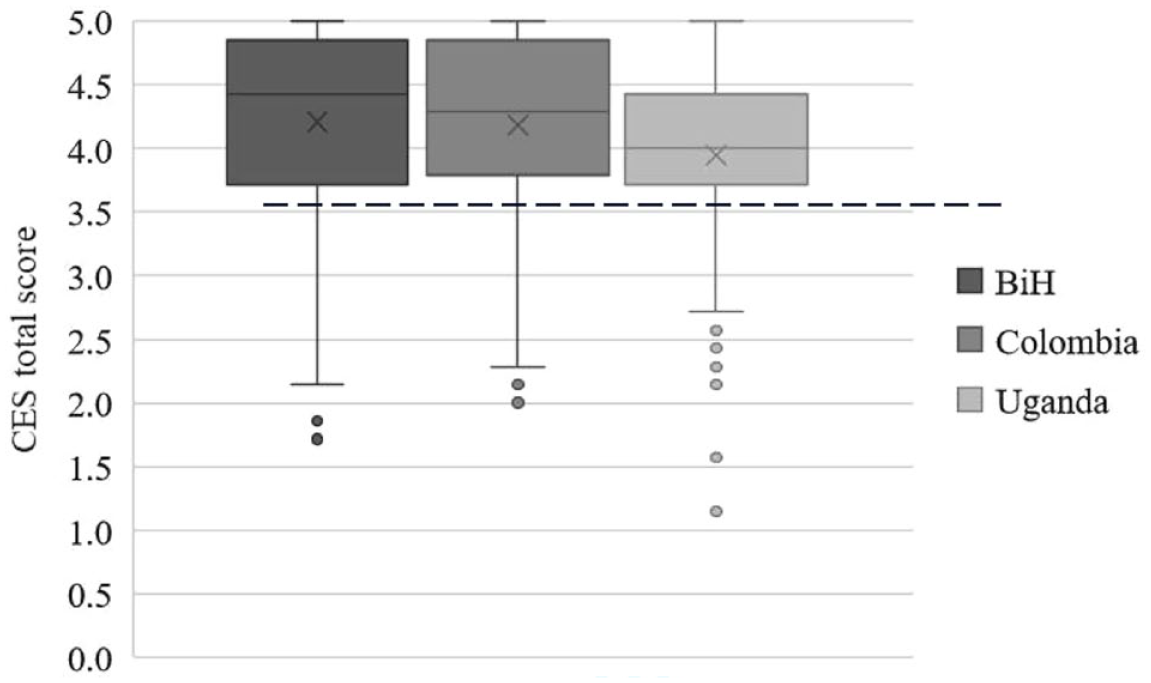
Distribution of CES scores by country.
Event centrality (CES scores) and relationships with other study variables.
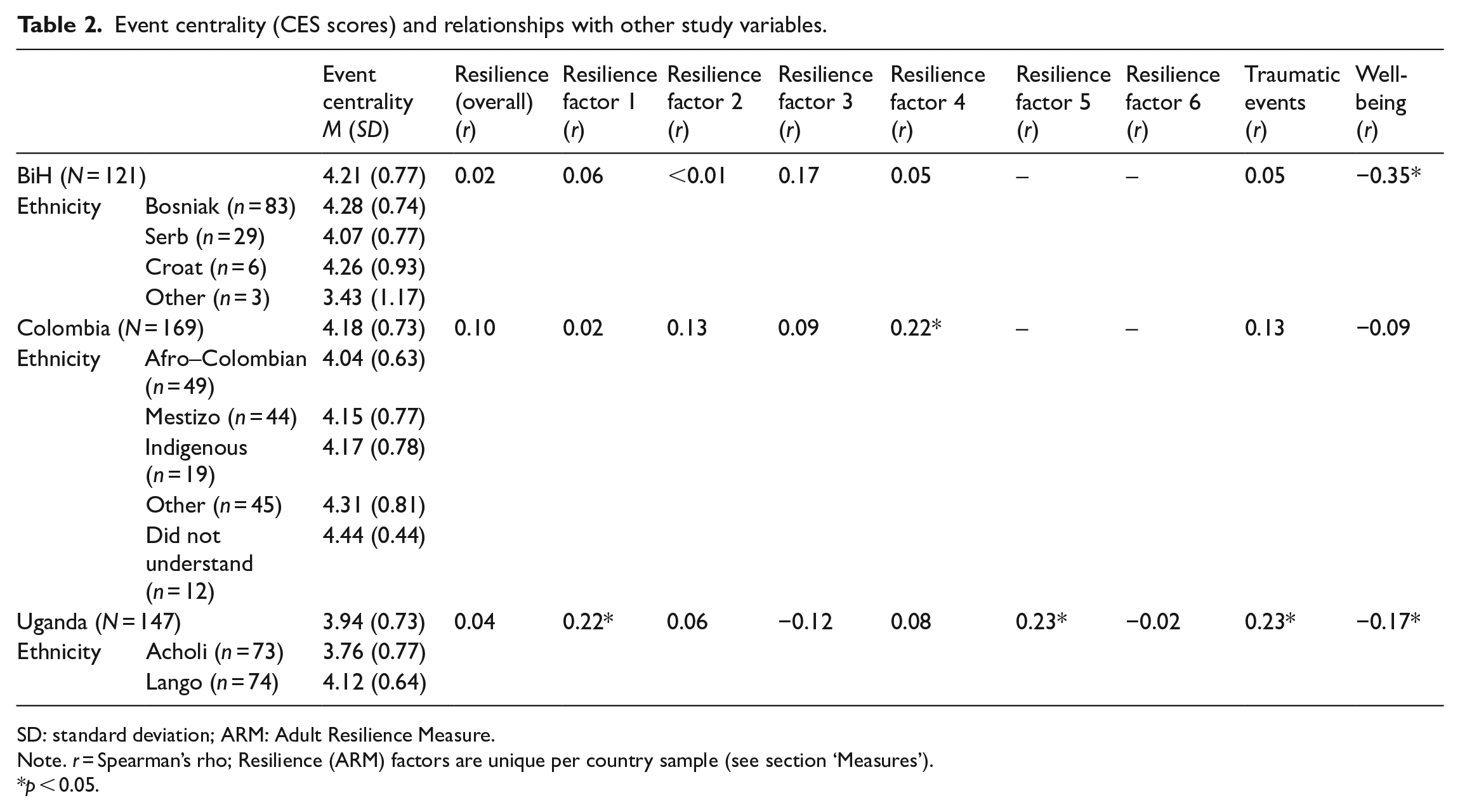
SD: standard deviation; ARM: Adult Resilience Measure.
Note. r = Spearman’s rho; Resilience (ARM) factors are unique per country sample (see section ‘Measures’).
p < 0.05.
The results of the one-way ANOVA indicated that CES scores strongly differed across the country samples (χ2 = 15.30, p < 0.001, ε2 = 0.04), with Dwass–Steel–Critchlow–Fligner pairwise comparisons indicating that significant differences (p = 0.001) could be found between BiH (M = 4.21, SD = 0.77) and Uganda (M = 3.94, SD = 0.73), and also between Colombia (M = 4.18, SD = 0.73) and Uganda (p = 0.004), but not between BiH and Colombia (see Table 2).
Regarding ethnicity, the ANOVA showed no significant differences between ethnic groups in the BiH sample (χ2 = 2.09, p = 0.149), but a difference was detected in the Colombian sample (χ2 = 6.63, p = 0.036, ε2 = 0.05), where Afro-Colombians had significantly lower CES scores (M = 4.04, SD = 0.63) than those who identified as ‘Other’ 11 (M = 4.31, SD = 0.81). A statistically significant difference was also detected in the Ugandan sample (χ2 = 9.93, p = 0.002, ε2 = 0.07), where Acholi participants had lower CES scores (M = 3.76, SD = 0.77) than those who identified as Lango (M = 4.12, SD = 0.64).
In terms of associations with other variables, no significant correlation was detected between CES and resilience (i.e. ARM) scores in any of the country samples (ps > 0.05; see Table 2). However, when examining the country-specific resilience factors that we identified from our previous analyses of the ARM, a significant positive association was observed in the Colombian sample between CES scores and factor 4 (support from friends; r = 0.22, p = 0.004). In Uganda, we found significant positive associations between CES scores and factor 1 (cultural and social bonds; r = 0.22, p = 0.009) and factor 5 (relationships with friends and community; r = 0.23, p = 0.005). CES scores were also significantly and positively associated with traumatic events, but only in the Ugandan sample (r = 0.23, p = 0.006). CES scores were significantly and negatively associated with well-being in the BiH (r = –0.35, p = 0.006) and Ugandan samples (r = –0.17, p = 0.035), but not in the Colombian sample (r = –0.09, p = 0.252).
CES scores were compared in terms of the presence of reported consequences of sexual violence (see Table 3). For some of the listed consequences, tests were not possible given low numbers (e.g. only six participants in Colombia did not report having trust issues). Significant differences in CES scores were associated with body image issues in the BiH (p = 0.001, rbs = 0.35) and Colombian samples (p = 0.020, rbs = 0.22), and with low self-esteem for all three samples (BiH: p < 0.001, rbs = 0.41; Colombia: p = 0.007, rbs = 0.40; Uganda: p = 0.002, rbs = 0.54). They were also associated with altered sexual desire in both the BiH (p = 0.032, rbs = 0.25) and Ugandan samples (p < 0.001, rbs = 0.41), with trust issues in the BiH sample (p = 0.033, rbs = 0.27) and with a sense of guilt in the BiH (p = 0.019, rbs = 0.26) and Colombian samples (p = 0.039, rbs = 0.18). In each instance, the presence of an issue was associated with a significantly higher CES score. In addition, having HIV (human immunodeficiency virus) was associated with higher CES scores in Uganda (p = 0.032, rbs = 0.22), as was the presence of other sexually transmitted infections (STIs) (p = 0.001, rbs = 0.31). Gynaecological issues were associated with higher CES scores in all three countries (BiH: p < 0.001, rbs = 0.39; Colombia: p = 0.030, rbs = 0.19; Uganda: p = 0.011, rbs = 0.25). Finally, CES scores were higher in those reporting damaged relationships in the BiH (p = 0.037, rbs = 0.28) and Colombian samples (p = 0.050, rbs = 0.17), and in those who were involved in leadership roles in the Colombian sample (p = 0.011, rbs = 0.23).
Consequences of sexual violence, having a leadership role and their relationship with event centrality (CES scores).
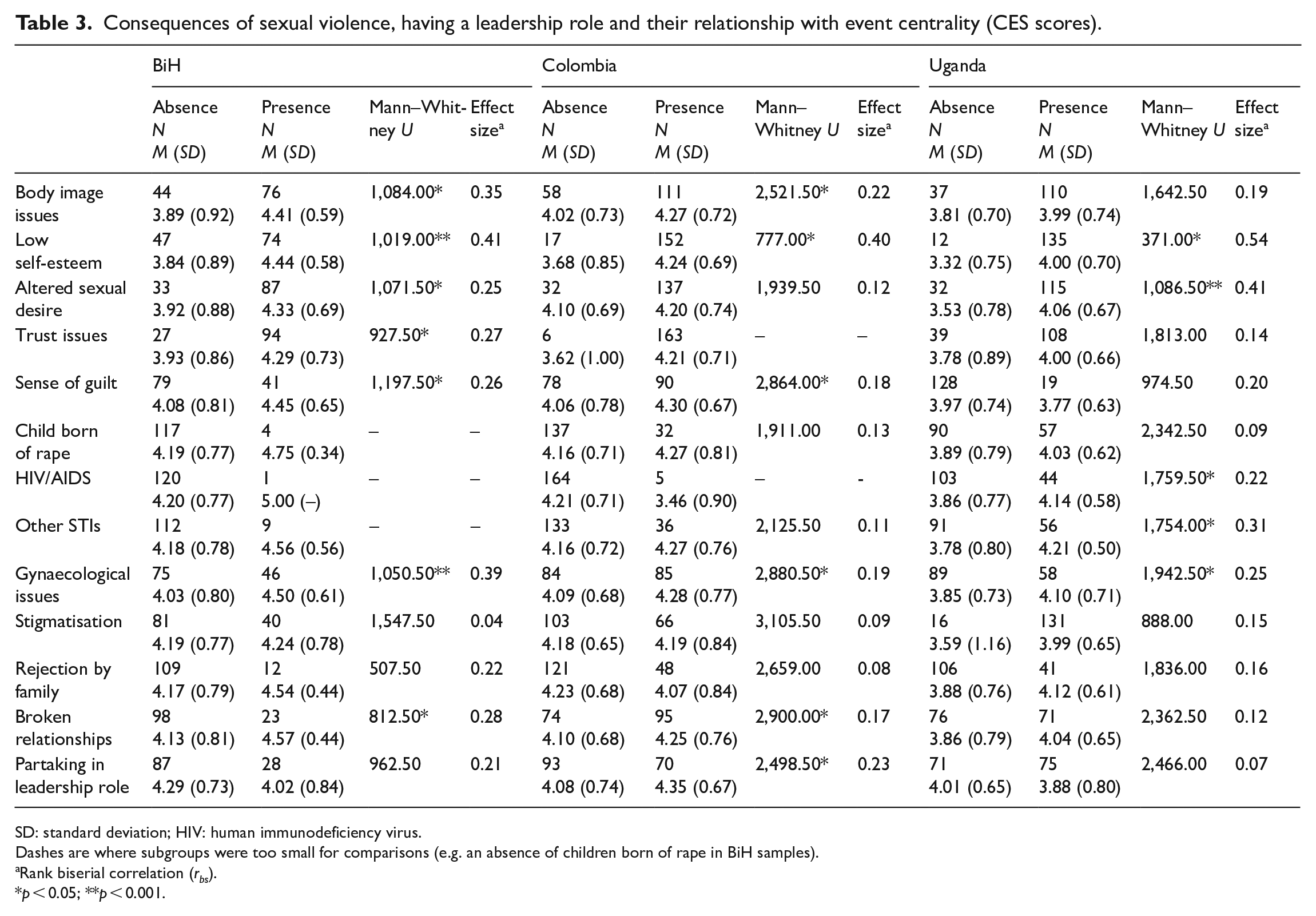
SD: standard deviation; HIV: human immunodeficiency virus.
Dashes are where subgroups were too small for comparisons (e.g. an absence of children born of rape in BiH samples).
Rank biserial correlation (rbs).
p < 0.05; **p < 0.001.
Discussion
While the CES itself has not been studied in relation to CRSV, existing research has examined and demonstrated some of the many ways that different types of sexual violence – and in different situations – affect victims-/survivors (see, for example, Akinsulure-Smith, 2014; Clark, 2017; Kelly et al., 2012; Tarzia, 2021). In other words, based on what we already know about some of the long-term consequences and legacies of sexual violence (whether during conflict or ‘peace’),
12
it is unsurprising that the data revealed high CES scores across all three countries. It is also not surprising that the majority of participants’ CES scores were higher than those in Berntsen and Rubin’s (2006) aforementioned study of 707 undergraduates in four North American universities. In that study, the authors themselves noted that:
Because many of our participants based their answers on stressful events that did not seem to satisfy the A1 [referring to the traumatic nature of the event itself] and A2 [referring to the reaction to that event] criterion for a trauma, future research should examine the relation between the CES and PTSD symptoms in clinical populations who fulfill the diagnostic criteria for traumas (Berntsen and Rubin, 2006: 227).
Many of the participants in this study would likely fulfil these criteria, although our aim is not to speculate in this regard. The larger point is that all of the participants in this research had experienced many PTEs, as Table 1 demonstrates. Specifically with respect to their experiences of CRSV, some participants had been raped and abused by multiple perpetrators – and sometimes in front of other people, including family members. 13 Some participants, moreover, and particularly those in Uganda, had suffered such violence when they were children. These ‘aggravating factors’ further help to explain participants’ high CES scores. The fact that there were also significant inter-country differences, however, gives important insights into the wider contexts of event centrality.
Explaining inter-country differences in CES scores
To explain why event centrality was higher in BiH and Colombia than in Uganda, and to reflect on where ethnicity and leadership might fit in, the following three points should be noted. First, the broader social and political environment in BiH arguably supports high event centrality vis-à-vis CRSV. There are several NGOs, mainly in the BiH Federation,
14
that work with women who suffered sexual violence during the 1992–1995 Bosnian war. These organisations secure funding, in part, for projects to support these women, focusing on the latter’s problems as a result of the sexual violence that they experienced (which assumes a simple cause–effect dialectic). NGO projects, and the donor priorities underpinning them, thus arguably contribute to keeping women’s experiences of CRSV very much at the forefront (see, for example, Clark, 2019: 254; Helms, 2003: 16). These women, moreover, are often publicly referred to as žene žrtve rata (women victims of war),
15
which is widely understood in the local context to mean women who were raped. Such discourse further maintains the focus on a particular aspect of the women’s identities (thus overlooking the many other PTEs that they experienced), limiting the space for them to be something other than ‘victims’ (a term that is used in BiH far more commonly than ‘survivors’) of sexual violence. In her own work in BiH, moreover, Močnik (2019) notes that:
What continuously emerged in workshops and group conversations was the ‘totalizing narrative of victimization’ (Simić, 2012: 133): Over the years, survivors have learned that this narrative is powerful and beneficial in attracting and engaging with representatives of various media and institutions (e.g. academic, humanitarian, political, etc.). (p. 467)
It does not follow from these examples, however, that the organisations supporting this research (and particularly those in BiH) had their own incentives to ‘centralise’ CRSV, thereby potentially affecting some of the participants’ answers. 16 It is essential to underline that none of these organisations work solely with victims-/survivors of CRSV – and indeed some of them do so in only a very peripheral way. Profamilia, for example, is a private organisation in Colombia that promotes respect for sexual and reproductive health rights. Some of the women who receive health services through its many clinics are victims-/survivors of CRSV, but they do not represent the totality of Profamilia’s clientele. It is also necessary to emphasise, to reiterate an earlier point, that although some of the research participants were in contact with the in-country organisations, this does not necessarily mean that they were in regular contact with them or that they had received/were receiving support. Furthermore, some of the participants were not in contact with any organisations and were reached via personal contacts (particularly in BiH) or suggestions from other participants.
Although event centrality was high among all participants in BiH and there were no significant correlations between CES scores and ethnicity, it is arguable that contextual factors help to explain high centrality scores among different ethnic groups. Bosniak (and female) victims-/survivors of CRSV have received far more attention, domestically and internationally, than their Serb (or Croat) counterparts. ‘As the war unfolded’, Berry (2017: 841) notes, ‘Bosniak nationalists created a victim hierarchy, endorsed by Western governments and media, with non-Serb “raped women” and widows or mothers from Srebrenica 17 at the top’. This hierarchy, moreover, has persisted. High event centrality among Bosniaks can thus be read, at least in part, as a phenomenon shaped by and linked to the wider sociopolitical environment. Conversely, high CES scores among Croats and (in particular) Serbs might be read as reflecting the political neglect of their experiences (see Simić, 2018: 4).
Second, what stood out in the Colombian sample is that participants who held leadership positions (typically as heads of women’s associations or social leaders within their communities) 18 had substantially higher CES scores than those who did not. This indicates that event centrality can be a factor that motivates leaders to fight for the rights of other victims-/survivors, including the members of their own associations. What this also highlights, thus, is that agency and resilience can exist alongside and entangled with – rather than set apart from – trauma and vulnerability (Yohani and Okeke-Ihejirika, 2018; Zulver, 2017). Indeed, exploring and demonstrating this was precisely one of the key reasons for designing and developing a large research study focused on resilience and victims-/survivors of CRSV. Relatedly, the relationship between leadership and high CES scores contributes to elucidating the fact that in Colombia, but not in BiH or Uganda, there was a positive correlation between event centrality and well-being. It is also important to situate and interpret high event centrality and its relationship to leadership in a broader historical and sociopolitical context of women’s activism in Colombia (Asher, 2007; Lizarazo, 2018; Rodriguez-Castro, 2021; Zulver, 2021). High event centrality can therefore be partly interpreted as reflecting political awareness – discussed in Kreft’s (2019, 2020) work on Colombia – of wider structural factors contributing to the persistent use of violence against women.
It is interesting, however, that Afro-Colombians had substantially lower CES scores than participants who simply identified as ‘Other’ and did not identify with any ethnic group. One possible explanation is that Afro-Colombian participants located their experiences within a very specific political-cultural context of structural racism and oppression – reflected in a long history of Black activism in Colombia (see Hernández Reyes, 2019) – making them less likely to focus on CRSV in isolation. Zulver (2018), for example, points out that:
In 2017, Colombia’s National Centre for Historical Memory released a report about the sexual violence that took place during the conflict, which highlights that the sexual violence suffered by Black women is part of a longer history of historical violence that has existed since the colonial era. (p. 378)
Third, context is also crucial for understanding why, compared to the Bosnian and Colombian participants, Ugandan participants had lower CES scores. They had overall experienced a greater number of traumatic events, as measured by the TEC, which might explain why they appeared to place less emphasis on their experiences of CRSV. At the same time, it was only in the Ugandan sample that CES scores were significantly and positively associated with traumatic events, suggesting a contextually specific enmeshment of participants’ sexual violence experiences with other traumatic war-related experiences. 19 The particular circumstances in which many of the Ugandan participants suffered CRSV are highly relevant in this regard. In both BiH and Colombia, participants were overwhelmingly civilians who were abused by armed groups. 20 In Uganda, however, many (although not all) of the participants – and especially Acholi participants – were formerly abducted children who were forcibly recruited into the Lord’s Resistance Army (LRA). The sexual violence that they had suffered was thus ‘experientially entangled’ (Stuart, 2016: 107) with this wider set of factors. This entanglement – reflected, for example, in the many projects that have been undertaken in post-war northern Uganda to help reintegrate former abductees and child soldiers – is an additional factor that helps to explain lower CES scores in Uganda, as well as lower CES scores among Acholi participants compared to Lango participants.
Event centrality, resilience and other variables
Turning now to the relationship between event centrality and resilience, as measured by the ARM, it was unsurprising that there were no significant correlations between participants’ ARM and CES scores when we treated the ARM as a single variable. Such an approach is arguably too blunt and does not sufficiently capture the complexity of resilience, reflected in the fact that the ARM itself consists of three sub-scales. Indeed, and as noted earlier, our previous analyses revealed that the original factor structure of the ARM did not work equally well across BiH, Colombia and Uganda. When we looked at CES scores in relation to the ARM factors that we previously generated through exploratory factor analysis, however, some interesting correlations did emerge. In Colombia, for example, we found a significant relationship between CES scores and support from friends. One might have reasonably expected a negative relationship between these two variables – meaning that more support from friends would result in lower CES scores. That the relationship was positive, however, makes sense given that many of the Colombian participants were involved in women’s (and women-led) organisations and had formed close relationships with fellow members. 21 What they articulated was a strong sense of solidarity, based on common and shared experiences (Zulver, 2017: 1508). In this regard, event centrality contributed to fostering new friendships. At the same time, having the support of other victims-/survivors of CRSV helped some participants to directly confront what they had gone through.
In Uganda, we found significant correlations between participants’ CES scores and particular ARM factors, notably cultural and social bonds, as well as relationships with friends and community. The broad cultural context does not encourage event centrality with respect to CRSV (see, for example, Bamidele, 2017: 77; Porter, 2017: 15), in part due to the social stigma attached to such violence (see Kiconco and Nthakomwa, 2022). Nevertheless, the positive relationship between CES scores and protective factors that enable resilience indicates that those who exhibit high event centrality are more likely to actively seek out sources of support within their social ecologies. It also indicates that having such support enables a more open and direct confrontation with the past. The fact, however, that CES scores were significantly and negatively associated with well-being in the Ugandan sample (as in the BiH sample) suggests that social support did not mediate this relationship. This is contrary to the findings of some other studies exploring the impact of social support on event centrality (see Brener et al., 2020).
Finally, as regards the relationship between CES scores and consequences of sexual violence, there were significant correlations in BiH, Colombia and Uganda. Two points are especially important to note. The first is that in all three countries, positive correlations existed between event centrality and gynaecological issues. This is a powerful finding because it shows that while event centrality is most often treated primarily as a psychological phenomenon within extant scholarship, it also has physical dimensions. In short, sexual violence can create long-term corporeal memories that linger in the body (see, for example, Culbertson, 1995; Minge, 2007), thus potentially fuelling event centrality. The positive correlation between CES scores and both HIV/AIDS and other STIs in the Ugandan sample further illustrates this. So too do the positive correlations in the BiH and Colombian samples between event centrality and body image issues, and between event centrality and altered sexual desire in the BiH and Ugandan samples.
The second point is that while participants in all three countries self-reported negative social consequences due to CRSV, namely stigmatisation, rejection by family and broken relationships, the data revealed significant positive correlations only between event centrality and broken relationships (which in some cases were linked to stigma) – and only in BiH and Colombia. This finding is important because it suggests that while context, as this section has consistently underlined, is crucial for understanding event centrality, it is also necessary to think about context in the sense of both proximate and distal social-ecological factors. More broadly, it illustrates the need to think in multi-causal terms about event centrality – which underscores that the latter is not necessarily something negative (see Broadbridge, 2018). Like resilience itself, event centrality is an expression of complex and intersecting individual and social-ecological dynamics. For this reason, and as this section has demonstrated, event centrality can be a ‘double edge sword’, in the sense that it can allow ‘for both debilitation and growth’ (Boals and Schuettler, 2011: 821; see also Barton et al., 2013).
The contextual dimensions of event centrality that this article has underlined have wider implications, in turn, for interventions aimed at supporting those who have suffered CRSV. At the international policy level, the prevalent discourse of a ‘survivor-centred approach’ to CRSV, referred to in the article’s introduction, accentuates the individual needs and priorities of those who have suffered such violence. What this article’s analysis of event centrality has demonstrated, however, is that wider contextual and social-ecological factors critically influence how individuals deal with their experiences of CRSV and, by extension, their needs and priorities related to those experiences. Ultimately, the complexities and nuances of event centrality support the case for a social-ecological reframing of ‘survivor centredness’ that gives greater attention to how the legacies of CRSV are ‘shaped by and within webs of relationships that are in a continuous process of negotiation and reconstitution’ (Aijazi and Baines, 2017: 465). Not only, therefore, are there important linkages between event centrality and resilience. The contextual dynamics of event centrality make prominent victims-/survivors’ social ecologies in ways that potentiate new approaches to dealing with CRSV which could themselves contribute to building resilience.
Limitations
Three particular limitations of this research must be acknowledged. First, as previously noted, the CES measures whether an event, or series of events, has become a reference point (or anchor point), a core component of personal identity and a perceived turning point in an individual’s life story (Berntsen and Rubin, 2006: 223). Because we used the seven-item version of the CES rather than the 20-item version, for reasons explained, we could not disaggregate the CES by examining how particular variables in our questionnaire correlated with these three elements. This would have been something novel to explore and could have provided deeper insights into the functioning of event centrality in diverse contexts.
Second, participants were specifically asked to focus on their experiences of CRSV when answering the CES items. Although this made sense in the context of the broader research study, in some ways it also required participants to artificially isolate a specific experience (or set of experiences) from a wider composite of PTEs. As noted in the previous section, some of the findings powerfully attest to the reality of deeply intermeshed and intersecting experiences that perhaps cannot be easily disentangled from each other. Moreover, the very fact of asking participants to focus only on one particular experience/set of experiences potentially risks treating these individuals first and foremost simply as victims-/survivors of CRSV (Stallone, 2021) – something that this research expressly aimed not to do – thus compressing other aspects of their identities.
Third, the significant correlations that emerged from the data did not tell us anything about the causal direction of these relationships. Hence, it is not clear in the context of this study whether event centrality is primarily a cause or a consequence – or, most likely, a mixture of both. In this regard, and because there is no previous research looking at event centrality and CRSV, this research represents a preliminary study on which it is hoped that other scholars will build.
Conclusion
This article has discussed the concept of event centrality, as an expression of meaning making, in the context of CRSV. Using a comparative case study design focused on BiH, Colombia and Uganda, it has provided unique insights into some of the complex cultural and contextual dimensions of event centrality, why it occurs and the purposes that it serves. Moreover, rather than examining the concept specifically in relation to either PTSD and/or PTG, as other studies have done (including studies on event centrality and SGBV), it has explored event centrality vis-à-vis resilience, traumatic events, well-being and consequences of CRSV, while also incorporating ethnicity and leadership variables. In so doing, it has sought to demonstrate that studying event centrality can facilitate deeper insights into the complexities of CRSV and its consequence for victims-/survivors.
The article posits a direct relationship between two ‘centring’ concepts, event centrality and a ‘survivor-centred approach’ to CRSV, in the sense of utilising its analyses of the former to argue for a social-ecological framing of the latter. This means thinking beyond just victims-/survivors themselves and locating their experiences, and the myriad legacies of these experiences, within an ‘entangled shared living’ (Haraway, 2016: 39) that reflects the multiple relational threads between individuals and their wider environments. These relational threads, in turn, can reveal complex patterns of resilience that support access to the psychological and sociological processes that diverse populations employ to deal with violent pasts.
Footnotes
Acknowledgements
The author(s) disclosed receipt of the following financial support for the research, authorship, and/or publication of this article: This research was supported by the European Research Council under the Horizon 2020 programme (grant number 724518).