




Abstract
The “Troubles” in Northern Ireland are often assumed to represent an outlier in respect of contemporary global discourse on conflict-related violence against women (CRVAW), and particularly “strategic rape.” CRVAW has neither commanded the narrative nor imagery of that conflict nor specifically recognized globally as part of women's experiences of it. A composite and comprehensive analysis of CRVAW for that context has been absent. Based on primary and secondary research, and analytically advanced through gender and critical harm theory, the article presents the first typology of CRVAW for the Northern Ireland Troubles. The article maps and evidences a range of gendered harms directly and indirectly resulting from the conflict enacted by state and nonstate actors. It argues that a resurfacing of gender is required to ensure current global debates on CRVAW are informed by a reconsideration of what constitutes “strategic” harm in armed conflict.
I didn't think that my wife would be
Unfaithful, I always thought that she
Would play the game, but when they
Let me out of the Long Kesh Prison
I’ll make her wish she’d never heard
my name.
We kneel in adoration before effigies of stone
Our eyes turned to heaven blind to what's going on
Six women hold a naked woman pinned down on the floor
Without trial or jury, like a prisoner of war
Though the rain it made the colours run, the message it was plain
Women are being strip searched in Armagh and Brixton Jail
Introduction
The quotes at the top of this article come from songs produced during the era of the conflict in Northern Ireland known as the “Troubles” (Moore, 1987; UDA, 1974). The songs convey a number of messages about women's experiences of that conflict: both make a clear pronouncement that women were subjected to violence by state and nonstate actors in the events unfolding in that conflict; both comparably articulate a character and quality to that violence—harms occurring within and across private spaces of the home and public institutions of the state; and taken together, the songs indicate a potential range of conflict-related violence against women (CRVAW) 1 impacting women and girls across Republican and Unionist communities, all of which signals its presence as a feature of the Northern Ireland Troubles.
Yet, Northern Ireland is not the first place that comes to mind or has ever really featured in global research, discourse, or policy on CRVAW. It is not the typified context for which understanding of conflict-related sexual violence, in particular, has been advanced (Eriksson Baaz & Stern, 2013; O’Rourke & Swaine, 2017; Pierson, 2019). 2 The conflation of strategic political violence targeted at women with the “rape as a weapon of war” framing that has become globally predominant, has in turn prompted assumptions that comparatively, CRVAW of equal gravity did not occur for that jurisdiction (O’Rourke & Swaine, 2017). Such assumptions overlook the realities of the multifarious ways that conflict-related gendered harm may occur outside of “strategic rape” (Swaine, 2015), how harm is subjectively experienced by women, and whether and how harm may be understood in the context of broader actions of conflict protagonists. The reduction of women's experiences of armed conflict to mass sexualized violence and strategic rape misses why and how “strategicness” (Eriksson Baaz & Stern, 2013) might be determined in different ways, how it might vary across and within conflict contexts, and indeed what it is that might make violence of any kind “strategic.” It further occludes the growing evidence that it may be “the violence people don't see” (Fitzpatrick, 2013, p. 180) that has most affected women in the Northern Ireland Troubles and remains unseen in the evolving understanding of that conflict. A range of factors have contributed to this: a disregard for gender as an analytical lens has promulgated the masculinist study and understanding of the Troubles and its violence (Coulter, 1999); the silencing and exclusion of women and their experiences have characterized processes dealing with the past (O’Rourke & Swaine, 2017); prevalent gendered harms have been delinked from conflict violence through, for example, the normalization of intimate partner violence (IPV) by conflict actors (McWilliams & Ní Aoláin, 2013); and localized questioning and misgivings over whether context-specific harms comparatively stack up against globalized normative and “classic” (read: mass sexual violence) definitions of “conflict-related” violence that takes place “elsewhere” feature in women's own understanding of their experiences of the conflict (Swaine, 2018). However, through the very ways that the conflict took place, women experienced and continue to experience a broad range of harms directly and indirectly related to that conflict (Swaine, 2018). There has been little of the formal “social recognition” (Conaghan, 2002, p. 322) required for those harms to be defined as anything other than normalized (Levitt, 1995), negating their relation to the conflict and entrenching assumptions that CRVAW did not occur (O’Rourke & Swaine, 2017). CRVAW has neither commanded the narrative nor imagery of that conflict, nor specifically recognized as part of women's experiences of it. The conflict in Northern Ireland has been assumed to represent an outlier in respect of the contemporary global discourse on CRVAW, and particularly with respect to current debates on conflict-related sexualized violence.
There are thereby two dualistic and synergistic motivations underpinning this article. The first is to present evidence and generate debate on the range of CRVAW for the Troubles in Northern Ireland. A composite and comprehensive analysis of CRVAW for that context has been absent. 3 Drawing from primary and secondary documentary research, this article presents the first typology of CRVAW for the Northern Ireland context. Rather than an outlier, the typology evidences Northern Ireland as yet another conflict context in which women experienced a diversified range of CRVAW. The article is presented as an indicator of the need for better investment in understanding and centering CRVAW in current discourse on the Troubles in Northern Ireland, and in particular, as a persuasive starting point for the need for a deeper examination of gendered harm in future processes for dealing with the past.
The second motivation behind the typology is to disrupt the narrowing rhetoric on CRVAW in global discourse and policy and contribute to growing scholarship that contests the aforementioned homogenizing frames centered on particular forms of conflict-related sexualized violence. The article and typology deliberately use a frame of CRVAW, that is, broad-ranging forms of harm directly or indirectly related to a conflict, including but not restricted to, sexualized harm. The Northern Ireland example illustrates the need for more textured and nuanced research and global policy approaches to uncover and address the depth and range of CRVAW conceptually, theoretically, and empirically within and across conflict contexts. Drawing from early feminist work on “surfacing gender” in the analysis of conflict violence (Copelon, 1994), the article argues that a resurfacing of gender is required in the current era if the kinds of CRVAW that takes place in contexts such as Northern Ireland are to gain recognition and accountability. Relatedly, the article challenges political and racialized hegemony inherent in global policy by presenting a typology of CRVAW from a fully functioning western European democratic state, that is, the United Kingdom (UK). The evidence that women in Northern Ireland experienced CRVAW disrupts the macro level homogenous “global” picture of where, how, and to whom CRVAW can occur. It reorients the focus of macro debates beyond global south contexts, toward inclusion of broader forms of harm taking place in contexts such as the UK.
From here, the article is situated within an overview of global scholarship on CRVAW and a context setting for Northern Ireland. The methodology for the typology is then outlined, followed by a section that presents the typology itself and a discursive account elucidating the harms annotated within the typology. The article's unique contribution is to present the first typology for CRVAW for Northern Ireland, and the first typology of CRVAW absent of and beyond evidence of typified strategic rape by nonstate actors across ethnonational lines that has been used to date as a basis for what constitutes “strategic” political violence against women. The article concludes that broad-ranging gendered harms require better recognition for Northern Ireland and beyond, as well as in the narrative characterizing global scholarship and policy on CRVAW.
Troubling Global Perspectives: Conflict-Related Gendered Harms from the Perspective of Northern Ireland
To date, examination of how conflict violence impacted women in Northern Ireland has emerged along specific thematic lines of inquiry. This has included what is perhaps the most significant work globally evidencing the relationship between conflict and IPV (McWilliams 1997; McWilliams and McKiernan 1993), and research evidencing women prisoners’ experiences of violence in the context of an ongoing conflict (Corcoran, 2006). Few studies to date have however established an overarching paradigmatic inquiry on “CRVAW” in and of itself for Northern Ireland and brought the varying lines of inquiry and existing evidence together. This is the purpose of this article and it later uses a typology to achieve this. The context to the subject matter and the theoretical basis for the article is first outlined here.
Global scholarship and policy have made significant inroads in making visible and gaining political and legal recognition for CRVAW. Significant progress has been made in making visible armed-actor-led strategic rape, while the associated reductive interpretation that has also emerged is critiqued for not necessarily reflecting broad-ranging lived experiences of gendered violence in armed conflict (Eriksson Baaz & Stern, 2013; Swaine, 2018). Further, CRVAW is increasingly examined as if void of the gendered context in which it occurs, eliding the value of gendered analysis of women's experiences of conflict (Davies & True, 2015). These trends have prompted a body of military-focused, often racialized, and politicized assumptions about where, how, in what forms, and to whom “conflict-related” gendered violence, and particularly strategic sexualized violence, can occur (Meger, 2016; Schulz & Touquet, 2020; Scully, 2009). That typology is not one that exposes the “ambulant” and multitextured nature of the variant kinds of CRVAW occurring within and across differing contexts (Swaine, 2018: 139), and particularly, not one that takes place in a western European state, such as the UK. While these recent trends have emerged since the peace agreement that brought an end to Northern Ireland's Troubles, the “grip of sexual violence” (Engle, 2014: 23) in global policy at least, prompts a reassessment of what is known and understood about CRVAW for that context. It also prompts reflection on re orienting understanding of CRVAW in this and other jurisdictions away from expecting singular typologies of physical violence “to bear all the weight of harm” (Miller, 2004, p. 39).
The Troubles in Northern Ireland were brought to an end by the Belfast/Good Friday Agreement in 1998, negotiated by actors among whom were the leading protagonists of the political violence that began in 1968: “Republican” paramilitary organizations such as the Provisional Irish Republican Army (PIRA) (whose aim was a United Ireland following partition of the island in 1921); “Loyalist” paramilitary organizations, such as the Ulster Volunteer Force (UVF) (defending the union with Britain); and the governments of the Republic of Ireland and of the UK, within whose latter jurisdiction the conflict took place and whose security institutions led responses to it. Ethnonational identities tied to religious affiliation characterized polarization between an Irish Catholic minority and a Protestant British majority, entrenching deep and increasingly politicized sectarianism (Coulter, 1999). Paramilitary organizations on each “side” were deeply embedded in and operated from their communities, also enabling control over their own communities as part of political and armed strategy. The response of the state reflected its criminalization policy toward what has otherwise been estimated, in scholarship, as an armed conflict (Ní Aoláin, 2000). Large-scale imprisonment, police and auxiliary security forces-led raids on homes and hostile communities, harassment, intimidation, and tactics designed to compromise political affiliations, characterized state responses. An estimated 3,600+ people were killed, 40,000 were injured and up to 37,000 bombings took place during the Troubles (UN, 2016). Assessment of the conflict has largely focused on the overt political violence of bombing and retaliation killings by armed parties and on a male-status victim, with much of women's experiences ignored (O’Rourke, 2013). Even where women experienced harm by conflict actors, such as in the home or community, those became subsumed under the criminalization model characterizing the conflict, invisibilizing women's experience of distinctive conflict harms (O’Rourke & Swaine, 2017).
The way that the Troubles played out has direct relevance to the ways that CRVAW featured in and indeed to the ways that it has been silenced in Northern Ireland. While the article draws from and contributes to the body of global scholarship outlined, it also veers past and challenges dichotomous definitions of what does and does not constitute “conflict-related” sexualized and other forms of harm. It does so to reflect the realities of what the events in Northern Ireland say to global debate: that the dynamics of this (and other) conflict(s) illuminate the gendered and sexist assumptions underpinning basic concepts of conflict, harm, victimhood, and of “conflict-violence,” and that there is need for feminist and gender-focused knowledge production to continue to “excavate” (Charlesworth, 1999, p. 381) women's experiences from among and outside of the panoply of violence that for this context at least, is presented as “the conflict.” The work of unearthing those layers of assumptions presents a “complex and uneasy coexistence” for feminists, however, as it requires “digging” on the basis of the “apparently neutral” existing masculinist determinations and descriptions of what constitutes political violence for this jurisdiction (Charlesworth, 1999, pp. 380–381). Critically examining the established canon of conflict violence for the Northern Ireland (and other) contexts thereby requires exposing the fallacy of the required level of “deviation from what is considered ordinary” (Levitt, 1995, p. 352) harm. Instead, a reimagining of how conflict violence is broadly conceived and determined in the first place is required, including movement toward a gendered canon of conflict violence that captures forms, patterns, and causal and connective basis of violence through gender analysis. At this current juncture, where global trends reflect a narrowing of the conceptual basis of conflict violence and of CRVAW, and where gendered analysis of violence directly and indirectly related to the conflict remains absent from formal political processes in contexts such as Northern Ireland, Rhonda Copelon's refrain of 1994 that “gender has historically not been viewed as a relevant category of victimization” (Copelon, 1994, p. 207) resurfaces. It presents a critical reminder of the significance of feminist knowledge production to continue to expand understanding of conflict-related harm generally, and gendered harm specifically, for this and other jurisdictions globally. It also signals the importance of gender as a multiplier effect on the significance, meaning, and impact of harm (Urban Walker, 2009) and how “the concept of harm can only be effectively harnessed to women's experiences when it fully encompasses the social and group effects of certain acts” (Ní Aoláin, 2009, p. 224).
This article attempts a modest contribution in this regard. The theoretical and practical dimensions of feminist harm theory outlined before are employed to frame the approach to crafting a typology that follows. Feminist harm theory points us to the relevance of social location and social context in the ways that women “sustain physical, emotional, psychic and political harms in daily life … on a daily basis … which have little or no counterpart in men's lives” (West, 1997, p. 100). This enables a reimagining of a gendered cannon of conflict violence. This makes space for capture of forms of violence that may not ordinarily be defined as “conflict-related” and to allow for women's own descriptions and interpretations of violence to become the starting point of inquiry into violence that looks beyond established legal and policy definitions (O’Rourke, 2013; Swaine, 2018). A collation of incidents, forms, patterns, and thick descriptions of harm experienced by women in Northern Ireland thereby results. They are presented here as an attempt to expand the established canon of conflict violence for a jurisdiction like Northern Ireland (and for other conflict contexts globally). This framing allows for capture of what might be deemed “strategic” harm through a gendered analysis, as well as those that occur alongside and in the absence of mass or strategic sexualized violence. Gendered harm analysis recognises that what women say, and the silences that pervade spaces women are in, as well as the ones they assumed to be absent from, offer us an articulation of the experience of conflict-related harm as defined by women. This approach forms the basis of the development of a typology of CRVAW for Northern Ireland from here.
The Trouble With Typologies
Feminist scholars may instinctively express some reluctance toward typologies—their reductive tendency present a risk for a body of scholarship that is at heart about unpacking the boundaries characterizing women's lives. Typology is thereby used here on the basis of a twofold function. First, it is used as a “pragmatic” means to “achieve scientific prediction [and] the construction of order” (McKinney, 1966, pp. 3, 8) out of a disparate and diverse set of resources that I have spent over a decade gathering. That data includes my own empirical research in Northern Ireland, as well as a large array of recent as well as historic scholarly articles and books, news and media reports, and grey literature of policy organizations. A review of vast numbers of documents through a gendered harm lens identified disparate references to incidents of CRVAW, sometimes randomly appearing across those materials. Developing a “constructive typology” became a vital tool to collate and organize that discrete data and enable a “conceptual pattern” to emerge which I base this article on (McKinney, 1966, pp. 1–8). Second, typology is used as a means to simplify a phenomenon for representation and as a “heuristic device constructed primarily for comparative and predictive rather than [only] descriptive purposes” (McKinney, 1966, p. 6). In this case, it has enabled the construction of a disaggregated collation of individual forms of violence, and on that basis, an aggregated analysis of the patterns, locations, and actors identifiable as a result of the typological method (McKinney, 1966). Its purpose here is to craft a critical analytical picture of CRVAW, to undo reductive trends present in scholarship, research, and policy toward CRVAW globally, and on the conflict in Northern Ireland in particular.
Typology and its use here have significant limitations evident in the next section. Typology cannot represent all that occurred, rather it is a reflection of an ordering defined by the author (McKinney, 1966). There is risk that this typology will be taken as a definitive account of CRVAW in Northern Ireland. It is not. It is an indicative account of what is currently known to this author. The typology is thereby also significantly limited to data that is available, which itself is reflective of the politics of the conflict. More data is available on state actions and IPV than on the actions of nonstate actors for example, as well as on Republican women's experiences in prisons. This is due to the modes of human rights monitoring and advocacy, scholarly trends, and the political acumen of particular actors. The typology may not necessarily reflect true trends and patterns of CRVAW, rather it underlines the need for formal investigation to address the glaring gaps in gendered knowledge of the conflict (O’Rourke & Swaine, 2017). The typology is also a subjective representation devised by the author. While the work of other scholars is used to triangulate that organization, nonetheless it is acknowledged that the research process is thereby, in some cases, framing women's experiences for them. Further, CRVAW like many phenomena made subject to typology by social scientists is a multidimensional issue not ideally suited to or fully represented through typification (Grävingholt et al., 2017). The singular categorization of harm in a typology cannot represent the full harm nor the experience of a range of harms by one woman. Nor indeed can it capture the interconnectedness between the harms in each category (somewhat addressed through the aggregated analysis), nor the ways that multiple types of harm might take place in one incident when defined as such. Each category, for example, sexualized violence, is made up of an array of violences, harms, and experiences that women from different ethnonational, economic, and political backgrounds may experience differently, the reality of which cannot be truly represented in an ordering process such as the one presented here.
Troubling CRVAW: A Typology of Gendered Harms in Northern Ireland
The typology is set out in Table 1, summarizing different “types” of gendered harms organized, per feminist harm theory, around the idea of context to harm: it is first stratified at a meta-level across the context to perpetration of the harm, that is, conflict actors (state or nonstate/paramilitary) and is then further stratified around a series of dimensions that categorize the data according to the social location of the harm. 4 Within each category is a descriptive annotation of examples of that harm. Lack of annotation does not signify that such harms did not occur, rather reflects a lack of data available to the author. The table is followed by a discursive and critical account of each dimension of harm, which is brief and absent of deeper and fuller accounts due to article limitations.
Typology of Conflict-Related Violence Against Women Northern Ireland.
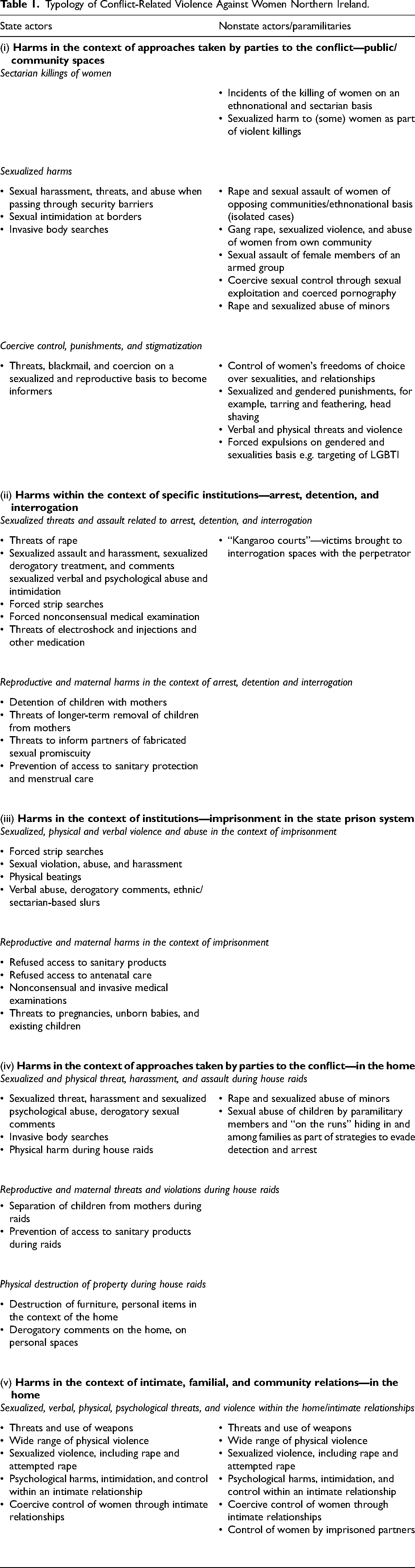
The scope of the typology is the period of the Troubles (1968–1998). CRVAW endures in post-peace agreement Northern Ireland, and while not a specific focus of the original data collection, postconflict paramilitary violence in some communities is included where it was found.
Harms in the Context of Approaches Taken by Parties to the Conflict—Public/Community Spaces
State Actors
The state’s response to violence in the early periods of the conflict was to establish a significant security presence through patrols, stop-and-search powers, security watch towers, and security checkpoints on streets and entry to particular areas of cities and at borders. The harassment that nationalist communities in particular were subject to through these apparatus has been documented as “overtly sexual” for women (Taylor, 1995, p. 309). One incident documented by a group called `Women Fight Back' described the experience of a woman who was stopped on the street by two police officers, was forced into the back of their truck and held down, while a third officer sexually assaulted her. 5 Though legally required, female officers did not always perform body searches and nationalist women experienced humiliating public body searches from men and women officers as well as sexual harassment, abuse, threats, and sexual gestures at checkpoints (Evason, 1982; Harris 2001; Taylor, 1995). The literature provides examples of women targeted for blackmail to become informants, with male British soldiers developing sexual relationships with women to “turn” them. One woman, identified as the wife of a Republican prisoner by security forces when returning from England through the airport, was detained and interrogated. When her travel for an abortion as a result of an affair became evident, she was threatened and coerced to inform, with obvious repercussions in the context of a conservative Catholic society and her husband's paramilitary membership, if she failed to do so (Fairweather et al., 1984). More recently, the experience of LGBTI individuals has been documented, where the nexus of laws criminalizing same-sex relations (known as the “blackmailers charter” (Toops, 2014)) and the coercive and blackmailing tactics of security forces to coerce people to become informers, meant that sexual and gender minorities were targeted both by state and nonstate actors in the context of the conflict (Ashe, 2019). Sexuality was assumed to be a distinct “vulnerability” and used as a basis for harassment, exploitation, and intimidation (McVeigh, 1994).
Nonstate Actors/Paramilitaries
While statistics show that men were the main victims of murder, (91% of those killed were male (Fitzduff & O’Hagan, 2009), a small number of targeted killings of women related to the conflict have been identified. Jean McConville was abducted and killed in 1972 allegedly for being accused of being an informer (deemed groundless by the Police Ombudsman in 2006) or relatedly, for offering assistance to a British soldier wounded outside her home, with accusations of blame for her killing leveled at the PIRA (Kennedy, 2001, p. 5). Loyalist paramilitaries are estimated to have deliberately targeted Republican women for assassination and Catholic women for expulsion from Loyalist areas (McWilliams, 1995). Opportunistic killings on the basis of ethnonational identities also occurred (McWilliams, 1995). The naked body of Margaret Wright was found in a rubbish dump having been lured into a bar in Belfast and stripped, interrogated, beaten, and shot, allegedly by loyalist-affiliated men working on an assumption of her Catholic identity and/or informer status (Bradley & Feeney, 2009; McWilliams 1994). As part of the sectarian killing campaign of the Shankill Butchers, at least four women are known to have been shot and killed (Dillon, 1989). The killings of women across ethnonational lines, as well as within their own communities are largely linked to paramilitary organizations and evidence the intersection of political killings, the sexualized violation of women, and the “misogynist dimension to the sectarianism” (McWilliams, 1995, pp. 14, 16) of the conflict.
There are limited accounts in research from the Troubles period of isolated incidents of sexualized violence on a cross-ethnonational basis by paramilitary organizations (McWilliams, 1998), including gang rapes occurring “on a smaller scale” (little contextual data is available to accompany these reports) (McWilliams, 1997). There is one account of a Catholic woman who was raped at gunpoint several times and shot by a group of four Loyalist paramilitaries who broke into her home (Farrell, 1980). In one well-documented example, a Loyalist paramilitary group attacked the wife of a Nationalist Member of Parliament who kicked and beat her “senseless” and “scratched the initials of the UVF on her breasts with a penknife” (Janke, 1979b). The “strategicness” (Eriksson Baaz & Stern, 2013) of the sexualized aspect of these kinds of assaults cannot be underestimated.
There is more evidence of rape, sexualized abuse, and broader coercive intimidation and control of women from within their own communities, by paramilitary organizations. The Rape Crisis Centre in the mid-1980s documented that “[g]uns ostensibly held for the protection of communities are used in the rape of women from those communities” (McKay, 1985, p. 9). In 2005, the Rape Crisis Centre in Belfast accused PIRA members of “cleaning up” rape scenes, including gang rape of women in their own communities. Accusations were also notably made post-conflict in the context of concerns over Community Restorative Justice programs, in some cases led by “former” members of paramilitary organizations and at times understood to be adjudicating reports of IPV and sexual abuse (Breen, 2005a, 2005b). Sexual exploitation through the production and sale of coerced pornography of women was estimated to be a “widely known” practice of some paramilitaries” (Smyth, 1995). Paramilitary members “policed” and acted as gatekeepers in their communities and there is some documentation that women who sought help for IPV from paramilitary organizations exchanged sexual “favors” in return (McWilliams, 1997). At least one female former PIRA member has spoken publicly about her experience of rape and sexualized coercive control by the commander of her unit (Theatre of Witness, 2010).
Paramilitary organizations across the political spectrum exacted control over women's sexual and reproductive freedoms. Republican paramilitary organizations prohibited women and girls from having relationships with those associated with the British state and were routinely “punished” through the very gendered rituals of head shaving, tarring, and feathering and by being tied, following those assaults, to lampposts for public shaming when those “rules” were transgressed (Harkin & Kilmurray, 1985). The number of Tarring and Feathering incidents is estimated to range from 27 incidents in 1971, 28 in 1972, 21 in 1977, and 6 in 1978 (Janke, 1979). Republican women were also punished for trying to end relationships with partners who were imprisoned for a paramilitary activity or for having affairs when partners were in prison (Harkin & Kilmurray, 1985). Research has shown that while Republican groups were more likely to harm children and juveniles, Loyalist groups “were more likely to select female targets for their attacks” (Kennedy, 2001, p. 5). Loyalist groups were responsible for 33 of the 56 serious assaults on women and Republicans were responsible for the remaining 23 assaults that took place between 1990 and 2000. Kennedy estimates that women accounted for 4% of all “punishment” victims and disproportionately felt the effects of punishment beatings whereby “their homes [were] invaded by hooded men; [they were] threatened verbally, sometimes physically; sometimes obliged to witness the beating of a male family member or to listen to screams in an adjoining room” (Kennedy, 2001). As primary carers, it must not be overlooked that women will have felt the impact of these abuses and sustained an intense “worry” over the fate of partners and sons targeted or expelled from communities by paramilitary groups (Kennedy, 2001). Paramilitaries views of same-sex relations as “sexual dissidence” has been examined in the context of their policing of antisocial behavior, with attacks on and/or banishment of LGBTI people from their homes and communities (Kitchen & Lysaght, 2004, p. 91). Sexualized controls over communities extended to “curb[ing] homosexuality through violence and intimidation,” which, while characteristic of homophobia in any context, entailed here the sinister threat of sectarianized petrol bombing (Toops, 2014, p. 55).
Harms in the Context of Specific Institutions—Arrest, Detention, and/or Interrogation
State Actors
State strategies such as internment and later, extended arrest and detention under emergency powers (that may or may not have led to imprisonment, below), meant that when arrested, women could be held for interrogation for up to seven days by the state security forces (Wahidin, 2016). There is a significant body of work that documents women's experience of continued, sustained, and deliberate sexualized abuse, threat, and in some cases violations during detention and interrogation. Sexualized abuses often began in the context of the raid on a woman or girls’ home (below) and continued through the following stages of detainment, transport, initial detention, prolonged detention, and interrogation. One study found that female detainees were more likely than men to recount psychological sexualized abuse in their experiences of detention (Campbell & Connolly, 2007). During detention and interrogation, women experienced threats of rape, sexualized, verbal and physical violence, harassment, derogatory treatment and threats to their lives, and forced removal of clothing (Amnesty International, 1978; Wahidin, 2016; Women Against Imperialism, 1980). Women's reproductive and mothering roles and ideas of gendered sexual purities were also the basis for strategic abuse, exploitation, and degradation, including threats to children, derogatory comments on mothering, threats that fabricated sexual infidelities would be shared with partners, derogatory sexualized name-calling, prohibited access to menstrual sanitary products, threats of injections and other medications, obligatory medical examinations by male doctors and in one documented case, nonconsensual invasive medical examination of a pregnant woman (Amnesty International, 1978). This quote from the interviews by Azrini Wahidin sums up their experience: I mean the [hittings], I could take. It's just you have a soldier and an RUC man in the room and they are talking to you in a completely pornographic way: “would you like a bit of dick. We’re going to rape you. We’re going to strip you. Nobody knows you’re fucking here. I can put you up that wall and I’m going to have you from the front. He's going to have you from the back and we’ll call somebody else and have his dick in your mouth,” and that went on morning, noon and night. (Wahidin, 2016, p. 48)
Nonstate Actors/Paramilitaries
In the context of paramilitary control of communities, there are documented attempts by those organizations to “mediate” and/or to cover up reports of sexualized abuse by their membership. This includes taking women that have reported the abuse to undisclosed locations where they have been forced to meet with their abuser while their testimonies are adjudicated by paramilitary leadership, extending threats and intimidation to the victim during and after these “hearings” (Breen, 2010a, 2010b).
Harms in the Context of Institutions—Imprisonment in State Prison System
State Actors
One in 20 political prisoners was a woman during the Troubles (Corcoran, 2004). Strip searching and verbal, psychological, physical, and sexualized violence in the context of imprisonment has perhaps received the most attention in respect of gendered harm in the Northern Ireland Troubles. Strip searches occurred as women moved in and out of prisons when admitted and when attending court hearings, following family visits, and as a routine part of their imprisonment. It involved interalia, complete stripping (sometimes forced and held down), invasive bodily searches including visual and internal examination of genitalia, and forced removal of sanitary materials by women themselves and/or by officers for inspection (Talbot, 2004, p. 141). During imprisonment, one woman was strip searched 240 times, while one prominent nationalist woman alleges she was strip searched up to ten times per day and was sometimes woken in the middle of the night to be strip searched (Loughran 1986). A mass one-day strip search “unprecedented in its form” (Aretxaga, 2001) occurred in Maghaberry women's prison in 1992 conducted by female prison officers and overseen by male riot officers. The search operated in the cells of prisoners “followed a ritualized pattern of militarized sexual assault” where women were forcibly stripped naked and searched, threatened with, and experienced physical violence, and were subject to gross sexualized humiliations, harassment, abuse, and threats of rape, including “sexual remarks … interspersed with anti-Catholic abuse” (Aretxaga, 2001, p. 11), signifying a clear ethnonational and sectarian motivation, purpose, and outcome of the abuse. Women noted the significance of the invasion of their cells in this incident, underscoring the importance of context and social location to the harm women experience: the relative safety of the cell up to that point, compared to the continuum of assault across arrest, detention, interrogation, remand, sentencing, admittance to prison, and prison surveillance.
Reproductive harms again featured. Some women who were pregnant when entering prison were given no antenatal care and were subjected to threats and physical abuse including threats to the unborn child, derogatory comments about the unborn child, and threats of taking the child when born. Pregnant women were declared “fit for punishment” by the prison doctor (Women Against Imperialism, 1980). Smear tests were also refused to women (Brighton International Women's Day Delegation, 1988a, p. 22). Women were refused or accessed limited sanitary products for menstruation, an acute issue during the “dirty protests” during which women smeared excrement and menstrual blood on their cell walls and were forced to empty their chamber pots containing urine and sanitary towels in the wing corridors (McCafferty, 1981).
Harms in the Context Institutional Approaches to the Conflict—in the Home
State Actors
State-led gendered violations in the context of the home were commonplace in the early stages of the conflict. During “raids,” invariably used for the purposes of intimidation, threats, intelligence gathering, and arrest, security forces violently entered homes without warning during the night. While house raids took place across both communities (WRDA, 2008), they were primarily targeted at Republican communities. For context, the volume of raids is important to note: in 1971, 17,262 house searches and in 1973, 75,000 house searches took place, which amounted to one-fifth of all houses in Northern Ireland (Darby, 1983).
The gendered hue of the political sectarianism of violent invasions on homes is evident, particularly given that women were either alone in the home or left alone with large numbers of soldiers following the arrest of husbands. Women bore the brunt of preparing for and dealing with the stresses and fallout of these repeated, cyclical, and frequent, incursions: coping with the destruction of personal and household property of poor households, and psychologically and practically preparing for raids by cleaning homes, having clean clothes ready to dress in urgency as soldiers entered homes and destroying own personal effects to prevent soldiers invasively searching through personal items (Harris & Healy, 2001). Women were also subject to strategic and opportunistic harm in the context of those raids: waking to find large numbers of men in your home (one woman reported waking to 15 soldiers in her bedroom; McCafferty, 1981) on a repeated basis (one woman reported her home being raided 12 times in a fortnight; McIntyre, 2002) meant that women experienced terror, sexual harassment, sexual threats, and physical violence by those leading the raids. Threats of sexual assault and death, and derogatory sexual comments were common (Harris, 2001a; Fairweather et al., 1984), as were bodily searches: “they went into every crevice of my bra and my pants, both from the top and bottom … It was like a woman raping me. That's what I felt at the time” (Harris & Healy, 2001, p. 84). Women's reproductive capacities were used in security forces tactics, including separation of women from their children during raids (Fairweather et al., 1984). The prevention of access to sanitary products for a 13-year-old girl during arrest and then subject to physical and verbal threat and assault during the detention that followed was documented in one case (McCafferty, 1981).
Nonstate Actors/Paramilitaries
Adult men and women have recently begun reporting their experiences of rape and sexualized abuse by membership of paramilitary organizations during the Troubles when they were children. Although some have been sensationalized in the media accounts through which many stories initially emerged (Breen, 2010; Cassidy, 2010), the complexities of sexualized abuse that has been enabled by the power, status, and access that paramilitary membership had to families and children cannot be overemphasized (Swaine, 2015). One victim/survivor who was raped when she was 9 years old by a member of the PIRA elucidated clearly the relevance of the threats and fear associated with his paramilitary status (Robinson, 2010). Others have noted the relevance of membership and conflict silences to enable predatory sexualized abuse (Bradley & Feeney, 2009). A paramilitary strategy in response to complaints by hiding members and “on the runs” in family homes to evade detection and arrest, meant that in some cases, children were further exposed to sexual abuse by those men hiding in their homes (Graham, 2011).
Harms in the Context of Intimate, Familial, and Community Relations—in the Home
State and Nonstate Actors/Paramilitaries
In the 1990s, a significant body of research on IPV in Northern Ireland first exposed the relevance and level to which the conflict was playing a role in that violence. A study by Montgomery in 1991 found that just over one-quarter of respondents felt that the conflict had affected their position as a victim of IPV: “…the conflict was perceived by these women as having influenced either their relationship or the nature of the violence they experienced, their use of the police, police procedures, and police attitudes” (Montgomery, 1991). Across related literature, there is documentation of IPV by state and nonstate actors in the context of their homes and relationships. As one commentator noted: at one point a women's refuge housed the wife of an IRA member, a wife of a UVF member, and the wife of the British Special Air Services all at once (McCafferty, 1981).
Legal and illegal weapons featured in IPV by members of security and paramilitary forces, in many cases worsening the extremity of that violence and the level of threat and control, extended over women, including threats to their children (McWilliams, 1997). Between 1991 and 1994, 25% of “ordinary” murders were from IPV, with 20 women murdered by their partners which, as McWilliams notes, is more than half of women who have died as a result of political violence in the same period (McWilliams, 1997). Some men used their actual or feigned membership of paramilitary organizations to threaten and control partners, while many women whose husbands were “involved” were unable to call police services for fear of reprisals. This was particularly acute in Republican communities where contact with police also posed a risk of being perceived as “informing” or where reports of IPV were used by police forces as a means to access members of paramilitaries through their partners (Montgomery, 1991). While there is little documentation of sexualized violence in IPV at this time, a publication from the mid-1980s carries several stories of women's accounts of sexualized assault and rape in their homes. This includes one which described how a Loyalist paramilitary member used the abuse, beating, and rape of his wife as a way of “winding down” after a night of paramilitary violence and killing outside the home (Fairweather et al., 1984, p. 130).
The first longitudinal study examining changes in IPV in the transition from conflict to peace was undertaken in Northern Ireland (1992–2016). The study found that the movement toward peace allowed more reporting and help-seeking by women (Doyle & McWilliams, 2020). It found that there were positive changes in trust and engagement with policing services and while threats and control as a result of membership of paramilitary organizations continued, it was not as readily pronounced. The research focused on IPV in Northern Ireland identified “the historical genealogy shaping the particularity of forms and pathways [of IPV] that emerge” as a result of armed violence, and perhaps offers the most substantive evidence on the link between conflict and IPV globally (McWilliams & Ní Aoláin, 2014).
Troubling Observations on CRVAW: The View From Northern Ireland
On a disaggregated basis, the annotated “thick descriptions” mapped out through the constructed order of the typology evidence that women of diverse backgrounds and involvement in the conflict experienced deep levels of harm and insecurities in their daily lives as a result of state and nonstate actors’ actions (WRDA, 2008). While the range and intensity of insecurities and harms will have ebbed over time in line with wider political dynamics, the typology nonetheless makes evident that wide-ranging CRVAW, directly and indirectly, related to the conflict that took place. It also shows that isolated incidents as well as patterns of “conflict-related sexual violence” took place, as did broader harms (reproductive, psychological, emotional, and physical, with more evidence needed of economic harm which is lacking in this typology). Differing kinds of conflict-related gendered harm from multiple actors took place in multiple contexts, from the home to state institutions, throughout the duration of the conflict.
On an aggregated basis, the accumulation of empirical descriptions generates an overarching paradigmatic depiction of gendered and sexualized insecurities and sexualized sectarian harm directed at women that characterized the political violence of this conflict. Some of these harms were driven by, derived from, and reflect and fuel the intersection of sexism and gender inequalities with the politicization of ethnonational identities in the conflict, arising in sexualized sectarian violence directed at women.
These findings and the depiction of CRVAW generated by the typology prompt the need for critical reflection on the assumed absence of political and strategic harms impacting women in the Northern Ireland Troubles. I make a nascent attempt to draw out this idea here. While I have earlier argued that the reductive approach to CRVAW that ties it primarily to “strategic rape” has proven problematic in seeing and making visible wider forms of gendered harm taking place in conflict contexts, here I engage with the idea of “strategicness” (Eriksson Baaz & Stern, 2013) to similar ends, that is, to broaden understanding of the potential range of harm within the idea of strategicness. I do so for three reasons: (1) to explore the possible political nature of these harms and inject into debates in Northern Ireland the idea that women's experiences of conflict harm require much further examination through the lens of their functionality with respect to the motivations of parties to the conflict; (2) relatedly, to signal the need for a fulsome examination of women's experiences in the context of future processes for dealing with the past, to ensure recognition and redress exclusions to date; and (3) to contribute to troubling and debating what constitutes the idea of “strategic” political violence in conflict within the debates taking place in wider scholarship and global policy.
To do this, I come back to the earlier argument of the need to resurface gender in researching, documenting, and analyzing harm. As demonstrated through this typology, the use of feminist harm theory as an analytical frame has illuminated how insecurities and harm were in some cases deliberative and integral to the approaches adopted by state and nonstate actors, as well as, and at the same time, some being opportunistic within their roles. This calls into question any assumption as to the neutral nature of political violence and instead points to gender as a fulcrum in advancing a more thorough understanding of the conflict. Such an approach could and should include a gendered analysis of harms directed at men and boys, including but beyond typified harms such as disappearances, targeted killings, and indeed sexualized harms. In keeping with this article's focus on women, the discussion here arguably prompts the need for deeper and formal political consideration of how and to what degree strategic gendered and sexualized harms directed at women were part of strategies adopted by parties to the conflict, a frame that has to this point been largely dismissed in terms of relevance to this conflict's narrative.
Problematic are the assumptions that are tied to the idea of “strategic” harms in conflict. In keeping with accepted legal and political framings, it has been conflated with public, mass, ordered, and planned sexualized violence, primarily rape by armed actors across “enemy” lines (Eriksson Baaz & Stern, 2013). However, the distinction between “mass and public” sexualized violence and “strategic” sexualized violence which may not be conducted in a “mass” or “public” way, is important here (Wood, 2014). Further, feminist scholars point to how gendered structural conditions underpin women's experiences of conflict violence and cannot be dismissed in an assessment of whether, how, and why sexualized harms might feature in the violence of preference selected by armed actors (Davies & True, 2015). The sexualized assault of women is a political act in itself. When enacted in the context of a conflict, it takes on a renewed political hue and condition, drawing the political nature of the act preconflict together with the political nature of conflict-time violence, to give it heightened political significance. Its gendered political and strategic significance in preconflict prepositions, its potential for gendered political “strategicness” during conflict, as well as its association with conflict protagonists. Taking a feminist harm lens then implies that the strategicness of violence, including but not limited to those directed at women, encompasses in effect: its relation to the foregoing preconflict depth and breadth of structural inequalities and tolerance for men's violence against women; its closeness to the actors and social locations where the dynamics of the armed conflict play out and in which these harms take place; its relevance to the political aims of the actors and institutions involved, as well as in sustaining their power at micro individual level, as well as macro political levels; its role as a conduit in embodying and maintaining structural limitations of sexual norms, purities and freedoms for women, norms associated with gatekeeping of women's agency and bodily integrity and ultimately men's control over sexualities and reproduction; and further, how all of those gendered and political dynamics intersect in some places and moments with the politicized sectarianism, ethnonationalism or other drivers of armed violence that evolved within and characterized that conflict.
On that basis, deeper and investigative research could support a further delineation of the harms mapped out here in respect to their strategicness. First are strategic sexualized and reproductive harms in state security responses. Analysis of state raids on homes and in public state security measures have in many ways been decoupled from the violence of the conflict due to their attachment to private spaces, to women's sexualities and reproductive capacities, to the idea that separation from children is an emotional issue rather than a strategic act of threat. Further, violations hidden from view in trucks and security points are assumed to be an individualistic act despite the context to that abuse and the perpetrator. The prevention of access to medical and menstrual care is a strategic way to enforce insecurity of bodily integrity. The intention of the sexualized and reproductive insecurity at the heart of these harms is central to armed actors’ intimidation of target communities and over women.
Second, strategic sexualized abuse of women during arrest and detention, namely strip searching by state actors is increasingly theorized as a “weapon” in the Northern Ireland conflict (O’Keefe, 2017). It was “heterosexual and ethnically marked” (Aretxaga, 2001, p. 19) by being predominantly targeted at Republican prisoners, upholding “the ethnic hierarchy of Northern Ireland, within which Catholics had to be put in their (subjugated) place” (Aretxaga, 2001, pp. 19, 21). Prisoners themselves have invariably articulated how their bodies became sites of politicized and sectarian sexualized intimidation, humiliation, and assault as tactics of control, punishment, and discipline. In the liminality of spaces of detention and interrogation, there is not only a temporary and surreal feel to what is happening, but as a specific site cordoned off from typified tactics of armed groups it represents a “sliding between the reality of legal definitions of rape and the actual experience of sexual violation that permits the exercise of forms of rape under the cover of institutional rule” (Aretxaga, 2001, p. 19). This shows that the strategicness of violence might also thereby be delimited and confined to particular spaces and time and not just a “blanket” public and shared event and experience. Rather as shown by the Northern Ireland experience it can take place in covert ways in “private” institutionalized spaces such as in the ecology of the state prison and security system.
Third, while there are few examples, strategic sexualized control and abuse by paramilitaries on a sectarian and cross-ethnonational basis is another dynamic evident through the typology. The limited prevalence of incidents of the murders of women on a sectarian basis, and sexualized aspects of assaults on women members of opposing “sides” of the conflict does not however mean that their relevance should be dismissed. Each was enacted in the context of sectarianism. Feminists in the jurisdiction have pointed to the significance of their gendered aspects including the stripping of women who were later murdered by and in front of groups of men and the sexualized degradation of women's bodies (McWilliams, 1994). It is clear in the few examples cited that sexualized sectarian harms were directed at women in some cases on an opportunistic and in some cases on a planned basis by nonstate actors across the political spectrum. While sectarian attacks and killings were largely perpetrated by men on men (McWilliams, 1994), the targeted acts of violence and killing of women involved sexualized taunts, abuse, and violations and that must be considered in any assessment of the sectarian violence of this conflict. It is the troubling problem of “a focus on female death as a category of harm works to disrupt the framework of understanding conflict” and while that remains untethered to the sectarianism of the conflict the idea of “ancient enmity” as an explanation is instead maintained (Rooney, 2018, p. 336).
Fourth, strategic sexualized control and abuse by paramilitaries of women in their own communities such as prohibiting sexual freedoms and sexualized assault more generally could, through a gender lens, be seen as central to paramilitary control over their own communities, and particularly of women within them. The nature of the structural condition of women's lives and of the structural basis for gendered violence within ethnonational groups thereby makes this a case where systemic gendered harms are underwritten by the politics of a conflict and mutate towards overt political control over women. That control was a critical aspect of those groups’ strategies. Their reliance on a disciplined community in line with and in support of the armed groups was essential to the achievement of their aims—and women's compliance, including sexualized compliance, was a central element of this. Further, the institutional context to the perpetrator of abuse matters—an abuser that has the force of the state or of a paramilitary organization behind him—makes his act of violence, not just his alone, but part of and reinforcing a collective armed and violent force that is derived from but is further emboldened beyond the structural conditions that enable men's violence against women outside of conflict. The significance of the Doyle and McWilliams longitudinal study becomes evident here. If the nature of IPV has changed since the end of the conflict, then its linkage with the conflict is evident. Violence against women can be systematic and systemic at the same time, each relies on the other to sustain and uphold the “background range” of normative harm, so that the “above the normal range” can occur during a conflict (Levitt, 1995, p. 532). The control of women's bodies and practices of their sexualities is a keystone in an armed group’s control over its own constituency (O’Keefe, 2017).
An overarching consideration is why there would be any necessity to delineate whether and how any of the forms of CRVAW in Northern Ireland mapped out in the typology fit a strategic threshold or meaning. There is significance in ascertaining what the Northern Ireland experience says to predominant frames of conflict-related gendered violence. The first is to evidence that parties to the conflict in Northern Ireland used and enacted sexualized and gendered forms of harm as part of their approach to, engagement in and as a basis for sustaining their positioning in the conflict. The nature and place of those harms in those institutions remain to be acknowledged. A critical reason thereby is to tackle the institutional silencing of the role of sectarianism, paramilitarism, and state action and intent in the conflict-related harms experienced by women collated in this article and that “looks set to continue” (Rooney, 2018, p. 334). Second, the Northern Ireland context speaks volumes to the global debates on strategic sexualized violence: that contemporary formulations of “strategic political violence” rest on neutral (read covertly masculinized; Carver 2014) assumptions of political violence which miss the fact that the strategicness of any of this violence is determined by its gendered systemic and strategic meaning and efficacy preconflict and during conflict. Within a conflict, it is the gendered meaning of the harm that should be paid attention to in the assessment of their strategicness to conflict tactics. The argument here is not to reinforce the importance of thresholds or hierarchies of strategy – but to show the diversity that can and should be acknowledged within claims of political and legal strategicness, particularly where that element becomes the measure on which those harms are taken seriously or considered to be part of a narrative of the “conflict violence” of a period of armed political contestation.
Conclusion
The resurfacing of gender to assess the conflict violence of the Northern Ireland Troubles evidence that women can experience gendered harm by conflict actors which on the one hand seem to be nowhere (in the narrative of the conflict) and at the same time are everywhere (in the private and insidious ways it has occurred across multiple spaces). The typology underlines that the apparent absence of strategic rape per global discourse should not be assumed to indicate the absence of any gendered harms or indeed other kinds of strategic gendered harms in a context of conflict. Women can and do experience sexualized and other forms of gendered harm within a conflict that may not be characterized by mass overt, ordered, or proclaimed sexualized targeting of women. The nexus between sectarianism and sexism and between sectarianism and sexualized harm is instead what matters whereby sexualized sectarianism drives some of the harms outlined here. These aspects of the harm are particularly pertinent to considerations of how patterns of gendered harm during the conflict relate to, influence, and continue to characterize and determine many women's experience of harm and control, particularly by those affiliated with paramilitaries, in postconflict Northern Ireland (Turner & Swaine, 2021). Acknowledging “what happened to the women” (Rubio-Marín, 2006) during the Troubles in Northern Ireland through this typology, and hopefully in future processes for dealing with the past, is pertinent to understanding what is happening now, how peacebuilding could and should be dealing with past and enduring conflict-related harm impacting women.
While in legal and political terms harm is often “assumed to be self-evident” (Conaghan, 2002, p. 321), for women, the “ranking” that trivializes their experiences of systemic harm (Levitt, 1995) instead formulates them as something normative and expected per the social rules of their social context (Urban Walker, 2009). That formulation travels onto women's experiences of conflict and in the case of Northern Ireland means that instead of being recognized as “conflict-related” instead: IPV involving conflict actors is only determined “self-evident” when framed as an “ordinary” crime, removing it from conflict analysis; sexualized violence is a systemic and normalized outcome of the prison life chosen by deviant women; paramilitary control of women is little more than a reflection of the everyday gendered hierarchy of social power between “social groups of unequal privilege” (Urban Walker, 2009, p. 25). Developing a composite picture of “conflict-related” gendered harms untied from such assumptions requires a critical gendered harm analysis that takes into account the social context to women's lives and to the conflict and its politics, the social location of the harm, and identifies women's experiences of conflict violence even when they are not presented through that conflict frame. Further, it requires analysis that more fully engages with intersectionality (Crenshaw, 1993; Rooney 2018). For the Northern Ireland context that requires looking deeper through the nexus of gender with, amongst others, the politicization of ethnonational identities, embodied sectarianism, sectarian homophobia, and the ways that political polarization and violent contestation have enabled state and paramilitary control of women's lives and bodies and has driven economic deprivations, all of which differentially affect women from Republican and Loyalist backgrounds. In its potential for evidencing the “universal-local” connect (McKinney, 1966), the typology here evidences the heterogeneity of the local of CRVAW and its relevance to advancing a similar heterogeneity to color the universal, that is, how global phenomenon on CRVAW as set out in scholarship, law, and policy should be more readily grounded in the empirical every day of women's experiences.
Footnotes
Acknowledgements
This article is the product of research that began as a PhD and continued over a period of a decade which benefitted hugely from the support, insights, and collaborative work with the following brilliant feminists: Fionnuala Ní Aoláin, Christine Bell, Catherine O’Rourke, Khanyisela Moyo, Monica McWilliams, Catherine Turner, Marie Brown, and Christie Edwards.
Declaration of Conflicting Interests
The author declared no potential conflicts of interest with respect to the research, authorship, and/or publication of this article.
Funding
The author received no financial support for the research, authorship, and/or publication of this article.
