




Abstract
Subscription-based digital platforms such as OnlyFans have expanded online sex work globally. Although research has documented their affordances mostly in Western countries with neo-liberal systems, what risks and challenges women experience and navigate on these platforms have not been adequately understood. The present study adopts a critical feminist perspective to address this gap by exploring women online sex workers’ agency and well-being in Türkiye, a conservative and patriarchal gender order that increasingly criminalizes online sex work. Six women who were working or formerly worked on subscription-based digital platforms participated in individual interviews for this study. Thematic analysis of the interviews showed women's efforts to protect their safety and voice within the bounds of possibility in four themes: a) withstanding fear, stigmatization, and objectification, b) pretending in the service of the male gaze, c) exerting digital boundaries, and d) setting priorities. Our findings contribute to previous research by uncovering diverse expressions of women's agency and emotional labor on digital platforms. The findings also pointed to the shaping impact of the Türkiye context in exacerbating this labor due to an insecure political climate and marginalization. We shared recommendations for feminist, empowerment-based research and practices for sex worker women's well-being.
Online sex work involves an exchange of sexual services over the internet, such as selling erotic videos and nude photos or webcamming (Cunningham et al., 2018; Jones, 2015). Subscription-based digital platforms provide a new avenue for practicing online sex work without physical contact (De Gioannis et al., 2025), leading to an expansion of the sex industry globally (Jones, 2015). Positioned as part of the gig economy, platforms such as OnlyFans serve as a junction between social media and sexual/erotic content and rely on sex workers’ creative digital labor and self-branding (De Gioannis et al., 2025; Rand & Stegeman, 2023). These platforms have rapidly grown during and after the pandemic due to rising rates of unemployment and increasing risk of infection (Bromfield et al., 2021; Hamilton et al., 2022) and continue to grow despite pushback on moral, religious, conservative, and legal grounds in some countries. As such, subscription-based platforms create a unique intersection where subscribers can directly interact with sex workers, access their content for a membership fee, and sustain their communications online (Sætre, 2023).
The growth of these platforms has changed the nature of sex work to a considerable extent; yet, still little is known about how women sex workers navigate these platforms, that is, how they exercise their agency and what it means for their well-being. In this study, we join previous researchers who take a both/and perspective that does not characterize sex work as categorically empowering or exploitative and see agency and oppression as intertwined in women's experiences (e.g., Karandikar et al., 2021; Martins et al., 2023; Sandy, 2006). We adopt a critical feminist approach (Henry & Farvid, 2017) that prioritizes women's own voices and personal testimonies in online sex work while also analyzing and exposing patriarchal relationships that they navigate both in the actual and the virtual world. Thus, one goal of our study is to use such a perspective to explore their accounts of agency and well-being.
A second goal of our study is to understand women's experiences in Türkiye, one of the countries that banned or restricted access to digital platforms offering sexual content. Türkiye is a patriarchal context currently ruled by a conservative gender order endorsing societal norms that control women's sexuality on the basis of morality, honor, and traditional family. Within this socio-political climate, for example, access to OnlyFans was banned in 2023 on the grounds that it risked potential degradation of Turkish societal values and the family system, and several women working on the platform were detained due to allegations of obscenity. Previous research focusing on online sex work is mostly conducted within more neo-liberal political and economic systems that treat it as individual entrepreneurship and rarely account for the gendered socio-cultural and political context involved. Thus, in this study, we explore unique risks and challenges women online sex workers face working under societal and political pressure and criminalization of online sex work. We hope that our study offers some recommendations for feminist practices that aim to support women online sex workers, an underserved group who encounters barriers in accessing legal, social, and psychological support in Türkiye and other countries (Bosworth, 2022; Topçu et al., n. d.).
Agency and Well-Being in Platform-Based Online Sex Work
Agency, particularly in relation to sexuality, is defined as making decisions by navigating existing resources and competencies, acknowledging and asserting one's sexual needs, values, and wishes while setting boundaries and protecting oneself in the relevant context (Karandikar et al., 2021; Pollock, 2008). In the realm of online sex work, we consider agency as manifesting in women's purposes, intentions, commitments, and overt or covert actions that aim to enhance their safety and well-being. One line of research demonstrates that online mediums offer some affordances that facilitate such actions. Digital channels seem to pose less risk of physical harm (Hamilton et al., 2022), provide more opportunities for self-protection (e.g., not disclosing personal information, limiting communications to the virtual domain) (Campbell et al., 2019; Puffer et al., 2024), and grant more control and decision-making power to sex workers (e.g., setting their own fees, deciding whom, how, and when they would like to offer a sexual service) (Puffer et al., 2024; Sanders et al., 2016). Correspondingly, online sex workers report experiencing an increased sense of self-esteem, autonomy, and confidence (De Gioannis et al., 2025), and valuing the opportunity to explore and express their sexuality (Bosworth, 2022) in subscription-based platforms.
Another line of research indicates that these affordances can be deceiving and that the virtual world poses new challenges to online sex workers’ agency and well-being. Some of these challenges are exposure to different forms of digital and sexual harassment and violence (e.g., unwanted attempts to get in touch in real life, abusive and threatening messages) (Campbell et al., 2019; Cunningham et al., 2018), issues around confidentiality, identity disclosure (Sanders et al., 2016; Stutz et al., 2024) and privacy invasions (e.g., accounts being hacked, videos being recorded and sold without consent) (Jones, 2015). Recent research shows that online sex work exposes women to misogyny, stigmatization, and discriminatory attitudes (Hamilton et al., 2022; Sanders et al., 2016) that may lead to internalized stigma and shame, particularly in the absence of community support and solidarity (Martins et al., 2023; Stutz et al., 2024). Furthermore, accumulating evidence indicates that working online can threaten one's sense of self and well-being by demanding constant virtual presence and availability (Rand, 2019) and warranting emotional labor to sustain online communications with fans like a virtual girlfriend (Henry & Farvid, 2017; Sætre, 2023). Overall, platform-mediated sex work brings along new challenges and affordances for women's agency and well-being. Nonetheless, beyond the virtual world, the socio-cultural, political, and structural context needs to be taken into account for a deeper understanding of women's experiences in online sex work.
The Current Study
Türkiye is a patriarchal context where the neo-liberal self-entrepreneurship model of platform-mediated sex work clashes with the current conservative gender policies and traditional pressures on women's sexuality. The Turkish socio-cultural terrain is currently characterized by traditional patriarchy that places undue emphasis on women's chastity and sexual modesty and capitalizes on conservative, anti-LGBTQ attitudes that idealize the heterosexual family (Acar & Altunok, 2013; Cindoğlu & Ünal, 2016). Within this context, sex workers are either stigmatized as worthless or totally silenced since their labor does not comply with the patriarchal view of women's sexuality as private, controllable, and reproductive (Yumuşak, 2019; Zengin, 2020). The discourses of honor exacerbate the stigmatization and social exclusion of sex workers (Zengin, 2020), despite the fact that sex work in registered brothels is legal according to the Turkish Penal Code. Nonetheless, there are cases where sex workers are accused of immoral acts and obscenity, which are included in crimes against general morality (Topçu et al., n. d.). In 2023, several women working on OnlyFans faced a similar accusation, creating a climate of criminalization around online sex work, as well. Unsurprisingly, the few studies that explored in-person and online sex workers’ issues in Türkiye reported fear, psychological and physical abuse from customers, lack of safety and protection, leaks and identity exposure, stigmatization, transphobia, social exclusion, and unreported sexual violence as the most pressing problems, although many refrained from seeking help and support due to existing discrimination, stigma and neglect in mental health, medical, and law enforcement systems (Al Zayani et al., 2025; Topçu et al., n. d.; Zengin, 2020).
In the current study, we aimed to explore how women online sex workers navigate subscription-based platforms in current Türkiye and contribute to the diversity in the literature by representing women's experiences in a conservative, non-Western setting. With this study, we wanted to respond to the call to recognize and further understand sexual labor in the digital world, based on sex workers’ agency and subjectivity (Rand, 2019). Although online sex work is perceived as the least detrimental with the most opportunities for agency (Puffer et al., 2024), previous researchers have highlighted the adverse impacts of criminalization and punitive policies on sex workers’ well-being and access to support (Campbell et al., 2019; Jones, 2015; Sanders et al., 2016). Thus, the notions of risk, agency, and well-being can acquire different meanings in current Türkiye, a unique point of intersection between traditional and patriarchal norms, criminalization practices, and affordances of the digital world. Adopting Henry and Farvid's (2017) critical feminist approach, we addressed the following research questions: a) What risks and challenges do women online sex workers experience on subscription-based digital platforms? b) How do they practice their agency and maintain their well-being?
Method
Data Collection and Participants
We designed this research as a small-scale thematic analysis study within a clinical psychology graduate program. After getting approval from the Institutional Review Board at the university where the study was conducted, we first shared a digital flyer on our personal and the program's Instagram and X accounts to advertise the study. The first author also opened an X account dedicated to the study and sent potential participants direct messages that involved the flyer and a brief study description. The inclusion criteria were a) identifying as a Turkish woman above the age of 18 to comply with the legal age for sex work and b) having experience with working on a subscription-based digital platform (e.g., OnlyFans, Fansly). The exclusion criteria were a) currently experiencing intense psychological distress that disrupted daily functioning for the last 4 weeks, and b) having suicidal ideation. We set these criteria to minimize the risk of causing distress to potential participants and prevent any possibility of psychological harm. We prepared a list of accessible mental health services for referral and used it when needed.
To screen for our inclusion and exclusion criteria, the first author emailed a sociodemographic form and an informed consent form to potential participants who showed an interest in the study. The socio-demographic form involved questions on the participants’ personal information (e.g., gender, age, educational background), online sex work experience (e.g., digital platforms used), and current mental health and functioning (e.g., psychiatric diagnoses). After this initial screening, the first author called eligible participants to learn about their mental state, inquire about the severity and impact of current symptoms, if any, and see if the participant was receiving psychological help. In this phone call, the first author also transparently explained the study goals, the interview content, and the possible risks and benefits of participation. She invited the potential participant to make a collaborative and mutual decision about participating in the study, based on voluntary and informed consent. She also suggested the options to carry out the interview via instant messaging, keeping the camera off, or sharing the interview questions beforehand to facilitate trust, share control, and address the participants’ rightful privacy and safety concerns. After the phone call, a mutual decision was reached with six participants who provided verbal and written consent to schedule an individual interview. Although our goal was to reach more participants, numerous women turned down our study invitation because of heightened concerns over anonymity and stigmatization, feelings of insecurity after the ban on accessing the OnlyFans platform, and unwillingness to talk about their adverse experiences. Thus, we stopped data collection after six interviews, seeing the richness of the accounts the participants shared and following Braun and Clarke's (2013) recommendations for 6–10 qualitative interviews for a small-scale study.
The first author carried out semi-structured individual interviews online in Turkish with six participants, aged 21 to 30. Their sociodemographic information is presented in Table 1. The interviews lasted between 45 to 97 minutes and were audio-recorded. We chose online interviews for data collection to enhance the participants’ privacy and comfort and to use an easily accessible medium for them. We developed an interview guide consisting of questions about the participants’ experiences in digital platforms, their challenges, interactions with fans, coping methods, and sources of support and well-being. We paid special attention to the wording of the questions and used neutral descriptions such as sexual content creation, as the daily language used to discuss online sex work has judgmental connotations and a stigmatizing undertone. Anticipating prevalent boundary violations that the participants have previously experienced, we paid special attention not to ask direct questions that may sound intrusive, such as their personal sexual experiences. Following the participants’ lead, we probed these topics if they spontaneously came up in the interviews. The first author followed the interview guide flexibly and worked to create a safe, non-judgmental setting where participants could share both challenging and agentic experiences. All participants expressed feeling comfortable and heard after the interviews and stated valuing the opportunity to talk about a topic that usually remains unspoken. Pseudonyms were assigned to the participants to protect their anonymity.
Socio-Demographic Information of the Participants.
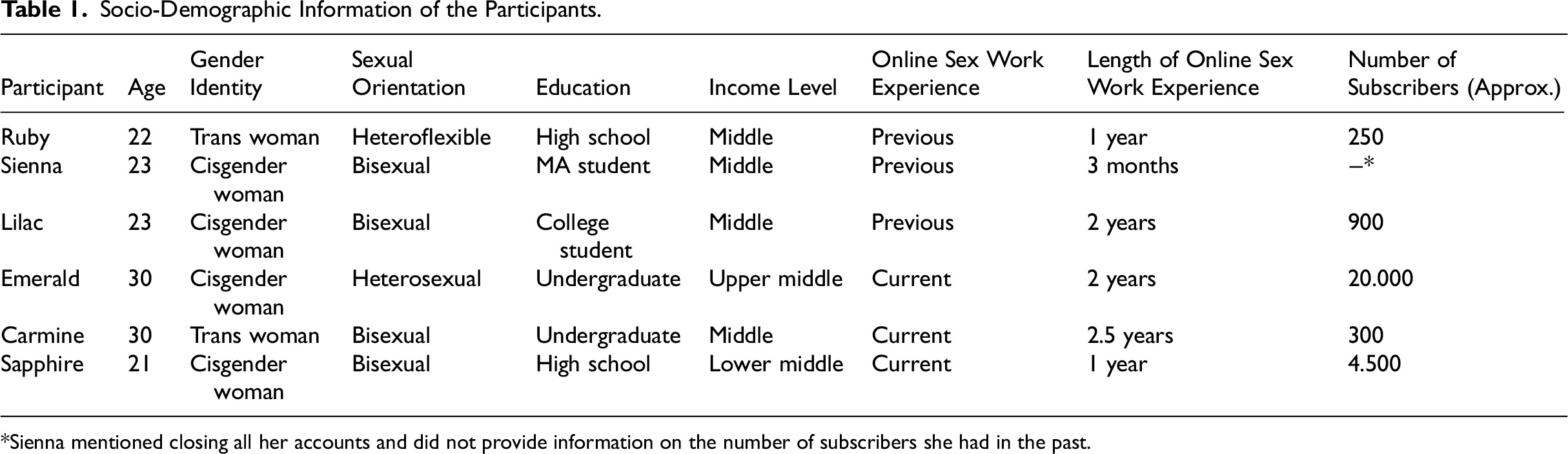
Sienna mentioned closing all her accounts and did not provide information on the number of subscribers she had in the past.
Data Analysis
We used Braun and Clarke's (2006) inductive thematic analysis steps to analyze the interviews on MAXQDA 2022. Initially, the first author transcribed the audio recordings of the interviews and read them for familiarization. In the second step, the first author conducted an open coding of the first interview, reading it sentence by sentence, and generating short and meaningful codes. We reviewed these initial codes (e.g., “safety-not disclosing personal info,” “earning good money”) and discussed whether the codes captured the participants’ accounts. Next, the first author went through the whole data set and completed the initial coding. In the third step, we examined the list of initial codes in several meetings and began to form potential themes (e.g., “content creation as demanding labor,” “the affordances of digital platforms,” “resources that support women”) by grouping the codes capturing shared experiences together. In the fourth and fifth steps, we reread and reviewed the potential themes and subthemes to clarify their boundaries and finalized the analysis by arranging them into a coherent storyline that best represented the meanings in the data set.
To increase the trustworthiness of the analysis, we held regular meetings to more deeply and comprehensively understand the participants’ accounts. We exchanged our ideas for the analysis to gain maturity and to make better sense of the data. Secondly, we utilized member checking to seek participant feedback about the final themes and subthemes. Two participants responded and confirmed that the summary of the results captured their experiences well. Therefore, no changes were made in the final analysis. Thirdly, we practiced reflexivity and transparency as core elements of feminist research throughout the study. We are both feminist clinical psychologists interested in the impacts of gender-based and social inequalities on mental health and well-being. Our feminist positions informed the decision to focus on agency and prioritize women's voices and subjective experiences in this study. Growing up as women learning about the perils of patriarchy in different ways in Türkiye, we were both committed to exposing the gender inequalities our participants experienced and generating applicable knowledge that can support women's resistance and empowerment on personal and societal levels.
Findings
Withstanding Fear, Stigmatization, and Objectification
The women in our study talked extensively about withstanding fear and experiencing stigmatization and objectification in and out of digital platforms. They considered these experiences an unavoidable challenge exacerbated by the current political climate, men's patriarchal entitlement, and the affordances of the online world. As such, fear, worry, and unease were pervasive in interactions with the police and male subscribers and intimate and family relationships.
The police and the insecure political climate
The fear of getting detained and facing abuse from the police was the most common experience reported by the participants. They expressed feeling worried and, at times, terrified, hearing about women who work on OnlyFans taken into custody on the news because of the accusation of obscenity. The image of the “OnlyFans women” in back handcuffs in the media, coupled with the recent ban on accessing the platform, elicited intense worry and a sense of being under threat. It seemed like consultations with lawyers did not suffice to soothe the participants’ anxieties and fears due to the lack of clarity and consistency in the execution of laws. Emerald expressed her anxiety over experiencing something similar to “the friend in back handcuffs” and started devising an exit plan, despite viewing all this surveillance as nonsense: Maybe you know that we have a friend who does OnlyFans; she got arrested with back handcuffs. You can’t be taken into custody with back handcuffs just because you showed your ass…I asked many lawyers, and they said, ‘The judicial system, they can’t do anything like that,’ but I don’t want my mother to see me with back handcuffs like that, even though she knows about my job. It is ridiculous that it happens because of sharing exclusive content. They can come to your house tomorrow or the day after; anything can happen. That's why people working on different platforms started to get a little nervous, especially me. I don’t think I’ll be doing this for a long time, especially in Türkiye. They treat you like a murderer, as if you committed the biggest crimes. You only uploaded porn to a digital platform, and their attitude is harassment…If I was raped today, I’m sure that the other party would not be punished. I’m sure of that because, in our country, people say this happens because women wear skirts. Imagine me.
Sexual objectification and stigmatization
Being treated as a sexual object by fans, friends, dates, or romantic partners was an overriding experience among the participants in and out of digital platforms. At times, this treatment got under their skin. Ruby described the sense of worthlessness she felt because of fans viewing her as an object whose worth was determined by money: “It's like you are a hometown whore. Everyone sees you naked. From a man's point of view, it devalues you as a human being. They think that for five dollars, they can see every part of you. My worth is five dollars there.” Lilac similarly shared how her inevitable encounters with misogynistic men who expected her to act “a bit like their slave” on these platforms adversely affected her emotional well-being: On digital platforms, men who hate women and never really value women write to you. They think they can get anything done by giving money to women. I would never talk to them in real life, but I spoke to those people for a very long time on several platforms, and this affects your psychology for sure…If you saw them on the street, you would change your path. Why am I serving this person like that for 10 euros? This issue bothered me so much. Afterwards, I thought that if I had done this job for my own pleasure and in a safer place, I would have been fearless and happy…But digital platforms are there to satisfy those men. Men approach you in a certain way because of your work. They immediately think that you will have sex with them on the first or the second date, or that they can see naked photos of you because you have them online. But that's business. It's a job, and people don’t understand it. They think you’re showing your ass for pleasure.
Leaks and identity exposure
All participants indicated that their videos and photos were recorded by subscriber men and sold without their consent on other platforms like Telegram and Reddit. Although some criticized digital platforms for lacking security and allowing men to take unfair advantage of their work through these leaks, their main concern was about identity exposure because of the pressure of stigma. Those participants who disclosed their work to their families and did not face negative reactions were less afraid of possible leaks, while those who kept it from their families or loved ones were terrified of the possibility of them finding out. For example, Sienna shared her fear and anxiety over a possible leak, seeing some account administrators on X or Reddit exposing women online sex workers’ actual names. Lilac explained how she continued her work with constant fear of “being unmasked” since this would risk disapproval by her family: That initial sense of safety I felt because of not showing my face was gone, because I have specific hair and tattoos. I had thousands of followers on X, and I realized that people started to find me on Instagram, contacting me there. I began living with constant fear. My mom calls me, for example, and I think to myself, ‘Did she see it or something?’ If my family knew I was doing this, they would never really understand…That's why I started to feel extremely fearful, but I still continued to do it. There is that fear, but on the other hand, I suppress it, and I continue.
Pretending in the Service of the Male Gaze
The women in our study described their work as requiring that they pretend to serve and satisfy men's sexual desires. They explained learning to adjust their content and communications to cater to men's expectations to see women as desiring sexual objects with whom they have a special connection. This learning process required incredible emotional labor, viewed as a crucial challenge that adversely impacted their well-being.
Acting “horny”
All participants expressed the discomfort they felt because of pretending to desire sex all the time to fulfill fans’ wants and demands. They defined acting “horny” as an obligation that they had to comply with, although they viewed it as inhumane and unrealistic. Lilac succinctly stated, “A real person is not horny 24/7,” adding that “but you also must be that person to earn that money.” Similarly, Sapphire and Carmine expressed that they project or are expected to project an image of a desirous object who is always ready and willing for sex while feeling the discomfort that comes with the illusory nature of this image: My online personality cannot be a woman who would ever say no to sex, but I may not always want to have sex…The character you create there is a woman who always demands sex, 6 times, 7 times, 8 times a day. This is a complete lie. (Sapphire) Men think that a woman who has OnlyFans has sex every day or she has a very active sexual life and is horny…That's what I’m trying to reflect in my online persona. It's not real. (Carmine) Who am I? I’m not someone who lives like this in her everyday life. I was convincing myself that I was doing this for money, but still, I thought about it all the time. I was in a state of questioning myself, ‘Who am I? What am I doing? Do these things suit me?’…Am I Sapphire? Is this me? Is this somebody else? I became confused about who I was.
Feigning a special bond
All participants stated that they learned to act like they have a special interaction and relationship with their fans who attribute them the role of virtual lover, constantly accessible and available to make them feel special. Lilac summarized the exchange fans expect: “Someone throws money at you regularly, and you become his lover.” Sienna mentioned how some of her fans ask for specific photographs, “special, only for them,” to keep this unrealistic fantasy alive, and shared her sense of overwhelm and moments of self-alienation while sustaining interactions that warrant pretend intimacy: “It was one of those moments that I questioned myself. He was calling me something like my virtual wife (laughs), and continuing that conversation felt cringe.” Below, Emerald explained how this fantasy extended beyond preparing sexual content and involved forging a make-believe exclusive relationship: You can view the profile of a girl who is prettier than I or has extra nudity, and so on, but I will make more money than her because it's not about nudity. If they want to watch porn, they can go and watch it for free on a porn site. But they actually want to connect with you there…I have a lot of VIPs who don’t want to do sexting at all or explicit content…On the platform, they are happy with the bond they establish with me, and I move forward, building on that bond.
Exerting Digital Boundaries
Exerting digital boundaries involved active decision-making about fans’ requests, such as sex work in real life or personal names and addresses. Taking steps to protect access to their privacy enhanced the women's sense of control and safety.
Declining insistent requests
All participants expressed saying no to the requests of subscribers who expected them to be available all the time, contact them in real life, or post specific sexual content. They shared the sense of discomfort and, at times, exhaustion caused by the fans’ insistent messaging and incessant desire for physical sex work. In response, the participants explained that they would either not engage with the fans who keep asking to meet in real life or block them on their platforms if such a feature is available. Lilac stated, “They don’t understand that you’re living your daily life, you’re not available, they keep writing as if you’re doing this job 24/7,” and explained, “I’d probably block them if someone were annoying me a lot.” Sapphire viewed the fans’ insistent attitude as stemming from “the desire to reach you completely” and considered being able to block their IP number a good safety feature. Carmine stated that she chooses to cut off contact when she faces that insistent attitude: There is always an effort to reach out, ‘Are you meeting in a real-life setting?’ or trying to convince me. I tell them that I’m not an escort, I’m not a prostitute…I’m not a sex worker in real life…He talks as if he himself has taken off that label [sex worker], ‘but I want to see you, I want you, I need to reach you.’
Protecting anonymity
Because of their past experiences with leaks and the risk of identity exposure, all participants took safety precautions to keep their personal information confidential. Despite their fans asking for such information, they reported not disclosing their names, phone numbers, home addresses, locations, bank accounts, or professions and protecting their anonymity, as Emerald succinctly stated, “As long as they don’t know my identity information, there is no problem for me.” Showing one's face or other body parts in the created content was another issue that the women considered. Lilac stated, “It seemed easy at the time; I felt safe just because I was going to do it without showing my face.” Although the other participants showed their faces, they assessed the risks of such visibility and tried to take precautions to protect against the risk of being exposed, as Carmine mentioned, “If there is a lot of nudity, I make sure that my face isn’t seen much…If there is a leak, they will only see a body.” Ruby underlined that she was careful not to show her genitals to protect herself from possible transphobia in the future, in case her past comes up after having surgery. She also remarked that she quit OnlyFans and planned to change her name and surname since she wanted to go to college and prevent the risk of facing stigma.
Setting Priorities
The women in our study continuously assessed the personal costs and benefits of working on digital platforms and occasionally made decisions aligned with their values, standards, and wants rather than the male gaze and societal judgments. Protecting their priorities within the bounds of possibility in and out of digital platforms fostered a sense of being in charge and supported their resistance to pressure and stigma.
Capitalizing on money
All women in the study expressed joining digital platforms to make money and enhance their economic welfare. This was a priority, particularly in the Turkish economy, where other jobs did not promise anything beyond ensuring survival and meeting basic needs. Carmine and Sapphire highlighted that the chance of evading the impacts of income inequalities under financial crisis is a primary issue for them: If I don’t do this, I won’t starve. There are many jobs I can do, but these platforms are more advantageous in this economy. (Carmine) Can I work other jobs? Unfortunately, I don’t think you can make money more quickly, and working somewhere for minimum wage doesn’t make sense. (Sapphire) I do it for money, but I use this money to invest in my environment, myself, my family, my husband, my pet, my home, my future…I live in a 5 + 1 villa with a pool with the money I earned from these platforms. When I was a kid, I could never have imagined that I could own a house like this. In my childhood, I was raised in economically challenging conditions…So, money is more important than the rest.
Personal wants, comfort, and aesthetics
The participants emphasized occasionally deciding to fulfill fan requests based on their wishes, wants, and sense of comfort. They repeatedly reported that fulfilling a fan's request, such as posting a video with a partner, “depends on their mood.” Lilac explained, “It all depended on my whim. If I wanted to do it, I did it.” Their whims and wants were based on an assessment of the amount of money offered, potential safety risks, the amount of nudity involved, and their interaction with the subscriber making the request. Nonetheless, the sense of making an active choice and being in charge of their content creation by resisting the pressure of fans or the money was notable. For example, Carmine stated, “I cannot change my perspective on life or my philosophy just to get rich.” Several women shared that they assessed their content with respect to how well it matched their own standards of beauty, besides serving the male gaze. For example, Sienna shared how she valued expressing her own aesthetic vision and prioritizing her sense of comfort despite it clashing with the average fan's expectations: It was important for me to produce photos that were in line with my aesthetic understanding. Fans expected penetration videos or videos with sexual activity rather than solo content. I was unsure about making a video while having sex, so I didn’t…This prevented me from making progress. The things I liked to do and what people expected were not compatible.
Resistance to stigma
The participants, particularly those who continued working on digital platforms, valued gradually learning to resist objectification and stigma. Disregarding others’ judgments helped them protect and prioritize their emotional well-being and cope with the demeaning treatment they faced in and out of digital platforms. All participants considered encountering men with sexist, objectifying, and harassing attitudes as a part of the job, and this acceptance helped them not to care. Sapphire, rather than giving into fear and dismay, clearly stated, “What I have to do is to accept that if I am in this business, every single one of these threatening messages is bullshit and that their comments have no value.” Emerald stated her growing sense of being at peace with herself as she began to say, “I’m doing this job; others can judge as they want,” and recommended being “iron-like” to protect oneself from others’ discrediting attitudes. Carmine similarly mentioned that learning to be indifferent in the face of harsh criticism, stigmatization, and devaluation helped her to prioritize her well-being and build an internal boundary for self-protection: I think it's necessary to take a stoic approach. These people are like that on every social media channel. If you will be any content producer in Türkiye, you need to learn not to care…There were times when I cared a lot or said I didn’t care, made fun of these people, yet cared internally. But you learn over time. Now, I really don’t care.
Discussion
In this study, we aimed to explore women online sex workers’ experiences of agency and well-being while working on subscription-based digital platforms in Türkiye. We adopted a critical feminist approach (Henry & Farvid, 2017) to simultaneously understand women's subjective experiences on an individual level and to inquire into how the current socio-political and digital contexts shape their accounts. Our findings contribute to a deeper understanding of how women online sex workers exercise their agency in multiple ways to protect their safety, well-being, and voice on the one hand and make money by serving the male gaze on the other, a process that involves continually assessing “competing preferences” as Sanders (2004) puts it (p. 559). Similar to Al Zayani et al. (2025) and Rand and Stegeman (2023), our study also supports a recent line of research that criticizes inattention to the challenges and risks women online sex workers face due to the overestimation of the affordances of digital platforms built on a neo-liberal form of self-entrepreneurship. Adding to the diversity of the experiences represented in the literature from a non-Western setting, the current findings indicate that the meanings of risk and challenge shift depending on the context, that is, Türkiye, a conservative gender order that intensifies political, legal, patriarchal, and economic pressures on women.
Managing Fear and Safeguarding
Most notably, our results pointed to the shaping impact of working in a context of criminalization, marginalization, and stigmatization. Fear of the police and feeling unprotected and under threat in the insecure political climate of Türkiye were remarkably dominant in women's narratives than reported in previous research on online sex work. The portrayal of OnlyFans women in back handcuffs in the media seemed to escalate this fear, operating as a mechanism of silencing and intimidation, as Zengin (2020) documented, against sex workers in Türkiye. These results suggest that the adverse impacts of criminalization on sex workers’ agency and well-being extend beyond in-person sex work to the digital domain. Our results also showed pervasive stigmatization, sexual objectification, boundary violations, and harassment that women were exposed to on digital platforms, resonating with recent research documenting men's misogynistic, demeaning, and objectifying attitudes toward online sex workers (Martins et al., 2023; Stutz et al., 2024). This highlights the fact that digital platforms create a setting where men's patriarchal oppression of women's sexuality is re-enacted.
The responses of the women to these challenges in our study indicated diverse manifestations of their agency that increased their sense of safety and well-being. While some of them posed the question, “Is it all worth it?” and decided to quit, others mentioned protecting their digital boundaries, blocking harassing men, and declining their requests, reported as a convenient feature of digital platforms previously (Hamilton et al., 2022). It was noteworthy that some women mentioned managing fear and resisting stigma with an indifferent approach. This reveals the extensive emotional labor the women performed as they learned “not to care” about the wrongs and violations they experienced. Hochschild (2012) defines emotional labor as managing or suppressing a feeling to perform a role and project an image that is required or expected in that role. It seemed that the women in our study performed this labor by accepting violations and judgments as an inevitable part of their lives and, in this way, developing the emotional skills to manage fear and discomfort day in and day out. Although this indifferent approach has possibly protected them from internalized stigma and shame, feelings that were notably absent in the women's accounts, it was nonetheless an internal solution to a social-structural problem. Within this context, “feeling safe and calm” became an unduly individualized skill and responsibility.
The isolation that women in our study reported seemed to exacerbate this emotional labor. Firstly, solidarity with other sex workers did not come up in our study, possibly due to distrust in others in the current context of criminalization, as opposed to previous research that documents how community support empowers sex workers by reducing internalized stigma and enhancing their resilience and mental health (Martins et al., 2023; Stutz et al., 2024). This isolation can also be related to having limited in-person socialization opportunities when working online, starting with the pandemic that posed disproportionate risks to sex workers’ health and safety, and continuing in its aftermath (Bromfield et al., 2021). Secondly, despite mentioning supportive relationships in their lives, women's help-seeking about the challenges and risks of working as an online sex worker was very limited in our study. As documented previously (Hamilton et al., 2022; Sanders, 2004; Stutz et al., 2024), stigma led them to conceal their work and instilled in them a fear of being found out by uninformed loved ones, risking the loss of significant attachments, social exclusion, and intimate partner violence. Similar to previous reports (Campbell et al., 2018; Jones, 2015; Sanders et al., 2016; Stutz et al., 2024), the participants in our study dealt with these risks by safeguarding against privacy violations, preserving their anonymity, and preparing for a possible leak, although being aware of the limits of these precautions and fearing the repercussions of being discovered. Even if they choose to disclose their work on digital platforms, the attitudes of partners or friends were not always supportive. Thus, political and societal oppression seemed to hinder the development of community bonds and weaken their support networks, increasing isolation and posing a serious threat to well-being.
Serving the Male Gaze and Protecting Voice
Our study pointed to the intangible risks of serving the male gaze in online sex work. Echoing Sanders’ (2004) analysis of in-person sex workers’ interpretation of risk, our study also showed that, due to the digital nature of their encounters with men, psychological risks take precedence over sexual health and physical safety issues in women's accounts. Consistent with a recent line of research that highlights the emotional, digital, and relational labor involved in online sex work (Martins et al., 2023; Rand & Stegeman, 2023), our findings similarly showed the extent of emotional labor and pretension the women needed to perform to make money on digital platforms. One aspect of this emotional labor was related to creating a hypersexual, “horny” online persona to appeal to subscriber men's male gaze. Another aspect of it was the pretension involved in enacting the virtual girlfriend relationship, defined as relational labor by Rand and Stegeman (2023), that required continuous accessibility and intimate, intense, and constant communication with fans. As also reported previously, both tasks warranted the regulation of discomfort, displeasure, and disgust (Jones, 2015; Martins et al., 2023) and involved managing and monetizing “authentic” interactions with men as a unique feature of subscription-based digital platforms (Cardoso et al., 2023; Sætre, 2023). One notable finding was the sense of alienation from oneself and identity confusion that the women in our study reported, a consequence of pretension to fit into the male gaze and continuous exposure to objectification. Thus, the current findings extend previous work to argue that emotional labor in online sex work is likely to involve the task of not losing oneself, paralleling Hochschild's (2012) emphasis on the risk of self-estrangement as a cost of emotional labor.
In response, the women in our study exercised their agency by preserving and expressing their own voices and priorities in different ways. Some women quit working on digital platforms to eliminate the discomfort, while others continued working by prioritizing their preferences and economically benefiting from the platforms for their goals. Our findings showed that capitalizing on monetary gains and making financial plans aligned with one's wants and life goals provided women with a sense of purpose, consistent with previous research documenting sex workers’ agency in making a living (Karandikar et al., 2021; Martins et al., 2023). The money they made and the joys it brought along were also related to their sense of power and control in a capitalist and patriarchal system that offered limited alternatives to afford a comfortable life, particularly under the economic crisis in Türkiye. This sense of control and being in charge, as previously reported in relation to digital sexual services (Martins et al., 2023; Sanders et al., 2016), was also evident in women's decision-making about content creation, which involved listening to their wants, moods, comfort, and aesthetic standards on the one hand and weighing the amount of money they would gain or lose on the other.
Nonetheless, in our study, this increased sense of being in control did not translate into positive emotional outcomes such as body confidence, creativity, sexual exploration, and pleasure, as previously reported by women working on digital platforms in Western contexts (Bosworth, 2022; Cardoso et al., 2023). The notions of self-discovery and sexual expression were briefly mentioned, yet not underlined in the women's accounts. One reason for their absence seems to be related to the overriding fear and anxieties in the current politically oppressive context, the omnipresence of the male gaze on digital platforms, and traditional restrictions on women's sexuality in Türkiye. This context is probably not conducive to exploring sexuality and leaves very limited room to discover pleasure in online sex work, as opposed to contexts with less conservative norms and criminalizing policies.
Practice Implications
Our findings have some important implications for feminist, empowerment-based practices with sex workers. Firstly, the results indicate that the dangers and emotional risks involved in online sex work on digital platforms should be recognized by social workers, mental health professionals, and other medical experts. Addressing these risks with psychological, legal, social, and economic interventions designed from an inclusive and multidisciplinary perspective is essential to support the agency and well-being of online sex workers. Firstly, considering the fear and insecurity about the political climate in Türkiye, legal briefing workshops or seminars can be the first step in empowering practices to provide correct information on laws and rights to online sex workers. Secondly, our findings show very limited utilization of mental health services despite experiencing emotional issues such as identity confusion, detachment, anxiety, and discomfort, to name a few. A number of factors could explain the lack of willingness to access mental health services, including the reality and risk of facing stigmatization and prejudice from practitioners who view quitting sex work as the cure for their psychological struggles (Bosworth, 2022; Topçu et al., n. d.). Thus, non-stigmatizing, egalitarian, accessible, and inclusive psychological support services need to be provided by practitioners who avoid a judgmental or rescuing position and support women in identifying their own goals, desires, and voices under their current circumstances. Thirdly, non-governmental organizations and community initiatives can organize workshops or seminars for online sex workers to increase their knowledge and awareness of emotional risks, since the women in our study occasionally mentioned not expecting the psychological repercussions of working on digital platforms because of the “easy work” misconception. Such workshops or seminars can better prepare online sex workers to tackle these risks from an empowerment-based perspective. Fourthly, the study's findings underlined both the absence and the importance of support networks and community solidarity for online sex workers’ well-being. Thus, non-governmental organizations and practitioners can organize online support groups to bring together sex workers in a safe, anonymous space to share common experiences, challenges, needs, and coping methods. Lastly and most importantly, the broader context of criminalization, stigmatization, and male harassment needs to be addressed with multi-level interventions that challenge unequal gender-power relations in Türkiye and similar contexts. Digital platforms also need to devise adequate safety and protection systems to safeguard against privacy violations, digital harassment, and abuse. Even though supporting and empowering women is critical, the harmful and dangerous scene created by misogyny, objectification, and oppression perpetrated by men on and off digital platforms is crystal clear. This shows the pressing need for changes in the existing socio-political structure that enables and extends patriarchal privileges into the digital world.
Limitations and Future Research
Due to the difficulty of data collection, the present study was conducted with six women. Although we noted some differences in the experiences of our participants depending on whether they continued to work on digital platforms, identified as transsexual or cisgender, labeled themselves as sex workers, disclosed their work to their families, and relied on digital platforms as their main source of income, we could not explore the impact of these factors in depth. Future research can explore diverse risks, vulnerabilities, experiences, and agency practices in different groups of women involved in online sex work. Studying the experiences of sex workers in countries with different legal systems and societal structures would also enrich our understanding of diversity and the dynamic nature of women's agency. The present study highlighted the significance of emotional labor in online sex work, warranting a deeper understanding of its strategies and costs in future work. Our findings also pointed to the need to further investigate online sex workers’ mental health from a multilayered perspective that examines personal, relational, and contextual influences. What facilitates and disrupts the development of social support networks for online sex workers can be examined since solidarity relations within marginalized groups are critical for their well-being. Women online sex workers’ objectification experiences in intimate relationships are also underexplored topics that need further attention in future work.
Conclusion
The present study was one of the first to investigate how women online sex workers navigate subscription-based digital platforms in a non-Western context, Türkiye. Our findings showed the coexistence of oppression and agency, marginalization and resistance in women's accounts, and demonstrated their efforts to safeguard against risks and preserve their own voices within the bounds of possibility. Emotional labor was a crucial element of these individualized efforts, as it enabled women to regulate fear and discomfort and pretend in the service of men's expectations. Despite nuanced manifestations of agency, their actions and decision-making power were shaped, and at times limited, by the criminalization policies and conservative pressures in Türkiye and the capitalist and male-dominated relationships on digital platforms. As such, the women in our study commented on how novel and unfamiliar it was for them to talk about their experiences on subscription-based digital platforms since several of them had not had the opportunity to engage in a conversation about it with others before. Against this silencing stance, there is a pressing need for non-stigmatizing and inclusive research and practices that listen to women's testimonies and represent their experiences, needs, and challenges in online sex work.
Footnotes
Declaration of Conflicting Interests
The authors declared no potential conflicts of interest with respect to the research, authorship, and/or publication of this article.
Funding
The authors received no financial support for the research, authorship, and/or publication of this article.
Ethical Approval and Informed Consent Statements
This study was approved by the Institutional Review Board at Istanbul Bilgi University (project no. 2024-20647-053) on March 4, 2024. All participants provided both written and verbal informed consent before starting interviews.
Data Availability Statement
The interviews (audio recordings, transcription files) used in the study cannot be shared with any person because of confidentiality concerns. In our informed consent form, we stated that the data would only be directly accessible by us, that is, the researchers, and only short quotations would be presented in the final output. The materials used in the research (socio-demographic form, interview guide) can be available upon request via email. The materials can be obtained by emailing pinar.ayradilli@bilgiedu.net
