




Abstract
Research on women who divorce their abusive husbands typically draws on the experiences of those who have had contact with formal intimate partner violence (IPV) support services. The experiences of women who have not sought such support remain poorly understood. Drawing upon a series of longitudinal, in-depth interviews with 12 women who did not seek formal IPV services, this work illuminates women’s “strategically stealthy” agency, as they navigate spousal violence, seek human connection and formal support, and eventually file for divorce. This article proposes a revision of the transtheoretical model’s (TTM) preparation stage from 30 days to a flexible time frame of months and even years, which allows a more complex, agentic understanding of IPV survivors’ actions, behaviors, and help-seeking efforts deployed in planning for divorce. By expanding the time frame of TTM’s preparation stage, this work has broad implications for social work practice.
Antiviolence researchers have long studied the dynamics of heterosexual relationships defined by intimate partner violence (IPV), particularly men’s violence against women and how women have navigated that violence. Empirical findings have focused on the association between relationship deterioration and the escalation of violence against women (Haj-Yahia & Eldar-Avidan, 2001; Kurz, 1996; Patzel, 2001), women’s fears regarding their safety and well-being and/or that of their children (Campbell, 1995; Kurz, 1996; Haj-Yahia & Eldar-Avidan, 2001; Merrit-Gray & Wuest, 1995; Patzel, 2001), dynamics of women’s increased agency navigating their relationships (Enander & Holmberg, 2008; Haj-Yahia & Eldar-Avidan, 2001; Merrit-Gray & Wuest, 1995; Patzel, 2001), predictors and processes of leaving along with postseparation psychological well-being (Anderson & Saunders, 2003), and connections between IPV and past experiences of abuse (Hamby & Grych, 2013). This previous research centers on women’s experiences with formal IPV survivor support services. Not as thoroughly considered are the experiences of women who strategically work to divorce their abusive spouses in the absence of formal IPV services. Examining the experiences of these women reveals how IPV survivors may be engaged in change processes that are misrecognized as inaction due to lack of engagement with formal IPV services and/or taking longer than the 30 days prescribed by existing behavioral change models. This work thus illuminates the agency of women who, without formal IPV support services, decide to divorce their abusive spouses and prepare for divorce during the marital relationship.
Theoretical Framework
To frame our understanding of women’s experiences navigating IPV, we turned to a well-established tool: The transtheoretical model (TTM; Prochaska & DiClemente, 1984; Prochaska & Velicer, 1997). The TTM is a theory of how behavioral change occurs that focuses on the motivational and developmental aspects of making desired change. The TTM posits six stages that allow providers to see planning for change as part of the process of change: precontemplation, where there is no intention to change; contemplation, where an intention to change is demonstrated by thinking about change; preparation, where active planning for change occurs (typically within a month’s time); action, where overt change is made; maintenance, where change is solidified; and termination, where self-efficacy is attained (Prochaska & DiClemente, 1984; Prochaska & Velicer, 1997). Although the TTM was originally used to understand how people end self-destructive behaviors such as smoking and drug addiction (Belding, Iguchi, Lamb, Lakin, & Terry, 1995), it is now used more broadly (Di Noia, Schinke, Prochaska & Contento, 2006).
IPV researchers have gradually utilized the TTM to better understand women’s experiences navigating IPV; the goal of such understanding has been to promote safety and support through improved interventions (Brown, 1997; Burke, Mahoney, Gielen, McDonnell, & O’Campo, 2009; Chang, Dado, Ashton, Hawker, Cluss, Buranosky, & Scholle, 2006; Frasier, Slatt, Kowlowitz, & Glowa, 2001; Reisenhofer & Taft, 2013; Williams, 2000). Thus, using the TTM in IPV intervention settings has expanded its use from a strictly medical model to one promoting multidimensional safety and support.
Brown’s (1997) theoretical work, one of the first to adapt the TTM to women’s IPV experiences, expanded the definition of precontemplation beyond denial to include women’s belief that their husbands’ violence was their fault. Subsequent work documented differing ideas on how IPV survivors’ stages of relationship management relate to each of the TTM stages, while not necessarily unfolding in a predictable manner (Burke et al., 2009; Chang et al., 2006; Reisenhofer & Taft, 2013; Williams, 2000; Zink, Elder, Jackson, & Klostermann, 2004). In general, however, a survivor’s change process may map on to the TTM as follows: precontemplation is denying or not recognizing the abuse, contemplation is awareness of the abuse and exploring that perhaps something must change, preparation is a 30-day period where survivors consider altering their situation, the action stage captures the survivor’s act of leaving the relationship, maintenance is living apart from the abusive partner for more than 6 months, and termination is survivor self-efficacy.
Because the TTM has historically been used to understand how individuals address their own “problem behaviors,” such as smoking cessation, using the TTM to frame women’s experiences responding to IPV they have not perpetrated, and therefore cannot be held responsible for stopping, is potentially victim blaming (Chang et al., 2006; Frasier et al., 2001; Reisenhofer & Taft, 2013; Zink et al., 2004). This work addresses this problem by encouraging a more complex understanding of the TTM’s preparation stage, as it relates to IPV survivors’ agency navigating their relationships in circumstances beyond their control and the extensive time necessary to do so. By proposing a theoretical reconceptualization of the TTM’s preparation stage, this work emphasizes a more complex, agentic understanding of IPV survivors’ actions, behaviors, and help-seeking efforts deployed in preparing for their divorces over time. Bringing attention to how 12 women prepared for change they desired and initiated, despite the external constraints of their partners’ abuse, illuminates an aspect of women’s experiences that has largely gone unexplored due to difficulty accessing this population. As a result, women who have not accessed IPV services may be misrecognized as lacking agency. A reconceptualized preparation stage honors the agency not only of these particular women but also marginalized others who may avoid accessing services for structural reasons, like gays and lesbians distrustful of heteronormative service providers (Parry & O’Neal, 2015) or undocumented women wary of immigration authorities (Oyewuwo-Gassikia, 2016), by documenting survivors’ efforts to escape abuse without employing formal services. This can encourage more intersectionally competent services and analyses (Mattsson, 2014; Mehrotra, 2010) that do not equate agency with accessing formal services or disregard actions taking place outside of the preparation stage’s limited time frame of 30 days.
Method
The respondents discussed here were initially recruited as part of a larger project designed to explore how those who separate from a long-term partner at midlife (between the ages of 32 and 55) make decisions about whether to pursue new intimate relationships. 1 In total, we recruited 69 participants—27 men and 42 women—who had separated from a partner of 5 years or longer within the previous 24 months. Seeking to minimize regional biases—for example, differences in dating behavior resulting from the relative density of local dating markets—we recruited respondents from across the United States, combining a nationwide print campaign with online recruitment through social media sites (such as Facebook).
Respondents completed an online questionnaire describing their social support networks, relationship histories, and personal demographics. They were then interviewed twice, in sessions spaced approximately 12 months apart. This longitudinal design was meant to capture how respondents’ thoughts and feelings about the separation continued to change as they gained distance from the experience.
Participants’ survey responses and transcripts of the completed interviews were compiled into a master data package and analyzed using Dedoose 7.6.17, a browser-based collaborative QDA program. Our research team proceeded through one round of “open” coding, compiling a master codebook, and developing a list of themes for further study. During this process, we found that while the larger study had not selected for experiences of trauma and/or violence, 16 of the 42 women interviewed disclosed some form of IPV. The severity and range of their experiences were similar to those reported by IPV survivor support group members (Larance & Porter, 2004). We then recoded these 16 transcripts, seeking to better understand the strategies these women implemented to legally end their marriages.
Of the 16 women that disclosed abuse, four reported that their former spouses had initiated the divorce proceedings; these four women were excluded from this analysis, given our focus on women who experienced marital IPV and decided to file for divorce themselves. The 12 remaining women ranged in age from 32 to 54 years old, with estimated annual incomes ranging from less than US$10,000 to US$150,000 a year. All 12 participants identified as white and had at least one child; 11 of the women identified as cisgender, and one (Amelia) identified as transgender. 2 None of the women self-identified as “survivors” of IPV, and none had contact with IPV survivor support services. Refer to Table 1.
Respondent Demographics.
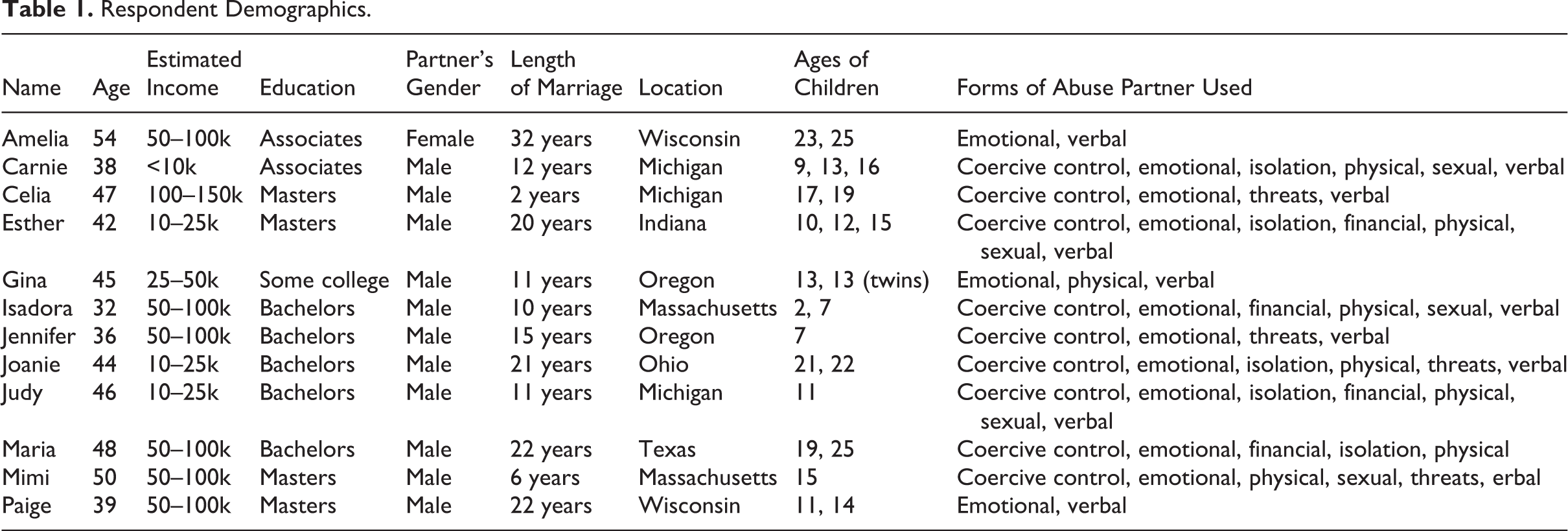
Women’s experiences may differ based on a range of factors including race, income, and educational attainment. While we have endeavored here to recruit a diverse population of respondents, we acknowledge that the experiences of the white, straight, nonimmigrant women captured here can in no way be considered representative of all women who separate from long-term partners, or even all women who separate at midlife from partners that have perpetrated IPV. IPV differentially impacts women at the intersection of diverse race, income, gender, sexuality, and immigration statuses by making them more vulnerable across a variety of individual and structural settings (Stark, 2007). Women of color, low-income women, queer and transgender women, undocumented women, and others face structural constraints that may inhibit or redirect their efforts to implement the strategies discussed here. As we note throughout, women of different socioeconomic classes may be inclined toward slightly different strategies, though all give evidence of the need to conceptualize the preparation stage as taking longer than 30 days and not necessarily involving formal services. In general, the women in our sample operated from positions of relative structural privilege, meaning that a lack of engagement with IPV services was likely not predicated upon fears of further marginalization or victimization by service providers insensitive to minority concerns. Recognizing the agency of these women and all others who do not access IPV services does not obviate the need for service providers and scholars to continue developing intersectionally competent services and analyses, so that women who do desire formal services can receive the help they deserve.
Likewise, because these data are derived from a sample of women who filed for divorce, their experiences may not generalize to women for whom divorce was not a viable option. For example, some women may be risking their lives or the lives of their children in pursuing divorce from an abusive partner, while others may be deterred from seeking a divorce by financial constraints or by religious beliefs.
Findings
While married women engaged in strategically stealthy actions and behaviors that included planning for their children’s care, managing the relationship by maintaining an illusion, innovatively utilizing counseling, seeking refuge from the abuse, and pursuing career development. Concurrently, women sustained themselves through human connection, individual and group support, and couples counseling. Their strategically stealthy planning and self-care enabled women to seek divorce while also accounting for personal safety and financial security. All of this was accomplished in the midst of feeling “stuck inside” the marriage.
Stuck Inside
The 12 women in this analysis experienced a range of verbal, sexual, and/or physical spousal abuse as well as the instrumental humiliation, intimidation, isolation, exploitation, and threats indicative of coercive control (Stark, 2007). For Maria,
3
the abuse started with “a little shove here, a head butt there” and escalated into “one night he was choking me and bruised my neck and put my head through the wall.” Similarly, Joanie was “dumbfounded” when she and her husband were arguing over money and “he just punched me.” Over time that punch evolved into a routine where he would, “actually tak[e] me into a closet so the kids wouldn’t see, and like pretty much bang my head up against the wall a couple times because then that way nobody would notice.” In Mimi’s “textbook abusive relationship,” the physical abuse included her spouse publicly humiliating her for not agreeing with him. Mimi explains that: I would just try to…just go along with it, but every now and then I would just be like, “What? What the hell are you talking about? Are you out of your mind?”…. Well, that would make him mad because he felt I should support everything that he said, everything he thought, everything he did, so he just basically said to me, “Really, you’re going to argue with me? You can walk home.”
Husbands’ threats broadly focused on the women’s well-being or that of their family and/or children. When reflecting on whether her marriage was defined more by emotional or physical violence, Isadora remembered her husband’s typical refrain: “I will chop you up in little pieces, put you on a raft in the […] river, and set it on fire.” In contrast, Mimi’s husband would implicitly threaten to harm her and the ones she loved with weapons. Mimi explained, He was just such an ass, and I was always afraid somehow, someday he’s going to actually go and do what he says, so I was really worried about my family. I was really worried about people I cared about. I didn’t want anything to happen, and also because I was living it. There’s more fear when you’re stuck inside. I always had a picture that this Prince Charming was going to come and take me away and give me a wonderful life because I had such a miserable one [growing up]. You know, growing up I wanted the whole dream. I wanted the husband, the little white house with the white picket fence. I wanted kids. I just wanted like a real family…. When I met my husband I really thought I picked the perfect person, but obviously I didn’t.
Strategically Stealthy: Preparing to Sever Legal Ties
We define strategically stealthy actions and behaviors as a heretofore unrecognized part of the preparation stage situated between contemplation (“Is divorce something I want?”) and action stages (“I'm filing for divorce”). Going beyond the 30-day window of current TTM formulations, we show how women may spend months, or even years, actively engaged in preparations to leave.
Many of these women were well aware that divorce will not enable them to fully disengage from their abusive partners; after all, ties with their children and their partner’s coercively controlling behavior mean the relationship will continue, albeit with more distance and without legal ties. During this time, women participate in intensive emotion work that has involved grieving as well as detachment from their partners and dreams for the relationship’s future. It is a time of intense loss, as well as a critical turning point, because it requires the women to confront the fact that the legal aspect of their marriage will eventually be over (Eldar-Avidan & Haj-Yahia, 2000).
The preparation undertaken by women in this sample involves a range of deliberate actions and self-care strategies intended to conceal their intentions to divorce. It is a gradual, time-intensive process. Although these women may be perceived by those outside the marriage as doing little to change their circumstances, they are fully agentic and acutely aware of time passing as well as the scrutiny of others. These women executed their plans in a variety of ways that included waiting for their children to get older, surrendering custody of their children, enlisting words and/or actions to maintain the illusion of a relationship, taking temporary refuge, seeking professional credentialing and education, and symbolic participation in couples counseling.
The children
As all of the women in this subset of our sample had children, many women’s planning revolved around how best to address safety concerns and financial support in light of parenting responsibilities. For some, this meant waiting for the children to get older before pursuing divorce. For others, the plan involved surrendering their children into the care of others. Isadora was pregnant with her second child when she decided she was ready to seek a divorce but felt that she had to place that decision on hold. Isadora reported, “I knew I was stuck because I was pregnant, and what can you do when you’re pregnant? You’re at everybody’s mercy pretty much.” She decided to wait to end the relationship until the baby was at least a year old, “I waited, I waited,” she explained. “I knew what I needed to do. I couldn’t do it yet, so I waited. You know, things just continued to suck. He was still mean to me. He was still screaming at me, calling me horrible names in front of my children.”
Isadora’s decision to wait for her baby to get older was similar to Jennifer’s. Jennifer knew when her baby was 18 months old that she did not want any more children with her abusive husband. At that point, she explained, I kind of had it in my head that I was on, like, a five-year plan. I wanted to get my child…off to…full-day school so childcare wouldn’t be an issue…. I wanted to be home with him when he was little, so I made sacrifices to do that, but I’ve kind of been, one of my friends put it as ‘planning in paralysis' for years to get to this point.
As the children became older and the abuse continued, giving up the children seemed a more viable option for some. When Esther recognized the power her husband had over her, she explains, “Oddly enough, I gave him the kids.” After years of her husband’s abuse, Esther ultimately decided she had to “go no contact with him because he does have extreme power of my brain, and I hate that,…. I don’t want to hear his voice. It triggers me.” By allowing the children to live with their father, Esther avoided the triggers that traumatized her. She also created her own emotional space. With that space, Esther physically moved out of the marital home, sought Christian support group counseling, and filed for divorce. For Esther, these actions would not have been possible were she still living with her abuser and caring for the children.
Similarly, Carnie gave her parents legal custody of the children. Giving her parents custody, and having the children move in with them, provided Carnie the opportunity to navigate bouts of homelessness and IPV while making sure her children’s needs were met. For both women, giving up custody of the children meant gaining not only a greater level of safety for themselves and/or the children but also the necessary space to move toward divorce.
Decisions about how to manage children were further complicated by financial constraints. Carnie and Esther, low-income women, chose to surrender their children to others not because they no longer wished to care for them, but because they knew they would be more securely positioned to transition out of the marriage having entrusted their children to someone else. Joanie, another low-income respondent, acknowledged that the need to retain access to her ex-husband’s income meant that she spent longer in the “planning and preparation” phase than some other participants did, waiting several years to sever legal ties. In contrast, women in higher income groups seemed to maneuver to keep their children with them as they seemed to anticipate being able to support their children and themselves over the long term.
Maintaining the illusion: Words and actions
Each of the women, regardless of income, exercised their own version of maintaining the “illusion” that their relationships were happy and fulfilling, enlisting language, and tailored interactions to manage their spouses even as they prepared to sever legal ties. This was an integral aspect of being strategically stealthy. For some women, this meant maintaining the illusion that they were committed to the marital relationship. For others, this meant a delicate combination of easing their spouses into the reality that things were changing while simultaneously de-emphasizing their personal agency in this process.
Maintaining the illusion involved actively engaging in interaction strategies that minimized their spouse’s detection that they were preparing to make a change. Illusion maintenance included tailoring speech patterns, tone of voice, and use of words as well as actions to navigate particular marital encounters. These actions allowed many of the women to establish a tone that nothing was unusual in the relationship when, in fact, they had already decided to file for divorce.
Women in the process of easing their husbands into the reality that the relationship was changing did not draw attention to their personal agency in making change. Judy, for example, knew she, “had to tread really, really lightly at first” to get him out of the house. “Treading lightly” meant being particularly careful about how she suggested that he move out. She remarked, [It sounds] so dumb in retrospect, but I was like, you know, maybe you could get a camper and put it in the side yard. You could just be over there…. [I] just had to be super, super diplomatic to finally get out of the relationship and divorce him. So I kind of kept him on a leash a little just to be polite because I couldn’t afford to have anything get in the way. Once I got my job I just told him. I’m like, “this isn’t working.” And then, of course, my attorney called him, and then he really flipped out.
While waiting for her children to get older, Isadora studied her husband’s interactions, adopting speech patterns and body language that kept her safe while managing her intended outcome. She explains, So, like you know how children are really manipulative because they don’t have much power? That’s what I learned how to do with him. If I ask for something from him, to this day I will not get it. It stinks because sometimes I forget that…. If I say, “I don’t want to do this,” or “I would like to go to this restaurant,” other people will either agree or disagree. Him, he will say no because I asked. If I don’t ask—if I hint, if I make faces, if I manipulate him—I can get it. I made it so he brought it up to me. He’s like, “ I’m thinking that I should move out.” He wants me to say, “No, don’t go!” and I said, “ okay.” He said, “ well, you don’t care?” [I said] “ If you want to go, go.” Then he’s like, “ I’m gonna”…so it’s like, exactly two years, he had moved out, almost
Counseling as a performance
While none of the women involved in this portion of the project sought services intended for IPV survivors, all respondents worked to secure some combination of human connection and formal support. Four of the women participated in couples counseling with their spouses, though the women did not view couples counseling as helpful or supportive. Rather, in the context of the strategically stealthy nature of their planning to leave, at least two of them treated it as a symbolic performance—a way to affirm, both to themselves and to others, that they had done all they could do to save the marriage before filing for divorce.
Judy, for example, was going to individual counseling and simultaneously encouraging her husband to meet with a marriage counselor. Both of them seemed to be engaged in the symbolism of showing up for counseling, rather than the actual process of addressing their issues: I wanted to end the relationship…. We started to go to marriage counseling, and I was doing individual counseling. It wasn’t getting [even] a little bit better when we went to marriage counseling because he did not participate. There was no opening up. He went up and would like, cross his arms and sit there pouting. He has no interest in self-growth, or spiritual awareness, or any kind of…. He was not interested.
Paige participated in the symbolic performance of attending couples counseling throughout the marriage. When her husband learned she met with a divorce attorney, he asked for her to once again enroll them in couples counseling. She explains: Well, we tried to go to therapy six different times. He just wasn’t really into it. There was more resentment. I was not in love with him anymore. I wasn’t in love with my husband for the last eight years of our marriage. I was just too scared to leave…. He debated with me to go back to therapy, that he would do anything, and I’m like, “no, Jim, it’s over. We’re done. There is nothing.” I go, “I’m not angry with you. I don’t hate you. It’s just over.” I was so done with everything that I’m like no, and I was fine with it.
Temporary refuge
Moving out of the marital bedroom or out of the home defined aspects of four of the women’s preparation stages that called on their being strategically stealthy. By seeking refuge in this manner, women provided themselves abuse-free space. That space often allowed for the opportunity to make sense of their relationships. For Isadora, moving into another part of the house enabled her to have distance, and eventually, relative safety from her husband’s sexual abuse and drunken nights: I moved out of the bedroom. I moved [into] a third room we were using as an office at the time, and it’s the worst room of the house…but I didn’t care. I just didn’t want him near me anymore because, you know, he would come home drunk and want to have sex, and he’s just so disgusting. I’m just like, “get away from me.” At some point I couldn’t fight him. I just let him because I was like, “ let’s just get this over with…leave me alone.” After that, I was like, “ I’m so done.” The room doesn’t have locks, so I put a 25-pound hand weight and wedged the door so when he’d come home at like 2:00 or 3:00…he couldn’t because he was all fucked up. My son and I went and stayed somewhere else. It was the point that I started [realizing this] just doesn’t feel like a normal relationship. I do feel crazy. There’s got to be something going on…. I started just doing my own research…reading some things on verbally and emotionally abusive relationships because I had kind of thought like that’s what I’m enduring because I would talk to certain friends that I confided in, and they’d be like, “Well, my husband doesn’t call me a crazy psycho bitch when I need to talk to him about something…. My husband doesn’t criticize me for the way I load the dishwasher,” and so it became apparent to me that I was not being treated like most of my friends were being treated in their marriages… I sent him off to rehab, and my brother helped me with having a place to stay. We went to stay with my sister-in-law’s parents in Northern California…. Then after I left my husband that time, I came back and I moved in with my parents for a couple months, and then I went back to my husband because he said it was the drugs that caused him to behave the way that he did with the physical abuse, and sexual abuse, the verbal abuse. So, I went back to California with my kids, and lived with him for six months, and then I knew that I had to get back out, so I left him again and I went to my brother [in] Nevada.
Credentialing and employment
While some planning strategies may have secured short, and at times long-term safety, financial security remained a concern for women. For some women divorce meant living on one income rather than two, for others it meant losing his income when he was the self-designated sole provider. Thus, attaining financial security before seeking a divorce was at the forefront of their agendas. To meet this need the higher income women went back to school, increased their professional credentials, and/or employed strategies to improve their employment options.
Mimi had long been her family’s sole wage earner but was dissatisfied with her earning power, especially knowing that she would be seeking a divorce: I mean, just money was really, really hard from my 20s, I would say. Eventually, I did better for myself. I decided, “I’m going back to school.” The only way I was going to get him to agree was if I sold him on the idea of going back to school [too], so we both enrolled in a bachelor’s program in the same college. He failed, and he left [college]…[but] I finished. Then shortly after that, I finally left him. working towards [certification in my field] because that was going to give me the opportunity to work an 8 to 4:30, four-day-a-week job which would pay my bills and also would be approximately during school hours, so that was kind of my thinking…and that was kind of my plans.
These 12 women executed their strategically stealthy preparation for divorce in a variety of ways that included waiting for their children to get older, surrendering custody, enlisting words and/or actions to maintain a relationship illusion, symbolic participation in couples counseling, seeking temporary refuge from marital space, and pursuing professional credentialing and education. They were able to endure the time-intensive nature of their preparations with self-care.
Sustaining the Self
Strategically stealthy actions and behaviors included seeking support and strength from human connection and formal supports. All of the women relied upon one or more forms of extended support. Informally, most of the women leaned on a small group of family and friends. Some felt they could share the extent of the abuse with this small group, while others shared nothing. In addition to the support of family and friends, extended support sustained the women’s ability to endure the IPV through the time-intensive process of planning for divorce.
Seeking human connection
For three of the women, “sustaining the self” via informal support was found in nonabusive intimate relationships. Although these relationships were short term, they provided immediate solace and intimate connection while simultaneously providing perspective about what a nonviolent relationship could be. Isadora remembers, There was [this] other father pushing his son in the swing next to mine [at the park], and we got…friendly…. [I] just fell for him kind of quickly…. He paid attention to me. He talked to me. He didn’t yell and scream at me. He didn’t try to choke me…so it was awesome. It was like, wow, this is like what life could be like. No one’s screaming at me or trying to kill me…
Formal help seeking
Similar to other women’s experiences, Isadora built on carefully chosen informal networks by pursuing individual therapy and group support. She explains, I was just a ball of fear. Fear and terror for a while, and so [the individual counselor] helped. I went every week. I still go every once in a while. You know, and she’s really helped me learn like what is a normal relationship, what is not. They say in the preamble, “The fellowship we have been privileged to enjoy,” [and it] is so true. A lot of the pain of living with an addict is the shame…. We live in an affluent town and I’m living with someone who’s selling marijuana out of our house and getting high in front of our children. I was so ashamed, and I didn’t want anyone to know my husband was coming home at 7:00 a.m. drunk and high, smelling like he slept in a dumpster…. You know, so it was just so embarrassing. He also wouldn’t let me tell other people, because he was so controlling.
The choice to enroll in couples counseling was often driven by one partner or the other but typically lacked buy-in from both. While the majority of these women seemed to enlist couples counseling as a symbolic performance of being strategically stealthy addressed above, couples counseling for Amelia and her wife was deliberately enrolled and participated in for the purpose of enduring the relationship. Amelia details how couple’s counseling enabled her and her partner to coexist until the relationship’s end. She explains: I remember we did a few things. We took the Myers-Briggs and different things like that. At one point she said, “Well, you’re both wonderful people. The problem is that you’re married to each other,” you know. She took the approach from the beginning, “I’m not a marriage counselor. I don’t counsel marriages; I counsel people.” So, she was dealing with each one of us independently…. I credit that experience with helping us to co-exist.
Discussion and Implications for Practice
Reconceptualizing the TTM’s preparation stage to account for IPV survivors’ actions, behaviors, and help seeking during the strategically stealthy preparation phase encourages a more complex, agentic understanding of how women navigate abusive marriages while preparing for divorce. This work builds on the TTM notion of preparing for change by expanding the time period and detailing what is involved for some women who left their abusive partners. Instead of the TTM’s expectation of 30 days preparing for change, the women’s preparations were much more time intensive—involving months or many years. The time needed was unique to their particular circumstances. Furthermore, their preparation had to be “stealthy,” purposely done in a cautious and surreptitious manner to go unrecognized by their abusers. Their stealth was a key component of maintaining some measure of safety for themselves and/or their children. The complex interplay of extensive time, nuanced agency and behaviors utilized by the women suggests that researchers and practitioners must continue to expand their conceptualization of the TTM for theoretical and practical IPV-focused work.
Developing a more nuanced conceptualization of the preparation stage brings greater recognition to IPV survivors’ agency from an intersectional perspective that encourages critical reflection (Mattsson, 2014). For example, more economically privileged women were more likely to maneuver to keep their children with them as they anticipated being able to provide for their families over the long-term. These women were also more likely to be able to access employment credentialing as well as individual therapy. Less economically privileged women may not have had these options but were equally as agentic in their preparations. Thus, practitioners must remain aware of how income impacts the options of different groups of women. By highlighting the agency of the women in this sample, the authors model how other scholars and service providers can honor the agency of those who do not access formal services—whatever the reason. This work will potentially discourage an essentializing binary conceptualization of higher income, white women as active agents in accessing services and marginalized women as less than agentic.
These findings challenge the idea that women in relationships defined by IPV can do little to protect themselves, other than physically leave the relationship. While married, these women planned for their children’s care, “managed” the relationship in word and in action, utilized counseling as a means to an end, sought refuge from their spouses, and pursued professional development. Concurrently, each woman sustained her emotional needs in a variety of ways including intimate connection outside of marriage, as well as individual and group supports and couples counseling. Each act of self-care forged a pathway toward divorce while allowing women to account for their safety and financial security.
The women’s formal help-seeking experiences are instructive given that they did not identify as IPV survivors. This suggests that self-identifying as an IPV survivor, is not a necessary precursor to help-seeking behavior. It also suggests that IPV survivorship continues to be deeply stigmatized, and such stigma may be a barrier to seeking IPV-focused services. Addressing this stigma is critical to ongoing antiviolence intervention efforts as survivor focused support groups have the potential to promote trust, healing, and network development (Larance & Porter, 2004).
That these women sought counseling services outside of traditional IPV intervention suggests the need for practitioners across direct services to be trained to not only to understand and address IPV, but the nuances of a leaving process each woman decides upon for herself. Furthermore, rather than depend upon women’s disclosure, they must anticipate the presence of IPV; particularly given that 38% of the women in the larger study experienced IPV. Practitioners should refrain from encouraging any women to end their marriages according to a professional timetable. Instead, a focus on women’s own version of being strategically stealthy could be more generative and potentially less alienating.
Particularly informative are the women’s nuanced approaches to couples counseling. They demonstrate that although IPV intervention providers have warned about the dangers of couples counseling IPV defined relationships—due to the anticipated risks to female survivors (Adams, 1988; Gondolf, 2011)—these women used couples counseling strategically. For some, it was used as an agentic, performative act of going through the necessary steps to sever legal ties. For Amelia, it provided the tools to coexist with her wife. This suggests that instead of categorically refusing to provide couples counseling, IPV intervention providers should consider the possibility that couples counseling may provide women with agency.
The women’s experiences, because of their IPV survivorship histories, directs attention to the need for a revised conceptualization of the TMM’s preparation stage: one that emphasizes women’s agency in strategically stealthy actions and behaviors, as well as help seeking. The gradual nature of this process calls on service providers to remain vigilant in their respect for the self-determination (NASW, online resources) of each woman’s chosen course. Future research using the TTM framework to understand the capacity for change among men who perpetrate violence and coercive control against their female partners is urgently needed. A deeper understanding of their capacity for change, and change processes, will greatly contribute to sustainable antiviolence efforts.
Footnotes
Acknowledgments
Our thanks to Dr. Elizabeth Armstrong and the University of Michigan Divorce at Mid-Life research team for their commitment to this work and feedback on earlier drafts of this article. We are also grateful to Dr. Alexandra Murphy for her guidance and expertise.
Declaration of Conflicting Interests
The author(s) declared no potential conflicts of interest with respect to the research, authorship, and/or publication of this article.
Funding
The author(s) disclosed receipt of the following financial support for the research, authorship, and/or publication of this article: The Templeton Foundation.