




Abstract
This study investigates Black women's experiences developing a sense of belonging while enrolled in undergraduate and graduate programs at predominantly or historically White institutions. Study participants (n = 22) engaged in semi-structured focus groups or an interview exploring their definitions of and their experiences developing their own sense of belonging, the associations between their sense of belonging and academic progress, and how they cope with their experiences. Findings indicate that Black women experience challenges developing a sense of belonging in spaces where their identities are not adequately represented, ultimately affecting their mental health and well-being. Additionally, participants who identified as Lesbian, Gay, Bisexual, Transgender, Queer or Questioning, Intersex, Asexual or Agender and other identities along the gender and sexuality spectrum (LGBTQIA+) endured unique obstacles that impacted their academic success and coping. Participants identified ways they foster a sense of community and establish connections to garner the support and encouragement needed to cope with their experiences.
Introduction
A sense of belonging is a feeling of connection or relatedness to others and a fundamental component of every human's basic needs (Cohen, 2004; Maslow, 1943). For members of minoritized or marginalized groups, developing a sense of belonging in spaces where they are not adequately represented can be a challenge (Hannon et al., 2016; Leath et al., 2021). A lack of belonging can harm an individual's overall mental health and well-being, hindering their capacity to develop meaningful relationships and community (Maslow, 1943; Szymanski & Lewis, 2016). Specifically, a lack of belonging has been attributed to an increased risk of anxiety, depression, suicide capability, heart disease, and decreased lifespan, among other challenges (Cohen, 2004).
Existing literature has established a link between a sense of belonging and student success in post-secondary education across all racial and ethnic identities (Lewis et al., 2021; Porter & Byrd, 2023). However, higher education institutions continue to report difficulty retaining minoritized students who have reported enduring discrimination and bias that often impair their ability to perform academically and even continue their studies within the institution (Hannon et al., 2016; Szymanski & Lewis, 2016). Black and other students of color often face obstacles that deter them from contributing to class discussions or engaging in social activities outside of the classroom as a consequence of racial and ethnic discrimination (Hannon et al., 2016). Women of color, and Black women specifically, face these adversities with more intensity as their experiences are compounded with gender related stereotypes and discrimination, making the challenge of completing their degree programs even harder (Dortch & Patel, 2017; Porter & Byrd, 2023).
Recent global and U.S. events such as the increase in social isolation as a result of the global COVID-19 pandemic, racially fraught incidences and the rise in social contention between groups in the U.S., the dismantling of diversity initiatives among institutions of higher education, along with attacks on the bodily autonomy of women have all altered the ways people, and more specifically, Black women, connect to their environments and other people (Coates et al., 2024). These socio-political events have added fuel to the growing number of hate crimes targeting racial, sexual, and gender minoritized groups in the U.S. (Daftary et al., 2020). In combination with historical contexts of attending predominantly or historically White colleges and universities, recent societal uprisings have created hostile environments on college campuses contributing to the challenges Black women face while pursuing their education (Daftary et al., 2020).
Employing a phenomenological approach, this study explored Black women's experiences related to academic success, their coping in historically or predominantly White colleges or universities, and how they fostered belonging in such institutions given their complex identities through the lens of intersectionality. Identifying as Black, a woman, and other intersecting identities such as immigration status, first-generation college student, socioeconomic status, gender identity, and sexual orientation were explored as the participants identified these as important aspects for their success. By centering Black women's perspectives on cultivating a sense of belonging, this study provides insight for social workers and other mental health professionals working with undergraduate and graduate students enrolled in predominantly or historically White institutions in the contexts of ongoing global and national crises (i.e., the aftermath of COVID-19 pandemic, ongoing racism) to ensure culturally appropriate support services are made available and issues related to belonging are addressed.
Literature Review
Despite the significant increases in Black women's undergraduate and graduate school enrollment and graduation rates, several studies have documented substantial hurdles Black women must overcome to achieve their academic goals (Lewis et al., 2021; Szymanski & Lewis, 2016). Existing literature suggests that Black women attending historically or predominantly White colleges and universities often feel like outsiders, where their contributions are consistently invalidated and their sense of place on campus questioned, leading to increased anxiety and discouragement related to their academic achievement (Lewis et al., 2021). Many of these occurrences have been labeled as “macro-” and “microaggressions” where verbal, behavioral, and environmental mistreatment, regardless of whether intended purposefully or not, is interpreted as degrading and insulting, which often results in negative experiences or trauma that impacts mental health (Robinson-Wood et al., 2020). These adverse experiences have been linked to a lack of support and resources on campus, discriminatory practices by faculty and staff, and contending with gendered racism among peers and administrators (Harwood et al., 2012; Leath et al., 2021). Altogether, these experiences and related confounding factors affect the experience of belonging as well as the ability to perform academically.
Black Women and Sense of Belonging
Black women's academic success is informed by their ability to experience belonging in supportive environments that encourage them to thrive (Dortch & Patel, 2017). However, Black women continue to experience lack of belonging within institutions of higher education, particularly while attending historically and predominantly White colleges and universities where they face numerous challenges beyond what other college students navigate (Harwood et al., 2012; Lewis et al., 2017, 2021; Porter & Byrd, 2023). Studies show that Black women in college lack belonging where they are not adequately represented in their department, field of study, or in their classes (Dortch & Patel, 2017; Hannon et al., 2016). While empirical evidence on Black women who identify as LGBTQ + is limited, the intersection of being Black, a woman, and queer creates intensified challenges related to a sense of belonging in various spaces. These challenges often lead to self-silencing on campus to align with heteronormative and gender binary expectations, as well as the burden of “coming out” regarding one or more aspects of their identity (Crenshaw, 1989). The lack of representation in higher education environments means queer Black women have fewer role models within their field of study, further exacerbating their feelings of alienation and disconnection. Experiencing such levels of disconnect generates feelings of exclusion and isolation, further deteriorating the well-being of Black women students.
Black Women and Coping
Even while navigating racism, sexism, and heteronormative stressors at predominantly White colleges and universities, Black women rely on a myriad of techniques and resources to cope with their experiences. Many of these techniques include active coping strategies rooted in culturally salient practices that preserve the mental health and well-being of Black women. Active coping strategies include engaging in self-care and spiritual practices and relying on social support networks for guidance, encouragement, and tangible resources. Many Black women report using breathing techniques, exercise, and journaling as methods of self-care that help reduce stress, as well as spiritual practices such as prayer, meditation, and engagement in places of worship to increase optimism and a sense of encouragement when navigating challenges that seem outside of their control (Spates et al., 2020).
Black women will also often employ avoidant forms of coping when in distress. For example, they may distract themselves through involvement in extracurricular activities, take on additional work, or become disengaged or detached from campus life (Lewis et al., 2021). Avoidant coping strategies are more likely to increase psychological distress by requiring that the individual expend effort to manage how other perceive them, causing increased distress while navigating these spaces (Lewis et al., 2021; Spates et al., 2020). At the same time, these strategies offer a sense of protection to shield their intersecting identities (Spates et al., 2020).
Overall, Black women face unique challenges that make achieving a sense of belonging and academic success particularly stressful. They often need to work harder to demonstrate their academic and social worth, while also managing their intersecting identities (Dortch & Patel, 2017). Moreover, it is commonly understood that Black women must exert additional effort to validate themselves academically and socially, given their diverse identities, which encompass race, gender expression, sexual orientation, family structure, geographic location, and socio-economic status. This struggle is further complicated by factors related to the climate and culture of historically and predominantly White institutions (PWIs) (Dortch & Patel, 2017; Lewis et al., 2017, 2021).
Theoretical Framework
Intersectionality Theory
Rooted in Black Feminist theory, intersectionality offers a framework to understand the unique experiences of marginalized individuals within a matrix of domination characterized by intersecting oppressions (Collins, 1990; Crenshaw, 1989). The term “intersectionality” was coined by Kimberlé Crenshaw (1989) in her analysis of how U.S. anti-discrimination legislation failed to recognize the unique experiences of Black women facing unfair treatment). Crenshaw (1989) pointed out that Black women's struggles are influenced by the intersection of their multiple identities, requiring them to advocate simultaneously based on race, gender, and other identities while also having unique unfair treatment. Since its inception, scholarship has have applied this theoretical orientation to other areas of marginalization such as disability, socio-political location, sexual orientation, and gender expansive identities, thus demonstrating how multiple intersections exacerbate the challenges faced by women of color and signal macro-level oppression (Abrams et al., 2020; Kelly et al., 2021). The narrow focus on individual aspects of identity, such as race, gender, and other identities, fails to adequately address the complex interactions among these social categories in perpetuating the inequities that stem from oppressive structures (Collins, 1990).
Recent studies have explored the intersectional experiences of Black women focusing solely on gendered racism (Lewis et al., 2017; Spates et al., 2020; Szymanski & Lewis, 2016). However, in the present study, there were many other facets of Black women's identities that informed their perceptions and experiences within historically or predominantly White colleges or universities including sexual orientation, socio-economic status, immigration status, and the first-generation experience (Oyewuwo & Walton, 2023). Employing intersectionality as a theoretical framework is vital when examining and understanding underrepresented communities that have been marginalized in society due to historical and political racism, gender discrimination, and other intersecting elements (Abrams et al., 2020). Such a comprehensive approach enables the exploration of how social constructs such as race, gender, class, and sexual orientation shape an individual's self-perception and connections with others (Abrams et al., 2020). Furthermore, intersectionality represents a fundamental and holistic exploration of the experiences of Black women; to compartmentalize Black women's identities would be an injustice to their experiences (Abrams et al., 2020).
Methods
Researchers’ Positionality
The first author identifies as a heterosexual cisgender Afro-Latina, daughter of immigrants and first-generation college graduate whose inner-city upbringing informs her perspective on power, privilege, and oppression in Western society. She is a community-engaged social work practitioner and scholar whose research, teaching, and practice is centered on advocating for and amplifying the voices of strategically undervalued individuals.
The second author is a Black feminist social work practitioner and scholar-activist researcher. Acknowledging her privileges as a cisgender woman in higher education, she is committed to social justice, healing racialized trauma, and advocating for Black liberation. Her research, rooted in BIPOC lived experiences, employs a critical framework addressing power and dominance, engaging participants as co-researchers to combat systemic inequalities.
The third author identifies as a White, first generation, Ph.D. level, Western educated cis woman. She employs a critical and Indigenous knowledge informed perspective in her scholarship and practice. She attempts to listen first, check her bias, and use reflexive, iterative cycles to elevate Black women's voices and experiences.
The fourth author identifies as a White, cisgender female and acknowledges when working in focus groups and coding, how her identity may not have aligned with study participants. This student author used her previous social work research experience to amplify underrepresented voices.
The fifth author identifies as a Black woman and graduate level social work student attending a predominately White institution. Her identity as a first-generation Malian college graduate allows her to understand how hard it is to develop a sense of belonging as a minoritized individual in a predominately White institution (PWI). The fifth author utilizes her experiences at a PWI to serve as an advocate for students, specifically Black and Latinx women, to join organizations on campus that promote inclusivity and a sense of community amongst its members.
Research Design
Employing a phenomenological research design, five semi-structured focus groups and one interview were conducted between April and December 2023 to explore the sense of belonging of Black women undergraduate and graduate students enrolled in historically or predominantly White colleges or universities. Universities and colleges were considered historically or predominantly White if 50% or more of the student population were White-identified or if the institution has historically prioritized the admission and retention of White-identified students. Each focus group consisted of 4–6 participants of similar academic standing (e.g., all undergraduate or graduate students) and focus groups were limited to students enrolled at the same institution (public or private). One student was not available during the times the focus groups were scheduled and was interviewed separately by a member of the research team using the same focus group protocols. A brief demographics questionnaire was also utilized to explore the diversity among study participants. The following research questions were investigated:
How do Black college women attending predominantly White colleges or universities perceive their sense of belonging? Based on participants’ definition of sense of belonging, what keeps Black women enrolled at predominantly White colleges and universities? What coping mechanisms do Black women employ when faced with stressors related to sense of belonging?
Recruitment
After obtaining Institutional Review Board approval we began the recruitment process to connect with Black women enrolled in undergraduate and graduate degree programs within historically or predominantly White colleges and universities in New York State who were willing to engage in a focus group discussion about their experiences. Study participants were recruited through the dissemination of flyers to academic departments and student-led groups across multiple colleges and universities. Snowball sampling methods were also used, where participants recruited for the study shared information about the study with their social networks and encouraged participation among their peers.
Sample
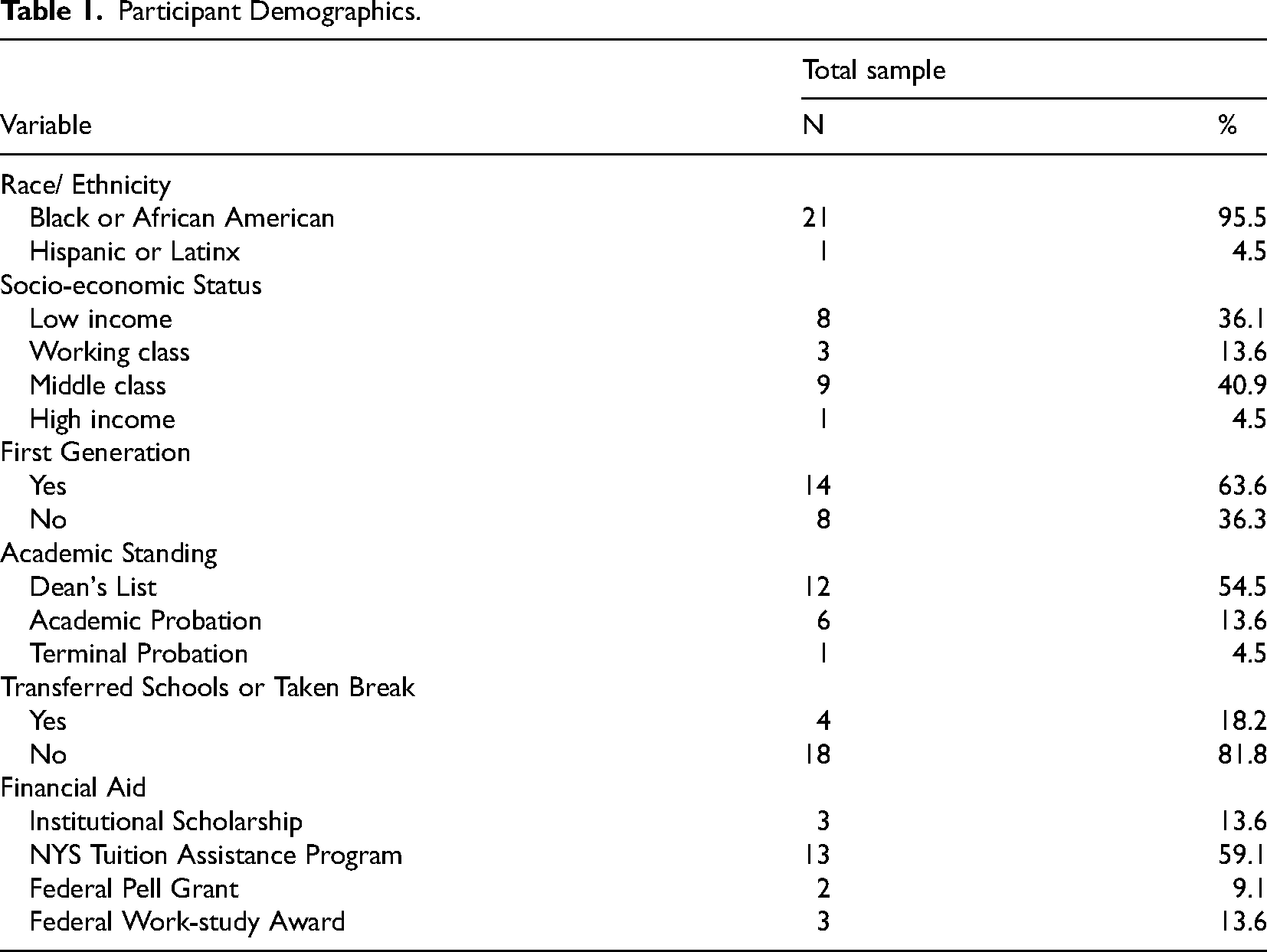
The study sample (n = 22) self-identified as Black or having ancestry from a country within the continent of Africa or the African Diaspora, Caribbean Black, Indigenous/ Native American, and Latinx; as women (of any gender expression); and as undergraduate (n = 13) or graduate (n = 9) students currently attending a historically or predominantly White college or university in New York State. Data collection did not include questions about participant's gender expression or sexuality; however, many participants disclosed their sexuality during the focus groups as it related to their experiences engaging with the campus community and adhering to university policies. All participants were English-speaking, 18 + years of age, and actively enrolled in a degree program at the time of participation with a diverse range of academic pursuits being reported. Participants were on average 21.7 (SD = 3.08) years of age and self-reported a mean grade point average of 3.57 (SD = .47). Table 1 describes self-reported participant demographics.
Participant Demographics.
Data Collection
We first surveyed participants to collect demographic information, including racial/ethnic identity, age, socio-economic status, student status, grade point average, academic standing, history of continued enrollment at their respective colleges or universities, and first-generation status. Immediately following the questionnaire, the focus group semi-structured protocol was used to elicit qualitative data from participants (Figure 1). Focus groups and an interview were conducted for approximately 55–90 min via a secure video conference platform (Zoom) or in-person with audio recording occurring. The semi-structured interview guide served as the instrument used to collect pertinent information related to the participants’ definition and experience developing a sense of belonging at their respective colleges or universities, how their belonging affects their academic progress, awareness of the support available, and how they cope with their experiences.
Thematic map of qualitative data from focus groups.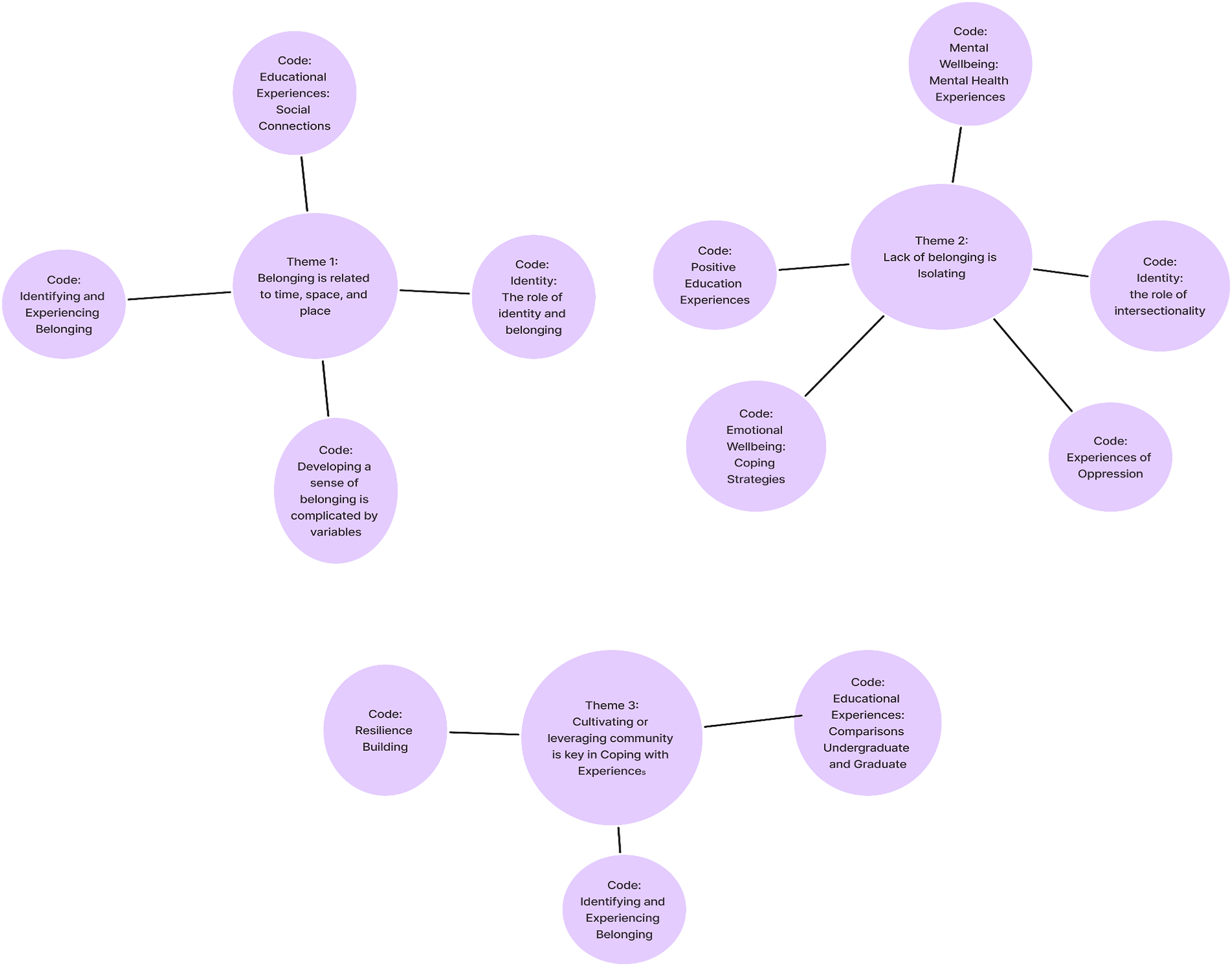
Data Analysis
All audio recordings were transcribed verbatim. Five researchers participated in the data analysis phase, which included a detailed first coding process. Using an inductive coding approach, thematic analysis helped to explore the meaning of participants’ lived experiences (Braun & Clarke, 2006; Clarke & Braun, 2016). The team uploaded the transcripts from the semi-structured interviews to Atlas.ti web version for qualitative coding and analysis. They repeatedly immersed themselves in the data to become familiar with it, develop initial interpretations, and engage in reflective memo writing. Using line-by-line coding helped create a thorough code list and set parameters. This coding process entailed assigning labels and phrases to repeated significant themes.
The second coding cycle began, building upon the initial coding stage. The first and third authors systematically categorized the codes into groups based on their relevance to the research questions. This phase required a collaborative effort between the first and third authors, who explored the dataset together, engaged in extensive discussions about the created codes, and conducted a reflective evaluation of how to portray Black women's lived experiences best. The parameters for the codes were critically redefined, leading to a consensus achieved through iterative discussions. This resulted in formulating a comprehensive set of codes, with researchers engaging in thoughtful discussions to uncover the underlying representations of the data. The codes were later grouped into overarching themes, three of which are highlighted in this article, effectively summarizing and representing the lived experiences of Black women.
Findings
Three main themes elucidated participants’ expressions of the multidimensional aspects of belonging based on their experiences and related to the people they were connected with, the spaces they were in, as well as the events occurring in society and the world around them. The themes also shed light on the mental and emotional toll related to feelings of disengagement or not belonging within their respective institutions, coupled with altering their presence through masking or shifting to fit into spaces that tax Black women's mental health. Participants indicated the value and power of connection among people with shared identities in soothing the emotional injuries experienced while navigating spaces where they are not adequately represented and that adversely affect their well-being through harmful practices and policies.
Theme 1: Belonging is Related to Time, Place, and Space
Participants consistently described the importance of connection and support in fostering a sense of belonging. In their definitions of belonging, they expressed the multidimensional aspects of belonging based on their experiences. Participants disclosed the importance of being seen and validated, having a shared identity with others within the campus community, and knowing or feeling that their contributions are appreciated and welcomed. One participant described belonging as a feeling of comfortability in a space and others discussed how this comfortability provides the support they need to share opinions and seek guidance. I guess to me belonging means that you feel comfortable um or at least accepted or better yet understood the way you are…being heard because um I think it's important to be considered and heard and actually be able to voice your opinion in something is actually like being taken from it… (Participant #12)
Similar sentiments were expressed among other focus groups participants who identified the need to be supported and heard as critical components within their academic spaces in developing a sense of belonging. Participant #10 expressed the need for shared identity in facilitating a connection with faculty to feel truly understood and validated in academic spaces, suggesting there may be some cross-cultural differences that affect the ways faculty affirm students’ sense of belonging within and outside of the classroom. I def[initely] feel belonging means being seen and heard. In my experience fall semester I felt seen and heard my first professor was a Black professor was able to be more personal with him because he understood. Spring semester I felt less belonging because I didn’t have a Black professor. I had [a] person of color, but I still felt like I wasn't understood sometimes. (Participant #10)
Several participants discussed and alluded to tense environments on their campuses amidst the 2020 presidential election and the rise of hate crimes during a time of increased social polarization related to race, class, sexuality, and gender identity. For example, Participant #18 discussed how the ongoing societal contention made it difficult to connect with other students on campus where they felt they needed to mask or shift their identity to avoid being stigmatized. I was just kind of scared to like show my personality, or like not so like I was very conscious of, like the stereotypes of Black women and people in general. So, I was like, try not to be like loud or overactive, or like talking with my hands and like things like that. So that's one way that I kind of like. I felt like I had to like to dim my light or like, make myself someone that I wasn’t, and I was also like very like careful, like what I spoke about. And it's interesting because I came in as a freshman in 2020. And that's when the election was. And we [Participant # 18 and roommate] were like talking about politics once, and we, I think we were watching the presidential debate. Oh. And I was like opinionated about something, and I think she [roommate] also felt that she couldn't really like say what she wanted to say… (Participant #18)
Participants also discussed the ways cultivating community in the academic and social spaces in college among people with shared identities facilitates belonging through safe spaces and creating comfortability to show up authentically. I want to say for me in addition to comfort belonging also means having the sense of community feeling like this is a space that is welcoming um but also this is a space where I deserve to hold and reserve space um I can definitely relate where like I mentioned when I was in undergrad that sense of community was there where I lived because in terms of the on-campus residence we were mostly Black students and students of color specifically from cities so from New York from Philly from Baltimore from Jersey so there was a sense of community amongst us because a lot of us not only have similar ethnic and racial identities and maybe socioeconomic statuses and we shared identities but we also came from similar backgrounds. (Participant #14)
Theme 2: Lack of Belonging is an Isolating Experience that Adversely Affects Black Women in Multiple Ways
Study participants explained that being Black women enrolled at a PWI did not directly affect their academics but did impact their overall well-being and progress in other ways. The participants delved into the effects that their encounters in environments where they are underrepresented have had on their mental well-being, emphasizing the shared struggles of Black women and other marginalized identities. These include the lack of safe spaces, feelings of isolation, and a pervasive sense of being undervalued due to their race and intersectional identities of socio-economic status, gender expression, and sexual orientation. One participant shared how they were affected by their lack of connection to the institution as it relates to the culture and climate of the college they attended. The participant indicated how witnessing or experiencing discrimination based on race, gender expression, and sexual orientation adversely affected their mental health. I would also agree that it hasn’t affected my academics [attending a PWI], but it did have an effect on my mental health a lot. I have to bear witness to straight cisgender men being very colorist and nothing being done about it. I’ve liked witnessed a lot of homophobia because, again, there is a lot of straight people here, so a lot of homophobia within the community, an extreme amount of transphobia that has not been addressed at all like people notice but do not say anything, a lot of sexualization of people to the point where it's like where it's harassment (Participant #1 says yes and nods) to be honest. Yeah, I haven’t had a good experience as a queer Black woman, I’m not just gonna sit here and befriend you because I need connections. I’m never going to go to that extent, so it's been very isolating for me. (Participant #2) Like in my Spanish major, and like most of my classes, I'm only one of 2 or 3 Black people. So, it's like pretty like interesting, but also kind of intimidating at the same time, because I feel as though sometimes like when it's like my turn to speak, I feel it's like everyone's looking at me, and it's kind of [prompting me] to prove myself right like for me to like show that I belong here. (Participant #18) I get good grades, but because of that, my mental health has suffered a lot cause just, like again, you’re a Black person at a PWI, you don’t have a safe space here. Like, at least in my experience, I’ve never had a safe space here. I feel like a target everywhere (Participant #1 nodding) I go. I’ve had experiences where professors have like unprofessionally come at me because they’ve heard my tone or like my accent; I don’t code switch, so you know if I’m really upset, it's going to come out, and they’ve like really tried to go at it with me. (Participant #3) …. if you report these hate crimes or the discrimination to the administration, they don’t do anything about it; they just gaslight you and the professors like gaslight you, if you have a boss, they gaslight, just everyone just gaslights you here… (Participant #1)
Institutional policies and practices continue to cause harm to Black women students who seek out support in counteracting the adverse experiences they endure in academic spaces. Participants expressed how the lack of support carries over from the classroom to university leadership in addition to their workplaces outside of their respective colleges or universities.
Theme 3: Cultivating or Leveraging Community is Key in Coping with Experiences
Creating and leveraging community was salient in fostering a sense of belonging among graduate students. Participants identified student-created spaces they accessed for support and described how connections made in these spaces developed into communities that helped improve their mental health during and after the adverse experiences at their respective institutions. Graduate student participants discussed their current experiences relating to belonging and subsequent mental health struggles within predominantly or historically White colleges but also their retrospective experiences attending predominantly or historically White undergraduate programs. Their undergraduate experiences allowed them to be more mindful of their own well-being as it related to belonging by specifically developing a safe space among a cohort of students with shared identities while in graduate school. Most importantly, creating a community exemplified the characteristics of giving and receiving support during challenges such as witnessing and experiencing microaggressions or adverse interactions in the classroom. My first year of the MSW program a group of girls… well Black women and some who identify as a person of color created um a safe space for um people of color in the Social Work program and we would just like talk and debrief and talk about um things that maybe probably offended us in class or things that we thought like um the other like non people of color would say in class that would be like you know you just want to talk about it with someone that that will understand and agree so definitely creating your own safe space helped. (Participant #16)
Several undergraduate and graduate participants also discussed the communities they developed outside of their post-secondary experience as foundational relationships distinct from those formed with college or university peers. Yea definitely community um I think also like the connection of Black women is so different I feel like than any other connection that I’ve had um like although I had a very bad experience in high school um the Black women I met there are definitely lifelong friends and people that I’ll never um forget and never lose my like really great connection with um so I think like there's something about that sort of relation like just I don’t know like there's just something different I guess about um being in community with Black women. (Participant #6)
Discussion
This study explored the experiences of Black women attending historically or predominantly White colleges and universities across multiple academic disciplines during a tumultuous time in societal history (e.g., the COVID-19 pandemic, Black Lives Matter Movement, changes in social policy, etc.). Echoing previous studies, participants described how incidences of discrimination were directly related to their intersecting identities based on their race and ethnicity, gender, gender expression, sexuality, and socioeconomic status (Hannon et al., 2016; Lewis et al., 2021; Oyewuwo & Walton, 2023; Szymanski & Lewis, 2016). In turn, these experiences adversely affected their mental and emotional well-being, although they did not affect their academic standing or academic success directly despite much of the literature suggesting adverse experiences are linked to poor academic performance (Hannon et al., 2016). The limited influence on academics may be associated with the coping strategies participants employed that have facilitated perseverance in their respective degree programs as suggested in prior research (Spates et al., 2020). Specifically, connecting with people who share similar identities i) helps provide the support and guidance needed to mitigate some of the adverse experiences participants were subjected to, and ii) overcome the institutional and interpersonal barriers faced. Participants described becoming selective in their activism and resistance to protect their own well-being (Jackson et al., 2022).
In alignment with previous findings, participants expressed a sense of belonging as human connectedness, feeling heard, a sense of community, and showing up in academic spaces as themselves (Hannon et al., 2016). Participants also spoke to the value of racial representation among faculty. For example, Participant #10's experience with a Black professor provided a personal connection that fostered a feeling of understanding where some of the literature has suggested relationship building and acknowledgement from faculty, regardless of race/ethnicity, can help students build a greater sense of community (Ong et al., 2018). In contrast, the findings of the present study indicate that insufficient representation within the academic faculty has resulted in feelings of disconnection among participants. This disparity underscores the necessity of examining the influence of faculty racial diversity on student engagement and the sense of belonging within the educational environment.
When participants reported a lack of belonging in PWIs, they indicated that their academic performance remained stable; however, the feelings of alienation negatively affected their overall mental health and well-being. This suggests that the challenges posed by higher education environments did not hinder academic success, as the participants displayed remarkable resilience despite challenges endured (Daftary et al., 2020; Szymanski & Lewis, 2016). Nonetheless, this resilience should not be glorified, as Black women deserve to be in environments that foster a sense of safety and should not have to be resilient (Jackson et al., 2022). Recurring themes among participants included the emotional injuries they suffered from feeling undervalued, displaced, and witnessing or enduring pervasive discrimination based on race, gender identity, and sexual orientation from peers and faculty (Daftary et al., 2020). Additionally, participants highlighted feeling pressure to prove themselves as an additional stressor in class. This sense of hyper-visibility led to anxious feelings and self-doubt, as participants were compelled to engage in discussions and demonstrate their worth. This finding runs contrary to previous studies that have suggested that added attention can support Black women in their academic work (Hannon et al., 2016). These negative experiences highlight the tensions arising from the repercussions and burdens of being one of the few Black women in academic spaces.
Lastly, participants expressed exclusion and poor academic support from faculty. Participants highlighted broader challenges within academic institutions, such as a lack of a safe mechanism to report when they experience harm that does not lead to gaslighting, retaliation, and re-traumatization (Leath et al., 2021). Inadequate support amongst individuals in positions of power further perpetuates the cycle of silence and suffering, as a result of the emotional injury caused by the “othering” and tokensim experienced (Jackson et al., 2022). The findings underscore the urgent need for systemic changes within higher education to promote a holistic approach to academic success beyond good grades (Leath et al., 2021). This approach should be integrated into academic accreditation processes and seek to ensure that Black women in higher education feel safe, supported, and valued.
Implications
Implications for Social Work Practice
The findings of this study present significant clinical implications for social workers and mental health practitioners engaged in supporting Black women students through the use of culturally responsive practice approaches and interventions. The authors contend that it is the responsibility of social work and mental health practitioners to create environments in which Black women feel secure and have their mental health prioritized by acknowledging the diversity in experiences and the multiple layers of discrimination that impact Black women's well-being. However, it appears that many service providers, including those employed by college and university psychological centers, have inadequately addressed the safety and sense of belonging of Black women. Therefore, exploring alternative methods of supporting Black women that prioritize mental health is imperative.
Practitioners should employ antiracist and intersectional frameworks in their assessments and support strategies for the mental health and well-being of Black women. This process begins with the unlearning of harmful, pathologized narratives that are often associated with the experiences of Black women. Much of the professional training and education that mental health practitioners receive is rooted in Eurocentric paradigms that do not align with the lived realities of Black individuals and other people of color, as well as women and gender-expansive individuals (Adames et al., 2018; Comas-Diaz et al., 2019). The integration of antiracist and intersectional approaches into clinical practice can enhance practitioners’ understanding of how therapy seekers are impacted by racism and isolation while also illuminating the multifaceted ways they endure subjugation through both internal and external systems of oppression due to their diverse identities (Adames et al., 2018). Antiracist clinical practice requires mental health professionals to recognize and address instances of therapy seekers' internalized identity-based discrimination, which may manifest as self-doubt, diminished self-worth, and reduced life satisfaction, potentially leading to increased feelings of hopelessness, anxiety, and embodied stress, as discussed by participants in this study.
Moreover, mental health practitioners must be equipped to provide culturally responsive services, such as psychoeducational group interventions explicitly tailored for Black women. Engaging in group work with Black women constitutes a culturally attuned approach to addressing mental health issues such as depression and anxiety, where participants share commonly aligned experiences and identities (Jones et al., 2023; Jones & Pritchett-Johnson, 2018). The psychoeducational components of these groups facilitate essential skills development, empowering participants to manage symptoms and cultivate coping mechanisms to navigate stressors encountered during their academic pursuits and beyond (Jones & Pritchett-Johnson, 2018). Additionally, modalities such as storytelling and the establishment of counterspaces spaces can aid clients in understanding their identities and those of others while fostering authenticity and self-care throughout their collegiate experiences (Porter & Byrd, 2023). Recognizing and validating shared experiences, creating spaces for open dialogue, supporting the formation of community among Black women, and analyzing internalized racism and systemic oppression can facilitate healing from the profound impacts of discriminatory incidents and the socio-political climate, as experienced by numerous participants in this study (Adames et al., 2018).
Implications for Higher Education
The implementation of an intersectional approach within higher education that values and understands the interlocking systems of oppression (gender, race, ethnicity, sexual orientation) is warranted if institutions of higher education want to build an environment that fosters a sense of belonging for Black women. In order to address the lack of belonging Black women face in higher education in PWIs, those working in various academic fields should mandate an inclusive curriculum that acknowledges the historical and contemporary contributions of Black women and their communities. By revising the curriculum to decenter Whiteness and adopting a comprehensive understanding of Black communities through insights from Black authors, we enable Black women to recognize themselves as knowledge producers. This approach transforms their educational experiences, alleviates the pressure to prove their worth constantly, and diminishes the effects of hyper-visibility.
Community plays a crucial and highly valued role in academic environments, providing opportunities for Black women to connect with individuals with shared identities. However, it is essential to recognize that Black women are not a monolith; they possess unique experiences and perspectives. Consequently, forming intersectional communities must transcend superficial initiatives to foster a sense of belonging. For instance, establishing Black queer groups that specifically explore the intersection of queerness and Black identity can be beneficial. As the Black women in the study highlighted, intersectionality is essential to their community-building process.
The representation of faculty and staff is crucial; when Black women predominantly see White professors, it diminishes their perception of themselves as potential academics. However, it is essential to note that White faculty members cannot absolve themselves of their responsibility to foster inclusive spaces by employing an antiracist and intersectional approach. Relying solely on Black faculty to create a safe space for Black students can lead to burnout for those faculty members. White faculty must also engage in the work required to support their Black students, which includes undergoing antiracist training, engaging in critical reflection, and enhancing their critical consciousness.
The findings of this study suggest that the participants’ feelings of belonging did not influence their grades. However, it is essential to recognize that grades should not solely measure academic success. This highlights the necessity of moving beyond educational achievement to adopt an intersectional and integrated approach that considers emotional well-being. Creating spaces for dialogue outside the traditional perspectives on academic success is essential for fostering a more equitable educational landscape.
Limitations and Need for Future Research
Although this study has several strengths and produced meaningful results, the findings only reflect the experiences of women who have attended a small number of the colleges or universities in New York State and do not reflect the experiences of all Black women enrolled at PWI or those enrolled at Historically Black Colleges and Universities (HBCU's). Through the exploration of semi-structured interview questions, focus group participants were able to reflect on their connections and academic progress and share their experiences. However, focus group methods do not allow the same level of depth as a one-on-one interview. Future research must consider the cultural contexts of private and public institutions as well as the overall student population size of colleges and universities, the number of faculty of color employed, and the accessibility of culturally relevant support programs offered, as these may also influence the experiences of Black women enrolled as students.
Conclusion
The findings of this study echo prior research asserting that a sense of belonging is influenced by socio-political circumstances, the representation of shared identities, and the availability of welcoming spaces where students can be themselves. For Black women, a sense of belonging within the larger or dominant group is deeply affected by sexism, racism, or other marginalization based on their multiple identities (Crenshaw, 1989). The ongoing social unrest, racial polarization, and the dismantling of diversity and equity programs across colleges and universities in the U.S. have created a unique circumstance where historical antecedents of gender and racial discrimination are reoccurring much more overtly. Adverse encounters cause Black women to further isolate themselves in academic spaces as they disengage from the campus community and seek support from peers or external members of their social networks to feel seen, heard, and supported in their experiences. Creating community and focusing on perseverance were common themes in the discussion in this study, indicating that Black women will often tap into resilience and embody stressors despite the harmful effects on their physical and mental health. These two methods of coping were highlighted as major resources for developing and maintaining a sense of belonging as they lean on individuals and groups of shared identity for validation and guidance while pushing through any negative encounters despite the emotional injury experienced (Jones et al., 2023; Jones & Pritchett-Johnson, 2018). Developing culturally appropriate spaces as interventions is important to Black women's overall well-being, including their academic performance and mental health.
Footnotes
Acknowledgments
The authors are grateful to the twenty-two Black women who participated in this study and shared their stories of perseverance despite the challenges faced at their respective institutions. A special thank you to Syre Zenon who served as a member of the research team, assisting with recruitment and data collection efforts in the initial stages of the project. We also thank Dr. Robert Miller Jr. and Dr. Lani V. Jones for the mentorship and guidance they provided the first author in the development of the pilot study that ultimately led to this iteration of the project.
Funding
The authors disclosed receipt of the following financial support for the research, authorship, and/or publication of this article: This work was supported by the University at Albany Initiatives for Women Gloria R. DeSole Fund Award and Skidmore College Mellon Grant Summer Research Program.
Declaration of Conflicting Interests
The authors declared no potential conflicts of interest with respect to the research, authorship, and/or publication of this article.
