




Abstract
Although the concept of intersectionality has gained widespread attention in social science research, there remains a significant gap related to the impact of intersectionality on identity formation for persons negotiating multiple marginalized social identities. This gap is especially significant among Black women who are Deaf—two groups who face significant education disparities and are largely absent in the research literature. In response to these gaps, we conducted a qualitative study with Black Deaf women (n = 25) on a college campus to better understand the lived experiences of this population and its impact on their intersectional identity. Many of the participants expressed, despite problems related to gender, race, and disability, the number of Black Deaf women on campus made them feel that they had a support network of allies. Implications for future research and social work practice are discussed.
Keywords
Black Deaf women are an invisible population because of the marginalization of their intersecting identities. The disparities experienced by Black Deaf women are often intersectionally connected to one or more of their marginalized identities. For example, Black Deaf women experience hostile climates on college campuses around their marginalized social identities status (e.g., race, gender, and Deafness), and the intersections of these identities exacerbate this reality (Chapple, 2012, 2019).
This study explored the ways that intersectional identity can impact the lived experiences for Black Deaf women on a predominately White, male, and hearing college campus by examining the following: (1) Black Deaf women’s understanding of their intersecting identities, (2) the lived experiences of Black Deaf women on a college campus, and (3) the social construction of gender, race, and Deafness on a college campus. This work challenges the dominant ideology within academic institutions that suggests Deaf students, women, and students of color have sociocultural and educational deficits based on their identity and social location (Williamson, 2007). Thus, we emphasize the structural inequalities and scarcity of research in this area, which shape Black Deaf college students’ opportunities and risks in educational institutions and its impact on identity.
By highlighting these experiences, we seek to improve the overall well-being, educational experiences, and reduce the social isolation of Black Deaf women. We centralize experiential knowledge by choosing a research epistemological approach that centers the standpoint of Black Deaf women’s lived experiences on the college campus. Data were collected through campus observations, focus groups, and individual in-depth interviews and analyzed using a critical race–grounded theory method. Three themes emerged from the data: (1) Identity is intersectional, (2) The lived experiences of Black Deaf women on campus, and (3) The role of intersectional racism, ableism, and sexism on campus. After a discussion of the themes, Black Deaf feminism (BDF) is introduced (Chapple, 2019). BDF is a theory developed as a conceptual framework for research and practice with Black Deaf women. Finally, we discuss implications for social workers and other clinical professionals working with this population.
This study was conducted using various insider/outsider perspectives as each of the three authors identify as Black hearing women, each having a unique relationship with the Deaf community. The first author is the mother of a Black Deaf woman, who has experience working with the Deaf community as a sign language interpreter, social worker, and researcher. The second author has a background in public health researching health disparities among the Deaf community, Critical Deaf studies (DeafCrit), and sign language interpreting. The third author is the Godmother of a Deaf woman, who has a background in social justice–orientated advocacy and research in the areas of social identity development of Black, Indigenous, and People of Color (BIPOC) and lesbian, gay, bisexual, transgender, queer, intersex, and asexual individuals in the context of social media and the gaming industry.
Literature Review
Working at the interface of intersectional critical race feminism, this work explores the lived experiences of Black Deaf women by placing their experiences in conversation with disability theories, which have traditionally excluded women and BIPOC. We also center Deafness in this discussion because culturally Deaf individuals do not automatically ascribe to the notion that they are disabled; the Deaf community identifies as a cultural–linguistic minority (Lane, Hoffmeister & Bahan, 1996; Holcomb, 2013; Leigh, 2009).
Our engagement with DeafCrit, critical race disability studies (DisCrit), and intersectionality allows us to add to the conversation on (in)visibility within disabled communities and scholarship, and how Black Deaf women perceive belonging within these normative and institutional spaces.
This project is also largely influenced by the relationship between identity and the variables of situational theory. While scholars from multiple disciplines have argued that people simultaneously hold many cultural identities, sometimes it is hard to dissect the implications of these meanings across a multitude of spectrums. Situational theory provides understanding into the process of making identity-relevant choices, particularly ones that require an actor to choose between conflicting sets of cultural values or beliefs as the experiences of Black Deaf women reveal. While situational theory of publics predicts when people have decisive thoughts and communicate about a problem, we explore the role that intersectional identity has on these decisions (especially when identities are externally in conflict with one another as Black Deaf women will reveal; Grunig, 1997).
DeafCrit
DeafCrit is said to have evolved from critical race theory (CRT) 1 and functions as a way to describe and research discrimination against the Deaf community (Gertz, 2008). One of the major tenants that DeafCrit draws upon is audism, a term introduced by Humphries (1977), which names discrimination and bias toward Deaf people and the Deaf community similar to other types of discrimination (e.g., racism, sexism, classism, homophobia, or ableism). Further, audism describes the ways that hearing privilege can be used by typical hearing individual and oral deaf individuals to marginalize Deaf individuals who primarily use American Sign Language (ASL) to communicate (Bauman, 2004; Leigh, 2009; Padden & Humphries, 2005). Ladd (2008) argued the idea that some hearing people have the impression that being Deaf denotes an imperfect individual that is flawed or damaged. This perception leads to the assumption that Deaf bodies are unwanted, inferior, and subject to repair. Although DeafCrit claims to have evolved from CRT, DeafCrit scholarship does not appear to contain writings that include a racial analysis for Deaf BIPOC; nonetheless, the concept of intersectionality is mentioned in some of the writings. It merely connects “audism” to Deafness in the same manner “racism” is connected to BIPOC, “sexism” for women, and “ableism” for people with disabilities, so on.
DisCrit
Historically, disability studies literature excluded the experiences of BIPOC, focusing exclusively on White individuals. Bell’s (2006) “White Disability Studies: A Modest Proposal” referred to the omission of race in disability studies as “whitewashing” disability history, ontology, and phenomenology in research and literature, referring to the field as “White Disability Studies” (p. 275). In response to the absence of race in critical disability studies, theorists and researchers turn to examine the intersection of race and disability as well as other aspects of identity in relation to disability. Annamma et al. (2013) introduced DisCrit as a theoretical framework that combines CRT with disability studies to incorporate “a dual analysis of race and ability” (p. 1). By doing this, they highlight the interdependent, intersecting, and mutually constitutive aspects of race and disability. Bailey and Mobley’s (2019) Black feminist disability framework centers race, gender, and disability by underpinning Black feminist thought into disability studies and Black studies in an effort to foster an enhancement of the social model of disability to create a more inclusive framework for research and practice.
Similarly, Erevelles (2000) focuses on the “constitutive relationship” between race and disability, considering the reciprocal relationship in how race informs disability and how disability informs race. This interconnected relationship strives to reconcile the overlooked, yet imperative, relationship between the two categories of difference. The rhetorical strategies within the fields adjacent to disability studies have moved us beyond conversations around social construction and focus more on representation, cultural interpretations, and configure the unequal structures that disparately impact racialized, gendered, disabled bodies. It is within these frameworks that we move beyond universal dimensions of disability studies and explore the spectrum of disability incorporating historical, cross-cultural, and intersectional realities. These intersectional possibilities are often seen as radical positionalities, as they represent a paradigm shift in focus away from the disabled (White, masculine) default. Erevelles theorizes the body as a multiple dimension with a range of possibilities and contexts.
We further these theoretical conversations and employ an intersectional praxis to engage conversations to be more applicable to the realities of Black Deaf women. These perspectives even push back against traditional discourse from critical race scholarship that often describes the life experiences of a racialized subject as “crippling” and “deforming” (or as “illness” and “disease”). These approaches fail to recognize that, rather than rejecting oppressive biological criteria, they unwittingly reaffirm an imagined biological wholeness (normativity) that was instrumental in the propagation of the same oppressive ideologies of critique. Deploying disability as a trope that one should overcome instead of embracing, furthers the ableist narratives seen within critical race scholarship. Intersectionality allows for the possibilities to see how these differences inform each other.
Intersectionality
Intersectionality has been established as a conceptual framework and analytical tool for understanding the intersection of race and gender. First articulated by feminist legal scholar Crenshaw (1989), intersectionality highlights the “multidimensionality” of Black women’s lived experiences and the systems of oppression shaping them (p. 139). Intersectionality places emphasis on multiple interacting systems of power and oppression that simultaneously privilege some and disadvantage others along multiple social locations (Crenshaw, 1991; Hancock, 2007; Hulko, 2009). Other approaches of intersectionality highlight additional social constructs (e.g., disabilities coupled with how persons with intersecting identities are located within society). Erevelles and Minear (2010) outlined the three types of intersectional frameworks (e.g., anticategorical, intracategorical, and constitutive approaches) used in scholarship to situate race and disability (p. 127). They outlined ways that intersectionality can be utilized in combination with both critical race feminism and disability studies to examine the experiences of women of color with disabilities. Their analysis emphasizes the ways that individuals at the intersection of race, class, gender, and disability are classified as “(no) bodies” by social institutions (pp. 128–129).
Intersectionality: Situational Identity
The role of intersectional audism/ableism, racism, and sexism and other forms of subordination play a role in the lives of Black Deaf women. Specifically, the positionality of Black Deaf women and how their intersecting identities and social locations can influence their lived experiences on a college campus. The authors posit that Black Deaf women’s unique position in society is critical to understand, as are their lived experiences and perspectives. This is important because it helps us to understand the contexts in which identity markers are more salient than others due to the various systems of oppression at play. Black Deaf women have intersectional identities that can be catalyzed by particular social situations, known as situational identity.
Situational identity is how one’s identity changes based on different social context(s) and/or how one views themselves in response to social situation and location. Social location refers to “the relative amount of privilege and oppression that individuals possess on the basis of specific identity constructs, such as race, ethnicity, social class, gender, sexual orientation, age, disability, and faith” (Hulko, 2009, p. 48). The experience of one’s social situational identity is complex, fluid, and dynamic, changing with the social context (Chapple, 2019; Hulko, 2009; Michell, 2007). Considering these markers, Mitchell (2007) described how situational identity is similar to alternating between phases of a person’s self like “flashcards.” The process of “flipping” or alternating experiences of visibility and invisibility between race, gender, and Deafness among Black Deaf women, influences their identities (Mitchell, 2007). Mitchell described her experiences being Black, female, and Deaf, and how she lives in moments of visibility and invisibility in a dual perspective of home life and public social (e.g., school) life. Individuals with multiple marginal identities can demonstrate a constantly changing identity fluidity based on their situation(s), while one aspect of identity may be more central than others at any moment in space, place, and time (Collins, 2000). Purdie-Vaughns and Eibach (2008) asserted that “invisible” people are the result of belonging to multiple subordinate-group identities (e.g., being a Black Deaf woman). It is important to examine which identities take precedent among Black Deaf women (or Deaf Black women) based on social contexts, environments, and spaces they navigate.
Aramburo (1989) suggested that there is a difference between being Black Deaf and Deaf Black; those who identify with the former do so because of the invisibility of Deafness and the prominence of race, and those who identify with the latter do so because they were born into Deaf families. Bowleg (2008) asserted that an additive model of identity (e.g., Black + Deaf + Woman + Lesbian) is different than intersectional identity (Black Deaf Woman Lesbian) and is not mutually exclusive. Moreover, these additive identities can further promote invisibility for diverse types of Black Deaf women on college campuses.
Intersectionality: Deafness and Identity
The Deaf community is a population that is rich in diversity and makes up an abundance of individual identity facets (e.g., race, ethnicity, gender, orientation, ability, religion, and socioeconomic class; Holcomb, 2013; Lane et al., 1996; Leigh 2009). Statistics show that White Deaf individuals are no longer in the majority. Until recently, much of our understanding of Deaf culture was based largely on research conducted on White Deaf individuals. This led many to believe that Deaf BIPOC viewed being Deaf as the most important facet of their identity. In reality, based on collective experiences with racism and oppression, many Deaf BIPOC view their race as the most salient part of their identity (Corbett, 2010). Due to the visibility of skin color, a sizable number of Black Deaf individuals note that their Black identity is much more prominent than their Deaf identity (Aramburo & Lucas, 2000).
The capitalization of the word “Deaf” carries a cultural distinction, which implies that an individual considers themselves to be a part of Deaf Community (individuals who generally use ASL to communicate and do not view being Deaf as a disability; this pathologic view needs to be corrected). In this article, the authors have chosen to capitalize the word “Deaf” when referring to Black Deaf women. The choice to capitalize “Deaf” follows the same reasoning many authors chose to capitalize the word “Black” when referring to Black individuals in the United States; capitalization elevates and intentionally draws attention to these marginalized group identities. Additionally, since this study focuses on the intersectional identity of Black Deaf women, we are viewing Black and Deaf identity as prominent identities, which are constantly shifting similar to flashcards (see Mitchell, 2007).
Identity development among the Deaf community can be understood through sociolinguistics (Aramburo & Lucas, 2000), Deaf culture and bicultural frameworks (Corbett, 2010), and familial and social contexts (e.g., Deaf schools and historically through Deaf clubs; Ladd, 2008; Lane et al., 1996; Padden & Humphries, 1988). Leigh (2009) argued that Deaf identity begins in the home and that there is a consistent modification of these identities as children go to school. Social and cultural constructs of normality within the familial and educational settings inform discourses and politics surrounding students’ identity development. Ninety-five percent of Deaf children are born to hearing parents, and the way in which parents of Deaf children experience hearing differences can be attributed to how their identities manifest (Leigh, 2009). When Deaf children navigate the school setting, they can also face instances that shape their identities such as isolation, resisting their identities from home into the school setting, and bullying (Leigh, 2009). This is particularly true about the identity development of Deaf adolescent girls because of their Deafness and their gender, “the overlay of their identities matters as it doubly places them in the cracks of two dominant worlds” (Brueggemann, 2006, p. 83). Assuming the earlier quote refers to White Deaf adolescent girls, the ability to straddle “two dominant worlds” is unavailable to Black Deaf women because of the absence of racial privilege. This concept further highlights the invisibility of Black Deaf women because they are often placed in an untenable position of choosing race, gender, or Deafness.
We also want to consider Deaf adults and their identity experiences. Most research that exists in this area focuses on the Deaf male point of view (Brueggemann, 2006). However, there has been cursory research done on Deaf women and identity. Deafness among women consists of different social, emotional, and cultural experiences (Becker & Jauregui, 1981). These situations can be viewed through an intersectional lens. Deaf people are such a multifaceted community who are often marginalized by the hearing society, their identities depend on their interconnectedness to the Deaf community, their environmental circumstances, and internal feelings (Leigh et al., 1998). Becker and Jauregui (1981) and Leigh et al. (1998) made important arguments as a part of the growing body of literature related to Deaf women and Deaf people as a whole, but their distinctions exclude race, which is vital to understand this understudied population.
Brueggemann et al. (2005) stated that “Disability is an identity system that is very similar to race, gender, sexuality, but yet it has its own specificity and a tremendous number of interesting complications that get brought into the analysis” (p. 32). Brueggemann et al. also remind us “no woman is ever only a woman”—she also has all these other identities. She is always a disabled or nondisabled woman who identifies or is identified in this way (p. 32). Considering this information, it is critical to note that much of the existing literature that focuses on Deafness and identity historically focuses on White Deaf people, excluding Deaf BIPOC. This further highlights systems of oppression under scrutiny. Leigh (2009) made a sensational point that formation and development of Deaf identity are ultimately up to who decides that identity—the Deaf community themselves. It is critical that future research focuses on diversity as markers of identity (with respect to race, Deafness, and gender), specifically regarding Black Deaf women.
Intersectionality: Racialized and Gendered Deaf Identity
Black Deaf women are largely invisible in society, and scholarly research about intersectional identities and Black Deaf women is sparse (Chapple, 2019). Moreover, Black Deaf women are a uniquely complex population, and it is critical to understand how Black Deaf women understand their race, ethnicity, and gender and how these identity markers influence their development in numerous ways (Chapple, 2019). Marginalized intersectional identities present and interchange in a fluid and complex way because they are intertwined and emerge when navigating society and social situations (Chapman & Dammeyer, 2017).
Method
This qualitative study explored the lived experiences of a group of Black Deaf female students who attended a college in the northeastern region of the United States, using a grounded theory approach. Grounded theory is an interactive process that involves the constant comparison of data collection, analysis, and theory (Glaser & Anselm, 1967). Grounded theory assists researchers in learning and constructing knowledge about populations being studied and the worlds they live in (Charmaz, 2014). A grounded theory approach can also aid in understanding the lived experiences of historically oppressed groups and creating a theoretical underpinning for this context (Bowen, 2006). Moreover, for our study, a critical race–grounded theory approach allowed for a more collaborative relationship with the participants to ensure their experiences were portrayed faithfully (Malagon et al., 2009). Considering this study focused exclusively on the lived experiences of Black Deaf women, we used the standpoint theory approach to encourage the participants to recount their occurrences of discrimination. By understanding their counternarratives, we were able to grasp what previously has been invisible because of the dominant narratives on campus (Solórzano et al., 2000; Solórzano & Yosso, 2002; Yosso & Solórzano, 2005).
Prior to initiating the study, the research plan was submitted to the institutional research boards (IRB) at both the primary researcher’s parent university and the university for the data collection site for review. After obtaining IRB approval, school officials were contacted to locate women who fit the criteria.
Study Location
While choosing the data collection site, we noted that there are few postsecondary programs in the United States that focus specifically on educating Deaf and hard of hearing students. Some of the more prominent programs are California State University, Northridge, Gallaudet University, and National Technical Institute for the Deaf (NTID) located on the campus of Rochester Institute of Technology (RIT). 2 NTID was chosen for the study location because (1) the ability to gain access to the campus and the student population and (2) of the diversity of NTID’s student population, which allowed for recruitment of Black Deaf women.
Participants
Of the 17,000 RIT students, approximately 7% were Deaf and demographically diverse by race and gender (Chapple, 2012). Purposive (snowball) sampling was used to recruit Black Deaf female participants. Qualitative researchers use purposive sampling to select participants and/or data collection sites that will best aid in the exploration of a group or location (Creswell & Poth, 2016). Snowball sampling allows the researcher to locate information-rich participants by asking well-situated people to identify individuals (Patton, 2015; Upcraft & Schuh, 1996).
The participants for this study were selected according to the following criteria: (1) identify as an African American or Black female; (2) self-identity as Deaf, deaf, or hard of hearing; (3) be a student enrolled at the NTID; and (4) be a willing participant of this research study. The sample was composed of 25 participants who met the criteria for this study. All participants in the study were between the ages of 18–28 years. There were three freshmen, eight sophomores, 14 juniors, eight seniors, and one graduate student; each of whom was given pseudonyms to protect their identities (see Table 1). 3
Study Participants.
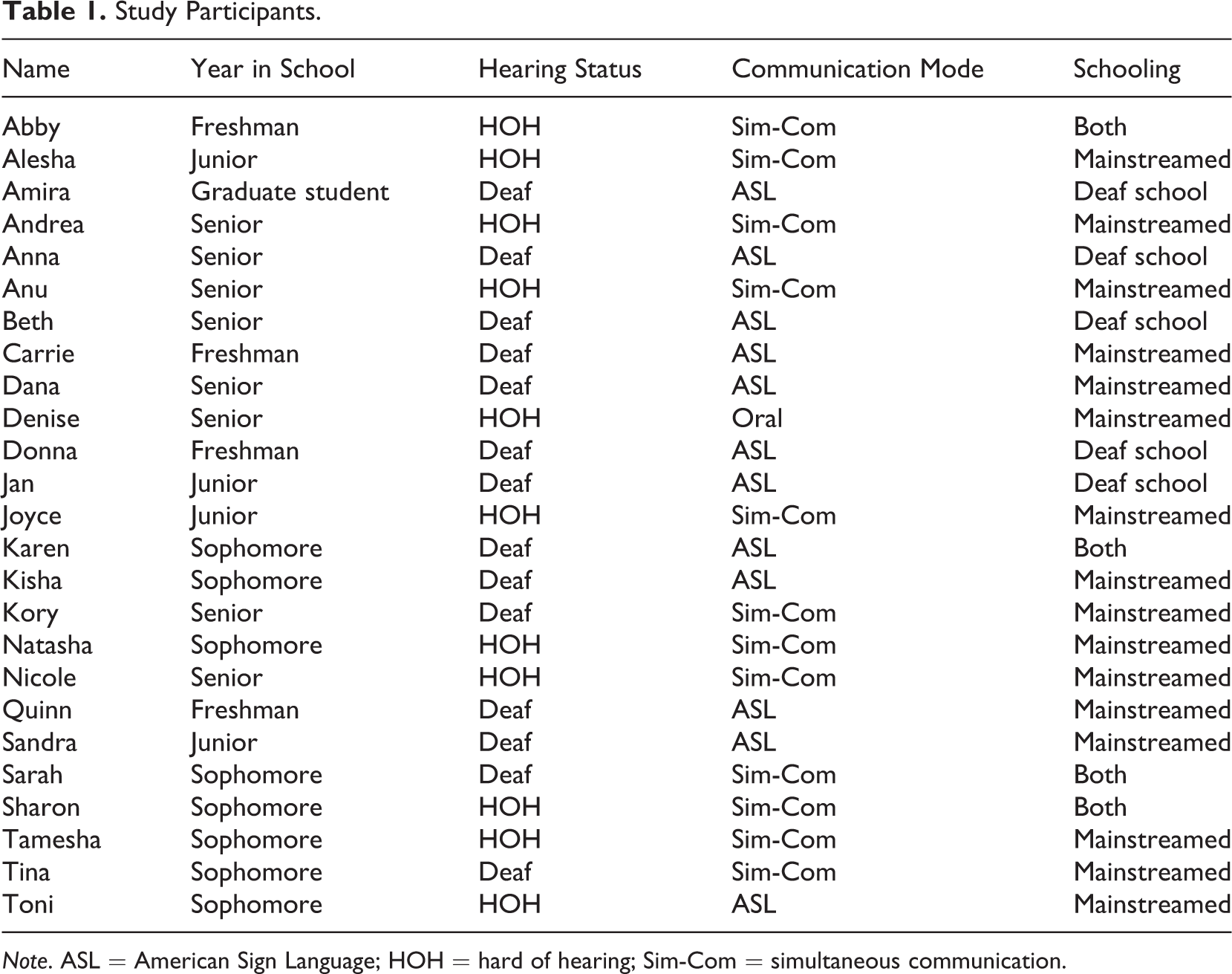
Note. ASL = American Sign Language; HOH = hard of hearing; Sim-Com = simultaneous communication.
Data Collection
Data collection consisted of four observational campus visits, four focus groups, and 15 individual interviews. The idea of a lived experience refers to the embodiment of the women’s daily life experiences and interactions while on their college campus. The research study focused on but was not limited to the participants’ concept of success, failure, discrimination, and/or marginalization highlighting the interplay of intersectionality and identity. All interviews were conducted using the participants’ preferred mode of communication that included spoken English, simultaneous communication (Sim-Com), or a variation of sign language including ASL, Signing Exact English, or Pidgin Signed English to elicit their narratives. 4 Both the focus groups and individual interviews were videotaped for purposes of transcription, validity, and message accuracy.
Participant Observation
Data collection began by “hanging around” unrestricted campus areas during four separate campus visits. During the first two visits to campus, even though this campus is known for educating Deaf individuals, we were still captivated by the volume of Black Deaf people on campus and the ability for Deaf individuals to navigate and communicate with both Deaf and hearing individuals on campus using a variety of communication modes. By the third visit, we noticed the layout of campus and appearance of self-segregation among the hearing and Deaf students as well as the Black and White students on campus. There appeared to be a noticeable separation between the Deaf and hearing students, the hearing White students and hearing Black students, and White Deaf students and Black Deaf students—of note was the division between the Black Deaf students and Black hearing students.
Implicit segregation between Deaf and hearing individuals was clearly displayed on campus, as the dynamics of the RIT campus fostered a clear separation between the Deaf and hearing students. As seen in the campus map (see Figure 1), there is a significant distance between the Deaf and hearing students, as most of the Deaf students take classes at NTID (located in the LBJ building 60) and live in the surrounding dorms. This is different for the hearing students who primarily take classes in one of the other eight colleges of RIT and reside in dorms located on the other end of the campus.
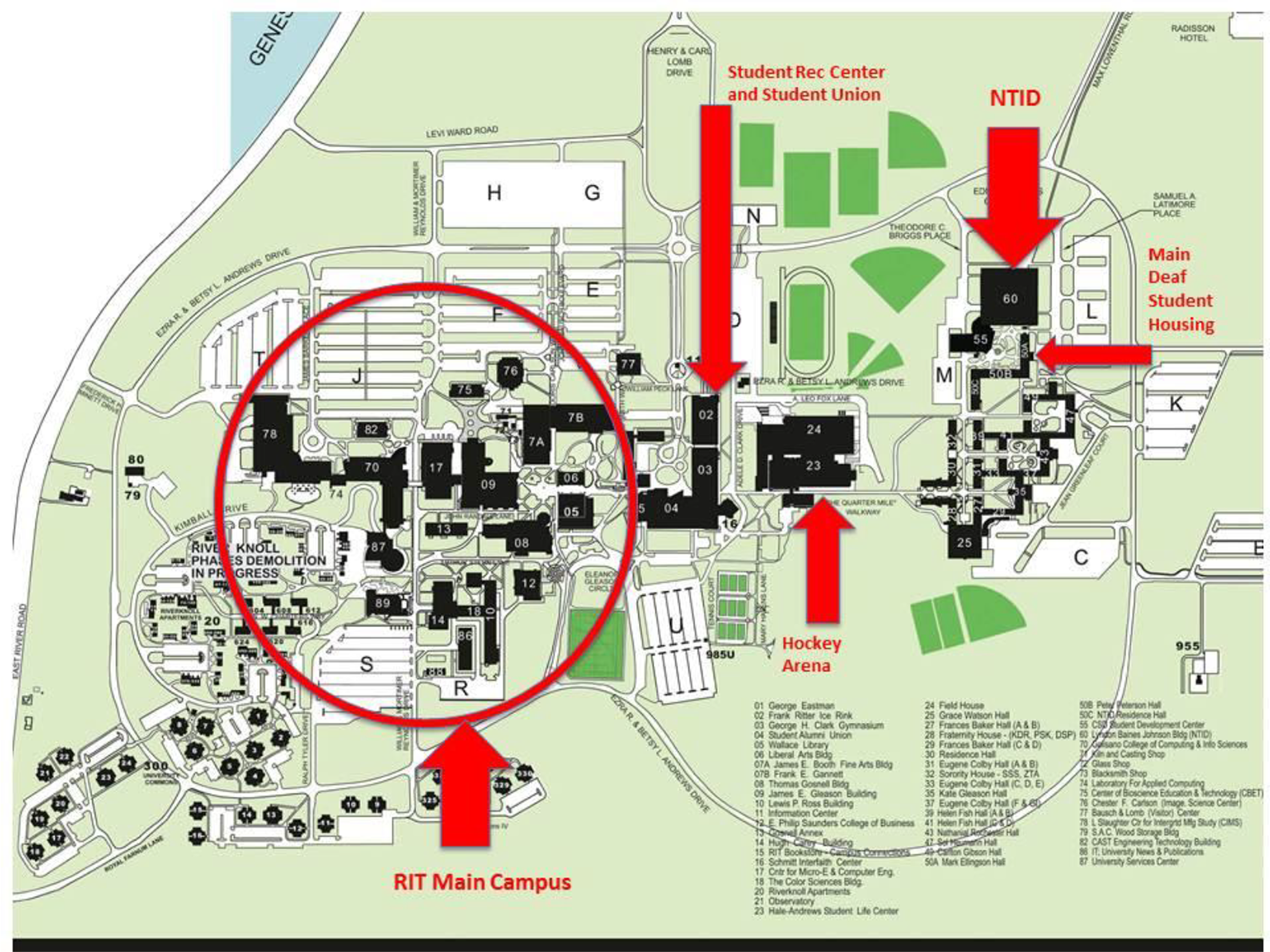
Map of Rochester Institute of Technology.
The geographical location of NTID within the larger campus of RIT offers a distinct feeling of segregation, which created distinct issues for the integration of Deaf students on campus resulting in a greater potential for separation and isolation of Deaf students from hearing students on campus. In other words, given the location of NTID, hearing students were never placed in a position to “wander” onto the Deaf side of campus and experience the same type of communication issues that Deaf students experience on the RIT side of campus. Conversely, the location of RIT’s main campus also keeps Deaf students from conveniently heading over to get a drink or a meal, unless it is part of a planned or scheduled trip to one of the campus buildings. As not to mislead, many of the Deaf students and faculty of NTID are happy with the location and distinction of the two campuses, nevertheless it also can create a sense of segregation between the Deaf and hearing students.
During the first campus observation, we attended an event where a hearing Black male student spoke on his experience attending RIT. He shared: “With so many Deaf students, you have to be careful when you approach a girl you are interested in on campus because she might be deaf and speak in sign language.” Alesha, a Black Deaf female student, shared a similar sentiment:
I talked to hearing friend yesterday and he said that Black Deaf people separate ourselves from Black hearing people and we stay with Black Deaf people. I tried to explain to him that we don’t try to separate ourselves from hearing people we are just trying to be around people we feel comfortable with. For example, if a Deaf girl goes up to a hearing guy she likes, he rejects her just because she is Deaf. So, most Deaf girls don’t approach hearing guys because they feel that the hearing guy won’t like her because she is Deaf…even if she really likes him…
This was reiterated by many participants who reported most Deaf students felt disconnected from the hearing students both physically and socially. Physically, the distance between the main RIT campus and the main NTID building contributed to this separation. Karen, a Black Deaf female, described the physical distance between the building that houses NTID and the main RIT student complex:
It’s different for hearing people here at RIT…They have more opportunities to socialize. They have more groups over there than here and they have more opportunities to make friends. It’s different for them because most of the Deaf people are at NTID and RIT is WAY OVER THERE…so we don’t socialize that much with them unless we go over there because of our major. Even then it is hard especially if you aren’t oral.
Focus Groups
Twenty-five women participated in four focus groups, each consisting of six to eight participants. The focus groups lasted approximately 1 hr each. There was an elevated level of familiarity and respect among the participants because many of the participants knew each other from campus activities and social groups. Before the focus groups began, the women were offered pizza and snacks for their attendance. While they ate, they discussed their classes and various school activities. The focus groups were conducted using a combination of spoken English, ASL, and Sim-Com and were videotaped. Focus groups were facilitated by the primary researcher/first author, a Black female nondisabled hearing social work researcher who is fluent in ASL. Although the literature suggests that some focus group participants might feel pressure to provide socially acceptable responses, focus groups have been found to work well in exploring the lived experiences of marginalized populations (Krueger, 2014). Focus group interviews were conducted first, with an invitation to each focus group participant to participate in an individual interview.
Individual Interviews
The invitations resulted in 15 women taking part in an individual interview after the completion of the focus groups. Interviews consisted of semistructured life histories. Participants completed a preinterview demographic questionnaire prior to the interview. The interviews were conducted using a casual conversational approach in their communication mode of choice. This was designed to put the participants at ease while discussing sensitive topics such as home life struggles and the academic and social challenges of navigating a predominately White and hearing campus.
Data Analysis
Interviews were transcribed for the purpose of content analysis. Data were analyzed utilizing a critical race–grounded theory approach (Solórzano & Yosso, 2002). All video recordings of the focus groups were transcribed. The transcripts were first analyzed using an open-coding strategy to tease out general themes (Corbin & Strauss, 2008). Following the open coding, axial coding was initiated to determine overall categories and subcategories (Strauss & Corbin, 1997). The following themes arose from the analysis: (1) Identity is intersectional, (2) The lived experiences of Black Deaf women on campus, and (3) The role of intersectional racism, ableism, and sexism on campus.
Identity Is Intersectional
I’m Black, I’m Deaf, and I am a woman…I’m also smart, nice and pretty! Am I really so different than other people? And anyways, what makes me different is what makes me special! (Quinn, freshman)
Although physical identifiers were salient and important to Quinn’s experiences in college, she is more than these identifiers. For Black Deaf women, their personhood is connected to three marginalized social identities. These identities dictate how people view them and interact with them (Collins, 2000; Crenshaw, 1989). The complexity of the women’s intersecting identities influences her interactions both on and off campus and the ways in which faculty, staff, and peers within the institution viewed her. Intersectionality is also concerned with the ways in which marginalized identities interact to shape multiple dimensions of personhood and accompany us in every social interaction (Crenshaw, 1991). Jordan-Zachery (2007) uses intersectionality to vividly describe her identity as a Black woman, she states: When you look at me, what do you see: a woman who is black or a black woman? In my eyes, this is a moot question since my blackness cannot be separated from my womaness. In fact, I am not sure if I want them to be separated. What I want is for individuals not to use my social location to justify punishing me or omitting me from the structures and practices of society. Sometimes my identity is like a “marble” cake, in that my blackness is mixed intricately with my womaness and therefore cannot be separated or unlocked. (p. 261)
Self-Descriptive Word Chart.
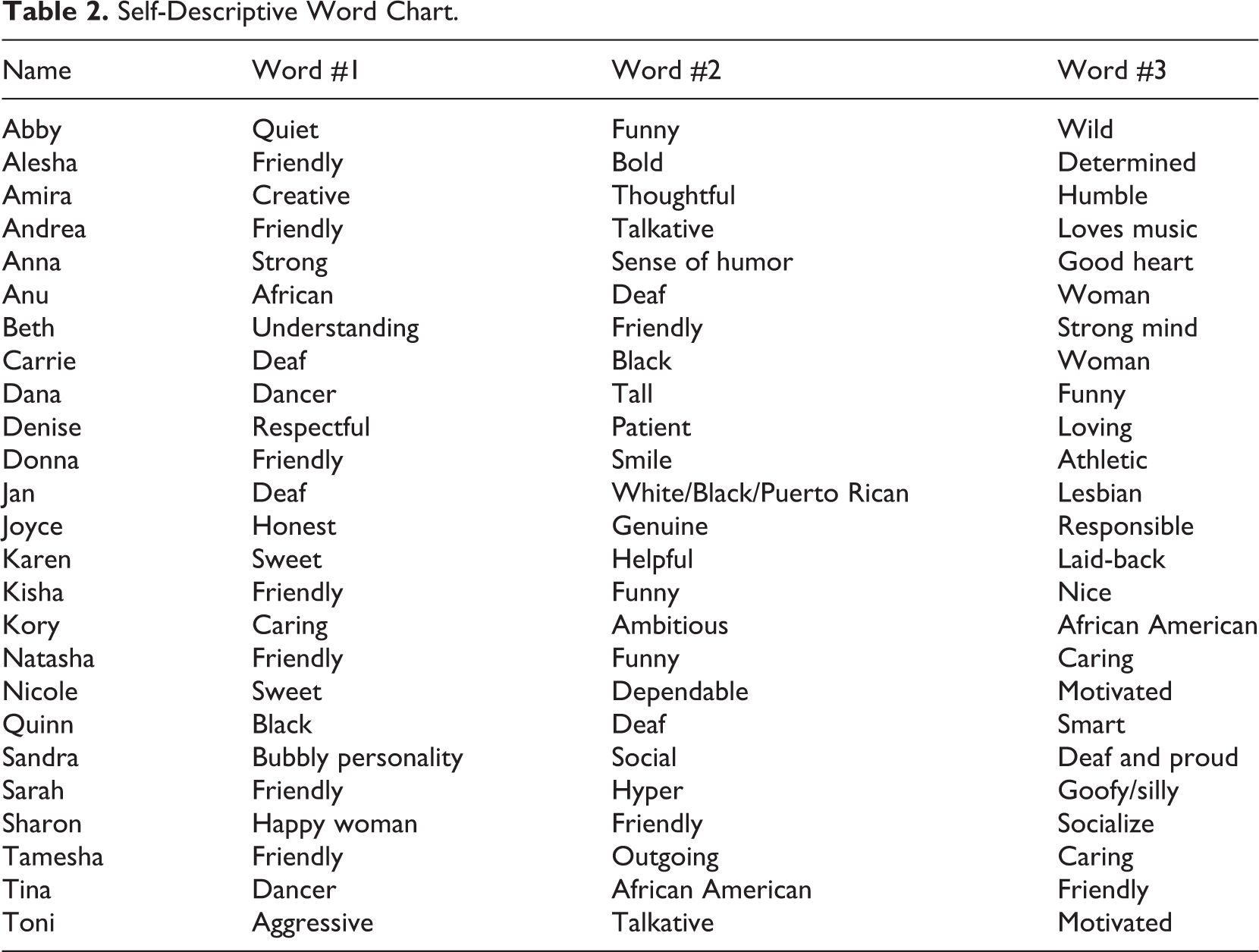
The self-descriptive word chart contains words the women used to describe themselves, many of the words chosen indicate a desire to provide a counternarrative to negative stereotypes associated with Black women or Deaf people. Nineteen of the 25 participants (76%) chose words that highlighted positive aspects of their personality (e.g., happy, nice, funny, or caring). Some of the participants choose words that described obvious physical attributes such as Black, African American, Deaf, woman, or tall. These physical descriptors suggest some of the women may have not explored other parts of their personality identity that were not focused on the most obvious identity markers of race, gender, or Deafness. The information correlates with the understanding that for most Black Deaf individuals, identity is simple, clear, and primarily situated around their identity as a Black person or a Deaf person depending on their social environment (Corbett, 2010; Hairston & Smith, 1983; Mitchell, 2007).
In some cases, the participants choose words that symbolized being strong, smart, self-sufficient, motivated, or independent. These words serve as counternarratives to the lived experiences of discrimination and the focus of stereotypical traits often used to describe women, Black individuals, or Deaf persons. As was the case with Natasha who indicated that she was “funny, friendly and caring.” Her choice of words was significant because Natasha said in her interview that people are often afraid to approach her because of her physical appearance:
I don’t know why people are afraid of me…I am very nice. I think it is because I am kind of heavy and dark [skinned]. I remember in high school, I finally decided that I had to be happy with my size and I stopped going on diets. I decided that when I got to college, I was going to be happy and be popular. I joined the dance team, but people still think I’m mean. Funny. Once people get to know me, they say, “she’s nice/good person.”
Natasha’s statement reflects an attempt to challenge the “Angry Black Woman” and “Dumb Deaf Girl” stereotypes placed on her identity as a Black Deaf woman. Natasha was not alone in this; participants found it necessary to clarify their statements to defend their character when the statement would otherwise reinforce negative stereotypes associated with Black women or Deaf people. For example, participants would end an answer to a question by volunteering something positive about their personalities. Many of the respondents stated: “I am smart,” “I am a good person,” “I am nice,” or “I am funny and fun to be around.”
The Lived Experiences of Black Deaf Women on Campus
When asked to describe what life is like for Black Deaf women on campus, many of the participants began by discussing one aspect of their identity (e.g., gender, race, Deafness, and/or sexuality) before quickly shifting to another identity depending on the circumstance or interaction. For example, Jan began discussing the difficulty of being a lesbian on campus due to the constant confrontation about her sexuality. Jan, who identifies herself as a Black lesbian with White and Puerto Rican heritage, stated:
Being a lesbian on campus is difficult. It is the hardest thing about going to school here. I am confronted all the time, harassed, and questioned. I’m a Black, Deaf, lesbian and every day I am confronted about who I am! People actually get right up in my face and ask me questions about being gay. (Jan quickly raises her hand in front of her face…ASL for “Confrontation.”)
Jan has no problem stating that her lesbian identity is the most difficult part of her identity to deal with, especially on campus. However, once the discussion changed to race, she seemed to reconsider her position, as she recalled an event from her childhood. She states:
I still think that being gay on campus is very hard. But race is a problem too. You know? Some people are just rude. I remember when I was younger, and we [my family] went on vacation to DC. A woman came up to me, grabbed me and asked if I had been kidnapped by my parents. My mom is mixed but she looks White and my dad is Black.
When Jan describes her intersecting identities, she struggles to decide which of her identities is the most difficult to live with, this is a clear example of situational identity. Her perspective seems to change according to the social situation because identity is fluid, ever evolving, and often influenced by structural factors that highlight social differences (Lawler, 2009; Mitchell, 2007). Problems with identity confrontation can also be based on sexuality or nonconformity of gender roles. For Alesha, a basketball player who is often confronted because she does not conform to the idea of a “typical” college athlete, stated:
I’m a basketball player…at first it is hard for me to accept the fact that I am the only Deaf person on the team. Some of my teammates were surprised that Deaf people were creative. They were like I never thought of a Deaf person playing on a team. I finally proved myself and they accepted me as part of the team. They accept me for who I am. They know I have enthusiasm for the game. They accept me for who I am.
While Alesha eventually felt accepted by her basketball teammates, she first had to prove that being Deaf would not hinder her athletic ability or her capacity to participate as a team member. Alesha, who is hard of hearing and grew up in a mainstream educational setting, believes her years of speech therapy and proper speech articulation, contributed to her ability to connect with her teammates.
Many of the women said that hearing people often feel that Deaf people have a need to be protected or rescued from their Deafness. On campus, even with a significant Deaf population, Black Deaf female students are made to feel marginalized trying to accomplish a small task like attending a group tutoring session. Carrie, a Black Deaf engineering student, who communicates primarily in ASL, felt ostracized during a group tutoring session with White Deaf students with speaking privilege. Carrie stated:
When I attend group tutoring, the other students will answer the questions for me if I don’t answer them fast enough. I am an engineering major, so I get tutoring for calculus, statistics, and chemistry. All of the Deaf people in my classes are White and most of them prefer to speak. In some of my classes, I am the only Black woman (hearing or Deaf)! They look at me and always want to help me in class and in group tutoring. This does not help me. I attend tutoring but often when I take tests, I do not remember the answers, because I never get to figure out the answers on my own in class or tutoring. It is very frustrating!
The problem Carrie outlined above is a direct result of her intersectional identity; as a Black Deaf woman who primarily uses ASL to communicate, she does not fit within the “typical” image of engineering majors who are most often White, male, and hearing. Additionally, on campus, many of the Deaf students have the speaking privilege and can communicate more easily with hearing students. A majority of the participants felt that despite the problems on campus from hearing and White students, they liked being on a campus with other Deaf students. Many of the women in the study attended mainstream high schools, where they were the only Deaf student on campus. Karen recalled:
I learned sign language when I was young, and I attended mainstream school until junior high school then I transferred to Deaf school. When I was in elementary school, we used the total communication method. 5 I had to learn to sign and talk at the same time. I had to sit and watch the interpreter and be “nice.” I didn’t really have a lot of friends. At the Deaf school, I learned ASL and I was allowed to express myself. I no longer had to sit and be “nice.” I was allowed to be myself. So, when I came here, I was overwhelmed because there were so many people here. My Deaf school was small and there are so many Deaf people here. At the Deaf school, I knew everyone there. But here there are 300 new faces every year. It is cool because I get to meet new people and learn different signs from all around the country. I’m from Pennsylvania and I notice the signs are different. It’s interesting but it’s nice and I have been here for three years and it’s been good.
Every student interviewed felt that the large concentration of Black Deaf female students on campus was a great feeling; however, nearly all participants indicated that they would like to see more students who looked like them on campus.
Having a lot of Black students on campus is a great thing, we can empower each other. Let’s be real! I look at the statistics. There is only 6% African Americans here, six percent out of so many thousands of students here.
I think it’s good because you can see that you are not the only one and you won’t get left behind. There are so many White people that can graduate with no problem. What about the minorities…what about people in our neighborhood if we graduate, we can show the younger people? See I did it you can do it too. I know it’s challenging but you can do it. So, having more numbers and the percentages increasing is good. Who knows maybe next year we will have 50%? (Nicole Laughs)
It would be a dream come true to have more Black and Deaf students on campus.
It has been noted that students of color perform better when they are on a college campus with other students of color, there is a sense of belonging that connects them to other students who reflect their cultural identity, which can fuel their academic success (Yosso et al., 2009). We see this sentiment expressed by those we interviewed.
The Role of Intersectional Racism, Ableism, and Sexism on Campus
The last theme in this area is the belief that the intersection of gender, race, and Deafness equated to a lack of intelligence and a belief that they (Black Deaf women) did not belong in college. A practice referred to as ascription of intelligence, which is the belief that an individual’s intelligence is somehow linked to their gender, race, or disability. This belief conveys a message that women are not as intelligent as men, BIPOC are not as intelligent as White people, and Deaf individuals are not as intelligent as hearing individuals (Barnartt, 2006; Sue, 2010).
Andrea, a senior, recounted negative interactions with her college professors, which caused her to stop confiding in them about her long-term career plans. Andrea, a biomedical science major, is often one of only a handful of Deaf students in class and often the only student who is Black, Deaf, and female. She said:
I stopped telling teachers that I want to be a doctor after I graduate…because they are always shocked. I told my biology teacher once and he laughed saying, “You want to be a doctor? How are you going to do that? You need to talk to treat patients.” Funny…at the time, I was one of the top students in his class.
The concepts of intersectionality and situational identity are continued here as many of the participants would often say that gender was the easiest to navigate on campus, until they entered an environment that was dominated by male students like the classroom environment. In the classroom, gender becomes a more salient identity for Black Deaf female students because they tend to be overshadowed by male students. Sarah said, “Most of the time, I feel invisible in class because many of the male students always raised their hands or blurted out the answers to questions in class before I can think of the answer.” This statement affirms sentiments of the other participants because many of them felt the instructors did not take them seriously in class or indicated they were challenged by male students during discussions. Gender bias was also evident in other areas of campus. Karen recalled the difficulty in joining a game of pickup basketball in her first year:
I love to play basketball and when I was in high school, I had a lot of friends both guys and girls that I socialized with and played basketball with. After graduation, I arrived here as a freshman with the goal of meeting new people and playing basketball. I showed up to the basketball court and it was all guys. I was like WHOA! I wanted to play but I was afraid not because I am Deaf more because I am a girl. Finally, When I asked to play. The guys focused on how I looked, and my clothes and they wanted to date me. So, the next time I went to play, I brought some of my girlfriends, but they did not know how to play basketball. So, we looked stupid.
Dana shared a similar belief that women are not encouraged to participate in sports on campus, she stated: “I like basketball and wanted to play sports here but here only guys play intermural sports not girls.” About sports, four of the women indicated that gender roles related to sports were problematic on campus, especially as it applied to Black Deaf students. The consensus among the women was that they were not encouraged to play certain sports on campus like basketball (unless it was in the Deaf intermural league). Although it may appear that the participants were being excluded from playing basketball based solely on gender, it was not clear if they were also being discriminated again based on being Black or Deaf. Even though Sarah, Natasha, Karen, and Dana had negative experiences based on gender, they believed most of their challenges on campus were more because of race and Deafness. Again, this is an example of intersectional discrimination based on situational identity.
Intersectional racism, ableism, and sexism on campus was also experienced in the classroom and included the belief that the use of ASL interpreters gives an unfair advantage to Deaf students, as some of the issues include a lack of understanding and legitimacy of the role of interpreters in the classroom. Alesha described an incident in which hearing students believed a Deaf student might receive a better grade because of her use of an interpreter during a group presentation:
I had a friend who had a class presentation and some of the students complained that her interpreter kept changing her words from ASL to English, because when the interpreter was voicing her presentation the other members in her group were saying, “no that’s not what she said”…They felt that the interpreter made her sound better. The interpreter translated the message from ASL into English because her English was all messed up. She [the interpreter] clarified it. She translated it to English, so the message could be understood better. Some students said it was fine but other students complained. They said it wasn’t fair to them. They thought she would get a better grade.
Was it an English class?
No! It was—a business class! They complained and said she messed up her own presentation by putting ASL [grammar] in it. But that’s how she talks. You can’t change someone’s communication [style]. That’s how she talks. But the problem was the structure of ASL. She was signing in short phases and the interpreter kept going. It looked that she was adding more to it.
Did the members of his group also think it wasn’t fair?
Right…They didn’t understand why the interpreter changed her words. They felt that the interpreter helped to improve her grade.
In the above incident, Alesha illustrates the concept of audism by students in the class. Often hearing individuals believe that the interpreter is giving the Deaf student an unfair advantage. A common misconception about the role of an interpreter is that an interpreter helps the student by tutoring them or by changing their “words” and speaking for them. This is not the case: An interpreter merely renders the message of the Deaf client understandable by translating it into a spoken language (Mindess, 2014). Tina and Joyce attempt to further explain the differences between Deaf and hearing people on campus:
The interpreter “expanded” her words. She was a good interpreter. Hearing students are always saying it’s not fair for interpreters clarify the message. What are we supposed to do? They need to learn sign language if they don’t want us to have interpreters.
I noticed that hearing people don’t try to communicate with us. As Deaf people, we are proud to be Deaf and we are proud to use sign language but if we wave at hearing people they don’t wave back, or they refuse to date Deaf people because they can’t communicate with us. But they don’t try! They can write notes or text or learn to sign, but they won’t do it.
The above experiences are all issues connected to the use of sign language in communication. However, Deaf students, who do not use ASL to communicate (sometimes referred to as “oral”), can face a different type of discrimination. Kory offered an example of this discrimination while working on a group project:
For me, a lot of times if I am working with a group, they confront me about whether I can work with them. They are curious and then they are like oh yeah, she can communicate. There is nothing wrong with my communication. Just like yesterday, I had to give a presentation and I have an issue with one individual in the group somehow it was inferred that I am supposed to look like I am nervous presenting in from of the class. But the roles were reversed I was fine, and he was nervous in front of the class. He thought that I could not present because I’m Deaf…He thought I was going to mess up the presentation and that made him nervous. I decided to ignore him and present my work. If he believed that I could not do it then that was his problem, not mine. I only need to prove to myself that I can do it.
It is common for hearing students to assume that all Deaf students will have a tough time being understood in class, especially the oral Deaf students because they typically do not have a sign language interpreter to voice for them in English. This apprehension based on communication can be falsely understood as a lack of intelligence. For these Black and Deaf women, their intersecting identities can play a key role in their academic experience and the way others perceive their academic abilities. Institutional oppression and structural racism become intensified in the narrative of the college experience (Bonilla-Silva, 2017; Solórzano et al., 2000).
Discussion
The data presented from this qualitative research uncovered three emergent themes related to the intersectional identities of Black Deaf women. First, identity is intersectional. Black Deaf women have multiple marginalized social identities based on their race, gender, and hearing status; this can dictate how privileged groups (e.g., hearing and White Deaf people) view and interact with them. Many of the participants in the study describe having a vague feeling of discrimination, however, they were unsure if they were experiencing discrimination or imagining it. Furthermore, the participants did not know whether their unsure feelings about discrimination were associated with one or more of their identities. This is consistent with findings in research on identity and campus climate (Solórzano et al., 2000). Additionally, the emotions experienced by the participants are consistent with the catch-22 of microaggressions; the psychological process in which a minoritized individual must decide whether or not a bias event has occurred and whether or not address it (Sue, 2010, p. 3-22).
Second, the lived experiences of Black Deaf women on campus are situational; one or more of their identities may make it difficult to interact, navigate, and exist on campus (e.g., the burden of being Black Deaf among a group of Black hearing students on campus vs. being Black and Deaf among a group of White Deaf students on campus). Even though the women involved in the study felt that they were able to successfully navigate space for themselves on their college campus, many of these women experienced more difficulty than their peers who were male, White, and hearing. The women developed strategies to negotiate being part of both the Deaf and hearing worlds while on their college campus. They often felt excluded from the Black hearing culture or the White Deaf culture. Some of these strategies include Alesha making the decision to stop telling teachers she wanted to become a doctor because she did not want it to be discouraged or Kory ignoring her hearing group member who did not believe she would do a good job during the group presentation, but she presented her work anyway. Many of the participants expressed that despite the problems they encountered related to their gender, race, and disability, the number of Black Deaf women on campus made them feel that they had a supportive network of allies.
Finally, this study describes the role of intersectional racism, ableism, and sexism on campus. The participants overwhelmingly stated they felt the campus environments they interacted in were dominated by privileged groups (e.g., hearing male professors and students in the classroom). In some cases, their gender identity became more apparent versus their racial or Deaf identity. However, depending on the situation, their other marginalized identities could become more salient. For example, being a Black Deaf woman in predominantly White male-dominated major (e.g., biomedical sciences). This is not surprising given the statistics of women, students of color and students with disabilities in Science, Technology, Engineering and Math (STEM) majors. Specifically, there were approximately 0.13%–0.19% of Deaf people in STEM according to the “Workshop for Emerging Deaf and Hard of Hearing Scientists” (Solomon et al., 2012); we cannot confirm how many of these students were Black Deaf women, but we can infer the number is diminutive. The complexity of intersectionality is presented here because it is difficult to know whether it is gender, race, or Deafness, or a combination of all this at play here.
These findings are specific and unique to this study and affect Black Deaf women on RIT’s campus. Furthermore, the data revealed that participants (1) were able to understand and describe positive aspects and the challenges associated with their intersecting identities; however, due to the variability of social situations, the participants were not always able to articulate the ways in which each identity (e.g., gender, race, or Deafness) influenced their encounters; (2) recognized challenges associated with negative stereotypes associated with racial, gendered, or Deaf identities; (3) described the “messiness” of their intersecting identities and outsiders perceptions of their identities; and (4) recognized that the lack of education associated with Deaf people in general caused some of the women to be made to feel helpless and made simple encounters seem especially difficult and frustrating.
This research is not intended to generalize the lived experiences of Black Deaf women across RIT’s campus, nor do we intend to make broad statements about Black Deaf women who attend college campuses across the United States. Rather, this study focuses the attention on Black Deaf women who have been historically marginalized and excluded from academic and social research. The narratives of the women in this study illuminate the understudied topic of intersectionality and the lived experiences of Black Deaf female college students. This study revealed an invisible space that the women occupied because of their gender, race, or Deafness. This study seeks to further social work research and practice by garnering a greater understanding of ways that experiences of racism, sexism, and ableism can shape individual’s understanding of their intersectional identity and their lived experiences in higher education and other institutional spaces. Social work curriculum typically includes courses in the following: cultural diversity, human behavior in the social environment, research, policy, and clinical practice; however, rarely do these courses expose students to the Deaf community, intersecting identities, or culturally responsive intervention planning. A greater understanding of how lived experiences shape identity and how interactions can influence individual self-esteem, which in turn can foster success or failure academically, can aid in better social work practice.
Implications for Future Research
The data collected for this study aided in the development of BDF (Chapple, 2019). The findings of this study highlighted the lived experiences of Black Deaf women and informed the development of a framework, which centers their experiences and acknowledges their unique positionality. BDF advances social justice principles by illustrating the intersectional embodiment of racialized, gendered, and differently abled bodies. The five tenets of BDF are as follows: BDF interrogates marginalized intersectional oppression and the impact that these identities have on the lived experiences of being Black, Deaf, and female. BDF is interested in the way structural inequalities and political spheres impact intersectional identities and a Black Deaf feminist standpoint at the micro-, mezzo-, and macro-levels. BDF highlights the intersectional lived experiences of Black Deaf women in the context of social research. BDF acknowledges social constructions of race, gender, and Deafness and resists the normalization of whiteness, maleness, and ableism including speaking ability. BDF recognizes the compounding effects of intersecting identities while also recognizing the positionality that one aspect of identity may be more central than others at any moment in space, place, and time.
A detailed description of BDF is provided in Chapple (2019). BDF can be a useful tool to guide social workers, researchers, and other practitioners who work with this population. BDF can also be used as a counternarrative for misconceptions and stereotypes placed on Black women and Deaf people specifically. As stated previously, there is a dearth of literature focusing on this population, much of the literature on intersectional identity focuses on a race, class, and gender analysis, often omitting disability, of in this case Deaf identity. Future research should explore how social workers can radicalize social work education, research, and practice in the current political context of critical disability studies and Black Lives Matters movements. Potential research in these areas can amplify intersectionality within social work, academia, and movement spaces at large. This analysis is especially important now in a moment of renewed engagement with racial justice, providing an opportunity to bring a deeper critique of racial hierarchies to the field of social work.
Footnotes
Declaration of Conflicting Interests
The author(s) declared no potential conflicts of interest with respect to the research, authorship, and/or publication of this article.
Funding
The author(s) disclosed receipt of the following financial support forthe research, authorship, and/or publication of this article: Partial Funding support received through graduate student fellowships from American Educational Research Association (AERA) and Arizona State University.
