




Abstract
The 2022 overturning of Roe v. Wade, rising threats to women's reproductive rights, and increasing populations of incarcerated women inspired this secondary analysis of qualitative data exploring the intersections between reproductive justice and mass incarceration. The original phenomenological study focused on women's perspectives on their interactions with law enforcement and the criminal legal system at the time of their arrests. Participants were recruited from a women's drop-in center for a three-round interview process. This secondary study revisited 13 participants’ transcripts to explore how the legal system intersected with and contributed to reproductive injustice. De-identified transcripts were analyzed using open coding and focused coding to identify themes and sub-themes. Four primary themes emerged, revealing a range of systemic inadequacies and the need for systemic reforms in the legal system: parental rights, healthcare access, economic challenges and homelessness, and systemic bias and discrimination. These findings amplify the often-overlooked voices of those with direct lived experiences, with participants clearly emphasizing the urgent need for adequate and equitable support and treatment. From a critical feminist perspective, the analysis links mass incarceration with reproductive injustice, highlighting intersecting systems of oppression.
This secondary analysis explores the experiences of formerly incarcerated women in the context of mass incarceration and reproductive justice. Based on qualitative data collected with two co-researchers in 2022 and 2023, this new analysis was guided by the following research question: How have interactions with the legal system intersected with or contributed to reproductive injustice? A total of 13 participants’ transcripts from the original study exploring women's perspectives of their interactions with law enforcement were considered, all of whom completed a three-round interview process. The goal of this secondary analysis was to highlight the intersecting experiences of people impacted by the legal system and offer social work practitioners, researchers, and policy makers a fuller understanding of implications for progress.
Background
Mass incarceration refers to the unprecedented and disparate rise in the number of people incarcerated in the United States (US) over the last several decades, as well as the intersecting social, economic, and political systems that contribute to imprisonment (Hayes et al., 2020). The US has the world's largest prison population, and women are the fastest growing group. Between 2009 and 2018, the number of incarcerated men decreased by 7.5%, while the number of incarcerated women increased by 23% (Prison Policy Initiative, 2020). Over 3.2 million women interact with the criminal legal system each year (Geana et al., 2021), and about 75% are of reproductive age, (between 15 and 49 years old) (Peart & Knittel, 2020). In the US, most incarcerated women are mothers with minor children, and approximately 6–10% are pregnant when taken into custody (Clarke et al., 2006). Women experiencing incarceration are among the most vulnerable groups in the US (Sufrin, Oxnard, et al., 2015), and yet little research has explored their experiences and health conditions (Sufrin et al., 2019).
Mass incarceration and threats to reproductive rights extend beyond the US, impacting marginalized women globally who face increased risks when engaging with criminal legal systems. For example, in Aotearoa/New Zealand and Australia, rates of incarceration among women have also risen significantly, reflecting broader patterns of systemic inequality and carceral expansion (Sudbury, 2005). In Latin America, harsh anti-abortion laws disproportionately target women, while in Europe, austerity policies have weakened reproductive healthcare access for vulnerable populations (Amnesty International, 2019; Gomes et al., 2020). These examples highlight how systemic injustices perpetuate cycles of incarceration and reproductive oppression, undermining healthcare access and bodily autonomy (Butler-Mokoro & Grant, 2018; Sufrin et al., 2019).
In the US, women in carceral settings have limited choices and control related to their reproductive bodies and decision-making (Quandt & Wang, 2021). They face reduced access to reproductive healthcare, increased rates of pregnancy complications (Liauw et al., 2021), inadequate support during delivery, and separation from their newborns (Quandt & Wang, 2021). If a mother cannot arrange care for her child, the child will be placed in foster care (Sufrin, Kolbi-Molinas, et al., 2015). Federal law requires states to initiate proceedings to terminate parental rights after 15 months in foster care (Sufrin, Kolbi-Molinas, et al., 2015), and because the average length of incarceration for women is 24 months, the likelihood of losing parental rights is increased (Baradi, 2023). In all of these ways, incarceration disrupts, compromises, and undermines the core values of reproductive justice (Hayes et al., 2020).
Reproductive justice advocates for the holistic well-being of women and girls across physical, economic, political, mental, spiritual, and social dimensions (Baradi, 2023). Achieving this requires social, political, and economic power to make reproductive decisions and exercise bodily autonomy (Baradi, 2023; Sufrin, Kolbi-Molinas, et al., 2015). Developed by Black women in the early nineties, reproductive justice analyzes how intersecting oppressions disrupt reproductive rights and health (Hayes et al., 2020; Sufrin, Kolbi-Molinas, et al., 2015). These intersecting systems of oppression, including those based on race, class, age, gender, sexuality, ability, and immigration, impact women's bodily autonomy and reproductive control (Hayes et al., 2020). Pioneers like Loretta Ross have been foundational in articulating reproductive justice as an intersectional feminist framework centering marginalized communities (Ross, 2017; Ross & Solinger, 2017).
Reproductive justice acknowledges that choice is not an equitably allocated capacity allocated – there are many ways in which women's bodies are controlled, regulated, restricted, and exploited as methods of social control (Baradi, 2023; Hayes et al., 2020). Aligned with critical feminist theory, reproductive justice cannot be fully understood without also acknowledging the many social conditions that shape it, including systemic racism and mass incarceration (Hayes et al., 2020). In the US, mass incarceration disrupts the right to have children, to not have children, and to parent with safety and dignity – the core tenets of reproductive justice (Baradi, 2023; Hayes et al., 2020; Liauw et al., 2021; Sufrin, Kolbi-Molinas, et al., 2015). It perpetuates reproductive injustice by denying women access to reproductive healthcare, providing them with substandard medical care, confining them during their reproductive years, and separating them from their children (Hayes et al., 2020; Sufrin, Kolbi-Molinas, et al., 2015). In all these ways, mass incarceration and reproductive injustice are closely connected and linked to systems of oppression and the ongoing violation of human rights (Hayes et al., 2020).
Most empirical carceral research focuses on cisgender men's experiences (Ramdath & Young, 2023) or time periods prior to mass incarceration (Marquis, 2018). Even as incarceration rates for women continue to rise, their lived experiences, especially regarding reproductive rights and justice, are seldom studied (Cavanagh et al., 2022; Liauw et al., 2021). Since reproductive healthcare in US carceral settings is not standardized, it is difficult to track usage and the long-term harm caused by limited access (Gulaid & McCoy, 2022). According to Advocacy and Research on Reproductive Wellness of Incarcerated People (ARRWIP, 2023), understanding the reproductive healthcare needs of those impacted by the legal system is essential to advancing reproductive health equity. This secondary analysis contributes to the limited body of research on carceral health and reproductive justice.
Author Positionality
As an Assistant Professor of Social Work, licensed clinician, and qualitative researcher, my work is deeply rooted in understanding lived experiences, particularly within marginalized communities. My research is informed by both my academic training and my professional experiences as a forensic social worker, where I have witnessed firsthand the impacts of systemic inequalities. I approach this research with a commitment to social justice, aiming to highlight the strength and resilience of communities facing ongoing challenges related to mass incarceration and reproductive injustice. I recognize that my position as a university-based researcher, and my privileged access to education and resources, places me in a different social and professional location than many of the women I study. I also acknowledge the potential for power imbalances in the research process and aim to minimize these through reflexivity and centering the voices of those directly impacted. Informed by critical feminist perspectives, I aim to be continually mindful of the ways in which my own social location intersects with the research process.
Methodology
This secondary qualitative analysis is based on interviews completed from 2022 to 2023 with 13 formerly incarcerated women. The study aimed to explore barriers to reproductive justice, especially in the context of mass incarceration. The primary goal was to learn from the experts with lived experience to generate scholarship that informs the work of practitioners, justice organizers, policy makers, and program developers during increasing restrictions to women's rights (Artiga et al., 2022). In doing so, the author hopes to provide context related to how the legal system impacts and disrupts women's reproductive health, rights, and justice.
Study Design
Qualitative research is based on the idea that knowledge is constructed through individuals’ interactions with their social worlds (Merriam & Tisdell, 2019). This research aims to identify common themes, factors, or components related to a phenomenon to better understand the perspectives of those who have experienced it (Marques & McCall, 2005). A phenomenological approach is valuable for understanding social complexities and lived experiences, as participants from a homogenous group can reflect on shared experiences, providing subjective and objective views (Creswell, 2014; Moustakas, 1994). This approach helps capture multiple realities, perceptions, perspectives, and experiences to highlight rich and authentic knowledge of the phenomena (Astalin, 2013; Smith & Osborn, 2015).
This secondary analysis utilized data collected in 2023 by the author and two co-researchers: Jennifer Kenney and Leah Cheatham. The original qualitative phenomenological study explored women's perspectives on their interactions with law enforcement during arrests and included recorded, semi-structured interviews. The author and co-researchers completed a three-round interview process with women about their experiences with the criminal legal system and their suggestions for improving support. Two graduate students assisted with data collection and analysis under the author's supervision.
For the purpose of this secondary analysis, a total of 13 participants’ transcripts were utilized, all of whom completed the original three-round interview process. All transcripts were de-identified prior to data analysis, which included open coding, focused coding, the development of a codebook, and the identification of themes and sub-themes. The analysis was guided by the following new research question: How have interactions with the legal system intersected with or contributed to reproductive injustice?
Recruitment and Data Collection
Interviews were completed between December 2022 and August 2023. Participants were recruited from a drop-in day center for women and children and interviews were completed via Zoom. Creswell (2014) recommends 3 to 10 participants for qualitative phenomenological studies, or until saturation. This secondary study utilized transcripts from interviews with 13 participants, each of whom completed a three-interview process. Participants were screened and selected based on several inclusion criteria: all were adult women, spoke fluent English, had experienced at least one felony arrest, understood the parameters of the study, and completed the informed consent process. Interview guides and questions were provided to participants in advance.
The first interview covered project goals, demographic information, and any participant questions. The second interview explored participants’ involvement with the criminal legal system, emphasizing their perspectives and meaning making of their experiences. Participants also provided recommendations or suggestions related to criminal legal system improvement. After each interview, participants received a gift card to thank them for their time and contributions. The interviews were recorded and transcribed using Otter.ai, a transcription software. The transcripts were then corrected, cleaned, and de-identified prior to data analysis and coding.
Data Analysis
The coding process was guided by the approaches outlined by Saldana (2021) and Creswell (2014). An inductive, bottom-up approach generated codes from the data instead of using established theory to recognize codes. A multi-stage process was used, including open and focused coding, the development of a codebook, and the identification of themes. The codebook was used to review and organize quotes that aligned with the new research question: How have interactions with the legal system contributed to reproductive injustice? Several transcript reviews identified primary themes, which outlined barriers to reproductive healthcare and the impact of incarceration on women's bodily autonomy and reproductive experiences.
Ethical Considerations and Limitations
The study's validity and reliability rest on the trustworthiness and authenticity of the data collected (Creswell, 2014). The original study received California State University, Sacramento institutional review board (IRB) approval in 2022, and this secondary analysis received IRB approval in April 2024. All participants signed informed consent forms prior to the interviews. The study's limitations included a small sample size of 13 participants, recruitment from a single drop-in center, and reliance on self-reported data. These factors may limit the study's generalizability. Strategies used to address and minimize these limitations included consistent use of interview guides, gathering rich descriptions, seeking a diverse range of perspectives, and engaging in reflexivity and peer debriefing (Creswell, 2014; Merriam & Tisdell, 2019).
To enhance transferability, the author aimed to present clear findings that were understandable and applicable to a wider context (Merriam & Tisdell, 2019). The overturning of Roe v. Wade in June 2022 has further restricted reproductive rights and access to healthcare, which now varies significantly by state (Guttmacher Institute, 2024). This shift disproportionately affects people impacted by the legal system, many of whom are of reproductive age and face heightened systemic barriers. While California offers more protections for reproductive rights than many other states, these variations underscore the urgent need to apply the study's findings across different healthcare landscapes, as they directly inform critical social work and advocacy efforts in this evolving and increasingly restrictive environment.
Finally, the terms “women” and “mother” in this paper reflect the language used by participants and in cited studies. The author recognizes that other individuals, including transgender men, nonbinary, and gender-nonconforming persons, also access reproductive health care services. Pregnancy and birth, for example, are not only experienced by cisgender women, but also by trans and gender non-conforming people, who are often criminalized and over-policed (Cavanagh et al., 2022). Future studies will expand inclusion criteria to reflect this diversity.
Findings
The first interview collected demographic information, summarized in Table 1, including participants’ age, race / ethnicity, education, relationship status, sexuality, and income. Participants’ mean age was 53.15 years. Most identified as multi-racial (n = 6), while others identified as Black / African American (n = 4), Native American (n = 2), or Hispanic / Latinx (n = 1). Education levels ranged from some high school experience (n = 2), a high school degree (n = 3), some general education (GED; n = 1), a general education degree (GED; n = 1), and some college (n = 6). Most were single (n = 7), with others married (n = 2), separated (n = 2), divorced (n = 1), or widowed (n = 1). Eleven participants identified as straight (n = 11), one identified as bisexual (n = 1), and one declined to answer (n = 1). Most relied on government income sources like Supplemental Security Income (SSI; n = 3), Social Security Disability Income (SSDI; n = 3), Social Security Retirement Income (n = 2), and CalWorks (n = 3). One participant worked full-time (n = 1), and another relied on financial support from friends and family (n = 1).
Demographic Description of Sample (n = 13).
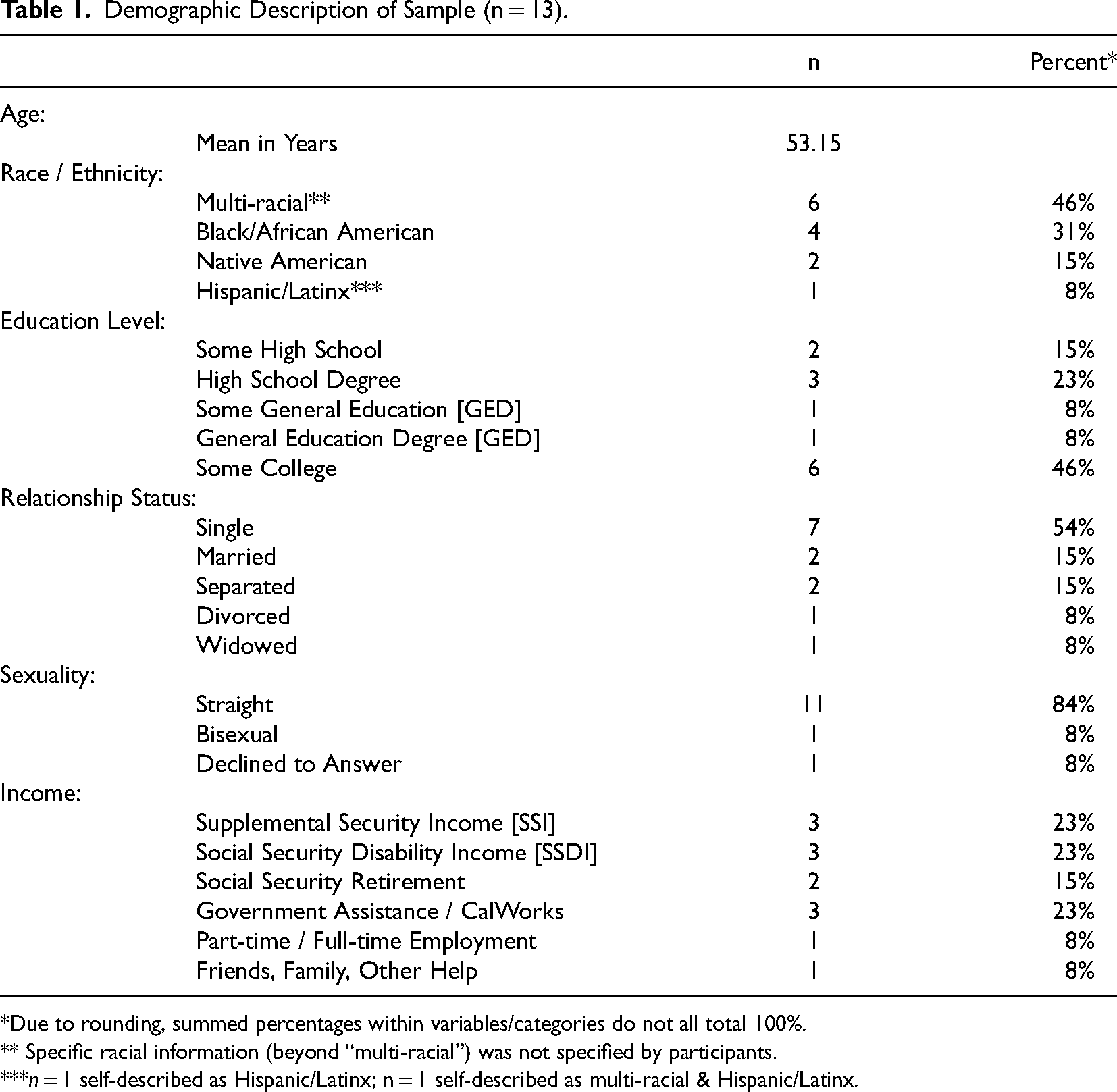
*Due to rounding, summed percentages within variables/categories do not all total 100%.
** Specific racial information (beyond “multi-racial”) was not specified by participants.
***n = 1 self-described as Hispanic/Latinx; n = 1 self-described as multi-racial & Hispanic/Latinx.
Themes
Qualitative data analysis resulted in the identification of four primary themes related to the research question: parental rights, healthcare access and disparities, economic challenges and homelessness, and systemic bias and discrimination. The following sections include a description of each theme, the definitions used by the author during coding and analysis, and direct quotes from the participants. Each theme is also organized into relevant sub-themes.
Parental Rights
The first theme, parental rights, includes individual experiences with child protective services (CPS), the justice system, and related agencies. Participants described family separation, lack of transparency, and the impact of these experiences on themselves and their families. This theme is organized into three sub-themes: challenges related to CPS, family support and barriers, and positive interactions and suggestions for improvement.
Despite separation, participants tried to advocate for their children. One insisted on keeping siblings together, explaining, “They said they was having a hard time finding a foster family for both. They would have had to separate them. And I told them I say you're not separating my babies” (P1). However, many struggled due to lack of information, transparency, and support. One explained, “I’m very good at following rules. I just need to know the rules to follow them” (P12). Another recalled feeling unsupported during a custody battle while incarcerated: “Nobody was ever there to actually help me, be on my side, advocate for my rights to be in court, to be transferred to those court hearings, to explain documents to me” (P9).
Post-release, this lack of support continued, leaving one participant “completely out of the loop” (P9). She described the emotional impact: “You're in emotional turmoil. But then psychologically, you're confused. I didn't understand” (P9). She stressed the need for improved communication and support: “We already feel defeated that we're, that we're going through the process of losing our children. It's an even more insurmountable task to try to respond through a process of forms that we don't comprehend” (P9). Another participant added, “She never told us like what we was supposed to be doing, like classes, like the time just went by,” adding, “They’re supposed to be reunifying you” (P1). Several participants also expressed concerns about potential future interactions with CPS post-release: “You never know when it comes” (P11). These concerns influenced participants’ decisions, such as delaying medical care to avoid CPS involvement: “At the time, I was getting the twins back in my care. So I never followed through with the appointments, because I didn't want them to think that I wasn't able to take care of my kids” (P1).
These participants’ experiences reflect broader systemic issues, emphasizing the urgent need for increased transparency and advocacy within CPS processes. The quotes highlight a pattern of emotional distress and perceived powerlessness when attempting to navigate interactions with CPS. Research supports these concerns, underscoring that CPS interventions often disproportionately impact women from marginalized communities and contribute to ongoing trauma and separation from family (Eyal-Lubling & Krumer-Nevo, 2016). This aligns with critical feminist perspectives on the systemic bias women face in maintaining rights within the criminal legal system (Sufrin et al., 2019).
This inability to regain custody underscores the systemic barriers that disproportionately impact marginalized families, particularly when dealing with historical CPS cases. Research shows that reunification efforts often overlook the rehabilitation and progress made by parents, and instead perpetuate punitive methods (Eyal-Lubling & Krumer-Nevo, 2016). Participants’ responses align with broader concerns related to the intersections between CPS and the criminal legal system and their disproportionate impact on families (Sufrin et al., 2019). They also highlight the emotional toll of separation, the lack of systemic support, and the need for more equitable family reunification processes.
However, participants consistently called for systemic changes: “CPS, the law, their courts and stuff need to really be fixed” (P5). Many felt that increased empathy and direct support could have helped them when navigating the system. One participant explained how the process would have been easier “if somebody was available to really just hold my hand through those processes” (P9). Empathy was a central theme, with participants emphasizing the importance of listening and understanding: “Understanding my situation, what I was going through, how young I was, you know, I got two kids” (P12). She added, “if people can walk in your shoes […] then they can see and feel how you're going through all this trauma and stress" (P12). These suggestions align with research demonstrating that rapport and relationship building in case management can improve outcomes for women impacted by the legal system (Ford et al., 2019).
Participants also called for dignity and respect, even when mistakes have been made. One said, “Everybody should be treated with dignity and respect at all times” (P2). She added, “Sometimes people make mistakes, but you should be able to have room to learn from your mistakes” (P2). This reflects broader critiques of systemic inequities in the system, particularly related to how marginalized communities are treated (Roberts, 2020). These responses also point to a need for CPS and legal system reform that centers the agency and humanity of the people who are navigating these systems (Dettlaff & Boyd, 2020).
Healthcare Access and Disparities
The second theme, healthcare access and disparities, refers to the challenges and inequities individuals face in accessing healthcare, especially within the criminal legal system. Participants described difficulties obtaining healthcare both during incarceration and in the community following periods of incarceration. Accordingly, this theme is organized into two sub-themes: inadequate healthcare during incarceration and barriers to post-release healthcare access.
Another described her probation officer's harsh treatment during her pregnancy, causing emotional distress: “The first time I met this man, he yells, and the second time I meet him he's trying to send me back to jail […] I was pregnant, so I'm just bawling my head off” (P5). The participant described her probation officer at the time as “determined to lock me up” and the experience as “really unpleasant” (P5). These testimonies underscore the systemic inadequacies in carceral healthcare systems, particularly for marginalized populations, including those living with HIV or those experiencing pregnancy. Research on healthcare in carceral settings aligns with these findings, emphasizing the frequent neglect of adequate reproductive and general healthcare services, especially for vulnerable groups like women and people living with chronic health conditions (Liauw et al., 2021).
Economic Challenges and Homelessness
The third theme, economic challenges and homelessness, captures the barriers and challenges faced by people impacted by the legal system, including inadequate support, biased law enforcement, and financially punitive legal environments. Housing and financial support were crucial and yet often inaccessible. This theme is organized into two sub-themes: housing instability and financial barriers.
Accessing housing programs like Section 8 provided stability for some, as one participant who experienced homelessness for three years explained: “I finally got Section 8. It's been a bit, I'm in a better space now. Yeah. I have a house, a yard, all my kids are with me” (P3). However, many faced barriers related to housing vouchers, a form of government assistance that aims to help individuals and families afford housing (US Department of Housing and Urban Development, 2023). In the US, these vouchers typically have a limited timeframe for use, often expiring after a set period if housing isn’t secured. Time limitations and barriers related to these voucher expirations, as well as credit score requirements, hindered access to housing for participants. One explained, “The voucher was only good for 90 days and then it expired” (P1). Interactions with law enforcement also disrupted housing, as described by one participant who lost her housing following a police incident: “It took effect on me and I lost my housing. And that's what sent me to homelessness and the whole life shift changes” (P3).
Post-release, participants encountered additional challenges. One expressed frustration with the “runaround” when trying to access services (P2). Another highlighted the importance of transitional programs, rather than being released without support and being “chopped off at the knees so to speak” (P8). One participant suggested that making jail calls free could help women connect with programs prior to release: “There's people who can’t get out because they have nowhere to go, nowhere to report their probation” (P3). This shared struggle with accessing support motivated participants to assist others: “I hope that I can be available to help people get straight through to the services that they need” (P2). Overall, they emphasized the importance of financial support, accessible housing, and integrated social services that address both immediate and long-term needs. These findings align with existing literature on the structural barriers that impede financial stability for people impacted by the legal system and the need for policy reform to address economic inequities (Pager, 2007).
Systemic Bias and Discrimination
The fourth and final theme, systemic bias and discrimination, captures individuals’ experiences with unfair treatment, rights violations, and targeted harassment based on race, gender, and other identities. Participants described systemic bias and harm in their interactions with the criminal legal system, including police brutality, gender discrimination, and racism. They also discussed how these experiences eroded their trust in law enforcement. This theme is organized into three sub-themes: police brutality and gender-based discrimination, racial discrimination and differential treatment, and trust and trauma in law enforcement interactions.
Participants reported being searched by male officers instead of female officers, in direct violation of protocol. One stated, “I've always been searched by a man, even though I know for sure I'm supposed to be searched by a woman” (P12), while another recalled feeling “groped” during a search by male officers (P2). A third participant shared a similar experience, noting that the officer was unnecessarily rough while searching her (P1). One participant who identified as a trafficking victim reported being sexually harassed and physically assaulted by officers, stating, “My experience with law enforcement in total has been absolutely horrible” (P9). She described “Sexual harassment inside, you know, in the prisons. Obviously, sexual assault outside” (P9). These participants’ stories emphasize the urgent need for the protection of women's safety and autonomy in interactions with law enforcement.
Participants also described differential treatment based on intersections between social identities, like race and economic status: “I think white women get treated differently […] and they had their white families representing them. Showing up to court for them. Yeah. You know, and my people showing up to court were Brown” (P8). Another echoed, “Because we are low, low-income Black people, that's how we get treated” (P10). When another participant was asked if they think any of her identities impacted how police treated her, she responded, “Yes, especially my age and ethnicity. Me being a woman” (P12). Another described bias related to criminal records: “I totally believe that I was treated different because I had a criminal record” (P9). As Crenshaw's (1989) intersectionality framework suggests, multiple axes of identity compound these challenges and create additional barriers to justice.
Participants also highlighted how lack of information, communication, and knowledge about rights contributed to mistrust. One stated, “We supposed to be able to trust them, you know, and I feel like they try to take advantage of you if you don't know your rights” (P2). She added, “And I'm, I'm trying to figure it out. But it's like, nobody wants to tell me anything” (P2). These experiences echo broader systemic issues related to law enforcement exploiting knowledge gaps, especially among vulnerable populations, which only further erodes trust (Tyler, 2005).
Participants also suggested improvements, such as involving social workers in police interactions to provide support: “I think it would be better for a social worker to talk to the person. Kind of less threatening I feel. At least it would be for me” (P8). Others described the importance of empathy and understanding: “Have an understanding about what's going on with us […] If they have more understanding, I don't think a lot of the mess would be going on” (P5). These recommendations are consistent with research that highlights the value of trauma-informed and restorative approaches to build trust between communities and law enforcement (Patterson, 2019). The importance of women supporting each other was also emphasized: “It's very important that women support women. No matter what you do in your life, whether you're a police officer, whether you're CPS, we need to support each other. Especially when we're going through something” (P12).
Discussion
This secondary analysis highlights the intersecting experiences of formerly incarcerated women, particularly within the contexts of mass incarceration and reproductive injustice. The findings highlight systemic inadequacies that demand urgent reforms in areas like protection of parental rights, freedom from violence, and access to housing, healthcare, and legal assistance. These issues are closely linked to social work practice and theory, particularly through intersectional and critical feminist perspectives.
Ethics and Challenges for Forensic Social Work
The findings from this study shed light on the tensions that arise when attempting to apply social work values and ethics in carceral settings. Social workers are committed to values like justice, self-determination, and dignity of all people (NASW, 2021). However, these values are often challenged within systems that operate on control, punishment, and surveillance. Several participants in this study shared experiences with CPS and the legal system that highlighted systemic inequities and barriers to reproductive justice, including those related to parenting, accessing reproductive healthcare, and maintaining bodily autonomy. Social workers practicing in these settings are tasked with navigating these ethical dilemmas – we advocate for human rights while working within systems that consistently undermine them. This study highlights the importance of this ethical obligation to challenge systems of oppression while advocating for systemic change (Butler-Mokoro & Grant, 2018).
Intersectionality and Critical Feminist Perspectives
Critical feminist theory emphasizes women's empowerment, challenges power imbalances, and calls for systemic reforms that center the rights and experiences of marginalized communities (Eyal-Lubling & Krumer-Nevo, 2016). Integrating intersectionality (Crenshaw, 1989), it explains how overlapping systems of oppression shape women's experiences in the criminal legal system. This study provides various examples of the system disproportionately impacting women of color and low-income women, limiting their ability to access resources and maintain bodily and parental autonomy. For many participants, their gender, race, and socioeconomic status further compounded their challenges and experiences of reproductive injustice.
Research demonstrates how the US criminal legal system disproportionately impacts oppressed groups, both reflecting and reproducing structural and intersecting inequalities related to gender, race, and class (Butler-Mokoro & Grant, 2018). Black women, for example, are imprisoned twice as often as white women (Sufrin et al., 2019). These overlapping forms of oppression not only impact experiences, but also function as social determinants of health (Baradi, 2023). Social workers who adopt a critical feminist perspective must engage with these intersectional realities, working to dismantle the systems that perpetuate them, as Fong (2021) emphasizes in their call for abolition as a means to address systemic racism within social work. This requires advocacy not only within micro level clinical social work practice, but also in macro level policy development, where intersectional feminist insights are needed.
Abolition and Reproductive Justice
Reproductive justice and critical feminist theory recognize the inequitable distribution of reproductive choices, with many denied the right to make decisions about their bodies (Hayes & Gomez, 2022; Shankar et al., 2020). Women's bodies are often regulated and exploited as a method of social control, and incarceration exemplifies this, disrupting and undermining fundamental tenets of reproductive justice and perpetuating health disparities (Novisky et al., 2021). As findings from this study demonstrate, women impacted by the legal system lack access to reproductive rights and services both during and after incarceration, leading to a range of health issues and increased vulnerability (Clarke et al., 2006; Geana et al., 2021; Liauw et al., 2021).
Since the 2022 overturning of Roe v. Wade, women's rights have faced increasing and varied restrictions across the US (Guttmacher Institute, 2024). Global organizations like the World Health Organization (WHO) and the United Nations (UN) have called for the protection of reproductive and sexual rights, particularly for marginalized populations like women experiencing incarceration (Liauw et al., 2021; WHO, 2024). As access to services decline and health risks rise for those impacted by the legal system, advocates have called for measures like diversion programs, early release for women experiencing pregnancy, or complete abolition of carceral systems to ensure reproductive autonomy (Davis, 2022; Hayes & Gomez, 2022; Paynter & Heggie, 2023).
Reproductive justice aligns closely with feminist and abolitionist frameworks, which call for the dismantling of systems that control and exploit women's bodies. Participants in this study described how incarceration and CPS interactions stripped them of autonomy, separated them from their children, and restricted their access to reproductive healthcare. These systemic violations highlight the need for abolitionist approaches that seek to replace carceral systems with community-based alternatives. Social workers, as advocates for social justice, are well-positioned to engage in abolitionist principles and advocate for the right of all individuals to parent and make reproductive decisions free from state control (Hayes & Gomez, 2022).
Implications for Social Work Practice and Research
The findings from this study provide important insights for social work practice, particularly in carceral and statutory settings. Social workers must navigate the tensions between upholding ethical values and working within systems that often contradict these values. Feminist-informed social work provides a framework to critically examine power structures, advocate for systemic reform, and prioritize the lived experiences of marginalized individuals. In practice, social workers should prioritize trauma-informed care, recognizing the intersectional oppression that women face within the legal system. Policy makers and practitioners must advocate for systemic changes that protect women's rights, promote family reunification, and provide access to integrated social and reproductive healthcare services. Additionally, social work research must continue to explore the intersections between abolition, feminist theory, and reproductive justice, further strengthening the connection between social work and broader social justice movements.
Summary
This analysis highlights how mass incarceration perpetuates reproductive injustice through intersecting systems of oppression. Through a critical feminist lens, this study amplifies the voices of formerly incarcerated women, underscoring the urgent need for systemic reform and equitable support. These insights offer social work practitioners, researchers, and policy makers in community and criminal legal settings a fuller understanding of the systemic challenges faced by individuals impacted by the legal system. The author hopes this work will encourage further research and coordinated efforts to ensure reproductive justice and transformative change.
Footnotes
Acknowledgments
This secondary analysis utilized qualitative data collected in 2023 by the author and two co-researchers. The author hired and supervised two IRB-approved graduate student assistants from the CSUS Master of Social Work program in 2023 to assist with some aspects of literature review and data collection and analysis for the original study.
Declaration of Conflicting Interests
The author declared no potential conflicts of interest with respect to the research, authorship, and/or publication of this article.
Funding
The author received no financial support for the research, authorship, and/or publication of this article.
