




Abstract
Despite social work's stated commitment to abortion rights, research on this topic is not prolific within the discipline (Begun et al., 2016). If we are to live up to our ethical principles, this should be changed. The authors posit that increasing students’ exposure to and understanding of abortion is necessary in the preparation of competent social work practitioners. Using Begun et al.’s (2016) Social Workers’ Abortion Attitudes, Knowledge, and Training questionnaire, the authors expanded the survey by creating additional questions about social work curriculum coverage and training experiences, as well as further content on abortion. Findings indicate that most social work students believe abortion should be legal in at least some circumstances, and also that abortion laws should be less restrictive in the United States. Reported religion and political affiliation had significant effects on several of the abortion attitude statements. Only 7.2% of respondents indicated that abortion is regularly discussed in social work classrooms, and only 2.7% of respondents report they have received training on the topic of abortion in their field placement. The results suggest that social work curriculum coverage on reproductive justice is tenuous and inconsistent at best, leaving students to grapple without the necessary professional foundation.
Though it may seem surprising, discussions about abortion, specifically, and sexuality, more generally, can elicit discomfort from students training to become social work professionals. It is perhaps overly assumed that social work students are more comfortable with this content than educators might appreciate: after all, social work as a discipline regularly intersects with a myriad of sexual and reproductive health topics, and social workers frequently serve as points of contact for clients regarding sexual health issues (Alzate, 2009; Begun et al., 2016; Ely et al., 2012; Whitaker & Arrington, 2008). Social work educators, especially those committed to a progressive reproductive justice framework, might expect student comfort discussing abortion on a macro-level. The topic is one of the most contentious in the United States as both state and federal legislation is proposed every year to restrict access to safe and legal abortion (Nash et al., 2014). Indeed, abortion is a hot-button topic in the social work classroom and beyond. Yet regardless of the myriad of stances on abortion, as a component of medical healthcare, the procedure is very common: approximately one-fourth to one-third of individuals that can become pregnant will have an abortion by the age of 45 (Boonstra et al., 2006; Finer & Henshaw, 2006; Jones & Jerman, 2017). Furthermore, abortion is accessed by a wide array of individuals regardless of age, marital status, race, ethnicity, socioeconomic status, or number of previous pregnancies (Henshaw & Kost, 2008). Only 25% of Americans do not consider abortion to be a major issue when voting (Brennan, 2020).
Restricted access to abortion can result in forced pregnancy and increased physical and mental health risks to the pregnant individual (Foster, 2020), including death from unsafe abortion (Ely & Dulmus, 2010; Gipson et al., 2008). This represents the reality for women as 87% of counties in the United States lacked abortion services in 2000 and half of unintended pregnancies still end in abortion (Finer & Henshaw, 2003). Yet, 2021 has been noted as the “most damaging antiabortion state legislative session ever” with more than 561 restrictions and 165 bans proposed in 47 states, and 83 such restrictions adopted into law in 16 states that also include 10 bans (Nash & Cross, 2021, p. 2). As of this writing, public advocacy is centering around Texas, where with the passage of SB8, abortion is outlawed at 6 weeks’ gestation, and private citizens, instead of the state, are deputized to enforce it (Texas Heartbeat Act, 2021).
Social workers are called to promote self-determination, autonomy, and justice with regard to disparities in access to needed services; however, given the intensifying assault on abortion, our profession must further define its commitment to supporting abortion rights and family planning that includes abortion services (NASW, 2021). Because advocacy and advancing policies that support human dignity and self-determination represents the foundation of the NASW Code of Ethics, social work education has a duty to introduce students to the expectations and values of the profession around abortion (Younes et al., 2021). The social work profession is steadfast in its commitment to social justice and is thus not politically unaffiliated. Future social workers first learn about our commitment to abortion rights (Ely et al., 2012) during their education; it is inappropriate to avoid explicitly ensuring that students are aware of and accepting of this responsibility.
Although the field of social work has a stated commitment to abortion and reproductive justice, research on those topics in social work education is limited (Begun et al., 2016). As Winter et al. (2016) note, although social workers regularly practice in organizations in which practice related to sexual health exists, the Council on Social Work Education (CSWE) does not explicitly mandate abortion, reproductive justice topics, or sexual and reproductive health education be covered in social work education curricula. The current study was based on the work of both Begun et al. (2016) and Ely et al. (2012), which examined social work students’ knowledge of and attitudes on abortion and abortion access, and expanded to assess how social work students feel about abortion, awareness of the profession's stance, curriculum coverage within social work programs, and if there is any correlation between abortion knowledge and supportive attitudes towards abortion access.
Purpose
The purpose of this paper is to build on the limited research on abortion and reproductive rights within social work education, and to potentially validate efforts to address that. The authors expanded Begun et al.’s (2016) Social Workers’ Abortion Attitudes, Knowledge, and Training questionnaire by including questions related to the sensitive topic of fetal anomaly and later abortion (defined as abortion after 20 weeks’ gestation), as well as social work education and training experiences. Indeed, the authors found it essential to explore not only students’ beliefs about abortion but also the actual education they are receiving in their programs, as experiences in the classroom are hypothesized to impact those attitudes about choice and options. Including fetal anomaly seemed especially appropriate as later abortion has been recently targeted by restrictive legislation across the country impacting social workers’ capacity to support clients’ decisions about ending wanted pregnancies within hospital and fetal care environments. The additional questions are derived from the authors’ teaching and practice experiences working in the field of reproductive health and justice from levels of curricular planning, policy, and practice. By increasingly examining students’ exposure to and understanding of abortion, educators might better consider how to incorporate this potentially triggering, but highly necessary topic into foundation-level and advanced courses.
Literature Review
Scholarship on student attitudes and abortion generally focuses on attitudes of undergraduates towards the practice and its correlation with a number of associated factors. These include gender, years of college education, religious activity, political orientation, and past sexual experience; unsurprisingly, individuals of more religious or conservative backgrounds are less likely to favor the practice (Alvargonzález, 2017; Bahr & Marcos, 2003; Esposito & Barsow, 1995; Maxwell, 1970; Strickler & Danigelis, 2002). This research has also indicated that personal exposure to abortion, increased college education, and relocation from rural to urban areas may influence an individual's point of view towards a more accepting or welcoming stance (Alvargonzález, 2017; Carlton et al., 2000; Maxwell, 1970).
Narrowing the focus onto social work education, research has explored both social work students’ attitudes, as well as their perspectives of the profession's stance on abortion. Despite diverse student backgrounds, results continue to reinforce the impact of religiosity on abortion attitudes, finding a negative association between religious orientation and support for abortion, as well as client referral for services (Begun et al., 2017; Ely et al., 2012). While social work practitioners are entitled to their own beliefs, giving precedence to the social worker's personal values threatens clients’ right to self-determination and betrays our profession's code of ethics and standards of practice. It may be argued that social work education must consist of assistance from faculty to help students navigate conflicting personal and professional beliefs through modeling inclusive discussions that maintain the importance of reproductive, sexual, and human rights (Begun et al., 2017). Moreover, research by Begun et al. (2017) noted that 49% of participants stated that they would not refer a client for abortion and 41% were unaware of their state's laws related to abortion. Curiously, 87% of participants in one study were social work students, yet 80% of them noted that abortion was rarely or never discussed in their courses, and 90% reported a similar observation regarding a discussion of abortion in field (Begun et al., 2016, 2017). Studies also highlight students’ lack of certainty regarding how to help clients seeking abortion referral information (Begun et al., 2016, 2017; Ely et al., 2012).
It is reasonable to assume that the same sociopolitical factors that influence students’ orientation to abortion and reproductive rights also constrain social work faculty and programs, and promote the apparent failure to provide the knowledge and training that graduates need to effectively serve their clients and advocate for their right to self-determination. The reluctance of social work education to address reproductive rights and abortion persists despite the profession's stance as articulated by the NASW that asserts every person's right to access family planning, abortion, and reproductive health services (NASW, 2021). Moreover, the many calls for CSWE and social work education to equip students with competencies related to abortion and reproductive rights remain unanswered (for example, Begun et al., 2016, 2017; Witt et al., 2019; Younes et al., 2021) despite research documenting the efficacy of abortion and reproductive health education in expanding students’ knowledge and support for abortion rights (Begun et al., 2016, 2017; Begun & Walls, 2015; Carlton et al., 2000; Esposito & Barsow, 1995). Indeed, exposure to sexual and reproductive health information in field practicum has been associated with an appreciation for the role of social work in this area (Winter et al., 2016). However, the overarching reluctance to address the topic more thoroughly across social work education is perhaps related to the nation's current sociopolitical climate that forges binary and often hostile equivocations towards reproductive health and abortion. Still, educators should note that a lack of appreciation of the role of abortion and sexual health conflict with the mission of the profession, NASW principles, CSWE mandates, and social work programs’ mission to educate students about social justice. They undermine the profession's aspiration and social workers’ ability to deliver critical services to the most vulnerable clients while respecting dignity and self-worth.
As of this writing, a barrage of antiabortion legislation continues to proliferate in the United States (Nash & Cross, 2021). For example, states including Texas and Idaho have enacted “fetal heartbeat bills” to prohibit abortions as early as 6 weeks and once fetal cardiac activity has been detected (No Public Funds for Abortion Act, 2021; Texas Heartbeat Act, 2021). In cities like Lubbock, Texas, self-designated “sanctuary cit[ies] for the unborn,” the procedure is banned at all stages, even in cases of incest or rape, and providing any assistance even in the form of transportation or money is considered a violation (Shammas, 2021). Furthermore, Texas’ SB8 does not rely on state agencies to police abortion, but empowers private citizens to pursue civil lawsuits against any anyone, providers or otherwise, who assist a pregnant person in securing one (Texas Heartbeat Act, 2021). Other laws have been enacted that infringe upon academic freedom and the information faculty can provide to students. In Idaho, it is now illegal for employees of institutions of higher education that receive any state funding to provide any information that could be deemed as “promoting” abortion, similar to a law from Missouri passed in 1986 (No Public Funds for Abortion Act, 2021; Use of Public Funds Prohibited, When, 1986). These laws and regulations are a threat to public health and underscore the profession's need to defend ethical obligations and advocate for equitable services for at risk groups, especially when their rights are under attack.
Macro-level policies are certain to impact micro-level responses to reproductive healthcare that include seeking services and understanding what options may truly be available (Wycoff, 2019), particularly in a climate of misinformation across social media. Gold and Nash (2012) assert that the majority of women of reproductive age reside in states that do not support abortion rights, which means that half the women in the United States are unable to access the full range of reproductive choices (p. 295). This area continues to be mostly understudied in social work research and overlooked in social work education. Alzate (2009, as cited in Wright et al., 2015, p. 302) has underscored the importance of recognizing and advancing “sexual and reproductive rights as essential components of social work practice and advocacy” to improve the wellbeing of clients served by social workers. Moreover, she stressed the need for social work practice to address contraception, abortion, and other related reproductive rights issues. Wright et al. (2015) found the focus on reproductive health care limited in social work literature and advocated for increasing knowledge and focus within research.
The inclusion of abortion and reproductive rights in social work research and education represents the best form of advocacy, and educators should be supported and encouraged to educate students about these issues while honoring professional commitments. It calls for the adoption of the constructivist approach advocated by Gezinski (2009) where classrooms are transformed into safe environments that enable students and faculty to engage openly and critically in assessing their own beliefs, knowledge, and skills as they discuss challenging topics such abortion, sexual minority issues, and others.
Research Questions
Based upon the limited work in our discipline on abortion education, we assessed a need for more research about how social workers are trained to examine, discuss, analyze, and engage with issues of reproductive choice, and where they are at a baseline during their schooling. This study explored the following questions: What are current social work students’ current attitudes about abortion?; what are current social work students’ reported levels of knowledge about abortion (legal, medical, professional)?; and is there any correlation between reported exposure to abortion-related content and reported support for abortion access?
Method
The authors did not replicate Begun et al.’s (2016) work in its entirety but adapted three of the questionnaires focusing on social workers’ abortion attitudes, knowledge, and training. Additional questions were added by the authors to gather information about alternative sources of information about abortion, to assess students’ knowledge of the profession's stance on abortion, and students’ experiences of the topics of reproductive rights and abortion within social work educational experiences (within the classroom and the field placement experience). After receiving Institutional Review Board approval, the Qualtrics survey was disseminated online using purposive, snowball, and convenience sampling. The authors utilized email to share a link to complete the survey to social work students at their institutions, and social work education listservs who also shared the invitation to participate. The recruitment email invited student to participate in a study about social work students’ attitudes and knowledge of abortion. Participants were informed that their participation was anonymous and voluntary. There was an optional raffle for three $25 gift cards to an online retailer for those that chose to participate. Anonymity was protected by routing participants to a new, nonlinked survey after questionnaire completion. Data were collected from students over winter and spring of 2020. Permission to utilize the scale was received by the authors.
Measures
Participant gender and age were measured using a write-in option only. Race/ethnicity, religious affiliation, political affiliation, and region one lives in were measured using categorical options and a write-in option. Personal experience of abortion was measured by asking “Approximately _______ (number) of my friends, relatives, and/or acquaintances have had an abortion, that I know of. You may also include yourself in this number if you have had an abortion.” This study collected information on prior abortion knowledge and training with the two-item scale from Begun et al. (2016), which utilizes a 4-point rating scale (1 = Never, 2 = Rarely, 3 = A few times, 4 = Frequently). The authors added one additional question utilizing the same rating scale: I have received training or information about abortion referrals, abortion policies and regulations, and/or the medical procedure of abortion from an entity outside of my social work program. This could include a volunteer opportunity, employment, your own personal experience or the experience of someone close to you, or other experience.
Additionally, the authors utilized Begun et al.’s (2016) three-question assessment of perceived abortion knowledge, utilizing a 4-point rating scale (1 = Strongly disagree, 2 = Slightly disagree, 3 = Slightly agree, 4 = Strongly agree). The authors added three additional questions utilizing the same rating scale: Abortion content covered in my social work class included reasons women have later abortions, such as fetal anomaly (medical issues), or lack of access to care (social justice issues). I researched and was aware of the profession's stance on the issue of abortion and/or reproductive rights prior to pursuing the program of study. The profession's stance on abortion and/or reproductive rights has been communicated to me within my social work program, from instructors, readings, classroom activities or some other way.
This study assessed antichoice abortion attitudes using a 5-item scale from Begun et al. (2016), which utilized a 4-point rating scale (1 = Strongly disagree, 2 = Slightly disagree, 3 = Slightly agree, 4 = Strongly agree). These questions were informed by Begun and Walls (2015) and reported strong internal consistency (α = 0.93).
One question specific to fetal anomaly and serious risk to the life of the pregnant person was included by the authors utilizing the same scale: Abortions after 20 weeks of gestation should be legal in the case of serious risk to the life of the pregnant individual or in the case of severe fetal anomaly.
Three items related to anti-choice policy were added using multiple-choice questions with varying scales. “The decision to terminate a pregnancy should be determined by (select those that apply)” included the options: Federal Government, State Governments, Medical Professionals, The pregnant individual & their medical professional, The pregnant individual alone. The question “I believe abortion should be” included the options: Legal under any circumstances, Legal in most circumstances, Only in a few circumstances, Illegal in all circumstances. The question “I would like to see abortion laws in this country made” included the options: More strict, Less strict, Remain as they are, and I am unsure about current abortion laws.
The additional questions were drafted by four social work educators that research reproductive health topics. After the additional questions were drafted, five professionals not included in the study (three individuals with reproductive health knowledge and two social work researchers) read the additional survey questions and provided feedback. Two MSW and three BSW social work students piloted the survey and provided feedback on clarity of the questions and overall survey comprehension.
Sample
A total of 626 students responded, most indicating enrollment in either BSW or MSW programs. The sample reported a social work education level of mostly upper-division BSW (32.3%), followed by advanced-year/specialization-year MSW (21.7%), then foundation-year MSW (16.5%), and finally freshman or sophomore BSW (8.1%). Nearly 27.4% of the participants reported living in the Northeast region of the United States The majority of the participants identified themselves as female (72.3%), with males representing 5.9% of the sample, gender queer representing 0.3%, nonbinary representing 0.3%, and transgender representing 0.2%. The most commonly reported racial/ethnic background was White (56.6%), followed by Latino/a (14.3%), followed by African American or Black (7.4%). Multiracial-identified participants represent 3.3% of the sample, Asian/Asian American/Pacific Islander 2.9%, Native American/Alaska Native 1.1%, Hispanic 0.5%, and Middle Eastern 0.5%. The age of the sample ranged from 18 to 69 years old (M = 27.73, SD = 9.06). Religions views were reported as follows: Spiritual but not religious (20.8%), Agnostic/Atheist/Secular (17.1%), Catholic/Roman Catholic (13.0%), Protestant Christian (10.8%), Evangelical Christian/ Baptist (8.9%), Nondenominational Christian (4.3%), Jewish (2.0%), LDS/Mormon (1.0%), Buddhist (0.5%), Muslim (0.3%), and Wiccan (0.2%). Political affiliation of the sample included liberal (42.6%), conservative (20.3%), moderate (12.7%), independent (12.0%), unsure/don't know (2.5%), socialist (1.0%), and Democrat (0.6%). Respondents reported living in mostly the Northeast (27.4%), followed by the West (21.1%), then the South (20.0%), and finally the Midwest (13.0%).
Results
Abortion Attitudes
The results indicate that social work students as a whole hold supportive attitudes towards access to abortion, with 68.1% indicating that abortion should be legal under all or most circumstances and only 16.3% indicating that they believe that abortion should be illegal under most or all circumstances. Over half of respondents (52.7%) indicated that they felt laws on abortion should be less strict, and 18.7% indicated that they were unsure of current abortion laws. Overall, the respondents strongly or slightly disagreed with the following statements: “Late-term (e.g., after 20 weeks of gestation) should be illegal in the United States under all circumstances” at 58.5%, “State laws should require parental consent before a teenager under 18 can have an abortion” at 53.9%, and “The government should not cover the medical costs of abortions for women who cannot afford the procedure” at 71.7%. Respondents also strongly or slightly agreed with the statement “Abortions after 20 weeks of gestation should be legal in the case of serious risk to the life of the pregnant individual or in the case of severe fetal anomaly” at 76%.
Comparisons of Attitudinal Responses Based on Region
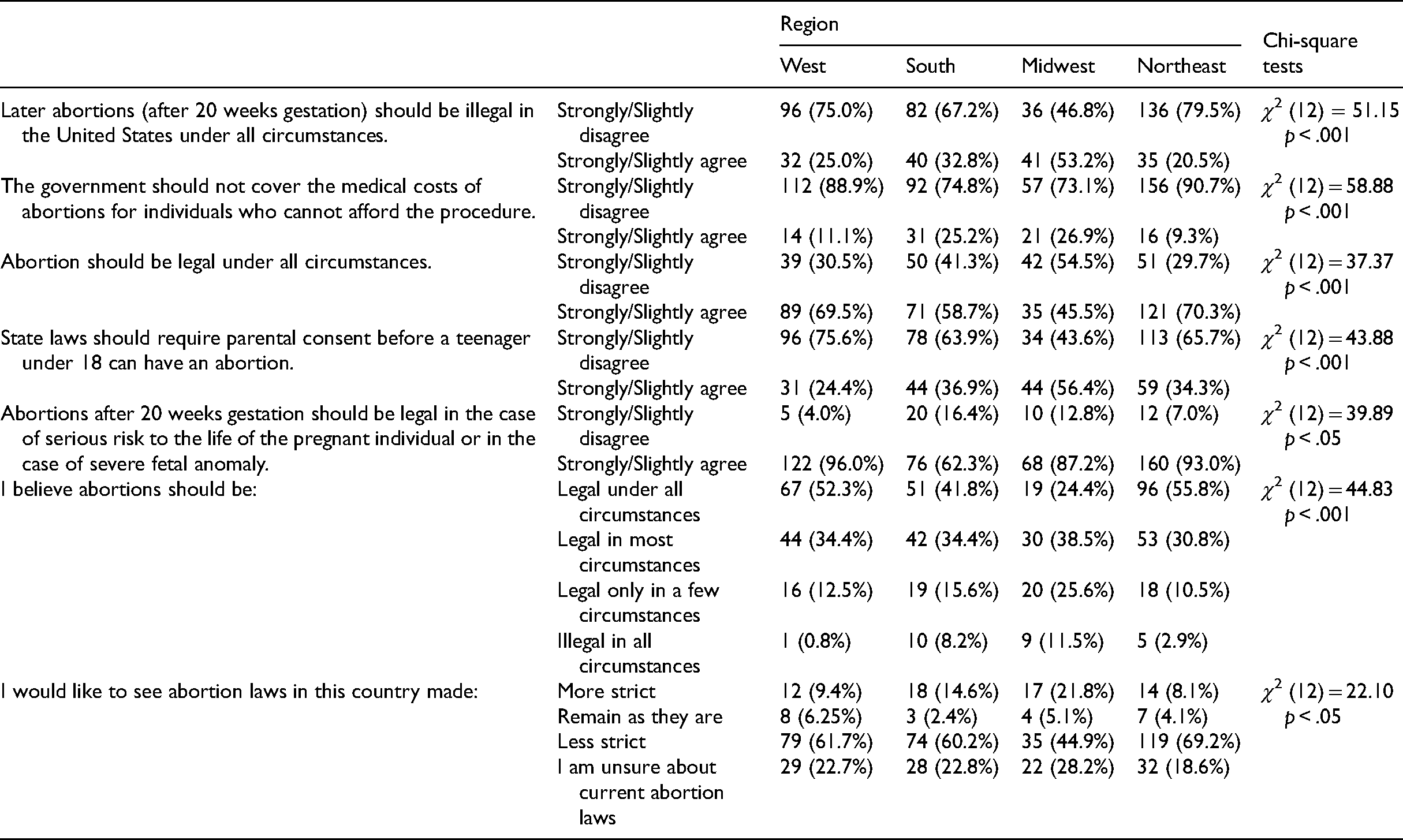
There were significant differences on levels of support of abortion attitudes when examined by region as examined by a chi-square test of independence. The Northeast and West regions of the country tended to be most supportive, and the Midwest reported lower levels of support. Table 1 provides more detailed information.
Comparisons of Social Work Students’ Abortion Attitudes by Region (N = 626).
Comparisons of Responses Based on Education Level
Examining results of a chi-square test of independence on level of education also showed significant differences. Generally, those reporting that they were in their freshman or sophomore year of a BSW program held lower levels of support than those at higher levels, with MSW students holding higher levels of supportive abortion attitudes. For the statement “Later abortions (after 20 weeks’ gestation) should be illegal in the United States under all circumstances” 1st and 2nd year BSW students were most likely to agree (49.0%) and foundation year MSW students were most likely to disagree (82.7%), χ2 (24, 626) = 54.45, p < .001. For the statement “The government should not cover the medical costs of abortions for women who cannot afford the procedure” 1st and 2nd year BSW students were most likely to agree (33.3%) and foundation year MSW students were most likely to disagree (95.1%), χ2 (24, 626) = 54.45, p < .001. For the statement “Abortion should be legal under all circumstances” 1st and 2nd year BSW students were most likely to disagree (47.1%) and foundation year MSW students were most likely to agree (81.7%), χ2 (24, 626) = 59.87, p < .001. For the statement “Abortions after 20 weeks’ gestation should be legal in the case of serious risk to the life of the pregnant individual or in the case of severe fetal anomaly” 1st and 2nd year BSW students were most likely to disagree (19.6%) and advanced year MSW students were most likely to agree (93.4%), χ2 (24, 626) = 57.28, p < .005. For the statement “I believe that abortion should be:” 1st and 2nd year BSW students were most likely to report illegal under all circumstances (11.8%) and legal only in a few circumstances (21.6%), upper-class BSW students were most likely to report legal in most circumstances (36.0%), and foundation-year MSW students were most likely report legal under all circumstances (59.6%), χ2 (24, 626) = 51.86, p < .005. For the statement “I would like to see abortion laws in this country made:” 1st and 2nd year BSW students were most likely to state more strict (19.6%) and remain as they are (5.9%), and foundation-year MSW students were most likely report less (72.1%), χ2 (24, 626) = 36.62, p < .05. Upper-class BSW students were most likely to report that they were unsure of current abortion laws (24.5%).
Religion and Political Affiliation and Beliefs About Abortion Access
An analysis of variance was conducted to examine the effect that religion and political affiliation had on the mean responses to questions related to attitudes.
The effect of religion on the response to questions related to abortion attitudes were was significant: “Abortion should be legal under all circumstances,” F (8, 495) = 12.643, p = .000; “Late-term (e.g., after 20 weeks of gestation) should be illegal in the United States under all circumstances,” F (8, 495) = 14.486, p = .000; “State laws should require parental consent before a teenager under 18 can have an abortion,” F (8, 495) = 10.306, p = .000; “The government should not cover the medical costs of abortions for women who cannot afford the procedure,” F (8, 495) = 15.357, p = .000; “Abortions after 20 weeks’ of gestation should be legal in the case of serious risk to the life of the pregnant individual or in the case of severe fetal anomaly,” F (8, 495) = 8.216, p = .000.
Similarly, the effect of political affiliation on the response to questions related to abortion attitudes were significant: “Abortion should be legal under all circumstances,” F (4, 496) = 38.608, p = .000; “Late-term (e.g., after 20 weeks of gestation) should be illegal in the United States under all circumstances,” F (4, 496) = 39.646, p = .000; “State laws should require parental consent before a teenager under 18 can have an abortion,” F (4, 497) = 25.406, p = .000; “The government should not cover the medical costs of abortions for women who cannot afford the procedure,” F (4, 497) = 64.103, p = .000; “Abortions after 20 weeks of gestation should be legal in the case of serious risk to the life of the pregnant individual or in the case of severe fetal anomaly,” F (4, 497) = 20.442, p = .000.
Levels of Knowledge About Abortion
Results indicate that provision of information about abortion is not regularly occurring in the social work classroom environment or in the field placement experiences. Respondents indicated that training on abortion happened never or rarely 86.2% of the time in their field placement. Additionally, 53% of respondents indicated that abortion is never or rarely discussed in the social work classroom. Over 36% of students reported that they do not feel they know how to assist a client who requested information about abortion. Less than half of respondents (37.2%) indicated that the profession's stance on abortion and/or reproductive rights has been communicated to them within their social work program. Respondents indicated that the topic of abortion has been brought up by clients frequently (2.7%) or a few times (14.1%). Students reported receiving training of information about abortion outside of their social work program never (42.9%) or rarely (18.7%). Less than half of respondents agree that they have adequate knowledge of abortion policies and regulations (37.2%) or as a medical procedure (37.3%). Medical issues and social justice issues related to abortion were only reported as covered in the social work classroom by 30.3% of respondents. Additionally, 47.9% of respondents indicated they did not research the profession's stance on abortion or reproductive rights prior to pursuing social work studies.
Exposure to Abortion Topics and Reported Confidence
Correlation between exposure to abortion topics and reported confidence were examined using Pearson correlations. The frequency that the topic of abortion has been discussed in my social work classroom, r(570) = 0.153, p = .000; frequency that the topic of abortion has been brought up by clients in my field placement, r(557) = 0.183, p = .000; receiving training on the topic of abortion in one's field experience, r(559) = 0.192, p = .000; receiving training on the topic of abortion outside of one's social work program, r(567) = 0.404, p = .000; and abortion content covered in my social work class included reasons why people have later abortions, r(537) = 0.205, p = .000 were correlated with agreement of the statement “I feel I would know how to help a client who requested information about abortion.”
Comparisons of Knowledge and Training Responses Based on Region
The relationship between the amount of knowledge and training on the topic of abortion and region was examined by a chi-square test of independence. Similar to the results on attitudes, region has an impact on the amount of knowledge students reported receiving on the topic of abortion in their social work experience, with students from the Northeast indicating lower levels of coverage of abortion in the classroom than other regions, reporting the topic of abortion discussed “Never” or “Rarely” in the social work classroom at 64.9% compared to 50.9% for the West, 48.7% for the South, and 39.8% for the Midwest, χ2 (12, 626) = 23.15, p < .05. The Northeast also had the highest level of “Strongly Disagree” or “Slightly Disagree” for the following statements “Abortion content covered in my social work classes included reasons people have later abortions, such as fetal anomaly (medical issues) or lack of access to care (social justice issues)…” at 71.2%, χ2 (12, 626) = 28.35, p = .005 and “The profession's stance on abortion and/or reproductive rights has been communicated to me within my social work program, from instructors, readings, classroom activities or some other way…” at 67.8%, χ2 (12, 626) = 33.55, p = .001.
Exposure to Abortion Topics and Beliefs About Abortion Access
Correlation between exposure to abortion topics and beliefs about abortion access were examined using Pearson's correlations. The frequency that the topic of abortion has been brought up by clients in field placement, r(518) = 0.138, p = .002; agreement with having received training or information about abortion-related topics, r(528) = 0.142, p = .001; and agreement that one knows how to help a client that requested information about abortion, r(531) = 0.158, p = .000 were correlated with agreement of the statement “Abortion should be legal under all circumstances.”
Reporting of having received training or information about abortion-related topics, r(528) = −0.088, p = .044; and that one knows how to help a client that requested information about abortion, r(531) = −0.113, p = .009 were both negatively correlated with agreement of the statement “State laws should require parental consent before a teenage under 18 can have an abortion.” Additionally, reporting of having received training or information about abortion-related topics, r(528) = 0.155, p = .000; and agreement that one knows how to help a client that requested information about abortion, r(531) = .144, p = .001 were both correlated with agreement of the statement “Abortion after 20 weeks’ gestation should be legal in the case of serious risk to the life of the pregnant individual or in the case of severe fetal anomaly.”
Rating of the statement “I believe abortion should be” between “legal in all circumstances” (1) and “illegal in all circumstances” (4) was negatively correlated with the frequency that the topic of abortion has been brought up by clients in field placement, r(518) = −0.145, p = .001; agreement with having received training or information about abortion-related topics, r(528) = −0.123, p = .004; agreement that one knows how to help a client that requested information about abortion, r(530) = −0.213, p = .000; agreement that one has adequate knowledge of abortion policies and regulations, r(530) = −0.111, p = .01; and agreement that one feels they have adequate knowledge of abortion as a medical procedure, r(531) = −0.527, p = .000.
Rating of the statement “I would like to see abortion laws in this country be made” between “more strict” (1), “remain at they are” (2), and “less strict” (3) was correlated with the frequency that the topic of abortion has been brought up by clients in field placement, r(405) = 0.124, p = .012; and agreement that one knows how to help a client that requested information about abortion, r(405) = 0.187, p = .000.
The following frequency statements were not statistically significantly correlated with any abortion views: “In my social work classroom experiences, the topic of abortion has been discussed…” and “In my field placement/practice experiences, I have received training on the topic of abortion…” This may be due to the fact that only 7.1% of respondents indicated that abortion is regularly discussed in the social work classroom, and only 1.9% of respondents indicating they have received training on the topic of abortion in their field placement setting. However, having a client bring up the topic of abortion, only reported frequently for 2.7% of respondents, was correlated with supportive statements at a statistically significant level.
Discussion
The findings of this study related to the first research question on current social work student's attitudes on abortion reaffirm the significant impact of religiosity and political affiliation on students’ attitudes towards abortion as similarly noted in Begun et al. (2016). These data highlight the continued influence of these factors on support for abortion access, a trend that has become more pronounced in recent years (Blazina, Lipka, & Gramlich, 2021). Also interesting is the diversity of the 626 study participants, which provided good representation of the four U.S. regions (Northeast 27.4%, West 20.1%, South 20%, and Midwest 13%), and both BSW (40.3%) and MSW (38.2%). This uncovered new insights into social work curriculum coverage differences by region as well as educational level. This is especially important given the tremendous challenges confronted by social work practitioners and their potential clients in states where bans and restrictions have been realized. Such challenges demonstrate the necessity of educating students and arming graduates with knowledge and skills to navigate uncharted waters and most perilous practice settings with little to no support for upholding any professional standards.
Encouragingly, the majority of participants agreed that abortion should be legal and legal under all circumstances, even after 20 weeks of gestation in the presence of serious risk to a pregnant individual's life or severe fetal anomaly. They agree that the decision to terminate a pregnancy should be made by the pregnant individual alone or with a medical professional, and disagreed with the statement that late-term abortions should be illegal, that laws should require parental consent for minors to secure an abortion, and that government should not cover medical abortion costs for those who cannot afford them. Despite a long-running assault on abortion access by policymakers in various states and a lack of public education on comprehensive, medically-accurate reproductive and sexual health, it is significant to note the percentage of students who hold supportive beliefs about access to abortion.
Our findings suggest that social work students are generally supportive of the NASW's policy related to self-determination, autonomy, and privacy, and the majority even agreed that abortion laws should be less strict, even in a society that has endured decades-long assaults on abortion access and misinformation/miseducation about how, why, and where to obtain one. Along this line, it is important not to overlook the 10.1% of respondents who believed abortion laws should be stricter or the 18.7% who were unsure about current laws regulating abortion. Discourse in personal and ethical standards also seems important for the 30.6% of the participants who either strongly or slightly disagree with abortion being legal under all circumstances, the 27% who agree that late-term abortions should be illegal under all circumstances, the 30.4% who either strongly or slightly agree that laws should require parental consent before a teenager under 18 secures an abortion, and the 16.2% who believe that either the federal or state government, or a medical professional should make the decision to terminate a pregnancy. While students are entitled to their own personal values, such positions can contradict core social work values and undermine the rights of clients to self-determination, privacy, and autonomy. Students commonly assert that such conflict is best resolved by referring clients to another professional who is able to help them; however this maintains the incongruence between personal and professional realms and represents a disservice to clients. This suggests that CSWE and NASW organizations should take a more explicit stand regarding social workers providing information and access to reproductive and sexual healthcare, advocating that our profession is ethically mandated to do so.
Relating to the second research question on levels of knowledge, a closer look at social work students’ abortion knowledge and training provided within social work curriculum reveals a deficiency as 53% of participants indicated that the topic of abortion was either never or rarely discussed in their classroom experience, and 42.9% either never or rarely received any training or information about abortion referrals, policies, regulations, and procedures. Moreover, the majority either strongly disagreed or slightly disagreed with the statement of having adequate knowledge of abortion policies or regulations, did not feel that they have adequate knowledge of abortion as a medical technique, and either strongly or slightly disagreed that coverage of abortion in their classes included content related to the reasons that women have later abortions. The training that students lack in the classroom is not provided in field placements either as indicated by the majority (72%) who shared that it was never or rarely provided (13.8%), and that clients either never (54.4%) or rarely (24.9%) brought it up. The majority of participants reported not researching the profession's stance on abortion prior to pursuing social work, which is a new and understandable finding, however most concerning is that most did not learn about it or reproductive rights in their programs, classrooms or from instructors. The authors suggest that without knowledge and training, professional service and advocacy may be undermined, especially given the current socio-political reality where reproductive rights are becoming increasingly restrictive for clients and debilitate the provision of services to clients.
New information on the correlation between exposure to information and/or training on the topic abortion and confidence in ability to assist clients was obtained from these results. Although the minority reported receiving this information inside the social work classroom, in their field placement, and from other sources, those that did were significantly more likely to feel confident in assisting a client that requested information about abortion. The authors cannot assess if confidence was increased due to this education and training or if these respondents were potentially already open to learning more information about abortion services and therefore sought this information out (either through their field placement or potential elective options). A more targeted research project that examines the impact of reproductive rights and abortion-specific educational interventions would provide us additional insight on how social work education does, or does not, impact supportive attitudes towards reproductive rights and abortion access.
The final research question examining exposure to abortion-related content and support for abortion access was not able to be answered as it pertains to exposure within the social work classroom. However, having a client bring up the topic of abortion in field placement and knowing how to help a client who requested information about abortion were correlated with the highest number of supportive abortion attitudes. This indicates that social work students who witnessing the impact that abortion access, or lack thereof, has on their clients, may be the most impactful learning experience of all. This also reinforces prior research that personal exposure to abortion results in a more favorable attitude towards it (Alvargonzález, 2017).
Indeed, knowing how to help a client that requested information about abortion was also correlated with supportive attitudes towards abortion access. This indicates that either individuals that seek out those resources are already supportive of abortion access, or that as they learned about those resources, they became more supportive. Either of these are important for social work educators to recognize. If it is the latter, having conversations about resources related to reproductive health, including abortion access, may result in a higher degree of confidence in how to assist clients, as well more supportive attitudes. This would be in congruence with the finding that students that report having adequate knowledge of abortion as a medical procedure are also more likely to state that abortion should be legal in all or most circumstances. If the former is true, and already supportive students are those that seek out this information to provide clients, a significant portion of future social workers, at least 15% based on the findings of this research, are going into practice without that vital information if it hasn't been provided by their social work program.
The results from this study conclude that it is vital that both CSWE and NASW more explicitly endorse reproductive and sexual health information and facilitate access to necessary appropriate services as part of our ethical mandate that social workers should provide all possible resources to their clients, regardless of their personal beliefs (Younes et al., 2021). Moreover, the basic human need to control one's body including reproduction and access to sexual health is a constitutional right and underlying principle for the NASW Code of Ethics and the social justice foundation upon which the profession was created. As such, it needs to be regarded accordingly, organically infused into social work curriculum, and integrated within the ethical foundation that underlies our professional mission. The credibility of the profession and efficacy of social work practitioners depend on the provision of reproductive and sexual health services to potential clients who are increasingly disenfranchised and in critical need of advocacy as well as the right to exercise the most basic of human needs.
Limitations
Recruitment for this survey was similar in nature to the Begun et al. (2016) study, although the authors of this study did not recruit on any social media sites related to reproductive justice unlike the original study. Efforts were not made to ensure that the same respondents did not participate in both the Begun et al. (2016) study and this one. Data collection between the two studies occurred 6 years apart, so there is a chance that some participants were still students and participated in both studies. Even though the authors did not recruit on reproductive justice or pro-life social media groups, the possibility exists that mostly those social work students that feel strongly about this topic elected to participate. This has the potential to result in data that reflects the views and beliefs of individuals that feel particularly strongly in support of or opposition to abortion access, and may exclude individuals that are unsure of or ambivalent about the topic. Because the only recruitment method was through social work student school email addresses, those that do not regularly access their email, or lack regular internet access may have been missed. Due to the sampling technique used (which allowed social work students and educators to forward the invitation to others), a survey response rate cannot be determined. Additionally, the self-developed items were not validated in any larger-scale or formal way in this study, nor in the Begun et al. (2016) study as confirmed by the corresponding author.
The study focused on the knowledge and attitudes of social work students towards abortion, both of which may be impacted by classroom coverage provided by social work faculty and program related to the topic. Whereas the findings of this research and others highlight this curriculum deficiency and reveal an apparent reluctance on the part of faculty and programs to address this issue, neither of these important topics were included in this survey. While the respondents of this survey were diverse in terms of geography and current level of education, the sample was also predominantly liberal, White, and female-identified. This study utilized a cross-sectional sample, and a longitudinal study would allow researchers to more accurately capture how support for abortion changes through students’ experiences in social work programs.
Implications for Future Research
The perspectives of social work faculty members and programs are crucial to understanding the current existing gap in academic and professional preparation of social work professionals related to reproductive justice and abortion. Thus, researching faculty attitudes towards abortion and reproductive justice and the contextual factors that either support or undermine their ability to provide this content to students is critical. Social work faculty and programs are just as diverse as the students and general population, and their ability to negotiate personal and professional values and obligations is relevant as they present this content to students in a fair and balanced approach. Moreover, understanding systemic, societal, and political factors that support or hinder their ability to fulfil their academic obligation to students is relevant. What concerns, fears, and/or even threats do faculty and programs foresee in their provision of reproductive justice and abortion education to students? What role should CSWE and the NASW play in order to empower faculty and programs to fulfil their obligation to students without fearing multilevel repercussions that may threaten their continued existence?
Additionally, research that examines abortion knowledge and attitudes prior to and after specific educational interventions would allow social work educators to better understand that types of educational approaches that are most effective at increasing the understanding of abortion as a medical procedure, factors that influence clients in their decision to obtain an abortion, current abortion laws and regulations, and why advocacy around reproductive health care is vital to the well-being of the communities we serve.
Conclusion
Social work education finds itself in a conundrum like no other when it comes to reproductive justice and rights education, and especially abortion. The provision of such knowledge or training challenges students and faculty alike, and advocacy for the most basic NASW principles of autonomy, self-determination, and privacy threaten the mere existence of social work programs. After all, one should not underestimate the passion of advocates on both sides of the issue, the current political reality dividing the nation, and the increasingly restrictive laws that are enacted to limit a pregnant individual's right to self-determination and the ability of helping professionals to provide the most basic form of services such as referral or counseling. This is a battle for the soul of the social work profession, and one that we must prepare students for in order to enable them to fulfil their future obligation to clients. Research demonstrates the power of education in enlightening the minds of students, informing their approach to serving clients, and supporting their professional identity and obligations. Yet, research findings repeatedly highlight the failure of academic programs to engage students or provide crucial content related to reproductive rights and justice, leaving them incapable of negotiating personal and professional values and unsure of the relevance of the NASW Code of Ethics when it comes to this issue. If anything, failure to educate students reflects an abdication of our professional role as social work educators and perpetuates a rippling and crippling effect to their clients and the communities they serve.
Social work educators and programs should not be required or expected to shoulder this responsibility without support from the NASW and CSWE. In fact, since the NASW is the professional standard setter and CSWE is the educational standard enforcer, the time has come for them to step up. NASW and CSWE need to lead the way and work with various stakeholders to support social work faculty and programs as they navigate the turbulent cancel culture that threatens their existence and undermines their provision of the knowledge and professional skills that graduates need to actualize their personal and professional aspiration.
Footnotes
Declaration of Conflicting Interests
The authors declared no potential conflicts of interest with respect to the research, authorship, and/or publication of this article.
Funding
The authors received no financial support for the research, authorship, and/or publication of this article.
