



Abstract
Reproductive rights and justice frameworks, which take an intersectional and social justice approach to reproductive health, are compatible with social work’s philosophical and theoretical foundations and its practical goals of advocating and promoting social justice. However, reproductive rights and justice are not frequently addressed in social work publications, an important gap that should be addressed. The search term “reproductive justice” was used to identify 10 articles published between 1994 and 2018 among the top 50 social work journals (using SCImago Journal and Country rankings). Only 3 of these 10 articles focused substantively on reproductive justice. By comparison, 55 article were identified with the search term “reproductive rights.” An analysis of the reproductive justice articles was conducted for purpose and topic, location, study population, year, journal, key findings, and implications for the social work profession. All articles called for an increase in research on reproductive justice topics. Encouragingly, these articles also included an analysis of the role of the social work profession with these frameworks. However, there is a lack of articles on reproductive justice, and the range of topics, and the methodological approaches, covered are limited. Although the increase in reproductive rights literature is heartening, there is a need for reproductive justice framings in social work practice and research.
Keywords
Reproductive rights and justice frameworks, which take an intersectional and social justice approach to reproductive health, are compatible both with social work’s ethical and historical foundations and with its practical goals of advocating and promoting social justice. Despite its importance, reproductive rights and justice are not frequently addressed in social work publications. Previous reviews have analyzed the reproductive health and family planning literature (Wright, Bird, & Frost, 2015), but this is the first to specifically analyze the scope of reproductive justice in the social work literature.
The research here identifies and explores this current gap in the social work literature and argues for the increased application of the reproductive justice framework in social work research and practice. This analysis is important because it provides an integration of the frequently siloed scholarship of public health, social work, sociology, and feminist scholarship through the lens of the reproductive justice framework. Use of a reproductive justice framework provides the social work discipline with an approach that is both congruent with its practice aims (promoting the holistic well-being of clients) and with the profession’s theoretical and philosophical foundations. This work not only identifies a critical gap in the field of social work research but also argues that incorporating reproductive justice principles into social work research and practice may be a way to begin to address the dire need for increased access to reproductive and sexual health-care services. It can also provide a framework for researchers that is both holistic and that includes an analysis of social justice issues.
Use of this framework is essential since maternal health outcomes are getting worse, not better for many women (Centers for Disease Control [CDC], 2016; Tiedje, 2005), in what has been described in the United States as a “maternal health care crisis” (Amnesty International, 2010, para. 1). An extensive body of public health and sociological research shows that maternal and child health outcomes have not uniformly improved for all women (CDC, 2016; Lane, 2015; Misra & Grason, 2006). Increasing socioeconomic disparities have been linked to increased childhood mortality (Singh & Kogan, 2007). Even after controlling for socioeconomic differences, racism has been linked to earlier health deterioration (Geronimus, Hicken, Keene & Bound, 2006). The disparate impacts of reproductive health policies, new restrictions on birth control and abortion, the impact of welfare policies on marginalized groups, and increasing barriers to teaching any form of sex education in schools are a few of the many topics where reproductive rights and justice frameworks can be utilized by social workers in their research and practice.
Sexual and reproductive health topics are underresearched in general, but especially in the social work literature. This is surprising since social workers provide a substantial portion of all reproductive and sexual health services (Alzate, 2009; National Association of Social Workers [NASW], 2018) making an analysis of the representation of reproductive rights and justice frameworks in the social work literature instructive for identifying gaps. Merging social work theory and values with reproductive rights and justice frameworks produces a coherent theoretical framework that social work practitioners and researchers can utilize to address these and additional reproductive and sexual health topics.
Debates regarding policies and restrictions about contraception methods and access, childbirth, and the ability of individuals to make agentic reproductive decisions have consistently played a prominent, if not central, role for many reproductive rights and justice scholars and activists (Ehrenreich, 2008; Flavin, 2008; Fried, 2013; Price, 2010; Ross, 2006). These areas have also frequently been the basis for mobilizing political action (Fried, 2013; López, 2008; Murray, 2008; Silliman, Fried, Ross, & Guiterrez, 2004). However, reproductive and sexual health discussions and activism have often focused on the issues that were important to straight, educated, and privileged white women, giving less attention to issues that were important to marginalized groups (Combahee River Collective, 1983; Price, 2010; Ross, 2006; SisterSong, 2006; A. Smith, 2004; B. Smith, Hull, & Scott, 1982). “Reproductive justice” emerged as a unifying framework that went beyond the pro-choice activist focus on the legal right to abortion and access to contraception and addressed some of the critiques of the mainstream feminist movement’s lack of attention to the concerns of poor women and women of color (Z. T. Luna, 2011; Price; 2010; Ross, 2006).
Limitation of the Choice Framework
The predominance of the “choice” framework in the reproductive rights discourse emerged after the Roe v. Wade ruling (Fried, 2013; Solinger, 2013). The term “choice” was used throughout the Supreme Court case and represents the right to privacy argument that was at the center of the ruling (Fried, 2013). Solinger (2013) suggests that after this victory, reproductive health activists were wary of the continuing usage of “rights” language and sought to develop a “respectable and non-confrontational movement” (p. 155). Further, choice rhetoric placed the emphasis squarely on the individual, “…the conception of choice is rooted in the neoliberal tradition that locates individual rights at its core, and treats the individual’s control over her body as central to liberty and freedom” (Silliman & Bhattacharjee, 2002, pp. x–xi). Choice, “evoked women as individuals, not as an activist mass-even as women shoppers selecting among options in the marketplace-would offer a kind of ‘rights lite,’ a less threatening package than unadulterated reproductive rights” (Solinger, 2013, p. 156).
Closely tied up with choice is the language of empowerment. Anderson (1996) contends that “empowerment” is frequently employed in discourses on health, often in the context of “consumer empowerment.” Anderson suggests that this language may in fact be fundamentally conservative, as it transfers responsibility to the individual while deemphasizing the obligation of the state to provide health services. Spade (2013), in an analysis of the use of rights language in reproductive health movements, echoes this sentiment, arguing that embedded in this discourse of empowerment is an allocation of responsibility for health from the state, to the individual. Focusing on individual choices may end up covering up the ways in which institutions perpetuate inequality and block access to resources (Spade, 2013). The rhetoric of choice framed the right to abortion as an issue of privacy and of governmental noninterference (Solinger, 2013). However, framing reproductive health as a series of private decisions obfuscates the very public role of institutional policies that impact these “private” choices (Solinger, 2013; Spade, 2013).
Anderson (1996) goes on to argue that this language of consumer empowerment has roots in the self-care movement which served to further the health-care privilege of already advantaged individuals, while doing nothing to improve the health of disadvantaged groups. The shifting of responsibility onto the individual instead of the institution can be seen in how options about reproductive choices are presented to women. Choice is presented as an individual’s ability to access contraception or abortion without consideration of the social conditions that may impact those reproductive choices and capabilities (Spade, 2013).
Reproductive health issues in the United States tend to be reduced to an “abortion-centric framework” (Nixon, 2013), where individuals are required to position themselves as either pro-choice or pro-life. This limiting of reproductive health debates is harmful, since as described by Nixon (2013), it “filters conversations…through the prism of legal rights” (p. 79). Understanding choice as access to the legal right of abortion inadequately captures the life-course trajectories of people’s reproductive lives and the diverse needs of women. Focusing on the legal right to abortion means that organizational attention and resources are concentrated on maintaining that legal right instead of addressing the additional reproductive health and social justice concerns of their constituents (Z. T. Luna, 2011). Many reproductive justice activists were, and continue to be, strong pro-choice advocates (Ehrenreich, 2008; Price, 2010; Silliman, Fried, Ross, & Guiterrez, 2004). However, as has been noted by S. E. Smith (2012), although “securing full access to reproductive rights for everyone perforce includes abortion protections. Focusing on abortion does not guarantee full access to reproductive rights” (p. 127).
Additionally, missing in mainstream pro-choice-centered activism is an analysis of how theories that depend on an essentialist view of female nature in childbearing tend to minimize differences in childbearing experiences and exclude men, transgender individuals, and children. The tension between rhetorical reproductive choice and actual reproductive justice emerged as the foundation of the critique of the choice framework made by reproductive justice activists (Z. T. Luna, 2011; Price, 2010; Ross, 2006; SisterSong, 2006; West, 2009).
The discussion above highlights both the empirical and theoretical literature that necessitated the development of a framework that was more encompassing and that allowed for greater inclusivity. Although important achievements in women’s health were achieved during the decades preceding the development of the reproductive justice movement, true reproductive rights continue to be unattainable for many women (Davis, 2014; Gurr, 2014; Murray, 2008; Nelson, 2015; Oaks, 2015). Reproductive rights activists were inspired by the broad and holistic ways in which human rights were envisioned under the Universal Declaration of Human Rights (Price, 2010). In the international context, concurrent with the move toward the use of a reproductive justice framework in the United States was a movement away from population control language and toward one of the holistic reproductive health (Murray, 2008). Although the development of a reproductive justice framework in the United States was distinct from international movements toward greater recognition of women’s rights, the movement to include women-specific concerns in international human rights conventions and rhetoric was influential for the creation of a reproductive justice framework.
Origin of Reproductive Rights and Justice Movements
Many of the women who would later be active in mobilizing for reproductive justice attended the international women’s conferences that were held in Mexico City (1975), Cairo (1994), and Beijing (1995) (Price, 2010) and were heavily influenced by the more encompassing version of reproductive rights that were discussed at these conferences. The definition developed in Cairo (1994) built off work in Mexico City (1984) and was further clarified in Beijing (1995): The human rights of women include their right to have control over and decide freely and responsibly on matters related to their sexuality, including sexual and reproductive health, free of coercion, discrimination, and violence. Equal relationships between women and men in matters of sexual relations and reproduction, including full respect for the integrity of the person, require mutual respect, consent, and shared responsibility for sexual behavior and its consequences. (United Nations Women, 1995, Women and Health section, para. 8).
Petchesky (1995), in analyzing the 1994 conference, cautioned that despite the improvement in using a reproductive rights framework in place of a population control one, there existed a “fault line” for feminists where the goals of economic and social development continued to be conceptually divided from sexual and reproductive politics. Petchesky’s (1995) critique foreshadows the continued need for the reproductive justice framework, despite the gains made by the inclusion of broad definitions of reproductive and women’s health made in international human rights documents. Additionally, despite the influence of human rights language, A. Smith (2004) notes that some women of color activists were wary of adopting this approach because of how it had been used by feminist organizations to advance imperialistic agendas in the name of addressing human rights in foreign countries while remaining silent on human rights issues in the United States. Amid these larger conversations about the importance of recognizing woman’s rights, Loretta Ross, one of the most influential leaders in the reproductive justice movement, and an attendee of these conferences, realized, that “rights that cannot be exercised do women little good” (Chrisler, 2014, p. 205). Much like the choice movement was criticized for failing to provide women with genuine choice, these conferences were critiqued for rhetorically recognizing women’s rights without providing concrete methods for achieving them. Price describes the term reproductive justice as first being used publicly following the 1994 conference in Cairo (Ross, 2006).
“Reproductive justice,” was originally defined as “the complete physical, mental, spiritual, political, social and economic well-being of women and girls…” (Ross, 2006, p. 4) and as being achieved when “…women and girls have the economic, social and political power and resources to make healthy decisions about our bodies, sexuality, and reproduction for ourselves, our families, and our communities…” (Asian Communities for Reproductive Justice [ACRJ], 2005, p. 1). Social Workers for Reproductive Justice (SWRJ, 2018) have broadened this conceptualization of reproductive justice and its application for social workers and state: Social workers should follow the NASW Code of Ethics by advocating for self-determination when it comes to issues of sexual and reproductive health. This means that when in practice a social worker should support any and all clients making decisions related to when, how and if to have a family and provide unbiased support, accurate information, and appropriate referrals for the client’s needs. (para. 3)
This framework has increasingly been used as a way to link reproductive health concerns with broader social justice issues and debates (Price, 2010; Ross & Solinger, 2017). Strongly rooted in feminist theory, it was originally conceptualized predominately for movement building (Ross, 2006), with a basis in intersectionality and a connection to critiques of the marginalization of women of color in pro-choice advocacy movements (Z. Luna & Luker, 2013; Price, 2010).
Many reproductive justice scholars noted that it was possible for reproductive rights to exist, but access to these rights to be limited (Z. T. Luna, 2011). The reproductive justice movement challenged what was considered “a legitimate reproductive issue around which to organize” (Z. T. Luna, 2011, p. 220). SisterSong (2006) further distinguishes reproductive justice as being about access, instead of the issue of choice, arguing that “there is no choice where there is no access” (p. 3). Key for reproductive justice activists was the need to recenter reproductive rights with other social justice issue concerns such as environmental and economic rights, rights for the disabled and Lesbian, Gay, Bisexual, and Transgender (LGBT), and other human rights concerns (Ross, 2006; Price, 2010). This holistic approach to health acknowledged that women would not be able to have true reproductive agency if these other social justice issues were not addressed (Ross, 2006).
Additional ways of conceptualizing the interconnections between reproductive rights and reproductive justice are provided by Ross (2006). Ross notes that because oppression is multifaceted and impacts women in all facets of their lives, a multipronged approach must also be used to address reproductive oppression. Ross proposes that to fight reproductive oppression, we can use three main approaches: (1) reproductive health (primarily addressed through service delivery), (2) reproductive rights (addressed through legal avenues), and (3) reproductive justice (addressed through movement building; ACRJ, 2005; Ross, 2006). Ross’s conceptualization of the different approaches that can be used to combat reproductive oppression is helpful because it acknowledges the need for the work that is being done to improve access to needed reproductive health services and the benefit of campaigning for legal rights, while also recognizing the ultimate limitation in an approach that does not include an intersectional analysis that facilitates social justice movement building. Social workers, who often use tactics from all three approaches in their practice, could benefit from incorporating a reproductive justice framework into their work. While the reproductive justice framework is increasingly being used in other disciplines (i.e., law and sociology (Z. Luna & Luker, 2013), it has yet to be incorporated substantially into the social work profession, both in academia and in practice settings.
Social Work and Reproductive Justice
Social work with its emphasis on applying and integrating social justice theories into practice is an especially fruitful arena in which to investigate the use of reproductive justice framings. The preamble to the U.S. NASW (1996) Code of Ethics states that “the primary mission of the social work profession is to enhance human well-being…with particular attention to the needs and empowerment of people who are vulnerable, oppressed, and living in poverty” (Preamble, para. 1). The preamble goes on to state that “social workers promote social justice and social change with and on behalf of clients” and that social workers “strive to end discrimination, oppression, poverty, and other forms of social injustice” (NASW, 1996, Preamble, para. 2). This commitment to social justice is paramount to the profession.
Alzate (2009), in a call to the social work profession to become actively engaged in reproductive and sexual health, argues that social workers have an obligation to promote sexual and reproductive rights as part of their professional duty to promote and improve the health of populations and to promote social justice. Although Alzate (2009) was not specifically addressing the need for social workers to apply a reproductive justice lens to their practice, her arguments are congruent with this approach.
Social workers are obligated to promote social welfare, in line with their broader ethical responsibility to society, and to engage in social and political action (NASW, 1996). The call for social workers to engage in concrete activities that promote justice and ensure equal access to all opportunities is an important one, and the emphasis on advocacy is one of the distinguishing features of the profession (Alzate, 2009; NASW, 1996). More explicitly, social workers are asked to “expand choice and opportunity for all people with special regard for vulnerable, disadvantaged, oppressed, and exploited people and groups” (NASW, 1996, Social and Political Action section, para. 2), making the combination of social work values with the reproductive justice a particularly powerful tool. Another social work professional governance organization in the United States, the Council on Social Work Education (CSWE, 2008), mandates that social workers demonstrate an ability to “advance human rights and social and economic justice” (p. 3) sentiments which are also reflected in international social work organizations (International Federation of Social Workers [IFSW], 2012). This core competency requires that students not simply understand oppression and discrimination but advocate for human rights and social and economic justice, engaging in practices that advance these critical areas (CSWE, 2008). These statements are congruent with Ross’s (2006) description of reproductive justice’s focus “on organizing women, girls and their communities to challenge structural power inequalities in a comprehensive and transformative process of empowerment” (p. 4).
Scholars also note the practical need for social workers to, at a bare minimum, have an understanding of reproductive rights since much of social work practice involves maternal and child health care (Alzate, 2009; Wright et al., 2015). Alzate (2009) argues for the importance of including reproductive and sexual health in the profession for both practical and ethical reasons. Alzate argues that social workers ought to make use of a “reproductive health paradigm” (focused on reproductive health as a tool for empowerment) in contrast to a “biomedical paradigm” (where improved reproductive health is viewed as a tool for achieving improved maternal or child medical outcomes). This echoes the concerns brought up by feminists about the use of a population control approach instead of one focused on rights (Murray, 2008). In addition to the ethical obligation for social workers to focus on reproductive justice, many social work theories that are cornerstones of social work curriculums and that are frequently used in research and practice are also compatible with a reproductive justice framework.
Purpose of Present Study
As highlighted above, the discipline of social work is ideally suited to incorporate the reproductive justice framework into its research and practice. The purpose of this content analysis was to identify and review the current state of reproductive justice literature in the social work literature. To my knowledge, no other research has focused on reviewing the body of reproductive justice literature.
Method
Journal impact factors (IFs) were utilized to identify the top 50 social work journals. “SCImago Journal and Country Rank” (SJR) ranking measures were used. Although using this measure can be limited, it is useful for identifying the most influential social work scholarship on these topics (González-Pereira, Guerrero-Bote, & Moya-Anegón, 2010). SJR was used over journal IF (based on Web of Science data) because SJR lists considerably more journal titles than journal IF; Falagas, Kouranos, Arencibia-Jorge, & Karageorgopoulos, 2008) broadening the scope of representation of journals while still ensuring that the journals which are most well respected in the social work literature were the focus of the literature search. Use of the search term “reproductive justice” identified 10 articles published within these journals. Each journal was individually searched with this search term. See Table 1 for a list of all journals searched and the number of articles identified for each journal. Inclusion criteria required that articles be in one of the top 50 social work journal identified by SJR and be identified through the search term “reproductive justice.” Articles also needed to be published between 1994 and 2018. This beginning date was chosen because it represents the date at which the term “reproductive justice” entered into more mainstream conversations about reproductive rights and health (Ross, 2006).
Number of “Reproductive Justice” and “Reproductive Right” Articles in the Top 50 SCImago Journal and Country Rank (SJR) Social Work Journals.
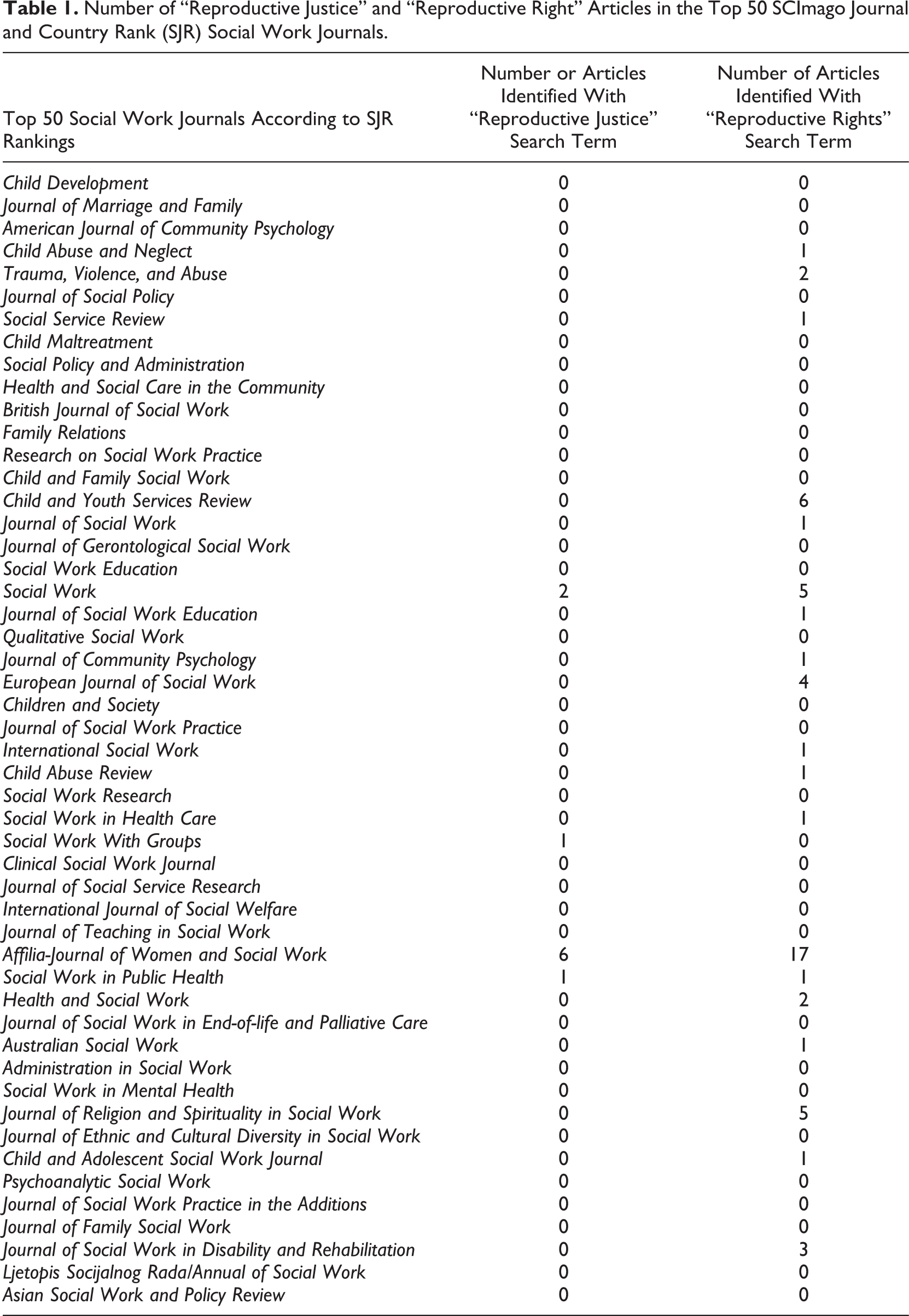
Exclusion criteria removed articles that did not include the search terms in the body of the article, that were not full articles (i.e. book reviews, editor's notes), or articles that only mentioned the search term in their article but did not include a substantive discussion of reproductive justice, reducing the reviewed articles to three. For a comparison, this search was also completed for each journal to identify the number of existing articles with the search term “reproductive rights.” This process identified 55 articles. Article searches were repeated by another researcher to check for consistency in the results. A review of the articles was conducted to analyze the articles for article purpose and topic, location, study population, year, social work journal, key findings, and implications for the social work profession. After the initial analysis, the collaborator then also analyzed the findings to ensure there was consistency in interpretation of each article. Articles were entered into excel and word files.
Results
Table 2 provides a description of each article by year, journal, article topic, purpose, article type (review, commentary, theoretical piece, qualitative, or quantitative original research study), study location (or applicable geographic region), main findings, and if the article contained an explicit discussion of the role of social work.
Reproductive Justice Articles Published in the Top 50 Social Work Journals (1994–2018).
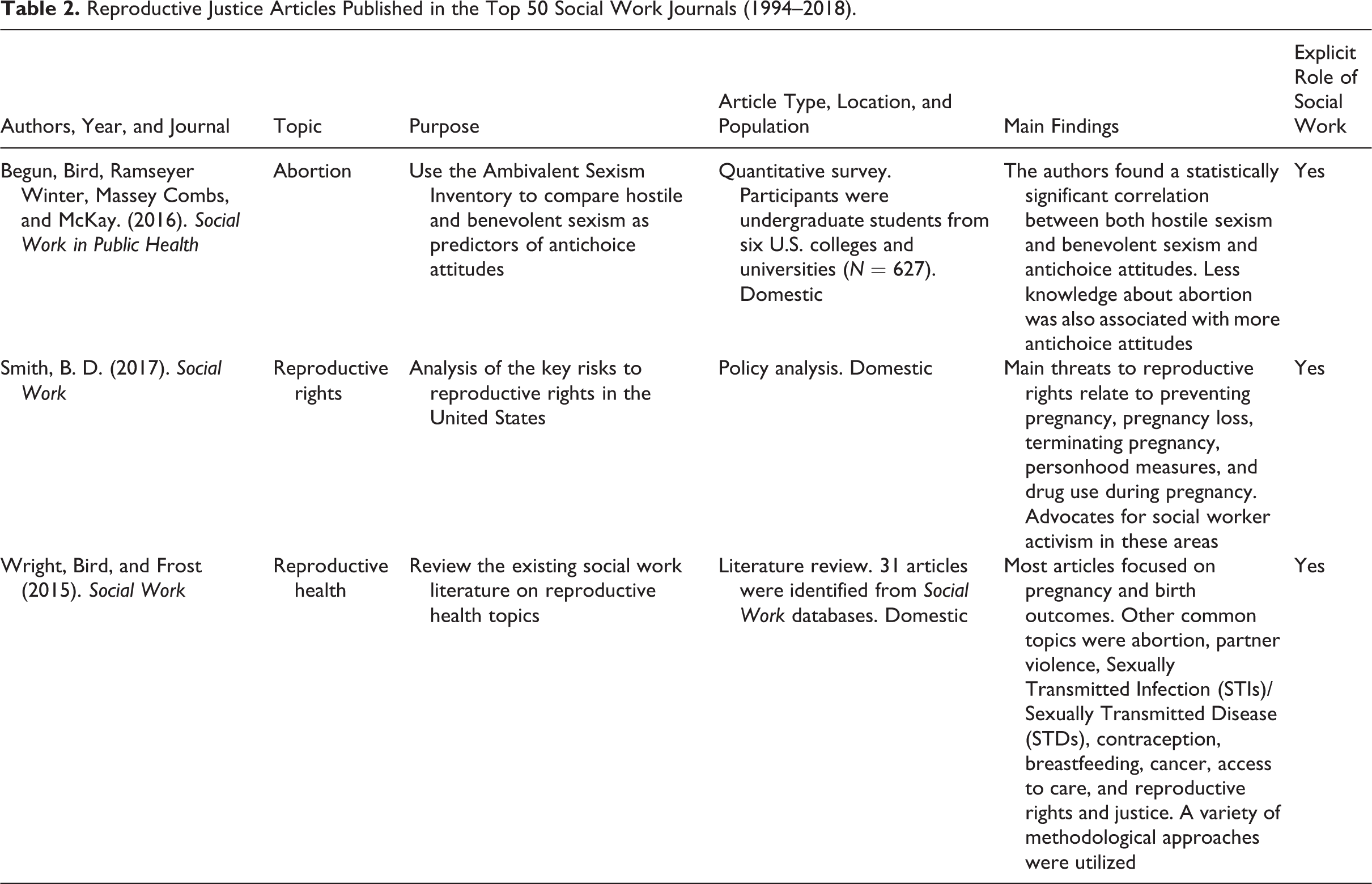
Abortion (n = 1), reproductive rights (n = 1), and reproductive health (n = 1) were the focus of these articles. All articles discussed reproductive rights and the importance of access to abortion. One article was a policy analysis (n = 1), one used a quantitative survey methodology (n = 1), and one was a literature review (n = 1). All three articles were published within the last 5 years. The journal Social Work published two of these articles (n = 2) and the journal Social Work in Public Health one (n = 1). Social work students were the sample for the quantitative article (Begun, Bird, Ramseyer Winter, Massey Combs, & McKay, 2016). The literature review investigated the presence of reproductive health topics in the social work literature (Wright et al., 2015). All articles (n = 3) focused on the United States. All (n = 3) called for an increase in research and practice on reproductive rights topics. Encouragingly, all articles (n = 3) included an analysis of the role of the social work profession and reproductive rights (see Table 1).
Discussion
There is not only a relative paucity of articles on reproductive justice, but the range of topics covered in these articles, and their methodological approaches, are limited. Although the recent increase in reproductive rights literature is heartening, it is surprising that only three articles that substantially focused on reproductive justice emerged, since it is congruent with the profession’s social justice values. Social workers provide a substantial amount of health-related services, in addition to being integral to the development of health policy, making an integration of reproductive rights and justice frameworks into social work research and practice especially needed. These findings suggest that social workers are receptive to a reproductive justice approach but highlight the need for applications of this framework to research and practice.
Current Gap in Social Work Practice and Frameworks
Although there is an overall commitment in the field of social work to research and practice that furthers social justice and women’s sexual and reproductive health (IFSW, 2012), this review demonstrates that social work literature has yet to frequently make use of the reproductive justice framework. This gap is surprising since social work principles and theories are intuitively compatible with the reproductive justice approach. Although the NASW (2016) in the United States, previously included on their website a page with resources connected to Reproductive Health and Family Planning, the major sections on this page (Access to Family Planning and Reproductive Health Care, Reproductive Health Care Delivery, and Gender and Reproductive Health Care in Emergency Settings) were all related to reproductive health access, and not to issues of social justice. The issue of access is of course an important one (SisterSong, 2006); however, the inclusion of a justice framework is necessary to understand the issues underlying these barriers to access and to achieve structural change. However, currently, there is an even greater absence of reproductive health and justice material on the NASW website. Reproductive justice is not listed among the social justice priorities that are to serve as guiding principles for NASW (2018) national offices and chapters nor is reproductive rights or justice listed as one of the policy issues under the advocacy section of the NASW website, and reproductive health and justice are not listed under the “health” section of the site.
This gap is also seen in the Grand Challenges for Social Work which were created at the 2016 Society for Social Work Research conference as a way of mobilizing social workers to take action on the top issues facing society (American Academy of Social Work and Social Welfare [AASWSW], 2016). However, these grand challenges do not include reproductive health, reproductive justice, or social justice, in their grand challenge initiatives. The Grand Challenges include 12 initiatives, categorized into three categories (“individual and family well-being,” “stronger social fabric,” and “just society”; AASWSW, 2016, 12 Challenges section, para. 1). Although “closing the health gap,” one of these challenges, may be conceptualized as possibly being related to reproductive rights and justice (it is included under the category of individual and family well-being), none of these challenges explicitly include a human rights or social justice approach to addressing health. These challenges can be analyzed in contrast to the U.S. NASW’s (1996) “Social Work Code of Ethics,” where social justice is one of the six ethical values. Although the reproductive justice framework is being increasingly used in other disciplines (predominately health fields, law, and sociology; Z. Luna & Luker, 2013), it may not yet be incorporated in the social work profession in the United States due to external pressures on the field. Social work’s legacy of advocacy, community organizing and social action, has in recent years gotten lost amid the growing popularity of clinical and psychotherapy focused practice, by both schools and practitioners alike (Trattner, 2007).
Despite social work’s more radical past, current social workers have faced pressure from both public and private employers that have in many cases required them to de-emphasize the social justice components of their work. In the 20th century, social work saw a shift toward a focus on casework and the individual, in part due to a desire to professionalize the profession, shifts in the composition of urban areas, and the increased importance given to psychoanalytic theories and casework (Trattner, 2007). Other scholars have also identified how the combined factors of neoliberalism, criminalization, and professionalization have become “braided” together to undermine social justice activism and structural change and justice-oriented approaches in social work research and practice (Mehrotra, Kimball & Wahab, 2016). The lack of use of the reproductive justice framework in social work may be in part attributable to this trend. Since social workers have and continue to frequently be in the position of determining a woman’s eligibility for social services, the need for incorporation of a reproductive justice lens is especially paramount (Roberts, 2014; Trattner, 2007). Although social work has yet to incorporate these frameworks into its research or practice, there are many opportunities for them to be applied.
Application of the Reproductive Justice Framework to Social Work
The reproductive justice framework can be applied by social workers in both research and practice. The framework is valuable for social workers because reproductive justice can be used to not only define reproductive health problems in a more holistic manner but can also be employed in the research methodologies used by social work researchers. Wronka (2008) has extensively discussed how social workers and other “helping” and health professionals can (and are in fact morally obligated to) incorporate human rights principles into their practice and research approaches. This can also include incorporating a justice framework in developing a research agenda and in deciding what type of, and how data are collected, and then disseminated (Wronka, 2008). Utilizing community-based participatory research methods in combination with a reproductive justice framework is one example of how ethical research could be conducted that could directly feed back into the community.
The need for research on the use of a reproductive justice approach in social work is congruent with findings from Roskos (2004) who argued that though there has been increased academic focus on human rights, narratives from individuals actually practicing in these areas have been limited. Some scholars and activists argue that without an emphasis on actual practice and activism, the reproductive justice movement may become co-opted and emptied of its meaningful potential (Z. T. Luna, 2011). Indeed, with its legacy of scholar–activist practicing, the social work profession seems uniquely suited to provide this approach, with its connection to both research and practice and its commitment to social justice (Alzate, 2009; Wronka, 2008). There is a need for ethical research from the perspective of those using a reproductive justice framework.
Although there is not yet a well-developed legacy of reproductive justice in social work, there are indications that some social workers are receptive to this approach. “SWRJ” have a website where they include blog posts from social workers interested in reproductive justice topics. In a 2012 opinion piece for “The New Social Worker,” the need for combining social work with reproductive justice to improve women’s health was also explicitly discussed (Clark, 2012). Clark discusses specific ways social workers can incorporate this approach into their practice, including both advocating for clients in micro interactions with clients, and at the macro level, through advocating for policies that improve women’s reproductive health through a reproductive justice lens.
Forward Together (2016), a reproductive justice organization connected to SisterSong, provides several resources on its website that can be utilized by practitioners incorporating a reproductive justice framework into their discipline. Among these is the suggestion that practitioners should ask the following questions when thinking about reproductive health: 1. Are people of color, young people, immigrants, Lesbian, Gay,Bisexual, Transgender, Queer/Questioning (LGBTQ) individuals, or low-income communities being disproportionately affected in a way that warrants exploration? Are certain communities or populations experiencing a significant difference in outcomes than others? 2. Who are the experts from communities affected by the disparity who can serve as sources or provide first-hand perspective for the story? 3. What are the historic and systemic factors that contribute to these outcomes? In many instances, law and policy, intervention from the medical establishment, or legacies of racism and colonialism have created disparities that provide critical context in understanding today’s outcomes. (Forward Together, 2016, p. 1)
An additional critique of using the reproductive justice framework centers on concerns that the term is being co-opted by mainstream feminist and reproductive health organizations without sufficient integration of reproductive justice principles into their programming, policies, and institutional ethos (Z. T. Luna, 2011). Z. T. Luna’s (2011) work is particularly important because it asks activists themselves how they currently conceptualize reproductive justice, which predominately focuses on the importance of including marginalized views and voices. Z. T. Luna finds that many of the activists she interviewed feel that “reproductive justice” is now simply being substituted for “pro-choice” and that it is used nonchalantly. As discussed previously, “reproductive justice” was originally conceptualized as predominately a framework for movement building (Ross, 2006), a move away from its activist roots may signal a dilution of what made the reproductive justice framework so powerful to begin with. These concerns are extremely valid and for social work practitioners’ issues that should be paramount when choosing how to meaningfully incorporate reproductive justice frameworks into their practice.
Additional potential limitations of the reproductive justice framework include that it still tends to view women in terms of their reproductive capabilities. This potential critique of essentialism may be avoided if reproductive justice applications continue to be expanded (as has been in the case of work by Nixon (2013) and Lind (2004), who respectively discuss transgender parenting and heterosexual bias through a reproductive justice lens). Those incorporating a reproductive justice lens in their research and work should be aware of the potential strengths and limitations of its application.
Conclusion
In this analysis, I argue that there is a current gap in social work practice where the reproductive justice framework can be applied. This framework is needed as a counter to how the rhetoric of “choice” has been used by mainstream reproductive health organizations to frame and direct debates around reproductive health and how this framework has hurt marginalized women. The choice framework is frequently used to portray the reproductive health decisions and experiences of marginalized women as “poor choices” instead of focusing on social and institutional barriers. Failing to acknowledge the ways in which female experience differs based on race or class, or other forces that structure material life, does not allow for an analysis of power structures across multiple axes, or of the ways these oppressive structures can interact with each other.
Study Limitations
This review only included articles in the top 50 journals identified by SJR. Additionally, it is possible that journals which are not identified as social work journals may still publish articles on reproductive rights and justice that are relevant for the profession. However, because the goal of this research was to specifically investigate the representation of reproductive justice in mainstream social work journals, this was determined to be the appropriate choice for this initial study. Future research should further investigate what literature exists outside of these journals. Although beyond the scope of this specific article, future research could investigate whether social work practitioners are publishing in other journals, possibly through compiling an author list of those who publish on reproductive rights and justice in nonsocial work journals and exploring whether any of these authors hold teaching or research positions in Schools of Social Work or have Master of Social Work (MSWs) or Doctor of Social Work (DSW)/PhD’s in social work. Additionally, only articles that were in English were included in the final analysis. This may have skewed the findings to be more representative of literature produced in the United States and in other Western countries. Although the focus of this analysis was on reproductive justice articles and not reproductive rights, there is often much overlap and compatibility between the two. The goal of this review is not to present them as in competition or as antithetical to each other but to note the current state of the reproductive justice literature. Although the number of articles identified were few, nonetheless, this review provides a much-needed overview of the current scope of reproductive justice in the literature.
Implications for Social Work Practice
This study is unique in being the first to systematically investigate the state of reproductive justice in the social work literature. In addition to identifying the current scope of the peer-reviewed literature on reproductive rights and justice, this article describes the importance and compatibility of these frameworks for the social work profession. Since this is the only known analysis that specifically looks at reproductive justice, it is a valuable resource for social work practitioners and researchers seeking an up-to-date review of this topic.
As outlined here, we see that several of the major theoretical approaches used in social work are highly compatible with a reproductive justice framework. However, despite this natural connection, reproductive justice frameworks have so far seldom been employed by social workers (at least as is identifiable in the literature). To alleviate the discrepancy between the frequency of reproductive justice articles being published in feminist studies and sociology journals, and journals of social work, some journals of social work may want to consider special issues or call for papers that focus on reproductive rights and justice topics. The Society for Social Work and Research (2018) conference theme for its 2019 conference is “Ending Gender Based, Family and Community Violence” an area which is highly compatible with reproductive rights and justice framings (para. 1). Encouraging further research and discussion of the study of reproductive and sexual health topics in MSW, DSW, and PhD programs is key in addressing this gap.
This analysis is important because it provides the first exploration of the current use of the reproductive justice framework in the social work literature and also offers social workers a path forward for incorporating this framework in their work. Reproductive justice frameworks offer the opportunity for social workers to provide health-care services and to conduct health-care research that is more empowering and beneficial for clients than previous models and that more fully takes into account intersectionality and social justice issues.
Footnotes
Declaration of Conflicting Interests
The author(s) declared no potential conflicts of interest with respect to the research, authorship, and/or publication of this article.
Funding
The author(s) received no financial support for the research, authorship, and/or publication of this article.
