




Abstract
In this current context, critical epistemologies, methodologies, and frameworks like Participatory Action Research (PAR), decolonial theory, and situational analysis can provide relevant tools for critical feminist social work research and praxis to expose and reenvision harmful, extractive, and privatized knowledge generation and dissemination. In this article, I describe the possibilities for using critical situational analysis to promote critical feminist social work scholarship through the interrogation of colonial forms of knowledge production, recognition of enactments of refusal and resistance, and illustrations of situational mapping from a study focused on exploring power differentials within PAR collaborations among social work faculty and community stakeholders. I then discuss possibilities to incorporate these analytic qualitative methodologies and frameworks to promote critical feminist principles for critical qualitative inquiry.
Keywords
This article emerged as part of a larger research study exploring power differentials among social work scholars and community stakeholders engaged in Participatory Action Research (PAR) or Community-Based Participatory Research (CBPR) collaborations. The purpose of this paper is twofold: 1) highlight the importance of situational analysis to critical feminism in social work to expose power relationships within knowledge production processes, and 2) present the utility of situational analysis as a powerful critical qualitative reflexive methodology to study the ways in which visible and invisible discourses of power impact participatory research collaborations, specifically, the situatedness of PAR/CBPR processes.
In this specific case, we use situational analysis to investigate the messiness of community-based participatory action research among social work scholars and community stakeholders. PAR/CBPR has been identified as anti-oppressive epistemological form of knowledge production congruent with social work's commitment to social justice and self-determination that seeks to partner with service users and oppressed communities to promote empowerment and social change (Flanagan, 2020). PAR/CBPR counters traditional top-down colonial approaches to research by recognizing the agency, self-determination, and knowledge of communities living at the margins as co-researchers within participatory contact zones through a reflexive, iterative, and action-driven approach (Fine et al., 2021; Omodan & Dastile, 2023). While PAR/CBPR originated within social movements in the global south as participatory action processes to promote critical consciousness-raising and political organizing that challenged the status quo and structural violence through testimonial literature, chronicles, visual historical cartography, and popular education workshops (Fals Borda, 2009; Rappaport, 2020), current applications, principles, and ethical commitments of PAR/CBPR have varied and continue to be interrogated (Lenette, 2022). For instance, despite scholars’ awareness of participatory action research standards of power-sharing in decision-making, action and dissemination of research, and critical reflexivity, studies have yet to articulate specific standards and processes to enact these commitments and principles fully in practice given major challenges experienced (Keahey, 2021; Tang Yan, 2023; Tang Yan et al., 2023; Wilson et al., 2018). Moreover, scholars have raised questions about the extent to which social work scholars’ genuine commitment to collaboration and reflexivity can fully enact PAR/CBPR decolonial and critical feminist principles while confronting structural barriers and power that prevent anti-oppression aims (Johnson & Flynn, 2021). In the following sections, further examination of micro level and macro level discourses of promoting and hindering elements of equitable knowledge production within PAR/CBPR is provided. Researcher's positionality is discussed, and further discussion of situational analysis methodology and critical feminist inquiry is presented.
Contesting the Possibilities and Limitations of Participatory Knowledge Production
Increasing research has explored the myriads of factors that shape the possibilities, tensions, and limitations of PAR/CBPR as knowledge production frameworks and processes that promote participatory inquiry in alignment with social work's values of social justice (Johnson & Flynn, 2021). At the micro level, PAR/CBPR has the potential to mitigate power differentials as it requires scholars, research processes, and frameworks to attend to macro, mezzo, and micro influences of power (Douglas et al., 2023). Moreover, PAR/CBPR interrogates colonial and hegemonic knowledge production by integrating critical feminist and decolonial frameworks as it facilitates opportunities for critical consciousness, critical reflexivity, dialogical relationality, shared decision-making, and self and collective determination (Fernández, 2022; Lykes & Távara, 2020). Social work scholars with marginalized identities and commitment to engage in power sharing within PAR/CBPR collaborations reported experiencing increased vulnerability and structural challenges to sustain these efforts, particularly due to balancing tenure promotion and research rigor expectations with community-based research visions when engaging in PAR/CBPR (Cosgrove et al., 2020). These structural barriers at the macro level go hand in hand with the presence of dominant ideologies and approaches to research such as capitalism, adultism, and white supremacy which generate ethical tensions and pose significant barriers to the achieving meaningful participation in PAR/CBPR partnerships (Teixeira et al., 2021). Additionally, findings of a scoping review of literature reveals key ethical issues in PAR/CBPR collaborations including validity and research integrity, the ethics review process, and unaddressed power differences between academic researchers and community members (Wilson et al., 2018). Although relevant research continues to explore key individual strategies, processes, and outcomes at the micro or macro level separately to secure success in long-term PAR/CBPR partnerships including development of explicit collaboration guidelines, cultural humility, and power sharing (Boursaw et al., 2021; Brush et al., 2020a; Coombe et al., 2020; Van Acker et al., 2021; Sánchez et al., 2021; Wallerstein et al., 2020), research has yet to incorporate research methodologies and frameworks that critically examine power discourses considering the ecology of micro, mezzo, and macro contexts within participatory inquiry (Egid et al., 2021). More specifically, research is needed that examines the ways these multilevel factors restrict the attainment of equitable participation and power sharing within CBPR/PAR in the context of neoliberal academia, where emphasis is placed heavily on tangible measures of researcher-driven scholarship, productivity, and reproduction of monolithic views of research (Kramer et al., 2021). Thus, integrating creative methodological, theoretical, and analytical ways to challenge oppressive social structures and power in knowledge production processes is essential in contesting these tensions of PAR/CBPR.
Current Aims
With this context in mind, this article introduces situational analysis as a critical qualitative methodology in alignment with critical feminist frameworks to further examine discursive power differentials within participatory inquiry. This article draws data from a larger exemplary empirical research project to illustrate the applications of situational analysis methodology. This data was collected between March 2020 to November 2020. It includes virtual semi-structured in-depth individual interviews with U.S.-based social work faculty (n = 13) and community stakeholders (n = 10) where power differentials within PAR/CBPR collaborations were explored (Tang Yan, 2023). It is beyond the scope of this paper to dig deep into the details of the qualitative data of this larger project, but to use this context and key highlights to demonstrate the potential of situational analysis. In the context of this article, critical feminist framework is paired with situational analysis, which informed the application of these key theoretical and methodological frameworks within the broader study, presenting possibilities to social work scholars to further examine discourses of power within participatory action inquiry. To achieve this aim, researcher's positionality and reflexive practices are provided, followed by a discussion of critical feminist theory and situational analysis. An examination of human and nonhuman elements, social worlds, and positions present in the situatedness of the exemplar study that explored PAR/CBPR collaborations using five types of situational maps to illustrate the breadth and depth of discourses in the situation.
Positionality and Reflexive Practice
Describing researchers’ positionalities and how they shape the research is a fundamental component of critical feminist praxis that shifts away from elevating individual selves to practicing accountability in socially just research (Jackson et al., 2024). Scholars have articulated multiple strategies to engage in active reflexivity as insiders, outsiders, and in-between, including documenting individual assumptions, systematizing reflexive practices throughout the research process, engaging additional individuals in the reflexive process, as well as articulating specific assumptions and reflexive practices in scholarly publications (Soedirgo & Glas, 2020). While researchers have objected to the practice of including positionality statements as it compromises the impartiality and integrity of research, support for reflexive practices to situational positional biases have also been documented (Savolainen et al., 2023). Similarly, scholars have called for researchers to move beyond static, hollow, performative “shopping list” positionality statements to engage in the development of “kitchen table reflexivity” that enacts relational positionality and meaningful engagement in knowledge production spaces and encounters (Folkes, 2023). Through a critical examination of embodied subjectivities and attention to heart-centered work, scholars become more aware of individual positionalities and lived experiences that impact the research and work towards an ethical reflexive practice (Fernández, 2018).
As an early-career scholar trained in social work, I engage in active unsettling reflexivity by situating my embodied subjectivities throughout the research to deepen my understanding of use of self as instrument in knowledge production processes. I lean into the tensions and the struggles that I strive to reconcile, those related to my personal experiences of privilege across the domains of education, class, ability, and gender, as well as those related to marginalization with oppressed communities that I work with and share affinity with, including Asian and Latine immigrant communities and youth of color. More specifically in the scope of this manuscript, I adopt a commitment to sit with, engage in dialogue with, and be accountable with the learnings, tensions, shortcomings from my former and current individual experiences serving multiple roles as a youth organizer collaborating with PAR/CBPR scholars as well as a doctoral student and faculty collaborating with community members in PAR/CBPR partnerships. Through reflexive journaling, peer debriefing, writing, and having open and honest conversations with community partners and colleagues, I intend to engage in ethical dialogical relational processes where I can be accountable and unpack my subjectivities and assumptions. This process requires me to engage in heart-centered work that is sentipensante, namely a holistic approach to knowledge production that combines sensory, intuition, and intellectual ways of being and knowing (Fals Borda, 2009). This is reflected in specific practices that I strive to unlearn and relearn in honoring and engaging in dialogue with my collaborators’ intuition, feelings, contradictions, and constructive dialogues and meaningful feedback. For instance, I have practiced rituals that include dedicating time to engage in individual reflections, collective dialogues, and relationship building activities with collaborators to explore different forms of knowledge production that are relational, embodied, and accountable. While I recognize the incommensurable value of these practices, it is also important to recognize the ways these practices contradict dominant forms of knowledge production in academia and commit to contest both strengths and limitations of these forms of knowledge and meaning making. Drawing from my experiences having partnered with academic researchers in PAR/CBPR projects and having co-led PAR/CBPR projects as a doctoral student and early career scholar, for the purpose of this study, I leaned into the tensions and contradictions that I witnessed, embodied, and struggled with because of power differentials and interests in knowledge production between academia and community grassroots groups.
Situational Analysis
Drawing from methodological and theoretical developments of constructivist grounded theory, situational analysis is an approach to qualitative analysis that focuses on examining discourses and situations as key unit of analysis (Morse et al., 2021). Developed by Dr. Adele E. Clarke, internationally recognized sociologist and critical qualitative feminist scholar, situational analysis uses iterative development of four distinctive analytic maps to analyze: 1) human and nonhuman elements present in the situation, 2) existing relations among these elements, 3) social worlds of commitments, and 4) positions taken and not taken in existing discourses or situations (Clarke, 2021). Qualitative discursive narrative, visual, and historical data including interviews, ethnographic observations, documents, images, literature, and social media can be examined using situational analysis (Morse et al., 2021).
Situational analysis promotes transdisciplinary research as it facilitates the integration of empirical, methodological, theoretical, and epistemological frameworks of various knowledges from different disciplines to form a single model of scientific research (Kalenda, 2016; Lawrence et al., 2022). Situational analysis’ reflexive and holistic approach is congruent with social work values through a transdisciplinary approach as it has the potential to engage individuals with various knowledges and experiences to collaborate in problem framing, co-creation of solution-oriented and transferable knowledge, and reintegration and application of co-created knowledge (Kalenda, 2016; Umesh Samuel Jebaseelan & Michael Fonceca, 2021). For instance, through the use of situational analysis, multiple challenges for equitable and inclusive engagement processes in water governance resource decision-making were identified, in particular, specific power structures that excluded and privileged specific exogenous, endogenous, and peripheral stakeholders (Whitley, 2024). Moreover, situational analysis presents theoretical frameworks and concepts relevant to researchers and practitioners from spatial disciplines that intersect with social sciences such as architects, urban designers, and urban planners (Kling, 2023). Additionally, the use of situational analysis has also illustrated a more historicized and critical analysis of implicated actors across fields in promoting specific technology and policy relevant to critical feminist issues such as abortifacient technology where scientists, pharmaceutical companies, medical groups, antiabortion groups, women's health movement groups, and others have shaped various discourses and situated knowledges (Clarke & Montini, 1993).
Rather than reducing the subject of research to a mere phenomenon in its conditional context, situational analysis maps the multilevel interdependent elements and discourses and conceptualizes the complexity of a particular situation (A. E. Clarke, 2022; Kalenda, 2016; Pérez & Cannella, 2013). For instance, in the event scholars were examining interactions within a classroom in school-settings, rather than focusing primarily in one or various particular forms of pedagogical communication, using a situational analysis approach, additional material, human, temporal, visible, and invisible elements and relationships including embodied communication, power dynamics among individuals, and communication tools, presents the potential to locate the unit of analysis in the situation rather than the boundaries of research disciplines (Kalenda, 2016). Similarly, in examining discourses of healing interpersonal patterns in family therapy, researchers used situational analysis, specifically positional mapping to critically examine range of possibilities and discourses that could inform therapists’ awareness in initiating societal discourses in therapy sessions to address family concerns (Wulff et al., 2015). Thus, situational analysis and mapping integrates a critical reflexive and theoretical approach to expose structural and power elements embedded in discourses and situations to inform practice and knowledge production (Dudley et al., 2022; Mudry et al., 2021).
Integration of Critical Feminist Qualitative Inquiry and Situational Analysis
Critical feminist theory and principles center epistemological, conceptual, and political interrogation of systemic issues, dominant ideologies, and critiques of power and gender differentials (Goodkind et al., 2021). While critical feminists in social work are increasingly engaging in intellectual exercises to theorize critical feminism and justice, limited analyses have included a careful examination of the ways the profession remains complicit in perpetuating settler colonialism, heteropatriarchy, heteropaternalism, and white supremacy (K. Clarke, 2022). Thus, scholars have presented indigenous decolonial feminist frameworks that center ideas, values, and actions grounded in sovereignty, self-determination, and relational worldviews for strategizing for social change (BlackDeer, 2023). As social work practitioners, scholars, and educators contest structures and ideologies towards the promotion of justice, critical feminist inquiry and principles play an essential role in anchoring knowledge production processes grounded in accountability, critical commitments, and praxis (Cree & Phillips, 2019).
Situational analysis is a research methodology that presents these possibilities by conceptualizing feminist and poststructuralist critical approaches to generate contextualized thick analyses of human and nonhuman elements salient in situations and discourses (A. E. Clarke, 2022). Similarly to the ways critical feminist principles prioritize the adoption of holistic worldviews by exploring complexity, intersectionality, and context (Goodkind et al., 2021), situational analysis uses critical mapping and textual cartography to contextualize the situation studied while simultaneously analyzing various elements, social worlds, and positions to illustrate complexities and contradictions found in the discourses to deepen ways of knowing and epistemologies recognizing explicitly key relational, temporal, political, and epistemic elements (Clarke & Hanssmann, 2021). Additionally, critical feminist epistemological principles challenge assumptions by centering counternarratives and integrating a critical reflexive praxis and examination of researcher's positionality (Goodkind et al., 2021). Rather than identifying simplified common patterns while avoiding contradictions and differences among social science research, situational analysis actively seeks to make silences and contradictions legible using participatory critical mapping and critical self-reflexive memoing to analyze implicated individual and organizational actors, contested arenas, and hierarchies that reveal subtle and explicit use and implications of power (Clarke & Hanssmann, 2021). These characteristics and principles are especially essential for participatory inquiry and knowledge production processes that contest persistent colonial, capitalist, and neoliberal frameworks that continue to compromise the profession's pursuit of justice.
Context of the Exemplar Study
The study used to illustrate the application of situational analysis here consists of an exploratory qualitative examination of the ways social work faculty and community partners with experience in PAR/CBPR collaborations contest power differentials within the partnership drawing decolonial, critical race, and critical feminist theories to focus on intersecting oppressions (For more detailed description see Tang Yan, 2023). The study aimed to a) analyze the ways multiple stakeholders conceptualized power differentials and interlocking systems of power and oppression within PAR/CBPR collaborations, b) analyze specific examples and ways in which discourses of contesting these power differentials were enacted among multiple stakeholders, and c) identify recommendations to engage in PAR/CBPR collaborations centering ethical relationality and accountability. Institutional Review Board approval was successfully obtained for this larger study. Two waves of in-depth semi-structured interview transcripts with social work researchers (n = 13) and community partners (n = 10) with prior or current experience engaging in PAR/CBPR collaborations served as major sources of data in addition to researcher team's reflexive memos and journaling. Participants were recruited using nonprobability sampling strategies, specifically quota, snowball, and convenience sampling strategies (Flick, 2017). Faculty (n = 13) were on average 47 years old (SD = 7.6), and community stakeholders (n = 10) were on average 42 years old (SD = 18). Near half of the faculty and community stakeholders reported being engaged in PAR/CBPR collaborations for a minimum length of 3–6 months and a maximum length of 1–3 years. Faculty and community stakeholders combined identified as Black/African American (48%) followed by White (26%), Latinx (17%) and Asian/South Asian/Pacific Islander (9%) (For more detailed description see Tang Yan, 2023).
This article draws data from the exemplar study to illustrate applications of situational analysis, critical feminist principles, and qualitative inquiry. More specifically, this article draws from all interviews to illustrate the application to situational maps (i.e., abstract messy, ordered, relational, and social worlds/arena maps) and focuses on specific interviews to further examine positional mapping. In the following sections, various types of situational, social worlds/arenas, and positional maps are presented and discussed. Specific emphasis on the situational analysis methodology, namely the mapping exercises and emerging themes in relation to critical feminist frameworks to examine power differentials in PAR/CBPR collaborations are highlighted. Rather than juxtaposing discourses pertaining to faculty and community stakeholders comparatively, the following discussion analyzes discourses from both perspectives to deepen the understanding of the situation by mapping invisible and visible elements in the discourse.
Application of Situational Mapping as Critical Feminist Mapping of Complexity, Intersectionality, and Context
First, the researchers immersed themselves in the interview data. Each transcript was analyzed by identifying each corresponding nonhuman and human elements in the situation and listed in the ordered situational map. Drawing from this information, memoing and messy maps were developed iteratively to visually represent the shifts in the focus of discourses pertaining to power differentials in PAR/CBPR partnerships discussed among faculty and community stakeholders in the interviews. Additionally, researchers engaged in peer debriefing, journaling, and engaging in discussions to increase awareness of specific assumptions, biases, power dynamics, and individual subjective experiences (Ide & Beddoe, 2024) stemming from identities at the intersection of power and oppression within knowledge production processes. These specific practices to increase researcher's reflexivity align with Situational Analysis’ integration of constructivist grounded theory elements to acknowledge researchers’ embodiment and situatedness of all knowledges as well as individuals as knowledge producers (A. E. Clarke, 2022). Using grounded theory's concept of saturation, this consists in the action of engaging in further analysis until narrative discourses are no longer analytically useful, namely, no new characteristics or elements emerge (Charmaz & Thornberg, 2021; A. E. Clarke, 2022). Saturation was reached when researchers worked collaboratively on mapping, memoing, and discussing at length all the possibilities of discourses and themes through multiple readings of data without finding any new emerging elements that made a difference to the maps and discourses gathered thus far (A. E. Clarke, 2022). Rather than developing conceptual or analytic maps based on grounded theory codes or analytic codes, researchers engaged in situational analysis to develop descriptive maps of the situations being studied. The abstract messy situational map (see Figure 1) demonstrates discourses used to represent multiple positioned actors’ perceptions on elements and discourses in PAR/CBPR collaborations. The ordered situational map (see Table 1) presents these elements arranged in specific categories. Figure 1 and Table 1 represent the final versions of the messy and ordered maps developed.
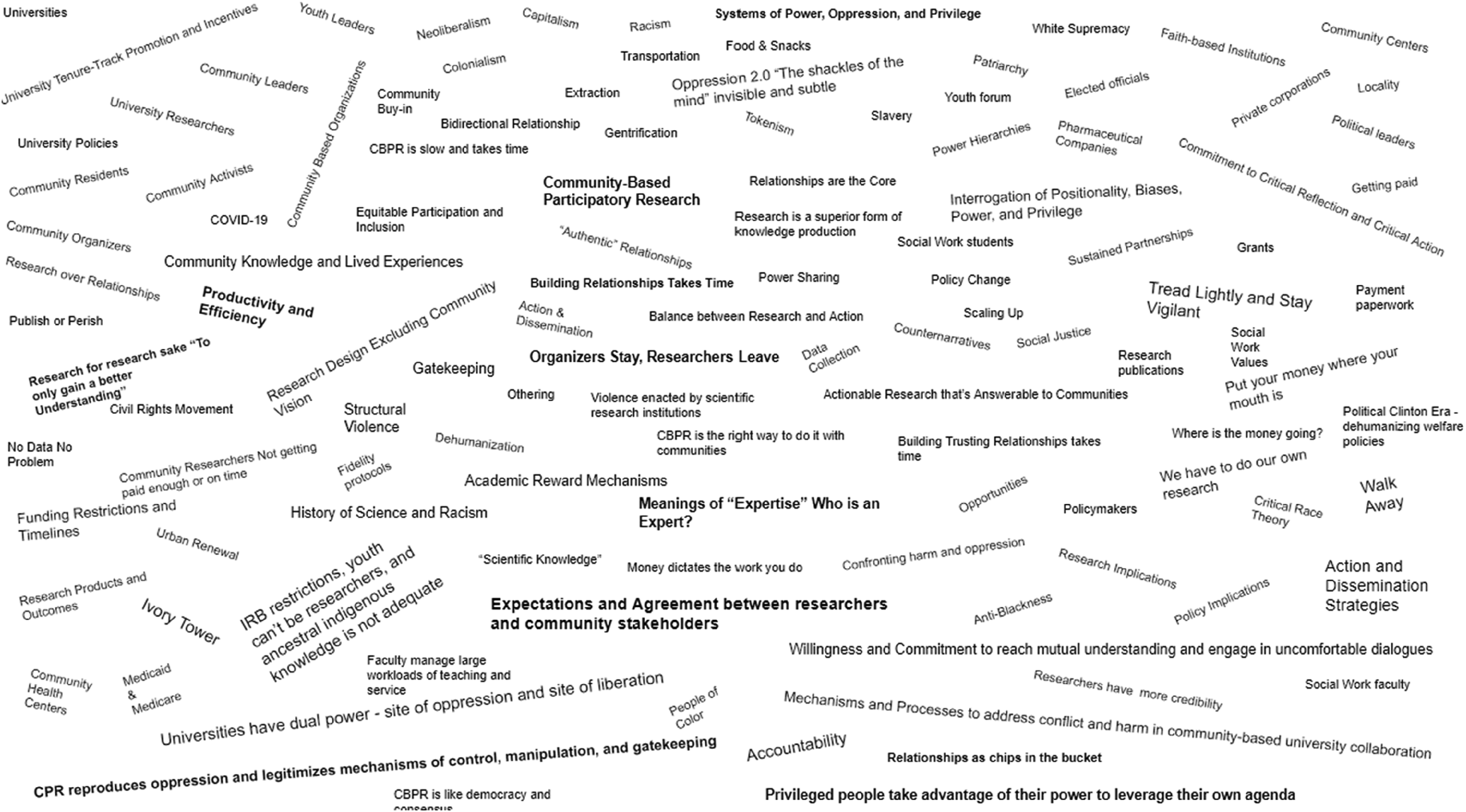
Messy situational map: analysis of human and nonhuman elements and actors.
Ordered Situational Map: Analysis of Human and Nonhuman Elements and Actors.
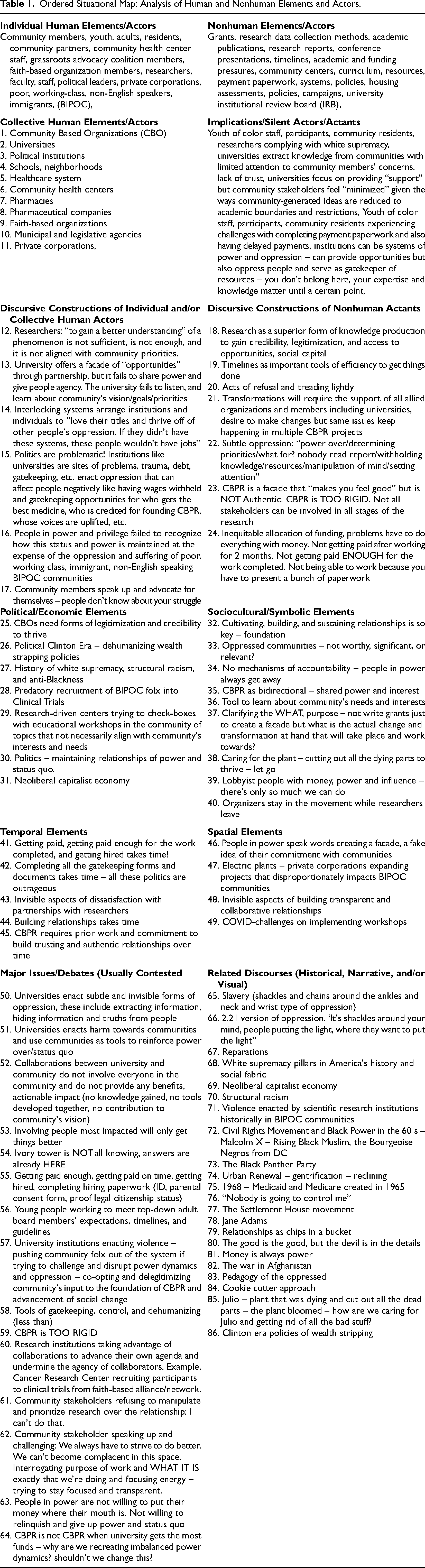
The messy and ordered maps serve as an illustration of situational analysis to integrate an emphasis on power relations within PAR/CBPR collaborations. For instance, while the discursive element and theme of “CBPR is the right way to do research with communities” given that “relationships are at the core” and “actionable research is answerable to communities”, visible and invisible political, historical, economic, temporal, and narrative elements limit the emancipatory potential of PAR/CBPR and interrogate major contested terrains within knowledge production and expertise. Elements such as “scientific racism”, “IRB restrictions”, “CBPR is too rigid”, and “organizer stay, and researchers leave” are juxtaposed with the possibilities of PAR/CBPR situated within higher education that “have dual power as sites of oppression and liberation”.
Upon the development of messy and ordered situational maps, researchers reviewed all transcripts to identify specific instances of identifying explicit and implicit potential relationships within the situation, namely PAR/CBPR partnerships. Building on the final messy situational map developed, researchers illustrated these textual relationships in the map systematically and iteratively by reviewing each interview, drawing lines between elements to reflect existing relations across the multiple elements and actants, and discussing the nature of the relationship, the ways it mattered to one another, and whether a change in one element provoked change in another one (A. E. Clarke, 2022). Given the scope of the exemplar study, specific relationships from individual actors including university researchers and community leaders were examined separately to further explore the apparent and non-apparent relationships that each hold in the situation.
(Figure 2).
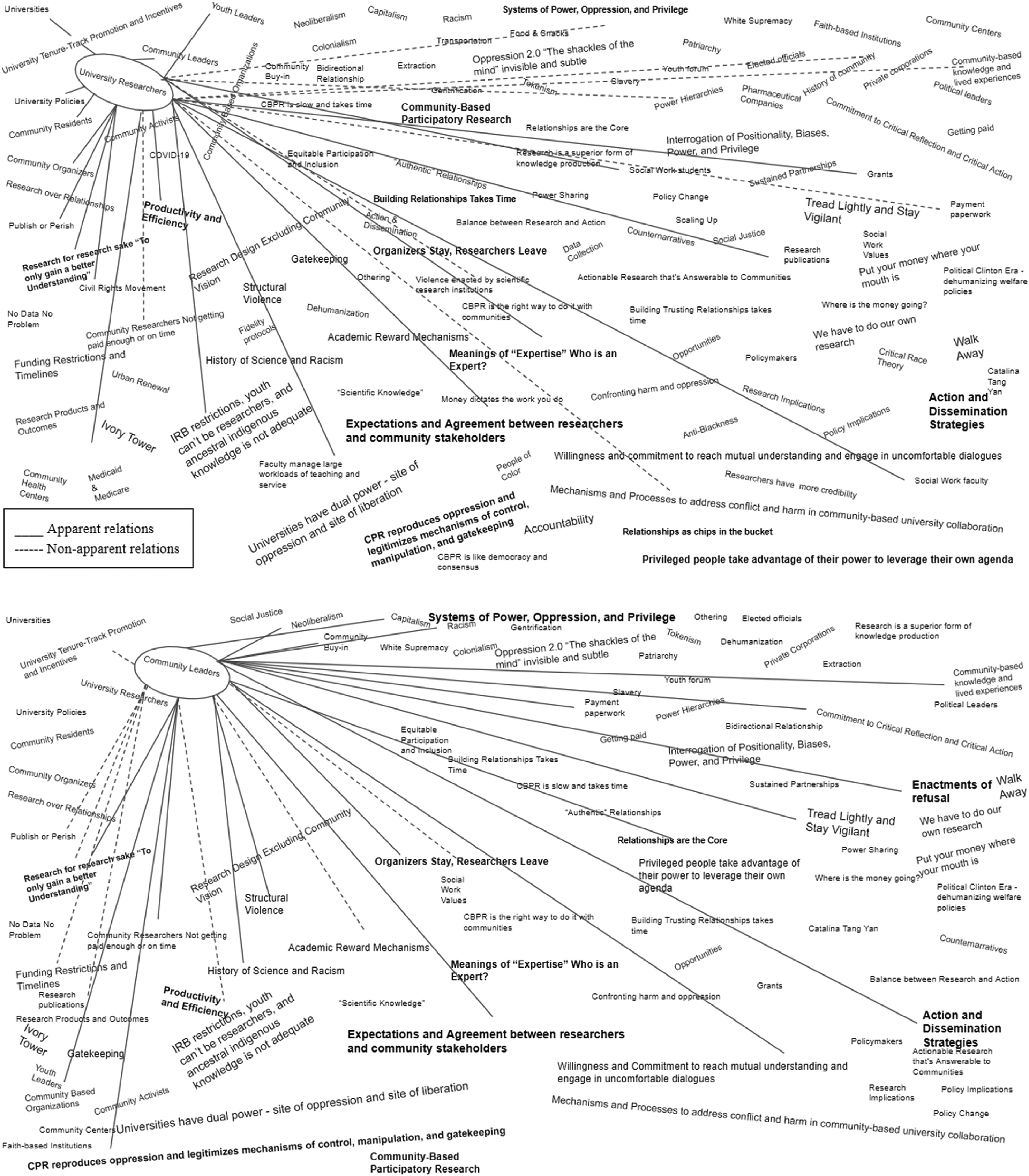
Relational situational maps.
The relational situational maps highlight specific discourses that are positioned in the background and the foreground of PAR/CBPR collaborations. It is evident that university researchers hold apparent relationships with explicit guidelines and frameworks of PAR/CBPR such as maintaining “expectations and agreements between researchers and community stakeholders” as well as specific tenure promotion and research expectations including “grants”, “publish or perish”, and “research publications”. Non-apparent relations mapped from the perspective of university researchers included discursive elements surrounding epistemic justice such as “meanings of expertise”, “community-based knowledges and experiences” and translating principles of PAR/CBPR into the material conditions of the collaboration such as “community researchers not getting paid enough or on time”, “mechanisms and processes to address conflict and harm”, and “violence enacted by academic institutions”. These non-apparent relations reflected to be apparent from the perspective of community leaders in addition to discourses of resistance in response to the interlocking systems of power and oppression present in academia such as “enactments of refusal”. Specific elements related to academic structures of tenure promotion and research funding restrictions were non-apparent relations that were reflected throughout the interviews and illustrated in the relational maps.
Interrogation of the Possibilities of PAR/CBPR Within Knowledge Commodification in Higher Education
Across the messy, ordered, and relational situational maps, what stands out in addition to including discourses of mutual and participatory partnerships in research, which is heavily emphasized in scholarly literature (Brush et al., 2020b), are the emerging tensions and contradicting human and nonhuman elements of knowledge production processes. The maps include key actors and discourses that naturalize the value and meaning of authentic mutual participatory science to inform policy and meaningful change. However, the maps are also full of terminology that includes nonhuman actors/actants that restrict and limit participatory knowledge production processes among researchers and community partners including IRB restrictions, faculty workloads, academic tenure-track publication pressures, funding priorities, and equitable compensation of community partners, signaling profound tensions to be considered. These situational maps demonstrate the density and significance of structural and material conditions where participatory knowledge production processes are shaped by elements that commodify participatory scientific inquiry under colonial, neoliberal, and capitalist ideologies.
Rather than juxtaposing discourses based on individual actors (i.e., university researchers vs. community stakeholders) to create dichotomous perspectives as scholarly research has primarily explored in the literature, situational analysis critically examines human and non-human elements and relations in the situation to identify major discourses influencing the complexity of the situation without portraying a homogenous or hegemonic representation. Three major discourses emerge from the abstract, ordered, and relational situational maps. One discourse of importance that emerges is the historical and sociopolitical discursive construction of participatory research and researcher(s) as mechanisms that democratize and decolonize knowledge towards meaningful transformation. This discourse also coexists with contradicting discourses that highlight the ways even with researchers being critically reflexive in building meaningful relationships with community partners in PAR/CBPR collaborations, knowledge production is interconnected to broader intersecting structural and ideological systems that reinforce top-down oppressive configurations of power. Finally, another major discourse to highlight is the ongoing tension of how “knowledge(s)” and “expertise” are defined and valued in academia, particularly the experiences from community partners in PAR/CBPR collaborations. As a result of this tension, emerging enactments of refusal to pursue forms of participatory knowledge production that honor self-determination, autonomy, and sovereignty are also highlighted in the map. Situational maps facilitate the application of critical feminist principles to further examine naturalized hidden conditions and discourses of intersecting power that are contextualized.
Similar to the process of developing messy and relational situational maps, interview data was reviewed, and specific social worlds/arenas map present were mapped. Specific patterns of collective commitments, groups with shared interests and stakes, and institutions were identified and mapped to illustrate the relative size and power of different worlds in their relations to one another in the broader situation of the study (A. E. Clarke, 2022). In the exemplar study, the use of social worlds/arenas mapping can further illustrate relational ecological analyses by identifying collective commitments, groups with shared interests and stakes, as well as constructive discursive sites that are constantly negotiated and contested in PAR/CBPR collaborations. In the social worlds/arenas map created from the exemplar study (See Figure 3), social worlds, subworlds, and organizations are represented using dotted lines and different shapes to highlight the fluidity and overlapping boundaries present in the situation. Drawing from the qualitative interview data with social work faculty and community partners, participatory knowledge production processes is the contested arena identified where multiple worlds and subworlds are actively shaping the situation. The depiction of multiple individuals, organizations, and social worlds involved in the background and foreground of PAR collaborations highlight the various ways in which specific opportunities, conditions, and resources are often contested or constrained by collective commitments of key actors and actants in the situation such as funders and academic research guidelines. Additionally, further memoing reflecting on the patterns and relationships of social words/arena mapping also emphasizes the complex relationships between individuals and organizations within these contested terrains. While social work faculty and researchers may prefer not to participate in participatory knowledge production processes that reinforce power hierarchies and epistemic injustice, their stakes or dependencies with academic institutions and social worlds demand their participation in the situation.
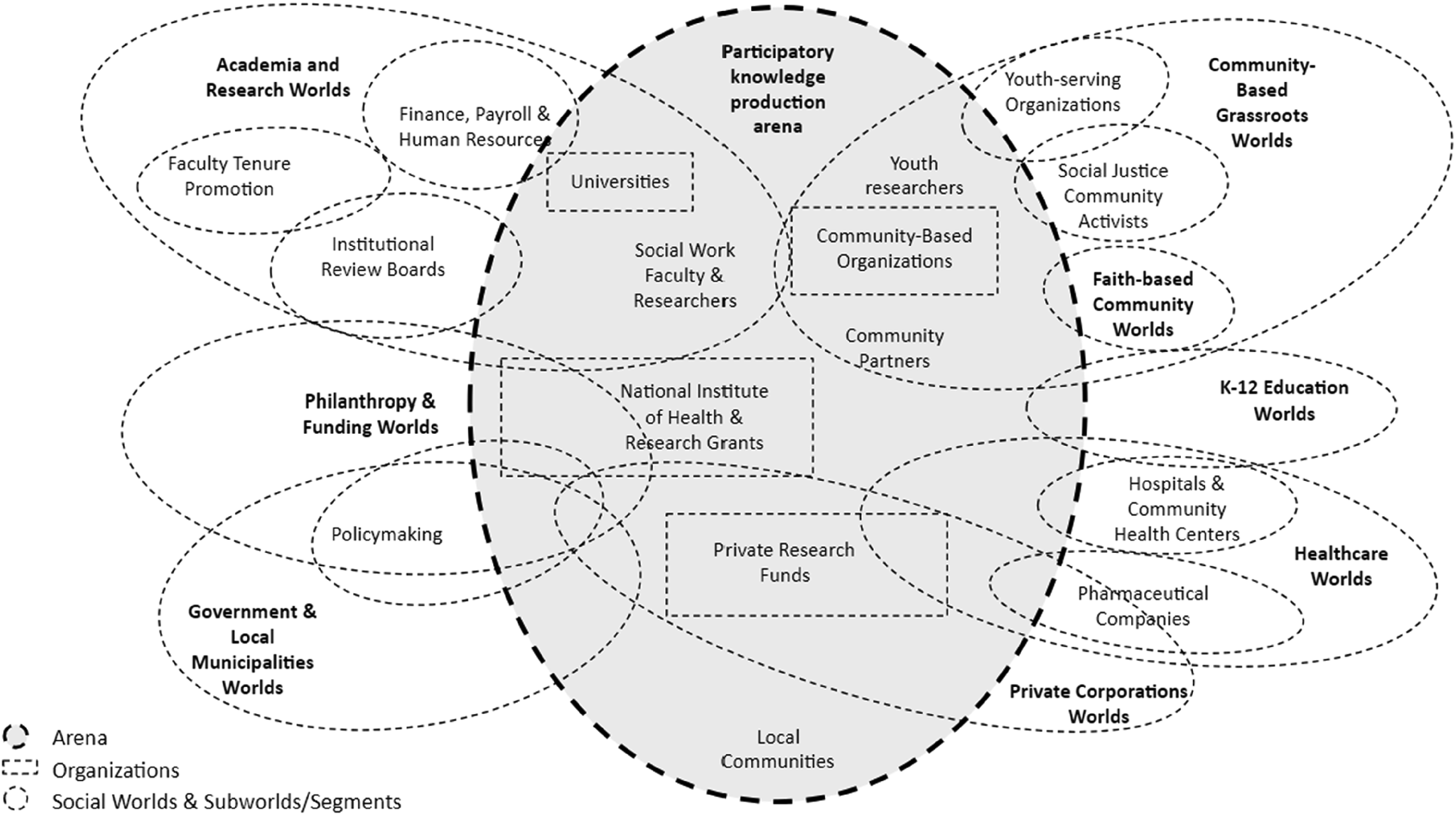
Social worlds/arenas map.
To develop positional maps, interview data was reviewed, and positional maps were created for each interview identifying specific issues contested as well as positions expressed on the particular issue with specific quotes from participant interviews. Then, these issues were laid out systematically across horizontal and vertical axes to show the positions present in the data. Similarly to the messy, relational, and social worlds/arenas maps, positional maps are developed by creating multiple versions of each map and building upon them to show multiple ways of representing the issue and positions taken. Once multiple positional maps are developed, saturation is reached where contested issues continue to emerge and its relevancy is much clearer. In the following sections, positional maps from the exemplary study are discussed with an emphasis on drawing from one interview with a social work faculty and another interview with a community stakeholder. Positions identified are examined separately in mapping to illustrate the iterative development of positional mapping.
In the positional maps developed for the study exploring power differentials within PAR/CBPR collaborations, emphasis on specific positions articulated regarding valued ways of knowing were explored. In the first drafts of positional maps developed (see Figure 4), individual interview transcripts were reviewed, and positional maps were mapped including direct quotes to illustrate articulated positions in the discourse. Five major articulated positions about valuing community stakeholders’ experiences and relationships as equally as traditional scientific knowledge emerged. These different perspectives highlight the tension of how PAR promotes different ways of knowing and being that contradict traditional scientific standards of evidence.
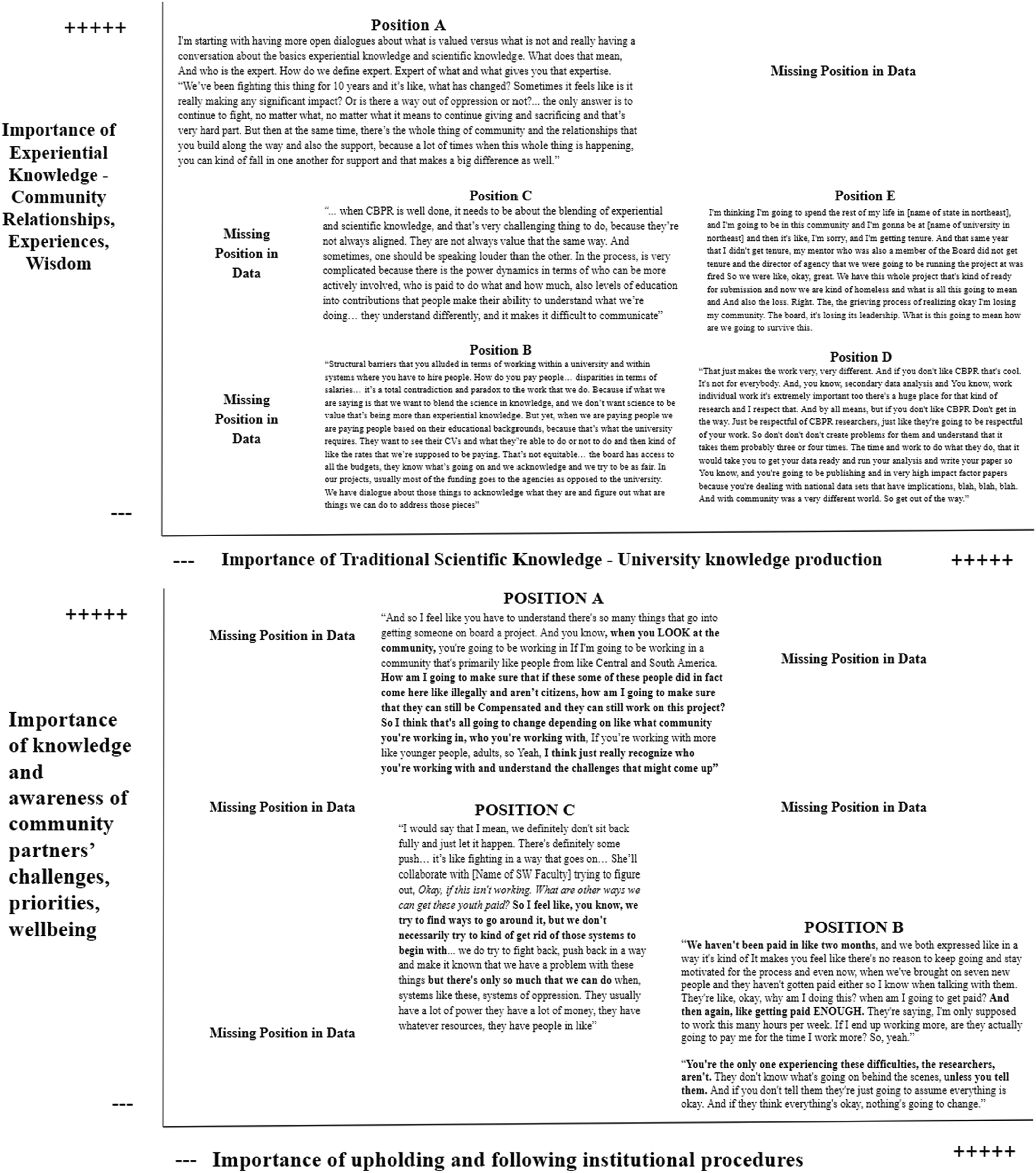
Drafts of positional maps analyzing importance areas of knowledge production contested.
In the first positional map in the top in Figure 4, social work faculty's direct quotes are placed to illustrate the different positions taken when contesting the relevance of community's experiential knowledge/relations and the relevance of traditional scientific knowledges. Specific quotes highlight the ways university finance policies, tenure promotion academic publication expectations, and prioritization of quantitative research position traditional knowledges highly. This is represented in the ways articulated positions question whether the recognition of expertise is commensurable in the form of equitable financial compensation based on community partners’ educational degrees. Additionally, the social work faculty interrogates the ways this form of recognition is reflected in their 10-year CBPR partnership where their tenure was denied and the intended CBPR projects were disrupted and impacted negatively: “… I didn’t get tenure, my mentor… did not get tenure and the director… was fired… now we are kind of homeless… what is all this going to mean… the loss… the grieving process… I’m losing my community…” (Social Work faculty). At the same time, social work faculty direct quotes also reflect the ways community relationships and experiential knowledge is positioned as highly relevant when engaging in dialogical praxis to interrogate expertise and redefine it by incorporating different knowledges and discussing non-apparent power dynamics within CBPR/PAR collaborations. This is reflected when faculty states: “I’m starting to have more open dialogues about what is valued versus what is not and really having a conversation about the basics experiential knowledge and scientific knowledge.” The faculty further asks: “What does it mean and who is the expert? How do we define expert?” (Social Work faculty).
In the second positional map situated below in Figure 4, youth researchers' direct quotes are placed to illustrate the different positions taken when contesting the relevance of awareness of community partners’ challenges/priorities and the relevance of upholding institutional policies and procedures that incorporate traditional forms of knowledge production. Specific examples where university policies are upheld to reproduce traditional knowledges are valued highly are reflected in the ways youth researchers' wages are withheld and questions “…When am I going to get paid? And then again like getting paid ENOUGH… you’re the only one experiencing these difficulties, the researchers aren’t. They don’t know what's going on behind the scenes unless you tell them” (community stakeholder). This position is further reinforced when researchers “… don’t necessarily try to kind of get rid of those systems to begin with” (community stakeholder). Alternatively, valuing knowledge and awareness of community partners’ challenges is represented in the position where researchers “… recognize who you’re working with and understand the challenges that might come up” (community stakeholder), such as, navigating or waiving specific paperwork required to pay undocumented youth researchers. Overall, positional maps further interrogate whether the missing positions of both approaches can in fact achieve emancipatory aims of meaningful transformation and action while contesting structural barriers that bound knowledge production processes.
By mapping specific articulated and missing positions in the situation, individual and collective positions can be disarticulated to analyze complexities, differences, and linkages. Upon iterative development of positional maps, saturation is reached, and final versions of maps are developed illustrating articulated and missing positions of collective actors. In Figure 5, analysis of power differentials within PAR collaborations is framed in the context of the ongoing tensions and negotiations in knowledge production processes that honor community-based experiential knowledges and ways of being or reproduce extractive and hierarchical colonial forms of knowledge. Rather than just focusing on monolithic and unnuanced approaches to knowledge production, positional maps serve as tools to examine the specific conditions that sustain neoliberal, colonial, and capitalist environments that shape PAR collaborations. The positional maps show the ways in which dominant discourses support epistemic injustice by reflecting market-driven and hierarchical scientific priorities such as publish-or-perish imperatives in academia. This creates competition for resources and recognition which may hinder and undermine community-based relational approaches to knowledge production and collective change. Positional maps aim to open discourses for further analysis.
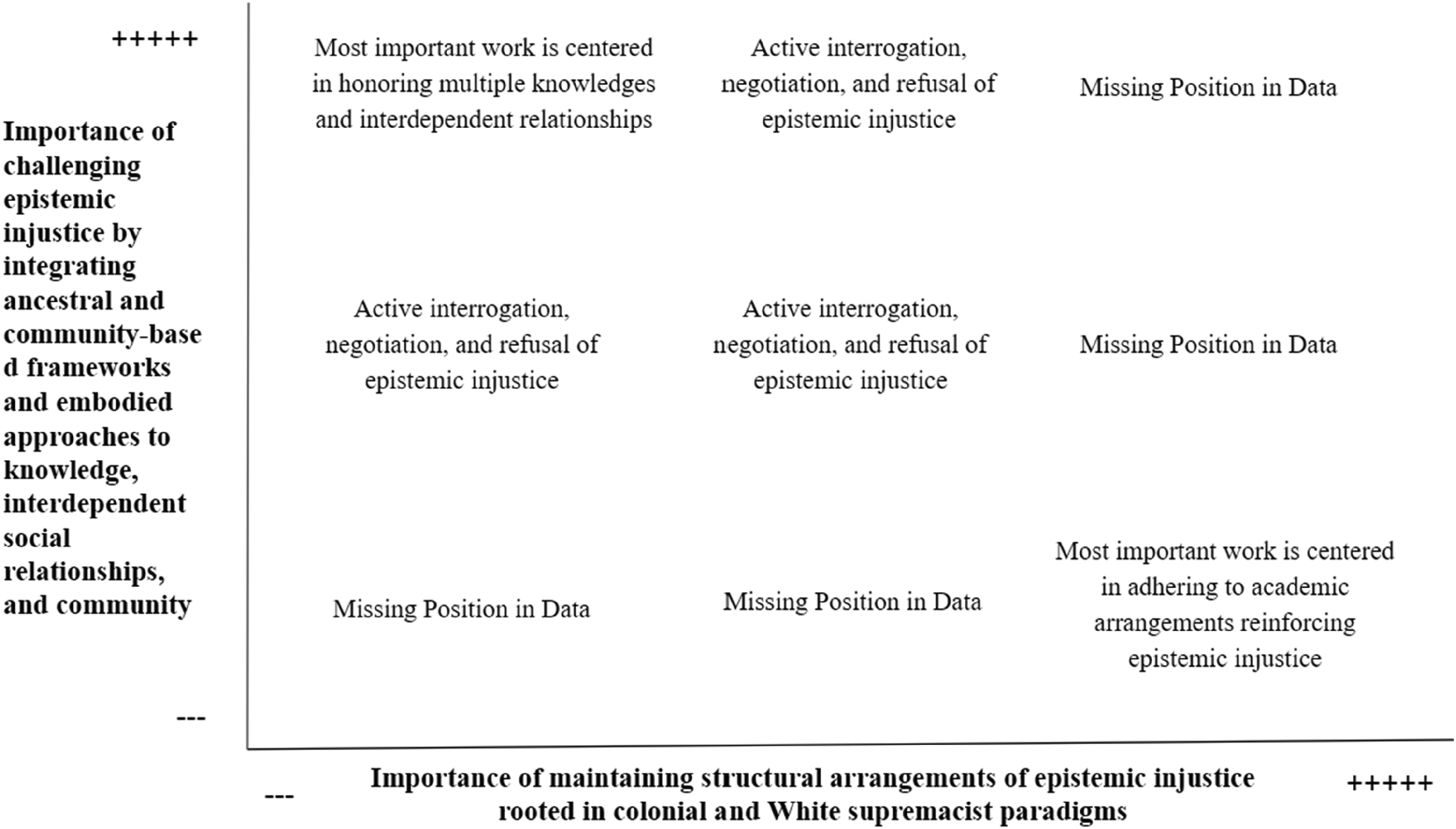
Positional map.
Discussion
The exemplar study exposing the influence of interlocking systems of power and oppression related to PAR processes among social work scholars and community stakeholders is an example of how situational analysis can be used for critical feminist and qualitative inquiry purposes. Through iterative mapping and memoing, apparent and non-apparent relations among human and non-human elements were analyzed as well as collective commitments of individual actors such as social work faculty and researchers. By analyzing positions articulated and not articulated in the collective efforts of actors in building equitable participatory collaborations, situational analysis uncovered key elements that shape master narratives of the neoliberal, capitalist, and colonial forces that shape knowledge production processes in academia and need to be further addressed and contested. While this research methodology assisted in adopting an intersectional and critical feminist approach to unraveling the micro, mezzo, and macro level elements shaping the situation at hand (namely power differentials within PAR/CBPR collaborations) through mapping, situational analysis has yet to further examine the dynamic nature across time how these discourses change and develop within social, political, economic, and historical contexts.
Social work's pursuit of justice across practice, education, and research is constrained by the dominance of neoliberal ideologies that favor market-led conservative policies and reductive educational and professional narratives (Carey, 2021). As the profession continues to experience significant pressures to adopt business principles to increase managerialist productivity, efficiency, and privatization of human service provision, social work's mission and commitment to advocacy and justice is further compromised (Abramovitz & Zelnick, 2021). Pressed by corporate funder-driven demands and adoption of business models, social workers report experiencing systemic racism in leadership hierarchies, worker surveillance, and workplace violence (Abramovitz & Zelnick, 2022) in addition to the prioritization of measured outcomes and evidence-based practices over social work values which are given lip service (Zelnick & Abramovitz, 2020). Furthermore, social work scholars contest persistent corporatization of academic research dictated by market profit-driven funders to benefit specific industries (Brownlee, 2015), where evidence-based micro interventions are prioritized over macro-oriented knowledge production, advocacy, and teaching (Hanesworth, 2017). Despite the contributions of evidence-based research and practices to social work research and practice where evidence for individual-based resilient practices are valued, these may neglect person-in-environment perspectives and further reproduce neoliberal logics placing individuals as sole actors without confronting systems that created the conditions for the intervention (Grimwood, 2023; Reisch, 2013; Tomkins & Bristow, 2023).
To disrupt the adoption of these capitalist, neoliberal, and colonial forms of knowledge production in social work research, scholars have called social workers to engage in “epistemic disobedience” to resist the encroachment of these pressures and regulations (Heron, 2019). Research on the impacts of neoliberal logics in social work has yet to be explored in depth. Findings of a scoping review of scholarly literature suggests research interest on neoliberalism, namely ideologies that favor free market logics, across social services and disciplines have increased yet a dearth of research on the impact of neoliberalism on social work practice and research persists (Toft et al., 2023). Drawing from collaborative autoethnographic research, market-based pressures to social work has resulted in commodification, compliance, and disillusionment of social work faculty in the field and scholars recommend recentering the work on social work values and adopting collective impact models (Kramer et al., 2023). Rather than reducing social work research to the engagement of group of academic researchers, scholars suggest establishing a community of inquiry to reaffirm social work's values of reflexivity, community advocacy, and ethics (Berringer, 2019). This commitment includes a critical reflexive approach to disrupt and confront power dynamics of university-community relations (Wilson et al., 2023). Instead of conceptualizing partnerships beyond utilitarian and instrumental relationships, scholars invite researchers to engage in significant paradigm shifts and adopt Paulo Freire's and Orlando Fals Borda's concepts of partnership companheirismo vivencia, which adopts a relational and people-centered approach that places communities’ interests first and emphasizes proximity, immersion, and commitment to communities' social realities while transforming them (Sousa, 2022).
The application of situational analysis in the exemplar study reveals the possibilities of this research methodology in considering these multilevel factors and contexts of knowledge commodification to further understand the complexity of the situation that may limit the ways participatory inquiry strives to engage in meaningful collaboration and action. Additionally, in alignment with critical feminist principles, situational analysis privilege a critical analysis of epistemological, theoretical, and methodological approach to knowledge production.
Situational Analysis’ Strengths, Tensions, and Areas of Further Research
In addition to serving as a relevant tool to enhance critical qualitative inquiry integrating critical feminist principles, situational analysis can also present relevant applications to the practice of multiple domains of human service professions, including social work. Situational analysis can serve as a tool for human service professionals to facilitate dialogue and critical reflection to re-imagine entry points into complex relationships between clients, families, and systems that inform key interventions and practices that promote social justice and address structural violence and power dynamics at play perpetuating inequitable circumstances within clinical practice (Newbury, 2011). Moreover, situational analysis has also served as a relevant qualitative methodology to examine multi-layered social environments in counseling psychology (Grzanka, 2021), healthcare (Fulton & Hayes, 2012), and clinical education (Ahmady & Khani, 2022).
While situational analysis has been characterized as having various strengths including acknowledging embodiment and situatedness, grounding in the situation, highlighting differences and complexities, sensitizing concepts, analytics, and theorizing, examining situations and discourses, scholars have also raised major challenges of this qualitative inquiry including the difficulty of integrating a reflexive approach and agenda (den Outer et al., 2013), layering complex information, and knowing where and when to create boundaries of juxtaposing information and ensuring important details are not lost (Uri, 2015). Furthermore, even when situational analysis uses mapping techniques to visualize and grasp complexity and multiple perspectives simultaneously in time, scholars have interrogated how this methodology can account for processes such as stability and change in a situation, especially with studies with smaller data scope and density as situational analysis requires data collection of different sources (Wazinski et al., 2023). Additionally when juxtaposing discourses, scholars have discussed struggling with balancing dominant and marginalized discourses from the data as well as the desire to identify linearity, predictability, directionality, and trends of data in situational analysis (Meszaros et al., 2019). Further studies should consider these tensions and identify complementary research analytic techniques, methodologies, and frameworks to address the tensions of situational analysis. Additionally, drawing from the findings of the exemplar analysis applying situational analysis, further research should explore discourses on specific dynamic social interactions and situations considering the experiences of privilege, oppression, resistance among community stakeholders and social work scholars engaged in PAR/CBPR in the context of these multilevel factors identified. Thus, situational analysis should be conceptualized as a complementary tool to engage in critical feminist scholarship while recognizing its strengths, possibilities, tensions, and areas of further growth and exploration.
Conclusion
Given the complexity and multidimensionality of contemporary social phenomena situated in local, national, and transnational contexts that we seek fail to integrate critical reflexive and discursive approaches to examine human and nonhuman narrative, visual, historical, and political discourses are no longer sufficient (A. E. Clarke, 2022). Rather than just employing research methodologies to be replicated, situational analysis engages researchers as instruments to engage in critical mapping before, during, and after the research design to interrogate, excavate, and uncover critical discourses, silences, elements, and positions that remain invisible or unexamined in perpetuating master narratives or developing counter narratives (A. E. Clarke, 2022). Critical feminist scholars, educators, and practitioners face significant constraints and challenges when negotiating and resisting dominant structures and systems towards intersectional liberatory and resistance pursuits. As social work is heavily influenced by managerialism and neoliberal principles that value profit and individualism, we need to engage in feminist collaborative scholarship, pedagogy, and practice where processes and tensions are interrogated and interrupted to embody feminist practice within the profession (Epstein et al., 2022; Harrell et al., 2022; Hosken & Vassos, 2022). This includes framing scholarship as resistance within key historical, social, and political contexts of bottom up organizing movements against structural violence and building upon critical feminist leadership and scholarship that challenges structural inequities and epistemological violence (Kim et al., 2021). This article sought to illustrate various possibilities of applying critical feminist principles and frameworks in scholarship by integrating critical qualitative research methodologies such as situational analysis.
Footnotes
Acknowledgements
The author would like to acknowledge the faculty mentors at Boston University School of Social Work and the Psychology Department at University Massachusetts of Boston for their mentoring and guidance. Additionally, the author would like to thank the support of the graduate research assistants (Yichen Jin and Samiya Haque) as well as community partners. Lastly, the author would also like to acknowledge social work faculty and community stakeholders who participated in the interviews for sharing their experiences.
Declaration of Conflicting Interests
The author acknowledges there has been no conflict of interest or benefit that has arisen from the application of the research. There is no potential conflict of interest reported by the author. The author confirms the data and findings are derived from the author's doctoral dissertation research. The author confirms the conceptualization and framing of the article is not necessarily identical from the dissertation research and it has not been published in any other academic journals.
Funding
This research was funded by Boston University Social Work Doctoral Program dissertation funds. This research does not reflect the views of the institution granting financial support. The author received no funding for the writing or publication of this research.
