




Abstract
High-conflict divorce proceedings in Turkey typically span 2 years but can extend to 6, reinforcing the perception that institutional violence against women has been widespread under the conservative Justice and Development Party’s 20-year rule. This study poses two primary research questions: (1) What are the legal, sociocultural, financial, and psychological experiences of high-conflict divorced women? (2) Which statutory social services could women access during and after the high-conflict divorce process? Employing a feminist qualitative research approach, this study draws on 20 semi-structured interviews with women in Istanbul who have undergone high-conflict divorces. The goal is to understand these women’s experiences and pinpoint the disparities between their needs and the support available from statutory social services. The findings illuminate the challenges women face while dealing with patriarchal norms within societal, cultural, and financial realms amid the divorce process. Additionally, the study reveals the inadequacies of current family-oriented services and emphasizes the urgent need for women’s rights-based support, including psychosocial, legal, and financial assistance.
High-Conflict Divorce in Turkey
Divorce rates have risen globally, including in Turkey, over the past few decades. Specifically, Turkey’s crude divorce rate, which reflects the number of divorces per 1,000 people, has climbed from 1.62 in 2011 to 2.13 in 2023. The yearly divorce count has surged from 91,994 in 2011 to 180,954 in 2022 (Turkish Statistical Institute, 2023). Research (Coşkun & Sarlak, 2020; The Ministry of Family and Social Policy, 2014; Turkish Statistical Institute, 2016) indicates that common causes for divorce include gender division of labor, communication problems, financial difficulties, domestic violence, infidelity, problems with the extended family, and addictions such as alcohol and gambling. The divorce experience challenges men and women differently due to gender role expectations (Cyr-Villeneuve & Cyr, 2009; Wadsby & Svedin, 1992). The two-decade tenure of the Justice and Development Party (JDP) government 1 propagating inequality between men and women has magnified traditional gender role expectations. This political climate has placed undue emphasis on women’s roles as homemakers and nurturers, expecting them to endure their marriage at any cost, tolerate all misbehaviors, and maintain their roles as mothers and wives. Post-divorce, women often face societal stigma, being labeled as “bad mothers” and “bad wives” (Kavas & Gündüz-Hoşgör, 2010; Özar & Yakut-Çakar, 2013; Sarpkaya, 2013) and blamed for the failure of marriage (Sandfield & Percy, 2003), and lose the social status they once had through marriage (Sakallı-Uğurlu et al., 2021).
Legislative strides have been made toward empowering women, including the ratification of the Convention on the Elimination of All Forms of Discrimination Against Women (CEDAW) in 1984, the adoption of no-fault divorce law in 1988, and significant amendments to the Turkish Civil Code in 2001, which have been pivotal in advancing women’s rights in marriage (Kavas & Gündüz-Hoşgör, 2010; Şimşek, 2018). The Turkish Civil Code, amended in 2001, aimed to provide equal rights in divorce, property distribution, and child custody, raise the marriage age to 18, allow women to retain their own surnames, and remove the phrase that “the man is the head of the household.” Furthermore, the Council of Europe Convention on Violence Against Women (Istanbul Convention), ratified in 2011, is the first human rights document that specifically addresses discrimination based on sex, gender, sexual orientation, or gender identity and provides concrete measures to combat violence against women. In 2012, the Law 6284 on the Protection of the Family and Prevention of Violence Against Women was amended. However, a regressive shift began in 2016 with campaigns against Law 6284, leading to a growing moral panic. Islamist conservatives declared a collapse of the family unit, blaming the Istanbul Convention as the cause. The Muslim conservative discourse of the JDP government bolstered this patriarchal backlash, culminating in the government’s revocation of the Istanbul Convention in 2021. Even during the era of legal rights development (1984–2012), implementing women’s rights, particularly in divorce proceedings, was never easy. However, since the regressive shift that began in 2016, divorce decisions and procedures have become even more challenging due to an increase in violence against women. Between 2016 and the end of 2023, there were 245 femicides in Turkey that occurred in the context of the divorce/separation process, involving a total of 1,112 women (https://kadincinayetleri.org).
In Turkey, divorces fall into two categories: consensual and high conflict. A consensual divorce occurs when both spouses agree to end the marriage and reach a mutual agreement on various aspects such as custody, alimony, and division of assets. In these cases, a judge can finalize the divorce in a single hearing, which is less time-consuming and less damaging. On the other hand, high-conflict divorces, as defined by Cummings and Davies (1994), are characterized by the intensity of their impact on the spouses and, most notably, on children in terms of timing, duration, and effects. This category often involves verbal and physical aggression (Johnston, 1994) and results in protracted, complicated, and significantly more expensive proceedings compared to consensual divorces (Hald et al., 2020).
What distinguishes a high-conflict divorce from a consensual one? The first criterion is the duration; high-conflict divorces can drag on for years (Amato, 2000; Haddad et al., 2016), indicating lengthy legal battles that are difficult, stressful, challenging, and financially draining (Hald et al., 2020). Lengthy court sessions can escalate the pressure on the spouses. For example, a woman wishing to drop her husband’s surname may be unable to do so until the final divorce decree is issued. The second criterion is a persistent disagreement between spouses, which is marked by high tension, mutual accusations, and communication breakdowns. During the prolonged legal process, women may be compelled to accept unfavorable conditions regarding alimony and property rights (Kurz, 1996; Mulroy, 1989), often leading to financial impoverishment. In high-conflict cases, spouses typically struggle to resolve issues related to child custody, alimony/financial support, and property division (Coşkun & Sarlak, 2020; Johnston, 1994). Another critical factor is the accumulation of legal fees over the years, which can place a substantial financial burden on women. Moreover, the prolonged process and associated uncertainties can provoke intense emotional responses, exacerbating the conflict and the potential for violence.
Every disagreement in the high-conflict divorce process escalates into a power struggle (Levite & Cohen, 2012), rendering women even more susceptible to violence in Turkey. Divorce, especially initiated by women, challenges male hegemony and increases the risk of domestic violence (Campbell et al., 2007; Sev’er, 1997), which is already high in Turkey. Research indicates that one in three women had experienced physical violence within marriage in 2008 (Altınay & Arat, 2007; Hacettepe University, 2008), and by 2014, half of all women had been subjected to domestic violence (The Ministry of Family and Social Policy, 2014). The prevalence of aggression within marriages often leads women to seek divorce as an escape, with some applying for protection (Diemer et al., 2017). Women’s shelters are vital statutory social services that provide refuge, protect, and empower women. These shelters are instrumental in altering women’s negative self-perceptions and informing them of their rights (Sallan Gül, 2013). Moreover, the research emphasizes that separation does not necessarily end abuse and violence (Kelebek-Küçükarslan & Cankurtaran, 2022; Fleury et al., 2000; Hayes, 2012; Kalmijn & Monden, 2006; Kurz, 1996; Sev’er, 1997; Toews & Bermea, 2017; Vatnar & Bjørkly, 2012).
Ex-husbands often use child custody as a means to exert control over their former wives’ lives (Kurz, 1996; Toews & Bermea, 2017). Thus, it is crucial to ensure a fair and prompt division of property and child-rearing costs for the well-being of both divorced adults and their children. According to a national study (Turkish Statistical Institute, 2023), 75,7,% of the custody of children was given to mothers because of the gendered division of labor, and working mothers mostly get help from their parents for childcare (Ejrnæs & Boje, 2008; Gedik, 2018; Kavas & Gündüz-Hoşgör, 2010). The existing inequalities in the labor market stem from patriarchal structures and, in turn, reinforce them (Atasü-Topcuoğlu, 2022). With the decline in statuary social service provision and the privatization of care-based social work, the caregiving responsibility increasingly falls on the family, particularly on women. While previous research on conflict divorce has largely centered on the impact on children (Dalton et al., 2003; Elam et al., 2016; Garber, 2019; Nielsen, 2018; Toews & Bermea, 2017), this study aims to shed light on the experiences of high-conflict divorced women, whose rights are at risk both as individuals and as mothers.
Divorce in Turkey, a country with dominant patriarchal ideologies, remains taboo. The prevailing patriarchal and conservative family ideology discourages women from seeking a divorce. It justifies domestic violence and honor-related crimes by family members as a means to control women’s sexuality in everyday life, media, and even in court decisions (Sakallı-Uğurlu & Akbaş, 2013; Sev’er & Yurdakul, 2001). Studies on court decisions regarding so-called ‘honor’ crimes reveal that the legal system in Turkey, along with interpretations and decisions by male judges, as well as conservative government discourse and policies, dominate women’s lives and leave them vulnerable to violence and femicide (Koğacıoğlu, 2004, 2005). Although official legal statistics are lacking, media reports suggest that one in five femicides is associated with separation or divorce, often stemming from possessiveness by the (ex)husband and his refusal to the woman’s request for a divorce (Kadın Cinayetlerini Durduracağız Platformu, 2023; Çetin, 2014). High-conflict divorces are sometimes fatal but always devastating for women, underscoring the importance of statutory social services and the implementation of women’s rights. The term “statutory social services” refers to services mandated by legislation and provided by government entities in Turkey, which have the sole authority to plan and execute these services. It is mandated by legislation. The statutory sector, being under government control, has the potential to establish an integrated system that encompasses various social welfare programs (Graycar, 1983). However, this term does not encompass the voluntary, non-governmental organizations or informal sector, contributing significantly to overall social service.
The divorce process brings about social and financial problems that threaten women’s well-being and mental health (Arıkan, 1992; Symoens et al., 2013; Zare et al., 2019). Hence, women are eager to seek informal and formal support, and they adopt different coping strategies (Gedik, 2018; Kavas & Gündüz-Hoşgör, 2010). Turkey’s welfare system, akin to the Southern model, places an undue burden on families and offers scant statutory social services (Atasü-Topcuoğlu, 2016; Özar & Yakut-Çakar, 2013), driving women toward informal support systems (Amato, 2000; Eldar-Avidan & Haj-Yahia, 2000; Ergöçmen et al., 2013; Hung, 2012; The Ministry of Family and Social Policy, 2015). Nevertheless, statutory social services, encompassing legal and psychosocial assistance and shelter provided by the state, local governments, and NGOs, are essential for managing risks of violence, poverty, and psychosocial issues.
Gender mainstreaming in social policy has a crucial role in empowering women. The experiences of women going through divorce highlight the necessity for gender-sensitive statutory services and significant shifts in Turkey’s conservative and family-centric policies. Women’s experiences of divorce and post-divorce processes underscore the need for gender-sensitive statutory social services and significant shifts in Turkey’s conservative and family-oriented social policies and services. The government employs a systematic patriarchal gender discourse to reshape social services (Atasü-Topcuoğlu, 2022). This discourse takes the family as the sole unit of statutory social services, omitting the individual, as denoted by the familialization of social policy (Atasü-Topcuoğlu, 2022; Akkan, 2018; Aybars et al., 2018). Thus, existing social policy and service provision practices encourage women to be dependent rather than independent. This approach is in contrast with the international definition of the social work profession based on human rights and social justice (International Federation of Social Workers, 2023). Several studies (Anderson & Saunders, 2003; Enander & Holmberg, 2008; Kurz, 1996) discussed women’s experiences of violence and divorce; however, discussing the women’s needs for statutory social services in and after the divorce process is an understudied issue in the literature. This study aims to develop an in-depth understanding of high-conflict divorced women’s experiences and underline their relations with statutory social services. The following research objectives were posited to achieve this aim: (1) To explore and understand high-conflict divorced women’s legal, sociocultural, financial, and psychological experiences; (2) To analyze statutory social services in which women could have access to during and after the divorce process in Turkey.
Method
The feminist standpoint theory frames our exploration of high-conflict divorce experiences and the efficacy of statutory service provision. The researcher’s standpoint is pivotal in feminist inquiry (Smith, 2005). In this study, we occupied both insider and outsider roles (Berger, 2013). Although we have not personally undergone a divorce, making us “outsiders,” our shared experience as middle-class women contending with patriarchy in Turkey afforded us an “insider” perspective. Following feminist methodology, we eschewed hierarchical approaches (Kümbetoğlu, 2011), opting for a qualitative method and purposive sampling to capture women’s experiences (Patton, 2002). We connected with high-conflict divorcees through their attorneys and municipal women’s centers. The first author directly contacted attorneys, explaining the research focus on contentious divorces. These attorneys then informed their clients about our study, and women who were willing to participate gave their consent for their contact information to be shared with the research team. In a parallel approach, the first author sent letters to municipal women’s centers, detailing the aims of our research and coordinating with social workers. Women who agreed to participate in the study and gave informed consent had their contact details forwarded to us.
We developed a semi-structured interview guide that explored participants’ experiences of coping with struggles related to their children, families, ex-spouses, daily lives, and legal and statuary services they may have used or were aware of during and after the marriage, divorce process, and its aftermath. Twenty semi-structured interviews were conducted with high-conflict divorced women who live in Istanbul. We sought high-conflict divorced women who voluntarily participate from various ages, education levels, occupations, and middle- and lower-class backgrounds. Table 1 illustrates the details of the socio-demographic information about the participants. The women’s ages ranged between 26 and 52 years. Four of them had no children. During the interviews, it was found that most participants worked full-time in typical “feminine jobs” such as cleaning, cooking, teaching, or sewing. The inclusion criteria included an experience of a high-conflict divorce, officially ended cases, living in Istanbul, and being willing to do the interview; women were excluded from the study if they were still in the divorce process.
Sociodemographic Information About Participants.
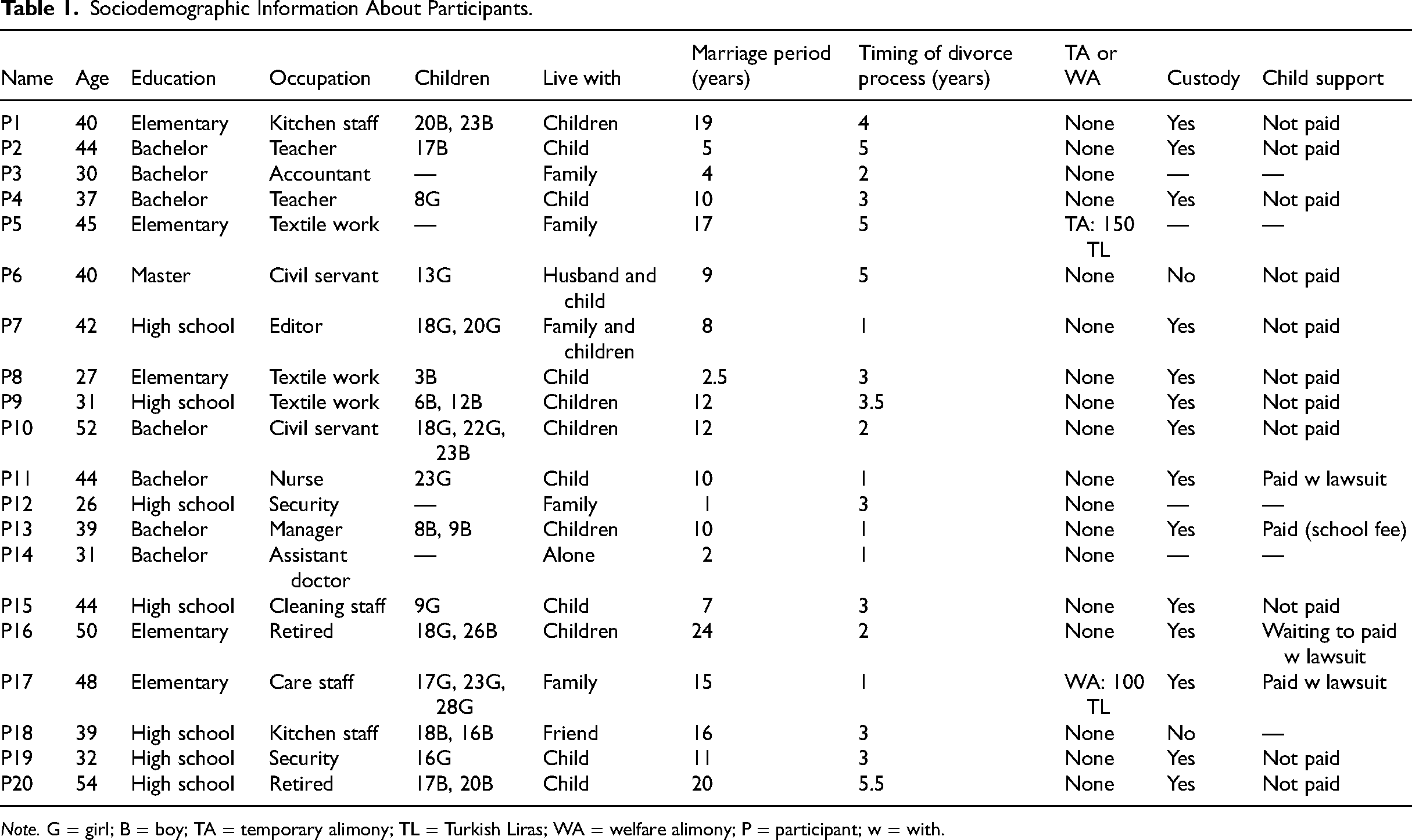
Note. G = girl; B = boy; TA = temporary alimony; TL = Turkish Liras; WA = welfare alimony; P = participant; w = with.
The interviews were conducted between December 2020 and April 2021. Each interview lasted 1–3 hours. The face-to-face interviews (11) took place where the participants felt most comfortable, such as shopping malls, cafés, women’s centers, or workplaces. The rest of the interviews were conducted via Zoom. The Hacettepe University Ethics Commission granted the ethical approval of this study.
Data analysis was conducted using MAXQDA software. The researchers obtained written consent from the participants, and interviews were audio-recorded and transcribed verbatim. We employed thematic analysis, identifying codes and categories through a process of open, axial, and selective coding (Corbin & Strauss, 1990). Three themes emerged with researcher reflexivity and after peer debriefing for determining the trustworthiness of the data (Lincoln & Guba, 1985): (i) The circular nature and transitive stages of the divorce decision process, (ii) Women seeking justice: “What kind of justice is this?” (iii) Struggles and resistance within the divorce. We engaged in discussions regarding codes, categories, and themes with a peer who is a social work academician/researcher. This process facilitated the incorporation of peer feedback into our analysis. Throughout the research, we applied reflexivity to gain a deeper understanding of the experiences of high-conflict divorced women, directing our focus inward and examining our study’s questions, data, and methodology.
This qualitative study was conducted in Istanbul, which is not rural, but the most urbanized city in Turkey. Participants were working women in formal and informal jobs; in a way, they were “empowered” women. The experiences we shared during the research and the knowledge gathered reflect a middle- and lower-class urban experience and cannot be generalized to many disadvantaged settings such as rural areas and traditional Anatolian cities. Despite these limitations, this study addresses a gap in the literature about the experiences of high-conflict divorced women and their access to statutory services.
Findings
The data analysis merged three main themes: (i) The circular nature and transitive stages of the divorce decision process, (ii) Women seeking justice: “What kind of justice is this?” (iii) Struggles and resistance within the divorce.
The Circular Nature and Transitive Stages of the Divorce Decision Process
I’ve tried to get a divorce so many times, but he always says, “I won’t give up custody,” and “If you leave, I’ll kill you and then myself.” (P17)
Leaving is not a single event but rather a process composed of different stages (Anderson & Saunders, 2003; Enander & Holmberg, 2008; Wuest & Merritt-Gray, 1999). The narratives of our participants reveal that deciding to divorce is not a linear journey beginning with a single abusive event; it is a circular process with transitive stages, as illustrated in Figure 1.
Most participants viewed marriage as an escape from their original family. This is often followed by a “honeymoon period,” typically brief. After this phase, women start adjusting to married life, becoming aware of issues like financial difficulties, domestic violence, communication problems, cheating, and addiction. Despite recognizing these problems, many try to ignore, adapt, and continue building a home. In the next stage, women exhibit an increasing awareness of their circumstances in their marriage, consequently encountering challenges. As a result, they may leave the house and actively seek help. Coping strategies vary based on factors such as age, employment status, financial situation, experience of violence, family structure, and having children. Women look for resources and support, both legal and informal. Leaving their husbands often coincides with achieving certain conditions, like securing employment or receiving emotional support from family. In the final stage, women seek divorce to gain freedom, taking steps such as moving in with family, obtaining restraining orders, or filing for divorce. Each stage can last months or years, with women often oscillating between these transitive stages.
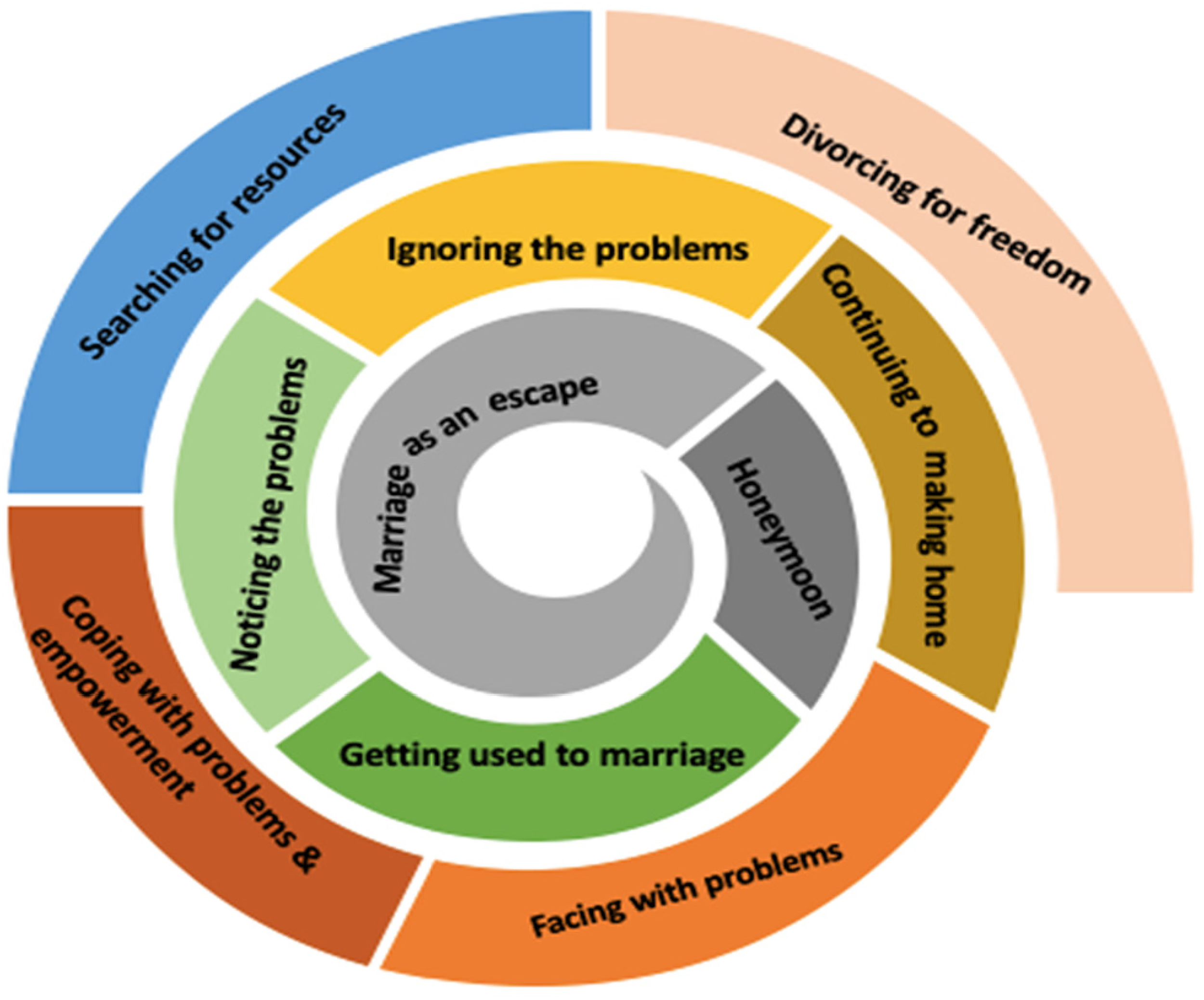
Women's divorcing process.
The length of these stages and the time taken to reach a decision are influenced by available resources and the attitudes of the immediate social environment. All participants shared that they have been blamed by society for failing marriages. This study highlights that factors such as having children, financial dependence, fear of violence, and concerns about the legal system can delay the divorce decision. Consequently, some women remain silent, endure pressures, and delay divorce for years. Patriarchal and conservative systems often demand limitless patience and unconditional love from women. We were fighting again one day, and he came at me with a knife. I was trapped in the kitchen corner, and all I could think was, “This man's going to kill me.” I felt like I had no other option… From day one, I knew this marriage wouldn’t last. It was kind of forced on me, you know? I tried telling my family I wanted out because of the constant fighting, but they always rejected the idea of divorce. They didn’t think the violence was a good enough reason for a divorce. (P7)
All the participants had heavy domestic and care work burdens and were exposed to domestic violence in physical, emotional, sexual, or economic forms. Findings show that financial resources are vital for making the divorce decision. In our sample, 17 participants had paid jobs during the marriage. I was working through the marriage, thank God! And now, my salary's enough for me. My family's been my biggest support, too. (P5)
Women's empowerment through paid employment and/or statutory services that provide psychosocial help and economic resources—particularly when complemented by informal support from family and friends—can significantly shorten the divorce process and profoundly impact women. Empowerment, coupled with awareness-raising, social, and financial support from statutory social services, enables women to leave abusive marriages. Divorces initiated by women are often viewed as a journey toward liberation, representing a battle against abusive partners and androcentric social institutions from the beginning to the end.
Women Seeking Justice: “What Kind of Justice Is This?”
The pursuit of justice by divorced women is often marked by distinctive challenges, particularly for those navigating high-conflict situations. Extended legal procedures and ingrained patriarchal biases within the legal system exacerbate the psychological and financial challenges faced by women undergoing high-conflict divorces. These challenges primarily stem from the tensions between estranged spouses and the deeply rooted patriarchal perspectives of predominantly male-centric figures in state institutions, encompassing both law enforcement and the judiciary. This perpetuation of patriarchy is evident in the attitudes and practices of police and judicial personnel, existing laws, and judges’ interpretations of the law and decisions (Koğacıoğlu, 2005; Uygur & Skinnider, 2022). The cops took me to the hospital to file an assault report when they understood I was battered. After that, we went to the police station, which was really scary for me since I’d never been there before. Even though I had the assault report as proof that my ex-husband had been violent towards me, the judge still found both of us guilty. Now, I can’t help but wonder, what kind of justice is that? (P5) I feel like I’m the judge's victim. I kept going to the courtroom for every case, even though my lawyer said I didn’t have to. My ex-husband was always saying wrong and bad stuff about me there, and I wanted to be present to defend myself, hoping I’d finally get a divorce. Every time I thought, “This is it, I’m getting divorced,” it just didn’t happen the way I expected. (P1)
The persistence of patriarchal perspectives among law enforcement officers, prosecutors, and judges still significantly influences women's experiences (Güneş, 2021). Police stations represent the initial formal step for women seeking to escape violence. However, many of our study participants expressed distrust toward the police due to various issues. These include reluctance to record statements, suggestions to return home, gender-biased attitudes and behaviors, lack of adequate information, and unwillingness to issue assault reports. Out of the 20 women interviewed, only eight succeeded in obtaining an assault report. Despite frequent breaches, women often seek protective measures and request temporary restraining orders against their husbands. Additionally, our interviewees expressed a clear lack of trust in the judiciary system. Every time I asked the cops for help, they’d always say, ’So, you’re going to complain about your husband and try to get a temporary restraining order? You think that’ll get you a divorce? (P13) I can’t get back the three years I lost to the divorce process. The way it dragged on really got me down and made me anxious every time I had to deal with it. I just don’t have the energy to keep standing. And honestly, I’ve lost faith in the justice system in this country. (P15)
Lost Years: “An Irrevocable Three-Year Absence Because of Divorce”
In cases of high-conflict divorce, women often face years-long battles for justice due to drawn-out legal proceedings, a stark contrast to consensual divorces. In our study, we found that women's access to justice is frequently hindered by androcentric attitudes of law enforcement, judges, and prosecutors. Additional obstacles include judicial costs, misinformation or lack of knowledge about court processes, lengthy durations of legal battles, and feelings of insecurity and distrust stemming from these factors.
The CEDAW Committee's General Recommendation No. 33 focuses on enhancing women's access to justice. It advocates for equal access to judicial systems and gender equality by eliminating barriers within legal frameworks (CEDAW, 2015). Beyond the law enforcement stage, women's pursuit of justice often encounters challenges such as judicial costs, prolonged waits due to case backlogs, and the apathetic attitudes of legally appointed attorneys. Women earning minimum wages or those financially dependent on their fathers struggle to effectively utilize legal services. While women can apply for state-funded legal aid, which includes free legal representation and exemption from court costs, the application process is complex and particularly daunting for those with limited education and information. This bureaucracy often forces women to seek private attorneys or rely on voluntary legal support from women's NGOs (Uygur & Skinnider, 2022). Sixteen of our 20 participants sourced their attorneys through personal networks, often prioritizing female lawyers known for their empathy toward women, proficiency in civil law, and flexibility with payment schedules. Remarkably, only four of the 20 participants received free attorney services through the legal aid provided by Bar Associations. My lawyer really didn’t care about my divorce case. To answer how they treat divorced women in Turkey: it's simple. If you can pay the legal fees, they’re interested. If you can’t, they’re not. (P15)
Beyond the legal costs, which include application fees, attorney's fees, and court costs, women in divorce proceedings face ongoing financial burdens. These are not one-off expenses but recurrent payments that stretch over an extended period, further complicating their access to justice. One participant poignantly remarked, I had to sell my wedding ring to pay for the divorce process. (P9)
The protracted nature of contentious divorce proceedings not only leads to financial strain but also causes significant psychological distress for the women involved. Many participants expressed a reluctance to visit courthouses, often due to anxiety. Despite these challenges, women strive to present themselves as strong and composed during court hearings. I used to cry over everything, a real cry-baby. But on the day of my divorce, I told myself to stay strong and not to cry in front of my ex-husband. I didn’t want him to see me as weak. Somehow, I managed to stand tall that day, like I had some kind of divine strength. (P18)
In the courtroom, he (my ex-husband) said I was “not mentally stable”. I wanted custody, but the judge said that even if I looked healthy, they’d still need a mental stability report. (P9)
The gendered nature of the court and legal process, the judges’ attitudes toward women, and divorce length prolonging up to 6 years can be defined as institutional violence that harms women.
Getting married is easy—you just sign some papers and it's done in a day. But getting a divorce? That can drag on for years. (P5)
I don’t want to be a married person anymore! (P14)
Testimonies can significantly contribute to the prolongation of the case. Both parties have the right to bring witnesses to the courtroom. While all participants in this study brought witnesses, several reported experiencing unequal treatment influenced by their husbands’ power and social status.
Even though the judge is a woman, she puts vast pressure on me. For example, she did not listen to my witnesses. My witness said that I was subjected to violence, but the judge silenced her. My ex-husband is a well-known person. I thought my ex-husband affected the judge with his money and power. (P10)
Generally, witnesses are chosen from families, close friends, colleagues, or neighbors. In some instances, the ex-husband brings or becomes a perjurer in the courtroom, which prolongs the process even more.
His father testified that I was not taking care of my child and was not interested, which could not happen. I am very keen on my child. (P4)
Custody Battles: More Than a Child, All About Power
In high-conflict divorces, issues like alimony, custody, and property division often escalate tensions between partners. The Turkish Civil Code (Article 336) stipulates that, upon divorce, custody may be granted exclusively to one parent, excluding the possibility of “joint custody.” Divorced women with custody of children arguably have a much more difficult process than women without. In our study, most mothers (14 out of 16) were awarded custody, reflecting a continued maternal preference in custody decisions. My ex-husband asked for custody. I did not give my boy. He is a baby. How can I leave him alone? Despite my ex-husband's threats, I did not give up my boy; I risked everything for him. (P8) My daughter was 5 years old when we broke up. Her grandmother was taking care of her. I wanted the separation. Because of this, I was constantly shown as a bad mother to my daughter by his family. I blamed myself. (P6)
Child custody often becomes a point of negotiation in high-conflict divorces, where women may relinquish other rights to ensure custody of their children. Temporary custody arrangements are common while the prolonged custody battles continue, adversely affecting women's experiences of motherhood. Men, in these scenarios, may impose conditions on granting custody, as shared by one participant: He said I could only have custody on one condition: I must live with my family. So, my family moved in with me to prevent him from taking my daughter. (P19)
Frequently, noncustodial fathers fail to adhere to child support orders. Although there are legal mechanisms for enforcing these payments, such as execution proceedings against the debtor, implementing these procedures involves fees and lacks a robust follow-up system or penalties. This legal loophole can be exploited by ex-husbands as a means of maintaining economic control over their ex-wives.
Whenever I needed to buy something for my children, he would typically avoid paying child support. He seems to think that child support payments would make me financially comfortable. (P7)
Right after we started the divorce case, he told the school he wouldn’t pay the tuition fees anymore because he’d be paying child support. But he never thinks about the kids’ future… It's been 10 years now, and he hasn’t paid any child support or tuition fees, not during the divorce or even after it. (P10)
Turkish civil law, specifically Article 323, outlines the personal communication rights of children with a noncustodial family member, with visitation schedules determined by a judge. However, some fathers use custody payments and visitation as tools to punish their ex-wives for seeking divorce. To foster the father–child relationship and avoid parental alienation, some women willingly adjust visitation schedules. We kept talking, just like the judge advised, but he didn’t stick to seeing them every 15 days. He’d just show up whenever he felt like it and take the kids out for a walk. (P8)
At times, fathers neglect the children's needs or use them to gather information about the mother's personal life, complicating co-parenting efforts. Children, witnessing their father's tactics, may become distant from him. Sadly, she was really scared. She saw all the stuff her dad did. Sometimes, he’d just show up out of the blue to take her, without telling us first. It freaked her out whenever she suddenly saw her dad at the door. She’d cling to me, begging me not to leave her alone because she didn’t want to go with him. (P4)
Struggles and Resistance Within the Divorce
Divorce often leads to a significant decline in women's living standards, a consequence of structural gender inequalities in education, employment, and wealth. The challenges faced by divorced women typically include societal judgment, power tactics employed by ex-husbands, the burdens of motherhood, and financial hardship. In this study, these women exhibited resistance in several ways: achieving financial independence through employment, seeking support from both formal and informal networks, particularly family and friends, focusing on their children's well-being, increasing their self-awareness, and choosing between self-isolation and engaging in social activities.
Each participant encountered negative attitudes and behaviors regarding their divorce. They faced societal blame for the marriage's failure, manifested through labeling and exclusion. Some endured derogatory “widow” jokes, while others dealt with women who perceived them as threats to their own marriages and husbands. I’ve got this neighbor, a guy who only chats with me when his wife isn’t around. If she's there, he practically runs away. I guess my being divorced bothers them. (P13) At school, where I work, the way people treat me is just awful. (P2)
Post-divorce stigmatization often leads women to socially distance themselves, inadvertently exacerbating their social exclusion and isolation. To counteract this stigmatization, many women adopt coping strategies, such as concealing their divorced status, continuing to wear their wedding rings, and maintaining a distance from others, particularly men. P11 succinctly captures this stigmatization with a metaphor that reflects societal attitudes toward divorced women: In Turkish society, a divorced woman is seen as an open door. (P11)
“Belt of classic patriarchy” (Kandiyoti, 1988, p. 274) asserts control and imposes limitations on women's public behavior. In response, many women restructure their lives to conform to conservative norms, altering their dress codes and adhering to societal rules to protect their honor. Most participants in this study expressed reluctance to consider remarriage, often due to the pressure from male family members—ex-husbands, fathers, and brothers—who assert control in the name of honor protection. One participant recounts a chilling warning from her brother: My brother told me he would kill me if I did something dishonorable. (P18)
Throughout the divorce process and its aftermath, ex-husbands often resort to various forms of violence to regain control and restore the threatened status quo. This includes threats, intimidation, and economic coercion both inside and outside the courtroom. During the divorce, the person I married with love turned into my enemy. He even cut off the electricity in our home where I lived with the children! (P10)
However, two participants chose a unique form of resistance by removing their hijabs, signifying a break from past constraints.
Hijab was a chain for me; decided to break free from that chain. (P18)
Breaking Bonds and Navigating Financial Conflicts
Throughout the divorce and its aftermath, women often face significant financial challenges. While some participants were able to secure employment for self-sustenance, others were not as fortunate. Many divorced women turned to social assistance programs offered by statutory social services, charities, or municipalities. However, these programs vary widely in their provision, with some being quite generous and others offering minimal support. I went to the district governor's office for help. Told them I was in the middle of a divorce and my husband wasn’t helping out. I was out of coal, so I asked for some assistance, and they actually delivered a ton of coal to me that evening. (P17) Social services helped me out with 300 Turkish Liras ($11.46 in 2018 currency). I made around 200–300 Liras from cleaning jobs. Paying rent and bills with that was tough. Sometimes, you just need more than what you’re earning. I really struggled and had to rely on others for help. (P15)
Divorced mothers generally exhibit greater emotional strength yet face more economic difficulties compared to childless divorced women. The importance of social support and financial assistance in bolstering women's resilience was a common theme among participants. Post-divorce, many women found autonomy in managing their lives: By and large, I earn my own money, and I’m standing on my own two feet financially. I’ve got a car and a small house. But the best part? I’ve finally found peace, which matters the most. (P2)
Despite the threat of increasing impoverishment, numerous women chose to forgo alimony to expedite the high-conflict divorce process. Some eventually settled for a consensual divorce after enduring multiple conflicts, prioritizing the swift termination of the marriage over financial gain due to fears of continued violence. I didn’t ask for any alimony for myself. I just didn’t want to drag out the divorce process. All I wanted was to get rid of him as fast as I could; I didn’t want anything from him. (P15)
Legal challenges persisted throughout and beyond the divorce proceedings, especially regarding child support. Despite court orders, nearly all participants did not receive the stipulated child support, profoundly impacting those with low income. Women had to engage lawyers and bear judicial expenses to claim unpaid child support. The comradeship between men and the patriarchal state left women alone financially and legally. He didn’t want to pay the alimony that the court ordered. So, we had to file another lawsuit for child support. This time, he claimed he was jobless and even showed the court fake proof, saying he was on unemployment benefits. But the crazy part? He was actually running a big company at the time. (P10)
Only three participants filed a lawsuit to get child support; one of them is still awaiting payment, while others received it only after years of struggle. At first, the judge ordered him to pay 250 Turkish Liras in child support ($9.55 in 2006 currency). But he didn’t pay it for a long time. Eventually, I had to sue to get the money, and even then, he never really paid it properly. (P11)
The right to claim pecuniary and non-pecuniary damages was exercised by some. For instance, P2 was awarded 50,000 Turkish Liras ($1910 in 2010 currency) in compensation, feared claiming it due to her ex-husband's threats. Many participants relinquished their rights to property division, often leaving the marital home with only the furniture provided by their families, exacerbating their financial and housing issues: I applied to the municipality for second-hand furniture and other stuff. They gave me all the things. With a little help from a few friends, we managed to set up a new home. (P18)
Women's shelters, as crucial statutory social services, are highly valued but remain limited in number. Law No. 6284 mandates shelters for “victim” women, and Law No. 5393 requires municipalities with populations over 100,000 to provide shelters. Despite these mandates, currently, there are only 112 shelters operated by the Ministry of Family and Social Services and an additional 33 run by local governments. Additionally, The Purple Roof Women's Shelter Foundation (Mor Çatı), a non-governmental organization (NGO), manages a single civil society shelter for women. The existing number of shelters falls short of meeting the EU standards, indicating a significant need for expansion. Among our study participants, only two opted to utilize women's shelters. My friend told me that there was a place I could go for support. I found it on the internet and called there. They suggested me to meet, so I went and talked to them. (P15) Before I left home, I researched Mor Çatı on the internet, called them and talked to them. I went there on Monday and they welcomed me, hosted me and took care of me. We had a very nice shelter, about 9 women and 9 children. I stayed there for about 15–20 days. (P18)
Aggravated Maternity: Moving on for the Child
In certain situations, men exert control over women by using their children as leverage. Mothers, often burdened with unpaid alimony, are forced to assume the role of the sole breadwinner, leading to intensified maternal responsibilities, which we term aggravated maternity. This shift necessitates that women secure paid employment to support their children's needs and their own survival. However, finding full-time, well-paid jobs is a significant challenge, especially for those with lower education levels. Consequently, many are compelled to accept part-time, low-wage jobs without insurance or job security. Most mothers preferred to work harder and longer to provide better conditions. Lone mothers, as observed in this study, challenge the dominant narratives about money and consumption and resourcefully develop skills to manage with limited means (Attrash-Najjar et al., 2022). To address childcare challenges, some participants sought assistance from their parents. The entrenched gender inequality in the labor market, coupled with societal expectations of caregiving, further squeeze divorced women into poverty, placing a double burden on their shoulders. It's tough to find a job and make money when you’re taking care of a kid. If it weren’t for that, I could’ve easily found a job on my own. I’d have worked and sorted everything out. But I couldn’t hold down a regular job with benefits for a long time because there was no one to look after my daughter. (P15)
Given the limitations and politicization of family-oriented statutory social services, many women lean toward support systems offered by family and friends. There's a pressing need for affordable and accessible kindergartens and day-care centers, particularly for divorced women with young children aged 0–5 years. Public care services are scarce, and private alternatives are often prohibitively expensive. Confronted with the absence of adequate public childcare options and the steep costs of private services, P1 suggests: Being divorced with a kid means I have to work, but finding someone I can trust to watch my children is hard. You know, the government could help by offering a discount for divorced women who can show proof with documents. (P1)
The Position of Psychosocial Services: Are There Any Psychosocial Services?
Professional support is crucial to facilitate change and growth among women undergoing divorce (Dominelli, 2002). Women require access to attorneys, psychologists, and social workers to effectively navigate the complexities of divorce (Kaušyliene et al., 2015). Addressing these needs calls for a feminist approach in providing statutory social services, particularly those aimed at psychosocial well-being.
The availability of professional support, especially psychosocial and independent counseling services, is currently lacking during the divorce process. The main avenues available are the Family Guidance Bureaus (Aile İrşad Büroları), under the Presidency of Religious Affairs, offering religious counseling and mediation (Adak, 2021), and the Ministry of Family and Social Services, providing family and divorce counseling. However, these services are government-initiated to prevent divorce and support the traditional family structure. These limited and biased family counseling options are often inaccessible to most women due to a lack of awareness. Independent, individual-oriented, and secular psychosocial support typically requires the services of private psychologists, which are prohibitively expensive for many middle- and working-class women. In addition, a small number of municipalities offer women's centers that provide free psychosocial support to all women. P9 shares her experience with the services provided by the Bağcılar municipality: Going to a psychologist isn’t easy when you’re tight on money. It helps to know what services the government offers. Like, at the local municipal center, they have a psychologist who can call you once or twice a week. Sure, there are some conditions, but at least it's free. That's a big relief. (P9)
While formal and informal support systems are crucial, the inadequacy and limitations of formal service offerings lead many women to rely more on informal support from family and friends. I began a new chapter in my life. My family was my biggest source of support. My sister was there for me emotionally, and my family helped out when I moved houses. They even stayed with me for a bit. (P4) My female friends really came through for me and helped set up my home. One brought a TV, another brought cups and plates. When I got home, there were even little paintings on the walls. We got some second-hand stuff. It looks like a home now, not fancy, but it's mine. (P13)
After the divorce, a great weight is off my shoulders. (P2)
Conclusion
This study on women undergoing high-conflict divorces in Istanbul, Turkey, underscores the need for a more efficient and safer divorce process. It reveals that the path to high-conflict divorce often stems from marriages initially seen as escapes, rooted in various forms of gender-based violence. The decision to divorce, marked by its circular nature and transitive stages, is a complex journey of back-and-forth steps, ultimately leading to a liberation struggle. Women struggle against legal, social, cultural, and financial challenges with the high-conflict divorce process. Unfortunately, the cessation of a relationship does not always end the violence from ex-partners, and societal stigma often exacerbates the difficulties these women face.
Key challenges identified in this study include inadequate psychosocial counseling, complex legal procedures, and the unreliability of child support and alimony, often due to fathers’ non-payment and ineffective law enforcement. Additionally, costly childcare and non-standardized, frequently insufficient financial assistance pose significant hurdles. There is a notable gap between the available statutory services and the specific needs of women who have undergone high-conflict divorces, particularly in areas such as psychosocial support, financial assistance, and childcare. To improve the living conditions for these women and their children, there is a pressing need to shift social policies from a family-centric to an individual-centric approach, focusing on anti-violence and gender equality. This shift should include reintroducing free kindergarten and after-school programs, reforming financial and employment services, and initiating independent, women-friendly psychological support programs.
Women's coping strategies, shaped by socioeconomic and cultural factors, vary widely. They encompass empowerment strategies, such as maintaining resilience, especially for the benefit of their children, actively seeking employment, and leveraging both formal and informal support systems. Additionally, some women adopt isolating strategies, such as distancing themselves from others in environments like neighborhoods and workplaces or concealing their divorced status.
The complicity between the legal system, including the attitudes and decisions of judges, and patriarchal structures often hinders women's access to justice, underscoring the need for prioritizing gender equality within the legal system.
The study also points out that a lack of knowledge about processes and services further weakens women's positions within a social welfare system that is limited and influenced by Islamic conservative ideology. The emphasis on familialization in social policy limits women to family-oriented social services, neglecting individual needs and reinforcing traditional roles. Most women in this study have custody of their children. Yet, they face financial challenges as ex-partners often do not pay child support, increasing the risk of poverty and imposing a reduction in living standards post-divorce.
This research identifies critical gaps in statutory social services from a gender equality perspective, emphasizing the need for free and accessible psychosocial counseling, including group social work models, stricter enforcement of child support and alimony payments, and necessary policy changes to protect children's welfare. The study advocates for a shift from family-centric to individual-centric support in statutory services for women and children involved in prolonged high-conflict divorces. A gender equality perspective is needed to strengthen and empower high-conflict divorced women and their children.
This study constitutes a crucial step forward in highlighting the experiences of women going through prolonged high-conflict divorces. Understanding their unique challenges is vital and serves as a catalyst for further research in social work, fostering interdisciplinary collaborations with professionals like lawyers and psychologists to develop and implement improved support models.
At the heart of social work practice is the promotion of gender equality and empowerment. Detailed knowledge of women's experiences in high-conflict divorces will not only equip practitioners but also deepen their understanding of current gender-based violence and the challenges in accessing justice. This insight is expected to motivate practitioners to advocate for gender equality and heighten societal awareness of these issues. Beyond focusing on family units, it's essential to offer personalized support to women and children grappling with prolonged high-conflict divorces. A comprehensive understanding of these experiences is crucial in broadening the scope of social work to more effectively assist both partners and children impacted by such divorces.
The findings of this study provide valuable scientific data to bolster public advocacy for gender equality and justice. This information is instrumental in guiding social work toward advocating for stronger policies, laws, and services that support women in high-conflict divorce situations. Integrating discussions on these contemporary social issues, especially the challenges faced in prolonged high-conflict divorces, into social work education is imperative. These issues hold significant importance not only in Turkish society but also globally. Incorporating them into the curriculum ensures that social work education remains up-to-date, relevant, and impactful.
Footnotes
Declaration of Conflicting Interests
The authors declared no potential conflicts of interest with respect to the research, authorship, and/or publication of this article.
Funding
The authors received no financial support for the research, authorship, and/or publication of this article.
