




Abstract
Despite efforts by scholars to visibilize Black women's community work, we still lack a framework that captures the nuances in the work arrangements of Black women serving and advocating for their communities. Our paper introduces a new conceptual framework, the Continuum of Transformative and Reproductive Labor (CTRL), to recognize this hidden multiform labor of racialized women. The CTRL places community work that reproduces oppressive social structures on a spectrum opposite what we call transformative labor—labor that disrupts systems of oppression. The CTRL framework distinguishes social reproductive and transformative community work along four dimensions, (1) the type of power each produces, (2) workers’ autonomy and leadership, (3) workers’ motivation, and (4) how the work is valued. We explore the utility of the CTRL framework for analyzing multiple types of community work Black women perform by highlighting historical and contemporary cases in two different labor contexts. Ultimately, we make a key contribution to feminist social work; Recognizing the community as a site of social reproductive labor, we create a new framework to acknowledge Black women's labor in the community as distinct in its capacity to transform social systems by resisting the reproduction of racial and gender inequality.
I think folks in proximity to power with decision-making authority need to stop assuming that this is Black women's work that we just have to do. It's extractive as fuck. It's exploitative and this is not what we wanna do. This is what we do because we understand the depth and the value and importance of our communities. Not just now, but for generations to come. … So I think a lot of our work is just taken for granted. Like, “They're just gonna do it,” you know? And that really irks me. (Celida Soto, Black Woman, Community Activist, and Mother, personal communication, October 26, 2022)
For decades, scholars of Black women's community work in the U.S. have challenged dichotomies between production and reproduction, paid and unpaid work, and the public and private sphere, highlighting the need for expanded definitions of labor and alternative analytic frameworks to better understand the fluid nature of this work. These scholars emphasize how the work Black women do relates to their racial, ethnic, and gender identities (Banks, 2020; Collins, 2000; James, 1993; Naples, 1992). For example, Patricia Hill Collins (2000) notes, “Whereas prevailing academic approaches fragment social life by separating paid work from social reproduction, activism from mothering, and family from community, the ideas and actions of Black women community workers challenge these arrangements” (p. 221). Examples of Black women's community work that transgress these dichotomies include [other]motherwork (Chatillon & Schneider, 2018; Collins, 1987; Lawson 2018), activism (Banks, 2020; Edwards, 2022; Orozco Mendoza, 2023; Shadaan, 2020), mutual aid (Gordon Nembhard, 2014; Reese & Johnson, 2022), and social and human services work (Bent-Goodley et al., 2017; Gilkes, 1983). While the community work of Indigenous and Chicanx/Latinx women also blurs the public-private sphere binary (Shadaan, 2020) and exists within multiple economies, Black women's community work and activism is uniquely shaped by anti-Black oppression and violence.
Although existing scholarship recognizes the multifaceted, complex, and unique nature of Black women's community work, the literature stops short of identifying a comprehensive conceptual frame for studying its nuances. As Nancy Naples asserted in her 1992 article about Black and Latina women's activist-mothering efforts in low-income communities, the sociological literature on work and occupations provides an insufficient and “limited framework for an analysis of their work” (p. 460). Using an intersectionality lens partially answers Naples’ call, as it acknowledges the multiple dimensions like gender, age, class, race, and ethnicity that mutually construct social identities and inequalities (Crenshaw, 1989; Collins, 2015). Similarly, social reproduction broadly addresses the way racialized and feminized labor to sustain daily life into the next generation has been exploited to reproduce the power dynamics and hierarchies of “racialized, patriarchal, colonial capitalism” (Ferguson, 2016, p. 47). But even though social reproduction's dialectical approach to analysis suggests resistance is a common response to oppression, it fails to recognize that resistance itself is also work.
Given these conceptual limitations, our analysis focuses on distinctive characteristics of Black women's community work. To recognize how Black women's community work often seeks to transform social structures by actively and intently challenging them, our paper introduces a new framework, the Continuum of Transformative and Reproductive Labor (CTRL). The CTRL (pronounced “control”) framework places what we call social reproductive labor and transformative labor on opposite ends of a continuum. Labor moves from reproductive to transformative when it is performed as an act of resistance against structural domination through systems of oppression, including cis-heteronormativity, white supremacy, capitalism, and ableism; the more labor destabilizes systems of oppression, the less reproductive and the more transformative it is. The CTRL includes four dimensions that distinguish transformative labor from social reproductive labor, including (1) the type of power each produces, (2) workers’ autonomy and leadership, (3) workers’ motivation, and (4) how the work is valued. Based on scholarship that centers Black women's community work, the CTRL framework provides a comprehensive analytic tool for recognizing the hidden multiform labor of racialized women.
We start by briefly reviewing the concepts of intersectionality and social reproduction and existing tensions within these fields that inform our analyses. Next, we challenge essentialist expectations that invisibilize the care Black women provide, loosely typologize Black women's community work, and reveal the shortcomings of current conceptualizations of reproductive labor. Then we present and describe the dimensions of the CTRL framework and highlight historical and contemporary cases that exemplify it. The paper concludes with a discussion of implications for the way we recognize, analyze, and frame community social work more broadly. In summary, we propose a new conceptual lens for interpreting the various types of labor Black women perform in their communities.
Conceptual Foundations: Intersectionality and Social Reproduction
Intersectionality and social reproduction are two feminist traditions that offer crucial insights for the study of Black women's community work. Scholars and activists use both terms to represent a wide range of ideas, offering various explanations for the ways different forms of oppression are related to each other and the implications of these arrangements.
Ross et al. (2022) note that Black women's activism is often motivated by their multidimensional experiences of systemic oppression, which call them “to promote the human and civil rights of all marginalized people” (p. 429). Understandings of intersectionality emerged from the standpoint of those confronting multiple forms of oppression, especially Black women, with its contemporary uses most often credited to the Combahee River Collective (1977/2024) and Kimberlé Crenshaw (1989). Collins (2015) suggests that despite the wide range of uses of the term, there is generally agreement that it refers to the way “race, class, gender, sexuality, ethnicity, nation, ability, and age operate not as unitary, mutually exclusive entities, but as reciprocally constructing phenomena that in turn shape complex social inequalities” (p. 2). However, scholars and activists note that the term has become so popular they feel it is often misunderstood or misappropriated through the failure to either apply a power analysis in its use or to recognize that these phenomena are not completely discrete from each other since they are mutually constitutive (Collins, 2015; Ferguson, 2016).
The concept of social reproduction, on the other hand, proves a complementary theoretical lens for understanding intersectionality within a specific social system—labor. Social reproduction provides an analytic framework for the existence and reproduction of inequality within labor and highlights the centrality of capitalist power dynamics, like the differential accumulation of material goods, wealth, profit, and social privilege, in this process (Ferguson, 2016). This approach traces back to Marx and Engels, who used the concept of labor power to refer to the mental and physical capacity to work and to demonstrate how capitalist systems seek to commodify and extract value from these capabilities as well as from the work that goes into reproducing the conditions of the working class (reproductive labor).
In the last 60 years, scholars have applied the concept of social reproduction in several distinct ways, using varying definitions and units of analysis. Second-wave feminists primarily engaged the concept to expose the patriarchal capitalist exploitation of women through unpaid housework (Seccombe, 1974; Vogel, 1983), highlighting how this work benefited men in addition to capitalism (Hartman, 1979). Laslett and Brenner (1989) broadened the definition of reproductive labor beyond the household setting to subsume “various kinds of work—mental, manual, and emotional—aimed at providing the historically and socially, as well as biologically, defined care necessary to maintain existing life and to reproduce the next generation” (p. 383). This definition has facilitated future analyses that apply a more intersectional lens to highlight how the devalued cooking, cleaning, and other caregiving service work performed by people of color, in both private and public settings, not only benefits men and the accumulation of wealth and profit, but also white people (Glenn, 1992; Duffy, 2007). Although many feminist scholars expanded their definitions of social reproduction to include labor performed in households as well as that performed for private and public entities, the community as a site of social reproduction remains understudied (a notable exception, however, is Nina Banks’ (2020) article).
Laslett and Brenner's definition of social reproduction also expanded the concept from its Marxian focus on reproducing labor power, the working class, and capitalism to a broader focus on the work of sustaining life overall. This allowed for the recognition that caregiving labor performed for survival does not necessarily contribute to the reproduction of dominant social structures. It also provides opportunities for resistance since it often allows more space for autonomy and privacy than other types of labor (Davis, 1971; Ferguson, 2016; hooks, 1990).
Studying Black women's community work makes the distinctions between competing definitions of social reproduction more salient. When scholars center the experiences of white women's housework, the work of sustaining life often aligns with the reproduction of labor power, the working class, and dominant social structures. However, when we center Black women's community work, the work of sustaining [community] life often challenges the reproduction of existing power dynamics and dominant social structures, making it more problematic to conflate the two uses of the term. This distinction has led scholars of Black women's community work to highlight how it does not fit neatly in the dichotomized analytic categories of productive versus reproductive labor, to underscore the role of racial oppression in structuring work arrangements, and to emphasize the importance of community (Banks, 2020; Collins, 2000; Edwards, 2022).
In summary, the term social reproduction has multiple, sometimes competing, definitions and uses. Some scholars use social reproduction to refer to the work of sustaining life, and thus, sustaining families. Others use it to refer to the reproduction of oppressive social structures. More commonly, scholars use social reproduction to refer to both, highlighting how the work of sustaining life is exploited to reproduce power dynamics. However, we contend that these conceptualizations of social reproduction are insufficient for capturing the nuances of Black women's community work. Rather than reproduce mutually constructive oppressive social structures, Black women's community work has the capacity to transform them. Later, we introduce the concept of transformative labor to fill this conceptual gap and we constrain our use of the term social reproductive labor to strictly refer to community work that reproduces inequality. However, we do not completely throw out Laslett and Brenner's definition of social reproduction, instead in the next section we adapt it to define community work as the work of sustaining communities daily and into the next generation.
What Do We Mean by “Black Women's Community Work”?
To understand Black women's community work, we must define the phrase in three parts: (1) “Black women”; (2) “community”; (3) and “work.” Foregrounding intersectionality calls us to recognize that our first phrase exists at the nexus of race (Black) and gender (woman), two mutually constructed identities (Collins, 2015; Crenshaw, 1989). Our use of “women” includes those who identify as cis- or transgender women and gender nonconforming individuals who may feel that their gender experiences or the way others perceive their gender closely aligns with women existing in the binary. We deploy “Black” to refer to people of African descent. Although we recognize the vast nature of the African diaspora, we limit our analysis to the community work of Black women in the United States. Acknowledging the importance of class as another intersectional identity, our analysis includes Black women at all socioeconomic levels collaborating with various communities.
The second key definitional component of Black women's community work is “community.” Enslaved Black people in the U.S. drew on concepts of family and kinship derived from African ancestral practices to redefine and recreate community (Collins, 2000). The racialized and gendered violence of slavery left many Black families physically separated, with children and partners of one family often being sold to multiple slave owners in different areas. The physical separation led enslaved Black people to form new types of families defined by shared experiences of racial oppression and resistance. Collins (2000) writes, “Bloodlines carefully monitored in West African societies were replaced by a notion of ‘blood’ whereby enslaved Africans drew upon notions of family to redefine themselves as part of a Black community consisting of their enslaved ‘brothers’ and ‘sisters’” (p. 49, emphasis added). In this sense community and family became interchangeable and violated dominant white assumptions about communities as hierarchically organized, “geographically specific, culturally homogeneous, and inherently apolitical entities” (Collins, 2010, p. 9). Today, community continues to occupy a unique role “in the lives of racially marginalized groups through their emotional and physical attachments to it” (Banks, 2020, p. 347). The internet and social media have also been conducive to the building and bridging of Black communities online (Bailey, 2021).
Finally, we focus on understanding the “work” part of “Black women's community work.” In an 1899 essay about Black women's unpaid care work, early Black feminist scholar and activist Anna Julia Cooper defined work as “all human exertion” (as cited in Logan, 2002, p. 155). Cooper's definition provides a useful scope for understanding the labor involved in Black women's community work for two reasons. First, it requires “effort to make things better and to eliminate the problems and structures that make life difficult” (Gilkes, 2001, pp. 22–23), yet the effort Black women put into community work often goes unrecognized. Nina Banks (2020) calls us to recognize the community as a site of production and points out how scholars have ignored Black women's unpaid community work, “Despite Black women's long activist tradition of performing unpaid work for their communities, Black women's work has suffered from invisibility because they perform it outside of markets” (p. 344). In her study of Black and Latina community workers, Nancy Naples (1992) found that sociological distinctions between paid and unpaid work did not map onto women's experiences of community work because “their paid work formed one component of their mothering practices, just as their mothering practices formed one component of their labor” (p. 460). For instance, Celida Soto (quoted in the introduction) works full-time as a policy advocate for a nonprofit and also engages in unpaid community organizing and mutual aid after hours. Through her formal and informal roles in the community, she transgresses traditional dichotomies of labor.
Second, when Black women engage with these different forms of community work for collective survival—sustaining the physical, mental, and emotional life of their communities— they are actively combatting systems of oppression, such as those based on race, class, and gender. Resisting systems of oppression necessitates immense amounts of emotional exertion, especially for those belonging to a marginalized group. Cheryl Townsend Gilkes (2001) writes, “Everett Hughes suggested that an important way to conceptualize ‘work’ is to view it as a ‘bundle of tasks.’ Racial oppression takes up more time and creates extra work, or more ‘bundles of tasks,’ for members of a victimized group” (p. 18).
Recognizing the immense exertion in Black women's community work challenges essentialist notions that community care is a natural resource somehow inherent to Black women, who are seen as freely available to support economic and social reproduction. bell hooks (1990) writes, “contemporary [B]lack struggle must honor this history [of Black women's] service just as it must critique the sexist definition of service as women's ‘natural’ role’” (p. 384). Three controlling images reinforce the racist and patriarchal beliefs that service comes naturally to Black women. First, the controlling image of the mammy as a dedicated, loyal, and obedient servant (Collins, 2000; Reynolds-Dobbs et al., 2008) suggests that Black women's service is a natural resource to be extracted. Second, if Black women do not conform to the mammy expectation, they are stigmatized through the matriarch stereotype as “dangerous, deviant, castrating mothers” (Collins, 2000, p. 77) who are too strong and assertive. Finally, the schema of the Strong Black Woman as “selfless, nurturing, resilient, independent, and exemplifying a physical and emotional will to endure great difficulties” (Miles, 2019, p. 43) combines elements of both the mammy and the matriarch to justify the assumption that Black women are naturally predisposed to pick up the slack for an uncaring society. Reframing Black women's community care as intentional and strenuous labor recasts the Black women doing this work as complex individuals consciously exerting themselves on behalf of community building in ways that destabilize the systems that oppress them and their communities.
Types of Community Work
Using Cooper's definition of work as “all human exertion” as the foundation for our understanding of Black women's community work helps us recognize its multitude of forms. Below we review the literature on Black women's commitment to caring for biological, adoptive, and fictive children, their involvement in mutual aid activities, their activism, and their work in human service organizations as efforts to sustain their communities. While none of these forms of work are mutually exclusive, we will briefly address the defining characteristics of each one.
Community [other]motherwork is not exclusively Black. Indigenous and Latinx scholars have highlighted communal mothering practices within their respective cultures and also emphasize extending notions of mothering and familial care work beyond blood-related children (Orozco Mendoza, 2023; Shadaan, 2020). What distinguishes these mothering practices is not so much who is mothering or mothered, but rather the racial politics and legacies that differentiate them. Erica S. Lawson (2018) emphasizes that the afterlife of slavery “haunts Black motherhood” (p. 722) and that Black maternal politics, particularly that of bereaved mothers, are informed by “how the racial project that was the plantation continues to operate within the modern militarized US state” (p. 725). In other words, the subordinate racialization of Black [other]mothers and their children by the state and the social, political, and economic oppression that follows uniquely informs Black mothering practices and experiences.
Anna Chatillon and Beth E. Schneider (2018) write, “Through intersecting systems of oppression based on race and gender, the state marginalizes Black mothers, denigrating and at times criminalizing their right, ability, and capacity to care for children.” Black women and mothers, often driven by their unique standpoint, “have built alternative forms of struggle as sites of resistance in response to structural oppressions, including the household, neighborhood, and community” (Orozco Mendoza, 2023, p. 6). Adrienne L. Edwards (2022) uses the term “Black political motherwork” to refer to the civic engagement of Black women in organizing against voter suppression and serving as elected officials. However, Naples (1992) cautions us against restricting our understanding of Black women's political activism to civic-oriented and electoral activities (e.g., voting, political party membership, or running for office).
Black women community workers’ upward mobility as a result of their service to the poor and the oppressed provides a small, but historically significant, example of [B]lack middle-class professionals who have shaped their professional tasks, goals, and careers with primary reference to the interests and problems of the [B]lack community–interests and problems they share through common residence, experience, or both. (p. 116)
Wendy Reynolds-Dobbs et al. (2008) remind us that professional Black women's “experiences in the workplace are quite different from other women of color” (p. 130) in that they are uniquely shaped by America's long history of anti-Blackness. The authors note that the “historic racial stereotypes” (p. 130) like the image of the mammy is still implicitly employed to devalue Black women's work and hinder vertical mobility within professional settings. While frontline workers in these jobs exercise some discretion and control over their interactions with community members and how they apply bureaucratic rules, they may have little say in the public policy and bureaucratic decisions that structure their work and the services they provide. Collins (2000) highlights that when this professional work is under-resourced and externally controlled it can also lead to feelings of ambivalence and alienation.
In this section we defined three key components of our paper: Black women, community, and work. Using an intersectional foundation to clarify how we use the phrase “Black women” calls attention to the complex multidimensional convergence of race, class, and gender identities that the phrase encompasses. Additionally, reconceptualizing “community” within the Black cultural tradition as a concept that defies geographic boundaries reinforces the notion that Black women's community work transgresses public/private dichotomies and uplifts the community as an important site of (re)production. Finally, we pay homage to the various forms of community work, which challenge essentialist notions of Black women's community work as “natural.” In this next section, we present a new analytic framework for understanding Black women's community work as distinct in its capacity to transform social systems by resisting the reproduction of inequality.
The Continuum of Transformative and Reproductive Labor (CTRL): A New Framework for Understanding Black Women's Community Work
The Continuum of Transformative and Reproductive Labor (CTRL) framework places community work that reproduces existing hierarchies and power relations (social reproductive labor) on a continuum opposite the work that disrupts and transforms existing social hierarchies and power relations (transformative labor). In this section, we draw from the existing scholarship on Black women's community work to examine how the dialectical tension between these poles has played out over time in different situations and to define and compare the dimensions of social reproductive and transformative labor.
As ideal types, we recognize that both social reproductive and transformative labor are abstract constructs that are unlikely to exist in their pure form. Most community work possesses elements of both these types of labor; however, one type may dominate depending on the extent to which Black women's community work resists oppression in different contexts and situations. Below we identify dimensions of social reproductive and transformative labor (Figure 1) and then delve into more detailed explanations.
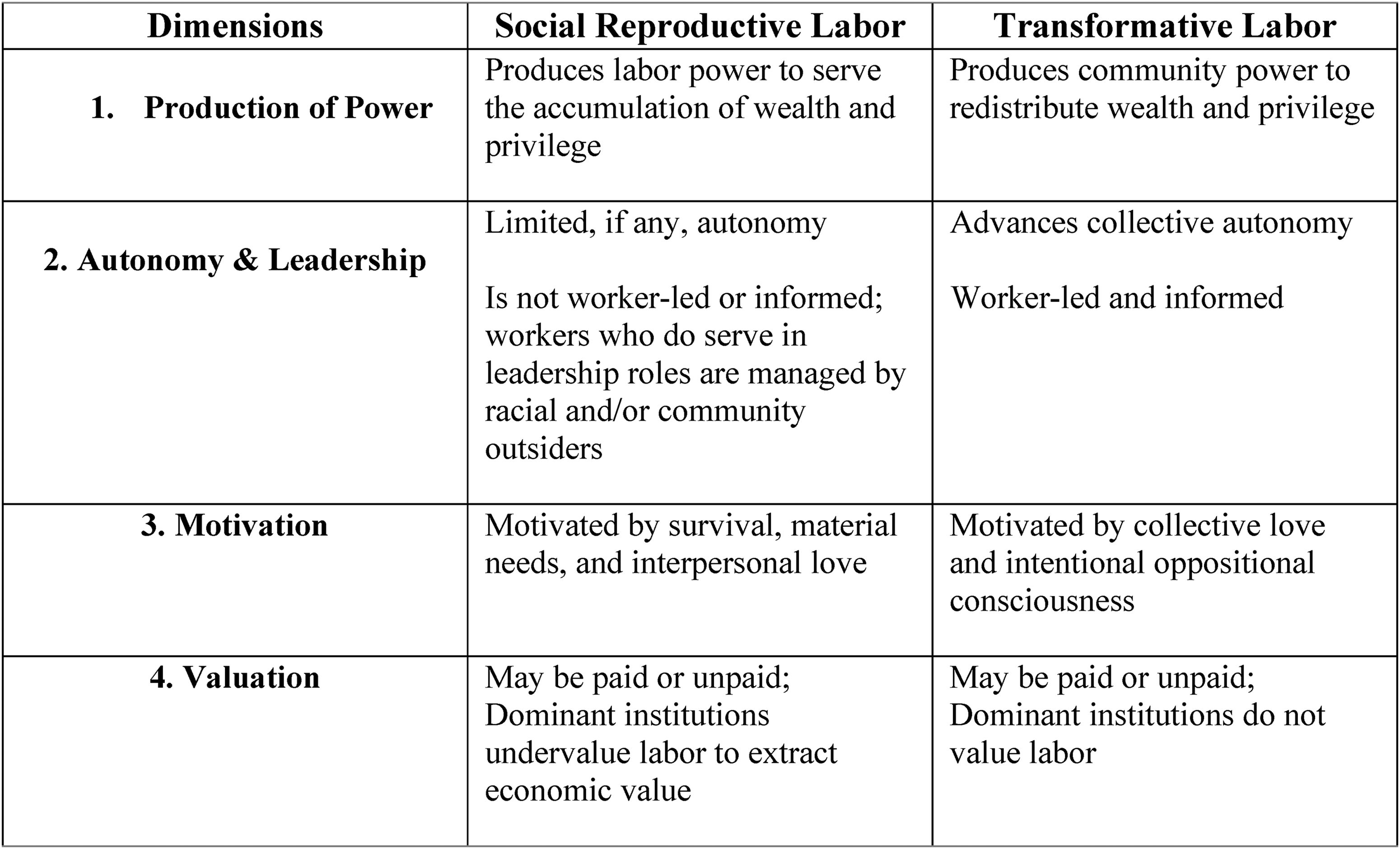
Social reproductive and transformative labor ideal-types.
Social Reproductive Labor
In the context of the CTRL framework, social reproductive labor refers to community work that contributes to the reproduction of interlocking systems of oppression, power relations, social hierarchies, and material differences, including the accumulation of wealth, profit, and social privilege. Social reproductive labor is undervalued by dominant institutions and relegated to those who are targeted by systems of oppression through identity-based essentialist expectations and discriminatory exclusion from more economically valued forms of work. Workers are motivated to engage in the work by their material needs and/or interpersonal love. Those who engage in social reproductive labor may or may not have autonomy over their work just as they may or may not be aware of their role in reproducing dominant structures. Social reproductive labor may be paid or unpaid, and activists have used economic arguments for valuing reproductive labor since it is work that contributes to the generation of commodifiable labor power.
Transformative Labor
Collins (2000) asserts that the very survival of Black communities, including the work of sustaining daily life into the next generation, is itself more a form of resistance to oppression than a service to the reproduction of white supremacy, heteropatriarchy, and capitalist accumulation. Thus, we introduce
Central to the workings of white supremacy, capitalism, and heteropatriarchy is their power to allege the inferiority of Black women. When Black women resist this subjugation through practicing love and care for themselves and their communities and pushing for liberatory societal change they are engaging in processes of transformation. Thus, resistance is the mechanism that pushes labor towards being transformative rather than merely reproductive. Resistance against systems of oppression takes many forms and its shape is highly dependent on which dimension of social reproductive labor individuals are resisting. Systems of oppression do not easily tolerate attempts to disrupt the nature or flow of power. Figure 2 demonstrates this dialectical push-and-pull process.
Production of Power - Labor Power v. Community Power: Community work may focus on building the labor power of individuals in a community and/or building community itself. Social reproductive community work contributes to developing the commodifiable labor power of community members. Social service organizations and schools often perform this type of work. Workforce development programs are a notable example. While these initiatives often employ Black women to support workforce development in their communities, they are typically directed toward making Black workers “job-ready” by preparing them for deeply exploitative forms of labor. Collins (2000) notes how professional Black women engaged in this work may find themselves at odds with their Black peers, clients, or their own identity. However, not all workforce development is necessarily or purely reproductive. For example, a program in Oklahoma that trains and supports Black midwives to reduce racial disparities in maternal and infant health offers a more transformative model of workforce development (Allen et al., 2022). The ways that Black women support the well-being of their communities through practices of mutual aid, activism, and community [other]mothering may reproduce labor power to some extent while also resisting systems of racist, sexist, and ableist oppression and producing transformative community power. We use the concept of building community power to recognize Black women's activities that combat interlocking systems of oppression and empower their communities to survive, grow, and advance in a hostile society. Black scholars assert that the very survival of Black communities challenges the structures that oppress and seek to annihilate them (Collins, 2000; Davis, 1971). Building community power may involve bringing people together to form collective identities, redistributing wealth through mutual aid practices that support those most in crisis, coalition building to change discriminatory policies and procedures, or putting on cultural events and throwing parties. The tools Black women use to build and support communities evolve over time. Moya Bailey's (2021) research calls our attention to the community-building aspects of an emerging digital transformative labor with “Black women repurposing tools of social media to grow community, share resources, and even advocate for each other's safety and health” (p. 71). Just like Black women's community-building practices push social reproductive community work to be more transformative, pressures to exclude and isolate individuals to build exploitable labor power can make community work less transformative and more reproductive. For example, the pressure to address racial oppression through respectability politics—“policing, sanitizing, and hiding the nonconformist, and some would argue, deviant behavior of certain members of African Americans communities” (Cohen, 2004, p. 31)—can reproduce racial and class-based oppression. Autonomy & Leadership: Black women have a long history of forming autonomous and nonhierarchical cooperatives and collectives to perform transformative labor (Gordon Nembhard, 2021). While collective autonomy and standpoint-informed leadership can help make community work more transformative, Black women's social reproductive community work is sometimes led by racial and/or community outsiders who exercise power and authority over individuals actually executing the work. The controlling images of the mammy, the matriarch, and the Strong Black Woman have led to the sorting of many Black women into more social reproductive community work in which typecasting and racial discrimination limit their autonomy and close doors to other types of work–especially for Black women without college degrees (Hodges, 2020). Black women working in social services may find their work can at times “resemble that of ‘modern mammies,’ namely, the care of the personal needs of the destitute and the weak in public institutions” (Collins, 2000, p. 65). Race and gender-based discrimination have made it challenging for many Black women to advance up the organizational ranks to positions of power in public social service organizations, where they “tend to be frontline workers in the local field offices that administer benefits and have direct contact with the public rather than office administrators or officials” (Watkins-Hayes, 2009, p. 293). Barbara Omolade (1994) highlights how even when Black women appear to be in positions of leadership in social service organizations their identities are frequently exploited and their power constrained, “Black women are often in high-visibility positions which require them to serve white superiors while quieting the natives” (as cited in Collins, 2000, p. 65). In contrast, increased autonomy creates more opportunities for Black women to perform transformative labor. This idea stems from Angela Davis’s (1971) insight that under conditions of slavery, it was Black women's work caring for their homes, families, and communities that offered space for autonomy since it was the only work that existed outside the white gaze: “precisely through performing the drudgery which has long been a central expression of the socially conditioned inferiority of women, the [B]lack woman in chains could help to lay the foundation for some degree of autonomy, both for herself and her men” (p. 7). Collins (1991) scholarship further extended this idea, revealing “Black women see the unpaid work that they do for their families more as a form of resistance to oppression than as a form of exploitation” (p. 46). Understanding Collins's reference to “families” as reflective of Black cultural traditions, whereby families consist of blood and fictive kin that comprise communities, reinforces the idea that increased autonomy engenders oppositional consciousness that shifts Black women's labor toward the transformative end of the CTRL framework. Transformative labor also requires higher degrees of leadership informed by Black women's experiences with systemic oppression. Krauss (2009) describes the way that community mothers’ identities as Black women living in a toxic environment informed their decision to organize and lead their communities in environmental justice campaigns. Krauss interviewed Hazel Johnson, an African American woman who became involved in environmental justice when her “husband died of lung cancer … [and she] really wanted to know what was the cause of so many people in [her] community having cancer” (p. 71). Johnson recounted her story: My community is an all-Black community isolated from everyone. We live in a toxic donut…The river, just a few blocks away from us, is carrying water so highly contaminated that they say it would take seventy-five years or more before they can clean it up. I started calling my neighbors and organizing. I was fifty when I first went to jail. (p. 71) Johnson's concern for her community, influenced by her family's tragedy, symbolizes a marked shift from simply performing labor that reproduces systems of oppression to leading efforts to dismantle them. The settlement house movement of the early twentieth century provides an example of how community work may be performed by Black women with varying degrees of collective autonomy and leadership. Although many Black settlement houses relied on the cultural expertise of Black staff and the close relationships they had with members of their communities, their activities were typically highly controlled by white funders and boards (Hounmenou, 2012). In the few settlement houses that were both Black-funded and Black-led, however, staff enjoyed higher levels of collective autonomy that allowed them to develop closer relationships with community members and to act on their oppositional consciousness by leading advocacy and social change efforts (Hounmenou, 2012). This example demonstrates how those who perform transformative labor are tacitly aware of the implication of their work and often hold a critically reflexive understanding of their position within systems of oppression. Motivation: The intentions and motivations behind Black women's transformative work is not necessarily about ideological beliefs but is based on their lived experience of everyday resistance to systems of domination (Collins, 2000; Nadasen, 2002). Hiring discrimination that limits the opportunities available to Black women–especially those without college degrees–may lead them to perform devalued social reproductive labor to survive and meet their families’ basic material needs (Hodges, 2020). In contrast, their engagement in transformative labor tends to be motivated more by resistance to oppression and collective love. Most Black women's community work falls somewhere between these two poles. Feelings of love are intertwined with the desire to meet families’ and communities’ material needs and can trigger resistance and movement toward more transformative labor. As Collins (2000) explains, “her struggles to provide for the survival of her children represent the foundations of Black women's activism” (p. 201). bell hooks (2018) asserts that love is not simply an emotion, but an action, drawing on M. Scott Peck’s (1978) definition of love as “the will to extend one's self for the purpose of nurturing one's own or another's spiritual growth” (p. 85). This definition demonstrates how love can act as a motivator for exercising intentional resistance against systems of oppression. In The Body is Not an Apology, Sonya Renee Taylor (2018) explains how having compassion for others is bound up with having compassion for ourselves. Taylor (2018) writes, “Not only does collective compassion provide an internal structure of governance (i.e., the rules that guide our personal work), it is also the bridge to the socially transformative power of radical self-love” (p. 79). Collective love is also intertwined with another motivator for transformative labor, Black women's double or oppositional consciousness. Collins (2000) writes “sustaining an independent consciousness as a sphere of freedom enables African American women to engage in additional forms of resistance; this allows Black women to stimulate institutional transformation by undermining the rules governing their work” (p. 205). Collective love can be especially important for sustaining transformational efforts informed by oppositional consciousness within social reproductive systems like schools. Valuation: Community and family members may highly value the work that Black women do in their communities, but dominant social institutions devalue this labor. For Black women engaged in paid social reproductive labor, this may look like insufficient wages offered by nonprofit social service organizations and the failure to recognize the expertise they may bring to the work from their own lived experiences and community relationships. As mentioned earlier, this devaluation is typically implicitly justified through essentialist expectations that view Black women's care as a natural resource instead of work.
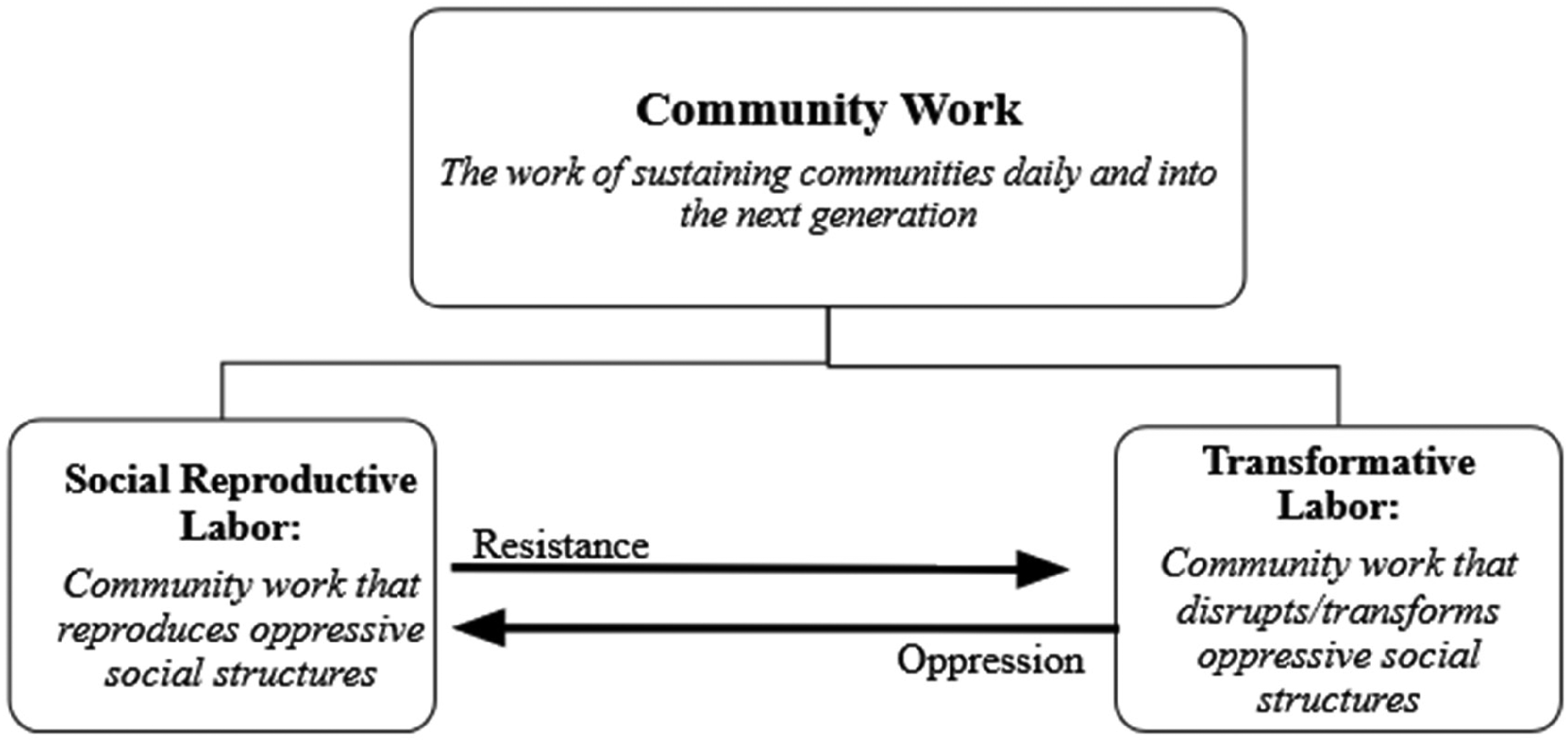
The CTRL framework.
The work Black women do to care for their communities is often not remunerated or even recognized as labor at all. Those engaged in social reproductive labor may argue that their labor should be valued by the markets and the state on economic grounds since it is a public good that contributes to both corporate profits and community well-being (Folbre, 2001). As Banks (2020) asserts, Black women's community work often benefits not only communities themselves but also businesses and the state.
In the rare occasions when transformative work is recognized and economically valued it is on tenuous grounds. For example, during the federal government's War on Poverty in the 1960s it funded Community Action Programs to give local communities access to federal support in “developing autonomous and self-managed organizations which are competent to exert political influence on behalf of their own self-interest” (CAP Workbook, 1965 as cited in Hinton, 2016). According to Hinton (2016), many Community Action Programs were successful in this mission until they gained enough power that municipal leaders felt threatened by the increasing political and civil involvement of low-income Black communities, at which point these organizations were disempowered. During this same period, poor Black women made the case that a guaranteed income could support their community work. Seeking “to bring dignity to their work as mothers,” they “organized protests and planned campaigns to demand higher welfare benefits, protection of their civil rights, and better treatment from their caseworkers” (Nadasen, 2002, p. 272). They challenged onerous welfare requirements by arguing that they “can be much more valuable doing something else…and that is out into the community, mixing with the people, finding out what their problems are, and trying to help solve those problems” (Sanders, 1969, as cited in Sherwin & Piven, 2019). As academics and activists with experience applying for funding to support community-led social justice initiatives, we have observed that private foundations and donors are more likely to support transformative labor than the state, although funders are few and far between and typically apply time-limited restrictions.
Example of CTRL Application
The following examples illustrate how systems of oppression and resistance push and pull labor toward social reproductivity and transformation. The first section provides a historical example of Black women's community work and how it shifts between reproductive and transformative poles. Similarly, the second section offers a contemporary variation of this concept.
Domestic Workers in the Post-Reconstruction South
Following Reconstruction, Black women in the South had limited opportunities to earn wages. Many turned to domestic work, an incredibly racialized and gendered field, to make a living. The disproportionate population of Black women employed in socially reproductive, domestic work post-Reconstruction (Glenn, 1992) makes it especially ripe historical terrain for analyzing how Black women's work shifts along the continuum of reproductive and transformative labor, and, how this shift breeds opportunity for collective community action.
Some forms of domestic work like laundressing allowed women to work from home and “avoid workplace environments in which [B]lack women have historically confronted sexual harassment” (Kelley, 1993, p. 98) or to care for their children while they worked. Whether they were at home or working under the watchful eye of employers, Black women found space for resistance within their labor. Black domestic workers “devised a whole array of creative strategies…in order to control the pace of work, increase wages, compensate for underpayment, reduce hours and seize more personal autonomy” (Kelley, 1993, p. 89).
Black domestic workers in the post-Reconstruction South often quit in tandem to sabotage large social events, causing great embarrassment to employers “forced to entertain their guests without servants” (Hunter, 1997, p. 60). Asserting their newly recognized right to quit allowed Black women to reclaim their own time to care for sick children, participate in social events, and join secret societies (Hunter, 1997). Collectively quitting served as an especially well-suited form of resistance and sabotage because it “did not require open or direct antagonism” (Hunter, 1997, p. 60) and “was an effective strategy to deprive employers of complete power over their labor (p. 28). Domestic workers’ tacit refusal to use their labor in service of white domination and their decision to instead invest their energy in community work represents a clear shift of their labor from the social reproductive end of the continuum towards the transformative end along several dimensions.
In 1881 Black laundresses in Georgia led the multi-week Atlanta Washerwomen's Strike to demand uniform wages and reduced work hours (Hunter, 1997). Members of the Washing Society, pejoratively termed the “washing [A]mazons,'’ defied stereotypes of Southern domestic workers as “passive victims of racial, sexual, and class oppression,” and instead “displayed a profound sense of political consciousness through the organization of this strike” (Hunter, 1993, p. 206). The exertion required by washerwomen to set the terms of their labor in defiance of racial capitalism is an example of how social reproductive labor (i.e., laundressing), through the mechanism of resistance, became transformative (i.e., the strike transformed dominant social structures by building community power).
The predominantly white local legislature and white employers, however, sought to maintain their control over the washerwomen and their labor. They used the powers endowed to them by systems of oppression to try to shut down the strike. The Atlanta police arrested six women for their participation in the strike–Matilda Crawford, Sallie Bell, Carrie Jones, Dora Jones, Orphelia Turner, and Sarah A. Collier–charging the women with disorderly conduct and quarreling (Hunter, 1997). When Collier refused to pay the $20 fine she was assessed, she was sentenced to work on a chain gang for forty days. The white-led city council subsidized commercial laundry rates and offered commercial laundry businesses non-profit tax status to undermine the strike. The City of Atlanta's multiple attempts to quell the strike is demonstrative of interlocking systems of oppression pushing back to make Black women's work more reproductive and less transformative.
Contemporary Mutual Aid and Community Activism
Celida Soto
1
, who identifies as Afro-Latina, is a local Birmingham activist who demonstrates the utility of the CTRL framework when examining Black women's contemporary community work. In addition to being a regionally well-known advocate for causes like defunding the police, food and water sustainability, and ending gun violence in Birmingham, Alabama (Webb-Hehn, 2020), Celida was selected as an exemplar case because of her commitment to publicly vocalizing the potential of Black women's work to disrupt oppressive, anti-Black social systems and its simultaneous essentialization and devaluation by those in power—as evidenced in her quote in this paper's introduction. Celida noted: We wanna save our babies. We don’t want them shot, you know, for wanting to be warm with hoodies. We wanna put an immediate stop to state sanctioned violence and make sure folks are fed and clothed and housed … I hate when people are like, “Oh, you’re so strong. You’re so resilient.” I’m like, You don’t mind to see me dead … I just want these folks that are in [a] position of power [and] that do have access to capital to stop looking at it as like this is like innate to us. It's not, you know, this is not what we’re, you know, meant to do and supposed to be doing, especially without support. (Personal communication, October 26, 2022)
When we spoke in late 2022, Celida worked for a nonprofit as a child hunger advocate. Her daily tasks included applying for grants and advocating for local and state legislation that reduces child poverty and increases funding for benefits programs (e.g., SNAP or WIC). She also collaborated with schools, food banks, and other nonprofits to provide direct assistance to families. Celida's nonprofit work was a form of community [other]mothering, as it focused on the well-being of her community's children and their parents, and social and human services work. However, the bureaucratic constraints of her work placed it squarely within the realm of social reproductive labor. She recognized that the type of work she performed was often controlled by funders who were “in no proximity to hunger or to our day-to-day struggles [yet] are trying to structure it.” (C. Soto, personal communication, October 26, 2022). She also highlighted that the struggle between community priorities and funders’ priorities creates an extractive relationship where grantmakers are exploiting the labor of Black women working in vulnerable communities. Celida argued: [Funders] have reports to write and they have their own grantors, [and] I guess responsibilities to fulfill. But we can’t keep bleeding and dancing for y’all. (Personal communication, October 26, 2022) My home is a community home to advocates and activists. If they need rest, if they need food, they’ll get a hot meal here and a place to lay and rest. I’m currently housing a young woman who's a senior in high school…She's definitely going to college. But if this home wasn’t available to her, her other option was gonna be sex work, which is real work, but I need her to concentrate in school and not have to worry about, you know, where her bed will be. We need more spaces like that… if we had a building…that you could go to and not feel the restrictions of a shelter, it's just like their own little space. We need that. (Personal communication, October 26, 2022)
Implications for Social Work and Future Research
The CTRL framework identifies distinct dimensions of two types of community work—social reproductive labor, which reproduces oppressive social structures and transformative labor, which transforms social structures—and places them opposite each other on a continuum to recognize the unique pressures and resistance present in Black women's community work. As an analytic tool, it has the potential to bring more nuance to labor studies than do existing conceptions of reproductive labor. However, it is also important to note that since the CTRL's focus is limited to the reproduction and transformation of social systems it is by no means all-encompassing given there are many other aspects of Black women's community work that also warrant study.
Expanding our understanding of racialized women's community work raises important implications for the social work and social services field. The CTRL framework is a useful tool for social work practitioners and funders of all races to assess how their work contributes to both the reproduction and transformation of interlocking social structures. By asking the following questions social work practitioners, other community workers, and funders can use this framework to strategize about how to move their work along the continuum.
Which systems of oppression does this work reproduce? Which does it intend to transform? Is this work reinforcing or dismantling anti-Blackness? How does this work serve the accumulation or redistribution of wealth, profit, and/or social privilege? Does this work build power in directly affected [Black] communities? Whose knowledge and expertise inform this work? Who leads it? Who has power over how the work is done and why? What are my motivations to do this work? Who in the community (de)values this work and why? How is this work valued? Do directly impacted [Black] communities see this work as valuable?
Funders interested in addressing structural oppression and anti-Blackness should take heed of the dimensions of transformative labor by valuing and financially supporting Black women engaged in community work. This requires a paradigm shift towards funding transformative community work with no top-down stipulations on how the work will be performed. Funders should also support the leadership development of those already doing the work.
While we apply this framework to Black women's community work, it has strong analytic potential for examining the community work of other racialized women. As discussed earlier, Indigenous, Latinx/Chicanx, and Black women share some similarities in their community activist practices (Orozco Mendoza, 2023; Shadaan, 2020). Non-Black women of color may also encounter racial and systemic oppression that shifts their work toward the social reproductive end of the spectrum. For example, Watkins-Hayes (2009) found that Latina and Black women shared similar barriers to promotion at a state welfare department. Moving forward, more empirical research is needed to bear out the CTRL's usefulness in examining other racialized and immigrant groups.
Although our paper addresses [other]mothering as one type of Black women's community work, we want to be clear that community [other]mothering is not restricted to cis-heteronormative conceptions of maternalism that reinforce biologically essentialist, patriarchal notions of motherhood. Rather, “mother” or “community [other]mother” is meant to encompass any individual who embodies and practices communal care ethics. Di Chiro (1998) points out that “the Mothers of East Los Angles (MELA) utilized ‘mother’ as a symbolic identity to connote the protection of the family and community, irrespective of gender” (as cited by Shadaan, 2020, p. 491). Marlon M. Bailey (2009) recounts the crucial role “house mothers”—which included “butch queens, femme queens, and women” (p. 260) of color in ballroom culture—played in reducing the spread of HIV/AIDS in queer Black communities. More research is needed to explore how gender-queer, non-binary, and men-identifying individuals deploy [other]mothering as community work and how their work traverses the CTRL spectrum.
Finally, the CTRL offers social reproduction scholars a new analytic tool for addressing existing debates in the field about the role of social reproductive work in both sustaining and challenging capitalist growth. These debates include whether the family is a site of protection from capitalism (Fraser, 2016) or a capitalist institution serving to maximize exploitation (Cooper, 2017); and whether unpaid care work is a decommodifying form of resistance to capitalism (Federici, 2018) or the result of austerity measures that have pushed the burdens of worker reproduction on to poor and working-class women (Cooper, 2017). The concept of transformative labor recognizes that not all care work reproduces existing power relations, and that resistance is work, making the CTRL a useful analytic tool for beginning to map where different arrangements of community work fall and how they move across the continuum.
Conclusion
The CTRL framework provides an initial conceptual and analytic framework to better understand Black women's community work. Research reveals that Black women's work in their communities violates traditional assumptions about labor and definitional dichotomies of paid and unpaid, private and public, or productive and reproductive labor (Banks, 2020; Collins, 2000; Gilkes, 1983; James, 1993; Naples, 1992). Instead, the commitment and labor of Black women call us to recognize two facts. First, Black women's work in their communities is labor that requires physical, mental, and emotional exertion. Just as feminists have long recognized the labor of caring for families and households as a legitimate form of work, Black feminists push us to recognize the legitimacy of the labor of caring for communities and the labor required to fight racism, anti-Blackness and other systems of oppression (Banks, 2020). Second, Black women's community work typically exists in a liminal and fluid dialectical space between social reproductive and transformative poles. Resistance to systems of oppression pushes work towards transformation, while social pressures push it towards reproduction. Though empirical research is needed to continue to study the applicability of the CTRL, especially for other racialized groups, this continuum provides a robust starting point for scholars to better understand the nuances of Black women's community work.
Footnotes
Acknowledgments
The authors gratefully acknowledge Celida Soto for her fierce dedication to her community and thoughtful contributions to this article. They also thank Lisa Moore and William Sites for their feedback on previous drafts. Finally, they would like to recognize the millions of Black women, written and unwritten, who labor every day in service of liberation and justice.
Declaration of Conflicting Interests
The authors declared no potential conflicts of interest with respect to the research, authorship, and/or publication of this article.
Funding
The authors received no financial support for the research, authorship, and/or publication of this article.
