




Abstract
This article demonstrates how to apply intersectionality as a lens during qualitative data analysis of a collective autoethnography study conducted by five social work practitioners and researchers who no longer religiously identify with the Mormon faith in which they were raised. The article presents methods and provides examples of analyzing the intersectionality of a phenomenon, using gender as the primary positionality. This intersectional analysis is conducted through organizational, representational, intersubjective, and experiential domains. This type of analysis provides a more nuanced portrayal of the lived experience of a given phenomenon. In this case, the intersection of religious identity and the positionality of social work could not be understood without intersectional analysis of the gendered experience.
This article presents the methodological foundation of a collaborative autoethnography (CAE) and the process of analysis in formulating emerging themes and qualitatively understanding difference. This article does not attempt to provide the full thematic results of a study, rather it demonstrates a specific example of analysis for other qualitative researchers to model. With this article, we demonstrate how using an intersectional framework (Anthias, 2013; Collins, 1990; Crenshaw, 1989, 1990) contributes to a qualitative data analysis and enhances understanding of participant experience and thematic transferability.
Utilizing data from a CAE study examining how formerly holding a Mormon 1 identity influenced participant researchers’ current identity as social work scholars, this article provides the example of using gender as an intersectional lens for critically analyzing experience of a phenomenon. Examining experience through the perspective of diverse identities (e.g., gender, race, class), allows researchers to identify where multiple identities intersect to create not just a uniquely different experience, but one in which they experience greater marginalization (Collins, 1990; Crenshaw, 1989, 1990).
We began with, and use, gender as the example because gender emerged as a repeated theme throughout data collection and analysis. This led us to realize that we needed to further analyze the phenomenon from an intersectional lens. An intersectional framework does the following: (a) allows researchers to better understand the lived experience of a phenomenon, (b) emphasizes the nuances of intergroup difference based on various positionalities, and (c) illuminates various domains of power (Anthias, 2013). While we present the analysis of gender as the example in this article, researchers should note that next steps would be to analyze data through other social positionalities (e.g., race, class, sexual orientation). Identities to be analyzed should be those of primary significance to the individual, and those that tend to be marginalized within the bounded system analyzed in the research project.
Intersectionality
Intersectionality attends to the lived experience at the intersection of social positionalities, emphasizing that experience cannot be reduced to an individual aspect of identity (Crenshaw, 1989; Collins, 1990). Crenshaw (1990) introduced the term “intersectionality” when critically analyzing the experience of Black women as not being represented in Black rights or feminist rights movements, exposing their devalued status in the social hierarchy and the resulting outcomes in the legal system. Collin’s (1990) analysis of the intersections of race, class, gender, and sexuality highlights how individuals who hold multiple marginalized identities are stigmatized through a multitude of oppressive forces. Both Crenshaw (1989) and Collins (1990) center Black women as the focus of analysis. While essential to engage in critical race analysis when examining a racialized social system, the critical analysis that they outline can be transferred to analysis of groups centered on other marginalized identities. It is beyond the scope of this article to expand the analysis to further center Mormon positionality through a racial lens and critically examine the reinforcement of whiteness within the population; however, this is the next step in on-going analysis.
Using the ideas of these theorists (Collins, 1990; Crenshaw, 1989, 1990) as a basis, Anthias (2013) expanded on this foundational work on intersectionality by identifying four ways to focus intersectional analysis of a phenomenon: (a) organizational (organized in a system), (b) representational (messages about), (c) intersubjective (practices in relation to others), and (d) experiential (meaning made by the individual). Stemming from previous Black feminist work, these categories are similar to Collins’s domains of power: structural, disciplinary, hegemonic, and interpersonal. Unlike Collins, who focuses analytic attention on marginalized populations that consistently experience multiple oppressive forces, Anthias’s framework provides a lens for analyzing fluid positionalities within individual experience. This framework highlights the social construction of groups, including who gets bound to the group through individual or social identification and the resulting hierarchical structure between groups.
For example, a Mormon identity situates people who regularly attend church meetings as more righteous than people who do not attend meetings within the social construction of Mormon (those who are members of the Church of Jesus Christ of Latter-day Saints) versus non-Mormon (those who are not members of the Church of Jesus Christ of Latter-day Saints). However, one can be a member of the Mormon church, but not practice. A non-member would be either someone who has not been baptized in the faith or one that has taken their name off the Mormon church membership records. Additionally, analysis explores how individuals’ experience of privilege and oppression may shift related to positionality and context. An individual who identifies as queer is excluded from a religious marriage in a Mormon temple but gains access to legal marriage benefits and acknowledgment from the broader U.S. society. For this reason, we used Anthias’s framework to examine data from White, middle-class, able-bodied participants who shifted between socially constructed groups (i.e., Mormon minority vs. non-Mormon majority) with different organizational systems and contradictory representations of identity.
Literature Review
The process of transitioning away from religion, particularly from high-cost or fundamentalist organizations, and the subsequent identity reconstruction, is established in the literature (Ineichen, 2019; Nica, 2020; Ransom et al., 2021). Early studies of Mormon disaffiliation tend to posit that the majority of leavers of the faith were less devout from the beginning. Albrecht and Bahr (1989) and Zuckerman (2011) in particular theorized about leavers of Mormonism, characterizing them as more or less marginal. Later research by Ormsbee (2020) shows how “…devout leavers had to engage in an ongoing, effort-full process of imminent critique, which often took years to accomplish, and that required work to gradually reconstitute the leaver’s self and their world” (p. 303). Similarly, other studies note that leavers weigh social costs, cultural costs, organizational values, and personal values as they move through the process, taking between 6 months and 20 years (Hinderaker & O’Connor, 2015). Brooks (2018) also found that leavers were not marginal members necessarily, and that the process involved significant analysis, seeking to resolve the tension between Mormonism and personal values. Further research found that such value conflicts were commonly rooted in political ideology and sexual and gender identity (Riess, 2019). In interviews with 23 Mormon women, Jacobsen and Wright (2014) found that at the intersection of gender and sexual identity, many experienced an impact to their mental health in the forms of mood disorders and suicidality. Other analysis of ex-Mormon narratives showed how leavers feel wronged or misled many, which punctuate the loss resulting in an identity crisis (Avance, 2013; Payne, 2013). Much of the research, unsurprisingly, finds that former Mormons are likely to turn toward secularism rather than seeking out new religious affiliations (Dehlin et al., 2011; McGraw et al., 2018). This turn, away from dogma and prescriptive values toward secularism, particularly at the intersection of gender identity and religious identity, illustrates the jumping off point of this methodological paper.
Methodology
This methodological report originated with a CAE study exploring the influence of intersecting identities and mutual positionalities as former Mormons and currently, as social work scholars. CAE allows for researchers to combine their lived experiences to examine a shared phenomenon (Chang et al., 2013; Hernandez et al., 2017). This qualitative design allows the flexibility to shift and adapt methodology as data and understanding emerges, including shifting the focus of research interrogation (Chang et al., 2013). We found that the emphasis on critical reflexivity in CAE aligned with the broader goals of intersectional theory, which corresponded with the four positional categories posited by Anthias (2013).
The participant-researchers consisted of five middle-class, White social work PhD academics with a Mormon religious background (Table 1). Each participant was born into a practicing Mormon household, with at least one parent who traced their ancestry back to the Mormon pioneers in the mid-1800s. Each participant is currently engaged in social work scholarship that now defines their identity and purpose. We questioned what themes emerged at the intersection where our primary identity shifted from one based on religion to one based on professional practice. Understanding how past positionalities influence current practices could benefit in the training of social work practitioners.
Participant Demographics and Experiences.
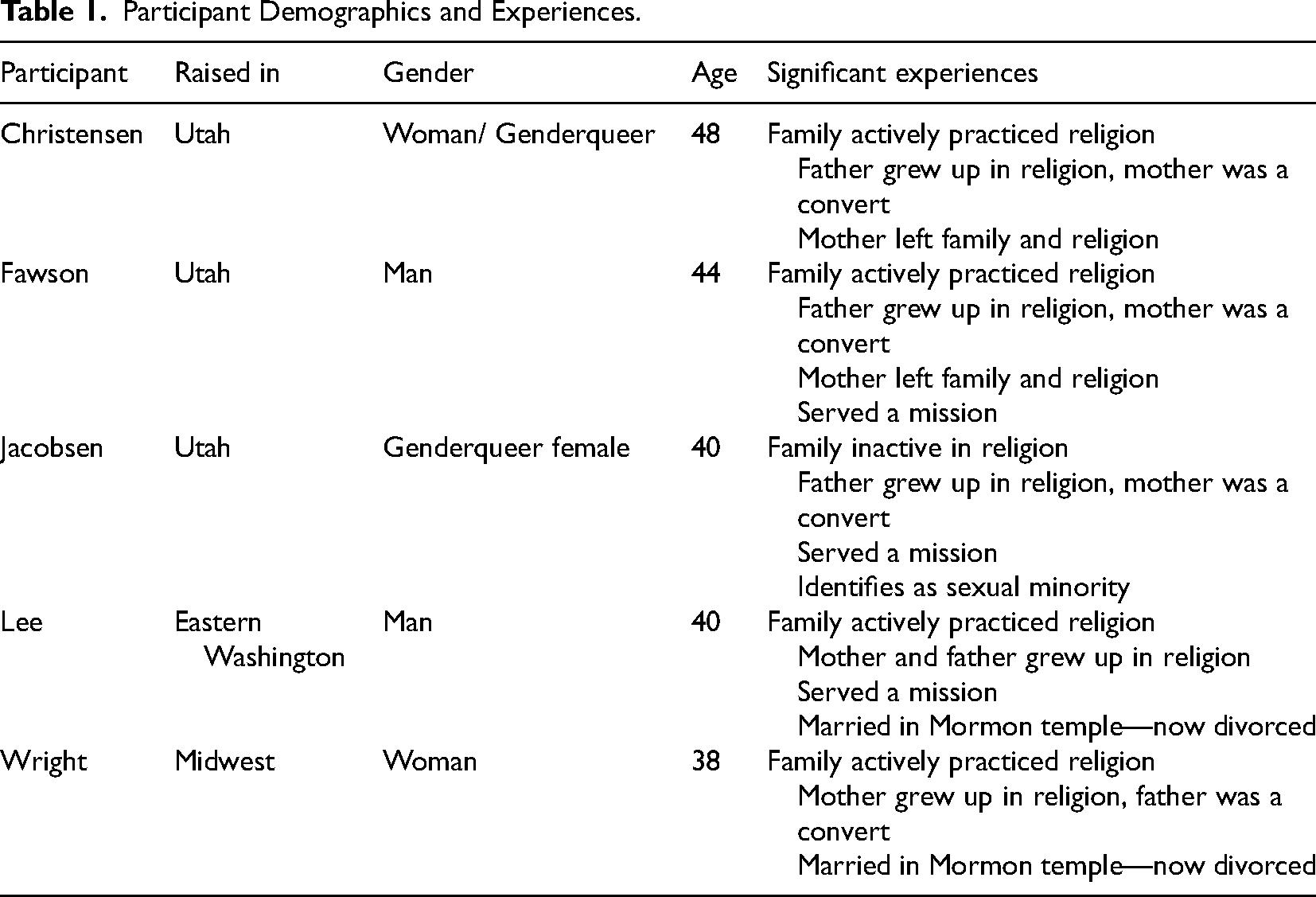
Four members of the research team have been acquainted for over 10 years due to attending the same PhD program. We connected with the fifth member through mutual social work colleagues. While attending a social work educational conference, we began a conversation about our journeys away from the Mormon faith and towards the social work profession. As researchers, we decided to begin examining how our experiences with the Mormon faith influenced our path as social work practitioners and academics. With the research question in mind, we first met to discuss the project and agreed on a methodological plan, which included meeting for 1 to 1.5 h every 3–5 weeks until completion of the initial analysis. We then submitted our project plan to one author’s university internal review board and received approval for this project. Data collection occurred over the period of 1 year.
Each meeting took place using video conference software and was recorded. In the second meeting, each researcher-participant discussed the potential benefits and harms in engaging in this type of research project. As we gave consent to use our names as part of this project, we specifically discussed the ethical consequences of this type of self-disclosure both as individuals and as related to the confidentiality of others named in our narratives. We self-reflexively considered which stories we owned, and which might be owned by a family member and not ours to share publicly even if they had influenced our experience or identity development.
Following the meeting on consent, we each wrote personal narratives about our experiences of being raised in the Mormon religion, leaving our practice of the religion, and entering into the profession of social work. We shared these writings with one another prior to the next meeting, where we discussed the ideas and impressions that emerged from reading the collective narratives. In this meeting, we also probed new questions that emerged and where each of us could expand our narrative based on content presented by the other researcher-participants.
Between this meeting and the next, we revisited our individual narratives and wrote additional details about our experiences with Mormonism and current position as social work scholars. In the next five meetings, we selected one narrative for in-depth, collective review and analyzed similarities and differences within our own experiences. Once each narrative had been thoroughly discussed and the recorded meetings transcribed, we transitioned to using the time between meetings to code (via Dedoose) the various texts. We used ensuing meetings to discuss the codes that began to emerge.
Analysis
Data used for analysis consisted of the written narratives, ranging from 8 to 14 single-spaced pages, and transcriptions of the recorded 60–90 min group discussions. In the initial coding stage, at least two researchers coded the text using an open coding process in which codes were used to identify significant statements and meaning units (Saldaña, 2015). We created a shared codebook that allowed for comparing codes between coders, narratives, and discussions. As a code became codified in one transcript, it could be used by the other researchers during their coding of other texts. In addition, each of us served as a member-checker for the coding analysis of our own narrative.
CAE allows greater exploration of a phenomenon due to a deep understanding of the experience each participant holds. As individuals are experts of their own experiences, the data collection and themes that emerge remain close to the source with minimal interpretation. At the same time, potential bias may occur as we each have reshaped our memories through time and experience. We engaged in reflexivity through the discussion of analysis. Questioning and probing shared experiences exploring our understanding then versus now. Given subsequent knowledge acquired through our social work education, interpretation related to understanding of developmental stages, trauma, and social justice could be perceived now in ways that were not perceived previously. Having created a safe space to analyze experiences, we felt able to challenge each other when current understandings of the world appeared to distort past experiences. Data collection and analysis occurred concurrently, allowing prolonged engagement in the process and greater dependability that analysis did not change over time given on-going reflection.
While we initially began looking only at Mormon identity, we soon realized how quickly other identities such as gender and sexual orientation marginalized some within the Mormon community. Using perspectives from these intersecting identities, we could use intersectionality to critically analyze how a social system (in this case a patriarchal religion) created further injustice between similar experiences. During discussion, we found that participants raised as women rebelled against narratives created by men (or masculine, patriarchal narratives), to subvert the patriarchal authority these narratives placed on our gender expression and sexual orientation. This included pushing against the narrative of male participants and their interpretation of group experience. At the same time, gender expression and sexual orientation added additional experiential nuance. Holding outsider identities (e.g., females assigned at birth, sexual minorities) even as an insider of the larger phenomenon, allowed us to maintain greater objectivity in data response and analysis.
Of note, our shared positionality as racially White did emerge through discussions of the data. These discussions included a critique of how whiteness and white supremacy are perpetuated through LDS doctrine and organizational practices. We each noted our racial privilege within LDS systems, and how race is constructed within the Book of Mormon and through LDS cultural practices. There are certainly politically progressive and anti-racist individuals within the LDS church who are strong, devout Mormons. However, the nuances involved with this site of inquiry requires more attention than is possible in this paper.
To understand our change in identity and what being a social work scholar meant now, we needed to first understand our previous Mormon identity and how that lead to the path of social work scholarship. Given that gender significantly impacted the experience and meaning made by relinquishing our Mormon identity and how that former identity influenced our positionality as social work scholars, we began with the analysis of how our positionalities related to gender intersected with our religious identity and how that then lead to our identification with and practice of social work scholarship. We present the analysis of this lens below. It is beyond the scope of this article to present analyses from each identity lens. This interrogation is limited to one positionality (gender) but has implications on other positionalities (e.g., race, class, ability).
Analyzing Gender
After initially coding transcripts and analyzing codes through discussion, we began combining these codes into categories. As categories emerged, we analyzed the experiences through an intersectional lens (Anthias, 2013) and identified the organizational, representational, intersubjective, and experiential influence on our collective lived experience as former Mormons and current social work scholars. Centering gender we critically examined the interplay of power dynamics and privilege. We identified specific examples that aligned with each level and analyzed how the intersection of gender affected experience, through constant comparison of narrative to narrative to larger group experience.
Organizational Level
Mormon positionality is based on membership in the Church of Jesus Christ of Latter-day Saints. Analysis begins with an examination of the organizational structure and how power manifests through the hierarchical system. The church espouses a patriarchal religion where men hold leadership authority and women are socialized to aggrandize marriage and motherhood as their primary role and avenue to salvation (Leamaster & Bautista, 2018; Smyth, 2018). The experience of being a woman, man, or not fitting into the gender binary in this church is placed in the context of the hierarchical positioning of men being valued and women being valued only in relation to men (Smyth, 2018). This religion views gender as an eternal construct and essential to salvation through heterosexual marriage. The organization gatekeeps membership, access to religious practice, and the church community through the male led positions of ecclesiastical power (Smyth, 2018). This hierarchy exists, within the community, based on the lifestyle one chooses to live—specifically related to living within a monogamous, heterosexual family in which both parents live the religion and fulfill their gender roles (Leamaster & Bautista, 2018; Potter, 2019). Conforming to the expected gender performance and lifestyle creates social power within the Mormon community. At the same time, performing gender in this manner reduces Mormon social capital in social/political circles where secularism is dominant (e.g., academia) (Dehlin et al., 2011; McGraw et al., 2018).
Once we identified the organizational structure and power relationships of the systems involved, our analysis moved to the diverse experiences of individuals within this group based on the positionalities we each hold. For the participant-researchers of this study, living within this gendered culture and participating in a gender-controlling institution eventually caused each of us to challenge those gender expectations. As seen in this study, experiences within the Mormon Church show structural pressure to conform to the hegemonic practices of traditional heterosexuality, inclusive of cisnormativity. Those of us who veered outside the prescribed gender Mormon norms were formally and informally disciplined by the church community and our families. Intersectionality provided this critical lens during analysis.
Participant-researcher experiences shifted depending on gender positionality and the gender norms presented by immediate family influences. For example, Lee, a White, heterosexual male, came from a position of privileged gender status within the Mormon culture. His family represented the ideal Mormon standard and background. As such, he did not question his fit within the religion until later in life when challenging his heterosexist beliefs during his social work education. By questioning gendered family ideals and eventually leaving the church, Lee lost not only his social status within his family and the local Latter-day Saints (LDS) community, but also the self-confidence that came with holding a Mormon identity in the context of his male status in the religious community.
Wright also had the ideal Mormon family growing up but did not fit the Mormon feminine ideal when forming her own family through marriage, due to an abusive partner. Given her role as wife, Wright felt blamed for the abuse she experienced and forsaken by the community. This caused her to challenge her fit within the church. Fawson and Christenson, in contrast, had to deal with what appeared to be ideal Mormon families breaking apart. Their mothers left the religion and their family, causing these families to lose social power within their local church communities and within the larger LDS system.
Alternatively, Jacobsen never had the ideal family from a Mormon perspective, due to lack of devout observation and a matriarchal family structure, which often placed the family on the outside margins of the Mormon community. This matriarchal organization of power within the family allowed Jacobsen’s family to accept their deviance from Mormon feminine norms, whereas the other four participant-researchers continued to experience tension within their families due to their gender deviations and their families’ religious beliefs.
These examples demonstrate how intersectional analysis can extract and examine divergent cases when looking at the intersection of religion and gender at the organizational level. Also, examining how organizational structures influence gender identities and expression is relevant to social work research aimed at understanding gender oppression.
Representational
The second area of potential intersectional analysis occurs at the representational level. For this study, we considered how different positionalities were represented within the analytic context. Taking gender as the example, each participant-researcher experienced similar messages about gender from the church, while also being told to ignore dominant messages about sexuality and gender from the broader society and to demonstrate worthiness in the minority culture. According to Mormon doctrine, binary gender is central to the purpose of life through traditionally defined family units, and playing the respective roles of women and men, especially mother and father, are essential to the aim of eternal exaltation (Sumerau & Cragun, 2015). One key to social and political power within the LDS system and community is to internalize these messages, perform the gender ideals, and police the gender behavior of the community (Smyth, 2018).
Christensen’s understanding of gender can be seen in how she interpreted her mother’s actions based on the internalized representations she held. I remember seeing my Mom as the bad guy—as the villain in this situation. I was angry and disappointed that my mother chose to leave the church. In my mind, leaving the church meant that she was choosing to be the opposite of what a mom should be. In LDS culture, moms should be sweet, submissive, forgiving, self-sacrificing, should submerge their own needs for the sake of their family. Through a Mormon lens, what my mother was doing—by leaving the church and divorcing my father—was incredibly selfish, it was immoral.
In Christensen’s words, one can hear her struggle with internalized, gendered messages and her feelings of needing to police her mother’s behavior. This need to police comes from systemic and communal messages that create a sense of shame and loss of social power resulting from her non-ideal family and having a deviant mother. While women strive for perfection that can never be achieved, males are given more power than they knew they deserved. Eventually, each researcher-participant in this study struggled with the gender hierarchy and gender role constraints of the organization based on interpersonal relationships that occurred at various points in time.
From a methodological perspective, introducing the representational level into an intersectional approach to data analysis reveals how messages about gender affect an individual’s interpretation of major life events. Examining these messages deepens researchers’ understandings of phenomena they are investigating.
Intersubjective
Intersubjectivity refers to patterns of relational practices as they relate to identity or positionality (Anthias, 2013). It is essentially the meaning attributed to a socially constructed concept, such as gender or Mormon, that is generated through interpersonal and communal interactions placing individuals into groups. These relational practices are grounded in “historically and culturally specific values” (Murray, 2009, p. 268). Relational dynamics are navigated within the structural hierarchies of the organizational context, where power is often used to constrain different positionalities (Anthias, 2013).
Using the positionality of gender, participant-researchers identified how they learned about gender roles in the religion. How they were enacted within the family system varied by participant-researcher and the positionality of the other individuals with whom they interacted. The intersubjective experience of gender varied depending on the fit of the individual with the gendered expectations assigned. Lee experienced little conflict with his gender, whereas Jacobsen’s story was of a constant misfit with gender expectations. Between these extremes, Fawson, Christensen, and Wright rubbed up against gender cultural norms as they attempted to develop values within a community that shamed sexuality and was hyper-focused on male and female purity. Christensen described the conflicting messages she received from the church related to submission to patriarchal authority versus women as sexual gatekeepers. Wright also experienced this tension in her marriage to a Mormon man who did not conform to promised expectations (as a benevolent provider) despite Wright’s performing her gender role as expected. Interrogating the positionality of gender in this way, of course, bumps up against the intersection of sexuality. Jacobsen experienced heteronormative Utah in a unique manner compared to the other researcher-participants, due to their lack of gender conformity and sexual minority status.
Presenting an intersubjective analysis of participants’ lived experiences illuminates how relationships shape social constructs such as gender and sexuality. As with the organizational and representation levels of intersectional analysis, the intersubjective level creates an additional layer that deepens data analysis. This level merges intrapersonal and interpersonal understandings of social constructs, such as gender.
Experiential
The final area of intersectional analysis is experiential. How an individual experiences an intersection of identities depends on the positionalities they hold. With gender continuing to be used as an example, participant-researchers gave different meaning to their experiences based on the positionalities they held in relation to their Mormon identity. The experience of Mormon positionality depends on privileged experiences related to the other intersecting positionalities (e.g., gender, sexuality, class, race) held. For example, how each researcher-participant experienced sexual control in the church varied based on sexuality and gender. Fawson wrote, I learned that social workers fight against social injustices. I found many injustices perpetrated in the Mormon Church and it was suffocating. The way women are portrayed as submissive and inferior to men…Many doctrinal issues where people just had to have faith. But faith is believing something without any evidence. I discovered that evidence is what is important or else you could say and believe anything you want.
Examining how participants experience their positionalities demonstrates how individuals understand their social locations in relation to others. Advancing this aspect of an intersectional analysis unpacks the meaning participants derive from a specific lived experience.
Integrating Social Work Identity to Analysis
Understanding the lived experiences of religious identity based on diverse positionalities within the context of a rigidly gendered institution provided greater understanding of the influence of a former Mormon identity on the current positionality of social work scholars. Having examined the intersection of religious identity and various positionalities, our analysis then turned to the intersection of former Mormon identity and current role as social work practitioner and scholar. Our positionalities within Mormon and non-Mormon social environments shaped the worldview, values, and scholarship trajectory of each participant. During analysis of identity development, we realized an assumption we held included an inquiry into whether our positionality as a social work scholars had replaced our previous religious identity. Jacobsen wrote, It is difficult letting go of everything you know to be “True.” The beliefs are buried deep within the neural synapses of my brain. I shifted belief from an absolute certainty in one Truth to a place of not knowing. For the most part, I am comfortable not knowing. It allows me to come from a place of curiosity and helps me practice cultural humility with clients and students. Coming from a social constructivist paradigm, I can accept that there are multiple, equally valid realities.
This quotation exemplifies the shift in paradigms participant-researchers experienced. Having previously held a religious identity that significantly defined our lives and stepping outside of that ethnic-religious culture, none of us replaced that religious institution with a new religious practice. Rather, each seemed to seek expression of spirituality and meaning through our social work practice. Despite our profession being a significant variable in our lives, we also realized this positionality did not hold that same weight as our religious identity previously held. The social work profession, while a position of importance as it allowed expression of aligned values, did not reflect a defining identity in the same manner and represents only one position we hold. At the same time, one reason social work may have felt like a professional fit could be due to its alignment with values remaining from religion (such as service, social justice, individual worth, integrity, and knowledge), while allowing us to critically question social constructs like gender and sexual minority identity in a way we could not holding a Mormon identity. Our previous worldview no longer being compatible, we embraced multiple truths, a perspective which is emphasized in a culturally competent, social justice approach to social work practice and scholarship.
Discussion
While the main thrust of this paper is to demonstrate the utility of using an intersectional lens in qualitative data analysis, this paper also contributes to research on leaving faith communities. Similar to previous studies (Brooks, 2018; Hinderaker & O’Conner, 2015), current findings showed how the researcher-participants invested significant analysis into the faith leaving process by weighing the cultural and familial costs. Also, value conflicts with the Mormon faith were grounded in divergent ideologies related to gender and sexuality (Riess, 2019). The present study extends this previous research by examining the intersection between an ex-Mormon identity and a social work practitioner/scholar identity. After leaving the LDS church, the participant-researchers sought spiritual expression and meaning through social work practice. They also noted that the influence social work carried in our lives did not carry the same weight as the Mormon faith. This may be due to the paradigm shift from seeing truth as absolute to viewing truth as socially constructed.
This methodological report carries limitations that need mentioning. With this study, we evaluated gender due to the diverse genders among the researcher-participants. We did not examine positionalities that we share, race and class. Using an intersectional frame to explore race and class is the next step in this research process, and necessary for understanding how faith systems and the social work profession perpetuate power differentials based on those positionalities (Figure 1).
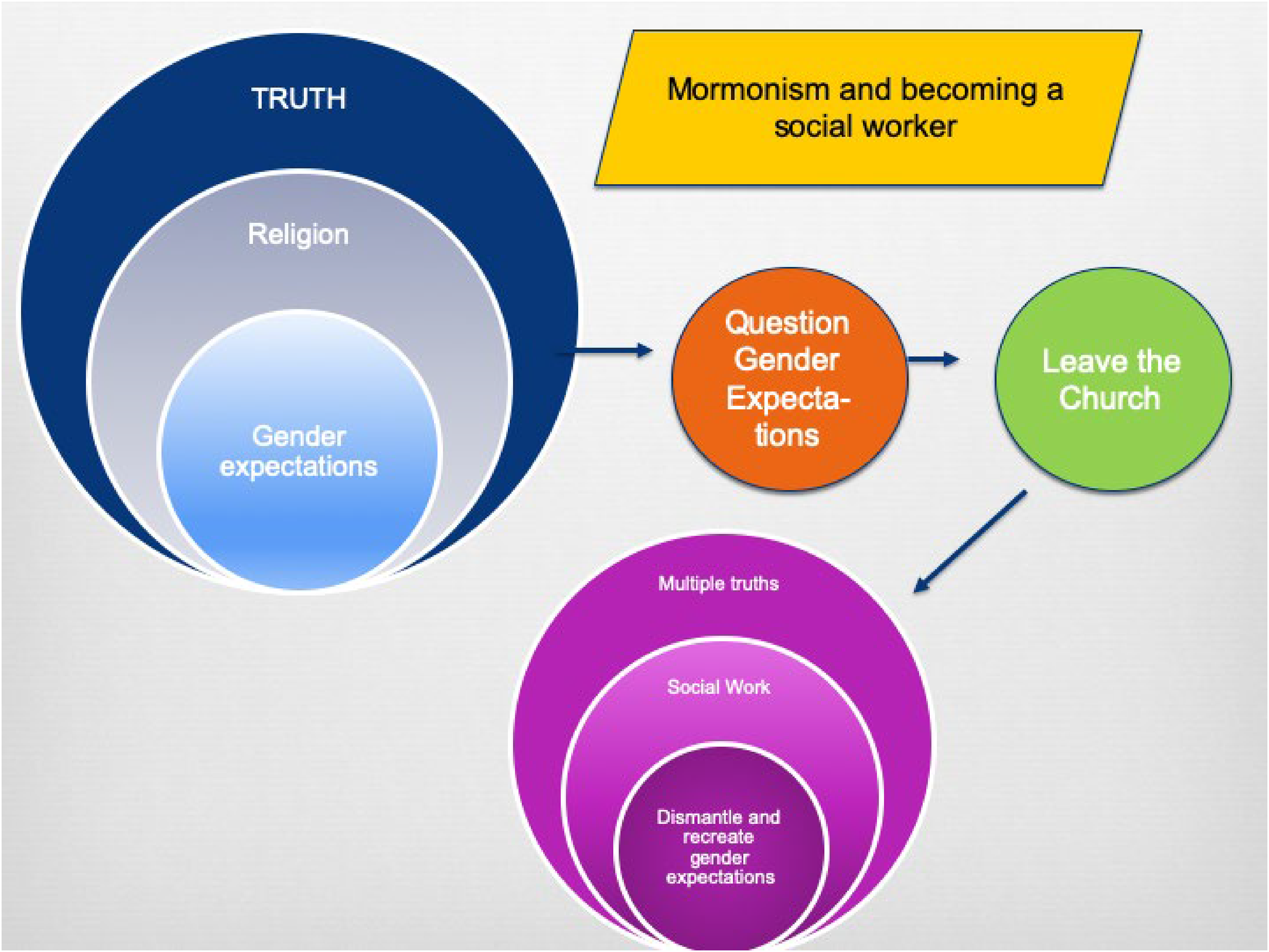
Change in positionality from mormon to social work scholar.
Implications
This article demonstrates the application of an intersectional lens to better understand the lived experience of a phenomenon as it provides an avenue through which to analyze the layers of experience created by intersecting positions. Intersectional invisibility occurs when analysis does not use an intersectional lens and the dominant group’s narrative is placed on all members of the group (Crenshaw, 1990). The nuances of intergroup differences based on other social identifiers are obscured and the diversity of experience is not presented in the findings. While this article demonstrates an example of analysis through the intersectional lens of one identity, next steps would be to engage in this similar process the lens of other marginalized identities (e.g., race, class, age, etc.). This critical analysis allows researchers to identify the structural dynamics that marginalize individuals within diverse groups in relation to the larger dominant social paradigm.
As is true of many CAE studies, the small sample in this study is not representative of other social identities. Identities and positionalities related to race, nationality, class, and ability may significantly shift the findings as additional layers of oppression emerge. For example, people of color within a predominantly White Church and the social construction of whiteness within the doctrine of the religion needs to be critically analyzed through Crenshaw and Collins concept of intersectionality within critical race theory. Transferable themes are identifiable related to understanding how a social identity, such as gender, is differentially performed and experienced within a specific population and how that experience later influences other positionalities and social performance.
Examining data through the various levels of intersectional analysis (e.g., organizational, representational, intersubjective, and experiential) (Anthias, 2013) provides in-depth understanding of qualitative data, while enhancing the rigor and trustworthiness of results. Understanding how experiences differ depending on positionality within a culture is essential to culturally aware practice. Cultural humility requires further awareness of the influence of intersectional positionalities on experience (Fisher-Borne et al., 2015). Analyzing through an intersectional lens enhances transferability of results. Finally, results through this lens are useful in examining how individuals’ gender construction shapes the experience of leaving religious communities.
Footnotes
Declaration of Conflicting Interests
The authors declared no potential conflicts of interest with respect to the research, authorship, and/or publication of this article.
Funding
The authors received no financial support for the research, authorship, and/or publication of this article.
