




Abstract
This study aims to understand how goals of activation and gender equality interact in labor market programs directed towards activating unemployed participants. The study draws on interviews with 28 social workers and managers at four Swedish municipally governed labor market programs typically targeted towards poor, unemployed individuals with little to no attachment to the labor market or social insurance system. Our findings show that activation goals are understood to be clear cut and a dominant logic within the labor market programs. The gender equality goals are understood as fuzzy and subordinate to the activation logic. Our theoretical analysis, based on neo-institutional theory, shows that gendered activation as a hybrid logic is created within the four programs as a means of handling the competing logics of gender equality and activation. Gendered activation may be reasonable on an individual level, where women in long-term unemployment can sustain a higher income through work and become financially independent. In the context of the gender segregated labor market, gendered activation reproduces gendered inequalities when an increasing interest for activation policy among welfare states overshadows claims of gender equality. Furthermore, our study exemplifies the systemic reproduction of racist discourse within social- and labour market policies. Within the logic of gendered activation, migrant women become singled out as specifically problematic for Swedish society to handle when unemployment is given gendered and cultural explanations. Through the logic of gendered activation, gender equality goals become no-matter-what employment rather than employment leading to equal outcomes.
Introduction
Activation refers to policies that enforce participation in the labour market by making benefits conditional on active participation in employment programs. Claims of activation and gender equality have gone hand in hand over the last few decades to become powerful claims for welfare states fighting injustice and inequality in society (cf. Jenson, 2015; Lister, 2009; Svensson & Gunnarsson, 2012). In Sweden, the activation trend is connected to the classic active labor market policy (Geldof, 1999; Giddens, 2013). Today, activation has a great influence on how Sweden tries to establish and re-establish people in the labor market (Panican & Johansson, 2016). In parallel, gender equality has been a vital component for the inclusion of women in the labor market as well as the shift from a male bread winner model to a dual bread winner model (Hernes, 1987; Lister, 2009; Lundqvist, 2017).
In this paper we problematize the relationship between activation and gender equality as an under-examined phenomenon. We do so by using institutional logics as theoretical constructs that display the organizing principles for an institutional field through competing knowledge claims (Friedland & Alford, 1991; Reay & Hinings, 2009; Scott, 2008). Activation and gender equality are competing logics 1 in the field of labor market programs but are harmonizing in some aspects, for example, when activation is described to be a fruitful way to increase women's employment. This can be seen in policy documents in the European Union (Jenson, 2015; Midtbøen & Teigen, 2014), United States (Morgen et al., 2013; Soss et al., 2011) and other Nordic countries (Hansen, 2018; Lister, 2009; Lundqvist, 2017; Martinsson et al., 2016; Midtbøen & Teigen, 2014). However, the push for activation as a means to solve gender inequalities is not friction free. In policy documents, women are categorized as ungendered workers, mothers, migrants or otherwise victimized and thus proclaimed to be in need of any form of employment rather than quality employment. This categorization of women's employment risks reinforcing unequal gender structures in the labor market and society as a whole (Jenson, 2015; Mulinari, 2018). As such, we argue that the knowledge claim for employment as a means to ensure women's liberation needs to be problematized. In other words, gender equality in the field of activation risks becoming a numerical issue rather than an issue of equalizing power between men and women where inequities in the quality of work and the gender contract itself are no longer an issue (see also Fahlgren, 2013; Svensson & Gunnarsson, 2012).
From a policy perspective, Sweden makes broad claims of gender equality while maintaining a horizontally and vertically gender segregated labor market, which has been criticized by United Nations Committee on the Elimination of Discrimination against Women (CEDAW) (Government offices of Sweden, 2016). In this perspective, labor market participation may be a path towards increased equality for individual women living in poverty, where employment can provide economic freedom, while structural levels of gender inequality are maintained. The latest official statistics for the thirty largest occupations in Sweden show that in 2018, only four occupations have an equal gender distribution. The most female-dominated occupation was preschool teachers (96% women, 4% men). The most male-dominated occupation was carpenters (1% women, 99% men) (Statistics Sweden, 2020). Furthermore, the gender pay gap has been more or less constant in Sweden over the past three decades (Angelov et al., 2013). In 2019, the Swedish gender pay gap was 9.9 percent according to official statistics (Swedish National Mediation Office, 2020). The Nordic welfare state model, with high social security, is based on high labor market participation and systems that protect citizens from income lost due to, for example, unemployment through a public social insurance system (Edebalk & Olsson, 2010). Thus, universal claims of the Nordic model are not applicable for women to the same degree as men, when women on a structural level are paid less and receive social security benefits to a larger extent than men (Martinsson et al., 2016; Svensson & Gunnarsson, 2012).
This issue is even more evident when it comes to marginalized groups such as international migrant women 2 who not only face a gender segregated labor market but also racial discrimination (Bursell, 2012; Knocke, 2001; Vernby & Dancygier, 2018; Wolgast et al., 2018). However, while gender equality may be institutionalized in Swedish policy as a tool to enable women to combine work and family life, the dominant feminist discourse in Sweden has failed to highlight the unequal relations between subgroups of women (Hussénius, 2019; Martinsson et al., 2016). Constructing the Swedish identity as a progressive feminist nation implies a projection of foreign countries as traditional and gender unequal (Vesterberg, 2015). Thus, international migrants (mainly non-European migrants) are also inflicted with this projection, causing a binary between being ‘Swedish’ or ‘other’ (Vesterberg, 2015). Specifically through labor market policy, migrant women are targeted as victims of their own culture (Mulinari, 2018; Wright Nielsen, 2009). Furthermore, the unemployment of migrant women is not only described in labor market policy as a problem for individual women, but also a challenge for gender equality more broadly (Mulinari, 2018). In social work research, Eliassi (2015, 2017) has shown how the categorization of clients as ‘immigrants’ or ‘Muslim’ is connected to Swedish social workers’ perception of the client as gender-traditional. Furthermore, perceived cultural differences are central in how social workers frame, assess and formulate interventions for clients. When analyzing gender equality, it is thus crucial to not only consider how individual experiences are connected to gender, but rather how gender inequality intersects with other inequalities that individuals experience simultaneously, which create complex processes of discrimination (Acker, 2011; Collins, 2000; Crenshaw, 1991; Mehrotra, 2010).
In light of the intersectional dimensions of activation and gender inequality, this study examines how goals of activation and gender equality interact in labor market programs directed towards activating unemployed participants, including migrant women. Little focus has been given to how the logics of activation and gender equality compete on an organizational level in public labor market programs. In this article, our empirical setting is municipal labor market programs, which are typically targeted to poor, unemployed individuals with little to no attachment to the labor market or social insurance system. A labor market program, as described by Lødemel and Moreira (2014), consists of services that offer a set of specific activation options and have a specific set of formal conditions and sanctions. Also, according to previous research, if the program targets migrant participants, gender equality is a frequent issue addressed in policy documents for labor market programs since gender equality is connected to the idea of learning to be Swedish (Larsson, 2015; Vesterberg, 2015). Given this context, this study aims to understand how goals of activation and gender equality interact in labor market programs directed towards activating unemployed participants. How are activation and gender equality given meaning in the descriptions of managers and staff in four labor market programs? And how in turn are these meanings applied differentially to international migrant women on the basis of migration and race?
The Logics of Gender Equality and Activation
Institutions, from a sociological point of view, are the formal and informal rules, norms, procedures and symbolical systems that govern everyday life and guide human behavior (March & Olsen, 1989). Mainstream neo-institutionalists have been criticized for failing to take gender into account when studying institutions (see Krook & Mackay, 2011; Popescu Ljungholm, 2017). As argued by feminist institutionalists, institutions are heavily permeated by gender (Popescu Ljungholm, 2017). For example, gendered norms regarding the distribution of paid and unpaid work influence one's position in the labor market and in the social security system (Cf. Acker, 2009; Kullberg, 2004; Morgen et al., 2013; Nybom, 2013).
However, only taking gender into account is not sufficient in an analysis regarding gender inequalities, as the experiences of individuals is not only connected to gender (Mehrotra, 2010). Different inequalities are intertwined with each other, creating complex processes of discrimination, exclusion and difference making (Acker, 2011; Collins, 2000; Crenshaw, 1991). Race and racism, much like gender and gender inequality, takes different shapes based on context. In Sweden, the discourse regarding racism and xenophobia have historically been vague and imprecise, as categories of culture and ethnicity are more often used in official statistics and research, rather than speaking of race (Vesterberg, 2015). This practice is however challenged by post-colonial researchers as problematic (see Hübinette et al., 2012; Hübinette & Lundström, 2014; Larsson, 2015; Mulinari, 2018). It is necessary to speak of racism, and thus race, since a vast number of the Swedish population are being discriminated against and systematically separated from what is known as ‘Swedish’ based on their non-white bodies (Hübinette et al., 2012; Larsson, 2015). These processes of racialization create a hierarchal structure of ‘us’ and ‘them’ that is institutional and systemic. The racialization processes are created and reproduced in the meeting between individuals, both consciously and unconsciously (Larsson, 2015). We seek to capture racialization processes that are targeted towards unemployed individuals that especially distinguishes migrant women as a racially-charged construct. We use the category of migrants to apprehend the activation of a very heterogeneous group of individuals who have migrated to Sweden, in terms of country of origin, race and lived experiences. International migrants are of particular interest for Swedish labor market policy, where specific activation measures and policies target migrants. In national labour market policy have international migrants been separated from other unemployed individuals since 2010, through the establishment reform. Through the reform specific activation measures, benefits and demands on unemployed migrants was created that efficiently have separated unemployed migrants from other unemployed (Larsson, 2015). This targeting of migrants is often done in ways that risk feeding racist institutions in society and reproducing racial hierarchies through racialization processes (Mulinari, 2018; Sager & Mulinari, 2018; Vesterberg, 2015).
In our study, structures and experiences connected to race and/or class seem to relate to how gender equality and activation is given meaning in the labor market programs. Class permeates the labour market programs since they solely target unemployed individuals living on social assistance, meaning poor people who are not established in the social insurance system. As discussed by Hübinette and Lundström (2014); Sager and Mulinari (2018), Mulinari (2018), gender equality policy in Sweden is connected to a sense of national identity that excludes migrants from the very notion of gender equality, as they are constructed to be patriarchal and not interested in change. Thus, by adopting an intersectional approach in our study, we highlight how activation may differ for migrant women. We do so by using intersectionality as a heuristic principle in our institutional analysis of our material (Acker, 2011). The framework of intersectionality reminds us that interconnected systems of inequality operate on multiple levels in which they affect marginalized groups in society, and hence needs to be represented in the analysis of our material (Mehrotra, 2010).
Institutional logics offers support in studying the intersectional impacts of societal-level knowledge on the behavior and cognition of actors, such as organizations and individuals (Thornton et al., 2005). As such, logics are much like discourses, i.e. theoretical constructs that help display the governing through institutionalized taken-for-granted knowledge claims (Alford & Friedland, 1985; Friedland & Alford, 1991). Institutional logics, to a higher degree than discourses, considers the role of actors and subjects in the way power forms persist and change. Institutions are contradictory by nature. Logics as knowledge claims become a way for actors to handle conflicts within the institutions as well as implement change; logics thus provide a link between institutions and action (Friedland & Alford, 1991; Reay & Hinings, 2009). Individuals and organizations can manipulate and elaborate knowledge claims, and knowledge can thus become more harmonized and well-incorporated and easier for individuals and organizations to process (see Friedland & Alford, 1991). Knowledge governs what is considered legitimate in the field and thus affects the way different organizations act (Dequech, 2008; Suddaby & Greenwood, 2005). The actors in this study, social workers and managers, thus have some degree of discretion in how they work and use knowledge claims, although this is embedded in a normatively and cognitively controlled context, i.e. labor market programs (see Friedland & Alford, 1991).
To capture how knowledge is handled and understood by the social workers and managers, we use the concepts of symbols, rituals and hybrids with regard to the concept of competitive institutional logics. Symbols are essential for institutional logics since they create meaning for the actors and through that maintain the logics in an institutionalized field (Friedland & Alford, 1991). Symbols are manifested through written and spoken language, for example, through organizational goals that can provide both legitimacy and a taken-for-granted truth (Friedland & Alford, 1991). Logics are concretized through ritualized behaviors in accordance with knowledge within the logic. For instance, the monitoring of the participants, including migrant women, within the labor market programs is a ritualized behavior. As such, the logics can be analytically explored by extracting the symbolic and ritualized practices conducted in an institutional field. In labor market programs as an institutionalized field, several knowledge claims exist and compete for power on the field, as one logic is dominant and others are subordinate (Reay & Hinings, 2009). Rituals and symbols maintain the logics and thus define and legitimize these logics, but they also serve to limit or increase the scope of the institutionalized field (see Tan & Wang, 2011). The organizational quest for legitimacy comes with the risk that there will be a loose connection between symbols and rituals within the logic on one side, and what the social workers aim to do on the other side. Meaning that there is a loose connection between the practical work of social workers and what the organization symbolizes.
To minimize competition, logics can also collectively create a hybrid logic (Glynn & Lounsbury, 2005; Thornton et al., 2005). In our analysis, we use two logics based on a literature review as we aim to create a greater understanding of activation and gender equality in labor market programs between women and men as well as among subgroups of women.
Activation Logic
Activation, inspired by Hvinden (1999) and Jones (2012), is defined as a policy where the formal aim is to assist a target group in entering or re-entering the labor market and includes formal conditions and sanctions. Among policymakers in the global North, activation has become a success story in fighting unemployment and poverty (Clasen et al., 2016; Gerfin & Lechner, 2002; Herbst & Benjamin, 2016). However, activation within labor market programs has also been criticized for being mainly symbolic to show political strength due to a lack of proven positive effects (Clasen et al., 2016; Raffass, 2017; Rueda, 2015). The idea of keeping the unemployed active is not such a new concept in the Swedish welfare state as it is in many other states, where the “work-first approach” (in Swedish; Arbetslinjen) has been a part of labor market policy for many decades (See Salonen, 1993; Thorén, 2008). The work-first concept has changed somewhat over the years, but in the context of municipal labor market policy, it is a symbol of the duty to work to support yourself and become financially self-sufficient (Thorén, 2008). Activation, and labor market programs by extension, contains rituals to maintain the work-first approach.
Thus, promoting discipline to the unemployed can be seen as a part of the activation process, making them more motivated to enter or re-enter the labor market (see Jacobsson et al., 2017; Lødemel & Moreira, 2014). Another shared aspect of the Nordic Welfare states is the dual character of their labor market policies (Lødemel, 1997; Ulmestig & Marston, 2015). One national labor market policy is implemented through the Swedish Public Employment Service, mainly for established workers. Those with access to unemployment insurance and other social insurance solutions receive benefits that depend on the public social insurance scheme. The other side of the dual welfare system is the municipal labor market policy, which mainly serves poor people who are not established in the social insurance system and are thus dependent on the means-tested assistance system. The welfare system institutionalizes this dual character and also maintains the gendered hierarchy of paid and unpaid work, where it is mainly women who need to establish themselves on the labor market to become financially independent through pension schemes and the possibility to receive sickness benefits, maternity leave and other welfare benefits (see Mulinari, 2018).
The four municipal labor programs we study here are characterized by interagency cooperation, professional staff for individual services, inclusion of market logics and decentralization/new ways of governance (see Jessen & Tufte, 2014; Lødemel & Moreira, 2014). The social workers in the programs often have an educational background and the skills needed to support people to make behavioral changes and transform the way they relate to the labor market. The programs work closely with the Swedish Public Employment Service as they subsidize constructed work for the unemployed participants in the programs, as the work does not compete with regular employees’ work tasks (see Calmfors et al., 2002; Mulinari, 2018). The labor market programs are administered through a joint organization that is managed by a board of local politicians. The managers work quite independently in relation to the over-arching organization. Both the managers as well as the social workers have strong discretionary powers but are set to follow the local political goals set by the board of the labor market organization. Examples of the local activation goals that govern the labor market programs are:
Women and men in the [municipality name] provide for themselves and have sustainable employment Women and men from 16–29 years of age either study or work The Board's measures contribute to providing employers with access to requested skills
The local activation goals given as examples are not about what the programs do. Instead, the goals are aimed towards what the participants will become through the programs and thus serve as examples of the disciplinary nuances of activation.
Gender Equality Logic
Gender equality, according to the CEDAW 3 definition, means that states will ensure that men and women have the same rights. As such, gender equality concerns equalizing power between men and women. Within the field of labor market policy, gender equality has mainly been focused on gendered differences in the labor market in a variety of ways (Gornick, 1999). Here, our main focus is the gendered differences in occupation, as horizontal and vertical gender segregation in the labor market has been an ongoing concern in Sweden and is linked to women's economic liberation from both family and government (Angelov et al., 2013; Svensson & Gunnarsson, 2012).
In the country's elaboration of the work-first approach, Sweden's national gender equality policies have been evolving since the middle of the 20th century. Gender equality was, and still is, an important symbol of high labor force participation as well as the idea of the universal welfare state (Lundqvist, 2017). Moreover, gender equality is an important symbol for Sweden, representing state feminism through gender mainstreaming where all national proposals and policies include a gender equality analysis and all public statistics are gender segregated (Svensson & Gunnarsson, 2012). However, the gender mainstreaming approach has also been criticized for its quest to neutralize the power differences between men and women. When the primary focus is making individual women equal to individual men rather than the relationship between women and men (Crespi, 2009). Also for approaches that equate to a gender-blind practice in policy outcomes by assuming that men and women are affected by policies in the same way (Vincent & Eveline, 2010).
While the strategy of gender mainstreaming emphasizes gender equality on a policy level, research on gender mainstreaming practice in Swedish social work and labor market efforts has shown how gendered differentiation is reinforced as social workers tend to focus more effort on women's involvement in family life rather than working life (Hussénius, 2019; Kullberg, 2004; Nybom, 2013). When specific measures are taken to activate women towards the labor market, it has been shown that gender segregation in the labor market is also reinforced as women are pushed towards traditional female professions such as child care or service-professions, especially when it comes to migrant women (Mulinari, 2018; Wright Nielsen, 2009).
Examples on local gender equality goals are:
The Board expands and develops efforts to reach women with a weak position in the labor market […] Newly arrived women and women with a lower level of education are prioritized. Employees, both women and men, have good and equal working conditions and an equal and sustainable work environment. The activities of the Board have the prerequisites for working with gender mainstreaming and directed measures to increase gender equality.
In contrast to the activation goals, that permeates the practical activation of the unemployed individuals, the gender equality goals is placed on an organizational level. The goals of gender equality, through a variety of measurements throughout the organizations is to increase gender equality. However, with little attachment to the day-to-day work within the labour market programs.
Our literature review reveals a gap in previous research concerning how two strong institutional logics in the Swedish welfare state, activation and gender equality, interact. Especially within the frames of labour market programs where the logics have strong legitimate knowledge claims through ritualization and symbolization. Even more so, the gap contains a lack of knowledge regarding how migration and race intersects with the two logics and can thus be applied differently on migrant women.
Methods
The empirical data for this article is based on semi-structured interviews with 28 social workers and managers at four labor market programs within the same municipality in Sweden, hence following the same municipal goals of activation and gender equality. The concept behind these labor market programs is that participants will be hired within the municipality at wages that are subsidized by the state and municipality for a designated period of time, where they will also be assigned a job coach. There are differences between the programs concerning the support and target groups, as described in the Table 1 below.
Overview of Labor Market Programs.
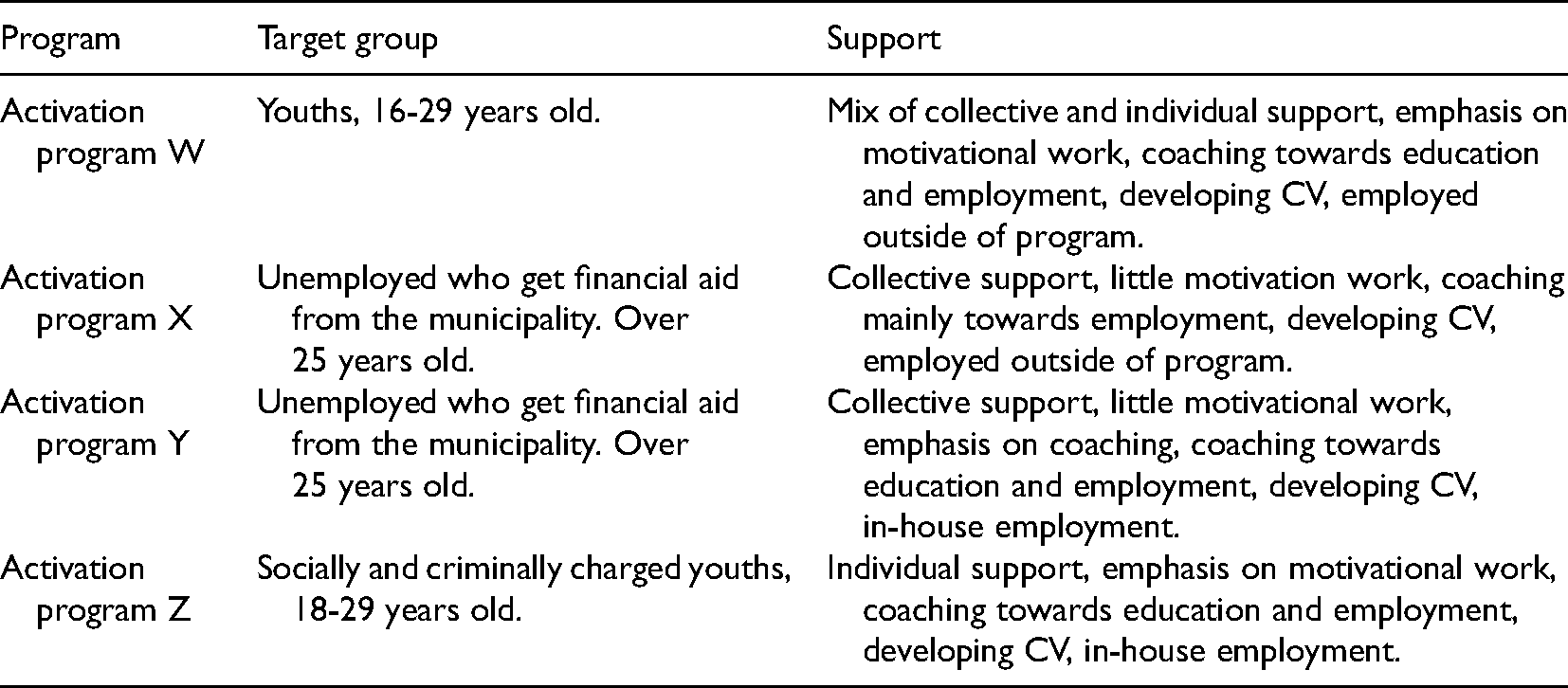
We made contact with the four managers of the programs for individual interviews and through them recruited a total of 24 social workers for group interviews. The semi-structured (Gubrium et al., 2012) interview guide was focused on professional perceptions regarding political goals and day-to-day work with unemployed participants. No demographic information regarding the interviewees was collected.
We had no knowledge or relation to the four labor market programs prior to the study. The one researcher who did the interviews have practical knowledge of working as a social worker within the field of municipal labor market program and social assistance, and thus had a reference frame that in some aspects could be shared with the interviewees and shape how questions were asked or how follow-up questions were formulated.
We carried out the analysis through a reflective dialogue in several steps, focusing on available research, theory and interviews, where several contradictory results and different perspectives emerged (see Alvesson & Kärreman, 2007; Alvesson & Sköldberg, 2008). This approach meant that the answers given in the interviews can be compared to larger social issues about activation and gender equality. The analysis of the material is based on thematic analysis where we sorted the material into categories and themes. First, we sorted the material into descriptive categories. Second, we performed a more selective reading where we coded items based on theory and available research, where the material is first entered under different themes and then written up as an analytical draft that includes theoretical concepts (see Bazely, 2009). Third, where patterns relevant to how activation and gender equality are given meaning in the descriptions of managers and staff, these were interlinked with quotes. Fourth, a last check of the analysis was made between the aim and research questions and our results. In this last round no themes dispersed nor were new ones formulated. This abductive process (Alvesson & Kärreman, 2007) generated an overview of the empirical material, and the relationships between the themes could ultimately be met with the theoretical analysis, which led to the overarching themes presented here, and thus the main analysis.
This study was approved by the Regional Ethics Review Board in Uppsala (Reg. no. 2016/173). All respondents in the interviews were informed about the study and that participation was voluntary and have given informed consent. The interviews were recorded, transcribed verbatim and stored securely.
Results and Analysis
To understand how goals of activation and gender equality interact and give meaning in the interviews, our results and analysis are presented through three logics: the activation logic, the gender equality logic and the hybrid logic of gendered activation. Each logic contains symbols and rituals that maintain the logics as theoretical constructs. What distinguishes the hybrid logic of gendered activation is how international migrant women becomes a powerful symbol that upholds and legitimizes the logic.
Activation as the Dominant Logic
The activation logic is maintained by two symbols. Symbols, as a theoretical concept, are manifested through language and are essential for creating meaning for actors to maintain the logics (Friedland & Alford, 1991). As we will show, the symbols are, much like the local activation goals, permeated by a focus on the actions of the unemployed participants rather than the measures of the labor market programs. The first symbol is self-sufficiency.
The social workers interviewed held the goals regarding activation towards self-sufficiency in high regard. As one social worker said: “[…] that more people should be self-sufficient in either work or studies. This is probably the foremost policy goal we are pursuing” (SW2W). This sentiment was also expressed by a social worker who was asked what the main political goal for the labor market program is. “Well, it is in line with the work-first approach, which is quite apparent. So, you could say that it [the labor market program] is part of the work-first approach, I would say. Although it is not explicitly stated, it is” (SW4Z). Acting in accordance with the activation goals seemed to be taken as a given: “The mission is to get them out in some sort of self-sufficiency” (SW2Z). Self-sufficiency becomes a powerful symbol for the knowledge claim that activation leads to employment, and through that, activation can be understood as a dominant logic that is prioritized in the labor market programs (see Friedland & Alford, 1991). Activation is taken for granted as effective, but the staff and managers also choose to prioritize it to a certain degree.
The activation goals are closely governed through the ritual of measuring outcomes for the participants: We have a lot of goals, but we have a specific goal that is stated in the operational plan and that is that 40% [of participants] will go on to work or study, and so that is our numbered goal. That is a pretty high number, 40%, but we are quite close (SW1X).
The results from the ritual, expressed as numbers and percentages, become powerful symbols of a job well done: “Yes, we do good things, we have good results […] between 60–70% go on to work and study” (SW4W). Symbols are essential for institutional logics since they create meaning for the actors within the institutionalized field (Friedland & Alford, 1991). Symbols carry knowledge claims through place and time, much like the organizational goals do in the four labor market programs when they emphasize that a certain percentage of individuals will become employed (see Meyer, 2008; Tan & Wang, 2011). As these results illustrate, the organizational activation goals have taken hold of the labor market programs, where the ritual of measuring labor market outcomes not only governs the participants, but also the social workers and managers. It is worth noting that there is no similar emphasis from social workers, managers or organizational leadership concerning whether the programs meet the goals of gender equality.
The second symbol of activation logic is activity, which is closely linked to motivation. Activity becomes a ritual for the participants to prove to the social workers that they are motivated to find work: “It's about getting the motor running, right? This is arranged employment. Then when you [social workers] come in, you help them obviously, but you have to get your own motor running to look for jobs” (SW1X). This illustrates how the social workers perceive the participants to be unmotivated before they arrive to the program. The social workers monitor the participants to see that they are keeping active; as one social worker described: “We see how they work, if they come late and manage time” (SW1Y). The monitoring described in the quote often has a function when activating the unemployed in a way that enhances motivation to activity, enforcing the logic of activation (see Thorén, 2012). The logic of activation is manifested as dominant in the ritualized work within the labor market programs through the rituals and symbols of activation (see Alford & Friedland, 1985; Friedland & Alford, 1991).
However, the symbol of activity does not give rise to rituals that accept any kind of activity. Instead, social workers see CV development, applying for jobs and individual coaching as well as guidance towards other welfare-support, as symbols of individual motivation: “But as I said, the main opportunity and chance is an individual match in the labor market” (SW4X). Acting in accordance with the activation logic is the individuals’ best chance to become employed. On the other hand, institutions do more than control and constrain, they also empower the behaviour of actors (Scott, 2008). For an instance, one social worker described how a personal goal is consistent with the activation logic; “[…] well, that is my goal. To get as many people out [self-sufficient] as possible, to help both the individual and the community.” (SW 2Y). The personal goal illustrates how actors, through their behaviour and their adherence to norms, embody institutional logics (see Friedland & Alford, 1991).
In this sense, activation is clear-cut in terms of how and why participants should be handled. Activation as an institutional logic, manifested through symbols and rituals in the interviewees’ daily work, becomes a dominant truth that guides the actions of social workers and managers within the labor market programs. In what follows, we show how it is hard for a gender equality logic to compete with this dominant logic of activation.
Gender Equality as the Subordinate Logic
The gender equality logic is maintained by three symbols and is understood as a subordinate logic within the four labor market programs. The first symbol was the loose coupling between the organizational goals and the rituals and symbols in the daily work. This means that there is a discrepancy between the organization-oriented goals of gender equality and how the social workers and managers describe what they do (Meyer & Rowan, 1977). There is a lack of awareness of gender equality goals among the interviewees. In two of the labor market programs studied, it is unclear if goals of gender equality are a part of the organizational goals, making the goals fuzzy. Furthermore, there is a discrepancy between managers and social workers within the same program. When asked if goals of gender equality govern the program, one manager stated “No, not here” (MZ), while the staff in the same program described how they did in fact work with goals related to gender equality. In another program, the tables were turned. Here, the manager gave explicit details on how gender equality goals were being pursued, while the staff said “no, not here anyway” (SW1X) and “No, not in this team” (SW2X). This illustrates an aspect of the logic of gender equality as a fuzzy logic that is not prioritized in day-to-day work, an aspect that is common in the critique of gender mainstreaming where the focus is on outlining policy goals with little emphasis given to how the policy goals should actually be implemented (Crespi, 2009).
The loose coupling was ritualized by a gender-neutral approach that maintained the symbol, such as giving the same service independent of gender and emphasizing individuality, which risked becoming a gender-blind practice. As one social worker described when asked if they worked with particularly vulnerable women by referencing the organizational goals: “[…] we work so actively with everyone so we don't have to distinguish between men or women, we spend the same time with everyone” (SW2Y). The quote highlights how the gender-neutral approach is ritualized within the programs by focusing on individual participants. Furthermore, the gender-neutral approach also risks becoming gender-blind when it assumes that policy outcomes, such as activation, affect men and women the same way and should thus be seen as a gender-equal practice since gender-neutrality is sought (see Crespi, 2009; Vincent & Eveline, 2010). One of the managers acknowledged the complexity of working with a gender-neutral approach and described gender inequality inherent in the service provided to participants: Two-thirds [of participants] are women. But then we have the same problem as everyone else has, we have more women, but we spend more time and … yes more time and money on the men. But that's the way it is all over. But we are just as bad, unfortunately. But we are working on it. We can see it in the statistics (MX).
The quote shows how gender equality goals, as a symbol, are loosely coupled to the behaviours and norms within the programs but are not completely invisible, as the managers have chosen to produce statistics on the matter. The interviewees described how gender equality can mean a variety of different things, making the gender equality goals themselves fuzzy and difficult to grasp.
The second symbol was that gender equality is a societal issue, which most of the interviewees acknowledged but which also became a bit too abstract to address. For example, in issues relating to the gender segregated labor market, one interviewee noted: “[…] so you have to work … try to get them to make gender norm-breaking choices, broaden perspectives and things like that” (SW5W). This quote from the social worker highlights the fact that the presentation of gender norm-breaking as an option is ritualized, unlike the motivation for activation, which is taken for granted. In other words, the subordinate gender logic is handled as an option. While the knowledge claim of breaking gendered norms is noticeable in the quote, an emphasis is placed on individual choice in doing so. This emphasis on individual choice reoccurs in another quote regarding how gender norm-breaking choices are handled within the programs: […] I think that I personally am not trying to change, but I can inform about what is feasible in society. That you can think what you want but this is the way it is and if you go outside, it can have consequences. I don't feel like I'm going to change things. I will inform, not change (SW1Z).
In the quote, information, rather than change, highlights how the gender equality logic is an option when presented to the participants in the programs. In contrast to the motivation to be active, the participants have a choice to make gender norm-breaking choices in the labor market, reinforcing the understanding that gender equality logic is a subordinate rather than dominant logic.
The third symbol was related to the gender equality perspective as a policy tool, given how the programs reported statistics back to their main administration. A manager described it as follows: We must have the gender equality perspective. It should permeate all of our statistics, and that is what I mean; there are no such figure targets for a certain number to be enrolled [within the program], but it is more that … more that the gender equality perspective should permeate all statistics, analyses and reports in the operational plan (MY).
As the quote shows, unlike activation, gender equality is not measured through statistics, where participant enrolment and program outcomes are measured. Instead, gender-divided statistics are followed by a gender equality analysis of said statistics, as part of the idea of gender mainstreaming (Svensson & Gunnarsson, 2012). The gender-divided statistics are non-selectable, but the gender equality analysis seems to have little impact on how the labor market programs are organized or how the activation should be conducted, since there are no compulsory practices for the analysis and the organization of the programs. Hence, there is nothing to ritualize gender equality goals, such as a policy tool that can serve as a signal to decision makers and society as a whole that gender equality is on the agenda. However, this kind of symbolic window dressing does not have to imply the subordination of an institutionalized logic (see Meyer, 2008). Promoting gender equality is interlinked with the Swedish welfare model (Lundqvist, 2017; Martinsson et al., 2016; Svensson & Gunnarsson, 2012). The knowledge claim of a need for gender equality affects what is considered legitimate in the field and thus shapes how different organizations act (Dequech, 2008; Suddaby & Greenwood, 2005). The interviews highlight how gender equality goals may be manifested on a societal level but are still subordinate within the labor market programs.
As illustrated in the above analysis, the gender equality logic is largely subordinate in relation to the activation logic. We highlight this fact by showing the loose coupling of the organizational gender equality goals in relation to the actions of the social workers and managers. However, the two competing logics can also be understood as a hybrid logic (see Reay & Hinings, 2009). In what follows, we illustrate a way to handle both gender equality and activation without creating competition between them.
Gendered Activation, a Hybrid Logic that Makes Gender Equality and Activation Non-competitive
A convenient way for organizations and their members to manage competing logics is to harmonize these logics or make them fit into one another (see Friedland & Alford, 1991). Theoretically, this can be understood as a hybrid logic where the logic of gender equality is absorbed into activation logic (see Reay & Hinings, 2009). By creating a hybrid logic, the four programs can maintain the knowledge claims of activation while supplementing the symbols and knowledge claims of the gender equality logic that provides legitimacy in relation to other actors within the field of labor market programs. Here, we present this as three symbols that maintain the hybrid logic of gendered activation.
First, paid labor becomes a symbol that enables the hybridization of the gender equality logic and activation, as paid labor is seen as both a possibility for unemployed women to achieve equality and as a goal for activation in itself. It is common that the social workers’ and managers’ reflections on gender equality was something mainly made through the labor market. As one manager described: […] We see having work as being equal. Because then you have the power to decide over your life. That is what gender equality is all about. That you have the power to decide how you want to live and what you want to do with your life (MX).
The quote coincides with the feminist critique of the welfare state, where work as a commodity is applied exclusively for workers. As such, labor gender equality may be achieved by taking part in paid work (see Sainsbury, 1999). However, this notion does not take into account the gendered differences in the quality of work, wages and working conditions (Gornick, 1999; Jenson, 2015; Rafnsdóttir & Weight, 2018) nor the unequal division of unpaid labor (Gornick, 1999; Lister, 2009).
The symbol of paid labor connects activation and gender equality through the ritualization of specific measures in activating women. The ritual of activating women was described by a manager as an organizational decision to have a 50/50 balance of women and men as participants and as staff: “So, I felt that I had a little to work with, as a feminist,” since the decision would mean more women being activated towards the labor market. Another labor market program was split into two interventions, one designed for men and one for women, as a way to attract more women to the program: “[…] but the girls do not come here. So therefore … okay what does that mean? Should we start only for girls? Then maybe it will happen. And it did” (MZ). In the male dominated intervention, the participants were employed to do light carpentry and thus, a way for the program to attract more female participants was to start a catering business that specifically targeted women, hence following the gender-stereotypical labor market. From the perspective that paid labor is a means to achieve gender equality, the opportunity for women to partake in work as a commodity is increased in the programs even when they follow the structures of the gender-segregated labor market. At the same time, however, the structures of the gender-segregated labor market were actively reproduced in the way the labor market programs were designed for men and women. Further, the gendered reproduction of class was manifested in the training of lower class or working-class women to become childcare workers and men to work as carpenters (cf. Skeggs, 2004).
The second symbol was how responsibility for gender equality was placed upon the individual participant rather than the labor market programs. The segregated labor market was discussed by a social worker as follows: Generally, I think it's a huge question. So how should we look at it? In general, there is, of course, a greater issue in breaking structures and changing norms. But is it people who are far from the labor market and who should be in the forefront of it? […] From a gender equality perspective … it is awesome and we all need to help break structures and norms, but if it is a young person for whom it will be a first job, or who has not worked for several years, they are the ones who will work at a preschool … if it is a woman, for example, where she feels confident and that she feels that she can handle it. Or should she be a janitor? Or … how are we going to look at it? The greater purpose is to enter the labor market, gain a stronger position and become self-sufficient (SW2W).
The quote highlights the conflict of handling structural issues, such as the gender segregated labor market, with individualized activation. This shows how the responsibility for gender equality in the programs is maintained as a symbol of individual responsibility in the logic of gendered activation.
This symbol is also maintained through rituals. The female participants were mainly employed within childcare and other types of care work, while the men were mainly employed as janitors, woodworkers and gardeners. One manager described this as a result of individual choice by the participants: “But it is also the case that the places we have available are in school kitchens and preschools, where women want to be. The men want to become janitors and such” (MX). The quote poses a chicken and an egg situation: is gendered employment provided because of the choice of the participants, or are the participants choosing certain employment because that is what is provided? In either case, there is an emphasis on the individual responsibility of making a choice by following structural norms and social attitudes, or not (Gornick, 1999). While the idea of breaking problematic gendered norms and structures in society may be inherent within the programs, the gendered choice of participants becomes a ritual where participants are described as wanting to take gender stereotypical employment and are therefore supported in such choices. The logic of gendered activation is thus dominated by knowledge claims from activation.
Some social workers and managers, however, described rituals for how they try to present gender norm breaking choices to participants: “[…] to present different [jobs] and to get some nuance to it as well. So, it's not so traditional, women should work in preschool and men should work as janitors you know” (SW9W). The quote shows how symbols of gender equality are kept within the gendered activation, which affects the programs. But the quote also highlights how gender stereotypical choices are the responsibility of the participants when the social workers’ and managers’ rituals do not work. As a manager describes, “We work according to the mantra if they don't want to, then there is no point in trying” (MW). Trying to influence non-traditional choices becomes a ritual that maintains the logic. What the participants actually choose does not really matter, it is still a symbol of gender equality that an attempt is made, which legitimatizes the program (Tan & Wang, 2011).
Women with a background as international migrants were the third symbol. Participants from this heterogeneous group become the perfect target for gendered activation and overall reduced by the social workers to a category that symbolizes the need for gender equality and activation. Friedland and Alford (1991) describe that categories are important knowledge claims for the state to maintain power and legitimacy. Through the metaphor of a country at war, they describe how the construction of “us and them” is almost as important as the actual conquest because it is the construction of the enemy that causes the citizens to fight for their country based on how the enemy is portrayed. In our data, the “migrant woman” is a constructed category that manifests the legitimacy for activation in itself, but also as a means to solve gender inequalities.
The legitimacy that gendered activation enjoys through the activation of migrant women can be noted in a quote from a social worker in one of the labor market programs. When explaining an obstacle in activating migrant women, the interviewee focused on cases when the women are expected to work together with men: You know, women from other countries. They are not like the Swedes who dare to say, dare to talk. In [their] family, women are sitting in one room and the man in another room, you know? Women never meet the man like this, go out with them and so on. I remember my first year here, a girl asked ‘what should I go out and work with a man?’ I said ‘of course you should do it but you do not go hand in hand you work like this.’ But now they dare to say things and so on (SW3Y).
The quote from the social worker highlights an example of putting cultural explanations on social problems, when the unemployment of migrant women is sweepingly understood to be interlinked with the resistance to work alongside a man. However, the quote also highlights the significance of migrant women being a symbol for gendered activation, as the construction of the migrant women becomes a dichotomized category to being Swedish, and thus in need of an intervention that can ‘solve’ both unemployment as gender inequalities, hence gendered activation. This notion also connects to how gender equality is seen to be part of Swedish national identity and the image of migrants being inherently patriarchal and lacking interest of gender equality (Hübinette & Lundström, 2014). Gender equality claims become amplified in relation to helping migrant women who are exposed in the labor market and who are at the same time described as victims of a gender unequal culture. In this way, migrant women thus become a symbol for the hybrid logic of gendered activation.
As previous research has pointed out (Larsson, 2015; Martinsson et al., 2016; Mulinari, 2018; Vesterberg, 2016), there is often a paradoxical discourse around migrant women in Swedish labor market policy. On one side, migrant women are victimized and described as exposed due to discrimination: it is like this; many people think when they see the [municipal] website that diversity is a nice thing … but when we come with our Somali women who not only have a hijab but a chador and then it's ‘nooo … we don’t want that kind of diversity’ (MX).
Migrant women are also victimized in relation to the knowledge claim that they are from traditional and unequal cultures, as a manager describes when discussing Somali women: But then it is also that they have a lot of children, that it is very common that they have 5 to 15 children, and then that is what their calling is in life, maybe, and then maybe you never had the idea that you should go out into the labor market because it is not your role, and then it makes it difficult to get out when you have so many [children] too (MY).
In contrast to the findings of Wright Nielsen (2009), Larsson (2015) and Vesterberg (2016), where the victimization of migrant women is interlinked to culture, our findings show a type of victimization that is also interlinked to societal dimensions of labor market discrimination. However, the end result still largely matches the findings of previous research, namely that the gendered activation of migrant women is intended to make them responsible for supporting themselves. This is the other side of the paradoxical discourse around migrant women in Swedish labor market policy: So to say … that you see the family as the provider, which means that you do not have to work unless you want to, the family sends money from all over the world. So, you do not see your responsibility to the state either (MY).
As described in the quote, migrant women are also depicted as unwilling to work and hence in need of activation measures to make them more motivated to work. In such cases, their unwillingness is set in relation to the traditional culture of the migrant women, putting a cultural explanation on the social problem that unemployment is for migrant women (cf. Eliassi, 2017).
In national labor market policy, the unemployment of migrant women has historically been described as a problem for the women themselves as well as a challenge to gender equality in Sweden (Mulinari, 2018). The image of migrant women as problematic and victims of an unequal and patriarchal culture is part of the racialization processes that upholds institutional racism in society, as it enables separation of migrant women and pushes specific activation interventions upon them (cf. Larsson, 2015). As such, a push for subsidized employment, much like the programs in this study, is described as a means to activate migrant women and thus uphold national ideals of labor market participation and gender equality. To activate migrant women into subsidized employment is thus a ritual that upholds the logic of gendered activation. This is exemplified in the programs by a quote from a manager: It is about people who have to become a part of the labor market and become integrated as well. Partly for financial reasons but especially for themselves and their children. There are so many benefits to integration and getting them into the labor market (MY).
The quote from the manager highlights why it is important for the programs to target and activate specific categories of women, here migrant women. The knowledge claim in the labor market programs is that activation of the migrant women is not only beneficial for the individual women who become temporarily employed and can become more financially independent, the migrant woman also become a symbol for a wider issue, where integration is equated with labor market participation.
The migrant woman as a symbol for gendered activation sheds light on the unequal relation among sub-groups of women. Gender equality, as shown in our result, is mainly understood as a woman's issue on a societal level. Gendered activation on the other hand becomes manageable and manifested through the symbolization of the migrant woman. By constructing the migrant woman as an ‘other’ who is a victim of her culture but in the same time responsible for her own and her children's future, migrant women are singled out as specifically problematic for Swedish society to handle, thus the need for activation. As such, the symbolization of migrant women is an example of the racialization processes that uphold institutional racism and discrimination. Migrant women thus become a very distinct symbol for the logic of gendered activation in this context.
Concluding Discussion
This study aims to understand how goals of activation and gender equality interact and how activation and gender equality are given meaning in the descriptions of managers and staff in four labor market programs. However, the study has limitations. One is that there are only four programs, which of course does not provide the possibility to generalize the empirical results. Secondly, we are limited to the descriptions of the individuals whom we interviewed. Furthermore, we did not collect demographic information about the interviewees that could have contextualized the results, as for instance, the results of Eliassi (2017) are contextualized. It should also be noted that the analysis is within the frames of the female-male gender binary. Thus, experiences of individuals living outside the gender-binary are not captured. Still, our study gives empirical examples on the connection between institutions and action (see Friedland & Alford, 1991; Reay & Hinings, 2009) and thus the complexity of doing practical social work within a field of competing logics. Neo-institutionalists have been criticized for failing to account for gender (see Krook & Mackay, 2011; Popescu Ljungholm, 2017). Our results show that institutional logics can be used theoretically to show how institutions are steeped in gender norms.
The goals of gender equality and activation that the labor market programs in the study are asked to follow are given different meanings by the interviewees, where gender equality is fuzzy and hard to grasp and activation is more clear-cut. As shown in the Table 2 below, gendered activation as a hybrid logic becomes a way of handling the fuzzy goals of gender equality together with the more clear-cut activation goals.
Overview of Logics, Symbols and Rituals.
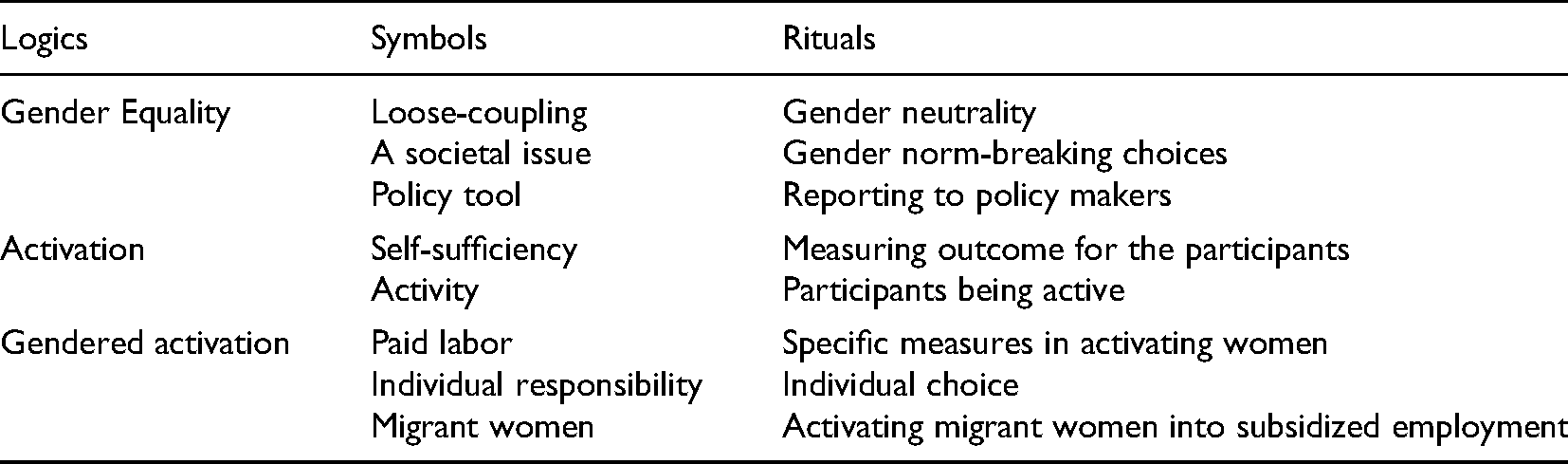
As the table shows, the logic of gender equality is given meaning through the symbols and rituals connected to an organizational and policy level. The activation logic, on the other hand, carries symbols and rituals targeting the unemployed individuals, which is generally consistent with how the organizational goals are modeled. As such, the goals are understood to interact on different levels in the labor market programs but can come together through the logic of gendered activation, where specific activation measures directed at women in general, and migrant women more specifically, encounter knowledge claims of gender equality.
In the programs, women are mainly trained to become service providers in low-status and low-wage work, and the responsibility is firmly placed on them rather than the structures of the labor market or labor market programs. Women with a migrant background are often targeted for gender equality and activation measures in welfare states (Larsson, 2015; Mulinari, 2018). Gendered activation shifts the focus away from questions of gender segregation and discrimination within the labor market programs in terms of how resources are provided and related to the labor market.
There are no reasons to doubt the accuracy of the reports of the managers or the social workers. Their understanding is strongly affected by the societal push for activation as a means to solve gender inequalities (see Mulinari, 2018; Svensson & Gunnarsson, 2012). However, Jenson (2015) and Mulinari (2018) point to the risk of categorizing women as ungendered workers, mothers, migrants or otherwise victimized and thus suitable to any form of employment without taking the quality of employment into consideration. This reproduces a segregated labor market where both women and/or migrants are often already at a disadvantage.
The risk that poor people will be directed to low quality jobs is increased by the dual welfare system in Sweden. To be able to establish yourself in the social insurance system, you need an income, regardless of the risk you put yourself in. In the end, gendered activation contains gender equality but is dominated by activation. Knowledge of gender inequality is used but also legitimizes behavior and ideas (see Dequech, 2008; Suddaby & Greenwood, 2005; Tan & Wang, 2011). The legitimacy connects the programs with ideas of gender equality in the welfare state where policy and organizational goals on gender are acknowledged (Lundqvist, 2017; Martinsson et al., 2016; Mulinari, 2018).
Gendered activation sheds light on the ambiguity of Swedish gender equality policy, where gender mainstreaming focuses on organizational measures in terms of gender equality analysis and reporting gender segregated statistics, but with little attachment to practical gender equality work (cf. Crespi, 2009; Svensson & Gunnarsson, 2012). Based on our study, we argue that gender equality policies need to be implemented in the day-to-day work within organizations, and not only used as an organizational measurement as it otherwise risks being an empty policy with little attachment to the experiences of individuals within the organization. For example, there is a risk that this kind of “empty” gender equality policy will reproduce a bad quality of work or a bad work-life balance for women, rather than supporting equality. Our results provide a critical analysis of the activation logic that suggests that employment is a universal answer to social problems, such as gender inequality. For social workers who find themselves implementing activation policies we argue that it is necessary to question what activation policy can mean for individuals as well as society at large, especially as activation tends to target marginalized groups who are already exposed.
Furthermore, gendered activation illustrates the existence of a loose connection between the claims for gender equality and what is done in the four labor market programs. Here, a policy indication is that our study provides insight into the complexity of using activation to create gender equality, where gender equality becomes strongly connected to the institutional dimensions of gender, class and race. Gender equality was understood by the interviewees to be fuzzy and complex and activation was clear cut and aligned with the work conducted within the programs and “the work-first approach.” This was perhaps also connected to the construction of the local goals, where the activation goals were focused on the activation of the participant and the gender equality goals were focused on organizational measures, which were less connected to the daily work of the social workers and managers.
Gendered activation may be reasonable on an individual level, where women in long-term unemployment can sustain a higher income and thus reach income independence from family members and the welfare state through work (Gornick, 1999; Lister, 2009). However, in the context of the gender segregated labor market and a situation where access to different types of work is still unequal, gendered activation reproduces gendered inequalities. Here, the results of our study align with scholars who have highlighted how the increasing interest in activation policy among welfare states overshadows claims of gender equality, where the gender equality goals become no-matter-what employment rather than employment leading to equal outcomes (Crespi, 2009; Jenson, 2015; Mulinari, 2018).
Lastly, gendered activation also sheds light on the unequal relationship between sub-groups of women. Here, our study shows how gender equality and activation is applied differently on migrant women. The issue of unemployment is given cultural explanations when it regards migrant women and how the migrant women symbolizes an ‘other’ in need of activation (cf. Mulinari, 2018; Vesterberg, 2015). While the interviewees in our empirical material did not give voice to clear claims of racial discrimination in terms of treating participants differently based on race, our material points to an example of the systemic reproduction of racist discourse within social and labor market policies (Mulinari, 2018). To gain more knowledge on how racist discourses are further operationalized, a more in-depth analysis of the day-to-day activation is needed. In relation to this, it is also paramount to include the experiences of individuals being activated to deepen our understanding of the complex processes of inequalities and discrimination.
Footnotes
Declaration of Conflicting Interests
The author(s) declared no potential conflicts of interest with respect to the research, authorship, and/or publication of this article.
Funding
This work was supported by Forskningsrådet om Hälsa, Arbetsliv och Välfärd (grant number 2016-07123).
