




Abstract
The agency of lone mothers who rely on government income supports is often erased by the discourse of dependency, especially under welfare-to-work eligibility criteria. Here we apply the concept of small acts of micro-resistance in constrained circumstances, augmented by conceptualization of resistance as conscious oppositionality and intentionality to understand the agency of lone-mothers who receive income-assistance (IA) as they make-do and raise children under state- and market-enforced rules. Using a resistance lens reveals the interconnected importance of everyday acts like “talking back” to income-support staff, surreptitious gleaning of goods for resale, and re-storying the self. We describe these in three modalities: resistance as evasion and subterfuge; resistance through asserting positive identities; and resistance in forging their own path. Using a conceptual framework of resistance reveals the extent to which women’s survival and capacity to raise children are contingent on a performance of compliance, demonstrating the impacts of welfare-to-work on female-headed lone parent families.
Keywords
Lone parents who receive state income-supports (known as welfare) are in a double bind: they must comply with strict employment search regulations to maintain eligibility for benefits, but they also receive very low stipends and must exert extraordinary efforts to meet their families’ needs (Cassiman, 2008; McIntyre et al., 2003; Reid & LeDrew, 2013). At the turn of the millennium, welfare reforms instituted in British Columbia (BC), Canada through a new program of welfare administration called BC Employment and Assistance (BCEA), intensified this pressure by expressly and intentionally making the link between benefits and labor market opportunities more rigid, explicitly withdrawing public sector culpability to meet human needs, and overtly shifting responsibility to the private sector by declaring that the best welfare is a job (Gazso & McDaniel, 2010). The effect of these neoliberal reforms in BC, as elsewhere, was to undermine rights-based social benefits in favour of obligation-centred conceptions of citizenship and, for lone mothers, escalate entrenchment of stratified reproduction (Pulkingham et al., 2010). In the twenty years since the reforms were instituted, the BCEA legislation implemented in 2002 remains in place even while undergoing perceptible changes that loosened some, but tightened other, welfare-to-work principles (Pulkingham, 2015). The overall effect is to leave the general structure of the program relatively unchanged (see, for example, Petit & Tedds, 2020) even as programmatic changes moderated the most harsh and penurious provisions. Universal disbursements for pandemic relief, such as the Canada Emergency Response Benefit, (CERB), have provided an interesting insight into the opportunity for change to this benefit system.
In this article, we utilize the natural experiment of the radical benefit restructuring of the early 2000s in BC to explore how a resistance lens may provide insight into low-income mothers’ responses to income-support restructuring, to recognize their agency more fully and to understand the impacts of shifting social citizenship. The circumstances lone mothers face can be approached through various frames including a gender respectability lens and a class lens. Skeggs (1997, 2005), who outlined the struggle over respectability as a key fulcrum of women's subjugation, later (2005) argued that when we lose our focus on income as an analytic lens, we risk performing middle class biases and endanger our capacity to recognize and legitimate low-income women's experiences. Others have more recently intertwined these two frames, examining the way gender expectations work to delimit acceptable forms of agency while also documenting class struggle (Herbst-Debby, 2018; Reppond & Bullock, 2020). Given highly constrained income support benefits, we therefore draw, and build, on a resistance lens as initially developed by Scott (1985) to explore whether or how those subject to welfare-to-work directives enact what Scott identified as “small acts” of resistance.
Scott develops a concept of resistance within conditions of almost total income control, focusing on cataloguing micro-actions among Malay peasants, like “foot dragging,” which refers to how agrarian sharecroppers and laborers could both appear compliant to landlords, yet still exercise micro-resistance. To assist with transitioning from Scott's agrarian context to income-support in the 21st century, we turn to Hollander and Einwohner (2004) who distill resistance into two constituent criteria. The first criterion is conscious oppositionality: there must be conscious, or reflexive, awareness of one's position in relation to polarities of power, not accidental opposition. The second criterion by which to assess resistance is intentionality, not political or other outcomes. Decoupling intentionality from outcome, and adding awareness, means that the indicator of resistance need not be change or even a desire to change power structures, but an articulated awareness of power, expressed as opposition. Therefore, using Scott's concept of small acts, we explore how conscious oppositionality may inform the everyday actions of income assistance (IA) beneficiaries who live in extremely constrained circumstances and provide insight into how lone mothers are, as Lister (2004) conceptualizes it, “getting by,” raising children, and living a life of agency under state- and market-enforced rules.
Overview and Background
Welfare reforms implemented in the province of BC in 2002 through the BCEA set the context for exploring lone mothers’ agency and resistance. Policy shifts instituted a work-to-welfare approach designed to sharply curtail supports, incentivize employment, and reduce welfare rolls. Changes were modelled on the 1996 US shift to the Temporary Assistance to Need Families (TANF), although with important differences, due to the Canadian context of a more universal approach to benefits such as health and education, and due to provincial control of income supports (Béland et al., 2021; Klein & Pulkingham, 2008). In contrast to the typically more universal approach, the intended purpose and impact of the reforms was to make it more difficult for recipients to: (a) be eligible for benefits by adding a new two-year independence test; (b) apply for benefits by instituting a new three-week wait period and a requirement for first contact through a new on-line/ telephone system; (c) continue to receive benefits by creating mandatory employability screens and associated work search and training requirements for those expected to work (ETW); and (d) re-qualify for benefits by limiting the appeal process for former recipients while also de-funding poverty law legal aid (Klein & Pulkingham, 2008). In addition, new regulations made it easier to disqualify those receiving benefits, including lone parents who had been receiving benefits for more than three years (Klein & Pulkingham, 2008).
The reforms reduced welfare recipients’ income, with rates for lone parents (consisting of a support and shelter allowance in BC) being reduced by approximately 10%, depending on family composition. In addition, earnings exemptions which had allowed parents without a disability designation to keep $200 per month of earned income were eliminated, as were exemptions that allowed lone parents to keep a portion of child support income (previously, lone parents could keep $100 per month). In addition, lone mothers were deemed employable earlier, when their youngest child turned three years of age, instead of the previous seven years of age (school age), thus necessitating child care. It was also announced that after a two-year employment search window, recipients would be disqualified and would have to re-apply. 1 These reforms comprised a particular “made in BC” instantiation of welfare-to-work provisions, which were also being implemented in some other provincial jurisdictions in Canada (Gazso & McDaniel, 2010). However, the reforms in BC were among the toughest instituted at the time in Canada, not just because income-supports were debased in value, and more difficult to obtain and maintain, but also because these changes were accompanied by a retraction in government funding support for an extensive array of community organizations that provided services to individuals and families who relied on state income-supports (Gazso & McDaniel, 2010; Griffen-Cohen & Pulkingham, 2009).
Although there is a long tradition of attending to the voice of those who are impoverished, including income-support beneficiaries, conceptualizing agency under crushing restraints is challenging. In a different context of agrarian crop-sharing, Scott (1985) approached agency through a resistance lens, defining it as “any act(s) by member(s) of a subordinate class that is or are intended either to mitigate or deny claims … made on that class by superordinate classes …” (p. 290). Several studies have expanded the range of contexts and small acts to include: corporate workplaces (Brody, 2006; Fleming & Spicer, 2003); rural farm migration in the global South (Gupta, 2001); gender- and race-based oppression (Haney, 1994; Kong, 2006; Solomon, 2003); and symbolic or discursive resistance (Oslender, 2007; Seijo, 2005). These studies broaden the types of power struggles beyond Scott's original landlord-peasant binary and expand the nature of actions beyond only the instrumental. Brody (2006), for example, identifies gossiping with co-workers and kibitzing with local low-income residents as resistance by women working as mall cleaners in urban Bangkok. They use surreptitious non-compliance in deliberate contravention of corporate pressures that aim to maintain a uniform server-personae. Seijo (2005) describes symbolic resistance by Basque separatists, who conduct public forest arson. The Basque separatists hope for real political change in the long term, but their first goal is to sustain a separatist ethos among fellow compatriots. Gupta (2001) finds that in a complex global labor market, farm laborers are motivated to leave rural workplaces in protest against perceived under-valuation. These studies expand on Scott's original binary power struggle and situate both the powerful and the subordinate in complex multi-directional vectors of globally or nationally engaged power struggles and demonstrate how individuals may direct resistance at public or private controlling forces, at public perception, or at community audiences. The acts themselves may also be symbolic, rather than instrumental.
Scott’s (1985) approach, although not yet explored with income-support recipients, offers an opportunity to develop a similar taxonomy of agentic actions as resistance. For example, trainees, mostly African-American women who were in mandatory job readiness training, talk back to their predominantly white trainers, fighting back in small ways to resist assumptions that they are unskilled and passive (Solomon, 2003). The trainees in Solomon's study clearly articulate how systemic bias was being re-entrenched by policies that forced them into low-wage, dead-end jobs, demonstrating conscious oppositionality, even while affirming their self-worth and solidarity with each other. Among low-income women with disabilities who rely on state income supports, Cassiman (2008) shows how they use offensive and defensive actions like withdrawing from social demands or deliberately overplaying their moral goodness to hide from or evade a stigmatizing gaze or combat negative stereotypes of passivity and laziness. Identity, disability stigma, and gender are in play in their actions. Drawing on the work of Sue et al. (2007) who described micro-aggressions, micro-invalidations, and micro-insults as three subtle ways of exerting racism, Liegghio and Caragata (2016) describe deliberate efforts by lone mothers to avoid micro-insults enacted by social workers, pointing out that avoidance and the effort to be invisible effectively creates class subjugation even if threats are not carried out. Jurik et al. (2009) describe how beneficiaries manage despite the system, which they term avoidance-as-resistance, while Critelli and Schwam-Harris (2010) describe how foster parents quit in protest over the expectation that foster parents receiving income-support comply with mandatory work-search orders. Just as Scott's catalogue of small acts, like “foot-dragging,” highlights the context of power by demonstrating the necessity of surreptitious resistance, the above moments of resistance demonstrate the necessity for such acts. These types of evidence could also be extended to a more coherent conceptualization of types and contexts of opposition.
Income-support studies more typically conceptualize agency as a form of coping used to survive or improve quality of life. For example, McIntyre et al. (2003) enumerate low-income mothers’ responses to food insecurity, including “self-sacrifice and coping, [within] 10 feeling domains: … deprived, righteous, the need for occupational choice, relatively better positioned than others, the need to manage the appearance of poverty, judged/degraded, guilty, isolated, dependent, and despondent” (p. 237). Coping with the challenges of feeding the family or managing an inadequate budget can be a triumph of survival, proof of the exertion and strength described by Lister (2004) as “getting by” and “getting on.” Coping can also demonstrate resilience, such as when women successfully manage low-income budgets (Hamilton & Catterall, 2008). These examples illustrate the dictionary definition, to “deal with and attempt to overcome problems and difficulties—often used with ‘with’” (Merriam-Webster, n.d.). Although coping reflects agency through resourceful and strategic maneuvers for current and future survival, Williams et al. (2003) suggest that our focus on coping may ultimately reflect a self-serving dominant-culture need to feel satisfied when people in constrained circumstances are able to overcome or manage problems despite imperfections in policy supports.
A coping lens also generates analytic problems that are evident when it is blurred with resistance, which can be seen in the way Parish et al. (2008) elide resistance and coping in their study on low-income women with disabilities, even as they acknowledge the complexity: “The women coped with or resisted their hardships by serving as advocates for their and their children's needs, accessing resources from safety-net services and their families, and relying on their religious beliefs … women's aspirations included setting a moral example for their children, securing a better life for their children, and wanting to work” (p. 51). While this statement links future aspirations, moral claims, and current survival, and credits the women's agency, it also surfaces two analytic issues intrinsic to the concept of coping. First, the influence of context recedes. Brown (2019, p. 163) emphasizes this risk in the field of mental health, in which a positive aprobation of “a coping attitude” can obscure whether women have anything to cope with. Second, and more problematic, if the outcome of an action is not beneficial then the agency of the person becomes conceptually invisible: they are “not coping.” However, this then raises the question of who adjudicates whether coping is functional. For example, Hoggett (2001) and Ferguson (2003) each observe that parental/caregiver anger may lead to judgements that the parent is “not coping,” as anger is not seen as a functional response. As each of the authors point out, this effectively denies the voice of parents and delegitimizes their agency. While one could posit a psychological rationale to legitimize the need to express anger, this construction risks becoming a speculative work-around. In mental health, Brown (2019) argues that overlooking resistance may obscure complex and material intersectional issues, such as some African-American women experience when they work to stay strong, even while contending with racialized and gendered violence. Using a coping lens may thus incur a great cost, obscuring structural violence or genuine despair, or delegitimizing valid anger, suggesting that a coping lens may have restrictive analytic consequences.
In this article, we approach the agency of lone mothers using formal resistance theory to explore the ways that subjectivity is recreated in the lives of lone mothers with young children who receive state income supports, to see how they survive and thrive. The analysis presented here complements earlier work with the same data set by Pulkingham et al. (2010) on citizen subjectivity and Vilches' (2011) on the way women build their own visions of futures for themselves and their children. We begin by asking whether Scott's conceptualization of small acts fits, but expand our question by using the more abstract definition of resistance provided by Hollander and Einwohner (2004) to consider the range of agency and what it might indicate about context. First, though, we provide a brief overview of the study design and methods, followed by a discussion of our findings and analysis, organized around the concept of resistance.
Study Design and Methods
This article is based on a study of the impacts of income-support restructuring in BC instituted at the turn of the millennium, drawing on data generated through longitudinal interviews with seventeen lone mothers with young children. The study began in 2003, the year after legislative reforms were introduced, just as beneficiaries who were lone mothers with pre-school age children would be entering time limits for receipt of benefits, based on the age of their youngest child. Six interviews per participant were conducted from 2004–2006, providing a high-tension natural environment within which to explore the impacts of welfare-to-work policies.
The study was undertaken by an interdisciplinary team from three universities that also included two community-based research partners. Over the course of three-years, using a multiple sequential qualitative interview design, each lone mother-participant was interviewed twice yearly by the same interviewer for six planned interviews. Prior to and at the conclusion of each round of interviews, the team, as a whole, discussed descriptive case summaries, which each interviewer had anonymized and organized thematically. We compared and contrasted the lone mothers’ experiences and perspectives of the interviewers. These group meetings were integral to the generative process of developing the meta-focus for subsequent rounds of interviews, as well as the particular follow-up focus unique to each participant-mother.
The selection of study participants was designed to include mothers with a diverse range of experiences, with some of the inclusion criteria linked to the nature of the policy changes, and others animating a range of known income insecurity vulnerabilities. Recruitment was conducted in the portside northeast quadrant of the city, which has historically welcomed immigrant cultural communities and was home to approximately half the city's urban Indigenous population and half the city's lone parent families (Vilches & Gurstein, 2016). We placed posters in community centers, local stores, laundromats, on telephone poles near children's playgrounds, at Indigenous centers, and other places mothers with young children might visit. We selected participants based on the length of time they would have been receiving income supports at the start of the study (greater or less than two years). This ensured that one-half of the mothers participating in the study would be in the mandatory work-search phase at the start of the study, while the others would enter it during the study and reach the time limit for employment one year before the end of the study.
We also wanted to be able to explore experiences of people who identified as Indigenous, racialized and/or immigrant. Among the included participants, three were “new” Canadians and nine identified as Indigenous with diverse experiences of growing up in on-reserve rural or urban communities, as well as in non-reserve urban environments. Two Indigenous participants grew up in foster care, one with an Indigenous family on reserve. One Indigenous woman identified as Native American (U.S. heritage), and one identified as Métis. In addition, half of the participants had larger families (two or more children). As the study progressed, the circumstances of children and their fathers highlighted additional complex diversities among the participants.
Interviews were conducted twice a year for 3 years, with 85 of 96 planned interviews completed. As shown in Table 1, the total number of participants declined over the three years. The final number included three quarters of the original participants. Of those who completed, all but one had a child under the three-year age threshold at the start of the study.
Final Sample Results and Total Number of Transcripts, Including Indigenous Participants (IP).
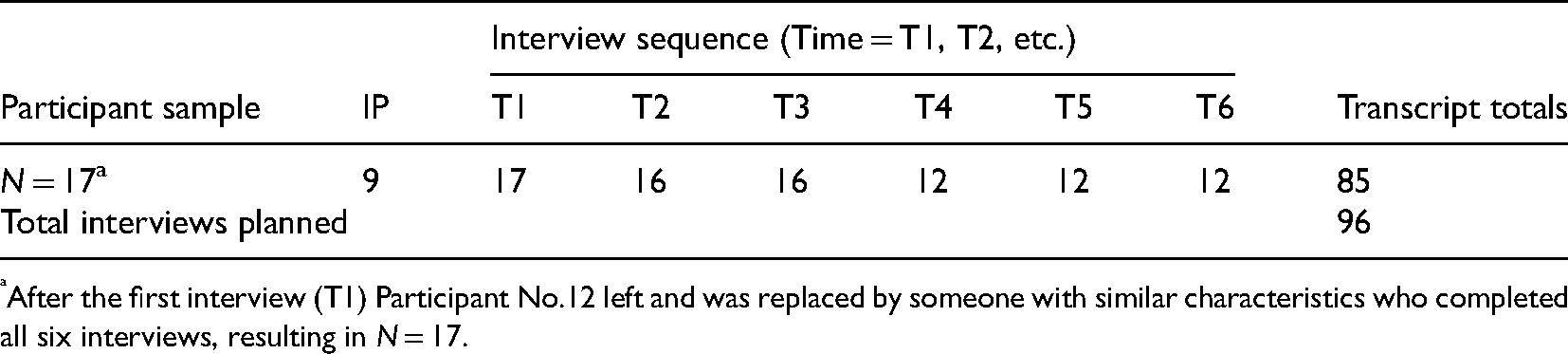
After the first interview (T1) Participant No.12 left and was replaced by someone with similar characteristics who completed all six interviews, resulting in N = 17.
The analysis presented in this article was developed by re-interrogating the case studies and interview transcripts, informed by the literature as discussed above, in an iterative analytic process. This generative process led to the development of a three-part framework of resistance applicable to the group of low-income lone mothers in our study, as presented in the next section.
Findings and Discussion: Three Modes of Resistance
Our re-interrogation of the data through a resistance lens led to the identification of three modes of resistance. The first modality, resistance as evasion and subterfuge, reveals intentional and conscious oppositionality as a way to survive in the context of dire needs, tracing the ways in which everyday acts, often for survival, become small acts of resistance against regulations and expectations. The second modality, resistance through asserting positive identities, demonstrates how women construct and express themselves through identity, enacting a performative resistance to co-option of their identity. The third expression of resistance, resistance in forging their own path, is enacted through the more instrumental acts of creating an alternate future, one not permitted under neoliberal reforms, even if goals, such as financial independence, are purportedly similar.
Resistance as Evasion and Subterfuge
Scott’s (1985) study outlined how Malay peasants exercised covert resistance under conditions of total economic subservience. The participant-mothers in our study exercised similar types of intentional but covert disobedience and noncompliance to new income assistance regulations that not only reduced welfare benefits, but also deducted dollar for dollar any earnings or child support income, and the value of all charitable gifts, including food. These conditions created a Catch-22 as all of the women except Molly,2 (who had a supportive, better-resourced, family), needed to use charitable food sources multiple times a week, including food banks, food depots and community-served meals, even though these services were simultaneously losing government funding, and were becoming more difficult to access, thus heightening need. Arlita, who had more recently started needing state benefits, described the desperate search for food: I’ve asked for things I’ve never asked for in my life. I have gone out of my way, scrambling to get stuff … My mind is constantly working, ‘I’ve got no food in the house, no milk, how am I going to get milk by 11, how am I going to get meat by 6? Who do I phone, what do I do, what do I trade? What do I sell? Does that mean I have to hang out at [the park] and sell stuff? Can I pawn anything? Does someone owe me a favour, can I trade off this, and do that?’
Although the participant-mothers obtained charitable food because they had no other options, declaring the value would reduce the next month's benefit. As a result, none of the women declared charitable food, even though this put them at risk because nondeclaration of income was defined as fraud and carried the potential consequence, if caught, of a lifetime benefits ban. Picking up charitable food was thus conducted surreptitiously as a deliberate evasion of compliance with rules of declaration. Although evasion for survival may not seem like political resistance, or even resistance, the actions point to the need to resist regulation to survive, and highlight the way the context squeezed women into spaces of action with fewer and fewer options that were not resistant.
However, evasion in service of survival strayed further and further into deliberate subterfuge and oppositionality to the rules. For example, Arlita started raising cash by selling repurposed donation items and items purchased when she had a middle-class managerial job, such as her son's books and electronic games. The cash Arlita made from her entrepreneurial activity, if declared, would have been deducted from her next cheque, so evasive non-declaration of charitable food evolved into deliberate subterfuge as she engaged in entrepreneurial activity in contravention of the rules. Each step put her more at risk: reselling charitable items is illegal and selling things on the street or in the park contravenes city bylaws. However, she was willing to risk bylaw infraction charges and a lifetime eligibility ban because she was also constantly worried about child protection surveillance if she did not have food on the table. These examples highlight the way women had to resist the rules to just to meet basic parenting expectations.
Arlita's resistance to regulatory strictures occurred through entrepreneurship, but another participant, Carla, exercised judicious resistance by “talking back,” to her support worker in an effort to maintain control of her very limited cash flow. When I did have to go in for a jacket for me, [my worker] looked me up and down. He kept looking at all the clothing that I was wearing very thoroughly. He was like, ‘I see you’ve got a pair of [brand name] shoes on. How much did those cost?’ ‘They’re like 2 or 3 years old. I don't know, I don't remember’…. ‘They look like, worth about $120 … And he's like, ‘And your daughter?’ And I [said], ‘She gets all her clothes mostly from a [low-cost department store].’
This passage, focused as it is on Carla's recounting of the support worker's observations about the brand, quality and cost of her clothing, could be understood through a framework of respectability (Skeggs, 1997) as Carla negotiates with the support worker. She uses her well-dressed appearance as a way to distinguish herself from other mothers in her situation, a fact that in the telling, seems to confirm her support worker's accusations of living beyond her means. However, the above excerpt is part of a longer narrative in which, across the interviews, Carla describes the myriad reasons and ways in which she resists and pushes back, not only to preserve her sense of dignity, but also to maintain control of her limited funds. The exchange recounted above is primarily about resisting the trope of spendthrift, which is where the caseworker's line of judgemental observation is headed, as Carla knows from past experience, and as is borne out in the ensuing exchange recounted below by Carla: So then [he] said to me, ‘If you ask us again, we’re going to balance your money for you.’ And I said, ‘No, that's not happening. I do not let anybody balance my money even though you guys do provide me with checks and support and rent, I still will not let you guys to do that.’ I’ll just fight and try my hardest for that not to happen because I’ve seen it happen to other ladies. I’m a very on-time lady
As is revealed here, asking for emergency funds was to be avoided if possible because of the risk of retaliation. However, asking was also compelled by the benefit reductions: the necessity was confirmed by the value of the request, about $40. This need reveals how the gendered argument, made above, can be a performative shield for class subjugation, as the support worker's implicit accusation that Carla is extravagant is an excuse to threaten to divide up her cheque and issue it in smaller increments. As the support worker threatens, Carla tests the limits by pushing harder, risking potentially all her control by directly arguing back through the language of being an “on-time lady.”
The focus on small acts provides insight into how women, who are disciplined, or “schooled” by regulations and policies of the income support system, push back in interactions with income support staff. Their push-back gives us a window to also see how the regulatory systems create conditions that offer opportunities for staff to implicitly convey policies and regulations through micro-insults. As Liegghio and Caragata (2016) also observed, micro-insults and other micro-aggressions are not only directly constraining and demeaning, but also boundary an arena of compliance and thereby capture women's energy, attention and agency. However, if women withdraw to evade these micro-aggressions, they risk confirming stereotypes of dependency by hiding their own independence, reflexivity, purpose and agency. Carla plays this edge as she walks a fine line between resisting the insinuation that she was a spendthrift and being refused the help she needed. The alternative to enduring unmet needs could be losing control of her very sparse cash flow, which then could risk her ability to control which bills were paid, and whether to delay some expenses like heat or food, if needed. The women in the study provided many examples of small acts of micro-resistance to directives that would require cash outlay, such as bus fare or child care, to attend mandatory training, because the risk of not being able to meet basic needs was very severe: lack of food, child protection visits, or loss of cash flow control. They had to decide, though, between provoking censure and hiding their true need or thoughts.
While individual small acts are no more remarkable than the “foot dragging” or surreptitious spilling of harvested grain that Scott (1985) described, the small actions of resistance exercised by Carla and others also demonstrates how the women constitute an identity-based resistance for themselves. By stating, to us, the interviewers, that she is an “on-time lady”, Carla reveals the work she does to resist tropes that beneficiaries are poor money managers who deserve the loss of control. This performative act, and its invisibility, reveals how gendered moral rationality is exercised away from the public gaze. At the same time, her actions highlight how the income-support regulations generate the need for resistance, demonstrating the discursive power of regulations. The welfare reforms, with their singular focus on employment as the only legitimate outcome, either forced women to render invisible parenthood work and needs, as Arlita did, thus erasing their survival acts and needs from public view, or as Carla did, risk macro-consequences by resisting micro-aggressions. Using a resistance lens highlights the extent of types of small acts, including instrumental work done to meet needs, but also reveals the performativity that is required to maintain the appearance of compliance.
Resistance Through Asserting Positive Identities
In the interaction described above, in which Carla found herself accused of being a spendthrift, discursive framing is the central issue. Women who receive government supports are discursively conceptualized as burdens to the state and presumed to be insufficiently motivated to work and incapable of designing their own futures irrespective of their child rearing responsibilities (Cassiman, 2008; Liegghio & Caragata, 2016; Solomon, 2003). However, women fight back by reconstructing their identities: Reppond and Bullock (2020) describe how homeless mothers living in shelters reconstructed their identities as good mothers to reject individualizing blame for their circumstances. Women also invoke collectivities to bolster the whole. Baker (2005), for example, uses the term “survivance,” a term referring to Indigenous cultural survival in the context of centuries of settler-colonialism, to frame Indigenous women's narrative self-construction as a discursive assertion through a positive communal cultural identity. In this study, Indigenous and non-Indigenous women implicitly construct or reconstruct the value of their contributions as parents and citizens by referring to collective identity. For example, Anne reframes and repositions herself in an overtly political way, asserting her rights by invoking herself as a member of a class of people: They think these pre-employment courses are going to help. Nobody is going to be able to get a job if the person does not have the proper attire, the proper nutrition or the proper health, the proper mentality, the proper emotional health. Not to say that they can't get a job, the problem would be keeping it. ….Yes, [the premier] has created jobs, but I can't sit there and hammer nails ‘cause I won't go past the third floor. I’d get fired. I’m afraid of heights. I can't carry bags of cement, I’m not physically strong enough. The jobs that he has created are for men, and for very healthy men. There's a lot of people that really want to change their lives but they don't think they can.
Anne resists the framing of herself as an easily employable person: she sees it as ludicrously inconsistent with her own 17-year history of street sex work and her physical capabilities. Although she desperately wanted to trust that her newly developed functional résumé, highlighting her customer service skills, could be an entrée to “legitimate” paid work, she took ownership to frame her priorities: regaining custody of her children, achieving and maintaining sobriety, securing stable housing, and obtaining her grade 12 diploma. She claims her identities as a mother, as a street-engaged person, and as a person with complex needs, including for family reunification.
Laura, who identified as an Indigenous woman from a rural community, also asserts an alternate identity by invoking a collective identity. Her mother had been placed in a residential school during Canada's campaign of genocidal assimilation and her aspirations were to help members of her rural First Nation community to heal from these experiences. I’m going to hook up with a lot of this residential [school experience] because I’ve been there and I’m going through it. And when the process is over then I can help other people… I’ve seen [that] there [are] people that I can relate to because some people weren't touched [affected] but there were a lot that were.
Laura counters the imperative to get a job with the more important vision of preserving and sustaining her family and engaging in communal healing. In so doing, she reframes herself as a neighbour, friend, community member, healer, and Indigenous person committed to social justice. It is important to note that Laura had a long work history in food production and manufacturing and was easily employable. However, part of her own recovery from colonialism was ensuring that her teenage children finish their grade 12, a goal that had mostly been denied her mother's generation. In wanting to break the intergenerational cycle of trauma Laura explicitly places herself within the nexus of the state, historical and current colonialism, and positive cultural regeneration. She is fully aware that her dream of achieving health and prosperity for future Indigenous generations is not a priority within the income support policy, although poverty is an outcome of the legacy of trauma. Her persistent resistance to the directive that the only important goal was to get a job is more than personal re-storying; her actions demonstrate survivance as cultural healing for herself, her children, and her grandchildren, or the “seven generations” referred to in many Indigenous cultural versions of time.
In these examples, Anne, Laura and Carla all express identity as performative resistance. For Carla (who is also Indigenous) naming herself as an “on time lady” who is a responsible money manager invokes a shared identity with an imagined, socially accepted other. Anne invokes a collective identity by rejecting the reduction to a standardized (male) worker, and Laura claims the right to more important missions in life, like engaging with the ongoing traumatic legacy of enforced residential schooling and the discriminatory practices of settler-colonialism. All the participant-mothers, though, generate and connect themselves to a collectivity arising out of their own positionalities and priorities, claiming the right to name and perform this positioning. They resist tropes by affirming the value of their responsibilities as parents, including the need to help stop the transmission of intergenerational trauma of settler-colonialism. This type of resistance, as personal advocacy, visioning, and family care, orients us to more than the binary power struggle between income-assistance systems and beneficiaries: these women leverage themselves within an unequal society as parents and as people with value and the right to their own personal dreams and circumstances. Their resistance reveals the controlling power of the reduction to economic actors embedded in the neoliberal agenda (Griffen-Cohen & Pulkingham, 2009). Anne, Laura, Carla and the others are consciously politically aware, deploying us, the interviewing team, as a witness to their stories, and therefore as allies. Just as Seijo (2005) observed in the Basque arson resistance, the public (us) becomes an important witness and third party to a performative resistance that invokes collectivity. However, this is more than just retelling themselves as good, moral people. The women are also resisting the discursive narrowing of their identity as recipients, as passive beneficiaries, and as people with only one purpose, which is to participate in the labor economy. The reconstruction of their identities is, as Baker (2005) reminds us, survivance in a context in which the material consequences of being oneself threatens women's ability to have food on the table, heat and light, shelter, and therefore, to keep their children.
Resistance in Forging Their own Path
While talking back, evasion and subterfuge were instrumental small acts in service of survival, and invoking identity performed a collective other as resistance, the women also resisted by asserting their own vision of a sustainable economic future for their families, rejecting the specific vision of employment intrinsic to work-preparation orders. For example, Molly, an immigrant, had a goal to achieve self-employment instead of a low-wage job: I want to start working [with] a company or some self-employment. But what I want to do in a few years from now, I want to open my own business … maybe two years or three years from now.
Her hopes were quickly dashed by income support staff. As Pulkingham et al. (2010) have discussed, to be employed was in accord with policy directives, but only via the pathway proscribed by regulation and policy. Being an entrepreneur was not a supported path. When Molly asked for training funds so that she could prepare for self-employment, she was told to wait until her daughter turned three and she passed the threshold for the mandatory work-search phase. However, if she waited, she could not train in time to build a sustainable business within the two-year time limit. Undeterred, Molly found under-the-table cash work to pay for training while her extended family provided child care. When her child turned three, she refused a mandatory résumé-preparation course designed for quick employment and enrolled in a college program. At 10 months, the course was too long and expensive to be approved, so Molly then applied for a $16,000 student loan, which immediately disqualified her from income-assistance because it was counted as income, irrespective of the debt she accrued. She successfully completed the course and resumed receiving benefits. However, this immediately re-entered her into the mandatory work-search phase. She again rejected this, opting to enjoy a one-month holiday with her child before starting her business, but disqualifying herself from benefits. By the time she reached her two-year time limit she had a short-term job in her chosen field and had started her business on the side. She chose this path because, as a lone parent, she foresaw that running a home-based business would allow her to cover child care. Her story illustrates the resistance needed to execute a well-thought out, intentional, plan. Her withdrawal from supports affirms what Liegghio and Caragata (2016) note, which is that when women anticipate material or discursive censure for trying to meet their longer-term needs, they may recuse themselves from benefits in order to avoid risks that could deplete resources or future family well-being. Planning a sustainable future was thus itself an act of resistance against impractical regulations. In simply executing their plans, they were thus claiming a right to create their own, alternate vision of responsible parenthood and citizenship.
If Molly's case illustrates the way regulations do not allow for parental responsibility to plan for the future, Natasha's case illustrates the complexity of compliance. Natasha, like Molly, had a child under three at the start of the study, and was elated to obtain a waitressing job at a local restaurant just as she entered the mandatory work-search phase. However, her job was too far from where she lived, so she moved in with her mother, which also saved on rent. Her mother made demands, though, that interfered with her parenting, and her employers could not give her full-time or regular shifts. Her boyfriend provided child care when he could, commuting 45 min each way on public transit, but he could not sustain this. After a few weeks, Natasha was receiving less than she had in income-support benefits and had to quit. For Natasha, as for others, her failure was not for lack of motivation or effort. Lack of affordable child care, long commute times, expensive housing, labor market incapacity on the part of her employers, and a demanding and complicated family situation contributed to failure. Natasha returned to her previous low-income neighbourhood, poorer than before and needing affordable housing. As the study progressed, she successively lost stability, first when she moved in with her mother, then, after giving up her job, moving into a low-rent but too-small place, and finally, renting space in another lone parent's apartment, sleeping on the couch while her son slept in the front hall closet. Natasha's case shows how compliance could be dangerous: the government's plan did not consider contextual supports and there was no policy solution for individuals when they stumbled.
This analysis points to the need for the participant-women to continuously recalibrate actions for survival, while also demonstrating the centrality of judicious resistance to achieving future aims. This was particularly evident for Molly and two women who successfully executed work plans. Andrea focused on qualifying for a union job in the traditionally male construction industry, and Gemma focused on a union job in health care. In order to achieve their longer-term goals of sustainable family income, though, both women, as had Molly, refused résumé-preparation courses that were a condition of receiving benefits. They accepted denial of benefits as a penalty for refusing to comply with preparing for a low-wage job. However, to meet their long-term goals, they had to work in the gray economy (Molly), forgo income supports (Molly, Gemma, Andrea) and/or use informal child care (Molly). They could not get ahead with mandatory conditions. There was a hidden risk, though: when women did not comply with mandatory work-preparation courses, they needed to hide their informal supports. Their strategic resistance thus left the women without a way to defend themselves against accusations of laziness because they could not talk about what they were really doing and they were unable to ask for help if they failed or were exploited.
As Gupta (2001) notes, the resistance of farm laborers operates within the dynamics of global market valuations, and, similarly, these women were directly affected by real estate valuations reflected in low vacancy and high rent, labour market flows and employment availability, as demonstrated when Natasha's employers could only pay her part-time. The women were not simply passively waiting for a job, as implied by the focus on incentives and mandatory time-limits in the work-to-welfare regime changes. Anne and others were fully aware that neither they, nor those they relied on, such as family, small business owners, property owners, and child care providers, were sheltered from the market by state supports. Creating a future required women to push back into complex power dynamics between states and markets, and so resistance was not only to regime change-expectations, but also aimed at managing these complex dynamics. The women wanted recognition of this: they asserted their right to choose.
Conclusion: Insights from Using a Resistance Lens
Using the lens of small acts, or “weapons of the weak,” as Scott (1985) termed resistance of those with very constrained power, generated the insights into the complex ways women were required to comply, but also hide, their purposeful navigation of the new welfare expectations. The three modalities of understanding resistance, allows us to better recognize agency in the ways that women repurposed programs, took advantage of opportunities, resisted instructions that they saw as destructive to their families’ or their futures, and asserted their own futures, distinct from policy solutions. Specific regulatory and support worker actions emerged as particularly harmful: micro-aggressions within the private space of client conversations; the constant threat of lack of cash flow; and the lack of room to attend to intergenerational support and the work of mothering, particularly in the context of historical effects of trauma for Indigenous peoples. Through the lens of each modality, we also see the way income assistance policies operate on and through gender, particularly for this group of women who are caring for small children, to materially constrain and make impossible the demands for compliance.
Looking at each modality of resistance directs our attention to the complex power dynamics in which both policy and women are situated. Resistance as evasion and subterfuge gives us insight into the way everyday acts are deliberate patterned actions not so different from the way Scott's study participants engaged in “foot dragging” or surreptitious gleaning to buy themselves time, dignity, or a little extra from a system that gave them very little, or to generate random acts just to show rebellion. For example, when Carla argues with her support worker for a winter jacket and experiences gendered micro-insults attacking her moral status, the material risks of the power struggle become evident as her support worker threatens to divvy her money for her, reducing her scope of agency and endangering her ability to care for her child(ren). Her total dependency on the support worker's discretionary power is made clear, and thus her actions can be seen as a fierce resistance aimed at maintaining a micro-space of freedom with an important material goal. The extent of resistance by the participant-mothers, including Arlita's under-the-table repurposing and reselling are also revealed as aware, constructive, purposeful, or expressive acts in the face of regulatory censure with material consequences. Silence, in this case, is only the appearance of compliance to meet terms and conditions.
The second modality of resistance, remaking identity, allows us to see the performative work the women engage in as resistance, and the way it is an arena of class struggle. Carla's identification of herself as an “on-time lady” invokes opposition through gendered identity, and invites us, the interviewers, to participate in witnessing her resistance. We see this performative resistance to the conditions that constitute stratified reproduction in other qualitative studies, in which women resist by enacting, or performing, subaltern identity for their interviewers, refusing to accept stigmatizing identities (Herbst-Debby, 2018; Reppond & Bullock, 2020; Solomon, 2003). While the participant-mothers’ actions here can be seen as opposition to moral gendered expectations, they invoke multiple other collective identities as mothers, community members, as Indigenous persons engaging in community healing from settler-colonialism, survivors recovering from trauma, volunteers, informal “street moms,” and other socially valued identities. The women constitute these identities to reframe their roles and compliance expectations, to re-make a rationale for financial stability and to re-prioritize their family cohesion, highlighting the importance of engaging class (Skeggs, 2005) and racial analysis (Sue et al., 2007) along with a gender analysis.
Resistance was a useful methodological lens for seeing how individuals worked through the regulatory framework to forge their own future, in contrast to mandated and other pre-set constraints including employment plans. Women like Molly exercised strategic resistance to weave a viable future between permitted and non-permitted activities, even while knowing that noncompliance risked significant penalties, threatened their short-term financial stability and potentially risked their family cohesion if they were found neglectful. Molly was determined to focus on a long-term goal of financial sustainability as a lone parent, however. Focusing on resistance also highlights the potential cost and complexity of compliance, as reflected in Natasha's experience. Obtaining a low-wage job meant she could not afford rent, though she managed by temporarily staying with her mother, and it meant she needed help with child care, which she obtained from her partner. Although government posited this type of employment as the solution to economic reliance on government assistance, Natasha's disappointed expectations arose out of the lack of support and inability of her employer to increase her hours, not lack of agency. This highlights what others have described, as the way employment directives and participant-mothers’ agency are circumscribed by market conditions, including low wages, rent costs, precarious employment, and lack of resources (Campbell et al., 2016; Gurstein et al., 2008).
Gender differences in employment associated with the Covid-19 pandemic highlight structural inequalities that have been maintained or exacerbated (Qian & Fuller, 2020), even though a federal income-tested pandemic income benefit, CERB (and its successor, the Canada Recovery Benefit), have sometimes been touted as a propitious test for basic minimum income. However, Béland et al. (2021) point out that, nevertheless, the CRB was only available to individuals with a certain level and recency of attachment to the workforce. This left most, though not all, income assistance recipients ineligible, so the BC Government provided a much smaller temporary COVID-related income supplement to those in receipt of income or disability assistance and exempted the CRB as income or assets. Although materially important during a crisis in employment, what these provisions highlight is the persisting structural problem of inadequacy in income assistance supports, despite improvements to benefit levels over the course of the past twenty years.
Seeing through resistance lens was analytically useful in understanding how human and citizen rights, including parents of young children were altered by the new more employment-aligned structure of benefits introduced in 2002. The more abstract conceptualization of resistance described by Hollander and Einwohner (2004) captured multiple ways in which intentional, not accidental, opposition was judiciously exercised with deliberate purpose. Additionally, applying Scott’s (1985) concept of small acts to low-income mothers’ experiences helps us move beyond a coping framework and its implicit or explicit adjudications of success to recognize the material and conscious risk-taking by mothers to the intense and singular pressure to gain employment. Everyday acts such as gleaning goods for resale, couch surfing to fit within rent allowances, pawning goods to raise cash, bartering for material benefit (often to obtain child care), working for cash (unofficial) wages, talking back, claiming the right to cultural healing, and volunteering in exchange for ostensibly free charitable gifts, like food donations, were not just survival responses to pressing circumstances or reactions to micro-aggressions, but fit within a coherent ethos of survival with dignity, in service of women's own vision in forging their own path and in opposition to regulatory pathways. The resistance exercised by participant-mothers in this study belies the singular framing of beneficiaries as passive dependents and reveals the way impoverished lone parents, who are overwhelmingly women, exercise resistance that is not only for survival, but is wily, oppositional, strategically aware, and in service of their own dignity, alternative goals and independent self-hood.
Footnotes
Acknowledgments
This article is based on primary research undertaken as part of the IA3.1 project, one of ten studies within the Consortium for Health, Intervention, Learning and Development (CHILD) supported by the Social Sciences and Humanities Research Council (SSHRC) under the Major Collaborative Research Initiative program. The analysis was supported by additional SSHRC funding in the form of a Postdoctoral Fellowship held by the first author under guidance of the second author. We are grateful for friendly reviews by Karen Bogenschneider, Susan Tasker, Lenora Marcellus, Mari Pighini, Corrine Lowen and Alexandria Macsutovici. The women of this study were the real stars, though, giving generously of their time to relate their struggles as we interviewed them over three years. This work is dedicated to improving the lives of the many lone parents who are still struggling.
Grant Number/Ethics
The data for this analysis was generated by subproject No. 3.1, “Government Responses to Poverty and Income Inequality and their Effects on Children and Families,” PI P. Gurstein and J. Pulkingham, one of ten projects within the Consortium for Health, Intervention, Learning and Development (CHILD) project, supported by a Social Sciences and Humanities Council (SSHRC) grant under the Major Collaborative Research Initiatives Program, PI Hillel Goelman. Approved by the UBC Ethics Review Board B03-0240.
Declaration of Conflicting Interests
The author(s) declared no potential conflicts of interest with respect to the research, authorship, and/or publication of this article.
Funding
The author(s) disclosed receipt of the following financial support for the research, authorship, and/or publication of this article: This work was supported by the Social Sciences and Humanities Research Council of Canada. The first author was also supported by a Social Science and Humanities Research Council of Canada Postdoctoral Fellowship.
