




Abstract
In addressing the grand challenge to build healthy relationships to end violence, social workers continue to engage in helping individuals affected by intimate partner violence (IPV). IPV often results in negative mental health and physical health outcomes. This qualitative study explored Latina immigrant women’s experiences of IPV by using an intersectional Chicana feminist approach. Twenty Latina undocumented immigrants who experienced IPV shared their testimonio interviews to denounce the injustices they experienced when seeking help. A narrative analysis is presented to illustrate some of the ineffective responses the participants experienced when seeking help as well as effective responses that provided them support. The analysis of the survivors’ testimonios also offered detailed stories to help us understand the intersectional experiences related to the survivors’ gender, ethnicity, social class, and undocumented immigration status when seeking help. Providing support to Latina immigrant survivors requires a better understanding of the unique help-seeking barriers they encounter in the United States. Implications from this study suggest that in order to effectively support the health of undocumented survivors of IPV, social workers need to consider trust building and be prepared to respond to the current political climate and institutional barriers when providing services for undocumented immigrant survivors.
Keywords
Intimate partner violence (IPV) is a serious form of interpersonal violence that may result in negative mental health and physical health outcomes (Mechanic et al., 2008a, 2008b). Data from the National Intimate Partner and Sexual Violence Survey indicate that more than one third of all women (35.6%) in the United States (37.1% for Latinas) have experienced some form of IPV including physical violence, rape, or stalking in their lifetimes (Smith et al., 2018). Compared to the general population, IPV rates among Latinas have varied, with both higher and lower reported rates (e.g., Aldarondo et al., 2002; Denham et al., 2007), depending on the age, nationality, acculturation, immigration status, and the definition of IPV. We define IPV as a pattern of coercive and controlling tactics including physical aggression, unwanted sexual contact, sexual assault, psychological aggression, and stalking, committed by a current or former intimate partner (Breiding et al., 2014). IPV is a form of domestic violence (DV), so we cite previous DV studies when findings focused on IPV.
Previous research on Latinas who have experienced multiple forms of victimization versus Latinas who have not been victimized suggests that victimized Latinas report being “significantly younger, attained higher levels of education, more likely to be citizens, more likely to prefer speaking English, less likely to be married, more likely to be employed, and have a higher household income than non victimized Latinas” (Cuevas et al., 2010, p. 302). These findings may deter future research that focuses on Latina immigrants because there is an assumption that acculturation signifies higher risk to victimization. It is imperative that Latina immigrant IPV survivors’ experiences are known within the social context of gender, race, class, and immigrant-status relations to better understand their help-seeking experiences. For example, Latina undocumented immigrant survivors rarely share IPV experiences with health practitioners because they are afraid that disclosing their immigration status will have negative repercussions (Gibson, 2013; Kelly, 2006). Further, research has demonstrated that immigrants are less likely to access social services than their U.S. citizen counterparts due to social isolation, language barriers, discrimination, and fear of deportation (Ammar et al., 2005).
As social workers address the Grand Challenge of building healthy relationships to end violence, the IPV experiences of marginalized immigrant women need to be better understood (Ayón et al., 2018). This requires a focus on women’s experiences and recognizing the ongoing intensified anti-immigrant sentiment in policy and politics as the fear of deportation and detainment creates stressful situations that deter people from seeking help. The limited utilization of services is risky for immigrant families experiencing DV (Vidales, 2010). IPV exposure may lead to detrimental health effects, so providing support to Latina immigrant survivors requires a better understanding of the unique barriers they encounter in the United States. For instance, undocumented immigrants, regardless of IPV exposure, confront barriers of access to health insurance and care (Ortega et al., 2007). Previous research has cited immigrants who suffer IPV face unique challenges when accessing healthcare, along with the negative health effects (e.g., Bauer et al., 2000). It is critical to explore how their social positionality requires them to engage with help-seeking differently than nonimmigrants.
The COVID-19 pandemic has also magnified the long-standing social inequalities that disproportionately affect people of color, including immigrants, and their greater risk of COVID-related mortality (Pappas, 2020). Further, the gendered impact has been evident. Since the instituted lockdown orders, violence against women has increased by over 30% in many parts of the world (United Nations Department of Global Communications, 2020). This alarming context is a reminder that understanding the impact of IPV on immigrant survivors is needed.
Literature Review
Help-Seeking Barriers for Latina Immigrants
Along with experiencing health effects from the IPV, Latina immigrants may experience barriers to access care to address those health effects. For example, participants in a Photovoice study of Mexican migrants who had experienced IPV reported that the cultural stigma of having contracted sexually transmitted infections by their partners was a main reason they did not seek medical attention (Moya et al., 2014). Similarly, in a community sample of Latina IPV survivors, researchers noted that, some participants found seeking services for assistance was a relatively easy process once they were informed of their options, while others reported not wanting to reach out to formal services for fear that they would experience mistreatment from service providers (Postmus et al., 2014).
Immigration status has been found to be a primary factor in both seeking and accessing help for this population. In one study, researchers found that the legal status of survivors was not a factor for seeking help from informal services, but undocumented Latinas were slightly less likely to seek help from formal services such as police and the courts (Zadnik et al., 2016). Reina et al. (2014) suggest that immigration status and the inability to understand IPV within given cultural norms are major barriers keeping Latinas from seeking help from formal agencies. Their study also suggested that participants’ sense of isolation, lack of language proficiency, and feeling ashamed deterred them from seeking help. In a subsequent study, immigrant Latina survivors were interviewed to explore the barriers that influenced their help-seeking behaviors (Reina & Lohman, 2015). The women dealt with institutional barriers in the legal system when they tried to escape victimization; their immigration status was a major reason keeping them from seeking help or reporting the abuse.
A recent qualitative study investigated Spanish-speaking immigrant women’s experiences of gender-based violence (including IPV) and help-seeking. This study used a framework of structural violence to consider how the structure of health care operates to reinforce these barriers (Parson et al., 2016). As Parson et al. noted, forms of structural violence are often “normalized,” which makes them difficult to see despite their inordinate effects. A majority of women in the study experienced depression and anxiety and attributed these symptoms to “immigration related stressors.” The findings revealed important structural barriers such as fear of deportation, economic and housing issues, and a lack of Spanish-speaking staff. Further, racism and discrimination within systems were experienced. For instance, participants reported that when police assistance was requested, police officers insisted on seeing their documentation before attending to their needs, even when visibly injured.
Further, Cook Heffron (2019) explored the complex underpinnings that may contribute to help-seeking among women who had migrated from the Northern Triangle (El Salvador, Guatemala, and Honduras). They found that violence was often a motivating factor in migration as well as a systemic part of the migration process. This deeply influenced the participants’ relationship with macro- and meso-level systems. Cook Heffron (2019) reiterated that Latina immigrants are not homogenous and that geographic location and political context matters when understanding how violence impacts the human experience.
Immigration Policy Context
U.S immigration law and policy impacts the help-seeking experience of undocumented Latina survivors of IPV. Immigration policy was a primary touchstone in the U.S presidential election of 2016, followed by the implementation of a series of restrictive practices and executive orders under the Trump administration, including removing DV as a criteria for asylum in the United States (Benner & Dickerson, 2018). Immigration policies in the United States have criminalized immigrants for decades at the U.S-Mexico border, in detention facilities, and through the pervasive manner of interior enforcement (Abrego et al., 2017). Restrictive immigration policies have been found to create a strong sense of fear in immigrants that creates a barrier to doing daily activities and accessing health and safety resources (Ayón, 2018).
Theoretical Perspective
In the current study, we incorporate a Chicana feminist perspective (Anzaldúa, 1999; Sandoval, 1991) to position a critical stance in understanding IPV as a systemic problem that affects women differently due to structural inequalities and social conditions. Chicana feminist scholars focus on the collective experience of oppressed individuals particularly that of women of color (Arredondo et al., 2003; Delgado Bernal, 1998). This theoretical lens constitutes a political stance that confronts patriarchy as it intersects with forms of disempowerment such as racism, class inequality, and nationalism (Arredondo et al., 2003). Chicana feminist scholarship challenges analytical frameworks that dichotomize multiple sources of oppression; it posits alternative frameworks grounded in life experiences. Combining this with an intersectionality framework (Crenshaw, 1994; Sokoloff & Dupont, 2005) allows for the expression of multiple oppressions and forms of resistance that transgress traditional academic paradigms. This can illustrate the agility that is derived to navigate nonlinear social realities. For immigrant Latinas, these contexts may require them to cautiously engage with social services systems due to the limitations placed on their immigration status that are reified through these established social structures that may be detrimental.
An intersectionality framework (Crenshaw, 1994) examines how multiple social identities and nuanced social contexts shift reflections about power, privilege, and oppression. We focus on the theoretical tenets that center structures of power as interconnected with social identities such as race, class, and gender. This serves as a basis for the multiple systems of domination that affect access to power and privilege, influence social relationships, and shape everyday experiences. Crenshaw (1994) further probed how women of color exist in social contexts created by the intersections of systems of power (e.g., race, class, gender) and oppressions (e.g., racial prejudice, class stratification, gender inequality). This framework provides a better comprehension of a complex and multilayered human experience.
Based on these tenets, a homogenous experience cannot be expected for all Latinas by simply recognizing their immigration status. Other factors such as their class, country of origin, and social location could function in tandem. This article intends to answer the following research question:
Method
In this study, we utilized a testimonio methodology (Delgado Bernal et al., 2012), which is grounded in Chicana and Latina feminist thought (Latina Feminist Group, 2001). The qualitative testimonio interviews explored IPV help-seeking practices and outcomes of Latina immigrants. These women, particularly when they are undocumented, are often hesitant to engage in research. The fear of deportation may discourage their participation especially if their experiences are misrepresented or misused (Shedlin et al., 2011).
Testimonio has emerged as a method in the field of Latin American studies to document the experiences of oppressed groups and to denounce injustices (Beverly, 1992, 2005) along with its roots in liberation struggles in Latin America (Reyes & Rodrıguez, 2012), which include but are not limited to the Cuban Revolution testimonios (Cairo Ballester, 1993) and the use of testimonio as a therapeutic tool (Cienfuegos & Monelli, 1983). Initially, testimonio mostly involved literary form, but it is now a part of a critical race methodological stance (Delgado Bernal et al., 2012; Reyes & Rodriguez, 2012). The testimonio narratives’ intent is political, inasmuch as it aims at giving voice to oppressed people (Lykes, 2010). This methodology can be a tool for building a solidarity discourse with victims of state terrorism or other forms of injustices. In this form, testimonio is a tool for women of color to theorize oppression, resistance, and subjectivity (Latina Feminist Group, 2001). We use the testimonio narratives in our analysis to expose the injustices experienced by undocumented immigrant women IPV survivors and as a call to action to raise consciousness about their circumstances (Reyes & Rodrıguez, 2012).
Testimonios are guided by the narrator’s will to share events that she viewed as significant to recount the situation’s urgency (Yudice, 1991). Participants in this study were most interested in centering their stories to benefit future service provision and community support for other survivors. While sharing their individual stories, the women’s motivation and intention was deliberate: (1) to help other women who were still in violent relationships and (2) to speak about the ways in which they would change barriers they experienced throughout the IPV help-seeking process. Their stories were often seen as a collective experience rather than an individual one, demonstrating the focus on a “collectively experienced reality” (Brabeck, 2003, p. 253). Being rooted in storytelling is significant because it is a tool for cultural survival. Borrowing from Perez Huber (2009), the participants defined testimonio as “a verbal journey of a witness who speaks to reveal the racial, classed, gendered and nativist injustices they have suffered as a means of healing, empowerment and advocacy for a humane present and future” (p. 643).
Procedures
Interviewee recruitment began at one community mental health nonprofit agency in Washington State specializing in mental health services for the Latina/o population. Purposive, snowball sampling was utilized to recruit participants. Practitioners at the agency shared a study brochure with IPV survivors who met the criteria. Inclusion criteria to participate in the study required that participants were undocumented during the time that they experienced the IPV and that they had migrated from Mexico, El Salvador, Guatemala, Honduras, or Nicaragua. Other Latin American and Caribbean countries were excluded to focus on the Central American countries that have most recently (since the 1980s) increased immigration patterns to the U.S. Participants contacted the researcher directly to be screened for participation. The first author and principal investigator (PI) established community relationships 4 years prior to the study. Building community trust was crucial because fear to disclose immigration status persists.
The data collection process included two separate one-on-one interviews for each participant. Each interview lasted from 1 hr to 3 hr (not including debriefing). The purpose for conducting two interviews was to allow the researcher and the participant to build rapport and to ask the more sensitive questions about the IPV experiences during the second interview. The interviews took place where the participants were most comfortable, usually at their home or a private office space reserved at a local agency. The PI was the sole interviewer. The semi-structured testimonio interview guide included sections on their experiences being undocumented, lifetime IPV experiences, formal and informal help-seeking efforts, IPV effects on children, and future hopes. This interview guide’s structure allowed the questions to be open-ended for more in-depth responses to emerge. This study received approval from the university’s institutional review board. Interviews were conducted from August 2013 to January 2014.
Issues of Trustworthiness
To ensure credibility, we took various steps to manage the risk of research reactivity (Padgett, 2008). The data were gathered without deception, and the PI documented the frequency and duration of data collection interview efforts, used uniformed probing interview techniques, audio-recorded interviews, and developed coding and analyses training for the researcher assistants. An audit trail of the research process was kept along with consulting with senior colleagues experienced in qualitative research. Finally, the findings were corroborated with two immigrant Latina survivors and two IPV advocates to ensure the yielded findings were credible.
Other strategies included triangulation and member checking. Data triangulation involved gathering data in two separate interviews. Observer triangulation involved having more than one researcher analyze the data. Member checking was essential because it stems from a feminist critical paradigm that seeks collaboration and corroboration with research participants. A practical concern with member checking was encountered when we were unable to locate all participants after completing their interviews. Even though only half of the interviewees were available for the member checking process, it was vital to incorporate.
Reflexivity: Situating Ourselves in the Research
Our reflexivity (Horsburgh, 2003) involved consideration of our positionality standpoints and the interviewer (PI) keeping written journal reflections after each interview to build self-awareness about preconceived ideas and social identity locations that may shape the study design and analyses. We approached this research with cultural humility as insiders–outsiders to the research. For instance, the PI was raised by two Mexican immigrant parents who became legal permanent residents during the 1986 Immigration Reform Control Act. When relevant, she explicitly named the ways in which her ethnicity and U.S. citizenship may have influenced how the participants talked about experiences of xenophobia within the help-seeking systems. She realized she would never understand the difficulties associated with obtaining employment without a social security number. During the process of coding and analysis, the PI provided space for the graduate students to engage in reflexivity through ongoing discussion of their own positionality in this process and to examine their assumptions and biases.
Sample
The sample consisted of 20 Spanish-speaking cisgender Latina undocumented immigrant IPV survivors who had received help from IPV agencies within 3 years of the interview date. The women immigrated to the United States between 1991 and 2004. Most women (n = 13) migrated after 1996 and the majority (n = 16) migrated from Mexico. Two participants migrated from El Salvador, and two participants migrated from Guatemala. Their ages ranged from 30 to 49 years old (M = 38 years). The women had an average of three children. All were mothers to U.S.-born children. The length of time in their last IPV relationship ranged from 1 year to 22 years (M = 9 years). None of the women were in an abusive relationship during the interviews. Due to child visitations with their fathers, six women had contact with their ex-partner who perpetrated the IPV. Some of the women were in the abusive relationship before they emigrated (n = 5), but most met their abusive partners after they emigrated (n = 11). See Table 1 for their demographics.
Demographic Characteristics of Participants at Time of Interviews.
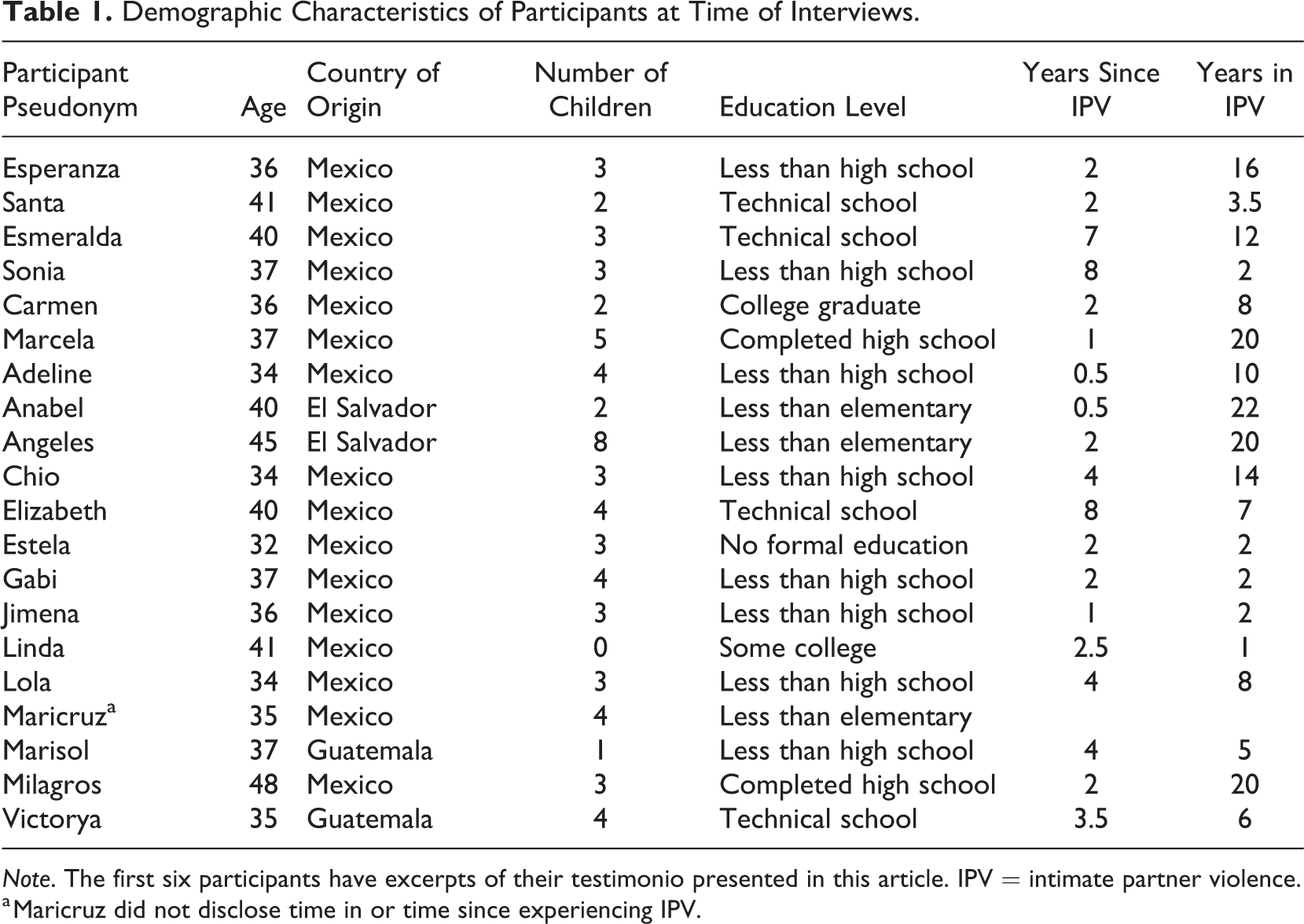
Note. The first six participants have excerpts of their testimonio presented in this article. IPV = intimate partner violence.
a Maricruz did not disclose time in or time since experiencing IPV.
Data Analysis
The interviews were audio-recorded and transcribed in Spanish to maintain the integrity of the narratives shared by the women. Information was confidential and recorded with a pseudonym. Exact words were transcribed, along with non-verbal exchanges (e.g., laughter, crying). As part of member checking, the PI invited participants to review their interview transcripts to provide feedback. Half of the participants agreed to receive copies of their transcripts. Of those who reviewed their transcripts, only one elected to eliminate a brief portion of the transcript, and everyone else approved of the transcript records.
Initially, thematic analyses were conducted by the research team to identify patterns and themes from all participants. An open coding technique was used (Saldaña, 2016) to develop a codebook of descriptive codes, which coincided with interview categories (e.g., IPV experience, IPV effects). The process was iterative with continuous reviews and revisions of codes and themes while using the online analytic software, Dedoose. Subsequently, a narrative analysis (Riessman, 2005, 2012) was conducted to understand how the women shared about their experiences. This article presents the narrative analysis to underscore the ways that social identity shaped the women’s help-seeking process. Interview quotes were translated from Spanish to English (with back translations) by two graduate research assistants whom are fluent in both.
Results
Even though the analyses included all participants, in the following section, we purposefully selected six women’s narratives that capture stories of how their immigration status along with other social identities played a role in accessing care. These narratives revealed that there were instances in which these women suffered barriers when accessing care and other instances in which they underwent moments of solidarity with other IPV survivors.
Esperanza
Esperanza is a Mexican undocumented immigrant with three U.S.-born children, including a child with autism. She never finished high school and worked in hotel housekeeping before moving into a 2-year transitional housing apartment. Esperanza shared about the different treatment in her day-to-day activities that she attributed to how others perceived her because of her social economic status (poor working class) and her country of origin. When we are on the public bus, people look at us with a face as if we stink. At work too and they talked about the undocumented, [they say] bad things…. When I worked at the hotel, they began to say things to us because we came from Mexico. To them [U.S. citizens], everyone from Mexico is automatically undocumented. It was not only MY WORD (emphasis in speech), my son also told them “my dad had her from her hair and he was choking her and threw her to the ground and that is why I called. I thought my dad was going to kill her.” And they [police officers] did not CARE. It took me about a month to recuperate that time because he would always hit me. They would tell me that I had to go to the doctor to have proof of the injuries, but how was I going to go if they ask for health insurance. Or you have to pay the cost and I did not even have money to eat. I said how is this possible? I’d rather stay with the pain. NOBODY KNOWS THE PAIN except the person that lives it. (silence) But I feel very proud that I have been able to do various things and I am moving forward with my kids. Even though we were staying at a shelter, it was better than the life I was living with my ex. Now I am thinking what happens if I do not find a job. Where will I go after here? If I had a social security number, I would not worry if they took away the aid because I can work. But like this, that really worries me. I think there needs to be someone to hear this more and pay more attention when we share this because many of us live this. Real talk, if I were white, they would pay more attention to my situation. I have noticed that there are white American women who get help. I do not have a social security number, and I am Latina and I do not get that same help. I think that is a bit inhumane or racist, unjust. There [at the shelter] too, people would talk and even the other clients would talk and say we were illegal. Amongst one another, they would make jokes of bad taste. In the shelters, there is discrimination. I do not want to talk bad because they did help me but if I were white, I would’ve been treated better. I also felt it in other places like clinics and at work. They tell you that because you are illegal you will get paid less and that they have the higher positions. There is a lot of discrimination even from our own people. That makes me sad because as Latinos we should help one another. Here it is like you go higher up and you do not look back.
Santa
Santa is also a Mexican undocumented immigrant, and she has a teenage daughter living in Mexico and a U.S.-born toddler daughter. Santa finished a certificate program to be a nurse’s assistant in Mexico. When she moved to Washington, she worked in fast-food restaurants. Santa would often hear her partner use her immigration status to scare her from leaving him. I told him once, what if I go to the police with this and he told me “feel free to go to the police but they are not going to believe you because you do not have proof. Another thing, you do not have papers, so you cannot go tell. If you go to the police, they are going to investigate you. The first thing they are going to ask you is if you are legally here.”…All these things would hold me back from reporting. His threats were becoming more difficult to bear. His threats to take my girl away and leave, and I would not see my daughter again. He could do what he wanted because he had papers and he could travel and I couldn’t do any of it. My fear grew more every day (still crying)…. He started showing me violent videos from Mexico of how they kill people, how they decapitate them. He told me that maybe I would die like that. In my meeting with the case manager, she told me to start looking for another place where I can move to because my time here will go by fast. Before I can find a place to live, I need to have a job. I cannot move out if I do not have a job. This is too much, I do not trust her. I’d better stay quiet, I cannot say anything because then things change. I had my interview with the immigration attorney and she is waiting because there were two police reports when my ex violated the order of protection. The immigration attorney told the case manager to speak for me, her client, to tell the police that I am in danger so that they will sign that paper. But the case manager told me that she is not going to do anything, that is what she told me. She said she will not talk to the police because they never did an investigation. So then what help do I have from her? What hope do I have that she is actually trying to help me? If I ask her for help to fill out some forms because I do not know how to fill them out, she tells me, “no, you have to fill those out.” I have no trust [in her]. I feel like I am not receiving the support that I need. I am now embarrassed to go ask her for anything.
Esmeralda
Esmeralda lived most of her adult life in the United States as an undocumented immigrant. She was married to a Latino U.S. citizen who began being violent on their wedding night. She had two children in Mexico before she came to the United States to reunite with her husband. Her third child was born in the United States and was diagnosed with autism. She worked various cash-paying jobs, which included cleaning houses, landscaping, and day labor. Having two undocumented children complicated things for her, making navigating the school system difficult. Esmeralda described I met a woman that spoke Spanish and she was American. She would see me walk by with the kids. Sometimes I would go out because I felt suffocated in the house. I would take my kids out at least to the park. One of those times, she saw me and said, “hello, how are you?” I was pleased that she spoke Spanish. “I have seen you walk by and you have two kids.”…She tells me, “your daughter will not go to school this year?” I tell her, it is because I do not know how to [enroll her]. I was ashamed to say that my daughter did not have papers. She said do not worry, you do not have to tell me anything—your daughter does not need anything but her birth certificate to enroll. I told her I did not know where the school was. She told me “I will take you—if your husband will not let you, when he goes to work, I will take you.” I snuck out and I went with her.
Esmeralda recounted her interaction with a Spanish-speaking doctor while seeking treatment for a back injury she suffered when her partner physically assaulted her. So the doctor turned to face his back towards my husband and in my ear says—if he hit you, I can help you. But clearly, in Spanish, and for me it was like the doctor was a ghost. I looked at him and I got scared when I saw my husband…. I said no by shaking my head.
Esmeralda was also homeless for a period and sought shelter. During this time, she sought mental health treatment, but she needed financial assistance to get to her appointments. She revealed some of those burdens. I was in a shelter. Before that, I slept at the Wal-Mart parking lot. I was told to leave many times because I would take a pillow and I had a shopping cart and I would lie my son there because my son did not walk. My kids were exhausted. We would sit on the bench outside of Wal-Mart, the one that is open 24 hours. We would sit there and wait for the day to come and afterwards we would go to the park to sleep… I would go to therapy and sometimes I felt very exhausted because I had no money. Sometimes it was difficult to have money because in the transition housing where I lived, rent was paid…. I asked staff at the mental health center. I would tell them that I had no money for the bus. And they would tell me, “oh, do not worry, we will give you some for you to attend”…. It was a bit easier that way.
Sonia
Sonia was one of the few participants who came to the United States as a teenager. She became a teenage single mother after her first experience with IPV. The lack of childcare was a perennial problem for Sonia, even preventing her from completing high school. Due to poverty in her mother’s home, rape from a family friend that resulted in the birth of her first child, and ongoing verbal and physical abuse from her mother, Sonia had to provide for herself and her children. Her situation became complicated when she started working at a bar and experienced sexual human trafficking. Her stories do not capture all the layers of her experience but demonstrate the barriers of being undocumented, not speaking English, and coming from a poor working-class family unable to offer her material or emotional support. To this day no one ever called me about housing, they would just tell me that my name is getting closer on the list but nothing to this day. Also in Section 8, that was in 2008. Imagine how many years have passed already and they have not called…. So that means that it is not fast or they had certain preferences towards people…. Many of the women that I know from the shelter have been left out. Section 8 did the same, those who have kids, they had Section 8 for the kids. But now, not even that is offered…. I noticed that for me it was more difficult because I did not have the U visa documents then and sometimes the social workers and case managers have to know what they are doing because I could have gotten housing in Everett but my case manager closed everything on me. If they would help women, I feel it would be a motivation to women to move on because it is not the same thing as “Here, you go find information, fill it out and let us know.” That is what they did with me, and we complained about that because it was always fill out the applications from here and send them out. I would think, how am I going to fill them out? What do I need to write here? I got two back because they were done wrong. I had to go out to look for help to fill out the paperwork when I had someone working there (transitional housing) that could help. It was not done correctly for me. Every 10 days I asked for tickets and they would say to me, “wow.” I thought “I don’t care.” I would bring all the young people (from the program) with me…. I noticed that they had a lot of tickets but they [case managers] would not give us the tickets. If we did not ask, they wouldn’t offer. That is why people would stay locked up in the apartments.
Carmen
Carmen came to the United States after she completed her bachelor’s degree in Business at a State University in Jalisco (MX). She received a job offer to manage various food businesses in the big city (Guadalajara), but her husband became unemployed at the same time. They decided to go to the United States on a visa that later they overstayed. Both of them were able to find jobs quickly; she worked in factory jobs or cleaning houses. When the IPV escalated, her ex-husband often told her that if she called the police, no one would believe her because she did not speak English. She remembered him saying, “they will send you to Mexico and I will keep the two kids.”
When the police were called during a physical altercation, her ex-husband was arrested and later deported. This incident spiraled other consequences, which affected her finances. I would say why is he ordered to only $82, for child support for his two kids. At first, I had rough times. I had three jobs that were not daily, all part-time. I could not pay rent. I had to ask to borrow from friends for the last two months because I couldn’t pay. They told me I could go to a shelter that is how I found this place. The social worker that helped me with the protection order told me to wait. Maybe I qualify for a U visa. But I would think that in the time I wait for the visa, I will become homeless, and that is what happened. I would go look for work and I was asked if I had a social security number—if not, then I was told to not even fill out the applications… I was on the [U visa] waitlist for more than a year and it would take more than one year to get the process started…. I was desperate because I felt like I was not moving forward. I signed all the paperwork but what they described on the paperwork was very different from the actual housing. I arrived to ensure everything was good [in the apartment] and to get the keys, and I began to see a lot of dots like glue. I got closer to look and the manager said that it was poison because the apartment had problems with cockroaches…. I thought how can I live here with my kids? I was not convinced but I had already signed. My kid has asthma and there was a strange smell…. I took photos—I could not accept the unit. I told them to move me to another unit but I was told I needed a doctor’s note. Those two weeks were difficult and in the end they told me no. You see yourself limited because without the social security number, you cannot [do it]…. The government knows that we do not have a social and they are helping us because instead of giving us things easily, not very easy because it is a very long process, but why not give us the tools to immediately start to work. Or a provisional work permit while you get everything in order?…It is not just about whatever they give us- we want to feel capable that we can do it on our own…. Believe me, I am the voice of many that do not dare say it…. Look, once I receive my social security card, I would like to work. But here I am limited because if I want my mother to come help with the kids, she cannot be in the apartment with me more than two weeks. These policies limit me. They do help you here, but it is a cycle that does not allow you to move forward. I think more help is needed and more motivation too. For example, a volunteer used to come to teach knitting or art activities. This is what is lacking. We need more of this because she came by two or three times and then stopped. There is no consistency. But yes, it would be motivation to gather those of us who like to cook. Because look, once you are motivated and informed, I think that the people themselves take initiative. They begin to gather in groups and they start taking initiative to do something.
Marcela
Marcela migrated to the United States as a teenager. She attended high school in the United States, and she participated in a job corps program that paid her as she received job training. It was through this program that she also met her husband. They had five children; the IPV intensified after each pregnancy. In her narrative, Marcela talked about not disclosing the IPV to her gynecologist even after she presented with bleeding from the injuries. Part of her nondisclosure was because she was afraid her husband’s immigration status would be affected if a report was filed. My husband made me have two abortions because of the beatings (continues crying). I lost two children because of the beatings. When I had my second child, I went to the gynecologist and she said she would take over my case. Every week I went to the clinic, they would give me a hormone injection because they didn’t understand what was happening…but it was because of the beatings. That was my fear since he is a legal resident. It was always my fear, not his, but mine—if I call the police, they will take his papers. I would hear comments that when it is a domestic violence case they will take his papers. I got my papers through him and so I could not do anything. I would tell my son that they could take his dad to jail. I would tell him [son] what could happen if the kids called the police. Shelters would call me back that there was no space. I would call different places and they would say, “look the truth is that with the number in your family it is very difficult for you to find something”…. Since we were six people, there is no space for six. Because the room fits three, and you are not allowed to have more. My situation got worse. They cut my cell phone and I had no communication and I did not have money because I worked and I would spend everything on the hotel and three meals…. I went with my daughter, who attended middle school and I spoke to a staff member who spoke Spanish and I explained what was happening and she told me, “why did you not tell me before, I could’ve helped you?” I am happy how we chat between neighbors. We think we are the only ones, but no, there are a lot of us with this problem. The majority move on, but sadly I see a lot go back. Now my neighbor tells me, “my partner got out of jail.” And I admire her because she did not look well. I told her, “How about I get you a coffee?” and she says, “Oh, yes, yes, yes!” We are there chatting for like an hour or two hours. I tell her, “How do you feel?” “Oh, much better, thank you”…. I told her, “If you see him, call the police. Do not lock yourself in. Have a normal life.” We give each other courage and we talk. We have to be strong. Because it can be done. There is help, it is very difficult but it can be done. If one door closes, knock on another, continue and if you see they will not open, one door will eventually open and they give you options and change.
Discussion
The participants reflected on their social identities along with producing a collective consciousness about their experiences when seeking help while uncovering systems of oppressions and the ways in which they overcome these barriers and experience community solidarity (Beverly, 2005). Chicana feminism and intersectionality provide frameworks to make meaning of these narratives as both unique to the lived experience of the participant and their own identity and as part of a larger shared experience where institutions did not adequately meet their needs. Collectively, the women faced a lack of access to services because of structural barriers and imposed limitations on low-income undocumented immigrants. Their narratives demonstrate how their positionalities influenced the responses they received when seeking care.
Western white feminist IPV research has strategically focused on the common experiences of IPV survivors to forge a strong feminist movement to end abuse against women. However, this approach may silence marginalized voices. One strength of testimonio is to connect human beings in ways that enable us to bear witness to struggles of those beyond our own. It is also a way to conduct feminist research on sociopolitical stories and make visible the ways in which systemic issues and dominant discourses influence the IPV experiences of undocumented immigrants. It extends our understanding of the ongoing barriers and illustrates the injustices that are being witnessed and lived in the current anti-immigrant contexts (e.g., closing off the U.S.-Mexico border has effectively ended asylum; see Pierce & Bolter, 2020). For these reasons, testimonio is an important methodology to explore, in a culturally responsive way, how undocumented Latina immigrant IPV survivors navigate and disrupt oppressive power as they seek services to address the IPV circumstances and seek social justice. The insights generated by these testimonios suggest several implications for practice, policy, and research.
As Hurtado (2003) summarized, Chicana theorists speak to the women’s struggle influenced by their gender but not independent of historical conditions. The participants in this study were motivated to produce knowledge from a “politics of urgency” to change their social conditions. The narratives the women shared also pointed to the various rules and policies that are established by programs that offer services but limit moments of ease as the women navigate the system. Specific to IPV help-seeking and undocumented immigrants, it may require not recommending a call to the police as the first line of defense due to mandatory arrests in DV cases and the disproportionate contact of men of color with law enforcement. Referrals to housing programs may be an entry point to receive other services.
Considering the shifting immigration context and structural inequalities is imperative because as it shifts, so does the meaning of race, gender, immigration status, and class. It is a fundamental reality that social identities are continuously changing social relations of inequality and systems of oppression which are larger than individual demographic identities (Hill Collins, 2019). For example, considering immigrant women who reside in battered women’s shelters, Crenshaw (1994) suggests that “their status as immigrants can render them vulnerable in ways that are similarly coercive, yet not easily reducible to economic class (p. 96).” Thus, those not able to secure employment as single mothers suffered in their housing conditions and also in their access to other services. The narratives presented in this article demonstrated how the shifts in immigration status (or approval for U visas) offered new help-seeking opportunities, including the reach to school personnel to better navigate accessing services and programs.
The responses the participants received when they were seeking help also relate to previous research (Parson et al., 2016; Postmus et al., 2014; Reina & Lohman, 2015). The ineffective responses often lead to stress, delayed care, and not trusting systems to be responsive to their needs. This placed the women at risk of other issues that extended after the IPV ended. These findings lay the groundwork for future lines of inquiry that can expand on the current political climate and institutional barriers when providing services for undocumented immigrant IPV survivors. The intersecting inequalities call for a greater interagency coordination and a multisector approach aiming at creating systems of safety and care for Latina immigrants. This study underscores the need for more research to inform effective interventions that address the IPV health effects along with the barriers to receive care when someone is undocumented.
There are several limitations related to data from a purposive sample. First, the women whom were recruited represented those who mostly emigrated from Mexico and all had received services. These women do not represent those who have not received services. Second, the information shared in these interviews focused primarily on the injustices, even though our methodology also intended to capture moments of solidarity, empowerment, healing, and advocacy. Even with these issues, this study addresses a gap in the literature about the help-seeking experiences of Latina undocumented immigrant survivors.
In order to address the barriers undocumented survivors of IPV face when attempting to access help, social workers should engage in efforts to disseminate information about available resources and how to best navigate systems especially when the immigrant women may not be willing to share their experiences. Social workers at IPV service agencies can provide plain language information, in multiple languages, about available resources for undocumented persons and highlight the rights that patients have when accessing care, such as the right to privacy. Social workers may serve as a bridge to build trust and ensure undocumented immigrant IPV survivors are aware of the programs and assistance that is available regardless of their immigration status. Unfortunately, the interactions between social service providers and undocumented immigrant IPV survivor clients more often silence women further because they are afraid to share about their experiences and be discriminated against because of who they are. Hence, the space for women to share their voices is limited in most programs.
Social workers can continue to improve their cultural competency abilities so as to best serve undocumented Latina survivors who will need support that is inclusive of their lived experience. Practitioners should also consider how to demystify the help-seeking process for undocumented persons seeking care and ways to build trust and foster confidence in these relationships. Providing clear information at these one-time visits may have long-term consequences for those accessing care related to IPV. Since their access to care is often restricted to emergencies, it is critical to offer support groups or cultural informed mental health services that women can access without fear of being deported or being denied services. To build trustworthy relationships with undocumented women, practitioners can support advisory boards and social action groups comprised of clients and community members that can serve as both a means to receive feedback on services and as a mechanism to create change.
Highlighting Building Healthy Relationships to End Violence as one of the 12 Grand Challenges, and ending gender-based violence as a primary subtopic (Edleson et al., 2015), is both appropriate and necessary. The framework for ending IPV rightly encourages social workers to forge a new path to address this issue through framing IPV as a macro-level problem that is deeply gendered. However, this rallying cry for social work researchers and practitioners is muffled by a framework that falls short in incorporating an intersectional lens to both the roots of this social problem and response efforts developed to address it and support survivors. An intersectional lens underscores that policy work intended to address IPV in the United States must include immigration policy as part of the analysis. As social workers seek to support undocumented Latina survivors of IPV, it is important that they seek to understand the unique experience of each woman, as opposed to accepting a homogenous view of undocumented Latina’s experience.
Footnotes
Acknowledgments
We extend our gratitude to the 20 women who shared their stories with us. This study would not have been possible without the women’s courage and trust to share their experiences. A nod of gratitude to the blind peer-reviewers for their suggested revisions.
Declaration of Conflicting Interests
The author(s) declared no potential conflicts of interest with respect to the research, authorship, and/or publication of this article.
Funding
The author(s) disclosed receipt of the following financial support for the research, authorship, and/or publication of this article: This research project received financial support through the Ronald McNair Dissertation fellowship from the University of Washington’s Graduate Opportunity Minority Achievement Program (GO-MAP).
