




Abstract
Colleges are working to study and address sexual assault (SA) and dating violence (DV) on campus. This quantitative systematic review assessed 196 studies of SA and DV to evaluate if the literature fully reflects the demographics of American higher education. Results show disproportionate representation in the populations and settings in which research is occurring. No studies occurred at associates/2-year institutions, and participants are substantially younger and whiter than American college students overall. Education and prevention efforts that do not take into account the bias in these studies may exacerbate intersectional barriers for students.
Keywords
Background
Sexual assault (SA) and dating violence (DV) are critical public health issues. Young women, especially those of “college age” between 18 and 24 years, are at high risk of victimization across the board, and studies have found high rates of victimization and perpetration among college students (Sinozich & Langton, 2014). Data suggest 22% of college women have experienced DV and nearly 20% have experienced completed or attempted SA since entering college (Hossain, Memiah, & Adeyinka, 2014; Krebs, Lindquist, Warner, Fisher, & Martin, 2007). Data from individual campuses frequently find even higher rates, with some finding upward of 40% of students reporting SA (Jordan, Combs, & Smith, 2014; Mason & Smithey, 2012). Consequences for collegiate survivors include increased risk for post-traumatic stress disorder (PTSD), depression, and substance use (Overup, Dibello, Brunson, Acitelli, & Neighbors, 2015; Zinzow et al., 2010), as well as increased risk for future victimization (Walsh, DiLillo, & Messman-Moore, 2012), and decreased academic achievement (Jordan et al., 2014). An emerging literature also points to certain subgroups of students being at increased risk of victimization. These groups include students of color and younger students (Roudsari, Leahy, & Walters, 2009; Smith, White, & Holland, 2003).
Recent attention to these issues has led to increased political oversight and demonstrated the need for a high-quality evidence base. Passed in 2013, the Campus Sexual Violence Elimination (SaVE) Act mandates increased transparency; guarantees the rights of survivors; sets requirements for disciplinary actions; and establishes standards for prevention, intervention, and education (Manning, 2014; Stuart, 2014). It also requires colleges and universities to provide education about preventing and addressing SA and DV on campus (Manning, 2014; Stuart, 2014).
Given these mandates and the devastating impact of violence on victims, it is clear that colleges and universities need a robust knowledge base for describing and addressing SA (including rape, attempted rape, and other unwanted sexual contact) and DV (including stalking, psychological, and physical violence between intimate partners) in their contexts. Bapat and Tracey (2012) point out that there may be some differences between college/adolescent DV (which tends to be studied among teens and young adults and may imply lack of cohabitation or long-term commitment) and our understanding of intimate partner violence (IPV), which often recognizes the role of violence and coercive control in “marriages, families, or romantic relationships between older adults … in [which] there is a high level of personal disclosure and emotional investment” (pp. 329–330).
Important work has already been done to understand DV and SA on campus, including work that documents the breadth of the problem (e.g., Fisher, Cullen, & Turner, 2000; Krebs et al., 2007) and investigates routes for intervention (e.g., Gidycz, Orchowski, & Berkowitz, 2011; Moynihan et al., 2015). In order to identify where they may be gaps, this systematic review assessed the extent to which our current literature on sexual and DV among college students is representative of the diverse student bodies and institutional structures found in American higher education.
Context of American Higher Education
According to the National Center for Education Statistics (NCES), enrollment in American higher education institutions has reached an all time high, with enrollment of women seeing the greatest increases (NCES, 2013). In the fall of 2012, there were 20.6 million students attending postsecondary institutions (NCES, 2013). However, American higher education is not a monolith, with institutions ranging from doctoral/research universities to associate’s colleges. This provides a variety of settings to meet the needs of students, from small residential colleges to extremely large commuter institutions (NCES, 2013). According to the NCES (2011), in 2010, nearly 40% of students attended institutions of higher education categorized as associates (“2 year” or “community”) colleges, while 28% attended doctoral-level universities, 22% master’s-level universities, 7% baccalaureate colleges, and 3% other types of institutions.
American college students also come from a wide array of backgrounds and experiences. While there is a common notion of a “traditional” college student between the ages of 18 and 24, the actual picture is considerably more diverse, with 33% of all students over the age of 24, and a mean age of 29 for associate’s college students (American Association of Community Colleges [AACC], 2015; NCES, 2011). Students are also racially diverse. In fall 2012, 60.3% of American students in institutions of higher education were white, while 14.9% were African American, 15% were Latino, and 6% were Asian. Comparatively, in 1980, 84.3% of college students identified as white (NCES, 2013).
Multiple Identities in Higher Education and Impacts on Experiences of Violence
With such a wide diversity in types of institutions and student identities, it is important to recognize that there is not a single “college experience” that is shared by all, nor an appropriate “one-size-fits-all” response to the challenges facing higher education, including the epidemic of SA and DV. A feminist intersectional lens, which recognizes the overlapping layers of identity within each survivor and the way that structures and systems (including educational bureaucracy and academic hierarchies) impact them, demands a critical evaluation of what we know about collegiate survivors of sexual and DV (Bowie & Dopwell, 2013; Crenshaw, 1991). We experience rates and consequences of violence differently, yet are bound by common experiences of systematic gender-based violence. This calls us to pursue systemic change, prevention, and intervention that is inclusive of all survivors (Ortega & Busch Armendariz, 2016).
The differences between types of institutions and populations of students could be of critical importance to our understanding of SA and DV on campus. As Giovannelli and Jackson (2013) highlight, there are important differences, including student body makeup and institutional structure, by institutional type that influences the attitudes, behaviors, and experiences of students, faculty and staff as well as the options available for prevention and intervention for sexual and DV. It is also clear that subpopulations of survivors may face unique challenges. Recent studies have identified racial discrimination as a key source of traumatic stress that may put minority students at unique risk of developing PTSD after experiences of SA or DV (Carter, 2007; Carter, Forsyth, Mazzula, & Williams, 2005; Cheng & Mallinckrodt, 2015). Similarly, Brown, Banyard, and Moynihan (2014) found that participant age and race are both linked to differences in social norms and beliefs around sexual violence and bystander behaviors. Given the current focus on developing effective campus prevention and intervention strategies, and an understanding that a uniform approach to campus-based prevention and intervention efforts may miss the mark for many, the time is ripe to critically evaluate our knowledge base. Thus, the current review seeks to understand the extent to which our evidence base is truly reflective of and responsive to some of the diversity found among violence survivors in American higher education.
This is particularly critical, given the history of research and advocacy around violence against women. A major emphasis early in the movement was on experiences of IPV being universal to women (Sokoloff, 2007, p. 2). This approach was successful in its aim of raising awareness but has been criticized for failing to incorporate the experiences and needs of women from diverse backgrounds (Wilson, 2006). Richie (2005) points out that the image of an IPV survivor became a middle-class, white survivor who “could turn to a … therapist, a doctor, a police officer, or a lawyer to protect her” (p. 1136). This has led to these women consuming a greater portion of intervention dollars and researcher attention, creating a social service system designed around the needs of a subgroup of survivors (Nash, 2005). In this context, as scholars shift attention to the development of preventions and interventions in the collegiate setting, including the voices of all violence survivors in research and practice should be a priority.
Research clearly demonstrates that interpersonal violence disproportionately impacts women in certain subgroups, particularly those already at risk of social exclusion or isolation (Wilson, 2006). The overlapping influences of women’s multiple identities shape their experiences of violence dramatically. As argued by Davies and Lyon (2014), the risks faced by women are shaped both by their unique IPV situation and by the “life-generated risks,” such as limited English ability, racism, or structural poverty that build upon and compound the violence within intimate relationships.
While this review applies an intersectional lens, critically evaluating the extent to which current studies are capturing the experiences of diverse students across institutional types, due to limitations in the data, reported it does not capture many of the impactful identities of a student or community. Nonetheless, an overview of the impact of certain identities on women’s experiences of violence, and how they could shape the experiences of college women, is warranted.
Race
High rates of violence against women are found among women across racial and ethnic groups; however, there is evidence that rates vary between groups (Sabri et al., 2013). Women’s cultural and ethnic identities can be sources of strength, but institutional racism presents unique barriers to women of color. There is substantial evidence of disproportionate victimization among women of color, with multiple national studies finding higher rates of IPV among women of color, including African American, Latina, and Native American women (Caetano, Schafer, & Cunradi, 2001; Sabri et al., 2013;Wahab & Olson, 2004). Among college students, Yoon, Funk, and Kropf (2010) found significant differences between black and white women in types and consequences of experiences of sexualized violence. Scholars have also been less effective in evaluating these differences in light of the impact of public and structural forms of violence, including imperialism, classism, and racism faced by communities of color (Sokoloff, 2007).
Women of color face the compounding forces of IPV and racism, both of which can contribute to the marginalization and isolation of survivors within social systems (Sokolof, 2007). According to Yick (2007), “the invisibility of this social problem partially explains why empirical examination of [IPV among women of color] has lagged until recently” (p. 279). The existence of structural barriers to safety that are unique to women of color highlights the need for explicit strategies to support women of color in living as safely as possible. For college women of color, institutional racism and structural barriers within the collegiate context impact their experience of prevention, intervention, and help seeking.
Age
Studies have established that “college-aged” women in their 20s and 30s face the greatest risk of IPV, DV, and SA adjusting for cohort and period effects, with these risks decreasing with age (Black et al., 2011; Rivara et al., 2009; Sinozich & Langton, 2014). For the youngest survivors, the dynamics of adolescence and early adulthood complicate their situation. Young people often perceive that they have fewer resources available to help deal with the situation, with less mobility, or financial power. They may also attend the same school/college as their abusive partner, both decreasing their ability to avoid the situation and increasing the social risks of confronting it (Wilson, 2006). For older survivors, the long-lasting nature of their relationships could lead to fear and uncertainty about the consequences of addressing violence (Beaulaurier, Seff, Newman, & Dunlop, 2007). For older college students, these unique dynamics could mean that some higher education–based responses are less applicable to their needs.
Geography
Location can shape both an individual’s identity and their experience. Rural communities may have different perceptions of and responses to violence compared to urban areas, and women in each setting may face unique challenges (Wilson, 2006). Students attending rural institutions may face similar challenges to their nonstudent counterparts, as they interact with the campus and community (Peek-Asa et al., 2011).
Socioeconomic status
Physical IPV is found disproportionately among women at the bottom of the income distribution, with one nationwide study finding IPV at rates 7 times higher among those in the lowest 1/7th of the population in terms of income (Rennison & Welchans, 2000; Tolman & Raphael, 2000). For these women, IPV not only means the daily threat of violence but also further limits to their options for economic stability. Given that low-income students are over represented in 2-year/associates colleges, tailored responses to DV/SA that address these dynamics may be uniquely appropriate in those settings (AACC, 2015).
Evidence demonstrates that survivors face differential risks and have unique needs based on their multiple identities. The current review seeks to understand the extent to which our knowledge base around campus DV and SA is adequate for understanding differences that could directly impact survivor’s experience of violence, prevention, and intervention.
Research Questions
In order to assess the extent to which the current literature on campus-based sexual and DV is representative of the students and survivors within American higher education, the current systematic review addressed the following questions:1) In what types of institutions is collegiate SA and DV research being conducted? 2 Who are participants in collegiate SA and DV research? 3) In what types of institutions are intervention research being conducted?4) Who are participants in intervention research? 5) Are there differences in type or focus of research by institutional or participant demographics?
Studies included in the current review did not consistently report on some aspects of student identity, including ability status, gender and sexual orientation, and social class. This limits the ability of the review to apply a full intersectional framework. However, there is enough attention given across the reviewed studies to identities including age, race, and type of institution being attended, to draw meaningful conclusions. Thus, the current review applies an intersectional lens focused on these issues, while recognizing a number of neglected areas that deserve serious attention from future scholarship.
Method
A systematic review “aims to comprehensively locate and synthesize research that bears on a particular question, using organized, transparent, and replicable procedures” (Littell, Corcoran, & Pillai, 2008, p. 1). The current quantitative review followed a predetermined literature search and data abstraction protocol to gather information from 196 peer-reviewed journal articles to address the research questions. The review protocol was as follows.
Literature Searches
Parallel literature searches for articles in nine databases (Academic Search Complete, Academic Search Premier, CINAHL Plus, Family & Society Studies Worldwide, Gender Studies Database, PsycINFO, Social Work Abstracts, and SocINDEX) were undertaken for the period from January 1, 2010, to March 2, 2015. Inclusion criteria included peer-reviewed articles with at least one of the terms “Intimate Partner Violence,” “Dating Violence,” “Domestic Violence,” “Sexual Violence,” “Sexual Assault,” or “Rape” in the subject terms, and at least one of the terms “College,” “University,” “Undergraduate,” “Collegiate,” or “post-secondary” in the abstract (see Figure 1 for the steps taken to identify the final sample of studies). The initial search returned 1,718 articles, which was reduced to 631 when duplicates were removed. Those 631 articles were abstract reviewed for additional inclusion criteria: original data collection among students enrolled at an institution of higher education in the United States, and a focus on campus-based DV or SA. From that abstract review, 311 articles were removed and 320 articles were reviewed in detail for potential inclusion. At this stage, articles were excluded if there was no full-text article available or if the fact that the study was within a population of college students was irrelevant to the study aims or implications. For example, a study would be excluded if a convenience sample of undergraduate psychology students was used, but the aims or implications did not deal with that population, or the only time the collegiate context was mentioned was in the description of the sample. This left a final sample of 196 articles included in the current review, which are available if requested.
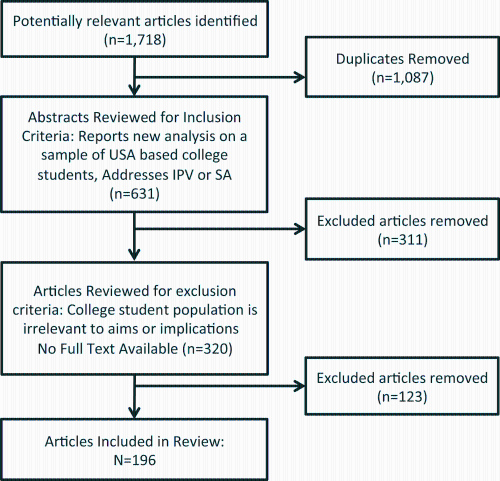
The identification of eligible studies for inclusion in the systematic review.
Characteristics of Included Studies
The 196 included articles were then reviewed in detail to identify key characteristics, which were compiled into a database for review and analysis (see Table 1). Analysis includes descriptive statistics of key variables and tests of association (χ2, t-test, and correlation). Assessed characteristics were the following.
Description of Included Studies.
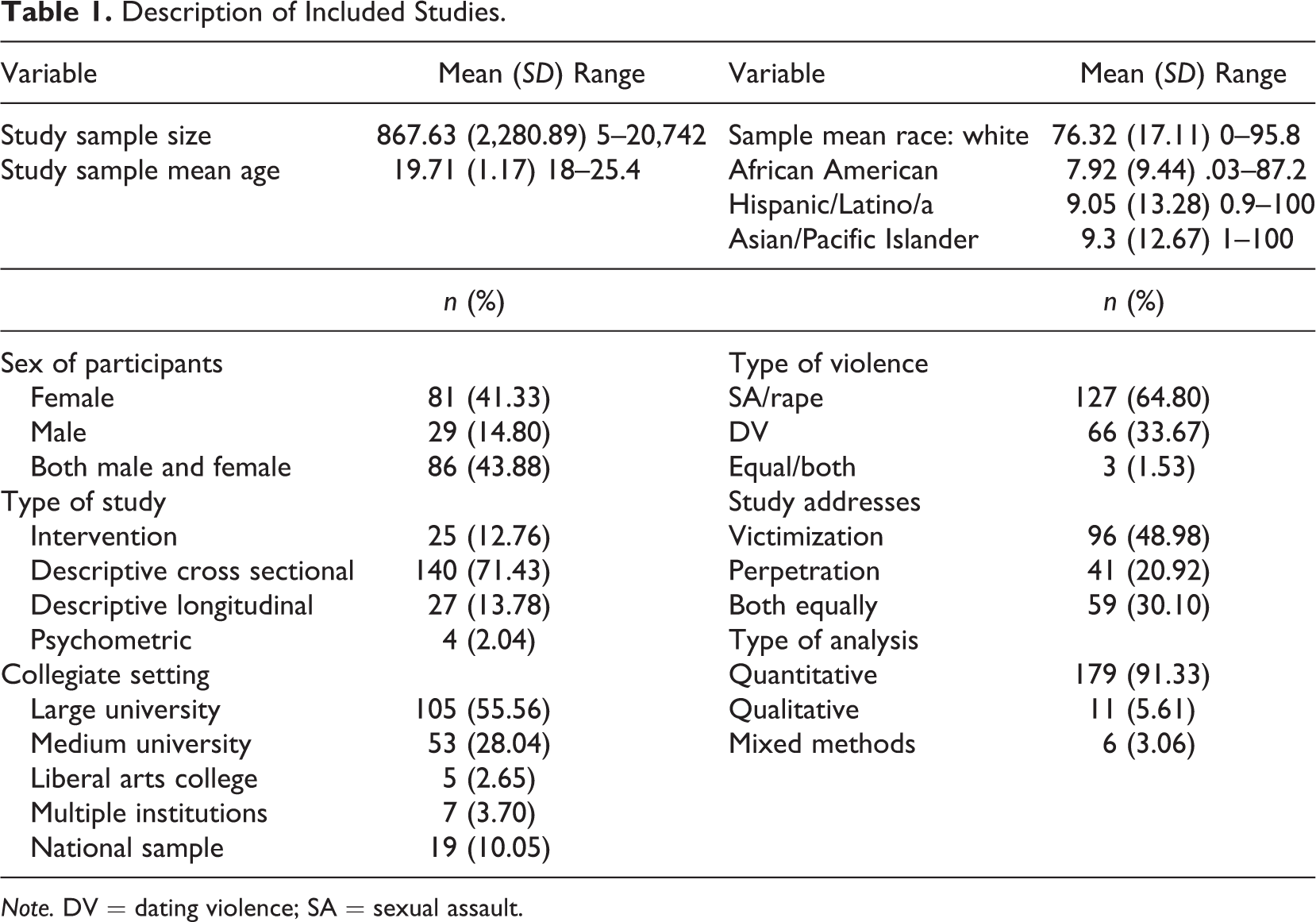
Note. DV = dating violence; SA = sexual assault.
Sample Mean Age
Of the 196 included studies, 153 reported the mean age of their sample. Many of those that did not report age reported year (freshman, sophomore, junior, senior) or suggested that the sample was “representative of undergraduates at the institution.”
Sex of Included Participants
All included studies reported on the sex of their participants as female/woman, male/men, or both female and male.
Race of Included Participants
Studies had a number of ways for reporting the racial composition of their samples. These included reporting on only the percentage of students who identified as “white,” reporting the demographics for several racial subpopulations of students, or choosing not to report racial composition. The current review reports on the percentage of respondents who identify as white, African American, Latino/a, and Asian/Pacific Islander.
Institutional Setting
Categories for institutional setting were determined by recording the most frequently used terms found in the current sample of articles and identifying similar descriptions. This list was then compared with the NCES classifications, and the category of associate’s college was added. Seven articles did not report information regarding the setting. Final categories were large (or “major/research”) university, medium-sized (or “regional/mid-sized”) university, liberal arts (or baccalaureate) college, or associates (2-year) college. Studies were identified that were conducted at multiple institutions or among national samples.
Sample Size
Sample size was recorded based on the number of individual participants.
Focus Type of Interpersonal Violence
Articles were categorized as addressing SA if they primarily used terms such as SA, rape, sexual violence, or sexual victimization to identify the focus of the article. Articles were categorized as addressing DV if they primarily used terms such as IPV, domestic violence, or DV to identify the focus of the article. Those that addressed sexual violence only in the context of intimate relationships were categorized as DV. A final category is comprised of those focusing equally on SA and DV.
Victimization or Perpetration
Articles were identified as addressing victimization if they only measured respondent’s experiences or beliefs about victimization. They were identified as addressing perpetration if they only measured respondents’ acts or beliefs about of violence perpetration. Those that measured victimization and perpetration were categorized as “both.”
Type of Study
Studies were classified as intervention studies if they reported outcome data on primary or secondary prevention interventions (including bystander intervention programs and other psycho-educational and awareness efforts), or interventions aimed at reducing the impact of SA or DV (e.g., trauma treatment). Studies were classified as descriptive cross-sectional studies if they reported on SA or DV at a single time point. Studies were classified as descriptive longitudinal if they reported on SA or DV over multiple time points. Studies were classified as psychometric if they reported on measurement development and testing.
Type of Analysis
Articles were categorized as quantitative if only quantitative results were reported. They were categorized as qualitative if only qualitative results were reported. Articles combining quantitative and qualitative results were categorized as mixed methods.
Article Content Area
Content area was determined by reviewing the measures and conclusions from each study to identify key domains. A study was assigned up to three key content areas based on a list of themes found frequently in the literature (see Table 2).
Major Content Areas of Included Studies.
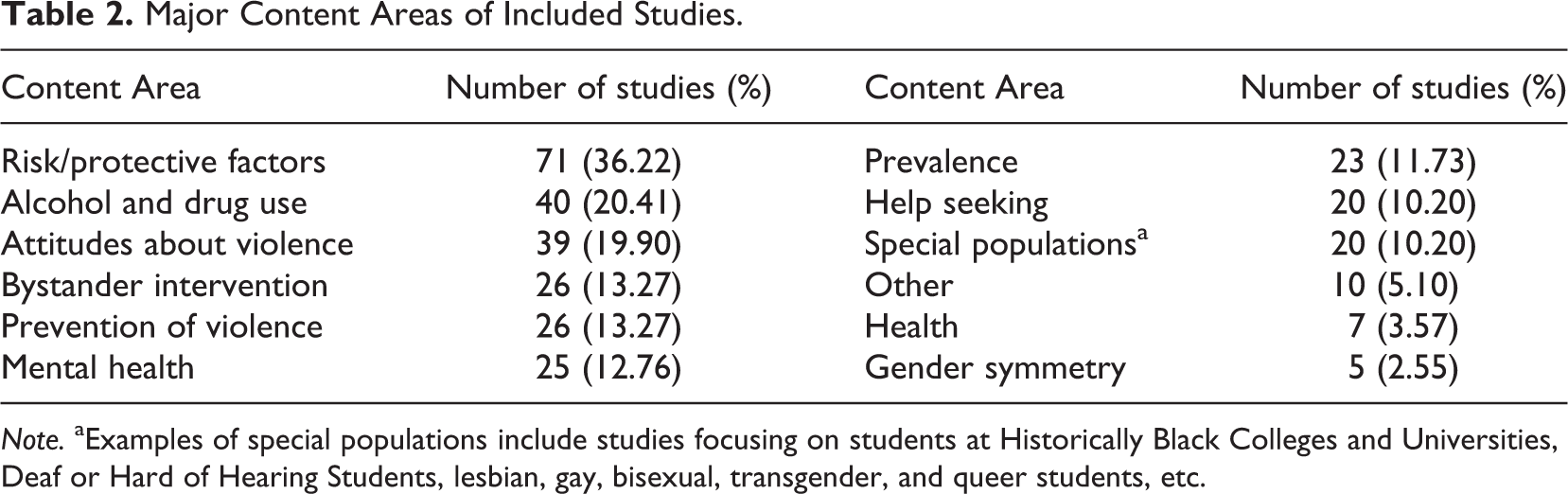
Note. aExamples of special populations include studies focusing on students at Historically Black Colleges and Universities, Deaf or Hard of Hearing Students, lesbian, gay, bisexual, transgender, and queer students, etc.
Results
The number of study participants ranged from 5 to 20,742, with a mean of 867.63 (standard deviation [SD] = 2,280.89; see Table 1). The large SD is due to two included studies with over 20,000 participants. The modal value for sample size is 316. Sixty-five percent of articles addressed SA (n = 127), while 33.67% (n = 66) addressed DV, and 1.53% (n = 3) focused equally on both SA and DV. Nearly 50% (n = 96) of articles were classified as addressing victimization, while 20.92% (n = 41) addressed perpetration and 30% (n = 59) were categorized as “both.” Risk and protective factors were the most frequently identified content areas (n = 71, 36.22% of articles), while other frequently addressed domains included the role of alcohol or substance use (n = 40, 20.41%), attitudes toward violence (n = 30, 19.09%), bystander intervention (n = 26, 13.27%), and other types of prevention (n = 26, 13.27%; see Table 2).
Over 12% of included articles reported on intervention studies, while over 70% were classified as descriptive cross-sectional (n = 140). Fourteen percent of studies were classified as descriptive longitudinal (n = 27), while four studies (2.04%) were classified as psychometric. Over 90% of articles were classified as quantitative. Eleven studies (5.61%) were categorized as qualitative, while six (3.06%) used mixed methods.
In What Types of Institutions Is Research Being Conducted?
The majority of studies occurred at large (n = 105, 55.56%) or medium-sized universities (n = 53, 23.04%). Seven studies (3.70%) were conducted at multiple institutions of higher education, and 10.05% among national samples of students (n = 19). No included studies took place in associates (2-year) institutions.
Who Are Participants in Collegiate SA and DV Research?
The sample mean ages ranged from 18 to 25.4, with an average of 19.71 (SD = 1.17). Just over 40% included only females, while 14.8% were exclusively male and 43.9% included both.
White identified participants ranged from 0% to 95.8% of samples, with a mean of 76.32% (SD = 17.11). For those studies that reported the percentage for other racial groups, African American students were an average of 7.9% of respondents (range = .03–87.2%, SD = 9.4, n = 109 studies reporting), Latino/a students were an average of 9.0% (range = 0–100%, SD = 13.3, n = 89), and Asian/Pacific Islanders were an average of 9.3% (range = 1–100%, SD = 9.3, n = 88).
In What Types of Institutions Is Intervention Research Being Conducted?
Of the 25 intervention studies, 11 (44.00%) occurred in large universities, 10 (18.87%) occurred in medium-sized universities, 2 (8%) occurred in liberal arts colleges, and 2 (8%) occurred on multiple campuses.
Who Are Participants in Intervention Research?
Intervention studies have an average participant age of 19.30 (SD = 1.13). Intervention studies had more mixed gender samples, with 60% of studies having both male and female participants. Seven intervention studies (28%) included only female students, while 12% included only male students. Of those who reported racial demographics (n = 19 of 25), intervention studies had an average of 74.25% white participants (SD = 14.39), 6.01% African American participants (SD = 4.0), 9.9% Latino/a participants (SD = 7.2), and 10% Asian participants (SD = 9.1).
Are There Differences by Institutional or Participant Demographics?
Differences were observed in mean participant age by type of study, with psychometric (mean age = 20.22, SE = .22) and cross-sectional (mean age = 19.89, SE = .11) studies having higher mean ages than intervention (mean age = 19.30, SE = .28) or longitudinal studies (mean age = 19.10, SE = .22; F = 4.20, p = 007). Intervention studies and psychometric studies were more likely to include both male and female participants, while descriptive studies were more likely to include only males or only females, χ2(6) = 13.87, p = .03. No differences were observed in participant racial demographics or setting by study type.
No differences were observed in type of interpersonal violence (SA, DV, or both) studied by mean age of participants, sex of study participants, racial demographics of study participants, or institutional type. No differences were observed in study focus on victimization or perpetration by mean age of participants, racial demographics of participants, or institutional type. There was a significant difference by participant sex, with studies of female-identified participants more likely to focus on victimization and studies of male-identified participants more likely to focus on perpetration. Studies with both male and female participants were more likely to assess both victimization and perpetration, χ2(4) = 130.96, p = .000.
Discussion
SA and DV on campus comprise an important area for contemporary interpersonal violence research. The body of work represented by this review stands as a testament to many students, faculty, and staff members committed to preventing interpersonal violence in campus communities. However, there continues to be important work to be done to build a body of knowledge that is reflective of the diverse campus environments and student bodies in American higher education. Samples are younger (mean age 19.71) and whiter (76.3% white) than American college students as a whole, and studies take place disproportionately within larger research universities. Studies are also overwhelmingly quantitative (91%), and most frequently address risk and protective factors, the role of alcohol and drugs, and attitudes toward violence. Fewer studies address intervention and prevention of violence. With new policy mandates in the Campus SaVE Act requiring increased awareness and intervention efforts across all institutions of higher education, expanding the settings and populations in which these sorts of questions are asked could help tailor efforts and promote the safety of students.
The experiences and needs of students vary dramatically across institutional structures and foci, and the culture and climate of different types of institutions are known to impact the attitudes and behaviors of students and organizations (Giovannelli & Jackson, 2013). However, our current knowledge base is weighted heavily toward the realities of large and medium-sized universities, even as half of the students attend other sorts of institutions. Particularly telling is the fact that, of the 196 included studies, none were conducted in associates/2-year institutions, even though they comprise the single largest sector in American higher education (NCES, 2011). Associate’s colleges serve 40% of all undergraduate students, and often serve populations who are underrepresented in other contexts, including students of color, first-generation college students, older students, and students from low-income families. Half of the students who receive a baccalaureate degree in the United States attend an associates college at some point and compared to the mean age of participants in these studies (19 years), the average age of an associate’s college student is 29 (AACC, 2015). There are differences in associate’s colleges that make the current literature less applicable. These differences include the older population, the fact that many students are juggling work and parental responsibilities along with school, and the fact few associate’s colleges include a housing component (AACC, 2015). Rather than simply applying a knowledge base built primarily in large universities to these campuses, social workers should engage associate’s colleges directly in research and intervention efforts. This would further our understanding of the dynamics and practices that are appropriate to these settings.
The generally young age of participants in included studies also points to a potential area for future exploration, as our current knowledge base is clearly primarily applicable to “traditional” college students, even as more and more “nontraditional” students are matriculating. There may be an important distinction here, as much of the literature for describing and intervening in campus-based SA and DV is based on the assumption of a “traditional” college experience—with alcohol, Greek life, and residential students at the center. For older students, Bapat and Tracy’s (2012) distinction between DV and IPV/domestic violence might come into play, as older college students may face abusive relationships that look less like the traditional conceptualization of “college DV.” If we are to implement efforts to serve this population, we need an expanded base of evidence to understand the dynamics and needs of older students. This may include greater attention to the way that issues like parenting, child care, transportation, and work intersect with student’s experiences of violence and coercive control. These are dynamics which social workers and social work researchers are well positioned to address.
Students obtaining higher education have become considerably more ethnically diverse over the last 30 years, yet participants in SA and DV research in the past 5 years still reflect the racial composition of campuses in the early 1990s (NCES, 2011). In 2012, 60% of students identified as white. However, among those studies that reported racial demographics, 77.87% of respondents were white, with 89 studies over 85%. While African American students comprise 14.9% and Hispanic/Latino students comprise 15% of American college students, they represent 7.9% and 9.0% of study participants. This limits the ability of scholars to draw meaningful comparisons between groups or examine potential needs when they are identified. Given evidence of ethnic disparities in the impacts of violence, and differential experiences with help-seeking, specific attention by social work scholars to the needs of students of color is clearly warranted.
Limitations
The current review has a number of limitations that should be considered when evaluating its findings and conclusions. While the review seeks to assess the current state of the literature through an intersectional lens, it fails to capture a number of critical individual identities that may intersect with those identities that have been included, deeply shaping survivors’ experiences. These include ability status, religious background, sexual and gender orientation, among others. It is hoped that the current analysis of the literature opens a dialog and underscores the need for continued work on many fronts. Only the data reported in included articles are reflected in the analysis, so where data are not reported, such as a number of articles that did not report participant racial demographics, or those that reported undergraduate year rather than age of participants, it is not accounted for. Additionally, while allowing for a clear snapshot of a “moment” in academic time, the 5-year plus 2 month time frame for included articles excludes many important contributions to our knowledge in this area. The systematic literature search is also only as good as the search terms, included databases, and full text availability of articles, so while it was designed to be representative of accessible peer-reviewed journal articles, there are contributions to the field that were excluded in the search process. The study also excludes the gray literature, which means it is not reflective of much of the important work being done by advocacy groups or others who are less likely to publish in peer reviewed journals.
Implications for Social Work Research
Continued attention from social work researchers to DV and SA on campus is called for. The current review points to a number of areas for future work: Given evidence that ethnic minority students may experience the consequences of interpersonal violence differently than white students, special attention should be paid to ensure that our samples reflect the diversity found in higher education (Carter, 2007; Carter et al., 2005; Cheng & Mallinckrodt, 2015; Hayes, Chun-Kennedy, Edens, & Locke, 2011). Strategic sampling techniques could be used to ensure that studies reflect the populations they are aiming to represent, and where suitable variation does exist, scholars should strongly consider reporting on any differences observed between groups. Expanding the range of institutions in which sexual and DV research is conducted would also diversity the participant pool. With zero included studies in associates/2-year institutions, there is a clear need for work in this area. With only 13% of included studies classified as “intervention” research, greater focus on prevention and intervention is called for.
As social workers committed to a code of ethics that calls for engagement in high-quality research and a philosophy of evidence-based practice that emphasizes evaluating the applicability of our evidence for the populations we serve, it is crucial to recognize where there are gaps in our knowledge. As scholars, engaging in research that expands our knowledge to include previously underrepresented populations and settings is an issue of social justice that is core to both social work and feminist values.
Footnotes
Declaration of Conflicting Interests
The author(s) declared no potential conflicts of interest with respect to the research, authorship, and/or publication of this article.
Funding
The author(s) received no financial support for the research, authorship, and/or publication of this article.