




Abstract
Human trafficking is a global challenge that violates fundamental human rights. While the risk factors and health impacts of human trafficking have been well documented, the potential for survivors’ resilience is far less understood. In Southeast Asia, the majority of trafficking-specific services have historically been concentrated in shelters, and yet evidenced-based protocols for shelter services are lacking. This study aligns with the growing literature that emphasizes the importance of feminist and trauma-informed services to support the long-term well-being of survivors of human trafficking. Drawing on qualitative data collected over a 6-year period, the analysis foregrounds the lived experiences and perspectives of 10 women who resided in the same trafficking-specific shelter. Six core themes emerged: being labeled as a victim of human trafficking despite contesting this classification, feeling forced to live in the shelter, a strong desire to leave the shelter environment, disempowering engagement with staff, lack of professionalism among staff, and limitations in vocational services. Collectively, these participant narratives reflect a marked divergence from feminist principles and illustrate the potential for recreating conditions that curtail women’s agency and cause harm within the shelter system. We conclude with a discussion of the implications for a feminist approach to shelter-based service delivery and practice.
Human trafficking is a pervasive global challenge that violates fundamental human rights and causes long-term harm for survivors, their families, and communities. Women and girls belonging to marginalized social groups are disproportionately impacted, reflecting how human trafficking is rooted in larger systems of patriarchal power and intersecting oppressions (Caretta, 2015; Hu, 2019; Lockyer, 2020; United Nations Office on Drugs and Crime [UNODC], 2018). Human trafficking is best understood as informed by multiple vulnerabilities and inequalities that often include histories of systemic trauma rather than as an isolated event (Samarasinghe, 2012; Sprang & Cole, 2018). Research has identified an array of individual and structural risk factors including poverty and economic marginalization, unequal gender norms, social norms condoning violence against women, sexual entitlement among perpetrators, underdeveloped protection systems, and legal discrimination, among others (Radford et al., 2016).
Both during transit and exploitation, women and girls often experience physical, psychological, and sexual violence; restriction of movement; poor living conditions; and lack of access to health care (Oram et al., 2012; Zimmerman et al., 2011). Secondary victimization is common; women and girls who experience human trafficking are subsequently vulnerable to cycles of economic marginalization, social stigma, and reexploitation (Cordisco Tsai, 2017; Jobe, 2010). Recovery from such complex, co-occurring traumas is difficult, and further complicated by long-term consequences experienced by many survivors, such as a diminished agency, trust, social networks, and sense of safety (Doherty & Morley, 2016). Numerous studies demonstrate a range of adverse mental health outcomes including post-traumatic stress disorder, anxiety disorders, depression, flashbacks, suicidality, and dissociation (Kiss et al., 2015; Oram et al., 2012).
In contrast to well-documented risk factors and health impacts of human trafficking, the potential for survivors’ resilience and well-being is far less understood, and evidenced-based treatment protocols are lacking (Doherty & Morley, 2016; Salami et al., 2018). Existing guidance drawing on trauma theory suggests the importance of physical and emotional safety, self-determination, an empowering environment, and long-term trusting relationships (Clawson et al., 2007; Machtinger et al., 2019). Such an approach aligns with feminist social work practice, emphasizing survivor-centered care grounded in nonjudgmental and transparent communications, respectful relationships, and critical reflection on gender and power dynamics (Eyal-Lubling & Krumer-Nevo, 2016; Hyde, 2013).
Cambodia is considered a source country for human trafficking, and to a lesser degree, a transit and destination country (UNODC, 2006). In Southeast Asia (as in much of the world), the majority of trafficking-response services have historically been concentrated in shelters, and significantly fewer trafficking-specific services have been available within community-based settings, though this is changing (Brunovskis & Surtees, 2012b). Shelters are intended to help facilitate recovery; however, quality of care varies significantly. When shelter-based services are well delivered, they can provide for basic needs such as housing, food, medical treatment, and education (Hacker et al., 2015). Respectful, encouraging, and supportive treatment from staff can foster emotional closeness and meaningful relationships (Surtees, 2013).
However, previous studies also highlight the potential for disempowering and abusive treatment by shelter staff. Research from Albania, Moldova, and Serbia identified biases, prejudice, and discrimination among some service providers (Brunovskis & Surtees, 2012a). Additional analyses from our research in Cambodia documents instances of verbal abuse, with some individuals residing in trafficking-specific shelters explaining that “select shelter staff spoke harshly to them, criticized them, pressured them, took out their anger upon them” (Cordisco Tsai et al., 2020, p. 183). The same analysis highlights how such actions compromise emotional safety and related principles of feminist practice; for example, participants describe experiencing stigma from staff for their prior engagement in sex work, in addition to feeling unheard and not believed (Cordisco Tsai et al., 2020).
One of the primary concerns mentioned in existing research on shelters for trafficked persons is involuntary detention. In Southeast Asia, some shelter clients 1 have reported being forcibly held against their will for long periods of time (Surtees, 2013; United Nations Children’s Fund, 2011), not being given full information about shelter services—signifying a breach in informed consent procedures—or being “strongly encouraged” to stay in shelter facilitates for legal and other benefits. While residing in shelters, individuals may experience highly restricted movement, minimal contact with family members, and little power to determine the duration of care (Surtees, 2013). In light of these conditions, some participants have described shelters as “prison-like” (Surtees, 2013, p. 197), highly stressful, and unjust (Lee, 2014). While shelters generally articulate good intentions for such practices arising from a concern for client safety, clearly these violations are antithetical to feminist and rights-based practice and can be re-triggering given survivors’ history of victimization and loss of agency (Hacker et al., 2015).
Collectively, these potential harms underscore the urgent need for more evidence-informed approaches to promote recovery and healing (Salami et al., 2018). However, the process for developing and implementing such a model is exceptionally challenging, in particular given the diversity of organizations providing such services and the highly politicized nature of the anti-human trafficking sector, with ideological tensions existing even within explicitly feminist organizations (Cavalieri, 2011). Another limitation is the lack of primary research to inform these efforts. Most notably, the perspectives of people who have experienced human trafficking and/or shelter-based services are not sufficiently represented in the existing literature (Curran et al., 2017; Marcus et al., 2014; Russell, 2018). Further, to our knowledge, no research beyond this study explores the experiences of women residing in trafficking-specific shelters in Cambodia. This knowledge gap has serious implications for the provision of quality services. As has been argued elsewhere, foregrounding the lived experiences of those who have participated in trafficking-specific services is critical in affirming their dignity and rights, and ensuring that anti-human trafficking programs are guided by the knowledge and experiences of the individuals directly affected (Cordisco Tsai et al., 2017; Lockyer, 2020).
In this article, we center the voices and insights of 10 women who resided in a trafficking-specific shelter in Cambodia. Understanding and listening to their experiences offer important implications for improving the design and structure of shelter services to better promote survivor resilience and well-being. First, we describe the study methods and participants followed by the study findings, grounded in everyday experiences of power and oppression within the shelter. We conclude with a discussion of the implications for a feminist approach to shelter-based service delivery and practice.
Method
In 2010, a Cambodian nonprofit organization, Chab Dai, commenced a 10-year longitudinal study exploring the experiences and trajectories of 128 individuals who were identified as survivors of human trafficking and sexual exploitation by service providers. This longitudinal study strove to understand the experiences, perspectives, and goals of women, men, and children who participated in services for survivors of human trafficking and/or sexual exploitation. While the research was not defined a priori as a feminist study, the design broadly aligns with a feminist paradigm. Most notably, by centering the voices of service users, the approach aims to capture the lived experiences of clients/survivors rather than producing knowledge on survivors’ behalf as is common within the anti-human trafficking sector (Hu, 2019). Additionally, the intention to produce actionable findings that inform programming and policy adheres to feminist praxis—for example, challenging “spectator” research by “mak[ing] research relevant to the actual lives of people who are affected by research and to explore critically and theorize action as it informs research” (Gringeri et al., 2010, pp. 393–394). Attention is directed to ethics, researcher–participant dynamics, and structural drivers of human trafficking, all important aspects of feminist research (Gringeri et al., 2010).
A prospective panel design was utilized, with the same participants interviewed over the course of 10 years. Although a few shorter longitudinal studies have been conducted with survivors of human trafficking (including a 1-year study in Moldova and a 2-year study in Indonesia), this study is, to our knowledge, the only 10-year longitudinal study with participants in trafficking-specific services globally (Ostrovschi et al., 2011; Surtees, 2017). The opportunity to build relationships with research participants throughout 10 years of engagement is especially salient in light of challenges involved in building trust with people who have experienced human trafficking and the need for more longitudinal research with this population (Easton & Matthews, 2016).
Sampling and Data Collection
Ethics approval was obtained from the National Ethics Committee in the Cambodian Ministry of Health and George Mason University. Purposive sampling was employed. Prospective participants were referred by 14 shelters and three other service providers in Cambodia. Referral partners included one short-term trafficking-specific shelter for women and girls; after this shelter, many participants transitioned to long-term shelter programs. Women whose experiences are highlighted in this article all resided in the same transitional shelter program for adult women that emphasized vocational training, as will be discussed later in the article.
Study eligibility criteria included being identified by referring service providers as having prior experience of child sexual exploitation or human trafficking for sexual purposes and having plans to return to one of 14 regions in Cambodia. Human trafficking was defined per the United Nations Protocol to Prevent, Suppress and Punish Trafficking in Persons (United Nations, 2000). Child sexual exploitation was defined as a girl or boy under the age of 18 involved in a situation/relationship wherein they are being used sexually, and the child, or a third party, receiving something in return, such as money, gifts, affection, or favors, for example, food, alcohol, or shelter (Miles & Miles, 2011). Referral partners evaluated whether potential study participants could be classified as victims of human trafficking and/or child sexual exploitation according to definitions provided by the research team. 2
The entire study utilized a mixed methods data collection approach. Between 2011 and 2013, the research team administered four revolving open and closed questionnaires addressing socioeconomic, education, psychosocial, health, and relationship issues. Over time, additional means of data collection were integrated into the study: focus group discussions, in-depth interviews, art projects, and participant observation. In 2014, the study team made a strategic decision to shift data collection primarily to in-depth interviews, as study participants expressed greater comfort with this method. Soliciting feedback from participants and being responsive to their input further illustrates alignment to a feminist research paradigm, particularly as it relates to acknowledging (and attempting to mitigate) inherent power dynamics within participant–researcher relationships (Gringeri et al., 2010). At this time, the study team compiled a narrative summary (in Microsoft Word) for each participant, which consisted of a chronological description of all research engagements to date, a summary of key findings (e.g., shifts in sociodemographic characteristics) and any inconsistencies in the data.
From 2014 until the study’s completion, data were collected via one or two in-depth interviews with each participant per year. All interviews were conducted in Khmer, audio-recorded with the participants’ consent, transcribed verbatim in Khmer, and translated into English for analysis. In-depth interviews have addressed a range of topics pertinent to participants’ experiences including stigma, discrimination, resilience, perceptions of justice, and experiences in trafficking-specific services, particularly shelter programming. The latter topic was identified in light of input from community partners who articulated that this analysis was vital to strengthening services in the sector, which have largely been centralized within shelters.
Data Analysis
We analyzed longitudinal study data collected between 2011 and 2016 focusing on the following research question: What are the perspectives of study participants on their experiences in shelters in Cambodia? The topic of inquiry was purposefully broad to reflect the totality of participants’ experiences in shelter programs. While the entire study contained 128 participants, the shelter analysis centered on the 111 participants who had lived in shelters. While analyzing data for these 111 participants, we identified distinct themes for three subgroups of study participants. Each of these subgroups are described below.
The first subgroup (the focus of this article) was comprised of 10 adult women who resided in the same transitional shelter program that specialized in vocational services. These 10 women were the only study participants who joined this shelter’s program, and they shared unvaryingly negative experiences within the same shelter. 3 The themes emerging from their experiences were sufficiently distinct from the themes emerging for other study participants that we decided to analyze the data for these 10 women separately (Subgroup 1). Second, boys were separated as their own subgroup (Subgroup 2), as all boy participants resided in Cambodia’s one and only shelter program for male survivors and their experiences differed in some respects from those of women and girls (n = 22). The final subgroup for analysis consisted of the remaining female participants (Subgroup 3). Subgroup 3 included both women and girls who resided across a wide range of shelter programs (n = 79). Findings regarding the experiences of Subgroups 2 and 3 in shelters are published elsewhere.
As noted earlier, in this article, we present findings from Subgroup 1. The current analysis (n = 10) includes data from 45 interviews and narrative summaries between 2011 and 2016 (see Table 1). We analyzed data using an interpretive phenomenological approach, consistent with the overarching motivation to center the experiences, insights, and perspectives of those most directly affected by anti-human trafficking services. Interpretive phenomenology explores people’s experiences on their own terms, striving to understand how people make sense of their own experiences (Smith et al., 2012). Interpretive phenomenology’s “philosophical framework acknowledges that people are inextricably situated in their worlds” (Crist & Tanner, 2003, p. 203), and their understanding of their own experiences is positioned within their cultural and social contexts (Hood, 2016; Houston & Mullan-Jensen, 2012).
Data Analyzed to Understand Women’s Perspectives on Their Experiences in a Trafficking-Specific Shelter.
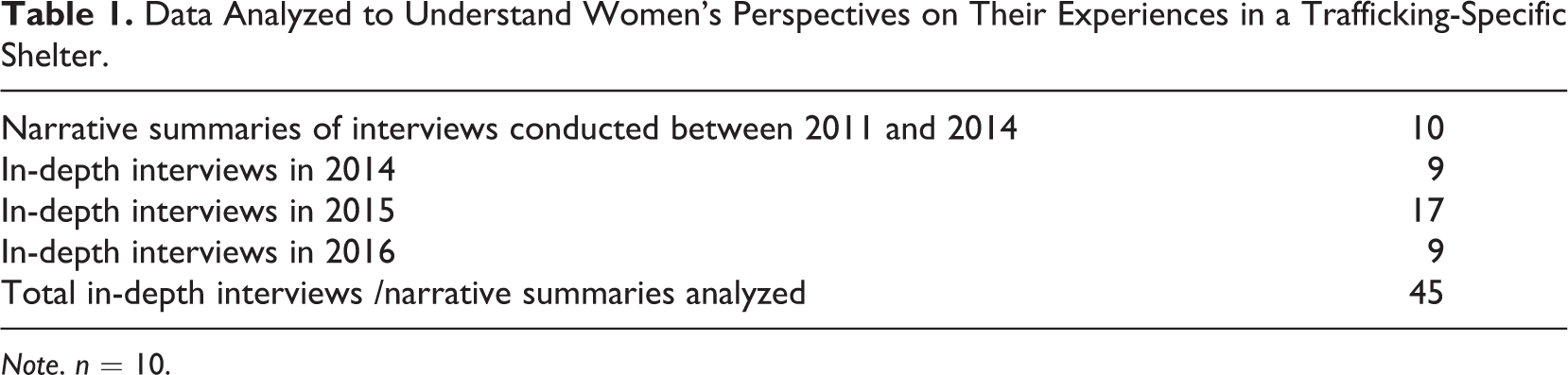
Note. n = 10.
We analyzed study data per the process outlined by Smith et al. (2012). The first step involved immersion in the primary data through active, repeated review of narrative summaries and interview transcripts. Second, codes were identified for segments of meaning, focusing on what each statement revealed about the experiences described by participants (van Manen, 1990). Codes were sorted into conceptually similar categories, which were compared against one another. Connections were made across categories, arriving at an emerging set of themes (Houston & Mullan-Jensen, 2012). Superordinate themes across transcripts were identified while maintaining attention to the “unique idiosyncratic instances” of each person’s experience (Hood, 2016; Smith et al., 2012, p. 101). Data analysis was led by the study’s academic advisor, a social work researcher. Analysis was conducted collaboratively with two additional women who managed implementation of the study and conducted interviews and as such were immersed in understanding the experiences of participants over the course of years of engagement.
Multiple strategies were utilized to establish trustworthiness. The team’s extensive engagement with participants throughout the longitudinal study resulted in a richer understanding of women’s perspectives on their own experiences, which many divulged years into the study, suggesting that relationships between participants and the research team deepened over time. Data were triangulated across multiple interviews from 6 years of study data (Leech & Onwugbuzie, 2007). We used thick description, reflecting women’s experiences in their own words as much as possible while also maintaining confidentiality (Guest et al., 2012).
Findings
Background characteristics of the subgroup participants are shown in Table 2. Six themes emerged regarding this subgroup of women’s experiences within trafficking-specific shelters. Each theme is addressed separately below.
Characteristics of Subsample.
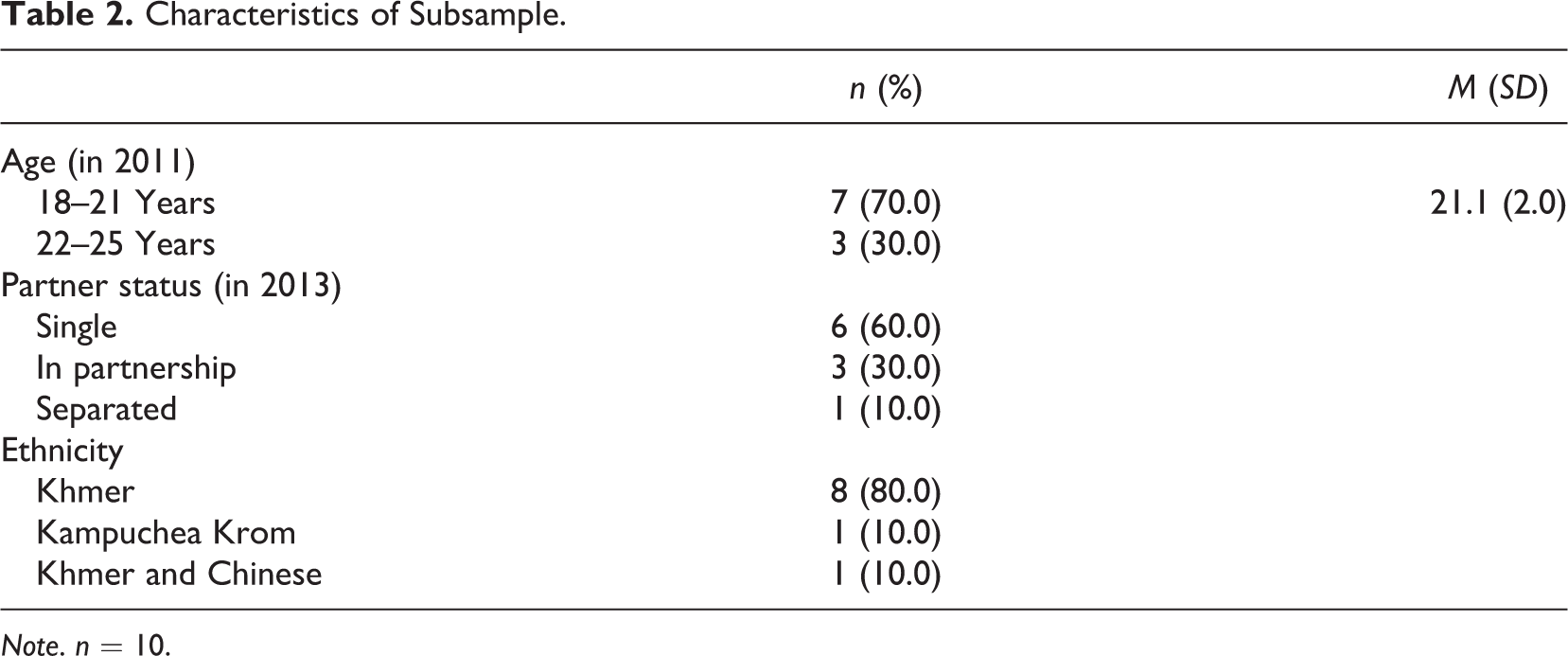
Note. n = 10.
Labeled a Victim of Human Trafficking
Some women in this subgroup contested their classifications as “victims” by law enforcement and shelter staff. Da
4
articulated numerous concerns regarding her identification as a human trafficking victim, which remained unchanged despite her persistent assertions that she was not trafficked. Da was labeled as a “victim” of human trafficking during a police raid in the KTV (karaoke club) in which she worked as a server. She questioned her need to be “saved” by police, saying: Police said they saved us. I said why did you have to save me because I did not do anything wrong? I was sitting and listening to music in a room. Then the police arrived and it seemed there was fighting and shouted “Stop…Stop…Catch…” I wondered why they saved me and what was saving? What did I do wrong that they wanted to save me? There was no one who beat or sold me. There is nothing. I was sitting in the room and I felt that I knew nothing. I was like a crazy girl. I did not know anything. And why did it happen? (2016)
5
They asked me was I forced or treated badly? I did not know what they had to force me to do. I did not know. I applied to work there by myself. Then they said I told them a lie. I told them I did not tell them a lie. What was the problem? I did not know…. They asked how old was I?…. I was 19 years old at that time. They said I was 15 or 16 years old and then I was sent to an organization [shelter]. I told them that I was 19 years old, but they did not believe me. They said I was 15 or 16 years old, so I did not know how I should say. After that, they sent me to the organization. (2016)
Forced to Live in a Shelter
Women expressed strong concerns about being placed in trafficking-specific shelters, stating that they were forced to live in a shelter. One woman, Seda, who was placed in a shelter following a police raid said: “I did not want to go [to the shelter], but I have been brought, so [it’s] not a choice” (2016). Phhoung also described her emotional distress upon being brought to a shelter following a raid, saying: “They told me they brought us to Phnom Penh. Once I heard like this, I cried until I nearly died” (2016). Da expressed similar experiences for herself and her peers—being forced to live in a shelter, denied the opportunity to speak with their families, and feeing traumatized by the transfer to a shelter: I did not volunteer. And they forced us. Both the mother of Seda and Chea called and cried until they lost consciousness, but they [the shelter staff] did not care. They did not care about their [Seda and Chea’s] parents. Their parents cried until losing consciousness. Their daughters also cried and wanted to jump. However, they [the shelter staff] did not care, hear, or know anything besides bringing us to Phnom Penh. I did not know what the problem was. I thought maybe they brought us to sell us because it looked like kidnapping. They did not care, not even calling to tell our mother that we were fine and happy, so please do not be worried about us. They took away phones from us and they did not allow us to speak although they [our parents] called us worried. (2016) No, I did not ask them to go to Phnom Penh. They [NGO staff] brought me to Phnom Penh…. They just wanted to correct me and [tell me] I should not work there [at the KTV] again later…. At first, I did not cry, but I cried when there were a lot of friends in the car who cried…. They [shelter staff] turned all phones off and they kept them [the phones] separately. They would give us back our phones when we were released. (2016) They did not believe me that I had a kid and did not believe that I was big enough. I begged them to please help me out of here because I had a kid. The kid drinks milk and there is no one to earn for that. It is only me who can feed. (2016) I told them [service providers] I would like to learn about cosmetology…. Then [service providers] told me they would try to contact an NGO that would teach me for free, and they would even give me a salary. I felt very happy hearing that. I said to them, “Don’t say that. Don’t lie to me. I wonder if you might want to take me somewhere. You may want to take me to another prison-like center.” (2014)
Desire to Leave the Shelter
Participants expressed a desire to leave the shelter environment, many of them indicating that they wanted to be discharged as quickly as possible. Bopha described her desire to leave: I did not want anything at that time [after being picked up in raid]. I only wanted to return home. I wanted to go to my friend’s home, like I wanted to look for a job to do in order to have money for spending. However, I had a salary too in that organization [shelter]. The thing was that I could not stay there…. I did not know how to stay there [at the shelter]. I had to study every week, do the exercise in the morning, learn to fight, and I was allowed to hang-out in the evening, as well as getting money, but I did not know how to stay there. My team [other women from the same KTV], which was six or seven persons, did not know how to stay there…I only wanted to go home at that time. (2016) I was asked “do you want to study in the NGO in Phnom Penh or [Province A]?”…I said I wanted to go home. I was told that I was not allowed to go home. They wanted me to study because I had a problem, like I was rescued from the dangerous situation so that the NGO accepted me to study. When I studied and had knowledge, I might have the chance to live outside the shelter. The NGO staff explained to me like this. I then said “I did not want that—I wanted to go home.” Then they did not agree with me. I did not know how to go home. I was asked “did you want to study in Phnom Penh or where?” I thought if I stayed in Phnom Penh, it would be far [from home]. If I stayed in [Province A], it would be closer because I knew that location [laugh]…. They [NGO staff] said that if I stayed at [the NGO] in Phnom Penh, I will be given a salary, but I thought that if I stayed there, it would be far…. Therefore, I thought if I learned at [the shelter in Province A], there would be Sunday for holiday and I would be brought to visit somewhere and given money for spending. I thought when I was given the chance to go for a walk, I would have the chance to run away. (2016)
Nearidei shared similar sentiments to Bopha. She described being deceived about how long she would have to stay in the shelter and deciding to run away. At the same time, Nearidei also regretted losing an opportunity to participate in vocational training: When they brought us to [the first shelter] from the police station…they only told us that they will send us to sleep at their place for a night and they will send us back home in the morning of the next day. We stayed there from that time on when we arrived [at the second shelter]…. I don’t really remember how long I stayed there…. It was about one to two months, I think, as I remembered. After that, they allowed the adult women to choose if they wanted to change their job. If we wanted to change, they sent us to the shelter to join vocational training. When I arrived at the shelter for two nights, we ran away. We secretly prepared the plan and ran away from the organization…. There I had an opportunity to learn a skill and plus I also got a salary. However, when my friends asked me to run away with them, I just followed them…. They [the other residents] did not like to stay there. For me, it was fine to stay there because I wanted to learn the skill, but when my friends ran away from there, I would be alone, so I decided to leave with them. If I continued staying there, I would get my salary and I would be able to learn a skill too…I feel regret about it. (2016)
Disempowering Engagement With Staff
Women portrayed their engagement with shelter staff as disempowering on numerous levels. First, women depicted a hierarchical environment in which their recommendations were not valued. Although on the surface staff invited client feedback, women described difficulties in openly voicing their concerns, as well as feeling discouraged that—when they did provide input—their views were not meaningfully considered or acted upon by staff. Kanya described her experience: How could I tell staff [my feedback] if the leader in the center did not listen to us when we told them?…They [shelter staff] suggested that if they did something wrong and not good, please tell them. How can I tell them? Just talked to them a little bit, they would not look at our face, not talk to us, not care about us. Who would dare to talk with them if we did not talk about that problem yet, but they would not listen to us? Who would dare to tell them? [Shelter staff A] said that she also saw as I told her. She said “if they want me to tell them, I am also afraid to talk with them because they are leaders and I am sub-worker and I do not know well, so I am afraid to talk with them.”…When you talked to them, they listened but they did not follow what we suggested. (2014)
Second, women described an environment in which they felt stigmatized and judged by shelter staff for their prior work. When asked how she wanted to be treated by shelter staff, Da said: Please do not talk as if they hate us. With their words, they say they do not hate, but their gestures tell…. They said sometimes Phhoung’s attitude was silly. Then they spoke ill about her. “Oh!!! Women who work for that workplace [KTV] are like that. If their attitude was not like that, how could they work there?” Please do not say like that! I think sometimes the staff regarded us women as crazy, stupid people…. As what I have observed from their gestures and words, they think of us…we are sitting on the ground and they are sitting on the sofa…. They say and think we are all bad, the same. Then they said I worked like that, so my attitude was stubborn and I did not listen to other people. It is not right. This is my attitude since I was born. (2016)
Third, women described an environment in which they were not allowed to make choices about their own lives, revealing another dimension of disempowering treatment from staff. Staff prejudices about women who engage in sex work led shelter staff to make decisions on women’s behalf, not listening to women about their own goals and interests, again delegitimizing women’s voices and denying their agency. Describing her experience with shelter-based vocational training, Da stated: I think it [vocational training] wasn’t helpful because I felt like they forced me to learn that skill, as I wanted to learn something else…I wanted to learn computer and English. They said I didn’t finish school, and [had] no high school diploma. They said such women like me should learn the skill they assigned for me to learn. To put it plainly, an NGO like the shelter, before they give us something, they command us to do what they want first…. The shelter said that I made my own decision. I learned how to do makeup, hairdo and sewing at the shelter, but I hate sewing. (2014) And I asked him [shelter staff]: “I learned about hair salon, so what kind of work do you think I want to do? Because if I finished the course about hair salon and you ask me to go back to sewing the bag again, I will not go. I got hurt with all my fingers because of this work,” was what I said to him. Then he said, if I don’t follow their advice, why did I renew my contract with them again?…He used a strong voice with me and he seemed to use his power above me. Then I just let it go. (2016)
Lack of Professionalism
Women raised concerns about the level of professionalism among shelter staff, articulating issues with lack of follow-through, unprofessional communication with clients and staff bias. Participants indicated that staff did not consistently follow through with what they had offered to clients. For instance, Da noted how shelter staff had discussed with her a lending program in which clients could pay back a loan to the shelter at reduced interest rates. However, in the end, there was no follow-through, eroding her trust in the program. Da said: They didn’t help me with anything. They just said it only…I want them to be sure in what they said!…It is about one year and a half already, but it hasn’t happened yet…. So this one year and a half is useless! They just interview us, but it never happens. Both me and the other students lacked trust in them and felt bored to participate with them again. (2015)
Additionally, multiple participants shared that they had difficulty communicating with shelter staff. Chea said: “we could not understand each other when they speak because they just speak scattered everywhere” (2016). Da also expressed concerns about the way shelter staff communicated, citing a lack of commitment reflected in their communication with clients. In describing one of the shelter staff, Da said: “[I’ll] repeat what [staff A] said, she said that she didn’t do it [work at the shelter] because of humanity, but she did it because she gets the salary from her job” (2015). The lack of professional communication with clients reinforced a sense of disrespect toward the women that permeated throughout the shelter’s programming.
Finally, women reported that staff demonstrated unprofessionalism through biased and preferential treatment. Kanya, explained her experience of staff bias, saying that leadership “was always concerned about only one side, not both sides. They did not clearly consider before they judged” (2014). Kanya elaborated: I think that they [services NGO provides] are all fine and good, but related to staff, they are weak…because they always listened to only one party when there were problems. Other parties they did not listen to their reasons and got angry with them…. When they [shelter staff] called us to ask for the reasons, they acted dissatisfied. Moreover, they did not pay attention or want to listen when we spoke. If they like that person, they focus on that person. (2015)
Limitations in Vocational Services
All women in this subgroup of study participants resided in a shelter exclusively for adult women that primarily focused on vocational training and business development, specifically in cosmetology. Study participants joined this shelter due to an interest in vocational services but ultimately expressed significant concerns regarding the quality of vocational instruction they received. Participants explained that the vocational training instructors did not show consistent attendance or attention. Phhoung said: “It was hard to study with them [vocational trainers]. Some days they taught and some days they were absent. Sometimes they slept” (2016). Chea also critiqued the quality of instruction: When I first learned that course, they didn’t try their best to teach me to be skillful at that time. They provided a teacher to us, but the teacher is not skillful. They just taught us briefly. So when we finished the course, we could not do well with our skills…I want to say that it is good if they can have bigger classes and they could provide the competent skills to those women, so that they are skillful in what they are studying. They [staff] can encourage them [clients]. We don’t know what will happen to them in the future, but as an organization, they should encourage them and provide them a clear/specific competent skill which they want to have…have a big space for our classroom, have proper and sufficient equipment. (2016) In the previous time, they allowed us to study outside of the shelter, but now they do not do that anymore. We study inside the shelter and the trainer inside the shelter is not professional in salon skills at all. That’s why we cannot understand the lesson well…. They have students teach each other…I think outside [training] is better. (2015)
Upon completion of vocational training, the shelter provided start-up capital for small business development. Participants like Phhoung expressed appreciation for support launching a business: “It was good because they offered me a skill and they helped me to study…. They offered me $400. They helped me to buy materials to run my shop” (2016). However, women also articulated apprehension about their readiness to succeed in launching a business in the community. Phhoung, who started her own hairdressing shop in the community with assistance from the shelter after completing vocational training, explained her fears: “I felt concerned that I could not serve my customers well because I could not do when they told me what hairstyle they wanted. In general, I did not know about hairstyles” (2016).
Similarly, another participant, Chea, explained that although the shelter was willing to help her open her own hair salon, she declined, citing that she had not developed sufficient skills to provide basic services to customers: As in my group, we feel that we haven’t understood the lesson well. We still need to learn more! To me, I haven’t known how to cut hair yet. That’s why I dare not open my own salon shop, as I don’t know how to cut hair. I don’t even know how to give a permanent at all. They only taught us the basics of salon skills. (2015) It is because I see most of my friends fail with their business [laugh]. The majority of them closed their shop and stay at home. They decided to close their shop or offer it to someone else and stay at home instead…. When I asked them, they said that the income does not meet the expenses for the rental shop and electricity. They want to change their job! When I heard that, I felt depressed and didn’t want to do it anymore…. When the customer comes one time and sees that we cannot do our job well, they will not come again later. (2015)
Discussion
Shelters can play a role in the service delivery system providing safety, basic needs, and educational opportunities (Hacker et al., 2015). However, a wide discrepancy exists in the quality of assistance provided across shelters, including in Cambodia where minimum standards have been established (Ministry of Social Affairs, Veterans, and Youth Rehabilitation, 2014; Surtees, 2013). A deeper understanding of the strengths, gaps, and possibilities of the shelter model—grounded in the lived experiences and perspectives of clients’ themselves—is urgently needed. This article begins to address this gap by exploring the perspectives of 10 women who resided in the same human trafficking-specific shelter and uniformly described negative experiences.
Feminist approaches to social work practice underscore the importance of establishing emotional safety, scrutinizing power dynamics (interpersonal, structural, etc.); maintaining accountability; and upholding the rights, dignity, and empowerment of clients (Eyal-Lubling & Krumer-Nevo, 2016; Hyde, 2013). Further, when addressing gendered issues such as human trafficking and violence against women, services must be informed by a feminist analysis that recognizes the direct and intersecting oppressions underlying these social injustices (Mehrotra, 2010; Mehrotra et al., 2016). Such ideas largely align with trauma-informed practices, recognized as especially salient when working with survivors of human trafficking (Clawson et al., 2007).
Support exists for the importance of feminist practice from the perspectives of service users. For example, a client satisfaction study in India explored the experiences of women engaged in commercial sexual activity (CSA) who had participated in services from a range of agencies of differing ideological perspectives; findings from this study indicated that “women-centric” approaches were highly valued by service users. “Women-centric” approaches were identified by their commitment to acknowledging systemic violations to women’s rights, treating each and every woman with dignity and respect, practicing nondiscrimination toward women who choose to remain in CSA, and inviting the active participation of clients in determining what services they require, including whether or not to stay in a residential setting (Wilson, 2019). This approach contrasts sharply with the experiences shared by women in this study. Below we draw on study findings and insights from the broader literature to illustrate four concrete ways in which this shelter replicated broader patriarchal structures and practices that devalue and infantilize women rather than redressing such inequalities. These divergences from feminist principles can cause explicit harms and violations within the shelter system.
First, participants expressed that they were forced to stay in shelter programming against their wishes—a violation of their legal rights that resulted in substantial emotional distress and for some, the trauma of being separated from family and social support. The issue of involuntarily detaining shelter clients has received considerable attention, with human rights workers arguing that such practices are in direct violation to international law principles (Lee, 2014; Gallagher & Pearson, 2010; United Nations Human Rights Office of the High Commissioner, 2014). Several women in the study described being unaware of where they were being taken and/or deceived about the duration of residence in the shelter. This is a marked deviation from established principles of informed consent, which requires a full understanding of one’s rights, expectations for engagement, and periodic opportunities to re-consent (Gallagher & Pearson, 2010). Further, the shelter’s disregard for women’s expressed preferences contradicts a core principle of feminist services: empowering survivors to lead their own healing (Richardson et al., 2009).
Second, the women interviewed provided several personal examples illustrating the lack of psychological safety with shelter staff. Psychological safety is a critical aspect of trauma recovery and requires care providers to be respectful, nonjudgmental, trustworthy, and able to develop meaningful and sustained relationships (Clawson et al., 2007). Such attributes are lacking from the women’s accounts; instead, they uniformly described feeling unheard, judged, stigmatized, disrespected, and condescended to by “unprofessional” staff, creating a discriminatory environment where many felt unable to openly express their concerns. Maintaining trust is especially salient in trafficking-specific services, given that human trafficking experiences often originate with manipulation and deep betrayal (Salami et al., 2018). Considering this perspective, the feeling from some women that staff failed to follow through on promises or even “tricked” them is especially harmful, and another avenue for potential coercion within the shelter environment. Such dynamics echo broader structures of gender inequality, serving to devalue or delegitimize women who deviate from normative gender role expectations.
Third, rather than promoting empowerment, case study findings highlight the many ways in which women’s self-determination and autonomy was circumscribed in the shelter. For instance, some women strongly contested their classification as “victims” of human trafficking in need of “saving.” The fact that these women were not believed and disempowered in defining their own life experiences is an acute violation of their dignity and personhood. This victimhood and rescue narrative is rooted in patriarchal norms and practices used to infantilize and control women (Hacker et al., 2015; Hu 2019). As other research with women living in shelters has shown, a “rescue and rehabilitation” model implies that women are incapable of exercising their own discretion and results in “stripping them of any freedom to make individual choices, while confining their movement to within residential institutions” (Wilson, 2019, p. 232). Such conditions are likely to recreate the coercion and denial of agency enacted by traffickers and, once again, reinforce a rigid gender hierarchy that undergirds human trafficking and other forms of violence against women (Mehrotra et al., 2016). This is antithetical to feminist and trauma-informed models of care that actively seek to restore autonomy and redress injustices based on gender and other identities (Hacker et al., 2015; Machtinger et al., 2019).
Finally, participants articulated being deceived and disappointed by the shelter’s vocational training program (which was often the sole draw to entering services), and several shared that they were subsequently unable to engage in a successful cosmetology business given the low quality of instruction. Their disappointment is best understood in the context of limited training and employment opportunities for women in the community, as suggested by the two participants who regretted running away from the shelter (despite not wanting to stay) because they had no other way to access training. Requiring women to reside in a shelter to access training can act as a form of coercion for women, exerting pressure on them to stay in the shelter despite their own preferences and the potential trauma of family separations.
The importance of promoting meaningful livelihood options—that align with client/survivor preferences and skills and are viable within the local economy—has been well documented in the anti-human trafficking literature as vital for a successful transition back into the community and protection against revictimization (Cordisco Tsai, 2017; Richardson et al., 2009). For instance, a study analyzing case data from persons using anti-human trafficking services in Thailand and Myanmar identified that the number one need prioritized by clients/survivors was to find employment (Lisborg 2017). From a feminist perspective, Hacker et al. (2015) argue that vocational training should provide a livelihood as well as create a “sense of self-value, confidence, and belonging” (p. 42). The same research questions the gendered and potentially stigmatizing nature of many vocational programs, for instance, tracking women with a presumed history of sex work into cosmetology without first enquiring about their own preferences and investigating market realities. Such gendered critiques are relevant to the narratives shared by women in the study, many of whom expressed a dislike for sewing (which they were required to do) and questioned the relevance of this activity given the perceived inability to earn money from sewing in the community. Rather than investigating potential livelihood opportunities and aligning high-quality vocational programming to clients’ expressed interests and needs, participants felt that the shelter staff were trying to “correct” them for their prior work in the KTV. Such actions within the shelter once again reflect patriarchal gender norms that infantilize women, suggesting their actions need to be “corrected” and controlled.
Findings must be considered in light of study limitations. This study aimed to achieve in-depth description rather than generalizability. These experiences shared by these 10 women all relate to a single shelter, and findings should not be interpreted as broadly representative of Cambodian women participating in shelter services, all anti-trafficking shelter programs, or even all participants in this longitudinal study. Other participants had differing experiences within shelter programs, as demonstrated by a broader set of publications from this research. Social desirability bias is always a risk in researching sensitive and potentially stigmatizing subjects. However, this risk is likely mitigated in light of the strong trust and rapport established over 10 years of relationship building between the research team and study participants.
While the case study approach does not intend to be generalizable, it highlights several broader implications for creating services that better responds to women’s needs and promotes their long-term well-being. Moreover, the scarcity of research dedicated to the perspectives of clients themselves concerning their experiences in shelter programs adds additional weight to these findings. At the micro level, organizations should develop and review transparent criteria for staff recruitment and training, including structured reflection on anti-oppression work, power dynamics between staff and clients, and the broader structural inequalities that give rise to human trafficking. As evidenced in our findings, failure to do so can result in a shelter environment that reinforces broader structures of gender (and other) oppression—causing serious harm for clients and their well-being. A values clarification process where organizations articulate and build support for a set of common values that include upholding women’s dignity—as well as continued mentorship and support for staff to uphold these values—are critical steps toward ensuring that feminist principles are meaningfully reflected in the shelter environment and service delivery. For instance, an explicit commitment around promoting client/survivor agency may lead to shifts in organizational culture that better supports client/survivors’ self-determination and creates space for them to be active partners in decision-making.
At the meso level, minimum standards of care must be followed, with clearly articulated and contextually relevant considerations for establishing emotional and physical safety, including the required procedures for informed consent and voluntary residence within the shelter. Forced detention of adult women is illegal and should not be tolerated, and paternalistic views that such conditions serve women’s “best interest” should be identified and contested. Moreover, shelter residence should not be a precondition to access vocational training, as this may coerce or manipulate women who lack viable livelihood options. Instead, a broader range of community-based employment services should be made available to address a lack of safe employment opportunities. Finally, while the existence of minimum standards is necessary, human and financial resources must be allocated for dissemination, monitoring, and accountability mechanisms involving meaningful input from service participants.
This article contributes to the underdeveloped but growing body of literature that centers the lived experiences of clients/survivors in anti-human trafficking research. By listening to and presenting women’s own experiences, this work aims to ensure that the priorities and perspectives of those directly affected inform policy and programs. Findings suggest actionable implications for promoting feminist social work practice within the anti-human trafficking sector, which more proactively challenge structural inequalities and build support for women’s own resilience and well-being.
Footnotes
Acknowledgments
Many thanks to Helen Sworn, Sreang Phaly, Phoeuk Phallen, Ou Sopheara, Kang Chimey, James Havey, Rous Yeng, Siobhan Miles, and the BLR participants.
Declaration of Conflicting Interests
The author(s) declared no potential conflicts of interest with respect to the research, authorship, and/or publication of this article.
Funding
The author(s) received no financial support for the research, authorship, and/or publication of this article.
