




Abstract
Domestic sex trafficking has yet to appear on the policy agenda in Aotearoa New Zealand, and yet to be met with a law enforcement response. Accordingly, we have minimal knowledge about the contexts in which sex trafficking is perpetrated and what victims’ experiences involve. This article focuses specifically on the attainment and negotiation of social capital by victims whose access to traditional capital is at least partially restricted by their social and familial contexts. Sixteen victims of domestic sex trafficking participated in semistructured interviews. The data were analyzed using an adapted version of Clanindin and Connelly’s (2000) three-dimensional structure of narrative analysis. Three of the themes emerging from this are discussed here; namely abuse and mistreatment in early life, the negotiation of survival within the trafficking context, and sexuality as a bargaining tool. We argue that victims’ access to traditional mechanisms of social capital accrual may be precluded by the multiple sites of gendered disadvantage that collude to entrap victims in a subordinate and exploited position. However, to negotiate their continued survival despite the constraints to their agency, they appear to access both vicarious physical capital and feminized (and usually sexualised) capital by instrumentalizing their sexual appeal or prowess and the protection of the subjectively more powerful male “partner.”
Sex trafficking in Aotearoa New Zealand has received scant policy, practice, or research attention, leading to both conceptual dissensus regarding what constitutes trafficking and a lack of awareness of its domestic manifestation. This article contextualizes New Zealand trafficking victims’ abuse and safety transactions with their abusers using Bourdieu’s (1990) concept of “capital.” Using findings from a 2018 study into the experiences of domestic sex trafficking victims, it considers the ways in which preclusion of traditional capital accrual and utilization of alternative forms of capital accrual create vulnerability to and manifest within the trafficking field. According to Bourdieu (1984/1979), social power is dependent on social capital (the collective mass of resources gained through relationships), which is legitimized by symbolic capital—both literally and metaphorically. He identified intersubjective dimensions of capital accrual, predicated on “different conditions of existence” (Bourdieu, 1984/1979) experienced by different individuals across different social spheres. Accordingly, we can look specifically at trafficking as a distinct space (or social “field,” as such social systems are conceptualized by Bourdieu, 1984/1979; Skeggs, 2004). In the discussion, we introduce distinct forms of capital accessed by participants within the sex trafficking field using a model to depict the relationship between field and capital negotiation.
According to Bourdieu’s conceptualization of social capital, forms of capital are accessed or constrained in accordance with governing social structures that manifest within an individual’s environment. Drawing on Bourdieu’s seminal construct of capital to conceptualize the constrained agentive actions within the specific social field of domestic sex trafficking can therefore be useful when making sense of victims’ experiences. We use it here to consider the (re)constitution of relational power in relation to participants’ pre-existing vulnerability to violence and their subsequent gendered disadvantage and capital accrual. We focus particularly on two forms of capital accessed by participants: vicarious physical capital and feminized (often sexualized) capital. While not all of participants’ experiences can be understood through consideration of these forms of capital, the accrual and use of capital by trafficking victims can offer practitioners a useful way to understand victims’ behavior and reliance on their traffickers.
In Aotearoa New Zealand, the classification of experiences that constitute “trafficking” is obscured by a legislative and law enforcement context in which trafficking is rarely mentioned and where sex work has been decriminalized through the Prostitution Reform Act 2003. A 2007 review of the impacts of this sex work law reform found that decriminalization enhanced the safe (Abel et al., 2007). This increased safety, however, is contingent upon workers’ willingness to contact the police, which is unlikely to be shared by people who fear the ramifications of disclosure, such as those who are underage or are forced by somebody else to sell sexual services when they do not want to.
The act of trafficking remains broadly perceived as a transnational rather than domestic problem. This perception is reflected in New Zealand’s National Plan of Action to Combat People Trafficking, which sets out the rights of migrants and visitors who have been trafficked or forced into the labor industry, without any mention of the commercial exploitation of New Zealand residents through forced participation in sex work (Ministry of Justice, 2002). Until 2015, this commercial sexual exploitation only legally constituted trafficking if it involved the crossing of national borders (New Zealand Legislation, 2016).
Despite this removal of the transnational requirement, there has never been a convicted case of trafficking in New Zealand other than for the import and subsequent exploitation of people in labor industries. This does not imply there is no trafficking, but rather that it is simply not being prosecuted as such:, high-profile cases involving the sale of young people in prostitution for the sole profit of caregivers or adult friends/boyfriends (see Hurley, 2018a, 2018b) have been tried under legislation with lesser penalties. The most common of these is ‘assisting a minor into prostitution’, which is prohibited under s.23 of the Prostitution Reform Act 2003 and is punishable by up to seven years imprisonment (New Zealand Legislation, 2003). As a result, domestic trafficking is largely absent from public and law enforcement discourse, and there is minimal domestic research reported on the topic to date. Accordingly, this is the first research project in Aotearoa New Zealand that attempts to explore domestic sex trafficking victims’ experiences.
The use of the term “trafficking” is contentious, and is often problematically conflated with sex work generally and used to further neo-abolitionist agendas (Kempadoo, 2016). It can also evoke inaccurate stereotypes about what trafficking must involve and who it impacts (Thorburn, 2017), leaving actual manifestations of trafficking unrecognized by health and social services. The United Nations defines sex trafficking as all purchased sexual activity involving people under 18, as well as the purchasing of sexual activity from adults who are forced or coerced into providing sexual services (Doran, Jenkins, & Mahoney, 2014). Similarly, jurisdictions such as the United States refer to the inclusion of children in prostitution as trafficking (Estes & Weiner, 2005; Hanna, 2002; Hughes, 2005) regardless of the use of force involved in the facilitation of this. However, for the purposes of this study, we have defined a victim of trafficking as any person who is forced or coerced through violence or the threat of violence to provide a sexual service primarily for somebody else’s financial profit. Correspondingly, just as the presence of force or coercion differentiates trafficking from sex work, the term “trafficker” differentiates those forcing or coercing victims to prostitute from “pimps” or managers acting within the lawful sex work industry generally.
While the experience of trafficking is often separated from the subsequent experience of exploitation, I have followed the lead of authors who use the trafficking to encapsulate both the process of recruitment into the relationship with the trafficker and the final product of the exploitation (e.g.,Newby & McGuiness, 2012; Tudorache, 2004). The term “trafficking” as it is used here thus denotes the entire experience from recruitment to exploitation.
Positionality
Both authors are registered social workers who have practiced on the frontline with people impacted by gender-based violence. This study was conducted as part of the first author's doctoral thesis, which takes a feminist, rights-based approach to sex work while framing domestic sex trafficking as a particular and under-recognized manifestation of gender-based violence. In the absence of any prior domestic research on sex trafficking from which to build, this research sought to answer the question: “how do victims in Aotearoa New Zealand experience domestic sex trafficking?”
Domestic Sex Trafficking Contexts
Vulnerability to trafficking recruitment can arise from numerous avenues, and literature on trafficking demonstrates the often insidious nature of initial exposure to exploitation. As there have not been other studies in New Zealand into the experience of domestic sex trafficking, we must look to international research (most commonly U.S. and U.K. research), the findings of which may not directly transfer to the local context. Women and girls in particular are often targeted while in economically desperate situations, optimizing the potential for “pull” (alluring) factors, such as immediate safety, accommodation, and access to substances, to ensure their compliance (Hopper & Hidalgo, 2006; Kerr, 2014). This is inextricably associated with the preclusion of conventional social capital, such as family protection, nurturing, and resource provision.
A desperate need for income and housing makes young people without easy access to these resources extremely vulnerable to being coerced into prostitution by promises of wealth and security, despite the mistreatment by the people managing them that accompany these benefits (Cobbina & Oselin, 2011; Hodge & Lietz, 2007). U.S-based studies have found that victims are usually recruited directly from situations of marginality, for instance, youth who are homeless, youth who are in or who have escaped statutory care residences, or youth or women with active addictions (Anderson et al., 2014; Vieth & Ragland, 2005). The precursors to this marginality (such as histories of abuse or abandonment) create immense vulnerability, which is identified and capitalized on by traffickers who can entice victims with promises of basic essentials and emotional security (Dorais & Corriveau, 2009; Hanna, 2002; Parker & Skrmetti, 2013; Reid, 2016). However, it is unknown to what extent this is the case in Aotearoa New Zealand, although research into underage sex work suggests that histories of abuse and family marginality are instrumental in shaping adolescent girls’ entry into self-facilitated sex work (Thorburn, 2016).
In the United States and Canada, exploitation through domestic sex trafficking is often catalyzed by the victim’s relationship with an abuser who profits from the victim’s selling of sexual services—typically a “boyfriend” figure or a family member, whether acting alone or as part of a coordinated scheme (Dorais & Corriveau, 2009; Reid & Jones, 2011). Victims’ desire for protective attachment relationships and the promises that traffickers give to victims about relationships and secure futures create a powerful mechanism for trauma bonding between trafficker and victim, and victims may not be consistently able to recognize the exploitation inherent within this (Dorais & Corriveau, 2009; Smith et al., 2009).
Copious parallels have been identified between the coercive behaviours inherent in intimate partner violence and those in trafficking. In both situations, the victim is isolated, manipulated through fear and lack of exposure to alternative realities, and controlled physically and psychologically (Bullard, 2011; Farley, 2003; Kennedy et al., 2007). Coercive control often manifests in abusers’ strategies of intimidation, emotional abuse, coercion into activities, and threats of violence to the victim or their family (Kelly & Johnson, 2006). It does not always entail physical violence; rather, it is often perpetrated through psychological means that induce anxiety, fear, loss of self-esteem, and symptoms of post-traumatic stress disorder (Chang, 1996).
These methods of coercive control can become enmeshed within every facet of the victim’s life, such as their economic power, relationships with family and peers, ability to work, and their expression of sexuality. The intermittent or threatened use of violence increases the efficacy of these methods. For example, abusers might conduct surveillance of victims’ homes, workplaces, and forms of communication, and determine victims’ styles of dress, diets, and sleep routines (Ludsin & Vetten, 2005). Many models of trafficking involving minors highlight some form of perceived emotional, practical, or social trade-off; in other words, methods of accessing social capital that is otherwise unattainable (see Chase & Statham, 2005; Cobbina & Oselin, 2011; Pearce, 2009). The consistency across these models shows the growing consensus regarding the pivotal role of traffickers’ promises of protective love in combination with physical and sexual violence in attaining compliance of victims. In other words, the experience of negotiating and accessing basic life necessities or affectionate relationships in the context of vulnerability often accompanies further victimization—a transaction of various safeties.
Method
This research was been underpinned by a feminist approach, principally because of the highly gendered nature of trafficking. Feminist research is centered on prioritizing the lived experiences of women, and in particular, women whose expression of experiences have historically been silenced (Ezzy, 2002; Oleson, 2000; Sands, 2004). Feminist theories highlight the oppression of women by patriarchal systems of power, identify contributing factors and avenues for change, and situate present situations within a historical context of gendered oppression. The application of such theory is active, not passive; as bell hooks (2000) states, “one does not become an advocate of feminist politics simply by having the privilege of having been born female. Like all political positions, one becomes a believer in feminist politics through choice and action” (p. 7). Simply put, feminist research seeks to avoid the replication of oppressive attitudes toward and experiences by women (Yegidis et al., 2012).
Given the close attention feminist theorists pay to prevailing power structures and the conscious repositioning of oppressive dynamics, many feminist researchers often seek to establish researcher–participant relationships that are non-exploitative, collaborative, respectful, and feature the shared construction of data (Dey, 1993), which we believed to be possible following close attention to opportunities for implicit or explicit expressions of mutuality. Accordingly, the desire to avoid replication of power imbalances and coercion informed our approaches to working with victims throughout this research. This study posed various ethical challenges, such as ensuring physical safety from further abuse or violence; a reliance on victims’ self-identification, which was complicated by the lack of a cohesive national narrative about what constitutes trafficking; the potential for retraumatization and obtaining true consent from prospective participants who may still be experiencing trauma-related disruption to their mental health; and the potential for people to volunteer to participate to obtain the offered voucher while not feeling entirely comfortable with the interview process.
As trafficking is a subject likely to be shrouded with trauma and both physical and emotional risk, decisions about recruitment, inclusion criteria, and safe spaces to interview were all managed exceedingly carefully. Victims of domestic sex trafficking were recruited for interviews using convenience sampling, chosen for its potential to overcome the secrecy surrounding victims’ experiences and the anticipated difficulties of finding victims eager to share deeply personal and potentially still fear-saturated stories of trafficking. While convenience sampling has been criticized for being unscientific, it accorded prospective participants the opportunity to safely consider the relative risks and benefits of participation from a safe distance, and circumvented their understandable suspicion about the reliability of the first author as the researcher by offering the opportunity to peruse her online profile. This was intended to allow participants the opportunity to gauge the first author’s trustworthiness and stance on issues of violence, as this had been an unexpected benefit of social media profiles in the first author’s earlier research into similar topics (Thorburn, 2019). Accordingly, recruitment posters outlining the inclusion criteria (being over 16, being currently safe, and having been forced by someone else to sell sex when they did not want to) were circulated through multiple social media platforms, including Facebook and Tumblr. This initially attracted 23 prospective participants from urban areas of Aotearoa New Zealand who met the stated criteria; however, several were excluded on the basis of risk, over the following weeks of rapport-building and dynamic risk assessment, seven subsequently disclosed or became subject to emotional or physical risk (such as still being on close contact with the trafficker) that the first author considered to preclude their safe involvement with the project, leaving a total of 16 participants. Like those who were able to participate fully, the seven excluded participants were given the NZD$40 voucher for their time (given to acknowledge that their experiences were valuable, and to incentivize participation), but their data were discarded.
Risks of further harm were partially ameliorated by the application of the authors’ social work training, including both the use of a formalized risk assessment (based on that used in the authors’ frontline family violence work and involving abusers’ access to the victim, any recent victimization, current support, and the risk of self-harm or suicide) and our own judgment regarding participants’ comfort and preparedness to participate. In some instances, when the first author assessed the prospective participant as being too dissociative or distressed to safely participate, or assessed the risk of ongoing violence to be high (e.g., when one participant disclosed that her partner monitored her phone), we gave them the voucher anyway but did not proceed with interviewing. A risk matrix had been developed in advance to guide both pre-assessment and ongoing safety decisions (Thorburn, 2019). Accordingly, attending to evolving risk as it arose throughout the period of engagement with participants, such as in the event of escalating violence by a new partner, renewed contact between the victim and trafficker, or deteriorating mental health or unexpected mental health crises, formed an important part of risk management. Twice, this necessitated the immediate involvement of other agencies to ensure participants safety.
The period of extended risk assessment also served an additional purpose of fostering familiarity with the first author and provided opportunities for participants to “test” her responses to difficult disclosures, challenge her motivation for conducting the research, and ask questions that allayed their concerns about privacy and use of information. For example, communicating initially by text message meant that participants could ask questions such as “why are you even interested in this and what do you get out of it?” and “what if I told you I’d be raped every day since I was 10?” They could then judge from our responses how safe they might feel to tell us stories of violence or trauma. Every participant was only interviewed once (12 in person, 4 by phone), but this was preceded by weeks to months of intermittent contact either by phone, by text, or by social media messaging to build participants’ comfort with being interviewed—important as all but two had never spoken about the experience of trafficking in any formal setting.
All prospective participants who made contact to express interest were offered avenues for additional support, including mental health crisis support, referrals to rape crisis organizations, information about local women’s refuges, and the opportunity to make a supported report to the police. As participants were all over 16, and were not physically unable to access support such as from Women’s Refuge, we did not report to the police against their will if they were at continued risk (and this risk to physical safety was uniformly from new abusive partners, rather than the original trafficker/s). This support and facilitation of access to services was provided irrespective of whether they were included in the final sample. In order to participate, participants needed to have been coerced into selling sex for someone else’s profit when they did not want to, and must have been unable to say no for fear of violence. This latter criterion was established to circumvent the challenge of victims self-defining as being “trafficked” but variably interpreting “force” as being made to sell sex by violence or the threat of violence (which was our own definition) or as feeling “forced” to participate by social circumstances and a lack of viable alternatives, which would not constitute trafficking in our view. They also needed to be now free from the trafficker in order to safely participate. Participants were then interviewed between March and July 2017.
Interviews were set up with feminist principles of power-sharing and attention to the potential for coercion in mind (Fonow & Cook, 1991). We encouraged the pace and content to be driven by participants and paid close attention to dress style, location, and use of language in order to maximize comfort, show respect for their time and the value of their stories, and make it apparent that there was no onus to proceed. Participants were communicated with in advance of the interview in an attempt to engender greater comfort and familiarity with the interview content. They were told they would be invited to speak about their early lives, how they became involved with the person who had forced them to sell or trade sex, what stood out for them about that experience of selling sex, and what they felt was (or would have been) helpful to them during and beyond the time they were forced to sell sex. These same topics were bullet pointed and given to participants during interviews, and they were asked whether they would like to simply start speaking about what they felt was important or whether they would prefer to be guided. For those that opted for guidance, we invited them to tell us about their families and childhoods and then continued to use minimal encouragers and open questions to develop their stories from there. Prior to the interview, participants were asked their ethnicity and age that they were first forced to sell sex by somebody else. We intentionally did not ask their ages (other than to make sure they were over 16) or about their level of educational attainment, statutory system experience, or social class strata, however much of this naturally emerged through their narratives.
Of the 16 participants, 15 identified as female and 1 as male. Nine identified as New Zealand Māori and six as New Zealand European. Eight were trafficked while under the age of 18. For all but four, a “boyfriend” figure was instrumental in their entry into trafficking. Each had been subjected to violence or the threat of violence by the abuser forcing or coercing them to sell sexual services for the abuser’s profit, thus meeting the definition of trafficking used in this article.
Given the potential for data regarding the experiences of such historically silenced subpopulations to be misappropriated and used in a way that is not beneficent, a narrative research approach has great potential to mobilize the aspects of the self-impacted by socially situated trauma, and to promote participants’ use of voice, power, and agency in storying their own experiences (Morse, 2007; Shaw, 2003). The data were therefore analyzed using an adapted version of Clanindin and Connelly’s (2000) three-dimensional structure of narrative analysis, informed with a feminist lens to pay particular attention to the structural facets of power, particularly in relation to gender. This involved dual layers of line-by-line coding: first descriptive, noting the immediate characteristics, and then abstract, which noted underlying connections. These were grouped into codes, subcategories, and categories using the organizing framework of narrative elements (specifically, character, place, temporality, and context).
During this initial phase of familiarization, it became apparent that the identification of aspects of survivors’ narratives encompassed a wider range of “interaction” aspects, contained a greater focus on the self or “character” in relation to the story, and required a contextual focus different to that identified by Clanindin and Connelly. Consequently, I adapted this method—while still adhering to the use of a three-dimensional structure of analysis, the dimensions were altered to capture the breadth of the data and to attend fully to themes of power and disparate access to resources. Themes relevant to capital, and thus represented here, include abuse and mistreatment in early life, the negotiation of survival within the trafficking context, and sexuality as a bargaining tool. Each of these is discussed in depth below. Bourdieu’s (1971, 1984/1979) conceptualization of social capital, and correspondingly the expanded considerations of capital in gendered environments, such as vicarious physical capital and feminized capital (Skeggs, 1997; Watson, 2016) have then been used to offer explanations for participants’ actions and relationships throughout the trafficking experience, and these concepts are expanded in the Discussion section.
Ethics approval was granted by the University of Auckland on the 25th of October, 2016, for a period of 3 years.
Findings
Abuse and Mistreatment in Early Life
Only 2 participants of 16 described childhoods that were demonstrably and consistently safe and protective. The majority recounted childhoods characterized by rejection, uncertainty, violence, abuse, inconsistency, or absenteeism. Sexual abuse in early childhood was a common experience among participants—all but three were subjected to contact sexual assault (almost universally penetrative) in childhood, and stories of abuse were accompanied by explanations of parental inaction, such as “Mum wasn’t able to protect me,” and “we were just given out to [the sexual abuser]”. Michelle, for example, described her relationship with her parents by saying “good, I had a really good childhood.” She later went on to describe an incident in the family home: My mum’s partner at the time, I think I was third form [the first year of high school] [at] college, he tried to, yeah, he tried to make a move on me, one drunken night, and he hopped in my bed, yeah…When he jumped in my bed I froze. The next morning I told my mum what happened…and then a couple of months later, my mum married him. (Michelle [referring to an event prior to the trafficking]) Well that guy [the trafficker] raped me, but I was also molested by my uncle when I was 9…I told my [grandma]…she just said “oh don’t bring it up again, he must have thought it was his wife.” (Sarah [referring to childhood abuse prior to the trafficking]) This guy had smashed the window and climbed through that window and waited for my mum to walk through the hallway, and he got a cord round her neck and dragged her back into the lounge, and raped her in front of me and my brother. (Jessica [referring to witnessing abuse prior to the trafficking]) He was a lot older than me, I was 10 he was 19 and yeah I fell for him. I was sort of in exposed [to] sex work you know…I was a virgin and one night, he was a heroin addict and he was sick [from heroin withdrawal) and I asked how I could help and he said “would you do anything for me” and I said “yeah” and he got up and dressed me up and put me on K [Karangahape
1
] Road and my first job was this guy, he took me to a hotel and he paid NZD$600 for my virginity. (Jessica [referring to her introduction to the trafficker and her first experience with a client]) He promised my family he would look after me and he didn’t. And he took me from [my home town] and actually trafficked me and sold me out. (Sophia [referring to the trafficker]) I actually kinda wonder, did my family actually have something to do with it. Did they know I was actually going to be casted out and sold out? It seems so strange. (Sophia) Yeah because he seemed like a nice fella and that and my parents were like “Oh he seems nice and you can go out with him” and that, but apparently it was wrong, I was wrong. (Des [referring to the relationship with her trafficker]) There were some days where he actually made me feel good but that didn’t last long. I had no one. I got kicked out of home when I was 11, and I’ve never really had anyone so I think for me it was more just finding someone that would comfort me…. At the beginning it was teenage love I suppose. We got on really well, we’d play fight, we’d do everything. (Corith [referring to her relationship with the trafficker]) I first got into it when I was 15 and I lived with my dad in the country, and my dad would often go to the pub and leave me home alone on the week nights…I met this older man…and we started seeing each other, he was about 35.…He said we’d be a family, that he’d be my family, and he would make sure I’m okay. (Sarah [referring to her relationship with her trafficker])
Negotiating Survival
Participants also reflected on the gains offered by abusers, even during situations of exploitation or violence. Access to safety (as the abuser would prohibit excessive violence by “clients”), drugs (particularly methamphetamine), transport, food, and affection were all potential gains, and these were recognized as sufficient to compel ongoing contact with abusers. Yeah [it was] my boyfriend, and he said “can I sell myself for money” and I said “no” and then he sold me off to this guy…. He forced me to give him a blowjob and that too and then I refused and he started punching me and that and I got knocked out for a little while. (Des [referring to the trafficker and to the first interaction she had with someone who paid her trafficker for sex]) Yeah they would set it up, they would set it up and make us go in, make us do the work and they would already collect the money. They would already talk to their client collect their money and then make us go in and say that they will give us a puff or something for doing that. (Michelle [referring to the traffickers] A whole two years of trust, two to three years I built trust…[I thought] I need to start complying and I need to actually just do as I’m told ‘cause I know I’m so deep in this, you know, there’s no way out…and so I got small stuff, you know, like clothes, money, stuff other girls didn’t get from him. (Sophia [referring to the trafficker]) He was safe, he kept me safe…. Even though he made me do the work and earn the money. (Michelle [referring to the trafficker]) It was kind of like “you do what I say, and I will protect you”…there was always somebody out there that was stronger than you. (Hope)
Sexuality as a Bargaining Tool
Sexuality was often alluded to as one of the few tools that participants could draw on to gain power in situations or to moderate the extent of violence. Michelle, for example, recounts a violent rape that she pretended to enjoy because she knew that would elicit a kinder response than if she showed her distress. Yeah I was trying to close my legs, he was ripping my pants off and I was crying, trying to hide my tears. I didn’t want to get a hiding or anything or even worse, [so] I pretended to enjoy it. (Michelle [referring to an interaction with someone buying sex]) It wasn’t familiar. I remember I stood there, looked at my friend dumbfounded, like, what am I to do. She took me into the bathroom cos she knew I didn’t wanna do it. And, um, my friend reckoned “just follow my drift ok. You’ll be ok.” My mate told me to tell him I was younger than I was. So tell him I was 14 or 13 and he was like “Yes, yes,” and he used to make us suck his dick. Like he used to make us gag and choke and make us tell him it’s our first time sucking dick. (Michelle [referring to an interaction with someone buying sex]) Yeah [the boss has] business arrangements, so [if I have the child with me] it will stop and they won’t have any of it. So then, um, I was like “okay then bring me my baby then I have no other fucking way to do it” [service clients]. So then I was texting this other person [employed by the boss] saying “hey mate um do you remember that time that you like came on to me, and the next night we done it [had sex against the boss’s orders]?” He was like “oh yeah okay.” (Sophia [referring to an arrangement with an employee of the trafficker])
While it was unusual for victims to have been offered support by bystanders or family members who had some idea of the abuse they had been subjected to, three participants described instances where someone had attempted to intervene. Yeah my grandparents intervened because the last time my step-father had abused me I was taken out or he took me out to my grandparents place and he just dropped me at the side of the road. I went to see my grandparents and from there I went straight to a shower. (Shannon) Yeah one of his friend’s wives she pulled me aside and then he cut off all contact with her and his friend because she was like, “you know, you need to get out” and I just felt like I couldn’t. (Kate) I remember standing on the street with young women going past and they pulled over, you know, and I didn’t know what the fuck to think but I said “okay” and I broke down and they actually paid for a hotel for the night and came to me the next day with a gift basket, with new clothes, and shampoos and nice things, you know, these are church people but they showed me something. (Jessica) And that’s all I held onto. I confided in my friends. And all we had was each other. (Sophia)
Discussion
The use of social capital as an orienting concept through which to consider victims’ actions and the ways that trafficking constrains their access to various forms of capital emerged after the analysis of data, rather than prior to analysis. Bourdieu’s conceptualization of capital offered a useful explanatory framework for identifying how traditional methods of capital accrual (or endowment) were precluded through intersecting experiences of marginalization, and what alternative forms of capital were alternatively accessed even in situations where victims’ autonomy was significantly limited by their traffickers.
Examining how these participants access social capital compels consideration of environmental constraints to the traditional access to capital that is typically endowed throughout adolescence and early adulthood. Dimensions of capital accrual vary according to social role and environment and are oriented by social conditions and relationships. Notably absent from participants’ narratives were accounts of protection, support, and safety in early life. Conversely, they shared stories of abuse and abandonment, and either dismissive responses to disclosures of violence in childhood, or a family breakdown of such proportion that it precipitated the seeking out of alternative figures to fulfill these family roles. Recognizing the limitations of traditional capital accrual, or the attainment of personal and practical resources (Skeggs, 1997), is therefore integral to considering how participants become oriented toward alternative means of capital accrual, such as vicariously through a more powerful male figure or by using feminized (and for these participants, sexualized) means of bargaining.
Watson (2016) departs from Bourdieu’s more limited (and less gendered) analysis of capital, outlining what she terms “vicarious physical capital”; in other words, the privilege afforded naturally to men that can then be accessed vicariously by women in intimate partnerships with men. This concept, while to some degree divergent to how it was utilized in her study (i.e., solely as a means for provision and protection in homeless shelters), is directly applicable to participants who exercise both compliant and survival-oriented behavior through the mobilization of vicarious physical capital. For example, some participants attached themselves during their adolescence to men who could provide safety from intuitively more dangerous clients, traffickers, or associates, irrespective of the level of (both anticipated and unanticipated) violence and exploitation perpetrated by these partners. This is consistent with previous studies into trafficking, which conclude that young people who may be lacking consistent relationships with other proximal figures (Hanna, 2002, Reid, 2011), or who are either living on the street or suffering intrafamilial abuse at home (Anderson et al., 2014; Reid & Piquero, 2014), or who have histories of neglect or abandonment (Estes & Weiner, 2005; Parker & Skrmetti, 2013; Reid, 2012), often seek out a subjectively more powerful “other” whose treatment of them is anticipatable.
This relationship with an abusive trafficker posing as a “partner” (such as Des’s and Sophia’s “boyfriends” who took them from their homes with parental permission) functioned as the principal site of perpetration of violence and thus the primary setting for participants’ experiencing of symbolic domination, in that it appeared to be predicated on the minimization of violence occurring “beneath the veil of an enchanted relationship” (Thompson, 1984, p. 56). Such reliance on an abusive male figure for protection and for the practical essentials for survival sets the scene for intense vulnerability to become a precursor to the seeking of vicarious physical capital represented by the masculinized “boyfriend” role. However, this seeking of vicarious capital (Watson, 2016) through the attainment of perceived secondary privilege associated with this perceptibly powerful and protective “other” was accessed at significant personal cost, as is apparent in participants’ recollections of rape, exploitation, and physical violence outlined in the findings.
Vicarious capital in this setting, therefore, is established as tentative and precarious, and cannot be converted into personal symbolic capital because of the temporal nature of the capital, that is, victims’ dependence on the maintenance of a particular relationship with the trafficker (Skeggs, 2004). Moreover, while previous conceptualizations of vicarious physical capital have centered on women’s own access to capital via a proximal male figure (Watson, 2016), participants in this study highlight the efforts of their parents to obtain vicarious capital by proxy. Their parents appeared to chiefly regard their children’s romantic and sexual relationships with adult men (which by virtue of age were inherently abusive) as the “setting up” of a good future life via the offerings of the male partner, in other words, a natural pathway to social capital. Correspondingly, parents’ normalization of victims’ sexual relationships with adult men appears influential in their orientation toward the seeking of vicarious physical capital, as it arguably substitutes traditional capital accrual for an exploitative and unequal power dynamic where the negotiation of necessities for survival has to be accessed vicariously. This has been little theorized: Studies specifically examining vulnerability to sexual exploitation such as through trafficking and identifying sexual abuse as a common antecedent are plentiful (see Ahrens et al., 2012; Holger-Ambrose et al, 2013; Stebbins, 2010), but these do not explore the extent to which predatory sexual relationships initiated by men against children were endorsed by family members, despite the oft-stated role of older “boyfriends” in recruiting victims (see, e.g., Anderson et al., 2014; Brayley et al., 2011; Reid, 2016).
It is important to note, however, that the disproportionate reliance on vicarious capital did not entirely negate participants’ tenuous access of conventional social capital; as outlined in the findings, some also benefited from the support of family or bystanders or of similarly victimized others. This assistance from protective or supportive structures, although minimal, is reflective of participants’ residual access to social capital that is socially endowed and reproduced through family and social support structures.
Interlinked with the attainment of vicarious physical capital is the negotiation and use of feminized capital (Huppatz, 2009); the double-bind of a gendered power differential that restricts autonomy and maintains a status quo of oppression but simultaneously provides for access to gendered sexuality as a bargaining tool. Butler (1993) argues that to access the protective mechanisms of the field’s normative legitimation of forms of social capital, participants must subscribe to these norms. In this case, therefore, using symbolic (feminized) capital requires victims to act in accordance with these regulations, such as tolerating violence, earning the expected amount of money, and adhering to both abusers’ and clients’ wishes for (often degrading) acts of service. In short, participants offered use of their bodies and skilled sexual services as a form of capital, as this often represented the primary means through which they obtained approval and consequent safety from further physical violence. While this was originally conceptualized by Huppatz (2009) as naturally occurring “female” or “feminine” capital, I use the term “feminized” capital here to denote the socially constituted reproduction of gendered behavior that informs participants’ methods of capital attainment. In the trafficking field, this predominately centers on feminized sexuality. This is to a degree inseparable from vicarious capital: female sexuality is prepossessed and traded to invite and maintain an access route to vicarious physical capital.
Social capital and the transaction of feminized capital are interlinked with social field—the setting where capital is used, in this case, the situation of trafficking. While Bourdieu has been criticized for his lack of acknowledgment of gender (see Adkins & Skeggs, 2004), the concept of capital cannot be separated from the wider social environment and the values that are converted into social power. In this context, this inherently involves the construction of gender within the social field—trafficking violence—and, in particular, the transactional use of the female body. Traffickers’ dominance commanding women’s submission was demonstrated predominantly through physical and sexual violence, a phenomenon documented in numerous prior studies into the sexual exploitation of young women (Dorais & Corriveau, 2009; Hanna, 2002; Parker & Skrmetti, 2013; Reid, 2016).
Bourdieu’s work on embodiment must consequently be extended to incorporate the multitude of ways that physical and social capital influence the (re)construction of bodies in time and space, and how these are given meaning through the exercising of power, coercion, and relational exchange (Shilling, 2012). Accordingly, Watson (2016) states that “the political economy within which bodies exist is central to contextualizing practices and meanings attributed to young women” (p. 260). Not all of the gender-based abuse was labeled as such by participants—rather, “lower-level” abuse was typically normalized and/or minimized, as illustrated by participants’ minimizing descriptions of abuse. Simultaneously, however, participants capitalized on this use of their bodies. Tolerating sexual victimization, sexual offerings, and sexual prowess were each used to gain negotiating power, such as by requesting reciprocal favors or benefits. Equally, their use of sexuality then functioned as an additional bind to their traffickers, and a reinforcement of their positions of sexual subjugation as they submitted to sex they did not generally want, in the absence of viable other potential sources of power. Accordingly, Moi (1991) refers to the “socially produced body” as an “embodied politics,” as gender performativity is reproduced and intrinsically embodied within the trafficking field, texturing access to capital. This embodiment is reflected in participants’ experiences of performing sexual acts for abusers and selling sex, which, if done “well,” largely protected them from the worst of the potential violence that traffickers, clients, and associated could perpetrate. In sum, social capital is both symbolically and practically attained by these victims through the interlinked means of submission to a proxy “partner” figure whose masculinized role provides protection while perpetrating further violence, and through performative (sexualized) femininity that is predicated on sexual service and which can be employed through multiple “conditions of existence” (Bourdieu, 1993), that is, as a partner, prostitute, and associate. This is illustrated through the following diagram of the trafficking field (Figure 1) and the ways that this both shapes and is shaped by forms of capital accessible to and utilized by victims of trafficking.
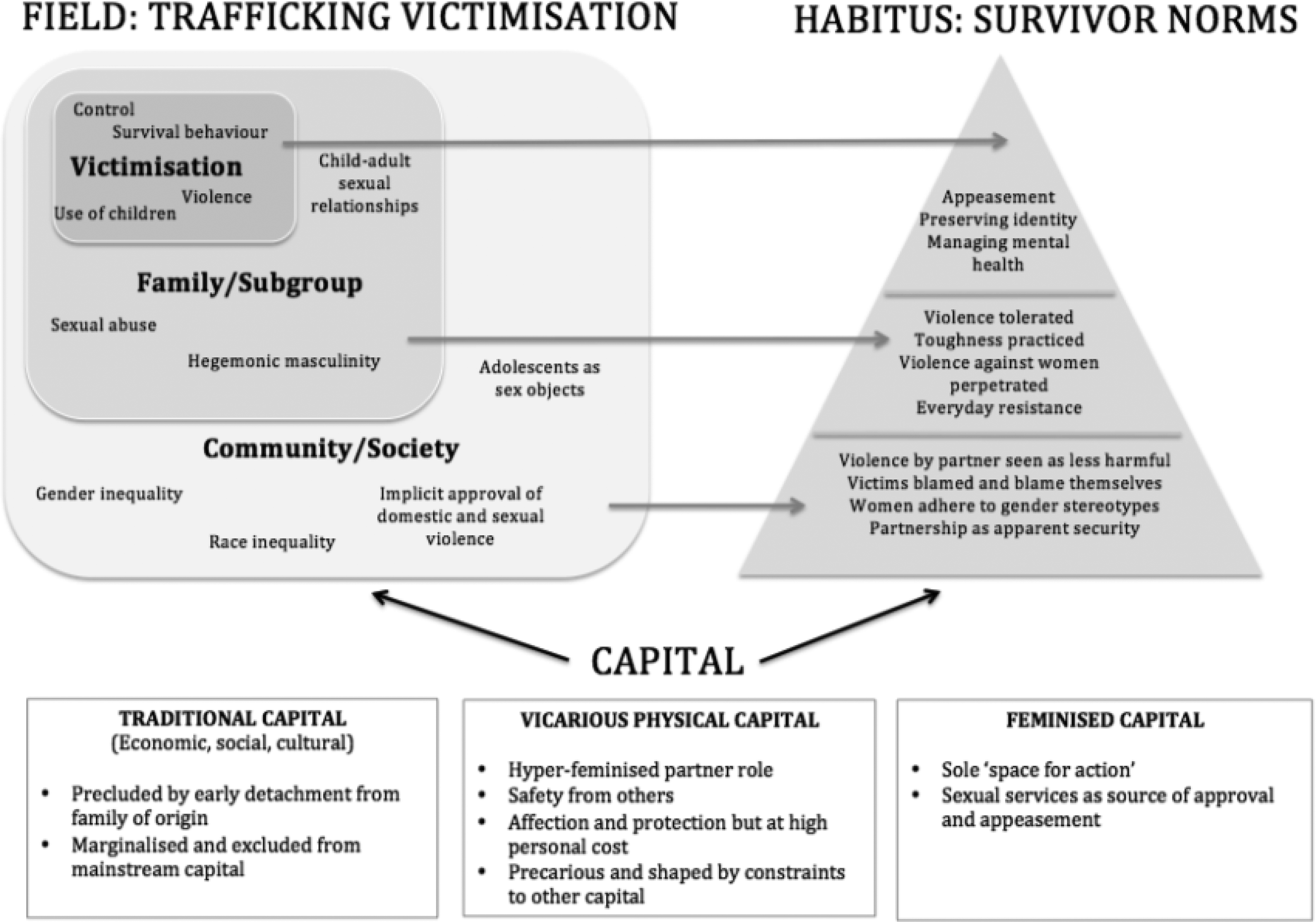
Forms of capital in the trafficking field.
Ultimately, these findings have direct implications for practitioners and policy makers working closely with victims or victims’ services, as they offer explanations for victims’ behavior and their ties to their traffickers that may otherwise be misinterpreted as solely affection or “choice.” However, given the sample size, further research needs to be conducted to ascertain how consistent victims’ reliance on these forms of capital is across different trafficking fields, or among victims with different backgrounds and therefore different levels of access to traditional forms of social capital.
Conclusion
This study was limited by a self-selecting sample that excluded high-risk participants and depended on participants having some level of social autonomy (i.e., the freedom and capacity to contact, communicate, and meet with a researcher), and focuses only on domestic trafficking. However, of this small sample, participants’ accounts speak to interlinked types of capital accrual: vicarious physical capital (the access to a subjective sense of safety or security via a powerful male other), and feminized capital (capital represented by fulfilling the compulsorily sexualized and subordinate female role), which can be utilized within multiple spheres simultaneously and could be utilized to access safeties and necessities. The vulnerability of pre- or barely pubescent girls whose families enable or endorse apparent romantic relationships with adult men arguably sets the scene for vicarious physical capital to be seen as the only viable option, and this merits consideration in child protective services when attempting to mitigate the potential for later exploitation.
Both physical and feminized capital are identifiable in the recruitment and exploitation of victims, which are premised on targeting marginality-related vulnerability and the exploitation of ingrained gendered schemas that create a feminized role as subordinate to the partner masculine role, and which perpetuate the exploitation of female sexuality within the trafficking field. Accordingly, it is evident that further research needs to be conducted into victims’ experiences of being trafficked and the gendered roles of proximal others, with a view to establishing key sources of influence that collectively facilitate the (largely unchallenged within the social field) position of subjugation through sexual exploitation, and also into the influence of parental sanctioning of inappropriate sexual relationships. In addition, establishing how constructions of gender within dating relationships lead to this manifestation of abuse should help with the development of prevention initiatives. These findings are taken from a small sample, were not homogenous within that sample, and are unlikely to be true of all situations of trafficking. However, they may advance understanding of how some manifestations of the trafficking relationship combined with early life experiences and parental collusion shape the subsequent allegience behavior of victims of sex trafficking.
Footnotes
Declaration of Conflicting Interests
The author(s) declared no potential conflicts of interest with respect to the research, authorship, and/or publication of this article.
Funding
The author(s) received no financial support for the research, authorship, and/or publication of this article.
