




Abstract
The Swedish government’s efforts to meet the needs of women subjected to violence have intensified since 2007 when it adopted an Action Plan for combating men’s violence against women. The aim of this study was to analyze how women are discursively framed from an intersectional perspective in five of the Action Plan’s study guides. A critical discourse analysis revealed three overall discourses. First, women are divided into various categories, which is likely to lead to an understanding that it is specific groups of women that become victims of violence. Second, women are framed in a heteronormative and a gender-equal context. This neglects nonheterosexual violence and underlines the otherness of ethnically categorized women. Third, the definition of women as agents stresses both their responsibility and their lack of agency. The absence of an intersectional analysis risks an interpretation in social work practice that some social division have a greater impact on violence in some specific groups of women. When women’s individual situation and needs are not taken into account, women risk being given inadequate help and support, which might put victims of violence in danger.
Keywords
Violence against women is a global problem that transcends political, social, religious, educational, and economic boundaries. This means that women subjected to violence have several needs depending on their individual situation. However, women have been, and often still are, framed homogeneously as a weak group, with the same interests and needs, and as victims of the same oppression in various systems of power, such as linguistic, research, literary, and legally (Mohanty, 1988). In addition, the problem of violence is situated in contexts where different discourses express society’s view of the problem in the shape of legal aspects, social norms, and media attention (Ljungwald, 2011; Lorentzen, 2008; Wendt, 2002). These discourses, in terms of discussions, adaptations, and practices, tell us how violence is considered and who is included. While a family perspective in policies has a focus on individual solutions at the expense of a structural analysis of oppression, a gender-neutral perspective hides the fact that women are most often the central targets of intimate partner violence (Nixon & Tutty, 2009). Overall, this means that the way violence is framed is a starting point for the representation of the problem and determines what is highlighted or not in policies aimed at preventing or intervening against violence (Hearn & McKie, 2010). These policies in turn have an impact on professionals, for example, social workers, understanding, reflections, and practice (Burnett, Ford-Gilboe, Berman, Wathen, & Ward-Griffin, 2016; Ljungwald, 2011). Krizsan and Popa (2014) argue that documents such as General Recommendation 19 of the Committee on the Elimination of Discrimination against Women and the 1993 UN General Assembly Declaration on the Elimination of Violence Against Women represent a structural gender-equality perspective. This perspective understands violence as a universal phenomenon, occurring irrespective of social status, education, or culture. However, it emphasizes women as particularly vulnerable, addresses violence by its roots in terms of gender inequality, and proposes a primary accountability on the perpetrator, individual intervention to aid victims of violence, and raising awareness to address domestic violence. Sweden is one of the few countries in Europe that follows this perspective in their laws and policies (Krizsan & Popa, 2014). In Sweden, violence against women is called violence in close relationships and includes both women and men, as victims as well as perpetrators, and various acts are regarded as violence such as physical, psychological, sexual, and emotional abuse; financial control; and material violence (Hoppstadius, 2018).
Sweden has a long history of a gender-equality discourse and is ranked as one of the most gender-equal countries in the world, in areas such as work, education, recreation, and positions of power. The Swedish welfare state is also known internationally for its generous and equality-intentional benefits such as parental allowance (Statistiska centralbyrån, 2018). The Swedish Government’s efforts to meet the needs of women subjected to violence have intensified since 2007, when the “Action Plan for combating men’s violence against women, violence and oppression in the name of honor, and violence in same-sex relationships” (Skr, 2007/08:39) was adopted. One goal of the Action Plan was to improve knowledge-based support for the social services in their work with abused women and with children who witness violence. The Swedish National Board of Health and Welfare (National Board), which is the Government’s expert authority in matters relating to health and social services, has published five public study guides on violence against women to meet this need. Policies such as these guides are centered on a real problem, that is to say men’s violence against women, with the intention of influencing society’s values and beliefs (Krizsan & Popa, 2014; Murray & Powell, 2009). Discourses in these texts construct social identities and social relationships between individuals, and they are a part of systems of beliefs and knowledge (Fairclough, 1992). Therefore, the ways in which women subjected to violence are framed in these documents represent an official discourse on how to pay attention to, respond to, and attend to violence against women. The National Board, therefore, plays a vital and normative role in distributing knowledge and truth regarding violence against women.
The aim of this study was from an intersectional perspective to analyze how women subjected to gender-based violence is discursively framed in study guides that is a part of the official Swedish anti-violence work. The central research questions were (1) How are women subjected to violence understood and conceptualized? (2) Which discourses do these understandings result in? and (3) What implications might these discourses have on social work practice?
Previous Research on Policies on Violence Against Women
Depending on how policies are framed, and which discourses they generate, they can impose consequences for those they intend to support, and previous research emphasizes that policies on violence against women can result in counterproductive effects or can limit women’s possibilities (Roggeband & Verloo, 2007). One example is when women have to prove that they are abused in order to get access to financial support or affordable housing (Burnett et al., 2016). Another example is when a lack of language skills limits immigrant women’s ability to seek help and support, while at the same time the policies do not advocate employing an interpreter (Choi & Byoun, 2014). Another situation is when policies disregard men’s part in violence and focus on the attainment of safety for women, but only consider that safety can be achieved by leaving the relationship and the home. Such a framing assumes that all women subject to violence want to leave the relationship, even though many women just want the violence to end (Hearn & McKie, 2010).
There is also a risk that hierarchies and inequalities in society are maintained depending on how individuals and their needs are conceptualized, for example, when women of color are socially constructed as different from, and subordinated to, white women, or when immigrant women are designated as traditional, backward, and (potentially) victims (Jordan-Zachery, 2009). A Swedish example is that foreign-born women are presented either as victims due to cultural differences or as active actors who have left their families (Carbin, 2014). There are those who argue that so-called honor-related violence has a special focus in Swedish policies and that violence appears as a matter of integration or lack thereof (Balkmar, Iovanni, & Pringle, 2009). Dichotomies between women can also be reinforced by representations due to culture and to the dominant frame of modernization and individual responsibility (Roggeband & Verloo, 2007). In case law and preparatory work in Sweden, there is a clear tendency to differentiate between the experiences of violence among minority or immigrant women, which means that the significance of gender, race, and power aspects is ignored, and violence therefore tends to be framed as a non-Swedish problem (Burman, 2012; Wendt, 2012). Furthermore, in policies and Swedish government bills based on the Women’s Bill of 1997 women are categorized as “vulnerable groups” due to social identities and causes such as disability, age, and addiction problems. This is a discourse of women’s responsibility and guilt that lacks an analysis of the structural conditions for violence against women, maintaining gender hierarchies and other structural and societal inequalities (Ekström, 2012; Hoppstadius, 2018).
Studies that investigate how social divisions such as age and ethnicity are visualized or conceptualized in different policies show that policies tend to pay attention to some social divisions at the expense of others. For example, ethnicity is more prominent in policies concerning forced marriage compared to policies on sexual offenses (Hearn, Strid, Husu, & Verloo, 2016; Montoya & Rolandsen Agustín, 2013; Strid, Walby, & Armstrong, 2013). When many social divisions are included without an intersectional analysis, the policy content often becomes gender-neutral (Lombardo & Rolandsen Agustín, 2012). Therefore, referring to Sweden’s structural-equality perspective, there is a need for an analysis of Swedish study guides to examine how they demonstrate the concerns of women from an intersectional perspective.
Social Divisions and Intersectionality
From an intersectional perspective, violence against women is not a uniform phenomenon. Bograd (2005) argues that “intersectionalities color the meaning and nature of domestic violence, how it is experienced by self and responded by others, how personal and social consequences are represented, and how and whether escape and safety can be obtained” (p. 26). According to this approach, women’s life situations and needs are affected by both group-specific and individual conditions (Bograd, 2005). Inequality aspects are thus both individual identity markers and aspects of social power structures. The principle of intersectionality is that different aspects gain meaning in relation to each other rather than simply adding them together or considering them separately. Central to this is the recognition that structural forces (i.e., patriarchy, capitalism, and white supremacy) intersect and create varying degrees of privilege or disadvantage (Crenshaw, 1991; Sokoloff & Dupont, 2005). The impact of social divisions depends on the social setting in which women are located, and because social divisions are linked to identity, they consequently affect what kinds of identities are understood as normal/abnormal and as desirable/undesirable, for example, heterosexuality and homosexuality, and white and women of color (Lawler, 2013).
Explanations of violence against women due to gender aspects (male perpetrator and female victim) are an example of a nonintersectional framing since they give priority to one aspect of inequality at the expense of others (e.g., social class and ethnicity). This understanding creates an exclusionary discourse (Christensen & Siim, 2010; Montoya & Rolandsen Agustín, 2013) that does not explain, for example, how a lack of money can affect abused women’s possibilities and life situations. Exclusionary discourses also tend to focus on specific groups of women (e.g., immigrants) or refer to causes of violence as “cultural” or “traditional” circumstances (Christensen & Siim, 2010; Montoya & Rolandsen Agustín, 2013). In inclusionary discourses, on the other hand, violence against women is described in universal terms and from a gender perspective, that is, the violence is seen as a global problem that can affect all women regardless of class, ethnicity, or other social divisions (Bruell, Mokre, & Siim, 2012). Inclusionary descriptions take numerous divisions, the interplay between them, and the negative effects of these aspects into consideration. Inclusionary framings do not stigmatize specific groups, that is, they do not describe any particular group in a negative way, and they pay attention to the experiences and needs of the most vulnerable women instead of placing them at the periphery. Inclusionary representations frame specific forms of violence such as forced marriages or honor killings in the context of violence against women, and not as distinct from it as a problem due to culture (Christensen & Siim, 2010; Montoya & Rolandsen Agustín, 2013).
Intersectionality poses a challenge because of its alleged emphasis on social divisions as social identities versus structures of inequality (Cho, Crenshaw, & McCall, 2013). However, the notion of intersection does not articulate anything about how the production and reproduction of discrimination and subordination takes place, and researchers (Anthias, 2013; Carbin & Edenheim, 2013) argue that there is a need to go beyond social divisions and take broader societal power and hierarchy relations within particular locations, context, and practices into account. This study used an intersectional perspective not exclusively to examine how women subjected to violence are framed but also to emphasize political intersectionality (Cho et al., 2013). It will say a study of how public study guides with the aim of raising social workers’ knowledge and competence, take societal structures of inequality into account to address women’s concerns.
Critical Discourse Analysis (CDA)—Methodological Framework
In this study, a CDA was used due to the method’s ability to explore how power is constructed and reproduced in society. There are several schools of discourse analytics, and CDA is usually associated with the ideas of Fairclough (1992) and van Dijk (2008). CDA regards language as a social construction and argues that language both shapes and is shaped by society (Fairclough, 1992). CDA is particularly interested in the interface between the local and the global and between the structures of discourse and the structures of society, that is, how global conditions such as political and economic factors affect an individual’s life situation in a local context (van Dijk, 2001). The focus is often on how implications, presuppositions, and ideologically biased discourses polarize people into “in-groups” (us) and “out-groups” (them). Another important aspect is what is left out of speech (van Dijk, 2001). It is important to study ideologies and social cognitions of the powerful, such as governments and other authorities, because everyday forms of text (or talk) that appear natural and quite adequately can reproduce dominance (van Dijk, 2004). Processes of inequality have to be examined through institutional frameworks in which power is exercised (Fairclough, 1992), and by combining an intersectional approach with CDA, you can go beyond social divisions and look at social power structures and ideologies. In CDA analyses, it is possible to use a vast number of methods to collect, examine, or evaluate data (van Dijk, 2008). To map how discourses of women subjected to violence are framed in documents originating from the Action Plan, I have created a CDA framework inspired by Fairclough’s (1992, p. 73; 2010) three-dimension framework (). This framework can serve as an instrument to bring together linguistic and social theories, and it makes possible an analysis to uncover normative discourses and production and reproduction of social hierarchies at several levels of a text. The framework is based on three complementary analyses: (1) the level of text, (2) the level of discursive practice, and (3) the level of social practice. These dimensions overlap, and questions of power and ideology arise at each level.
Sources of Text
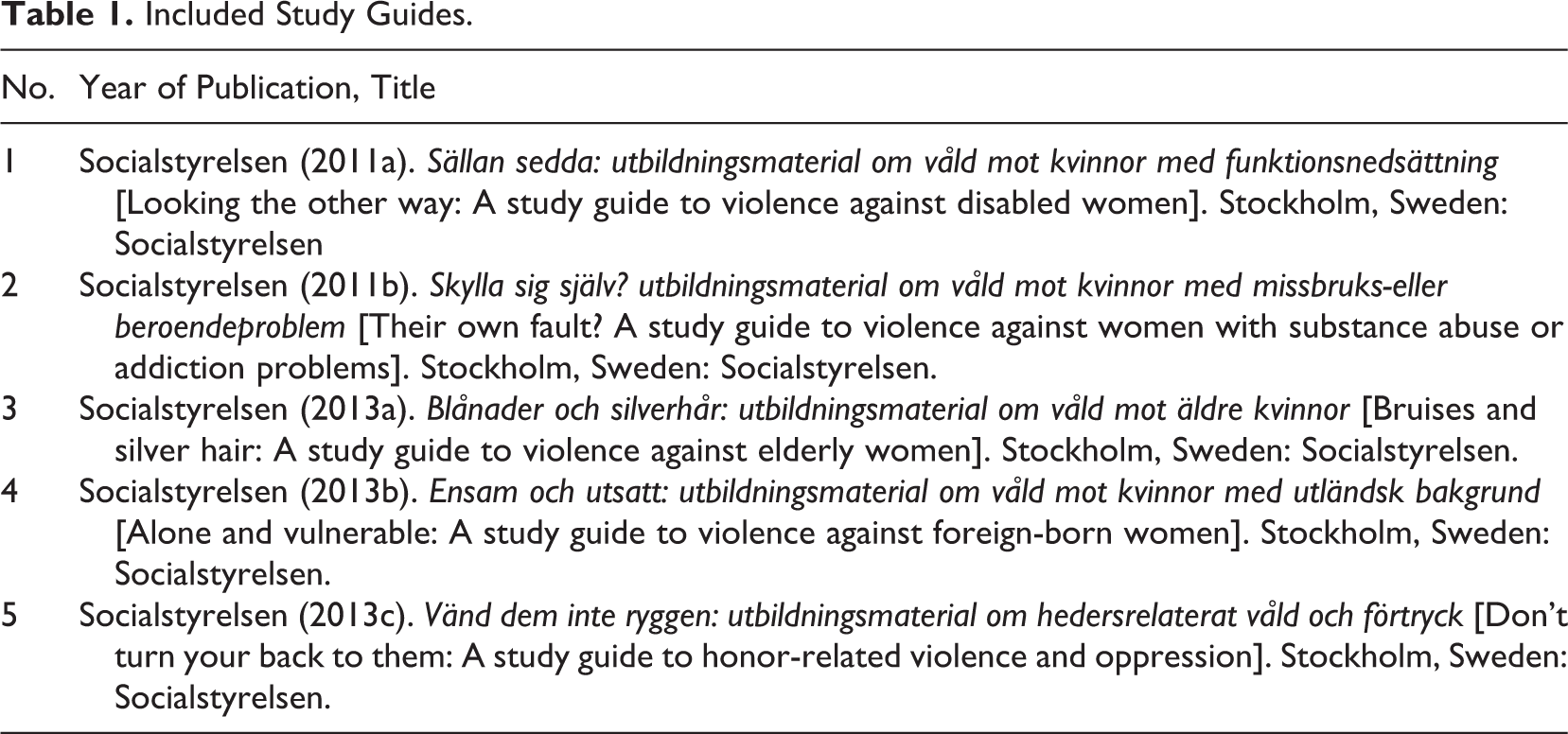
The texts that were analyzed in this study are five public study guides derived from the “Action Plan for combating men’s violence against women, violence and oppression in the name of honor, and violence in same-sex relationships” (Skr, 2007/08:39). The Action Plan is a result of a broad political agreement that men’s violence against women is a high priority area. The five documents concern the following groups that are considered to be particularly vulnerable to men’s violence: disabled women, elderly women, women with substance abuse and addiction problems, foreign-born women, and victims of honor-related violence and oppression. The overall purpose that unites these documents is to improve awareness and competence in matters of violence among professions operating within areas such as the social services, health care, the police, and NGOs for example women shelters. In addition to providing information and knowledge about women subjected to violence in general, these study guides focus on the specific situation of women within each target group, children subjected to violence, society’s responsibility, interventions, and guidance on how to meet and act when supporting women subjected to violence. The guides are published by the National Board and they consist of current legislation and action plans from the government, as well as reports and other publications from various authorities. The guides are also based on research and other publications on respective target groups, mostly from a Swedish context. Study guides included are produced with a specific purpose and are intended to increase the knowledge and competence related to violence against women within a broad target group, but the purpose is not to examine social workers’ understandings of the study guides or to evaluate them or find their meaning. The primary aim is to consider the texts in a larger context and to examine what they express both explicitly and implicitly. Table 1 lists the included study guides.
Included Study Guides.
Analytical Process
In the analytical process, I have been inspired by Huckin’s (1997) strategy, which implies that a text is going to be read a number of times. The aim of first reading is to form an overall picture of the texts, while the rereading aims to raise questions about it and critically review the text at various levels; then, the texts are taken into account in the larger sociocultural context surrounding them. In this study, the texts were read briefly with the aim of forming an overall picture of how discursive processes were operating within the texts. Then, the texts were read carefully sentence by sentence, following Fairclough’s (1992, 2010) three-level framework. Attention was on how certain concepts are emphasized or de-emphasized. In the rereading I analyzed words and phrases in the guides, the purpose was to identify implicit understandings, such as ideologies and beliefs in the texts. The analysis is guided by predefined questions presented in Table 2.
Research Question for Each Level of Analysis.
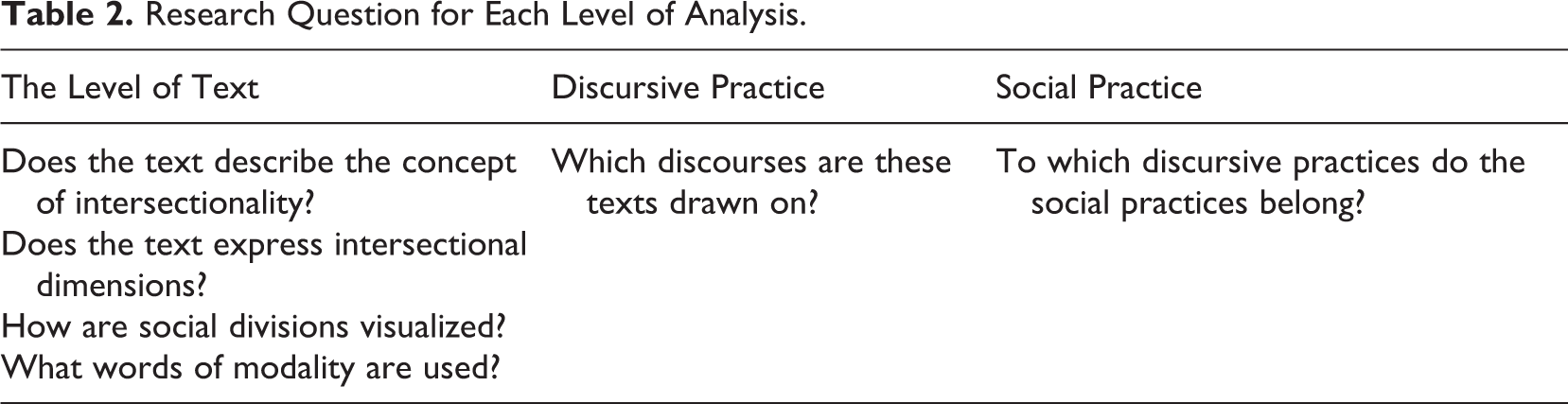
At the text level, parts of a text such as structure, vocabulary, grammar, and cohesion are in focus (Fairclough, 1992). The analysis of this level was 2-fold. One part examined whether the study guides describe the concept of intersectionality. The texts were also searched for words and terms dealing with the following social divisions: age, social class, disability, ethnicity, substance use and addiction, sexual orientation, and gender in order to determine in what way the guides describe how social divisions affect women’s life situations (i.e., how the interplay of various divisions is visible within the study guides, and whether they are framed as individual aspects or as societal power structures). The other part of the analysis at the text level included an analysis of the grammar component of modality. Huckin (1997) argues that modality refers to the tone of statements and that the use of modal verbs and phrases conveys a tone of deference. Modality also tells us about the position of the speaker (in this case the National Board) and how reality is represented in a text. Modality can be categorical, objective, or subjective (see Fairclough, 1992, p. 159). The statement “it is important that women leave an abusive partner” realizes categorical modality, such framings are universal statements that apply to everyone. Objective modality involves some form of power and does not clarify who stands behind what is being expressed, such as in the following sentence: “Many women are subjected to violence” while subjective modality clarifies whose point of view a particular statement represents, such as “according to a report from the Crime Prevention Council, many women are subjected to violence.” As Fairclough (1992, p. 160) points out, “modality then is a point of intersection in discourse between the signification of reality and the enactment of social relations.” The following questions were asked: Does the text describe the concept of intersectionality? Does the text express intersectional dimensions? How are social divisions visualized? What words of modality are used?
The level of discursive practice can be approached in various ways and involves the examination of processes related to the production of a text (Fairclough, 1992). The starting point in this study was linguistics, and the text was read with special attention to identifying intertextuality, that is, the presence of discourses within the study guides. It is through the discursive practice that texts are shaped and at the same time shape social practice (thus each communicative event functions as a form of social practice in and of itself by reproducing or questioning a certain discourse). The discursive practice can be seen as the link between the text and the social practice. I asked the following question: Which discourses are these texts drawn on?
The last level, social practice, was analyzed in order to understand the links between the text and the broader social practice surrounding it (Fairclough, 1992). Social practice cannot be studied without the other two levels, and at this level, ideology and hegemony are central parts, which can have consequences for how to consider women subjected to violence and how to best meet their needs. Ideologies are constructions of reality that arise through social divisions such as class and gender, and ideologies create understandings of social identities. When discourses produce or reproduce power relations, they are hegemonic, since hegemony is the power over society as a whole (Fairclough, 1992). I asked the following question: To which discursive practices do the social practices belong? Relevant parts were marked and notes were made in the study guides. These parts were then compiled in separate documents, one for each study guide. Text parts were then reread to locate the most dominating discourses that the guides generate together. In the presentation of the findings, the quotations have been translated from Swedish so as to best illustrate their meaning.
Findings
The Level of Text
Intersectional perspectives and framings of social divisions
The analysis revealed that women subjected to violence are framed as a specific type of women, and that the texts are framed as statements of fact. First, I present the main findings from the level of text, which is organized under two subheadings: Intersectional Perspectives and Framings of Social Divisions and Modality. Then, the findings of the level of discursive and social practice are presented under five subheadings: Women as Categories, A Heterosexual Female Victim, The Equal Swedish Woman, An Inactive and Fragile Woman, and Individualizing Responsibility for Women’s Own Situation.
The first question to be answered on the text level is how intersectional perspectives and social divisions are made visible within the study guides. The analysis revealed that all guides give a brief description of what is meant by an intersectional perspective, and they usually explain it as a number of hierarchical and societal variables that affect people’s lives and circumstances. It is also clarified that these aspects can create inclusion and/or exclusion and might privilege some: “The concept of intersectionality permits an examination and analysis of the ways that various hierarchies and power structures interact to create inclusion or exclusion, oppression, or privilege” (e.g., Document 3, p. 13). However, the material only gives an indication about who is to be regarded as privileged or oppressed: “A person’s experiences of oppression or privilege (and position in society) is according to this view controlled by gender, socioeconomic background, and ethnicity” (Document 3, p. 13). This quotation refers to the individual’s own experience of privilege and oppression, which means that it ignores the fact that some are excluded and oppressed in society as a group even if they do not consider themselves as oppressed, for example, women’s subordination to men and foreign-born women in relation to women from the majority society.
This study further shows that many social divisions are evident in the guides; however, several of them are mostly framed separately, such as in the following extract from a text describing an overall perspective of violence and abuse: A number of hierarchical and societal variables—including class, sexuality, ethnicity, nationality, and age—affect people’s lives and circumstances and might be relevant to understanding violence in intimate relationships. (e.g., Document 1, p. 25) Foreign-born elderly women are seen as a special risk group in terms of exposure to violence. It can be difficult to discover that a woman is exposed to violence if she has recently come to Sweden, has insufficient skills in the Swedish language, has traumatic experiences as a refugee, and has a lack of relatives and friends in the country. (Document 3, p. 22) For many, they have not been oppressed in a similar way as women subjected to violence by a partner. It is instead the orientation of a collective, norms, and exposure to violence that has limited their possibility to develop an explicit or complete “self”, and they have also lacked the opportunity to develop their own inner morality. (Document 5, p. 23)
Modality
The other question to be answered at the text level concerns the grammar component of modality. Modality shows the manner in which something is expressed, that is, if the text reveals who stand behind a statement, and if the text is framed as a matter of fact or if it indicates that there can be various understandings. The analysis presented here reveals that the National Board frequently present interpretations of violence against women as if they were universal, by choosing categorical and objective modality rather than subjective modalities, for example, in text describing when a woman does not want an assessment, support or help: If the woman does not want the social services to conduct an assessment of her needs, the social services personnel should still inform her verbally and by other means that she is entitled to assistance and support and should still try to motivate her to accept what they have to offer. (Document 3, p. 45) Of course, women of foreign origin can have an extensive social network, good knowledge of the community, and excellent language skills, and it is only the absence of a permanent residence permit that is uniquely associated with their origin. Women who were born in Sweden with one or two native parents can also have a limited social network, gaps in knowledge of society, and poor language skills. (Document 4, p. 20)
The Level of Discursive and Social Practice
At the level of social and discursive practice, the analysis examined which discourses the texts generate (i.e., social practice) and which discursive practices these are drawn on. The analysis revealed five interrelated dominant discursive patterns: Women as categories, A heterosexual female victim, The equal Swedish woman, An inactive and fragile woman, and Individualizing responsibility for women’s own situations. These patterns partly overlap, and in the following I will highlight the specific features of each.
Women as categories
The guides studied can be seen as a good attempt to pay attention to vulnerable groups of women instead of placing them at the periphery. Each study guide pays attention to separate groups of women, namely, women with substance abuse or addiction problems, disabled women, foreign-born women, elderly women, and those who are victims of violence in the name of honor. The study guides further describe violence as a global problem that can affect all women regardless of social class, ethnicity, or other social divisions. However, at the same time, the guides create a discourse of violence as something that mainly affects specific women. One example is when the study guides describe the particular needs and difficulties of young women living in families who practice so-called honor-related violence and oppression, while the needs of younger women “in general” are neglected. This leads to a division between young women and a discourse indicating that young Swedish women are not exposed to violence. The study guide on so-called honor-related violence does not describe immigrants in a negative way, and it is written in the context of violence against women, which is an inclusionary discourse. However, separate guides on violence against Swedes and immigrants result in a distinction between “our” violence and “their” violence. Immigrants seem to originate from non-Scandinavian countries, which is visualized through statements that point out that immigrants have insufficient language skills and knowledge of Swedish society: “Some have only been in Sweden for a short period of time, and the lack of knowledge of the Swedish language and limited or no knowledge of Swedish society often make them isolated” (Document 4, p. 10). In addition, there is a distinction between diverse groups of foreign-born women. Immigrants are conceptualized as either “common” immigrants or as victims of so-called honor-related violence and oppression. A possible consequence of differentiating immigrants is that all kinds of violence against foreign-born women risk being interpreted as so-called honor-related violence. The focus on specific groups of women involves a categorization of women, and although the guides provide information about abused women “in general,” it is possible that the categorization contributes to a distinction between women and an understanding that it is a “special kind of woman” who might suffer abuse, meaning not the “average” woman.
A heterosexual female victim
The texts are based on the assumption that women are the main targets of violence. This is illustrated by various examples of consequences: Violence is more damaging, repeated, and entails more serious consequences for abused women than for men, and it is more common that women are killed by a partner or former partner compared to men (e.g., Document 1, p. 21; Document 3, p. 17). These framings indicate a feminist ideology that complies with Swedish legislation in which women’s vulnerability is emphasized. The statements position the violence in a heteronormative context, which is strengthened by various statements that point to a heterosexual relationship such as “she thinks that her partner’s illness or substance abuse will make it too hard for him to live without her” and “she still has strong feelings for her man and hopes that the violence will stop” (Document 2, p. 33). This text groups all women as heterosexual individuals because the study guides lack information on those who have undergone gender reassignment, trans-women, and lesbian women.
The equal Swedish woman
Towns (2002) argues that the discourse of gender-equality, with the aim of eliminating men’s oppression of women, has resulted in a discourse of differentiation between “Swedes” and “immigrants.” This differentiation also appears in the analysis of these study guides. There is a significant pattern that reveals a discourse concerning equality in Swedish society, and this discourse emerges through a distinction between “mainstream violence” and so-called honor-related violence. The analysis shows that “honor-related violence” is contextualized within immigrant families, as demonstrated by the following quotation: “The violence has a collective character, that is, there might be several perpetrators from both family and other relatives, and the violence can also be sanctioned or enforced by family members or relatives who do not directly participate in the violence” (Document 5, p. 11). The text locates the violence in patriarchal families, indicating “traditional” circumstances, which is an exclusionary discourse. None of the other guides describe violence as collective and sanctioned by family members or other relatives; instead, they individualize the responsibility for women’s own situations. This discourse suggests that so-called honor-related violence is worse than “mainstream violence” because honor-related violence is collective and is sanctioned by family members or other relatives (Pratt, 2000). These framings indicate an ideology of Swedish society as good, equal, and more developed compared to other societies. The risk of overemphasizing gender-inequalities as a particularly urgent issue in the work with foreign-born women subjected to violence is that other aspects of their lives might go unnoticed (Arousell, Carlbom, Johnsdotter, Larsson, & Essén, 2017).
An inactive and fragile woman
The analysis exposes a discourse in which women subjected to violence are framed as powerless, exploited individuals in need of help and support, and not so much as active agents. However, the analysis of the study guides does show a few exceptions. One example is in the case of women with addiction or drug problems, under the heading; Blaming oneself, shame, and feelings of guilt: “A woman with substance abuse or dependency can often seem very strong outwardly and not give the appearance of being, or even wanting to be, a victim” (Document 1, p. 45). This example points out that some women do not want to be seen as a victim of violence. The social workers, therefore, have to investigate and provide support and assistance, while the women have to be persuaded to “receive” the support. Another example shows that younger people subjected to so-called honor-related violence can demand action in their contact with the social services: “Some young people can be perceived as demanding in their contact with the social services” (Document 5, p. 30). Both quotations indicate that women “act like” they have strength, with an underlying understanding that they in fact should be seen as fragile and in need of help and support. By producing women as vulnerable and in need of support, women correspond to the picture of the ideal victim as weak, passive, and subordinated.
Individualizing responsibility for women’s own situation
A discernible discursive pattern is the clear attribution of women’s individual life situations and responsibility for their vulnerable situation. This is expressed in the way the texts describe the reasons for why a woman does not leave her abusive partner, for example, that she is financially dependent on her man, that she would have trouble finding a place of her own, and that she thinks that keeping the family together is best for the children (Document 1, p. 43). These framings indicate that women have various individual shortcomings, or problems, that they need to address in order to reduce or end the violence. The guide’s lack of information about actions directed against men’s violence shows that the study guides do not problematize men’s part in the violence or the structural causes of such violence. Women’s personal responsibility for limiting and preventing violence becomes particularly obvious in the guides that underscore the importance of individual support such as advice, security planning, temporary and permanent housing, and financial assistance. In the long-term support, social services are expected to find out how the woman thinks about the future. What does her job situation or other opportunities look like? How will her accommodation be arranged? Does she need any kind of counseling? (Document 1, p. 73). Even outreach activities and information (e.g., Document 2, p. 80) aim to reach and pay attention to women in different ways. These interventions are solutions to structural and systemic barriers to leaving violence, but since they pay attention to consequences of violence instead of the roots of violence, the problem of men’s violence can be considered as an individual problem for women. Women are in other words expected to seize their situation in order to prevent violence. The result of these representations is a neglect of the structural causes for violence against women.
Conclusion
The aim of this study was to analyze how women subjected to violence are discursively framed in study guides that are a part of the official Swedish antiviolence work from an intersectional perspective. The study used a CDA to examine how women subjected to violence are understood and conceptualized, which discourses these understandings result in, and what implications these discourses can have for social work practice. The conceptualization of women in the texts can be summarized in three overall discourses: categorization of women, women within a heteronormative and gender-equal context, and women as agents.
The most striking discourse is that women are divided into categories, which is visualized in two separate ways, first through the focus on specific women in each guide, that is, women with substance abuse or addiction problems, those with disabilities, foreign-born women, those who are victims of violence in the name of honor, and the elderly. These categorizations partly reflect target groups within the Swedish Social Services Act (2001:453). The second kind of categorization is through framings within the texts. A particular attention on some women and their special situation and needs thus conceals others. The division of women into various categories means that there are certain groups that are noted, and the categorization contributes to an understanding that it is some specific women who mostly become victims of violence, and not “average” women. This is a contradictory finding, since violence is also presented as something that can affect all women regardless of individual situation, and it is important to be aware that even privileged women in the dominant culture are subjected to violence (Berg, 2014). These framings might lead to generalizations. On the one hand, might help and support be offered due to the most prominent need (e.g., disability). On the other hand, it can result in one size solutions for women within each target group or one size solutions for all women regardless of individual situation and needs. A possible consequence of the categorization is that social workers might have difficulties in knowing how to deal with victims of violence, and that they might feel that paying a particular attention to certain women is perceived as discriminatory against others.
Women are framed within a heteronormative and gender-equal context, which is in line with the gender-equality discourse and the rhetoric surrounding Swedish law. However, the emphases on gender aspects, that is to say male hegemony as the main risk of violence against women, only become visible implicitly. A consequence of framing the violence due to gender aspects and within a heterosexual relationship is a neglect of lesbian women and trans-women. Furthermore, the distinction between Swedish women and foreign-born women underlines an otherness that is particularly evident when it comes to women subjected to so-called honor-related violence. The guide contextualizes these women within a patriarchal context, indicating “traditional” circumstances, with the consequence that Swedish women are understood as equal compared to foreign-born women, and thus that structural aspects and hierarchies are overlooked. Such discourses are also evident in Swedish politics and media (Carbin, 2010; Lorentzen, 2008).
Women as agents stress women’s responsibility and lack of agency. On the one hand, the discourse frames women as partly responsible for their own situation with various individual shortcomings or problems that they need to address in order to reduce or end the violence. For example, they should take control of their life and change their way of living and in line with neoliberal ideas seek support within personal relationships (Espvall & Dellgran, 2010). On the other hand, the discourse points to women’s lack of agency. Women are to some extent framed as inactive and fragile and in need of help and support. This points to a categorical understanding of victims of violence, in which victims of violence are considered as weak and innocence (Ljungwald, 2011). However, even this discourse on women’s responsibility and lack of agency neglects men’s role and responsibilities for the violence.
Overall, the study guides give a brief description of what is meant by an intersectional perspective, and social divisions such as age, gender, disability, ethnicity, and social class are visualized within the guides. However, some aspects receive more attention (e.g., gender and ethnicity) and are mainly discussed separately in relation to women “in general,” and not very often in relation to women within each guide. This means that the intersection between various social divisions and structural factors are in general overlooked. This is especially true when it comes to women within the guides treating specific groups of women, for example, elderly women or foreign-born women.
Implications for Social Work Practice
These study guides constitute a public discourse on how to consider women subjected to violence and can be interpreted as a good attempt to visualize women’s situations and needs from an intersectional perspective. Still, women are categorized, and the attention on some particular women conceals others. This involves a risk that differences among women within a group as well as violence against women in general might go unnoticed by social workers. For example, a focus on specific forms of violence (e.g., honor-related violence) might lead to an understanding that violence is related to “the other” in a discourse in which Swedish society is interpreted as more gender-equal, good, and developed compared to foreign countries. A lack of an intersectional analysis can, therefore, imply an interpretation in social work practice that some social divisions are more important and have a greater impact on violence than other aspects, for example, gender and ethnicity. Policies on violence against women that lack a critical perspective on how social divisions intersect and on the impact of structural perspectives risk reinforcing unequal power relations. This means that social divisions such as social class and sexuality are considered to be aspects of women’s identities rather than social locations in larger systems of inequality. The consequence is that men’s part in the violence becomes obscure.
Furthermore, the discourse of women’s responsibility and lack of agency supports a distinction between women who have the strength to manage their own situation and those who do not. This can, in a worst-case scenario, mean that women are pushed to take on identities as the ideal victim—as weak, passive, and subordinated—in order to obtain help and support. Even if these study guides, which are aimed to improve awareness and competence in matters of violence among social workers, do not explicitly stigmatize either women or men, it appears that they on one hand generalize women’s situations and needs, and on the other hand categorize women. However, the categories are presented relatively homogeneously which neglects special needs. When women’s individual situation and needs are not taken into account, women risk receiving inadequate help and support which might put victims of violence in danger.
Because the intended readership of the study guides is a broad group in various settings, it is important to visualize which discourses these guides generate and their possible consequences. If these discourses are not questioned, they might be taken for granted and remain invisible and result in an exclusionary practice. However, it is still unclear how these discourses are interpreted and understood by social workers, and therefore further research is needed to determine how public discourses affect what efforts are being made and how these interventions support women subjected to violence.
Using CDA gives the researcher several possibilities for how to perform an analysis, while at the same time it might also impose certain limitations. This study does not intend to evaluate policies or to clarify what the “real” problem is in order to develop appropriate solutions. The analysis should instead be considered as an attempt to question representations in public study guides. The study is limited by focusing on five public study guides, and even if I have made an effort to differentiate each discursive level to highlight the specific features of each, there can be interpreted in various ways (Fairclough, 1992). The analysis might have been influenced by my view of the problem and by the context in which I am located, as a white female social science researcher with an interest in and knowledge of critical social work.
Footnotes
Declaration of Conflicting Interests
The author(s) declared no potential conflicts of interest with respect to the research, authorship, and/or publication of this article.
Funding
The author(s) received no financial support for the research, authorship, and/or publication of this article.
