




Abstract
Frontline service providers are often tasked with providing services to criminalized populations, including individuals involved in the sex trade. These providers have been working to transform services to this population, proposing what they believe to be socially just responses in helping individuals in the sex trade transition from “criminals” to a “victims.” While frontline service providers have been advocating for trauma-informed and compassionate responses to working with individuals involved in the sex trade, they regularly temper this work with collaboration with law enforcement, propagating carceral (punishment-oriented) logics in order to “protect” vulnerable clients. This qualitative study, completed in a Midwestern U.S. state, used interviews with 30 frontline service providers who work with individuals in the sex trade to understand service providers' perceptions around their work with this population, and how this shapes collaborations with law enforcement. Findings reveal that as most frontline service providers assume that individual trauma and drug use are present in the sex trade, these individual characteristics have legitimated paternalistic service responses provided in collaboration with law enforcement. However, a minority of frontline service providers denounce these collaborations as harmful to their clients, revealing that responses to law enforcement are not homogenous across service providers. I conclude by discussing what these law enforcement–social service collaborations mean for the social work profession and provide a discussion of alternative methods to work with individuals in the sex trade.
As individuals in the sex trade have long been referred to “deviants” or “criminals,” recent discourse surrounding this population has shifted to one of victimization, whereby a person enters the sex trade as a result of trauma and exploitation, often ignoring the presence of individual agency and the effect of socioeconomic circumstances (Leon, Shdaimah, & Baboolal, 2018; Lutnick, 2016). This victimization discourse has started to shift to law enforcement as well (Alter, 2014; Baylson, 2018; Steele, 2017), as some states and municipalities have sought to reduce criminal penalties on sellers of sexual services, instead offering rehabilitative programs implemented by collaborations between criminal justice and social service systems. In addition to reducing criminal penalties on sellers of sexual services, individuals using the victimization approach seek to implement policies that will increase penalties on buyers of sexual services, as a way to “end demand” for the sex trade. These policies which seek to abolish sex work have led to a confluence of policies often referred to as sex work or feminist abolitionism. Sex work abolitionism emerged from the advocacy of liberal feminist movements in the Nordic countries, specifically Norway and Sweden. These policies have made inroads in the United States, where they have been accepted by some feminist activists who believe that “harms suffered by prostituted people are the kind that perpetuate patriarchal structural inequality” (Dempsey, 2009, p. 1735). Arguments to abolish sex work have also been accepted by more conservative and reactionary interest groups who are more concerned with the prevention of extramarital sexual behavior. This form of sex work abolitionism and “strange bedfellow” collaborations between feminists and conservatives have involved the criminal justice system to increase surveillance of the sex trade to arrest purchasers of sexual services, as well as to involve law enforcement as an entity poised to “rescue” individuals involved in the sex trade (Bernstein, 2010; Doezema, 1999; Weitzer, 2007).
The rise of U.S. policies around sex work abolitionism has created inroads for sustained collaboration between law enforcement and social service agencies (Bernstein, 2010; Dewey & St. Germain, 2016; Musto, 2016; Steele, 2017). Recent work by Dewey and St. Germain (2016) and Musto (2013, 2016) problematizes these criminal justice–social service collaborations, noting that they fail individuals in the sex trade, regardless of pathway into the trade. Musto (2013) describes how collaborations between social service and police departments have led to a detention-to-protection pipeline, whereby the use of softened and gendered versions of criminal justice, including victim advocates and gender-specific diversion programs, disguises the close cooperation with law enforcement that may facilitate a sense of distrust and increased trauma among victims of domestic minor sex trafficking. Dewey and St. Germain (2016) note that social service–law enforcement alliances in addressing the needs of street-involved women in the sex trade neglects the fact that for this population, their socioeconomic status makes the sex trade the best option they have for survival. Some social justice organizations such as INCITE! and Black and Pink (who advocate for feminists of color and the LGBTQ+ prison population, respectively) take this information one step further and eschew the criminal justice system altogether, advocating for a form of “prison abolitionism” (not to be confused with the aforementioned sex work abolitionism), which advocates for the use of community accountability instead of the criminal justice system in solving community problems (Black & Pink, 2019; INCITE, 2018). Their argument is that the criminal justice system fails to protect and serve marginalized populations, particularly women, undocumented persons, people of color, LGBTQ, and gender nonconforming individuals. While prison abolitionism is a view that has not made its way into mainstream forms of service provision, it has gained traction with community and social justice advocates in recent years (Gilmore, 2019; INCITE, 2018). A better understanding of frontline service provider perceptions around law enforcement addressing the needs of those in the sex trade is necessary to identify mechanisms inherent in creation of these collaborations, and it is important to understand whether some of the criticisms of the criminal justice system have made their way into service provision.
In this article, I discuss the quandary that frontline service providers find themselves in when working with clients in the sex trade, while collaborating (or not) with law enforcement. I seek to understand this collaboration between law enforcement and social work using the concept of carceral logics. Simply put, carceral logics entail “having a punishment mindset” (Kaba & Meiners, 2014, para. 1), focusing on the expansion of the criminal justice system to solve social issues such as domestic violence, juvenile delinquency, and trafficking, among others (Bernstein, 2012; Meiners, 2016; Musto, 2013; Oliver, 2017; Schept, 2015; Whalley & Hackett, 2017). I interrogate the use of carceral logics in working with individuals in the sex trade, while I attempt to better understand how frontline service providers work within (or in some cases, against) this system.
In this article, I seek to answer three major research questions: (1) How is the way in which frontline service providers conceptualize entry into the sex trade linked to the perceived need for carcerally oriented services? (2) How do frontline service providers make sense of the prominent role law enforcement has in working with individuals in the sex trade? and (3) How are carceral logics embedded in this work, and how do some frontline service providers seek to promote/counteract these logics? I use 30 qualitative interviews with frontline service providers (including one advocate for people in the sex trade and one police officer heavily involved in training service providers on this population) and observation of events (conferences, panels) around the sex trade to answer these questions.
It is important here to discuss the terms that come up in this article when discussing sex trade involvement. Throughout this article, I use the gender-neutral and inclusive umbrella term “individuals in the sex trade” for this population, a term initially defined by the Chicago-based social justice organization the Young Women’s Empowerment Project (YWEP). About the term, the codirector of YWEP stated: We use the term sex trade as an umbrella term, and the umbrella term is to really pull all the experiences of what girls are doing to survive all the time, everyday. And so we use it to mean any way that girls are trading sex or sexuality, or forced to trade sex or sexuality, for anything like money, gifts, survival needs, documentation, places to stay, drugs, you know. (as quoted by INCITE, 2010)
Social Work Logics Around Individuals Involved in the Sex Trade
It is well-documented that social work has a long and fraught history with service provision to individuals involved in the sex trade (Bromfield, 2015; Wahab, 2002). While I lack the space to undertake a comprehensive history of the subject, Wahab (2002) provides a detailed history of social work’s involvement in serving this population, noting that social workers have historically viewed them as “fallen women,” “victims of sexual slavery,” or “pathological deviants” (p. 54) who are in need of protection from outside forces, whether those forces include lower class values, a patriarchal social order, male desire, or their lack of cognitive capacity. Social workers have sought to “protect women for their own good” (p. 53), carrying with this an assumption that individuals in the sex trade lack agency, and do not have the wherewithal to speak to their own needs. Although there have been strides made in recent years (Anasti, 2018) to rectify poor treatment of this population, many historical protectionist values that shaped social work practice around individuals in the sex trade remain.
Indeed, the social work field has seen a discursive shift from rhetoric focusing on behavioral deficits of this population, to a focus on individual trauma and grief inherent to their experience (Corrigan & Shdaimah, 2016; Dewey & St. Germain, 2016; Hossain, Zimmerman, Abas, Light, & Watts, 2010). Dewey and St. Germain (2016) point out that social service programs that serve women in the sex trade may use “trauma as a universal justification for various discretionary forms of intervention in street-involved women’s lives” (p. 17) as trauma explains why street-involved women in the sex trade end up reverting back to the same situations. Corrigan and Shdaimah (2016) note that when involved in prostitution diversion programs (programs that offer rehabilitative services in lieu of jail time), “real victims are expected to offer meaningful and appropriate presentations of trauma” (p. 473), while denials of trauma in the lives of program participants are treated by service providers with disbelief. Although it is undeniable that trauma plays a considerable role in the lives of individuals in the sex trade, implementing protectionist policies to address trauma precludes the fact that individuals may enter the sex trade for socioeconomic reasons, including for survival (Dewey & St. Germain, 2016; Lutnick, 2016).
Scholars have documented the process through which social work has shifted its focus from “society changing” to “individual changing” (Carr, 2010; Midgley, 2001; Pollack & Rossiter, 2010; Specht & Courtney, 1995). Neoliberal patterns of governance, moreover, have shifted responsibility from state control of social welfare to individual control, an increased belief in individual responsibility to take care of oneself (Carr, 2010; Cruikshank, 1999; Hackett, 2013; Hasenfeld & Garrow, 2012). Pollack and Rossiter (2010) describe this as “the rejection of the notion of the collective public good in favor of an individualized entrepreneurial subject” (p. 156), which they decry has found its way into feminist social work practice as social service agencies privilege positivist measurable outcomes that focus on individualized treatment programs addressing “the women’s ‘self’” (p. 163) rather than addressing root causes of social problems. Indeed, Hackett (2013) notes that even among programs that espouse socioeconomic and structural reasons for criminalized behavior, there is still a predominant focus on changing individual behaviors resulting from neoliberal assumptions of individual responsibility. These programs perpetuate therapeutic systems of control that often require the use of the carceral-legal system to ensure that individuals remain present in the program, trying to change pathological behaviors in ways that assimilate to that of mainstream society.
Carceral Logics Implemented Through Social Services and Law Enforcement
Scholars have noted that even among some liberal social activist groups, a crime frame, embedded in the concept of carceral logics, has dominated in dealing with particular social issues such as trafficking and domestic violence (Bernstein, 2012; Bumiller, 2008; Whalley & Hackett, 2017). Instead of understanding problems as being concerned with issues of economic or material deprivation, carceral logics involve the use of the criminal justice system as a conduit through which social issues are addressed. The presence of carceral logics has been particularly stark in discussions of feminist sexual assault and domestic violence movements, wherein grassroots and social service solutions to helping women have shifted to the use of the criminal justice system in addressing gender violence (Bernstein, 2012; Gruber, 2006). Similarly, efforts of some feminist activists to “end the demand” of the sex trade (arresting buyers of sexual services, while treating sellers of sexual services as victims) uses carceral logics to address the criminal “predators” that prey on innocent “victims” in the sex trade (Bernstein, 2012; Weitzer, 2007). For these activists, the assumption that increased criminalization will deter “bad men” from purchasing sexual services by increasing criminalization of buyers, may lead to solutions that focus on microlevel reasons for sex trade (exploitative men, trauma, drug use, etc.), making few links between socioeconomic reasons for sex trade involvement.
In contrast, members of law enforcement have been taught to view individuals in the sex trade as criminals: arresting them, placing them in jail, only to have them return to the street-level sex trade, where the cycle begins again (Dewey & St. Germain, 2016). There have also been numerous reports of law enforcement abusing individuals in the sex trade, in the form of coercive sex acts, beatings, or ignoring reports of crimes (Burns, 2014, as quoted in Berlatsky, 2014; Fernandez, 2016; Lutnick & Cohan, 2009; Thukral, Ditmore, & Murphy, 2005). Nevertheless, there have been state-led efforts to improve relationships between individuals in the sex trade and law enforcement, which have typically been through the implementation of diversion programs: programs which involve arrest, followed by referrals to social services in lieu of jail time. Halter (2010) notes that police often use criminal charges to detain “victims” for what they believe is their own protection, so actions such as arrest, handcuffing, or court detention, are utilized in the service of victim protection. Musto (2016), through her description of “carceral protectionism,” similarly notes that while efforts to not immediately prosecute sex trafficking victims as prostitutes may have resulted in a shift in how these individuals are treated, victim-centered interventions do not represent a clean break from purely punitive measures to address individuals in the sex trade. While these programs may be an improvement over prior cycles of arrest, the social service programs that work with victims are often in service to the police, with the idea that the police are there to “protect” victims from returning to pimps and traffickers. As a result, service providers are often complicit in the implementation of these programs.
To illustrate an example of this type of program, Wahab and Panichelli (2013) and Hail-Jares, Shdaimah, and Leon (2017) describe the law enforcement and social worker–run program Project Reaching Out to the Sexually Exploited (ROSE). The program, which arrests individuals accused of manifesting prostitution, sought to provide a diversion program for individuals at the street level, so that they may avoid arrest and leave the sex trade. Individuals arrested are taken to a church basement, and if they are found to have no other arrests or warrants on their record are deemed eligible for a social service diversion program. Those who are not eligible for the program (i.e., have an arrest record, are undocumented, or do not want to take part in the program) are taken to jail to await adjudication. The program itself had a 30% completion rate (Crabapple, 2014) and was largely focused on individual issues of self-esteem, self-worth, and empowerment, encouraging abstinence from the sex trade rather than addressing root socioeconomic causes. Similarly, other U.S. cities, including Chicago, Philadelphia, and New York, use prostitution diversion programs and/or human trafficking courts that rely on the criminal justice system to arrest (primarily) women on prostitution-related offenses, offering them dismissal of their charges in exchange for participation in gender-responsive programming or survivor support groups (Baylson, 2018; Robbins, 2014; Zumbach, 2015). Programs that rely on arrest-to-protect mechanisms violate a number of social work standards, which include arrest in exchange for services, circumventing informed consent procedures, and denying services if the individual is ineligible for the program (Wahab & Panichelli, 2013). These programs, moreover, require women to submit their already limited agency to service providers that are not guaranteed to help improve their socioeconomic situation. What these programs do provide is a nexus between frontline social work and law enforcement that is shaping rehabilitative programs for this population around the United States.
Method
Design and Sampling
My data come from an ongoing qualitative research study (specifically using semistructured interviews and observation methods) on organizations that work with individuals in the sex trade in a Midwestern U.S. state. For this aspect of the study, agencies that work with individuals in the sex trade (even if this was not their primary population) were identified in major metropolitan areas in the state. I used purposive sampling of organizations, using information from websites to ensure that I obtained representation from frontline service providers who worked with different primary populations, with varying budgets and service type. I contacted agencies (or in three cases, private practice therapists) via postal mail, following up via telephone, and e-mail, asking for permission from the agency director to interview a frontline service provider who worked directly with individuals involved in the sex trade. For private practice therapists, I contacted them directly, as they were not working for an agency. Subsequently, the agency director would provide me with the contact information for a frontline service provider to contact for an interview. Thirty of the 35 people I contacted agreed to participate, and I ended recruitment when I achieved data saturation. All interviews were conducted at the agency in a private space made available (except in one case, where I interviewed a respondent from their home, where they did most of their therapeutic work). The rationale for choosing frontline service providers is that these are the individuals who have direct contact with individuals in the sex trade: they are the street-level bureaucrats (Lipsky, 1980) responsible for determining clients’ needs and providing referrals when necessary. As street-level bureaucrats are in charge of implementing and interpreting public policy, I sought to interview frontline service providers in order to better understand how services were being provided on the ground level. The project was approved by the researcher’s institutional review board prior to data collection.
Data Collection
Between April and December 2018, I conducted 30 semistructured qualitative interviews with frontline service providers (28), a law enforcement agent (1), and an advocate for individuals in the sex trade who was planning on opening a service agency for individuals in the sex trade as of 2018 (1). The law enforcement agent and the advocate included in the study are considered to be area experts on the sex trade and provide many trainings to frontline service providers in the area. All respondents worked in urban districts in the Midwestern U.S. State. Two thirds of the respondents had a graduate degree or higher, the sample was 80% female, and 47% were nonwhite. The average age of years in the field is 10.6, and the median years are 6. Demographics of participants (gender, race, years in profession, and type of organization) are located in Table 1. All interviews were conducted in English at a location of the respondent’s choosing. All of the interviews except four were conducted in the respondent’s office. Two were conducted in the home of the respondent, and two were conducted over the telephone.
Demographics.
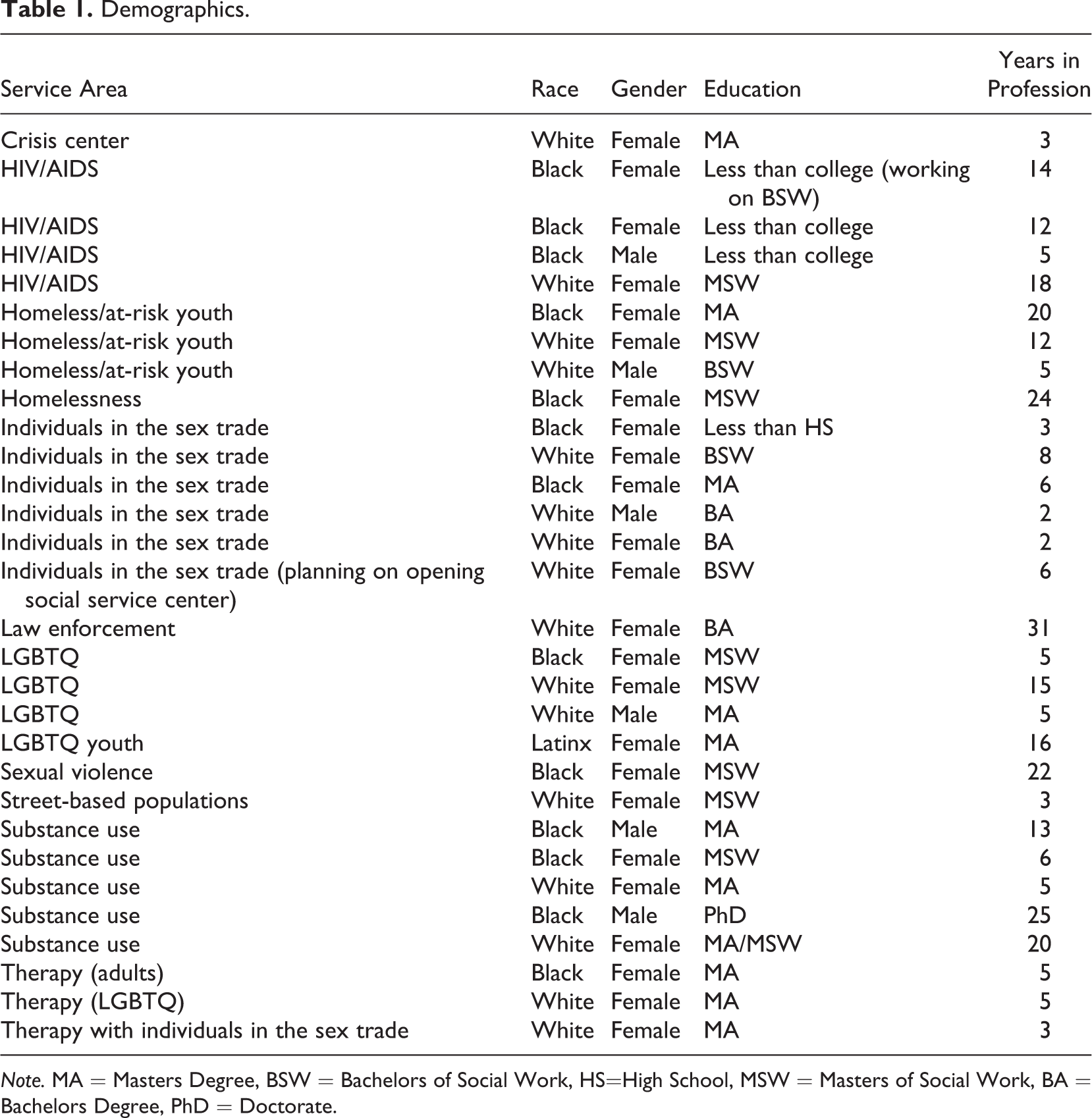
Note. MA = Masters Degree, BSW = Bachelors of Social Work, HS=High School, MSW = Masters of Social Work, BA = Bachelors Degree, PhD = Doctorate.
Prior to the interviews, I assured each participant that this interview was not tied to their position at their agency. I used a semistructured interview guide that included prepared questions about their work with individuals involved in the sex trade, their perceptions of entry into the sex trade, and questions around their work with (or against) law enforcement. These questions included additional probes to elicit additional information that may be useful, particularly around language used to discuss the sex trade, decision-making process within their work, conceptualization of the work of law enforcement, how they perceived laws regulating the sex trade, and among others. Moreover, I informed each participant that I would only discuss demographics in the aggregate and would specify them as “a frontline service employee working at an [population-serving] agency in a Midwestern state.” Participants were free to stop whether any questions made them uncomfortable throughout the interview. I offered each participant a US$20 gift card as a thank you for participation in the study. Each interview lasted 1 hr, on average, ranging from 45 to 90 min long. All interviews were conducted and recorded with the written permission of the respondent, except for one that opted out of the recording process. For this interview, I took copious notes throughout. I transcribed two interviews on my own, to get a feel for the structure of the interview, and the remainder were transcribed by a professional transcription agency.
In addition to the semistructured qualitative interviews, I attended a variety of events related to the sex trade in the state, which totaled around 50 hr of observation work. These events included human trafficking seminars for social work professionals, one state human trafficking conference, one national human trafficking conference (which included both antitrafficking and sex worker rights activists), a statewide harm reduction conference, sex worker rights trainings, and conferences around human trafficking geared toward the general public. Given the location of the project, there were a greater number of events dedicated to human trafficking initiatives than there were sex worker rights events. I also had informal conversations with 20 frontline service providers, law enforcement agents, and other advocates at these events. I do not directly quote from these interviews but use them as a guide for assessing the perception of service providers outside of a more scripted interview setting. Observation work was used specifically to better understand the field context, as well as to increase the rigor of the study: to learn the types of messages that were being put forward to service providers, to check what service providers were telling me during qualitative interviews, and to observe nonverbal communication that was happening with participants at these events.
Researcher’s Positionality and Epistemology
I am a white, middle-class social work professor who has years of experience in working with homeless women, and decades of activist experience in working with harm reduction and sex worker rights movements in major metropolitan cities. While acknowledging that sex trade involvement can be a form of labor, and/or a pathway to sexual and/or economic empowerment, I understand this may not be the case for more marginalized and oppressed populations that frontline service providers work with, many of whom work in the survival sex trade. Additionally, having worked primarily with homeless women, some of whom were involved in the sex trade for survival, others who were involved in trafficking situations, and some who had experience with both, I saw firsthand effects of criminalization on these women’s lives.
Social constructionist and feminist epistemology were used to discuss interpretations of frontline service workers’ work with individuals in the sex trade. According to social constructionism, actors are constituted by wider policy discourses, and language is interpreted in the context of the sociocultural environment in which they are embedded. In feminist epistemology, special attention is paid into how the concept of gender enters into discussions around service provision to individuals in the sex trade, which was especially reflection in discussions of drug use and trauma among this population.
Analysis
Each transcribed interview was read at least two times for clarity prior to data analysis. The interview data were analyzed by the author with the qualitative analysis software NVivo Version 12, using a constructed grounded theory approach (Charmaz, 2006; Glaser & Strauss, 1967), whereby data collection codes and categories are derived directly from the data itself, not from preconceived hypotheses. Open coding is initially used for analysis, developing codes directly from the data. Subsequent to open coding, I used multiple cycles of focused coding to further synthesize core ideas that emerged from the data. In keeping with constructed grounded theory, I sought to keep my respondent’s words intact, ensuring that their words are present throughout analysis and that the focus is on the meanings that the participants abstract from their experiences (Charmaz, 2006). This inductive approach also includes the constant comparative method, whereby comparisons are made between data points at each and every stage of the analysis (Glaser & Strauss, 1967; Strauss, 1987). Grounded theory requires continual analysis throughout the data collection process, and thus I engaged in an intensive process of analytic memo-writing, using this writing to clarify concepts engaged in throughout data collection (DeWalt & DeWalt, 2011). Patterns observed during data collection informed subsequent interviews and analysis. During observation of events, I wrote jot notes (DeWalt & DeWalt, 2011; Emerson, Fretz, & Shaw, 1995) in order to quickly capture certain words and concepts that would jog my memory as I typed notes in longhand. I analyzed these notes along with the transcripts of the interviews. For research rigor, I used both observation and interviews for data triangulation, as well as negative case analysis, whereby I sought to examine parts of the data that appear to contradict patterns observed during research (Charmaz, 2006).
Perceptions About Individuals in the Sex Trade and Need for Criminal Justice Involvement
Individual Trauma
For frontline service providers, involvement in the sex trade is the result of individual trauma. Respondents referred to trauma as an event (or multiple events) that happened during childhood or early adulthood and that stymied their clients’ ability to exhibit healthy coping mechanisms. This includes exposure to violence, physical and emotional abuse, sexual assault, molestation, and among other things. Regardless how the respondent referred to sex work (whether they called it sex work, survival sex, the sex trade, prostitution, and trafficking)—trauma is considered to be both a primary cause and a result of involvement in the sex trade.
In almost all of the interviews, trauma was often assumed to mean some sort of sexual abuse or violence—for 26 of the 30 respondents, sexual trauma subsequently led to involvement in the sex trade. When referring to trauma, and traumatic events, respondents often mentioned personal interactions with a person in the sex trade, which shaped their subsequent views on this population. A frontline police officer, who has been working to change perceptions of prostitution (the term she used) in her district, described her views on prostitution after recognizing a childhood friend on the beat: I was in eighth grade, me and my best friend in eighth grade were pretty close and she was talking to me in eighth grade about having sex and I was like, “What?” She goes, “Oh, it doesn’t matter, my dad has been doing it to me since I was eight.” So, she was a sexually abused person who was abused by her father…well fast forward I’m on the police force and I see her prostituting in [city]. Well, of course, it freaked me out…and I went up to her and talked to her and I just said, “Honey you have to go somewhere.” Because, at that point I had no way to help her…there were very little services. Nothing. Back then, they were prostitutes. They were not looked at as victims or victimized people. Don’t get me wrong, I understand there’s a trafficking victim, there are prostitutes. But, back when I used to work the road, I would go pick the women up that were out there and talk to them…many were prostituting themselves, but they weren’t being forced. They were trying to supply their drug habit at that point…and I thought there’s got to be a backstory here. I don’t care who you are, when you’re engaging with street prostitution, and I do, I do outreach you’re engaging with trauma, you’re engaging with someone who doesn’t want to be there. I guarantee every woman, if I asked her if she wanted to be there, she would say no.
Drug Use and the Sex Trade
Over half of respondents stated that drug use was intimately tied into the sex trade because of the ease through which one could obtain money or drugs in this manner. One respondent, working primarily in street outreach among individuals in the sex trade, noted that clients were “doing sex work out of pure survival, because of addiction and that’s all they can do.” Similarly, when asking a respondent who worked at a substance use treatment center how many of their clients were engaging in the sex trade, they answered: “between 80% and 90% of people with addictions will do the sex trade. There’s no easier way to get US$10.” 1 Another respondent, also working with those in substance use treatment asked, honestly: “With sex work, what faster way to get US$20 for drugs, which you need?” These respondents mentioned that women particularly were far more likely to use the sex trade to obtain money for drugs because they were told that “being a woman, they’ll never be broke”: According to these respondents, for women, there is always the possibility of the sex trade to get money for immediate needs, including illicit substances.
Although no respondent directly blamed clients for drug use, there are limited frontline service providers (outside of those specific to street outreach) who are willing to work with individuals currently using substances. Many frontline service providers mentioned that in order for individuals in the sex trade with problematic substance use disorders to receive treatment, they had to enter detox prior to receiving services. However, respondents were adamant that they would not refuse working with substance-using persons. One respondent, who worked with homeless individuals, many of whom are in the sex trade, mentioned that although they won’t take individuals that are visibly using substances, once they are off illegal substances they’re always welcomed…but you just hope that that (drug addiction) is their rock bottom. That’s one frustrating thing is that I have a few clients that will go back to drugs…we always take them back, but there’s a reason they go back, whether they’re trying to help fill that pain with drugs and they’ve experienced so much trauma. We know where they’re coming from and so we understand, even though we get frustrated.
The narratives of drug use, trauma, and the sex trade are woven through about three quarters of the interviews, suggesting that there is a significant concern about the coexistence of drug use and the street-based sex trade, particularly among women. Heteronormative expectations of women assume that if they are not being explicitly trafficked, they may be in the sex trade specifically for obtaining illicit substances, which itself is the result of trauma. As one respondent, who worked with substance-using women said: Sex work is a natural response for a female in trouble. That’s a quick fix for us. We know we can do that…if I really wanted a nice pair of new shoes, or jewelry, or drugs, I know that I could probably go find an older man and give him some attention and get what I need or want, and I think that’s cultural…it’s cultural, a built-in trafficking if you want to say that. The drugs are a way to escape trauma, to feel better…. So a lot of women started in the sex trade to support their drug habit…so now they’re out prostituting, and so they didn’t choose this for a career, it chose them. What would be the theory? What kind of burst with the trauma? They have the drug use to medicate themselves based on trauma. Then, the prostitution supports the drug habit. love and sex gets confused…they’re really vulnerable about seeking out attention and love and then they feel like the drugs give them this euphoria and numbness from some of that stuff, but they also cause continued trauma and pain.
Collaboration With Law Enforcement
Collaboration Between Social Services and Law Enforcement to Identify Individuals in the Sex Trade
Although “blame” for drug use and involvement in the sex trade are acknowledged by respondents to be the result of trauma that is no fault of the individual, this has not changed their perception of the importance of carceral mechanisms in addressing the sex trade. There is a perceived need for over three quarters of my respondents to collaborate and work with law enforcement, who are, in many cases, the state-controlled entity which street-based individuals in the sex trade first come into contact with. Respondents acknowledge that relationships with law enforcement and individuals in the street-based sex trades have been strained, although they propose that because some law enforcement members are being trained in sex trade–related issues, particularly around the effects of trauma, relationships have improved substantially.
Efforts in training law enforcement to work with individuals in the sex trade are encapsulated through various antitrafficking task forces and conferences, as well as support from social service agencies that work with this population. For about half of my respondents, there is a perception that police officers have been responsive to these trainings and have been amenable to changing criminalization laws that disproportionately affect sellers of sexual services. As one respondent, who works with youth, explained: The [County] Sheriff’s department keeps pushing, I think they’ve written up 3 times for a special victims unit for prostitutes and trafficking victims…. There’s a lot involved in it. First of all, trauma-informed interviews for law enforcement. Then, I know they would be pushing for, let’s not charge them with a felony. …the relationship and education between law enforcement officers who work with [sex trade] survivors has gotten a lot better because education is really getting out there…they’re starting to understand that when all this trauma hits, all these chemicals in the brain are released and there’s all this stuff going on, so they’re not trying to be untruthful with you, there’s a lot happening right? The biggest problem used to be law enforcement. Law enforcement has become more enlightened. But the problem with law enforcement, even though they’re becoming enlightened, the girls don’t trust them. Because the cops have raped them. So there’s a long history of law enforcement, I used to think they were the worst thing…. But one of the cops in [city], the captain of the Special Victims Unit, we were talking to him and he says “You know, you think you’re taking a lot of them off a bad situation but sending them back home can be just as bad or worse a situation if you’re sending them back” and he goes into this incredible quandary that law enforcement has. So I think now, they’re doing the best they can.
In addition to hearing about these collaborations from the respondents, law enforcement was a near-constant presence at the various events and trainings I observed. This is important to note, considering that licensed social workers, nurses, and other licensed health service providers are required to attend a certain number of human trafficking trainings in order to obtain continuing education units or CEUs in human trafficking.
2
Antitrafficking trainings almost always included members of law enforcement on their panels present in order to discuss the role that they played in addressing the problems inherent to the street-based sex trade. Law enforcement would often perpetuate certain “truths” about trafficking. At one human trafficking event (which provided human trafficking CEUs to social workers), a police officer, who ran an organization called “Save Our Adolescents from Prostitution,” spoke to the audience. She was a highly spirited and charismatic woman, describing her talk as “triggering” and apologized in advance for anyone she might offend. I describe this event in my field notes as so: “Where are people trafficked?” the officer (white, female, 50s) yelled to the crowd. “Homes, schools, churches, malls, libraries, anywhere where kids are.” As she paced excitedly across the stage, she noted that 12–14 years of age is the average age of entry into human trafficking, and the FBI (Federal Bureau of Investigation) estimates that 100,000 U.S. youth are trafficked each day. “ONE HUNDRED THOUSAND!” she yelled with emphasis.
3
“Many of these youth run away because their home life isn’t so hot,” she said. She noted that there are 1.3 million missing kids right now in trafficking and mentioned that on average youth are approached 48 hr of leaving home. “Once they get their first act under their belt,” she said, “it [the sex trade] often gets easier.”
Service providers I interviewed who worked with law enforcement mentioned their involvement in these events as indication that law enforcement was “on their side” and were prepared to work compassionately with the individuals in the sex trade, even though their main protection tool was to arrest members of this population. As one respondent, who worked specifically with victims of sex trafficking and individuals in the survival sex trade, stated: They’re [police officers] amazing. They get the issue, they put together amazing pieces, they really try to work hard to make sure the kids are safe. They go to schools and talk to kids and parents [about trafficking]. So, we have a really good relationship with the State Police Department. They seem to really understand the issue. But the thing that we consistently get over time is, we don’t have resources. When we pick up a girl…at three o’clock in the morning…The only intervention we have is to arrest her. It’s just totally true. You don’t have the resources. It’s not the intervention we want or need. But it’s the only one available. (emphasis added) develop some protocols, so if something were to happen, what would we do? Now, we know that we could call the local police, the state police, we could call the FBI if need be, we could call [other service organizations]. They know the organizations they could call if they found a victim. So, I think the police officers are doing the best they can. Because they haven’t had all the training that they’ve needed and I think they are open and I think they’re willing. So, it’s just getting them that training and for them to apply it, too, and to see them as humans and people who’ve experienced severe trauma. But I know that’s hard when you have that person cussing you out. You just want to lock them up so it’s hard, I can see what it’s like being in their shoes. I think more interventions [for the sex trade] is better [than punitive policies]. The equipment and the knowledge and the skills the police officers can lead to programs. So, I like states where they have programs where police officers could have a connection with an organization where they can take them to and they can talk to them and they can say “Okay listen, we have this young lady.” We’re trying to do an intervention. Nine times out of 10, she may go [to the intervention program]. And if they have the resources to take them to that’s a safe haven, they may not go but they may as an alternative to jail. We work with and train law enforcement a lot because when it comes to the sex trade that goes hand in hand with transgender people. Because for a lot of them, that’s how they survive. So we wanted the police to understand that when you show up to this call or this situation, you’re not dealing with someone that is very well-balanced and that they may show a sign of aggression, but it’s just how they survive in the community…. So, understanding [that the officer] doesn’t have to go from 0 to 60 because the threat may not be presented as a threat. This may be just a normal role that this person plays because they are on the street. [The liaison] is kind of our gateway into the police department, and so if we have any issues around police treatment, we usually are contacting her first. Then she could kind of tell us who are the go-to people to contact in that space.
Challenging the Field: Working Against Carceral Logics
While frontline service providers have found much to criticize of their law enforcement counterparts in regard to the continued criminalization of those in the sex trade, there remains a perception by a majority of respondents (70%) that law enforcement and carceral mechanisms can be a useful force in dealing with individuals that are involved in the sex trade. The minority of providers that sought to refute these carceral logics are more likely to work with HIV-positive individuals, as well as the LGBTQ population—populations who do not fit the victim narrative of an exploited cisgender woman/girl, and whom are more likely to be discriminated against by service providers who do not have the expertise to work with this population. One respondent, who worked with the LGBTQ population, stated that “clients have talked about the anticipatory stress or the anxiety of being potentially discriminated against” as a barrier to receiving services, which put these agencies in a separate category of serving the most marginalized individuals in the sex trade.
In this section, I address the minority of respondents who sought to directly challenge carceral logics in the field: These respondents refute predominant approaches to working with individuals in the sex trade that focus solely on exit from the trade and question the collaborations with law enforcement that characterizes many of their contemporary agencies. These respondents were concerned about law enforcement focused interventions in the lives of individuals in the sex trade, claiming that the emphasis that law enforcement had placed on addressing the needs of trafficking victims does not improve the lives of their population, whom were mostly in the trade for survival. For instance, one respondent noted that “the police, they’re kind of intimidating our clients and clearing them out [of the area where they work], so it seems like they’re less likely to come in to receive our services in fear that they will be caught.” Another respondent, in describing how law enforcement treated her clients, stated that: We just had a young lady [client] talk about two police officers. I can’t remember what area…. They had been officers for a long time, and in cahoots with this particular hotel where [the women] turn tricks. They are scared not to give sex to these police. The contact of law enforcement is generally abusive…because you’re assuming they’re this kind of person and treat them in this very negative or nasty way…. But the sex worker doesn’t get any respect in regards to what it is they do because it’s not just the criminalization of it but I think, from my own experience and what I saw in the jail, the way a lot of people who are active in the sex trade are treated is dehumanizing by law enforcement. Some of the comments that I’ve heard about the way we talk about these women: “Well, she’s just this slut. She’s just a hoe.” That’s the kind of language they’re using. That narrative harms our youth, when they’re thinking, “no one forced me to do this, society did.” So, they’re taking it from this ambiguous random male, pushing you into [the sex trade] versus these are societal issues…this is a way that that narrative takes accountability from society and saying like, “Well, everything would be fine had you not been trafficked” like no, that’s not true. People are homeless…people are pushed out of their families, 50% of trans people attempt suicide…. I think that when we create other bad guys, it takes away from this bigger systemic issue. I know that there are individuals trafficked into the sex trade by a pimp. I know that happens. But we here, we don’t see that very often, and so these individuals are often treated badly by police if it’s perceived they’re not a victim.
Nevertheless, frontline service providers (and the organizations they work for) who seek to challenge carceral logics find it difficult to infiltrate the organizational field that lays claim to working with victims. As licensed social workers in particular are required to attend human trafficking trainings in order to obtain CEUs for keeping their license up to date, those who are critical of carceral logics describe these trainings as favoring the perspective that all sex work is the result of exploitative men—instead of exhibiting their opinions within the trainings, providers disagreeing with this perspective prefer to hang back, believing that there “are too many disparate beliefs, ones that [they] disagree with” for the provider to have been useful in this context. Some acknowledge that they must find common ground with those that they disagree with: as one provider that works with the LGBTQ population notes, although their organization must refer clients to organizations that perpetuate the victim narrative, she makes clear that she believes that narrative is racist and does not account for the systemic mechanisms behind trafficking. They have used their organization’s training center in order to educate other service providers about these mechanisms, but the provider describes how she isn’t sure that we should be going into organizations to talk about the difference between sex work and trafficking when there’s other issues, if your organization has trouble just dealing with trans people, I don’t know that that it’s yet important to talk about the difference between sex work and trafficking.
Discussion
This qualitative study provides a contribution to the burgeoning research on the use of carceral logics in work with individuals in the sex trade. Using social constructionism and a feminist epistemology, the data show how frontline service providers varied around their perceptions of carcerality, highlighting how the perceived causes of sex trade involvement can help to legitimize criminal justice solutions to this issue. While the data show that the perceptions that individuals in the sex trade no longer revolves around their being “deviants” or “feeble minded,” it does show that for many frontline service providers, these individual failings have been replaced by assumptions that clients have had significant traumatic experiences, heightened by the problematic use of substances that requires a rehabilitative approach in order to encourage (but not necessarily mandate) leaving the sex trade. These services involve a softened rehabilitative approach that heightens an individualistic response to individuals in the sex trade, which these frontline service providers believe can be accomplished through collaborations with the criminal justice system. For many frontline service providers, these sorts of rehabilitative and carceral interventions continue to rely on neoliberal ideas of a focus on individual problems, although this is tempered with the acknowledgment that trauma is a considerable barrier to individuals exiting the sex trade.
Frontline service providers aligning with law enforcement comes from several factors that must be taken into account. First, the criminalization of the sex trade, particularly the street-based sex trade, often means that law enforcement is the first line of contact that individuals in the sex trade have—even before they have contact with many frontline service providers. As several respondents noted, there are minimal resources available to service providers who work with individuals in the sex trade. Law enforcement, which is often relatively well funded in comparison to social service providers, has more experience in patrolling areas that may contain individuals working in the street-based sex trade. Service providers, which often do not have the resources to reach out to those at the street level (with the exception of a select few organizations with outreach programs), are reliant on law enforcement to reach out to this population. While many frontline service providers do not consider this to be ideal, they believe that officer involvement with this population can be managed and tempered by increased understandings that this population is vulnerable and traumatized, with minimal access to social supports. Their perception that officers can be trained in victim and trauma-oriented methods undergirds their belief that having law enforcement as collaborators in working with individuals in the sex trade can be beneficial for “rescuing” this population. Frontline service providers acknowledge that police officers are often the first line of defense in protecting individuals (particularly women and girls) in the sex trade. Thus, the goal is to temper and soften law enforcement involvement, without making larger structural changes on the criminalization of the sex trade. Keeping the criminalization of the sex trade intact, for some providers, will facilitate the ability of law enforcement to keep this population safe.
Second, frontline service providers perceive minor changes within law enforcement to be strong evidence that officers are trying to alter their previous transgressions. Hiring an LGBTQ liaison in the police department, for instance, has created inroads for collaboration even among service providers who had been initially highly critical of police treatment of their clients. This has assuaged concerns that law enforcement has not been amenable to social service agency requests. Additionally, seeing law enforcement present at conferences and events dealing with issues around the sex trade has created the perception among frontline service providers that law enforcement is making concrete changes to their treatment of this population. Frontline service providers consequently perceive law enforcement as useful protectors of individuals in the sex trade and are willing to work with them in order to ensure perceived safety. For frontline service providers, “arresting-to-rescue” this street-based population is not the preferred way to address the sex trade, but because this population has been stymied by trauma, they may have difficulty leaving the trade of their own accord. If law enforcement has received the adequate trauma-informed training that is required by frontline service providers, then there is a perception that these “protectors” will encourage individuals to enter rehabilitative services or to leave the streets. However, peer-based research (Burns, 2014; Iman, Paz, McKinney & Daphnie, 2011) has described considerable institutional violence directed at people in the sex trade by the police. While this violence was acknowledged by some frontline service providers, they also commended the police force for the positive steps they were taking toward addressing the sex trade. For these respondents, the role that trauma and drug use played in their perceptions of the sex trade necessitated the role of the carceral system in addressing the needs of their clients: With adequate training, police can play the protector.
Indeed, not all frontline service providers buy the use of arrest as a corollary to trauma-informed service provision. A minority of frontline service providers note that the involvement of the criminal justice system enhances trauma due to the increased anxiety and harm that arrest inflicts on the individual. While there is still acknowledgment of the role that trauma and substance use play in involvement in the sex trade, these service providers emphasize structural factors that lead to sex trade involvement and stress their ability to provide services that seek to reduce the harm of the sex trade. Frontline service providers who challenge carceral logics note that the assumption that the criminal justice system can be helpful tends to neglect the needs of individuals in the sex trade that do not fall into the “innocent girl-predatory man” narrative. Instead of being treated in a sympathetic manner, those individuals are still treated as criminals once involved within the criminal justice system (Dewey & St. Germain, 2016; Lutnick, 2016; Musto, 2016), and these service providers criticize their peers for being amenable to the role of the criminal justice system in addressing their clients that are involved in the sex trade. Nevertheless, this group of providers does not wield a tremendous amount of power in this field of organizations—while they do not engage in the same collaborative efforts of law enforcement as their peers do, they also do not challenge or publicly advocate against the role of law enforcement. Even if they take a more radical position such as prison abolitionism, they would struggle to advocate for this position as frontline service providers, dependent upon public and private funders for their organizational existence. Their role is to continue their service work with underserved and marginalized populations, and they do attempt to mitigate the encroachment of the criminal justice system within their organization. As it stands, their minimal resources may not be able to afford them (in terms of time and resources) to engage in advocacy actions against the use of the criminal justice system.
Implications for Social Work Practice
Providing services to individuals involved in the sex trade can be physically and emotionally taxing due to the complexities inherent in their clients’ lives. I write this article in order to educate not only academics, but service providers in order to better understand how the perpetuation of carceral logics within the sex trade may not protect their clients, even if they are instituted with good intentions. Recent literature around the alliances between law enforcement and social services in treatment of individuals in the sex trade have forged new paradigms in identifying problems inherent to collaboration (Dewey & St. Germain, 2016; Lutnick, 2016; Mac & Smith, 2018; Musto, 2016). A substantive minority of respondents interviewed were dismayed with these alliances and perpetuation of carceral logics, although the barriers that exist in advocating against these policies, combined with the minimal resources service organizations have specifically for policy advocacy, prove difficult in creating mechanisms for addressing carceral logics in their population. Moreover, as Sloan and Wahab (2000) point out, the debate around sex work has precluded integrated efforts to provide services to individuals in the sex trade. Disagreements about the nature of the sex trade can lead to disorganized services, and a lack of collaborations that can best serve this population.
What frontline service providers can learn from this study is that for some social service clients, particularly those that are homeless, LGBTQ, or otherwise discriminated against in the larger labor market, the sex trade may be the best option for survival. Consequently, service providers need to be trained in areas of harm reduction (reducing the harm of risky behaviors in lieu of abstinence) in order to provide effective services for all of their clients—even if penalties on involvement in the sex trade are reduced for sellers of sexual services, they must contend with safety issues that can be addressed through peer-based safety strategies and encouraged by frontline service providers. Assumptions that all individuals in the sex trade are in need of services that exclusively address individual trauma can lead to ineffective services for individuals who may be considered “untreatable” because they refuse to cease sex work, are unable to achieve financial independence, or may refuse or be unable to cease the use of illicit substances. This consequently results in a subjective distinction of the “worthiness” individuals in the sex trade, contingent entirely upon their ability to transition out of the sex trade (Koyama, 2012). However, as the sex trade (and drug use) continues to be criminalized, the options for individuals in the sex trade are incredibly limited. As mentioned by Dewey and St. Germain (2016), those involved in the sex trade often end up in neighborhoods dominated by the criminalized economy, as well as a shortage of safe and affordable housing options available. Regardless of social service efforts to address trauma and drug use, it is still likely that individuals in the sex trade may return to neighborhoods that are afflicted by a lack of resources and systemic discrimination.
As social workers and other frontline service providers, we should advocate for systems that not only provide rehabilitative services to individuals in the sex trade but also address larger systems of oppression that serve to keep individuals in the sex trade in unsafe and possibly traumatizing situations (Sloan & Wahab, 2000; Wahab & Panichelli, 2013). Instead of assuming that all individuals in the sex trade want to address individual trauma and drug use first, it is important to start with the assumption that this population has an understanding of what their needs are: perhaps they are in need of trauma-informed therapy, perhaps they are in need of safer sex materials, and perhaps they are in need of a safe place to live. Individuals in the sex trade should be recognized as individuals with agency, who have the capacity and wherewithal to navigate social systems and exhibit behaviors designed to increase their chances of survival (Oselin & Cobbina, 2018; Shdaimah & Leon, 2015). It is important that blanket assumptions are not made about people’s lives based on ideology and that frontline service providers continue to listen to their clients to determine how to best provide services to this population. One obvious way in which frontline service providers can do this is to make sure they center client voices in their work, using a harm reduction and strengths-based approach to their service provision, including asking directly what clients need from service providers (Iman et al., 2011). Individuals involved in the sex trade have complex lives that may not be improved by following particular paths required by frontline service workers: Instead, it is important for providers to recognize that clients may choose to continue sex work and drug use and assist clients in safety practices in order to avoid perpetuating additional harm (Dewey & St. Germain, 2016). It is crucial that service providers recognize the intersectionality of particular identities in order to avoid additional harm: someone that has involvement in the sex trade may also be undocumented, they may be in possession of an illegal substance, and they may have a criminal record. Even if law enforcement may be “softening” their approach to individuals in the sex trade, having additional items on their record often preclude this population from accessing resources. Even if penalties on individuals in the sex trade are lessened, without the necessary social and material resources to address the specific needs of street-level workers, they will likely continue to be amenable to harassment and violence on the streets. Using the criminal justice system in an effort to “rescue,” all individuals from the sex trade may perpetuate further harm for populations whose actions may be criminalized, even if selling sexual services is not. Another step is for service providers to speak to organizations in their area working on areas of sex worker rights’/safety or anticriminalization agendas. As organizations that are typically led by marginalized or vulnerable populations, they typically have experience in areas of harm reduction and policy advocacy and can convey (1) harm reduction strategies and tactics to frontline service providers in order to avoid perpetuating further harm to criminalized populations and (2) actions that service providers can do (either individually or on behalf of their organization) in order to advocate on behalf of the policy needs of criminalized individuals.
Limitations and Future Research
While this study does provide important insights into the perceptions that frontline service providers have around carceral logics, it does come with limitations. One limitation is the lack of generalizability. I acknowledge that this study is limited to a specific time and place, which may preclude generalizing these results to a different context. Additionally, social desirability bias, the tendency for research participants to portray themselves in a way that is favorable to the researcher, should be considered. As I contacted an agency director for permission to interview a frontline service provider, this may influence the respondent to only discuss their agency and work in positive terms. Nevertheless, I found that the participants were quite willing to share negative opinions about their organization and clients, at times using course language during the interview which minimized concerns about social desirability. I was unfortunately unable to interview many members of law enforcement, which hinders our ability to understand law enforcement’s perspective around the criminality of individuals in the sex trade: The interview that I used for this article cannot be generalized to other members of the law enforcement community. Another limitation of this study is a lack of representation of recipients of services. Do they actually perceive differences between frontline service providers that carry the mantle of carcerally oriented services and those that seek to reject that option? Is the criminal justice-social service alliance, as noted by Dewey and St. Germain, failing individuals in the sex trade? Or rather is it difficult to provide services to this population within the context of the larger socioeconomic system that serve to oppress this population? As in, even among organizations that sought to distance themselves from carcerally oriented systems, is this enough to transcend the stigmatization and marginalization of this population? Future research must engage in comparative analysis focusing on clients receiving care at varied organizations, within localized and international contexts, and longitudinally. While this research takes the step of interviewing frontline service providers at organizations that serve individuals in the sex trade (as opposed to interviewing organizations that exclusively serve this population), more work needs to be done in order to determine the effectiveness of these services to the larger population of individuals in the sex trade.
Footnotes
Acknowledgments
The author would like to thank the editors of Affilia: Journal of Women and Social Work, as well as the anonymous reviewers for comments to improve this article. Special thanks to Terressa Benz and Wendi Johnson for important comments on the article, as well as to Oakland University for funding this project. The author would also like to thank all of their participants for their time and energy put into this study.
Declaration of Conflicting Interests
The author(s) declared no potential conflicts of interest with respect to the research, authorship, and/or publication of this article.
Funding
The author(s) disclosed receipt of the following financial support for the research, authorship, and/or publication of this article: This project was funded by a University Research Council (URC) Grant from Oakland University.
