




Abstract
Regardless of primary population served, human service organizations are likely to come into contact with individuals who have been currently or formerly involved in the sex trade. In the United States, social workers have had a fraught history with this population, either treating them like delinquents or like victims in need of rescue. Sex worker activists in the United States continue to decry the negative treatment provided by individuals in the helping professions, even as harm reduction, the practice of reducing the harm of risky behaviors, has entered the service provision lexicon as an antidote to abstinence-only services. This article uses qualitative interviews with managers of human service organizations in the city of Chicago to determine how they think about their work with sex workers and how they perceive the proposed solutions to “fixing” the sex trade: abolitionism and decriminalization. Findings show that despite the dominant discourse of abolitionism in the United States, most of managers in this project believe full decriminalization of sex work will best assist their sex worker clients. Future research needs to understand how this finding holds in different settings and how this affects current efforts to advocate for decriminalization.
Sex work—the exchange of sexual services for tangible goods—is criminalized in the United States. 1,2 While the range of punishments vary by state, both individuals selling sexual services and those purchasing sexual services are subject to punishment in the form of jail time, mandated rehabilitation, or fines. Because the sex trade is criminalized, buyers and sellers of sexual services have had barriers to accessing social workers as well as others in the health/helping professions (Cohan et al., 2006; Kurtz, Surratt, Kiley, & Inciardi, 2005; Lazarus et al., 2012; Sloan & Wahab, 2000; Wahab & Abel, 2016).
In addition to being criminalized, sex work is highly stigmatized. Sex workers are referred to using derogatory terms (Scambler, 2007), and stigma is inherent in all types of sex work, including both “legal” and “illegal” forms (McCarthy, Benoit, Jansson, & Kolar, 2012; Weitzer, 2010). Exotic dancers (Trautner & Collett, 2010), porn performers (Lee & Sullivan, 2016), dominatrices (Levey & Pinsky, 2015), escorts (Bernstein, 2007), and street-based sex workers (Lazarus et al., 2012) are all subject to occupational stigma from the general public. Thisstigma has also historically been perpetuated by social work professionals (Bromfield, 2016; Iman, Fullwood, Paz, Daphne, & Hassan, 2009; Wahab, 2002; Wahab & Panichelli, 2013).
Today, certain facets of social work continue to perpetuate stigma among those in the sex trade. To illustrate, Monica Jones, a transgender woman of color, was walking on the street one evening in Phoenix, AZ, and was subsequently offered a ride home by a man. She asked the man if he was a police officer, upon which he handcuffed her and took her to a prostitution diversion program 3 in a church basement (Hail-Jares, Shdaimah, & Leon, 2017). This diversion program was run by Arizona State University’s (ASU) School of Social Work, where ironically, Jones was a student. The diversion program was part of a project called Project Reaching Out to the Sexually Exploited (ROSE) which consisted of a collaboration between Phoenix law enforcement, service agencies, and ASU’s School of Social Work to “rescue” people from sexual exploitation. The program was created as an alternative to incarceration for individuals arrested for sex work, yet only individuals with no prior arrests were eligible for the program, which limited the number of beneficiaries (Strangio, 2017). Other individuals are charged and taken to jail. Project ROSE has been condemned by social work scholars in this journal (Wahab & Panichelli, 2013) and sex work activists, among others (Blumberg, 2014; Maryasova, 2014; Sex Workers Outreach Project [SWOP]-Phoenix, 2014).
These sorts of coercive measures to engage with sex workers have a long and storied history in U.S. social work. While sex worker activists had made strides in working with human service professionals, including many social workers, in some metropolitan areas (Anasti, 2017; Majic, 2014), there is still much that scholars do not know about how U.S. social workers perceive the issue of sex work. 4 This article seeks to address this gap. It does so using qualitative interviews that were conducted with managers of human service nonprofits (HSNPs) in the city of Chicago in order to answer the following research questions: (1) How do managers of HSNPs perceive sex work and their work with sex workers? (2) How are managers influenced by different approaches to sex work as promoted by different advocacy groups?
This article proceeds as follows: first discussed is a history of U.S. social work’s response to sex work, beginning with the Charity Organization Societies (COS) in the early 1870s (for a more detailed discussion of the historical context, see Bromfield, 2016; Wahab, 2002). The history is followed by contemporary discussion of sex work, focusing on the competing ideas behind abolitionism and decriminalization. Following the literature review is a detailed discussion of methods and methodology. The results from the qualitative interviews are discussed, and this article concludes with the importance of considering the responses of human service managers to issues surrounding sex workers.
Social Work and Prostitution in the United States
Early Social Work: COS and Settlement Reformers
In the United States, the history of the social work profession begins with the creation of COS in the 1870s. COSs consisted of middle- and upper-class women who sought to provide charity to the deficient poor. While they were among the first to engage in systematic data collection in order to eliminate poverty (Ziliak, 2004), central to the beliefs of COS volunteers is that the poor were largely to blame for their condition (Boyer, 1978; Katz, 1996; Wenocur & Reisch, 1989). Scholars have noted that COS workers’ judgment of the poor was commonly rooted in moralism and classism, as they believed that their own views and behaviors were superior to those whom they helped, denigrating those who did not conform to the norms of middle-class life (Abel, 1998; Boyer, 1978; Katz, 1996; Mink, 1990). Generally, COS women were highly suspicious of female sexual activity outside of wedlock. Prostitution, in particular, was the most serious of these sexual offenses (Wahab, 2002). Members of COSs were fervent in attacking the legalized model of prostitution prevalent in Europe and tried to prevent this model from moving to the United States (Jabour, 2013). COS volunteers feared that legalized prostitution in the United States would result in sanctioning commercialized sex, infringements on constitutional liberties and law enforcement corruption (Jabour, 2013, p. 143). A quote from the Official Proceedings of the Annual Meeting of the National Conference of Charities and Corrections (the early name for the National Conference of Social Work) illustrates just how negatively early social workers viewed prostitution: We have seen
Reformers and the Mann Act
As a result of the efforts of social workers and other moral reformers, many communities began to appoint vice commissions to address the sex trade, proceeding to shut down previously tolerated brothels in major cities across the United States. In Chicago, communities sought to shut down the sex trade in the Levee, widely considered to be the most debauched red-light district in the country (Abbott, 2008). In 1908, two French brothel owners in Chicago, Eva and Alphonse Dufour, were heavily punished for their role in bringing French immigrant women into the sex trade. The Dufours sent the country into heightened anxiety around white women in the sex trade (Pliley, 2014). Resulting from the intensified publicity surrounding the Dufours, reformers’ fears around the plight of white women being trafficked into sexual slavery led to the 1910 creation of the Mann Act. The Mann Act, also referred to as the “White Slave Act,” resulted from a collaboration between social workers, legislators, and law enforcement that sought to protect women (primarily white women) from the evils of sexual slavery (Pliley, 2014). The act prohibited the transport of women across state lines for “immoral” purposes, implying some form of interstate prostitution and sex trafficking—the assumed model being of a Black male “pimping” out a white female, regardless of the actual relationship (Bromfield, 2016; Lutnick, 2016; Pliley, 2014). For Black women who worked as sex workers during this time, the Mann Act did not apply--rather, Black women were subject to arrest and denigration (Blair, 2012).
The Two World Wars
Upon the onset of World War I ([WWI] and continuing through World War II), the focus of social workers and reformers shifted from rescuing (mostly white) women in the sex trade to stopping the spread of venereal disease (Hobson, 1987; Wahab, 2002). As noted by historian Dorothy Brown (1987), during WWI, the Federal Commission on Training Camp Activities rounded up prostitutes to protect soldiers from venereal disease, which they perceived to be the greatest threat to the military. During and between the two world wars, the national mentality around prostitution shifted from a victim mentality to a criminal mentality, as most efforts were put into place to prevent soldiers from contacting so-called diseased women. Women walking alone near military bases were labeled as prostitutes and were targeted for arrest. They were then forced to undergo mandatory testing and medical examination regardless even if they did not actually engage in sexual activity and could be held without bail until results were known (Hobson, 1987). As social workers engaged with the sex working population, they did so with casework methods, believing that prostitution stemmed from deficiency within the individual (Hobson, 1987; Sloan & Wahab, 2004).
Sex Worker Rights and the Sex Wars
This perception of viewing sex workers as diseased and/or individually deficient persisted until the late 1960s and early 1970s, when sex workers began to clamor for human and civil rights (Hobson, 1987). Sex worker activists consisted of one side of what is termed the “sex wars” (Duggan & Hunter, 2006) debate, believing that the provision of sexual services constitutes a type of labor and should be subject to the same rights, health benefits, and work provisions that are afforded other professions. The term “sex work” emerged in the 1970s as a result of the efforts of Leigh (1997), who coined the term in response to her desire to see the provision of sexual services in exchange for material goods be recognized as a legitimate form of labor, while uniting sexual laborers of various types under one umbrella term. Sex worker activists seek to reform all types of sexual commerce into recognized and legitimate labor (Delacoste & Alexander, 1987; Jenness, 1993; Nagle, 1997). On the other side of the “sex wars” debate are abolitionist feminists who believe that the existence of prostitution and pornography is the natural conclusion of male supremacy and thus negates women’s capacity for choice into the sex trade (Barry, 1979; Dworkin, 1989; MacKinnon, 1987). Abolitionist feminists view prostitution as violence against women and do not believe that there is a distinction between forced and voluntary prostitution (Chuang, 2010). In their view, prostitution reifies male dominance against women by solidifying women’s role as a passive sex object (Barry, 1979). They do not believe prostitutes should be subject to criminal penalties but rather should be rescued and provided social services. The abolitionist view, which seeks to stem male domination over women through the increasing criminalization of individuals who purchase sexual services, is parallel to the views of COS and settlement workers of the late 19th/early 20th centuries, who saw prostitution as a social ill that needed to be abolished. It is beyond the scope of this article to heavily engage in the history of the “sex wars” that have divided feminist coalitions over the past five decades (for more information on this topic, see Bernstein, 2010; Duggan & Hunter, 2006; Weitzer, 2007); yet it is important to note that these different perspectives have influenced many social workers that serve sex workers (Bromfield, 2016).
Abolitionist feminists specifically were a driving force behind the creation of the Trafficking Victims Protection Act (TVPA) of 2000, one of the first acts to specifically address human trafficking (Chuang, 2010). This act established human trafficking as a federal crime, using a three-pronged approach to address trafficking: prevention of trafficking through public awareness programs, prosecution of traffickers, and protection for human trafficking victims. The TVPA specifically stated that the victims of human trafficking were primarily women and girls, setting up a gendered context for enforcement of the provisions of the bill (Shoaps, 2013). The original version of the bill was focused primarily on trafficking into the sex trade, despite the fact that trafficking for forced labor accounted for more than 70% of trafficking victims (Shoaps, 2013, p. 944). This federal human trafficking law affects the way many social workers have focused on trafficking, specifically sex trafficking, as a human rights abuse (Alvarez & Alessi, 2012; Bromfield, 2016, p. 134). The policy failed to include the voices of sex workers or sex worker activists, and its implementation resulted in a focus on sex trafficking cases at the expense of the more prevalent labor trafficking cases (Bromfield, 2016). Finally, sex work was not provided with human rights protections in the TVPA, nor were sex work–related offenses removed from criminal law (Chuang, 2010, p. 1664).
During the development of the TVPA, the inclusion of specific language around trafficking in women and girls, in conjunction with policy makers’ failure to engage with sex worker rights groups, illustrates that the current laws around prostitution and trafficking in the United States tend to favor individuals and organizations that align with abolitionism. Unfortunately, as noted in the Project ROSE anecdote at the beginning of this article, this had led to some coercive interventions with sex workers by social workers in order to “save” women from trafficking—regardless of their current involvement in the sex trade. Social workers have generally been more likely to side with abolitionist feminists, with some continuing to advocate for these types of coercive interventions with sex workers (Bromfield, 2016; Wahab, 2002; Wahab & Panichelli, 2013). Moreover, research on trafficking in social work has focused on sex trafficking as opposed to other types of labor trafficking (Okech, Choi, Elkins, & Burns, 2017).
Harm Reduction
Indeed, recent years have shown a rise in the use of harm reduction in human services and social work (Henwood, Padgett, & Tiderington, 2014; Shernoff, 2006; Tsemberis, Gulcur, & Nakae, 2004). Harm reduction is “a set of practical strategies and ideas aimed at reducing negative consequences associated with drug use” (Harm Reduction Coalition, 2015, p. 1). For social workers working with substance users, harm reduction entails a shift from abstinence-oriented policies prohibiting drug use while receiving services to a focus on service provision minimizing the harms of drug use. Harm reduction programs do not typically prohibit substance use while participating in human services--for instance, the popular “Housing First” approach to homelessness denotes that individuals should receive housing even if someone has not ceased their use of substances (Tsemberis, Gulcur, & Nakae, 2004). Harm reduction has made its way into contemporary discussions of sex work, and advocates note that similar to drug use, sex work should be addressed in a manner that seeks to minimize harms (Crowe, 2012; Cusick, 2006; Rekart, 2005; Saunders, 2006). It is not clear the degree to which the influence of harm reduction on social work has made its way to contemporary discussions of sex work, which this article seeks to address.
Social Workers Who Work With Sex Workers
As of 2013, there are about 29 prostitution-serving organizations in the United States (Oselin & Weitzer, 2013). Although this number is likely to have increased as sex work and sex trafficking have become more salient issues, it remains that organizations that serve sex workers are more likely to serve another primary population such as homeless persons, Lesbian, Gay, Bisexual, Transgender and Queer (LGBTQ) persons, substance users, and domestic violence victims, among others. Even if organizations do not see sex workers as their primary population, there is likely a strong overlap between their client population and people involved in sex work. Executive directors and upper-level managers of these organizations are in charge of implementing agency policy around this population; thus, they are a vital conduit to begin examining how sex work is perceived in the field of social work in the United States.
Chicago Context
While prostitution is illegal in the United States, there have been a variety of conversations around whether or not it should continue to be criminalized. In Chicago, where this study takes place, there are two primary groups that seek to represent those that are involved in the sex trade. On the abolitionist side, there are individuals and organizations that advocate a policy process referred to as “End Demand,” which promotes the increased criminalization of johns that utilize sexual services, while advocating for rehabilitation and human services for prostitutes. They claim to be “shifting law enforcement’s attention to sex traffickers and people who buy sex, while proposing a network of support for survivors of the sex trade” (End Demand Illinois, 2011, p. 1). As discussed previously, this rescue-based policy has been dominant historically in the United States. Recently, law enforcement and politicians in the city of Chicago have been primary proponents of End Demand policies (Dart, 2011, 2015), and the group has successfully used their lobbying skills in order to pass five laws relating to sex work and sex trafficking in 5 years. 5
On the sex worker rights side, there is an organization called the SWOP-Chicago that advocates for full decriminalization 6 of sex work, combined with a destigmatization of the sex trade. 7 SWOP-Chicago operates within a smaller network of activist organizations and tries to counter one of the core narratives of the End Demand campaign: That abolishing the sex trade through increased criminalization of individuals who purchase sexual services will decrease sex trafficking. The organization operates with an all-volunteer staff, no government funding, and limited foundation funding. They identify themselves as a “grassroots organization dedicated to improving the lives of current and former sex workers in the Chicago area, on and off of the job” (SWOP-Chicago, 2014, p. 1). While End Demand organizations promote the dominant discourse around sex work in Chicago, SWOP-Chicago and other sex worker rights groups have recently begun to insert themselves in the human service field as legitimate actors in the debate around sex work (Anasti, 2017).
Both of these groups (End Demand and SWOP-Chicago) work with HSNPs to promote their policy agenda. What we do not know is precisely how successful these advocacy groups are in promoting their agenda to service providers and social workers, those who are tasked with implementing these policies in their service provision role (Lipsky, 1980). This project addresses this gap by asking human service managers about their relationships with these advocacy groups, as they are the individuals that are tasked with directing their organization’s advocacy and service goals.
Method
Study Participants and Recruitment
All interviews took place between July 2015 and August 2016, and approval for this research was granted by the University of Chicago Institutional Review Board in July 2015. Participants in this study included nine board members at SWOP-Chicago, four highly active members of the End Demand coalition, and 40 managers of HSNPs. I come to this qualitative research with an interpretivist perspective. Because I believe that knowledge is socially constructed, I remain open to allowing respondents to create meaning through the interaction between the interviewer and respondent. I sought to interpret the text provided to me from the interviews without imposing a predetermined framework on the research.
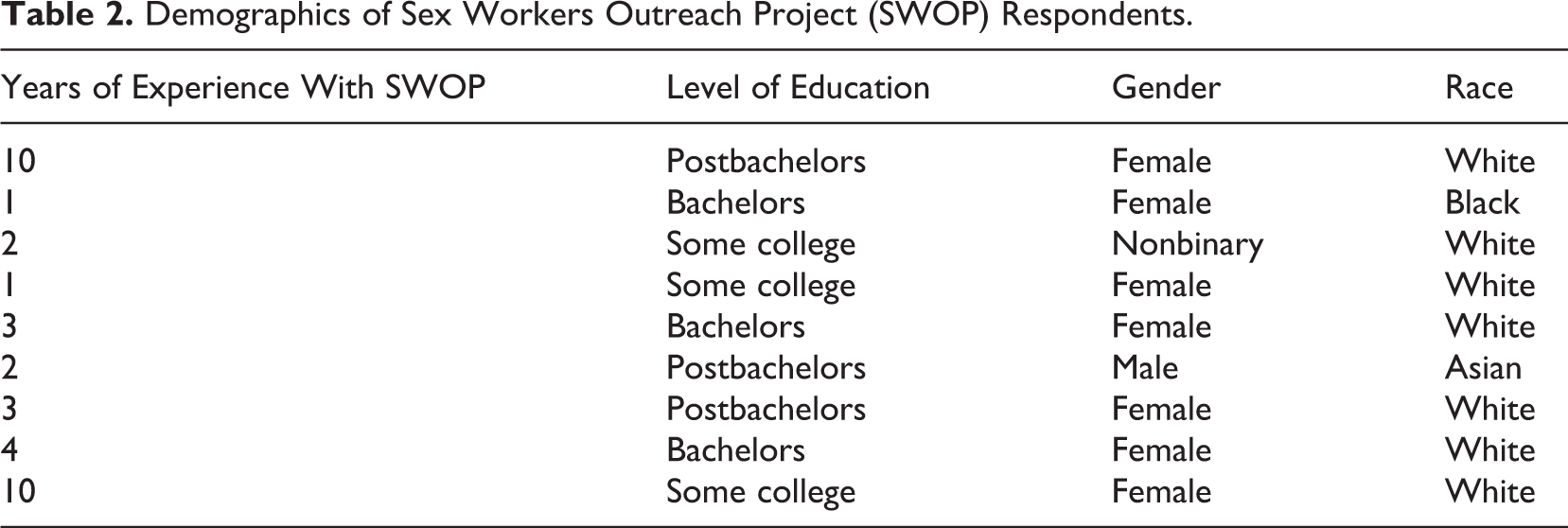
This article comes partly from my work as a volunteer participant observer with SWOP-Chicago. Previous publications based on this work (Anasti, 2017) reflect on how SWOP-Chicago professionalized in order to gain support among human service providers. During the time of this study, there were no other sex worker rights organizations in Chicago, and thus I interviewed all of the board members of SWOP. To attempt to balance the focus on SWOP-Chicago, I undertook interviews with four individuals who were prominent advocates for End Demand organizations in Chicago. The majority of this article stems from my findings from the managers of the HSNPs, with supplemental data from a few leaders of End Demand organizations, as well as board members of SWOP Chicago (demographics of End Demand members is listed in Table 1, and SWOP-Chicago members is listed in Table 2). For the managers of HSNPs, I selected cases to interview in three different ways. First, I contacted every organization mentioned to me in interviews with SWOP-Chicago board members and members of the End Demand coalition, whether they were considered to be opponents or collaborators with the advocacy group. Second, both SWOP-Chicago and the End Demand coalition list collaborators on their respective websites, thus I contacted any organization that was listed on these websites. Third, I sought out HSNPs that were listed in the “Chicago Prostitution and Trafficking Intervention Court Resource Guide,” a guide published by an organization that provides services to sexual assault survivors in Chicago. Organizations in this guide often partnered with the End Demand campaign or SWOP-Chicago, yet a few organizations were not acknowledged as collaborators of either.
Demographics of End Demand Respondents.
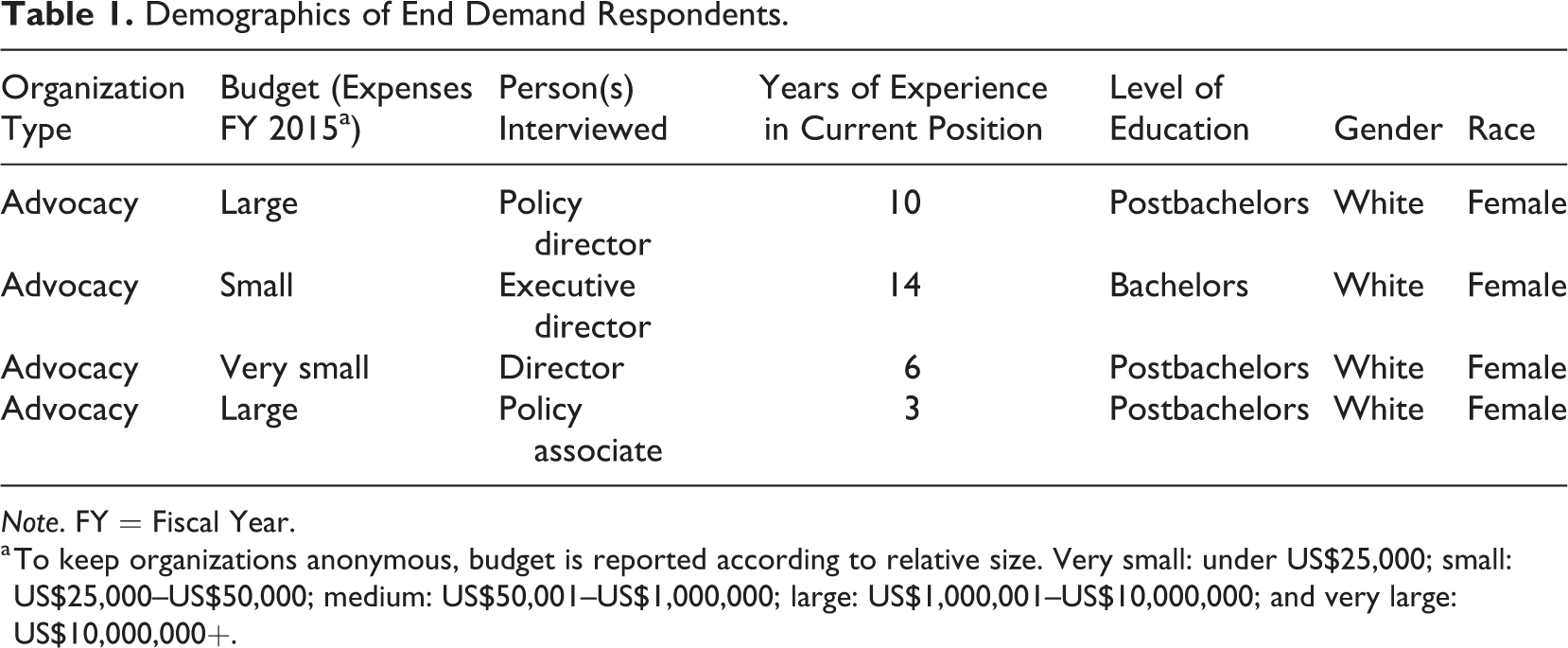
Note. FY = Fiscal Year.
a To keep organizations anonymous, budget is reported according to relative size. Very small: under US$25,000; small: US$25,000–US$50,000; medium: US$50,001–US$1,000,000; large: US$1,000,001–US$10,000,000; and very large: US$10,000,000+.
Demographics of Sex Workers Outreach Project (SWOP) Respondents.
Ultimately, I came up with a list of 82 HSNPs from which to recruit possible respondents. I attempted to interview all of these organizations, recruiting organizations through postal mail, e-mail, and telephone. I was successful in interviewing 40 individuals at 38 organizations, ending data collection when I hit data saturation. Respondents included employees at domestic violence organizations, homeless service organizations, women’s health clinics, employment training nonprofits, substance abuse treatment centers, counseling and other mental health centers, immigrant and/or refugee-serving organizations, legal services, and LGBTQI organizations. A full list of demographic information on the respondents (gender, race, years at organization, type of organization, and organizational budget) is included in Table 3. Seventy-three percent of respondents were white, a finding not unusual for nonprofit directors (Kunreuther & Thomas-Breitfeld, 2017). All but two respondents had a bachelor’s degree or higher. I also included employees at two government organizations: One respondent was working with a HSNP as part of her employment with the federal government and another was a member of a state government department that was embarking on a project with sex workers. The latter had been in the process of engaging with collaborative partners in this field, and one of the partners was SWOP-Chicago. I made it a point to contact the executive director of the organization first, as they are tasked with promoting the organizational mission.
Demographics of Human Service Managers.
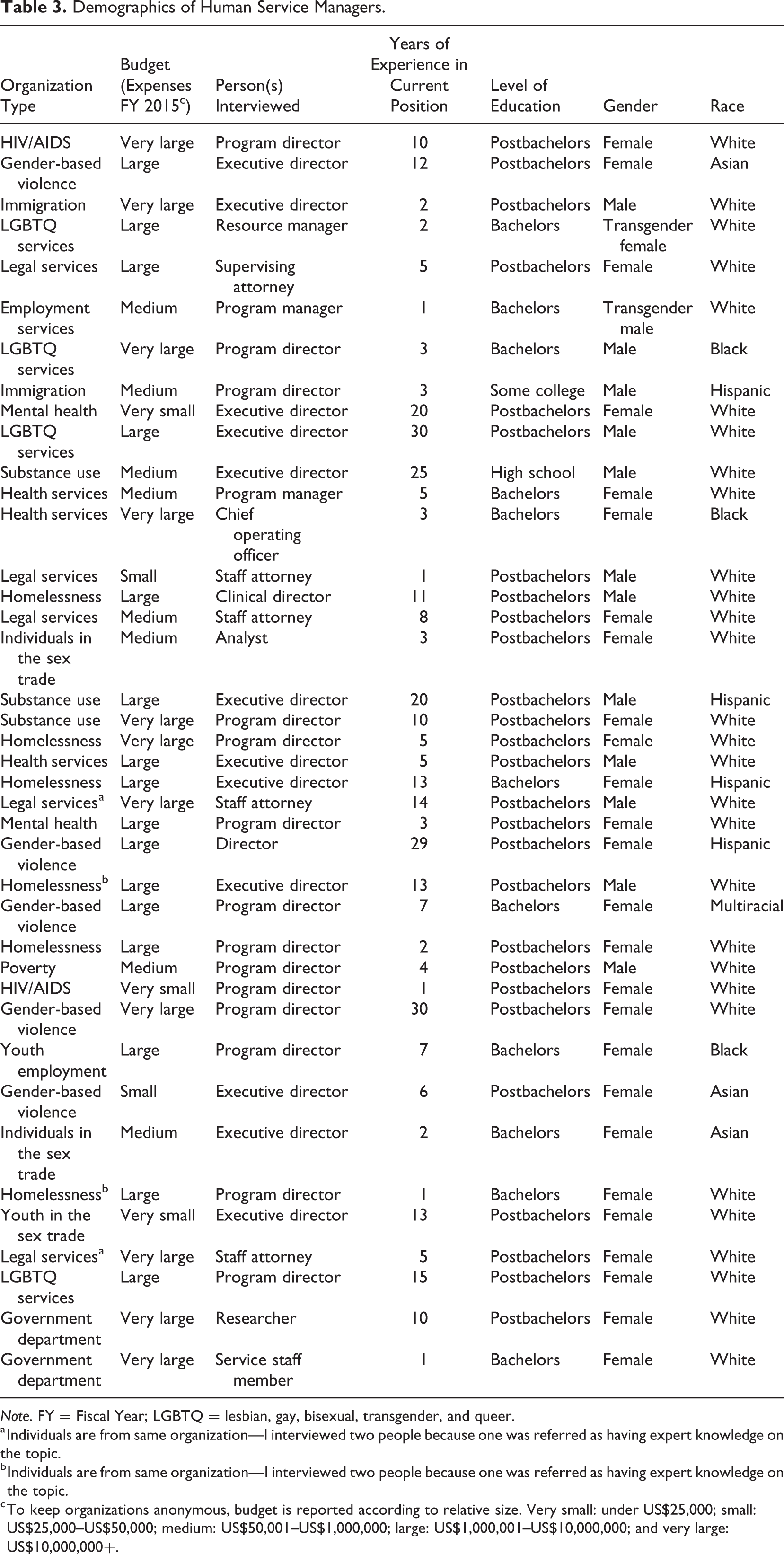
Note. FY = Fiscal Year; LGBTQ = lesbian, gay, bisexual, transgender, and queer.
a Individuals are from same organization—I interviewed two people because one was referred as having expert knowledge on the topic.
b Individuals are from same organization—I interviewed two people because one was referred as having expert knowledge on the topic.
c To keep organizations anonymous, budget is reported according to relative size. Very small: under US$25,000; small: US$25,000–US$50,000; medium: US$50,001–US$1,000,000; large: US$1,000,001–US$10,000,000; and very large: US$10,000,000+.
Data Collection and Analysis
Each interview lasted between 35 min and 1.5 hours and was conducted at the respondent’s home, at their office, or, in five instances, over the telephone. Semistructured, in-depth qualitative interviews have the benefit of eliciting information that allows for more nuanced answers (Kvale, 1996), allowing respondents to go beyond a simple “yes/no” answer binary, which provides deeper answers to the researchers’ questions (Reinharz, 1992). The qualitative interviews began with questions around organizational history, mission, and goals. I then asked respondents how they defined the concepts of “feminism” and “social justice” in this work. Do these organizations consider themselves to be feminist? Is feminism a leading ideology in how they frame their work? This led to the question of whether or not they worked with any individuals in the sex trade. The term “individual in the sex trade” was developed and disseminated throughout Chicago by the Young Women’s Empowerment Project (YWEP) during the mid-2000s. The idea behind this term is that there are many individuals in the sex industry who neither “choose” nor are “forced” to be in the sex trade. Thus, for many organizations providing services to this population, neither the terms “sex worker” nor “trafficking victim” may apply. I used this term with respondents, as I thought it would be the term that best reflected the situations of the individuals whom they worked with. I then continued with the interview using the term the respondent used. I asked respondents about their current work with individuals in the sex trade, their reasoning behind why individuals entered the sex trade, and how they engaged in advocacy (if any) on behalf of individuals involved in the sex trade. I also asked them directly about their thoughts on the differences between End Demand/abolitionist policies and sex worker rights/decriminalization policies. Finally, I also asked them about the incorporation of harm reduction in their work. The results are reported based largely on the answers to those questions.
All interviews were recorded (with the respondent’s 8 permission) and transcribed by me and a professional transcriber. Subsequently, the interviews were analyzed with NVIVO (Version 8) qualitative software. I took extensive memos immediately after each interview, returning to the memos after coding. In analysis, I created a set of codes that I used to analyze both the qualitative interviews as well as the memos. These codes included but were not limited to “harm reduction,” “abstinence,” “stigma,” “trauma,” “feminism,” “decriminalization,” “survival,” and “criminalization,” among others. In addition to these predetermined codes, I utilized open coding to capture new insights (Auerbach & Silverstein, 2003; Patton, 2002). Analysis consisted of a process of meaning categorization and interpretative analysis (Kvale, 1996), as I created themes of analysis and divided them into subcategories, writing memos in order to connect the theoretical constructions to existing data.
Methodological limitations include the inability to conduct this study using random sampling techniques: Individuals who refused this study, believed that they did not work with sex workers, or were not embedded in organizational networks of sex work/sex trafficking may have added crucial insight to the study. As it stands, almost all respondents were aware of the debate in the field between abolitionism and decriminalization. Another limitation was my position as a participant observer with SWOP as well as a long-standing supporter of sex worker rights. In some cases, this likely precluded some contact with a few abolitionist organizations in Chicago due to the tensions between organizations focused on abolitionism and those focused on decriminalization.
Findings
(De)criminalization of Sex Work
No human service manager in this study believed that sex workers should be criminalized, regardless of whether a human service manager advocated for abolitionist or decriminalization policies. As one manager from a health service organization stated: I definitely believe that women have been more victimized by the correctional system than the johns have, essentially because prostitutes have to risk a lot more than johns have to risk…so that data is really clear that women are unfairly prosecuted in comparison with the person purchasing it. The salesperson is getting victimized from doing it. They’re getting arrested, but they’re also getting victimized by the pimp or somebody who’s supposed to be protecting and selling them at the same time, so I think there will never be a balance, and I think as a society there’s a lot more judgment for the female salesperson, and that needs to change. I know within the advocacy community, there is tension around the criminalization of the johns piece, because there is concern that it will implicate men of color…. But the needs of victims always get downplayed: “oh, we can’t do that because it will further stigmatize communities of color, you know that we can’t go after the pimps and johns because that will be selected enforcement, and hidden prostitution will be protected, and only johns at the street level will be arrested. And so, there is a concern that we are stigmatizing people already marginalized but you know, it’s like well why are we again putting needs of victims of the sex trade below the needs of other populations?
As this respondent describes, some activists have expressed concern around the criminalization of the john because they are worried that an increase in criminalization would disproportionately affect poor Black and Brown men, who activists say are more likely to be caught buying sex than their wealthier white counterparts. One manager who worked at a legal services organization agreed with this and stated that the criminalization of johns was controversial to their organization because “anything that creates more criminal barriers is difficult because the assumption that somebody can pay court fees when they cannot can be detrimental.” Another manager who worked as a manager of a mental health organization stated that “if you’re just targeting the john, you’re targeting the livelihood of the sex worker,” decrying that if you arrest the john, “the sex worker gets caught up in the mix too…they may lose money or a safe place to stay, or whatever is going on.” A few respondents expressed the concern that criminalizing the john would often lead to the criminalization of the sex worker: For instance, if a sex worker was undocumented, was found with an illegal substance, or was found with a weapon for protection, they may be “caught in the mix” being arrested for other nonsex work–related crimes even if the purpose of arrest is to catch the buyer of sexual services.
A few managers in this study wavered between whether or not to criminalize the buyer of sexual services: A few stated that it would help reduce the instances of exploitation, while others were concerned that it would increase penalties on an already vulnerable population, while continuing to situate sex workers in the criminal justice system. Whether or not they felt the criminalization of johns was the best solution to sex work was typically tied into how they perceived the differences between sex work and sex trafficking.
Difference Between Sex Work and Sex Trafficking
Within the abolitionist community, there is a common perception that sex trafficking and sex work are two sides of the same coin. According to feminist Gloria Steinem (2016), attempts to acknowledge that there are individuals who choose sex work ignore “the power difference between buyer and bought” (p. 1). According to this view, there is little difference between clients who are trafficked and those who are not, as the power imbalance between buyer and seller is always unequal. Among managers of HSNPs, a majority of respondents acknowledged that there were differences between those who were trafficked and those who were not; however, they were also cognizant that most of the individuals they worked with were more likely to find themselves in poor living conditions and higher risk of violence, regardless of whether or not they chose sex work: I know that some of our clients advertise their work online, even if they are homeless or at risk for being homeless. So you have the different levels of like, in sex work, there’s like the high-end escorts, and then there’s the middle of the road, and then there’s what used to be, mostly street level, and now because of technology some of the street-level stuff happens online. So almost all of our clients are at that street level. Define force or trafficking, when you have no options. Someone may not be forcing you but it might feel like the only option versus what technically means force. I think a lot of times what we find in this are folks that have nowhere to turn. They have minimal familial resources, and they don’t have any community ties. People out there are preying on them and those types of people probably have some mental health issues on top of it. They’re sitting ducks as far as the target goes. So, if we’re talking about sex trafficking, like, someone came in, they got off a bus, and then someone was like “hey, let’s go on a date,” [we don’t serve] very many of those. Most folks we work with get into sex work, the sex trade, because of rejection of family, that forced them into homelessness…so it’s mostly about survival sex…. Trafficking, we’ve had some people come in that were trafficked, either for sex or labor, but we often refer those folks to an organization with more experience on that issue. Yeah, for one thing I think that ideology of like, all sex work is trafficking and therefore is bad, right, like that kind of mind-set filters down to people and people internalize that, and so it affects people’s self-worth, that kind of thing. And it legitimizes in a way, violence against sex workers. And then yeah, in a direct way, it prevents people from seeking out support.
Sex Workers as “Victims” and “Survivors”
A few respondents would refer to sex workers as victims, which typically corresponded to whether they conflated sex work with sex trafficking: However, this was often tempered with an acknowledgment that sex workers attempting to leave the trade are survivors and that you have to “meet clients where they are at.” As one manager who worked at a substance use agency stated, “definitely there’s violence, they’re victimized” and went on to describe why they were victims: “because some women need to do that for housing. I hear horrible stories. They’ve got to engage in sex because they want to be in a shelter. They don’t want to be cold outside.”
For a few respondents, sex workers were victimized regardless of how they ended up in the sex trade. One manager who worked at an immigrant-serving organization said that she almost never met anyone who had not been victimized as a result of their involvement in the sex trade. She stated that: In my experience everyone has been trafficked. There’s definitely a level of coercion, I mean, there might be a survival aspect to it, but I don’t think that’s primarily it. I mean, I don’t know many stories where people are like, oh, this is what I want to do, and this is the only way I can survive. There is some level of coercion, or experience of trauma, or something that makes them vulnerable to that.
Other respondents appeared to refer to their clients as victims of the sex trade, while recognizing that the clients they worked with were often indigent and may not be representative of the sex worker population as a whole. As one director of a legal service organization stated: Our organization doesn’t have an official policy stance [on sex work], and I think if you talk to everyone in the office, the may have a different take. I think that one is tough, because there are so many bad things, so many negative things that can happen to people involved in the sex trade and it can be a really bad experience, but then I’ve heard some feminists think that it’s empowering…. But we typically see it from the other end, as most of our clients are coming to us from bad situations.
Sex Workers as Agents
Despite the fact that all but three respondents managed HSNPs nonprofits that served indigent populations,
9
over half of the respondents promoted the discourse that sex workers were agents over their own lives and that sex work could be a legitimate form of labor. One respondent, who worked at an employment agency for low-income persons, described how they addressed the existence of sex work in their organization: It’s like good for you, that’s resourceful. It is, because like honestly, it’s so hard to get public assistance and it’s also so hard to get a job that it’s like if you found a way to make money like I don’t care, just keep doing it, keep fighting for yourself, like that’s all that matters…. I wouldn’t respond to [sex work] than I would if they had been in any other job…Oh well if you are doing sex work or you’re selling drugs, and I don’t really care what it is, we’ll just put like other income and we’ll put it down, whatever.
While respondents who perceived sex workers as victims were more likely to conflate sex work and trafficking, those who considered sex workers as agents were more likely to perceive them as survivors in an inequitable society. As one manager who worked at a homeless service agency said: “most of the conversations that staff have [with sex workers] is like ‘yeah, that’s how I make my money.’” She described how some people will talk about frequent customers to staff members, and that she “cannot think of a time where someone has said that they have been interested in stopping sex work” and that their role as an agency was to “meet the participant where they are at.” This illustrates that even for respondents who worked with the most indigent clients, some managers believed that they should not prohibit clients from engaging in the sex trade and sought to promote the workers’ agency while they were under the care of the organization.
Stigmatization of Sex Work
Regardless of sex workers’ status as agents or victims, respondents made frequent note of the way in which stigma permeated the public and governmental response to sex work. Most respondents referred to the stigma of sex work as a direct effect of the criminalization of sex work—if sex workers were not criminalized, then the stigma surrounding sex work would decrease, and sex workers would be more likely to open up about their work. Scholars and activists have shown that the stigma surrounding sex work not only precludes sex workers from opening up about their work to service providers but also results in service providers treating clients poorly as a result of their involvement in sex work (Iman et al., 2009). One provider who worked at an LGBTQ services organization stated that while she couldn’t name names…a lot of housing programs specifically will kick people out if they find out about sex work…what we do is help people unlearn stigma and find ways of navigating systems.
As a result, many respondents describe how this is something that one hides in order to deflect harmful consequences. As one person who worked in an HIV/AIDS clinic within a larger hospital stated: It’s kind of the one area where people are afraid to come out, so they will tell us “I stayed at this guys house last night, I don’t really know him that well.” So they don’t really tell us it’s sex work, but it’s something you can kind of read between the lines, especially in counseling sessions I’ve heard there’s a lot of hesitance to come out just due to stigma. This [sex work] is actual work and it’s not that we don’t want as part of our culture. So, [our organization] has been really intentional about that. But I think this stigma runs really really deep, and there is so much attached to that. The reality is some of our buildings too are CHA
10
buildings. We have vouchers with CHA. If someone gets caught for something that puts them danger of losing the vouchers, and all these extra things that come with it, then CHA is likely to cancel the voucher…. And so I think that there’s people afraid of losing their housing, of judgment.
Influence of Advocacy Organizations: SWOP-Chicago and the Harm Reduction Narrative
I had SWOP come into a training, because I’m part of our trauma committee and we recognized that many people in the universe are traumatized, and they express things in different ways. Just to be more open-minded…and so a few voices were like, we need to bring SWOP in. And I’m hoping to have a training from them for all of our programs. We do our best to help, there are folks that work with us and volunteer with us that have a very strong connection with that, or have made that transition [out of the sex trade]. And we can refer them to, SWOP is probably the place where I would do that.
These quotes describe how respondents perceive the work that SWOP-Chicago does on behalf of individuals involved in the sex trade. SWOP-Chicago and sex worker’s rights organizations with similar objectives of decriminalizing the sex trade have purportedly used the “empowerment” narrative around sex work, advocating for sex work as an empowering career. Initially, empowerment was their primary narrative: SWOP held parties and peer-support events specifically for individuals in the sex trade advocating for sex work as an “empowering” career. Over the several years, board member respondents told me that SWOP’s emphasis on sex work as an “empowering” career has shifted as a result of a renewed focus into promoting their message to service providers that work with sex workers. Consequently, there has been more focus on sex work as being an valid option for survival.
One SWOP board member described their recent involvement in the harm reduction movement, which has provided them with access to harm reduction services and advocates and has helped SWOP to gain legitimacy among harm reduction service providers: She noted that as a result of their entry into the harm reduction service world, she became more passionate about Housing First, and just general housing issues in Chicago, which extends their advocacy, and we also give free trainings…and we give them information about sex workers…so we learn about housing and drug users, and they learn about sex work.
Influence of Advocacy Organizations: End Demand and the Victim/Survivor Narrative
We did talk a lot about this issue [trafficking] to Senator Kirk
11
last year. And of course you cannot see him because he does not talk to anybody but we saw his staffer, and he was certainly very supportive as was Senator Durbin
12
…. So there is a lot of receptivity on the part of policy makers. One of the things we are doing because of a law that End Demand helped to get passed in 2014, which was creating this fund for victims’ services. And so what happens is when the local municipalities make arrests and they collect the fine from a john, or a trafficker, or pimp they actually get to keep some of those funds so it really actually helps the municipalities…[End Demand] have been really interested in getting education to these municipalities, to get the police to arrest the right people, meaning the johns and the pimps. Not only are we helping victims and survivors with whatever they tell us they need help in, but we’re also really addressing the End Demand side of things and looking at the johns and the pimps…Through End Demand Illinois, we were able to defelonize prostitution, which has been amazing…and now you know women and men can now use affirmative defense, instead of being prosecuted for prostitution. And they can say no, I am the victim of sex trafficking. So, there are a lot of great things happening legislatively in the city of Illinois.
Interestingly, there were fewer managers who took the End Demand/abolitionist perspective than those who advocated for decriminalization, possibly indicating that SWOP-Chicago has been highly successfully in promoting their discourse in a milieu that has been largely unreceptive to decriminalization. In contrast to the harm reduction narrative plied by organizations like SWOP-Chicago, advocacy organizations that are part of End Demand refer to individuals in the sex trade as either victims or survivors. Specifically, they are part of a system of “commercial sexual exploitation.” This system is currently being addressed by law enforcement that “intervenes and goes after the bad guys.” For some respondents, this perception that the women and girls 13 involved in sexual exploitation are victims of “bad guys” allows for a distinct locus of blame. Having a single locus of blame results in the following solution: collaborate with law enforcement to get “bad guys” off the streets. The Cook County Sheriff, Dart (2011, 2015), has been extremely amenable to this solution and has dedicated additional law enforcement resources to rescue sex trafficking victims over the past several years. Respondents encouraged by this solution maintain that their primary goal will be to get both men (as buyers) and women (as sellers) off the streets in order to eliminate the presence of the sex trade. These respondents maintain a working relationship with Dart and refer to him as “one of the good ones,” “open and understanding,” whose police officers are very “nonviolent.” For these respondents, Dart is doing everything in his power to reduce the prevalence of the sex trade, thus reducing the incidence of trafficking. In contrast, organizations that adopt a decriminalization stance on sex work point to the victimizing stance that Dart has made around sex work, decrying his support as “political” and “ineffective for sex workers.”
Once victims are rescued from the sex trade, either by service organizations or by law enforcement, respondents refer to them as survivors. “Survivors” refer to those (primarily) women who have exited the sex trade and, in some service agencies, take on a role of helping others exit sex work. Several organizations mentioned the wish to hire survivors of sex trafficking, as one manager of an antitrafficking drop-in center stated: “It is our intention to hire survivors…it is extremely important that we live out what we stand for.” What they “stand for” is to assist adult females involved in sexual exploitation from what they refer to as a harm reduction approach, as they allow women to come into their drop-in center and receive services, no questions asked. Having survivors on staff would allow their organization to illustrate their dedication to helping “victims with things they need help with,” which she noted could be “legitimate” ways to support themselves.
What to provide to individuals involved in the sex trade?
Although tensions prevail between organizations that aim to reduce the harm of sex work and those that seek to abolish sex work entirely, there appears to be less discrepancy between the types of services they seek to provide. One director of an antitrafficking organization stated that: our only hope is that we can give any woman who comes in a sense of security…we have our own long-term goal but it’s not something that we are going to push on anybody who is not ready for that change.
Services specifically for sex workers are limited, according to the respondents in this study. Thus, even among respondents who believe that sex work should be decriminalized broadly, a few acknowledge the important work of organizations who seek to assist sex workers in leaving sex work. One manager who works in legal services stated: Diversion programs can be helpful in some ways, not necessarily because of the diversion because honestly we just want to see prostitution decriminalized, but because it is providing service support. When I speak to clients about what they need the most, ensuring safety from someone who is trafficking or exploiting them can be a big thing. The thing that I hear a lot is “hey it is all well and good to tell us to leave the sex trade or to leave our trafficker” but where do you go, where is safe, how do I get counseling, how to I get health care and so the services are so needed.
The most important service provision tools that these managers felt should be provided were basic needs services (housing and food), counseling, and health services. Many respondents felt that basic needs were difficult to obtain because of the criminal status of sex work. One respondent from an organization providing services to individuals with HIV/AIDS stated: A lot of [sex workers] wouldn’t survive unless they were engaging in sex work…I don’t know I guess it’s a catch 22, because it allows them to have access to money, so they can get housing and those things, but it also prevents them from getting housing because of a criminal record and all those things…a lot of those people that engage in sex work come to us…so if they need housing, we can connect them to people, or food, and we try to be responsive to those basic needs. there is still going to be coercion, there are still going to be health needs, there is still going to be the fact that people are turning to prostitution because they don’t have other options…and that is the baseline before deciding what is helpful and working with people.
Discussion
In this study, managers of HSNPs have had their opinions on the sex trade shaped considerably by the competing sex work discourses of abolitionism and decriminalization in addition to being shaped by the human service technology of harm reduction. I suggest that although the End Demand/abolitionist model dominates the political and policy debates around sex work and sex trafficking, the influence of organizations such as SWOP has shaped and altered the way that many human service professionals are conceptualizing their work with sex workers. However, this does not indicate that human service professionals have completely eschewed their beliefs around the victimization narrative of sex workers. Many social workers have tried to complicate the debate, describing how they understand that many sex workers have chosen their profession, they are less likely to work with those relatively more privileged (i.e., middle to upper-middle class) sex workers.
Indeed, it is true that social workers and other helping professionals (outside of those working in private practice psychotherapy) will be more likely to see sex workers who have been trafficked, those who regularly experience physical violence, those with HIV/AIDS, and those with minimal options for other employment. As several of my respondents noted, for many of their clients, sex work was the least of their problems. For human service professionals working at LGBTQ organizations or HIV/AIDS organizations, there tended to be a strong awareness of the macrostructural reasons behind entry to social work; it is also the case that these organizations were more likely to work with transgender individuals. Transgender women, particularly transgender women of color, are disproportionately represented in the sex trade due to a lack of opportunities and discrimination in other types of paid work (Fitzgerald, Patterson, & Hickey, 2015; Nemoto et al., 2006). Thus, human service managers working with this population considered sex work to be a mode of survival and strongly disavowed any type of criminalization of sex work.
Additionally, some researchers (as well as two of my respondents) have made note of the practice of arresting transgender women in prostitution as men, which is the gender they may have listed on their driver’s license. Lovell (2012) and her research team at DePaul University in Chicago found that a disproportionate number of transgender women had been arrested for patronizing prostitution. In Chicago, individuals arrested (not convicted) for patronizing prostitutes automatically have their mug shots taken and posted to a Chicago Police Department website for 30 days. Lovell (2012) found that many transgender women in their sample were being charged with “buying” sex, likely automatically assumed as such because the state classified them as men. Consequently, even with the push to decriminalize sex work for sellers, there is a preconceived notion that these sellers are cisgender women. Thus, transgender women are caught up in the increased criminalization of sex work.
Advocacy organizations are also influencing human service providers in their views on sex work. While members of SWOP are largely middle-class, white sex workers, their transition from a peer-support network to an organization that seeks to provide services and outreach to street-based sex workers has increased their legitimacy and standing among HSNPs (Anasti, 2017). Members of SWOP are cognizant of their relative lack of diversity and have sought to increase representation from workers of color, transworkers, and workers from a lower socioeconomic status. As noted by Panichelli, Wahab, Capous-Desyllas, and Saunders (2015), the experience of sex worker activism in the United States has been predicated on the needs of white women who overly focus their attention on the legislative process of decriminalizing sex work (see also Koyama, 2016). In working with populations that are already criminalized, SWOP has attempted to tailor their message as being “anticriminalization” of criminalized social statuses as opposed to being strictly about the decriminalization of sex work, which would primarily affect members of their peer group. Work and collaboration with SWOP have shaped some service professionals’ thoughts about sex work, even as the dominant discourse continues to be the End Demand model of sex work abolitionism. However, there are still a considerable number of organizations that are working with End Demand—this is this case even as many individuals who work at these organizations are proponents of decriminalization. A respondent noted that despite her support of decriminalization, her organization worked with End Demand because “we don’t want to see it worse than what it is.”
For various reasons, social work research and education in the United States has been minimally concerned with issues of sex work, although this has been changing in recent years (Bromfield, 2016; Wahab, 2002, 2006; Wahab & Panichelli, 2013). The focus in social work continues to remain with issues of human trafficking, which some social workers conflate with consensual sex work (Bromfield, 2016). Until 2015, sex work was collapsed under the violence against women category at the Society for Social Work and Research Conference, implying that the two things were the same. My research provides a preliminary glimpse into the ways this conception is changing among human service managers who saw sex work as a form of survival, not necessarily violence in and of itself.
Conclusion and Future Research
Future research should be done to examine how frontline social workers view clients who work in the sex trade. While research has been done on this topic with social workers who work specifically with individuals in the sex trade (Dewey & St. Germain, 2016; Oselin, 2014), most social workers coming in contact with this population are specifically serving another population. This study spoke to managers of HSNPs: While many had practiced direct service work, only three respondents were currently working in direct service. Interviewing frontline workers will help us to understand how those providing direct services to sex trade populations think about sex work.
There are two other lines of research that I believe will improve our understanding of how human service professionals work with individuals in the sex trade. First, the use of surveys may help us get better quantitative data on what professionals are actually working with sex workers and what their perceptions are around working with sex workers. Second, because this study is done in a large, metropolitan city with a strong presence of sex worker rights activists, some of whom work in human services, its findings are limited by a narrow geographic focus; work needs to be done with human service professionals living in areas without a strong network of sex work activism in order to help understand how much advocacy organizations influence HSNPs.
This study provides a small glimpse into how human service managers in Chicago think about their work with individuals involved in the sex trade. In this city, like all urban U.S. environments, prostitution is illegal for both buyer and seller, although efforts have been made to decrease criminal punishment specifically for the seller of sexual services. This study shows that many managers of HSNPs are considering what the possibility of decriminalization of sex work may mean for their clients: Many believe that full decriminalization will benefit their clients, although it conflicts politically with the dominant discourse of abolitionism. Indeed, while many respondents have expressed these thoughts to the author in private interviews, many do not engage publicly in activism around this issue due to fear of retribution by funders who may support abolitionism.
Footnotes
Acknowledgments
Many thanks to Ron Weitzer, Jennifer Mosley, and Susan Lambert for their guidance and support during this research. Christopher Dingwall provided crucial support and copy edits to the document. Additional thanks goes to my departmental colleagues at Oakland University, who have provided support during the writing process. A big thank-you goes to the Fahs-Beck Fund for Research and Experimentation that funded this research.
Declaration of Conflicting Interests
The author(s) declared no potential conflicts of interest with respect to the research, authorship, and/or publication of this article.
Funding
The author(s) disclosed receipt of the following financial support for the research, authorship, and/or publication of this article: The data collection was funded by the Fahs-Beck Fund for Research and Experimentation, New York.