




Abstract
This article explores women’s experiences of the women’s safety services associated with a South Australian integrated program for male perpetrators of domestic and family violence. As small scale and exploratory, the study aimed to understand impact of such services on women’s perceptions of safety. Interviews were conducted by telephone, using a semi-structured format, with 14 women whose partners or ex-partners had been referred to a perpetrator intervention program. Informed by a feminist standpoint perspective, thematic analysis was used to explore each woman’s experience and perception of safety. The findings of the study suggest that integrated domestic and family violence programs can improve women’s feelings of safety through the application of practical safety planning, timely intervention, emotional support, and trauma-focused practice. Importantly, while the behaviors and actions of perpetrators were clearly relevant to women’s perceived safety, it was apparent that focusing on women’s strengths and capacity for recovery can significantly impact on their continued sense of safety and well-being. This article also reiterates the importance of women’s perspectives in evaluating the effectiveness of perpetrator interventions.
Integrated service responses, combining a criminal justice response with both perpetrator interventions and services for victims, are widely recognized as central to efforts to address to domestic and family violence (Day, Chung, O’Leary, & Carson, 2009). In prioritizing the continuing safety of women and children, such approaches emphasize the necessity of interagency collaboration and accountability, ensuring that the needs and interests of victims are always in view. Likewise, including women’s voices in the evaluation of integrated program responses is vital for establishing that these are having the desired impact (Breckenridge, Rees, Valentine, & Murray, 2015; Gray, Broady, Gaffney, & Lewis, 2015; McGinn, Taylor, McColgan, & Lagdon, 2016). This article reports on a study which aimed to explore women’s experiences of the safety service element of a South Australian integrated program response to domestic and family violence. With a particular focus on women’s shifting perceptions of safety, this article contributes to the growing body of work advocating that women’s voices be included in the determination of “effectiveness” in domestic violence integrated responses.
Questioning Effectiveness
Evaluating domestic and family violence program responses is a complex task that raises difficult questions concerning what effectiveness means, what can and should be measured and so on. Approaches to program evaluation vary greatly as does the quality of evidence obtained. As observed by Akoensi, Koehler, Losel, and Humphreys (2013, p. 1206), “methodological problems relating to the evaluation design” make it difficult to draw conclusions regarding the relative effectiveness of one program over another. Broader debate also exists concerning issues such as what should “count” as success—for example, whether the absence of further physical violence is a sufficient measure and whose perspectives should be sought (Gondolf, 2004; Kelly & Westmarland, 2015). Growing recognition of domestic violence as constituting an ongoing pattern of coercive control, rather than isolated acts of physical violence, has also been significant in highlighting the need for more “nuanced understandings” (Westmarland & Kelly, 2012, p. 1098) of effectiveness in this context (see also Gondolf, 2004; Vlais, Ridley, Green, & Chung, 2017).
Project Mirabal, in the United Kingdom, was a large-scale and important study established to investigate effectiveness and the meaning of success for “key stakeholders in programs working with perpetrators of domestic violence” (Westmarland, Kelly, & Chalder-Mills, 2010, p. 1), including funders, program staff, male perpetrators, and their ex-partners. Significant reductions in men’s perpetration of physical and sexual violence and a general improvement for women across quality-of-life measures were both noted as significant indicators of effectiveness. Notable, though, was the finding that women did not necessarily attribute positive changes—such as reduced anxiety and fear and greater “freedom of movement” (Kelly & Westmarland, 2015, p. 17)—to changes in men’s behavior but rather to shifts in their own perspective and sense of self. Elsewhere, McGinn, Taylor, McColgan, and Lagdon (2016, p. 246) have highlighted the significance of women’s contributions to facilitating men’s change, observing that the support and validation provided by women’s safety services can empower women to hold perpetrators to account by, for instance, “setting parameters” of acceptable behavior.
Limited research attention has been directed toward women’s perceptions of men’s involvement in domestic violence interventions. In the Australian context, a study conducted by Gray, Broady, Gaffney, and Lewis (2015) confirmed the significance of victim services—or “survivor groups”—observing that women’s participation in these “heavily influenced” their views of men’s behavior and, subsequently, “their appraisal of the relationship as well as their goals or expectations” (p. 75). Thus, women became more competent in assessing the progress made by their ex-partner—including his motivation, the “authenticity of any statements or changes” and the “nature and sustainability of these changes” (Gray et al., 2015, p. 81), which in turn informed their assessment of safety. Gray et al. (2015) also found that victim services were effective in raising women’s awareness of support services and the behavior change journey, as well as ways to recover from experiences of victimization.
In an earlier study in the United Kingdom, Madoc-Jones and Roscoe (2010) found that the support—both emotional and practical—provided by safety services was what women most valued. Importantly, Madoc-Jones and Roscoe (2010, p. 161) challenged the tendency to conceptualize “safety and support as two distinct areas,” instead highlighting the “supportive relationship” between women and safety workers as the critical context for discussing safety issues. Safety and support, in other words, go together. Lastly, in their study focusing on women’s perceptions of safety following police intervention for domestic violence, Dichter and Gelles (2012, p. 57) emphasized the significance of the “meaning of the violence and the context in which the violence occurs.” They concluded that, while separation from their abusive partner does not necessarily mean that a woman is—or feels—safe, “once out of the relationship, having physical distance […] and an informal social support network are critical to women’s sense of security” (Dichter & Gelles, 2012, p. 59).
Focusing on women’s perceptions of men’s change and of their own safety represents a crucial shift in the evaluation of domestic and family violence intervention programs. Victims’ perspectives, as McGinn et al. (2016, p. 247) point out, are an important “part of a jigsaw.” The inclusion of victims’ voices and perspectives both acknowledges and validates women’s lived experiences of domestic violence and can contribute to recovery. Moreover, recognizing the central role played by “women’s empowerment and refusal to accept abuse” in holding men “to account” (McGinn et al., 2016, p. 247) shifts the emphasis from women’s victimhood to women’s “expertise” in this space.
A recent metaevaluation of existing integrated service responses to violence against women, commissioned by the Australian National Research Organisation for Women’s Safety, called for more research into the integration of women’s perceptions of safety in evaluations of perpetrator interventions (Breckenridge et al., 2015). In responding to this call, this study seeks to address the gap in knowledge concerning the role and impact of victim services on women’s perceived safety. In doing so, it also builds upon existing research by further highlighting the unique insights offered by women regarding “what works” in integrated domestic and family violence programs.
The Program
Evidence indicates that one in four Australian women will experience domestic violence in their lifetime (Cox, 2016), and on average, one woman is murdered each week by a current or former partner (Australian Institute of Criminology, 2017). Responses to domestic and family violence are increasingly on the public agenda, marked by the release of Australia’s National Plan to Reduce Violence against Women and their Children 2010–2022 in 2011 and, more recently, work on the Fourth (and final) Action Plan, due for release later in 2019. Relatedly, the National Outcome Standards for Perpetrator Interventions are underpinned by a core commitment to women and children’s safety and clearly articulate the responsibility of perpetrator services to engage with victims: Helping them “to feel confident they will be believed, responded to, supported and protected when they speak up against and report violence” (Commonwealth of Australia, 2015, p. 4). The importance of providing integrated victim safety and support services alongside perpetrator programs has also been highlighted.
The program that is the focus of this study is the Women’s Safety Contact Program (WSCP) in Adelaide, South Australia, that operates in partnership with the Domestic and Family Violence Intervention Program (DFVIP). At the time of the study, the WSCP and DFVIP programs were colocated and embedded within an interagency partnership, with an emphasis on integration and collaboration, between the Department of Corrections and Women’s Safety Services South Australia. The WSCP focus is on providing tangible support to women by responding to the immediate and ongoing effects of violence including safety planning. The DFVIP provides both case management and community and/or prison-based intervention for perpetrators, with a focus on responsibility and behavior change. Information sharing between programs informs the ongoing assessment of risk and safety planning. At the time of the study, WSCP had been operating for 18 months.
Method
Informed by feminist standpoint perspective, this qualitative study set out to explore women’s feelings of safety and their experiences of domestic violence support services. The guiding research questions were the following:
The study was approved by the Social and Behavioural Research Ethics Committee.
Recruitment and Sample
Potential research participants, all of whom had previously received WSCP services, were identified through the WSCP taking into consideration any current safety concerns. Following the distribution of information about the study, including study purpose and description, risks, and researcher contact details, interested parties were invited to participate on a voluntary and anonymous basis. Women who expressed an interest in participating were followed up by safety workers, their consent sought, and time and contact methods determined in line with their stated preferences.
Fourteen women participated in the study. Their partners or ex-partners had participated in 1 of the 10 community or prison-based perpetrator programs delivered between November 2016 and July 2017. As shown in Table 1, four women were still in a relationship with their partner, two were separated from their ex-partner but had minimal contact for child access purposes, and eight had no current contact with their ex-partners. Of the 14 women, 11 had children in their care and 1 had children who were no longer in her custody.
Participant Characteristics.
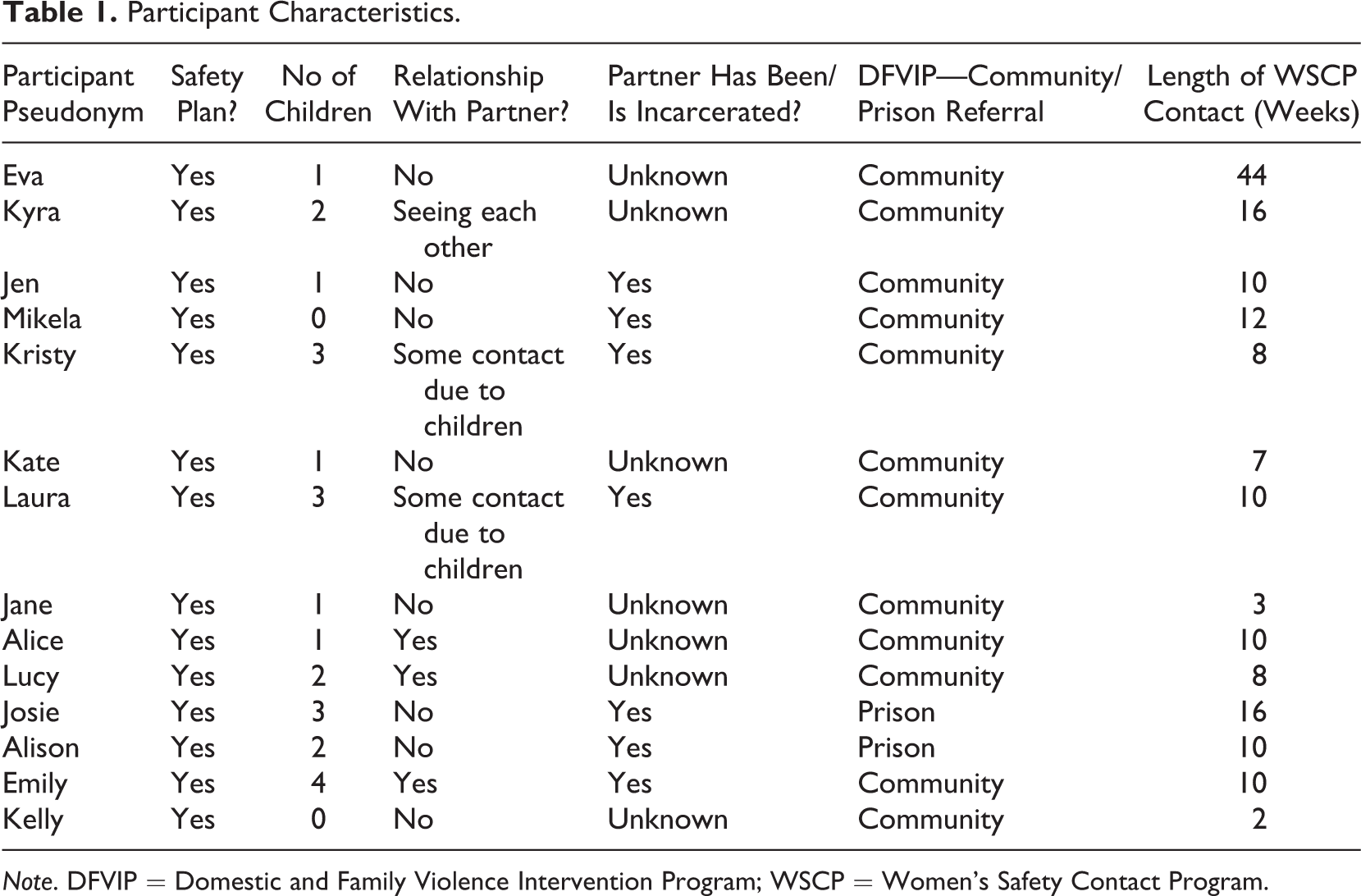
Note. DFVIP = Domestic and Family Violence Intervention Program; WSCP = Women’s Safety Contact Program.
Data Collection
Data were collected through semi-structured, one-on-one, telephone interviews. Telephone, rather than face-to-face, interviews were chosen on the basis that these offered women greater anonymity and confidentiality in discussing their experiences (Vogt, Gardner, & Haeffele, 2012). Interviews ranged from 10 to 42 min, with the mean being 22 min. The interviews with women who reported a higher level of fear tended to last longer (between 22 and 42 min). Women were asked about their feelings of safety and their experiences of the WSCP service. Interview prompts focused on the quality of, and access to, services, fear levels, perceived risk and safety, issues concerning children, and observations regarding their ex-partner’s behavior.
Interviews were conducted with a focus of flexibility, allowing the conversation to be led by women while providing space for expansive discussion of more sensitive issues. This approach is common in social work practice and is especially suited to interviews concerning sensitive and emotionally laden topics (Buchanan & Wendt, 2018). Interviews were recorded and transcribed by the researchers. Pseudonyms have been used to protect the confidentiality of participants.
Data Analysis
Analysis was informed by feminist standpoint epistemology, recognizing that research should be grounded in the lives, perspectives, and experiences of those who are socially and politically marginalized. Thus, this study is underpinned by the acknowledgment that women’s perspectives illuminate the everyday experiences of power and oppression with which they live (see, e.g., Weisman, 2017). Thematic analysis was used to analyze the transcribed interview data by identifying patterns and developing key themes. Braun and Clarke’s (2006) framework for thematic analysis was chosen for its usability and ready application to research concerning people’s experiences and perceptions.
Limitations
The value of qualitative research is that it allows researchers to explore sensitive issues in depth, thereby generating rich and complex data (Silverman, 2010). In this study, it is recognized that while the decision to conduct interviews by telephone provided the participants with a sense of privacy, it may also have inhibited the depth of discussion. The absence of visual cues—such as body language and facial expressions—and the potential for participants to be distracted by people or events in their own environment have also been noted as possible limitations of telephone interviews (Novick, 2008).
Findings
Various types of abuse were identified by women including physical violence, threats and coercion, use of weapons and firearms, isolation, child abduction, and psychological and emotional abuse. For some women, this also extended to threats directed at children and other family members. Eva, for example, said that her partner had “started acting like he [their baby] was his property, running off with him,” while Josie explained that in addition to physical and “mental” abuse, her partner had “trapped” her—that she “was isolated, [had] nowhere to go, no support.”
Domestic violence is multidimensional, occurring in many different forms. Each experience is different, impacted by varied and often correlating determinants. Thus, while the severity, duration, and type of abuse varied, the impact of this on all of the women’s lives was significant. The extent to which women live with fear was perhaps the most striking finding of this study, along with the complex relationship between fear, safety, and risk in women’s lived experience. Dichter and Gelles (2012, p. 48) differentiate between safety—or the sense of safety—an emotion “possibly based on past trauma,” and the perception of risk which involves a “cognitive assessment that may or may not be related to feelings of safety.” Hinkle (2015, p. 149) further draws a distinction between “emotional fear, perceived safety, and perceived risk,” noting that, while closely related, these are nonetheless “different constructs.” That fear, risk and safety are intimately related, was clearly evident in the women’s accounts as discussed next.
“If He Does Find Me, Then He’ll Kill Me”: Living With Fear
Dichter and Gelles (2012) suggest that fear is not only related to violence itself but also to the meanings and contexts of violence. Exploring these meanings with the women participants enabled them to talk about their perceptions and feelings of safety. Many women in the study considered that they would always be at risk of further violence from their ex-partner. Indicative responses included: If he does find me, then he’ll kill me, I’m 100% sure one day, something will happen. That’s why I’ve skipped state. (Mikela) If he has the chance, he will, but I am doing my best not to see him. (Eva) How likely? 110% no doubt about it. (Kate) I know I could be walking down the street with the pram, he could be driving a car, see me and hit me with it. (Jen)
Children’s safety was a key consideration for all of the women who were parents, whether or not they were separated from the abusive partner (Eva: “[that’s] pretty much why I left”) or still residing with him (Kyra: “I really needed to protect my kids”). The perceived risk to significant others, including pets and extended family, was also significant as recognized by Mikela when she observed that, “[t]o get to you, they will get to the people that are close to you, whether your family, your animals or your children.” Perpetrators thus used their “intimate knowledge of the person they are abusing,” including “traits such as [their] caring nature” (Pain, 2012, p. 15), in order to maintain control. In this respect, “using and playing on fear” (Pain, 2012, p. 6) by targeting women’s significant relationships including those with children (Moe, 2009), pets (Newberry, 2017), and extended family members (Birenbaum & Grant, 2012) was an important way in which their ex-partners continued to abuse and exercise psychological and emotional control over them.
Fear, then, was a constant for many women in the study. Fear, however, changes and shifts over time. Emily, for example, was feeling less fearful—or relatively safe—at the time of interview but largely attributed this to her current circumstances including the level of support provided by a family member. While describing her partner as “much, much better,” she was less certain about the likelihood of him sustaining this into the future, saying “that’s a hard question, I don’t know, I don’t know, at the moment […] because I don’t know what the future holds.” Similarly, the six women whose ex-partner was, or had been, in prison experienced a welcome—but temporary—period of reprieve. Although providing them with “piece of mind” (Alison), the prospect of release loomed and was a significant source of continued apprehension, as expressed by Jen who said, “I don’t know what he will do, what happens when he gets out of prison? What happens if he finds me?”
The involvement of the criminal justice system nonetheless led some of these women to feel more confident—or, at least, less concerned—about their safety. For instance, for Laura, this represented a kind of external monitor, in that the expectation that her partner “will go back to prison if he breaches the order” allowed her to feel more safe (or less unsafe). As she went on to explain: The fact that I can ring the police and he will go straight to jail, deters him, it didn’t use to deter him, but it does because he has a taste for it now [prison]. I don’t like to do it, but do you know what, no way is he going to be doing anything to us.
“The Fear Is Still There But…”: Finding Security
The participants’ accounts of living with fear—rather than in fear—illuminate the complex and nonbinary relationship between safety and fear. Recognizing that these are not mutually exclusive—that safety and fear can, and do, coexist—is critical to understanding women’s experiences of domestic and family violence. Pain’s (2012) discussion of the distinctive nature of fear in situations of domestic violence is useful here; notably that this is chronic fear, with impacts that are both long term and cumulative. Drawing attention to the innumerable ways in which women deal with abuse, manage risk, and navigate fear acknowledges the agency of women, whether or not they choose to “leave” the relationship. It for this reason that Pain advocates the phrase “finding security,” as used here, highlighting both the indeterminacy of fear and its coexistence alongside other emotions. Thus, because “emotions are not ‘single’ in the way they are felt or experienced” (p. 22), women’s fear does not negate their courage, strength, anger, hope, and so on. Further, the involvement and support of others—whether professionals, friends or family—can play a crucial role in enabling women to “find security.”. The role played by the WSCP in this respect is explored next.
Informed/Informing fear
The provision of information and awareness are key elements of the WSCP role which were consistently highlighted by the participants in this study. This included general information about domestic violence (what it is, types of violence, patterns, gendered dimensions, and so on), risk factors, and the men’s (perpetrator intervention) program, as well as practical safety strategies, juridical and policing processes, and details of support and crisis services. The WSCP workers also provided the women with relevant information about their ex-partners such as whether they were attending programs, applications for parole, impending release from prison, and so on. Becoming more informed had emancipatory effects for some of the women: It’s only in the last year, that I have felt it’s not my fault. For a long time you think that. [It’s] important not to feel it’s your fault. (Kate) it made me become more aware of what was going on […] I used to talk to [WSCP worker] about this, and she would say, that’s not you, that’s the cycle, not you, not you. (Eva) I don’t have to put up with this, and [I] shouldn’t. (Mikela) I can’t really put myself in the headframe because it freaks me out beyond a controllable point. […] I don’t feel any safer, I am still in the same amount of fear that I was [then].
Overall, WSCP’s educative role was helpful in enabling women to make informed decisions about both their safety and their own responses in relation to, for example, holding ex-partners to account for their actions, involving police, and so on. Across the group of participants, the women remained alert to the possibility that they, or their significant others, would be subject to violence or abuse in the future. It was apparent that fear was related, at least in part, to the severity of violence experienced and the perceived risk to self and others, both currently and in the future. Importantly, far from “just a feeling,” women’s fear was rational and justified.
Supporting women to find security
For the majority of the women interviewed, there was no “after” to fear, that is, fear was a constant presence that ebbed and flowed over time. Pain (2012, p. 24) discusses the fluid balance between fear and other emotions—including the sense of safety—that, at some point, may be accompanied by an “emotional shift”: not “a sudden change of heart” but rather the “culmination of a gradual long-term change in perspective [and] emotions.” The support and encouragement of others—whether professionals or family and friends—are critical at these times, “creating a context in which it is more or less possible” for women to “find security” ( p. 24). The involvement of the WSCP, in this study, played a central role in creating this context; this was evident across two key, but interrelated, areas, namely emotional safety and physical safety, both of which were highly significant to women’s overall sense of safety.
Some, but not all, of the women identified their improved physical safety as a direct and concrete effect of the involvement of the WSCP. They spoke in detail of the safety planning facilitated by WSCP including specific escape strategies, intervention orders, contact numbers for emergency assistance, and so on: [WSCP worker] worked out a safety plan with me, I would ring my mother and my mother would pick me up. Having her explain to me all the safety concerns and what can happen after, made me feel more comfortable. (Lucy) We discussed strategies, what I will do to protect myself. Keep boundaries up so he doesn’t contact us, things like that. (Alison) [I] learnt about safety contingency plans, to always think about situations. (Jen) If that lady hadn’t walked in that day, I don’t know what I would have done, I couldn’t have stayed there. I don’t know where I would have gone. The program had a massive impact for me. It made it heaps better. They had put full measures on my property, there would be no way possible, he could come to me. It’s full security, security doors, cameras. He’s not allowed in that town itself. I was really grateful for the measures they had done. […] They went to extended lengths to make sure that house was going to be secure. He [ex-partner] has shattered me, I am going through a lot to get back to who I was before. The hardest part has been building myself up. We have done a lot in nine months. The fear will always be there. For me it’s a personal thing, it’s just taking that every day. For me it [involvement of WSCP] means to feel a bit more reassured. (Alison) The fear is still there but I definitely feel better and I am better having had the service. (Kate)
Enabling women to rebuild their sense of self and grow in confidence emerged as a particularly valuable aspect of the WSCP. Mikela, for instance, commented on the importance of the emotional support she received, saying “they helped me to move on [and to realize] I don’t have to put up with this and shouldn’t.” This, in turn, impacted on women’s sense of safety, as expressed by Mikela: Yes [I feel safer] because I started to build up my confidence, the confidence to say no, enough is enough. [I’m] always going to be terrified, regardless. [WSCP] [h]elped me to build the self-confidence to leave. Takes a hell of a lot and they are helping, trying to make sure [I] feel safe. (Mikela) [WSCP] [h]elped me get through it or manage it better. Although I don’t feel safer, it is helpful to help me have a better way of life. (Kate) [The WSCP worker] made me feel better about myself. (Laura) [The WSCP has given] me piece of mind. It’s been over 2 years, I’m getting the support and assistance to help me, I guess, manage past what has happened. (Alison) They were so happy to have the front door…. It made my kids happier, to be home, you wouldn’t think fixing a front door would make kids so happy, but it did!
Discussion
This study has explored the omnipresence of fear in the lives of women who have experienced domestic and family violence. While the link between fear, trauma, and domestic violence is well established (see, e.g., Hermen, 2015), this study adds to the literature by focusing more closely on the intersections between fear and safety. It also emphasizes the ways in which women actively manage fear to “find security” (Pain, 2012) in negotiating their daily life and decisions. The key contribution of victims’ services, such as the WSCP, is a significant finding that confirms existing research (see, e.g., Dichter & Gelles, 2012; Madoc-Jones & Roscoe, 2010; Smith, Humphreys, & Laming, 2013; Warshaw, Sullivan, & Rivera, 2013). This study draws particular attention to the need for such services to be, both, comprehensive, flexible, and customizable to individual needs and circumstances, and responsive to women’s fear and perceived safety. The educative role of safety workers, in contextualizing domestic and family violence within broader societal, cultural, and gendered inequalities (Weisman, 2017; Wendt, Buchanan, & Moulding, 2015), was also important, enabling women to understand their position differently and, thus, move away from self-blame. 1
This study has also highlighted the importance of attending to both physical safety and emotional safety. The women’s accounts demonstrate that service responses must address, but go beyond, immediate physical safety needs to ensure that women have opportunities to understand their experiences as well as the “nature and role of fear” (Pain, 2012, p. 28). This suggests that services that respond only to physical safety and fail to recognize the “risk, complexity, and chronic fear” of domestic and family violence are unlikely to be effective. Fear, as emphasized by Pain (2012, p. 16), “does not exist in a social vacuum,” rather it is shaped by societal expectations around gender and relationships and, in turn, the assumptions and reactions of others. Professional service responses, such as the WSCP, thus represent a critical point of connection for women, providing access to opportunities, resources and supports and creating a context in which it is possible for women to find security, in whichever form that takes.
Finally, this study builds upon existing research highlighting the importance of women’s perspectives in understanding effectiveness in perpetrator interventions. Like the participants in Kelly and Westmarland’s (2015) study, this group of women also attributed feeling safer to their own personal development and not, primarily, to whether or not their ex-partner had changed his behavior. It was further evident that, with the support of safety services such as the WSCP, women can contribute in important ways to men’s change by reinforcing key messages and holding them to account, thereby complementing the work of perpetrator intervention programs. Women’s accounts also provide a window into the everyday dynamics of domestic and family violence, highlighting the otherwise invisible intricacies of coercive control that constitute and enable men’s power in practice.
Taken seriously, women’s insights constitute evidence that can inform the form and content of perpetrator interventions in relation to both individual men—and the specificities of their perpetration—and the nature of violence more generally. Further, women’s voices provide relevant and current evidence of program effectiveness (i.e., “what works” in general) while also tracking the “real” progress of individual men, providing the potential for feedback loops and tailored intervention. This potential has been recognized by others, most notably in the work of Kelly and Westmarland (2015; see also Westmarland & Kelly, 2012) and Dichter and Gelles’s (2012, p. 45) focus on the importance of “victims’ perceptions of risk […] for informing interventions to protect future safety.” Notwithstanding the need for multiple measures and sources, the contribution of women’s voices to evaluating the effectiveness of perpetrator programs is therefore an area that remains underdeveloped and demands further research.
Conclusion
Integrated approaches—with their focus on interagency collaboration and shared commitment to perpetrator accountability and women’s and children’s safety—are increasingly recognized as best practice in responding to domestic and family violence. In addition to work with male perpetrators, often within the context of a criminal justice response, integrated programs incorporate work with women/victims, ensuring a triangulated, or wrap-around, response that holds men both to account and addresses women’s safety and welfare needs. In seeking to understand women’s experiences in this context, this study has highlighted the critical role of such programs in facilitating women’s immediate and ongoing safety, providing the foundation for recovery and “restoration” (Pain, 2012) in the longer term. The women in this study particularly valued those service responses that involved safety planning, emotional support, advocacy and allyship, and linkage with relevant services and resources.
This study further highlights the complexities of fear and safety, the extent to which these interweave and shape women’s lives, and the agency of those women who live with chronic fear. It is argued that women’s accounts of fear and safety constitute critical sources of evidence in their own right, not least regarding the nuances of risk and behavior change. Women’s perspectives, as observed by Day et al. (2010, p. 7), are “an important piece of the story of men’s change.” Evaluating the effectiveness of domestic and family violence programs demands an understanding of their real-world consequences, making visible the ways in which program goals and outcomes translate into men’s everyday lives through the lived experiences of women and children.
Footnotes
Acknowledgment
The authors would like to thank Women’s Safety Services South Australia.
Declaration of Conflicting Interests
The author(s) declared no potential conflicts of interest with respect to the research, authorship, and/or publication of this article.
Funding
The author(s) received no financial support for the research, authorship, and/or publication of this article.
