




Abstract
With millions of women experiencing forced displacement, attention is needed toward migrant women’s lived experiences. Religion is an understudied but central component of coping for many migrant women. Through the use of qualitative and quantitative methods, an exploratory study was conducted with 36 forced migrant Shia Muslim women residing in a predominantly Sunni Muslim country of first asylum. Using the brief Multidimensional Measure of Religiousness/Spirituality and drawing from feminist theory, intersectionality, and the ecological framework, we describe women’s experience with religion and spirituality across a variety of domains. Open-ended semistructured interviews were analyzed using a thematic analysis approach. Participants were highly religious across all domains measured. Key themes emerged related to how religion helps women manage stress, including: (1) trusting God to solve problems and (2) relying on prayer and other religious practices to cope. Despite these strengths, women also described major challenges to religious practice, where the third identified theme emphasized that fear and persecution limit religious practice. This article builds understanding of forced migrant women’s experiences, with implications for social work practice and immigration policy. Service organizations can recognize and support religious coping, particularly among religious minority refugee women. Additionally, practitioners and policy makers can promote religious tolerance and understanding within diverse host communities.
Keywords
When seeking asylum, forced migrants often enter societies with religious norms and practices that differ from their own. Approximately 3.3% of the world’s population (244 million people) are international migrants (Connor, 2016) and nearly 1% (over 68 million people) are forced migrants (United Nations High Commissioner for Refugees [UNHCR], 2018). Although there are limitations on disaggregation of data by gender, UNHCR estimates that approximately half of forced migrants worldwide are women or girls (UNHCR, 2017b). Countries of resettlement and asylum in Europe, North America, and Australia have long hosted refugees of diverse religious backgrounds, including Muslims (Buber-Ennser, Goujon, Kohlenberger, & Rengs, 2018), although religious intolerance toward Muslims, and Muslim women in particular, is common within these predominantly Christian contexts (Connor & Krogstad, 2018; Hanniman, 2008; Patrick, 2017; Perry, 2015; Rahmath, Chambers, & Wakewich, 2016).
The majority of refugees and asylum seekers reside in countries of first asylum, often near their countries of origin. As countries with existing barriers to sustainable development struggle to accommodate large populations of forced migrants (UNHCR, 2017a, newcomers struggle to survive in cities or camps where they face difficulty accessing employment opportunities, limited public services, and social tensions (Dadush & Neibuhr, 2016). Despite religious and other motivations on the part of host societies to assist, refugees often experience difficulties accessing basic protections alongside economic and social hardships and gaps in needed services (Afifi, Afifi, Merrill, & Nimah, 2016; Hoffstaedter, 2017; Hutson, Shannon, & Long, 2016; UNHCR, 2017a). Many top hosting countries of first asylum including Turkey, Pakistan, Lebanon, and Iran have majority Muslim populations (UNHCR, 2018), and refugees residing in these countries often share an Islamic background. Of the 40 Sunni Muslim majority nations, many host communities of refugees are Shia Muslims. Shia Muslims comprise approximately 10% of the world’s Muslims, forming a majority of the population in four countries (Iran, Azerbaijan, Bahraim, and Iraq) and a significant minority of the Muslim populations in Pakistan, India, Turkey, Yemen, Afghanistan, Syria, Saudi Arabia, Lebanon, Kuwait, Germany, the United States, the United Kingdom, and Bulgaria (Pew Research Center, 2009, 2011). Although particular contexts vary, long-standing tensions between the sects based on differences in understanding of religious succession and practices have led to violence and persecution as well as discomfort, anger, and fear (see Abdo, 2017; Behuria, 2004; Council on Foreign Relations, 2016). Religious tensions, whether across religions or across sects, influence the environments in which asylum seekers seek to survive and adapt. Further understanding of the role of religion and religious differences in migration contexts is needed, as religion and spirituality may play a central role in coping and adjustment.
To this end, this study uses qualitative and quantitative methods to examine the experiences of a community of predominantly Shia Muslim women refugees and asylum seekers residing in a Sunni Muslim majority country. Increased understanding of religious supports and tensions may be useful to social service practitioners and those advocating for responsive international migration policy. The concept of spirituality is referenced as a distinct characteristic relating to the transcendent, that is, feeling God’s presence, while religiosity emphasizes organized religious participation and practices related to religious belief (Fetzer, 2003; Koenig, King, & Carson, 2012).
Literature Review: Religion Among Forced Migrant Women
In seeking to understand the experiences of forced migrant women, we draw on feminist theory to examine shifts in identity, power, and oppression that occur during the migration process (Mehrotra, 2010; Silvey, 2004). Within feminist social work theory, intersectionality points to the complexity of women’s identities (Mehrotra, 2010). After migration, women identified as refugees or asylum seekers experience this new identity alongside conceptualizations of what it means to be from a particular ethnic, religious, and linguistic community within the broader host country. In addition to social and economic circumstances within host country settings, the limits on women’s power and opportunities are shaped by an uncertain global migration context with few opportunities for permanent resettlement. Alongside intersecting identities of gender, nationality, ethnicity, and migrant status, religion may also be a salient component of identity for migrant women. Women’s identity may change through the process of becoming a religious minority and based on the perceptions of the host community toward that minority group (Mirza, 2013).
Recognizing the utility of multiple theoretical perspectives to develop greater understanding of refugee women’s lived experience, we also draw on theory to point to the ways religion may influence emotional well-being. As religion and spirituality shape individual, social, and structural components of women’s lives, we utilize the ecological framework to consider how these multilevel contexts influence emotional well-being (Bronfenbrenner, 1994; Serdarevic & Chronister, 2005). Specific components of religiosity such as public practice, private practices, commitment, experiences, and coping occur within the context of life experiences and environmental circumstances to influence well-being and mental health symptoms (Koenig et al., 2012). We now examine the ways in which religion may influence well-being among forced migrant women at the individual, social, and structural levels.
In the face of traumatic experiences, including those that occur in the context of forced migration, religion and spirituality influence individual coping. Research among forced migrants (Ai, Peterson, & Huang, 2003; Benson, Sun, Hodge, & Androff, 2012; Gozdziak, 2002) as well as among other groups impacted by traumatic events (Currier, Mallot, Martinez, Sandy, & Neimeyer, 2013; Johnstone, Hanks et al., 2017; Johnstone, Yoon et al., 2012; Park et al., 2017; Stratta et al., 2013; Toussaint et al., 2017) examines relationships between religion, trauma, and coping. Mental health symptoms often result from the trauma experienced prior to forced migration as well as difficulties experienced during transit and while in countries of first asylum (Afifi et al., 2016; Berzengi, Berzenji, Kadim, Mustafa, & Jobson, 2017; Hutson et al., 2016; Thomas, Roberts, Luitel, Upadhaya, & Tol, 2011). Religion may facilitate coping with stress, depression, and anxiety (Koenig et al., 2012; Levin, 2010) through providing a source of meaning and easing adjustment (Gozdziak, 2002; Hipolito et al., 2014; McMichael, 2002; Raghallaigh, 2011; Toussaint et al., 2017). Some research suggests traumatic loss is associated with increases in religious coping, daily spiritual experiences, and organized religiousness (Currier et al., 2013), while other research has found trauma to be associated with a weakening of spirituality (Stratta et al., 2013). Religious conceptions of suffering may be particularly helpful in making sense of trauma (Hasanov & Shirinov, 2017). A study examining the influence of Islamic beliefs on trauma survivors found that beliefs that the difficult event was God’s will, hardship is followed by ease, patience will be rewarded, and the difficult event was a test of faith were associated with fewer post-traumatic stress disorder (PTSD) symptoms. Alternately, beliefs that difficulties are punishment from God were associated with experiencing PTSD (Berzengi et al., 2017). The ways that women utilize religion to cope with loss and change are multifaceted and intersect with broader social and structural influences.
Religion and spirituality are situated within social and cultural contexts that include environmental changes for forced migrants (Benson et al., 2012; McLellan, 2015). People who have been displaced often draw upon religious and community supports to cope with challenges (Schweitzer, Greenslade, & Kagee, 2007) and may find support in religion that they would otherwise lack in their new environment (McMichael, 2002). Religious involvement may serve to promote bonding (within group) or bridging (across groups) forms of social capital within the host country (Allen, 2007). Migrants may find strength in a new religion chosen to replace or become integrated into their prior belief system when adapting to their new community (Winland, 1994). Religious conversion may also be used as a migration strategy, particularly when certain religious identities are favored over others (Akcapar, 2006).
Social and environmental factors including public perceptions also influence how forced migrants utilize religious and spiritual strengths to cope with stress and trauma. Concerns about religious and cultural differences may pose barriers to refugee acceptance in countries of first asylum as well as within locations of permanent settlement. As observed among Muslim women residing in Australia, religious minority refugees may experience cultural insecurity in the form of threatening or abusive language that demeans religious beliefs, stereotypes or accusations of being terrorists, racism, and discrimination (Casimiro, Hancock, & Northcote, 2007). In addition to engendering fear, these experiences may hinder adaptation and mental well-being. Opposition to migrant resettlement on the part of host communities varies by context, but research suggests the level and nature of opposition varies based on religious differences (Bansak, Hainmueller, & Hangartner, 2016; Creighton & Jamal, 2015; Yitmen & Verkuyten, 2018) and the strength of host community religious identities (Bloom, Arikan, & Courtemanche, 2015). There is some evidence that exposure to religious material or immigrant conscious religious services may reduce negative sentiment on the part of host communities (Brown, Kaiser, Rusch, & Brown, 2017; Lazarev & Sharma, 2017). Programs seeking to support migrants can better attune to individual and community needs by understanding how refugees experience religiosity and spirituality. Religious and spiritual supports may assist forced migrants to cope, adjust, and heal, while religious differences and clashes with host communities impede adjustment processes.
This study examines religious coping as well as difficulties in religious practice among Muslim women refugees in transition. Through multiple methods, this exploratory study examines three research questions regarding the lived experiences of forced migrant women: What is their experience of religion and spirituality? How do religion and spirituality play a role in coping? What challenges to religious practice exist particular to religious-minority women?
Method
The research team consisted of a partnership between multiple locally based and U.S.-based researchers, including a team member with a similar nationality, migration, and religious background (Shia Muslim) as participants in the study. Another team member identifies as Sunni Muslim and has conducted research related to Islam in various settings. The study principal investigator has also conducted research related to religion, Islam, and topics such as sexuality in multiple regions of the world.
Using qualitative and quantitative methods and a postpositivist perspective, we examined religious experiences of 36 female refugees. Quantitative assessment of religion and spirituality provided understanding of how multiple religious domains are experienced by women. Qualitative interviews allowed a more in-depth examination of religious experience, including exploration of religious experience within the context of forced migration. The use of both methods enables a more thorough understanding of women’s experiences than would be feasible with either method alone. Study procedures were reviewed and approved by a local university ethics committee and a U.S.-based university institutional review board. We chose not to describe the specific nationality and location of the sample to avoid drawing negative attention to this community or the host context and to protect participant confidentiality. Data were collected in 2016.
Recruitment
A native-speaking researcher from the same ethnic and religious background as those interviewed approached women at a nongovernmental health and social service organization that served refugees and asylum seekers and invited them to participate in a research study. This convenience sampling approach was supplemented by word-of-mouth referrals. All participants resided in an urban setting. As participants located within a service organization may have felt coerced to participate in order to retain services, we emphasized the voluntary and confidential nature of participation during the informed consent process.
Eligibility for participation in the study was determined by the following inclusion criteria: (1) age 18 or over, (2) female, and (3) a refugee or asylum seeker. While all participants identified as Muslim, we did not ask whether participants were Shia or Sunni. Those who chose to participate met with the research assistant in a private location to learn more about the study, give informed consent, and answer a series of questions. This initial interview took less than 1 hour, on average. Additional interviews where questions were asked about religion were conducted at a later time, also in a private location of the participant’s choosing. Study materials including assessment tools were translated into participant’s native language. Qualitative interviews were audio-recorded and took 15 min on average. Thirty-six women participated in these interviews.
Measures
Sociodemographic measures assessed included age, marital status, number of children, education, employment, and time spent in the host country. Quantitative data on religion and spirituality were collected through verbal interviews. Participants also answered a series of qualitative questions regarding religious coping and challenges.
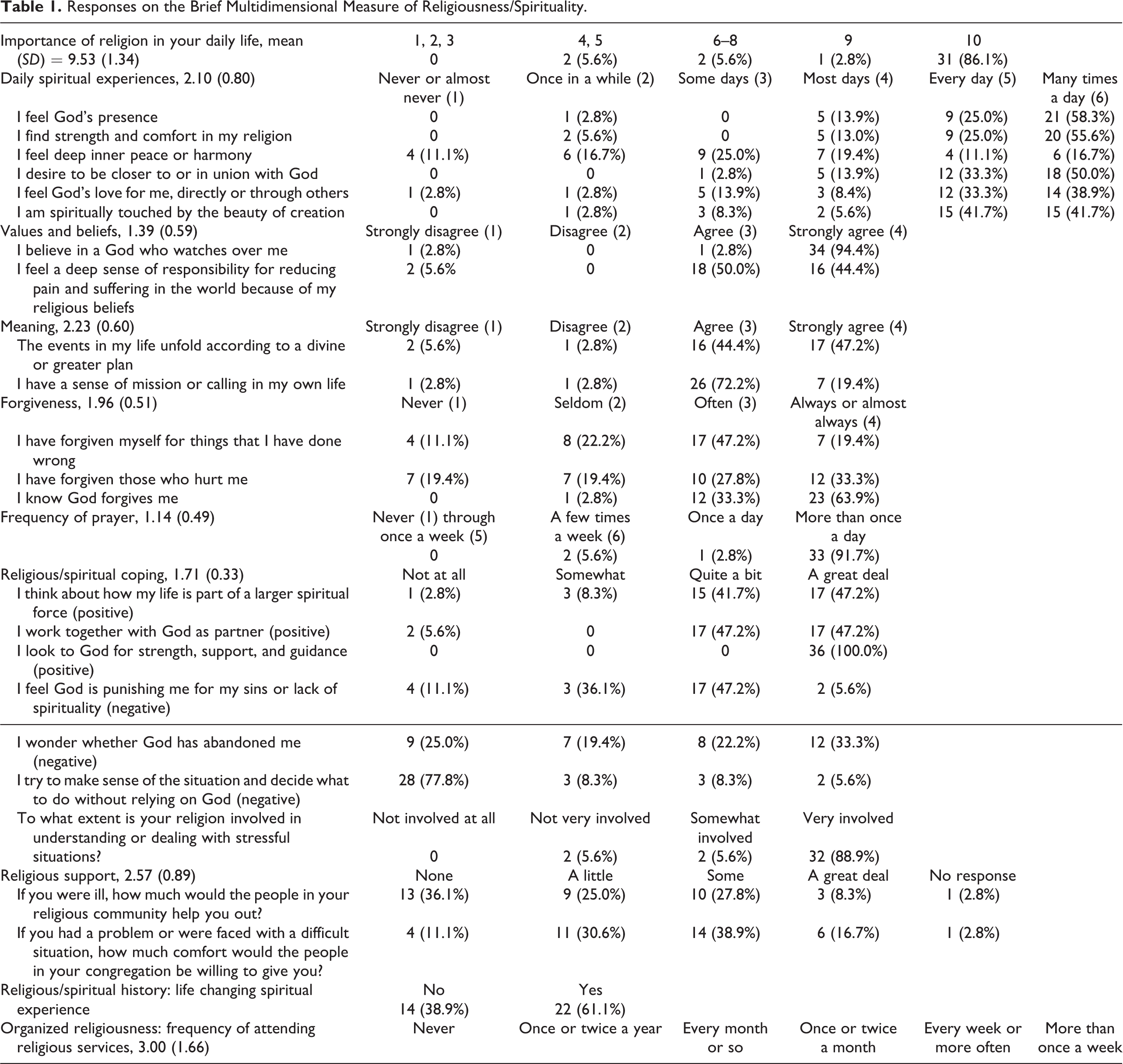
Quantitative measures examined religious affiliation, religiosity, and multiple dimensions of religious experience. Initial questions included “What is your religious affiliation?” and “On a scale of 1–10, how important is your religion to you in your daily life?,” with 1 indicating religion is not important and 10 indicating it is extremely important. Selected questions from the Brief Multidimensional Measure of Religiousness/Spirituality (Fetzer, 2003), developed for use across religious affiliations, were also used. We utilized 25 questions across domains that were deemed most appropriate for the sample, as determined through consultation with the local research team. The following domains were measured: daily spiritual experiences (six questions such as “I feel God’s presence” scaled from 1 = many times a day to 6 = never or almost never), values and beliefs (two questions such as “I believe in a God who watches over me,” scaled from 1 = strongly agree to 4 = strongly disagree), meaning (two questions such as “The events in my life unfold according to a divine or greater plan,” scaled from 1 = strongly agree to 4 = strongly disagree), forgiveness (three questions such as “I have forgiven myself for things that I have done wrong,” scaled from 1 = always or almost always to 4 = never), private religious practices (one question: “How often do you pray privately?,” scaled from 1 = more than once a day to 8 = never), and religious/spiritual coping (seven questions such as “I work together with God as partners” scaled from 1 = a great deal to 4 = not at all). As indicated in Table 1, some measures examined positive forms of religious coping while others examined negative religious coping. The final question in this category, “To what extent is your religion involved in understanding or dealing with stressful situations?” utilized a different 4-point scale, from 1 = not involved at all to 4 = very involved. Additional items measured religious support (two questions such as “If you were ill, how much would the people in your religious community help you out?” scaled from 1 = a great deal to 4 = none), religious/spiritual history (one question: “Did you ever have a religious or spiritual experience that changed your life?” with responses yes or no), and organizational religiousness (one question: “How often do you go to religious services?” scaled from 1 = more than once a week to 6 = never).
Responses on the Brief Multidimensional Measure of Religiousness/Spirituality.
For the qualitative component of the study, women were asked a series of open-ended questions regarding helpful religious practices and beliefs as well as challenges to religious practice. After asking “Does religion help you manage stress?,” we asked participants who responded “yes,” “could you give specific examples of how it helps you?” We then asked, “What challenges to religious practice do you experience in the host country?”
Data Analysis
Quantitative measures were analyzed using SPSS Version 23. Descriptive statistics of each of the religious domains were examined, with frequencies and mean scores presented in Table 1. Less than 1% of data were missing.
Qualitative interviews were transcribed verbatim and then translated into English by the native-speaking research team member, who assisted in the analysis process. Qualitative data were analyzed in NVivo Version 11 using inductive thematic analysis, where line by line open coding by two research assistants led to identification of common codes and then overarching themes (Fereday & Muir-Cochrane, 2006). To ensure rigor in the analysis process, we utilized multiple coders and reviewed findings as a research team, drew upon the prolonged engagement and perspectives of research team members within the community, and incorporated peer review with a colleague who did not participate in the initial data collection process to gain additional perspectives on the themes (Creswell, 2007). Throughout the analysis process, we sought to engage in reflexivity, considering limitations of author perspectives as well as potential negative consequences to participants of research findings (Creswell, 2007). In response, the team was expanded, through inviting a scholar with a different background and perspective to assist in the analysis and manuscript preparation, to include additional perspectives on how to frame and share the findings. Additionally, we decided to share general findings without describing the particular migration context.
Findings
Thirty-six women were interviewed, with an average age of 34 (ranged from 20 to 66). The majority of participants were married and had children, with an average of 2.8 children (SD = 1.4). Less than one third of participants had completed a secondary education. Only one participant was employed part time while the remainder were unemployed. On average, women had been in the host country for 2 years, with a range from 2 through 38 months.
All participants identified as Muslim. Although we did not ask whether participants were Sunni or Shia, most described being Shia Muslim, and one participant described being Sunni. Religion was an important part of women’s daily lives, with an average score of 9.53 (SD = 1.34) on the scale from 1 to 10, where 31 participants indicated 10. Responses to each item assessed are reported in Table 1. Across the measured indicators, religiosity and spirituality were high, with women on average reporting spiritual experiences every day (mean = 2.10, SD = 0.80), strongly agreeing with values and beliefs about God (mean = 1.39, SD = 0.59), agreeing with religious/spiritual meaning (mean = 2.23, SD = 0.60), often forgiving (self and others) (mean = 1.96, SD = 0.51), and praying more than once a day (mean = 1.14, SD = 0.49). Around 90% or more (varying by item) of participants utilized positive religious/spiritual coping a great deal or quite a bit. Negative religious coping was less common and responses varied by items, where nearly half of participants felt God is punishing them for their sins or lack of spirituality quite a bit, and over half of participants wondered whether God has abandoned them quite a bit or a great deal. When asked whether they try to make sense of the situation and decide what to do without relying on God, over three quarters of participants stated not at all. Participants on average reported receiving between some and a little religious support (mean = 2.57, SD = 0.89) and attended religious services every week or more (mean = 3.00, SD = 1.66). More than half of women reported having a life-changing spiritual experience.
Through analyzing the qualitative interviews, themes emerged regarding how religion enables coping as well as challenges to religious practices. Most women (n = 34) described religion as helpful to managing stress, while two said it was not helpful. Key themes examining how religion helps participants manage stress included (1) trusting God to solve problems and (2) prayer and other religious practices enable coping. The third major theme identified, regarding challenges to religious practice, was that (3) fear and persecution limit religious practice and coping. Most participants (n = 33) described specific challenges to religious practice in the host country. These themes will be examined in detail below.
Trusting God to Solve Problems
Trusting God was central to participant’s ability to cope, accompanied by a knowledge that God could solve problems. As Participant 34 described, “I personally trust in God. I feel only God can save me.” Another Participant (#4) described further the need for assistance from God when no other solutions are apparent, “I trust in God. Sometimes I see the problem is too big, I cannot do anything and it needs more time, so in that case I leave it for God.” When problems are solved, another woman (Participant 11) attributed these solutions to intervention from God, “If our problem [is] solved, we know that [it] is because of [our] vow and pray[er]. God has helped us. He hears us and solves the problem.” When assistance comes through another person, this was also seen as a response from God, for example, Participant 3 described, “When you want something of God, He will give [it to] you. When he wants to help you he sends somebody to help you. Actually, God helped you. God always help[s] us.” This turning to and trusting in God may be particularly salient for women who feel a lack of recourse in other sectors of society. Where systems of aid and protection appear unresponsive and unreliable, solutions that do come are attributed to a higher power.
Stress and health were areas where help from God was needed. As one woman (Participant 32) described, “I can share with God easily. My religion is very peaceful. When I have distress and sadness I want [the] help of my God.” Another (#29) described relying on God for her health, “I want health. I want everything of God. If he doesn’t help me, I can’t live.” As with general solutions, participants also attributed health and healing to God. Participant 11 stated, “when a sick person is healed, we know God heals.” This sense that a higher power is available to intervene and provide support, including health and life, was a central component of the worldview many participants shared. Again, where minority ethnic and religious migrant women face uncertainty and vulnerability, the power of God to heal and assist in coping is fundamental to an ability to maintain life, subsuming experiences of oppression and conflict. Where power and opportunities are lacking, participants appear to rely on a higher power with the ability to intervene, specifically in regard to health and coping.
Prayer and Other Religious Practices Enable Coping
Participants acted on their trust in God through practices such as prayer, describing that God listens to their prayers and helps solve problems. For example, Participant 20 stated, Every time that I am faced with a problem [and] I get high stress, at that time I pray on time and read [the] holy Quran to calm down. With reading [the] holy Quran and pray[er] I [become] calm and have low stress. My heart beats normal.
Reading the Holy Quran, along with prayer and fasting, was also described as promoting feelings of physical and emotional relief. Participant 4 described: When I have stress, [then I] mention [the] name of God and read [the] holy Quran; [it] is very nice and full of facts, [then I know that] I will be okay. Reading [the] holy Quran is very interesting. Generally, when I pray and mention [the] name of God it makes me [feel] relief.
Fear and Persecution Limit Religious Practice
Despite the centrality of religious beliefs and practices to women’s lives and their abilities to manage challenges, religious practice and identity in the host community was limited and stressful. Participants described being afraid that neighbors, coworkers, police officers, and strangers may identify them as Shia. One woman (Participant 1) said, “these people don’t know truth about Shia. They know wrong things about us and hate us.” Another (Participant 2) said, “I [am] scared a lot. I [am] scared someone knows that we are Shia.” Another woman (Participant 18) described being robbed and the ensuing fear of identification: One time somebody opened my door. They broke the lock and came to my house. We were not home [and] when I came home I [was] afraid, [because] if they saw my prayer mats they would know we are Shia.
Fears were motivated by harassment participants had been through or heard about. One woman (Participant 21) described, “they can send [us] to prison, or threat[en us] to death.” Another (Participant 20) described being forced out of a taxi before she learned about perspectives in the host country: When [the] driver asked us, we said we are from [native country]. Then he said, ‘are you Shia?’ It was our first time that someone asked that question. We came here [recently]. I didn’t know they have [a] problem with our religion. We said ‘yes, we are Shia.’ Suddenly he stopped the car. And told us, ‘get off from my car, you are Shia. I don’t want to see you again.’ We were shaking and afraid. We didn’t know what we should do.
Because of fear, many participants described being unable to openly practice their religion through prayer, mosque attendance, and participation in the religious month of Muharram, a time of mourning for Shia Muslims. Participant 26 described, “When we pray or worship at home I close the door [so] that no one [can] hear our voice.” Others feel they cannot go to the mosques in the host country, saying, “One of [the] things that [could] make us calm, that is going to [the] mosque and praying. But we cannot do it in [host country] (Participant 34).” Others described their hidden practice during Muharram. “We cannot mourn during Muharram. This is a big problem (Participant 31).” These limitations on religion force participants to hide their identity and practices.
Discussion: Religious Identity and Religious Influence on Well-Being
Study findings point to the importance of religion among this sample of forced migrant women as central to their lived experience and modes of coping, as well as a major environmental stressor. Quantitative findings demonstrate high levels of religiosity and spirituality across every domain measured. Qualitative findings point to women’s reliance on God as a source of power and intervention, while highlighting specific practices that enable them to access this power and source of support within a vulnerable migration context. After applying intersectionality as a lens through which to understand women’s experience, we consider how religion influences well-being drawing from the ecological framework.
Intersectionality of gender, religious, ethnic, and migrant identities influences the experience of oppression for women who describe hiding their faith. Research suggests women experience higher levels of religiosity and spirituality than men (Pew Research Center, 2016). One study identified Muslim women were more likely to perceive discrimination against their religious group than Muslim men (Litchmore & Safdar, 2015). While we are unable to compare the perspectives of women in this study with their male counterparts, most women in this study were married, had children, were unemployed, and had little education. These lived realities place them in a position of economic dependence and limited mobility within the family, which heightens vulnerability. With extended periods of waiting in the hope for eventual resettlement to a third country, women also face dependence on the tenuous setting in the host community and on an international migration system, neither of which they have significant power to influence. The fear of being observed as Shia, which may lead to opposition or persecution, is especially threatening for women who have few opportunities for legal, economic, or social recourse as refugees and asylum seekers. Outward expression of religious affiliation may limit safety or opportunities where identification of religious status marks a person as a threat or someone to be feared. These intersecting gender, religious, and migrant experiences influence disadvantages and contribute to difficulties integrating into a new country and culture.
Within these intersecting contexts of powerlessness, trust in a higher power may be important for maintaining meaning, and the opportunities that come may be attributed to God rather than an individual in power or systems that are generally seen as unresponsive. While refusal to adapt to the religious or cultural context of a host community may hinder acceptance and integration (Benson et al., 2012), maintaining religious identity and practice is a critical source of power and well-being for this group of forced migrant women.
At the individual level, religiosity and spirituality are related to and may promote mental well-being, as has been found in other research with migrants (Berzengi et al., 2017; McLellan, 2015; McMichael, 2002; Schweitzer et al., 2007) and among nonmigrant samples (AbdAleati, Zaharim, & Mydin, 2016). Participants emphasized the importance of private practices, particularly prayer and reading the Quran. These practices and a trust in God were directly linked to positive mental health including providing participants with assistance in coping, peace, and well-being. While our sample was highly religious, research conducted among Muslims in 24 countries identified high levels of religiosity, with participants describing religion as central to their lives and engagement in daily prayer (Pew Research Center, 2008). This suggests levels of religiosity identified among this sample may be similar to many Muslim communities. Specific processes by which religion promotes coping include reliance upon trust in a God that can solve problems and be accessed through practices including prayer and reading the Quran. A closeness or secure attachment to God may enhance health and well-being through provision of security and comfort, particularly needed in times of stress (Hill & Pargament, 2008; Koenig et al., 2012). Additional research is needed to examine how the relationship between religion and coping may have changed due to migration and time spent in the host country. In light of the economic and social challenges associated with migration, women may rely more heavily upon religious identity and practices as a way to cope. However, this religious coping may be hindered when religious-minority women perceive higher levels of discrimination because of their gender, race, ethnic group, and/or religious affiliation.
Socially and structurally, belonging to a minority religious group led to adjustment challenges among this sample of women. The difficulties of living with fear and persecution due to religious identity do not appear to reduce the centrality of religion in women’s lives. However, fears of persecution and the need to hide one’s religious identity may inhibit mental well-being and successful coping in the new environment. Conflict regarding religious difference relates to global differences in religious belief, including tensions between Sunni and Shia Muslims (Pew Research Center, 2008). Religious and cultural differences are likely amplified within migrant hosting countries where resources are limited and host communities struggle to accommodate the needs of newcomers (Dadush & Neibuhr, 2016). Women experience these tensions alongside disruption in the cohesion of their religious communities due to migration and the lack of availability of former and familiar places of worship.
Limitations
The small sample limited our quantitative analysis capabilities. Due to the sampling approach, findings are not generalizable to other Muslim or Shia Muslim refugees. Although the scale was designed for application across religious and spiritual traditions, it was developed in English with a Western, primarily Judeo-Christian audience, raising questions about the validity of the tool for this sample (Fetzer, 2003; Traphagan, 2005). We sought to enhance the relevance of the tool through selecting items in consultation with a researcher from the community. Furthermore, the emphasis on questions about religion may have biased participants toward seeing the centrality of religion. The necessity of translation throughout the research process first from questions developed in English and then of participant responses back to English may also have led to a loss of nuance and understanding regarding people’s perspectives toward religion and spirituality. Without a comparison group of male asylum seekers, we were unable to compare the unique perception of discrimination experienced by religious-minority women to that of men.
Despite these limitations, this exploratory study contributes to the research available on religion/spirituality and mental health among an understudied community (Hill & Pargament, 2008). The multiple methods approach allows for a depth of understanding about both strengths and challenges of religious practice that would not have been feasible in a solely quantitative approach.
Conclusion: Enhancing Supports and Understanding Across Religious Differences
Findings regarding the religious identities, coping strategies, and challenges experienced by forced migrant women lead to a number of social justice implications. While religion provided a source of identity and meaning, fears of persecution limited abilities to practice and gain from religious community supports. Religious discrimination against forced migrants, who comprise some of the world’s most vulnerable individuals and families, is a significant social justice issue that calls for a multidisciplinary response. Social workers can address current injustices by raising awareness of communities in distress and seeking collaborative solutions.
At the policy level, governments and multilateral organizations can recognize the added barriers religious minority groups experience and seek to promote resettlement opportunities, host community accommodation, and needed access to resources. They can also acknowledge the added limitations female migrants experience and seek to remove those barriers to religious coping. Although migrant religion may be viewed by host countries both as facilitating or hindering adaptation (Foner & Alba, 2008), advocates can emphasize commonalities and the centrality of religious identity, which is unlikely to change in the face of host community preferences. Efforts to draw upon a host community’s religious values that promote respect and tolerance may be useful (Brown et al., 2017; Lazarev & Sharma, 2017).
Religious traditions have a history of promoting and providing supports for migrants (Ager & Ager, 2015). A number of countries with majority Muslim populations have sought protection for persecuted groups of Muslim refugees, and Islamic principles often motivate efforts to provide relief (Kirmani & Khan, 2008; Krafess, 2005). Charitable ideals and practices such as zakat (donations), qurbani (distribution of food), and sadqa (helping the poor) may motivate perspectives regarding aid to migrants (Erdal & Borchgrevink, 2017), although differences in cultural and social realities may prove more significant to service provision than religious commonalities (Palmer, 2011). Christian, Buddhist, and other religions are also motivated by beliefs and practices to assist migrants and play a significant role in service provision (Canda & Phaobtong, 1992; Eby, Iverson, Smyers, & Kecic, 2011; Ives, Sinha, & Cnaan, 2010). Additional research on how religion can be incorporated into service provision in ways that honor the religious beliefs of forced migrants is needed, as well as research on how experiences vary by gender.
Service providers working with forcibly displaced populations can recognize and draw upon the centrality of religiosity and gendered experiences when building casework, community, and mental health–related programs. Collaboration with religious and community leaders to seek cross-religious understanding may enable local communities to increase acceptance of those with different religions. When refugees cannot seek asylum among those who accept their religion, organizations can provide information about how to navigate religious differences, share information about safe locations to worship, and advocate for further tolerance and acceptance within host communities. Religious communities and service organizations can provide material, social, and spiritual supports (Dako-Gyeke & Adu, 2017) that respond to the unique circumstances of forced migrant women, as well as creating venues for building tolerance, understanding, and respect for differences (Islamic Society of North America, 2013).
Spiritual and religious resources exist on both individual and community levels, where women turn inward for strength through prayer and faith and outward to others within their religious communities for assistance. Attention to respecting and enhancing religious and spiritual supports is key to promoting well-being among many communities of forced migrant women.
Footnotes
Acknowledgments
The authors appreciate each participant who was willing to share her experiences with our research team. They also appreciate constructive feedback received from anonymous reviewers.
Declaration of Conflicting Interests
The author(s) declared no potential conflicts of interest with respect to the research, authorship, and/or publication of this article.
Funding
The author(s) disclosed receipt of the following financial support for the research, authorship, and/or publication of this article: This project was funded through research support from Brigham Young University.
