




Abstract
Throughout the West Bank, 19 camps are home to more than 200,000 Palestinians, more than half of whom are female. The Israeli occupation and attendant poverty cause communities inside West Bank camps to live under stress and violence particularly limiting to women. Although often portrayed as “helpless victims of war,” little research has been done to explore how women understand their contributions to the resilience of refugee communities. Female refugees were interviewed about their household roles and community participation. This inquiry shows how female refugees navigate the impacts of gender on community resilience.
Introduction
The concept of community resilience can be understood as “(1) the actions taken by the community to absorb the shock of a crisis; and (2) the resources available to help a community act as a ‘collective unit’” (Nuwayhid, Zurayk, Yamout, & Cortas, 2011, p. 508 ). This idea has many variations, yet central to its utility in the health and social sciences is the focus on a community’s strengths rather than weaknesses. Researchers have raised the question of “why, despite significant exposure to war, individuals and families achieve emotional adjustment and social functioning” (Eggerman & Panter-Brick, 2010, p. 71). Identifying how and why certain individuals and communities achieve and adjust amidst displacement and war helps to better contextualize social dynamics within groups. There are several frameworks in the literature that discuss community resilience; two main models will be highlighted here. Norris, Stevens, and Pfefferbaum’s (2008) popular model presents community resilience as a set of networked adaptive capacities—economic development, social capital, cultural competence, and information and communication—which function together to reinforce personal abilities to handle adversity and prepare for short-term disaster readiness. Kirmayer, Sehdev, Whitley, Dandeneau, and Isaac’s (2009) model differs as it is particularly focused on displaced populations under long-term occupation (Aboriginal Canadians), which rely on different components and resources to maintain resilient communities and lifestyles over long periods of time. Community resilience is a powerful concept because it draws attention to the sociocultural components that are beneficial and increase community members’ capacity to work and live together under adverse situations.
In the Middle East, protracted conflict has long been a normal facet of many people’s daily lives (Giacaman et al., 2011; Moran, Khawaja, Khoshnood, & Ramahi, 2011). Displacement and political violence in Palestine, Iraq, Lebanon, and other neighboring countries has threatened the existence or establishment of stable democratic institutions on which citizens can rely. This has had the effect of reinforcing people’s reliance on community networks and social ties. In Lebanon and the occupied Palestinian territories, strong politico-religious networks, such as Hezbollah and Hamas, have at various times enjoyed more popular support than secular governing parties (Nuwayhid et al., 2011). People look to these networks for medical, monetary, and physical support, and in exchange often support the political movement. In countries such as Lebanon, Syria, and the occupied Palestinian territories, the effects of violent conflict, including death and physical displacement, have been felt heavily by the civilian population. Because women and girls “comprise a significant proportion of the civilians living in war-torn areas, they are therefore faced with significant risks and threats to their physical, psychological, and social well-being” (Haeri & Puechguirbal, 2009, p. 112). Even in times of peace, gender roles typically segregate men from women in many Middle Eastern countries, and both sexes exist in and perform very different roles. By maintaining social traditions and a sense of female identity, women in situations of displacement play distinct roles in community life and in contributing to its resilience under adversity (Kassam & Nanji, 2006). Their activities and inspirations warrant attention because greater understanding can lead to better delivery of humanitarian assistance as well as a more nuanced picture of how gendered ideas of community support and shape resilience.
This study explores the following questions:
What do Palestinian women living in the West Bank see as their participation in, and contribution to, community resilience? What are the various ways women leverage individual coping strategies for larger community efforts to withstand violence, symbolic, and physical?
The Context of Resilience in the West Bank
Women and men living in the West Bank must navigate a host of barriers and obstacles to access basic rights, such as education and employment. These obstacles include those that affect both genders—the physical occupation of land by the Israeli state and settlers and the attendant restrictions on movement throughout the territories, as well as those cultural practices that prohibit women from independent movement within camp settings, and social traditions that reinforce women’s role within the home and reify their maternal capabilities.
The Israeli occupation of the Palestinian territories, beginning in 1967 and continuing to present day, has created a situation where more than 230,000 people live in 19 camps throughout the West Bank (United Nations Relief and Works Agency [UNRWA], 2013). Today, the West Bank is divided into three territories: Areas A, B, and C. Area A (12% of the West Bank) falls completely under Palestinian Authority (PA) control, Area B is jointly controlled by Israel and the PA (10% of the West Bank), and Area C falls under Israeli authority. Area C makes up 80% of the West Bank, is home to multiple large Israeli settlements, and is the site of frequent settler attacks on Palestinian agricultural land and residences. It is also home to 17 camps, where daily life is subject to numerous hardships, such as utility shortages, Israeli Defense Forces (IDF) incursions and lack of medical services. Unemployment in most camps reaches 40% and frequent violent conflict, such as the Second Intifada, reinforces the societal notion that working outside the home is dangerous for women, who are more valuable when taking care of children and supporting their husbands (UNRWA, 2013). More than 98% of residents in UNRWA camps identify themselves as Muslim. In daily life and throughout the camp environment, women occupy very different spaces than men. Cultural understandings of Islamic practice vary but share many similarities, including placing limits on women’s movement in public space and a heavy value on women’s honor. The results presented subsequently focus primarily on Palestinian women’s personal experiences living in the confines of UNRWA refugee camps. In order to compare and contrast experiences, particularly with other communities living under occupation, a discussion of community resilience in other Middle Eastern countries is also presented.
Resilience in Other Middle Eastern Contexts
Cross-cultural studies have shown that resilience is a process highly influenced by cultural values (Masten & Wright, 2010). Punamäki (1990, p. 76) writes that in the West Bank, the “nature of the collective phenomenon of coping is already more than merely the sum of individual coping methods, [and] has become a cultural-political feature” of the Palestinian community. There is a growing base of literature on the resilience of similar communities affected by conflict in the Middle East. These studies present examples of three themes common to community resilience in Middle Eastern countries, that is, strong religious leadership and/or social networks; changing gender roles as a result of conflict, and resilience being a process rather than a static state.
Social networks play a central role in supporting community resilience under adversity by serving as a platform for execution and cooperation of community living, secular and religious (Helton & Keller, 2010; Norris, Stevens, & Pfefferbaum, 2008). In the 2006 Israeli-Lebanese war, researchers found that social support networks enhanced the resilience of Lebanese refugees by providing direct material and immaterial support throughout the conflict (Nuwayhid et al., 2011). Here, Shiite leadership provided underlying support for the collective struggle in the form of religious motivation as well as physical sustenance and shelter. Research highlights similar examples among Somali refugees in Australia, and Afghani refugees in Pakistan where Islam offers a meaningful framework of practice and ideology that sustains women during the hardships of exile (Allabadi, 2008, p. 192) and through emotional distress (Mowafi, 2011). Spiritual faith relationships take place internally and do not challenge traditional mores such as where Muslim women can be in public or whom they can talk to. The confluence of these factors promotes high levels of religious adherence, as individuals draw support from faith relationships when social mobility is restrained.
Researchers in the West Bank have argued that Western understandings of community resilience may undervalue preexisting local mechanisms of communal care (Nguyen-Gillham, Giacaman, Naser, & Boyce, 2008). In their overview of women’s roles in wartime, Haeri and Puechguirbal assert that framing women as innocent and vulnerable only serves to further decrease their participation in decision making for peace and retain the status quo. Palestinian identity narratives have traditionally celebrated women’s maternal and reproductive roles and valued them as mothers to martyrs of the Palestinian cause (Massad, 1995, p. 475). During the Second Intifada, however, women took up armed struggle against the Israeli state. In so doing, they challenged previous assumptions about women’s place in society and gendered segregation in the workforce, yet remained compliant with religious norms around their mobility and public lives. Taking on roles that involve negotiation, problem solving, and peacemaking, women living under conflict have built up organizations and publicly displayed themselves to be capable of leadership (Bachay & Cingel, 1999). The involvement of women in previously male-dominated areas and consequent changes to traditional ideas of feminine and masculine is one of the lasting impacts of recent conflicts in the Middle East and Africa (Haeri & Puechguirbal, 2009).
The third theme arising from research on Middle Eastern community resilience is the appreciation that communities are not static entities, but exercise and develop resilience as a process itself (Nuwayhid et al., 2011). Resilient communities exhibit specific qualities of a collective unit, such as community problem solving, the ability to cope with divisions and get along, which foster community pride and a sense of belonging (Kulig, 2000). Rather than reacting to one central shock, the Palestinian experience in the West Bank involves regular incursions by the IDF and a constant low-level psychological threat. Individuals’ abilities to withstand episodic violence and discrimination strengthen the collective resolve and unite community members for group action.
Gender and Resilience
Across cultures, women exist and inhabit very different physical and political spaces relative to their male counterparts. Resilience and resistance, as adaptive behaviors, are experienced differently for women and men, because of the gendered beliefs, roles, and strategies that collectively develop a female or male worldview (Gilgun & Abrams, 2005). Structural violence and feminist theories suggest that women’s subordinate positions and increased vulnerability in times of conflict stem from “pre-existing peacetime social inequalities, which are further reinforced by conflict” (Haeri & Puechguirbal, 2009, p. 108). In countries near and surrounding the West Bank, such as Egypt, Jordan, and Iraq, women’s mobility and access to resources have historically been restricted and tightly controlled (Allabadi, 2008). Culturally codified adherence to Islam can remove women from public life in these contexts, even when it is not mandated by the Koran (Moghadam, 2002). Models of community resilience within the health sciences literature often frame community as a positive repository of trusting relationships and safe spaces (Norris et al., 2008). Although these health-based models are useful in their focus on positive community traits rather than deficits, they do not discuss community resilience in occupied or restrained spaces, such as refugee camps. Control over women’s “social roles, their movement and their sexuality forms the core of Islamic fundamentalist views on gender roles and relations” (Ud Din, Mumtaz, & Ataullahjan, 2012, p. 4). Women judge themselves in terms of their ability to care for others and are socialized into a more “relational” state than male counterparts (Gilgun & Abrams, 2005), which in the closed-off context of refugee camps in the West Bank can diminish women’s freedom of mobility and expression in the public sphere. To gain a better understanding of the gendered experiences of community resilience, and how women view their ability to support communities inside UNRWA refugee camps, for this study, community resilience will be defined as “(1) the actions taken by the community to absorb the shock of a crisis; and (2) the resources available to help the community act as a ‘collective unit’” (Nuwayhid et al., 2011).
Study Context
This study partnered with UNRWA and research was undertaken by the first author through her participation in UNRWA’s community mental health program. Semistructured interviews with 31 women were conducted in nine camps over the region from May to July 2012. Interviews took place inside UNRWA health centers (14 in the North, 7 in the Middle, and 10 in the South). Ethics approval was obtained through the University of Toronto Research Ethics Board, which was accepted by UNRWA without further review. Participants were women between the ages of 22–48, who had no clinical condition, who accompanied family members, were waiting to participate in health promotion programming, and who generally spoke Arabic only. Interviews were conducted in private rooms within the clinic, with the assistance of translators.
Study Design
Interviewees were chosen from women sitting in the UNRWA health center waiting room. They were invited one at a time by a female UNRWA clinic psychosocial counselor to participate. None of the women were previously known to the interviewer, nor did any of the women know about the research prior to being asked to participate. The first author explained the study and its voluntary nature. An informed consent form was developed in English and translated into Arabic using a professional translation service. It was then back-translated to ensure that the intention and information remained the same. The UNRWA clinic psychosocial counselor or male UNRWA field operations director acted as an interpreter, reading the document to each participant and obtaining written and verbal consent. There were no inclusion criteria related to health status, physical ailments, or mental health status. Approximately three interviews per day were conducted, with women of different ages invited each time. Interviews lasted approximately 30–40 minutes, and 20 interviews were recorded. For interviews that were not recorded, the lead author took written notes from the English verbal translation. These interviews are denoted with <<>> in the Results section.
The interview guide contained five open-ended questions, relating to social identity, family customs, relationships, and social norms (see Box 1). There were no incidents of women retracting their answers or not agreeing to participate. Out of the total respondents, 25 women were married and 6 were single. The average age of respondents was 35 and the average household size was 4 children. In conjunction with the interviews, informal conversations were held with the psychosocial counselors in the clinics about the general state of women’s participation in camp society and political life and notes were taken. All interview and informal conversation notes and English translations of interviews were transcribed and encrypted. The researchers used the constant comparative method, as per Strauss and Corbin (1990) to look for instances that represent categories. After the open coding phase, categories of information supported by interview text were identified. The first author read five transcripts using open coding, and the open codes were used to apply to the remaining 26 transcripts. Subcategories were created in the major codes to distinguish nuances.
Interview Guide Questions
Q1. When I say “community” what comes to your mind? Who is in your community? How do you associate with community members?
Q2. Can you tell me about examples of things women in general have done here, in your camp, to make you feel stronger, safer, or better?
Q3. How do you know you are Palestinian?
Q4. What sort of things do you teach your children about being Palestinian? What are the most important values?
Q5. What makes it difficult for you to participate in your community? What role do family obligations play in your ability to participate in your community? What role do religious customs play in your ability to participate in your community?
Results
Reproducing Social Traditions
Being Palestinian has historically meant defying dominant military powers (Jordan, Britain, and Israel) and remaining closely tied to one’s land and livelihood (Allabadi, 2008
Our identity gives us resilience and resistance. It gives me hope and makes me mentally strong. Baladna ∼ It’s our country! We can’t leave … My neighbor sold his house to the Jews, but I can’t do that. I have to be here. I stay and live here. It is my land and culture. (Int. 18) Because we have one aim. At the same time, we are teaching ourselves the concepts. We need to be free. We love our land. We don’t like to betray our land and its people. My husband was in jail when he was 12. It’s something in your blood. You are raised that way, you are raised to be strong. (Int. 13) <<It gives me inspiration to act and not become depressed by the negative things. We are Palestinian and we must keep going. My family teaches me to respect the culture, to be a hard worker, to help others, and to love our country. I know we will never leave our land. It is something very important about being Palestinian. We are here. When we have marriages, funerals, we are all together like one hand, together >>. (Int. 4) I cope with it by being busy in work and having a social life … Weddings, we get together. I think that being a member of the camp I must be strong and share my feelings with my family. In the camp there are strong relationships. I feel that people here are united together. We work and help each other in different circumstances. We listen to each other’s problems by active listening. I think the cooperation between people is the best thing. There is great unity for social things. We have a lot of social occasions, and when there is a problem in the community we all try to solve it together. People from all over the community try to help out. (Int. 13) Women are the community. They are everything. Women play ninety percent of the roles here. Women take care of the kids, do the cleaning, take care of the house, and have the main role in the community. We talk about our kids and we cook. We share all the food we make together throughout the community. We most often talk about life in general. Like the things that stress us. We talk about how we want to make ourselves happy. We talk also about depression and mental health. (Int. 20)
Religious Affiliation
Faith systems anchor and give meaning to life. Adhering to fatalistic religious beliefs and practices, which emphasize God’s will and determinism, was related to positive community relationships and resilience among Appalachian women in the central United States (Helton & Keller, 2010). All the women we interviewed discussed how their religious convictions oriented daily life and helped them deal with material poverty and hardship. With 98% of camp residents self-identifying as Muslim, the role of religion in the resilience of West Bank communities cannot be overstated (United Nations Relief and Works Agency, 2012) I love being Muslim. Sometimes there is no work for my husband, and that is very hard. But I get over these things because I am Muslim. I get strength from God. (Int. 5) Yes, for sure. We all go more. We believe in God and say it is a destiny. My idol is Mohammed, and He said that Muslim people must be united together to rid ourselves of the enemy and the occupation. (Int. 24) The Koran gives me motivation. I read it every day. It is very important to me. When I go to pray, I feel more comfortable and calm, I feel more peace in my heart. (Int. 6)
Raising “Palestinian” Children
Raising children and instilling in them Palestinian values were cited as major components of women’s contributions to community resilience. Our respondents illustrated how their maternal capabilities bring them pride and positively reinforce that they are good mothers, vital to the community functioning and reproducing itself with traditional values. One mother related how she teaches particular lessons to her children, many of which have overt political and racial implications. I want to take care of my family, to be in the house with them, and to treat them well. I decided to have kids and it’s my responsibility. It is my motive, but it’s also the culture itself. I teach my children about our customs, our dress. I am proud of our food, the dance–dabkeh, and the unity. We teach them to love freedom, to love your land. We teach them to resist Israelis. (Int. 13) I had a son in Israeli jail. He was there for 2 years. He needs counseling now and the PA [Palestinian Authority] owe him money. They haven’t paid. I know a lot of young men like him here. There is a group of them in the camp. (Int. 9)
Working Outside the Home
It has been traditionally taboo for Palestinian women to work outside of the house (Allabadi, 2008). Husbands are supposed to provide for the family, and women are prized for the roles of caring for their children and extended family. Current stalemates of political negotiation with Israel have intensified the sense of seclusion inside camps, and many Palestinian men who used to leave the camp for daily work inside Israel are prevented by the Separation Wall from doing so. This has led to a depressed economic situation today of up to 40% unemployment in some camps (UNRWA, 2013). It has also necessitated that a growing number of women participate in the workforce outside the home. More women are opting to take sewing, cleaning, or handicraft lessons run out of camp women’s centers because of the uncertainty about when their husbands might be able to work again. Of the 31 women we interviewed, 12 were working at the time of the interview. In the camp, there are no jobs. So the women get together at the women’s center and do some sewing projects. It gives us a bit of money. (Int. 8) Most women only work inside the house. Most of them want to work outside but they don’t have the educational background. Or their husbands say no to them. Some husbands don’t allow them to go outside. If men say no, then its no. Definitely no. But maybe because of the bad financial situation, in the camps, men will change their minds. Maybe he will change his mind and allow her to go out and work normally and bring money back to the house. (Int. 20) People are getting more educated. Seeing that working is not a problem. Being an educated person makes you realize you can participate in the community. It makes you aware of things. I want to go out and work outside the camp and go out of the house and get some money and have a good financial situation for my family. (Int. 18)
Meeting Spaces
Although more women are moving slowly into the workforce, their movement and mobility are still under scrutiny. In most parts of the West Bank, cultural norms dictate that women should be accompanied by a male relative in public, which for the women we spoke to hindered their ability to visit friends and attend to daily activities. Meeting space for public gatherings and exercise are very uncommon inside the camps which were originally built to promote a sense of temporality and reduce feelings of community. The lack of public infrastructure is part of a physical and ideological legacy tied closely to the Palestinian “right of return,” and camps were set up with the intention of being short-term housing, not the long-term settlement communities they have become (
New York Times, 2014). This lack of public meeting space for all camp residents was a common theme in our respondents’ comments, who highlighted how women are adapting in gendered ways to restrictions on their social lives. Women reported that UNRWA centers gave them access to community networking, mental health education, and a safe space for socializing: three things that were hard to come by inside the often prohibitive environment within camp walls. If I go to the center, it is free. No one can say ‘oh, she was out walking with another man.’ No, here in the UNRWA clinic it is free. (Int. 8) In the camps we [women] don’t talk to each other. There is not a lot of community here, except for the clinic and the women’s centre. There I think it is more free and we can be together and talk. It is good. (Int. 24)
Gender Discrimination as a Threat to Resilience
Models of community resilience often include a component of social solidarity where all actors feel respected and heard (Colussi, 2000). This assumes a functioning social equality among community members, irrespective of gender, age, or race. As discussed earlier, many women spoke about gender discrimination and limitations on their mobility: <<We [women] are supported against the occupation. Together we can do that, but as women, we have other problems that are not the occupation. They are cultural>>. (Int. 26) <<Your parents and the culture don’t allow you to do anything you want. They are controlling and do not let you exercise your rights. I studied one semester of media and political science. I didn’t continue because of the checkpoint that I had to cross every day. My parents didn’t understand how women could go and study in another city. So I stopped. Here women don’t have freedom or a free life>>. (Int. 21) The political parties control everything here. And men are the ones who control the political parties. It is just men. Women can’t even say one word. I don’t think we can do anything. They can’t do anything here without the husband’s approval. It is impossible. (Int. 17) For all. It is hard for all. Everyone has a hard life here in Palestine. Men and women. Women have more responsibilities. Women have to take care of the children and the home. Men only have to work and bring money, but women have many more rules to comply with. (Int. 19)
Discussion
Portrayals of women in conflict settings such as an occupation often focus on their vulnerability and reliance on formal institutions for physical and emotional assistance. Some scholars propose that there are just two main coping paths for the women interviewed in this study to deal with occupation: (a) to turn “inwards” toward traditional Palestinian values or (b) to look “outwards” and adopt Western norms and ways of life (Popper-Giveon, 2009). This dichotomy does not reflect the perspectives gathered from interviewees whose accounts demonstrate how the complex intersections of religion, culture, and gender create a specific form of resilient adaptation (Logie, James, Tharao, & Loutfy, 2011). Coping strategies that women spoke of most closely mapped to several aspects of Kirmayer et al.’s (2009) model, such as connection to the land and collective knowledge and identity (Table 1). Like Aboriginal Canadians’ connection to the land, the women interviewed in this study stressed the importance of their connection to a physical place (UNRWA camps). These women have always had the choice to leave the camps they live in, and move to a larger city inside the West Bank, or leave the territory altogether and emigrate elsewhere in the world. Doing so would officially annul their refugee status, but not impose any financial or physical penalty. Whether the choice is symbolic or material is a matter of debate and perspective, but it serves to underscore the centrality of sumud to the Palestinian community identity.
Comparison of Aspects of Community Resilience.
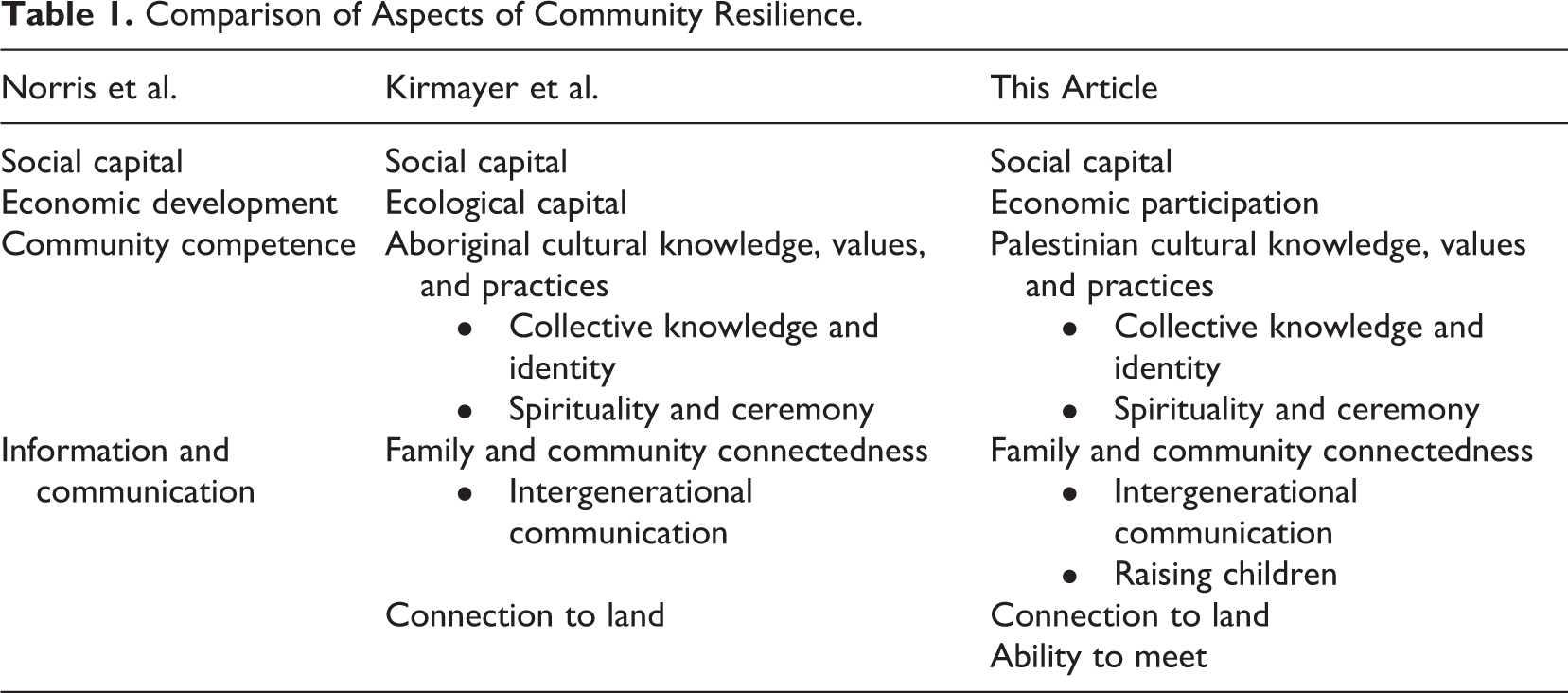
Interviewees also presented strategies akin to Kirmayer et al.’s concept of collective knowledge and identity (Table 1). Defiance against occupation forces was a central aspect of women’s understanding and definition of their community identity. The ability to meet and share the stories of suffering under occupation was a central strategy our respondents used when they explained how they supported community resilience. Women’s ability to publicly show this defiance was stifled, however, because of the prevalent socioreligious norms that pressured them to inhabit the private sphere and manage their anger internally (Gilgun & Abrams, 2005). Like other women in remote, isolated locations, the women interviewed sought out opportunities to share adversity, downplay the negative aspects of their situation, and promote their Palestinian identity (Leipert, 2005). What compounded their difficulty in doing so was the asymmetry in notions of who can maintain community in public, whereby women sought out opportunities to share social space in public like the men, but men saw women in public spaces as a mixing of the sexes and therefore immoral ( New York Times, 2014).
The emphasis on community action and information exchange may be appropriate for resilience in the face of acute disaster regions (as per Norris et al., 2008); however, it does not align easily with how interviewees understood and experienced life inside UNRWA camps (chronic disaster conditions; Table 1). The issue of space and having an environment to meet for social and political reasons was central to our interviewees’ ability to share information and plan for action. The process of achieving the communication infrastructure and support for community action is where our respondents encountered obstacles and is what explains the need for a different understanding of community resilience for groups like displaced women. Women eagerly discussed how the health centers were not only points for medical care, but served as quasi-community centers where they could go to connect with each other without suspicion from their husbands and male relatives. In their maternal capacities, women mentioned holding group meetings to teach tales of struggle and remember their sons and husbands as martyrs killed by the IDF as methods of managing collective grief. Despite the lack of education opportunities, gendered ideas about protecting women and physical restrictions placed on their mobility, respondents also spoke favorably about searching out employment opportunities as cleaners, teachers, or as low-paying nannies. Several women discussed participating in collective camp-based work projects, involving handicrafts or culinary products. These female-run endeavors brought women together to make goods to sell in a semi-formal network. The actual market feasibility and income generation potential of these activities were very limited, and the jobs they spoke about with enthusiasm were unlikely to improve the financial status of their family in a substantive way. This is illustrative of how Palestinian women are repurposing the limited resources available to them, trying to leverage resilient individual behaviors into a resilient community network, sometimes with success, as in the health centers. Participants were clearly interested in contributing to their community, but could not easily do so because of prohibitions on movement and rigid gender norms.
Eggerman and Panter-Brick (2010) have raised the contradictory nature of such types of resilience in their work in Afghanistan, where “the ability to demonstrate adherence to cultural values may reproduce inherent social injustices, perpetuated for women by the dominance of men in politics, economics and social relations (Eggerman & Panter-Brick, 2010, p. 81).” Working together as a community was a challenge for female participants because there were so few ways they could collectively meet to discuss and plan their efforts. Through raising children with particular values and keeping a strict Islamic faith, the respondents illustrated how individual and societal actors can improve conditions but also the numerous obstacles to collective long-term progress. Existing research highlights that faith-based social networks like the one described by the interviewees are common among displaced communities exhibiting high levels of resilience, such as internally displaced Ugandans (Horn, 2009) and Aboriginal Canadians (Kirmayer, Sehdev, Whitley, Dandeneau, & Isaac, 2009). Unique to our respondents, however, is that their faith existed within refugee camps where cultural and religious norms gave them strength and identity and at the same time discouraged free community networking for women.
Similar to research done by Nyugen-Gilham et al. with Palestinian youth in the West Bank, this research exposes the complexities inherent to the notion of resilience (2008). Women in this study talked about being supported officially to resist the Israeli occupation while at the same time being required to fit with traditional Palestinian values and norms. Many interviewees raised the role of patriarchy in Palestinian society as an obstacle to individual freedom of choice and movement. While religion and cultural identity enabled a positive outlook on life events in many cases, Palestinian identity posed certain obstacles in the lives of many of the women. This subject has not been covered sufficiently in other studies and points to the need for more research on the gendered experiences of community resilience in situations of displacement. Amidst protracted conflict, this study highlights the ways women’s attitudes and activities in refugee camps enable them to normalize a situation that for most people is highly abnormal. New models need to be developed to capture the interactions between gender, culture, faith, and territory in order to adequately articulate and document the accounts of women such as those interviewed in our study.
Limitations
This study was conducted within UNRWA, a singular institution that pervades all aspects of people’s lives in the camps. If interviews were conducted at other centers or sites, women may have voiced other concerns or questions. We used a convenience sampling method of healthy women who attended the clinics within an age range of 22–48, and no additional information was collected about income or political affiliations. This does not represent all characteristics of the female population in UNRWA camps. While female Arabic translators were relied upon as much as possible, resource and time scarcities necessitated that the male field operations director translated 11 of the interviews. This could have limited the answers women felt comfortable sharing and may have reduced the ease and freedom participants experienced in the interaction. In cases when the director had to translate, the women interviewed did not know him or his role. We believe that the influence on recruitment was minimal for two reasons, that is, (a) the director was unknown to the women and (b) we perceived that the women were waiting with time on their hands and wanted to do something new. It is possible that the women participating in the interviews who had a male translator felt they could not refuse to answer questions—leading to a positive response to participation. However, there are ways to subtly resist answers during the interview process if this is the case and we did not perceive that this happened. In the future, recruitment and translation of women interviewees should be done completely by women. We also had to rely on the clinic psychosocial counselor as a recruiter and interpreter. Women may have felt less comfortable talking with a staff member of UNRWA than an unknown translator from outside the camp. To mitigate this, the women we spoke with were not currently seeking treatment at the clinic. Interview transcripts were made from English translations, which could have an impact on the accuracy and/or representativeness of responses.
Conclusion
This study’s findings offer an enriched understanding and detailed picture of Palestinian women’s perspectives and strategies for living under occupation and persevering in the face of adversity. Interviewee accounts suggest the multiple social and physical boundaries that must be navigated to express and belong to their Palestinian community. Life in UNRWA camps imposes hardship on all residents, such as the occupying Israeli presence and attendant economic disadvantage. This article underscores that women face a disproportionate challenge.
In situations of chronic occupation, such as that of Palestinian women living in the West Bank, existing models of community resilience are only partially able to explain the dynamic process of resilience building and utilization of space. The respondents in this study highlighted how important a safe meeting space was to their social lives and ability to support each other through challenging times. Each interviewee commented on how she sought out more time at UNRWA health centers to meet with other women and share stories and hardships. For these women, more opportunities to meet might enrich the strength of their connection to the larger community and thus their community resilience. The process through which our interviewees created de facto community centers is itself illustrative of the active forces resilience requires, which often are not examined or identified in formal institutions. At present, the individualized resilience of these women is strong, but the ability to work together to negotiate the education and employment opportunities they themselves highlighted is weak. A steadfast commitment to their land, political activism, faith, and maintenance of identity through storytelling were strong contributions to community resilience that were identified in other models. The importance of safe social space is an addition to the existing models of community resilience.
What this research did not answer is the question of the long-term costs of such resilience. For women, having a Muslim faith in the context of UNRWA camps gives a strong sense of identity and meaning, but it also carries restrictions on movement and pressures to raise children. The women illustrated that good coping in certain circumstances can mean perpetuating the status quo political situation. The architecture of the Palestinian struggle is founded centrally upon resilience and resistance activated by men and women in the West Bank. The question that could be answered in future research is identifying the role of both genders in fostering community resilience.
Footnotes
Acknowledgments
We would like to acknowledge the staff of UNRWA West Bank, in particular Dr Bassam Madi and Rita Kahwaji for their invaluable assistance, as well as Dr Izzeldin Abuelaish at the University of Toronto for his guidance and support.
Declaration of Conflicting Interests
The author(s) declared no potential conflicts of interest with respect to the research, authorship, and/or publication of this article.
Funding
The author(s) received no financial support for the research, authorship, and/or publication of this article.