




Abstract
Despite a dramatic increase in homelessness globally, little attention has been paid to the effects of gender and other identities on unsheltered women’s lives in non-Western contexts. Like their housed counterparts, homeless women in India live with gender norms such as female modesty, marriage, motherhood, and economic dependence. This ethnographic study focused on the lives and surrounding environment of 10 women sleeping rough in Delhi, India. The primary goal was to explore how they enact or subvert gender norms in maintaining bodily integrity and autonomy and the influence of intersectional identities in mediating such enactments. Findings show that allegiances to marriage and motherhood are moderated by exigency. Acts of “everyday resistance,” including sexual freedom, mobility, self-sufficiency, and self-defense, brought negative and positive consequences. Intersections of religion or caste with gender were less salient, thus underscoring the influence of gender. Similarities and differences are noted in comparing their experiences to those of other homeless women globally. Implications for social work practice include greater attention to gender and other structural barriers while working with homeless women seeking to rebuild their lives.
Homelessness has become one of the 21st century’s most obdurate global problems. As the world’s population becomes increasingly urban and mega-cities grow rapidly, concentrations of homeless persons become more visible as their numbers rise and housing availability fails to keep pace (Chamie, 2017). Indeed, worldwide increases in homelessness must be understood in the context of a larger global shift toward neoliberal governance favoring free markets and privatization of public services, the latter including a multibillion dollar homeless “industry” in the United States (Lyon-Callo, 2004; Padgett, Henwood, & Tsemberis, 2016; Willse, 2015).
Demographic composition varies considerably across homeless populations, but women are generally less numerous than men, especially among those who are unsheltered or “street homeless” (Sikich, 2008). This is attributable to three likely causes: (1) homeless women’s greater likelihood of living doubled up with others, (2) homeless women are given priority access to shelter if accompanied by underage children, and (3) women living in a shelter because of partner violence are rarely defined as homeless (Bretherton, 2017). If homeless mothers with children are far less visible in Western nations, such is not the case in the cities of postcolonial nations such as India, South Africa, and Brazil (Biscotto, de Jesus, Silva, Deise, & Merighi, 2016; Harriss-White, 2005; Olufemi & Reeves, 2004).
Definitions of homelessness vary by time and place, a reflection of societal norms and priorities. For example, homelessness is more broadly defined in Western Europe where living in insecure and inadequate housing is included within the definition (Busch-Geertsema, Culhane, & Fitzpatrick, 2016). If the boundaries of these definitions vary in inclusiveness, the core definition of street homelessness, also known as ““rooflessness,” is widely shared as referring to sleeping in the open in places unsuited for human habitation (Busch-Geertsema et al., 2016).
National governments may add more specific description. For example, the Indian government’s definition of homelessness refers to persons who live in the open on roadsides, pavements, in [drain] pipes, under flyovers and staircases, or in the open in places of worship, mandaps (porches), and railway platforms. The specificity of this definition illustrates the range of encampment locations used by Indian homeless persons, their number estimated at 1.7 million persons (Office of the Registrar General and Census Commissioner of India, 2011). In India, the distinction between being “homeless” and living in a makeshift slum or encampment is blurry given acute shortages of housing (Mander, 2015), a phenomenon that has reached crisis proportions in many cities in the Global South (Speak, 2013). In addition to groups of unaccompanied street children, entire families can be found sleeping outdoors, their lives in full view of any visitor to Delhi (Koshish, 2009).
This ethnographic study addresses a group of homeless persons about which little is known—women sleeping rough in India’s capital city of Delhi. Beyond describing their lives, our primary goals in this study are to explore how homeless women enact or subvert social and cultural norms and the influence of intersectional identities in mediating such enactments. The stigma of homelessness and vagaries of street life might be presumed to enable “everyday resistance” (Hart, 1991; Scott, 1984), but when and how this is done remains virtually unknown.
Finding the balance between exerting personal agency and observing societal norms governing acceptable behavior is a daily negotiation for homeless women anywhere in the world. However, local variation in how this balance is pursued points to cultural, social, and economic influences. Despite rapid modernization in recent decades, India’s traditions of gender, religion, and caste continue to play a role in Indian society (Das, 1996; Vaid, 2014). However, these ideologies are not hegemonic, having been eroded by the decline in rural village life and rapid growth of cities such as Mumbai and Delhi (Riessman, 2000; Roy, 2011).
Linked to the global growth in neoliberal economic policies (favoring privatization and decreases in human services; Willse, 2015), the accelerated pace of rural–urban migration has loosened ties to tradition as well as set the stage for increasing homelessness and economic insecurity (Chamie, 2017). In addition to impoverished rural migrants, those at high risk of homelessness are abandoned or runaway youth (Steinberg, 2013) and transgender adults (Kalra & Shah, 2013; Reisner et al., 2016). For homeless women, youth, and transgender adults, threats to safety such as sexual violence and trafficking are mitigated by cohabiting in small groups for mutual protection (Zimmerman, Hossain, &Watts, 2010).
Research on Gender and Homelessness
The burgeoning literature on homelessness in recent decades has been overwhelmingly situated in the West and has had a preoccupation with individual problems—mental illness, substance abuse, family dysfunction—rather than poverty and unaffordable housing (Kertesz et al., 2016). In part due to the relative invisibility of their younger counterparts, homeless women in the West have been typified by their more visible representatives, thereby reduced to the caricature of an older “bag lady” mumbling to herself and pushing a shopping cart full of personal possessions (Hopper, 2002; Passaro, 2014). Published research has been largely confined to single adult shelters populated by older women with mental and physical problems as well as histories of substance abuse. Liebow’s classic ethnographic study of African American women living in a Washington D.C. shelter (Liebow, 1991) is an early example, and later research has followed suit (Luhrmann, 2008; Padgett, Hawkins, Abrams, & Davis, 2006; Wenzel, Green, Tucker, Golinelli, & Kennedy, 2009). Such studies serve to highlight the othering of homeless women for not fulfilling heteronormative roles of marrying, bearing and raising children, and maintaining the household (Golden, 1993).
Much less is known about the lives of younger homeless women who are more likely to be caring for young children and less likely to be afflicted by serious mental illness or addiction (Lewinson, Thomas, & White, 2014; Mayock & Bretherton, 2016; Shinn, 1997). Least visible are the experiences of younger homeless women in postcolonial nations where access to health care, equitable property rights and economic self-sufficiency are compromised (Sikich, 2008). Rapid rural to urban migration in these nations exacerbates preexisting shortages of adequate housing (Harriss-White, 2005), leading to increased numbers of street homeless persons. With government safety net programs severely underfunded and familial support systems weakened by poverty and migration, the likelihood that a woman can avoid (or exit) homelessness is reduced (Sikich, 2008).
Subsumed within the category of “family homelessness,” younger homeless women find their individuality subordinated to their maternal status and the needs of their dependent children. This relegation of gender identity, common to women’s experiences globally, takes on new meaning in rapidly urbanizing nations such as India where gender roles are in flux alongside other contested identities such as caste and religion (Bayly, 2001; Borooah, Diwakar, Mishra, Naik, & Sabharwal, 2014). Critical attention to gender is necessary as social, economic, and cultural differences in gender are deeply implicated in the homelessness experience (Bretherton, 2017; Passaro, 2014). Societal expectations affecting women of younger age—maintaining reproductive health in pronatalist regimes and tending to child care and other forms of domesticity including extended family obligations—portend significant burdens beyond daily survival needs when homeless. We contend that gender norm enactment is undermined by homelessness in poorly understood ways. Moreover, an understanding of everyday acts of resistance requires close attention to the multiple identities homeless women live with.
Women in India: Gender Norms and Bodily Integrity
Gender ideologies carry special weight in India where women’s rights remain contested (Gahleitner, 2015; Mishra, 2006; Riessman, 2000). Marriage and motherhood are crowning achievements of Indian womanhood and bearing sons further elevates a woman’s stature (Das, Das, & Das, 2012). As with many patriarchal societies, the domestic sphere is a woman’s responsibility where family rituals of cooking, cleaning, and childcare dominate. An unmarried girl must be modest and chaste; a married woman is expected to remain sexually faithful to her husband and to live with (and be supported by) his family where her mother-in-law has domestic authority (Hasan, 2010; Mander, 2015).
A visitor to Delhi or Mumbai will notice that men are far more numerous and visible in public spaces and public amenities such as women’s restrooms are few and far between. “Eve-teasing,” sexual harassment of women, is a common problem decried as meant to discourage women from going out in public without male relatives (Mishra, 2006). In addition to verbal harassment, brutal attacks of sexual and physical violence have increased (Gahleitner, 2015) as exemplified by the horrific gang rape and murder of a young female graduate student in Delhi on December 16, 2012. Her death gave rise to nationwide protests amid demands for greater protections for women and prosecutions of male offenders. Despite the outcry, such violence served as a perverse reinforcement of traditional beliefs that women should not leave the home (Gahleitner, 2015). However, an Indian woman is not necessarily safe in her own home. India has one of the world’s highest rates of domestic violence against women (World Health Organization, 2013), and such violence is often normalized as a sanctioned form of discipline (Lafta, 2008). Rape within marriage is not recognized as a crime in India (World Health Organization, 2013).
A unifying thread within feminist thought is the concept of bodily integrity. According to Nussbaum (1999), the right to bodily integrity is considered inviolable. Although gender-neutral in meaning and intent, it has been invoked to highlight violations that affect women since gender norms may tacitly allow sexual and physical violence against women (Chaudry, Joseph, & Prakash Singh, 2014). An extreme example was noted by Amartya Sen when he referred to the phenomenon of premature female mortality in India due to selective abortion, infant neglect and homicide leading to “over 100 million missing women” (1990, p. 102).
Nussbaum (1999) defines bodily integrity as “being able to move freely from place to place; being able to be secure against violent assault…having opportunities for sexual satisfaction and for choice in matters of reproduction” including unwanted pregnancies (p. 121). This combination of “freedom to” and “freedom from” lays the foundation for having and acting on the capabilities necessary to lead a fulfilling life. Intrusions on bodily integrity range from restrictions on mobility to the extremes of sex trafficking—the latter a problem of global proportions (Zimmerman et al., 2010).
From a feminist perspective, gender norms that sanction threats to women’s bodily integrity—restricted mobility, catcalling, and unwanted touching—are exacerbated by street homelessness where a homeless woman is exposed to bodily violations on a daily basis (Chaudry et al., 2014; Lewinson et al., 2014). In the Indian context, gender-related customs of modesty, submission, and economic dependence further impinge on a woman’s ability to fend for herself. Homeless women in Delhi must navigate resistance to such customs even as they maintain adherence to guard against additional stigma and victimization (Chaudry et al., 2014; Lewinson et al., 2014; Padgett et al., 2006).
Intersectional Identities Among Indian Women: Gender, Religion, and Caste
India is a nation of religious diversity with a Hindu majority (80%) alongside a sizable Muslim minority (13%) and many smaller religious subgroups such as Sikhs, Buddhists, Parsis, Jains, and Roman Catholics. In Northern India where Delhi is located, Muslim and Hindu traditions have a long history of coexistence (Char, 1993). India’s economic modernization in the 1990s promoted secularism and economic growth as antidotes to religious extremism, but Indian Muslims face social and economic discrimination that has increased with the recent increase in Hindu nationalism (Mander, 2015). While their religious minority status places Muslim women at a disadvantage in comparison to their Hindu counterparts, the strictures of gender tend to be more similar than different in these two religions (Char, 1993; Das, 1996). The rise of women’s rights organizations in recent decades has raised the profile of feminism in India, albeit with limited impact on public policies (Hasan, 2010).
India’s centuries-old caste system imposes rigid limits on upward mobility for members of lower castes. Laws have been passed to assist the members of “scheduled” and “lower” castes, but caste labels continue to affect the lives of many among India’s majority Hindu population (Bayly, 2001; Vaid, 2014). Caste intersects with gender in placing low-caste women at greater risk of personal harm, that is, they are considered fair game for sexual assaults committed by higher caste men (Gahleitner, 2015).
The intersection of gender, religion, and caste among homeless Indian women opens the door to a kaleidoscope of possible experiences (Crenshaw, 1991). Sharing in gender subjugation and the exceedingly low status of being homeless, these women nonetheless have opportunities to create spaces for everyday resistance born of economic necessity and individual initiative. In this article, we address how these women adhere to and adapt gender norms, how they engage in modes of resistance when faced with such expectations, and the role of religion and caste as each intersects with these norms.
Method
Setting of the Study and Data Collection
This ethnographic study was conducted for 15 months between September 2013 and January 2015. Ethnographic methods were chosen as they make it possible to build trust and rapport with participants and achieve a deeper understanding of the everyday lives of homeless persons living on the streets of Delhi. The primary fieldworker (the second author) had previous ethnographic experience as a supervised student researcher in a psychiatric clinic in Varanasi (Uttar Pradesh) and in a community-based program for homeless adults in Pune (Maharashtra). Her research experience, as well as her native fluency in Hindi, was helpful in gaining rapport and conducting observation and interviews while residing in Delhi. The first author, an anthropologist, made four visits to Delhi over the 15-month period to assist in data collection.
Our NGO collaborators (names withheld for privacy) provided entree to their varied service programs including women’s shelters and a street medicine outreach van. Observational data were supplemented with field interviews. We conducted shorter, informal field interviews with more than 200 men and women, including 160 homeless adults and 40 nonhomeless interviewees including non-governmental organization (NGO) employees, government officials, lawyers, police officers, and hospital employees. In all, we spent approximately 2,000 hr in the field. For this study, we concentrated on data from in-depth life history interviews with 10 women (purposively selected to represent differences in age, number of children, and marital status) and field notes taken at the sites where these women resided. Although on occasion participating in daily activities, for example, playing with young children, we limited our participatory role to minimize the impact of our presence as outsiders.
At the suggestion of the NGOs and others familiar with the sensitivity of speaking with homeless persons, we did not audio record interviews and wrote interview field notes instead. Interview questions were designed to elicit trust while hearing firsthand about their everyday lives. Examples include “tell me about your life since you came to Delhi (with probes for male partners),” “how do you get income to buy food?”, “do the women here get along with one another?,” and “tell me about your children and how they are doing”. For this study, we focus on interviews and observation conducted at two primary locations: (1) a women’s shelter run by our partner NGO in an Old Delhi park and an adjacent homeless encampment, and (2) a group of homeless families living near a temple compound located close to Delhi’s main tourist center, Connaught Place.
At Site #1, two corrugated metal buildings provided sleeping spaces for 20–30 women and young children with outdoor toilet facilities nearby. Women with male partners and other family groups camped nearby under a small canopy of trees. The grounds of the park contained dry fountain beds where some homeless families slept and a dusty open field where young men played cricket. Surrounding the park were predominantly Muslim working-class neighborhoods and a crowded, bustling market district. Site #2 was a busy plaza traversed by tourists, alms seekers and temple staff amid stalls selling food, flower garlands, and religious objects. Groups of homeless persons settled into their usual sleeping spots each evening and scattered during the day.
Life history interviews—all conducted in Hindi and translated into English—took place in semiprivate spaces in the shelter at Site #1 or on the edge of the plaza at Site #2 after giving verbal consent. Frequently interrupted by young children, shelter staffs, or local groundskeepers, we relied on repeated encounters to capture each woman’s life story. The study was approved by the authors’ institutional ethics committee.
Data Analysis
Thematic analysis of the data was conducted by repeated readings and memo writing of observational field notes and interview notes by the two authors. The first author is an experienced anthropologist who has studied homeless men and women in the United States for over 20 years. The second author is a Hindi-speaking daughter of immigrants from Bihar (to the United States) with training in anthropology and public health. Both authors shared a deep commitment to understanding the lives of homeless women in Delhi. To guard against biases, we deployed strategies for rigor (Padgett, 2016) including data triangulation (observation and interviews), prolonged engagement in the field, peer debriefing throughout fieldwork and a negative or deviant case analysis to ensure that our findings were not contradicted by a closer examination of the data (Charmaz, 2006).
Using a template approach in which a priori concepts are applied inductively but not allowed to exclude serendipitous or unexpected findings (Crabtree & Miller, 1999), three principle features of culturally sanctioned gender norms helped to structure the initial data analyses: (1) female modesty and bodily integrity, (2) domestic roles including marriage and motherhood, and (3) financial dependency on male providers. Conformity to, as well as everyday resistance against, these norms was documented along with their impact on the women’s lives.
Patterns of women’s responses across the three normative dimensions were noted from the in-depth interviews, and ethnographic field notes were consulted for the specific sites where the interviews were conducted. While there were no direct contradictions between the two sources of data, the field notes often affirmed or expanded upon what we learned from the interviews.
Analytic memos (Charmaz, 2006) were used to record decisions made during the analyses and to flag references to religion or caste as interacting with gender norm enactment. All incidents and quotes were directly observed and recorded in field notes or reported during interviews with the women. All names are pseudonyms to protect privacy.
Findings
General Description of Study Participants
As shown in Table 1, the women who were interviewed in depth were mostly in their 20s and 30s with an average age of 29.6 years. All were rural migrants (predominantly from the state of Bihar) and all but two had children (average number of children was 2.9 with a range of 0–7 children). Most identified nominally as Muslim (8–10) and had a male partner at the time of our interviews (7–10). Legal marital status was difficult to ascertain because romantic partners were routinely referred to as “husbands”; some women remained legally married to husbands who had long since abandoned them and obtaining a legal divorce was an expense they could ill afford. As shown in Table 1, begging and informal sex work were the primary sources of income; one woman (Tanvi) eked out a living selling religious items and another (Prija) worked with a local NGO (although she had not been paid in months).
Demographic Characteristics of Study Participants.
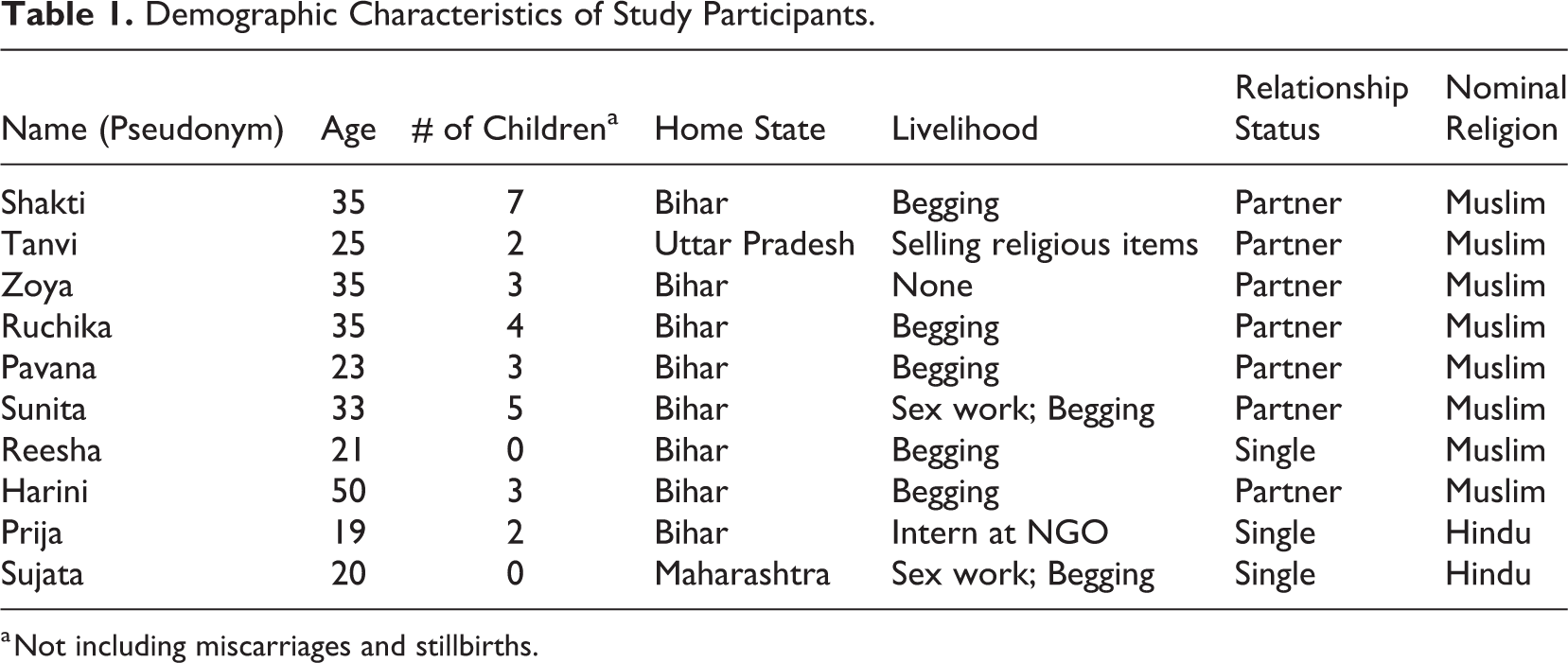
a Not including miscarriages and stillbirths.
The scarcity of records made pinpointing the number of years of schooling difficult and we chose not to probe when the women demurred. Typically born in rural villages and betrothed in early adolescence, their migration to Delhi could have been prompted by a number of events—accompanying a husband, fleeing a husband and his family, or visiting friends or family already in the city. Maintaining ties with one’s home village meant returning for various reasons including the birth of a child, a religious festival, the funeral of a relative, or to escape a violent relationship.
Drug and alcohol use was common in the encampments, for example, smoking “smack” (brown heroin) and marijuana or inhaling solvents. Women who engaged in drug sales, theft, and other criminal activities were acting in concert with male partners (those who engaged in sex work appeared to do so alone). Although less likely to use heroin compared to men, the women reported (or manifested) the use of alcohol and gutka (a form of smokeless tobacco).
Male partner relationships were frequently unstable. Partner violence, theft of conjugal property, and substance abuse were the primary reasons for relationship instability. Violent incidents–jealous quarrels, physical assaults, arguments between rivals—were more common at night but could also erupt during the day.
Meals consisted of temple or mosque handouts supplemented by cooking lentils, potatoes, or rice and chapatis (bread) on open fires. Personal hygiene was difficult as clean water was scarce. Health problems included respiratory ailments, tuberculosis, and skin infections. Young children showed signs of malnutrition and infestation by intestinal worms. Injuries from accidents were common as the encampments were in close proximity to roads crowded with auto rickshaws and automobiles. Open trash fires, often the only source of fuel or heat during the cold winter months, led to burn injuries. Sleeping on hard surfaces and heavy manual labor produced back and joint pain and injuries.
The women’s gynecological problems came to our attention while accompanying the all-male staff of the mobile street medicine van on its rounds and continued throughout the in-person interviews. At each van stop, upon seeing the female coauthors, women emerged from nearby encampments and shared complaints of abdominal and vaginal pain. Vaginal discharge, known as “safed pane” or “white water,” has been reported in several studies of Indian women, the symptoms of abdominal pain and discomfort widely shared (Kostick et al., 2010). Various causes such as bacterial vaginosis and urinary tract, yeast and other infections have been put forth as causes but stress has also been cited as a contributor (Culhane et al., 2001). Poor prenatal care, repeated pregnancies, lack of access to contraceptives, untreated infections (many sexually transmitted), and malnutrition compound the likelihood of pelvic inflammatory disease, pregnancy loss, and infant death (Das et al., 2012).
The findings below focus primarily on the 10 women who agreed to multiple interviews. The experiences of other women from whom we learned valuable information may also be included (also identified by pseudonyms).
Modes of Conformity and Resistance
As demonstrated below, our findings are structured around the three primary dimensions of gender ideology described earlier. Homeless women can be expected to conform to normative expectations as well as perform acts of “everyday resistance” (Hart, 1991; Scott, 1984) given the exigencies of their lives. Our goal was to examine modes of conformity and resistance as manifested in field observation and interviews.
Bodily Integrity, Modesty, and Sexuality
It would be an understatement to note that modesty and personal hygiene are a challenge while sleeping on Delhi’s broken sidewalks, bathing at a public water tap, and having little access to toilet facilities. Menstruation required wearing rags and washing them when possible. Labor and delivery ideally took place at a hospital with the financial help of an NGO (prenatal care a rarity), but some women gave birth outdoors in a secluded area with the help of other women. Contraception and family planning were virtually unknown (nor were they necessarily welcomed by the women and their partners).
The women dressed in modest attire and wore little makeup. The absence of makeup was highlighted during an International Women’s Day party at the shelter when generous applications of lipstick and eye makeup were proudly shared by the women to celebrate the day. On other occasions, women seen wearing makeup were accused of being a randi (prostitute).
If sex work was hidden, sexual activity was approached with more candor during discussions with the women. Sujata, age 20, describes a casual encounter:
I was walking around at night. There was a guy. He looked rich.…. He came over and sat next to me…. I did some stuff with him. Not a lot. He just touched me with his hands, pulled my clothes up a bit—nothing else. The rich folk, they don’t do really bad things because they know those things cause disease.
With male romantic partners, sexual activity was late at night and furtive given the proximity of children and other people sleeping nearby. Zoya, aged 35, related with humor a recent incident when her husband surprised her with the suggestion that they have “fun sex.” When she asked what that meant, he said they would be all touchy and feely. Zoya replied to her husband: If we do that, won’t the kids wake up? Won’t the sun rise before we actually end up having sex?
At the same time, bodily integrity was threatened by sexual violations from men known and unknown, which could extend to girls in infancy. One of the more trenchant episodes during our fieldwork took place when the male partner of a homeless woman was caught sexually molesting an 18-month-old girl (Anjari). Her mother (Tanvi, aged 25) and others physically attacked the man and had him arrested, but the case lingered in the courts and grew to include charges brought against Tanvi for physical assault. The lack of resolution of the court case after a year is typical of the slow pace of the justice system in Delhi.
Domestic Roles: Marriage and Motherhood
The legal status of being married or divorced was not easily ascertained and not always essential to the women given their circumstances. However, the transactional nature of romantic partnerships often left one or both parties unhappy with the return on their emotional investment. Pavana, aged 23, lived with her husband, her mother, and her three children in the park (Site #1) encampment. When asked about violence in the area, Pavana said No one’s ever tried to put a hand on us. Yet when asked about her husband, Parvati replied Oh, he beats me all the time. She related: he was showing his craziness. He drinks then he fights. Pavana fought back by threatening him with hot oil but in general did not want to retaliate, saying A woman shouldn’t raise her hand against a man anyway. What can I do? If I do anything, everyone will say his wife beats him.
Sunita, a mother of five at age 33, barely suppressed her anger with her ex-husband Mahmood for his cruelty during their marriage, abuse that he forced their children to witness. “He has hit me many ways. Make me naked and hit me badly. Would come at 2 a.m. at night and do bad things. Would wake kids up.” Mahmood tried to force Sunita into sex work to support the family but she refused. There was no happiness then. He used to ask me to do bad things. To prostitute myself. To make more money. Not from me—I will beg but not do wrong things.
Being a wife or romantic partner brought protection from other men and sharing of resources. It could also lead to pregnancy and motherhood, a role embraced as inevitable and deeply gratifying. As one woman remarked: My children are my everything. Indeed, children were viewed as protectors in the present (older sons defending their mothers) and the future (children taking care of their mother in old age). At the same time, not every pregnancy was welcomed, miscarriages and stillbirths were common, and surviving children lived in abject poverty and, at times, neglect.
The costs, availability, and feasibility of contraception were beyond reach, and the government’s support of tubal ligations (female sterilization) was strongly resisted as it removed the woman’s ability to bear children with future partners (viewed as a critical asset to the relationship). Abortion and especially sex selection were considered an upper class prerogative. Prija (19 years old with two children) explained, Sex-selection is something only people in the big, rich houses do.
Basimah (not included in Table 1) lived near a temple along with her five children ranging in age from 1 year to 17 years; her husband slept outside on an improvised recumbent bicycle used by the physically disabled. Pregnant with her sixth child, Basimah was forthright in speaking of her desire for an abortion followed by the insertion of a long-acting contraceptive implant (abortion is legal in India up to 20 weeks but extremely difficult to access due to the cost). However, her wish to terminate the pregnancy was not fulfilled when hospital officials rejected her request as being too late (past the 20-week deadline).
The women’s ability to carry out domestic activities such as feeding, bathing, and clothing themselves, and their children was severely compromised by scarcities of food, clean water, and clothing as well as the threats of accidental injuries, abuse and child trafficking. With regard to the latter, worries about child abduction were a near-constant refrain among the women. As one shelter employee said, You can’t even look away from a baby for more than a few seconds here. Someone will just snap them up.
Although we did not witness any abductions, infant and child trafficking were found to be common in Delhi in an investigation by the journalism advocacy group Women’s Media Center. In their report, it was noted that the children were trafficked for domestic labor and were invariably sexually and physically abused (Sur, 2013).
Tanvi, mother of baby Anjari (mentioned earlier), rescued her daughter being hurriedly carried out of the park by a strange man as she returned from the water tap. Having already lost her other child (a son) in a fire, Tanvi was consumed with worry about Anjari as she had to leave the shelter to earn a living selling religious objects to mosque faithful. If I’m not here today or tomorrow, there’s only the drunk old lady to take care of her. I’m always scared when I’m at work. Someone from this very park could take her. And Anjari’s just a child, she could walk around the park and just walk out alone one day.
The strains of parenthood broke through in a few other ways. Child neglect and malnutrition were visible and untended older children a common sight (despite the risk of abduction). The demands of earning a living—sometimes exacerbated by alcohol and drug use—meant frequent absences and children left in the care of others. Infants and toddlers were sometimes carried along by their mothers while begging at mosques and temples. Begging is illegal in India, so local police had to be avoided to escape arrest.
Several homeless mothers (and widowed fathers) relinquished custody of their children to government homes where they would be housed and schooled. Originally established for orphans, some of these homes accepted school-aged homeless children. Shakti at age 35 had seven children. The older four were in custodial homes and she took the younger children (ages 5, 4, and 3) with her to beg. Shakti’s eldest child (a daughter aged 13) recently left the custodial home and was rumored to have been betrothed by Shakti to a man in her home village.
This decision to arrange a daughter’s marriage at (or before) puberty was deeply engrained in India’s traditions, but it was also a practical consideration among Delhi’s homeless mothers. Married at a young age themselves, they were motivated by the nagging fear that the girls were more vulnerable to sexual assault while living outdoors, thereby rendering them unmarriageable. Marrying one’s daughter meant one less dependent and it also introduced the possibility of financial or social support from the husband’s family.
Financial Dependence
The Indian tradition of a woman relying on her husband and his family for economic support became untenable given the fragmentation of households and families wrought by homelessness. To be sure, male partners supplied much-needed economic support for homeless women even if it fell short of providing a home for them. Sujata, aged 20, was pleased to report that Mahesh, a rickshaw driver, was a provider for her and her three children, he’s taking care of me, with food, drinks, and everything.
Sujata’s plan to marry Mahesh was greeted with skepticism and disapproval by the other shelter women, in part because of his reputation as a womanizer but also because she had a 13-year-old daughter considered to be of marriageable age. As one of the shelter workers said, How does it look if a mother who should be seeking marriage prospects for her daughter is getting married herself?
Despite Mahesh’s economic support, their relationship became strained when he insisted that Sujata stop using gutka and begging. While willing to forego the tobacco, Sujata protested that “Work is fun.” She added, I like all that walking back and forth. Sujata was one of the women seen late at night wearing heavy makeup and this incited gossip. As one of the shelter women noted, They may say they’re out working or getting alms, but nothing is open past 11 so they’re not doing anything good.
Despite occasional support from male partners, the women were emphatic that they had to learn to fend for themselves. There were few sanctions for men who did not support their families beyond expressions of disapproval and anger by those most affected. Harini had three adult children who lived away from Delhi and earned a living through begging. Years earlier, her husband had abandoned her and fled back to their home village after stealing a rickshaw and getting caught. His drinking and gambling habits also led to increasing indebtedness. Lamenting the squandering of limited income on alcohol, drugs, and gambling was a common refrain among the women.
Older children (especially sons) were viewed as sources of current or future financial support. Sunita looked to her sons for support. “Being married did not work the first time, and I won’t do it again. My four sons are my men now, that is why I love them so much.”
Relationships between women were sometimes supportive, for example, tending another woman’s children, protecting a woman from an abusive male partner, sharing food or clothing. At the same time, friendships between women—much like relationships between women and men—tended toward instability and conditional reciprocity.
Despite their tenuous living situation, the women we interviewed expressed a strong reluctance to ask for help. In the first place, there were few trusted individuals in their lives since their social networks had been depleted by distance, estrangement, and premature mortality. Sudha, 29 years old (not listed in Table 1) was a relatively recent arrival in Delhi from Mumbai. When asked about her family, Sudha noted that her mother was not alive, her father and brother were untraceable and she preferred to support herself through begging.
Local NGOs offered assistance such as street medicine outreach, identity card enrollment (to enhance eligibility for government benefits), and advocacy with local hospitals during health crises and childbirth. NGOs sometimes had an impact but their capacities were extremely limited and sorely underfunded. Even well-intended efforts could fail due to the exigencies of the women’s lives. When a young mother of three children suffered third degree burns after drunkenly falling into a fire, NGO representatives insisted she go to the hospital and accompanied her during the stay (patients were required by the hospital to bring a caretaker). However, she left after a few days, insisting her children had no one to look after them, and died at her family’s encampment not long thereafter.
In justifying their desire for independence, the women expressed distrust of others’ motives. Living in close proximity fuelled gossip and recriminations pitting women against men and against each other. With sympathy in short supply, the women turned inward and toward their children. When asked if she sought help from friends or family in times of need, Harini stated, simply, no one is anyone’s. Pavana said, I’m just being eaten up by worrying about my children….I make two rupees, he [partner] doesn’t help. He doesn’t have any care or worry for the kids.
Intersectionality of Gender, Religion, and Caste
We begin by noting that caste references were hardly in evidence and religious identities lightly held in the interviews and observations we made. Caste differences were likely downplayed since homeless Hindu women were far more likely to be lower caste and most of the women we interviewed identified at least nominally as Muslim. Nevertheless, the lack of salience of caste for these women is noteworthy.
In one of few demonstrations of Muslim piety, the women at Site #1 would cover their heads in response to the imam’s call to prayers, though not invariably. Religious identities were activated during religious holidays but they were strategically fluid to ensure access to food and alms. Thus, the Eid al-Adha feast at the end of Ramadan brought herds of goats to the park to be slaughtered, promising generous food handouts. Hindu religious holidays also meant feasting and celebrations. The women we studied were comfortable with both religious observances despite having nominal allegiance to Islam or Hinduism.
Discussion and Implications
Taken together, conformity to and defiance of gender norms varied considerably across situations as well as individuals. For any given challenge emanating from gender normative expectations, a woman might conform, resist, or opt for some combination of both. Her exercise of agency, in turn, brought consequences both positive and negative. Thus, despite a loss of privacy necessitated by living in plain sight, the women maintained a degree of gender conformity through wearing modest attire and keeping their sexual activity discreetly hidden.
Some of our findings—the lessened salience of caste and religion, the balancing of sexual assertiveness with discretion, distrust of others—were not anticipated. For example, acts of everyday resistance to normative expectations included self-directed sex work and the sexual freedom of nonmarital (or quasi-marital) liaisons. Less surprising was learning that begging was the most common earning option available to these women (Chaudry et al., 2014).
Subversions of gender norms brought problems and solutions. Living outside of a traditional household arrangement freed a homeless woman from domestic role subordination and dependence on her in-laws, but it also forced her to earn income through begging and sex work, having few options in a local economy hostile to female labor. Some women were engaged in drug dealing and trafficking alongside male partners but we did not witness any women who were “solo operators” in crime.
Relinquishing custody of young children to government homes might appear to flout the strong commitment to motherhood but a mother who made this choice could also be seen as affirming her role by reckoning the dangers of the street as far worse by comparison. A similar calculation attended the decision to betroth a young daughter to a man in the home village.
Our findings reveal a nuanced examination of how gender roles are enforced, subverted, and shaped by exigencies while enduring homelessness. Some traditions were clearly observed, for example, motherhood and an aspiration to be “feminine” (especially on holiday occasions). However, bodily integrity and modesty were virtually unattainable given the exposures of living on the street. Securing male partners for intimacy and protection brought trade-offs in domestic violence and loss of the couple’s income spent on drugs, alcohol, and gambling.
The demands of survival led to creative subversions of traditional roles leading to a degree of self-sufficiency, although income generation through begging and occasional sex work was hardly sanctioned by society. That the women in our study were unheralded breadwinners is not surprising nor is this phenomenon unusual among the world’s poor (Sen, 1990). When possible, these women turned to vertical family ties (children, grandchildren) as present and future supports. Indeed, such ties remained stronger than nonfamilial ties (partners, friends), offering instrumental support in addition to traditional role validation.
In revisiting Nussbaum’s definition of bodily integrity, homeless women in Delhi had freedom of movement and exercised it locally and on visits to their home village. Whether by necessity or choice (or both), they subverted stereotypical expectations of femininity, fighting back physically and verbally. They had greater sexual freedom, although this too came at a price. Whether consensual or not, sexual relations consigned women to what Nussbaum considered a type of nonfreedom, that is, the inability to plan for or prevent pregnancy. Although motherhood was exalted, the stark realities of repeated pregnancies affected the health of mothers and their children.
In considering intersectionality, it is plausible that the Muslim women were not weighed down by caste distinctions but disadvantaged by their religious minority status—the opposite would be presumably true for Hindu women. However, we assert that the overarching effects of gender and extreme poverty undermined religious and caste differences and united homeless women more than dividing them. This phenomenon could be construed as a type of leveling effect. If this is the case, it is all the more telling that gender roles continued to be such powerful influences in the women’s lives.
We note as a potential study limitation that caste was not directly asked about during the interviews (to avoid a sensitive topic) and relying on its absence alone risks biasing the findings. To guard against observer bias, we returned to the interview and field note data to conduct “negative case analysis” (Charmaz, 2006) and discuss whether such bias may have led to downplaying the effects of religion and caste. We did not find evidence of such omissions or misinterpretations. Another limitation of this study includes omission of some demographic information such as years of formal education in the interest of maintaining trust and rapport. Strategies for rigor that lend strength to the findings include prolonged engagement and enhanced ecological validity (Padgett, 2016) derived from in situ observation triangulated with in-depth interviews.
This study represents one of few ethnographic inquiries into the lives of homeless women in general and specifically unsheltered women living in a non-Western setting. Framed as an exploration of gender conformity as well as “everyday resistance,” we turned to prolonged engagement and immersion in the women’s lives to seek a balanced and nuanced portrayal.
From a cross-national perspective, our findings reveal commonalities and differences in homeless women’s experiences in Western versus non-Western contexts. Common experiences include reliance on casual sex work and begging as ways of earning income as well as living within abusive relationships and exposure to physical and sexual abuse by strangers (Mayock & Bretherton, 2016; Olufemi & Reeves, 2004; Padgett et al., 2006). A primary difference affecting Indian women includes living on the street within family groups compared to Western nations where the sight of homeless infants and small children is far less common (Mayock & Bretherton, 2016). Such a difference has troubling implications as it exposes families with young children to all of the dangers and deprivations of life on the street. The distinct cultural traditions associated with Indian society—dowry marriage, caste restrictions, and religious devotion—were less prominent in our findings which might point to the abovementioned “leveling” effect associated with severe deprivation.
Implications for social work practice and policies arising from this study can be viewed both globally and locally. With respect to what is known about ending homelessness for women and men alike, the “housing first” approach (offering immediate access to housing without preconditioning demands) has a strong evidence-based record for humanely housing individuals and families and providing support services as needed (Padgett et al., 2016). Social work practitioners in “housing first” programs adhere to values of choice and empowerment which closely align with their own professional values (Henwood, Shinn, Tsemberis, & Padgett, 2013). Support services for homeless women in particular—which can be incorporated into “housing first” support services—should include trauma-informed care and parenting support that builds on existing strengths (Lewinson et al., 2014).
On a broader basis, feminist social work practitioners can apply their awareness of gender norms and other structural barriers to working with homeless women seeking to rebuild their lives (Golden, 1993; Lewinson et al., 2014). Although not yet configured for widespread adaptation in the Global South, “housing first” and feminist empowerment principles are being implemented via family-style communal living arrangements at The Banyan, an organization serving homeless women in Chennai, India (Gopikumar, Easwaran, Ravi, Jude, & Bunders, 2015).
Given the paucity of research on homeless women in the Global South, we urge future studies on how these women adapt to (and at times resist) restrictive cultural and gender norms that threaten bodily integrity and undermine their capacities for surviving and caring for their families. Western approaches to ending homelessness may need modification to accommodate cultural and economic limitations on what is considered feasible locally—and researchers can assist by filling in the gaps in what is known. Proposed changes in homeless policies and programs that draw on the needs and strengths of homeless women as well as men will benefit from such greater inclusivity.
Footnotes
Acknowledgments
The authors wish to thank the Center for Equity Studies in Delhi and especially Mr. Harsh Mander and Ms. Shaguna Kanwar for invaluable support in making this research possible. The authors deeply appreciate the many homeless participants who allowed us to observe and ask about their lives. In particular, we thank the women who shared their life stories.
Declaration of Conflicting Interests
The author(s) declared no potential conflicts of interest with respect to the research, authorship, and/or publication of this article.
Funding
The author(s) received no financial support for the research, authorship, and/or publication of this article.