




Abstract
Intimate partner violence (IPV) is an extreme example of gender inequality that compromises women’s citizenship. This article discusses the effects of IPV on women’s housing circumstances based on the findings of a large national Australian survey. The analysis found that IPV erodes women’s citizenship, which includes their access to safe and affordable housing, connections to “home,” and participation in community life. Drawing on notions of gendered citizenship, this article provides new understandings about how women negotiate housing as a key dimension of citizenship in the context of IPV.
Previous research has found that intimate partner violence (IPV) invades many aspects of women’s lives, including housing, mental health, and employment (Devaney, 2008; Kwesiga, Bell, Pattie, & Moe, 2007; Paglione, 2006; Staggs, Long, Mason, Krishnan, & Riger, 2007). Men’s violence against female partners attacks women’s ability to participate in civil society and exercise their agency as citizens, by compromising the quality and stability of women’s housing, their mental health, and employment opportunities (Flaherty, 2010; Lister, 2003). This article draws on findings from a large Australian research project that documented women’s experiences of the effects of IPV on their housing, mental health, and employment as key domains of citizenship. In this article, we explore how women negotiate housing as a key aspect of citizenship, in the context of IPV, using the concept of gendered citizenship (Lister, 2003).
Citizenship and IPV
Notions of citizenship are contested. Liberal notions of citizenship in the 20th century focused on political, social, and civil rights within the nation-state (Marshall, 1950), which assumed a “gender neutral” citizen. Feminists in the late 1980s and early 1990s engaging with the notion of citizenship revealed how historical and political constructions of citizenship exclude women, by ignoring gender inequalities that materially and symbolically disadvantage women (Dietz, 1987; Lister, 1998, 2003; Voet, 1998; Walby, 1994). However, feminists have also used the concept of citizenship as an “aspirational and analytical concept” to articulate demands for social, political, economic, and cultural change and to critique practices and conditions that continue to oppress and disadvantage women (Roseneil, 2013, p. 1). Feminist authors have argued that citizenship is an important concept for women to claim human, civil, and social rights (Yuval-Davis & Werbner, 1999), incorporating rights and participatory understandings of active and full citizenship (Lister, 2003). Women’s claim to citizenship rights provides an important political avenue to make visible the long-term effects of IPV that further exacerbate gendered inequalities.
Research from countries across the world has demonstrated that IPV affects women disproportionately, with adverse health effects (García-Moreno, Jansen, Ellsberg, Heise, & Watts, 2005; Tipple & Speak, 2009). Worldwide, there are over 100 million people without shelter and at least one billion people lacking adequate housing (Tipple & Speak, 2009; United Nations Commission on Human Settlements [UNCHS], 1996; United Nations Economic and Social Council, 2005). Women and children are systemically disadvantaged with limited access to economic and social rights in many countries, increasing their vulnerability to violence, abuse, and homelessness (United Nations General Assembly, 2011; United Nations Economic and Social Council, 2005). In Australia, reported statistics about violence against women aged 15 years and over indicates that one in three have experienced physical violence, one in five have experienced sexual violence, one in four have experienced emotional abuse from a partner, and one in five have been stalked (Australian Bureau of Statistics [ABS], 2012). The number of women killed by partners or ex-partners average one per week in Australia.
This article argues that when women experience IPV and subsequent post separation violence, women’s fundamental freedoms and rights as citizens are violated, including their rights to negotiate adequate, safe, and affordable housing. In this article, we explore how IPV affects women’s housing status and safety practices within their homes, drawing on feminist understandings of citizenship.
Gendered Citizenship
A number of Australian, British, and North American feminist authors have reconstructed citizenship as gendered and embodied (Bacchi & Beasley, 2002; Bacchi & Eveline, 2010; Dietz, 1987; Lister, 2003; Pateman, 1988; Walby, 1994; Yeatman, 2001). Anupama Roy (2005/2013) examines gender relations and nationalism, using the notion of gendered citizenship in the Indian context. Recently, the United Nations (UN) Report (2014) by the Special Rapporteur on violence against women Rashida Manjoo also advocated for viewing IPV through a citizenship lens, emphasizing women’s participation as full citizens. This UN report focuses on women’s participation, autonomy, and agency in society and highlights how gender-based violence impedes women’s ability to exercise full participatory citizenship. Furthermore, the United Nations promotes the need for state intervention to work toward eliminating gender-based violence in public and private spheres (United Nations General Assembly, 2014, p. 4). This intervention by the state would include social workers.
Citizenship rights have traditionally been viewed as a fixed legal status within the nation-state, premised on a static and binary assumption that citizens either do or do not have such rights. Feminist scholars have argued that the rigid separation drawn between the private and public spheres has prevented women from gaining access to the same public rights as men and hence to full citizenship (Bacchi & Beasley, 2002; Bacchi &Eveline, 2010; Pateman, 1988). Lister (2003, pp. 195–196) argues that there is a dynamic relationship between citizenship as an achieved status (which relates to rights or outcomes) and a practice (which relates to participation or processes that are more inclusive of human agency). Citizenship as participation can be described as an “expression of human agency” and citizenship as rights “enables people to act as agents” (Lister, 1998, p. 6; Lister, 2003, p. 37). These dual understandings of citizenship as rights and participation are important to challenging constructs of women as “passive victims” of IPV, while also acknowledging “the discriminatory and oppressive political, economic, and social institutions” that still deny women “full citizenship” (Lister, 1998, p. 6).
Citizenship has both inclusionary and exclusionary potential (Dominelli & Moosa-Mitha, 2014). For both men and women, citizenship involves the freedom to choose how to participate in private, public, and political life, by “having the cultural, economic, political, and social space” to pursue individual and community life as it relates to one’s identity, sense of belonging, relationships, and memory (Arnold, 2004, p. 48). However, the status and practices of citizenship exist within unequal power relations that reinforce gender inequality. For example, women’s poverty can act as barrier to realizing full citizenship, which includes exercising and having access to equal economic, political, social, and civil rights (Lister, 1998, 2004, 2008). In this article, we argue that gender inequality is exacerbated by the financial impact of IPV, which affects women’s housing circumstances (Baker, Niolon, & Oliphant, 2009; Pavao, Alvarez, Baumrind, Induni, & Kimerling, 2007), curtailing women’s ability to achieve full citizenship.
As Isin and Turner (2002, p. 8) point out, citizenship is also a “social process” through which individuals and social groups “engage in claiming, expanding, or losing rights.” The idea that political struggles are needed, to “continually defend, reinterpret, and extend” citizenship rights, is pertinent to an inclusive social work practice that embraces feminist, antidiscriminatory, and antioppressive principles (Lister, 1998, p. 16; Lister, 2003, p. 198). As Dominelli and Moosa-Mitha (2014) argue, gendered and racialized inequalities underpin citizenship practices, which compel social workers to interrogate the actual attainment of full citizenship rights. Consistent with the principles of inclusive social work practice, this article gives voice to women’s self-reported long-term effects of IPV on their housing circumstances, by using qualitative data from a large national Australian survey.
Housing and IPV
At the global level, the UN General Assembly adopted the Universal Declaration of Human Rights in 1948 (Article 25), which states that everyone has the right to a standard of living that is adequate for their health and well-being, including access to food, clothing, housing, and medical care. All citizens have a universal right “in theory” to housing. However, housing trends in Australia influenced by neoliberal market reforms to the welfare state has reduced the availability of affordable housing (Carson & Kerr, 2014). Government policies have curtailed the funding of public housing, average house prices have increased relative to income, average monthly repayments on home loans have increased, the proportion of first homebuyers has fallen, and there is increasing competition for housing in the private rental market, where landlords exercise considerable discretion in choice of tenant (South Australian Council of Social Services [SACOSS], 2007, p. 79). These housing trends particularly affect women because of their lower income, inequalities in the labor market, and the “gender pay gap.” For example, currently, the average full-time male salary in Australia is A$81,146 per annum, compared to the average full-time female salary of A$66,269 per annum (ABS, 2014). These economic and employment inequalities are further exacerbated by women’s experiences of the effects of IPV.
IPV is the primary reason for women’s homelessness (Chung, Kennedy, O’Brien, & Wendt, 2000). Safe and appropriate housing and the economic resources to maintain it are two of the most pressing concerns for women wanting to escape IPV. Following separation from a violent partner, women and their children are likely to experience significant income loss, financial hardship, and housing instability, particularly women who were at least partially financially dependent on their partners (Baker et al., 2009; Pavao et al., 2007). Pavao, Alvarez, Baumrind, Induni, and Kimerling (2007, p. 143) conducted a quantitative analysis of the California Women’s Health Survey (2003) and found that women who experienced IPV in the last year are 4 times more likely to report housing instability than other women, including late rent or mortgage payments, frequent moves, and being without their own housing. As well, Baker, Cook, and Norris (2003), Baker, Niolon, and Oliphant (2009), and Baker, Billhardt, Warren, Rollins, and Glass (2010) have extensively researched housing and IPV in the U.S. context and found that housing problems were worse among women who experienced severe violence, who contacted fewer formal systems, had less informational support, and had received a negative response from formal welfare services. Lister (2008) argues that respectful responses (such as by social workers) toward welfare state service users is also a citizenship right. Women who have (or are) experienced(ing) IPV encounter multiple systemic barriers to accessing safe and appropriate housing, often placing them and their children at risk of further exposure to IPV (Clough, Draughon, Njie-Carr, Rollins, & Glass, 2014, p. 685). These barriers affect women’s ability to practice their citizenship rights, participate in civil society, and act as empowered citizens. This article reports on the effects of IPV on women’s housing, highlighting how male partner violence erodes women’s capacity to access and maintain housing over time.
Method
The findings discussed in this article are part of a broader nationwide Australian survey that examined the compounding effects of IPV on women’s housing, employment, mental health, and participation in activities of civil society (such as social, political groups, and volunteering). The survey had six questions about women’s housing, including What is/was your main housing situation while experiencing domestic violence? Where did you live straight after the last time you left your violent partner? What is your current housing situation? What has been the change in housing costs post domestic violence? Have you had to make a significant move to a different geographical location, interstate or overseas because of domestic violence? What other effects did domestic violence have on your housing situation? This article focuses on the findings from the final open ended question: “What other effects did domestic violence have on your housing?” to explore how IPV changes women’s housing situations, as one facet of attaining full citizenship. The term “domestic violence” was used in the survey and to refer to services because this is most commonly used in Australia, but for the sake of specificity, in this article, we use the term IPV.
In order to recruit a broad community sample, the survey was promoted via a mass media campaign and through contact with domestic violence, women’s and housing organizations across Australia. Electronic and social media played a key role in the recruitment strategy. Most respondents participated through an online electronic survey, which was distributed through human service organization e-mail networks as well as print and social media outlets. The introduction section to the survey provided information about relevant services (such as 24 hours crisis lines) that the women could contact should they feel unsafe or wanted to access services. The survey was hosted by Survey Monkey and was open for a period of 6 months. A small number of participants requested paper and pencil surveys that they completed and returned. To access a wide variety of women, we opted for a community-based sampling approach, as previous studies tended to draw samples from women who were or had used shelter and transitional housing services (Dewey & Germain, 2014). While we anticipated some women from a community sample would have accessed shelter and transitional housing, we anticipated the majority of the sample would not have accessed such services; hence, this would provide a different dimension to our understandings of women’s experiences of IPV.
The survey included closed questions and open-ended questions, allowing respondents to offer meaning, context, and explanations of their experiences. Information was sought about women’s lives before the relationship with the violent male partner(s), during, immediately after separating and their current circumstances. The national survey relied on self-reporting and was organized into five main sections. The first section of the survey collected demographic information including age, gender, marital status, education levels, income levels, cultural background, number of children, and geographical location. The second section asked about the types, extent, and duration of IPV, including emotional, psychological, social, physical, sexual, spiritual, and financial abuse. The remaining three sections asked questions about the effects of IPV on housing, employment, participation in social activities, and mental health. The research team developed the survey intensively at a workshop over a number of days, considering what information merited attention in relation to the areas of inquiry, namely, the survey questions to be asked about demographics and IPV experiences, as well as questions that could capture the effects of IPV on housing, employment, mental health, and community participation. The research was approved by the Human Research Ethics Committee at the University of South Australia. The survey was piloted and a few questions were modified for clarity or removed to reduce repetition.
Findings
This section briefly discusses the overall survey findings from 658 included female respondents and then presents a thematic analysis of the responses of 525 women who answered the survey question: “What effects did domestic violence have on your housing?” The thematic analysis of the responses to this question examined the essence of quotes and patterns within the survey data (Morse, 2008). This involved several steps, including familiarization with the data, compiling a list of quotations from each respondent, and grouping these together to collate common responses. Secondly, these common responses were counted and coded into categories and given descriptive headings to identify the theme. These themes were then discussed during research team meetings. This process resulted in progressively developing more refined themes, until they resonated with all five research team members (Braun & Clarke, 2006). The main themes found in the qualitative data related to financial costs (or harms), the loss of home, and dominant feelings of fear and shame. This analysis showed that women’s citizenship status (such as housing access and rights) and practices (such as participating in negotiating a safe home and community life) are all affected by IPV.
In regard to the demographics of the total sample group, 729 women responded to the national survey. Those who did not complete essential parts of the survey were excluded in the analysis, leaving 658 women in the sample. The age of respondents ranged from18 to over 80 years, but the most highly represented age-group was between 35 and 44 years (34.5%). The majority of the sample reported their sexual orientation as heterosexual (94.5%). In regard to current relationship status, 50.6% were separated or divorced and 31.4% were partnered, living together, or married. The majority of respondents reported they were not currently experiencing IPV (82.4%), with 17.3% reporting that they were still experiencing IPV at the time of completing the survey. A large proportion of the sample (79%) had children and 38.8% were living alone with children. The majority of respondents were born in Australia (81.2%) and considered their cultural identity to be Australian (78.7%), followed by Northern/Western Europe (12.2%), with small numbers from the Middle East, Asia/SE Asia, South America, and Africa. The majority of respondents lived in a city or suburban area (65.8%).
Overall, incomes were in the lower ranges, with 40.6% currently earning under A$30,000 per annum, 13.7% in the A$30,000–A$39,000 per annum range, and 10% in the A$40,000—A$49,000 per annum range. However, unlike previous studies in the United States, such as the one by Dewey and Germain (2014, p. 390) in which the highest income level for women accessing transitional housing services was US$25,000 annually, 8.1% of the sample in this community-based study reported an annual income of A$90,000 and over. This exceeds the average male and female salary in Australia (ABS, 2014).
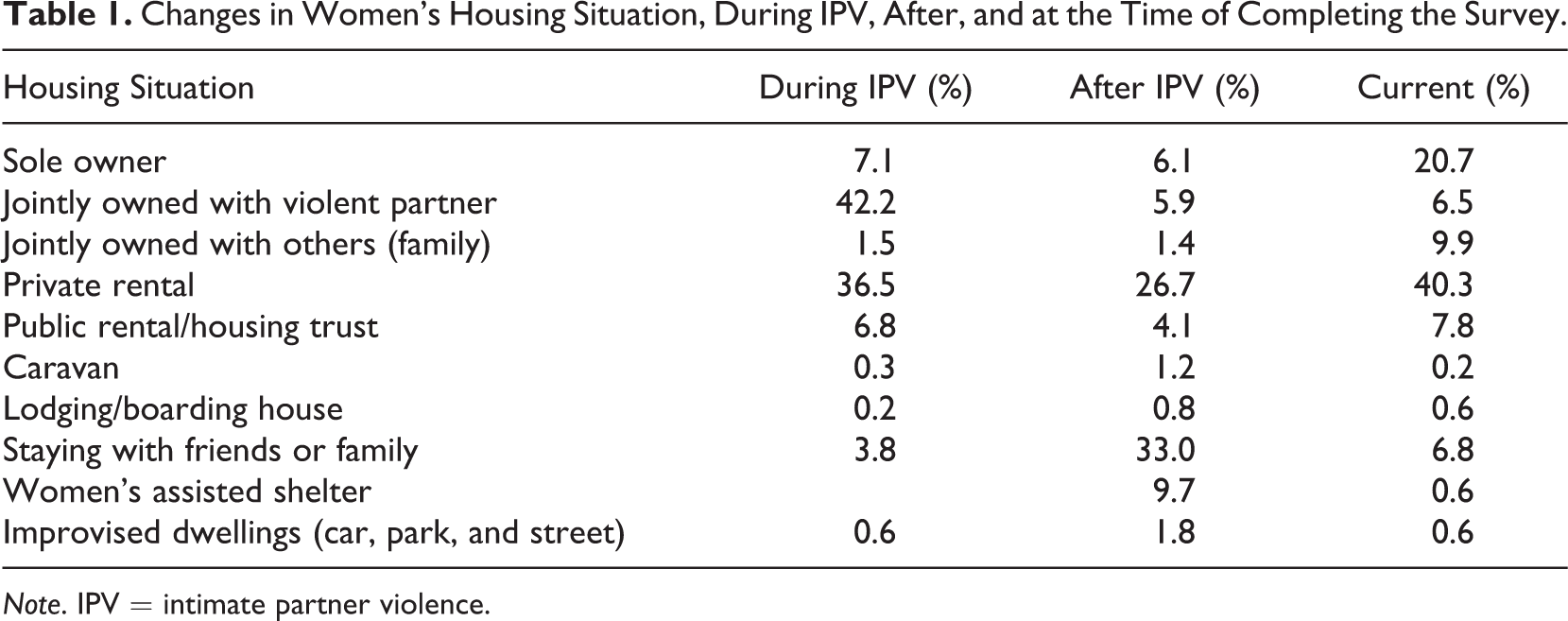
The housing questions in the survey were concerned with the effects of IPV on women’s housing circumstances, while they were experiencing IPV, immediately after leaving, and their current housing situation. The changes in women’s housing status are show in Table 1.
Changes in Women’s Housing Situation, During IPV, After, and at the Time of Completing the Survey.
Note. IPV = intimate partner violence.
These percentages were an analysis of the total number of 658 included female survey respondents. As indicated in Table 1, women’s home ownership did not reach their previous levels, and private rental and public housing status slightly increased. There was only a slight increase in access to public housing, from 7% while in violent relationships to 8% currently, reflecting the limited stock of public housing in Australia. Immediately after leaving, 46.5% of the sample lived in temporary dwellings, which included staying with friends, emergency shelters, cars, parks, caravans, and lodging and boarding houses. The one third (33%) that stayed with family and friends corroborated previous research about the important role of support from friends and family (Postmus, McMahon, Silva-Martinez, & Warrener, 2014). Furthermore, after leaving violent partners, 20.7% of the women were currently sole home owners, compared to 7% of sole owners when women were in violent relationships. This level of sole home ownership is considerably lower than the general population in Australia. In Australia, home ownership is lower for female sole parents (41%) than male sole parents (50%), and more men (80%) than women (74%) over the age of 75 years own their home outright (ABS, 2013). These findings illustrate how the effects of IPV further exacerbate gendered housing inequalities and women’s ability to exercise their economic and social citizenship rights (United Nations General Assembly, 2014).
Thematic Findings: IPV, Financial Loss, Loss of Home, and Fear and Shame
The survey responses provided rich data about women’s experiences of financial losses, living in fear, the loss and destruction of their homes, rebuilding a home, and remaining “safer at home” as well as feelings of shame. The most prominent finding of the survey related to housing costs increasing for the majority of women post separation (67% of survey respondents), which subsequently affected women’s housing choices. This is consistent with previous research that emphasizes how women and children who leave their home to escape a violent relationship experience “considerable social and personal disruption and financial disadvantage” (Chung et al., 2000, p. 46). In this study, after escaping the violent partner/s, women also report being on a much lower income, having to leave their employment and experiencing financial insecurity and poverty. Women’s housing stories were complicated, illustrative of the complex navigation of financial abuse and responsibility, threats, fear of violence, unpredictability, housing instability, and shame, which are inextricably linked to women’s ability to exercise their citizenship rights (Lister, 2003; United Nations General Assembly, 2014).
Financial losses
The most dominant theme in the survey responses related to financial losses as a consequence of IPV and the effects this had on women’s housing status, choices, and practices. First, the financial responsibility ascribed to women for their violent partners’ property damage and debts they left behind affected women’s ability to access and afford adequate rental housing. Second, women who were home owners reported feeling frightened and bullied into accepting unequal property and financial settlements. Consequently, following separation, women were forced to “downsize” into poorer quality housing. As well, women’s housing costs increased proportional to their incomes.
Women who were renting reported being held responsible for their ex-partners’ damage to property and his financial debts, which disadvantaged them when accessing rental properties: “Property damage from him … the place was in my name … it’s held against me in finding rental” (Chelsea). Women also reported experiencing discrimination in the rental market for behavior they were not responsible for: “Landlords are reluctant to rent to me due to the fear of him coming and damaging the property” (Ruthie).
Women who were home owners (or had leases in their names) were disadvantaged because the various types of housing debts accrued by their violent ex-partners were considered joint financial debts: He hadn’t paid bills for several years, and would lie, saying he had paid them while hiding the bills. When he left, I was left with about A $10,000 over due on the rates, A$10,000 worth of other debts, plus he left the house in an unmanageable state of disarray, which is going to cost me several thousand more to fix. (Freya) My ex-husband did not have a cent towards the deposit. It was mine and extra was from my family to buy the house. As a male he earned more and could keep the house. I had to rent and still do. (Marina)
Women who were able to continue to be home owners did so at increased costs, with higher mortgages and increased personal debt. As one woman said, “I was living in rented accommodation for 7 years … until I could save to buy a house … enormous mortgage at the age of 57, which will be paid off at age 83” (Eva). Home owners post separation explained the effects of reduced income for housing: “I have a much larger mortgage, in lesser valued and smaller property” (Nelly). Legal costs and nonpayment of child support after separation also reduced income for housing. The majority of the women indicated that they had to downsize to “smaller, older, [and] less comfortable” and inadequate housing in “cramped conditions due to affordability.” This impeded their ability to exercise full citizenship rights in regard to accessing adequate housing (United Nations General Assembly, 2014).
Furthermore, women who were (or had been) home owners experienced unequal and lengthy property settlements. Women depended on informal supports such as family and friends for considerable lengths of time because the ex-partners refused to cooperate in the property settlement process, forcing women to continue to pay the mortgage. As the quote below shows, women reported feeling intimidated into accepting far less than their fair share of the property settlement, with serious repercussions for access to adequate housing and feelings of connection to home: I was bullied into a settlement where he got 80% of assets and meant I was left with an enormous mortgage. The house I am living in is too small to accommodate all my three children and I have to sleep on a day bed in lounge room as I can’t afford to put on more bedrooms. I feel dislocated not having a cupboard for my clothes or bed lamp or room. (Aileen)
This quote highlights how women’s citizenship rights and practices are affected by IPV, which includes lack of access to their legal rights in property settlements and fear of asking for their financial entitlements due to years of abuse and intimidation. Women escaping IPV are prevented from claiming full citizenship rights through social process that continue to maintain gender inequality (Lister, 2003). As well, a further consequence of IPV is that women reported feeling “dislocated” and fearful within the private sphere of their homes. These findings show how the coercive control and power of male violence reinforce gender inequalities and have ongoing effects on women’s housing status, sense of safety, choices, and practices within the home, all of which further undermine women’s quality of life, rights, and “position as citizens” (Lister, 2003, p. 113; Stark, 2012).
A safe home
The notion of home is a multidimensional and contested concept. It is a subjective phenomenon as well as a materiality that relates to feelings, identity, belonging, connections, and practices (Blunt & Dowling, 2006; Marcus, 2006; Mallett, 2004; Tolia-Kelly, 2004). A total of 169 out of 525 (32%) women used the word home in their responses to the survey question about the effects of IPV on their housing. The most frequently used description about the effects of IPV on housing was the loss of a “safe home.” Typically, after experiencing IPV, women reported never feeling “safe” and not having a sense of home: “I will never have a home of my own or a place that I feel is my home safe, secure, and private” (Lydia). The thematic analysis found that women lost their home/s became homeless as a consequence of escaping IPV, rebuilt a home, and were able to stay in their “own homes” by changing their safety practices.
The survey findings indicated that women (and their children) had to make frequent and significant geographical moves to escape violence (42% of total survey respondents). As one woman said, “We’ve (my child and I) moved 6 times in less than 6 years … it is expensive and disruptive” (Jade). Half of the survey respondents (50.9%) reported experiencing postseparation violence, which occurred on average for 2.78 years after separation, with one woman reporting 25 years of postseparation violence. The women reported living in constant fear and frequently moving and leaving their home/homes with “nothing” and “nowhere to go.” To escape postseparation violence, women relocated for lengthy distances (including moving overseas and interstate) and this disconnected them from their communities and feelings of connection to home: I have had to keep moving around so as not to be found by my husband … He has driven from [state to state] looking for me … from house to house. I cannot work as I cannot stay in one place long enough to secure income and a job. (Cynthia) I would have to leave my house with the kids in the middle of the night because he was threatening to come burn it down or slit my throat … also kill all 4 kids … afraid to go home because of his death threats … only went back when he was jailed … we were separated and living elsewhere but he continually threatened us … had to leave the state and relocate with the kids and sell my house. (Nadia)
The survey data showed that immediately after leaving IPV, nearly half of the women lived in temporary dwellings, such as staying with friends, women’s shelters, cars, or parks. This percentage included 33% of survey respondents staying with family or friends as well as 1.8% of women who reported living in “impoverished dwellings” such as cars, streets, or parklands. For example, “I currently couch surf and house sit for friends or sleep in my car” (Phillipa). The risk of homelessness is particularly high for women who do not have any family or other informal supports in Australia: “I became more or less homeless as I didn’t have family in Australia, a baby and no job and no money” (Greta). Many women highlighted the cumulative effects of IPV on their housing status: “The first round I lost the home I was buying, the second time, I had to leave my long term rental and entered an extended period of homelessness” (Darlene). IPV contributes to women (and their children) experiencing multiple losses—loss of housing, personal possessions, and attachment to places and spaces, which impede women’s ability to fully exercise their citizenship rights (Lister, 2003).
Despite experiencing persisting and severe threats and violence, women also reported negotiating ways to rebuild a home and finding ways to remain safer at home. Rena explained how the long term effects of IPV affected her ability to emotionally and physically recuperate from the abuse and continually affecting her connections to a safe home, I have felt “invaded”, under siege, at every house I have been in, including the shelters, where he would charm the addresses out of the children … I stopped being able to bounce back anywhere near as far as I had fallen, which is why I moved to the country … I realized then I would not survive if I stayed near the city. This house and my relationship to it is a daily litmus test of my physical and mental health, but even on my worst days it is still mine—my safe place. (Rena)
In Australia, there is legislation and programs to prevent homelessness and to support women and children to stay safe in their own home (Baker, Billhardt, Warren, Rollins, & Glass, 2010). However, women reported continued difficulties having the perpetrator removed: “Very difficult to have him removed from house. Fear of him knowing where I live” (Tula). Women who were able to keep living in their own homes did so at additional costs of installing security, such as locks on doors and windows, extra lighting, CCTV, and video intercom. This need for safety equipment created additional financial burdens and affected women’s practices within her home: I needed to pay for increased security measures: sensor lights, high fencing, lockable gates.… I slept with my bedroom light on for over a year, plus I always slept with my mobile phone under my pillow. (Leigh)
Occasionally, women reported being able to maintain their employment and their current home, with the support of family members: “I am lucky, I was the main income earner and had family helping me financially … so no impact for me. I kicked him out” (Veronica). This woman argues that she was “lucky” that she could continue to enact her citizenship rights to housing by being economically independent (the “main income earner”) as well as interdependent (with the financial assistance of her family; Lister, 2008). She exercised her power and agency by “kicking” the violent partner out of the home, which reinforced her rights to safety and housing status. However, this theme was not common in the survey data.
Shame
Lastly, the majority of women who responded to the survey (76.3% of respondents) sought assistance from services, including medical, police, crisis accommodation, and/or legal services. Of particular importance to social work practice is an emerging theme in the analysis related to feelings of shame when accessing services, which hindered women’s decisions and abilities to seek out assistance. Shame was multilayered. Shame about IPV contributed to women moving location: “We as a family moved from the house due to me being embarrassed by the neighbors’ knowledge of the abuse” (Beccy). Women reported feeling “shame, fear, and anxiety” when in “applying for rentals” and health and welfare services for IPV-related issues. As Mina explained below, the process of applying for public housing and the responses of housing service providers can be experienced as disempowering and demoralizing, contributing to her feelings of shame: We had to go into housing commission rental. That was very demoralising for me … my children suffered as some parents wouldn’t let their children come play with them because I was a “single parent living in a housing commission house” and they didn’t want their children associating with the like. Lost everything I had worked for e.g. most of my furniture. The staff at the housing commission office made you feel like you were second rate—and that made my self-esteem even worse than ever. I remember the man at the office told me I could go round and look through the windows to see if I would accept it. If I didn’t I would go to the bottom of the list and wait years before my name came up again. I asked if it was possible to go inside to see if my furniture fitted. His reply was, “What do you think, we build palaces?” I have never forgotten that. (Mina)
This quote highlights how women are further systemically disadvantaged and “put back in their place” as second class, welfare-dependent citizens (Lister, 2008), after experiencing IPV. This gender inequality is maintained through the disrespectful attitudes and approaches of community members and service providers, which has implications for how social workers and housing workers respond to service users. The practices of the welfare state can further contribute to eroding women’s emotional safety and citizenship rights, even after escaping violent partner/partners. This has compounding effects on women’s sense of safety and belonging to place, family, and community (Murray, 2008) and thus, their basic citizenship rights have not been fully realized (Lister, 2007).
Discussion: Citizenship and Home
This article started with the premise that women’s citizenship is always limited compared to that of men’s (Lister, 2003). It showed how gendered inequalities continue to constrain women’s ability to participate in political, economic, and personal spheres, which is further exacerbated by IPV. Women’s access to safe housing and an adequate income is one means to realize full citizenship (Voet, 1998). However, the effects of IPV on women’s housing exacerbate the gendered inequality women already experience. Access to safe and affordable housing, respect, recognition, financial security, and feelings of belonging to a safe home are fundamental to women’s well-being. Yet, women escaping IPV experience limited access to social justice and basic human rights, which is a central concern for social work and feminism (Kemp & Brandwein, 2010).
Male perpetrators of IPV erode women’s citizenship by disrupting their access to housing rights and constraining their agency in their public and private lives, providing a strong example of how gendered violence further curtails women’s ability to act as citizens (Hoffman, 2004; Lister, 2003). However, as Lister explains (1998, p. 7): To be a citizen … means to enjoy the rights necessary for agency and social and political participation. To act as a citizen involves fulfilling the full potential of the status. Those who do not fulfil that potential do not cease to be citizens.
The sample of women survey respondents was not typical, as previous studies have tended to include only women accessing domestic violence services, who are usually not home owners. However, even women who are home owners and in the higher income bracket were not protected from the damaging effects of IPV. Of the sample of women who responded to this survey, 79% had children and 21% were currently sole home owners, which is considerably lower than the population average of 41% of female lone parents who are sole home owners (ABS, 2013). This illustrates how men’s violence impacts on women’s access to home ownership, further exacerbating the gender inequality that already exists in Australia, undermining women’s citizenship and housing status. Future research on the effects of escaping IPV on women’s home ownership in different international policy contexts is needed to better understand how IPV impacts home ownership in differing contexts across the life course.
The survey responses indicate that women do not regain the housing status and safety they enjoyed before experiencing IPV. Across all categories of postseparation housing, including access to private rental, services, public housing assistance, property settlement, and home ownership, women’s ability to negotiate and maintain their standards of living, and rights to safety and security were eroded due to IPV. Some women eventually managed to repurchase their own homes but at a much greater risk due to increased costs of rent, sole mortgages, cost of housing security (such as alarms and locks), damage to property, paying debts caused by ex-partners, lower wages, and frequent moves due to safety concerns. A minority of the women were able to remain in their own homes with the added cost of security. However, women’s position and participation as citizens and their ability to negotiate their social citizenship rights in the domain of housing is severely undermined by IPV, with particular effects on maintaining a safe home.
This article analyzes women’s experiences of the long-term effects of IPV on their housing and connections to home. The notion of a safe home reflects a person’s inner self, a place where one goes to “recharge” oneself, immersed in objects of our personality and identity (Marcus, 2006; Pilkey, 2014). The majority of the women in this study were forced to leave their homes for their own and children’s safety, live in constant fear, and frequently relocate, severely curtailing their freedom to participate in private, public, and political life. Women are systemically disadvantaged when seeking safety from violence, which further erodes their social status, citizenship rights, and participation in gendered ways. This research highlights how IPV seriously affects women’s agency and ability to “bounce back”, to fully and actively participate in civil society. Further examination of the notion of gendered citizenship and it usefulness for theorizing and explaining the diverse effects of IPV on women’s agency is needed.
As Stark (2012) argues, the harm that violent men inflict is political and “reflects the deprivation of rights and resources that are critical to [women’s] personhood and citizenship” (p. 5). Feelings of fear and shame contribute to women’s sense of powerlessness (Wilson, Drozdek, & Turkovic, 2006). This research found that women (and their children) who are escaping IPV experience fear, shame, poverty, lack of respect, recognition, and the loss and destruction of their feelings of connection to a safe home, often resulting in homelessness. The material realities of homelessness and feeling “homeless” are embodied experiences marked by limited citizenship rights, loss, grief, and limited economic, political, and social power (Arnold, 2004, p. 122). Of particular significance to social work are women’s feelings of shame and being shamed when accessing housing assistance, which indicates how social workers can play their part in providing and advocating for dignified and respectful services (Lister, 2008) that respond to the housing needs of diverse women affected by IPV. This relates to all service providers, including social workers, responding respectfully to women’s disclosures of abuse, addressing safety issues, and focusing on holding perpetrator/s accountable for their crimes (Wall, 2012, p. 8).
To prevent homelessness, recent legal reforms in all Australian states provide for exclusion orders that enable women to seek protection from domestic violence and remain in the family home, while the perpetrator is removed (Phillips & Vandenbroek, 2014). This supports women and children to maintain connections to their homes and communities, social support networks, and employment and educational opportunities and provides more stability for their children (Phillips & Vandenbroek, 2014). The right to remain safely in their home after being a victim of crime and not being forced to flee was an important intended policy shift, reflecting a more just approach to women and children whose rights had been violated. This study also found that, depending on the severity of violence and safety concerns, it is possible for some woman and their children to remain in their own homes and retain some sense of belonging to place and community but with added home security.
Conclusion
This article highlights the effects of IPV on women’s housing and advocates for respectful and empowering service responses that would enhance women’s citizenship rights. The findings of this research have implications for social workers working in the fields of domestic violence and housing. Social workers working together with women and communities affected by IPV can help to enhance the inclusionary side of citizenship as both a status and a practice (Lister, 1998, p. 16). Consistent with social work ethics and values, social workers can continue to advocate for and acknowledge women’s citizenship rights to be recognized, respected, and treated with dignity and have a political voice, which can contribute to women’s sense of belonging to community and agency in civil society (Lister, 2007, p. 53). This includes social workers advocating for safe, affordable, and appropriate housing and resources in the women’s community, which can impact their ability to leave or stay safe from their abusive partners (Clough et al., 2014, p. 685). The challenge for feminist researchers and practitioners is to continue to make visible the power dynamics involved in the material and discursive manifestations of unequal gendered citizenship (Lister, 2003, p. 202), including extreme manifestations of inequality such as IPV.
Footnotes
Acknowledgments
We would like to thank all the women who participated in the online survey and provided comments on the effects of IPV on their lives for their courage and generosity. We would like to thank Dr Alison Elder for her research assistant work on this project and assistance with the literature review. We would like to thank A/Prof Janet Bryan, A/Professor of Psychology at the University of South Australia for her assistance with the quantitative analysis of the survey data.
Declaration of Conflicting Interests
The author(s) declared no potential conflicts of interest with respect to the research, authorship, and/or publication of this article.
Funding
The author(s) disclosed receipt of the following financial support for the research, authorship, and/or publication of this article: Grant Number and/or funding information: Australian Research Council, Project No: DP1130104437.