




Abstract
Transgender and gender-nonconforming (GNC) individuals experience homelessness at higher rates compared to the broader population, with many directly attributing homelessness to their transgender/GNC identities. Homeless individuals often engage in survival sex in exchange for food, housing, and other basic necessities. Few research efforts, however, have examined survival sex specifically among homeless transgender/GNC populations. Utilizing the 2011 National Transgender Discrimination Survey (N = 6,454), this exploratory study analyzes relationships between homelessness and survival sex among transgender/GNC individuals. Results suggest these individuals experience homelessness at high rates, and their engagement in survival sex is associated with homelessness. Implications for social work are subsequently discussed.
Keywords
Transgender/gender-nonconforming (GNC) individuals are more likely to become homeless than their cisgender/gender-conforming counterparts (Grant et al., 2011). Homeless individuals, regardless of gender identity, often obtain food, housing, and other basic necessities through their participation in survival sex, as sex in exchange for needed resources is often the only means by which they might be obtained. Research efforts pertaining to survival sex specifically among homeless transgender/GNC populations, however, are especially scant. This exploratory study seeks to understand potential associations between homelessness and survival sex among transgender/GNC individuals and adopts an intersectional, feminist social work lens to build awareness of the need for anti-oppressive social work education and training efforts that develop more trans-affirmative approaches to service provision and advocacy with this population.
Background Literature
Transgender/GNC individuals (i.e., those whose gender identity does not match the sex that they were assigned at birth) are estimated to comprise approximately 0.3–5% of the adult population in the United States (Gates, 2011; Transgender Law and Policy Institute, n.d.; Trotter, 2010). While many identities fall under the “umbrella term” of transgender/GNC, including trans, gender variant, genderqueer, gender expansive, and nonbinary, we have chosen to use “transgender/GNC” to align with language used in the 2011 National Transgender Discrimination Survey (NTDS).
This group is twice as likely to experience homelessness compared to other members of the general population, with 20% reporting that their homelessness was directly attributable to their transgender or GNC identities (Grant et al., 2011). Homelessness is a challenging experience for any individual, as life on the streets or while homeless or unstably housed is often accompanied by myriad stressors and vulnerabilities, including risks of physical and/or sexual assault (Coates & McKenzie-Mohr, 2010; Kipke, Simon, Montgomery, Unger, & Iversen, 1997; Whitbeck, Hoyt, & Ackley, 1997). Homelessness also often precipitates individuals’ engagement in substance use (Bender, Ferguson, Thompson, Komlo, & Pollio, 2010; Rytwinski, Avena, Echiverri-Cohen, Zoellner, & Feeny, 2013) and risky sexual behaviors, such as survival sex, which is participating in sexual activities in exchange for food, housing, and other basic necessities (Halcón & Lifson, 2004; Haley, Roy, Leclerc, Boudreau, & Bolvin, 2004; Warf et al., 2013; Watson, 2011).
Compounding such challenges, research has shown that transgender/GNC individuals experience high levels of discrimination, including when they attempt to access health care such as emergency rooms, doctors/hospitals, and ambulances/EMTs (Kattari & Hasche, 2016; Kattari, Walls, Whitfield, & Langenderfer-Magruder, 2015), as well as social services including mental health centers, drug treatment programs, rape crisis centers, and domestic violence shelters (Kattari, Walls, Whitfield, & Langenderfer-Magruder, Revise and Resubmit; Stotzer, Silverschanz, & Wilson, 2013). Many transgender/GNC individuals report experiences of anti-trans discrimination and outright denial of services by social service providers while attempting to access such services (Stotzer et al., 2013). Very few research efforts, however, have quantified these disparate experiences, as transgender/GNC individuals are notably underrepresented in research, particularly in the context of homelessness. Adding complexity to these injustices, such experiences of discrimination and harassment often lead to increased substance use among transgender/GNC individuals (Nemoto, Operario, Keatley, & Villegas, 2004; Sugano, Nemoto, & Operario, 2006), thereby further escalating this group’s need for certain social services.
Also troubling, many service providers, including most homeless shelters and drug treatment programs, are segregated by gender (Lombardi, 2007; Mottet & Ohle, 2006). When attempting to access shelter and/or substance use treatment programs, transgender/GNC individuals may thereby be forced to choose between accessing shelter/treatment under the guise of a gender with which they do not truly identify, or instead, simply not receiving needed support (Lombardi, 2007; Mottet & Ohle, 2006). Research has shown that when transgender/GNC individuals do opt to access homeless shelters, many shelters fail to provide physically safe environments for these individuals, do not adequately protect their privacy, and do not display respect for transgender/GNC individuals’ autonomy in defining and expressing their gender identity (Mottet & Ohle, 2006). Given these experiences of discrimination in the very places designed to help them, transgender/GNC people may not have access to needed services, and many, thus, turn to survival sex as a means of obtaining basic necessities and resources. An estimated 10–50% of homeless individuals engage in survival sex at some point (Greene, Ennett, & Ringwalt, 1999; Haley et al., 2004; National Alliance to End Homelessness, 2009; Warf et al., 2013). While often perceived as one of few viable options for survival and self-sufficiency on the streets, survival sex has been linked with numerous adverse outcomes, including elevated rates of HIV and sexually transmitted infections (STI) acquisition and transmission (Gangamma, Slesnick, Toviessi, & Serovich, 2008; Solorio et al., 2008), unintended pregnancies (Warf et al., 2013), substance use disorder (Halcón & Lifson, 2004), and suicide ideation/attempts (Greene et al., 1999; Walls & Bell, 2011; Whitbeck, 2009). However, it is also important to note that while many individuals engage in survival sex as their only option for shelter, income, and/or safety, some participants may view this as an empowering economic decision for themselves and may not think of survival sex as an entirely negative outcome. Regardless of sources of motivation and/or oppression pertaining to homeless individuals’ engagement in survival sex, little to no known research has examined associations between homelessness, survival sex, and other sociodemographic characteristics specifically among a sample of transgender/GNC individuals.
Intersectionality
When examining how individuals’ identities relate to experiences of discrimination, harassment, and victimization, the use of an intersection lens through which researchers may view lived experiences is crucial in understanding the nuances of these occurrences. Intersectional theory, based in black feminist thought from the likes of Kimberlé Williams Crenshaw, Audre Lorde, and Patricia Hill Collins, operates on the belief that any individual has multiple identities, belonging to groups that hold social power in society as well as to groups that experience social marginalization (Crenshaw, 1991; Warner & Shields, 2013). Such intersections may modify the experiences of each person, indicating how the effects of privilege and power (or lack of such) change individuals’ interactions with their social environment(s). There have been increasing shifts toward the use of critical feminist theory and intersectional theory within social work, suggesting the need for social work researchers to ground their studies in intersectional feminist thought to better understand the multilayered experiences of research participants (Mattsson, 2014; Mehrotra, 2010). In the present study, the intersections of gender identity, race/ethnicity, and age are examined to explore potential associations between these identities and experiences of homelessness, survival sex, and transphobic discrimination. The use of intersectional, queer, and feminist theories in order to explore experiences of transgender individuals has created a new theoretical model of transgender theory, connecting these theoretical frameworks with feminist social work practice and advocacy (Nagoshi, 2010).
While research has noted the risks associated with homeless individuals’ survival sex, as well as discrimination faced by homeless transgender/GNC individuals in shelter/service provision milieu, little to no research has sought to establish prevalence and deeper understanding of the confluence of these identities and experiences. We hypothesize that the intersectionality of transgender/GNC identity, homelessness, and engagement in survival sex is indicative of notably stark marginalization and may warrant innovations to how service provision is approached. Extant literature on homelessness and survival sex particularly among transgender/GNC individuals is absent and will almost certainly benefit from preliminary studies. This exploratory study uses a national survey to examine: (1) What is the prevalence of homelessness and survival sex among transgender/GNC individuals? and (2) What relationships exist between homelessness experiences and survival sex among transgender/GNC individuals?
Method
Sample and Procedure
This study analyzes secondary data collected from the 2011 NTDS (N = 6,456) by the National Center for Transgender Equality (NCTE) and the National Gay and Lesbian Task Force (NTDS, 2011). A team of community-based advocates, researchers, transgender leaders, and lesbian, gay, bisexual, and transgender policy experts collaborated to design an original, 70-question survey instrument. Participants were invited to respond to the survey through community-based and organization-based listservs, direct outreach by organizations serving difficult-to-reach populations (e.g., rural, homeless, and low-income transgender/GNC individuals) and via organizations’ social media pages, including blogs, Twitter, and Facebook. Participants were invited to respond to the survey online or via paper surveys, which were available in both English and Spanish languages.
In recruiting transgender or GNC participants, the survey used the language, “You are invited to participate in a research project regarding transgender and gender-non-conforming people in the United States” (NTDS, 2011, p. 1), defining transgender and GNC as “people whose gender identity or expression is different, at least part of the time, than the sex assigned to them at birth” (NTDS, 2011, p. 3). The sample includes residents of all 50 U.S. states, Washington, DC, Puerto Rico, and Guam, who were at the age of 18 and above, with all participants in the survey self-identifying as transgender and/or GNC. Among other survey items, participants were asked if they had ever experienced discrimination based on their gender identity/gender expression across a number of situations, including when trying to access medical providers, social services, and school environments, as well as whether they had ever been homeless and whether they were currently homeless. Approval was obtained by the authors’ university-based institutional review board to conduct secondary data analyses.
Measures and Data Analysis
Data were first examined for missing data and to ensure that all appropriate statistical assumptions were upheld. Descriptive analyses were used to depict the full sample’s sociodemographics and characteristics pertaining to homelessness and survival sex experiences. Then, sociodemographic characteristics, including sex at birth (male vs. female; female as the reference category), primary gender today (male, female, and part-time; female as the reference category), age (measured continuously), race/ethnicity (White, black/African American, American Indian/Alaskan Native, Latino/Latina, Asian/Pacific Islander, Middle Eastern, and biracial/multiracial; White as the reference category), ever homeless due to transgender/GNC identity (0 = no and 1 = yes), and ever sought temporary sleeping arrangement(s) due to transgender/GNC identity (0 = no and 1 = yes), were included as independent/control variables. For the dependent variable, participants’ responses to whether they had ever engaged in survival sex (0 = no and 1 = yes) were regressed using bivariate logistic regression on the control/independent variables.
Results
Sample Characteristics
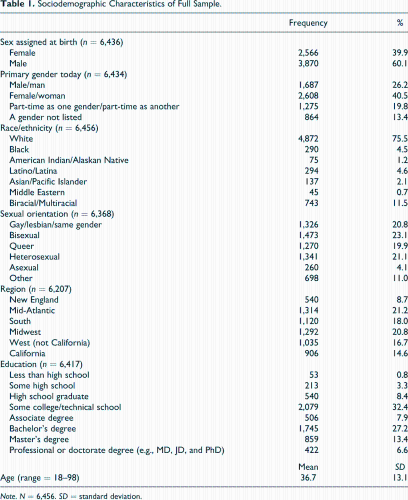
The sample consisted of transgender and/or GNC individuals (N = 6,456), and among the respondents, 40.5% (n = 2,608) identified as female/woman, 26.2% (n = 1,687) identified as male/man, 19.8% (n = 1,275) identified as living part-time in their authentic gender, and 13.4% (n = 864) identified with a term not listed and were given the opportunity to fill in their own preferred gender identity. Racially, 75.5% (n = 4,872) identified as White, with 24.5% (n = 1,584) identifying as racial and ethnic identities who were not white. A wide age range (18–98 years) was represented in the sample and the mean age was 36.7 (SD = 13.1) years. For additional sociodemographic characteristics of the respondents, see Table 1.
Sociodemographic Characteristics of Full Sample.
Note. N = 6,456. SD = standard deviation.
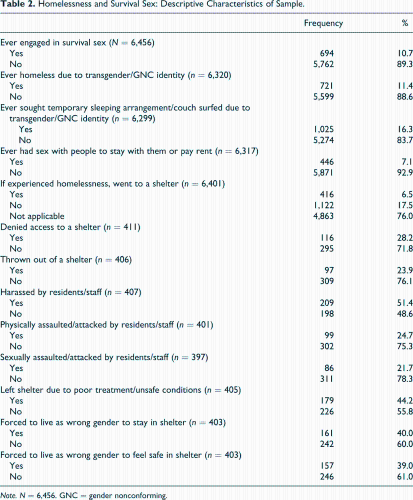
A sizable portion of respondents indicated experiences of homelessness due to their transgender/GNC identity (n = 721, 11.4%), with even more participants noting they sought temporary sleeping arrangements/“couch surfing” due to their transgender/GNC identity (n = 1,025, 16.3%). Many transgender/GNC individuals reported ever engaging in survival sex (n = 694, 10.7%) or ever having sex with people for shelter or in order to pay rent (n = 446, 7.1%).
Among respondents who experienced homelessness, numerous negative incidences of discrimination were encountered while seeking shelter or services, including being denied access to shelters and/or experiencing harassment, physical assault, and/or sexual assault by shelter residents or staff. Many respondents reported leaving shelters due to poor treatment or unsafe conditions (n = 179, 44.2% of subsample accessing shelters), with many also noting they felt forced to live as the wrong gender in order to stay in the shelter (n = 161, 40.0% of subsample accessing shelters) or to feel safe in the shelter (n = 157, 39.0% of subsample accessing shelters). See Table 2 for a more detailed synopsis of descriptive characteristics pertaining to the sample’s homelessness, survival sex, and discrimination experiences.
Homelessness and Survival Sex: Descriptive Characteristics of Sample.
Note. N = 6,456. GNC = gender nonconforming.
Associations Between Homelessness Experiences and Survival Sex
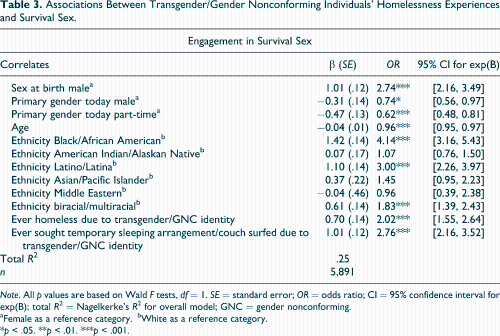
Table 3 presents associations between both sociodemographics and homelessness experiences and transgender/GNC individuals’ engagement in survival sex. Bivariate logistic regressions revealed that individuals who were assigned male sex at birth were significantly more likely to engage in survival sex when compared to those in the sample who were assigned female sex at birth (β = 1.01, OR = 2.74, p < .001). Individuals who identify today primarily as male (β = −.31, OR = 0.74, p < .05) or living part-time in their authentic gender (β = −.47, OR = 0.62, p < .001) were significantly less likely than individuals who identify today primarily as female to engage in survival sex. Younger participant age was also significantly associated with a greater likelihood of engaging in survival sex (β = −.04, OR = 0.96, p < .001). Compared to their White counterparts, participants who identified as black/African American (β = 1.42, OR = 4.14, p < .001), Latino/Latina (β = 1.10, OR = 3.00, p < .001), or as biracial/multiracial (β = .61, OR = 1.83, p < .001) were significantly more likely to engage in survival sex. Regarding the independent variables of greatest interest, respondents who had ever been homeless due to their transgender/GNC identity (β = .70, OR = 2.02, p < .001) or those who had ever sought temporary sleeping arrangements/couch-surfed due to their transgender/GNC identity (β = 1.01, OR = 2.76, p < .001) were significantly more likely to have ever engaged in survival sex.
Associations Between Transgender/Gender Nonconforming Individuals’ Homelessness Experiences and Survival Sex.
Note. All p values are based on Wald F tests, df = 1. SE = standard error; OR = odds ratio; CI = 95% confidence interval for exp(B); total R2 = Nagelkerke’s R2 for overall model; GNC = gender nonconforming.
aFemale as a reference category.
bWhite as a reference category.
*p < .05. **p < .01. ***p < .001.
Discussion and Implications
Those assigned male at birth were significantly more likely to participate in survival sex than those assigned female at birth, and those who identify as female today were significantly more likely to participate in survival sex compared to those who identify as male today as well as in comparison to those who present their authentic gender only part-time. This may be a result of the intersectional marginalized identities of being both transgender and a woman in the society, both identities that experience large amounts of oppression. The experience of this intersection of identities is often referred to as transmisogyny (Serano, 2007) and encompasses the high rate of discrimination experienced by trans-feminine individuals, especially trans-feminine people of color, often resulting in having to turn to survival sex and sex work in order to have needs met.
Black/African American, Latino/Latina, and biracial/multiracial individuals also experienced higher levels of survival sex than their White peers, with black/African American transgender/GNC respondents reporting approximately 4 times the likelihood of engaging in survival sex than white transgender/GNC individuals. The findings that American Indians/Alaskan Natives, Asian Pacific Islanders, and Middle Eastern respondents were less likely to have participated in survival sex follows racial patterns evident in transgender research on discrimination, with Latino/Latina and biracial/multiracial individuals most often reporting the highest levels of discrimination across the board in various health and social service settings (Cabassa, Zayas, & Hansen, 2006; Kattari et al., 2015; Lundgren & Delgado, 2008). These findings highlight the multiple marginalizations experienced by individuals who hold multiple oppressed identities and are supported by intersectionality theory, which looks as the intersections of identities, rather than individual identities alone.
Perhaps unsurprisingly, individuals who had experienced homelessness were twice as likely to have participated in survival sex than peers who had never been homeless, and those who had attempted to find shelter via couch surfing or other arrangements were twice as likely to have participated in survival sex than others who had never sought temporary sleeping arrangements. Age was significantly associated with survival sex. The likelihood of participating in survival sex decreased with age, indicating that transgender/GNC youth and emerging adults are more likely to engage in the street economy of survival sex than their older peers, perhaps due to less social connections able to fiscally support them, lower levels of education/work experience, and/or being kicked out of their homes by unsupportive family. This follows critical intersectional analysis, in which marginalization regarding age and gender identity intersect to impact younger transgender/GNC individuals in different ways than their older counterparts.
The findings in Table 2 are particularly alarming, as only 6.5% of respondents reported that they ever accessed a shelter, which is noticeably low in comparison to the 11.4% of those surveyed reporting lifetime homelessness. Of those attempting to access shelters, 28.2% had been denied access to a shelter, 23.9% had been thrown out of a shelter, 51.4% had been verbally harassed at the shelter, 24.7% had been physically attacked, 21.7% had been sexually assaulted, and almost half (44.2%) had left the shelter for safety. Evidently, shelters are not emotionally or physically safe spaces for transgender/GNC individuals, although very few prior research efforts have quantified the actual rates at which this population accesses emergency shelter services in general, making results of the current study difficult to consider in relationship to prior investigations. As such, to best support this community, there is an urgent need for further research, social work education, and community advocacy to make these services safer and more inclusive, paying particular attention to intersecting identities. Not only is it crucial to better understand how transgender/GNC individuals are treated in shelters, but it is necessary to examine the intersections of race, gender identity, age, and access to housing when developing more inclusive spaces. While homelessness rates and survival sex rates are high in this community, it is clear that transgender/GNC individuals do not have many alternative options for finding safe respite in homeless shelters, which plausibly precipitates their engagement in other street economies, such as survival sex. Although this sample is cross-sectional and thus cannot support causal arguments, future research would benefit from exploring such phenomena.
Not only is it essential to understand experiences of discrimination and lack of access facing these individuals, but as feminists and as social workers, it is our ethical duty to enact change to support this population not only in finding housing situations, but especially in training current and future social workers in culturally responsive, anti-oppressive, trans-affirmative care from an intersectional perspective. Shelters should be safe spaces for individuals of all gender identities and expressions and areas where clients should not fear discrimination, harassment, and assault from other residents and even staff. As a field that values social justice grounded in an intersectional feminist perspective, there is demonstrated need to include information about various gender identities in social work education curricula and to support this population via ongoing trainings for social workers already in practice. Social workers should also be able to advocate for policy change in their organizations to use more inclusive languages and practices that frame these spaces as welcoming for transgender/GNC individuals, of whom over 1 in 10 may evidently need housing support at some point throughout their life. Such training and education efforts should focus on establishing guidelines that all social work practitioners and students become familiar with clients’ preferred names and gender pronouns as well as how to ask relevant clinical questions without unnecessary or insensitive probing. Individuals who have or are experiencing homelessness and/or engaging in survival sex have often faced many forms of trauma, rejection, and discrimination; when considered in conjunction with intersections of racism, sexism/misogyny, and transphobia, it is of paramount importance that social workers are trained not only to establish rapport, empathy, and nonjudgment, but also that they are given skills that allow for competence in working with the many complex concerns facing these highly vulnerable populations. Social workers must also be encouraged to invest adequate/additional time to create comfortable shelter-based, mental health/health care, and policy advocacy spaces that truly seek input and validate the experiences and needs of these individuals.
Given the glaring lack of extant research on this population, particularly regarding experiences of homelessness, survival sex, and sex work of any type, there is a need for further inquiry of these issues within the transgender/GNC community, particularly within the context of intersectional identities, recognizing that different racial groups and ages of transgender/GNC individuals experience even higher rates of discrimination and marginalization. While additional research exploring the prevalence of homelessness and survival sex among this population would better frame the issue at hand, research that follows individuals throughout their experiences with housing insecurity could provide deeper, greatly needed insights into the different constructs that may influence engagement in survival sex and/or shelter use proclivity. Developing and testing potential educational interventions that could support shelter workers in offering safer and more intersectionally inclusive spaces to homeless transgender/GNC individuals would be of great use in reducing harm being done to this community in what should be safe and supportive shelter.
Limitations
Certain limitations exist and should be considered in the interpretation of findings. First, the study’s cross-sectional design constrains the ability to draw causal conclusions. Additional limitations include the use of single-measure items, and measurement issues that pertain to accurately capturing the nuances of complex experiences like homelessness or survival sex. The NTDS also used language that may be not accessible to certain individuals participating in the survey or that may convey varying or multiple definitions according to the perspective of a given respondent, such as the terms “transgender” as compared to “GNC” as two unique identities. Because of this, some participants may have opted to skip some questions that they did not understand or they may have understood the question differently than the survey administrators had intended. Additionally, this sample was predominantly White, even though many transgender/GNC people identify with non-White racial and ethnic identities, and transgender/GNC people of color are often marginalized within community spaces. This survey sampled predominantly those who had access to the Internet and also those already connected to transgender-specific communities. This sampling strategy may have thus excluded individuals living in rural areas and older individuals who may not be as comfortable with online usage.
Conclusion
Transgender/GNC individuals experience high rates of both homelessness and survival sex participation when compared to the general population. Such relationships are made more complex when further considering intersections of racial/ethnic identity, sex assigned at birth, age, and gender identity today, deepening the marginalization placed on many in this population. Furthermore, these individuals experience elevated rates of discrimination, verbal harassment, physical assault, and sexual violence in homeless shelters, often waged by other residents and staff. As such, there is a clear need to further explore not only the experiences of transgender/GNC people in terms of housing insecurity and engagement in survival sex but also a demonstrated onus upon social workers to educate themselves and others on how to create safer, inclusive spaces, and to advocate for policies that would better support transgender/GNC people in having safe, affordable housing options, including temporary shelters as needed. In conclusion, a failure to increase social work’s competencies in improving the lives of this especially vulnerable oppressed population ensures social work’s role in the continued oppression of this group. As a profession grounded in social justice, social work should be leading the community in transgender/GNC inclusivity rather than being complicit in their oppression.
Footnotes
Acknowledgment
Thanks to the National Center for Transgender Equality and The Task Force for their tireless work toward supporting transgender rights and allowing us to use their data.
Declaration of Conflicting Interests
The author(s) declared no potential conflicts of interest with respect to the research, authorship, and/or publication of this article.
Funding
The author(s) received no financial support for the research, authorship, and/or publication of this article.