




Abstract
Military culture promotes status hierarchy and a hypermasculine paradigm, upholding combat arms, and war heroism to exemplify the ideal soldier, contributing to existing gender disparities. This study utilized an online anonymous survey of U.S. military veterans (N = 25) to examine veterans’ likability related to gender and level of combat exposure using frequencies, descriptives, and Mann–Whitney U tests. Results indicate that veterans prefer combat experienced and male soldiers. Female, noncombat exposed or injured veterans may be more socially isolated than their male counterparts following military service or deployment, illuminating potential barriers to help seeking and service provision with this vulnerable population.
Keywords
During times of war, males have traditionally been at the forefront of combat exposure while females have predominately remained at the sidelines. In the United States, the majority of individuals in the armed forces are males. However, the number of females who are actively serving in the armed forces as well as females who are expected to enroll is likely to increase (Zinzow, Grubaugh, Monnier, Suffoletta-Maierle, & Frueh, 2007). While the number of females serving in the military continues to rise, the role of the female soldier has also changed, largely due to the rescinding of the 1994 direct combat exclusion rule, which excluded females from being exposed to direct combat (U.S. Department of Defense, 2013). Since the rescinding of this rule, females serving in the military are able to participate in combat directly. As a result, males and females are equally exposed to combat, revolutionizing the way that male soldiers and veterans interact with female soldiers and veterans. However, there continue to be gendered labels and corresponding character judgments attributed to active military female and female veterans because the military, and combat in particular, has historically been governed predominately by males (K. Dunivin, 1994). The purpose of the current study is to examine veterans’ perspectives regarding which soldiers are most likable depending on their sex and level of combat exposure. We use gender development theories and military culture to develop vignettes describing scenarios in order to evaluate veterans’ attitudes toward soldiers. We posit that veterans are likely to view their peers as being more or less likable based on perceived gender and combat experience. Within the body of this study, the words women and female and men and male will be used interchangeably; while each term reflects its own set of gender-specific sociocultural challenges, each noun, adjective, and modifier is utilized to convey the highest linguistic respect in each context (Safire, 2007).
Gender development theories assert that there are tangible social differences that distinguish males from females (Bandura & Bussey, 2004; Bussey & Bandura, 1999). The bifurcation of acceptable gender roles in society has led to various disparities and corresponding power imbalances between sex designations of male and female (Gayle, 2006). It is well-documented that discrepancies in wages (Fuller, 2008), power (Neff, Cooper, & Woodruff, 2007), and health (Haavio-Mannila, 1986) between males and females are pervasive. Gender-specific norms in American society stipulate that men are to be “aggressive, forceful, independent, and decisive, whereas women are characterized as kind, helpful, sympathetic, and concerned about others” (Macapagal, Rupp, & Heiman, 2011, p. 658). Gender-specific attitudes, characteristics, and roles are rigid and stereotypically assigned to males or females solely on the basis of gender, suggesting that specific roles attributed to males and females are dichotomous. Aggressive, forceful men are not expected or encouraged to be kind or sympathetic and sympathetic and kind women are not expected or encouraged to be aggressive or forceful. The social construction and stratification of specific gender roles is particularly prevalent within military culture.
Military culture embraces a paradigm that upholds combat and hypermasculinity as core constructs, which may unwittingly influence interveteran attitudes, increase stigma, and create barriers to help seeking (Ashley & Brown, 2015; K. Dunivin, 1994; Keats, 2010). The values and practices of the military are predicated on seeking war victory, fostering attitudes, beliefs, and behaviors constructed around combat (Keats, 2010). Furthermore, Chinkin and Kaldor (2013) argue that male “soldiers are deemed as ‘heroes,’ giving rise to the dichotomy between the images of the ‘protector’ (male) and the ‘protected’ (female)” (p. 168). Chinkin and Kaldor also highlight how the social construction of gender impacts the participation of males and females in war because women are overarchingly viewed as weak, peacemakers, and requiring protection, ultimately undermining the role of active females in the military and upholding beliefs regarding specific gender roles (p. 168).
Many women feel the need to conform to the hypermasculine standards of military culture which has both positive and negative outcomes for interpersonal interactions and the internalization of values. Under the direct combat exclusion rule, combat exclusion laws and policies prohibited females from performing many combat-related roles or duties, reinforcing widespread attitudes about the substandard place of women in the military (K. Dunivin, 1994; K. O. Dunivin, 1988; Prividera & Howard, 2014). Currently, post rescinding of the rule, female soldiers on the front lines are immersed in military institutionalized sexism, with female soldiers who rise in rank maintaining without challenging the status quo. Higher ranking female soldiers may feel the need to conform because “whenever anyone enters an institution that has a certain power structure, the higher up they rise within it, the more likely they are to adopt its principles” (Anonymous, 2013, p. 215). Although female soldiers are growing in number, moving through ranks, and are seen as soldiers with quality performance akin to their male counterparts (Anonymous, 2013), they appear to have minimal influence in altering the misogynistic domain of the military. Soldiers are trained in an environment that promotes male superiority and sexism toward women (Szymanski, Gupta, Carr, & Stewart, 2009) and condones rape culture on and off the battlefield (Grubb & Turner, 2012; Maxwell, 2009). Everyday speech further reinforces hegemonic interactions of soldiers and creates a hierarchy that sexualizes female soldiers, which has influenced many female career soldiers to leave military service earlier than expected (Dichter & True, 2015). Within an environment inundated with devaluing and sexualization, female soldiers can very easily develop internalized misogyny.
Gendered stereotypes and attitudes toward women may position female veterans at a disadvantage as compared with male veterans. Military roles reflect strength and power and are traditionally seen as masculine, especially during combat. Combat veterans are viewed as possessing, “power, hiding perceived weakness, as well as maintaining self-reliance and emotional control” (Lorber & Garcia, 2010, p. 297). Those who do not possess these characteristics, or who are perceived as the “fairer sex” due to gender-specific attitudes and stereotypes, are viewed as weak and vulnerable. K. Dunivin (1994) established the paradigm of the combat masculine-warrior (CMW), which contends that combat-exposed soldiers are more respected than their noncombat experienced peers. The masculinity that military males embody is the epitome of what a real soldier is and “women were not be regarded as ‘real’ soldiers until they were able to do what ‘real’ soldiers do, which is to kill or die in combat” (K. Dunivin, 1994, p. 536). This paradigm is highly exclusionary, barring any challenges to the hypermasculine norms and values that pervade military culture. A consequence of the CMW paradigm and the exclusionary policies that support it is reinforcement of the perception that masculinity and combat experience or exposure is the defining feature of a “real soldier.” Thus, despite their present capacity to participate in combat, the hypermasculine paradigm continues to define masculinity as male, excluding female soldiers primarily on the basis of gender. The combat experienced masculine warrior is viewed through a lens of combat elitism, awarding him heroism, honor, and respect while those who have not experienced combat or who are not deemed masculine (specifically women) may be dismissed or devalued (Ashley & Brown, 2015; K. Dunivin, 1994). Ashley and Brown (2015) found that male combat veterans without injuries were perceived as more well liked than all other soldiers, including male combat veterans with injuries. This finding reflects a complex internal hierarchy of deservedness and value based on combat and gender, heavily influenced by perceived health and level of functioning.
Soldiers and veterans express apprehension about accessing mental health services due to concerns about stigma (Hoge et al., 2004). Male and female veterans have different health needs for a variety of reasons including individual military experiences, increased prevalence of certain conditions in females, and sex-specific health concerns (Goldzweig, Balekian, Rolón, Yano, & Shekelle, 2006). It is estimated that female veterans who have been exposed to combat experience more symptoms of post-traumatic stress disorder (PTSD) as compared to females who are not exposed to combat (Resnick, Mallampalli, & Carter, 2012). Furthermore, female veterans endure traumatic experiences during their military service that have taxing effects on their quality of life, putting them at increased risk for PTSD, military sexual trauma, substance abuse–related issues, and depression (Resnick et al., 2012). In 2013, female active- and reserve-component service members were 4 times as likely as their male counterparts to report sexual assault (Morral et al., 2015).
An additional barrier to service provision for female veterans is judgment by military peers. Some female soldiers report experiencing “secondary victimization” when they sought mental health services from the military (Campbell & Raja, 2005, p. 97). It has been well-documented that female veterans would rather seek professional help through private care because they do not feel worthy of seeking care for their physical or mental issues at the Veterans Affairs Health Administration (Mattocks et al., 2012). Many female veterans prefer to engage in alternative cognitive and behavioral strategies to manage and cope with traumatic experiences they witnessed during wartime, including overeating, using prescription drugs, exercising, or listening to music as opposed to seeking treatment at the Veterans Administration (VA), and were less likely to seek the support of friends, family, or other contacts (Mattocks et al., 2012). It is noteworthy that while these women exhibited the vigor, strength, and resilience to navigate a combat setting, they did not feel worthy of mental health treatment or benefits post combat.
Erroneous judgment by superiors is an additional barrier to support. Thorndike (1920) coined the term “the halo effect” to describe errors in how military officers evaluated subordinate soldiers on a number of traits and refers to the habitual tendency to rate individuals with certain characteristics more favorably than others. The halo effect concurrently describes the global impact of a more likable personality or specific desirable trait in creating biased judgments of a person on a number of dimensions (Standing, 2004). Judgments regarding personality, competence, and value based on biological sex or combat experience are consistent challenges for female veterans.
Female veterans face specific areas of disadvantage related to their unique position as minorities in a culture where membership is mutually exclusive to other communities. Enlistment with the armed forces requires an oath of loyalty, faith, and allegiance, distancing members from other communities. K. O. Dunivin (1988) proposes that female veterans experience minority group status within the male/masculine dominant military but lack gender consciousness as evidenced by their disconnection from women’s issues, women’s groups, and other military women. Thus, these women are isolated from military peers, masculine military culture, and the larger feminist community. There are multiple contributors to isolation from viable support systems available to female veterans, including military masculine culture that frequently devalues women, negative judgment from peers or superiors, disconnection from other women, or lack of cohesion. Social cohesion is a critical element in military interpersonal dynamics. At both an individual and a group level, cohesion has a direct impact on psychological coping (MacCoun & Hix, 1993). Bifurcated into task-oriented cohesion (regarding common goals and group efforts to strategize regarding those goals) and social cohesion (the extent that group members like one another and feel emotionally close to one another), the terms clarify both content and process elements of military cohesion (MacCoun & Hix, 1993). However, mere friendship is not the foundation of cohesion; with combat in particular, the potential outcome is one of life or death, so trust, dependability, and teamwork are essential elements (Siebold, 2007).
Research reflects veterans often obtain support predominantly from other veterans who can validate the traumas that occur exclusively within the context of military culture (Fraser et al., 2010). As a result, veteran-to-veteran judgment regarding who is deserving of support has a significant impact on trauma recovery, treatment utilization, and intervention efficacy. Veteran judgment can take the form of verbal or nonverbal communication, expectations regarding competence, or may manifest as simply as likability. Assessing likability is a critical step toward understanding the nuances of judgment of women in the military.
Within the context of the current study, whom one likes, favors, or prefers is based on immediate assessment and reflects capacity for trust, dependency, and team building among military personnel. For veterans, cohesion within social networks provides pathways to social support, utilization of health and mental health resources, and emotional acceptance. Costa and Kahn (2010) found that cohesiveness can mitigate or accentuate the impact of stress. An absence of these connections increases vulnerability for exclusion, social isolation, and mortality.
While there are clear differences in the ways in which males and females in the military are viewed, there is a paucity of literature comparing the likability of men versus women veterans. This study explores veterans’ perspectives regarding which soldiers are most likable depending on their sex and level of combat exposure. We posit that the internalized hypermasculine paradigm present in military culture supports an illusory ideal soldier, characterized as a man’s combat experienced/exposed, masculine, aggressive, and nonemotional warrior. Veterans are likely to view their peers as being more or less likable based on perceived gender and combat experience. The implications of being less likable are extensive; the self-esteem, confidence, competence, camaraderie with fellow veterans, and willingness to access mental health services of female veterans may be adversely impacted.
Method
Sample
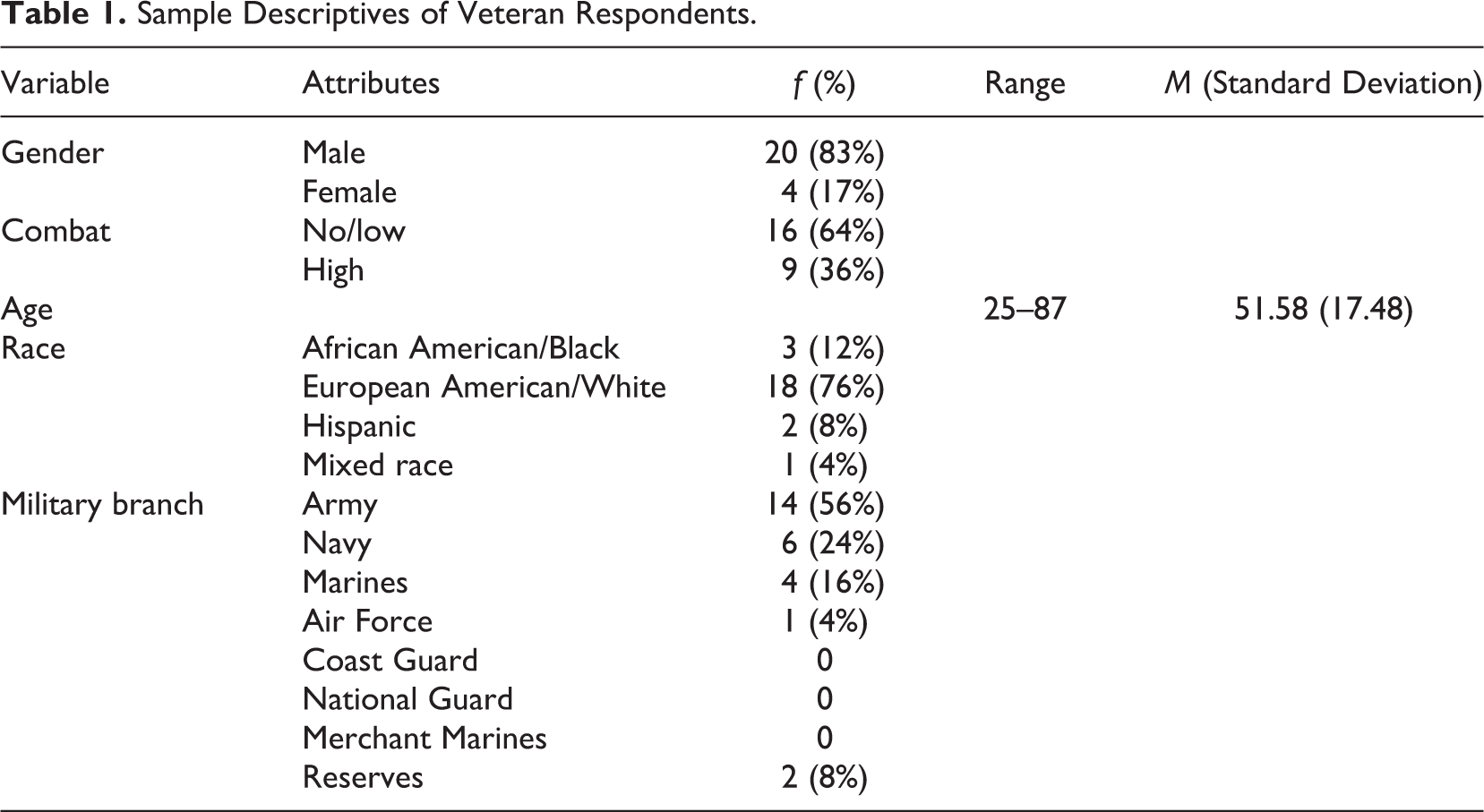
The current study uses a convenience sample of veterans (N = 25) who served in the U.S. military who were primarily white (n = 19, 76%), male (n = 21, 84%), and served in the army (n = 14, 56%). All veterans were welcomed to participate in the study regardless of level of combat exposure or discharge status. Participants were recruited using a snowball sampling method whereby they were asked to forward an anonymous survey to friends, family, colleagues, and other contacts. This form of sampling is effective in that it is convenient, maintains low cost, and recruits members that would otherwise be difficult to survey (Rubin & Babbie, 2010). The California State University Standing Advisory Committee for the Protection of Human Subjects approved this study.
Design and Data Collection
This study uses an exploratory online survey design. A 77-question survey was posted on the American Legion website, and the Center for Veterans Advancement posted the survey on their monthly online newsletter. The survey was also advertised and circulated on social networking sites such as Facebook. All participants were asked to complete a series of questions that asked about their service information. Following these questions, participants were presented with a series of vignettes depicting female and male soldiers who suffer from PTSD due to exposure to combat and female and male soldiers who suffer from PTSD and did not serve in combat. In order to assess the participant’s level of combat exposure, the Gallops Revised Combat Scale was utilized.
Measures
Gallops Revised Combat Scale (1981)
The Gallops Revised Combat Scale consists of 10 dichotomous (yes/no) questions. Questions 1–6 of the scale are appointed a value of 1 while questions 7–10 are appointed a value of 2, whereby 2 indicated higher levels of combat exposure. The highest possible score is 14, indicating high level of combat exposure while a score of 0 represents no combat exposure. The current scale has been updated to be applicable to all military veterans who served in all eras not just veterans of the Vietnam era. Consequently, words such as “Vietnam” and “Improvised explosive device (IED)” have been replaced with more appropriate terms such as “enemy” and “mines or booby-traps,” respectively. The Revised Combat Scale has a high internal consistency (α = .90 for the current study) as well as construct validity.
Attitudes toward veterans
Participants were asked to read a series of six different vignettes and respond to 10 related questions intended to measure attitudes about likability and help seeking behavior. The six vignettes were initially developed based on the work of Fraser et al. (2010). Participants were posed with hypothetical scenarios with initials used in lieu of a name in order to maintain ethnic neutrality. A sample vignette for a male soldier is:
Soldiers in the vignettes were categorized into different groups based on gender, level of combat exposure, and whether the soldier had sustained any injuries. Soldiers were categorized into the subsequent groups: “male—no combat,” “male combat—no visible injury,” “male—combat injury,” “female—no combat,” “female—combat no visible injury,” and “female—combat injury.”
After reading each of the six vignettes, participants were asked to rate soldiers on ten 5-point Likert-type scale questions ranging from very low to very high, where 1 = very low and 5 = very high. Questions included (1) How would you describe (soldier’s initials) resilience (ability to bounce back from adversity)? (2) How trustworthy is (soldier’s initials)? (3) How reliable and dependable is (soldier’s initials)? (4) How likely is it that (soldier’s initials) needs treatment for PTSD? (5) How likely is it that (soldier’s initials) deserves treatment for PTSD? (6) When she/he comes back to work, how likely is it that (soldier’s initials) will perform at a level above that of his/her peers? (7) When she/he comes back to work, how likely is it that (soldier’s initials) will perform at a level equal to that of his/her peers? (8) When she/he comes back to work, how likely is it that (soldier’s initials) will perform at a level below that of his/her peers? (9) How likely is it that you would like (soldier’s initials) if you met him/her? and (10) How likely is it that you would enjoy working with (soldier’s initials)? In the questions following each vignette, soldier’s initials and personal gender pronouns were tailored to match the specific vignette.
Data Analysis
Likability was assessed by finding the mean score of nine vignette questions for each soldier described in one of the six vignettes. Reliability analyses revealed improved internal reliability for all groups by removing question number eight from the total score. Cronbach’s α scores without question number eight were .74 for male, combat, no-injury; .75 for female, combat, no-injury; .79 for female, combat, injury; .80 for male, combat, injury; .88 for female, no combat; and .90 for male, no combat, revealing acceptable internal consistency for vignette questions by category. Exploratory factor analysis confirmed the unidimensionality of vignette questions, loading on to a single factor we term “likability,” although the sample size is clearly limited and results should be interpreted with caution. Univariate analyses included frequencies and descriptives of individual variables. The Mann–Whitney U test was used to test for differences between veterans’ combat experience and soldiers’ likability and veterans’ gender and soldiers’ likability. Data were analyzed using SPSS Version 22.
Results
Descriptives for sample demographics and variables of interest can be seen in Table 1.
Sample Descriptives of Veteran Respondents.
Overall likability means and standard deviations are reported by soldier in Table 2 and depicted graphically in Figure 1. Higher numbers indicate greater likability as reported by veterans in the six vignettes.
Likability Means (Standard Deviation) by Sex and Combat Experience (N = 25).

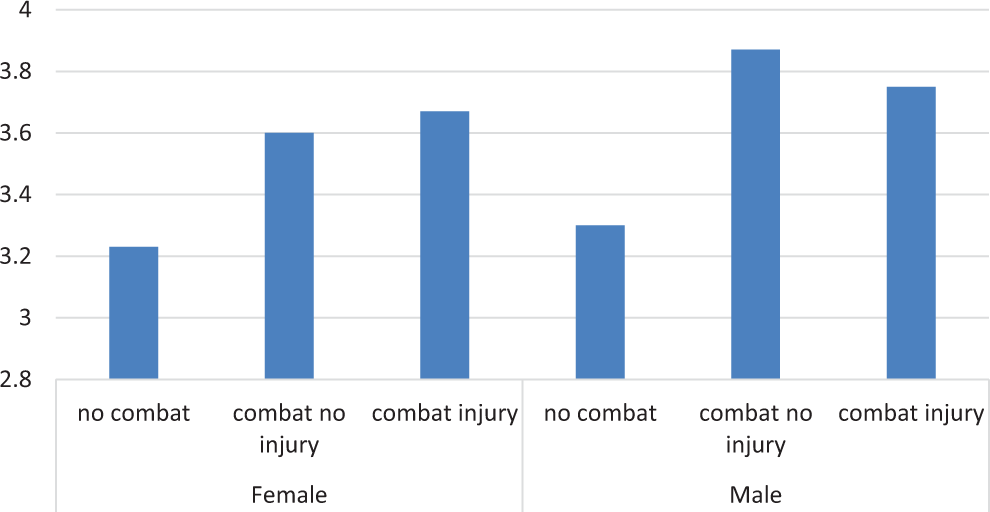
Mean likability by combat and gender.
As seen in Table 3, no/low combat veterans consistently rate soldiers’ likability higher than their combat veteran counterparts with the exception of male soldiers with no visible injury. Mann–Whitney U tests revealed a significant difference in soldiers’ likability between no/low combat veterans (Md = 3.66, n = 17) and combat veterans (Md = 3.00, n = 9) for male soldiers who did not experience combat (U = 43, z = −2.11, p = .03), with male soldiers who did not see combat rated as less likable by combat veterans than noncombat veterans.
Means (Standard Deviation), Z-Scores, and Effect Sizes of Soldiers by Veteran’s Combat Status.
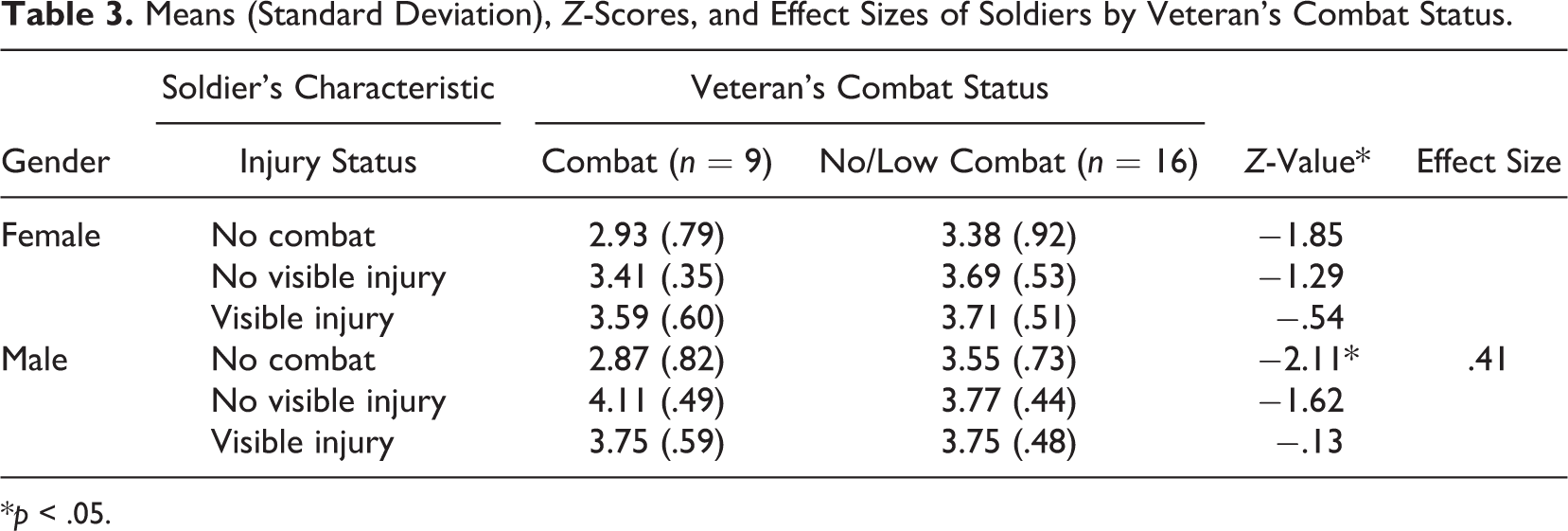
*p < .05.
As seen in Table 4, Mann–Whitney U tests revealed significant differences in soldiers’ likability between male and female veterans, with female soldiers rated higher by women veterans than male veterans regardless of the soldiers’ injury or combat status. Mann–Whitney U tests revealed a significant difference in soldiers’ likability between male veterans (Md = 3.11, n = 20) and female veterans (Md = 4.05, n = 4) for male soldiers who did not experience combat (U = 9, z = −2.40, p = .01), with male soldiers who did not see combat rated as less likable by male veterans than female veterans. All four female veterans in the sample were no/low combat status.
Means (Standard Deviation), Z-Scores, and Effect Sizes of Soldiers by Veteran’s Reported Gender.
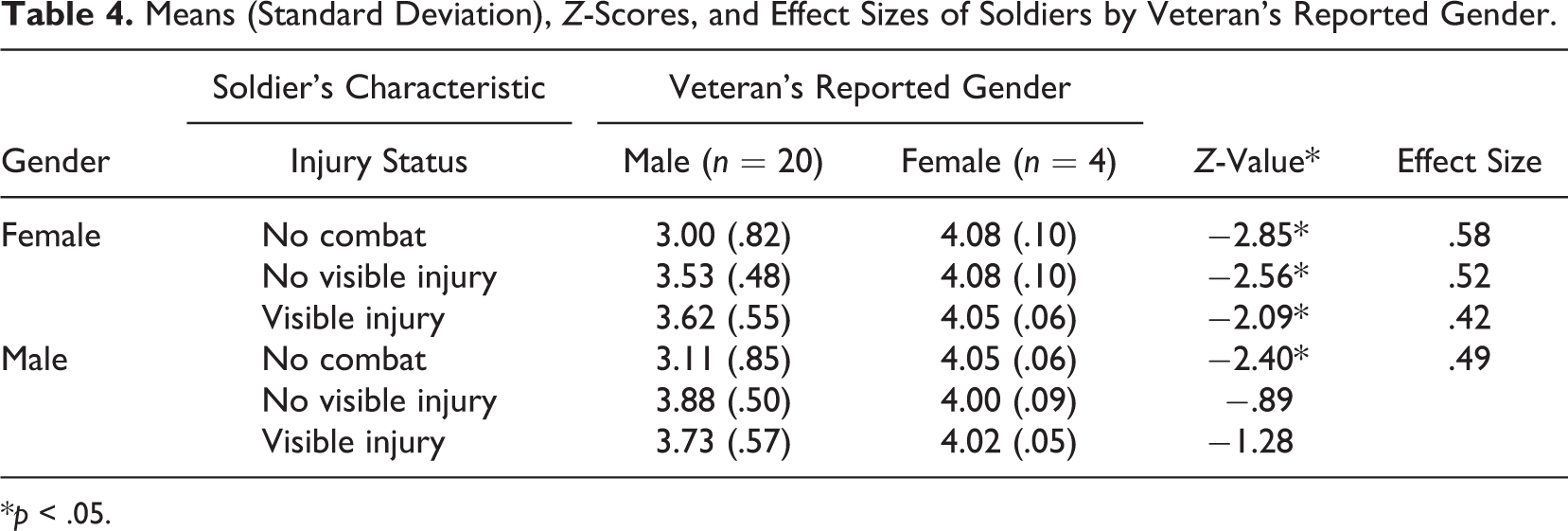
*p < .05.
Discussion
The current study examines the perspectives of veterans regarding the extent to which soldiers are favored depending on the soldier’s gender and level of combat exposure. Consistent with previous research (Ashley & Brown, 2015; K. Dunivin, 1994), this study revealed that male veterans like and prefer male soldiers to female soldiers and prefer combat experienced soldiers to noncombat experienced soldiers. Injured soldiers were preferred over soldiers with no combat experience, but less liked than healthy, uninjured soldiers. This supports the notion of the CMW (K. Dunivin, 1994) in that soldiers who are exposed to combat are viewed as manly, deserving, possessing higher status, and better liked than their noncombat counterparts. It is possible that the disliked, injured male soldiers further challenge the CMW paradigm by juxtaposing the heroism associated with combat with the weakness, dependency, or vulnerability associated with injury or disability.
The results further indicated that male soldiers were perceived as more likable than female soldiers, whether combat experienced or noncombat experienced. The latter results are supported by previous research, which suggests that female soldiers and veterans are treated differently than male soldiers and veterans (Archer, 2013; Campbell & Raja, 2005; Dichter & True, 2015; Goldzweig et al., 2006). Different attitudes toward female soldiers may be due to gender-based condemnation of women within the military or feminine presentations incongruent with the image of a “real” soldier, resulting in ongoing discrimination, harassment, and abuse toward females in the military (King, 2013). These differential attitudes toward women can be detrimental to females entering the armed forces because they are treated as inferior in relation to their male counterparts. The masculinized culture of the military could impede the integration of males and females due to male presumptions and the sexualized nature of the military (Grohowski, 2014; Grubb & Turner, 2012; King, 2013; Maxwell, 2009).
The participants in this pilot study largely represent white male veterans with little to no combat experience. Revealing a preference for healthy, combat experienced soldiers and aversion to female soldiers, it is noteworthy that the participants had the most impassioned responses for persons unlike themselves. Previous military literature supports the authors’ assertions that this is most likely associated with the hierarchy created by the masculine climate of the military and the combat elitism (Ashley & Brown, 2015) inherent in heroism. However, these findings directly conflict with Moreland and Zajonc’s (1982) study, showing that perceived similarity was related to likability and familiarity. Future research exploring the self-concept and needs of various subgroupings of the veteran population may show a more intersectional picture of the military demographic, with consideration given to male and female soldiers who are married versus unmarried, with children versus without children, heterosexual versus homosexual, of differing racial and ethnic backgrounds, and how these factors may influence the perceptions of soldiers and veterans.
Limitations and Implications
The results of the current research reveal important insight on the attitudes veterans have regarding gender, likability, and level of combat exposure. Nevertheless, there are some limitations that require consideration. Exploratory studies such as this one have low internal validity, although they are useful as pilot projects and can yield groundbreaking information on new research topics. The results presented in this study provide initial evidence for the usefulness of future studies with more rigorous design.
The convenience sample that was used in the current study was relatively small and was comprised mainly of Caucasian males. With the growing population of ethnic minorities entering the military, a concerted effort should be focused on casting a wider net to capture a more ethnically diverse veteran population. A wider demographic may give a more complete picture of veterans seeking health care due to the findings that show many ethnic minority veterans refrain or lack access to postmilitary service health care (Tsai, Desai, Cheng, & Chang, 2014). There were a limited number of female veterans who completed the survey, making it difficult to explore females’ attitudes toward male and female soldiers. It is possible that females feel differently about soldiers than their male counterparts, but this must be further explored. There is also some question of how fathers and mothers are seen, in reference to gendered caretaking and parenthood stereotypes (Archer, 2013; Hoiberg & Ernst, 1980; King, 2013). For this reason, the results attained in the study cannot be generalized to all veterans. It is also important to take into consideration that the study was an exploratory online study. Not all veterans have access to the Internet and not all of them are capable of completing a survey for the duration of 30 min. Although there is some consensus as to the effectiveness of using vignettes to explore attitudes (Archer, 2013; Fraser et al., 2010; Gould, 1996; Griffith, Hart, & Brickel, 2010), it does not guarantee that veterans responded to the questions on the vignette truthfully.
The distinction between how injured soldiers and uninjured soldiers were perceived, categorized, and favored highlights critical discourse regarding the differences between physical and mental injury. Mental health needs and treatment contain stigma not found with physical health. Stigma in seeking mental health services is laden with gender, cultural, and stigmatization of mental illness and the incapacity for recovery. Because PTSD, depression, anxiety, substance abuse, and traumatic brain injury are invisible injuries, combat veterans returning from war may feel greater obligation to maintain the stoicism and masculine expression expected of them as heroic combat warriors. Veterans with mental health symptoms may disproportionately experience concern about stigma because they have the most prestige to lose from peers and by leadership (Hoge et al., 2004).
The results of the current research illustrate the importance of attitudes toward female and male soldiers. Combat exposure fused with an oppressive climate of inadequacy renders women veterans at increased mental and physical health risk, especially as the number of females entering the armed forces continues to increase. Part of the resolution involves challenging the masculine climate of the military. As long as military culture condones a masculine characterization of heroism (Szymanski et al., 2009), individual veterans will maintain preferences based on soldiers’ or veterans’ gender or level of combat exposure. Ideals perpetuated by the military must be more inclusive, as the fight to protect the United States isn’t gender-specific. It is specifically important to consider how veterans perceive other veterans because it could explain how professionals and paraprofessionals can better assist and counteract the stigmas and stereotypes of this population. Future research should consider exploring the attitudes of female veterans due to the limited number of females who participated in this current study.
Conclusion
The military is a male-dominated institution that perpetuates a culture of masculinity. This Combat Warrior culture (K. Dunivin, 1994) breeds negative and dismissive attitudes toward individuals who are deemed weak based predominantly on gender stereotypes and combat status. The results of this study reflect that combat veterans prefer male soldiers who have been exposed to combat and who have not been visibly injured. Moreover, veterans like male soldiers better than female soldiers regardless of injury or combat exposure. The preference for combat experienced male soldiers perpetuates gender disparities among soldiers and veterans, creating a hierarchy in which sex, gender expectations, and combat status are defining features of superiority and heroism. The implications of being perceived as more likable based on sex and level of combat exposure are substantial; camaraderie with peers may be impacted, self-esteem and self-efficacy may be influenced, potentially impacting confidence and competence, and utilization of necessary health or mental health services may be affected. Valuable services like group treatment or programs offered by the VA may be renounced due to fears of judgment or lack of support from other veterans. Ongoing interveteran division creates barriers toward the larger goal of defending our country and protecting the security of the United States. Change requires conscious effort to shift these entrenched ideals and support inclusiveness within the armed forces. Because this population is already at significant risk for suicide, PTSD, and substance abuse, the level of risk for veterans is more substantial overall. Interveteran attitudes may be a key element in developing services and programs to veterans that are accessed, utilized, and effective.
The findings of the current study are important because the perspectives of veterans shed light on the ongoing polarities that bifurcate rather than unite the veteran population. Gender and combat differences have the potential to promote divisiveness while soldiers are in service and can adversely impact soldiers’ attitudes about others and themselves post service. Exploring veterans by nuanced intersectional categories of combat elite versus noncombat experienced, male versus female, healthy or invisible injury versus visible injury reveals interveteran population barriers that may impact access to and utilization of resources.
Footnotes
Declaration of Conflicting Interests
The authors declared no potential conflicts of interest with respect to the research, authorship, and/or publication of this article.
Funding
The authors received no financial support for the research, authorship, and/or publication of this article.