




Abstract
A problem with the current conceptualization of youth sexual violence is its exclusion of chronic, “low-severity” forms of violence known as gender microaggressions. A review of the sexual assault, sexual harassment, and gender microaggression literatures is undertaken to identify the unique and overlapping characteristics of each construct. A theoretically grounded conceptualization of youth sexual violence is presented with gender microaggressions, sexual harassment, and sexual assault existing along a continuum from chronic, low-severity to infrequent, “high-severity” offenses. In this reconceptualization, gender microaggressions exist as a unique form of youth sexual violence and function as a potential “gateway mechanism” to legally actionable offenses.
Youth sexual violence is a profound public health problem disproportionately affecting adolescent girls, with 10.5% of girls and 4.2% of boys (N = 13,583; Grades 9–12) reporting forced sexual intercourse at some point during their childhood or adolescence (Kann et al., 2014). As defined by the Centers for Disease Control and Prevention, youth sexual violence is any sexual act perpetrated against a person’s will and involves a completed or attempted sex act, abusive sexual contact (i.e., intentional touching), or noncontact sexual abuse (e.g., voyeurism and sexual harassment; Basile & Saltzman, 2002). Youth sexual violence is associated with a myriad of mental and behavioral health consequences, including increased risk of depression, posttraumatic stress, and substance abuse (Boney-McCoy & Finkelhor, 1995; Kilpatrick, Ruggiero, et al., 2003; Walsh, Galea, & Koenen, 2012). The societal costs of youth sexual violence in the United States are staggering, with rape (excluding sexual abuse) of adolescents between 12 and 17 years of age having an estimated annual cost of $23 billion related to medical care, mental health care, police and fire services, victim services, losses in productivity, and intangible costs such as reduced quality of life (Miller, Cohen, & Wiersema, 1996).
An inherent problem with the current conceptualization of youth sexual violence is its exclusion of chronic, “low-severity” forms of gender-based violence known as gender microaggressions. Gender microaggressions are defined as intentional and unintentional insults, invalidations, and assaults based on gender and are most frequently perpetrated against women and girls (Sue, 2010). The extant literature on youth sexual violence has focused predominately on youth sexual assault and sexual harassment (Gruber & Fineran, 2007; Kann et al., 2014; Kilpatrick, Ruggiero, et al., 2003). The exclusion of gender microaggressions from the current conceptualization of youth sexual violence (a) creates a false impression that chronic, “low-severity” forms of violence are less harmful than infrequent, “high-severity” forms; (b) fosters environments that ignore or condone gender microaggressions inadvertently normalizing sexual violence against girls; and (c) hinders the identification of upstream prevention strategies targeting gender microaggressions as acts of youth sexual violence before they escalate into legally actionable offenses.
The authors of this article postulate that gender microaggressions are a form of youth sexual violence that also function as an environmental antecedent, creating and promoting a sexually violent culture toward girls that facilitates later “high-severity” forms of youth sexual violence (e.g., sexual harassment and sexual assault). This article builds off findings that subtle forms of microaggressions can lead to more severe acts, such as sexual harassment (Espelage, Basile, De La Rue, & Hamburger, 2015). To address the exclusion of gender microaggressions from the conceptualization of youth sexual violence, this article addresses the following three aims: (a) to review the extant literature on sexual assault, sexual harassment, and gender microaggression to identify behaviors and characteristics unique to each construct, the conceptual overlap that exists among them, and the ways in which these forms of youth sexual violence may escalate to more extreme acts; (b) to integrate the theoretical and empirical literature to propose a theoretically grounded conceptual model of youth sexual violence that incorporates gender microaggressions, sexual harassment, and sexual assault along a continuum of chronic, “low-severity” to infrequent, “high-severity” forms of violence; and (c) to identify next steps for prevention as well as future theoretical and research development for the broadened conceptualization of youth sexual violence.
Review of the Literature
This review explores the constructs of sexual assault, sexual harassment, and gender microaggression to identify their conceptual distinctiveness (e.g., legal ramifications, levels of severity, and chronicity) and overlap (e.g., related offenses and similar mental health outcomes). As such, the review focuses on the constructs of sexual assault, sexual harassment, and gender microaggression and then explores components of these constructs that overlap and intersect to lay the groundwork for a new conceptual model of youth sexual violence.
This article is the first step in a larger conversation that articulates a need to reconceptualize youth sexual violence by placing gender microaggressions, sexual harassment, and sexual assault along a continuum of violent behaviors ranging from chronic, “low-severity” to infrequent, “high severity”. The current construct of youth sexual violence emphasizes sexual assault and harassment thereby minimizing or failing to recognize the chronic nature of gender microaggressions (often described as “low-severity” offenses), which may be equally impactful on mental and behavioral health as supposed “high-severity” offenses (Nadal & Haynes, 2012). This work is foundational, as no studies exist that examine chronic, “low-severity” gender microaggressions as a form of youth sexual violence or as a mechanism in its perpetuation.
The review focuses on the experiences of sexual assault, sexual harassment, and gender microaggressions among middle and high school aged youth (12–18 years old), with an explicit emphasis on the implications of these microaggressions in the lives of adolescent girls. Although the focus is on girls, gender microaggressions impact the experiences and socialization of all youth, for example, by objectifying girls and extending power and privilege to boys (Nadal & Haynes, 2012). In addition, gender microaggressions are universal in that they impact all girls; however, the content and associated historical trauma (e.g., slavery and ownership of black female bodies and “corrective rape” against lesbian bodies) of gender microaggressions will be unique to each girl based on the constellation of her intersecting identities. Although it is beyond the scope of this article, more work must be done to deepen the intersectional perspective in the study of gender microaggressions and our reconceptualization of the youth sexual violence continuum. This future work is vital, as the experiences of youth sexual violence potentially vary in important and distinctive ways across girls with multiple intersecting identities (e.g., girls with disabilities, girls who are transgender, and girls of color).
To accomplish the goals of this article, the review uses a feminist-informed, ecological perspective to frame our reconceptualization of youth sexual violence. The review, for example, looks beyond a girl’s individual experience to explore other critical impacts of youth sexual violence such as relationships with peers, connectedness to school, the development of systemic and societal beliefs, and the cycle of revictimization (Campbell, Dworkin, & Cabral, 2009). Understanding the constructs of youth sexual violence from a critical, feminist perspective and across different ecological levels deepens both our conceptual understanding and capacity to develop social work approaches to prevention and intervention.
Sexual Assault
To explore the continuum of youth sexual violence, we begin with its most extreme and recognizable form: sexual assault. According to the U.S. Department of Justice (n.d.), sexual assault is any sexual contact or behavior that takes place without explicit consent from the receiver. This definition is broad and it is important to note that for the purpose of research, many different behaviors fall under the definition of sexual assault, including vaginal penetration, other types of penetration (e.g., oral and anal), and unwanted sexual touch (U.S. Department of Justice, n.d.; Young, Grey, & Boyd, 2009). Studies vary in their reported prevalence of sexual assault depending on the definition used. Young, Grey, and Boyd (2009; N = 1,086; Grades 7–12) found that approximately 50% of high school girls and 33% of middle school girls reported being sexually assaulted using a broad definition ranging from sexual harassment to forced penetration. When breaking these rates down between “less severe” (e.g., forced kissing and being fondled) and “more severe” (e.g., rape and attempted rape) behaviors, Young and colleagues (2009) found that about 25% of high school girls experienced a less severe form of sexual assault and 25% a more severe form. Precise constructs with clear definitions are critical in developing a shared and accurate understanding of the phenomenon of sexual assault as well as clear prevalence and incidence rates for offenses.
Sexual assaults are generally infrequent but can be described as “high-severity” events that often have an immediate and profound impact on survivors. The extant literature indicates negative outcomes—posttraumatic stress disorder, substance abuse, and delinquent behavior—among sexual assault victims observed at 3–5 times the rate of nonvictims (Kilpatrick, Smith, Saunders, & National Institute of Justice, 2003). Acute acts, such as sexual assault, do not occur in a vacuum but are the end result of individual, relational, and societal events and circumstances that create and establish a culture conducive to such acts (Connolly, Friedlander, Pepler, Craig, & Laporte, 2010; Heise, 1998). It is therefore critical that researchers and practitioners address the negative consequences of sexual assault and of equal importance that they identify testable theories and conceptual frameworks that can be used to design interventions that prevent these “high-severity” forms of youth sexual violence.
Sexual Harassment
For the purpose of youth in schools, sexual harassment is defined as conduct that is sexual, unwelcome, and denies or limits the student’s ability to participate in or benefit from school (U.S. Department of Education, Office for Civil Rights, 2008). In order for behavior to be considered sexual harassment, the perpetrating youth’s conduct must be explicitly sexual in nature (U.S. Department of Education, Office for Civil Rights, 2008). Sexual harassment is common in the lives of American youth, with 81% reporting experiencing some form of sexual harassment during their school careers and 59% reporting experiencing it occasionally or often (American Association of University Women [AAUW], 2001). While sexual harassment may be most identifiable when it overlaps with sexual assault (e.g., physical grabbing), verbal and psychological sexual harassment is common and has a profound impact on adolescents’ well-being (Gruber & Fineran, 2007). The spreading of sexual rumors is the most common form of sexual harassment and is consistently reported as the most upsetting (AAUW, 2001; Gruber & Fineran, 2007). The frequency and impact of sexual harassment in youth populations has the potential to be particularly detrimental, as youth are actively developing their sexual and gender schemas and are heavily reliant not only on their individual disposition but also on their relational context (Connolly et al., 2010).
Many youth victims of sexual harassment face immediate mental health consequences. Sexual harassment has been linked to poor mental and behavioral health outcomes such as elevated risk of self-harm, suicidal thoughts, maladaptive dieting, substance use, and feeling unsafe at school (Chiodo, Wolfe, Crooks, Hughes, & Jaffe, 2009; Gruber & Fineran, 2008; Ormerod, Collinsworth, & Perry, 2008). In addition to the impact of sexual harassment on the individual, research suggests that sexual harassment impacts youth social and school connectedness, with victims of sexual harassment reacting to their victimization by avoiding the person who bothered or harassed them (40%), talking less in class (24%), not wanting to go to school (22%), changing their seat in class (21%), and experiencing difficulties paying attention in school (20%; AAUW, 2001). Sexual harassment impacts school culture and climate, instilling fear, creating a hostile environment for learning and relationship development, fostering a permissive environment for gender microaggressions, and potentially leading to “high-severity” forms of youth sexual violence.
On a societal level, sexual harassment reinforces gender power dynamics that perpetuate systems of violence. According to Hand and Sanchez (2000), girls’ experience of sexual harassment is more common, severe, physically intrusive, and intimidating in comparison to boys. In their study on the impact of school climate on sexual harassment, Ormerod, Collinsworth, and Perry (2008) found girls experienced higher incidents of sexual harassment and that sexual harassment was associated with higher levels of negative body image, psychological distress, and lower levels of school safety. Sexual harassment is a primary form of female objectification that functions to sustain systems of male dominance (Hand & Sanchez, 2000) and polices the gender expressions of youth that fail to conform to hegemonic gender roles (Epstein, 1997; Robinson, 2005). This policing is harmful to youth development, because it upholds a restrictive and often oppressive, understanding of what it means to be a boy and a girl (American Psychological Association [APA], 2007).
Gender Microaggressions
Pierce, Carew, Pierce-Gonzalez, and Wills (1977) proposed the construct of microaggressions to refer to unacknowledged derogatory representations of African Americans in the media and society at large. Microaggressions are defined as everyday verbal, behavioral, and environmental indignities that communicate slights or insults to a targeted group (e.g., racial minorities, women, and sexual minorities; Sue et al., 2007). This field of study has expanded from its original focus on racial minorities to other marginalized groups that face societal oppression but still remains an emerging field in its application to gender and adolescents. The extant literature has qualitatively explored gender microaggressions among adult women (Capodilupo et al., 2010; Owen, Tao, & Rodolfa, 2010) but has not explored gender microaggressions specifically as relates to sexual violence or in an early or middle adolescent population.
The majority of existing microaggression research is based on fairly small samples with selective recruiting methods (Lau & Williams, 2010). Conceptual and methodological challenges are compounded by the sheer paucity of research on gender microaggressions and the complete absence of early or middle adolescents from current gender microaggression research. The discussion of gender microaggressions that follows draws on theoretical and empirical work on gender, sexualization, objectification, and minority stress to enhance understanding of the mechanisms and impact of gender microaggressions as a form of youth sexual violence. Further, this discussion will explore gender microaggressions as a potential “gateway mechanism” or environmental antecedent to infrequent, “high-severity” forms of youth sexual violence.
Gender microaggressions are comprised of three subtypes: microassaults, microinsults, and microinvalidations (Sue et al., 2007). As discussed by Nadal (2010), these subtypes can be overt in nature, directly overlapping with sexual assault and sexual harassment in terms of sexually violent content and conscious awareness among perpetrators and victims. Unlike sexual assault and sexual harassment, microaggressions can also operate covertly, below the level of conscious awareness of the perpetrator, the victim, or both, encompassing a new domain of violent behaviors (Sue, 2010). Regardless of its overt or covert delivery, the cumulative nature of gender microaggressions is associated with mental health problems such as depression, anxiety, trauma, and lowered self-esteem similar to sexual harassment and sexual assault (AAUW, 2001; Kilpatrick, Ruggiero, et al., 2003; Nadal, 2010). Gender microaggressions have the potential to be impactful across the social ecology, altering interpersonal relationships, impairing connectivity to institutions (e.g., school connectedness), reinforcing restrictive and violent gender norms (e.g., it is okay to touch girls or comment their appearance), and ultimately perpetuating cycles of youth sexual violence.
The underlying power of gender microaggressions lies in the deeper systems of influence and oppression from which they arise. Emerging out of the extant literature on sexism (Swim & Cohen, 1997) and objectification theory (Davidson & Gervais, 2015; Fredrickson & Roberts, 1997), gender microaggression research focuses on the compulsory nature and rigid enforcement of gender role expectations and stereotypes (Capodilupo et al., 2010). Gender microaggressions are often cited as deterring women from meeting their full social, personal, and vocational potential (Nadal & Haynes, 2012). Because gender microaggressions are less overt than other forms of youth sexual violence, they are often dismissed, invalidated, or viewed as harmless, leaving the victim feeling paranoid, hypersensitive, or isolated (Nadal & Haynes, 2012). Theory and empirical research point to the mechanisms through which gender microaggressions, while seemingly benign, bring about outcomes analogous to sexual harassment and sexual assault.
Consistent with minority stress theory (I. H. Meyer, 1995), the chronic and cumulative nature of gender microaggressions can lead to multiple mental health problems, including depression, anxiety, trauma, and lowered self-esteem (Nadal, 2010). I. H. Meyer (1995) builds on the tenant of accumulated risk, acknowledging that chronic stressors build up, particularly for minority groups, and can overwhelm coping resources. Minority stress theory proposes that members of minority groups, including girls, are subject to psychosocial stress due to the ongoing negotiation of their minority status in a society that places less value on them (I. H. Meyer, 1995). Further scholarship has suggested that the buildup of chronic stressors, as proposed by I. H. Meyer (1995), may be exponential for individuals with multiple marginalized identities (Sterzing, Gartner, Woodford, & Fisher, 2016). While beyond the scope of this review, it is critical to consider how linear, additive models of stress may need further articulation when examining the multiplicative (i.e., not simply additive) nature of microaggressions that target an individual’s multiple, intersecting, marginalized identities.
Gender microaggressions are deeply impactful, not simply because of the direct harm that they cause but because of the cultural meaning they activate. For example, while sexual harassment and sexual assault are observable with a much clearer connection between event and negative outcome, the harmful effect of gender microaggressions is often based on cognitive mediation (i.e., the activation of a cultural stereotype). As discussed previously, a major gap in the current gender microaggression literature is the ways in which gender microaggressions are differentially experienced by youth with multiple marginalized identities. For example, the historical trauma activated when a white adolescent girl is leered at or called names is likely very different from the experience of a black adolescent girl or a Hispanic transgender adolescent girl. While limited scholarship has examined these differences (Lewis, Mendenhall, Harwood, & Huntt, 2013; Nadal et al., 2015), they are critical to developing a full understanding of the impact of gender microaggressions on youth.
Objectification theory provides insight into the mechanisms of gender microaggressions and the ways in which small often invisible influences can impact girls’ thoughts and behaviors (Fredrickson & Roberts, 1997). Objectification theory highlights the ways in which girls are taught to internalize the observer’s perspective as their view of themselves and their worth, ultimately understanding themselves as valuable only insomuch as they meet someone else’s needs or standards (termed objectification; Fredrickson & Roberts, 1997). Objectification theory further highlights the ways in which a woman’s sexuality and sexual functioning can be detached from her as a person in both extreme ways (e.g., sexual assault) and through “everyday” subtle behaviors (e.g., gazes and remarks; Davidson & Gervais, 2015). Capodilupo and colleagues (2010) found that participants in their qualitative study of gender microaggressions reported sexual objectification at high rates (Capodilupo et al., 2010). Study participants reported feeling like their “body is all men see” due to microaggressions such as leering and being touched by strangers (Capodilupo et al., 2010, p. 202). Capodilupo and colleagues’ (2010) findings are consistent with foundational research on the objectification of women (Fredrickson & Roberts, 1997) as well as current research which has suggested that prolonged and sustained gender violence is intimately linked to objectification (Davidson & Gervais, 2015).
While Capodilupo and colleagues (2010) identify objectification as extremely common in adult women’s experience of gender microaggressions, they do not speak to the adolescent experience. The APA (2007) convened a task force to examine the sexualization of girls and found girls were inundated with objectifying messages (e.g., advertisements depicting nearly naked women to sell products and songs with lyrics like “I’d tap that”). The objectification discussed in this study was associated with higher rates of academic distraction, poorer cognitive performance, body image anxiety, self-esteem issues, and depressed mood (APA, 2007). Uncovering the presence of gender microaggressions in youth’s lives and its mechanisms of power highlight its critical importance to the youth sexual violence continuum. To date, no measure looks specifically at gender microaggressions among adolescents. Some qualitative research has begun examining gender microaggressions both singularly and intersectionally (Capodilupo et al., 2010; Lewis et al., 2013); however, this research has yet to be targeted to youth populations. Not only is measure development critical, but innovative study design employing mixed methods and taking the perspective of observers, perpetrators, and targets could be transformative (Lau & Williams, 2010).
Conceptual Overlap: Sexual Assault, Sexual Harassment, and Gender Microaggressions
The previous section presented a review of sexual assault, sexual harassment, and gender microaggressions to examine their current conceptualizations, incidence and prevalence rates, and related consequences. This review allows us to begin the process of reconceptualizing youth sexual violence by identifying the unique and overlapping aspects of these three foundational constructs (i.e., sexual assault, sexual harassment, and gender microaggressions). For example, due to the broad conceptualization of sexual assault, many instances of sexual harassment (e.g., grabbing a girl’s breasts) could be categorized as sexual assaults, as they entail sexual contact or behavior without consent (Young et al., 2009). Similarly, gender microaggression researchers have stated that sexual assault can be considered a subtype of gender microaggressions known as gender microassault (Sue, 2010). Based on the existing theoretical and empirical research, it is not clear how “micro” an aggression must be in order to be categorized as a microaggression and not some other offense such as sexual harassment or sexual assault. Without further articulation of this construct and discernment of its unique aspects from sexual harassment and sexual assault, it will prove difficult to identify the role these often covert, chronic, “low-severity” offenses may play in promoting less frequent, high-severity forms of youth sexual violence.
A conceptual overlap also exists between gender microaggressions and sexual harassment, as verbal and psychological sexual harassment is less visible and overt but is still deeply impactful (AAUW, 2001). Gender microaggressions and sexual harassment are conceptually related in that both can reinforce and perpetuate gender power differentials and may be difficult to detect and confront (Capodilupo et al., 2010; E. J. Meyer, 2009; Sue, 2010). Sexual harassment and gender microaggressions also have definitional overlap in that they encompass many of the same behaviors. Gender microaggressions, however, contain subtler forms of violence that are excluded from the constructs of sexual assault and sexual harassment, and early empirical evidence suggests these can be equally harmful (Capodilupo et al., 2010; Nadal & Haynes, 2012). This conceptual overlap highlights the importance of unpacking these constructs to create more precise definitions and operationalizations. This endeavor is vital to determining the role gender microaggressions play in creating environments more conducive to legally actionable offenses.
Youth Sexual Violence: New Conceptualization
Building off the review of the literature, the authors propose a new conceptualization of youth sexual violence that captures the full continuum of behaviors ranging from chronic, low severity (i.e., gender microaggressions) to infrequent, high severity (i.e., sexual assault). This new conceptualization includes gender microaggressions as a unique and impactful form of youth sexual violence. The term youth sexual violence represents a myriad of behaviors from spreading sexual rumors to forced sexual intercourse (Basile & Saltzman, 2002). The inclusion of gender microaggressions in the definition of youth sexual violence alters the conceptualization to include the full continuum of sexually violent behaviors. Bringing gender microaggressions into focus as an interpersonal and environmental contributing factor to later “high-severity” forms of youth sexual violence allows individuals and communities to prevent and intervene in these profoundly negative from of violence.
Overview of Conceptual Model
Figure 1 outlines a new conceptualization of youth sexual violence that incorporates gender microaggressions, sexual harassment, and sexual assault. The model flows from left to right moving from “low-severity” to “high-severity” and from high-chronicity to low-chronicity forms of violence. As severity increases and chronicity decreases, the continuum progresses from gender microaggressions to sexual harassment and finally to sexual assault. As previously outlined in the review, the Venn diagram captures the unique and overlapping aspects of these three constructs. Not only does this overlap speak to the necessity of unpacking these constructs to create more precise definitions and operationalizations, it also encourages research and theory development inclusive of the entire spectrum to encompass the full scope of each construct. The unidirectional arrows further highlight the theoretical relationships between these constructs. The high chronicity of gender microaggressions helps create and sustain the objectification of women (Fredrickson & Roberts, 1997), strict expectations for boys and masculinity (Connell, 2002; Messerschmidt, 2000), and male privilege (Katz, 2006). The aforementioned issues create an environment in which the harassment and assault of women is normative and permissible (APA, 2007). The opposite arrow highlights the mechanisms by which acute events such as sexual assault have lasting impacts on behavior, reinforcing “lower severity” and higher chronicity stressors. For example, on a societal level, numerous high-profile sexual assaults have garnered major media attention (e.g., Steubenville and Duke Lacrosse) and in many instances, rallying around the perpetrators has been extreme and further harassment and microaggressions against women have flourished (Armstrong, Hull, & Saunders, 2015). Sexual harassment and gender microaggressions can be used after an assault to maintain “patriarchal terrorism,” which reduces the target’s agency in order to uphold systems of power and control that benefit the perpetrator (Próspero, 2007). The functionality of this model rests upon the ubiquitous nature of gender microaggressions for all girls; however, future work is needed to examine the ways in which experiences within the model may differ for those with multiple marginalized identities.
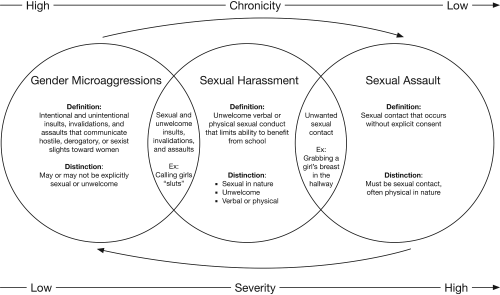
Expanded conceptualization of youth sexual violence.
Directions for Future Social Work Theory and Research Development
The proposed model, while in need of empirical testing, encourages a holistic vision of youth sexual violence and can be used to articulate an agenda for future social work research. Substantial qualitative work with adolescents is necessary to refine the core constructs of gender microaggressions, sexual harassment, and sexual assault. This research is a vital first step to the design of new measures that can assess the unique impact of each core construct on youth mental and behavioral health. Youth targeted gender microaggression research is also critical to understanding the role that gender microaggressions play in creating environments conducive to high severity and legally actionable forms of youth sexual violence. It is essential that scholars situate identity at the center of applying the proposed model to social work research to better understand the impact of multiple marginalized identities on individual and group experiences of youth sexual violence.
In addition to studies specific to youth’s experience of gender microaggressions, the construct could be integrated into current youth sexual violence research. Incorporation of questions or scales related to gender microaggressions in regularly implemented surveys like the Youth Risk Behavior Survey would dramatically increase the amount of data available on gender microaggressions. Furthermore, this integration would allow for the examination of gender microaggressions in the context of other forms of youth sexual violence. Increasing the available data on gender microaggressions as a form of youth sexual violence has the potential to answer questions about the relationship between microaggressions and “higher severity” offenses (e.g., do environments with more gender microaggressions also have higher rates of sexual assault?) and to transform how the field approaches prevention (e.g., do schools that target gender microaggressions see a decline in sexual assault?).
Youth Sexual Violence and Social Work Practice
Social workers are often at the front lines in the fight against chronic, “low-severity” and infrequent, “high-severity” forms of sexual violence at both an individual and societal level. Ross-Sheriff (2012) points out, however, that social workers not only work to help clients overcome and cope with gender microaggressions, but they also have to actively work to challenge and confront the microaggressive culture around them. As illustrated in the model above, gender microaggressions are chronic experiences that often become a part of the environment and may come to coalesce as norms in girls’ lives. In order to effectively combat gender microaggressions as a part of youth sexual violence, social workers need to bring a feminist framework into macro-level and micro-level practice. “Neutral” helping frameworks (like person-in-environment) that do not explicitly center practice on marginalized identities and its impact on space, place, time, and coping inadequately capture girls’ challenges or their strengths (Kemp, 2001). As gender microaggressions may go unnoticed by both the perpetrator and the target, it is critical that social workers emphasize girls’ everyday, and possibly unnoticed, experiences to help them identify their sociopolitical context and its impact on their processing and interpretation of sexual violence in their lives. It is with this deeper and more nuanced understanding of girls in context that social workers have the potential to enact profound and lasting change.
Gender microaggressions play an important role in creating and sustaining cultures permissive of youth sexual violence. Successful efforts to reduce higher severity forms of youth sexual violence require addressing chronic, “low-severity” behaviors, policies, and environmental norms that harm girls and place them at continued risk (APA, 2007). In this way, primary (e.g., teacher training) and tertiary (e.g., restorative justice approach) prevention strategies can promote environments that feel safe and supportive to the whole community.
Social workers and educators need tools, training, and resources to confront youth sexual violence in their schools and communities. Charmaraman, Jones, Stein, and Espelage (2013) found that educators remained quiet about sexualized behaviors observed among youth and were often confused about their role in addressing them. Sue (2010) outlines the predominate fears that keep educators from broaching challenging conversations about gender in the classroom as difficulty recognizing the behavior as a problem, challenges dealing with classroom emotions, fear of losing control, and feelings of incompetence. Educators, social workers, and all those who interact with youth need to be trained to overcome these fears as core tenants of their professional education and ongoing development. This need calls on education and social work programs to examine their curricula to ensure that graduates are equipped with skills to address issues of identity and gender among the youth in their classrooms, offices, and communities. Training social workers and educators in feminist theory and pedagogy has the potential to create a guiding framework for teaching and interventions targeting gender disparities and sexual violence. This training could enable those who work with youth to confront “low-severity” offenses and end cycles of youth sexual violence in schools and communities.
Classroom education and support may be impactful in preventing gender microaggressions; however, social workers have the capacity to implement the strategies needed to confront low-severity youth sexual violence (i.e., gender microaggressions) after it has been perpetrated. A restorative justice model allows communities to move beyond an individualized conception of offenses and punishments to think about community needs and healing (Koss, Wilgus, & Williamsen, 2014). While a traditional disciplinary approach focuses on establishing guilt, restorative justice emphasizes relationships, needs, and responsibilities. In the case of “low-severity” youth sexual violence offenses, restorative justice may be able to promote a vision of their systemic nature, bringing the full continuum of youth sexually violent behaviors into focus. Change of this nature is needed to deconstruct the systems of power and oppression that hinders the healthy sex and gender development of all adolescents.
Footnotes
Authors’ Note
Portions of this article were presented at the 19th Annual Society for Social Work Research held in New Orleans, LA, on January 16, 2015.
Declaration of Conflicting Interests
The author(s) declared no potential conflicts of interest with respect to the research, authorship, and/or publication of this article.
Funding
The author(s) disclosed receipt of the following financial support for the research, authorship, and/or publication of this article: This work was supported by a doctoral chair fellowship from the University of California, Berkeley.