




Abstract
Addressing sexual harassment in educational environments is integral for Title IX compliance; however, there are few estimates of prevalence of the phenomenon in social work’s signature pedagogy, field education. A survey of 515 bachelor of social work and master of social work students revealed that 55% of participants had experienced at least one incident of sexual harassment on the Sexual Experiences Questionnaire. Those participants who were younger, Latina/Hispanic, or in a committed relationship were more likely to report harassment. The most common perpetrators were other staff at the field placement and clients. Implications for social work education and practice are addressed.
Social work students and practitioners experience a broad range of risks when they enter field or practice, including sexual harassment. Sexual harassment can include threats or demands for sexual interaction in order to maintain or increase a position or status, but sexual harassment also encompasses a wide range of unwanted attention that contributes to a hostile work environment. It is defined by the Equal Employment Opportunity Commission as Unwelcome sexual advances, requests for sexual favors, and other verbal or physical conduct of a sexual nature constitute sexual harassment when this conduct explicitly or implicitly affects an individual’s employment, unreasonably interferes with an individual’s work performance, or creates an intimidating, hostile, or offensive work environment. (2015, Facts, para. 2)
The social work field has documented problems with worker safety, including incidents of sexual harassment affecting up to 15% of workers in some fields of practice (Jayaratne, Croxton, & Mattison, 2004). Despite the occupational safety risks of social work, there are no recent estimates on the prevalence of sexual harassment among social work students in field placements. The current study explores the extent and nature of sexual harassment experienced by students during their required social work field placement.
Literature Review
Sexual Harassment Among College Students
Estimates of sexual harassment emphasize high prevalence rates. The American Association of University (AAU) Women conducted a sexual harassment prevalence survey of a random, nationally representative sample of over 2,000 college undergraduates (Hill & Silva, 2006). A majority (62%) of students surveyed had been sexual harassed and 25% had experienced unwanted sexual touching. Hill and Silva (2006) report that student-to-student harassment is the most common, but 18% of students report that sexual harassment from faculty or staff occurs occasionally. More recently, the AAU conducted a climate survey with students from 27 universities and found that 47.7% of students had experienced sexual harassment since they had enrolled in the university (Cantor et al., 2015). Among graduate students who reported sexual harassment, 17.7% said the perpetrator was a coworker, boss, or supervisor. While this number was lower among undergraduates (5%), the findings do suggest that sexual harassment experiences of college students are not limited to peer-to-peer incidents.
The burden of sexual harassment is not equally distributed among college students. Female students and those who are transgender, gender queer, or gender nonconforming reported higher prevalence of sexual harassment on the AAU survey (Cantor et al., 2015). Hill and Silva (2006) reported that lesbian, gay, bisexual, and transgender (LGBT) students are more likely to be harassed than their heterosexual peers. Yoon, Funk, and Kropf (2010) found in their survey of 410 African American and white college females that African American students were more frequently harassed and experienced more sexual coercion.
Federal legislation, such as Title IX of the 1972 Education Amendments, specifies that educational institutions must take steps to protect students from hostile environments that hinder equal access to educational opportunities on the basis of gender (Cantalupo, 2014; White House Task Force to Protect Students from Sexual Assault [WHTFPSSA], 2014). The Office of Civil Rights, which is responsible for oversight of Title IX, has clearly identified sexual harassment as a form of sex discrimination that creates a hostile environment (Block, 2012; WHTFPSSA, 2014). Under Title IX, campuses have an obligation to engage in efforts to prevent sex discrimination, including sexual harassment, and to address instances of discrimination and remedy hostile environments.
Field placements and internships are core components of many university educational programs, perhaps especially so in professional degree programs like Social Work. Under Title IX, all educational programs receiving federal funding have an obligation to both prevent and respond appropriately to sexual harassment in campus sponsored and affiliated activities, particularly when that harassment might interfere with students’ access to educational opportunities. Required field placements in other fields of study have shown the potential for student exposure to sexual violence and harassment. A recent survey of former students in science professions such as anthropology and zoology (Clancy, Nelson, Rutherford, & Hinde, 2014) revealed that 64% of participants had experienced sexual harassment and 20% had experienced sexual assault during their field experiences. Understanding the rate of sexual harassment in social work field placements is, therefore, crucial in helping the field understand the need for both prevention and response protocols.
Safety in the Social Work Field
Social workers experience many forms of violence in the workplace, including threats of violence, physical assaults, verbal abuse, and sexual harassment (Respass & Payne, 2008). An analysis of 8 years of labor statistics found that social service workers were in one of the most high risk groups for workplace violence (Respass & Payne, 2008). While workplace violence had declined for all professions, the smallest decline was in social services (Respass & Payne, 2008). Criss (2010) conducted a random sample survey of 595 master of social work (MSW) and bachelor of social work (BSW) students to assess for experiences of workplace violence from clients. Over 41% had experienced client violence, although only 3.5% had experienced physical violence. Forty-seven percent reported fearing verbal abuse from their clients, and those who had experienced client violence worried about it happening again. Newhill’s (1996) seminal study of workplace violence experienced by social workers discovered that 57% of social workers in a random sample of 1,129 National Association of Social Work (NASW) members had experienced violence or the threat of violence. Seventy-eight percent of respondents felt that client violence was a problem. The most high risk settings for workplace violence were criminal justice, child protection, and drug- and alcohol-focused work. Male social workers were more likely to experience client violence, in part because they were more likely to work in high risk settings (Newhill, 1996). A study of 218 social service workers in the Netherlands found incidents of violence in youth detention and other agencies to be reported by about 81% of workers, with 15% reporting sexual harassment (Alink, Euser, Bakermans-Kranenburg, & Ijzendoorn, 2014).
If social workers across a range of practice areas are at high risk for experiencing client violence, as this research suggests, students completing field education in these settings face many of these same risks. Reeser and Wertkin (2001) surveyed 258 field directors at schools of social work and found 42% had at least one student report a threat of assault in the previous 2 years and 13% had a student report a physical assault. A survey of Canadian social work students found that most participants experienced a traumatic event during their field placement leading to physical and emotional symptoms (Didham, Dromgole, Csiernil, Karley, & Hurley, 2011). Mama (2001) found in a small sample of field instructors and students that 54% of students and 88% of field supervisors had experienced some kind of violence in the past year, most often from clients and often verbal threats. Some participants experienced unwanted sexual attention. These studies suggest that social work students are likely to encounter a range of experiences, in which their safety may be threatened, and that clients are often the source of the safety risks. Sexual harassment in field, therefore, occurs in this larger context of possible safety risks.
Previous Research About Sexual Harassment in Social Work Field Placements
Research about sexual harassment and assault experienced by social work students in the course of fulfilling the required field internship component of their social work degree program is limited. Fogel (2001) conducted a survey of a random sample of 355 BSW practitioners who were members of the NASW. Only 12 respondents reported sexual harassment in their BSW social work field placement (Fogel, 2001). The low prevalence rate in this study may be in part because people were asked if they had experienced “sexual harassment” rather than asked if they had experienced various behaviors which meet criteria for sexual harassment. Other studies using behavioral measurement found much higher rates of sexual harassment. Singer (1989) found that 54% of social work programs had received reports of sexual harassment in the previous 5 years, and in most cases, a formal grievance was not filed. A study of 226 BSW and MSW students conducted by Risley-Curtiss and Hudson (1998) found 29% of BSW students and 28% of MSW students had experienced sexual harassment in their field placement. In a small study of 58 Canadian social work students, 12% had been sexually harassed by a client and 8% by their supervisor at their field placements (Didham et al., 2011).
This previous research suggests that sexual harassment is occurring in student field placements, however, research about the prevalence and characteristics of students’ experiences is outdated or limited by small samples. Federal policies, such as Title IX, highlight the necessity of greater attention to prevention, awareness, and appropriate response to incidents of sexual harassment that occur in student educational experiences.
Given the current focus on assessing campus safety, preventing sexual assault, and improving campus handling of student complaints (Cantalupo, 2014; WHTFPSSA, 2014), it is essential that social work programs understand the prevalence of sexual harassment in social work field placements. This study explores the rate of sexual harassment experienced in field placements among BSW and MSW students, the context and nature of these experiences, and the effect of sexual harassment on students.
Method
Research Questions
The current study explores three research questions.
Participant Recruitment
Participants were recruited from MSW and BSW programs accredited by the Council on Social Work Education (CSWE). Eligible participants were students above the age of 18 who were enrolled in a bachelors- or graduate-level social work program and had completed at least 200 hr of a field placement. CSWE (2008) mandates that BSW students complete at least 400 hr in field, therefore, 200 hr was considered a baseline for partial exposure to field.
Recruitment began at the school level. The researchers reached out to their professional networks of colleagues, as well as two social work education listservs, to find social work programs willing to help recruit students. Programs were asked to forward a recruitment e-mail with study purposes and a link to the survey to their current students and recent alumni. The first screen on the survey was a consent form detailing the personal nature of the survey, sample questions, expected benefits and potential consequences, and further resources. No incentive was offered for survey participation. The study was reviewed by the institutional review board at Texas State University.
Survey Participant Demographics
Forty-five schools in 24 states indicated interest in sending the recruitment e-mail to students, and 40 agreed to send it out to at least some of their students. The number of students that the survey was sent to ranges from 2 to over 800. Ten schools agreed to send a second reminder e-mail about the survey. It is difficult to estimate a response rate because of uncertainty about how many students the survey was sent to at the 40 schools.
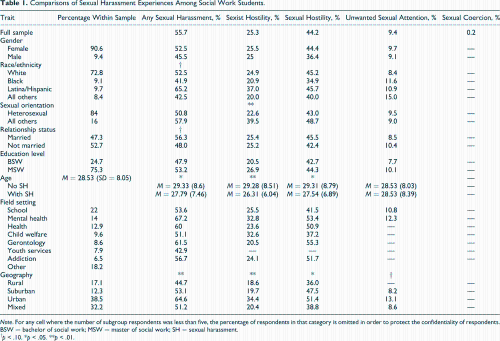
This recruitment process resulted in a sample of 515 social work students. The sample was largely female (90.6%) with a mean age of 28.53 (SD = 8.05; see Table 1). White students made up 72.8% of the study sample, with 9.1% of students identifying as black and 9.7% identifying as Latina or Hispanic. Approximately 84% of the sample identified as heterosexual and 47.3% were married or in a long-term committed relationship like a domestic partnership. Master-level students accounted for 75.3% of the sample, with the remaining 34.7% of respondents enrolled in bachelor-level programs. About 38% of students reported being in field placements in urban areas, 17% in rural areas, 12% in suburban areas, and the remaining 32% in mixed areas. The most common field placement settings included schools (22%), mental health (14%), health (12.9%), and child welfare (9.6%).
Comparisons of Sexual Harassment Experiences Among Social Work Students.
Note. For any cell where the number of subgroup respondents was less than five, the percentage of respondents in that category is omitted in order to protect the confidentiality of respondents. BSW = bachelor of social work; MSW = master of social work; SH = sexual harassment.
† p < .10. *p < .05. **p < .01.
Measurement
Demographic questions, including age, gender, race, ethnicity, and relationship status, were asked. The survey assessed for experiences of sexual harassment using the Sexual Experiences Questionnaire (SEQ; Fitzgerald, Gelfand, & Drasgow, 1995), a tool that has been validated and used in many previous research studies. The SEQ–Department of Defense version of the scale (Fitzgerald, Magley, Drasgow, & Waldo, 1999) was adapted with minor adjustments to the language to more closely fit social work field settings. The 23-item scale measured the frequency of four constructs related to sexual harassment on a 5-point scale from never to very often: sexual coercion, unwanted sexual attention, and gender harassment which is further divided into two subtypes, sexist hostility and sexual hostility. Sexual coercion included behaviors that attempt to coerce sexual behavior through threats of punishment or offers of rewards. An example item from the sexual coercion subscale asks whether anyone you encountered at your field placement “made you afraid you would be treated poorly if you didn’t cooperate sexually.” The unwanted sexual attention subscale includes behaviors of a sexual nature that were not welcome, including, for example, whether anyone “touched you in a way that made you feel uncomfortable.” The sexist hostility subscale items measured sexist treatment that might create a hostile environment based on gender, including an item asking whether anyone “put you down or was condescending to you because of your sex.” Sexual hostility measured behaviors of a sexual nature that create a hostile environment, such as “made offensive remarks about your appearance, body, or sexual activities.”
Additional questions modeled on the campus climate survey provided by the White House Task Force to Protect Students from Sexual Assault (2014) were used to ask for additional information about any reported sexual harassment experiences, including information about the relationship to the perpetrator(s) and the gender of the perpetrator(s). To assess the impact of sexual harassment, we asked whether students felt frightened by the incident (measured on a 4-point scale from extremely frightened to not at all frightened), whether the experience made them feel uncomfortable (4-point scale, extremely uncomfortable to not at all uncomfortable), and whether the incident interfered with their learning in field (4-point scale from did not interfere to interfered significantly). Respondents were also given an opportunity to add additional comments with an open-ended question at the conclusion of the survey that asked “Is there anything else you would like us to know about sexual harassment in social work field placements?”
Analysis
To analyze the data, we calculated descriptive statistics and conducted tests of association using SPSS, Version 19 (IBM, 2010), using listwise deletion to account for any missing data on variables used in each test. To answer the first research question about the prevalence of sexual harassment, we combined data across all 26 items, such that any respondent who indicated experiencing one or more of the items at least once was counted. We also calculated the prevalence of each of the four subscales using the same method as the full measure, the number of items reported, the frequency of experiences reported, and characteristics of those experiences. We then compared prevalence across various subgroups in the sample using χ2 and t-tests to assess whether any subgroups or other factors were associated with higher rates of sexual harassment. Open-ended responses were reviewed and thematically categorized to add nuance to quantitative findings.
Findings
Prevalence of Sexual Harassment
The overall prevalence of sexual harassment in field placements within our sample was 55.7%, meaning that over half of the respondents reported at least one experience of a sexual harassment behavior as measured by the SEQ. The most commonly reported items were being repeatedly told offensive sexual stories or jokes (27.9%), being treated differently due to sex (19.6%), being stared at in a way that made you feel uncomfortable (16.4%), being whistled at or called at in a sexual way (13.6%), and hearing someone make crude and offensive sexual remarks (13.6%). Six of the items in the scale were not reported by anyone in the sample, including attempted or completed sexual assault, promising better treatment in exchange for sex, treating poorly or threatening poor treatment for refusing sex, or threatening retaliation. Using the four subscales outlined in the SEQ, 25.3% of the sample reported items were consistent with Gender Harassment-Sexist Hostility, 44.2% endorsed items on the Gender Harassment-Sexual Hostility subscale, 9.4% reported Unwanted Sexual Attention, and only 0.2% reported Sexual Coercion.
Incidents and Perpetration
Further analyses were completed to better understand the frequency and pervasiveness of sexual harassment experiences. Of those who reported sexual harassment, 63.4% endorsed more than 1 item on the SEQ. The mean number of SEQ items endorsed was 2.57 (SD = 1.98), and the maximum number of items endorsed was 14. While many of the items endorsed by respondents represented incidents that happened infrequently (i.e., once or twice), 48% reported at least 1 item that happened sometimes, 10.1% reported at least 1 item that happened often, and 7% reported at least 1 item on the scale that happened very often.
When asked how frightened they were in response to the experience of sexual harassment, the mean was 3.35 (SD = 1.16), indicating low levels of fear. Respondents on average indicated moderate levels of discomfort as a result of the sexual harassment experience, with a mean of 2.31 (SD = 1.00). Respondents indicated that sexual harassment experiences, on average, interfered slightly with their learning experience in the field, M = 1.37 (SD = 0.76).
Participants who reported sexual harassment experiences were asked about the perpetrators of the harassment and could select multiple responses. Most of the perpetrators of the sexual harassment behaviors reported were male (79.1%), while 35.2% of incidents were perpetrated by females. Among those who reported sexual harassment, the most common perpetrators were other staff members at the field placement (41.8%), clients assigned to the student (40.8%), and clients not directly assigned to the student (32.8%). The next most common perpetrator was the student’s field supervisor (12.4%).To answer the third research question, we examined and compared rates of sexual harassment across various subgroups of the sample (see Table 1). Because the sample included less than five students who reported an item on the Sexual Coercion subscale, we did not include additional information about subgroup membership for Sexual Coercion subscale items in order to protect the confidentiality of those students. There were no significant differences in rates of sexual harassment on the full measure or any of the four subscales when comparing reports by male and female students. The sample did not include sufficient number of students identifying as transgender or gender queer to allow for comparisons. Whether students were enrolled in a BSW or MSW program did not make a difference in the rates of exposure to sexual harassment in the field. There were also no significant differences in the type of field placement.
On the full sexual harassment measure, there was a marginally significant difference between racial and ethnic groups, χ2(3, n = 474) = 6.46, p = .09. Latina/Hispanic students reported the highest prevalence of sexual harassment (65.2%) compared to white students (52.5%), black students (41.9%), and all other racial groups (42.5% include students who identified as Asian, Hawaiian or other Pacific Islander, American Indian or Alaska Native, and multiracial individuals). There were no significant race and ethnicity differences on any of the four subscales.
On the full SEQ measure, there was no significant difference between students who identified as heterosexual and those who identified as bisexual, lesbian, gay, or questioning (LGBQ). However, LGBQ students did report significantly higher prevalence of items on the Sexist Hostility subscale (39.5%) than heterosexual students (22.6%), χ2(1, n = 474) = 9.60, p = .002.
Students in long-term, committed relationships like marriage or domestic partnerships were marginally more likely to report sexual harassment experiences in field (56.3%) than were nonmarried students (48%), χ2(1, n = 474) = 3.22, p = .07. This marginally significant relationship did not carry through to any of the four subscales. t-Tests were conducted to assess whether mean ages (measured continuously) differed between students who reported sexual harassment versus those who did not. The full sexual harassment measure did show significant differences, with those who were reporting higher prevalence of sexual harassment having a younger mean age (M = 27.79, SD = 7.46) than those who did not report sexual harassment (M = 29.33, SD = 8.59), t(467) = 2.07, p = .039. The same pattern of those who reported sexual harassment having a younger mean age also emerged as significant on two of the subscales: Sexist Hostility, t(467) = 3.50, p = .001, and Sexual Hostility, t(467) = 2.38, p = .018.
Students placed in urban settings consistently reported the highest prevalence of sexual harassment compared to suburban, rural, or mixed settings. This was consistent across the full measure, χ2(3, N = 513) = 12.11, p = .007; the Sexist Hostility subscale, χ2(3, n = 485) = 13.14, p = .004; the Sexual Hostility subscale, χ2(3, 484) = 8.22, p = .042; and the Unwanted Sexual Attention subscale, χ2(3, n = 479) = 6.46, p = .091.
Participant Comments
Participants were asked at the end of the survey to share any additional thoughts about experiences in their field placements. These comments covered a range of issues, including working expectations of client behavior to sharing sexual harassment experiences. Many participants shared details about their experience of sexual harassment in their field placement. Comments from several participants revealed extent and the nature of sexual harassment incidents.
To be clear, the incidents consisted of him continually touching me. He didn’t touch my private parts usually. There was 1 time where he touched my breast “accidentally.” I would move away from him when he touched me, but that did not stop his behavior. The touching was in the guise of friendly behavior.
There have been instances both at my field placement and in the classroom that people have said derogatory things regarding sexual orientation. It made me highly uncomfortable, I felt somewhat frightened, and feel that I am limited in how well I can perform as a student and intern at times.
My internship supervisor would continuously touch me in a manner that made me uncomfortable. I discouraged it but nothing changed, and it was dismissed as being friendly by others.
Several participants noted that they worked with a group of clients who had mental and physical health problems that contributed to erratic and sometimes inappropriate behavior. In addition, students reported that they expected some client groups to have less respectful behaviors.
In my case, I work with domestic violence offenders who are court ordered to my field placement. Thus, many of the behaviors listed are very relevant with the men I work with but due to their status, it is expected.
I feel it’s different in my field placement, as I am working on an inpatient psychiatric unit. Many times, patients who are very ill will act inappropriately, although it clears up once they have appropriate treatment. The incidents still make me uncomfortable, but very rarely do I feel frightened or threatened.
Several other participants made comments related to harassment and discrimination in field more broadly. In particular, race, racism, and ethnic discrimination were concerns or had been experienced by some participants. Hostility, workplace bullying, and harassment that was not of a sexual nature from supervisors and other staff at practicum sites were reported by a few participants as well as concerns with safety and distortion of boundaries in the social work internship role.
Discussion
The findings in this study suggest that social work students are experiencing sexual harassment in their field education experiences and that those experiences are causing low to moderate levels of distress and interference with learning. Over 55% of the sample in this study had experienced at least one incident of sexual harassment and 63% of that group had experienced more than one form of harassment. Perpetrators were most often clients in the work setting or a coworker of the survey participant.
Survey results and the participant comments highlight the intersectional nature of sexual harassment with other marginalized identities. This is consistent with intersectional feminist theorization about how violence and oppression is experienced within the context of intersecting identities (Crenshaw, 1991; Mattsson, 2014). Hill and Silva (2006) found that LGBT participants reported higher rates of sexual harassment, and our findings similarly indicate that LGBQ participants experience significantly more sexist hostility types of sexual harassment. In addition, our marginally significant finding that Latina/Hispanic women reported higher levels of sexual harassment similarly suggests that some students may be at heightened risk for experiencing sexual harassment. Given that respondents reported that sexual harassment resulted in some degree of fear, discomfort, and interference with learning, it is troubling that students with multiple marginalized identities may be most at risk of having sexual harassment negatively impact their well-being and learning. Social work’s commitment to serving marginalized populations, ending oppression, and promoting social justice should be mirrored in our commitment to educating social work students with diverse identities, particularly those who have traditionally been excluded from professional fields. Participant comments, however, suggest that students are experiencing field climates that not only might include sexual harassment but may be hostile climates in terms of race and sexual orientation. Our study did not systematically assess for larger climate issues in field, but these comments suggest a need for researchers and field educators to think more broadly about how to ensure that all students, particularly those in marginalized groups, have access to high quality field education experiences.
Because our study did not use a representative sampling strategy, it is important to understand how our sample may differ from social work students as a whole. Compared to social work student demographics, this study had a strongly female sample (90%), which is somewhat higher than a 2012 survey from CSWE that found that 87% of full-time BSW students and 85% of MSW students are female. Just over 53% of MSW students are white, compared to 54% of BSW students (CSWE, 2012), which is noticeably lower than our sample that was about 73% white. Given that white students reported lower rates of sexual harassment than, for example, Latina/Hispanic students, this could suggest that our estimates are low. However, the nonrepresentative sampling does increase the likelihood of self-selection bias, in which those students who have experienced sexual harassment are more likely to take the survey which would result in higher estimates of the prevalence of sexual harassment. Much like the movement toward assessing campus climate regarding sexual assault (Cantalupo, 2014; Cantor et al., 2015), social work field programs should consider assessing the climate in field placements and include a broad range of questions to make sure student field environments are safe places to learn. Social work programs might consider partnering with their university sponsored climate survey to ensure that questions disseminated through surveys to the student body assess for experiences in educational internships and field placements.
Social work field programs need to focus more attention to offering resources for a broad range of experiences students may encounter in their field placements, including sexual harassment. In this study, 41% of sexual harassment perpetration came from another worker at the agency and 40% from clients. Perhaps most concerning is that 12% of the sexual harassment behaviors were perpetrated by field supervisors who have significant power over students’ learning and opportunities. Students and field instructors have previously identified trust and a mutual relationship built on equality, respect, and the sharing of power as core components of an effective, empowering learning experience in field (Lazarri, 1991). Any supervision relationship that includes sexual harassment precludes this kind of empowering learning environment and potentially impacts the students’ ability to develop a sense of competence and expand knowledge and skills.
Further research should examine if student responses to sexual harassment, for example, their resulting level of fear and discomfort, vary depending on the relationship to the perpetrator. Participant comments suggested that their reactions to sexual harassment may differ based on their relationship to the perpetrator and the broader context of the incident. As the comments from participants indicated, sexual harassment from clients was difficult to sort out from expected client behavior, indicating the need for more training in social work field education. The level of discomfort experienced by participants was 2.31 out of 4 on an average, indicating mild to moderate discomfort. This might be explained in part by this expectation of encountering such behavior from clients. There are, however, students who are experiencing more severe levels of discomfort and fear and who report that their learning was negatively impacted by the sexual harassment. This research indicates that sexual harassment has the ability to interrupt the educational experience and cause distress. Although the extent of the distress and impact may vary, social work students may need more support and resources to process and address the events that occur in the field.
Labeling sexual harassment as “typical” client or coworker behavior could contribute to a hostile environment by suggesting that students should learn to tolerate sexual harassment, which may prevent a distressed student from feeling she can access support. Typical or not, social work field placement and education programs must do more to support students in their field placements, including helping students develop the clinical skills to safely manage a range of client behaviors while still maintaining rapport and adhering to ethical standards. Social work programs should also help students build their knowledge and awareness about sexual harassment to increase their ability to identify potentially hostile environments and when to seek assistance from the field education staff or others at the university.
Social work is a gendered occupation. Social workers and students are largely female (CSWE, 2012), and the work done by social workers is often gendered and constructed as women’s work (Zufferey, 2009). The focus in social work on emotions, relationship, and caring, for example, are often associated with women. Zufferey (2009) suggests that the gendered nature of the work and workforce shape social work in ways that are both visible and invisible. The influence of gender can shape the way the work is structured, the nature of the relationship between worker and client, and the meaning that social workers make of their work. By making visible the high rates of sexual harassment reported by students in field, this study highlights the way that larger systems of oppression may shape the experience of social work students. Furthermore, an intersectional feminist approach suggests that sexually harassing behaviors performed by primarily male clients in the presence of mostly female workers should not be simply dismissed as expected client behavior that workers must tolerate. Rather, students should be encouraged to critically examine how such incidents are complex enactments of social power, oppression, and privilege, in which both client and worker are situated in intersecting identities with differing power and privilege (Mattsson, 2014).
Limitations
Although the sample of this study is similar in some ways to the national demographic makeup of social work students, caution should be exercised when trying to generalize the findings more broadly. As stated earlier, it is possible people chose to participate in this particular study because of experiences or concerns over sexual harassment. The researchers were not able to estimate an exact response rate, but given that the survey invitation and link was distributed to students at 40 schools, the response rate is likely low. We were also unable to determine significant differences in sexual harassment experiences among various social work field settings, such as child welfare, mental health, and criminal justice, which have been indicated in previous research (Alink et al., 2014; Newhill, 1996), possibly due to how we asked the question about placement setting.
Implications and Recommendations
Schools of social work, as part of university systems, must actively engage in efforts to uphold Title IX legislation, which protects against forms of sex discrimination, including hostile environments, which limit student access to educational opportunities (Block, 2012). As colleges and universities across the country are embarking on campus reforms related to sexual harassment and violence, social work programs, as well as other fields that use educational internship training models, must take up the issues of student safety in field. Social work educational programs should establish local benchmarks of prevalence and incidence and monitor the rates of sexual harassment experienced by their students. Understanding the scope and nature of sexual harassment in field education will help programs develop effective prevention and training programs and develop appropriate programmatic responses to students who report sexual harassment as part of Title IX protections. Legislation requires educational programs to promptly investigate any complaints of hostile environments, such as those caused by sexual harassment, and to offer both immediate and long-term remedies. In social work field education, this may mean anything from working with the field placement site to reassign a client, ensuring that field sites have adequate sexual harassment policies and procedures, or even discontinuing partnerships with field sites that continue to place students in hostile environments because they have been unable to remedy sexual harassment.
Reeser and Wertkin (2001) assert that schools have the ultimate responsibility for student safety in field, and that comprehensive safety education from the school and the field instructor are the best methods for preparation and ensuring a sensitive response to incidents. Much like preparation for social work practice like home visits, students need practical tips for addressing and reporting incidents (Allen & Tracy, 2008). Education should focus on helping students identify sexual harassment and understand the resources available to help remedy a hostile environment such as that caused by sexual harassment.
Conclusion
This study highlights a problem in social work field placements with sexual harassment and also brings forward concerns about other forms of discrimination experienced by students in their practicum settings. The sexual harassment experiences highlighted in this study are especially salient, as universities strive to increase compliance with Title IX as sexual harassment in the credit-bearing field placement is potentially creating hostile educational environments. The social work profession needs to address incidents of sexual harassment and gendered violence that occurs within and among the workforce as part of ongoing discussions about worker safety. Social work programs should take the lead among the professions in assessing the prevalence and characteristics of sexual harassment, developing training and prevention programming, and ensuring that students who experience sexual harassment have access to needed support and accommodation. Looking inward to the experiences of new student social workers in field settings is critical to ensuring safety and workplace satisfaction in the profession in the future.
Footnotes
Declaration of Conflicting Interests
The author(s) declared no potential conflicts of interest with respect to the research, authorship, and/or publication of this article.
Funding
The author(s) received no financial support for the research, authorship, and/or publication of this article.