




Abstract
Many female service members deployed to Iraq and Afghanistan report experiencing some level of combat. However, female veterans may perceive combat and threat differently than their male counterparts. A feminist analysis of semistructured interviews was used to examine female veterans’ (N = 12) definitions of and experiences with combat. Participants described combat in three themes—experiencing combat-related events, witnessing combat-related events, and feeling threatened. Veterans also described a flexible definition of “combat veteran,” comparing their experiences to others’ to determine their status. This study has implications for practice, research, and policy on veterans, including broadening the assessment of combat.
Introduction
Women’s roles in the U.S. military are growing. Women make up an increasing percentage of military service members and veterans; Twenty percent of new recruits are female (Meehan, 2006), and the number of female veterans will increase by more than 17% in the next 20 years (Government Accountability Office Report, 2009). Women’s combat roles have also expanded significantly in the conflicts in Iraq and Afghanistan. Women are reporting more exposure to traumatic events than in any past war (Maguen, Luxton, Skopp, & Madden, 2012). While women have the opportunity to participate in 92% of military occupational specialties (MOS or military jobs; Department of Defense, 2009), a recent repeal of the ban on women in combat arms positions may expand their participation (Department of Defense, 2013). This increase may also expose the female veterans to combat-related trauma, putting them at risk for additional post-deployment mental health concerns.
As women enter these direct combat roles, it will be critical to understand their perceptions and experiences of combat, both for a better understanding for clinical work with female veterans and for research into the relationship between combat and post-deployment mental health for female veterans. It is essential in feminist research to gather women’s perspectives of combat in their own words, rather than rely on the voices of male service members and veterans to describe the combat experience (Reinharz, 1992). This study employs a feminist perspective, which seeks to conceptualize women’s experiences in their own terms, rather than the terms received from predominantly masculine perspectives.
Feminist Perspectives on Women and War
There is continued feminist debate about the role of women in war and no single feminist stance on women in war (DeCew, 1995). Feminist research encourages examining issues from a variety of standpoints and multiple viewpoints on a single issue (Reinharz, 1992). For example, there are multiple feminist ideas about women’s participation in the military and war. Radical feminist analysis has been primarily anti-war (Zeria & Salime, 2006), viewing war as inherently and disproportionately consequential for women. From this perspective, women’s active participation in the military and war is a step backward for feminism.
A different feminist view, however, advocates for gender equalities in all aspects of citizenship, including expanding opportunities for women within the U.S. military (Decew, 1995). This differing perspective is an important shift, because historically, some have viewed men’s citizenship as more “legitimate” than women’s because of their willingness to sacrifice for the good of the country through combat service, while women have been barred from this sacrifice (Sasson-Levy, Levy, & Lomsky-Feder, 2011). Inclusion of women in the military can be considered a sign of progress toward equal citizenry (Sasson-Levy et al., 2011).
Regardless of the feminist debate about whether women should participate in the military and in war, it is important for feminist researchers to examine what those experiences are. Feminist studies of women in war have, until the conflicts of Iraq and Afghanistan, largely focused on the impact of war on women in their roles in relation to men at war as mothers, wives, and nurses (DeCew, 1995; Masters, 2009), or the impact of war on women’s civilian lives (McLeod, 2012; Zeria & Salime, 2006). Harp, Loke, and Bachmann (2011), in a content analysis of 406 media reports on the U.S. war in Iraq, found that women’s voices in war were effectively silenced through omission, representing less than one tenth of the subjects cited. This reinforces the traditional masculine perspective of war and emphasizes the predominance of men’s experiences, concluding that women’s perspectives on war are as crucial as those of men.
Gender, Combat, and Trauma
Despite the previous bans on women in combat roles, many female service members during their deployment to Iraq or Afghanistan have experienced some type of combat during their deployment (Vogt et al., 2011). These authors found that gender difference in exposure to combat-related stressors such as firing a weapon or witnessing injury or death was small. A recent survey of male and female Iraq and Afghanistan veterans found that 73.4% of female veterans were exposed to any combat, while 81.7% of male veterans were exposed to any combat (Street, Gradus, Giasson, Vogt, & Resick, 2013). However, when combat exposure was defined more conservatively with higher cutoff points on the Combat Experiences Scale, 8.8% of female veterans experienced combat, while 29.1% of male veterans experienced combat exposure. This demonstrates that while men and women have similar rates of any exposure to combat, men, as expected given their roles in combat arms, experience more frequent and intense combat exposure.
There is evidence, however, that while women are experiencing combat in addition to other stressful war zone experiences, they may find combat to be the most stressful. For example, Street, Gradus, Giasson, Vogt, and Resick (2013) found women were more exposed to the aftermath of battle (15.4%) than combat (8.8%) and suggest that these experiences be included in the assessment of stressful deployment events, broadening the examination of stressful deployment events for female veterans. Wolfe, Brown, and Kelley (1993), who studied war zone exposures in the Gulf War, found gender difference in the relative stress of various war zone experiences. Women were more likely than men to report combat as their most stressful deployment experience. Vogt and colleagues (2011) examined combat exposure and threat perception in service members deployed to Iraq and Afghanistan and found that despite a slightly lower exposure to combat, female service members reported a higher level of perceived threat than their male counterparts. These studies indicate that while women are experiencing different types of stressful war zone experiences, a woman may find the combat experience more stressful than her male counterpart would.
Appraisal of Threat Theory
A key aspect of women’s experiences of combat in Iraq and Afghanistan is their subjective appraisal of the threat of combat, or how frightening the experience is for the individual. Lazarus and Folkman (1984) described a theory of cognitive threat appraisal to explain varying responses to a similar threat. In this approach, the response of the individual to the stressor is influenced by the individual assessment of the threat. Recent research into post-deployment mental health for both men and women has focused on the threat perceived by the individual, rather than the combat event itself (Franz, Wolf, MacDonald, Marx, Proctor, & Vasterling, 2013). It may be that the individual’s subjective appraisal of threat has a greater influence on post-deployment mental health than the combat event itself (van Wingen, Geuze, Vermetten, &Fernandez, 2011). Vasterling and colleagues (2010) found that perception of threat was more strongly associated than combat experiences with post-traumatic stress disorder (PTSD) symptom increases. A more recent study supported this conclusion, finding threat appraisal during deployment mediates the relationship between pre-deployment risk factors such as prior war zone deployment and preparedness, and PTSD outcomes, even after taking into account combat intensity (Franz et al., 2013). This suggests that the relationship between combat experiences and post-deployment mental health concerns may be based, at least partially, not on the number of combat events (such as explosions or firefights) but on the individual’s appraisal of the threat posed by those events. It has been reported that a service member who feels more threatened may be more likely to experience post-deployment mental health concerns (Franz et al., 2013).
This perception of threat is an important concept when examining post-deployment mental health, especially for female veterans. Women may be more at risk to negative mental health consequences of traumatic events because of a greater appraisal of the threat (Norris, Friedman, Watson, Byrne, & Kaniasty, 2002; Ptacek, Smith, & Zanas, 1992). A review of 160 samples comprising 60,000 individual disaster victims (including victims of terrorism) found across samples, female gender increased the likelihood of adverse outcomes (Norris et al., 2002). These authors suggested that this higher risk was due to women’s subjective interpretation of events rather than the objective exposure to the events. Sever, Somer, Ruvio, and Soref (2008) also found that women exposed to terrorist threats suffered higher levels of negative mood and rates of posttraumatic stress than men, even when women had a lower level of exposure to attacks. They also concluded that the perception of exposure heightened women’s risk of psychological outcomes after a terrorist attack. These studies suggest that women may have a greater sense of threat than their male counterparts.
Current Study
The literature points to the need to utilize a feminist lens to explore the experience of exposure with attention to female veteran’s perceptions. Much, though not all, of the research that examines combat trauma or the intersection of gender and combat trauma have been quantitative (Creswell & Zhang, 2009). These studies utilize scales of combat exposure, including combat types of combat experiences, types of aftermath of battle experiences, and perception of threat, (Vogt et al., 2011) or measures of exposure to specific combat events, such as mortar explosions or firefights (Hoge, Clark, & Castro, 2007). These quantitative measures have excellent utility but cannot offer an understanding of the subjective experience of the event. In fact, Wolfe et al. (1993) also found that a single dichotomous measure of exposure to combat was insufficient for calculating traumatic exposure, and more qualitative measures were necessary. They described the need for measures that were more sensitive to female veterans’ experiences of combat, including how they define combat.
Feminist research methods aim to understand the subjective, realizing the importance of context and agency and find qualitative methods, and specifically narrative analysis one of the most effective means for this purpose (Morawski, 1997). Therefore, this study aims to examine the individual qualities of female veterans’ experiences of combat in Iraq and Afghanistan by systematically exploring their experiences using qualitative methods. The authors hope to give voice to the experiences of female veterans who were deployed to Iraq or Afghanistan to gain a better understanding of how combat is defined and to explore the experience of the combat situation. This study was approved by both the institutional review board at the VA New Jersey Health Care System and Rutgers University.
Method
Participants and Procedure
A convenience sample of 12 female veterans who has served in Iraq and Afghanistan was used in this qualitative study to explore their experiences in combat. Five male veterans of Iraq and Afghanistan were also recruited for this study, but those data were excluded to focus on female veterans’ perceptions and experiences. The sample was recruited through several methods from a large northeastern Veterans Administration (VA) medical center. Letters of invitation for the study were sent to VA-registered Iraq and Afghanistan veterans between December 2011 and December 2012. These recruitment letters explained that there was a study being conducted to explore the combat experiences of Operation Enduring Freedom and Operation Iraqi Freedom (OIF) veterans, informed recipients that they would receive a follow-up phone call from the researcher to invite them into the study, and contained contact information for the researcher. The recipients of these letters were then contacted via phone, and the researcher explained the study in detail and made appointments for interviews. Informed consent was completed at the appointment, prior to engaging in the survey or interview.
Measures
Quantitative measures
A series of measures were used to assess deployment-related factors to ensure participants with a range of levels of exposure to combat were recruited. Participants completed scales from the Deployment Risk and Resiliency Inventory (DRRI; King, King, & Vogt, 2003). The DRRI is a suite of scales developed to assess deployment-related factors for military veterans, such as combat exposures, post-battle exposures, and post-deployment challenges. The Combat Experiences Scale from this inventory was used to ensure participants with a variety of combat exposures were represented. The Combat Experiences Scale included 15 dichotomous items and scores were summed to create a total score. Examples of questions included, “I went on combat patrols or missions” and “My unit engaged in battle in which it suffered casualties.” The scores ranged from 0 to 15; higher scores indicated greater exposures to combat situations, such as firefights, explosions, and mortar attacks. The Post-Battle Experiences Scale was utilized to provide additional descriptive details on the experience of battle. This scale included 15 dichotomous items, and scores again were summed to create a total. Some of these items were “I took care of injured or dying people” and “I saw the bodies of dead civilians.” The range was 0–15, wherein, again, higher scores indicated exposure to a greater number of war zone events and circumstances.
The DRRI scales were chosen because they are the only scales validated for the cohort of female veterans from Iraq and Afghanistan (Sternke, 2011), and the inventory has been validated with OIF veterans (Vogt, Proctor, King, King, & Vasterling, 2008). The Combat Experiences survey data provided additional descriptive information about the study participants, such as their exposure to specific events including mortar attacks, chemical attacks, and firefights.
Qualitative questions
A set of interview questions was developed to address both the definitions of combat and a description of the participants’ significant combat experiences. To develop the interview guide, a literature review was conducted to study the contributions of other researchers in this area. The initial draft guide contained 23 open- and closed-ended questions and was refined following review by experts in qualitative methods and the veteran population, as well as with two combat veterans of Iraq and/or Afghanistan. The final interview guide included 17 open-ended questions in five general categories: (1) definition of combat, (2) most significant combat experience, (3) direct versus indirect combat experience, (4) dealing with combat experience, and (5) gender differences in combat. Examples of these questions include “Please think for a minute about the most significant combat experience you had. Can you tell me about this experience?” and “There are many ways in which people can be exposed to combat, even if they aren’t intended to be combat participants. Even if you weren’t in a combat role, what are some of the ways you were exposed to combat while you were deployed?”
Procedures
Participants first completed scales from the DRRI, then engaged in a semistructured interview, which lasted 45–75 minutes. The interview was audio recorded and transcribed. All interviews were conducted face-to-face by the researcher at the medical center and were completed over at 12-month period.
Data Analysis
For analysis, a framework for coding was developed from the interview guide and captured several areas of the combat descriptions, including definition of combat, definition of a combat veteran, self-identification as a combat veteran, types of combat experience, adjective descriptions of the combat experiences, thoughts or feelings during combat, physical responses, actions, and behaviors during combat. A general inductive analysis was used as described by Thomas (2006), in which the data analysis is guided by evaluation objectives, which identify the domains to be investigated and then analyze those domains through multiple readings and interpretations of the text. The data in each area of focus were coded through open coding and then through axial coding to group similar codes together. Finally, selective coding collapsed these groups into broader themes. Analytic tables are constructed to display both the codes and the broader theme under which they fall. For example, a female veteran described a scene in which she picked up human body parts. This was coded as “handling human remains,” but fell under the larger theme of “witnessing.” Table 1 displays both the codes and the broader themes under which they fall.
Types of Combat Experiences of Female Veterans.
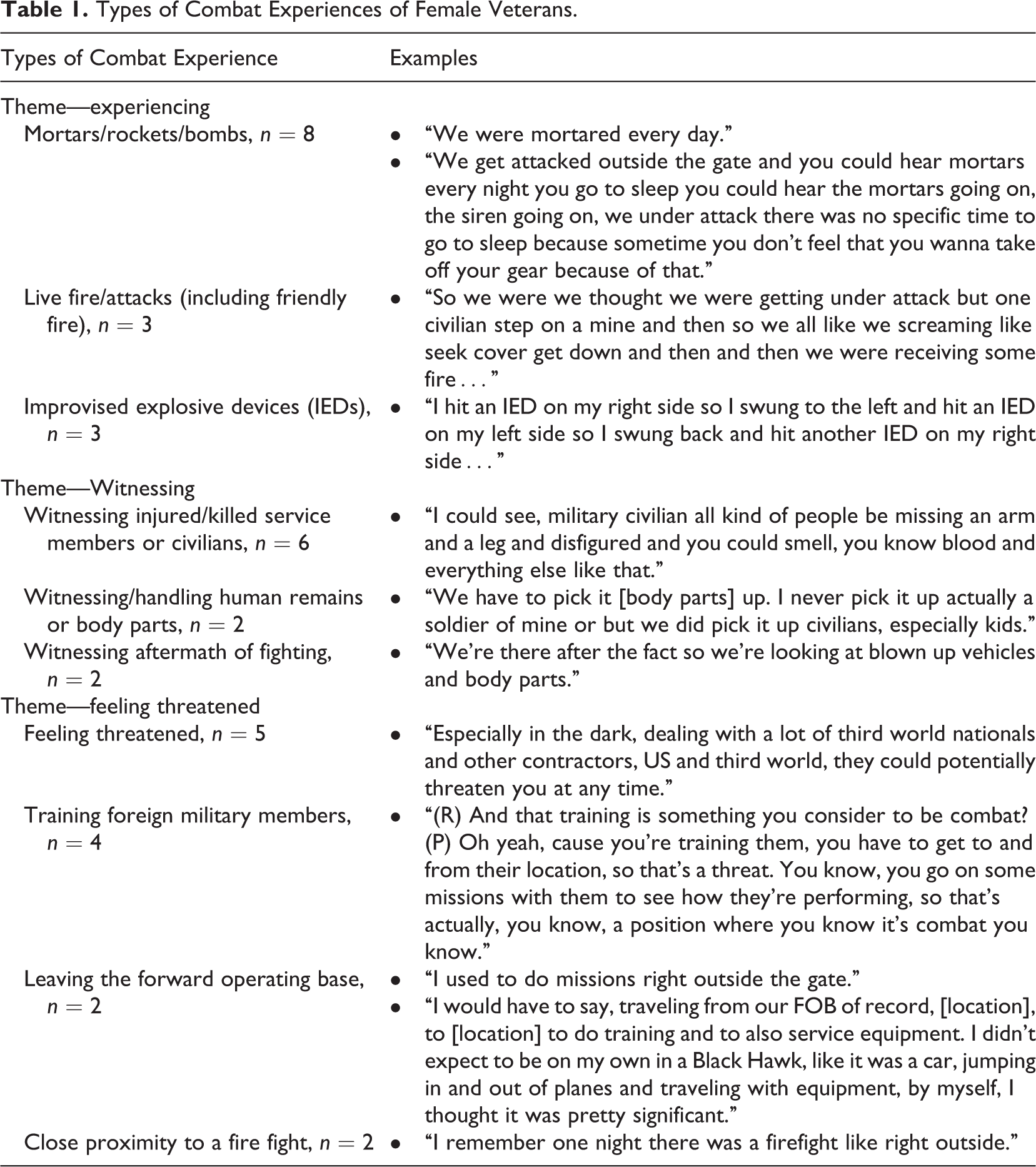
To interpret the meaning from the codes and compare across the subgroups, the researcher examined the coded meaning units to identify patterns and determine themes that reached across narratives. After all interviews were completed and analyzed, the researcher conducted member checking with two participants in order to increase confidence in the interpretation of the findings (Patton, 2002). These participants independently verified that the results drawn from the study resonated with the perspectives given in the in-depth interview.
Results
Sample Description
The convenience sample included 12 female veterans who served in active duty and reserve components as well as from the Army, Navy, and Air Force. The Marines were not represented in this sample. The veterans had a variety of roles within the military, including finance, logistics, military police, communications, and transportation roles. Participants were African American, Asian or Pacific Islander, Hispanic, and Caucasian. Because of the small sample size and a concern for participant privacy, further demographic characteristics of the sample are not reported.
Table 2 presents the counts of types of combat experiences and post-battle experiences of veterans in the sample, from the Combat Experiences and Post-Battle Experiences Scales of the DRRI. Veterans in the sample reported a range of experiences in the objective experience scales. Some were exposed to only a few combat or post-battle experiences and others were exposed to many types of combat or post-battle experience. Participants reported a range of 0–11 types of combat experiences. They also reported a range of 0–12 types of post-battle experiences. They reported more types of post-battle experiences (5.25) than combat (3.75) experiences.
Definition of Combat and Combat Veteran for Male and Female Veterans.
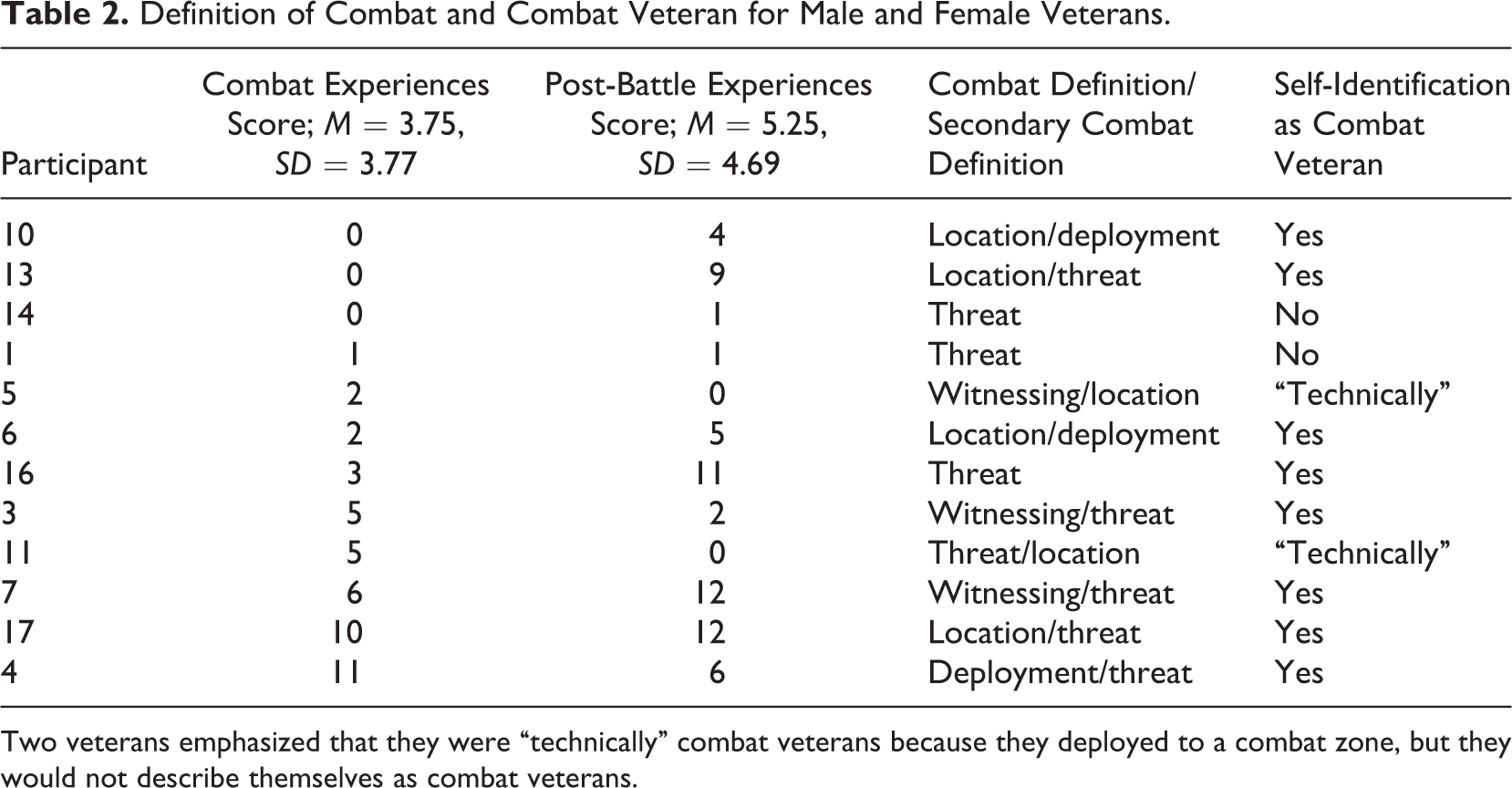
Two veterans emphasized that they were “technically” combat veterans because they deployed to a combat zone, but they would not describe themselves as combat veterans.
Definition of Combat
Female veterans described several definitions of what “combat” is and how to define a “combat veteran.” These are also included in Table 2. They primarily described “feeling threatened” as combat, regardless of circumstances. One participant described combat as “any kind of confrontation that you or your team is in danger. Any kind of hostility. Doesn’t always lead to you know fire but you can have situations where you had to employ the rules of engagement of war.” Another, when asked what combat was, replied “feeling threatened. Feeling threatened. You know, you’re not safe. You’re in a hostile environment.”
Another theme was location in a combat zone, which is consistent with the VA definition of service in a hazardous duty zone (Department of Veterans Affairs, 2011). Seven of the 12 participants included location in a combat zone or deployment in their definition of combat. This definition included an emphasis on the constant vigilance that is required in a theater of combat and echoed the theme of “feeling threatened.” For example, one veteran reported, “If you’re in a red zone, deployment I mean, if you’re just in any deployment where there’s no harm or anything just doing the daily activities, but to be aware of your surroundings at all times of being attacked, that to me is considered combat. Whether you’re attacked or not.”
Three participants included witnessing war, including fighting, people being injured or killed, or the aftermath of war, such as blown up trucks or human remains as part of their definition of combat. One stated, Like people who go outside the gate and see the fighting and see the shells and see the people and things like that like we did, that’s combat. [ … ] Blown up trucks from another convoy, um people being injured from another convoy, things like that. Things in rubble …
Quotes from three participants describe the relative nature of the definition of combat veteran for them. I mean I suppose I feel a little more justified ‘cause I went out on those missions and I was more exposed. But my second deployment I didn’t really feel like one [a combat veteran]. I was just there, I you know, I stayed on the FOB [Forward Operating Base] and yeah I mentored and all that stuff but I guess you know like I said, technically yeah I am but … Guys and women that are out there on patrols are at much higher risk, so you know. Like I don’t, technically I’m a combat veteran, but I don’t really consider myself having been in combat. I guess I really don’t [consider myself a combat veteran] because I like I wasn’t out there. You know like I really wasn’t exposed to it because … when my unit came back they told me like … a week before they came back, they got hit by where we sleep, we’re pretty close to the border of … the place where the sergeant and the commander lived like that part got hit, like you know, they were really exposed.
In contrast, several female veterans strongly endorsed a combat veteran identity, yet perceived that others did not recognize them as such. The setting of the interviews in the VA hospital made this identity more salient, as some of these women felt they were still struggling for legitimacy of their status as a combat veteran within the VA system. One female veteran had been attempting to file a disability claim for PTSD as a result of her experiences of combat and was stymied by its rejection. She said, “I’ve been in these situations. I’ve seen things, been exposed to things. I mean, I’ve seen shots fired. I mean, just because I haven’t taken a bullet myself doesn’t mean I’m not a combat veteran.” The lack of recognition of the role they played in combat caused the women to feel devalued. Another female veteran described returning from Iraq and entering the VA and being questioned about calling herself a combat veteran. She was asked what she had done, implying that she hadn’t “earned” the identity of a combat veteran, because she was female.
Describing the Combat Experience
One theme that was repeated by many veterans was that each combat experience is unique to the individual. One veteran said, “I know what it is for me and what I’m dealing with, but what is it in somebody else is not for me to say.” If the veteran served in more than one tour, each experience was different, even if it was in the same country. Features such as mission, geographic location, and level of technology available differentiated combat experiences in the perceptions of participants. One veteran, who served in two tours in Iraq, 3 years apart, described the two experiences in the following way: They were so different. So it’s hard to generalize. I think if I would have just gone by one experience or the other ‘Oh it’s like this, that, or the other.’ But I know that it can be a world apart depending on where you are in the country, depending on what year it is that you’re there. If you’re gonna be there at the beginning of the war where it’s intense or later on when you’re maybe not dealing with incoming as much but you’re dealing with psychological issues of soldiers with suicide attempts and this and that. [ … ] It could be so vastly different.
Experiencing combat included exposure to mortars, rocket propelled grenades, and improvised explosive device (IED) attacks; shooting at or being shot at by enemy combatants or being attacked by friendly fire. The constant presence of physical attack in the environment caused veterans to feel as though there was no escape or respite from potential danger, and constant vigilance and preparation to defend oneself were thus required. One female veteran described, We get attacked outside the gate and you could hear mortars every night you go to sleep you could hear the mortars going on, the siren going on, we under attack. There was no specific time to go to sleep because sometime you don’t feel that you wanna take off your gear because of that. I was particularly exposed to combat when I had to leave my place in the convoy to pull over to the side of the road. And I told the convoy you know go we’ll catch up with you ‘cause I had to use the bathroom. So I had to pull over to the side of the road and use the bathroom and I jumped back in to almost the end of the convoy. And I don’t know how it happened. I don’t know if there was maybe somebody on the side of the road that just timed it. I don’t know. And I hit an IED on my right side so I swung to the left. And hit an IED on my left side so I swung back and hit another IED on my right side. And another truck that was. I think it was either Army or Marines, but it was coming on the opposite side of the road, hit my truck with a 50 cal, and shot a 50 cal bullet straight through my engine block. So I had two broken tires, two flat tires, and a hole in my engine block and I was leaking steering fluid. And so they tell you that if you’re ever hit to try to get a mile down the road to get out of the kill zone. We didn’t have any walkie talkies, this was like, like uh, caveman era, before like all this great stuff that was in Iraq was put there like burger kings and flushing toilets and things like that. We didn’t have all that fun stuff. So, you know I got as far as I possibly could with my steering fluid leaking and they noticed. They finally noticed that I wasn’t there. So the gun truck came back around and they didn’t see anybody but they towed us, ‘cause I was running on rims. I guess that was, that was the scariest part of my journey.
Witnessing combat involved seeing or hearing over radio transmissions the death or injury of service members, combatants, or civilians; viewing the aftermath of an attack, such as body parts, human remains, or blown up vehicles. One veteran said, “I could see, military civilian all kind of people be missing an arm and a leg and disfigured and you could smell, you know blood and everything else like that.” When asked about her most significant combat experience, another participant described handling human remains. I’m in my room and all of sudden I hear this massive explosion. The windows in the palace broke, everything broke. [ … ] So as soon as you hear that and especially so close you put on your full battle rattle as they call it. And I was gonna go outside to the bunker and you know everyone is sort of gathered in the common area. We’re getting ready to go outside and to head into the bunker and we go outside. And I guess it was a VBIED, a vehicle borne IED, that had exploded right on the other side of the wall and body parts came over. And so we went outside and you know, completely did not expect that. And you see blood and and matter like. And you know, I was sort of shocked for the first second. I just went out and I almost everything went blank you know. And I just you know, I couldn’t or I wasn’t processing sound I guess or anything. I don’t remember hearing anything. I don’t remember. I just remember I stopped dead in my tracks and just looked around like I couldn’t believe. And my sergeant grabbed me from my vest and dragged me into the bunker with everyone. And I stayed there until further notice and then a team eventually came over to do pick up and clean up.
An additional finding was the theme of feeling threatened as a description of combat, particularly as the experiences described did not fall into the stereotypical descriptions of combat—firefights and mortar attacks. One veteran, for example, described her first experience with combat as feeling threatened. “It was my very first interaction of combat of any kind, you know. I’m 18 years old at the time, 18-year-old girl in this combat, you know, dangerous situation and you know that was my first experience where I felt threatened.”
Situations that may not seem threatening on the surface, such as lapses in security, were also described as ways in which female veterans were exposed to combat and felt threatened. One veteran described a situation in which a secure room was left unlocked, leaving her at risk. My second deployment, when I was a guard in a hospital in Baghdad in a prison. And we would work with Iraqis who were … We were training them for them to take over so that when we left they could handle their own. So, you know, you would hear on the news all the time about Iraqis turning on the American soldiers trying to train them. So that was always a constant worry as well. Like, here I am. I’m showing you our procedures, I’m showing you how we do things. And now you know them and now I’m scared that something happens you know exactly what I’m gonna do. You know exactly what I’ve been trained to do. Also I would watch the detainees when they were going to the hospital. They would be inside a room with glass window and one of my jobs, some of the time, was to sit and do the computer work, process them in and out of the hospital. You know, one time a soldier left the door unlocked. He didn’t lock it and it was cracked open. And I had no idea and my office is connected to that door. [ … ] A little child was sitting in the waiting room and he was just looking at me with big eyes. [ … ] I’m looking through the through the window and I feel like he’s trying to tell me something, but I don’t know. And so I got up to go out to pull them out. I’m thinking, maybe he’s in danger. Maybe something’s happening. And when I go I notice the door is cracked open and I said, Oh my gosh, if that wouldn’t have happened, I wouldn’t have known. And god knows that they were plotting in there. [ … ] After that I became very paranoid. Every time somebody would go out I’d have to check myself to make sure the door was locked. [ … ] Because I felt my life was constantly in danger.
While not traditionally conceived as a type of combat, protecting oneself against physical or sexual assault or harassment by foreign or American military members required of women a similar form of vigilance and represented an ever-present source of threat. When asked about some of her most significant combat experiences or events, one veteran described multiple exposures to military sexual trauma. “There was another incident with an American soldier in my unit, where he put his 9 mil on me but I was easily, I … he did it at the chow hall. I was doing duty there for three months, guys were desperate, so he put his 9 mil on me and from across and he’s just shaking, shaking, talking about I need to be his. But I was able to talk him down from you know, real quick.”
Discussion
Adopting a feminist approach, this study sought to understand how combat is conceptualized by female veterans. Consistent with prior literature and military protocol, women considered being directly faced by physical threat, such as being attacked by mortars or IEDs, as the most obvious type of combat exposure. Women also described two additional types of situations: being exposed indirectly to the violence of war by viewing its aftermath or clearing its physical by-products and managing the persistent threat of potential physical and sexual threat endemic of living in a combat zone. The three themes derived from female veterans’ descriptions of combat experiences—experiencing, witnessing, and feeling threatened—accord with the previous literature on female veterans’ experiences of deployment and combat, in that female veterans have been exposed to both battle and post-battle experiences, and that their subjective appraisal or perception of a threat was a key aspect of their combat experience, perhaps more important than exposure to combat itself. Nearly all veterans in this study independently described a feeling of threat as an essential component of combat. This indicates that the assessment of threat perception is a critical part of examining the combat experience and potentially the post-deployment reintegration experience. Though the current study cannot compare the level of threat that men and women perceive while deployed, it does provide support for the further exploration of this issue. This study indicates that female veterans do perceive threat as a critical component of combat, and it may be that female service members perceive threat differently than their male counterparts.
Another important finding from the study was the flexibility in the definition of combat veteran status used by some of the female veterans. Two of the female veterans defined their own combat experience in terms relative to others’ combat experiences, and more importantly, to the risk that others were exposed to in comparison to themselves. Those service members who went out on patrols were “more” combat veterans than the female veterans, whose role was a supportive one. Two additional female veterans were hesitant and defined themselves as only “technically” combat veterans. Although they met the VA definition of a combat veteran, which includes veterans who served on active duty in a theater of combat operations (Department of Veterans Affairs, 2011), they did not feel that this definition suited their idea of a combat veteran and were hesitant to claim it. This “relative” definition of combat is important to consider when examining a veterans’ combat experience, because it requires a frame of reference. In a unit that is highly exposed to combat, the veteran’s experiences may seem minor in comparison, but in a less exposed unit, those experiences may be more pronounced.
Implications for Practice
Feminist research seeks to provide a voice for those who have been marginalized (Reinharz, 1992), as historically women have been excluded from discussions of war (Harp, Loke, & Bachmann, 2011). Social workers have an obligation to help give voice to the voiceless, and therefore are in a unique position to empower female veterans to share their perspectives. An accurate assessment for PTSD, or any mental health condition, requires practitioners to be sensitive to a broad definition of what veterans consider to be combat, in which they have felt threatened. Even situations in a war zone that are not self-defined by the veteran as combat, but are perceived by the veteran to be threatening, can be potentially traumatic. This theme supports the previous literature, especially that by Chaumba and Bride (2010) and Street, Vogt, and Dutra (2009), who describe a variety of potentially traumatic deployment experiences faced by female veterans.
To accurately assess the traumatic experiences, social workers should ask about situations in which the veteran felt threatened or witnessed war or its aftermath. There may be multiple experiences which continue to affect the veteran, and those experiences may not fit stereotypes of combat, particularly for the female veteran. Assessing for trauma, which is paramount in working with veterans who have experienced post-deployment mental health problems, requires a broad scope.
Limitations
This study aimed to examine descriptions of the female veterans’ experiences and definitions of combat in Iraq and Afghanistan to provide a view of combat from the standpoint of a subordinated group. The study was exploratory and therefore used a smaller sample; results do not automatically generalize to other groups. The small sample size also precluded theoretical sampling based on potentially important variables, such as role in the military and number and length of tours, contextual factors that would be useful to examine in future studies. Further, because the sample self-selected to participate in the study, the participants may differ in important ways from the veterans who did not chose to participate. Participants were also required to complete the interview in person, which excluded veterans with transportation, child care, or other logistical barriers.
Recall bias was also a limitation; many veterans were not only recalling events from their past but also events that they may have described one or many times in a therapeutic setting. Although all participants were veterans, some were still serving in the reserve component of the military. Because the interviews were set in a medical center, self-presentation bias may have influenced participants to report following the protocols that were expected. Though all participants were assured that their responses were confidential, veterans may have altered their stories to either prevent loss of VA benefits or to provide a better claim to receive disability benefits. Finally, female service members in this study may have felt compelled to perform their gender in a specific way and may have altered their description of events to more appropriately conform with gendered expectations. Despite these limitations, this research expands the previous understanding of combat experience and offers a more subjective definition of this experience, which supports the inclusion of “perceived threat” as an important predictor for post-deployment mental health. Furthermore, future research in this area could expand this study in several ways. Certainly, a closer and more detailed examination of the perception of threat in combat or deployment zones should be considered. Research should also examine gender roles and gender identity, as the performance of gender, by either male or female service members, may affect their behavior, appraisal, and responses to a perceived threat. Women in this study described some instances of sexual harassment or assault; though these issues were not the focus of this study, their inclusion in the description of combat underscores the importance of examining military sexual trauma. These issues should be examined further, particularly with the feminist lens, to examine the interplay between gender, masculinity, femininity, and violence within a military context and to give women voice. Finally, as jobs expand for women in the military, future research should certainly examine the impact of MOS on perceptions of threat and combat experiences, both for women entering jobs in combat arms, such as artillery and infantry, and for male and female service members in supportive occupations.
Footnotes
Declaration of Conflicting Interests
The author(s) declared no potential conflicts of interest with respect to the research, authorship, and/or publication of this article.
Funding
The author(s) received no financial support for the research, authorship, and/or publication of this article.