




Abstract
Gender inequality is exceptionally high in India. It shows up through various explicit measures, but implicit disparities embedded in patriarchal norms are harder to measure. This article explores whether disparate freedoms between genders influence paid-work capabilities—abilities, skills, resources, and opportunities at personal, interpersonal, and structural levels. Using a mixed-methods design, purposive sampling, and face-to-face interviews, this article reports paid-work capabilities of 67 women and 25 men. The study finds statistically significant gender differences in some work capabilities; however, combined capabilities for work impact type of work and income more for women than for men. Implications are discussed.
Over the past half century, significant progress has been made toward reducing gender inequality, yet gender equality has not been achieved even in the developed world. In developing countries, particularly in India, gender inequality is exceptionally high. Gender together with caste and class create a uniquely oppressive situation for Indian women (Dreze & Sen, 2013). India’s Human Development Index (HDI) of .547 comes down 28% to .392 when adjusted for gender, caste, and tribal inequalities (World Bank, 2013). Gender inequalities in India are both explicit and implicit. The explicit indicators relate to sex ratio, child infanticide, literacy, health, wage, and ownership of land and property. The implicit measures are embedded in the patriarchal culture, where women are expected to depend on men throughout their lives from father to husband to son. This dependence is laced with unfair and unequal distribution of work, food, education, and paid-work skill development; it justifies dowry to marry daughters, and boy child preference over girl children (Agarwal, 1989; Government of India, 2009; Kabeer, 1997).
Improving access to paid-work opportunities for women is one way to address gender disparities in India. However, Indian women’s paid-work participation rate has been consistently low, 29% for women and 81% for men (World Bank, 2013). Not only is women’s paid-work participation rate low by international standards, but also it hides important gender differences in the nature and dynamics of work. A vast majority of women are primarily found in low-productivity work or they operate micro-enterprises in the informal sector (World Bank, 2011).
Sen (1992) states, “The issue of gender inequality is ultimately one of disparate freedoms” (p. 125), and can be understood better by comparing what men and women are able to do and be (functionings and capabilities), than by examining what means or resources (income and wealth) they enjoy. The purpose of this article is to apply insights from the capability approach (CA) developed by Sen (1999) to understand what freedoms/capabilities—abilities, skills, resources, and opportunities at personal, interpersonal, and structural levels—enhance/hinder women’s and men’s work and income in India. Although not sufficiently emphasized by social workers, it is important to examine paid-work capabilities between genders because economic disparities between men and women is a primary reason for women’s economic dependency.
Literature Review
Sen (1992, 1999) developed the CA as an alternative to the existing utilitarian and Rawlsian theories of social justice. Instead of focusing on happiness (utilitarian) or resources (Rawls), Sen (1999) states that a just society expands people’s freedoms and opportunities to lead a life of their choice and that “an integrated and multifaceted approach is needed, with the object of making simultaneous progress on different fronts, including different institutions which reinforce each other” (p. 115) to enhance people’s capabilities. Sen uses the term “capability” in a unique way. Instead of implying abilities and capacities for doing something or being someone, capability refers to freedom or opportunity. Capabilities are potential basic and complex functionings that enable individuals to be or to do things that they value. Basic functionings include being nourished, safe, healthy, educated, and employed; complex functionings include being able to participate in the life of a community and being able to appear in public without shame. In other words, capabilities are not functionings such as working, but the possibility of working through interrelated abilities, skills, resources, and opportunities or freedoms. The CA emphasizes the freedom to work, instead of the achieved functioning of working because it values the freedom to choose whether or not to work. However, functionings such as working, and the type of work and income people earn through work, indicate the extent of freedom/capabilities people have for work.
In the CA, Sen (1992) brings women’s issues center stage. He is the first scholar to draw attention to the plight of “missing women,” or the reality of fewer women in relation to men because of neglect and bias. He notes that there are systematic disparities in freedoms between men and women. For instance, differential wages, division of labor within households, extent of care or education received, and freedoms that men and women are allowed to enjoy. Social conditioning influences whether women are free to work for pay outside the home and may discipline women into being submissive and less courageous. Further, for both biological reasons and social factors, women may have special disadvantages in converting income into particular functionings. Such disadvantages may apply to the capabilities of being nourished (demands of pregnancy and neonatal care), achieving security (single parent families), having fulfilling work (stereotyping of women’s work), and establishing one’s professional reputation early on in one’s career (asymmetric demands of family life). Sen states, “In addition to economic independence, outside work is important in making women have a better ‘deal’ in intra-household distributions. Women’s work at home can be backbreaking but rarely honored or remunerated, and the denial of the right to work outside the home is a violation of women’s liberty” (1999, p. 115). Although he emphasizes freedoms for valuable functionings, he acknowledges that “resources are important for freedom, and income is crucial for avoiding poverty” (1992, p. 112).
While the CA is beginning to gain prominence in social work (Banerjee & Damman, 2013; Birkenmaier, Sherraden, & Curley, 2013), it has been extensively used in welfare economics, political philosophy, education, public health, development studies, disability studies, and gender studies. Agarwal, Humphries, and Robeyns (2003, p. 3) report that the International Association for Feminist Economists has claimed Sen as “a feminist economist” and that the CA has the potential to address feminist concerns such as gender inequality. From a feminist perspective, the three main strengths of the CA are that functionings and capabilities are measured at the individual level while acknowledging the importance of societal norms and customs that influence them; examined both at market and nonmarket settings, creating the possibility of revealing complexities and ambiguities in women’s well-being; and acknowledged to be influenced by human diversities such as gender, age, caste, location, and abilities (Robeyns, 2003). However, the CA also has been criticized for underspecification, lack of direction regarding which capabilities are important, inadequate attention to the role of institutional power in generating or sustaining gender inequalities, and overemphasis on the value of freedom (Agarwal, Humphries, & Robeyns, 2003; Nussbaum, 2011).
Moving onto what is known about paid-work in India, it is important to note that for a large section of women, social conditioning dictates that women’s work for pay be invisible because if women are seen working, then it tells outsiders that the family is in dire straits. Yet, Bhatt (2006, p. 23) notes, “among the poor, every woman works,” although her income may be near starvation. This is because 91–93% of women and men work in the informal or unorganized sector (International Labor Organization [ILO], 2014). Harriss-White (2004, p. 17) states, “In fact, India’s economy is ‘unorganized’,” and those who work in the informal sector are not protected by the few labor laws that do exist. She continues, even in the organized sector including state government offices, a large proportion of workers are purposely assigned as casual or temporary labor. Thus, there is no neat boundary between organized and unorganized labor.
The biggest proportion of unorganized labor are “self-employed,” and this group ranges from being very small, such as petty commodity producers and traders, to much larger family businesses employing many individuals. Additionally, in the unorganized sector, women’s wage labor is highly concentrated in rural sites particularly in agricultural or home-based work on casual contracts. In nonfarm work, women are likely to be concentrated in the lowest grades and stages, on piece rate rather than time rate, and with earnings uniformly lower than men. Women work longer and harder than men, and their income-generating work is what is available when household chores are completed. Income-generating work by women is largely distress induced. Educated women in higher income families are frequently withdrawn and secluded (Bhatt, 2006; Dreze & Sen, 2013; Harriss-White, 2004; Kantor, 2009). Women own so few assets and are so much less literate than men (65.5% for women and 82.1% for men in 2011; Saha, 2013) that “their class positions are uniformly lower than men” (Harriss-White, 2004, p. 27). Kantor’s (2009) study with low-income self-employed individuals found that men earned more and had more access to credit than women, but there was no significant difference between genders in access to market information, educational level, or skills. There was a gender difference in work experience and aspirations, and market competition was the primary constraint for both groups.
Caste still shapes women’s work type, whether they can work at all, and how far from home they can move. Dalit or oppressed castes, formerly known as “untouchables,” comprise about one third of the Hindu population. Adivasi or tribal populations and Dalits are constitutionally entitled to positive discrimination (reservation) in education and work in the public sector. Reservation has had a mixed impact with some benefiting with education and work, but it has also cemented caste-based segmentation of labor instead of dissolving caste differences. The upper/general castes continue to have significant control over public institutions. Muslims as well as Christians, often descendants of low-caste Hindus or tribal groups who had converted to Islam or Christianity to overcome bias, can have socioeconomic disadvantages comparable to Dalits (Dreze & Sen, 2013; Harriss-White, 2004).
Two recent large-scale empirical studies confirm these observations. For example, Desai et al. (2010) studied a nationally representative sample of 41,554 families in India. They found that education remains the key to obtaining the much desired salaried jobs in the organized public sector, but access to education is socially structured. Women’s work participation varies by their social background and place of residence, with educated urban women being least likely to engage in paid-work. Women from low-income families are more likely to work than women from higher income backgrounds. Adivasi women are more likely to work than general caste or other minority religion (Muslim) women, with Dalit women falling in the middle. There is much less employment available in rural areas than in urban areas. More than 50% of Indian households receive income from multiple sources. Women earn lower salaries in both public and private sectors, and salary inequities are higher in the private sector, favoring general caste and other minority religions instead of Dalits, Adivasis, and Muslims. Employed urban women earn INR 21,263/year, which is more than rural men or women; urban men have the highest annual earning (INR 48,848). Income is impacted by a combination of better jobs, especially salaried work, more work days, and a higher wage rate. These advantages accumulate across educational level, age, caste, gender, and urban location.
Das (2012) examined the National Sample Survey (2004–2005) data set—a cross-sectional study with a representative sample of 92,162—on employment and unemployment, and found that a large part of the workforce is either unemployed or engaged in extremely low-paid contractual labor. Similar to Desai et al., he found wage differentials are higher in rural than in urban areas and are higher for women than for men. Wage inequality is influenced by education, experience, and other personal and household characteristics. Workers in the informal sector are paid less than one third the wage in the formal sector. Wage inequality is influenced by education, technical skills, and experiences, and wages are different across sectors. Education has greater effect on the expected wage and wage inequality. In summary, there is no specific empirical research on people’s work capabilities although Sen hints at them, but there is research on work and income, which indicates that women have less personal and structural freedoms for work and income. Based on the literature review, this study conceptualized capability for work as abilities, skills, resources, and opportunities at personal, interpersonal, and structural levels.
Methodology
Given the complexity in the idea of capability in the CA, a mixed-methods study emphasizing qualitative research (Padgett, 2008) was designed to explore and understand paid-work capabilities. It was a qualitative–quantitative–qualitative, initially sequential and eventually concurrent design. Qualitative data were collected through in-depth face-to-face interviews (n = 26) and focus group interviews (n = 566), and quantitative data were collected through a face-to-face survey (n = 66) with a total of 658 disadvantaged individuals. Face-to-face and focus group interviews were held also with 125 service providers for a total sample size of 783. This article reports findings related to capabilities for work, type of work, and income for 92 disadvantaged individuals (26 + 66). The survey had both open- and closed-ended questions related to work and well-being, but well-being is not discussed here. However, in order to better understand work capabilities, the question related to capabilities for work was open-ended in both in-depth and survey instruments. All respondents were asked: (1) what work do you do to earn an income? (2) What capabilities—abilities, skills, resources, and opportunities at personal, interpersonal, and structural levels—make it possible for you to work and earn? (3) How much do you earn? Only quantitative analyses related to these questions are presented here.
Purposive sampling (Patton, 2002) with an eye toward maximum variation was used to identify past and current disadvantaged individuals. Also, 11 of the 18 districts classified by HDI were sampled in the state of West Bengal, an eastern state in India, where the data were collected. Among the sampled districts, three had high HDI, four had medium HDI, and four had low HDI. Access to sample was obtained through staff at various levels of hierarchy in government departments, nongovernmental organizations (NGOs), for-profits, and through key informants. Institutional Review Board (IRB) permission for the study had been granted from the author’s university. Participation in the study was voluntary and informed. First, oral consent was obtained from top officials of participating organizations and then oral consent was obtained from all respondents. No monetary incentive was provided to any individual respondent in keeping with the custom of social science data collection in India. However, preliminary findings were shared with participating organizations prior to departure, and the audience agreed with the findings.
Length of interviews ranged from 30 minutes to 120 minutes, and average length of interviews was 50 minutes. A majority of interviews were recorded on a digital recorder and later translated into English and transcribed. Transcripts were imported into NVivo 10 qualitative software. Parent and child nodes were created deductively and inductively, and categories and subcategories were finalized after constant comparison (Bazeley & Jackson, 2013). The classification sheet with demographic data on NVivo was imported into SPSS 21, and qualitative findings related to work capabilities were entered; presence was noted as 1 and absence as 0. Women were coded as 1 and men as 0. Univariate, bivariate, and multivariate analyses were conducted. Relationships and differences were tested through nonparametric statistical tests such as χ2, Spearman’s rho, Mann–Whitney U, and Kruskal–Wallis H. Fisher’s exact probability test was performed when observed cell frequency was less than expected in χ2 tests to confirm relationship. Post hoc power analysis on GPower 3.1 was conducted for each test setting the p value at .05. It was found that the sample of 67 women and 25 men (n = 92) could detect medium to large effects but not small effects.
Findings
Sample Characteristics
A majority of respondents were women (n = 67; 73%), and about one third were men (n = 25; 27%). Their age ranged from 18 to 58 years (mean = 31, SD = 9.80). A majority of respondents were married (58% women [W] and 76% men [M]); less than one third were single (28% W and 24% M); 14% women were widowed or divorced, but no men were in this group. A majority of respondents were Hindu (66% W, 80% M); about a quarter were Muslim (25% W, 20% M), and 9% women were Christian, but no men were in this category. With regard to caste which is predominant among Hindus, 27% women and 28% men identified as general caste; 37% women and 52% men identified as Dalit; 9% women identified as Adivasi, but no men fitted this classification (5 out of 6 Christians [9% total] were Adivasi). A majority of respondents were from urban areas (62% W, 64% M), while 28% women and 24% men were from rural areas, and 10% women and 12% men were from semiurban areas. A majority of respondents were from high HDI districts (60% W, 64% M), 24% women and 20% men were from medium HDI districts, and 16% women and 16% men were from low HDI districts. There was no relationship between gender and any of these background characteristics. However, there was a small but statistically significant difference between genders in education (Mann–Whitney U = −2.397, p = .02). Sixteen percent women and 4% men were nonliterate; 55% women and 44% men had less than high school education; 13% women and 20% men had high school education; and 15% women and 32% men had some college, college, or postgraduate degrees.
Capabilities: Personal Abilities, Skills, and Resources for Work
Abilities
Sen has used the term “swakhomota” for capability in Bengali (the language used for data collection), which translated into English means personal abilities. Thus, respondents were asked about their abilities for income-generating work. Respondents identified 17 types of personal work abilities such as hard working, self-confidence, determination, pragmatism, intelligence, initiative, courage, pride, enthusiasm, persistence, patience, desire to learn, desire to earn, flexibility, entrepreneurship, high aspirations, and trustworthiness. Twenty-one (31%) women and 4 (16%) men did not identify any work ability. Three (5%) women identified desire to learn as a work ability. One woman stated at first she did not have any work ability, but “I had a great desire to learn.” No men mentioned this ability, and the remaining 16 abilities were shared by both genders. Among the list of 17 work abilities, χ2 tests showed gender is related to self-confidence, courage, pride, and high aspirations (see Table 1). Given social conditioning, unsurprisingly, women reported less of each of these four abilities. However, the absence of gender difference in 13 other work abilities is worthy of attention as it reflects well on these women.
List of Work Capabilities With Significant Gender Differences Identified.
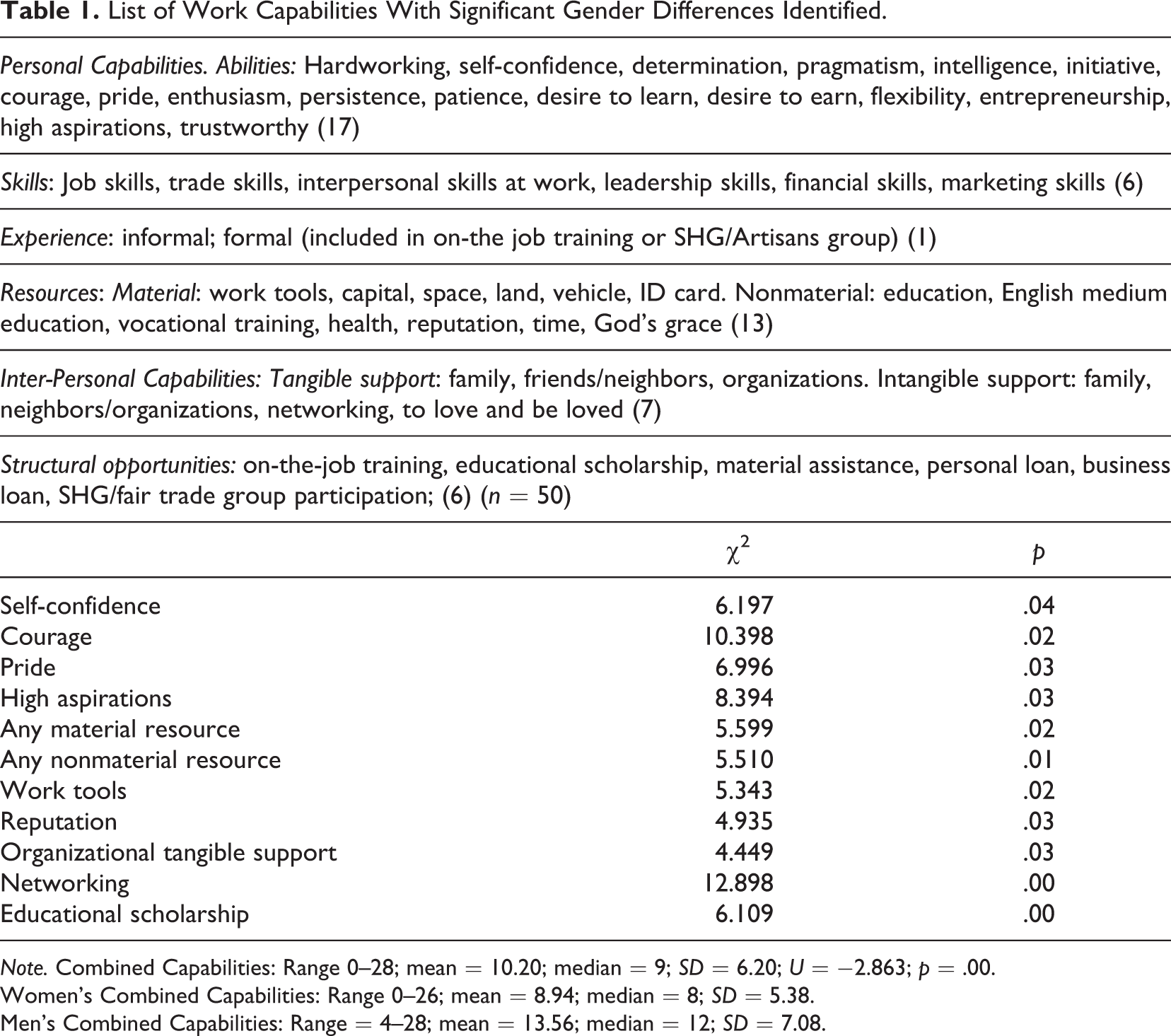
Note. Combined Capabilities: Range 0–28; mean = 10.20; median = 9; SD = 6.20; U = −2.863; p = .00.
Women’s Combined Capabilities: Range 0–26; mean = 8.94; median = 8; SD = 5.38.
Men’s Combined Capabilities: Range = 4–28; mean = 13.56; median = 12; SD = 7.08.
Skills
Respondents identified 34 types of trade and job skills, reflected in type of work (discussed later). Forty-two (46%) respondents (43% W, 52% M) reported having interpersonal skills essential for work, such as being able to work with others, learning from one another, helping one another, and influencing one another. Also, some self-employed respondents reported three types of management skills: leadership (33% W, 48% M), marketing (13% W, 20% M), and accounting (10% W, 20% M). Five of the seven nonworking women did not identify any work skill. χ2 tests showed gender is not related to any work skill, which is also noteworthy. Last, both abilities and skills can be learned through formal (on-the-job training, vocational training/skills training) and informal (family tradition, observing and learning from family, friends, and neighbors) work experiences. Some had access to both informal and formal training, while others had access to one or the other. However, gender was not related to either type of work experience.
Resources
Respondents identified various work resources which were broadly categorized into two groups: material and nonmaterial. Examples of material resources are land ownership, capital, work space, work tools, vehicle for work access, and ID cards. Examples of nonmaterial resources are education, English medium education, vocational training, health, reputation, time, and God’s grace. A thriving business man stated, “Mother’s (Goddess’s) blessing” was a precious resource for him, but no one else expressed a similar sentiment. About half (48%) of the respondents (40% W, 68% M) reported at least one material resource, and about three quarter (70%) of the respondents (63% W, 88% M) identified at least one nonmaterial resource. However, 20% respondents (25% W, 4% M) did not report either type of personal resource for work. χ2 tests showed a statistically significant gender relationship between having at least one material or nonmaterial resource. Also, gender was related to having work tools and reputation (see Table 1). Women reported less of each type of work resource.
Interpersonal Capabilities for Work
Respondents identified two types of interpersonal capabilities or social capital for work classified as tangible social support and intangible social support. Examples of tangible social support from family, friends, and organizations are learning about work availability; getting connected to people or agencies; getting assistance with health care, education, or housing. All these opportunities resulting from interpersonal relationships made paid-work possible. Examples of intangible social support are mentoring, networking, and ability to love and be loved by others which helped to get the work done. A majority of respondents (91%), among whom all 25 men and 59 (88%) women had some form of interpersonal social support, but 8 (12%) women did not report any interpersonal support for work. χ2 tests showed there is a statistically significant gender relationship with interpersonal capabilities for work: organizational tangible support and networking. Women appeared to have less tangible support from organizations, and fewer networking capabilities in relation to men reflecting institutional discrimination and seclusion norms at work (see Table 1 for details).
Structural Opportunities (Capabilities) for Work
Access to some form of income-generating work was the primary structural opportunity sought, and 92% of respondents had work opportunities (elaborated later). In addition to work, respondents reported six related structural opportunities. Thus, 98% of respondents had access to some form of structural opportunity. Two nonworking women did not report any structural access. Among the six related structural opportunities, on-the-job training was a useful opportunity shared by almost half the respondents (48%). Although more men (60%) than women (43%) had on-the-job training, there was no statistically significant difference.
The second structural opportunity, identified by 30 (32%) respondents, is group-based work, either through the Self-Help Group (SHG) program operated by the government or by NGOs, and an Artisans’ Association organized by a fair trade agency. Twenty (17 W, 3 M) respondents participated in the SHG program, and 10 (7 W, 3 M) artisans participated in the Artisan’s Association. Each program had its unique features and advantages. Most women participating in the government SHG found it to be a valuable opportunity for work and income. It enabled them to save and get access to micro-credit, provided access to skills training for starting or improving micro-businesses, and created access to markets to sell products. In addition, it provided a stipend during training, and travel and daily allowance when participants traveled to fairs to sell their products. Meeting other producers at these fairs enhanced their marketing skills and widened their horizon regarding future possibilities. Also, it enabled poor women to earn by cooking for the government’s Mid-Day Meal program in schools. However, those who participated in NGO sponsored SHGs only had access to saving, credit, and skills training. Last, the 10 respondents affiliated with the Artisans’ Association benefited much from its skills enhancement, design innovations, cash and material advance, and ongoing monitoring.
Four other structural opportunities identified were educational scholarships (6% W, 24% M), material assistance (10% W, 12% M; e.g., wheel chair, medical bills), personal loan (10% W, 8% M), and business loan (13% W, 20% M). χ2 tests showed that among structural opportunities, gender is related to educational scholarship only (see Table 1). Fewer educational scholarships for women suggest systematic gender discrimination both at home and outside.
Combined Capabilities: Personal, Interpersonal, and Structural
Clearly, some individuals reported more work capabilities than others. Thus, a new variable: Combined Capabilities (CC) was created by adding 50 personal abilities, skills, resources, and interpersonal and structural opportunities for work (see Table 1 for list). Because Sen and researchers working on capabilities for well-being (Alkire, 2002) accept some capabilities as nonhierarchical, irreducible, incommensurable, and hence basic, no attempt was made to reduce overall work capabilities into a scale. Instead, CC comprises all identified work capabilities, giving equal importance to each, and respecting each individual’s input. Respondents’ CC ranged from 0 to 28, with mean = 10.20, median = 9, and SD = 6.20. Women’s CC ranged from 0 to 26, with mean = 8.94, and SD = 5.38. Men’s CC ranged from 4 to 28, with mean = 13.56, and SD = 7.08. A t-test found a statistically significant difference in CC between genders (Mann–Whitney U = −2.863, p = .00).
Type of Work and Income
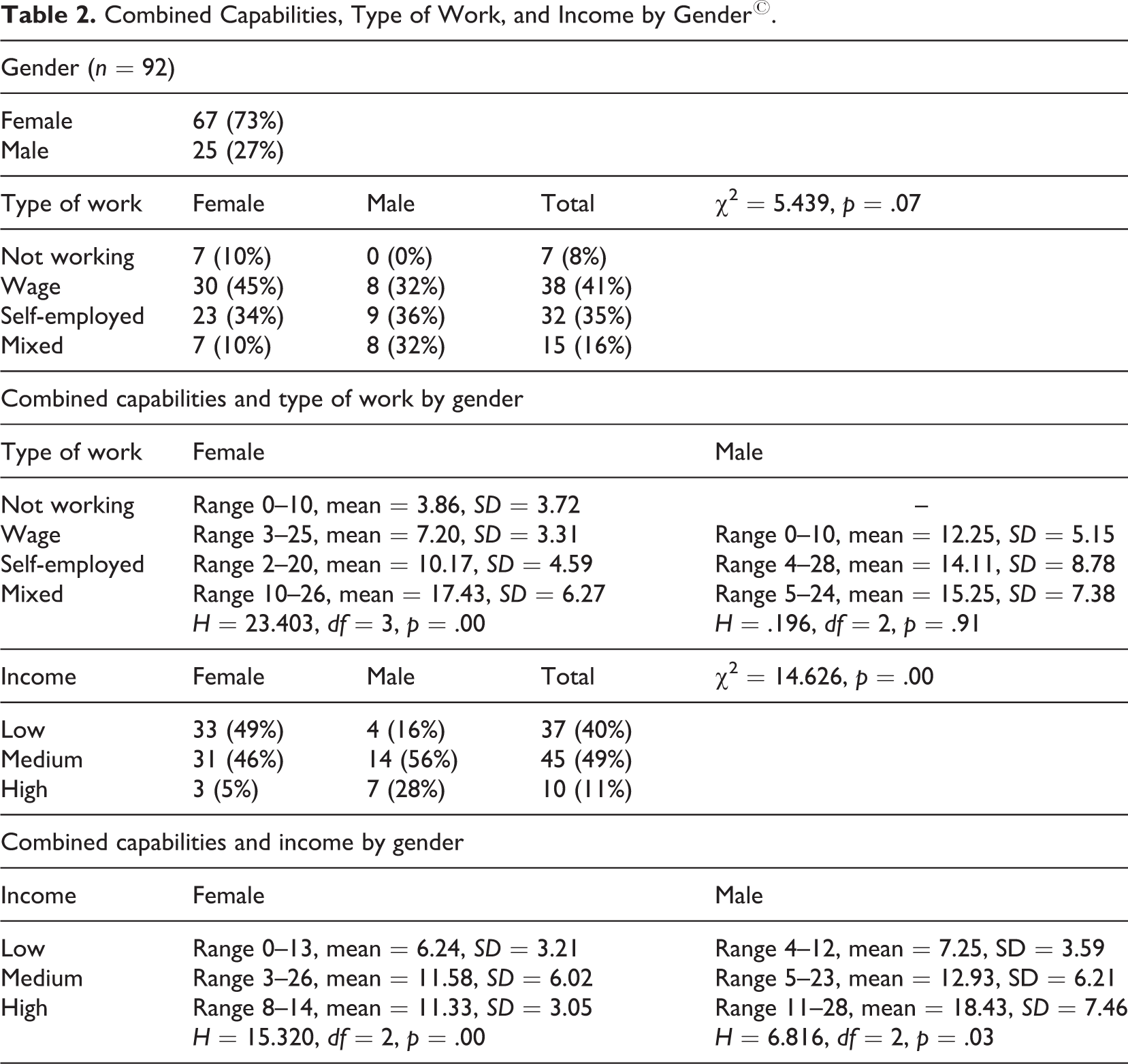
Table 2 shows that 38 (41%) respondents (45% W, 32% M) were engaged in wage employment. However, here wage work does not imply benefits were tied to wages. Among the wage earners, 8 (9% W, 8% M) were contract laborers or provided domestic service, 9 (12% W, 4% M) had temporary government jobs without benefits, 11 (13% W, 8% M) worked for NGOs and a majority had contract work with no benefits, and 10 (9% W, 16% M) worked for the for-profit sector among whom 6 had benefits. About a third (n = 32 or 35%) engaged in self-employment with no benefits. Examples of wage employment and self-employment are shown in Table 3. Fifteen (16%) respondents (12% W, 28% M) engaged in mixed work such as janitorial and rickshaw puller, electrician and office supply business, pottery and tailoring. Seven (10%) women were not working because of family tradition (n = 2), lack of work availability (n = 2), physical disability (n = 1), young child (n = 1), and looking for work (n = 1).
Combined Capabilities, Type of Work, and Income by Gender©.
Elaboration of Type of Work by Gender.
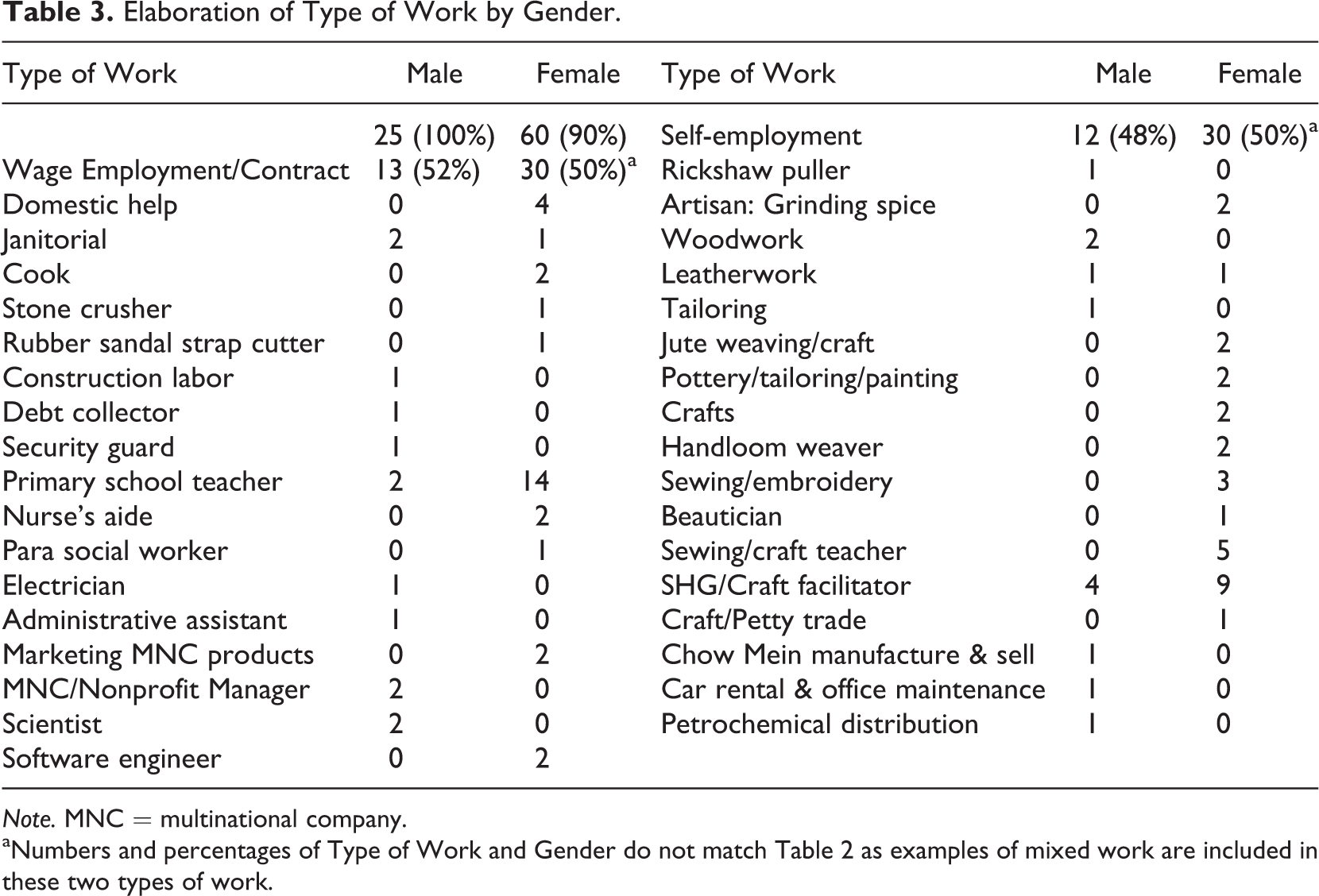
Note. MNC = multinational company.
aNumbers and percentages of Type of Work and Gender do not match Table 2 as examples of mixed work are included in these two types of work.
Work was classified into two broad sectors: informal (64% W, 60% M) and formal (25% W, 40% M), and included not working as a third category (10% W). Gender was not related to work sector or type of work, although gender and type of work came close to statistical significance (χ2 = 5.439, df = 2, p = .07); more men were in mixed work, and more women were in wage work. Hours of work ranged from 4 to 12 hours/day, 5, 6, or 7 days a week when work was available. A close examination of Table 3 shows respondents’ gendered nature of work both in wage-based work and in self-employment, as well as implicit gendered pay tied to education and wage-based work and self-employment.
Respondents’ average monthly income ranged from none to INR 10,001+ (see Table 2). Income was classified as low, medium, and high. Thirty-seven (40%) respondents (49% W, 16% M) were low income, with average income below INR 2,000, which indicates living below the Indian poverty line (earning less than US$2/day). Forty-five (49%) respondents (46% W, 56% M) were medium income, with average income between INR 2,001 and INR 10,000. Ten (11%) respondents (5% W, 28% M) were high income, earning an average income of more than INR 10,000 per month. However, 51 (55%) respondents reported variable monthly income. Income was related to education (r = .456, p = .00), but not to type of work. A χ2 test showed a statistically significant relationship between gender and income (χ2= 14.626, df = 2, p = .001).
Understanding Gender Differences in Capabilities for Work and Income
As noted, there is a statistically significant gender difference in CC; women have fewer number of CC than men. In addition to gender (r = −.300, p = .00), Spearman’s correlational tests showed CC was weakly related to caste (r = .200, p = .05), with general caste respondents reporting more number of capabilities. CC was related to age (r = .319, p = .00), with older men having higher CC. Also, CC was related to education (r = .308, p = .00), and men had higher levels of education than women. Type of work was related to CC (r = .492, p = .00), and income was related to CC (r = .551, p = .00). However, marital status, religion, location, district HDI, and work sector were not related to CC.
Finally, Kruskal–Wallis Analysis of Variance tests controlling for gender showed that men’s CC were not different for type of work (H = .196, df = 2, p = .91), but women’s CC were different in types of work (H = 23.403, df = 3, p = .00). Due to small sample size, and less than acceptable cell frequencies, these findings must be treated as exploratory and not definitive. Table 2 shows self-employed women’s CC vary widely from 2 to 20 (mean = 10.17); among women in mixed work, CC are higher and range from 10 to 26 (mean = 17.43); among women in wage work, CC are lower and range from 3 to 15 (mean = 7.20); and among nonworking women, CC are low and range from 0 to 10 (mean = 3.86). Again controlling for gender, analysis of variance tests showed men’s CC vary with income (H = 6.816, df = 2, p = .03), but women’s CC vary more widely with income (H = 15.320, df = 2, p = .00). Again as noted earlier, caution is warranted in interpreting these findings. Table 2 shows low-income men’s CC range from 4 to 12 (mean = 7.25); medium-income men’s CC vary widely from 5 to 23 (mean = 12.93); and high-income men’s CC range from 11 to 28 (mean = 18.43). However, such clear increases in mean with levels of income are not evident in women’s income. For instance, low-income women’s CC range from 0 to 13 (mean = 6.24); medium-income women’s CC range widely from 4 to 26 (mean = 11.58); and high-income women’s CC range from 8 to 14 (mean = 11.33).
Findings related to CC, type of work, and income together indicate that self-employment and mixed work (with a self-employment component) that pulls people out of poverty require more CC than basic wage or contract work. But men and women without very high CC can earn a high income in the formal, for-profit sector of wage work if they have a critical capability: higher education such as software engineering or a science degree. Also, the ability to speak in English is an important capability for high income even when the number of CC is not high.
Limitations, Discussion, and Implications
One major limitation of this study is the open-ended nature of questions to identify capabilities for work. It is possible that respondents who were more verbal and expressive identified more work capabilities than those who were less verbal or more reserved. This is particularly true given gender norms of self-expression in India, where women are socialized to express less about themselves and their abilities than men. Despite this caveat, empirically it was found that three women artisans were in the highest tier of CC with a score of 26, 25, and 20. Among them, two were rural Muslim women from low HDI districts, and one was a Dalit woman from a semiurban, medium HDI district. All three also had less than high school education, but due to their high CC, they were very successful in their micro-businesses and were leading SHGs, or artisan groups. In fact, three high-income men in the organized sector were more reserved and their CC scores were 11, 12, and 17. Gender difference between male respondents and researcher (author) could account for this difference (although as noted earlier, education was their key to high income). Overall, researcher’s gender did not play a big role as evidenced through statistically significant differences between genders and CC. (One general caste, urban man from a high HDI district had the highest CC with a score of 28).
With regard to other differences between researcher and respondents, issues of caste, class, power, and translation deserve discussion. Unlike race, caste does not show in appearance, although it gets revealed through the last name. In keeping with the Indian culture, often the researcher was introduced to respondents by staff by her first name followed by “Didi” or sister. Thus, caste may not be an issue here, but class difference (education/occupation/income) is much more difficult to hide. Although the researcher tried to soften differences by wearing a simple sari, tying her hair back, wearing a bindi, and speaking the same language as respondents, yet class difference is harder to erase. Moreover, there is power imbalance between a researcher and respondents, and the topic of income is very personal and sensitive. Every attempt was made to make respondents comfortable, and income was queried toward the end of the interview after trust had been developed, but it is unknown how class and power could have influenced the data. Last, translation and back translation have the potential to dilute or erase nuances. This is true for aspects of this study. For example, the Bengali to English translation of the term “prochesta” is persistence (a work ability), but it does not convey the sincerity implied in the Bengali term.
In future, a structured interview schedule based on capabilities identified in this study with a much larger sample size could be used to examine whether similar gender differences in CC prevail. Second, further analysis needs to be conducted to examine similarities and differences between genders where CC are low, medium, and high. Third, it is important to examine which abilities, skills, resources, and opportunities at various levels are more or less important in relation to type of work and income for men and women. Finally, these findings must be treated with caution due to small sample size and purposive sampling. These findings do not apply to all Indians, but the findings are reflective of income-poor Indians (Agarwal, 1989; Das, 2012; Desai et al., 2010; Kantor, 2009).
This study makes a significant contribution to the social work literature by applying Sen’s CA to income-generating work for economically disadvantaged individuals, and by identifying similarities and differences between women’s and men’s work capabilities. Although conclusive statements cannot be made about whether women have less freedom than men in developing the examined capabilities for work due to small sample size, these preliminary findings indicate women tend to have less freedoms to develop some of their work capabilities which in turn influence their type of work and income.
The major findings of this study generally corroborate prior research findings, while a few are unique to this study. The study found gender is related to education (Das, 2012; Desai et al., 2010; Sen, 1992); among 17 self-identified abilities, there is a gender difference in self-confidence, courage, pride, and high aspirations (Kantor, 2009; Sen, 1992); there is no gender difference in work skills (Kantor, 2009); there is a gender difference in material and nonmaterial resources for work especially work tools (Harriss-White, 2004), and reputation. Further, there is a gender difference in interpersonal capabilities particularly with regard to tangible support from organizations and networking abilities; there is a gender difference in access to educational scholarships; women have less CC for work than men. Also, women’s CC vary more widely for type of work, but this is not true for men, and women in mixed work tend have the highest CC; more women are in low-wage jobs than in high-wage jobs, self-employment rates are similar between genders, and fewer women than men are in mixed work. Importantly, women earn significantly lower income than men (Das, 2012; Desai et al., 2010; Harriss-White, 2004; Sen, 1992). Together, these gender differences in capabilities for work, type of work, and income reflect patriarchal norms related to gender socialization, segregation, and institutional power in sustaining gender inequalities (Agarwal, 1989; Bhatt, 2006; Dreze & Sen, 2013; Sen, 1992). They are age-long challenges for Indian women. However, the few women in this study who have succeeded, particularly the two Muslim women and the one Dalit woman with the highest CC (and who had crossed the poverty line also due to their capabilities), despite these norms, indicate there are opportunities for transgressing gender inequities in India.
The first and most important opportunity lies in enhancing women’s educational attainment (Das, 2012; Desai et al., 2010; Sen, 1999). Two out of the three high-income women in this study had college or higher education. Although schooling is available for all, more attention needs to be paid to girl children’s education to promote gender equality for the next generation. Education should not only emphasize literacy and numeracy, but also teach girls to think for themselves and question societal practices, and encourage them to challenge unfair norms. Simultaneously, more opportunities need to be created for increasing women’s education through adult literacy classes to open their minds to questioning gender inequities which keep girls and women subservient in the Indian culture. Similar critical thinking through formal and informal/adult education must be imparted also to boys and men. Ideally, both genders should participate together in gender discussion and reflection.
Second, although this study shows no gender difference in work skills, the study also finds that almost half of the women (49%) lived below the poverty line, despite many representing high HDI districts and urban location. Thus, women must be taught work skills also to enable them to rise above poverty line income. The government’s SHG program as well as Artisans’ Associations organized by NGOs has much potential to enhance work skills, create access to credit and market, and increase income. When women come out of the seclusion of their homes and meet others who have succeeded with their enterprises it inspires them to strive further. Although initially income from SHGs is low, over time some have been able to get out of poverty. However, SHG participation was not free from gender discrimination. It was reported that a few husbands allow their wives to participate in SHGs because women are the only ones who can get a loan, but once the cash comes in, it is transferred to the husband who retains full control. Also, a few women reported being disrespected by male staff who oversee these programs. For example, one woman reported that although she was supposed to get a stipend during skills training, she was required to complete the skill training and produce the skill learned before she could get paid. Although much more wide-spread infusion of the SHG program is recommended, men’s behavior toward women requires monitoring and reporting.
Finally, for those who have crossed the poverty line, more advanced training in occupations/trades that garner a higher income is recommended. Importantly, easier access to work tools and a larger business loan are needed as well. The government of India has started many vocational training and post–high school technical centers. Often successful women teach at these centers and serve as role models for aspiring women. Yet, due to high market competition, some teachers (both men and women) do not divulge the best or the latest techniques. Some form of social recognition or award is recommended to encourage teachers to impart their best skills and knowledge. Also, much more economic growth needs to be induced in India to address high competition in the market place. Most importantly, gender norms need to be challenged and changed at individual, interpersonal, and structural levels for women to succeed with paid work, and erase gender disparities at home, at work, and in society.
Social workers need to be an integral part of this process of social development. Among the entire sample, there were only six social workers with a master of social work. The researcher repeatedly asked, where are the social workers? The answer was that professional social workers cannot be found because social work education does not emphasize economic development, and pay is relatively small in social development work. The social workers who were involved did so because it was their own calling. Their strategies ranged from advocacy, lobbying, monitoring, and protesting women’s work and pay, to organizing and mobilizing women to form groups, providing skills training, and encouraging saving and borrowing for micro-businesses, to increasing women’s awareness about their rights at home and at work. Further recommendations for social work involvement include regular monitoring of men’s behavior at work and in programs designed to serve women; developing programs to train male staff in gender sensitivity and equality; promoting ownership of income and property in women’s name, creating easy, reliable, and affordable access to work tools; and identifying and connecting women with available scholarships for education or technical training. Finally, social work education and practice need to incorporate women’s work and income capability to enhance social justice.
Footnotes
Acknowledgment
The author is grateful for a Fulbright Research Award to India which allowed data collection, and for a sabbatical leave at the University of Kansas which enabled data analysis.
Declaration of Conflicting Interests
The author(s) declared no potential conflicts of interest with respect to the research, authorship, and/or publication of this article.
Funding
The author(s) received no financial support for the research, authorship, and/or publication of this article.