




Abstract
This article depicts the case study of Casa Rut (“Ruth Home”), a shelter for victims of sexual trafficking, who are predominantly Nigerian women. Since 1995, through the implementation of article 18 of the consolidated act on immigration, Casa Rut has offered a program of social assistance and rehabilitation to 340 women, 120 of whom were Nigerian and 41 of whom were pregnant. Data gathered during a 2-month internship between 2008 and 2009 are examined in light of the context of the Nigerian sexual trafficking operation and its collusion with the local criminal organization Camorra in the surroundings of the southern Italian city of Caserta. Casa Rut’s interventions are analyzed according to a multilevel perspective and the nature of victims’ case management in order to assess whether this nongovernmental organization can be considered to represent “good practice” in the fight against sexual trafficking. Hence, the work of the social cooperative NewHope—a tailoring cooperative founded in 2004 by Casa Rut that provides vocational training to formerly trafficked women—is considered in relation to the long-term employment needs of sexual trafficking victims. Human and sexual trafficking has not been extensively investigated within social work, even though practitioners are best positioned to address this issue. This work therefore aims to facilitate social service providers in their everyday activities by presenting multilevel evidence of good practice in the fight against the modern day slave trade.
Introduction
Human trafficking is defined in the 2000 “Protocol to Prevent, Suppress, and Punish Trafficking in Persons” as the trade and exploitation of people in the sex industry or in forced labor (United Nations [UN], 2000, p. 2, Art 3a). The literature reporting on practitioners’ experiences in assisting human trafficking victims is limited (i.e., Alvarez & Alessi, 2012; Busch-Armendariz, Nsonwu, & Heffron, 2011; Hodge, 2014).
This article aims to contribute to closing this gap in research and practice in the field of social work. This work is centered on a case study of Casa Rut (“Ruth Home”), a shelter for victims of sexual trafficking, who are predominantly Nigerian women. The article elucidates the sexual trafficking racket in the surroundings of the southern Italian city of Caserta and the activities undertaken by this nongovernmental organization (NGO). In 2010, ministerial records indicated that 2,381 individuals were trafficked into Italy for sexual purposes—the highest number among the European Union (EU) 27. These individuals are predominantly Nigerian women who are forced into street prostitution (Ministero Pari Opportunitá, 2012). The real numbers are nevertheless much higher and disputed (Crowhurst, 2006), that is, estimates of the number of sexually trafficked Nigerian women and minors vary from approximately 4,000 (Curtol, Decarli, Nicola, & Savona, 2004) to approximately 10,000 annually in Italy (Carling, 2006).
This case study is relevant to social work not only because Casa Rut assists mostly Nigerian victims but also because Italian legislation on human trafficking is unique within the EU (Curtol et al., 2004). Approved in 1998, article 18 of the consolidated act on immigration grants victims of sexual trafficking residency permits for humanitarian purposes for up to 18 months. Victims are not obliged to press charges against their persecutors, but they must undertake a rehabilitation program that includes language education, vocational training, and school completion (see Crowhurst, 2006; Goodey, 2004). These programs, on which there is no scientific literature in English published so far, are hosted by NGOs, of which Casa Rut is one.
This article begins by providing an overview of the methods that were used for data gathering. The following section presents a testimony from a trafficking victim, the context of the Nigerian trafficking operation, and its collusion with the Camorra in the surrounding area of Naples. Afterward, the case study of Casa Rut is outlined and analyzed according to Goodey’s criteria (2004) for “good practice” in supporting survivors of sexual trafficking and Hodge and Lietz’ (2007) multilevel approach. The micro-level analysis follows Macy and Johns’ (2011) case management recommendations and presents a unique initiative of Casa Rut that has established a tailoring cooperative at which former victims can become seamstresses. Concluding and summarizing remarks are preceded by a short discussion on how Casa Rut practically assists sexually trafficked victims to remain in Italy legally and avoid the risk of being forcibly repatriated, which can lead to further abuse and social scorn.
Method
Data for this article were gathered during a 2-month internship at Casa Rut between 2008 and 2009. Methodological choices were guided by feminist epistemological principles in order to overcome power disparities between the victims and the researcher (Maynard & Purvis, 1994; Skeggs, 1995). I was nevertheless undeniably positioned as an outsider in relation to the sexually trafficked victims. From an intersectional viewpoint (Crenshaw, 1989), we were positioned diametrically opposite each other. I am a white, well-off, educated Italian, while the victims were black Nigerians with an underprivileged background and a minimum level of education who were from the rural Global South and were forced for economic reasons to move to Europe—their faith and their body merely a piece of a globalized puzzle shaping the global capitalist process of the commodification of bodies (see also Chong, 2014; Dominelli, 2010; Lobasz, 2009).
I lived at Casa Rut, an apartment building in downtown Caserta, shared by victims of sexual trafficking and the organization’s personnel. I was invited by the organization’s personnel to share everyday space and life with them and the women whom they assisted. During my ethnographic work, I followed the ethical guidelines prescribed by the organization, protecting the anonymity and privacy of the victims. I had access to the organization’s archive, through which I could triangulate the collected data. Upon the completion of my study, I wrote a report for the organization, which was published on their website.
During a 2-month period, I interacted with 15 Nigerian women on a daily basis, primarily teaching them Italian and looking after their newborn babies. Although I never directly interviewed any of these women, to avoid affecting their healing and recovery process, with time they opened up to me and shared their stories. My position moved across the ethnographic spectrum of nonparticipant observer to participant observer and finally to nonobservant participant. At first, I was an outsider to the NGO, but I then became a trainee, and I was then directly involved in activities with the women. By the time that I left the NGO, I knew the routines and had become part of those routines (cf. Näre, 2009).
During the data gathering and analysis, I was aware of all of the ethical dilemmas that confronted my study. For instance, I aimed to minimize the impact of my ethnographic work by not recording conversations and not taking notes during discussions with the women. By avoiding such practices while trying to establish a friendly relationship and letting them question me (cf. Miraftab, 2004), I attempted to blur our stark intersectional differences. Finally, I positioned myself critically and reflexively, that is, being aware of my partiality as a feminist researcher to provide connections rather than final answers was crucial to the ethnographic research process (Skeggs, 1995).
The following section presents a testimony gathered during my stay at Casa Rut. It is aimed at providing the cultural and material context of the issue at stake through the lived experience of a girl trafficked from rural Nigeria to southern Italy.
Insight Into the Nigerian Sexual Trafficking Racket
I come from a small town in Nigeria, and I was taken to the city to attend secondary school. During those years, I worked as a hairdresser, and I got to know a lady who told me that she had a friend in Italy that could offer me a job as hairdresser. I informed my parents, and then I left. I travelled by flight. When I reached Italy, I was left in the hands of a madam who told me I should pay back to her 20,000 euros for the travel. The madam told me we were going to school, she took us to a bus stop, and when I asked her if we were waiting for the bus, she told us we were going to prostitute ourselves. She forced me to change my clothes. When a car stopped, I could not understand what the man was telling me so the madam negotiated, but then I refused to go with him. When we went back home, the madam hit me and locked me up in a dark room without food for five days. To eat I had to pay 200 euros a month, plus the 20,000 I had to pay back for the trip; I also had to pay for utilities and for the mattress I was sleeping on. I was living in a house in Pineta Mare together with several girls. We didn’t even have a bed, only mattresses. I worked from 1 pm to 8 am; I wasn’t feeling well, so the madam took me to a doctor who said I was pregnant. When the madam found out I was pregnant she tried to force me to have an abortion. I didn’t consent even though she said she would sell my child to white people. She kept on sending me to the street. There I tried hitchhiking in order to flee. Finally, I managed to get in contact with the doctor who had seen me for a check-up. He first took me to a kind Neapolitan lady who then brought me here to Casa Rut. The following Wednesday, my son was born. I lived through a nightmare. [Blessing, 26 years old, from Edo State, March 2008]
Blessing was sold by her parents to a madam who paid her flight to Italy where she got in the hands of another madam who forced her into prostitution. Blessing’s dream of becoming a hairdresser turned into the daily nightmare of prostitution which she managed to escape solely thanks to her own will after becoming aware of her pregnancy. This spontaneous testimony gathered at Casa Rut provides an overview—composed of light and shadow—of the vicissitudes that sexually trafficked Nigerian women experience (see also Cole, 2006; Crowhurst, 2012; Peano, 2013b). Although awareness campaigns against sexual trafficking exist in Benin City, Edo state, Nigeria, the point of departure for most women, their desire to improve the condition of their families often prevails (Cole, 2006; Peano, 2013a, 2013b). Moreover, in Nigeria, the success or failure of a household is directly credited to the woman. These often-illiterate girls thus face pressure from their own families to provide or to repay their debts by contracting yet another debt with a sponsor (Aghatise, 2004; Cole, 2006). Consequently, while human trafficking is commonly described as a scam, the people in Edo state are aware of the fate of the women who have been migrating to Italy. Yet, Nigerian migrant women are not afraid of taking risks, and they tend to be fatalistic about their future (Peano, 2013b). Hence, they often subscribe to a contract before leaving Nigeria, cosigned by a sponsor and sanctioned by religious and voodoo rituals, where they agree to repay a debt (for a detailed analysis of these issues, see Carling, 2006; Cole, 2006; Taliani, 2012). In this sense, Nigerian victims of sexual trafficking are neither kidnapped nor deceived but rather sold by their own families (Curtol et al., 2004). Note however that the Palermo Protocol states that a person is considered a victim of human trafficking even when he or she has given consent (UN, 2000, p. 2, Art 3b).
Castel Volturno: The Nigerian Mafia and the Camorra Hub
Nigerian sexual trafficking is present in several areas of Italy (see Aghatise, 2004; Cole, 2006; Peano, 2013a; Taliani, 2012). The Domitian littoral zone in the provinces of Naples and Caserta is notorious as a major hub for Nigerian drug dealing and prostitution, as indicated in the account previously, but it has received little research attention in the English language academic literature (e.g., Becucci, 2008; Buonaiuto & Laforest, 2011).
The town of Pinetamare, mentioned in the account previously, is located within the municipality of Castel Volturno, 50 km west of Caserta and 40 km north of Naples. In 2012, the population of Castel Volturno was 22,927, 13% of which were migrants legally residing in the municipality. Africans accounted for 61.7% and Nigerians 35% of this immigrant population (Istituto Nazionale Di Statistica [ISTAT], 2012). Relative to the national population, which comprises 8.2% immigrants (Caritas, 2012), these data reflect the magnitude and uniqueness of the immigrant presence in Castel Volturno. These data refer to legally registered residents only, which likely represent a very limited proportion of the immigrant population residing in Castel Volturno. Most trafficking victims enter Italy with a 3-month tourist visa when they reach Italian airports or with no documents if they cross the Mediterranean Sea by boat, and they subsequently remain in the national territory without any permit. Described as a “wild west town” (Antinori, 2012, p. 230) and “the Italian Soweto” (Saviano, 2008, in Buonaiuto & Laforest, 2011), Castel Volturno was the stage of a riot in 2008 by African migrants rebelling against mafia rule and the inhumane living conditions that they were forced into. This riot was prompted by the killing of six West Africans by the Camorra (Antinori, 2012; Buonaiuto & Laforest, 2011).
When Nigerians started moving to the Domitian coast in the 1990s, the Camorra tried to prevent them from establishing themselves in the area by killing a number of Nigerian drug dealers and shooting prostitutes in the legs. However, in the early 2000s, it became clear that the two organizations were “exchanging favors.” For instance, Nigerian prostitutes and drug pushers serve as sentinels for the Camorra by signaling when the police are passing (Direzione Investigativa Antimafia [DIA], 2003). The Camorra has also contracted Nigerian pushers to sell small amounts of drugs directly to customers. Although the Camorra has not autonomously managed prostitution since the 2000s, they profit from it by requiring prostituted women to pay up to 5,000 euros a month for the “joint,” which is the slang term for the spot where they stand on the street. The Camorra has left control of Nigerian prostitution to the Nigerians (Becucci, 2008), whose criminal framework consists of a madam (i.e., the sponsor and direct exploiter of the trafficked women) and drug dealer duo. This arrangement is a shared business, as the madam often has small amounts of drugs that she sells while the drug dealers oversee the prostitution racket in the streets. Thus, the Nigerian mafia is characterized by multisectorality and a flexible network, which has facilitated its integration with the existing Camorra frame of illegal operations (Bernadotti, Carchedi, & Ferrona, 2005).
In this section, the geographic and criminal context of the prostitution racket in the surroundings of Naples was presented. The following section we look at Casa Rut, the focus of this article, describing its work against this ongoing modern day slave trade. The analysis of Casa Rut’s practices in assisting victims and in fighting against human trafficking is done through two frameworks in the two upcoming sections. First, the criteria by Goodey (2004) to determine whether Casa Rut can be considered a good practice in its scope. Second, the multilevel approach by Hodge and Lietz (2007) to assess the extent of the action of Casa Rut. These two frameworks examine achievements and potential improvements in the practices of Casa Rut, while also opening for the possibility of a comparative analysis with similar organizations.
Good Practice Analysis Framework
Examining this type of case study represents a contribution within the field of social work, which aims to ensure social justice for victims of oppression (Hodge & Lietz, 2007; Sloan & Wahab, 2000). However, the most important aspect is the replicability of such case studies and their ability to provide examples of “good or best practice” in the fight against sexual trafficking.
Goodey (2004) defines the following six criteria to determine whether a project assisting victims and aiming to eliminate criminal organizations involved in sexual trafficking can be considered to represent good practice (Goodey, 2004, p. 94): Positive results: projects assisting victims should lead to the improvement of their condition. Innovation in the solutions found to protect and assist victims. Sustainability and durability (beyond the criminal trial) of assistance for victims and their families. Replication of projects in other settings through the exchange of information. Cooperation between criminal justice and civil society and NGOs nationally and internationally. Ethical consideration toward the opinions and concerns of victims throughout the process of assistance.
These criteria serve as a framework for the analysis of Casa Rut’s practices, which are discussed in the following sections.
Casa Rut: A Multilevel Approach
Within this challenging context, this shelter for human trafficked victims was founded in 1995 by the Ursuline Sisters congregation. Given the complex nature of the challenges that they face, Casa Rut and all social service providers for human trafficking victims need to intervene at different levels with different actors and stakeholders in order to raise awareness and fight against this modern day slave trade. The framework proposed by Hodge and Lietz (2007) to analyze multilevel interventions in response to sexual trafficking is used in the following subsections to report on the work conducted over time by this NGO.
Macro-level
The macro-level is described by Hodge and Lietz (2007) as the legislative front at which social work providers can advocate for stricter legislation while enforcing existing legislation. In this sense, social workers are best positioned to identify and advocate for the prosecution of exploiters (Sloan & Wahab, 2000). Casa Rut has worked on this front from the very beginning. Together with a network of human rights organizations, this NGO spearheaded article 18 of the consolidated act on immigration, which entered into force in 1998. This legislation is considered innovative within the EU because of the insights provided to policy makers by social service operators. The social service workers advocated for the importance of a “double circuit” whereby the victim can choose either a judicial path or a social path to denounce his or her persecutors while being granted a residence permit. In the latter path, the NGO protects, assists, and acts on behalf of a victim who is rightfully afraid of retaliation (Curtol et al., 2004).
Mezzo-level
According to Hodge and Lietz (2007), the mezzo-level consists of the community interventions conducted in both the receiving and the originating nations of sexual trafficking victims. The work of Casa Rut within the mezzo-level has been threefold.
First, this NGO initially faced the resistance of neighbors, who were suspicious of the women living in Casa Rut and the activities of the nuns. With time, people realized that the nuns, who do not wear a veil and hence might not be recognized as such, were helping women in difficult circumstances. Neighbors did not disrupt their daily life but rather increased their sense of community with reciprocal visits during holidays. Through this experience, Casa Rut managed to destigmatize the position of the victims, which is the inherent objective of social practitioners working for a more just world (Sloan & Wahab, 2000).
Second, in 2000, the NGO was registered by the Social Affairs Department on the list of associations working to improve the condition of immigrants. Despite being registered, Casa Rut has never received financing from the Ministry of Equal Opportunities. In fact, Casa Rut is part of a large network “of 100 small shelters run by 250 sisters from 70 different congregations that offer hospitality to 6 to 8 persons at times for 6 to 12 months or longer” (Bonetti, 2006, p. 49). Religious- and volunteer-based organizations have become providers of social services, acting as substitutes for an ineffective state. Accordingly, Dominelli (2010, p. 601) asserts that globalization, intended as “the embedding of capitalist social relations in daily routines in personal lives, public life in general and professional practices”, has brought about the internationalization of social problems, among which is human trafficking. Social assistance has become a service that the state purchases from a range of NGOs—volunteer, nonprofit, and commercial organizations assisting migrants and oppressed people (Dominelli, 2010). Although solely funded by the Ursuline Congregation and single donors, Casa Rut has become known at the national level as an example in the assistance and rehabilitation of victims of prostitution. The founder of Casa Rut, Sister Rita Giaretta, was honored with the title of “Grand Officer of the Order of merit of the Italian Republic” in 2007, and she has written two books on the experience of Casa Rut (Giaretta, 2007; Giaretta & Tanzarella, 2012). She has been active in the Italian national press by denouncing Italian politicians’ decision making and attitudes against migrants and women and by raising awareness about human trafficking for sexual purposes (e.g., Giaretta, 2011).
Third, in 2007, the founder of Casa Rut together with representatives of several Italian NGOs working against sexual trafficking travelled to Nigeria for an official visit. During their stay, they met with local authorities to present their work on alleviating the suffering of the numerous girls and women who had left Nigeria under the promise of an honest job that never materialized. They also raised awareness among student and women groups in the areas surrounding Benin City, the point of departure for most trafficked women. Finally, they inaugurated a shelter for the victims of sexual trafficking who are forcibly repatriated.
Hence, at the mezzo-level, Casa Rut’s practice fulfills Goodey’s (2004) criteria of “replication” and “cooperation” since the NGO is active in promoting similar projects and cooperation at both the national and the international level to end this form of modern day slavery. One example is Rita Giaretta’s books, which have been widely sold in Italy and have been translated into English.
Micro-level
The micro-level, which is the level of direct identification, assistance, and support for women trafficked for sexual purposes (Hodge & Lietz, 2007) is where Casa Rut is most active, as well as where the literature is most lacking (i.e., Alvarez & Alessi, 2012; Busch-Armendariz et al., 2011; Hodge, 2014; Hodge & Lietz, 2007). This NGO operates according to a standardized screening and aftercare protocol that is delineated in the following section.
Case Management
Since its foundation in 1995, Casa Rut has been assisting Nigerian women who decide to rebel against the prostitution racket in Italy. A total of 340 women have been assisted, 120 of whom were Nigerians and 41 of whom were pregnant. Women are taken through a three-step process whereby their needs are assessed and addressed. These steps are introduced in the following subsections according to the case management framework outlined by Macy and Johns (2011) (Figure 1). This framework has been chosen because it helps readily visualize and grasp both for practitioners and nonpractitioners the nature of the practices of Casa Rut. Moreover, it does not only facilitate the analysis of Casa Rut daily work, but it provides ground for comparison with similar projects for the assistance of sexual trafficking victims.
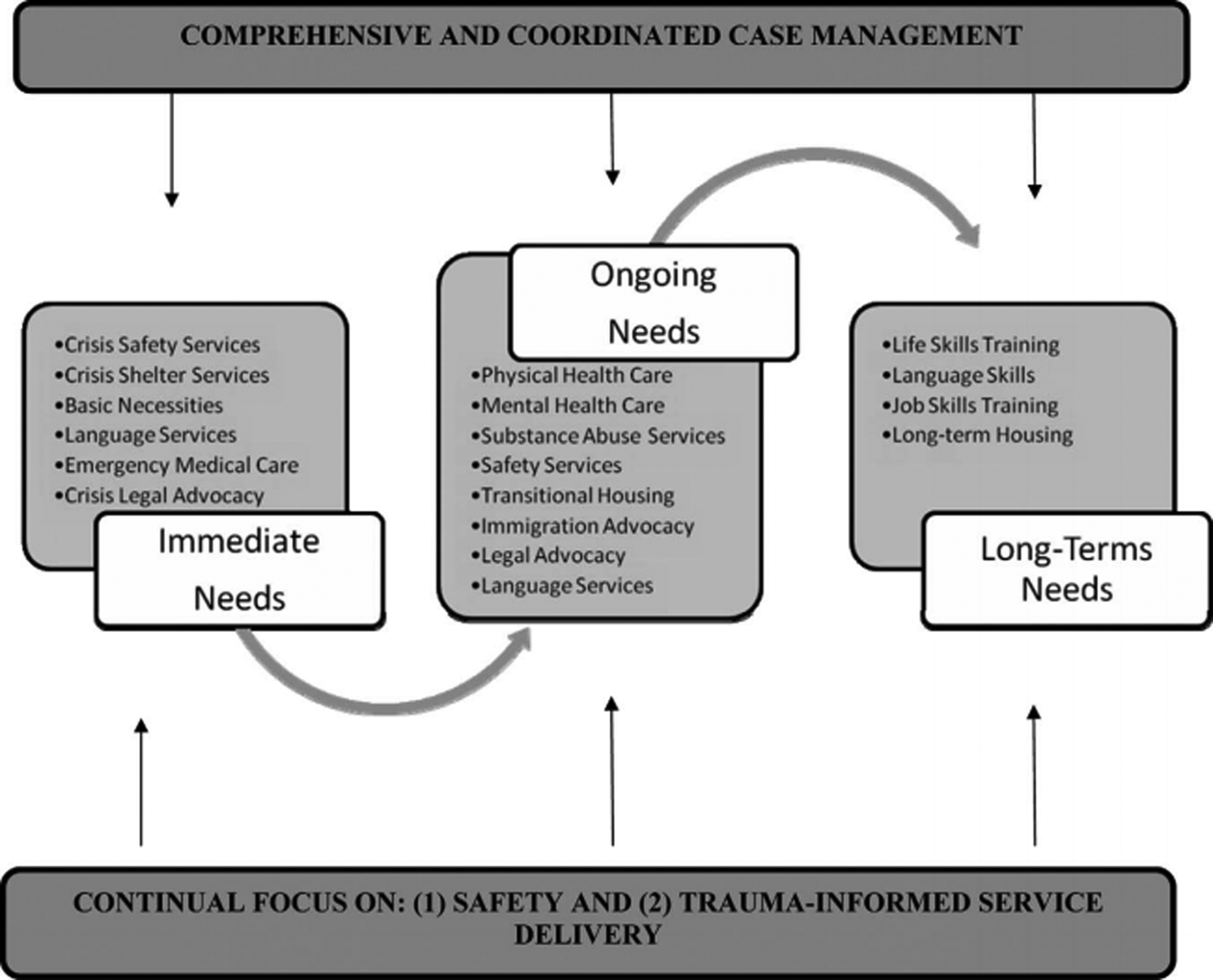
Framework for a continuum of aftercare services to address the changing needs of international sexually trafficking survivors (from Macy & Johns, 2011, p. 90).
Immediate and Ongoing Needs
When a victim of sexual trafficking reaches Casa Rut, either by herself (because the NGO is widely known in the area) or by the aid of the authorities, she is welcomed and asked her real name—not the Italianized version that is forced upon her by her persecutors. In this way, operators start building trust with the survivor of sexual trafficking. She is provided with new clothes and a clean bed to give her with something of her own and to show respect toward her and her body. Her room becomes her shelter and a place where she enters into the normal daily routine of sleeping, cooking, and spending time with her housemates. Their presence, as they often have a language and culture in common, helps the newcomer feel at ease and develop trust in Casa Rut’s personnel. Housing is particularly important because it is stable and safe, in contrast to where she was kept by her persecutors, which facilitates the restoration of the victim’s wellness (see also Macy & Graham, 2012).
One dedicated case manager at the NGO questions the victim alone on several occasions with a standard screening protocol that addresses issues of safety, employment, living environment, travel, and immigration to identify the victim, as suggested by the literature (Macy & Graham, 2012; Macy & Johns, 2011). The process of requesting that victims share the identity of their perpetrators to obtain a residency permit for humanitarian purposes is very strenuous. Nigerian victims often tell similar false stories because they have been instructed to lie by their madams (for a detailed analysis on these issues, see Carling, 2006; Cole, 2006; Crowhurst, 2012; Peano, 2013b; Taliani, 2012). Victims’ housemates and compatriots at Casa Rut play a critical role in breaking the chain of lies and in helping newcomers open up about their past and their previous experiences.
Because of the proven record of Casa Rut, the Caserta police headquarters grants approximately 20 residency permits per year for humanitarian purposes, and the trust gained by Casa Rut as a credible social institution has streamlined the acquisition of documents and the receipt of social assistance benefits for human trafficking victims. Casa Rut’s experience thus shows the importance of effective and trustful cooperation between the NGOs and the police/immigration and judicial bodies (Curtol et al., 2004).
Simultaneously with completing paperwork, the NGO personnel ensure that victims of sexual trafficking undertake health checkups and that all of the necessary tests are conducted if a victim is pregnant. Victims’ psychological condition is equally important. Victims of abuse and exploitation often suffer from post-traumatic stress disorder and are cognitively impaired (Zimmerman et al., 2006). Time, together with physical and psychological care, often fosters a more open attitude toward social workers and a willingness to collaborate with the police.
Long-term Needs
Tutoring in Italian, which is spoken fragmentarily at best, is a fundamental element of the restoration and rehabilitation process, providing a further chance for victims to become part of the community. This service is offered at Casa Rut by local volunteers several times per a week individually for the victims so that they can improve their Italian.
As victims of sexual trafficking have seen conspicuous amounts of money, they often have the impression that their chances of obtaining a job in Italy are relatively high. With time, the nuns help them understand the importance, yet difficulty, of finding a job. If they verify that a woman has a relative in Italy with a regular job, she is accompanied to a reunion with this family member. This entire process, which takes 6 months to a year, is much more challenging if the woman is pregnant. In this case, she is encouraged to continue her pregnancy and to care for her child, and she is then enrolled in a vocational training program initiated by Casa Rut, which is outlined in the following subsection.
In this sense, Casa Rut satisfies Goodey’s (2004) good practice “ethical” criteria because ensuring victims’ safety and welfare is prioritized over pressing charges against their procurers. For this reason, sexual trafficking victims are taken through several steps that evaluate and respond to their immediate and long-term needs. The women are consulted throughout this process, and they are neither enrolled forcibly into the social program nor forced to sign up for the trainee program (see NewHope vocational training). Finally, the voluntary repatriation of 10 women provides evidence of Casa Rut’s openness toward women’s right of self-determination (see After Casa Rut: options and challenges).
NewHope vocational training
This social cooperative was founded to offer vocational training in tailoring to the women assisted by Casa Rut. A total of 65 women have been trained since 2004, and 2 women who were among the first to complete the training have since returned to their countries, Moldova and Tanzania, where they opened tailoring shops.
After a trial tailoring of 1,000 tote bags, the sisters of Casa Rut with the support of volunteers and the citizens of Caserta opened a tailoring laboratory, where bags, napkins, tablecloths, pen cases, and pillow cases are made from African-inspired textiles. Products were sold at markets and outside churches during special festivities. News eventually spread via word of mouth: Creations are now sold online, and many customers choose them as party favors.
Women sign a vocational trainee contract for 6 months and receive a small salary. This bursary is given directly by Casa Rut. The government’s commitment to provide bursaries to support the rehabilitation and education of human trafficking victims has not been maintained. As highlighted by Crowhurst (2006), social cooperative projects have therefore become unfeasible for other operators, and they have been forced to leave immigrant women halfway through their integration programs.
The director of the NewHope cooperative is a young Eastern European mother who succeeded as a trainee and started teaching newcomers. As a young woman, she sometimes faces challenges in receiving acceptance, attention, and respect from Nigerians, who might struggle to accept criticism about the quality of their work and may speak among themselves in English or in the local Nigerian dialect if they are annoyed by something. These challenges are undeniable, but dialogue always remains open among all of the trainees, and when necessary, Sister Rita intervenes to help resolve disputes.
Formal steps, such as the provision of a small salary, are taken to convey to the women that they are participating in a serious enterprise and that they should be committed because they are rewarded. These months of vocational training are crucial for the women to learn how to manage time and juggle the responsibilities of work and a baby. Sisters at Casa Rut consider this process to be a dry run to show the women themselves that they can be autonomous and leave Casa Rut.
NewHope is the most apparent illustration of Casa Rut’s fulfillment of Goodey’s (2004) good practice criteria. With respect to the first criterion, Casa Rut’s establishment of its own social cooperative has yielded positive results in the recuperation of victims not only in the short term but also—and more important—in the long term by teaching them specific job skills. This strategy, together with the facilitation of victims’ employment as caregivers, has allowed the women to stay in Italy and to avoid the risk of retaliation. NewHope also fulfills the second of Goodey’s (2004) good practice criteria, that is, innovation. NewHope is certainly an innovative solution. No other Italian NGO working for victims of sexual trafficking has founded a social cooperative in which trainee programs are offered. Victims can receive protection from the NGO while also learning an occupation that they can use in the future. Finally, consistent with the criterion of sustainability, according to which projects should ensure long-term and durable protection and assistance to sexual trafficking victims, Casa Rut’s trainee program and assistance in finding employment help sexual trafficking victims and their newborn children find stability and remain in Italy.
After Casa Rut: Options and challenges
Having completed the training, if women do not have family residing somewhere else in Italy with a regular job, Casa Rut facilitates their integration into the local job market. Since the early 2000s, 25 women have become caregivers for older people, and 35 have become domestic workers in the city of Caserta or the surrounding area. In Italy, these employment sectors are dominated by migrants (Caritas, 2012; Cole, 2006). A total of 750,000 domestic workers are registered in Italy, but many more domestic workers are likely employed without a contract in the households of the 90,000 Italians that are no longer self-sufficient. By 2050, 33% of the Italian population will be over 65 years old. Thus, migrant caregivers will represent a significant resource (Caritas, 2012). As shown by Näre (2009), the daily practices and rhythms in southern Italian households can be maintained through the employment of live-in migrant domestic help. Indeed, the Nigerian women employed in Caserta report that families have become reliant on and attached to them and that they show affection toward their toddlers.
In some cases, Casa Rut signs contracts on behalf of employers who do not want to or who cannot pay social benefits to their caregivers. This practice is known and accepted by the local authorities, who admit that the modalities to acquire a residency permit are too strict and rigorous. The women’s residency permit for humanitarian reasons can only be extended up to 18 months, at the end of which the sexual trafficking victims are repatriated if they do not have a stable occupation. Many of these women thus risk becoming illegal immigrants and being at the mercy of the Italian police and the squalor of the immigration centers.
Research shows that women, especially Nigerian women, face evident and imminent threat when they are repatriated. In some instances, they are raped by police officers when they reach Lagos, or they meet their persecutors on the flight, who then force them back into the racket that they escaped from (see also Skilbrei & Tveit, 2011). All of these acts occur with the consent of the Nigerian police force, which is rife with endemic corruption (Cole, 2006; Skilbrei & Tveit, 2011). Moreover, as the Edo community, from which most trafficked women come, does not accept prostitution, the returning women become social outcasts (Aghatise, 2004; Cole, 2006; Skilbrei & Tveit, 2011). They suffer the stigma of failure upon return, they no longer have a network, and they face retaliation threats if they have not paid off their debt. Thus, for most women, returning to their home country is not an option (Skilbrei & Tveit, 2011). Only 10 Nigerians assisted by Casa Rut have been voluntarily repatriated.
As mentioned earlier, Casa Rut’s assistance to former victims in finding an occupation after the trainee program so that they are not forcibly repatriated is a clear indication that Casa Rut acts ethically and sustainably, according to Goodey’s (2004) good practice principles, to improve the future of these women by providing them with both emotional and material support to start a new life in Italy.
Occasional, irregular jobs in domestic and elderly care work coupled with bureaucratic traps and criminalization of immigration result in fact in ordinary segregation. Finger printing was voted by a large parliamentarian majority in 2008 legitimizing ethic coding hence further marginalizing the “extra communitary” (Buonaiuto & Laforest, 2011, p. 53). Immigrants have to wait up to 8 months to get their permits renewed. A process that is truly lifelong. In fact, the Italian citizenship is based on jus sanguinis that is to say that one of your parents needs to be Italian for you to become Italian. Therefore, acquiring the citizenship is a chimera for immigrants and provisions for refugees are similarly missing. 700,000 second-generation children are reaching the age of consent. They have to be erased from their parents’ residency permit knowing they will never be full citizens (Buonaiuto & Laforest, 2011).
This perspective is particularly wearisome and almost provoking toward those victims of sexual trafficking that decided to keep their children alive. Deciding to carry on the pregnancy is in fact an act of insubordination against her exploiters who through trafficking, the contract and the voodoo, it is as if they would own her body. Given such a tumultuous itinerary and the Italian upbringing of their children, it is an ethical imperative for policy makers to take into account the question of citizenship for second generation’s immigrants (Taliani, 2012), which Casa Rut has also been fighting for.
Conclusion
Human trafficking has been defined as the modern day slave trade. Social workers are best positioned to fight against this trend because the guiding principle of social work is to reduce social and economic injustice (Hodge & Lietz, 2007; Sloan & Wahab, 2000). Nevertheless, there are few practical examples in the social work literature of practitioners’ experiences in assisting sexually trafficked victims (i.e., Alvarez & Alessi, 2012; Busch-Armendariz et al., 2011; Hodge, 2014).
To contribute to filling this research gap, this article presents the social assistance and rehabilitation program offered by Casa Rut, a NGO based in Caserta, to Nigerian victims of human trafficking. Casa Rut has been operating since 1995 to assist Nigerian women who decide to rebel against this racket. Relying on only self-financing and local volunteers, in 2001, Casa Rut founded NewHope, a tailoring cooperative that provides vocational training to victims of sexual trafficking. When they conclude the rehabilitation program, the women are faced with the risk of repatriation if they do not find a permanent occupation that supports their residency permit. Because of cultural taboos and fears of retaliation, repatriation is not a viable option for most Nigerian victims of trafficking (see Aghatise, 2004; Cole, 2006; Skilbrei & Tveit, 2011). Casa Rut has been helping these women to find employment in the domestic and elderly care sectors, often by signing contracts on behalf of employers that do not want to cover social benefits.
The global north–south economic imbalance and the historical patriarchal subordination of women are the denominators of human trafficking, the reasons why it is acceptable to sell a daughter in Nigeria and buy a body in Italy. Social workers, as shown in this case study, have a great role to play, not only in assisting victims but also in changing social preconceptions toward women and immigrants.
Nevertheless, human and sexual trafficking is not extensively examined within social work, even though practitioners are best positioned to address this issue (Alvarez & Alessi, 2012). In this sense, this work is a novelty because it does not only present the everyday local practices for the assistance of victims but also shows how the cooperation among local and international organizations is vital to raise awareness about this modern day slave trade. In fact, as argued by Alvarez and Alessi (2012), social workers should openly acknowledge their epistemological stand in the ongoing debate on human trafficking.
Guided by the principles of feminism, striving toward improved human rights through economic and social justice, Casa Rut’s personnel engages in local, national, and international debates in the media to make human trafficking visible and to dissect its causes, consequences, and possible solutions. From Caserta, a provincial town in southern Italy, Casa Rut has been putting human trafficking in the Italian picture, showing that human trafficking is happening next door and in the streets of many Italian cities hence, challenging normal citizens to watch out for it and policy makers to act on it. Moreover, this work wants to serve as an encouragement to other social workers to share their experiences and practices in relation to human trafficking. Social workers, grounded on feminist critical thinking and action, are in fact best equipped to fight against this practice, not only by relieving victims but also by drawing public opinion’s attention toward this shocking phenomenon that is feeding on women’s exploitation.
Footnotes
Acknowledgment
Thanks to the personnel of Casa Rut, in particular Sister Rita Giaretta for letting me become a part of her community. I am indebted to all the women who shared their stories with me. Thanks to Louisa Vogiazides, Luis Andrés Guillén, Deborah Reynolds, and the anonymous reviewers for helping me improve earlier versions of this article.
Declaration of Conflicting Interests
The author(s) declared no potential conflicts of interest with respect to the research, authorship, and/or publication of this article.
Funding
The author(s) received no financial support for the research, authorship, and/or publication of this article.