




Abstract
Fifty years after the Equal Pay Act of 1963, research continues to find disparities between the salaries of men and women across disciplines. This study examines empirical evidence about salary and gender within the social work profession from the 1960s to present day. All available articles with empirical data regarding salary and gender during the time period were included in this systematic review. Salary disparities were found between men and women in the vast majority of studies. The authors classify contributing factors into three categories (a) characteristics of the employing organizations, (b) characteristics of the position held, and (c) characteristics of the individual, and include a discussion of factors relevant to social workers in academic positions. The researchers recommend legislative policy changes, best practices in organizational policy, and proactive education within social work programs. Social workers have the opportunity to effect change in this area by promoting social justice within our society, practice, and educational institutions.
The year 2013 marked the 50th Anniversary of the Equal Pay Act, legislation which amended the Fair Labor Standards Act of 1938 to prohibit “sex-based wage discrimination between men and women in the same establishment who perform jobs that require substantially equal skill, effort and responsibility under similar working conditions” (U.S. Equal Employment Opportunity Commission, n.d., p. 1). This anniversary coincides with popular press examination of current wage gaps between men and women, potential causes (Noguchi, 2013), the increasing number of “breadwinning” women who serve as sole or primary providers for their families (Wang, Parker, & Taylor, 2013), women as the “richer sex” (Mundy, 2012; Shteir, 2012), the responsibilities of individual women to “lean in,” and needs for system change (Sandberg, 2013). The debate also examines the role of children, motherhood as a predictor of poverty (Rowe-Finkbeiner, 2014), and whether women can “have it all” (Slaughter, 2012).
The gendered salary gap is visible when we look across all disciplines. A 2011 report by the Georgetown University Center for Education and the Workforce found women needed a PhD to equal the lifetime earnings of men with bachelor’s degrees (“Women can boost earnings,” 2011). However, studies that include a broad array of professions are often criticized as inappropriate comparisons, with critics pointing out that women in male-dominated professions make significantly more than other women (“Women rare in STEM,” 2011). However, salary inequities between genders exist in professions most highly populated by women. 1 For example, female teachers (81% of all elementary and middle school teachers) make approximately 91% of their male counterparts’ salaries (WeNews Staff, 2012). Female nurses with the same productive characteristics as their male counterparts earned about US$4,825 less than male nurses in the 1990s (Kalist, 2002). Although 2012 data suggest that the difference remains smaller than other professions, it still exists, with the disparity ranging from 91% for registered nurses to 88% for nursing aides (Hegewisch & Matite, 2013). These disparities within historically female professions are particularly challenging in efforts to disprove the wage gap, as they can’t be explained away by low female interest or recent female entry into these areas.
MacPherson and Hirsch (1995) investigated whether the wage composition that is evident in such studies is due to occupational characteristics, quality sorting on gender composition, taste differences, or other factors correlated with the proportion of females in an occupation. They examined changes over time in the gender composition of jobs for both women and men and the changing effect on wages and the gender wage gap in a large representative national sample. Job skills, detailed job characteristics, and unmeasured worker-specific skills and preferences were found to account for two thirds of the gender composition effect. MacPherson and Hirsch (1995) resolve that predominantly female jobs pay lower wages to both women and men largely because of their skill-related characteristics the ratio of females to the total employment in the worker’s occupation. This review will consider whether these variables, particularly job characteristics and preferences, are connected to any salary disparities within social work.
This article examines the state of knowledge within the social work profession regarding salary, gender, 2 and other important variables that affect salary. Does our profession replicate and reinforce societal inequities? Can social work be a model for equitable gender treatment?
Methods
A systematic literature review was designed to capture the most complete historical knowledge possible of salary and gender within the social work profession. Peer-reviewed articles included in this review focused on salary disparities among men and women in social work and included the reports of empirical research among social workers, social work students, or social work faculty members. Three databases (SocIndex with full text [EBSCOhost], Social Service Abstracts [ProQuest], and Scopus [SciVerse]) were included. Search terms included gender, social work, salary inequity, men and women, and pay equity.
The initial search produced 40 articles matching the search criteria. The reference lists of these articles were examined to find other articles and books that met the criteria for the study and that process was repeated when new articles were found. In total, 135 articles and books were reviewed. Articles and books were retained for the study if (a) the full text of the article could be located, (b) they were in English, and (c) they included the results of empirical research that included both salaries and gender as variables. A total of 51 articles and 3 books were accessible in English and full text. The majority of the articles (31) described salaries of practicing social workers, while the remainder discussed social work faculty, social work students, or social workers and other groups combined. A total of 26 articles included empirical information from original research in which data were collected between 1967 and 2006. These articles form the basis for this study.
A meta-analysis was the preferred methodology for this study but was not possible due to the nature of the research designs involved within this review. MacDonald (2003) suggests that it is generally inappropriate to combine statistical data from studies heterogeneous in important aspects that deploy different outcomes. Systematic reviews are appropriate when there is uncertainty and where there has been some previous research on the issue, but key questions remain unanswered (Petticrew & Roberts, 2006). Therefore, a systematic literature review was more appropriate for this study. We believe this systematic review will meet the goal of providing “a reliable picture of current best evidence relevant” to this question (MacDonald, 2003, p. 3).
The quality of any systematic review is limited by the quality of the studies contained. One question for the authors of this study was whether gray literature, documents such as unpublished studies, conference reports and proceedings, and government and agency reports, should be considered high enough quality to be included in this study. The main argument in favor of including the gray literature is that it minimizes the effects of publication bias. The arguments against its inclusion include the concerns about its quality and lack of peer review, and the unevenness of access to such literature (Bellefontaine & Lee, 2014). The authors of this study chose not to include gray literature for two reasons. First, the access to such literature was challenging, particularly for studies that were produced decades ago, and we were concerned this would provide unevenness in the results reported. Second, while publication bias is known to allow positive results to be published more easily than negative results, finding of negative results in salary disparities would be significant and therefore, we believe such articles would have an excellent chance of publication. However, the authors did review a number of publications from the National Association of Social Workers (NASW) and other professional organizations, including those from the Center for Workforce Studies (their detailed publications with a variety of information about work environments of social workers are available at http://workforce.socialworkers.org/), which provided a wealth of background information. See Table 1 for a comparison of the studies discussed.
Findings of Salary Studies Within Social Work.
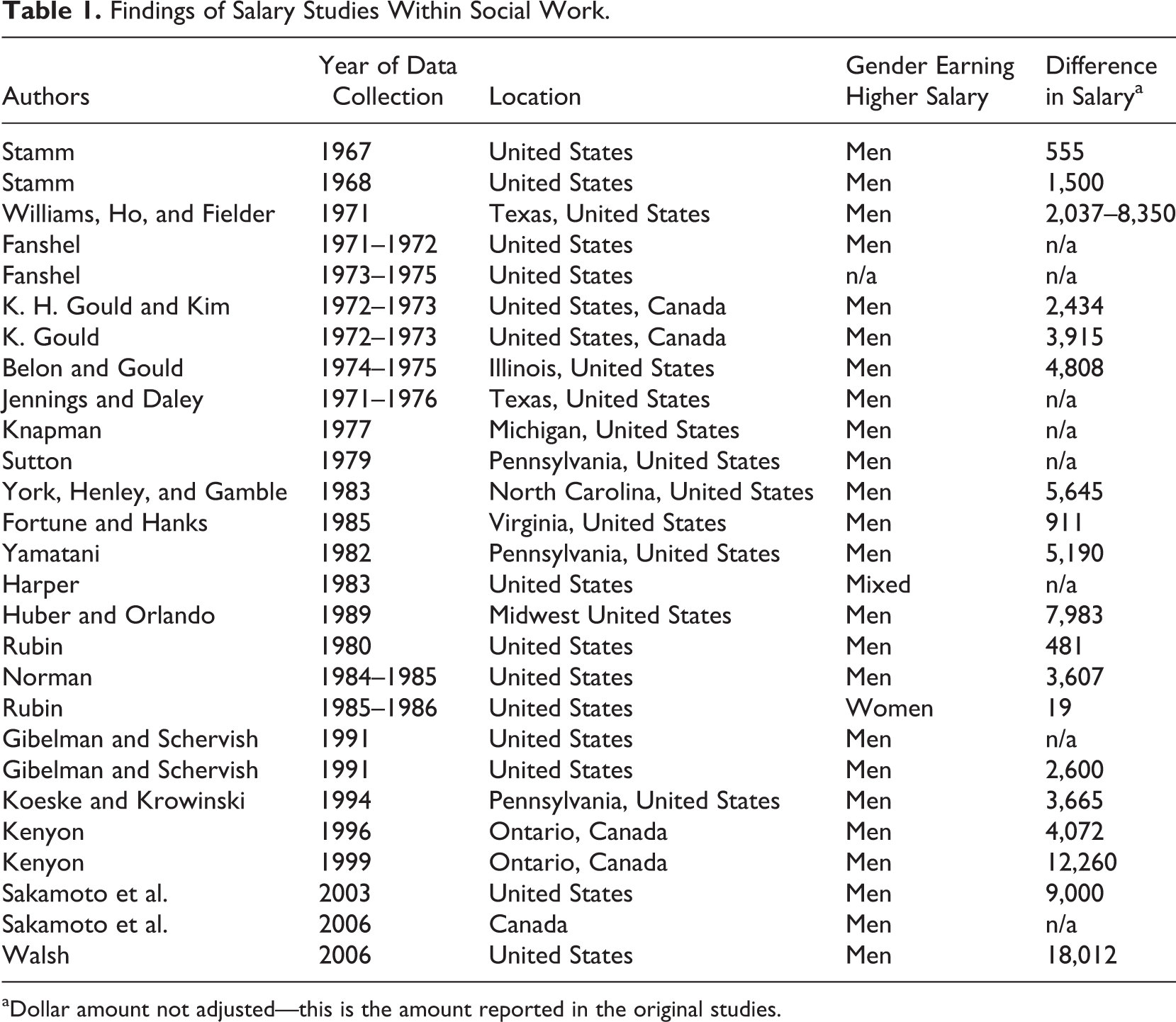
aDollar amount not adjusted—this is the amount reported in the original studies.
Literature Review
The 1960s: Women Outnumber Men; Men Outearn Women
Little information is available about gender and salary during the 1960s. Stamm studied NASW members who were new graduates in 1967 (Stamm, 1968) and NASW members in general in 1968 (Stamm, 1969). First, Stamm compared MSW graduates from 1963, 1965, and 1967 and focused on personal characteristics, employment, salaries, and other variables. While there had been an increase in the number of men entering into the social work profession, their proportion had decreased (Stamm, 1968). In 1967, men were more likely than women to pursue graduate studies after some experience in the social work field. Stamm found that 73% of recent graduates in 1967 were employed as caseworkers with women nearly twice as likely as men to hold this position. Overall, men outearned women in both studies, with a US$555 median difference in salary for 1967 graduates (Stamm, 1968) and US$1,500 for NASW members (Stamm, 1969). More men (10%) than women (4.5%) were found in the highest earning category (US$10,000 or more) (Stamm, 1968). Men were also more likely to be in jobs with administration as their primary function (Stamm, 1969).
These articles paint a picture of a white, female-dominated profession with changing gender proportions and an emphasis on casework, with women overrepresented in casework and underrepresented in administration. Although they were numerically in the minority, men were outearning women.
The 1970s: Women’s Careers are “Stable”; Men’s Involve Advancement
The gender and salary connection gained more attention during the 1970s. Eight studies examined social work salaries and gender with different methodologies and similar results.
Williams, Ho, and Fielder (1974) surveyed Master of Science in Social Work (MSSW) graduates from the University of Texas at Austin School of Social Work in 1971. The sample included 269 (110 men and 159 women) who had graduated from 1952 through the spring of 1971. The survey focused on family commitment, career tenure, education, and job mobility among men and women.
The authors found a large and statistically significant difference in the salaries of males and females when controlling for job tenure (p = .0000), from a low of US$2,037 in 1970–1971 to a high of US$8,350 in 1958–1960. A statistically significant difference was found in the salaries of men and nonsingle women (F = 8.04, p = .0005) as well as men and single women (F = 6.19, p = .0026). Family obligation was not found to be a major reason for salary differentials. The researchers found that women stayed in the same position longer than men, while men were more mobile and had a greater variety of jobs during their career.
Fanshel (1976) conducted a secondary analysis of data from two groups: 21,755 NASW members responding to a membership survey from 1971 to 1972 (12,760 women and 8,995 men) and 14,524 new NASW members entering the association between 1973 and 1975 (9,958 women and 4,565 men). This study focused on type of employment, marital status, salary, gender, ethnicity, and parental status.
Male NASW members in both groups were twice as likely to occupy a leadership position as female NASW members. Men held more administrative positions than women and they outearned women. In the 1971–1972 survey, 57% of male administrators earned US$16,000 or more, while only 37% of female administrators earned the same. Parenting status was significant for women, that is, 22% unmarried women with no children identified administration as their primary professional role, as compared to 13% of married women with no children and 14% of those married with children. The greatest disparities within administrative roles were between men and married women. The low proportion of married women in administration was reportedly influenced by the disruption of careers through family moves or the assumption of parental responsibility. Married women with and without children were overrepresented in casework. Significant salary differences were not seen between men and women in the 1973–1975 groups who were all fairly new to the profession and worked mostly as caseworkers.
Gould (1978) and Gould and Kim (1976) studied 822 faculty members of graduate schools of social work in the United States and Canada in 1972–1973. The effects of gender and ethnicity on rank, salary, job assignments, and responsibilities of faculty of graduate schools of social work were examined, focusing on gender (1976) and ethnicity (1978). When rank, degree, number of publications, years of experience, and ethnicity were controlled for individually and in all possible combinations, there was a significant difference (p = .002) between the mean salaries of men and women. These five variables accounted for 23% of the variance in salary, suggesting the remaining variance is accounted for by factors other than those normally articulated by schools of social work. Gender and rank were significantly related to salary (p ≤ .001), and there was a significant difference (p ≤ .001) between the mean salaries of men and women faculty, with men earning US$17,464 and women US$15,030 (a difference of US$2,434). A significant difference (p ≤ .05) of US$1,323 was found in the mean salaries of men and women with doctorates as well as US$1,864 (p ≤ .001) between nondegree holders.
In the 1978 article, Gould focused on the intersection of ethnicity and gender, analyzing the same data, attempting to isolate the effects of ethnicity on salary. Sex and rank were significantly related to salary (p ≤ .001), and there was a significant difference (p ≤ .001) between the mean salaries of nonminority males and females. Among nondoctoral degree holders at the assistant professor level (the only group of minority faculty large enough to compare statistically), men outearned women by US$3,915 (p ≤ .001). Having a doctorate degree helped minority males and females upgrade their salaries but not nonminority females. Minority females were concentrated in the lowest academic ranks.
Belon and Gould (1977) studied 122 NASW members (81 women and 41 men) of a unit of the NASW Illinois chapter in 1974–1975. This study included variables such as degree, years of employment, time off from employment, type of agency, and responsibilities carried, which explained 63% of variance in full-time salaries. A significant difference in salaries (p < .0001) between full-time workers was found in favor of men after controlling for all five variables and all possible combinations. Men working full time earned US$4,808 more than women, while the difference for part-time workers was US$444 in favor of men. The gap grew with experience, with men who had worked more than 10 years outearning peer women by US$6,400. There was a greater salary difference between men and women employed in public agencies, compared to those in private not-for-profit agencies. Even after controlling for other variables, gender was the strongest explanation of the salary differences.
Jenning and Daley (1979) surveyed 205 (139 female and 66 male) graduates who obtained an MSSW degree from the University of Texas at Austin School of Social between 1971 and 1976. The survey collected information about initial and current jobs, work settings, work tasks, professional activities, and the transition to professional life. A strong salary difference was found between men and women in both their current jobs (p = .01) and initial jobs (p = .01). Women were more likely than men to work part time rather than full time (x2 = 5.32, p < .05). With job type held constant, the salary difference between men and women disappeared, credited to the disproportionate number of women in lower paying jobs and men in higher paying jobs. The authors suggested “most salary differences result from the promotional process” (p. 20).
Knapman’s (1977) quantitative study examined social workers in Michigan to examine discrimination against female social workers in personnel practices. The sample included 132 respondents (77 females and 55 males) from 20 family agencies. Variables studied included salary, position held in the agency, position into which respondents were hired following their MSW, current position held, and amount of time in one position prior to promotion to the next.
A significant relationship between gender and position level was found, with females more likely to be in lower level positions and reporting a significantly greater average time prior to promotion to all positions other than executive director. Salaries and time of employment were highly correlated (p < .0001) and overall, women earned significantly less than men (p < .0004). Fewer females were initially hired at the supervisory level, and women were promoted more slowly than men, resulting in a significant relationship between gender and position level. A greater difference in salaries between men and women in smaller communities was also found.
Sutton (1982) surveyed 1,566 (1,049 women and 521 men) NASW members from Pennsylvania in 1979 to test whether education, type of employment, length of employment, agency auspices (including whether the organization was a for-profit, nonprofit, or government agency), and job responsibilities were the reason for salary differences. A significant relationship was found with the variables of income, gender, and leadership opportunities for respondents with an MSW, 76% of the total sample. The author compared two groups of MSWs, namely, those employed full time for more than 10 years in an agency and those employed full time between 2 and 4 years. When controlling for all variables except auspices, median incomes for women were less than men at all levels of job responsibility for both groups. When auspices were considered, men’s income was higher than women in six instances out of eight, that is, all except private auspices at the direct service level and for public auspices at the supervision level. There was a significant difference (p < .01) between gender and job responsibilities, with men more likely to be in top management positions. This relationship was statistically significant for those in the private sector, not in the public sector.
A significant relationship (p < .01) between career goals and gender showed women with less preference for administrative positions than men. More men (58%) attended continuing education training in management compared to 31% of women. Women were more likely to report that they did not receive paid time off for continuing education (75% of women and 25% of men) and paid out of pocket to attend (74% of women and 24% of men).
Overall, social work salary research from the 1970s concluded that male social workers consistently outearned female social workers, both in practice and in academia. Men outearned women in most situations in social work even after controlling for other factors such as family commitment, education, job, rank, ethnicity, experience, and parental status.
The 1980s: Authors Debate Whether Salary Disparities Exist
During the 1980s, eight published studies examined salary disparities between men and women with an emphasis on academics, and four out of nine studies focused on faculty members and administrators, with data analyzed by multiple researchers with substantially different findings. Although women made progress in obtaining better paying positions and breaking some barriers, salary disparities were still found in most analyses, across the board, in all areas of practice.
York, Henley, and Gamble (1987) surveyed 94 members of a North Carolina NASW chapter in 1983 employed full time (61 female and 33 male) regarding salary, gender, job position, length of experience, full-time status, and interest in a career in administration. On average, men made US$7,651 more than comparably employed women. After controlling for amount of paid experience, education, and job position, the difference in salary explained by gender was US$5,645 and the difference explained by position was US$2,147, making gender a better predictor of salary than position. Experience, job position, and education were significant predictors of salary and explained 54% of variance in salary for women, but only 26% of the variance for men’s salaries, with only job position as a significant predictor for men.
In 1985, Fortune and Hanks (1988) surveyed MSW graduates of a Virginia school of social work between 1975 and 1983 about their social work careers. Of those, 520 (88%) had been employed in the social work profession (410 women and 110 men). Women (84%) were more likely than men (68%) to be in micro practice jobs (casework and group work). Men were overrepresented in macro practice (planning, administration and community organization, and social planning) and more likely to have a macro job directly out of school (20% compared to 9% of women). Men’s salaries were higher over time and they received larger salaries with promotions. After accounting for specialization, number of jobs, number of years of employment, and type of employment, men still outearned women by US$911.
Yamatani (1982) surveyed 827 (503 women and 324 men) members of the Pennsylvania Chapter of (NASW) about gender, age, marital status, agency auspices, employment status, length of work experience, educational level, present job rank, geographic location, salary, and future roles. A significant relationship was found between gender and salary level (p < .001), with men’s median salaries US$5,190 more. Agency auspices and geographic location did not significantly affect salary. After controlling for educational level, job rank, marital status, and length of experience, gender was still significantly (p < .001) related to salary level. The length of job experience had a greater impact on women (B = .70) than men (B = .48), as “salaries of female workers were more a function of accumulated job experience than of job rank and marital status” (p. 26). Men were more likely to receive higher increases in salaries as they advanced.
Harper (1991) surveyed directors of Council on Social Work Education (CSWE) accredited undergraduate programs in 1983 (225 total, 81 women and 144 men) and 1988 (299 total, 141 women and 158 men) regarding gender, age, education, work experience, ethnicity, tenure, rank, geographic area, size of the institution and program, and administrative auspices. Men and women had similar years of social work experience and academic teaching experience, with women appointed as Bachelor of Social Work (BSW) directors at a faster rate than men, with a 74% increase from 1983 to 1988. There were 27% more female directors at the rank of assistant professor than male directors and men outnumbered women at the rank of professor. Female directors had higher salaries than male directors at the rank of assistant professor and associate professor, and men had higher salaries than women at the rank of professor.
Huber and Orlando (1995) surveyed alumni and students of an MSW program in the Midwest in 1989 and obtained information about income for 300 alumni and 72 students (raw numbers of men and women were not provided). Alumni were asked about post-MSW careers and students about salary expectations. Both student groups had similar expectations of future income 1 year and 5 years after school but reality did not match their expectations. Male alumni outearned female alumni by US$8,500. Age was a significant predictor of higher income for both women (p = .001) and men (p = .01) and income increased with experience. Women held administrative or supervisory positions at a comparable rate to men, but the income gap was more pronounced in administrative positions, with 16% of women earning US$40,000 or more compared to 52% of men. Men’s incomes were consistently higher than women’s, with differences ranging from US$4,953 in mental health to US$14,810 in the field of children and families. The overall difference was US$7,983 across all fields of practice.
The 1980s also saw debate about salary and gender within social work education. Rubin (1981) utilized data from the 1980 CSWE annual survey of accredited graduate schools of social work. A multivariate inferential analysis was performed with a sample including 1,067 faculty members at the full, associate, and assistant professor ranks (400 women and 667 men), examining gender, rank, level of education, salary, and years since appointment to current rank.
Rubin found a significant salary difference (p < .005) between male educators and female educators, with men earning a higher salary (US$2,379). His analysis showed that gender accounted for one fifth of 1% of the variation in salary. He reported the difference dropped to US$481 after controlling for rank, degree, and years at current rank and argued there was a statistically significant relationship between gender and salary, but that it had little practical significance—that rank and degree were more influential.
Norman (1986) utilized data from CSWE’s 1984–1985 statistical survey of graduate schools of social work. Data were collected from 85 of 90 schools and covered 1,856 full-time faculty members, including instructors, lecturers, and administrators (raw numbers of men and women not provided). Norman’s analysis found men in the highest ranking and better paying administrative positions, that is, 71% of deans and 60% of associate deans. Women were more likely to have the lowest paying administrative jobs in academia, and they were 59% of field directors and 68% of assistant field directors. Men made between US$2,000 and US$5,700 more than women in all but two administrative positions. Female deans and continuing education directors earned more than their male peers by US$750 and US$969, respectively. With all academics averaged together, men in social work academics significantly (p < .00) outearned women by US$3,607. Men outnumbered women in faculty positions (57% of the total), tenured positions (77% of men were tenured, compared to 53% of women), and full professorships (approximately 40% of men and 20% of women). Almost half the variation in salary difference was explained by tenure and rank.
Norman (1986) examined 11 variables and their relationship to gender equity within the school, including geographic location, size, and auspices of the university; number of full-time social work faculty members and their gender distribution; degree offered by the school (MSW or BSW and MSW), dean’s gender, and the difference between the proportion of men and women with doctorates within the school. The most important variables in predicting differences in men’s and women’s salaries were the gender of the dean and the geographic location. Schools with female deans were more likely to have men and women at equivalent ranks, tenured in equal proportions, and earning comparable salaries. Women social work faculty in New England earned US$465 more than men, while women faculty in the region including New York, New Jersey, Puerto Rico, and the Virgin Islands earned on average of US$6,433 less than men.
In response to Norman’s study, Rubin (1988) conducted a secondary analysis using data from the CSWE 1985–1986 database (the year following Norman’s data) analyzing salaries at the individual and school level. The number of included individuals and schools was not provided. The analysis controlled for years at rank, educational degree, rank, and number of publications. He found the relationship between gender and salary to be small and almost nonexistent after these changes. A difference of US$181 in favor of men was found when analysis of all regions and all faculty and administrators were included in the analysis. When University of Puerto Rico was excluded, the difference was US$19 in favor of women (not statistically significant). Rubin also disputed Norman’s findings about New England and found women earned on average US$160 more than men in schools of social work with male deans (not statistically significant). Men earned US$625 more than women when they worked at schools of social work with women deans.
The differences between the two analyses can at least in part be traced to level of analysis: Rubin focused on the individual as the unit of analysis, whereas Norman focused on the school as the unit of analysis. These differences highlight the difficulties in collecting and analyzing this data and continued differences about the existence and causes of disparities. Research in this time period continued to show higher salaries earned by men in most, but not all studies, with a variety of reasons suggested for this difference. Job rank, number of years of experience, and family responsibilities were among the factors considered.
The 1990s: Large-Scale Studies Find More of the Same
The six salary studies published in the 1990s focused on more variables and increased numbers, with similar results. Men were still outearning women in most cases.
Gibelman and Schervish published two articles (1993, 1995) analyzing 1991 NASW membership, initial and renewal applications. Their 1993 article included all employed (nonretired, nonstudent) U.S. members with a social work degree, a total of 100,899 members (raw numbers of men and women were not included). Only 6% of the total membership worked in supervisory positions and 16% worked in managerial positions. Men, 23% of the total sample, were overrepresented among supervisors and managers. More male NASW members with 10 or more years of experience were employed as supervisors (8.4% of men and 7.9% of women) and managers (33% of men and 23% of women). The move from direct service to supervision and management appeared to occur earlier in men’s careers. Gender, setting, auspice, geographic location, ethnicity, and field of practice all significantly contributed (p < .05) to job function.
Gibelman and Schervish’s 1995 article focused on 37,097 members from the same 1991 survey, who held at least an MSW degree; reported income and were employed full time; and considered their gender, income, highest social work degree, number of years in practice, geography, work setting, and function. Men were disproportionately represented at the higher salaries in all levels of practice, with salaries increasing with function and experience. Ten percent of men with 2–5 years of experience earned more than US$30,000 compared to 6% of women with the same amount of experience. The authors conducted an analysis of variance (ANOVA), controlling for the effect of primary practice, primary setting, primary auspice, primary function, experience, ethnicity, and geographic location on salary. All factors except geographic location were significant (p < .01) contributors to the salary of MSWs working full time. A multiple classification analysis indicated that gender alone accounted for a US$4,650 differential in salaries. After accounting for other factors such as practice, setting, auspice, function, ethnicity, experience, and geography, gender accounted for a US$2,600 differential. The only more influential factor in determining salary for an MSW’s first job in the field was employer auspice, and after 2 years of employment, gender became the most influential factor.
Koeske and Krowinski (2004) surveyed 417 Pennsylvania social workers (309 women and 108 men) in 1994 regarding their employment status, the year they completed their MSW, and salaries. A statistically significant relationship was found between salary and gender (p < .001). Men outearned women by US$3,665. Women made 90% of men’s salaries, even after controlling for years of experience in social work, job role, and status.
Kenyon (1997) analyzed data from a 1996 survey of 770 full-time employed members (raw numbers of men and women were not provided) of the Ontario Association of Social Workers (OASW). Variables examined included education, employment, salary, language, ethnic expertise, professional and other interests, political affiliations, educational needs, and volunteer opportunities. The men and women in the study differed in several statistically significant ways. Women were younger, more likely to have an undergraduate social work degree, less likely to have a doctorate, and were more recent graduates. Women were overrepresented in clinical practice and underrepresented in management/administration positions. Gender, years of social work experience, years since obtaining master’s degree, employment status, and educational level were all found to be significant predictors of salary (p < .001). Overall, women earned 80% of male salaries, with men earning US$4,072 more than women.
Kenyon (2000, 2003) studied gender and income among 1,075 graduates of two Canadian schools of social work (837 women, 219 men, and the remainder unspecified) in 1999. Variables included level of education, years of experience in social work, employment status, function, salary, administrative status (interest in administration and time spent on administrative work), family status (marital status and parenting status), hours worked per week and work interruptions, retention variables (job changes and moves), job change variables, and OASW membership. As in Kenyon’s other study, women were younger, had less work experience (6 year difference), and were overrepresented in the BSW group; and men were more likely to have an MSW and a doctorate.
Among those working full time, men worked 1.3 hr more each week. Men with a spouse/partner and children worked 41.1 hr per week compared to 38.6 hr for their peer women. Women were more likely to work in community development and organization, men in administration. Women changed jobs more than men in the 10-year time span, were more likely to take time out of the workforce for family reasons and childbearing, and men to take time from the workforce for education purposes. The mean salary of men (full and part time) was US$12,260 higher than comparable women. The income gap also widened as experience increased.
The 2000s: Interest in the Topic Wanes
Only two studies about salary within social work since 2000 are available. Sakamoto, Anastas, McPhail, and Colarossi (2008) examined American full-time faculty members via 2003 data from CSWE and looked at demographics, salary, highest degree earned, rank, level of program, auspice of institution, institution size, and professional activities. They also examined Canadian faculty through data from the 2006 Canadian Association of University Teachers (CAUT) survey as well as a pilot study completed by deans/directors of Canadian Association of Schools of Social Work (CASSW) accredited schools of social work. Variables included gender, rank, race/ethnicity, sexual orientation, title, position, geographic location, student enrollment at the university and school of social work, and recruitment/retention of students.
The CSWE data included 3,567 full-time faculty members (2,284 women and 1,283 men). Female faculty members were more likely to be employed in undergraduate only programs, with men more likely to be employed in joint programs. Male faculty members tended to be older and had a higher number of years in current rank. Women were more likely to hold clinical faculty (nontenure track) positions and assistant and instructor (tenure track) positions. Women were less likely to be primarily in doctoral and master’s programs; and men had a lower percentage of time in bachelor’s programs, field, and liaison work. Men published more in refereed articles and books.
The authors found a statistically significant difference in adjusted salary between men and women. On average, men earned US$9,000 more than women. Factors such as age, years at rank, percentage of time spent on research, number of articles published, and total publications for the year (p < .001) were all correlated with the salary difference. A stepwise regression found that gender influenced faculty salaries independent of race and ethnicity. Program level was the strongest institutional predictor. Age, rank, time at rank, tenure status, program level, time spent on research, and publication productivity were all correlated with salary; and women were disadvantaged in all of these categories. Yet when all were controlled, gender still showed a small but significant correlation with salary.
The CAUT data included 312 full-time university teachers, 58.7% female. Only 34% of surveyed schools (12 schools) participated in the pilot study, covering 184 full-time social work faculty members (117 women and 67 men). Women were 39% of full professors. Three fourths (75%) of women held the rank of assistant professor. More men (78%) were full or associate professors compared to 44% of women. With field directors excluded, men were twice as likely to be in senior administrative positions (30%) than women (15%).
Walsh (2006) surveyed 487 members of NASW (256 women and 231 men). Variables included gender, salary, race, age, marital status, career motivation, years of experience, education, professional training, licensure, employment status, breaks in employment, function, and organizational type as well as individuals’ perceptions and experiences of discrimination. Gender was a significant influence on salary (t = 5.108, p = .000), with US$18,012 difference between men and women. The influence of gender disappeared when administrative/supervisory status, private practice status, experience, specialized training, number of hours worked weekly, full-time employment, and family-related breaks were included.
Discussion
Nearly every study of social workers in practice and social work faculty from the 1960s to present day has found salary disparities between men and women. Contributing factors from these studies can be divided into the following three categories: (a) characteristics of the employing organizations, (b) characteristics of the position held, and (c) characteristics of the individual. A separate group of factors are considered for social work educators.
Organizational characteristics were found to be influential across the board. These included agency auspices (whether the agency was found in the for-profit, nonprofit, or public sector) (found in 1970s 1980s, and 2000s) and geography (1970s, 1980s, and 1990s). Findings in these areas varied, with Sutton (1982) finding a benefit for women managing in the public sector, but Yamatani (1982) and Harper (1991) reporting more mixed findings. In general, the NASW Center for Workforce Studies has found social work salaries highest in for-profits and lowest in nonprofits (NASW, 2007). Similarly disparate findings related to geography, with Rubin (1988) and Norman (1986) coming to opposite conclusions about whether New England had better salaries for women (and whether Puerto Rico and the Virgin Islands should be considered in the same region as New York and New Jersey). Positional characteristics were also influential. They included the field of practice (1990s and 2000s); level of the position, such as direct practice, administration, or macro practice (1960s, 1970s, 1980s, 1990s, and 2000s); leadership requirements (1970s); whether the position was full or part time (1970s, 1990s, and 2000s); and number of hours worked per week (1990s and 2000s). Influential individual characteristics, other than gender, included age (1980s, 1990s, and 2000s), race/ethnicity (1990s and 2000s), level of education (1960s, 1970s, 1980s, and 1990s), training (1970s and 2000s), experience (1970s, 1980s, 1990s, and 2000s), career goals (1970s and 2000s), family status (1990s and 2000s), amount and purpose of time out of the workforce (1990s and 2000s), number of job changes (1970s and 1990s), and speed of promotions (1970s and 1990s). Factors specifically influential for social workers in academics included rank (1970s, 1980s, and 2000s), tenure (1980s and 2000s), level of primary program (2000s), time spent on research (2000s), number of articles published and total publications in a year (2000s), and gender of dean (1980s).
Call to Action
This call to action is written from the perspective of liberal feminism, focusing on the methods in which women’s rights can be defined in terms of equal citizenship with men and can be advanced through emphasis on equal opportunities and access (Harris & White, 2013). Gheaus and Robeyns (2011) define the three main tenets of liberal feminism as the pursuit of individual goals, parental care that meets dependents’ needs, and achievement of gender fairness. We believe this perspective allows a solid framework for organizing needed action in this area but acknowledge there are many critiques of liberal feminism, particularly its lack of focus on issues of class and race (cf. Holvino, 2010), and encourage future examinations of this topic from other perspectives.
The profession of social work, in its Code of Ethics, provides us with an ethical charge to “pursue social change … primarily on issues of poverty, unemployment, discrimination, and other forms of social injustice” (NASW, 1999, p. 20). We have an obligation to ensure that our own practices are ethical, including practices that affect salary equity, such as hiring, promotion, and salary negotiation.
If we find ourselves practicing in organizations that are not behaving ethically in these areas, we have an obligation to advocate for change on behalf of our fellow social workers and others who may be targets of discrimination. Based on the best practices from social work and other disciplines that have addressed this issue, the authors recommend education and advocacy in the following areas:
Legislative Policy Changes
Legislative policy related to gender and pay has been slow to change, resulting in increased efforts in other policy areas. For example, in April 2014, President Obama signed two documents pertaining to equal pay, applying to federal contractors only. These included a memorandum advancing pay equality through compensation data to be collection by the Department of Labor (The White House, 2014b), and an executive order that prohibits federal contractors from retaliating against employees that discuss their pay (The White House, 2014a).
Social workers should advocate for legislation at the local, state, and federal levels that would increase awareness and penalties for gender-based employment discrimination and training in equitable hiring and management. One federal proposal, Paycheck Fairness Act (S. 84), has been proposed in the Senate every session since then-Democratic Leader Tom Daschle first introduced a version in 1997 (Killingsworth, 2002) and most recently sponsored by social worker/Senator Barbara Mikulski and Congresswoman Rosa DeLauro. This bill would amend the Equal Pay Act to put the burden of proof on employers to show pay disparity is unrelated to gender. Employers would be prohibited from retaliating against employees who share salary information among themselves. The bill allows punitive damages for discrimination, and increases outreach and training in this area (S. 84, 2013). It is also recommended that social workers work with elected and appointed leaders who have shown interest in some form of equal worth legislation (Gibelman, 2003). Social workers can also look to states such as Connecticut, Iowa, Minnesota, Montana, New York, Oregon, Washington, and Wisconsin to get a better understanding of comparable worth legislation at the state level (Gardner & Daniel, 1998; Killingsworth, 2002). Minnesota in particular has provided data regarding its equal pay efforts to researchers so that its policies may be thoroughly analyzed (Killingsworth, 2002). Social worker Carolyn Treiss was recently appointed to head the Connecticut General Assembly’s Permanent Commission on the Status of Women (PCSW), one example of the effectiveness of social workers in affecting policies in these areas across the country (PCSW, 2014). This is an opportunity for social workers to be at the front of a battle that affects social workers, clients, and families throughout the country.
Organizational Policy Changes
Social workers should educate and advocate within our employing organizations to ensure that employers are aware of and complying with existing law and best practices in this area. In addition, organizations can take several steps to remedy salary disparities and prevent future disparities from occurring. The NASW developed Standards for Social Work Personnel Practices in 1968 out of concern for professional social workers. The most recent revisions were completed in 1990. This document includes principles that can be used to implement the following recommendations (NASW, 1990). Many examples of good process for the following recommendations can be found in the business literature. A publically available starting point for relevant policies and processes is Zackin’s (2012) discussion in BloombergBNA. The recent executive orders described above apply only to federal contractors but could also provide models for internal agency policies. Another excellent resource is the NASW policy statement on Women in the Social Work Profession (2006).
Our first recommendation is that organizations can conduct a systematic salary review to determine whether any disparities that violate the letter or spirit of equal pay legislation (or any other societal discrimination against disadvantaged groups) are currently in place. These disparities can be corrected through one-time salary adjustments that will benefit the employees who have been negatively affected and serve as a baseline for future employment decisions. The National Committee on Pay Equity (n.d.) provides a 10-step guide to a self-audit for interested organizations.
Following this review, agencies can adjust hiring procedures so that salary disparities in other arenas are not unwittingly brought into the existing agency. One method eliminates reference in hiring materials to the applicant’s current salary (“How widespread,” 2006). For an applicant currently the victim of salary discrimination, these references would allow disparities to be perpetuated by the hiring organization. Agencies can also advertise salary ranges when hiring, to ensure all applicants have access to the same salary information.
Administrators can also ensure a standardized process is in place for performance reviews and determinations about promotion and salary increases. This allows all employees to compete on a level playing ground for available promotions and increases and decreases opportunities for biased decision processes to play out away from public view. They can publicize the salaries of all employees to all current employees. An employer should be able to justify any salary differences between individuals at the same level.
Agencies can standardize and publicize policies about flextime, working from home, and time off for personal needs across the board to male and female employees, those with children and those without. This allows all employees to have equitable access to the time needed to take care of family members or personal matters. Organizations should not assume that women are the primary caregivers in their families or that men are the primary breadwinners and should actively work to rewrite any policies, official or unofficial, that incorporate these assumptions. Organizations should be clear in written and unwritten policies about ways family care or other uses of leave or flexible time might affect opportunities for promotion or salary increases.
Agencies can consider methods used to recruit beginning employees and prepare employees for upper level positions, such as evaluating whether existing programs or methods are accessible to persons of all genders, backgrounds, or family status, and ensure that recruitment is done without bias and the procedures are continually reviewed. Social workers in public or nonprofit agencies can access agency records (which are public records) and conduct studies on their own or in groups to look for salary disparities (Gibelman, 2003) and advocate for agency policies that allow for public discussion of salaries and reduce stigma around such discussions. Finally, all policies should be implemented in accordance with the law and the Code of Ethics and continually reviewed and improved to reflect changing legislation, circumstances, and need.
Educational Changes
Schools of social work have a responsibility to educate students about labor laws, equipping students with an understanding of acceptable and unacceptable hiring and salary procedures. NASW (2006) recommends teaching female students job negotiation, confidence building, and assertiveness skills, and we recommend this for all students. We believe students should leave social work programs prepared to understand the systems they are entering and understand how to change those systems to remedy any illegal or unethical hiring or salary practices they encounter. NASW and other professional organizations can use newsletters and social media to provide knowledge about gender-based salary disparities and how-to information about negotiating salaries, and filing U.S. Equal Employment Opportunity Commission claims (Gibelman, 2003).
Schools of social work are not exempt from the discrimination issues so prevalent in our profession and society. Schools should model ethical practice by identifying internal and external obstacles to parity, challenge internalized restrictive gender-role stereotypes, use the accreditation process to hold themselves accountable for attention to women’s issues, develop mentoring programs for women starting early in their careers (NASW, 2006), and continual review and improvement of policies and implementation. Continued attention by social work scholars to conditions of the field and methods that are effective in combating discrimination will keep debate in this area active and maintain attention on areas requiring change and advocacy.
Conclusion
The profession of social work has an opportunity to lead in promoting social justice within our society, practice, and educational institutions. Advocacy for better practices within social work education, social work practice, and legislative policy can move us toward this leadership role to demonstrate our commitment to social justice and equity. The credibility of social workers in advocating for human rights and social justice is harmed if we are actively allowing discrimination and inequity to persist within our profession and organizations. Consider the attention of the press to salary inequities within the White House in the coverage of President Obama’s public advocacy for equal pay policies and legislation (Goldfarb, 2014). For social workers to be most effective in our role of promoting social justice and advocating for disadvantage populations, we must be vigilant to our own failings in this area and address them with speed and efficiency.
Footnotes
Declaration of Conflicting Interests
The author(s) declared no potential conflicts of interest with respect to the research, authorship, and/or publication of this article.
Funding
The author(s) received no financial support for the research, authorship, and/or publication of this article.