




Abstract
This document studies street harassment in Queretaro, Mexico. We characterize and determine its prevalence and the age at which adolescents begin to receive it and to exercise it. A mixed methods research was conducted using 13 focus groups and 528 questionnaires. Street harassment was characterized by the level of proximity and its associated intentions. Half (49.8%) of the adolescents had experienced harassment at an average age of 11.2 years. However, women were harassed 2.65 times more often than men. The findings may provide guidelines for social workers’ efforts to counteract this form of gender violence.
Querétaro, located about 200 km northwest of Mexico City, is progressing rapidly into a modern and urbane city. Its industrial expansion began in the 70s, followed by rapid population growth. In 1990, its population grew by 400%, reaching today a million inhabitants (Calzada-Rovirosa, 2012). Within Mexico, Queretaro stands out for many achievements (Calzada-Rovirosa, 2012): It is one of the five safest states, with a yearly gross state product of 8.1%; it is second in economic growth (with emphasis in the automotive and aeronautics industries); it is highly competitive in sports (winning 503 medals in the National Sport Competition 2012); and it is the second nonbeach destination for tourists in Mexico. Moreover, with 55 universities, 44 research centers, and 1,870 researchers, Querétaro has a vibrant and expanding educational system (Poder Ejecutivo del Estado de Queretaro, 2010). It is in this context of boom and prosperity that we are interested in studying the phenomenon of street harassment. Our objective is to unearth the cultural roots that existing violent practices may have beneath this image of modernity. Despite the fact that the prevalence of street harassment is high (Sullivan, Lord, & McHugh, 2010), much remains to be done to understand it conceptually and to promote justice through legislation (Bowman, 1993; Darnell & Cook, 2009; Ilahi, 2010).
Harassment is a common practice against women that limits their mobility and freedom (Benard & Schlaffer, 1981). Paradoxically, street harassment is seen as inevitable within a culture that values privacy. Ilahi (2010) points out the following difficulties of tackling street harassment: (a) underreporting; women fail to report it because of the apathy of the authorities and the possibility of being blamed for provoking it—by what they wear or by daring to be in the context in which street harassment occurs and (b) a lack of statistical information. Failure to report street harassment does not generate the statistics that indicates the seriousness of the problem to the justice system. This study provides data that characterize the first experiences of people who encounter street harassment. Based on the narration of adolescents who have experienced or observed street harassment and from a gender perspective, the objectives of this study are (a) to characterize street harassment and (b) to determine the prevalence of street harassment and the age at which it is experienced and/or performed.
Review of the Literature
Generally, street harassment is studied as a phenomenon caused by men and suffered by women (Gardner, 1980). It is also viewed as a form of gender inequality because it tends to exclude women from public spaces (Shoukry & Hassan, 2008). Because street harassment makes public spaces hostile to women, the selection of private spaces might be seen as a form of self-protection, leading women into an increasing level of isolation (Bowman, 1993). Street harassment has been defined as a phenomenon that: occurs when one or more strange men accost one or more women whom they perceive as heterosexual in a public place which is not the woman’s/women’s worksite. Through looks, words, or gestures the man asserts his right to intrude on the woman’s attention, defining her as a sexual object, and forcing her to interact with him (Di Leonardo, 1981, p. 51).
Street harassment has a high prevalence in women for whom it turns into sexual violence. Kearl (2010) estimates that worldwide 80% of women suffer at least occasional street harassment, 80% have to be constantly alert when walking through the streets, 50% have to cross the street to find alternate routes to their destinations, 45% feel that they cannot go alone to public spaces, 26% lie about having an intimate partner to avoid harassment, and 19% have had to change jobs just to avoid the area where they have been harassed. According to Kearl, street harassment includes a wide set of conduct such as whistling, making sexually charged comments, sexual contact, horn/blowing, making evaluative comments, exhibitionism, and masturbation.
In Mexico, street harassment generally is silenced and is not reported. According to the National Survey on the Dynamics of Household Relationships (Encuesta Nacional sobre la Dinámica de las Relaciones en los Hogares, in Spanish, INEGI, 2006), in public places (e.g., streets, markets, transportation vehicles, cinemas, churches), 40% of Mexican women have experienced some form of violence, 42% have suffered sexual violence, and 92% have experienced intimidation. However, there is a tendency to blame the victim, which explains why these actions are rarely reported.
Street harassment of adolescents needs to be further studied, as the lack of scientific articles on the subject indicates. Previous research shows that street harassment of women has a high prevalence and exhibits a sexual connotation. However, the age of the onset, the characteristics of this phenomenon among male and female adolescents, and whether there are differences in experiences according to gender are unknown. The absence of knowledge about this phenomenon results in street harassment being unnoticed and consequently minimize adequate intervention. Therefore, the main contribution of this study is to assess street harassment of adolescents.
Theoretical Background
In this research, we studied the practices of street harassment as a gender issue in the sociocultural system. We study gender as it operates in our culture, developing performative acts (Butler, 1990) in which reality is constructed with repetition of conventional acts and, in turn, results in the definition of specific behaviors of men and women as “natural,” leading to inequity. The categories men-masculine/women-feminine disguise the fact that social differences always involve economic, political, and ideological order (Witting, 1992). We investigate how street harassment is interpreted and how this phenomenon regulates the practices that can lead to a system of domination (Bourdieu, 2005). We study street harassment as a form of oppression, where the possibilities are limited, operating through practices that differentiate in the exercise of power (Baró, 1995). We understand power as actions placed upon another person that direct, control, limit, and regulate the other person’s possibilities (Foucault, 1988).
Method
We integrated qualitative and quantitative approaches in the investigation (Hernández, Fernández, & Baptista, 2003, p. 21). Thus, to empirically characterize street harassment, we used qualitative methodologies to approach social interaction in its sociohistorical moment (Castoriadis, 1986). In this process, we have uncovered the meanings that adolescents attributed to events and the intentions involved (Velasco & Díaz, 1997). At the time, we used quantitative techniques to determine the prevalence of street harassment among teenagers and the age at which they begin to experience it, either by receiving it or by exercising it.
Participants
In the quantitative phase, a convenience sample was gathered in a public high school: 528 sophomore students participated, 295 (55.87%) women, 228 (43.18%) men, and 5 (0.95%) unspecified gender. The age range was between 12 and 17 years (M = 13.85, SD = 0.52). Inclusion criteria on the sample were being at least 12 years old and having some experience with street harassment (received, exercised, seen, or heard about it). Students answered a survey with closed- and open-ended items.
The qualitative method of sampling was guided by theoretical saturation (Strauss & Corbin, 2002) and consisted of collecting and analyzing data as relevant and new information was being gathered. We held 13 focus groups with adolescents (with 24 participants in total: 20 women and 4 men). In addition, the open-ended responses from the survey (n = 528) were included in the qualitative analysis.
Procedure
The high school principal was informed about the aims and procedures of the investigation. Then, he sent a note to the parents of the students who indicated an interest to participate in the study, asking for consent and providing the researchers contact details. A meeting with parents and students was organized so that the study could be described to them. Students answered an online survey at school. Subsequently, an invitation for focus group participation was made to students to encourage group participation. Two groups of adolescents (12 participants in each group; in total, 20 women and 4 men) attended a weekly 90-min focus group meeting. The total number of sessions was 13 (8 sessions with Group #1 and 5 sessions with Group #2). Focus groups were held in school after the normal school hours. Written informed consent and permission to record the discussion of meetings were signed by adolescents and parents. Meals were provided to the participants during these sessions.
Instruments and Data Analysis
We collected qualitative data from the focus groups using an open-ended questionnaire, and quantitative data using a survey. Focus groups discussed street harassment topics related to adolescents, their experiences and perceptions; the impact on their lives, practices, and prevention strategies used. The audio of the sessions was recorded digitally. We used the following: (a) audacity (Bland, Busam, Gunlogson, Mekkes, & Saunders, 2004) to improve the sound quality of the recordings, (b) sound scriber (Breck, 1998) to transcribe verbatim with Jefferson’s notation (Atkinson & Heritage, 1984), (c) Atlas.ti (2007) to analyze qualitative data, and (d) CMaps (IHMC, 2007) to develop relational diagrams. Qualitative information was analyzed under the principles of the grounded theory (Charmaz, 2008; Glaser & Strauss, 1967; Strauss & Corbin, 2002) with constant comparisons and a recursive process between data collection and analysis (Hennink, Hutter, & Bailey, 2011) and between the inductive and deductive processes.
We also designed a specific-purpose survey with open- and closed-ended questions. Our characterization of street harassment is based on the analysis of the focus groups and open-ended questions (about participants’ understanding of the subject and which types of street harassment have been experienced or have been carried out). The street harassment prevalence in adolescents is based on the analysis of closed-ended items in the survey, specifically, age when harassment was first experienced and their experiences of harassing male and female subjects for preset age ranges. Quantitative data were analyzed using descriptive statistics, and Student t-tests were used to compare gender responses. We used SPSS (2003) to analyze the quantitative data.
The Study’s Ethics
This study followed ethical standards as stipulated by the American Psychological Association (2010). An informed consent process was held with parents and adolescents. Confidentiality and person’s anonymity were maintained at all times. All recordings were done with parents’ and students’ written authorization.
Results
Through our analysis, we characterize street harassment and its prevalence among teenagers.
Street Harassment Characterization
Street harassment is characterized by a certain level of physical proximity, which is a continuum along the line with and without physical contact. The following paragraphs explain this characterization and the intentions that adolescents attribute to it (see Figure 1, as a conceptual map related to the text).
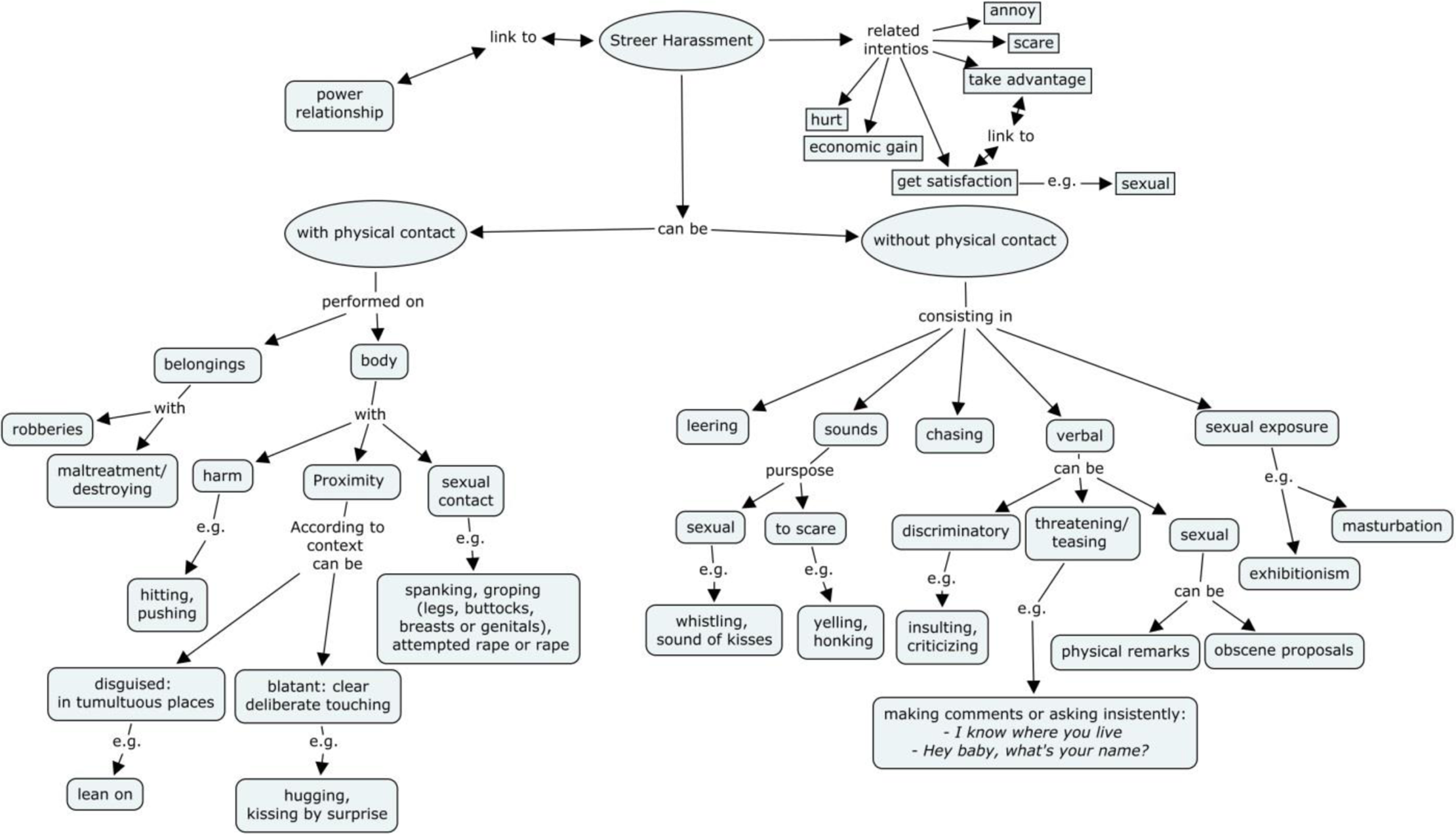
Adolescent’s street harassment characterization. Full explanation is given in the text.
Street harassment with physical contact
Physical contact implies touching and can be performed on either the belongings or the body of the harassed person. Harassment made to belongings takes the form of robberies, maltreatment, or destruction. The adolescents define this type of harassment with the intention of obtaining economic gain, to mistreat or to annoy someone. Street harassment that targets belongings commonly involves adolescent males (e.g., Manuel, a 15-year-old boy said, “a young drugged boy stole my cellphone 1 ”; another participant in the survey, a 14-year-old boy said, “Nearby my school, some guys asked me money to pay their bus ride. They pulled out all my belongings from my backpack and stole my MP3”).
The respondents identified three types of street harassment with physical contact on the body, namely harm, proximity, and sexual contacts. (1) Harm consists of violent actions that cause maltreatment, such as hitting or pushing. They are associated with the intent to hurt or annoy. This is one of the types of harassment that men experience most (e.g., Participant 186 in the survey, a 14-year-old boy said, “Harassment is when someone maltreats you or hits you”; Participant 431 in the survey, a 15-year-old boy said, “my cousin ignored the young people who were swearing at him, they got angry and beat him”). (2) Proximity involves annoying nonconsensual physical contact. The associated intentions are as follows: to scare, to annoy, to take advantage, or to get satisfaction. Physical proximity is mostly experienced by adolescent women. According to the context and the way it is performed, proximity can be disguised or blatant. Proximity contact can be disguised with unintentional touches. Usually, they are fostered in tumultuous places, such as public transportation during rush hour (e.g., Participant 427 in the survey, a 14-year-old girl said, “a stranger on the bus was groping my friend's buttocks…but just with a slight touch”). Often, women hesitate to take action because they may be confronted with the following: (a) a feeling of discomfort, regularly increased by previous street harassment experiences and (b) because the tumultuous situation is propitious to proximity, the harassment is unclear or it is impossible to identify to the harasser (e.g., Participant 164 in the survey, a 14-year-old girl said, “my cousin was groped [her legs and buttocks] when she was getting off the bus, but it was unclear who was because the bus was very crowded”). This proximity contact generates in women dissonance and confusion between the feeling of true harassment and the fear of overestimating their perception of potential harassment. For instance, Jessica, a 15-year-old girl, complained:
some men in the bus appear to be sleeping and lean on you. They may make touches that you feel are not accidental, but you do not know if they do it to take advantage of you. Then, when finally you decide to complain, they reply “you are crazy.” So, sometimes you just do not know what to do.
Blatant is another type of proximity contact done with the intention to touch. They are clearly interpreted as street harassment because adolescents can identify them as actions addressed to them. It can include behaviors such as hugging, kissing by surprise, or getting too close when there is enough free space to avoid physical contact. In these cases, the adolescents are more likely to complain to the harasser (e.g., Participant 83 in the survey, a 14-year-old girl said, “My friend was going to school, a man approached her to ask for an indication, but then he tried to give her a kiss. My friend pushed him and ran to my house”; Participant 423 in the survey, a 13-year-old girl said, “one day I was asleep on the bus and suddenly felt something on my leg, I thought it was an animal, but when I woke up I realized it was an old man’s hand. I told him ‘what is wrong with you’ and he got off the bus”). (3)
Sexual contacts are actions directed toward intimate body areas where the harasser treats the harassed as a usable object, as a fetish. Sexual contacts mainly are materialized with spanking or groping and rubbing of legs, buttocks, breasts, or genitals but can escalate to rape. Sexually harassed people are reduced in their human quality to merely body parts that are available for the harasser’s satisfaction and will (e.g., Participant 371 in the survey, a 13-year-old girl said, “I was crossing a dark bridge, giving no importance to the woman behind me, but as I ascended the stairs she grabbed my butt really strongly and she got her fingers inside me, I screamed but no one helped me”).
Usually, sexual contacts take place in a few seconds, even in the presence of other people. Harassed people are shocked by such unexpected behavior. Frequently, they do not have enough time to react to confront the harasser. Besides, in most sexual contact, there is no supporting physical evidence in order to report because of the difficulty in identifying the harasser and because of the absence of marks on the body (e.g., Participant 516 in the survey, a 14-year-old girl said, “Today, while I was coming to school on the bus, a guy started to touch me and threatened me not to scream. It was a truly terrifying moment; I was desperate and felt so helpless”).
In this study, a rape, or rape attempt, was considered by girls as the most violent form of sexual contact and one of the most feared. Although not the most common, we found it as a shadow that marks the practices that adolescent women have had in public spaces. Related to another form of harassment, the girls expressed thoughts of fear about its possible escalation into rape (e.g., Susana, a 16-year-old girl, had experienced attempted rape, “I was in the bus alone, with the driver and his companion, and he started to touch me all over, I could not speak or do anything”; Rosa, a 15-year-old girl said, “What you fear the most is being raped”).
Street harassment without physical contact
Other types of harassment are those that are committed without physical contact (see Figure 1). These consist of a variety of behaviors that do not leave visible marks, so it is difficult to denunciate them. Mainly, they produce discomfort and anger. The adolescents in this study distinguished the following five forms of street harassment without physical contact: leering, sounds, chasing, verbal comments, and sexual exposure. These are explained in the next paragraphs. (1) Leering is commonly perceived as an obscene manifestation of a sexual attraction that is uncomfortable (e.g., Jessica, a 15-year-old girl said, “There are some looks where you feel as if you are undressed”). (2) Sounds made by harasser with sexual connotation (e.g., whistling and sound of kisses) or to scare (e.g., yelling or honking). For instance, Participant 472 in the survey, a 14-year-old girl said, “Street harassment is when you’re walking down the street and someone whistle or honk at you.” (3) Chasing produces insecurity and uncertainty with different interpretations between men and women. Although both men and women fear assault or beating, women also fear being kidnapped and especially being raped. When girls are chased their alert system wakes up to find and make self-protective strategies to avoid rape (e.g., seeking places of refuge or changing their route). For instance, José, a 15-year-old male, was very surprised by women’s thoughts when they were followed by strangers, “I just think that perhaps that person is going the same way that I am going, or in the worst of the cases, that he wants to get into a fight. But, I am surprised of what women think in these situations (that of being kidnapped or raped).” (4) Verbal comments can range from whispering to yelling and is subdivided into the following: (a) degrading and discriminatory comments (e.g., insulting, criticizing, name-calling, racist, or homophobic comments; for instance, Participant 124 in the survey, a 14-year-old boy said, “I have been discriminated against because of my skin color or because I am small in stature and I have been mistreated),” (b) sexual connotation with physical remarks (e.g., an evaluation of the body or the appearance: you are pretty/hot) or making obscene proposals, and (c) threatening and teasing by making comments or asking questions insistently (e.g., what’s your name, baby? Where do you live?). (5) Sexual exposure, such as exhibitionism and masturbation, generally produce a high impact on witnesses. Being so surprising and unexpected, sexual exposure can produce confusion, paralysis and subsequent momentary uneasiness, and guilt in the harassed person. The guilt comes after the harassment is over, and for not being quick enough to react differently. Some people may even resort to self-scolding. Because of its high emotional impact, sexual exposure endures as a fact that, like sexual contact, leaves a significant mark on the memory (e.g., Participant 522 in the survey, a 14-year-old girl said, “A man talked to me and he was masturbating, I was afraid and went to tell my mother”).
Street Harassment Prevalence
Street harassment’s prevalence was subdivided into those that have been experienced and those that have been carried out.
Street harassment experienced by adolescents
Almost half (49.8%) of the adolescents in this study have experienced street harassment. The first incident occurred between age 5 and 16 years (M = 11.24 years, SD = 1.90). We found no statistically significant differences among genders in age (t = −1.60, p = .11). However, we found gender-significant differences in the experience of harassment (t = −10.44, p = .00). Women have experienced harassment more frequently (67.7%) than men (25.5%), and they were harassed at a younger age (M = 10.80, SD = 2.49 in women vs. M = 11.36, SD = 1.70 in men).
Adolescents as harassers
Approximately 10.93% of adolescents (6.43% of women and 16.90% of men) admitted that they have harassed some strange person in a public space. Table 1 shows the gender of the harasser and the gender of the harassed person. Preponderantly, men and women harass the opposite gender within their specific age range.
Street Harassment Percentage By Gender.
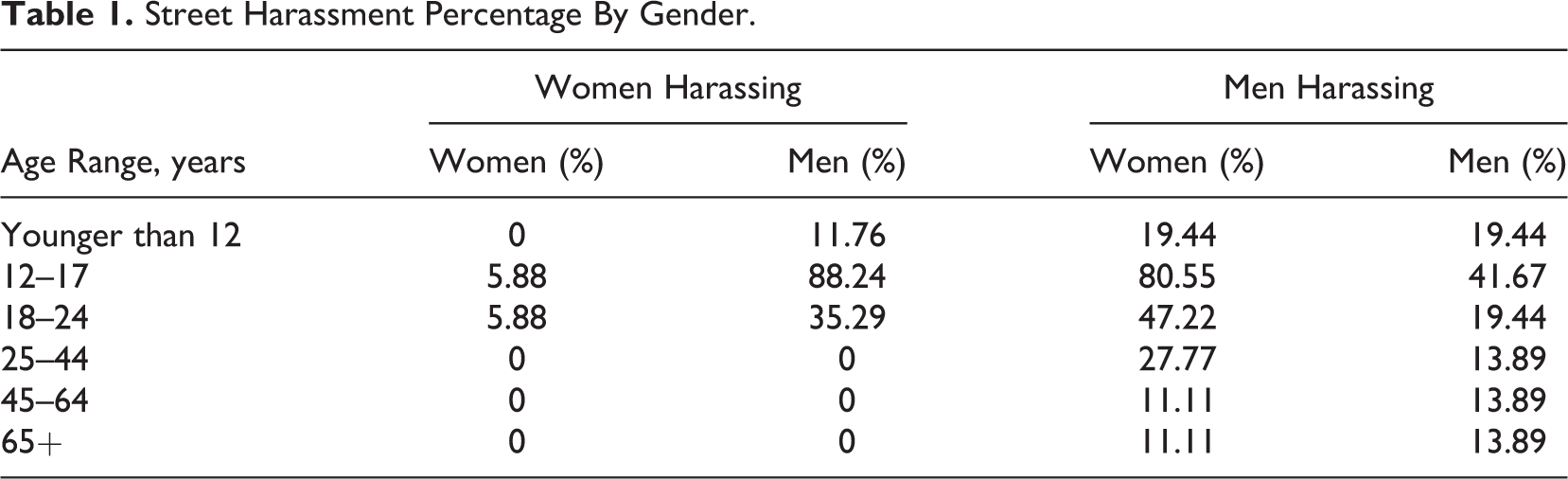
For the most part, adolescent men carried out street harassment without physical contact (72.22%), which corresponded to whistling (30.56%), verbal abuse (25%, e.g., swearing), and physical remarks (16.67%). Among harassers in men, 33.33% used physical contact, corresponding to a sexual nature (22.22%, e.g., groping), harming (8.33%, e.g., hitting), and proximity (2.78%, e.g., hugs).
Women as harassers generally harass without physical contact (83.33%), such as making verbal comments with insistent questions (27.78%), physical remarks (22.22%), whistling (16.67%), and leering or staring (16.67%). Because some women (22.22%) reported “bother” without citing any action, this was classified as indeterminate. Finally, we found that 5.56% of women admitted to harass with physical contact such as by groping.
Discussion
Women learn to live and deal by themselves with street harassment. We found that street harassment has an alarming prevalence from a very young age (11.24 years on average), and the ratio of experienced harassment between adolescent women and adolescent men is 2.65. Women’s feelings of discomfort on a specific event regularly are increased by social learning (Bandura, 1977), which may be derived from previous street harassment experiences. So, street harassment reinforces through repeated acts repetition the place of girls and women in society. A society where women have to learn to cope with street harassment in isolation, because the external response to validate their discomfort or their defensive action does not exist, is unjust.
We found that denouncing street harassment is difficult for various reasons. In some cases, street harassment can be disguised with unintentional touching, and it is difficult to react in the very few seconds in which it can occur. As mentioned previously, often it is not known who the perpetrator of the harassment is, and when it is possible to see the harasser it is difficult to enforce an accusation without access to the identity of that person. Additionally, such an accusation may face the possibility of flaws in the justice system. Thus, repeated experiences on street harassment picture the perspective of an insecure and unwelcoming world for girls.
Street harassment is related to the characteristics of what Agamben (1998) conceptualize as state of exception. The harasser is awarded the power to act with impunity, regardless of the anger, the indignation, or the discomfort he or she causes. Mostly, acts of sexual harassment are committed by men against women and have different gender implications. For men, it involves a social structure in which they can act without penalty, in a hierarchy that place men at a higher position than women. Within such a hierarchy, women learn to be treated as objects to be used. Hence, the harasser is positioned in a privileged condition. These features may be considered to be related to the figure of Zoé (Agamben, 1998) or nude life—a life without quality of citizen’s rights. In this case, the rights are not fully available to harassed people and, where it is created in a state of exception, laws do not apply to that group of people who are positioned in a subordinate condition (Spivak, 1988). From street harassment, girls learn to be objectivized as a fetish, as a consequence of being women. As we have argued, their place as objects is assured when they are ignored, and the roads to justice are so twisted and complex. Street harassment is a practice that reaffirms a place characterized by hierarchical power differences, where an established cultural and social order prevails (Witting, 1992), leading to rules of a system of domination (Bourdieu, 2005).
The recurrent theme of street harassment of women points to a mechanism of social control. It is a form of sexual terrorism, where women must remember their vulnerability to violent sexual assaults (Fogg-Davis, 2006; Sheffield, 1987). Street harassment is linked to sexual terrorism because women know it may happen, but they are not certain when or how it will happen (Fogg-Davis, 2006). It is a form of intrusion that society accepts as common and as a result can be easily trivialized (Sheffield, 1987).
From this study, street harassment is a mechanism to continue the hierarchical social order sustained by patriarchy. It establishes a cultural pattern where there is a different reality in the life of women and men. The ones who take the right to harass, mostly men, exercise the power to act with impunity, whereas those who are harassed, mostly women, develop a self-protection alert that has the effect of reminding them of their vulnerability. It is this action of vulnerability that reaffirms to women their lower place in the hierarchical order—characterized by different power distribution between genders—that establishes and maintains social control.
Conclusion
This article characterizes street harassment supported by the experience of male and female adolescents as harassers and harassed persons. This characterization reveals important sociohistorical conditions within a rising city in the Mexican geoeconomical spectrum. It seems clear that a broad and overlooked violence issue is affecting the mobility and quality of adolescents’ life, especially that of women, even in a city with outstanding conditions of apparent prosperity.
Street harassment is a gender-oriented violence, considering how it is exercised and experienced by women and men. The findings described herein reinforce that street harassment involves forms of interaction among people socialized into a sex-gender system, where different dynamics of power take place, consistent with the sex roles assigned to them. Harassers are mostly men who direct their actions toward women—almost twice during adolescence. Often, men receive street harassment by maltreatment, robbery, and chasing. Since women are sexually harassed more than men, this produces a different experience for genders. In a street harassment situation, men are afraid of being beaten, while women, in addition, fear being raped. Because of that potential escalation, women learn to live under uncertain and frightening conditions from an early age, from the time they begin to experience sexual harassment in public spaces.
The findings from this study call for a legitimate effort to address a phenomenon that divides society to augment the little attention that street harassment is receiving and to study and understand it in all of its complexity, in order to contribute to an essential social justice transformation. Social workers are propitious agents to change the culture of harassment by promoting programs in educational settings to reduce and then prevent this violence.
Because other studies have found that sexual abuse has a high positive correlation with shame (Yoon, Stiller Funk, & Kropf, 2010) and decreased self-esteem (Harter, 1999; Putnam, 1999), especially in children (Feiring, Taska, & Lewis, 1998), our future research will study the relationship between harassment in public spaces and adolescents’ self-esteem.
The limitation of this study should be considered when interpreting our results. Even when questionnaires were collected anonymously, they were self-reported and might be influenced by social desirability. Besides, sampling was conducted in Queretaro and it may not be generalizable to other populations.
Footnotes
Declaration of Conflicting Interests
The author(s) declared no potential conflicts of interest with respect to the research, authorship, and/or publication of this article.
Funding
The author(s) received no financial support for the research, authorship, and/or publication of this article.