




Abstract
For the past few decades, Kerala, India, has been heralded as the model of development and has attracted significant media and academic attention. Among its most noteworthy achievements are its literacy, life expectancy, and mortality rates and state government spending on social welfare. However, these macrorealities mask many unpleasant microrealities, such as subjugating cultural practices and violence against women. This article explores the social system of Kerala to identify the invisibility of highly literate women in Kerala. The objectives are to deconstruct the gender paradox in Kerala and to discuss strategies to transform the dominant discourse including social work.
Kerala, a southern state of India, has received significant attention from the international development community since the 1970s for its human development indicators. Amid low levels of economic growth, Kerala is renowned for its achievements in literacy, life expectancy, and mortality rates. In what has been coined the “Kerala model” of development, the state is recognized as an anomaly, with its high human development index and low per capita income (Devika, 2006; Ramanathaiyer & Macpherson, 2000). Kerala enjoys a tropical climate and is covered in lush green vegetation, in contrast to the more arid climate of northern India (Menon, 1979). Malayalam is the predominant language of the region. The majority of Kerala’s population subscribes to the Hindu faith; however, this region also has a significant number of Christians and Muslims. Prior to colonization, marumakkathayam—the matrilineal system of inheritance—was practiced in many Hindu families. However, in the early 20th century, it was increasingly condemned by Hindu men who wanted to reform the matrilineal system (Menon, 2008). This reformation, in part, was a result of colonization, which paved the way for a patriarchal social structure with the importation of Western values. Among the changes brought about was the shift in ideology to emphasize men’s right to assert power over women (George, 2008). Currently, traditions are dictated and interpreted through male dominance with the support of colonial-postcolonial patriarchal norms. The influence of men is evident in all aspects of life in Kerala, from the home base to professional and social spheres (Mitra & Singh, 2006).
My motivation to write this article came from my personal reflection as a Kerala woman and my professional reflection as a social worker. The professional social work education in Kerala developed through a process of cultural borrowing. It has adapted Western philosophy, with the expectation that professionals will integrate Western theoretical concepts into social work practice in Kerala. In considering the lived experiences of the shattered Kerala women as a social issue, one needs to examine how social work in Kerala addresses this social problem. The objective of this article is to deconstruct the gender paradox in Kerala and discusses strategies to transform the dominant discourse, including social work.
The Gender Paradox
Kerala women experience a unique circumstance of empowerment and oppression. Statistics have revealed that they are irrefutably the most literate in India, which has contributed to other indicators of social development that appear favorable to them. The Kerala model of development has garnered the attention of the media and academics and has contributed to the image of the Kerala woman as one who is less oppressed by patriarchy; however, there appears to be a “gender paradox” (Mitra & Singh, 2006). The higher level of literacy, improved access to health care, the cultural movement toward smaller families, and weaker taboos with regard to education and employment for women have not significantly improved the range of life choices for women in Kerala (Devika, 2006).
Education
Since its inauguration as a state in 1956, Kerala has been governed predominantly by a democratically elected Communist Party whose social and educational reforms have resulted in one of the highest literacy rates in India. In a 2005 study conducted by the Centre for Women’s Studies and Development, all the 100 participants were literate, with 49% reporting minimum secondary level education. Female literacy in Kerala has been found to be 88% compared to 55% for the rest of India (George, 2008). Literacy reforms in Kerala encouraged women to pursue educational and employment activities, and, as a consequence, the mean age of marriage increased. According to the Human Development and Socioeconomic Well Being report of the Kerala State Planning Board (2010), the mean age of marriage for women in Kerala is 22, compared to 19 for the rest of India (see Table 1 ). The Communist Party provided the people with an arena to learn and expand their intellectual horizons within cultural boundaries. These boundaries have included limiting women’s roles to nonleadership positions, lack of decision-making power in society, and continued subordination to men. Although educational attainment is encouraged, it tends to focus on a woman’s role as a wife, mother, and primary caregiver. The human capital investments made by the women of Kerala are traditionally geared toward general liberal arts education, in which women learn about education, health, and better child care (Mitra & Singh, 2006).
Gender Development Indicators in India and Kerala
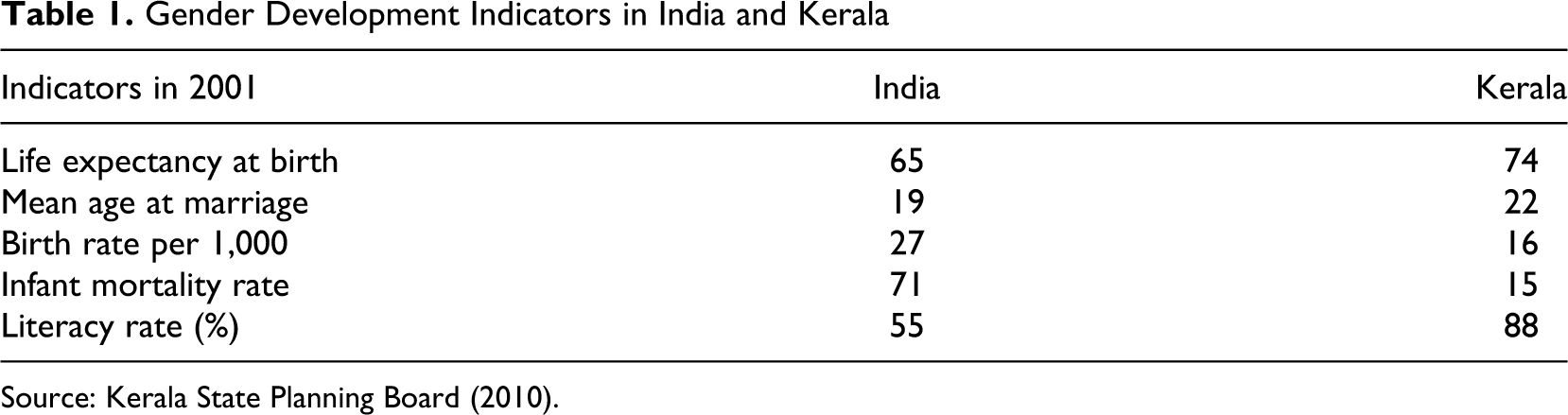
Source: Kerala State Planning Board (2010).
It is commonly believed in Kerala that a woman’s legitimate place in society is as a mother, daughter, sister, or wife and that education is only ornamental and nonessential. The education of women has not broken the bonds of religious customs and traditions that have hindered women’s mobility for years. Saradamoni (2000) conducted interviews with male professionals about the reasons why women lag behind men in professional arenas. The men’s responses revealed significant facts about the lives and positions of Kerala women. They identified the absence of safety on the streets, which prevents women from attending classes; women’s lack of exposure to the world at large; parents' anxiety about finding suitable husbands for daughters with professional degrees; and the belief that men have a greater analytical capacity. Women are not denied access to schools, colleges, or workplaces; however, the paths to achieving these endeavors are obstructed by multiple road blocks (Saradamoni, 2000).
The experience of many women in Kerala with a higher level of education is the desire for high-status jobs coupled with a shortage of white-collar professional jobs. Another reality in the workforce is discrimination against women, which prevents them from achieving upward mobility because of the perception that women play a secondary role in the labor market (Mitra & Singh, 2006). Moreover, a woman’s educational status in Kerala does not allow her to digress from the cultural norms of relinquishing her job to obtain a husband. In marital relationships, the woman’s position is that of the subordinate partner. Crime in India (National Crime Records Bureau, 2008) identified a high suicide rate among female undergraduates (31%) and postgraduates (32%) in Kerala. These statistics illustrate the negative results that arise from socially controlled education for women. Furthermore, the report of the Centre for Women’s Studies and Development (2005) also identified a correlation between higher literacy levels and mental distress among women. Women in Kerala generally have a high level of educational attainment, but the liberation associated with their literacy is curtailed by cultural practices that serve to limit their autonomy.
In Kerala, a woman who is employed is unable to spend her earnings without the permission of her husband. According to the National Family Health Survey (2005–2006), only 66% of women in Kerala have access to money, compared to 79% in Tamil Nadu, India. Media reports from Kerala suggest that crimes against women are rooted in anger resulting from a woman’s social status or employment. Women with financial leverage are often perceived by their male counterparts as a threat to their power and status as breadwinners for their households. Moreover, men are threatened by the idea that an employed woman’s successful financial independence promotes the woman’s awareness of her potential and ability to make decisions on her own.
Physical and Mental Well-being
According to the Kerala Human Development Report 2005 (United Nations Development Program, 2006), the life expectancy of women, maternal mortality rates, infant mortality rates, and fertility rates in Kerala all compare favorably with those of many wealthy developed countries. Of the 137 places that were evaluated, Kerala ranked 80th, a position that surpassed India, which ranked 103rd (Kerala State Planning Board, 2010). However, looking more closely at the numbers reveals striking gender discrepancies. In Kerala, the prevalence of acute morbidity and chronic disease is higher among women than among men. This disparity is due, in part, to the workloads and burdens carried by women, which exceed those of men. Women are responsible for household chores, including shopping for food and supplies; cooking; cleaning; washing; and attending to the needs of their children, husbands, and husbands' parents (less often their own parents). The work performed by women is by and large undervalued, with husbands often complaining “aval onnum cheyyunnilla,” which translates to “she is doing nothing” (Ramanathaiyer & Macpherson, 2000). For women in Kerala, marriage is supposed to be their primary goal in life, and they have the responsibility for making a happy and contented home. Subservient gender roles are ingrained from an early age and are reinforced by the media (Saradamoni, 2000).
Women in Kerala are expected to attend to the needs of their families often at their own expense. A woman’s social relationships and networks are often not given importance. Rather, in many ways, the lives of these women are restricted to the roles of wife, mother, and daughter of the household. Whereas 60% of women in Tamil Nadu do not need permission to visit their friends or relatives, only 40% of women in Kerala enjoy this freedom (Suchitra, 2004). Many men in Kerala fear that a woman’s elevated social status associated with her employment and her meaningful social relationships may threaten their power and control. By insisting that the woman become a housewife, the man ensures her social isolation. According to a report published by the Centre for Women’s Studies and Development (2005), there has been a visible increase in the number of women requiring psychiatric services for depression and other mental disorders caused by social and economic factors. Women are under constant pressure from their families and communities to relinquish their independence and pursue a subordinated marital life, which contributes to their depression, anxiety, and suicide.
Violence
Kerala boasts favorable gender development indicators despite its high rates of female depression and suicide and, as a result, continues to be viewed by some as a role model for women's development. Despite the advanced literacy and older age of marriage for Kerala women, suicide rates and violence against women are on the rise, and research has suggested that a significant proportion of family violence is related to dowry-related payments, performance in school, unwanted pregnancies, and wife beatings (Mitra & Singh, 2006, 2007; see also Table 2 ). The Centre for Women’s Studies and Development (2005) reported that 67% of the Kerala women in their study were subjected to psychological violence and had no decision-making power in their lives. The violence against Kerala women, specifically patriarchal societal oppression, has been documented as a serious concern by social researchers. Regardless of high literacy, societal practices persist that perpetuate the notion that all women should be submissive to men and invisible citizens.
Crimes Against Women in Kerala
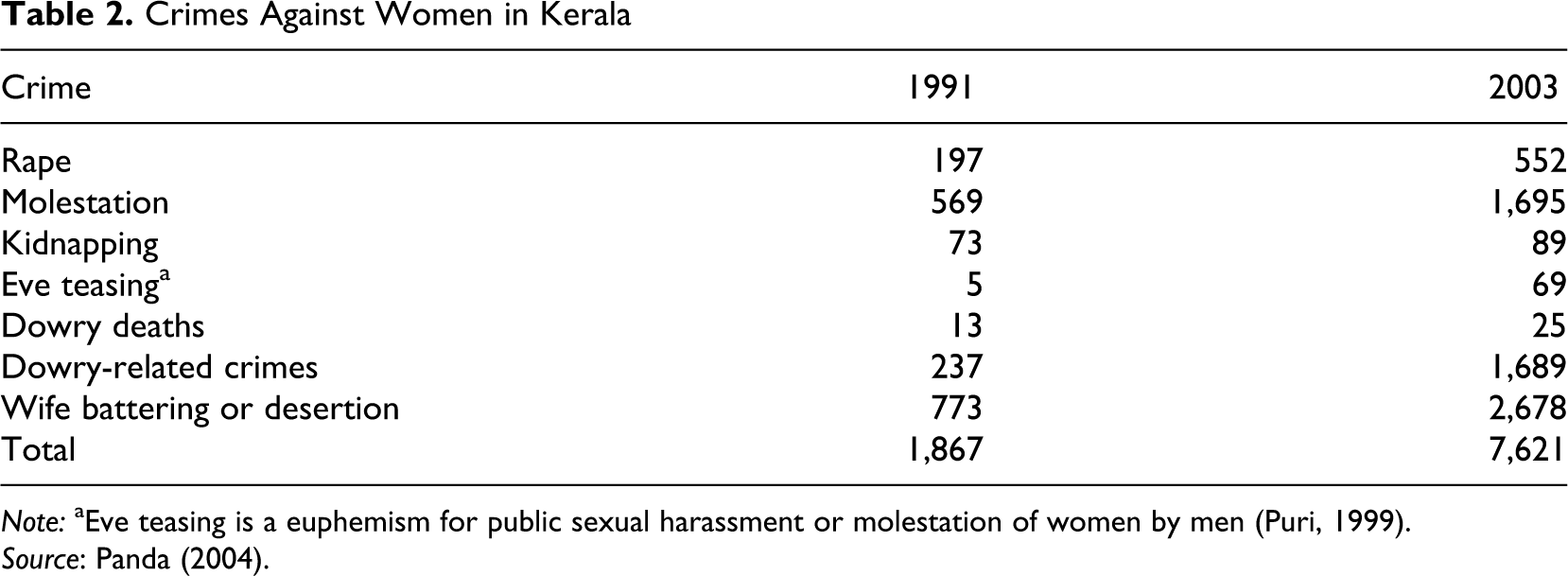
Note: aEve teasing is a euphemism for public sexual harassment or molestation of women by men (Puri, 1999).
Source: Panda (2004).
According to Panda (2004), violent crime rates against women in Kerala, including dowry-related issues and wife battering, are higher than the national average. The incidences of domestic violence, sexual harassment, and violence from in-laws have significantly increased over the years (Sharma, Reader, & Gupta, 2004). The issue of violence and oppression is a systemic one that emerges from everyday practices.
The Muting of a Gender
The oppression experienced by women in Kerala is structural and emerges from societal norms and dominant meanings related to women. Women have become a group made invisible by the stereotypes and beliefs that are inherent in Kerala society. The male-dominated powers reinforce their position by subjugating women according to dominant norms (Young, 2006). The recent attention given to violence against women in Kerala has exposed the ways in which sexism has been intertwined in Kerala society. Traditionally, human development theories have been measured according to individuals' attainment in life. However, they have not paid attention to the structural impact on human development. Health concerns have been recognized as different from the traditional human development form of thinking, thus requiring a unique definition that is not merely related to the traditional norm. Similarly, many of the challenges of women in Kerala have been identified and made visible through research on the Kerala puzzle crisis and the advocacy work of many self-help and feminist groups (Sunny, 2003). These developments provide an opportunity to expose gender inequalities as evidenced by a declining sex ratio (differential female mortality), as well as inequalities in education, income, access to health care, and political representation (Katzenstein, 1989).
It is a harsh reality that the women in this Indian state have been treated as a commodity and are still largely influenced by deep-rooted social norms. Customs, such as dowries, marriage at a young age often to older men (leading to early widowhood for many women), and the stereotyping of the ideal woman as submissive, have resulted in the physical, mental, and spiritual subjugation of women. The dowry system remains steadfast in Kerala, where even educated women feel compelled to comply with this custom of providing money or goods to their husbands upon marriage. Women are housebound, and their individuality is obscured by their primary domestic role. Thus, Kerala women are subject to discrimination on the basis of gender, caste, and class. Tradition, culture, family, society, and the state—all patriarchal in structure and ideology—have oppressed women and muted their identity, often resulting in elevated rates of suicide or an inevitable acceptance of the oppression that envelops them.
Kerala women face multiple oppressions by men because of their educational and employment status. Many of the reports published on the Kerala puzzle have emphasized the double bind that often confronts women. A woman who has a higher level of education and professional aspirations is seen as threatening to the patriarchal social structure, which increases the violence that women face in society. This double bind leads women to remain silent and submissive.
Stevens (1994) identified silence or controlling information as a protective strategy by which women attempt to interact with society. In fact, several researchers have concluded that women remain silent for fear that their confrontation or self-disclosure will increase the oppression they face (see, e.g., Sharma et al., 2004; Stevens, 1994). The invisibility of women as a result of expected cultural notions is most obvious in the area of sexual violence. Women are often portrayed as material objects for men’s satisfaction, which leads to the idea that women are not only the victims of cultural expression but internalize the expressions that are inherent in their patriarchal society. Sex education is not common in Kerala society, and, as a result, women are often victimized. Media reports have concluded that the majority of victimized women do not access supportive services because of the stigma of doing so or an expectation of increased violence against them (Sharma et al., 2004). It is not surprising that self-disclosure requires both a considerable amount of courage and a strong support system. Sunny (2003) found that many women in Kerala who disclose their abuse to service providers feel ignored, dismissed, subordinated, silenced, shamed, and/or denigrated. Because service providers work within this patriarchal system, they may unintentionally cause victims of abuse to feel responsible for their encounters or perpetuate the cultural beliefs around expectations of a woman’s acceptance of her life situation.
Analyzing the Kerala Puzzle
The experiences of women in Kerala warrant an examination of the social and cultural environment of this region that has given rise to gender inequality. The Kerala puzzle suggests that human development indicators need to correspond with social and structural change to ameliorate gender inequality and its impact on women. For structural change to occur in the state of Kerala, structural oppression must be addressed. Grassroots movements, in addition to research and the dissemination of information on oppressive practices and violence against women, are shedding light on a wide array of women’s experiences and perceptions as well as those of the dominant powers. Many different theoretical approaches may be applied to identify the societal barriers to women gaining respect as rightful citizens. But feminist discourses are particularly relevant in the discussion and examination of power relations and impediments to structural change.
Feminism is about women claiming their right to self-determination and equality (Bhattacharya, 2007). The struggle for equality is also about “understanding women’s resistance to sexism—how they use the power that is available to them, how they claim their space where they can, how they build alliances, how they engage in acts of subversion, and how they ask others to bear witness to their pain” (Dabby, 2007, p. 7). Feminists from Asian countries have criticized the Western philosophy-based knowledge that not only wrongly claims universalism but is insensitive to issues of race, class, and cultural difference (Li, 2009). The idea of multiple realities is crucial to the practice of social work in areas such as Kerala. It emphasizes the ways in which ethnicity, class, locality, and constructed identities affect the experience of women in Kerala.
The social construct of arranged marriages (agreements negotiated primarily between families) is common practice in Kerala by which men control women’s bodies. Many women in Kerala consider arranged marriage an “arranged rape.” From a young age, women are trained to see themselves as material objects that are controlled by their fathers in childhood, their husbands in adulthood, and their sons in old age. Often, women are forced into marriage to avoid the cultural stigma of being unwed. Marriage arrangements call for the woman’s family to arrange a dowry—money given to the groom upon marriage. These factors can contribute to deep feelings of remorse and insecurity. The gender oppression in Kerala is so entrenched and pervasive that females today are viewed as both material objects and a social and economic burden. When communities resort to culture to explain and justify violence against women, their claims are based mostly on an outdated male-defined ideology (Mohanty, 1991). However, culture enables communities to defend their actions because the actions are in accordance with commonly practiced norms (Chong, 2006). This defense explains how it is that male authority figures are protected and respected in the state of Kerala and elsewhere. Moreover, it provides the justification for gender inequity and violence. The phenomena of the Kerala puzzle, including the subjugating cultural practices, calls for a deeper exploration of women’s issues. In Kerala, feminism exists only as an ideology, not as a practicing tool; its integration with social work provides practical relevance for the feminist ideology (Rosser, 1999).
No theoretical framework can support the notion that social issues should be practiced or studied in isolation. If one of the goals of social work is to represent the oppressed groups in society, then social needs and challenges must receive more attention and should be studied, analyzed, and practiced within the context of the society in which the groups live. One of the tenets of social work is the idea of “meeting clients where they are,” which speaks to the importance of acknowledging the individual experiences of clients, rather than the assumptions of the clinician (Archer, 2009). By ignoring clients' unique experiences, social workers silence the experiences of women from different social and cultural backgrounds, including those in Kerala. By ignoring women’s voices, society normalizes the oppression of women and perpetuates inegalitarian relations. Many theories may consider that oppression against women in Kerala is culturally reasoned. These theoretical approaches view the Kerala woman’s experience as individualistic; by doing so, they consider women’s oppression a private matter not to be discussed. Women’s invisibility lies in the success of normalizing universal patriarchal power by excluding the realities of women. The process of normalization emphasizes what is expected in a society (male power equals normal) and what is not expected in society (female power equals abnormal). Through such discourses, women’s oppressive experiences are viewed as those of “others” and “different.” This kind of individualization is an insidious process that leads to culture blaming and silencing women and ignores any effort to fight against women’s subjugation. Kerala society must realize the outcomes of the normalization of male power and the individualization of women’s sufferings. Such normalization has the effect of making Kerala women invisible.
Social work practice in Kerala keeps a distance from “real” social issues and is thereby producing a group of social workers who lack community engagement skills (George, 2011). Engaging with local communities is a basic social work skill that needs to be achieved and practiced. Shifting the social work focus to learn, reflect, and act on the basis of local community knowledge can motivate social workers to respect local knowledge and use it to shape their unique identity as social workers from Kerala. To address social issues, social workers need to consider dimensions beyond Eurocentric social practices, such as giving a voice to the disenfranchised within their households, communities, and nations. They should create an environment that is conducive to intellectual discussions, reflections, and analyses on social inequalities and giving choices to the vulnerable populations in their own community (George, 2011). It is unlikely that female social workers in Kerala have not experienced oppression or witnessed that of other women. These experiences form the core knowledge base for social workers to respond to violence against women. Feminist scholarship could provide social workers with the impetus to transform these personal experiences into meaningful and shared narratives. Incorporating personal experiences into theoretical discourses will construct different interpretations by viewing society from authentic, rather than conventional, male-controlled perspectives. Any helping profession, especially social work, does not contest societal injustice and inequality, regardless of its cultural practices. Consequently, the profession fails to recognize the core objectives of social work. The integration of feminism into social work practice would create a solid face against the subjugation of Kerala women and transform social work into a more constructive discipline with a stronger base to oppose social injustice and human rights violations.
Strategies for Social Work Practice
The invisibility of women inhibits progress toward identifying women’s unique struggles in Kerala society. The failure to acknowledge women’s experiences increases women’s vulnerability. The determinants of health are not only biological learning modules to be used in classrooms; rather, the concepts need to be expanded to include the structural challenges of violence, dowry, the lack of inheritance rights, discrimination, oppression, and inadequate housing. Social workers in Kerala need to work with its citizens on these issues.
Social work is an empowering profession with a discourse committed to professional values based on the principles of human rights and social justice (Payne, 2005). Intersecting feminist analysis with social work provides social workers with a knowledge base to examine the impact of structural forces on women’s marginalization and oppression. Creating and understanding one’s own standpoint and participating in self-reflection, as well as social and cultural dialogues, are strategies that can assist social workers to engage with meaningful and productive practices in Kerala society. The use of such strategies could help to shift the focus from dominant discourses on sexism to marginalized discourses that deconstruct women’s invisibility. By adopting these positions, social workers can resist and work to transform societal practices that exclude and silence women and assume a leadership role to act against the social control over women in Kerala. The goal of such strategies is not to reformulate a new discourse reflective of vulnerable women but to provide social workers and members of the community alike with different ways by which they can expose the power that lies within discursive practices.
Social workers rely on social work values of acceptance without judgment. In an ideal situation, these values should help them to accept and respect clients and their unique experiences. However, most social workers work within the boundaries of organizations that follow prescribed agendas that may not be in line with social work values. In such scenarios, they need to create their own space, so they can begin to address the oppressive practices against women. This approach is particularly important for addressing the Kerala puzzle because most of the social welfare organizations in Kerala are operating under different religious-, class-, and caste-based organizations. These organizations keep an “oppositional positionality” as a means by which they speak and act for themselves within a collective discourse (Halperin, 1995). Social workers who perform under these individualistic organizations need to move away from male-dominated power in a patriarchal society and instead reemphasize the subjective experiences of women. hooks (1990) discussed this strategy as the action of resistance. Marginalized individuals are not a separate body; rather, they are part of the diverse makeup of society. Social workers who already have marginalized positions in organizations can accept their marginality and work from the subjective experiences of marginalized women (Daley, 1998). Social workers can function as the link between patriarchal society and the oppressive experiences of Kerala women.
Another key approach for social workers is to give importance to self-reflection. Self-reflection begins with an examination of the interpretive tools we social workers use and how they have been shaped by our culture and dominant discourses. As social workers, it is our duty to acknowledge that our experience of the world is also an interpretation of it. This recognition enables us to begin to explore the adequacy of our conceptual frameworks (Young, 2006). Most social workers in Kerala have personally experienced and/or witnessed the oppression experienced by Kerala women. They have the responsibility to reflect on their lived experiences and understand the ways in which these experiences can fuel their efforts and practices. The knowledge that social workers gain through their subjective experiences has to be reflected upon and examined to separate the centrality of male power. This self-reflection and self-awareness are necessary to integrate the knowledge gained from these experiences, both personal and professional, into knowledge sharing. The inclusion of personal experience into practice reflects social workers' personal and professional expertise as part of their practice, which leads to total involvement.
Conclusion
The Kerala puzzle demonstrates the need for human development to correspond with social and structural change to ameliorate gender inequality and its negative impact on women (Mitra & Singh, 2007). Many helping professions, including social work, that were imported into developing countries seldom consider the perspectives of local inhabitants and their living environments. Because of the lack of connections with the community they serve, social workers lack knowledge about the community’s needs. Baskin (2002) discussed an indigenous approach to social work that gives importance to the maintenance of balance among individuals, families, and communities. Such an approach can be implemented only if social workers connect with their living environment through social dialogues. These dialogues will result in effective social work strategies that are socially and culturally relevant, politically viable, and economically sustainable. To do so, it is necessary to work with communities so that individuals can begin to understand the communities' needs and learn to mobilize the communities' resources to address these needs. To achieve this result, social workers should accept their role as social agents to work toward giving a voice to the voiceless.
Footnotes
The author declared no potential conflicts of interest with respect to the research, authorship, and/or publication of this article.
The author received no financial support for the research, authorship, and/or publication of this article.