




Abstract
The social work profession has made a commitment to serve people who are marginalized and address issues at the direct practice level and the policy level. Beyond the Defense of Marriage Act, marriage inequality in the United States negatively impacts millions of individuals and families. A review of the history of same-sex marriage (SSM) and the current state of SSM suggests that actions at the state level continue to have far-reaching negative impacts. Issues of marriage equality and families headed by same-sex couples will require the advocacy and support of social work for decades to come.
Keywords
A 2009 Affilia article from “past and present” (Fredriksen-Goldsen, Lindhorst, Kemp, & Walters, 2009) served as a reminder to social work of the intimate same-sex relationships of the profession’s influential early women leaders. This matter is often overlooked when social work recites the remarkable efforts of Jane Adams, Mary Richmond, Jessie Taft, or Virginia Robinson. The same authors also challenged social work scholars to further the work on matters related to social justice with people who identify as lesbian. As social workers, we can honor this challenge by utilizing the feminist lens. Like other critical approaches, feminist theory seeks to identify the oppression and eradicate the source of inequality. Marriage inequality is a feminist issue—denying same-sex marriage (SSM) serves to command traditional male and female roles in marriages and promotes a family design that supports the patriarchal role as superior and minimizes women (Harding, 2007).
A recent conservative estimate indicates that 3.5% of Americans identify as lesbian, gay, bisexual, or transgender (LGBT; Gates & Newport, 2012). Applying that figure to the 2012 estimated U.S. total population of 314 million (U.S. Census Bureau Quick Facts, 2012) yields a conservative estimate of almost 11 million that do not have equal access. The Elimination of Defense of Marriage Act (DOMA) by the U.S. Supreme Court (U.S. vs Windsor, 2013) does not equate to national SSM nor will it end discrimination toward same-sex headed families. It does however, at minimum, allow the possibility for same-sex headed families, allies, and professionals to advocate for equal rights and create systems that support equal access. Most states do not allow SSM and as a result millions will continue to be denied access to the financial and civil benefits that accompany marriage (After DOMA, 2013).
The struggle for marriage equality will continue at the state level. Some states may also continue to expand laws that oppose SSM. The elimination of DOMA does not prevent individual states from banning SSM nor does it require states to recognize marriages performed in other states. States that do not recognize SSM can discriminate against families headed by same-sex couples and those same state laws may deny same-sex couples and families 1,138 federal benefits, rights, and privileges (After DOMA, 2013; Holtz-Eaken, 2004; Kubasek, Glass & Cook, 2011). Those who oppose SSM suggest that marriage is the sacred (religious) bond between a man and a woman for the unique purpose of procreating and raising children. They further argue that DOMA did not deny civil rights to any person but protected the rights of the each state to determine the legality of SSM (Marshall, 2013; Slattery, 2013). SSM supporters argue marriage in the United States provides access to basic rights, protections, and benefits that have far-reaching effects on all members of same-sex headed families at all ages and stages of life (After DOMA, 2013; National Gay & Lesbian Task Force, 2011, July 20).
Through the lens of feminism, this article will look critically at the history of SSM in the United States and the actions that led to the creation and demise of DOMA. The state’s responses to SSM are explored including current attempts by states to implement SSM or civil unions. The impacts of marriage inequality will be explored in relation to the distribution and access of federal government benefits, civil rights of citizens and families, and the impacts on institutions. Ethical and political factors will also be reviewed, and the article concludes with recommendations for practice in social work.
History
Efforts of same-sex couples to attain equal rights afforded by marriage in the United States can be traced back to the early 1970s. Although it was defeated in court, the first attempt at SSM legislation occurred in 1971 in Minnesota. These attempts to marry and advocacy efforts to pass domestic partnership legislation led to the states’ efforts to deny marriage to same-sex couples by defining marriage as an act of one man and one woman. As a result, advocacy for SSM moved to the local level. One of the first victories for opposite-sex couples occurred in a local municipality in San Francisco in the early 1980s with the creation of a city domestic partnership registry. An early victory at the state level occurred in Hawaii in 1993 when a trial court ruled that a state statute prohibiting SSM violated the equal protection as defined by the Hawaii Constitution. The court ruled that the state’s argument failed to prove that SSM had any negative effect on the public. Although voters in Hawaii later approved a constitutional amendment that allowed state legislators the option to reserve marriage for same-sex couples, the 1993 Hawaii court response created movement on the national level to ban SSM (Gay and Lesbian Advocates and Defenders, 2009; Kubasek et al., 2011; Robinson & Soderstrom, 2011). In an effort to nationally define marriage as one man and one woman, Rob Barr, Republican Representative from Georgia introduced DOMA on May 7, 1996, and it was signed into law by President Bill Clinton in September 1996. DOMA declared (U.S. Code, 1996) that no state or Indian tribe in the United States would be required to recognize relationships between same-sex couples or recognize SSM from other states. For federal government purposes, it defined marriage as a union between one man and one woman as husband and wife and spouse as a person of the opposite sex.
Some states acted in opposition to DOMA with attempts to create state-defined same-sex partnerships. Other states demonstrated support of the law by creating state laws that define marriage as one man and one woman. Vermont responded early to DOMA when in 1999 the state supreme court ruled that same-sex partners must be granted civil unions. In 2003, the Massachusetts Supreme Court declared the state DOMA law unconstitutional resulting in the first legal SSM in the United States in 2004. In the same year, attempts to amend the U.S. Constitution with language that banned SSM were defeated when the Marriage Protection Act of 2004 did not receive the needed votes to pass the Senate (Robinson & Soderstrom, 2011).
Interest groups on both sides continue to skirmish with the issue, often times repeatedly, taking the matter from court to higher court. Numerous efforts on both sides are also directed at the legislative system and electoral systems at both the state and national levels. California’s Proposition 8, a 2008 ballot measure that overturned legalized SSM, is a well-known attempt at state marriage and has been a public issue for more than 5 years and has climbed through the state and federal judicial systems. The U.S. Supreme Court (Hollingsworth v. Perry, 2013) refused to rule on the case, deferring the matter to the lower court and the state. The lack of a ruling by the U.S. Supreme Court favors same-sex couples in California because the lower court previously ruled Prop. 8 as unconstitutional (Cathcart, 2013). Conversely, Iowa’s passage of SSM was not subjected to the electoral process. In 2009, the Iowa Supreme Court ruled that denying SSM was unconstitutional. Though not without opposition, SSM exists without defeat in Iowa. The U.S. Supreme Court’s response to Prop. 8 will make California the 13th state to allow SSM as of July 2013. As shown in Table 1, there are 6 states that offer civil unions or domestic partnerships and 34 states have either a constitutional ban or law against SSM or same-sex relationships recognition in any form (Defining Marriage, 2013; Freedom to Marry, 2013).
Same-Sex Marriage Laws by State.
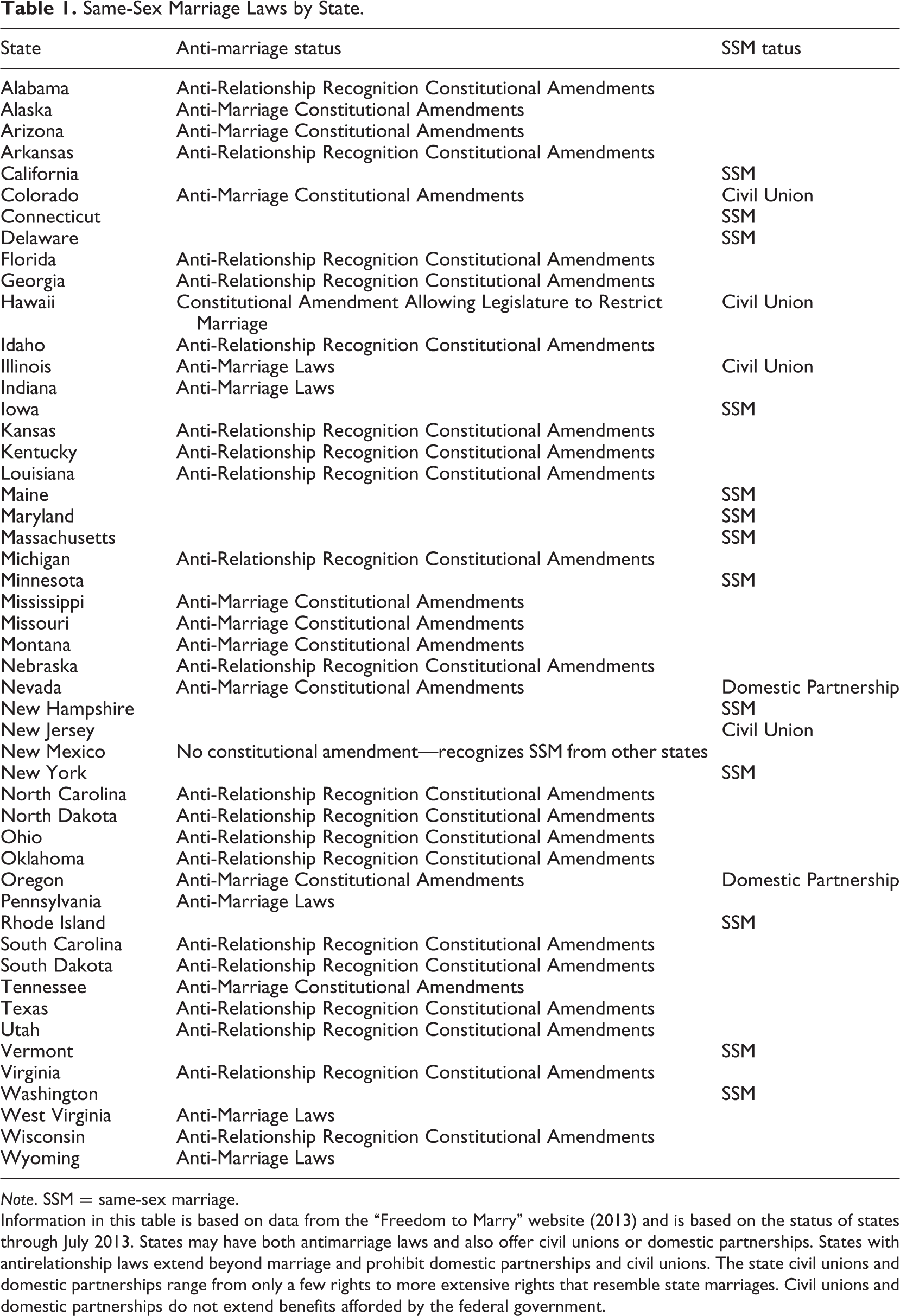
Note. SSM = same-sex marriage.
Information in this table is based on data from the “Freedom to Marry” website (2013) and is based on the status of states through July 2013. States may have both antimarriage laws and also offer civil unions or domestic partnerships. States with antirelationship laws extend beyond marriage and prohibit domestic partnerships and civil unions. The state civil unions and domestic partnerships range from only a few rights to more extensive rights that resemble state marriages. Civil unions and domestic partnerships do not extend benefits afforded by the federal government.
On the national level, in 2011 (The White House, Office of Press Secretary), President Barack Obama informed the public that DOMA did not require further scrutiny and federal funds would not be extended to defend the Act. In March 2013, the U.S. Supreme Court heard a case (U.S. v. Windsor) that challenged DOMA. The outcome, though favorable to same-sex couples in states that have a legal SSM, leaves much work in the remaining 37 states.
Post-DOMA
In this section, efficiency, equity, and freedom and liberty are used to explore the overarching impacts of marriage inequality on individuals, families, and institutions. The feminist lens continuously seeks to identify the source of oppression and illustrates how the oppression of one group can systematically oppress other groups. The view also reveals that traditional marriage and traditional family roles have served as a means to not only oppress lesbian and gay men but also to oppress all women (Harding, 2007).
Those who oppose SSM argue that the expense of SSM will come in the form of increased costs to taxpayers and costs associated with broken families that result in increased crime and increased incidences of mental illness (Donavan, 2011). Donovan argues that only a family with traditional males in dominant roles and females in subservient roles create healthy children. Numerous studies and reviews of the scientific literature related to same-sex parents reveal no empirical evidence to support such claims (Garrett & Lantos, 2013; Joslin, 2011). The literature suggests that same-sex couples have the same capability to raise healthy children as traditional families. Those who support SSM also argue that continuing to fight this matter on the state level is expensive and though SSM may result in an increase in expenditures in some government programs, overall the federal budget will increase when marriage equality exists nationwide (Holtz-Eaken, 2004; Kubasek et al., 2011; Marshall, 2013).
In regard to liberty and freedom, supporters of state laws that restrict marriage to opposite-sex couples suggest that prohibiting SSM does not discriminate against significant number of citizens, maintains control of marriage at the state level, and SSM would force religious institutions to change (Allen, 2010). State laws that limit marriage are unnecessarily restrictive of national individual freedoms and interfere with the constitutionally supported separation of church and state. The state laws and constitutional amendments that prohibit SSM and states that only provide civil unions or domestic partnerships can serve to deny citizens access to federally defined and distributed benefits that come with marriage.
Impact on Families
The repeal of DOMA does not address the civil and financial issues that impact same-sex couples and their families in 37 states that serve to deny access to matters that impact every facet of life such as survivor benefits, retirement income, hospital visitation rights, immigration, and inheritance (National Lesbian & Gay Task Force, 2005, May 17). States that deny SSM interfere with how families headed by same-sex couples experience life and it legalizes discrimination. A 2003 (Cox) example used to illustrate the personal impact of DOMA remains true today. Even though DOMA is repealed, same-sex couples who reside in a state where they are legally married lose the rights they have as a married couple when they leave that state. Most states, institutions, and hospitals do not recognize the union of an SSM from another state that affords opposite-sex couple access and input into health care decisions. Unlike opposite-sex couples, spouses of same-sex couples are left without say in crucial health care decisions or visitation. In addition, most Americans access affordable health care through an employer’s insurance policy or their spouses or parents employer policy. States that legalize SSM can facilitate access to health care for more Americans.
Studies also suggest that legal marriage has positive impacts on mental health factors. For example, a February 2013 article in the American Journal of Public Health (Wight, Leblanc, & Badgett) reported on findings from the California Health Interview Survey. Findings revealed a significant positive correlation between legal marriage and psychological well-being for both same-sex and opposite-sex couples. Conversely, those in opposition to SSM argue that opposite-sex marriage serves to maintain the American family and exists as a unique relationship in society for the purpose of procreating and ensures the well-being of children (Anderson, 2013). Anderson argues that it is the unique gifts of the mother and father that result in children becoming productive members of society. Donavan (2011) argued that SSM is like broken families and will increase the youth crime rate, increase the number of children living in poverty, increase child poverty, and increase mental health issues in adults creating a huge burden on American society.
Allen (2010) argued that SSM proponents ignore the potential negative impacts on society suggesting that SSM weakens traditional marriage and the family unit. He further suggested that because SSM impacts a small, easily identifiable portion of the population, exclusions from marriage and the benefits that accompany marriage should continue. Allen used a review of history to support this argument rather than empirical data arguing that too little is known about SSM to justify the legality and it serves little social purpose.
Arguments such as these were used in the March 26, 2013, testimony before the Supreme Court. Justice Anthony Kennedy (Liptak, 2013, ¶ 10) responded with, “There are some 40,000 children in California” with same-sex parents and “they want their parents to have full recognition and full status. The voice of those children is important in this case, don’t you think?” As Justice Kennedy’s response suggested, marital status has a significant impact on families that extends beyond the parents. Parents’ marital status influences how children are viewed by peers, viewed by larger society, and how children access government-defined benefits such as education. State laws that restrict marriage to opposite-sex couples will continue to create problems for children of same-sex couples who are heading to college by raising the question: “Should tax forms from both members of same-sex couples be evaluated even though laws prevents them from being legally recognized as married?” (Farrell, 2008, p. A1).
Financial Impact
In a 2004 report to Congress titled The Potential Budgetary Impact of Recognizing Same-Sex Marriages, Holtz-Eakin reviewed the impact on federal revenue and outlays if marriage equality were a reality. Although SSM would increase expenditures in benefits for federal employees and some Social Security programs, other Social Security programs such as Supplemental Security Income, Medicaid, and Medicare showed projected decreases in expenditures. Holtz-Eaken reported that a national SSM recognized in all 50 states would have the most significant financial impacts on Social Security programs and the Federal Employees Health Benefits Program. Results indicated that by 2014, Social Security expenditures would increase by $250 million dollars, a relatively small amount when looking at the $488 billion dollar expenditures of 2004. The same report estimated a savings in some Social Security programs that would offset this increase. For example, the Supplemental Security Income program would see a savings of US$100 million by 2014. By 2014, federal employee health benefits would cost an additional US$30 million. As a result of income tax and estate taxes, federal revenue was projected to increase by US$500–$700 million annually. Overall, with the potential increase in tax revenue, a national SSM was estimated to have minimal impact on federal budgets and would increase the overall federal budget by almost 1 billion dollars per year.
La Croix and Gabriel (2013) looked at the potential impact of SSM on Hawai’i’s economy and government. Overall projections suggested that SSM would decrease dependence on publicly administered programs such as state Medicaid and welfare. As reflected in other states’ experiences, it is projected that Hawai’i will see only small increases in expenditures related to covering spouses of state employees on insurance. Hawai’i projected an annual increase in revenue of US$46–$258 million based on visitor spending and increases in state and county general excise tax revenue related to SSM.
Addressing marriage equality in individual states is expensive and time consuming for the electoral, legislative, and judicial systems. Enormous expenditures invested in supporting and opposing SSM could be directed toward other efforts. For example, a report in The San Francisco Chronicle (Wildermuth, 2009) estimated that more than 85 million dollars was spent by supporters and opponents of Prop. 8 leading up to the Fall 2008 state election; the most money ever raised and spent on a local ballot issue.
Impact on Institutions
Many large institutions argue that the lack of a national law which affords same-sex couples equal access continues to complicate already complex systems such as health care, taxation, defense, and immigration. Recognizing SSM impacts many large public and private institutions and systems. Laws that promote discrimination are expensive to enforce and consume large amounts of taxpayer revenue. For example, before the repeal of Don’t Ask Don’t Tell in 2011, it cost the U.S. Department of Defense (DoD) more than US$556 million to implement and resulted in the discharge of 14,000 service members who had to be replaced by new personnel who had to be recruited and trained (U.S. Government Accountability Office, 2011). The DoD continues to create new policies and adjust policies in an attempt to allow equal access and accommodate same-sex couples (Outserve-SLDN, 2013).
Three hundred large employers filed a brief with the U.S. Supreme Court in support of the repeal of DOMA. Employers such as Johnson & Johnson, Morgan Stanley, and CitiGroup in a united front stated that DOMA forced employers to treat groups of employees differently and administering benefits to employees under multiple systems is administratively challenging and expensive. DOMA made this issue difficult for any employer who recognized same-sex couples and the problem may be further compounded with employers who operate in multiple states (Eckholm, 2013; Nickisch, 2013).
Those in opposition argued that SSM interferes with the religious based institutions whose doctrines define marriage as one man and one woman and suggest that legalized SSM will eventually interfere with religious freedom arguing that churches and religious organizations will be forced to perform and recognize SSM in order to survive (Grimard & Anderson, 2013). President Barrack Obama publicly addressed the issue of separation of church and state and explained two types of marriage (Rogers, 2012): First, President Obama noted that there is an important difference between civil marriage and religious marriage. The state defines civil marriage, which serves as the gateway for a wide variety of government benefits, rights and privileges. Religious marriage, on the other hand, is defined solely by religious communities.
President Obama explained no religious entity will be required to sanction SSM, and religious institutions will be able to define what their organization recognizes as marriage.
Challenge to Social Work
The repeal of DOMA is a big step toward marriage equality in the United States. The information presented in the U.S. Supreme Court Ruling (U.S. vs Windsor, 2013) and many other reference materials cited in this article can be used to counter arguments of those who oppose SSM. As it currently stands, marriage equality in the United States and the rights of families headed by same-sex couples are now determined by geography. As shown in Table 1, there is much work left to do. If a family resides in 1 of the 13 states where SSM is legal, they have access to 1,138 benefits. For those who reside in the remaining 37 states, that may not be the case.
The social work profession embraces cultural competency, respect, and diversity; a commitment to serving the most oppressed and marginalized; and efforts that promote social and economic justice on both the micro and macro levels (NASW, 2008). The feminist lens seeks to identify the sources of oppression; in this instance, the laws and practices that continue to send the message that people who identify as lesbian, gay, bisexual, transgender, or queer (LGBTQ), their relationships and their families are not fully worthy. This oppression exists not only in greater society but may also exist in direct social work practice.
Direct Practice
Social work services with people who identify as LGBTQ can be most effective if delivered by a provider who understands the historical context of oppression while incorporating elements of advocacy and social intervention (Pope et al., 2004). Yet, studies reveal that direct social work practice can potentially marginalize LGBTQ individuals and their families (Woodford, Luke, Grogan-Kaylor, Fredriksen-Goldsen, & Gutierrez, 2012). Social workers in direct practice can counter oppression toward SSM couples and their families by creating practices that are inclusive. Include literature about LGBTQ individuals and families in the practice setting and ensure that policies and paperwork do not assume heterosexuality or assume opposite-sex marriage. Such practices counter marginalization by informing individuals, couples, family members, and other professionals that SSM couples and families are relevant and welcome.
If an oppressive practice is identified in an agency practice, share or request the opportunity to formally inform decision makers and other professionals of the impacts that allowing discrimination and oppression to continue has on LGBTQ individuals, same-sex couples, and family members. Social workers in direct practice and those who have access to people who are directly impacted by practices that oppress individuals who identify as LGBTQ and SSM matters might invite them to engage in advocacy and education efforts. Providing individuals with data from this article and other sources, teaching people how to present their personal stories, and demonstrating how to use that information to advocate and counter oppression can be highly empowering (Corrigan & Mathews, 2003).
Those in direct practice must also have an awareness of how personal values potentially impact service delivery. Understanding the needs of families headed by same-sex couples and the impacts of the discrimination that will likely continue have been explored only minimally. In emerging areas of practice, such as SSM, social workers should rely on training, information from research, supervision, and consultation to inform their approaches (NASW, 2008).
Policy Advocacy
The feminist lens of Affilia continually reminds the social work profession that “times of struggle are historical moments that are ripe for change” (Roche, 2009, p. 346). There is much work left to do for equality for people who identify as LGBTQ and as the profession with the element of political action and advocacy (NASW, 2008) at the core, social work plays an important role. Policy advocates rely on information in the scholarly literature to support efforts for equality. A 2013 Affilia article (Sewpaul, 2013) reported on the application of emancipatory theories to challenge policies steeped in sexism and racist ideologies by addressing the relationship between agency and structure. Matters related to policies that impact SSM, parenting, and all facets of life will continue to arise in the courts and in the chambers of lawmakers. The need for social work to understand these matters and inform lawmakers is vital.
At the May 2013 LGBT Research Symposium, plenary speaker Cheryl Angelaccio (2013), Lambda Legal Litigation Coordinator, reminded scholars of the social sciences of the important role that peer-reviewed research plays with policy change. As the agency that served as the legal representative for same-sex couples in Iowa that brought the issue of marriage to the Iowa Supreme Court, Angelaccio outlined how research from social work and other human service disciplines was used to effectively counter every argument presented by the opposition. Based on the case that Lambda Legal built using the research from social sciences, the Iowa Supreme Court unanimously approved SSM, making Iowa only the third state in the United States in 2009.
History suggests a strong need to be proactive with advocacy efforts to counter the efforts of institutions that are advocating for new oppressive policies; in fact, it is suggested that complacency among social workers in times of social progress with oppressed groups can stymie or even allow the reversal of recent progress (Miller-Cribbs, Cagle, Natale, & Cummings, 2010). There are many ways social workers can counter oppressive actions and advocate for inclusion. However, social service organizations and social workers oftentimes operate with the understanding that political advocacy is prohibited due to restraints outlined in contracts with government. Research suggests this is a myth, and most advocacy activities related to changing policies, rules, and regulations of a government administrative agency are permitted (Rocha, Poe, & Thomas, 2010). Oppressive comments from individuals, practices that assume heterosexuality, and discriminatory policies that have existed for decades present an opportunity, if not an obligation, for social workers to educate and advocate for inclusion of SSM couples, their family members, and individuals who identify as LBGTQ. Combining central tenants of the profession—feminism and empowerment can serve as a means to inform and advocate. Feminism can serve to continually identify the oppression within practice approaches, agencies, and laws that serve to exclude LBGTQ people, SSM couples, and their family members. Empowerment can serve to command efforts that counter the oppression. When oppressive actions or discrimination is identified in practice, agency policy or legislation social workers can take note of the issue and follow up with a response that includes a recommendation to address the oppressive action. The plan may be simple and easy to fulfill. For example, responding to an institutional policy such as a state or federal law that discriminates may involve writing a letter to congressional leaders that includes the personal story (with consent) of an individual who is negatively impacted. It may also be effective to combine elements of that personal story with facts from this article and other scholarly sources to demonstrate the greater societal impact.
Attitudes toward SSM and people who identify as LGBTQ are changing, yet the need to advocate for equality and justice with this population is strong. As the largest provider of services with oppressed populations and the social service profession with advocacy as a core element, social workers cannot allow oppressive practices and discrimination to go unaddressed. Scholarly literature that supports equality and inclusion is essential and can be used by social work policy advocates, practitioners, and administrators to address these matters in a prepared manner.
Footnotes
Declaration of Conflicting Interests
The author(s) declared no potential conflicts of interest with respect to the research, authorship, and/or publication of this article.
Funding
The author(s) received no financial support for the research, authorship, and/or publication of this article.