




Abstract
This article explores the structural factors that hinder Vietnamese immigrant wives from escaping domestic violence by applying an institutional ethnography perspective. Taiwan’s Domestic Violence Prevention Law requires the government to assign professionals to help abused victims, but the law in action shows that abused Vietnamese wives must go through multiple institutions, which put different structural constraints on them, to reach the goal of escaping domestic violence. Following the structural intersectionality approach, we contend that gender, nationalism, and class structural factors intersectionally impose constraints on immigrant women seeking help from the state.
Keywords
This article seeks to explore the question: Why do abused Vietnamese immigrant wives, married to Taiwanese men, find it difficult to escape from violence despite the Domestic Violence Prevention Law having been in place for 15 years or more; while the government claims that a supportive system has been established? By application of the institutional ethnography approach (Smith, 2005), we may contend that, even though there are laws, institutions (police, hospital, social workers, courts, etc.), and professional people constituting a support system for abused immigrant wives; the structural forces of class, ethnicity, and gender discrimination intersectionally influence them, as they seek to find a way out of the abuses they face.
The worldwide increase in international migration flows linked to marriages between individuals from different countries has been situated within larger trends that have been taking place in the present era of globalization (Constable, 2005). In Taiwan, the number of female migrant partners from Southeast Asia and China has increased significantly since early 1990s. The proportion of cross-border marriages reached nearly one third in 2003 but gradually dropped to 14% in 2012 (National Immigration Office, 2013). Up to the end of 2012, over 100,000 cross-border marriages involved unions of a Vietnamese woman and a Taiwanese man. Potential immigrant wives tended to meet their future husbands mainly through profit-oriented match-making agencies; consequently, such marriages have become stigmatized as “commodified” (Wang & Chang, 2002). Vietnamese residents in Taiwan constitute the largest ethnic group after Chinese immigrants (Belanger & Wang, 2012). 1 According to the immigration law, immigrant wives are “dependents” of their husbands, and the yearly renewal of temporary residence permits needs approved by their sponsors (i.e., their husbands). After 3 years in Taiwan, they may apply for naturalization, a process which takes about 1 year to effect. In other words, to gain full citizenship, it may amount to no less than 5 years.
Taiwan’s mass media nearly always portrays immigrant wives as either victims of Taiwan’s patriarchic system or as materialistic girls using migration as a means to earn money. However, we should emphasize the fact that not all immigrant wives experience domestic violence! In the course of our research project, we interviewed a total of 16 battered Vietnamese wives (see Table 1). In a previous research venture, we discovered that as many as a third of those abused immigrant wives were able to escape from domestic violence as a result of certain job opportunities available in Taiwan’s flexible small-to-medium labor market, along with the protection offered by the Domestic Violence Protection Law. They had received protection orders issued by the government and having left their husbands, obtained work outside (Tang & Wang, 2011). However, another two thirds of them were still unable to find means to avoid violence. In the present survey, we continue to explore the plight situation of those who were still suffering familial violence and seek to discover why it was that they were not able leave the family in question, even though they had requested official help. As the women in this group had sought help from a Domestic Violence Prevention Centre, they cannot be simply classed as passive victims lacking a means to exercise their rights. Their inability to escape from domestic violence should not be attributed to a weakness attending their personality, or a lack of determination. Thus, we should pay attention to such factors, as race, class, gender social discrimination, and so on, that may hinder the realization of their desire to escape from their violent and unhappy situations. Our findings echo those of related researchers who have found that abused immigrant women are often more vulnerable than are local women, since they are blamed as being a “burden,” due to the prevalent xenophobic climate as, for instance, in Hong Kong society (Leung, 2011, p. 300). We found that abused Vietnamese wives in Taiwan have much the same situation as those in Hong Kong. Bhuyan and Velagapudi (2013) also examine how intersecting and interlocking oppressions shape the delivery of services to immigrant women who are facing violence in an intense and at times hostile antiimmigrant environment in Kansas, United States. They have pointed out that “the Surveillance of Immigrants’ illegality and deportability critically influenced the legal processes and social services for abused migrant women.” We are in agreement with the above perspectives, but would seek to point out how Taiwan’s unique social contexts, in terms of migration policy and social services for domestic violence protection, have led to an interlocked response to abused migrant women seeking help.
Background of 16 Female Interviewees.
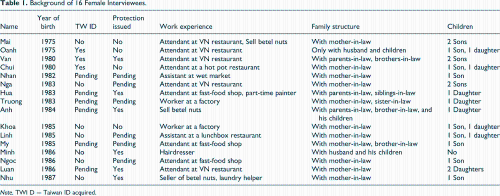
Note. TWI D = Taiwan ID acquired.
The DVPL in Taiwan’s Social Context
In 1993, a chronically abused woman killed her husband, which resulted in a severe sentence as if she had committed a serious offence. Feminists criticized the sentence as one which “decontextualized” the hardship that the woman experienced, by having ignored the long term of domestic violence accorded her, thus failing to comply with the social expectations of a more gender-equal society. In 1996, a draft of the DVPL was proposed by Judge Gao, referred on America’s “Model Code on Domestic and Family Violence.” 2
In 1966, Judge Gao issued a draft on the Domestic Prevention Law with reference to America’s Model Code on Domestic and Family Violence. This lead to the enactment of Taiwan’s “Domestic Violence Prevention Law” (DVPL hereafter) in 1998 3 —an outcome of the women’s movement which emphasized problems of structural gender inequality in situations of domestic violence (Lin, 2004). This being in contrast to the individualistic perspective that tends to regard domestic violence as a personal matter (Wang, 2007).
However, as this aspect of the DVPL is based upon the ideology of maintaining the traditional family structure, it does not improve gender equality. Western feminists have criticized domestic violence as having assumed “gender neutrality”; that is, it requires the woman, in the end, to return to her family; and so, neglects the fact that the maintenance of familial harmony becomes the price that a woman has to pay for her life and dignity (Bush, 1992). Besides the underlying ideology of the domestic violence law, there are problems in law enforcement itself. Feminist Taiwanese legalists argue that the law, in itself, cannot overcome gender inequality. They argue that legal culture is itself a part of the social and gender structure—it reflects but does not change the existing gender hierarchy (Chen, 2006). To gain legitimacy and effectiveness, a law must be based on relevant social facts, as well as an understanding of how people act within the legal processes (Wang, 2007, p. 146).
Scholars (Chiu, 2003) have observed that there are problems of decontextualization and loss of social perspective in the legal process, especially for immigrant women. When female Mainland Chinese immigrants seek official assistance, they may often face prejudice from the law enforcement agencies, for example, the police, judges, and border patrol officers. These personages often have presupposed attitudes toward female immigrants, which affect the manner in which they carry out their duties, so having an impact on the effectiveness of the DVPL (Chen, 2003). While Chao (2008) has characterized Taiwan’s laws regulating Chinese immigrants as “gendered nationalism,” namely, the manner in which it discriminates against female Chinese immigrants through the various and tedious bureaucratic procedures. In other words, it does not pay adequate attention to their social relational difficulties that an abused immigrant woman experiences as she attempts to navigate the bureaucratic jungle when seeking assistance from the DVPL.
Though the structural constraints shape many of the life opportunities available to abused women, most domestic violence research in Taiwan is grounded in the disciplines of criminology, social work, or counseling, and focuses on individual personality traits, to explain domestic violence (Lin, Lee, & Tsai, 2007). For example, researches on domestic violence in cross-border marriages attribute it to the female, she having sought a marriage of convenience, and to the low social and economic status and the inability of the Taiwanese male to foster a happy marriage (Peng, 2005). Other researchers argue that a provision by the government, to implement more occupational training and language classes for immigrant wives, would alleviate family problems. But these opinions ignore the structural factors underlying causes of domestic violence. In cross-border marriages, domestic violence is related to unequal power relationships in the family, and the unequal treatment of immigrant wives under Taiwan’s laws and institutions (Tang & Wang, 2011).
Theoretical Framework: Navigating the Socially Structured Legal Process
We agree with the various arguments of scholars to the effect that abused women have not only been faced with personal sources of violence but also have suffered from systematic social structural situations (Dobash & Dobash, 1979; Dobash, Dobash, Wilson, & Daly, 1992). Our research contends that the experiences of abused immigrant women should be understood in the context of Taiwanese conceptions of gender, nationalism, and social classification. Vietnamese immigrant women in Taiwan who have suffered abuse have been highly constrained by their husband’s family as well as their social status. Gender, nationalism, and social biases are the structural factors that make it difficult for immigrant women (in transnational marriages), to escape from domestic violence: “gendering,” because they are expected to take the roles of mother, wife, and daughter-in-law; “nationalism,” because they are not treated equally as Taiwanese citizens; “social status” classism, because they derive from poor families. Accordingly, their marriages with Taiwanese are regarded as marriages of convenience and money.
It is misleading to discuss domestic violence from an individual and gender neutral perspective, since it runs the risk of “blaming the victims.” Such discourses affect not only the treatment of abused women by others but also the self-identification of abused women (Roche & Wood, 2005). Bush has criticized American domestic violence law on the grounds that it presupposes a harmonious family without power relationships. Taking the American Battered Women’s Movement and Indian Anti-Dowry Violence Movement as examples, Bush (1992)found that abuse of women resulted from their secondary status in family and society. The state did not entitle these women with equal citizenship in institutional designs. So, if we merely focus upon abused women and seek to protect them with legal and medical aid or social worker assistance, without paying attention to the disadvantageous aspects of structural factors, domestic violence would recur.
In addition, the implementation of the domestic violence law might hurt the immigrant woman further, when the law enforcers carry gender, nationalist, and class biases against them. So when an immigrant woman seeks assistance from the DVPL, she needs to navigate structural barriers in getting adequate support, for example, to avoid the stigma of “abnormal user” of DVPL, which suspects the motivation of abused immigrant women to apply for protection (Lin et al., 2007).
Even if an abused woman can get a protection warrant, she might not be able to walk away from the shadow of domestic violence because there remains the danger of “separation assault.” The murder of women who have legally left their families is often reported in the media. Feminist legalists have pointed out that we should not only allow abused women to leave their homes but also to address the risk of separation assault after they leave, as such abused women are at risk of even greater violence (Mahoney, 1991). Littleton (2004) proposed that abused women should have a right under law to a safe haven and not simply have the option of leaving their homes.
In Taiwan, the middle-class gender regime with which most social workers identify also influences how domestic violence victims are perceived and treated. Hollander (2002) has pointed out that the social construction of traditional gender roles makes people believe that abused women are “poor and miserable” and deserving of sympathy. If an abused woman does not appear to be poor and miserable, often there is little sympathy and assistance available to her. Among our interviewees, Lich is such a woman. Many Taiwanese social workers complain that their clients are indecisive. They do not understand why some women do not take the opportunity to escape from their husband’s abuse, by entering a shelter. But an abused woman is in multiple difficult conditions, and to help her leave her husband will introduce other risks, such as separation assault and economic insecurity. They are located in a position that is intersectionally influenced by different structural forces (Sokoloff & Dupont, 2005). Accordingly, in addition to the gender factor, we should not ignore other structural factors like nationalist and class biases which put immigrant women facing domestic violence in a disadvantageous position in a patriarchic society.
Research Methods
This survey has adopted the method of institutional ethnography developed by Smith (2005) namely, to ask questions, and by using fieldwork observation, interviews, and text analysis. The purpose of this perspective is not to discover the common experience of abused Vietnamese interviewees, but to generalize different local experiences after an in-depth description of these abused women’s disjunctural experiences which are located in a power structure that affects all people. As Smith has observed: “disjuncture between the artificial realities of institutions and the actualities of the lives of the people are not avoidable; they are of the transformation, viz., the process of going from the actual, to words or images that represent it. The necessary disjuncture at the point of transition from actual to institutional reality dump, or distort, the experience of those who are caught up therein, and subject to institutional forms of action.” Where there is domestic violence, institutional ethnographers would like to learn how the variations of data in different information, events, and processes are being organized in different institutions through the actions of law enforcement agencies. Institutional ethnography will enable us to understand how different subsystems are coordinated and linked and so constitute either a supporting net or a difficult barrier for abused women. Institutional ethnography tries to unveil such barriers and seeks to assist people located in similar situations within a complex structure.
Between May 2008 and the end of 2009, we interviewed 16 Vietnamese wives who sought help from the DVPL in a local city government in Taiwan, and six Taiwanese husbands who had been reported as abusers (three of whom were husbands of the female interviewees), four Taiwanese social workers, and two Taiwanese Judges. Intensive interviews were conducted in Mandarin Chinese from May to August 2008; follow-up interviews were conducted subsequently until 2011.
On average, each interview took 1½ to 2 hr, but some interviews took about 3 hr. All interviews were voice- and video-recorded and conducted with the permission of the interviewees and subsequently transcribed into Chinese. All conversations were in Mandarin Chinese, with a few short conversations in Vietnamese, as most interviewees could speak fluent Mandarin Chinese. The ability of one of the authors to speak basic Vietnamese helped build trust between the interviewees and researchers.
The average age of our informants was 25 at the time of interview in 2008 (see Table 1 for a summary of the interviewees’ backgrounds). The oldest was 33 and the youngest 22. At the time of the interviews, they had lived in Taiwan for an average of 5.3 years. The longest period was 10 years and the shortest 2. Six of them had become naturalized and possessed Taiwanese identification cards (IDs), while the others had only temporary resident permits. Six of them were in the course of applying for naturalization. Four of them had not thought about applying for naturalization. All but 1 of the 16 informants lived with their in-laws. Six of them not only lived with parents-in-law but also other relatives. All our informants had relatives or Vietnamese friends who had married Taiwanese men, either before or after their own marriage. All but one of them had met their husbands through a marriage broker. The exception was introduced to her future husband, by her brother-in-law. Only one informant has no child.
All interviewees faced psychological or physical abuse at home. The abusers included Taiwanese husbands, mothers, sisters or brothers-in-law, or the husband’s children from a former marriage. Five of the husbands were unemployed and six of them had unstable incomes.
Domestic Violence in Taiwan’s Transnational Marriages
None of the interviewed Vietnamese women claimed to have been forced by her family into marriage, or had felt cheated by a marriage broker. However, their husband’s family and society often stigmatize them for entering a “marriage of convenience” or a “marriage for money,” and as “victims of human trafficking” (Chen, 2003). On the other hand, Taiwanese men (who had married foreign brides) were depicted as too low in status to have sought for a Taiwanese wife; just as a well-known female legislator once remarked: “if Taiwanese women demand a high status in their choice of husbands, Taiwanese men should meet their demand, to reach a high status to match them.” 4 When there is domestic violence in these transnational marriages, mainstream discourses may ascribe the blame to individuals, either the wife or the husband, but without due reference to the social structural factors that limits their actions.
Taiwanese society often expects immigrant women to follow traditional gender roles. If they do not, both the family of their husband and the society in general make racist remarks and criticize their behavior as “deviant.” A-Zhong, a Taiwanese husband, explained the reasons for his quarreling with his wife. He would say to her: “Our customs are different from yours. Here the husband goes out, and the wife stays at home. You should do as your husband says, and so become integrated into Taiwanese society. You should not insist on your own opinion, or on going out to work. If you do, then it is your fault that we argue. Vietnamese food is different from ours and, if you cook that way, your mother-in-law will definitely be unhappy. You have to learn how to cook Taiwanese food. As the mother of Taiwanese children, you need to learn Mandarin to help them with their schooling, or they will fall below the average level of education standards of Taiwan, which would be very bad!”
Such a discourse is also often expressed in Taiwan’s mass media and by the state. For example, the website of the Department of Social Education in the Ministry of Education 5 provides learning materials for foreign spouses. In the lesson “My Family” the definition of family members includes “father-in-law, mother-in-law, husband, wife, son, and daughter.” This is a nationalist Chinese conceptualization of family that has no provision in regard to Vietnamese family members, who may also come to Taiwan to help their daughters at home, or in business (Belanger & Wang, 2012). In another lesson, “Happy Marriage,” couple relationships are discussed. It advises that “when your husband is in a bad mood for the sake of the family you should treat him kindly, care for him, and understand him.” Such a gendered tone ignores the social and emotional needs of immigrant women. Another lesson, “Social Welfare,” states: “Wenru (foreign wife) found that her child was not good at walking even by the time she was 1½ years old, the Community Director put her in contact with the Early Intervention Treatment Scheme provided by the Department of Social Welfare.” Through these learning materials, the state hints and reminds Taiwanese that the offspring of foreign spouses might experience developmental delay and could lower Taiwan’s “population quality” (Wang & Belanger, 2008).
Such prejudices also affect the way people look at their own transnational marriages and can legitimize their own domestic behavior. For example, A-Fa believed that he had every right to beat his wife because she did not follow Taiwanese norms and customs. He said that “in Vietnam it is the female who goes out to make money, while in Taiwan it is the male who goes out; the female stays at home to care for children.…These women should understand Taiwan’s customs. They should not leave children alone and do whatever they like when they are in Taiwan. If they do, their marriage will be undone. When you marry a Taiwanese, you should learn about, and think, like the Taiwanese. You are going to settle down here, not in Vietnam, so you need to learn our customs.” Taiwanese husbands who married Vietnamese women thought they were marrying a “traditional” wife, as compared with a Taiwanese woman, but later they discovered that their wives were aggressive, self-determined, and used all means to find a job (Tang & Wang, 2011). They even argued against their husbands. One abusing husband told us that “when we quarreled, she dared to talk back. Of course I was very mad at this and beat her.”
Many Vietnamese women want to improve the economic condition of their natal families by marrying Taiwanese men. If the husband’s family can assist them to achieve this goal, Vietnamese spouses are more willing to play the roles imposed on them. But when there is a gap in expectations, or unhappy personal relations in the extended family, then finding a job helps these women become financially independent and even to leave their unhappy environment. But such an option is often a trigger for quite serious domestic violence. A Taiwanese diplomatic official, interviewed in Ho Chi Minh City, who was in charge of visa issuing, said that the two questions most frequently asked by Vietnamese women about transnational marriages were, how long does it take to apply for naturalization, and is it possible to obtain work as soon as they arrive in Taiwan. For these women, marriage to Taiwanese men provides the possibility of pursuing citizenship and finding a job to make money. However, the husband’s family has contradictory expectations of the marriage. They want his wife to stay at home to take care of the whole family. Such a gap in expectations often leads to conflicts in the marriage relationship. Unless these women find a job, they have very few options thence available to get out of the home (Tang, Belanger, & Wang, 2011).
The husband’s family, and society, often look at working immigrant women with suspicion. Their marriages are discredited as a channel pursued to make money in Taiwan and are often linked with the sex industry. In addition, the government has a policy of investigating fake marriages, which reinforces the image of immigrant women as “bad women” if they do not play the traditional roles of “good mother, wife, and daughter-in-law” in an appropriate manner (Chen, 2010), a situation such as this cannot but engender domestic violence and racist attitudes, in both the husband and the society in general.
For example, A-Zhao described his wife as a slut, because one day she walked out from the shower room unashamedly naked. He regretted that he had married a woman from such an “uncivilized” culture. In his mind the reason why his wife did not like to stay at home, and preferred to fool around, it was because she was Vietnamese. Another husband, A-Cheng, believed that most immigrant wives who work become sex workers. He said that,
I have found that 8 out of 10 Vietnamese wives, who went out to work, had affairs with others. Even if they did not have an affair, they learned something bad and were corrupted by others. They like to compare husbands on the basis of who is the richer and provides more money. If the husband cannot satisfy her (financially), she would find her own way (to make money). They are influenced by each other, to make money by sex. This is very bad! They should come here to marry, not to make money—and such immoral corruption destroys the family.
Since society has established many structural constraints on working immigrant women, if these women still insist on going out to work, violence can be used and excused as “putting her back on the right track.” As A-Zhong said, “Yes. I did beat her. The problem is that she still insists on going out and works in the sex industry.”
Navigating Domestic Violence Reports
As soon as she arrives in Taiwan, a Vietnamese woman is expected by her husband’s family to take care of the family and to have offspring. Therefore, they are immediately tied up with domestic work and do not have contact with local people. When there is domestic violence, they do not know how to ask for help. Many interviewees said they faced domestic violence in the first 1 or 2 years after they arrived in Taiwan, but normally only after the fifth year did they report it to the police (Tang & Wang, 2011).
Why should there be such a delay in the reporting of domestic violence? Some interviewees said they did not know such behavior was domestic violence, some said they did not know there was a DVPL, and some said they did not know how to report domestic violence. However, at this stage, incomplete citizenship is the key structural factor hindering the reporting of domestic violence. Many interviewees were afraid of losing their temporary residence status if they made such reports. Nhan told us: “He always uses the renewal of my residency status to control me.” For example, he did not let me go to the police station to apply for the renewal until the last day, and said, “I won’t let you apply, you fucking shit.” When I wanted to apply for naturalization, he threatened to divorce me and said, “Then you will have to leave Taiwan, and will never be able to see your son.” Husbands know that the Government’s immigration laws are a good weapon with which to control their wives. As A-Zhong said: “If I agree to let her apply for naturalization, she will run away (as soon as she gets the citizenship status).” The DVPL assumes that every person seeking help has rights equivalent to full citizenship, but it neglects the fact that the gender-differentiated citizenship regime limits the ways immigrant women can escape from violence (Lister, 2003, p. 94).
In taking the first step to report domestic violence, immigrant wives are usually assisted by their neighbors, employers, or Vietnamese friends. Without a social support network, it would be difficult to go through the bureaucratic process, which is performed by professionals in different institutions. These professionals are positioned in Taiwanese social structures which influence their attitudes toward immigrant women. The specialists in government organizations are the key persons who decide whether the abused immigrant women can make their way through the bureaucratic jungle and get assistance. Below, we will discuss the problems with different specialists, which immigrants have when they navigate through the DVPL process.
Domestic violence reporting and the police
Abused women in Taiwan normally report domestic violence to a neighborhood police station, then the police refer them to a Domestic Violence Protection Center. However, Khoa complained that “even though I was beaten many times, I still could not get a protection warrant, because they (the police) refused to understand what I said.” Ngoc had a similar problem: “I told them many things about domestic violence, but they did not believe me. They only listened to my husband.” Thieu has a low opinion of police. She claimed that “one day my husband beat me and I went to the police station. My husband also came. The police spoke Taiyu (Taiwanese language) to my husband so that I could not understand them. The Taiwanese police are really hopeless.”
One night Hien quarreled with her husband and he beat her. She went to the neighborhood police station to report the incident and, after a brief interview, the policeman called her husband and asked him to take her home. Hien said that the policeman was her husband’s friend, and the two would sometimes go out drinking. After this, she did not trust the neighborhood police station and the next time she went to another police station, then the police referred her case to the DVPL.
Sometimes social workers complain about the way police treated abused women. For example, Luan left her home after getting a domestic violence protection warrant. Her mother-in-law also has a protection warrant regulating Luan’s contact with her. However, Luan still has the right to see her children living with their father. When Luan went to see her children, her mother-in-law called the police to eject Luan from the house, thereby preventing her from seeing her children. A social worker complained that the police “were not neutral and deliberately provided incorrect information to confuse the two women.”
Domestic violence reporting and social workers
From some social worker’s point of view, Lich is not a client deserving help because of her high credentials, her solid command of Mandarin, and her fashionable dress. She had been to a DVPL many times, but still could not get adequate assistance. Her child was put under official guardianship, and neither she nor her husband retained guardianship. One day she called us and cried, “Whenever my mother calls me from Vietnam, and says she wants to talk to her granddaughter, I have to lie and tell her that she has already gone to bed.…I don’t want to make her sad by letting her know that I am so poorly treated here.” She complained that social workers do not sympathize with her situation.
Though social workers are assigned to help Lich, this stereotype of a domestic violence victim influences their attitude toward her. On one occasion, a social worker seeing Lich dressed beautifully commented: “She is very young, very beautiful, and dresses even better than me. I cannot imagine that she is abused. Really, not at all!” Another social worker in charge of the case lodged by Lich’s husband, A-Zhao, told us: “The first time I saw A-Zhao I thought to myself ‘Look at him, he could never win a case against Lich’.” Compared to Lich, Luan looks like a weak and poor woman, and gets more sympathy and assistance from social workers assigned to her, and is more likely to win an application for a protection warrant. Lich looks like a “strong woman” and does not accord with the typical image of an abused woman and, in the end, the court did not grant her a protection warrant in 2011. Here, consistent with Hollander (2002), the case which deserves assistance depends not on objective criteria but on the ideology of the law as enforced within specific social structures.
Sometimes female social workers attribute the escalation of domestic violence to the abused women. For example, one woman called her unemployed husband “useless,” and the social worker said this provoked him to use violence to defend his masculinity. These social workers are females, but they still ascribe to the gender role stereotype that a woman should not be “too strong,” and it is not socially acceptable when an abused women fights back orally or physically. A woman not conforming to the social image of a victim is not seen as deserving Government protection and has a lower chance of getting a protection warrant issued.
Sometimes social workers advise abused women to endure their husband’s oral abuse because the husbands are from the “lower working class,” where the use of vulgar, or sexist, words is common. Such gender attitudes also affect their judgment of the behavior of abused women. For example, Kieu left her husband to live alone with her daughter. Subsequently, she met a man, but the social worker reminded her that “You are still in a marital status, and even if you have left your husband you should not have extramarital sex. This would be a crime and your husband could divorce you.”
Domestic violence reporting and the medical system
Although mental abuse is listed as a type of domestic violence, the absence of physical injury makes it very difficult to get a protection warrant issued. Hien said: “My husband is formidable, he can beat me without leaving any visible injury.…The police told me to get a medical check, but the doctor would always write the medical report carelessly.” In addition, doctors are reluctant to make a report stating that there is proof of injury, if it is psychological abuse that has been alleged. Many male doctors think that the treatment of psychological abuse should be left to social workers or police, rather than the medical system. If an abused woman goes to hospital for help, the medical system normally adopts medicine’s epistemological model of care to treat her, and the domestic violence problems are reduced to the relationship between doctors and clients based on medical matters (Warshaw, 1989).
Most doctors are males, and their social position vis-à-vis immigrant women leads to different attitudes toward abused women (Rose & Saunders, 1986). In hospitals, nurses, mostly females, are usually under the doctors’ command and have low autonomy and they treat abused women just like any other patient, displaying little emotion. In practice, doctors handle physical injury and the nurses report the injury to the police if the patient claims domestic violence. In such circumstances, it is hard for a psychologically abused immigrant woman to get much assistance from the medical system. Khoa told us that her doctor told her: “Your injury is not too serious.…Think about it, if you can’t change your husband, why don’t you change yourself?”
Domestic violence reporting and the courts
The law does not take cultural differences into account, and both the language barrier and the difficulty in getting evidence from witnesses make it hard for abused immigrant women to go to court to defend their rights.
An interviewed judge said that if an immigrant woman did not go to court to defend her rights it was her decision, and it could have an adverse effect on her application for a protection warrant. However, this attitude ignores the fact that immigrants often do not understand the legal system or court culture, which, even for Taiwanese, is difficult to understand. When an immigrant woman seeks assistance from the public sector, the lawyer hired by the government takes the case only because he needs to make money and he charges the government for the hours worked. To reduce the cost to the government, immigrant women are given very limited time to explain their cases. Sometimes, when in court, there is no interpreter available. Luan has complained about this, and the court told her that there was not an interpreter present in the court because they could not find one.
In addition to the language barrier, finding a good witness from the community to appear on the woman’s behalf is constrained by community norms. The husband’s family often has long-established relationships in the local community, and this social network is more favorable to them than to the immigrant wives.
Although the neighbors might initially support the reporting of domestic violence, they are wary of appearing in court against the husband, as this could damage social relationships in their community. Luan’s brother-in-law described the situation of two witnesses before the court: “There were two neighbors set to appear as witnesses. They went to the Domestic Affairs Court. As soon as they saw the name of the husband on the court’s register, they fled.…Both of them knew what the mother-in-law had said to her daughter-in-law. We asked them to tell the judge how bad the mother-in-law was. They ran away as soon as they saw the name of the husband.”
Conclusion and Policy Recommendations
Class, race, and gender-based/related structural constraints can explain why the DVPL does not effectively assist abused Vietnamese women who need to leave home. Police, social workers, doctors, or judges are deployed to help the abused women, but they are not free of mainstream ideology. Gender, class, and ethnic discrimination are represented and reproduced in their daily interaction with the abused immigrant women. The structural problems of domestic violence in transnational marriages are not adequately comprehended by society or law enforcers, and the violence is often understood as individual problems. This limits the effectiveness of the law, which was intended to help abused immigrant women.
Four findings and policy recommendations are suggested here. First of all, in the section regarding police, we pointed out that when the Vietnamese wives ask for help from police officers, Taiwanese social networking always influenced the police to stand on the Taiwanese husbands’ side. Instead of battered wives leaving home, we suggest that abusers should be arrested. Second, regarding social work professionals, we contend that social workers should be trained to cultivate their gender and class sensitivity and consciousness. They should pay attention to their own professional hierarchical ruling relationships with abused Vietnamese wives. In terms of class, social work professionals are at risk of making a hasty distinction between deserving and undeserving clients. It is worthwhile for social workers to investigate and explore ways to escape the xenophobia and misogyny in Taiwanese society. Third, the current medical treatment-based model is ineffective, since it pathologizes abusers without paying attention to the social factors involved. Community-based and culturally sensitive treatments should be emphasized to help families with domestic violence issues. Finally, Taiwan’s courts should be equipped with more interpreters to help immigrant wives; in addition, judges should have better cultural competency to understand domestic violence caused by gender, racial, and class differences.
Footnotes
Declaration of Conflicting Interests
The author(s) declared no potential conflicts of interest with respect to the research, authorship, and/or publication of this article.
Funding
The author(s) disclosed receipt of the following financial support for the research, authorship, and/or publication of this article: Taiwan's National Science Council 95-2412-H-260-006; 100-2410-H-110-037-MY2.